Late-arriving, futile “justice” and reminders of a life that has been all but annihilated

I read the news yesterday, oh boy.  And yes, it was about a lucky man‒luckier than I am, anyway, at least in some ways.

There was a doctor in the heartland of America somewhere, I don’t recall where, who had been convicted of, apparently, inappropriately prescribing very large amounts of pain meds, the report quoting the number 500,000* (It seems unlikely that there were 500,000 prescriptions**, so it probably was that number of pills).

Anyway, his conviction was overturned on appeal, because apparently, in 2022, the SCOTUS handed down a ruling that the prosecution had to prove in such cases that there was “intentional or knowing” inappropriate prescription for it to rise to the level of a crime, and the jury hadn’t been appropriately instructed regarding that fact.

I looked up the case, and I’ve even downloaded the PDF of the case.  Although I haven’t read through it yet, the summaries make it clear that, yes indeed, this is a new and specific requirement.

Silly me, I had always thought that mens rea was a crucial requirement for nearly any criminal case, certainly one that rises to the level of a felony charge.  I brought that up with my (public) defense attorney, trying to point out that I shouldn’t be convicted of a crime since I literally had never intended to do anything but treat patients who had chronic pain‒which I did because I had chronic pain, and it had already severely harmed my life.  I knew how hard it was for even a physician, who at the time had good health insurance, to be able to get adequate treatment and even to get his prescriptions filled by often-judgmental pharmacists who looked at him as if he were a criminal just because he wanted to try to mitigate his pain with the most effective medicine that was available.

But no, apparently, according to my attorney, the prosecutor didn’t have to prove any such thing specifically; it could just be inferred.  And apparently I’m not exactly the sort of person to elicit sympathy from a jury in south Florida, because my voice tends to be monotone and my face tends to be expressionless and I don’t look like someone who is frankly worthy of sympathy.

All the charges against me were created by the PBSO, who sent in undercover people with (evidently) faked MRIs and fake complaints, who complained of chronic, severe pain and said they were in pain when I examined them***, and whose own secret recordings and records showed that there were often only one or two other patients in the whole office when they were there‒hardly what one would call a “pill mill” I should think.

Anyway, I was offered a plea bargain and I took it, because unless you’ve got a lot of money or you literally have nothing to lose, you will take a plea bargain in the right circumstances, even though you know you’re innocent.  I’ve written a blog post about how the plea bargain system is an extortionate game slanted against especially the underprivileged.

The statutes involved in my charges were designed by that <sarcasm> bastion of intelligentsia and morality, the Florida State Legislature </sarcasm>, to give judges no leeway, and to grind away maximally at anyone charged with “trafficking”.   If a jury decided that they should convict on at least one charge, since the state had created so many charges against me (each prescription being a charge, and twenty something having been conned out of me by various lying police officers over time) and the number seems impressive, I still could have faced a minimum of fifteen years in prison.

In retrospect, I think I would have been little worse off if I had, given the mockery and shambles my life has become.  But at the time, I hoped to see my kids again, perhaps sometime before they were adults.  Three years was better than fifteen (or potentially the rest of my life), and I had no one else to help me with a legal fight, and certainly no reservoir of money, so I took the deal.

The way things are now, though, I might not have been charged, or might have been offered some misdemeanor plea deal.  Or I might have gone to trial and won with relative ease, since the fact that I never knowingly or intentionally mis-prescribed medicine was a fact I knew for certain, at a Cartesian, cogito ergo sum sort of level, since it was a fact about my own mental state.

I may be naïve, and I often do not understand humans.  I am often easily misled and manipulated and used and misused and probably abused, because I am socially and emotionally very clueless and believe in giving other people the benefit of the doubt (to hold them innocent until proven guilty, in other words).  But I have never been greedy or unscrupulously opportunistic, and I took the practice of medicine and my duty and goal to relieve suffering very seriously.  I was never into making a lot of money, though it was good to be able to buy books I wanted and to take care of my kids.  I lived in a one-bedroom apartment and drove a ten-year-old Toyota Sienna.

Before yesterday, it had been a long time since I’d bothered thinking about what my life might have been like if things had not gone the way they did.  There didn’t seem to be any point.  I was a lost cause and that was that.  But this has made me feel acutely once again the cut of all the lost time with my kids and my lost ability to practice medicine, and all the other losses I’ve experienced as part of this debacle of a life.

What’s more, there’s been salt and vinegar rubbed into the wound by the fact that it took a Supreme Court dominated by many justices who’d been appointed by The Donald to require courts to require prosecutors to prove something that was supposed to be a necessary element of almost any serious criminal charge:  actual criminal intent.

That’s all leaving aside the un-ethics and illogic of the government of the “Land of the Free” dictating what people can put into their own bodies when it doesn’t directly harm other people in the first place.  I won’t get into that because it had no bearing on my medical practice‒I was not in the business of dealing in euphoriants, I was trying to relieve actual suffering.

One cannot really apply new jurisprudence to old cases in which a sentence has already been carried out and finished, and when the consequences thereof are already irrevocable.  I cannot regain the time I have lost with my children or the time I have lost when I could have been practicing medicine, or the time I spent at FSP West or in the Palm Beach County Main Detention Center, where even the people who worked there frequently asked why the hell I was there, or still there (I spent 8 months in the place, on the mental health floor, because I couldn’t make bail, but finally my former girlfriend’s mother helped secure it‒at least she got all her own back after I was sentenced, and I appreciate her very much, though I might as well just have stayed in jail, since at least the whole sentence would have ended earlier given “time served” and I was basically homeless when out on bail, having lost everything I owned and relying on the generosity and kindness of friends/former coworkers).

So I am stuck with a ruined life and a twisted mockery of myself.  The fruits of a considerable number of years of time and effort and thought and creativity on my part**** were all taken away by the mindless grinding of a huge stupid machine of “criminal justice” that has little to nothing to do with the latter part of the term.  I don’t claim not to be stupid or foolish or not to have ever made mistakes in the whole situation.  I make many mistakes.  But it is maddening to see how misapplied the law can be and to experience it for oneself, especially when one is now by oneself, partly thanks to that misapplication, and then to learn that now the law is changed (or correctly applied) such that I could have been in a better situation had that change come sooner.

I often consider the possibility of going to the Palm Beach courthouse, dousing myself in various flammable liquids, and turning myself into a “bonfire of the unsanities and inanities”, to bring attention to some of the costs of misapplied “justice” and to bring an end to my own mis-called life.  I even have two gallons of paraffin lamp oil and six liters of charcoal lighter fluid and a big enough backpack to carry them all, in case I decide to do it.

Death by fire is intimidating, though‒I am no Buddhist monk by any means.  And I also dislike causing inconvenience to other people, even those involved in an institution that had no qualms about recklessly “judging” me and ruining my life.  But it is tempting, and I feel right now even more than usual the utter pointlessness of continuing, even while stupidity in the office in which I work grinds away at me further (though, to give him credit, my boss tries hard to keep things as sane as he can).

I feel rotten enough and alien enough even at baseline, and all this doesn’t help.  I have lost almost all that mattered to me, and I live alone in a stupid one-room (plus bathroom) “in-law” suite that is smaller than many hotel rooms.  All my previous friends are far away, and most are doing much better with their lives than I am and don’t really have much in common with me anymore.  In any case, I don’t really talk or otherwise communicate with them, though it would be nice.

There are also plain few people where I am now who have anything in common with me.  Very few people have much in common with me:  a disgraced physician unable to practice, with a love of math and physics and biology and of Shakespeare and horror fiction and science fiction/fantasy (reading and writing it) and of science and rationality-oriented podcasts and books and videos, who wants to learn or relearn more about modern physics at a deep level and whose brain doesn’t seem to run the same operating system as most of the people around him‒a Linux in a world of iOS, or worse.

So, I don’t know what I’m going to do.  Knowing me, I’ll probably just grind along until I’m worn to a nub and then tumble into the trash can, unmarked and largely unlamented.

I know that I won’t be sorry‒not about that.


*This sounds like an awful lot of pills, but it’s deliberately chosen to sound that way in a manipulative, rhetorical tactic as used by reporters and prosecutors alike.  Let’s run the numbers, as I am wont to do, to see how impressive they really are.

Now, if there were one patient, taking one pill per day‒perhaps the person only takes one prescription, say an antidepressant or a cholesterol med or a long-acting antihypertensive‒it would take nearly 1400 years to use that many pills.  Plain few patients live that long (see my recent blog post), and most pills would long since have expired and become inactive before the end of that time.

Still, the average physician is responsible for the care of 2,000 to 3,000 patients (see here and here), meaning that if, on average, their patients each only took one prescribed pill a day, they would go through 500,000 pills in 6 to 9 months.  But many prescriptions call for more than one pill per day, and uninsured patients cannot tend to afford the long-acting pain meds that claim to allow for steadier doses and thus slightly less risk of rebounds and escalations and all the horrors involved in that.

Now, presently, I take three to nine aspirin a day, sometimes more, and I also take two naproxen and some supplemental Tylenol as well, all of which are more directly toxic to the body than opioids, but are nonetheless over the counter (as they should be).  If I averaged ten total pills a day, then it would take me only 137 years or so to take 500,000 total pills.  That’s longer than I’m likely to be taking pills, but I’m only one person (that, as Dave Barry said, is the law).  An average practice of patients who took only six pills a day would go through 500,000 pills in one to one and a half months.  Many ordinary, non-pain-specific patients, especially those middle-aged and older, take that many and even more prescription meds a day.

In any case, an ordinary general practitioner with a light patient load of two thousand patients, each taking only an average of two pills a day, would prescribe 500,000 pills in 3 to 5 months.  So don’t be too impressed by the carefully curated numbers that prosecutors and media choose to elicit your alarm and disgust.

**Even 500,000 prescriptions, in a modest 2000 patient practice, would require only 250 prescriptions total per patient.  That would certainly take quite a bit longer than 500,000 pills would take, but given an average of only one prescription per patient per month (counting refills) it would only take a bit over 20 years, a decently short length of practice.  Many doctors see more than 2000 total patients and many patients get more than one prescription per month.  And, of course, one cannot even apply refills on “controlled substances”, they have to be literally re-written every month, and patients have to come to the doctor’s office to get them, assuming they can even get them filled.  Monthly doctor’s visits can be hard for someone trying to work a regular job while dealing with chronic pain.  Thus, the whole “mill” part of the “pill mill” trope is created by the law itself, leading to greater costs in time and fees for the patients who are trying to survive after job-related and other injuries or conditions that have caused them chronic pain and make it difficult for them to find consistent, gainful employment or to sustain health insurance.

***Pain is a symptom, not a sign, in medical terms.  We have no reliable ways of testing it, beyond patient report.  We try to find physical correlations when we can, often to see if we can find some treatable cause, but even Harrison’s Principles of Internal Medicine (I think it was on page 80 or 81 of the 14th or 15th edition, whichever one I had at the time) has clearly stated that, for instance, back pain does not correlate well even with specific injuries noted on MRIs and the like.  As large a number of people without pain will have nerve root impingements and bulging discs and the like seen on spinal MRIs as do have pain.  NO ONE KNOWS all the wherefores of this situation, but there is no serious doubt that such pain is quite real.

****It did not all happen during medical school or residency‒one does not coast along from K-12 and undergraduate college and only then start to work hard in med school, especially if one grew up in a blue-collar, factory town outside Detroit.

Monday’s blogger at least still likes to learn

Hurray, hurray.  It’s Monday.

It’s probably hard to tell from the printed words, there, but I was being sardonic with that opening pseudo-exclamation.  I’m not excited that it’s Monday and the beginning of a new work week.  Then again, I’m not excited by much of anything.  Staying at the house doesn’t seem likely to be exciting, either.  There’s not much I can think of doing or any place I can think of going that seems exciting.  Nearly all the things in the world are on some spectrum from boring to stressful.

I don’t recommend this as a way of being, not even to myself.  I’m trying to find ways around it, or rather, to counteract it, but all my previous attempts have not succeeded in any durable fashion, as should probably be obvious.  Various medications, various therapies, lifestyle changes, exercise‒none of it has worked.  Some time ago, I had some hopes that trying marijuana that a former friend had would at least help my pain, if not my depression, but it did neither after two tries, and when I tried too much when I was in particularly bad pain, it made me quite sick to my stomach.  I was throwing up for a few hours (not continuously, of course, but it was still pretty bad).

It’s ironic that THC is used to treat nausea in many cases.  Evidently, my nervous system is too atypical for such things.

I recently happened upon some videos about psilocybin, specifically that there’s a study beginning on using it to try to treat some of the negative symptoms of autism spectrum disorder.  I know it has been used to treat recalcitrant depression and related disorders, including depression in people facing terminal cancer.  Psychedelics have always sounded intriguing, and people make much of them, but I think, given my experiences with other meds, I would be very frightened to try any of them.  My mind is not my friend, and I worry that I would be particularly prone to a “bad trip”, and there’s no way to abort such a thing once it has started; one just has to go through it to the other end.

Speaking of being anxious and frightened of things that many people find beneficial, I had meant to retry riding my new bike yesterday, and perhaps to ride it to the train and then into the office today, but I find myself subtly terrified to do so.  The beginning of last week was just so exceptionally painful and horrible that I am frightened of reinitiating it.  I wish I could know that it’s something that would resolve after a time, but it seemed to worsen over the course of the three or four days I was riding, until by last Monday I was bed-ridden, and I was even grumpier and more cheerless than usual on Tuesday, if you can imagine such a thing.

I think I’ll have to forgo it.  My boss really liked the bike, and offered to buy it from me if I can’t use it, but then I need to get it up to the office, which would mean riding it.  I don’t see myself carrying it.

My train is coming in five minutes.  I’ll pause and then return to this once I get on the train.

***

Okay, I’m on the train now.  What was I talking about?  Oh, yeah, the bike.  I guess I could have it shipped up to the office.  I think Uber even provides services like that, or I could try to see if there’s a way to set up an Uber in a vehicle that can carry the bike.  It’s a thought.  I don’t see my boss making a trip all the way down to my place to pick it up.

I guess I should stick to walking, even though it’s slower.  At least I can listen to audiobooks and podcasts and such while walking.  Nothing beats The Fellowship of the Ring as walking accompaniment, since it’s all about a journey on foot.  Even walking has its troubles, of course‒I have spandex braces on my left knee and right ankle to address the little bit of walking I did yesterday, and the right side of my back is in moderate spasm.  But that sort of stuff is par for the course.  If/as I lose weight, some of that will decrease, and some of it may even disappear.

Life is annoying on so many levels.  But at least there are lots of videos on things like hyperbolic geometry and computers and tensors and matrices and Einstein’s field equations and things like that.  It’s often the case that if I find several different people explaining the same thing I end up with a much deeper understanding.  Each teacher or author or whatever approaches things in a slightly different way, with different emphasis.  When one sees a subject from multiple angles, one tends to get a more complete and thorough understanding of it.  In this, I guess it’s analogous to binocular vision, which gives us depth perception.

I really want to read Zee’s book on quantum field theory, but although these new glasses are better for such smallish print, I think maybe I should have gone even higher on the strength.  Maybe I’ll go to the drugstore over lunch and pick up a stronger pair.  It would get me a bit more exercise, at least.

Please don’t emulate or internalize my negative outlook on things; I have no desire to see a world where more people are depressed.  Do try to keep learning.  Try to build as accurate a map of the world‒in all senses‒as you can.  Be ruthless with yourself in that process.  Your biases will try to trick you, and they will never stop trying, so you need to apply active countermeasures against them.  It’s a pain, but it’s important (and often satisfying and even thrilling) to work toward as accurate a map as you can get, not one that shows a world the way you would like it to be or you believe it to be.  A poor map will be less likely to get you anywhere you might want to go.

Laptop computers and steroids in noses; rough economics and thoughts on typos-es; multiple footnotes with time travel zings; these are a few of…well, you know the rest

After yesterday’s brief discussion about the pitfalls of using the smartphone to write my blog posts, I decided to do this one on my laptop computer, so I brought it back with me at the end of the day.  So far, so good:  my typing speed is definitely faster, and though there are certainly mistakes being made (and, yes, by me…obviously), they are relatively easy**** and quick to correct, and are of a much more typical kind than the ones I make on the phone.

Mostly, these mistakes are the products of trying to type too fast and so not completely pressing down on some of the keys as I go along.  Occasionally, my brain finishes the wrong word once I start typing, because it’s used to typing that other word much more often than some word that begins with many of the same letters.

Shifting topics abruptly:  Last night, for the first time in several months, I did not take any nasal steroids at all.  I’ve been using them to treat my allergic rhinitis, and they seem to have helped some of the symptoms thereof, but unfortunately, I suspect—because I have been using the maximum dose for quite a while—that I’ve begun to have systemic corticosteroid effects, among which are weight gain, glucose intolerance, weakening of various tissues, and so on.

This would explain at least some of my physical travails.  Corticosteroids can, of course, have mental effects as well—the brain being a physical organ, after all—but these are more subtle and difficult to recognize, let alone ascertain.  It is, alas, not likely that stopping the fluticasone will have a significant effect on my depression.  That is something with which I’ve dealt* since I was a teenager, and probably is at least partly a consequence of my apparent ASD.  If someone wants, I can get into how I think that happens in my particular case, but otherwise, I won’t discuss it, at least for now.

I still haven’t done the “videos” for my last two audio blogs; I’m sorry if anyone is waiting with figuratively bated breath.  On the other hand, this means that, for the moment, those audio blogs are exclusively available for people who follow my blog directly.  That’s almost like the Patreon rewards people offer to their patrons, but I don’t use Patreon, so I don’t even charge you for them.  Aren’t you lucky?

I sometimes think that maybe I should sign up for Patreon—as a creator, I mean.  I do follow two creators on Patreon, so in that sense, I’m already signed up.  And, of course, episodically, Patreon tries to encourage me to start using it for my content.  I mean, they would, wouldn’t they?  It’s how they make their money.

Not that I hold that against them; I don’t.  We all have to make a living one way or another, and since none of us animals (or fungi) photosynthesize—even coral polyps need algal cells living within them for that kind of thing—we’re forced to scrape our continued existence out of the various resources and means and skills and whatnot in the world around us, which includes all the other people.  Economics is really a branch of both biology and thermodynamics.

It was easy enough for John Lennon to sing of imagining no possessions, but I wonder if even he could, sitting at his white grand piano in his very fancy place, with his rock star money***.  I don’t think he really imagined a plausible  world in which there were no possessions.  Hunter-gatherer societies might be the closest realistic version of such a thing, but I strongly suspect they were not the sort of society about which John was singing.  They certain do not entail any “brotherhood of man”, especially if other tribes were encountered—see Steven Pinker’s The Better Angels of Our Nature.

Soon, my train will come—though it’s running ten minutes late, it seems.  The auto announcement is calling it a southbound train, even though it’s northbound; at least it has the track correct.  This error has been going on for several days now, at least.  I’m guessing it’s a software problem, perhaps due to some virus.  If it were a simple mistake, I imagine they could have fixed it by now; I don’t think they’re that incompetent.  Also, the Wi-Fi on all the trains seems to be hosed, lately, as do at least some of the position signals for the Tri-rail tracker app.

I’ll wrap this up for now.  By all means, give me feedback if you’re interested.  And “thank you” to those who already do so.  I’ll try to work on those “videos” I mentioned, but I make no promises.  Have a good day, if you can.


*That is an example of a word my brain often accidentally mixes with another.  When I start typing d-e-a-l-t, although my system finishes the intended word, it also seems to call up the subroutine that spells the word “death”, and so, frequently—maybe half the time—I add an “h” to the end of the word, producing “dealth”.  It’s odd**, but mildly interesting.

**And I often write “off” when I intend to write “odd”.  Indeed, I did it just now.  This typo, however, is at least partly due to the fact that “d” and “f” are adjacent on the keyboard.

***Don’t get me wrong; I revere John Lennon.  All the money he ever could have had in any reasonable version of reality could never have adequately compensated him for the beauty and joy he and his bandmates brought to the world.

****I only caught this typo on the edit, not while I was writing the first draft:  I had initially typed this word as “east”, an error at least partly due again to the position of the letters.  I left it as footnote four—with four asterisks—even though it will now be the first footnote in the linear reading of the blog post, because its content and subject matter make it, still, the logical fourth one.  Is this an analogy for time travel stories?  Perhaps.  Maybe I’ll write about that some other time*****.

*****Or maybe I already have.

Thoughts on confident statements about scientific fallibility

This is some audio I recorded this morning trying to follow up on the subject I brought up near the end of my last “audio blog”.  It relates to overconfidence about scientific pronouncements and so on both by the experts and by those who think they know the “real” motivations of the experts, particularly relating to the issues in the pandemic and so on.  It was triggered by a snippet of a conversation between Bill Maher and Seth MacFarlane, but I’m not sure where to find the original snippet.

As you will note, I did NOT make it shorter than my last audio.

[There is an interruption in the middle–presaged and followed by three chirps–in which I say what I had meant to say upon bringing up a particular subject, but then distracted myself completely by discussing some excellent YouTube channels about science and math.]

Here are some links to the YouTube channels I mentioned (along with one or two I did not) and which distracted me.  I heartily endorse them:

PBS Spacetime

PBS Eons

PBS Infinite Series

Be Smart

Numberphile

Sixty Symbols

Deep Sky Videos

Periodic Videos

Computerphile

“Check it and see…”

Well, I’m writing a post today, again, for some unknown and unholy reason, and I’m doing it on my smartphone, because I did not bring my laptop computer back to the house with me last night.  I was not up to carrying it.

I’m writing in the back of an Uber that’s bringing me to the gas station near the office, because I am feeling quite under the weather and do not want to face any train travel today.  I spiked a fever overnight‒not a huge one, but my pulse really raced for a bit there (about 136 at rest).  I don’t have much in the way of specific symptoms, other than a general achiness and malaise that is different from the general elevated pain I’ve been having lately.  Also, I feel just a slight sense of breathlessness.  It’s not literally difficulty breathing, but just a feeling as if I were exerting myself even while sitting still.  My pulse ox is fine*.

You may wonder why I am going to the office at all, if I am sick, and you are not foolish to wonder this.  Unfortunately, my coworker who shares some of my roles was out yesterday because his wife and baby are both sick, so I had to pick up the slack, such as it is, despite exacerbations of chronic pain and being suicidally depressed.  And I don’t know if he’s going to be out again, today, but by the time I find out, it will be too late for me to get to the office on time from where I “live”.

I feel just a little bit queasy, now, also.  It’s not like I’m in danger of throwing up, as far as I can tell.  It’s just a bit unpleasant.

No matter what, I swear I am not going to switch and fill in tomorrow, even if my coworker cannot make it.  The boss will just have to figure something out.  Or he’ll have to close the office.

Sorry, I know this is all boring.  I don’t know what you’re hoping for from me, but this is probably not it.

Oh, I took delivery yesterday of a four part book collection compiled from the writers of the Less Wrong website.  Collectively, the set is called The Engines of Cognition, and their individual titles are: 

Trust

Modularity

Incentives

Failure

In the inside front of each book, on the first page, there is a little quote from some famous thinker, such as Richard Feynman.  This is particularly fun because, in the first volume, the quote is uncredited, but I knew right away Who had said it.  The quote was, “If I always told you the truth, I wouldn’t need you to trust me.”

That quote is from the 11th Doctor, in series 5, episode 5, “Flesh and Stone”.  I think it’s cool that the luminaries from Less Wrong chose a Doctor Who quote for the inside of this book.  There’s a bit of a spoiler associated with the quote in the show, so I won’t get into it any further.  Maybe some of you will eventually want to watch Doctor Who, and I wouldn’t want to mess you up with spoilers‒though that’s always a potential part of any time travel adventure, I guess.

Here’s a related thought:  I don’t understand why more of the companions in Doctor Who don’t ask to learn about the science of the TARDIS and the Time Lords in general.  The TARDIS is “bigger on the inside”’ thanks to “dimensional engineering” but how is that actually accomplished?  How does time travel work?  If the past can be rewritten, what does that say about the many worlds interpretation of quantum mechanics?  If the past can be changed and have within-universe consequences, just rewriting reality, then why (and how) are there parallel, nearly identical universes, such as the one to which Rose was sent?

I know, the writers have no idea of the answers to such questions.  But why aren’t the characters curious about them?

Anyway, that’s enough of that.  I’ll just close by mentioning something related to health insurance.  My sister said (in a comment on Facebook instead of here‒I’m not sure why) that she would very kindly help me with filling out forms.  Unfortunately, the forms aren’t my issue, really.  It’s the actual starting of the process, the picking up of the phone and the calling of the insurance broker.  That’s the main barrier, partly due to social anxiety‒though that feels like too mild a term‒and partly just my resistance to taking care of my health.  I mean, think about it:  how hard would you work to help protect the worst person you know, your least favorite person in the world?

Those are rhetorical questions, of course.  But I would like to remind people that I prefer it if they leave comments here rather than on Facebook or other social media.  For one thing, it apparently helps boost my blog via whatever the WordPress algorithm is.  And I don’t really need my personal Facebook page boosted.

I suppose it matters very little.  Maybe this illness I’m fighting now will end up killing me, and everything else will be moot.  🙂

I doubt it.  It just feels like an ordinary virus.  But who knows?  Maybe I’ll get lucky.  And, as part of that, maybe all of you who read my blog out of kindness and/or obligation, will get lucky and not have to do so anymore.  It would be appropriate for it to happen on the weekend of New Year’s.

Fingers crossed!


*Of course I have my own pulse oximeter.

Here we go again, it seems

Well, here we go again, as I wrote above, starting another work week against all of our better judgments.  I walked to the train station and arrived relatively early today, but I’m letting the 610 train go‒it’s just now arriving‒and I will get on the 630.  That way I have time to cool down a bit.  I will use the extra 20 minutes to write this blog post, such as it will be, here at the station.

I don’t know what I’m really going to write about‒though I’ll begin with the annoying fact that “what to write about” feels like a phrase that ends with a preposition.  I don’t think the word “about” actually is a preposition, but it acts sort of as one here, and its object is “what”.  I want to write something to the effect of “I don’t know about what I’m going to write”, but even I feel that’s more awkward than the more common alternative.  It does bother me, though.

On a different subject, I think that maybe I should just give up on talking about the fact of my worsening dysthymia/depression and suicidal thoughts that I wish I could escape.  The combination is what I wish I could get away from, I mean.  Either one, even without the other, is nearly just as bad, and it’s honestly not too easy to imagine the latter without the former.

I often present my intermittent desire to die as if it were a philosophical conclusion arrived at merely through thought, but those ideas are at best motivated reasoning and at worst sophistry.  I just happen to be good at such things, so it’s going to be difficult to argue around me.  And though I have arrived at some conclusions through more and less rigorous means, I am open to new and convincing reasoning and discussion and ideas.  Such things don’t appear to be forthcoming, alas.

Maybe, since my depression precedes and/or is orthogonal to my reasoning about the value of my life, I shouldn’t expect any counterbalancing notions to be arrived at by reasoning or conversation.  I’ve undergone cognitive-behavioral therapy before, which is keyed to targeting the disordered reasoning associated with depression, but it was no more successful‒with or without meds‒than other approaches.

However, it doesn’t mean that certain forms of response are welcome or even remotely useful.  For instance:  being berated is not useful.  I once had a former coworker/friend berate me for being depressed and feeling suicidal*.  They even compared my situation to theirs:  they had (and still have) some form of slowly progressive cancer, which remains under treatment, as it has been for years now.

To me it’s a rather foolish comparison, and not one to make to someone who is alone and feeling suicidal.  For one thing, though I would never dismiss or belittle that person’s suffering, that person did and does continue to share info about the course of their treatment on Facebook, with pictures of them at the hospital, for instance.  When they go, they are always accompanied by their spouse, their children,  their grandchildren, and so on.

I’m not saying their situation is enviable in general terms, but in some ways‒sometimes‒I do envy it, reprehensible though that may seem.  I’m fairly certain that, if such a thing were possible, I would gladly take that person’s illness upon myself if, by my doing so, they would be cured.  It would bring me joy to be able to make their life better, and to give them more and better time with their loved ones.

I would not then fight the illness, most likely.  I would simply ask for palliative care, and let the disease run its course.  Maybe‒but maybe not‒if my kids knew I would be dying soon, they would want to see me again.  I don’t know.

Maybe, even if it were possible, I would not actually go through with the disease transference.  It’s easy enough to think one would, but It’s just an idle thought as long as it’s an impossible thing to do.

But it was infuriating to be berated for feeling depressed and actually judged about it, as though I simply had chosen to be depressed and could choose not to be at a whim if I just stopped being…what?  I don’t know‒mentally lazy or something along those lines.

I am not my own biggest booster‒I’m more likely to be my own detractor and even derogator‒but neither mental nor physical laziness have been hallmarks of my life or character.  And failure to grasp simple concepts or recognize facts is not one of my major failings, though I certainly am capable of it.  I try very hard not to fool myself about things, but of course it’s always conceivable that such trying may lead me to fool myself in other ways.

Still, for instance, unless someone is going to perform some convincing miracle that would persuade even a disinterested extraterrestrial, then supernatural or mystical or religious arguments are not going to convince me of much of anything.

I’ve read the entire Bible (original and sequel) some of it more than once (and a tiny bit of it in Hebrew), and I’ve read as much of the Koran as I could get through, and I’ve read the Tao te Ching many times, and various other works of religion and philosophy.  I’ve tried to read both high and low religious apologia and statements and philosophy as much as I could without puking on myself, but even such luminaries as C. S. Lewis and Francis Collins and Descartes seem to lose their grasp on what it even means to have convincing reasons for something**.  If my discussions about depression and pointlessness and death involve motivated reasoning and sophistry, I’m far from alone in those things.

Of course, my depression and suicidal urges don’t really come from reasoning about my situation.  This is clear if for no other reason than that I had them even at some times in my life when everything was going objectively well for me.

It seems they are tendencies baked into the circuit boards of my brain in some fashion, possibly related to possible ASD***, or possibly orthogonal to that possibility.  Rather than a lack of joy or a surfeit of sorrow, they seem to be associated, at some level, with a setpoint issue‒perhaps a defect in one’s capacity to feel or sustain joy, or an overactive solemnity and dreariness perception circuit.  Certainly I have great difficulty with belief (as opposed to being provisionally convinced about something).

Maybe there is no help to be had, given current states of technology and knowledge.  It might be interesting to try psilocybin-based therapy or trans-cranial magnetic stimulation or some such other, but I don’t have real access to those things.  I’m also not able to advocate for myself.  That’s one of my problems.  I don’t like myself, and I have no real capacity to seek out anything on my own behalf.  I haven’t gone to see a doctor of any kind for some years now.  What I need is probably not argument or reasoning but rescue, and that is not forthcoming.  Why would it be, for such as me?

Anyway, writing this blog is about my only form of self-advocacy and help-seeking, but it seems to suck for those purposes.  Oh well.  I guess it’s something for me to do until my time is up‒which, for today at least, it is now.


*As if it were perhaps some form of “lifestyle choice”.

**And Augustine and Aquinas are frankly often embarrassing.  I suppose one must give them some slack given the fact that they lived many centuries ago‒but then again, Marcus Aurelius lived even longer ago than they, and he was able to write things that make a great deal more sense than these two.

***There are strong associations between the two noted in the literature, and people with ASD have much higher rates of depression and suicide than the general population, and an average lifespan, even among “high functioning” individuals, in the 50 to 60 year range.

Apologies in advance for the subject matter

I’m writing this at the office this morning, because I came in quite early.  I had a bad night, secondary‒apparently‒to having eaten something that didn’t really want to stay in my GI tract any longer than it absolutely had to, so I’m kind of wiped out.  I decided to take the most expeditious, if not most cost-effective, way in and just kind of take it easy here while waiting for the day to start officially.

I don’t expect I’ll make this post very long, and I’m probably not going to write it all in one sitting, because I feel very tired.  Probably I’ll intersperse it with a nap or two.  I seem a bit dehydrated and volume depleted after last night, but at least I have what appears to be an effective dose of Imodium in me, and that’s good.  It’s a very clever product:  an opioid that doesn’t cross the blood-brain barrier, so one doesn’t get high from it, and it has no real abuse potential*.  It is, however, particularly prone to produce one of the inevitable side-effects of opioids‒shutting down (or at least turning down) the motility of the GI tract.

So, I’m feeling a bit poorly on the physical level, and my mental level is blunted by a combination of worse sleep than usual and the loss of some of my fluids.  The latter are, at least, easily enough replaced.

The schedule for my coworker is more or less set now.  He will work next weekend, then he will take his trip on the following Monday through Wednesday, the ninth through the eleventh.  Unfortunately, I will be working the weekend of Friday the 13th (though, to be fair, I enjoy the day and its subsequent weekend, as I think I’ve mentioned) but the following Friday is a personally significant one‒though one that, in many ways, I had hoped not ever to see again.

Who knows, maybe it’ll turn out that I have some more dangerous GI bug than seems to be the case‒I give this very low odds‒and that will take the whole situation out of my hands.  That would be okay, as I think I’ve said before.  In many ways, it would be nice to have something happen for which I could not, in practice, be blamed or held responsible.  It’s at least not too terribly painful.  In fact, it mostly is just slightly unpleasant but very fatiguing, in that I really want to try just to go back to sleep.  I think I will take a brief nap before finishing the first draft of this blog post.

***

Okay, I haven’t taken a nap yet, but I think I’m going to draw this to a close.  I don’t really have much to write about today.  I certainly don’t have much to say that’s new and/or interesting.  I apologize.  I would just add, by way of exculpation, that I really didn’t expect to be writing this now, today, or this last week, and so on.

Tomorrow begins October, which has often been my favorite month for various reasons.  Even in my current mental state, I can’t completely resist the appeal of the Month That Used to be the Eighth and Is Now the Tenth.  I’m hoping that the weather will soon begin to cool down a little, or at least to become a bit windier.  It would be nice to be able to walk without becoming more dehydrated than I am right now.

I guess I can tolerate my delays of time when I think of the fact that, though Frodo left Bag End on his birthday, he arrived at Rivendell on my birthday (which he rudely neglected to celebrate).  So perhaps the latter can make as decent a boundary point as the former.

Anyway, it’s all silly and pointless when you get right down to it.  In reality, every day is like every other, and the differences between them from a human point of view are trivial, arbitrary, and inconsequential.  Any day will do.

I hope you all have a good one.


*Except rarely, very desperate addicts to some forms of opioids‒so I have read‒will sometimes take ridiculous amounts of Imodium, sometimes ground up into a kind of milkshake, when they cannot get their drug of choice.  I can only imagine how constipated they must get.  Well, no, I can more than imagine it, because I’ve treated people with bowel obstruction/shutdown due to opioid abuse.  They’re often very skinny people, but their bellies are bloated and distended by way more digested and partially digested material than they were ever built to handle, but which cannot be expelled correctly because the whole GI nervous system has been stunned into somnolence.

Feel free to imagine your own illustration to accompany this post

As so often seems to happen, I arrived at the station this morning just in time to see the first train of the day arrive and pull out.  That’s fine; I hadn’t been planning to take it, anyway, and there was really no possible way for me to have done so.  If I had gotten up and left five minutes earlier, I very likely would have caught that one, but of course, there’s no true point to getting on that earliest train, since I’ll either be killing time at the office or at the train station or at the house.

I prefer to leave early, since I’m awake anyway, and have been for hours, and traveling early means things are less crowded.  I used to spend time in the morning practicing guitar after writing, but I don’t do that anymore, so there’s no huge benefit to being at the office.

Now, I’m sitting at the station and writing this post on my smartphone.  I’ve been writing all my posts on the phone, lately, since it’s just so convenient.  In fact, I took my little 11-inch laptop back to the house with me last night and I left it there.  I don’t think I’m going to be writing on it again.  I may, possibly, use it for something else, but that’s an iffy possibility.  I guess I’ll have to see.  Anyway, there isn’t much point in keeping it at the office.

I threw out some other things at the office that I don’t need, so it’s getting a little less cluttered.  That’s good, I guess.  It’s probably more pleasant for everyone else.  I still need to clear out some more of the crap there, and even more at the house.  I live in a small room, but there’s still too much useless drek in it, stuff that no one is ever going to want or need.  Better to do my part to contribute to the unsustainability of landfills.

I tried out a corrected-size pair of boots yesterday, since I think part of the issue with the others was that the sizes made by Timberland might be a bit larger than my usual.  Anyway, half a size down seems very good.  I had no adverse effects, and I plan to try a longer walk today, heading back to the house from the train after work.  I wasn’t going to do that yesterday, after a 24 hour food and water fast.  The food wouldn’t be an issue, but I might have become a bit too dehydrated.

The fast yesterday was interesting, as it always is.  I moved rather slowly and was not quite as mentally sharp as I normally am, though that was more due to lower caffeine levels than anything else.  I had one incidence of “head rush” when rising from a seated position, but it was pleasant and a good sign that I’m probably losing weight, which I want to do.

I’ve had head rushes before, and I’ve even had them bad enough to make me lose consciousness completely, including once while in jail.  I didn’t like smacking my head on the concrete (I didn’t feel it at the time; I definitely did afterwards), but passing out suddenly is not a bad feeling.  Indeed, it’s more or less no feeling at all.  That’s what’s great about it.  There’s just that hint of a head-rushy sensation, then everything goes white and then blank.  Even those sensations are probably reconstructed memories after the fact.

I suspect, based on actual expertise, that this is what it “feels” like to die of a sudden ventricular fibrillation arrest.  I don’t mean a heart attack; heart attacks are almost always quite painful and unpleasant, and in and of themselves, they don’t usually cause one to lose consciousness.  Though they can induce dangerous arrhythmias such as ventricular fibrillation, the process leading up to it is decidedly uncomfortable and generally terrifying for the person involved. Trust me; I’ve seen it many times, and I have a very good memory.

But in a V-fib arrest or similar process, the heart basically stops pumping blood all of a sudden, and the brain stops getting perfused‒it’s much like what happens in a sudden fainting spell, but more persistent‒and when the brain suddenly loses all blood flow, it pretty much suddenly blanks out, or at least consciousness does.

There’s no fear, there’s no pain, there’s not any experience of what’s happening.  One isn’t confronted by the threat of permanent cessation*, and there is no potential to “rage, rage, against the dying of the light”, anymore than a computer that is abruptly deprived of all power can struggle to stay “on”.  It simply doesn’t work that way.  The thing that does the raging is what is shut down, and quite abruptly.

Your brain (i.e., you) can no more fight to stay conscious or alive when suddenly deprived of blood flow than your lungs can successfully draw in oxygen if you suddenly find yourself in outer space without a space suit.  Though, even that seems likely to be less unpleasant than movies make it seem, because while you can’t get oxygen, you will still be able to expel carbon dioxide, and it’s the CO2 in your blood that drives your sense of needing to breathe.

So, you won’t feel like you’re suffocating; you’ll just get rapidly light-headed from the lack of oxygen.  Some of the other effects of vacuum might be unpleasant‒your saliva and mucus bubbling into gas phase, perhaps some bubbles forming within your eyes, some other outgassing here and there, but you won’t experience them for long, if at all, because the lack of oxygen will deliver a slightly slower version of the effect of the V-fib arrest.

Oh, by the way, you will not suddenly freeze or even accumulate frost in seconds, like in some movies.  Space is very cold, yes‒the overall temperature of the vacuum is about 2.7 degrees above absolute zero‒but there’s nothing there to conduct your heat away from you, so you only lose it through radiation (mostly infrared and such, but humans do give off a tiny amount of “visible” light), and that is a very slow process.

Think about it.  You can survive indefinitely and even feel pretty comfortable in 70 degree (Fahrenheit)** air, even without much clothing, and that is far from vacuum.  But if you are dropped in water at the same temperature without a wetsuit or similar, you will probably die from hypothermia before long.  And that probably would be quite unpleasant.

Anyway, that’s all quite a digression, but it does reinforce a point I sometimes make:  if you have a choice of how to die, do it by some means that suddenly and completely cuts the blood flow to your brain.

As for other fasting-related matters, well, there was, as always, a slight feeling of detachment from my body by the and of the day, not quite like my numerous experiences of depersonalization***.  It’s a good sort of feeling, a sense of being slightly out of sync with the physical world, but not in a confusing or disturbing way.  Maybe it’s akin to a much slower version of the fainting/V-fib experience.  Anyway, the less I experience being me, usually the better, from my point of view.  Not that I want to be someone else!  That would be even worse.

So, I’ve learned nothing new from fasting, really‒certainly there were no epiphanies‒but I have re-experienced things I’ve experienced before that I found worth repeating.

And now, we’re nearing my train destination, so I’ll let you all go, at least for now.  Have a good day, if you can.


*Or “death” as it is sometimes referred to in the medical literature…but I wanted to avoid too much jargon.

**70 degrees Centigrade/Celsius would be another matter entirely.

**I think that’s the term.

Remember what the dormouse said: Decongest your head

Well, it’s Saturday morning, and I’m waiting at the train station for the first train of the day on this first day of the Jewish year.

I took a long-acting decongestant last night, and though it did make me notice more alertness when I had my frequent nocturnal awakening, I don’t think I actually woke up more often than usual.  If anything, as I’ve long suspected, nighttime decongestants improve my breathing (duh), and thus the quality of such sleep as I get.

I have a family history of some degree of sleep apnea, and I suspect that using decongestants‒as long as the side-effects aren’t prohibitive‒provide protection from, and possibly prevention of, that process (This, I suspect, is especially true if, as needed, inhaled corticosteroids are also part of the treatment).

I’ve long suspected that sleep apnea can be a long-term secondary consequence of chronic allergic (and/or vasomotor) rhinitis, with narrowing of the nasopharynx due to inflammation/swelling of the mucosa leading to snoring and worsening sleep, then the weight gain often associated with certain kinds of inefficient sleep and high carb intake secondary to the nocturnal relative hypercapnia (high CO2) and the elevated cortisol that often accompanies chronic insomnia.  That high carb intake, with consequent elevated insulin, may lead to worsening of the inflammation and further narrowing of the airways and the gradual reduction in the quality of sleep, leading to a vicious cycle.

This is hypothetical, of course, and there are many variables that would need to be controlled to test it; I’ve only ever “experimented” on myself, starting when I first had a cat and realized that I was allergic, and that I was sleeping horribly and developing many signs and symptoms consistent with early sleep apnea.  It worked.

I’ve tried (with incomplete success) to avoid having cats since my first one was no longer in the picture.  That helped some and I have intermittently cut back on decongestants, but in south Florida‒and when living indoors in general, I suspect‒it’s hard to avoid all potential airway allergens and irritants.  Over time, the decreased quality of sleep (especially in someone like me who has a deceased tendency to sleep at all) has its effect on my cognitive function, and on my general energy level and appetite.

I have noticed that, when I am treating myself assertively for congestion, I tend overall to be cognitively sharper than when I am not, and I do not think this is simply due to the stimulating side-effects of the decongestants.  Studies have demonstrated that even true stimulants such as amphetamines do not actually bolster measures of intellectual function, though in the short term, they can improve alertness.

The biggest problem with my use of such things is that they tend to increase my level of internal stress and anxiety, particularly social anxiety.  All chains break at their weakest link (at least when under uniform tension), and social interaction is evidently my weakest link.

I’m not terribly afraid of physical danger, though it could never be said that I am fearless nor even particularly courageous, and I’m relatively used to physical pain.  I also don’t worry much about people being “mean” to me or not particularly liking me, or whatever‒for the most part, I don’t really have a clear notion of what other people are thinking of me at any given time, or indeed, what they’re thinking of anything.  When I’m not in someone’s presence, their presence in my brain seems abstract and ephemeral at best.  There are rare exceptions to this rule, but they are countable on the fingers of one hand.

But I do get stressed out about knowing what to say or how to interact, especially with new people, and I worry very much about being a bother or an annoyance to others.  Phone conversations are particularly stressful, except with people I know very well.

So this is definitely a trade-off situation, as are almost all things in life.  The body is an extraordinarily complex Rube Goldberg machine, and to push down on the system in one place almost always causes something to pop upward somewhere else.  I know, that’s not quite a consistent metaphor, but I think it works to convey my point.

Right now, at least, I want to try to improve my sleep quality‒increasing its quantity seems an unachievable goal without using things that make me feel worse overall‒so I can have the energy to do more walking and the like, including quite long-distance walking.  And I want to try to optimize my thinking as best I can, to decrease the risk that major decisions and changes I hope to make are based on poor thinking.

As for social anxiety, well, my social life is nonexistent anyway, apart from work.  I don’t expect ever to make* any new friends or have any new relationships, romantic or otherwise.  That aspect of life just doesn’t seem to be in the cards for me‒certainly nearly all such things have been disastrous hitherto for me.  Maybe if I could find some other member of whatever species I am, it might be different, but I don’t consider the odds of success, or the probable payoff, to be worth the likely cost and the probable rate of failure.

Plus, let’s face it:  I’m no one’s idea of a good prospect for a long term friend or partner of any kind.  I can be quite useful; I tend to be hard working and disciplined, and I’m reasonably bright, but my skills in romantic interactions, for instance, have always been horrible, and if anything they have atrophied over time.

I used to be tolerably good at friendship, but I seem to have no skill at keeping friendships going from a distance.  I don’t naturally think to try to reach out to people‒those times when I do think of it, I always feel awkward and anxious and am sure I’m just going to be an annoyance to anyone with whom I interact and to find the interaction stressful and even heart-breaking.  I’ve said before, even leaving comments on blogs or videos or what have you often leads me to feel real stress afterwards, and to regret doing it.

I just don’t think I’m well designed for this world, though there are attributes I possess that are useful and effective.  Overall, I’m just not a good fit, and the places where that fit is bad chafe and grate and grind away quite painfully at me.  Every day is painful, and not just physically.

If I could find some other world to try, I might do that, depending on what I judged my chances to be.  But I don’t think that’s going to be an option, probably not ever in my potential lifetime.  So, it seems better to consider and prepare for a relatively straightforward exit from this world.

I could say, “Prove me wrong”, like those stupid Internet memes, and I guess if anyone thinks they can do it, they’re welcome to try.  But I don’t expect any fresh arguments or evidence that I haven’t already seen or considered.  I’ve been dealing with this question since I was a teenager.

Anyway, have a good day and a good weekend.  Thanks for reading.

the doctor in the desert


*Google’s auto-correct tried to make me change this phrase, making it “to ever make”.  Yes, it actually recommended that I split an infinitive where I had not done so, though there would be no improvement in the clarity of my expression thereby.  It’s exasperating.  To quote a very sarcastic young Scrooge, “This is the evenhanded dealing of the world!”

2 kinds of ASDs and an NTD called SBO all considered by a pitiful SOB

It’s Friday, and this weekend I am not working, which right now seems like a highly positive thing, because starting yesterday in the middle of the day, I suddenly had a huge flare-up of my back/hip/leg pain.  I’m not sure what triggered it.  I’m always trying to see if I can tease out (and test) the causality of such occurrences, but of course, it’s a tricky business, with so many possible variables.  I wondered if it was something I ate‒I had a specific type of food in mind, that I had not eaten for a while‒or was it partly because of my severely poor sleep the night before?  What was it?

It was frustrating in more than the usual sense because, after having walked to the train that morning and not having any problems from it or the previous few days’ longish walks, I was planning to walk in the evening again.  Unfortunately, I did not feel up to such a thing when the time came, so I took an Uber to the house‒after getting some comfort-oriented ice cream at the Cold Stone Creamery*, a place I’ve not visited in over a decade‒and then another one to the train this morning, since I still feel rotten.

It’s noteworthy that, when I am in more severe pain than usual, my willpower to resist indulgences that I want to resist gets quite a lot weaker.  I suppose that trying to compensate for and deal with the pain diverts mental resources that would otherwise be pointed toward self-discipline.  I had a big hot pastrami sandwich for lunch yesterday and then that ice cream, but they were both far less satisfying and pleasant than I would have expected.  I don’t think I’ll ever get either one again.

I’m always trying to think about my back pain and the things that trigger and assuage it and so on, and occasionally‒though for the most part it’s all well-trodden ground‒I come upon some possible connection that I hadn’t seen before.  Yesterday, while thinking about my then-present back pain, I thought back to my childhood leg pains, which I think I’ve mentioned here before.  When I began having my current problems (about 20+ years ago), they first presented as a recurrence of the kinds of pains that I had as a child, quite similar in character.  This led to various investigations to look for neuromuscular or myopathic processes, but I had no myopathy**.

Having more recently researched connections between autism spectrum disorders (which I might have) and congenital heart disease (which I certainly did have‒Atrial Septal Defect, secundum type‒because I had open heart surgery for it when I was 18), it yesterday occurred to me that there might be other associated anomalies.

I think it was while I was browsing biomedical news related to neurodevelopmental stuff on a site that’s linked with phys.org (which is a science news site that I enjoy and recommend) that I saw something about neural tube defects related to autism spectrum disorders.

Neural tube defects (NTDs) occur when the neural tube‒the embryonic infolding that creates the cavity that becomes the sort of scaffold and center of the spinal cord and central nervous system and its supporting structures‒fails to close completely on one or both ends.  It’s mainly to prevent these that potentially pregnant women in the modern world are encouraged to take daily folate supplements.  NTDs can be utterly catastrophic, producing forms of anencephaly and various types of severe and lifelong neurological impairment, or they can be comparatively mild, all the way down to spina bifida occulta.

neural tubeadjusted

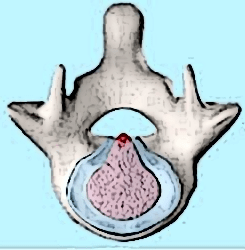
That latter term describes the situation when, at the very lower end, the spinal bones and what not are not completely closed at the rear.  The “occulta” part refers to the fact that there are no noticeable external findings that show the presence of the incomplete closure.  The most commonly affected portion of the spine is in the L5 and S1 vertebral bodies (lumbar and sacral, that is) with somewhat incomplete rear closure.  These findings are, according to what I have read, not always noted on MRI unless it is looking for them specifically.

diagrams of sacral spina bifidaadjusted

It is noteworthy (to me) that when my back was investigated, including “provocative discography”, I had not just a bulging disc but a full thickness tear in the L5-S1 intervertebral disc, going all the way from the outer edge to the nucleus pulposus.  Imagine one of the pieces of Freshen Up gum, with the goo in the middle of each stick up gum, but torn inward from the edge so that the central liquid leaks out.  That’s the sort of thing I had.

annular-tearadjusted

And it was in the rear of the intervertebral disc, just where any SBO might have left poor structural support.  No one noticed SBO in my back when they were working me up, but they weren’t looking for it, nor even looking at the bones in particular.  No one (including me) suspected any skeletal issue.  And SBO can be very occult, and may present, conceivably, with only very minor, hard to notice changes.

I haven’t yet mentioned that one of the findings that can be associated with SBO is bed-wetting.  I had trouble with that, in addition to my frequent and rather severe childhood leg aches, far later than my siblings…in fact, I never heard of either of them having that trouble at all.

It turns out that the correlation between congenital heart disease and SBO is quite high as such things go, more so than either condition’s correlation with autism spectrum disorders.  Of course, most people with congenital heart problems do not have neural tube defects, and vice versa, but the existence of one involves a prevalence of the other that is quite a lot higher than in the general population.

So, though I cannot arrive at any firm conclusions, I know that I had congenital heart disease, I have lifelong neurological and psychological attributes that seem (to me) to be consistent with what would have been called Asperger’s Syndrome before about 2013, and I had symptoms (and signs) that could very well correlate with the presence of a minor form of Spina Bifida Occulta***.

Also, of course, my physical findings when my back was investigated for a resurgence of leg pain in mid-adulthood are consistent with a structural weakness in the posterior region of L5-S1, such that my disc damage or injury was markedly worse than most I’ve seen in patients with whom I’ve been associated, or in descriptions of disc disease.

Alas, I no longer have, nor have access to, my former radiographs of any kind, nor medical notes or surgical notes.  I could be incorrect in this assessment of possibility, and I certainly don’t put my credence very close to 100%.  But I think I’ve nudged myself at least past the 50% point.

Whatever the case, I have chronic pain now, and I’ve had surgery in my back and implanted matrix with bone growth factor there and a titanium cage, so it’s probably all too messy ever to discern if there used to be a very minor case of SBO in the past.  Until and unless someone develops a means of scanning the past such as the Father invented in my book Son of Man, which uses complex time (and a phenomenon I made up) to be able to scan the past of quantum fields without running afoul of the uncertainty principle, I’m unlikely ever to know with anything close to certainty.

I’m convinced that our firm credences of any of the facts of reality can never actually be 100%‒I personally don’t even consider “I think therefore I am” to be completely valid, since even my consciousness might be part of some much greater mind’s imagination…though I suppose in that case, it would still be valid to say that “I am”, just that what I am would be different than what I seem to myself to be.

But for all practical purposes, it’s reasonable to go with Descartes, though.  Most other aspects of reality are, as he pointed out, less certain than we often suspect them to be‒except when they are more certain than we expect them to be.  

I hope I haven’t bored you too much with these thoughts.  They seem interesting to me, of course, but I recognize that’s no guarantee that anyone else will find them anything but mind-numbing.

It would be nice if I could find a way to get better answers than I have on questions of personal neural tube defects or neurodevelopmental disorders, but even textbook findings of such disorders are somewhat misleading, because we don’t have MRIs (or similar) of everyone in a population and symptoms or signs to correlate with findings.  Indeed, almost by definition, the MRIs and CTs and X-rays of people with such issues are going to be those with the most obvious and glaring findings.

Oh, well.  Reality is often disappointing.  But at least thinking about these things is momentarily engaging.

I won’t be writing a blog post tomorrow, barring the unforeseen, so I hope you all have as good a weekend as you can have‒which you will, since whatever happens will be what has happened, and will not be subject to change once it has (It’s always the best, and the worst, of all possible worlds, in a sense).  So, I guess it might be worth it not to worry about it too much.  But, of course, you also don’t have any choice about whether you worry about it or not, once you’re worrying about it****.

Even if there are “many words” a la Hugh Everett, you still only will experience one version of your life.  The fact that another of you might have it better (or worse) has no bearing on your experience in any given Everettian branch, unless it’s possible for the wave function branches to interfere again after decoherence, which is, in principle, possible, but so vanishingly unlikely that it seems not worth considering.

Enough!  Please have a good weekend.


*It was disappointing.  My tastes seem to have changed over time, perhaps due to Covid or perhaps to other matters, but some things I used to like don’t seem to please me anymore.  In this case, that’s probably just as well.

**Myo- for muscle and -pathy for “something wrong with”.  It’s a fairly basic term that reveals almost nothing beyond its prima facie meaning, but it sounds impressive because of the Latin.

***I should note that leg pain is not part of the traditional symptom list of SBO, but intermittent leg weakness is definitely a part of it‒and my leg aches were associated with some radicular type symptoms, such as apparently being associated with notable temperature change in the affected extremities.  At least, it was notable by our family dog, Ernie, who would often unerringly come and lie on my affected leg when I was in pain, just in the right place, as if to provide warmth and comfort.  He was a good dog!  Anyway, disorders rarely exactly follow the textbook descriptions.  As I’ve often said, diseases don’t read the literature.

****Rush were simply wrong; you cannot choose free will.  It either is or it isn’t, but that’s not up to you.