“The lone and level sands stretch far away.”

Welcome to July of 2026 (AD or CE) everyone.  Yes, since yesterday was the last day of June, then it must follow, as the day the previous day, that today is the 1st of July (given the specifications of “our” date-assigning system).

It’s payroll day today, of course, this being Wednesday.  I’m never too enthusiastic about such days.  I am, however, pleased to have learned that we, meaning those in my office, are not working this Saturday, it being Independence Day here in the US.  And we’re not working next Saturday, either, since it is a Saturday we would have had off, anyway.

That will be three Saturdays off in a row.  What will I do if I actually accrue a bit of rest and recover a bit of physiologic reserve?  Huh?  Have you ever thought about that?  Or are you too self-centered to be always and principally concerned about what is going on with me?

I’m kidding.  Even I don’t have much interest in my day to day life…or my life overall, now that you mention it.

Wait, you didn’t mention it; I mentioned it.  Then I projected my feelings onto you, whoever you may be that is reading this.  What pathetic, but very typical of human, behavior that is.

Obviously, I have nothing in mind about which to write today, despite having already written, let’s see…228 words.  I guess that’s not all that many words so far, is it?  Then again, it’s not very few words so far, either.

Speaking of “few” words, do please try to remember the difference between “fewer” and “less”.  If the referent of the adjective is something that comes in discrete, countable units, e.g., people or marbles or books, then the word to use is “fewer”, while if it is something that is continuous, such as some form of fluid or substance, e.g., water, air, sugar, then “less” is the word to use.  If you think* that it does not matter‒that it’s fine to say, “I have less friends than I used to have”**‒then try to realize that it’s just as bizarre as saying, “I’ve been drinking fewer water lately”, or “we only have a few sugar left in the sugar bowl”.

Even the Google Docs grammar checker balks at such uses of “few”, underlining them in blue as possibly incorrect, but it doesn’t highlight the “less friends” disgrace that precedes them.  This is what happens when these programs are “taught” their grammar simply through patterns of usage on‒of all the stupid things‒the internet, rather than by learning the logic behind grammar, and why it matters for clarity of communication.

There are arbitrary and unnecessary “rules” of grammar, of course, but they are fewer*** and farther between than you might expect.

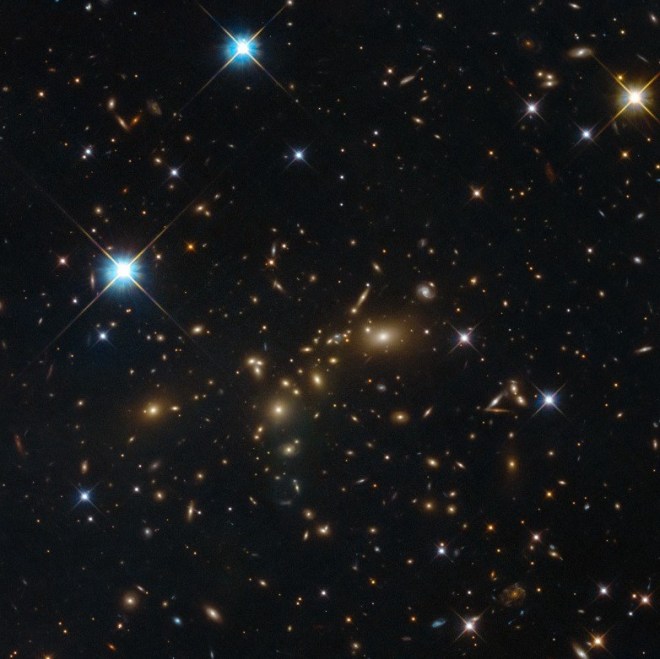
I suppose it probably doesn’t matter, really, not on any kind of large scale.  Not unless it is possible‒allowed by nature, that is‒for humans or their descendants eventually to become cosmically important, to endure for eons, to engineer the shapes of galactic clusters and so on, and perhaps even to solve the problems of the “end” of the universe.

How’s that for a huge and noble quest:  to save the universe from the heat death/big crunch/big rip?  It’s crazily ambitious, but then again, only those who attempt the “impossible” can achieve the unbelievable.  I won’t say it’s the only way to make existence worthwhile‒such judgment is in the mind of each judge, and eternity is not a requirement to make a life a worthwhile thing (though the converse is also not necessarily true).

But for anything about any life to be remembered for any serious duration, then memory itself, conscious memory, must endure.  Simply stored records are not quite enough, not if one wants to leave anything behind that’s even as significant as “trunkless legs of stone” in the desert.

The universe itself seems unlikely to be finite in any larger sense‒the laws of nature that allowed our universe to exist at all seem likely to be, at some level, ever-present and “eternal” (though time is a function within the universe as we know it, so that “eternal” quality is not merely a function of time, but also of the very stuff of which space and time, and whatever else there may be, is made).

But one wants a universe where information from the past can persist, not merely be wiped away inevitably by the whips and scorns of time and big crunches and heat deaths.  If all one seeks is some time capsule that will never be opened, well, then you’re already making that, at least if the conservation of quantum information is correct, which most physicists who work in such areas seem to think it is.

Everything you are and do leaves evidence behind of itself and of you.  But so would a narrow, laser-based optical signal detailing all your thoughts‒something like a blog, say‒that you shine out into the widest void in space you can find, such that it will never so much as encounter a possible recipient before universal expansion has rendered such potential recipients too far away ever to be reached, even in principle.  Would that be satisfying?

I don’t know.  A lot of my writing hasn’t been too far from that situation.  But I do at least have readers here, whose minds become at least a little encoded (infected?) with the memes of my thoughts on a regular basis.  I can only apologize.


*And I use the word “think” here quite wrongly.

**No one should be surprised by your dearth of friends.

***See how weird it would be to think “they are less and farther between”?

Cosmic. Way out. I can relate.

Well, here we are beginning another Monday, and I’m writing this post—again—on the mini lapcom.

I say “again” not because I am writing this very post for a second (or more) time, nor because the last post I did was written on the lapcom, because it was not.  I mean “again” in the sense that last Monday I wrote my blog post on the lapcom.  I also did so on Tuesday and on Wednesday last week, but I cannot yet say that I will do so tomorrow and the next day.  I won’t even say “barring the unforeseen”, because I can rather easily imagine, and therefore foresee, situations in which I will not write those blog posts on the lapcom.

Of course, I also cannot predict whether, like last week, I will write Thursday’s and Friday’s posts on the smartphone.  It’s not that unlikely, but I don’t know ahead of time whether I will write them on the smartphone or the lapcom.  I could make predictions, but I think anything deviating terribly far from 50/50 would probably be very much a rectally sourced prediction.

I will say, though, that if I do write blog posts the rest of the days this week—which will include Saturday, alas—I will almost certainly write them either on the lapcom or the smartphone.  How’s that for a bold prediction?  It’s not a certainty, of course, but then again, pretty much nothing is.  It’s getting into the high 90 percentiles though, I’d guess.  I’m not skilled enough at probability/decision theory to get much finer in my estimation than that.

Anyway, that was about 250 words of utterly pointless drivel, wasn’t it?  It’s quite odd how much and how quickly I can write about more or less nothing of significance.  Mind you, from a certain point of view, nothing is really of significance.  Also nothing is of significance.  I mean two different things by those two different uses of the same words.

The first means that there is almost nothing in the universe that, in itself, is significant (cosmically speaking, of course—on different scales, significance has different requirements).  No individual, localized thing or fact can matter much on the largest scales.  On the other hand, nothing—the vacuum, absence, whatever you want to call it—is significant.  This partly refers to the fact that the universe appears to be expanding at an accelerated rate, and this seems to be due to the vacuum energy, the energy of “empty” space.  A uniform energy density in space creates a negative pressure, which creates “negative gravity” in a sense, and that drives an expansion of spacetime.

The nature of this vacuum energy, or cosmological constant, is definitely significant in that it will determine, almost solely as far as we can tell, the future fate of the universe.

Of course, the term “vacuum” may be somewhat misleading given its ordinary usage (quite apart from when one refers to the household appliance).  The vacuum is never really “empty” despite what the usual meaning of the word is.  It’s full of all sorts of quantum fields as well as the gravitational field that is spacetime itself.  The vacuum is just when these fields are in their lowest possible states/energy levels*.

There’s also the famous Higgs Field, which actually is one of the quantum fields, but it is interesting in that it is a scalar field, meaning that it has magnitude at every point but not direction (like a map demonstrating local temperatures on Earth’s surface, as opposed to one detailing the wind, which will have magnitude and direction).

If this seems a peculiar distinction to you, think of the electromagnetic field, which has both magnitude and direction at every point.  It’s actually a little more complex even than just that, because of course, electricity and magnetism are two aspects of the electromagnetic field, but each one of them is a vector field (with magnitude and direction) which interacts with the other, so the combination of them is something more involved.

Also, when energies are high enough (changing the way the Higgs field interacts with other fields), the weak nuclear force and the electromagnetic force turn out to be part of the same thing, called the electroweak force.  And, of course, there is the question of whether all the fields are really just aspects of some “higher” field or structure.

This would be some form of “unified field theory” (not to be confused with GUTs, or “grand unified theories”, which are less grand and less unified than unified field theories).  Of course, we don’t know that there is a unified field.  There may not be.  There may just be a minimum number of fields that cannot be further reduced.

If M-theory (AKA string theory) is correct, then yes, there is a unified form from which all fields derive their character thanks to the shapes and resonances of their vibrations in high-dimensional spaces.  On the other hand, other versions of quantum gravity such as “loop quantum gravity” leave gravity (AKA spacetime itself) as a separate kind of field, composed of tiny, tiny parts (the “loops”) knitted together.

At least some versions of this theory have been disconfirmed, however, because it predicts a very, very slight difference in the speed of travel of electromagnetic waves depending on wavelength, and light from extremely distant quasars has been tested and found to be uniform in arrival time (based on variability in the quasars and specific catastrophic events, if memory serves) from wavelength the wavelength, even to tiny parts in billions of light years traveled.

Okay, well, that’s surely enough trivia for anyone early on a Monday morning.  I wish I didn’t have to work today, but then again, I wish I didn’t feel like I have to do anything.  But I do feel that way.  I guess it’s probably better than being inert.  Without a goal or goals—terminal, instrumental, or otherwise—there is no action.

You can call it a “drive” instead of a “goal” if you prefer.  That may be a more accurate term, since nature doesn’t act in a teleological way (outside of thinking minds) but instead generates drives/urges/impulses, some of which lead to increased genetic reproduction and some of which lead in the other direction.  Over time, the former are the ones that tend to accumulate, for what are probably obvious reasons.

Enough.  I already said it was enough, didn’t I?  Anyway, I hope you all have a good day.  And remember, if you tend to come to this blog via other social media, you can subscribe to it using your email, and then you’ll get emails sharing every new post with you directly.

Take care.


*There is also a thing called a false vacuum.  Spacetime itself could be in such a state, if the vacuum energy is capable of tunneling to an even lower energy level than the one at which it currently resides.  This would not be a good thing for the current inhabitants of the universe, but at least they would never know it if the drop-down happened, because everything that currently exists would be erased at the speed of light.  The universe as a whole would even be affected, but it wouldn’t be endangered per se.

Should you give a fig about a freight train’s Newtons?

It’s Saturday, April 25th, in 2026 AD/CE.  There are only 7 shopping months until Newtonmas (Other holidays are available).

Anyway, I’m very groggy and tired today, though at least I am (for the moment) in slightly less pain than yesterday.  It still sucks, but now it’s more of a neutron star kind of sucking rather than a full scale black hole.

Not that either of those two stellar remnants can be said to “suck” in any atypical way, with respect to gravity.  It is true that the gravitation at the surface of a neutron star is extremely high (to say nothing of the “surface” of a black hole).  But that’s just because everything is so compact, and you can get much closer to the center of gravity than you would be able to do with more spread-out astronomical bodies made of more typical matter.

But, to reiterate a perhaps overused example, if the sun were suddenly (and without any other phenomena that would complicate the picture) to collapse* into a neutron star or even a black hole of the same mass, the Earth’s orbit would not change at all.

There’s no special “supergravity” or whatever some people imagine there might be due to black holes or neutron stars.  It’s just ordinary gravity with a large mass in a small region.  From farther away than the former surface of whatever collapsed into it, the gravity of a neutron star or a black hole is literally indistinguishable from that of the celestial object that became the black hole or neutron star (if it did not lose any mass in its collapse to the latter state, which in reality they almost always do).

How the hell did I get on that subject?  I don’t know.  I guess I’ll see it while editing.

I’m a little out of it this morning, because I took half a Benadryl last night in addition to my other, more typical stuff.  I don’t usually take Benadryl on a work night, but groggy and unpleasant quasi-consciousness that at least helps me to be unconscious is better than not being able even to get to sleep or stay that way for long and being groggy because of that rather than the side effects of an antihistamine.

Something like that, anyway; I’m not sure I made that very clear.

I’ve just now become briefly distracted because a redirected freight train just went by on the track in front of me (going south on the usually-northbound side of the tracks, something for which there were no doubt legitimate reasons, but which still feels quite wrong).  This happens occasionally, and I’m sure the process that leads up to it is somewhat interesting, at least from a certain point of view.

It’s definitely an event that happens only because something has gone wrong somewhere.  The tracks for commuter trains, like the course over which they run, are not really meant for heavy freight trains, so they can’t let them use them very often.  And it was heavy, I’m sure of that. There were numerous tank cars and box cars and all sorts of similar cars carrying potentially heavy stuff.  Even the train’s whistle as it approached was a different, lower pitched sound and had a more somber timbre (sombre timber?) than the usual Tri rail whistle.

I already was pretty sure it wasn’t a regular train when the nearby gates went down to stop traffic, because there’s no scheduled Tri rail train going in either direction at even close to that time on a Saturday.  If it were a behind-schedule train, it would have to have been the first train of the day going south, and it would be quite off its schedule indeed.  Trains only come every hour on the weekend.

I almost wrote “every hour on the hour” there, just for the “sound” of it, but of course it’s not feasible to have a commuter train arrive every hour on the hour at every train station unless the stations are an hour’s traveling distance apart.  That would be one hell of a commute, and not in a good way.

Anyway, I think that’s enough nonsense for today.  I still don’t feel good.  My legs and hips are still channeling low-level but constant DC current (or so it feels), and I am having more and more trouble seeing any point to continuing to try to style my way though all this.  It’s been more than 20 years and things are not improving overall.

It would be more tolerable if I had other people and reasons and points in my daily life, but I don’t, not really.  The comments here below this blog constitute the majority of my socialization, not counting work interactions (which are a different kind of thing, though related).

I’m so bloody tired.

Anyway, have a good weekend if you can.  For goodness sake, cherish the people you love and who love you, especially if you’re lucky enough to be with them every day.  And remember, when in doubt, don’t ask yourself “What would Newton do?”.  Unless you’re a scientist, that is, in which case, yeah, Newton was a decent role model.

Otherwise, he was a terribly unpleasant, vindictive, and spiteful man (and here I thought it impossible for me to admire him more than I already did).  He is reported to have laughed only once in his life, when someone asked him what was the point of studying Euclid.

I sympathize with Newton there.  That is an idiotic question for anyone who is stuck living in and making their way through three-dimensional, locally Euclidean space.

Mind you, when things like black holes and neutron stars are involved, you need to go beyond Euclid, but you can’t readily go beyond Euclid if you’ve never gotten to Euclid***.


*There’s no known process by which this could happen, by the way, so don’t worry about it.  Also, you don’t need to worry about encountering spherical cows or frictionless surfaces**.

**Though I’ve long thought that “Frictionless Cows” might be a good name for a band.

***You don’t need to read Euclid’s actual book to study Euclidean geometry, any more than you need to read Newton’s Principia Mathematica to learn Newtonian physics.  But it’s worth giving them each a tip of the hat in passing, at least, for they are among humanity’s greatest works.

We have met the cosmic horror, and…

Well, here I go again (on my own, like the song says) writing another blog post.  As for why I am doing so, well, there is surely a set of causes‒potentially tracing all the way back to the Big Bang, or at least the period just during and/or after inflation, assuming that happened, which seems more likely than not‒there may not be any good reason for it.

Oh, of course, I could come up with reasons.  I could “justify” myself.  Indeed, there is reason (har) to think that justification and persuasion to bolster one’s status and identity in a tribe against others with opposed motives may have been one of the driving forces behind the development of the human reasoning capacity.  This is apart from, and perhaps almost orthogonal to, the basic power of reasoning to understand and thus best navigate the territory of reality.

Once it got started, reasoning would have accelerated thanks to biological arms races between those competing for survival and reproduction, and then it would have turned out serendipitously to have been more broadly and powerfully useful than merely for securing status and food and mates.

Imagine if the peacock’s tail had turned out not only to be ostentatious and beautiful and sexy (to peahens, anyway) but tremendously useful and broadly powerful, especially once it reached a certain level.  Imagine if the peacock’s tail had allowed peacocks to build skyscrapers and boats and trains and planes and cars, if peacocks’ tails helped peacocks build a global civilization, quite apart from their ability to secure one’s status and acquire good mates.

That’s quite possibly more or less what happened with human brains.

Of course, like the peacock’s tail, the human brain is not without its drawbacks.  I suspect that things like depression and anxiety, and perhaps even neurodivergence, are simply potential (and statistically inevitable) outcomes for a brain that has grown powerful enough to assess the world deeply and uncover the almost Lovecraftian terror of our tiny little existence when placed against the scope and scale of the cosmos.

I say “Lovecraftian”, but even with Lovecraft, though the beings in the mythos are thoroughly inhuman and incomprehensible‒unsane, as I like to say‒they are still beings.  The true cosmic horror is surely that beings of any kind are almost nonexistent; indeed, to a very good approximation, they are nonexistent.

In some senses, this can at least be morally reassuring.  If we do go and spread out through the universe‒or even just the galaxy or even just our local family of stars‒and there are indeed no other life forms, then at least we need not worry about violating implicit rights.  Uninhabited asteroids (for instance) don’t have goals or wishes and, as far as we can tell, they cannot suffer.

Of course, we may have aesthetic concerns about such things, but aesthetics are not as urgent as ethics.  And, of course, we will still have moral/ethical concerns toward each other; that almost goes without saying.

Whether or not we will exist long enough for the ethics (or lack thereof) of changing the state of uninhabited other places in the galaxy to be pertinent is quite uncertain.  I see nothing in the laws of physics that makes it impossible, so in that sense, I am optimistic.  But I see nothing in the laws of physics, nor more specifically in human nature, that makes it certain or even likely that we will survive to spread out from our native planet to any significant degree.  And I see nothing in the laws of nature that seems to imply that, if we don’t succeed and spread through the cosmos, anyone else will do so, or indeed that anyone else even exists.

Don’t get me wrong; physics clearly and undeniably allows life to exist, and it allows (human-like) intelligence and civilization to exist.  But those are two different scales of allowance.

The molecules and principles of life as we know it, with long-chain molecules capable of carrying information and of replicating themselves, leading to “competition” and “improvement” and increasing complexity and so on, seem so straightforward as to be happening potentially (but far from certainly) in a good many places in the universe.  This is straightforward enough.  The equivalents of viruses and prokaryotes may exist in many regions.  It’s even possible that there may be such life in other places in our solar system (Europa and Enceladus being possible contenders).

But multicellular, “eukaryotic” life, seems likely to be much rarer.  Basic life started on Earth, as far as we can see, very shortly after the Earth formed and cooled enough for complex molecules to endure (nearly 4 billion years ago).  Eukaryotes, especially multicellular ones, didn’t really arrive until about 500 million years ago.  So, seven eighths into the time of life on Earth, it was basically just “bacteria” and some viruses.

Then, for significant, interpersonal, symbolic and technological intelligence to develop took another…well, basically another 500 million years.  And as far as we can tell, it’s only happened once.

That doesn’t give us a good, clear picture of how rare or common such a thing is‒one is a difficult number of experimental subjects from which to draw too many conclusions‒but it’s possible that the existence of technologically intelligent life is so rare as to occur only once per, on average, every chunk of spacetime as large as our visible universe.  It could even be rarer than that.

In an infinite cosmos, of course, even such exceedingly rare events would happen an infinite number of times (so to speak).  But that doesn’t necessarily make things less lonesome.  If you have an infinite number of decks of cards (with no jokers), all thoroughly shuffled together, there are literally just as many Aces of Spades as there are red-suited cards in total (ℵ₀, the “smallest” infinity).  Nevertheless, if you draw cards randomly, you will only get an Ace of Spades one twenty-sixth as often as you will get a red-suited card.

Similarly, there are as many whole multiples of a trillion as there are integers in general (again, ℵ₀), but if you pick a random integer, you’re still only going to pull such a multiple one out of a trillion times (on average).

So, maybe the takeaway is that the real cosmic horror may be that we are the only entities haunting the abyss, and there are no (other) mad idiot gods bubbling away at the center of celestial existence.  Maybe it’s just us.  And if our lights go out, then nobody is home.

It’s worth considering, not least because it has every chance of being true, whether literally or just practically.  For if the nearest other technological life form is in another galactic cluster, for instance, then we are, for all reasonable purposes, alone in the universe.

It’s the end of the week, but weakness persists

It’s Friday again, at last, and this is indeed the final day of the work week for me.  I am not expected to work tomorrow, and I think that even if they decided they were going to hold the office open tomorrow, I would not go in.  I am too tired and dispirited to once again throw myself into the gears of the machine just because other people want me to do it*.  Honestly, I feel it’s more likely that I’ll throw myself into real machinery than that I will go to work tomorrow.

Speaking of such throwing, as I was leaving the train yesterday evening, I found myself looking under the engine, seeing where the wheels meet the tracks, and wondering if I would have the guts just to lay my head across the track‒my neck, really‒and let myself be run over.  It would be a quick death, I suspect.

I don’t think I have the guts, though, not right now.  Also, it would be rude to screw up people’s commutes.  But it does carry a weird kind of perverse attraction.

Nothing else of interest is happening, really.  Well, perhaps one might concede that there are many interesting things happening, in the sense of the old curse, “may you live in interesting times”.  Unfortunately, even those types of interesting things that are happening are so…well, almost so trite, so pathetic, so contemptible, so predictable, so “been done already”.  None of the weird, would-be interesting, things that are happening are impressive in any sense.

Okay, well, I’ll concede the relative interest and impressiveness of the Artemis II trip around the Moon recently.  It would be more interesting if it hadn’t been something we’d done literally before I was born (3 months before, to the date, for Apollo 11’s landing), using computer systems that were‒to use the most conservative definition‒28 iterations of Moore’s Law ago.  So, literally, by more (ha) than one measure of that “law”, we are at least 2 to the 28th times as advanced, computationally, as we were when we first went to the moon.  That’s conservative, because I’ve heard descriptions of Moore’s Law that put the doubling time at 18 months, in which case there would be about 37 doubling times since then.

For those of you for whom exponentials don’t carry quite the visceral impact they ought to carry, 2 to the 28th power is 268,435,456.  So, by more conservative, every-two-year characterizations of Moore’s Law, our current computational powers are more than 268 million times what they were in 1969.  By less conservative estimates they are 137,438,953,472 times, so more than 137 billion times as advanced.

To be fair, it’s just computer tech that has advanced like that.  The process of engineering rockets hasn’t improved to the same degree, because that’s a large-scale engineering thing, and is more constrained by the rate at which one can directly interrogate nature and build and test technology.  Still, we went from Kitty Hawk to the Moon in about two thirds of a century, but in the more than half a century since, we’ve certainly not extended that streak much.

Okay, to be fair, we got pretty good at sending out space probes and such.  Even then, though, our most distant and still most impressive probes were launched in the late seventies.  There have been some quite impressive things since, and I intend no shade to be thrown at them.  That Pluto thing was very impressive, as are almost all of the Mars missions and the probes sent to other planets (on the other hand, the ISS isn’t that much more impressive than Skylab was).

The things that have improved significantly have largely done so solely because the increased capacity of computers has assisted in modeling and, well, computing things.  So, rocket science has improved to the degree that computer science has improved, divided by the fraction of that improvement that cannot make a difference in how well rockets can be made.  Something like that, anyway.

Yeah, rocket science hasn’t advanced much in my lifetime.  Brain surgery has done a bit better, but not as much better as one might have reasonably expected.

Then again, we’ve certainly improved our ability to make memes and now AI images and videos to make fun of people and express our own loyalties or outrages.  Yes, in a real sense, many of our greatest advances in recent decades have been improvements in our ability to hurl feces at each other like the monkeys we all are.  We appear to be more engaged by such shit-flinging even then we are by sex, which seems mind-boggling.

I say “we” but that broad description does not apply to everyone.  Some people are still more interested in sex.  At first glance, that would seem to be the more evolutionarily stable of the approaches, but it’s an empirical question, so we can really just wait and see which, if either, of the two tendencies prevails in the long run.

To paraphrase Dave Barry, I myself plan to be dead.

Anyway, that’s about all I have to say for this week.  I don’t mean to make a post tomorrow, but of course, as always, that is barring the unforeseen.

I hope you have a good weekend.


*Okay, to be fair, that’s not really the reason.  I do it because I get paid.

It’s not about me. It’s not about you. It’s not even about everyone.

It’s Friday today (as I write this, anyway‒it may be another day entirely as you read it), and I am in the process of heading to work.  I will also be working tomorrow, barring (as ever) the unforeseen.  And that doesn’t just include the foreseen unforeseen; the unforeseen unforeseen (especially that one) can also change what happens tomorrow, in ways that we do not expect, more or less by definition.

Of course, the Tao te Ching advises us to act without expectation, and I suppose that’s pretty good advice.  The universe doesn’t make special deals, such that if you do some particular thing, it will definitely turn out the way you hope.  The universe does what it has always done, and you are not the subject or the object of its action‒you are just one of the innumerable things the universe does.  It did not have to ask your permission, and it will not apologize.  It also does not make exceptions, not as far as anyone can see.


Since the beginning

not one unusual thing

has ever happened*.


You can imagine and draw a map that looks any way you want, that contains fairy lands and misty mountains and roads that are shorter in one direction than another**, but if your map doesn’t match the actual territory, it’s not going to be useful for traveling through that territory safely and successfully (by whatever reasonable criteria you might judge success).  Likewise, blank spots on the map don’t imply blank spots in the territory, and writing “here be dragons” does not somehow conjure dragons into existence (alas).

Reality is that which actually exists, whether or not anyone “believes” it or “believes in it”, whether or not anyone has been, is now, or ever will be aware of it.  Heck, if eternal inflation and a consequent inflationary multiverse following (for instance) the string landscape are true, then the vast majority of the stuff of reality will never, ever be known, because most of it‒the ever-expanding inflaton field and those bubble universes where local laws are such that complexity cannot exist, as well as those huge stretches of even our universe that precede (or follow) any existence of life‒will never be accessible to conscious experience.

That’s okay.  Man is not the measure (nor the measurer) of all things.  Man is the measure of almost nothing.  Man‒indeed, all life of which we know‒is a tiny little epiphenomenon that exists in a tiny little sphere of nonzero thickness on and around the surface of the Earth.  I’ll try to remember to do the math comparing that volume to the volume of the visible universe and put it in a footnote below.  If it’s not there, I didn’t do it***.

One sometimes hears people say‒often they seem to be trying to make excuses for themselves to believe in some deity or other‒that the universe is exquisitely tuned for life, such that it requires explanation by some “supernatural” means.

When I hear or read such things, my reaction is, “What universe are you looking at?!?”  Almost no place in the universe can be survived by life as we know it, let alone produce it.  The fraction is so close to nonexistent that it is zero to a good first approximation, and a good second approximation, and a good third, and so on.

It may seem that time could possibly give us a bit more comfort than space does, since life on Earth has existed between roughly a fourth and a third of the time since our Big Bang.  But the future of this universe gives every indication of being without end, whereas conditions for large scale matter to exist‒as far as we can tell‒will not last long (not compared to infinity, which to be fair, nothing is, not even TREE(3) or Graham’s number or any other huge but finite numbers).

By the time the last supermassive black holes finish evaporating due to Hawking radiation, which will be about a googol years, things will already have been impossible for any kind of life we would recognize for eons of eons.

Of course, it’s conceivable that life will grow to become cosmically important and able to engineer specific ways for the universe to avoid heat death (or whatever is coming), or to make new universes, or whatever.  But that’s a mightily narrow course for the future to thread.

And the time until a straightforward Poincaré recurrence of the current state of our universe makes a googol years seem unnoticeably teensy by comparison.

Anyway, the main point I’m making, if there is one, is that the universe neither promises nor owes you anything.  That doesn’t mean it’s not okay for things to be important to you.  You matter (on the scales we’ve been considering) nearly as much as the whole Andromeda galaxy.

It’s fine for you to try to make your life what you want it to be.  Why not?  There’s no one else who has any legitimate claim to it (not counting children, friends, etc., all of whom could be considered part of “what you want it to be”).  Just don’t expect other people, let alone the vastly bigger number of things that are not people, to be also trying to make your life the way you want it to be.

Okay, that’ll do, pig.  I’m tired (What else is new?).  I’ll most likely write a post tomorrow.  I hope you have a good day.


*I got this haiku from Eliezer Yudkowsky’s Rationality: From AI to Zombies, though I am not sure if it originated with him.

**Actually, I’m not sure how you would draw that.

***I did it, though I initially made a mistake in calculating the surface area of the Earth, as you can see below if you look closely (I forgot to square pi in the denominator).  Anyway, assuming that the depth-to-height range of life on Earth is about 20 km, then the volume for life as we know it is about 1 x 10^19 cubic meters.  The volume of the visible universe on the other hand is 2.6 x 10^81 cubic meters (if my calculations are correct).  That means that the fraction of the universe that is, to our knowledge, amenable to life is 3.8 x 10^(-63), or 0.0000000000000000000000000000000000000000000000000000000000000038 of the volume of the universe.  By comparison, the fraction of your volume represented by one of your tens of trillions of cells is roughly 10^(-12), or .000000000001.  You lose thousands of cells every proverbial time you scratch your nose.  How much do you notice them?  How much less would the universe notice if it scratched all life off?

Blog, we know what we are but know not what we may be.

Hello and good morning.  It’s Thursday again, and out of tradition I’ve started this blog with “Hello and good morning”, which you’ve already seen but might not have noticed.  Speaking of tradition, I’m also writing this post on my lapcom, partly for just a changeup, and partly because my thumb/wrist arthropathy has been acting up quite a bit, so I brought the lapcom back to the house with me on Tuesday evening.

Speaking of Tuesday evening going on to Thursday morning, I was out sick yesterday, and so I did not write a blog post.  I did work from “home” for a bit, because it was payroll day, and obviously I needed to get that done or else people won’t get paid.  But I wasn’t in any mood to write a blog post from the house.  I didn’t even have the energy to leave a little quasi-post like I did on last Saturday, just to let people know that I was not going to be writing the expected full post.

Honestly, I don’t feel terrific even today, but I do feel a bit better than I did yesterday, at least for the moment.  If human civilization were sane or even slightly reasonable, I would feel no qualms about taking a second day off, because no one else would expect otherwise.  But I cannot feel comfortable doing that, even if other people would not mind.  It’s a pathology, of course, but there it is.

Still, if I leave things at the office for too long, when I get back it becomes too stressful because there’s so much catch-up work to do (thank goodness, we got rid of all our mustard work long ago)*.  Luckily, I still have plenty of face masks available.  Indeed, I often consider trying to find a brand that I like and can wear every day, all day.

I’m not a fan of my face.  There are too many signs of the past 20 years or so on it.  It’s possible that these signs are things no one else would notice, but that hardly matters, because I am the one bothered by it, and I and the one stuck with this face.

It’s not an emergency.  I don’t feel like I must cover up my face, like Doctor Doom or the Phantom of the Opera or something.  It just annoys me.  Don’t get me wrong, I don’t wish I looked like someone else, anymore than I wish I were someone else.

I can’t even see how that could work in principle.  If everything about me changed into someone else, I wouldn’t exist anymore, I would be someone else.  But that wouldn’t be me experiencing the process of being someone else; it would just be someone else.  Nothing of me would come along.

I guess I just would prefer it if I could be a better version of me.  I work on it, of course; I don’t just wish for it.  I’m always trying to improve in any way that I can.  And the good and bad thing about self-improvement is that there is no finish line.  One can always be better—by almost any criterion one might choose—than one currently is.

This is similar to—and may be related to—the nature of intelligence and ignorance.  Intelligence can increase without any known limit, in principle, but everyone is always infinitely ignorant and always will be.  There is always an uncountable infinity worth of potential information one could know but does not (just within, for instance, the digits of π alone, apart from the uncountably infinite other Real Numbers).

This is a blessing and a curse, as such things tend to be.  It is a curse in the sense that one can never know everything there is to know, and therefore, in principle, one cannot know that one knows the most important things to know.  On the other hand, it is a blessing to know that one can always become smarter, more knowledgeable, than one currently is.

You can’t keep building muscle indefinitely; you can’t run faster or swim faster or bike faster without limit.  New Olympic records are set by tiny, tiny margins.  But while there surely is a physical upper limit to possible human intelligence—based upon information theory, thermodynamics, neuroscience, general relativity and so on—as far as we can tell, no one has ever gotten close to that upper limit.  You can keep learning new things every day that you are alive**.

This is a notion I wish more teachers would explain to their students.  Yes, it’s true that different people have different aptitudes for different subjects.  But unless there is real and serious pathology, anyone can get to the goal in time.  Your fundamental limits are processing speed and memory.

If your onboard, RAM-style memory isn’t great (and no one’s is VERY great) then you can store things externally, using written language.  If your processing speed regarding, say, 17th century British literature, is slow, you may reasonably choose to do something else.  Had you but world enough and time, you could learn anything, but you don’t have world enough nor time.  In principle, though, you could learn it.

Motivation, drive, impulse is/are factors holding people back more than anything else, as far as I can see, and it’s perfectly understandable.  Thinking requires a lot of effort—fully 20% of our bodies’ calories are used by our brains***.  One wants to choose as wisely as one can just to what to apply that energy.

In principle, one cannot know for sure if one will make an optimal choice—that’s the whole “unknown unknowns” thing—but that’s part of the point of decision theory.  We have to make decisions with incomplete information, pretty much every single time.

That’s okay.  It’s much more fun to be surprised by the things one learns than just to have more of the same.  The most exciting non-personal moment in my lifetime so far was in 1998 when it first became clear that the universe was not merely going to keep expanding (rather than recollapsing) based on data in the supernova studies, but that the expansion of the universe was increasing in speed!  Literally, my picture of the whole universe changed, and it was amazing.  I cannot properly explain just how invigorating it was to learn about this.

Look at me, being slightly positive in my blog.  I must be ill, huh?  Anyway, that’s enough for today.  Presumably, I’ll be writing another post tomorrow, but I never make an absolute guarantee.

TTFN


*Sorry, I know it’s a stupid joke, but I’m sick.  Please give me a break.

**And in a certain sense, you do this no matter what:  at the very least, you learn what it is to experience that day.

***Though there is reason to suspect that some politicians use a significantly smaller percentage, as do some of the people who vote for them.

I had a good headline idea, but it slipped my mind

I was surprised by how much response I’ve received to yesterday’s blog (and that of the day before) as well as the number of comments.  It’s very gratifying, and I appreciate it very much.  Thank you.

As for today, well, I am really not sure what to write, because yesterday’s blog was‒from my viewpoint, anyway‒about as free-form and chaotic and tangential and stochastic (not to say redundant) as anything I’ve written.  But maybe that’s just the experience I had while writing it; maybe it doesn’t actually come across that way to the reader(s).  It’s difficult for me to know, because even more than reading, writing is a solitary thing.

That’s not to say that people can’t write together.  Back when I was a teenager, I co-wrote some partial stories with one of my best friends, and we did it sitting next to each other and talking things through aloud as we typed.  That was a pretty active and interactive collaboration.

Unfortunately, I don’t think we got very far with it.  We made much more progress writing silly computer programs in Basic on the Apple II+ my father had bought.  This was in the days before there were any ISPs as far as I know, though we did dial onto a couple of local “billboard” services from time to time with my dad’s old modem (I think it was 600 baud*, but it may be some even divisor or even a very small multiple of that number).

One time, I even had a conversation with a girl (!) who was helping run one of the billboards.  She was (supposedly) about my age, and obviously she was much more into computers than I was for the time.  There was never (in my regretful mind) any possibility of an ongoing interaction, let alone a physical meetup or anything, however.  Even then, though I was reasonably confident when within my local group of friends and teachers, I was painfully shy and awkward, and could never make conversation other than about specific topics.

Goal-directed interactions are okay, as they tend to flow naturally from the process involved.  This is why I’ve made nearly all my friends at school or at work.  Purely social interactions were never really an option for me, except with people I already knew quite well.  And having a successful romantic relationship was unfortunately not in the cards for me.

It still isn’t, as far as I can tell.  I suspect the problem is that there’s no other member of my true species on this planet.  I did come reasonably close, or so I thought for a long time, but I’ve been divorced now about five years longer than I was married, so I apparently wasn’t all that successful.

Okay, well, sorry about the weird, ancient info-dump.  It’s not nearly as cool as the data that’s coming in from the recently-activated Vera Rubin observatory.  That, at least, is the sort of thing that helps restore my faith in humanity.  Or, well, maybe it would be more accurate to say that it shifts my Bayesian credence slightly away from the “humans are without net redeeming value” end and toward the “humans may not be all that bad in the end” end.

The credence is still quite low, though.  By which I mean I’m closer to the first end than the second most of the time.

Things might be a little bit better if the sort of people who do things like setting up the Vera Rubin telescope, and who set up and launched and now use the James Webb telescope, and the members of the former human genome project, and the people who study cognitive neuroscience, were the sort of people working in government, writing and administering laws.  Generally speaking, though, the first type of people don’t tend to want to do the governing nonsense, probably not least because a lot of that business is not about everyone trying to do the best they can for the people they represent.

The people who want to do astronomy and mathematics and biology and geology and neuroscience and meteorology and so on are probably some of the best people to do those things‒not just from their point of view but also from the viewpoint of civilizational benefit.  Unfortunately, many of the people who want to go into government and politics tend to be some of the worst people for those jobs, from the point of view of civilization.

I can’t say they are the worst possible group for the job.  The truly disaffected and uninterested or the misanthropic and nihilistic might well do a worse job even than the lot who do it now.  This is despite the fact that most of those latter people act on shallow and immediate self-interest.  Self-interest can do the job adequately when the incentives are structured such that one’s self-interest is served by serving the interests of the people of one’s community/city/nation/species.

Those incentives are very tricky to manage, unfortunately.  It would be much better if we could find people who had real enthusiasm and curiosity and an actually somewhat scientific approach to government.  If only we could find a group as committed to seeing a truly and objectively well-run society‒in which everyone was better off than they would have been in nearly any other‒as the group who set up the Vera Rubin observatory was committed to actually getting the observatory done so they and we could learn ever more about the universe on the largest scales, things might be quite a bit better than they are.  Maybe not, but my credence leans more toward the “maybe so” end.

Alas, politics and government were not born of human curiosity and creativity‒the things almost entirely unique to the species‒but of the old, stupid primate dominance hierarchy/mating drives, which are evolutionarily understandable, but which don’t make for pretty, let alone beneficial, government.  Think about it.  Would you want to put a bunch of self-serving apes doing the jobs of government?

Oh, wait!  That is the group doing the jobs of the government!  Of course, it’s also the group being governed.  Uh-oh.  This could be boding better**.

Not that being recognized as an ape is an insult per se; apes are all that we’ve had available, and they’re the best that’s come along so far.  Some of them are really not so bad.  Some of them figure out ways to launch immense telescopes into space, not so very long after one of them first created the telescope.  Some of them figure out ways to cure and even prevent unnecessary disease.  Some of them figure out ways to turn simple manipulations of base-two arithmetic into information processing that can be scaled up to any kind of logic and information that can be codified.

Some of them just write blogs and sometimes write stories and songs and such***.  But hopefully, that’s not too detrimental an endeavor.


*A baud is a bit per second being sent over the phone lines.  Not a meg, not a K, not even a byte, but rather a bit‒a binary digit, a one versus a zero, on or off.  If you listened to the sound of the modem, you could imagine you could almost hear the individual bits.

**Tip of the hat to Dave Barry’s “Mister Language Person”.

***Though I have done my very small part in advancing human scientific knowledge, in that I am a co-author and co-investigator on an actual published scientific paper.

If you can look into the seeds of time, and blog which grain will grow and which will not

Hello, and also, good morning.

What to write about, what to write about‒that is the question today.  Of course, “to be or not to be” is always the question as well, as was recognized by Camus in The Myth of SisyphusIf I recall, he arrives at the conclusion that the titular rock-rolling protagonist must be “happy” despite the patent and constant pointlessness and absurdity of his existence.

That goes along with the whole recognition of the absurdity of life itself that is central to the existentialism movement.  Still, it’s hard for me to “imagine Sisyphus happy”, unless he was a true Bodhisattva or had been thoroughly lobotomized by Zeus (or whoever it was that had doomed him to his…well, his doom).

It can help, I guess, to think about the vast scale of the cosmos in space and time (and any other dimensionality that might apply) and also about the incredibly minute scale of the cosmos, the fundamental quantum fields (and whatever gravity ultimately is) interacting from the Planck scale on up.  It helps keep things in perspective.

Of course, even given the scales of the cosmos*, there’s another, almost sort of Buddhist/Taoist notion that notes that each individual‒each particle even‒always exists at the nexus of two “light cones”, existing in an ever-moving now.  These are 4-dimensional cones, by the way, but it’s okay to reduce things by one dimension if you will.  It makes them easier to visualize.

Your (or anyone’s) past light cone is the outer boundary of all influences that can possibly have had any effect upon you at the present moment‒those influences that could have reached you at the speed of light or more slowly.  Similarly, one’s future light cone encompasses all those things that could possibly be influenced by things at the present location at or below the speed of light.

Any motion within the light cones‒the only motion that anything within spacetime can execute, as far as we know‒is called timelike motion.  Any motion that would require going outside a light cone is considered “spacelike” motion, and is not allowed by relativity.  This is not merely because of the speed of light, it’s because the speed of light is defined by the speed of causality.  Causes cannot travel faster or have effects beyond the speed of causality.  This is a bit tautological, I know, but it nevertheless simply must be true.

So each individual’s experience, each individual process, sits at the moving balance point of a future light cone and a past light cone, crossing at the moving present, tracing out a “timelike” path in spacetime.  Of course, individual creatures are not individual particles, and so their overall spacetime path would resemble the final line produced by a sketcher going over and over a particular path to make the curve the artist desires.

If one could look at the structure of a human in spacetime, like the Tralfamadorians of Slaughterhouse Five, but one could also trace even the spacetime paths of individual “particles”**, a human life would be a sort of higher-dimensional braid in spacetime, surrounded by a haze of incoming and outgoing quantum entities, most of which will be locally bound and interacting, and so will be moving at a net velocity lower than the speed of light.

I’m assuming you don’t eat your food or drink your water or breathe your air or (shudder) sweat or excrete at near light speed.

Imagine what the inside of a mere proton or neutron might look like if one were able to see it as a rendered, four-dimensional model in fine detail!  If you think it wouldn’t be that interesting because it’s so wee, think again.

Remember, only the tiniest fraction of the “rest mass” of a nucleon comes from the mass of the three “net” quarks in it (two up, one down or two down, one up depending on whether it’s a proton or neutron).  Almost all the rest of its mass is the energy of the interactions between these three quarks:  all the gluons exchanged, all the virtual quark/anti-quark pairs popping into existence, mediated by that famous strong force and its weird*** “asymptotic freedom”.

Bringing this back around, I guess my point was merely to note that everyone and everything is pointless from the perspective of the laws of nature and the spacetime scale of the cosmos, but when you learn about those things‒the cosmos at large and small levels‒you are at least familiarizing yourself with those vast workings, and you are in a sense taking part of them into yourself.  That’s kind of a cool thought.

But don’t take too much of it into yourself!  For, much as would happen to someone who stuffed all the information about Graham’s number into one head, if you do you will become a black hole.  Now, it may be possible to survive becoming a black hole, but I don’t recommend betting on that pony.

TTFN


*I wrote a post on Iterations of Zero about how it might be useful for people to consider the cosmic perspective as contrasting with their prosaic concerns.  I don’t remember how good it was, but here’s the link, in case you want to read it and give any feedback you like.

**I use this word for want of a better term that everyone would recognize and that would be succinct.  I think we need such a different term, because a lot of the perceived so-called weirdness and mystery of quantum mechanics comes from trying to use inaccurate terms that originated in times before we understood things as well as we now do.  Quanta are not little “particles” that sometimes act like waves, nor are they little waves that sometimes act like particles (though that’s slightly more accurate).  They are entities unto themselves, and the ways they behave are all always consistent with that nature.  They don’t sometimes act like one thing and at other times act like another.  They all, always, act like what they are.

***Except it’s not weird, really.  Those of us who are surprised by it?  We are the weird ones.  Quantum chromodynamics has always done exactly what it still does, since long before any life at all existed in this universe.  To quote Yudkowsky again, “Since the beginning not one unusual thing has ever happened.”

Our wills and fates do so contrary run, that our devices still are overthrown; Our blogs are ours, their ends none of our own.

Hello and good morning.  It’s Thursday, the 26th of February in 2026, a date that’s only very slightly interesting whether you write it as 2-26-2026 or 26-2-2026.  The fact that you have repeated 2s and repeated 26s is somewhat entertaining, but the zero throws potential symmetries off, making it not nearly as much fun as it could conceivably be.  It’s a shame, really.  I suppose you could write it as 26-02-2026 and rescue a bit of symmetry, but that feels like reaching.  It’s not quite symmetrical anyway, unless one is writing in base-26 or higher.  No, wait, even that wouldn’t work.

I don’t know about what I’m going to write this morning.  That in itself, of course, is nothing unusual.  But I don’t feel that I have much to say about anything at the moment.  I don’t want to get into my depression and ASD and anxiety and chronic pain and insomnia and just general moribund state, because I’m sure no one wants to hear about it anymore, and in any case, there seems to be no way anyone can do anything about it that’s useful, which makes it all the more frustrating.  Writing about it certainly hasn’t cured or even improved my state much, if at all.

Anyway, as I said the other day, you have been put on notice.  Unless you just started reading my blog for the first time yesterday, you’ve no right to act fucking surprised no matter what happens.

Okay, that’s that out of the way.

Now, let’s see, what should I write today?  I could discuss some topics in science, especially physics, though I also have literal, legally recognized expertise in biology, and I know a lot about quite a few other branches of science as well.  This is because I have always been curious about how the world, the universe, actually and literally works on the largest and on the most fundamental scales.

I mean, yes, humans also have their rules and laws and social mores and antisocial morays and all that nonsense, but if you step back even a bit, you can see nearly all human behavior encapsulated by basic primatology.  If you know how the various monkeys and gibbons and gorillas and chimpanzees behave‒especially their commonalities‒human behavior almost always fits right in.  It’s usually not even very atypical.

That doesn’t make the specifics of behavior very easily predictable in any given case, necessarily; then again, we understand an awful lot about the weather and the climate, but the specifics of tomorrow’s weather are tough to predict precisely and accurately, let alone next week’s weather.  Nevertheless, the physics of longer term climate effects of certain kinds of atmospheric gases is almost trivial.

Anyway, humans are too annoying to be very interesting, except in special circumstances.  In this, they are perhaps a bit like cockroaches.  From the point of view of a scientist who studies them, they can be interesting, and from just the right angle and with the right detachment, they can even be beautiful (or some of them can).  But overall, they are merely large masses of highly redundant little skitterers, just doing their shit-eating and reproducing and infesting almost every possible location.

Which type of creature did I mean to describe just now?  See if you can figure it out.

Of course, on closer scales, cognitive neuroscience and neurodevelopment and related stuff, such as “neural” networks, “deep” learning, and other such areas are fascinating.  One thing interesting about them is how all the things that brains and computers and so on are and do are implicit in the laws of physics‒clearly they are some of the things that stuff in the universe can do‒and yet, for all we know, they have only ever happened here, just this once in all the vast and possibly infinite cosmos*.

And for all we can tell, given the human proclivity to plan about 20 Planck units ahead and then after that trust to luck, this could be the only place they occur, and their time will not continue much longer, certainly not on a cosmic scale.

I could be wrong about that…except in the sense that, since I am stating it merely as one of the possibilities, I am not actually wrong at all.  Even if humans do survive into cosmic time scales and become cosmically significant, it will still not be easily debatable that it could have happened that humans would go extinct and would fail to go anywhere but Earth.

Of course, depending on the question of determinism, I suppose one could say that if humans (or their descendants) become cosmically significant then there literally was nothing else that could have happened, at least as seen from outside, at the “end”.

On the other hand, if Everettian quantum mechanics is the best description of the fundamental nature of reality, then in some sense, every quantum possibility actually happens “somewhere” in the universal quantum wave function, though those variations may not include all conceivably possible human outcomes.

Some things that seem as though they should be possible may simply never happen to occur (or occur to happen?) anywhere in the possible states of the universe.  That feels as though it should be unlikely, given how many possible states can be locally evolved in the quantum wave function, but I don’t think we know enough to be sure.

Okay, well, I vaguely hope that this has been mildly interesting and perhaps thought provoking.  It would be enjoyable to get more feedback and thoughts, but I don’t have a very large readership, and only a certain small percentage of people ever seem to interact with written material in any case, so I’m probably lucky to get the feedback that I get.

TTFN


*With the inescapable caveat that, if the universe is spatially and/or temporally infinite, and if as it seems there are only a finite number of differentiable quantum states in any given region of spacetime (the upper limit of which is defined by the surface area of an event horizon the size of the given region) then every local thing that happens, and all possible variations thereof, “happen” an infinite number of times.  But given that all these regions are more or less absolutely physically distinct and incapable of “communicating” one with another, they can be considered isolated instances in a “multiverse” rather than parts of the same “local universe”.