Near-catatonic dysthymia with sensory overload and the difficulty they engender in writing fiction at work – a personal case report

Well…

I tried to write some on HELIOS yesterday‒even just a page would have been nice.  I got my clipboard down, put the title at the top of the first page, and I even worked on a few names for characters and places.  I chose a good name for the school in which some of the action takes place, one that I like (this happened before the workday started), and a couple of tentative names for three main characters.  I’m not sure about sticking with any of those.

As I’ve noted before, I made up the rough idea of HELIOS when I was quite young, as a comic book superhero.  I don’t remember what name I had given to the main character, but knowing me, it was probably some ridiculously simple and probably alliterative name.  For instance, I once made up a completely ripped-off-from-the-Hulk character called “the Cosmonster” (!) and his regular, human name was John Jackson.

To be fair to my past self, I was quite young, and I was influenced by Stan Lee, who made such characters as Bruce Banner, Peter Parker, and Reed Richards.  So, there was precedent.

Still, a decent name for the main character is rather important.  “Doofus Ignoramus” is unlikely to be the secret identity of a memorable hero, though it could be an interesting genus and species name for some newly described creature.

Anyway, as I implied, I got no actual writing done on the book.  It’s just too noisy and chaotic during the day, and it’s almost impossible for me to block it all out, since I have to attentive to work matters.

Also, my dysthymia/depression and probably some other things were in full swing yesterday, and I was all but catatonic through at least two thirds of the work day.  I barely moved when I didn’t need to move, I barely spoke‒even when someone spoke to me, except when necessary‒and I don’t think I showed any facial expression before about 4:30 pm, though it can be hard for me to tell.  I’m trying not to exaggerate here.  I really felt more or less completely empty.

I even did a quick Google search for the official clinical meaning of catatonia, to see if I was close to meeting it, as I felt I might be.  It wasn’t quite the right term, but it wasn’t ridiculously far off, either.  There were times during the day that, if I had somehow caught fire, I probably would have looked at it and thought something along the lines of, “Huh.  I’m on fire.  I should probably put that out.  But is there really any point to doing that?  It’s too noisy in this world, anyway…maybe I should just let myself burn.”

Eventually I thawed slightly as the day went on‒I do fit the typical pattern of depression in that my overt symptoms tend to be worse in the morning.  Weirdly, despite that fact, I find it far easier to get many things done in the morning, when it’s quiet and I’m effectively alone.

I’ve always been that way, or at least as long as it’s been pertinent.  Even in junior high, I used to get up and go to school very early, so I tended to be the first student there and have quiet space and time to feel like the surroundings were just mine before everyone else showed up.  I carried this on through high school.  In my undergrad years, I used to set my watch fifteen minutes ahead and then still make a point to get to class early, by my watch, even though I knew it was set ahead.

That would be harder to do nowadays, since all the effing digital devices display time based on local corrections to UTC, getting updates and adjustments through 5G or Wi-Fi or whatever other connections are there.  This is good around daylight savings time, I guess‒it’s harder for people to make the excuse that they forgot to set their clocks forward in the spring and that’s why they’re late for work the Monday after.  But the whole uniformity of time and whatnot seems overrated‒and it certainly doesn’t seem to stop people from being habitually late in the morning and then keeping other people late at the end of the day.

Not that I am bitter.

Going back to writing:  despite my emptiness and disconnectedness yesterday, and my inability to write any fiction, I decided to order two good spiral bound notebooks, thinking maybe I can at least bring them on the train and write on my way back to the house or something.  If I brought the clipboard with the paper in it, the pages would get all shmushed and mangled in my backpack, and that would be very aesthetically unpleasant.

So, I’ll be getting two of those lovely, sturdy “5-Star” spiral bound notebooks delivered today.  They were quicker to arrive and cheaper than if I had bought them in a stationery store, and I had better choices of colors, though I still had to settle for one green one along with the black one to get a one-day delivery.  That’s okay.  One of the nice things about black is that it goes with every color quite nicely.

I guess I’ll let you know how things go today.  I’m not too optimistic, especially given that work is more sensorially overloading and distressing than is even riding on a commuter train, a fact which at first glance might seem rather contradictory.

It makes a certain amount of sense, though.  On a train‒or a bus, or similar‒one is actually much more alone than one is in an office.  There are other people, but they are each also alone.  You are all mutually alone, and there is no impetus to communicate or interact.  It’s much more pleasant than working where people feel they can just come up and interact with you without warning, whether or not you’re already doing something.  And then, they’re all talking and interacting and there’s overhead music, and there’s stupidity, and you can’t even hear the useful, pertinent information that you’d like to hear.  It’s too chaotic and noisy, certainly for someone with constant tinnitus in one ear and other sensory difficulties.

Oh, well.  Whataya gonna do?  The forces that brought the world into existence never bothered to get my input when they did what they did.  The morons.  Things could have been so much better than they are, but they didn’t bother to ask me.  Then they give the poor excuse that I “didn’t exist” at the time.  Whose fault was that, huh?  Not mine!

Maybe it’s not too late for me to fix everything.  But it often seems hardly to be worth the effort, even if it can be done.  For the most part, life in general does not merit help or protection.  Macbeth had its number:  it’s a tale told by an idiot, full of sound and fury, signifying nothing.

Speaking of tales told by idiots, I’ll let you know tomorrow how it goes today with respect to fiction writing after my notebooks arrive.

Chaos surfing and the omni-curious mind

It’s Saturday morning and‒as I warned you‒I am writing a blog post today.

I just experienced a tiny little frisson of déjà vu, which is always interesting when it happens.  It involved that seemingly obvious, curious sensation that I could remember dreaming about the process of writing this particular blog post, in the location in which I’m writing it, at some time in the past.  Of course, I have no reason to suspect that precognitive dreams are actual things, except occasionally, by coincidence, due to the large number of dreams that happen and the brain’s capacity to model/predict its world with decent accuracy due to the regularities therein.  But déjà vu is still an interesting and sometimes enjoyable experience.

In case you haven’t noticed, mine is very much a stream-of-consciousness kind of blog.  I sometimes wish I were writing something more useful or informative or thought-provoking.  Then I could imagine I was contributing to the world in some way.  I have a wide range of knowledge on lots of topics‒science in general, some physics and cosmology, biology and medicine, some mathematics, a tiny bit of computers, and of course some philosophy (and psychology).

I sometimes regret not having explored philosophy more at an earlier age.  There was a philosophy class in my high school; it was one of my favorite classes, and the teacher was great, but I avoided philosophy in college deliberately.  I had little understanding of how good and useful it‒as well as pure mathematics, not solely for use in physics‒is in improving one’s ability to think about all subjects.

At its “worst” it’s at least analogous to doing calisthenics to get stronger and more fit.  One doesn’t do push ups in order to become a world champion at push ups‒usually‒and one doesn’t do push ups because one expects to become a professional pusher up and to make one’s living that way.  As far as I know, there is no such profession.  One does it to keep one’s body fit so it is more capable of responding to any of a functionally limitless number of specific challenges throughout life.  So it is with the mind, but the mind is far more capable of growth and strengthening than even the greatest athlete’s body has ever been.

I get so frustrated when I hear people whining about, say, the fact that they never use the Pythagorean Theorem in their daily lives, or haven’t used algebra since they left school.  My first reaction when I hear such moans is to think, “If that’s true, then too bad for you; you’re missing out.”

But I also find it noteworthy that most people don’t complain of the fact that they’ve never played kickball or tag or used their sandlot baseball skills in their later life.  Similarly, very few people get jobs playing video games‒there is a vanishingly small few who make at least temporary livings playing video games competitively, but that’s not a reliable long-term strategy for almost anyone.  Such skills are, for the most part, far less useful than those of algebra and calculus‒though I understand that there is some evidence that playing video games can make people better drivers by improving their alertness and response times.

Breadth and depth of knowledge are ends in themselves; they are their own reward, one might say.  When one learns something new, one makes oneself “larger” without taking anything away from anyone else*.  Information can be shared without loss, and one can contain whole universes‒real and/or imaginary‒in one’s mind.  It’s remarkable.

But also, knowledge, even of esoterica, is of practical, basic value.  Insights gained from having studied epistemology or Boolean logic may become useful, unexpectedly, in a business negotiation or a plumbing emergency.  Who knows?  The world is too complex for one to be able to predict the specifics of local events very far ahead of time‒and even the precise knowledge of that fact is based on an originally obscure branch of mathematics and information theory, and was formally born of the use of a “primitive” computer weather simulation.

You cannot fundamentally alter the chaotic nature of reality.  You cannot effectively steer the chaos‒but you can learn to surf on it.  And the more you know and the greater the breadth of your mental skills, the more likely you are to be able to catch the right waves and ride them to someplace you’d like to be.

Anyway, back to what I was saying earlier:  I sometimes imagine myself doing a more informative or exploratory blog, a discussion of sorts, albeit one-sided.  When I leave it to my stream of consciousness, my blog is often depressing (or at least it’s often depressed).  But I don’t know what people might like to read my thinking about; I have a great deal of difficulty understanding what other people find interesting or engaging, let alone why.  So, if anyone has any general subjects they’d like me to explore, whether truly broad or regarding current events or science news or anything within my relative wheelhouse**, feel free to let me know in the comments…or, I suppose, via Facebook or Twitter.  I don’t like to encourage such things, but these “social media” can be entertaining and even useful in certain rarefied situations.

In the meantime, have a good weekend if you’re able to do so.


*Apart from the tiny, tiny increase in overall universal entropy that all learning entails.  But that’s going to happen anyway, and the entropy created by a lifetime of astonishing erudition is unnoticeably small next to, say, that produced every day simply by the Earth absorbing sunlight, warming up, and releasing higher-entropy heat back out into the cosmos.

**My wheelhouse walls are made of rice paper, so I can easily knock them down and expand that chamber as desired.  I dream of my wheelhouse eventually being as large as the cosmic horizon‒or even larger!  Why not?

Salutations on a Friday

I don’t have much to say, today‒or much to write, I guess, if you want to be precise.  Honestly, I don’t think I have much to say in the literal sense, either, but it’s harder to tell since I don’t tend to talk to anyone at all before nine or so in the morning.  Often, I would prefer not to say anything even then, but people will insist on saying things to me, like “Good morning,” and so on.

I guess I don’t really mind the “Hi” and “Good morning” type greetings*, though it is often irritating that one is expected to return them in some ritual fashion, for no particular purpose that I can discern‒other than, I suppose, that of primate hierarchical, dominance, and coalitional signaling between members of the same flange of naked house apes.  I doubt most people think much about it.  Still, a “Hi” is okay.  I can return it with a word and a nod, though often my voice is apparently too quiet for other people to hear when I reply.  I also will often give a Vulcan salute, which is good because it is silent and distinctive.

I gave one of those to a young man on the train who had asked me which stop was next because he needed to get off at a particular one.  I gave him useful information, he got off at his desired stop, and as he left, he thanked me.  I said a somewhat befuddled “you’re welcome” and without thinking did a low-key Vulcan salute.  I’m not sure he noticed it.

It can be amusing to greet or say goodbye to people using the American Sign language “love” gesture, with the index and pinky fingers and thumbs out but the middle two fingers down, as if you were Spider-Man shooting webs straight up into the air.  It’s not that I particularly like telling people that I “love” them‒generally, I don’t (love them or want to tell them), and I think the whole “I love you, man” kind of thing is very much overused, and bastardizes and cheapens the word and the very concept of love.

On the other hand, if you fold your thumb in, the “love” sign turns into the heavy metal sign of the devil (supposedly), so for people toward whom you have the least affection, it can be a good way to slag them off without them even realizing you’re doing it.  I know, it’s petty and rather unsatisfying, but it’s not as though you can act on your real impulses.  If you set them on fire with a homemade flame-thrower or beat them to death with a baseball bat, you’re liable to get arrested, even‒and this is the galling point‒if everyone else in the office agrees that the person is annoying.

This is all hypothetical, of course.

Anyway, I will be working tomorrow, so I suspect that I’ll be writing another blog post in the morning.  Yippee.  I don’t know why, but I have not yet been able to break that habit.

I am tempted just to sleep in the office tonight rather than go back to the house.  It’s a bit pointless, all the going back and forth.  There’s no one and nothing waiting at the house for me.  Even the neighborhood cats are coming around less often; someone else must be putting out better food than I do.

This is probably just as well.  I only started feeding the cats because my housemate used to do it, and he said he was going to come pick up the really skittish one.  He has not yet done so, and it’s been a few years now‒I don’t recall how long‒and I’ve been spending money on cat food that I could…I don’t know, that I could use as washrags to wipe the bathroom sink, something like that?  Nothing that I spend money on is really beneficial, other than books, perhaps, but I have oodles of those, and I still haven’t read much of Quantum Field Theory, As Simply as Possible, or Spacetime and Geometry, or Classical Electrodynamics or any of those books that I keep meaning to read.

It’s all very boring, but at least I have chronic pain and depression and insomnia to keep things from being too peaceful.  It’s too bad I don’t have drug or alcohol problems‒at least those keep life from being predictable.

I was being tongue-in-cheek with that last sentence.  I don’t want to have drug or alcohol problems, though they are enticing routes to self-destruction.  It was bad enough when I had to take prescription pain meds for so long.  And my favorite alcoholic beverages are the ones I imagine drinking; the real ones are always a disappointment, and they leave me feeling unpleasant.

I mean I feel unpleasant internally in that situation, meaning that I feel uncomfortable physically, that I feel unwell.  I know that I’m always relatively unpleasant to other people.

However, although my mind is not my friend, there are and have always been aspects of it that are the most treasured things about reality for me, and I don’t want to endanger those.  My love of learning and understanding, of reading, of horror and science fiction and fantasy, of music, all those things are treasures, even when my depression makes them inaccessible to me.  I don’t want them to go away permanently, at least not while I’m alive.  I guess that means that, if I were to get cancer, I wouldn’t want a brain tumor.

Of course, that would mean that I would be most likely to get a brain tumor, if the universe dealt in irony, which as far as I can tell it does not.  As far as I can tell, all instances of seeming “karmic” irony are cases of selection bias or recall bias.  We remember the time the guy who refused to fly died in a train derailment, or when the exercise guru died young of a heart attack, not realizing that we remember them precisely because they are unusual and atypical.  They are cases of “man bites dog”, which is news, according to the cliché, while “dog bites man” is not.

Talk to you tomorrow.


*On the other hand, I have great trouble with “How are you doing?” and related greetings.  I almost always freeze up for at least a moment when met with such inquiries.  I don’t know what to say.  Most days I feel that I am not doing well at all, but I don’t necessarily want to say that to others, nor are they likely to want to hear it, and I feel irritated at being put on the spot, especially when people don’t seem really to care much how well or poorly I’m faring.

The enemy of my Self is Myself

I mean to try to keep this post relatively short today, and only partly because I’m writing this on my smartphone and don’t want to make my thumbs feel worse.  It’s mainly that I just don’t have much to say or talk about, and certainly nothing uplifting.

I tried to do a few relatively upbeat posts‒for me, anyway‒on Monday and Tuesday of this week, but I don’t think they’re as popular as my depressed and nihilistic posts.  It’s rather ironic; one might imagine that upbeat posts would be the ones people would prefer to read, but I guess that may not be true.  I shouldn’t be surprised that it surprises me, probably; people often make very little sense to me.

Anyway, I’m just tired.  I left work slightly early yesterday with a bad headache and just feeling horribly stressed out and tense and angry.  I don’t know if it was that things were particularly frustrating at the office, or if it was the usual fact that I cannot escape from the person I loathe most in the world:  me.

I often say that I hate the world and I hate my life‒at least, it feels as though I often say it, because I say it in my head a lot.  Maybe I don’t say it aloud or in writing as often as it feels as though I say it.  I haven’t kept track, and I don’t mean to do so.  That would be truly boring.

But of course, the reason (one of them, anyway) I don’t just change my life‒or try to change the world‒is that I cannot escape the common denominator that is the single biggest contributor to the fact that I hate the world and hate my life:  I hate myself.

I wish it were otherwise.  It would be nice to love myself, I guess.  I wouldn’t have to be narcissistic or anything.  It doesn’t require a delusional or overinflated self-worth to love oneself, any more than it need be irrational or delusional to love one’s spouse or one’s children even when one can see and knows their imperfections.  No one is perfect, after all‒I’m not even sure what the term could mean when applied to a person.

One can love another person even when angry at that person.  One can punish one’s children when they misbehave, and one can choose not to indulge all their wishes precisely because one loves them and hopes to guide them toward being the best people they can be.

So love doesn’t have to be stupid or delusional.  But that doesn’t necessarily mean one can simply choose to love someone.  I’ve tried to train myself to love myself, with positive self-reinforcement, with cognitive therapy, with auto-suggestion, with written lists of my positive attributes, and even with self-hypnosis.  Obviously, I have not succeeded.

Even when I’m stressed out and irritated by everything that happens at the office‒by the noise, by the overbearing “music”, by the stupid little rituals, by the personality conflicts, by the frequent interruptions when I’m doing one task and people just come in without preamble and start asking me about something else entirely*, as if I were a machine just waiting for them to give me work‒even when all these things are happening, the thing that bothers me most is that I am with me.

That’s what I feel, and it’s what I’ve been fighting and it’s the fact in spite of which I’ve been trying to be positive, at least in my writing, but that’s not really working.

When I was writing fiction, that seemed to help at least a bit‒and sometimes a lot‒but there’s only so much fiction one can write that almost no one reads before one feels as delusional as if one believed one had magic powers.  But it is true that writing fiction is good therapy, as Stephen King has pointed out on more than one occasion, and if I could do it full time without other commitments, I might again find the energy to do it.  Unfortunately, if I want to stay alive‒which is a rather big “if” a lot of the time‒I have to work, like everyone else, and my mental energy is used up and more than used up.

Anyway, that’s that.  Yesterday I was very stressed out and had a headache and yelled openly at my closest friend in the office and came within a hair’s breadth of breaking my tablet and my back Stratocaster.  I banged my head on the wall a few times to release some of those destructive urges, and that didn’t help my headache.

Yet I didn’t sleep well at all last night, even for me, despite going back to the house somewhat early.  I don’t feel rested; I almost never feel rested.  The very air through which I move feels like viscous, heavy smoke, burning my eyes, poisoning me as I breathe, impeding me as I try to walk, pressing down on me as I try to stand up.  I need to stop.  I need to rest.  I need to sleep.


*This is a bit akin to people who will come up and start talking to one when one is reading, as if someone who is reading must be unoccupied and just waiting to be of service to other people.

Most people are dead, and it will probably always be that way

I sometimes think about historically based films in which tragedies happen and deaths occur.  I know they’re highly fictionalized, but think of Braveheart and of Gladiator* and movies of that sort, where the loss of loved ones makes viewers sad but drives the protagonist to “great” deeds that change the course of local history‒or, well, that make the course of local history.  After all, one only knows history after it happens, and once it’s happened, one cannot change it.  One can be mistaken about it, one can misrecord it, one can lie about it, but one cannot actually change it.

Even if it were possible to time travel, going into the past to alter something, it wouldn’t change the history from which you came‒as even the Marvel movies have pointed out, you’d just have created a new future, a new history, local to you.  It wouldn’t change your previous one‒that would be paradoxical.

Yes, Back to the Future is bullshit.  This really shouldn’t surprise you.  It’s still a fun movie.

Anyway, that’s beside the point I planned to make.  I think of tragic deaths in historical dramas that we see and about which we feel heartbroken, or even about real historical horrors‒human made, like the vast slaughters of Genghis Khan’s hordes or natural, like earthquakes and volcanoes and tsunamis and the like‒and about all the deaths involved, and sometimes I think:  “They would all be dead now, anyway, no matter what.”

Not one single person who was born before 1900 is alive today, as far as I know.  If there is one, that human is an all-time record holder in longevity, and is unlikely to live much longer.  And I would probably bet my own life** on there being no one alive who was born before 1850.  Indeed, the majority of humans who have ever lived are dead.  It’s not as big a majority as it might be, given how long humanity has existed, but that’s only because of recent exponential population growth.

In principle, of course, with a fast enough exponential population growth, it would be possible for the majority of humans to be presently alive, even with current lifespans.  But that’s not sustainable in the real universe.  For it to be sustainable in the long run, eventually humans would have to expand their empire over matter and space at faster than the speed of light, and reach far beyond the cosmic horizon, which is impossible in principle, as far as we know.

I say “eventually”, but don’t let that mislead you.  It would happen with surprising speed.  There’s a well known fact that, given a typical doubling/generation time of about 20 minutes, and assuming enough resources, a single bacterium could multiply to a volume greater than that of the visible universe within a month.  I’ll try to check my math on that when I get to sit down with a pen and paper***, but whether the specific time of a month is not quite right, it’s in the right ballpark.

This is the sort of doubling that is thought to have happened‒at an even faster rate, of course‒during the “inflationary” stage of the universe, if inflation happened.  Of course, in a sense, if “dark energy” is really the cosmological constant, then we are still undergoing inflation even now, just with a slower doubling time.  That doesn’t help is with our exponentially growing human population, though; spacetime itself can expand at, functionally, faster than the speed of light****, but nothing travels through spacetime faster than light.

Anyway, we’re already slowing down our population growth rate, which is good, since Malthusian growth tends to be unpleasant for almost everyone.  Therefore, as time goes by, the fraction of all humans who are dead will probably more and more overtake the fraction who are living.  And all early deaths are, in hindsight, not too terribly early.

This is one reason I get slightly irritated by people who talk of “saving lives” or characterizing a person’s death, per se, as a tragedy.  If every death is a tragedy, then the anti-natalists are right, and each new life should be avoided.  But, of course, it’s not that death in and of itself is a tragedy‒or if it is, it’s an inevitable one that’s going to happen to us all, sooner rather than later.  Even a being that lived for thousands or billions or googols or googolplexes of years would come no closer to living eternally than does a mayfly.  This is a mathematical fact.

It’s suffering that is the tragedy, not death.  Death can be a decent shorthand, in certain circumstances, because‒as Carl Sagan pointed out‒if one is dead, there is very little one can do to be happy.  Then again, if one is dead, there is also very little that can happen to make one disappointed or sad or in pain or afraid.  And since these things are more common and sustainable, or at least more reliable, than joy is, life itself, as a shorthand, is at least as good an indicator of suffering as death is of loss of possible joy.

It’s possible, I think, to live without joy‒meaning that it can happen, not that it’s a state one can or should seek.  But I don’t know that it’s possible for any true living things, or at least any living things with any equivalent of a nervous system, to exist without suffering.

So, perhaps Dumbledore’s post-mortem***** admonition to Harry Potter could be truncated to “Do not pity the dead, Harry.  Pity the living.”  Full stop.


*Which should have been the title of the sequel to Jaws.

**That’s maybe not as impressive as it might seem, since much of the time I hate my life and myself.  But it’s the only life I have with which to bet.

***With a typical length of 1 micrometer (10-6 meters) and a doubling time of approximately 20 minutes (leading to 72 doublings a day), after only one day, a colony of bacteria would be roughly 4700 cubic meters in size, a cube more than 16 meters (just over 50 feet) on a side.  After 2 days, its volume would be about 2 x 1026 cubic meters, or a cube 280,000 kilometers long on a side.  That’s nearly the distance from the Earth to the Moon.  After the 2160 doublings involved in a month of doubling, that would yield a volume of 2 x 10632 cubic meters, or with a side length of about 5 x 10210 meters.  A light year is 10 trillion kilometers, or 10 quadrillion meters, which is “only” 1015 meters.  So that’s a cube with a side length of 5 x 10195 light years‒waaaaaay more than a googol light-years.  Indeed, if you subtracted a googol from that number, it would not change it to any degree measurable by any means known to humans (5 x 10195 minus 1 x 10100 is still, basically, 5 x 10195).  The visible universe is only about 92 billion light-years across, yielding a sphere with a volume of “only” 4 x 1080 cubic meters.  It’s not even close to the order of magnitude of a volume of 2 x 10632 cubic meters!  My estimate was far short of the mark.  But that only strengthens my point, doesn’t it?

****It doesn’t actually do so locally‒I suspect that is also impossible, since it would defy the speed of local causality.  It’s only the summation of all the local doublings spread across the entirety of space that can make distant points separate at faster than the speed of light.  Then again, can “traditional” inflation cause any kind of local superluminal expansion?  I don’t think so.  Could two points in space a Planck length apart separate at a local speed that exceeds c even during inflation?  I doubt it, though I’m not absolutely sure.  Of course, if space is mathematically continuous, then there are no two closest possible points, anyway.  Between any two points on the real number line, there exists an uncountable infinity of other points, no matter how arbitrarily close you make them.

*****Of course, if one can deliver admonitions, one is not really dead in any useful or meaningful sense.  But it’s fiction, and it’s magic within fiction, so leeway can be given.  We have no evidence nor have I encountered any even borderline convincing arguments for any “life after death” in the real world, unless you count things like multiverses or Poincaré recurrences or the like, and I don’t, since they really entail other versions of a person, not a continuity of personhood.

Learning about science, troubles with reading and socialization, and (not) writing fiction

It’s Saturday morning, and boy was yesterday’s audio blog a little weird.  I think it’s not so much that I said anything particularly weird—certainly not for me—but rather the odd meanderings thing took, from musing on the fact that I’ve been losing any joy of any kind in my life, becoming more and more bored or even irritated by more and more things that used to be interesting, on to the various declining cinematic universes and finally to thoughts about General Relativity.

At least that latter part encouraged me to read some material and watch some relatively hard-core YouTube videos about General Relativity and its mathematics.  By “hard-core”, I don’t mean there was any graphic sex involved.  First of all, I don’t think they allow stuff like that on YouTube, but even more to the point, I don’t see how one could work such a thing into an educational video about matrices and tensors and stuff like that.  I mean “hard-core” as in being more in-depth than just a general information, analogy kind of educational presentation, and especially that it talked about the mathematics underlying the science.

Not that I’m against the more general stuff.  I certainly began all of my interest in science with general knowledge/information.  When I was a kid, growing up (which is what kids do if things go well), I had a whole bookshelf I called my “science shelf” full of various kid-level books about everything from biology to paleontology (there were lots of dinosaur books—my first career ambition was to be a paleontologist) to “how things work” kinds of books and so on.

I didn’t really start to have as much physics and astronomy related material until after Cosmos came out.  That show was the reason our family got our first color TV.  I also asked for (and received) a hardcover copy of the book for my 10th or 11th birthday (it came out in 1980, I think, so it should have been 10th), and I was very pleased.  That book and show really triggered my love of space-oriented and physics-oriented science, including—of course—cosmology.

I chose my undergraduate college precisely because it was where Carl Sagan was a professor, though I never did meet him.  I would have thought it presumptuous and appalling to try to seek him out and bother him with gestures of my admiration and thanks.  I tend to feel that way about inflicting myself upon anybody—friend, foe, or stranger.  I just feel that I don’t have any right to intrude upon anyone else’s life or time, and also that I frankly don’t know what to say if I do meet them.

It’s a bit sad, though.  By most accounts, Professor Sagan tended to be quite pleasant and positive toward people who liked his work, and he considered himself—according to him—first and foremost a teacher.  He certainly taught me a great deal.  Though his books are now somewhat out of date, they are mostly still great repositories of fact and interest, and they remain overflowing founts of wonder.  I feel confident in recommending them to anyone, most prominently Cosmos, Pale Blue Dot, and especially The Demon-Haunted World.

Of course, I’ve read a lot of his intellectual descendants since then, and his cousins as well in other fields (Stephen Jay Gould’s and Richard Dawkins’s books and collections about biology are wonderful, too, for instance).  One thing I like about listening to podcasts that focus on ideas is that the guests are often people who have recently (or not-so-recently) written books, and if the subject is interesting I can read their books to get more deeply into their work.  I first encountered David Deutsch and Max Tegmark (and many others) on Sam Harris’s podcast, for instance.

And, of course, I have also read books by Brian Greene and Sean Carroll (and others) about physics in general.  It was to The Big Picture that I turned yesterday after my audio blog, in addition to the aforementioned video, to review some of the mathematical basics of General Relativity.  From there, maybe I’ll go on to the YouTube videos of Leonard Susskind’s* real graduate level lectures at Stanford, and to reading Sean Carroll’s textbook.  I’d also like to read through Zee’s Quantum Field Theory, As Simply As Possible, which I’ve mentioned before (with the thought of going on to his textbook if I can).

I have Zee’s layperson-oriented book in hardcover, but the print is small, and it’s difficult to read.  Still, I took delivery yesterday of a new set of reading glasses that are slightly stronger than the ones I was using, so I hope they’ll make it easier.  I’d really prefer to learn by reading than even by watching videos.

Of course, all this is probably just “pie in the sky” thinking.  My biggest difficulty is just summoning the will, the energy, to do these things.  It’s similar to the trouble I have with writing fiction.  I have quite a few story ideas I could write, but I have no drive, no desire to do the writing.  There’s no percentage in it, so to speak.  It’s not as though I have any fans out there telling me how much they like my books and want more.  I mean, my sister has read them all, and she liked at least most of them, and says she really liked The Chasm and the Collision.  That’s very nice, and I do appreciate it.  Apparently, though, it’s not the required stimulus for me to want to write more fiction.

Perhaps nothing would be.  Perhaps I’m just deteriorating too much, or have deteriorated too much.

Or perhaps it’s that I feel that a truly tiny minority even of people who engage with fiction do so in written form nowadays.  There’s too much competing immediate gratification out there, and primates—probably almost all life forms—are prone to fall for immediate gratification, and to someone else doing the imaginative work for them.

I fear that much of the general population has allowed their personal imaginations to atrophy, much as physical health atrophies when someone goes everywhere by car.  People even play Dungeons & Dragons online now, apparently.  That seems weird to me.  I don’t think I could really stand to play role playing games with strangers.  Playing them with my friends, as I did back in junior high and high school, for countless hours, was greatly enjoyable, and I think it did exercise and improve my imagination and my story-telling and story-creating “muscles”.

Oh, well.  I don’t have anyone with whom to do any of that stuff now, and I can’t even really imagine trying to find new people with whom to do it—see my above discussion about inflicting myself on people for part of the reason, but that’s not the only one.  I also don’t want to invest the considerable necessary stress and effort and anxiety into trying to find friends with whom I actually share interests—if such people even exist—and then have it all go sour or just go away as nearly every other relationship of any kind that I’ve ever had has done.  The juice, however delicious, is not worth that old vice-grip-on-the-testicles (and on all the joints and tips of one’s fingers) level squeeze.  The juice doesn’t last, anyway.

I’m on the train now, and I’m not exactly producing anything edifying, am I?  I’ll bring this week’s writing to an end, but I hope I’ll have the will to keep studying, at least.  And, of course, I hope most fervently and sincerely that all of you have a very good weekend.


*I also have his series The Theoretical Minimum in kindle and/or paperback and/or hardback form; his most recent one was about GR.  But I’ve had trouble reading physical books of any kind (let alone the Suss kind…ha ha) lately; I’m hoping my new reading glasses will help that.

“…all these weird creatures who lock up their spirits…”

It’s Tuesday morning, and I’m writing this on my laptop computer at the train station.  I brought the computer back with me last night because the bases of my thumbs have been—like so much of the rest of my body—really killing me (albeit slowly) lately, more so even than usual.  I guess writing the blog post yesterday on my smartphone didn’t help soothe them any.

It’s the last day of January in 2024, if that’s important to anyone.  Actually, it’s the last day in January in 2024 even if that’s not important to anyone at all, anywhere.  It’s just a fact of reality, one of those things that is so whether anyone even notices that it is.  Of course, the names of the months and the numbering of the days and years and all that are “made up” and effectively arbitrary, but once the system is in place, it is a fixed thing.  It is what it is.

This is the nature of reality, of course.  Despite political disinformation, or ideologies, or beliefs, or wishes, or fads, or “political correctness”, or whatever subjective, parochial notion people might have, reality is nevertheless “out there”, and it does not bend to anyone’s desires except through concerted effort and thought and will.  Even then, the laws of nature, whatever they may be in their ultimate form, are clearly not optional.  The old saying goes, “Nature, to be commanded, must be obeyed,” but there is no option not to obey nature.  It might be better to say, “Nature, to be commanded, must be understood.”

Even if the world were to turn out to be an illusion—some version of the Matrix, or a deceit of some other kind, perhaps some manner of hallucination—this would not undermine the existence of reality.  It would merely create relative barriers to our understanding of it.  Even if our universe were to turn out to be a simulation in a simulation in a simulation, on and on, as far as one arbitrarily might extend the chain, there would still have to be some underlying, ground-state reality in which the simulators and the simulations can exist.  A dream is not a free-floating thing, able to dream of other dreams that can then dream of it.  It requires some foundational place in which at least the first dream can occur.

All that’s pretty self-evident, I guess, so I’m sorry to bore you with the rehashing of such ideas.  It’s just that I encounter notions such as the whole “perception is reality” and its relatives too often, and they are maddening.

Then again, many things are maddening to me, especially lately, especially when my pain is flaring up.  Much of the world that I perceive is maddening.  I feel angry toward almost everything in the universe, and I have fewer and fewer respites in the form of distractions that make me at least temporarily joyful.  Pain doesn’t help, obviously.  Being in pain makes everything darker in general, and I’ve been in pain for roughly two decades, with no single day’s break from it.

The Dread Pirate Roberts said life is pain.  This is a simplification, of course; it would be more accurate to say that pain is a ubiquitous and necessary part of life.  That’s one of the reasons I hate it in general.

I particularly hate my own life, especially as it is now and as it feels to be more and more becoming over time.  There are so many things in the office, for instance, that increasingly drive me to want to lash out, physically—against the inconsistencies, and the idiocy, and the counterproductive chaos.  The noise also doesn’t help, frankly, and my pain makes things that I would normally at least be able to tolerate difficult even to endure.

I’m tired pretty much all the time.  I have no desire to play music, let alone to write any, and no desire to read fiction, let alone write any.  It’s harder and harder to find even YouTube videos that are transiently interesting, or that cover science topics in which I’m interested in ways that I didn’t already know.  “Mainstream” movies and shows, and the fodder on the various streaming services, all seem so utterly banal and trite and submoronic.

The last movie I watched all the way through was No One Will Save You, on Hulu.  I enjoyed that because the outsider main character fought off the invaders and the humans alike until finally the aliens accepted her and left her to her usual nature while taking over all the humans in the town.  At the end of the movie, the young woman dances happily with the alien-infested townsfolk, finally accepted into a community, finally having come to a place where she belongs—among the aliens, if you will.  As the last scene pulls out from the dancing, we see green forests and pleasant scenery, with alien ships hovering overhead*, perhaps supervising everything.  Perhaps this is the state of the whole world at the end of the movie.  I didn’t find it in any way horrifying.  It was actually quite beautiful.

Of course, it is a silly conceit that an alien species would look so like humans (only slightly stretched and bent here and there), or that they would have any interest in us, or that they were only slightly more advanced than we are (presumably) such that they would have any difficulty securing the dominance of any group, let alone an individual.  It’s a bit like a scientist finding it difficult to keep a yeast culture in a petri dish because some single yeast cell is fighting back.

Perhaps I’m being unkind.  Perhaps the aliens could simply have overwhelmed the Earth (which in the end it seems they did) but they wanted to do some manner of experiment or more subtle control, and were sworn not simply to wipe out individual humans who resisted, even when one of those humans killed several of them.

I guess human naturalists wouldn’t necessarily kill a grizzly bear or a lion or a shark or whatever that had killed people who were trying to interfere with it in some way as part of their research.  Perhaps they would consider it lamentable but accept—just an inherent risk involved in what they were doing.  I don’t know.  I’m probably overthinking it.

Anyway, that’s the most interesting new movie or fiction I’ve encountered recently (not counting Doctor Who, which isn’t really new), but I don’t plan to watch it again.  I should cancel my subscription.  I should probably cancel all of my subscriptions.  What is the point of having them when nothing is interesting?

I’m very tired, and I’m very sore—it hurts to sit, and it hurts to stand and walk, and it hurts to lie down, just in slightly different ways—and I’m exasperated.  Also, my train will be here in a moment.  So that’s it for today.


*Are they “making home movies for the folks back home”, as in Radiohead’s Subterranean Homesick Alien?  Possibly.

Laptop computers and steroids in noses; rough economics and thoughts on typos-es; multiple footnotes with time travel zings; these are a few of…well, you know the rest

After yesterday’s brief discussion about the pitfalls of using the smartphone to write my blog posts, I decided to do this one on my laptop computer, so I brought it back with me at the end of the day.  So far, so good:  my typing speed is definitely faster, and though there are certainly mistakes being made (and, yes, by me…obviously), they are relatively easy**** and quick to correct, and are of a much more typical kind than the ones I make on the phone.

Mostly, these mistakes are the products of trying to type too fast and so not completely pressing down on some of the keys as I go along.  Occasionally, my brain finishes the wrong word once I start typing, because it’s used to typing that other word much more often than some word that begins with many of the same letters.

Shifting topics abruptly:  Last night, for the first time in several months, I did not take any nasal steroids at all.  I’ve been using them to treat my allergic rhinitis, and they seem to have helped some of the symptoms thereof, but unfortunately, I suspect—because I have been using the maximum dose for quite a while—that I’ve begun to have systemic corticosteroid effects, among which are weight gain, glucose intolerance, weakening of various tissues, and so on.

This would explain at least some of my physical travails.  Corticosteroids can, of course, have mental effects as well—the brain being a physical organ, after all—but these are more subtle and difficult to recognize, let alone ascertain.  It is, alas, not likely that stopping the fluticasone will have a significant effect on my depression.  That is something with which I’ve dealt* since I was a teenager, and probably is at least partly a consequence of my apparent ASD.  If someone wants, I can get into how I think that happens in my particular case, but otherwise, I won’t discuss it, at least for now.

I still haven’t done the “videos” for my last two audio blogs; I’m sorry if anyone is waiting with figuratively bated breath.  On the other hand, this means that, for the moment, those audio blogs are exclusively available for people who follow my blog directly.  That’s almost like the Patreon rewards people offer to their patrons, but I don’t use Patreon, so I don’t even charge you for them.  Aren’t you lucky?

I sometimes think that maybe I should sign up for Patreon—as a creator, I mean.  I do follow two creators on Patreon, so in that sense, I’m already signed up.  And, of course, episodically, Patreon tries to encourage me to start using it for my content.  I mean, they would, wouldn’t they?  It’s how they make their money.

Not that I hold that against them; I don’t.  We all have to make a living one way or another, and since none of us animals (or fungi) photosynthesize—even coral polyps need algal cells living within them for that kind of thing—we’re forced to scrape our continued existence out of the various resources and means and skills and whatnot in the world around us, which includes all the other people.  Economics is really a branch of both biology and thermodynamics.

It was easy enough for John Lennon to sing of imagining no possessions, but I wonder if even he could, sitting at his white grand piano in his very fancy place, with his rock star money***.  I don’t think he really imagined a plausible  world in which there were no possessions.  Hunter-gatherer societies might be the closest realistic version of such a thing, but I strongly suspect they were not the sort of society about which John was singing.  They certain do not entail any “brotherhood of man”, especially if other tribes were encountered—see Steven Pinker’s The Better Angels of Our Nature.

Soon, my train will come—though it’s running ten minutes late, it seems.  The auto announcement is calling it a southbound train, even though it’s northbound; at least it has the track correct.  This error has been going on for several days now, at least.  I’m guessing it’s a software problem, perhaps due to some virus.  If it were a simple mistake, I imagine they could have fixed it by now; I don’t think they’re that incompetent.  Also, the Wi-Fi on all the trains seems to be hosed, lately, as do at least some of the position signals for the Tri-rail tracker app.

I’ll wrap this up for now.  By all means, give me feedback if you’re interested.  And “thank you” to those who already do so.  I’ll try to work on those “videos” I mentioned, but I make no promises.  Have a good day, if you can.


*That is an example of a word my brain often accidentally mixes with another.  When I start typing d-e-a-l-t, although my system finishes the intended word, it also seems to call up the subroutine that spells the word “death”, and so, frequently—maybe half the time—I add an “h” to the end of the word, producing “dealth”.  It’s odd**, but mildly interesting.

**And I often write “off” when I intend to write “odd”.  Indeed, I did it just now.  This typo, however, is at least partly due to the fact that “d” and “f” are adjacent on the keyboard.

***Don’t get me wrong; I revere John Lennon.  All the money he ever could have had in any reasonable version of reality could never have adequately compensated him for the beauty and joy he and his bandmates brought to the world.

****I only caught this typo on the edit, not while I was writing the first draft:  I had initially typed this word as “east”, an error at least partly due again to the position of the letters.  I left it as footnote four—with four asterisks—even though it will now be the first footnote in the linear reading of the blog post, because its content and subject matter make it, still, the logical fourth one.  Is this an analogy for time travel stories?  Perhaps.  Maybe I’ll write about that some other time*****.

*****Or maybe I already have.

Monday, Monday, heavy as a ton day (why is there no Qunday?)

It’s another Monday morning at the train station, and I’m waiting for my morning train.  I don’t feel much like writing today. but I don’t feel like passing my time doing nothing, either.  Similarly, I really don’t have any wish to go to the office, but I likewise have no desire to stay at the house.  I have very little desire for anything.

I have not yet turned either of my two previous “audio blogs” into “video audio blogs” yet.  Perhaps I’ll do that today.  Probably not.

I do sometimes (as I’ve noted before) get irked by the terrible waste of storage space necessary for audio and especially for video, given that written language is such a storage-efficient means of communication once mastered*.  Also, one doesn’t need a microphone or a camera if one chooses to write.  I suppose it may be easier to convey emotions in some sense through audio and video, but I don’t seem to be very good at conveying my emotions in any format, even in person; hell, I often don’t recognize them, myself.

I admit that writing on my phone, as I am doing now, is not nearly as satisfying as doing so on my laptop computer; it is also slower.  Additionally, I make far more typos, since the keys are so small, and the autocorrect is often wildly and stupidly incorrect in its suggestions.  Using the phone likewise exacerbates whatever arthropathy I have at the base of my thumbs.  But I’m always in pain, anyway, so that doesn’t matter very much.

I’ve been thinking lately that maybe I ought to get a new bicycle (a mountain bike style one) to try once again to do my morning and evening train station runs on the bike.  I never did fix the previous one’s front tire, but that was partly because riding it hurt my back.  In fact, I put that one out for the large trash pickup day last week, and it was gone within an hour.  This is something that makes me glad.  I hope whoever picked it up makes good use of it.

I’ve had mountain bikes before and they didn’t seem to hurt my back.  Maybe that style of bike would just work better for me.  Plus, they come in a wide range of prices.  The thing that keeps bringing it back up in my mind is that it would give me greater mobility in more reasonable time than walking gives me.  But bikes are frustrating because they require maintenance, and I’m not great with that sort of thing.  I can readily enough do the work once I start it‒it’s nothing terribly arcane, after all.  But I simply have no motivation to do so.

In unrelated news, I got a calculus problem and solution review book that was free through Kindle unlimited last week, and on Saturday I worked through the problems in the first chapter.  There weren’t very many, and they were pretty easy‒it is chapter one‒but it was also rather unsatisfying to do problems though a Kindle book on a Samsung tablet (I used pencil and paper to do the problems); I just find a physical text more satisfying, probably because that’s the way I did such things throughout my life before.  I don’t know if I’ll do any more of them, though.

Everything seems almost completely dreary and uninteresting, and I feel rotten to the core‒by which I don’t mean that I feel sick**, but that I feel that I am a horrible, horrible person, who tends to bring pain and heartache to the people closest to him, to those about whom he cares the most.  And so, because of that, I am alone.  Which really sucks, but is at least appropriate.

On the way back from work on Saturday, I stopped in at the Yellow Green Farmers Market, which I’ve been meaning to visit, and it was indeed all that I expected:  a lovely place full of stalls and stands and local musicians, just the sort of thing I would really have loved if I had someone with whom to share the experience.  By myself, although it was interesting, it was also rather hollow and depressing.  I didn’t stay for long, and I didn’t buy anything.

I’ve gradually come to realize that things like movies and TV shows and farmers markets and malls and so on are all things that, at least partly, I’ve enjoyed because they let me connect with other people.  I don’t know how to connect directly, but even work and school and reading were and are conduits through which I could actually have friends and be able to interact because there was something about which to interact.  Without such conduits, I seem to tend to involute and wither away.

Even now, once I’ve watched an episode of Doctor Who, which is the only new show I’ve enjoyed since The Big Bang Theory (though that got boring after a few seasons), what I like to do after is just watch other people’s “reaction videos” to Doctor Who episodes.  It’s almost like having friends with whom you’re sharing an interest in something, except there’s no actual back and forth.

Anyway, that’s enough about nothing.  I’m already tired and I’ve just barely started on the way to the office.  Every day is more pointless than the previous one, if such a thing is possible.  The most interesting thing that I’ve done lately is that yesterday I made a makeshift “flame-squirter” as I call it.  It’s pretty neat, but it’s not as intimidating to raccoons as you might expect, and I’m not ready actually to use it on them.  They would probably make a really annoying amount of noise.  And then, of course, they might join the Guardians of the Galaxy or something, I don’t know.  Anyway, the cats I try to feed are hanging around less often these days‒maybe they’re finding food that they prefer somewhere else, and seeing me is certainly not a good enough reason to come to the yard.  If I had any choice in the matter, I wouldn’t even see myself.  So, let the raccoons eat a bit.

Oh, well.  Try to have a good day.


*This despite the fact that the English language is a quite redundant code.  For instance, you will almost never see a “q” that is not immediately followed by a “u”.  When it does happen, you will probably be inclined to notice it, precisely because it is so rare, and so, a q without a u is probably even less common than you imagine it is.

**Apart from in the head.  I feel quite sick in the head, honestly, but I haven’t been able to find any way to treat that.

Stories and simulated universes and Laplace’s Demon and related stuff

Here are just some thoughts I spoke out loud this morning because I didn’t feel like writing.  They took a surprising course, but I hope they might be interesting.  Please let me know what you think.


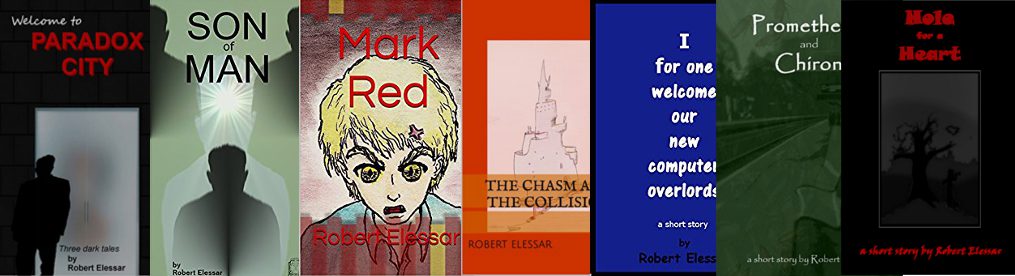
Here are some links to my stories/books to which I referred in this audio blog.

Penal Colony

Dr. Elessar’s Cabinet of Curiosities

Welcome to Paradox City


And here’s the home page for Nick Bostrum, a very smart philosopher (he’s younger than I am!  I didn’t realize that before).

And here’s the link to Sean Carroll’s podcast, which I readily recommend.