This post relates somewhat to my regular post from earlier today.
Here is a link to the book I mentioned.
This post relates somewhat to my regular post from earlier today.
Here is a link to the book I mentioned.

Meet the new day; same as the old day. Or at least, in everything but the trivial details, every new day is indistinguishable from the previous oodles of days. It’s just a full rotation of the Earth around its axis, such that when it’s done, the same points on Earth are lined up with the same…
…well, okay, here there’s some variation depending on how you’re measuring the day. There are solar days (our usual measure), which are reckoned when the same line of latitude points “directly” at the sun again. But, of course, the Earth is moving relative to the sun, and at a noticeable rate: it goes roughly one 365.25th of the way around the sun in one day, and so it takes slightly longer to get back to the original orientation toward the sun than it would otherwise.
Then there are sidereal days, in which we reset when the same point on Earth is aligned with the same relatively distant stars. Such distance means the angular change to those stars caused by Earth’s motion is much smaller than the angular change to the sun. So those day lengths are, I believe, more consistent, but they are actually slightly less than 24 hours long.
I suppose, at our current level of technology and understanding, the most consistent day measure would be Earth’s rotation relative to specific spots on the cosmic microwave background radiation, which would basically be as far away as anything we can measure.
The Milky way is moving slightly relative to the CMB though. I think this is called proper motion*, but I may be misremembering that term. Still, that rate of motion is tiny relative to the scales involved. Although, come to think of it, since the Earth is moving within and along with the Milky Way, it’s possible that the Earth’s motion relative to the other, relatively distant stars within the galaxy may be smaller than its motion relative to the CMB.
I don’t know whether or not that is the case. If anyone out there knows off the top of your head, I would be delighted if you would let me know. But don’t bother Googling it, or asking some LLM about it; I can do that for myself if we’re going to resort to such tactics.
Speaking of relative motion and such, I did something relatively new yesterday afternoon with respect to reading. Allow me to set the stage**.
I recently started dabbling (very inconsistently) in the online courses at MIT (and other universities) on their YouTube channel(s). I started with Quantum Mechanics and then also started the General Relativity course, since I have some personal curiosities related to that subject that I’ve yet to see answered.
In the first lecture, the GR professor went over the main texts they would be using. Well, I already have two of them, so I figured I would get the third. I ordered it in paperback (the hardcover was ridiculously expensive, whereas the softcover was about the same price as any good-sized trade paperback). After it arrived, it sat rather forlornly on my desk for some weeks.

oplus_34
Now, as I’ve said, I’ve been having a hard time reading fiction or nonfiction lately. But a softcover textbook is no heavier than my lapcom would be, unlike the two hardcover GR texts I own. So I brought the text General Relativity, by Wald, with me when I left the office yesterday.
The cool thing is, I actually read from it while waiting for the train and then while on the train. I completed the preface/introduction and chapter one! It’s not a long chapter, of course, and it mostly reviewed concepts of special relativity and so on***, which I know relatively (har) well.
Still, I feel reasonably pleased to have done this, and I hope to continue the process. Maybe once I get this book under my belt, I’ll feel more inclined to do similarly with Sean Carroll’s Spacetime and Geometry, which is hardcover but not too terribly heavy. Gravitation, on the other hand, is a book comparable in scale to Harrison’s, the “bible” of internal medicine. It’s not a book one tends to carry around (though it provides its own rather pointed example of the effects of gravitation).
Anyway, with any luck, maybe I’ll inaugurate a more useful commuter reading schedule. And maybe I’ll achieve enough skill at GR that I might be able to explore my perennial question. At least, I should be able to learn more stuff, and that’s always a good thing.
I hope you all have a good day.
*Actually, no, in astronomy “proper motion” has to do with angular movement with respect to more distant stars, or something along those lines. I don’t think it’s a great term for that. The motion of a galaxy relative to the CMB is apparently called the “peculiar motion”, which seems like a rather peculiar choice to me.
**I don’t know how you could stop me even if you so wished.
***It has one practice problem, which is a version of the classic barn door paradox aka the ladder paradox, but I didn’t work the problem. I know the basic answer already; it involves the relativity of simultaneity in special relativity, and the author asks us to draw a spacetime diagram demonstrating the basic issue. I had no resources to do this on the train.

Well, it’s Friday at long last, the end of the “official”* work week. My mood is at least somewhat better than it has been previously this week; starting midmorning yesterday, my mood increased and I even became somewhat playful and a bit silly. This was, hopefully, thanks to certain interventions I have undertaken, and not just because of some low-grade cycling of my mood.
As far as I know, I don’t have any form of bipolar disorder; certainly no therapist has even mentioned considering that as one of my issues. Then again, none of them (to my recollection and knowledge) considered the possibility of undiagnosed ASD. But I have, apparently, done quite a good job at masking over time. Or so I believe.
Anyway, I’m not going to be working tomorrow after all (my improved mood long preceded my learning this fact). In fact, I’m going to be getting together with my youngest to have a late Father’s Day outing. That also came about hours and hours after my mood had improved, and after I had learned I would not be working.
That’s about as good as my life gets, and has gotten, in nearly a decade and a half, but it is quite good. The only thing that might be better would be if my son were also coming, but I cannot get my hopes up about such things. He does as he must.
I’ve lately taken to rubbing Aspercream™ with lidocaine all over the MCP joints and the interphalangeal joints of my thumbs, and it seems to be doing at least a little to ease the pain of my arthropathy therein. This helped make me willing at least to try to play guitar (and sing) a little bit yesterday. I was still a bit stiff, but it wasn’t too bad. Mind you, I didn’t do anything particularly fancy; the Bach piece I’ve mentioned was the most challenging part of the session.
I have a whole repertoire of songs I can sing and for which I can play chords from memory. It’s not a big playlist, but it’s there. Ironically, it doesn’t include any of my songs, which I would have to relearn at this point! That’s kind of sad, really. But it is a weird thing that I’ve noticed, that once I’ve made and shared a video (or even just audio) of me doing a song, I tend to stop playing it at all. It’s quite strange, at least to me. Have any of you encountered anything like this?
This shouldn’t be confused with the general anhedonia I’ve been experiencing lately (not for the first time); that makes me not really interested in playing anything. I also have not been able to find anything that I can keep reading for more than 10 or, at most, 20 minutes before getting bored of it**.
I’m trying to read something different now, so I downloaded some Star Trek and Star Wars novels from Kindle Unlimited, and we’ll see how they go. Currently, I’m reading the novelization of Into Darkness, which I think was an underrated movie. Did it play fast and loose with certain aspects of important characters from TOS? Absolutely! Even so, the surprise was fun, and the casting, I thought, was very good, as were the performances.
The book is by Alan Dean Foster, who is one of the most reliable science fiction authors out there. He has written quite a few of the best novelizations of science fiction movies.
I also downloaded the novelization of The Wrath of Khan, one of my favorite movies. I’ve read the book before (by Vonda McIntyre, who is at least as good, if not as prolific, as Foster), a long time ago, and it was good, so hopefully I’ll enjoy it again.
On a somewhat related note, as a very big fan of Doctor Doom, I am rather nervous about how he will be portrayed in the upcoming MCU movies. He has been badly written so far in the movies that have featured him, though I thought Julian McMahon (RIP) was well cast and did what he could with the role.
But I’ve long said that if anyone wants to know how to portray Doom onscreen, there is a nearly perfect performance on which to model one’s acting, and that was Ricardo Montalban as Khan, especially in the movie (though the original Trek episode Space Seed is also great). Khan is a lot like Doom, though he has a more sentimental, romantic aspect to his character (it’s the death of his wife that leads to his wrath in the movie, after all). Still, the charisma, the brilliance, the arrogance (and, alas, the overconfidence and the tendency to be consumed by vendetta) match the best-written aspects of Doctor Doom’s character.
To be fair to Khan, he is kinder to his subordinates than Doom sometimes tends to be. This, I think, is one of Doom’s biggest flaws. Then again, I suspect Doom is “on the spectrum”, so he doesn’t necessarily really get how to manage people at a personal level, though as a national leader he is unsurpassed.
I know, I know, I’m being fanciful, but I really do love these characters. They are bad guys, certainly, but they are not really evil, or at least not psychopathically selfish and shallow the way, say, Voldemort is. I’ve said before, Doom and Batman are in many ways very similar characters. Both have similar tragic backstories and are obsessively driven, implacable, indeed all but unstoppable, and neither of them has actual super powers (contrary to what was represented in the first two Fantastic Four movies).
I wish Julian McMahon had a chance to play a well-written Doctor Doom, because I thought he was an excellent casting choice (and I’m pretty sure Ricardo Montalban was not available).
Okay, I’ll draw things to a close for the day and for the week. As a parting “bonus”, I’ll embed below some old audio files (NOT high quality recordings – lots of clipping and some flubs and occasional pitchiness) of songs I have recorded me practicing and singing, just for fun, in case you’re interested.
I hope you all have a nice Friday and a good weekend. There’s a big sporting event on Sunday, I think; if you like those kinds of things, why not take that in?
Sore dewa.
Nothing Compares 2U – originally by Prince
Karma Police – Radiohead
Just the Way You Are – Billy Joel
Here, There, and Everywhere – the Beatles
Here Comes the Sun – the Beatles
Desperado – Eagles
Fake Plastic Trees – Radiohead
Julia – the Beatles
*I’m not sure what exact office might be involved in that determination, but whataya gonna do?
**Though I have been doing some exercises on Brilliant dot Org lately, focusing for the moment on vectors and working into matrices and related stuff, with an eye toward General Relativity.

After my little test yesterday of the “writing a blog post directly on the app related to my WordPress account”, I considered writing this morning’s post directly on that app, just to see how it went. However, I don’t yet know how to keep track of my word count on that app*, and I don’t feel like doing any trial and error exploration this morning‒not of that, anyway.
So, I’m writing this instead on the usual Google Docs app. Google Docs has the advantage that when I write this document on my phone, it automatically saves to my Google Drive, and I can then readily open it up on any computer that has an internet connection. That’s fairly handy.
Of course, it means that I’m putting many eggs in the Google basket, but for these purposes, I’m okay with that. Also, when it comes to phone apps, Google Docs is so far the best word processor I’ve tried, as far as interface quality goes. The same cannot be said for the desktop app, but it’s perhaps better than it used to be.
I don’t really like to leave my fiction in Google’s hands if I can help it. I like having a hard copy, so to speak, of my fiction writing. So far, except for those which were written with pen and paper for the first draft, all my fiction has been written on MSWord (and even the handwritten ones were completed on Word). I used to recopy each file onto a thumb drive after a day’s writing, in addition to keeping it saved on my mini lapcom, so I knew I had at least two up to date copies. Then‒once it became a thing‒it would also auto-save onto my Microsoft OneDrive.
The inception of the latter made me think that maybe I could write everything on the Word app for smartphones. It auto-updates in a fashion similar to Google Docs. Alas, it’s not nearly as fluid and seamless as the Google app. If it were, I would probably use it, although‒the nature of Microsoft accounts being what they are‒I wouldn’t be able just to pull it up on the work computer, since it uses a different (boss-related) Microsoft account. So, I would have to send a file as an email or something no matter what.
I’m sure there are ways around that‒or, well, there may be ways around that‒but the phone app for Word just is too cumbersome for now. It’s not worth the effort.
Sorry, I know this is probably dreadfully dull to all of you. I’m impressed that you’ve read this far. You may know, I guess, that I don’t plan these posts out ahead of time, I just spew out whatever comes into my head. If you find it tedious or infuriating, just imagine how I feel! You, at least, could always navigate to another website. What am I supposed to do? I can’t even get away from myself by sleeping most of the time.
Anyway…
I’ve been doing a little bit of rereading of some of my fiction recently. For instance, yesterday afternoon, while waiting for my train, I finished rereading The Chasm and the Collision.
I still like it.
I have a hard time feeling good about things that I do (and am) but I think CatC is a good story, and I think its world is interesting and that the characters are good and so on. I think there are probably a lot of people out there who would like it. And, like I mentioned sometime earlier this week, it would be really cool to encounter fanfiction based on it.
Alas, I am not good at self-promotion. I don’t like myself, so it’s hard to find the will to promote my work, even when I like the work. It’s quite dispiriting, and the fact that I can only hold myself, and my nature, responsible for it doesn’t make it any easier to swallow that bitter pill.
Now I’m rereading Unanimity: Book 2, though I’m not sure if I’ll read it all the way through to the end. That’s another book that I think is good, though it is long, and some of the characters aren’t as likeable as in CatC. Of course, they’re not supposed to be likeable, when they’re not. It is a horror story, after all, and in many ways it is one of my two most horrifying stories. Weirdly enough, those two most horrifying stories are my longest and my shortest works.
On the other hand, my sister recently pointed out to me that‒ironically‒my most lighthearted story is The Vagabond, which is a sort of old-school, gonzo horror story. She’s right. I guess that lightness shows that I wrote it (originally) while in college and med school.
The heck with it, all of my stories are good. Some are better than others, and different people would surely prefer different ones, but I think they’re all pretty good. Even the stuff only published here like Extra Body (which is complete) and Outlaw’s Mind and The Dark Fairy and the Desperado (those two are not complete) are good. So read them. Read all of my stories. Tell your friends and families and even your enemies and strangers about them. Spread the word far and wide across the land. “Stop all the clocks, cut off the telephone, prevent the dog from barking with a juice bone”. Okay, well, maybe not that last bit, but do get the word out.
Thanks.
Okay, well, tomorrow I work, so expect a blog post tomorrow, whether you like it or not. I may do another test post this afternoon if I get a bit bored, mainly to see if I can sort out the word count stuff on the app for WordPress. If so, I’ll post it. If not, of course, I won’t. It’s funny how that works, isn’t it?
I hope you have a good day.
*I need to keep track of that because I can sometimes get quite carried away.

It’s Tuesday now, and I’m writing this on my mini lapcom. I don’t know if I wrote any of my posts from last week on the lapcom*, but so far this week, this will represent 50 percent of the week’s posts so far.
Admittedly, that’s not saying much, and one cannot draw many conclusions from a two-item sample in which one is one way and one is another. To presume that they will continue to occur in a 50/50 ratio would be a major statistical/probabilistic error. At best, one can say that there are at least two ways in which my blogs can be written, since two have so far been sampled—and that is certainly true.
Anyway, speaking of twos, it’s Tuesday. It’s the 10th of March, of course, and the second full weekday in Daylight Savings Time, or in non-Daylight Savings Time, whichever one it officially is now. You can tell that I really don’t see the sense in the whole thing from the fact that I cannot even recall nor logically infer which of the two possibilities is correct. When I am actually interested in something, I tend to try quickly to dispel any ambiguities in my understanding if I can. With this, I really don’t care, because it’s all silly.
In fact, it’s so silly that I think that’s all that need be said about it. On to better things, or at least to other things. But, of course, the question now is: What other things should I discuss**? I don’t know, honestly.
I don’t know dishonestly, either, come to think of it.
Isn’t it weird how much of a habit it is to say things like, “honestly”, or “to tell the truth”, or “I swear”, or other similar words and phrases to try to emphasize the authenticity of our words? But they don’t do anything at all to confirm our truthfulness; epistemologically, they’re almost without content. If anything, the fact that we felt unsure enough to have to say we’re being honest might raise a so-called red flag in the mind of a given listener.
Does the fact that a person says “honestly” or “I’m not gonna lie to you” or any similar phrase actually provide any information about truthfulness, except for the fact that this person recognizes that truthfulness is valued, at least by the person to whom they are speaking? It doesn’t really demonstrate truthfulness, I think that’s clear.
Some might be inclined to think that the words actually indicate falsity, but that’s not true, either (ha ha). It may be the case, at times, that a person who is trying to deceive another may say “honestly” to reassure their interlocutor that their lies are true and also to relieve some of their own anxiety. But people who are telling the truth may merely want to recognize and emphasize that fact, and so use the same phrases. They may, for instance, realize that something true they are saying could seem improbable to some hearers.
If it were always a harbinger of a lie, then such a seeming reassurance would indeed be a reliable signal, but of the opposite state from that described in the message’s content. People would very quickly stop using it—the honest ones wouldn’t want to use it, since it always implies dishonesty, and the dishonest ones wouldn’t use it because it would be a dead giveaway.
Somehow, seemingly at least partly because it is an ambiguous signal, it stays in our discourse and is used automatically, more for emphasis and for rhetoric than for its prima facie purpose. I’m sure Steven Pinker could give a good explanation for why this is so, or at least part of an explanation. I know he’s come out with a recent book about mutual implicit knowledge and its nature (and its implications), but I don’t have it yet, and I haven’t read it.
I’ve read some of his other books and enjoyed them. I seem to particularly enjoy his work as audiobooks. I listened to The Better Angels of our Natures in audiobook format during my then-commute, using a Bluetooth enabled motorcycle helmet. That book is almost 40 hours long on audio, but I was sad when it was over. There was not one dull moment for me (of course, I was riding a very fast and non-armored conveyance at the time, so even if the book were to have become dull, there would have been other matters to keep me alert).
Okay, well, I’ve managed to meander about lexically—is that the proper term or not?—without any clear destination in mind, other than “at least 700 words”, and have written some vaguely coherent sentences about some distantly interrelated subjects. I hope I have at least mildly entertained you, the reader.
I know, hopefully there is more than one of you, but only one of you can be reading this at one time in one place. Now that’s a vaguely interesting thing to recognize: reading is only ever a solitary process. One can read alongside others, but one cannot share the process, even if several people are all listening to the same audiobook at once. Reading does not add in parallel, only in series.
With that little tidbit that some of you will recognize and others will not, I’ll call this blog post to a close. If there are no objections? No further business? Very well. [Smacks the gavel on the table] This blog post is adjourned.
*I did not.
**Certainly not those round Frisbee® things they throw competitively in the Olympics.

Please forgive me if I behave or speak as though today were Tuesday. I know that it is in fact Wednesday as I write this‒it’s anyone’s guess on what day of the week you might be reading it (though I suspect that, for the most part, if one doesn’t read my blog on the day it’s posted, one is unlikely ever to read it)‒but I didn’t write a post yesterday (Tuesday) so I may be a bit thrown off.
I didn’t write a post yesterday because I didn’t go to work yesterday. And I didn’t go to work yesterday because of pain. I had already been having a bad pain day on Monday, one in a long string of worse-than-average pain days. Then, in the evening on Monday, while trying to reach for something in my room, I took a bad step on the tile floor and slipped and nearly fell.
I caught myself, as is implied by the “nearly” in that last sentence, but I wrenched my back significantly, and the night and morning and so on were particularly bad, and I hardly slept and I did not have the energy to go to work, or at least to do so and not spend all my time writhing and snapping at people. So I stayed at the house.
Regarding chronic pain, I’m fond of quoting Ulrich’s description of Vermithrax from Dragonslayer: “When a dragon gets this old it knows nothing but pain, constant pain. It grows decrepit. Crippled. Pitiful. Spiteful.” I had to double-check and fix a few words to get the quote exactly correct, but the most important parts are always remembered correctly. And the whole thing feels like it describes me pretty well.
I used to be much more pleasant and amiable than I have become since my chronic pain began. Though I’ve had problems with depression since my teens and anxiety before that and ASD since I was born (in two different senses), I always tried to be polite and amiable and kind as much as I could. I always figured that was the real position of strength: not being in competition with other people but just trying to do your best while others do similarly.
But when one is in chronic pain, it is hard not to be grumpy (presumably even if one hasn’t lost almost everything one had worked to achieve through the first thirty plus years of one’s life, though I cannot know for sure). I think there are people who have only known me since the time of the beginning of my back problem who would be surprised by how pleasant I was back in the day.
Though, there are those who read this blog who did know me in the past, before the aforementioned time, and maybe they would give a different report. I can only share my own perceptions and perspective, and I could to a certain degree be mistaken about how I came across to other people.
I’ve never been all that good at knowing what other people think of me. Because of that, I generally try just to take people at their word, and take those words to have their most straightforward meaning. If someone hopes to hint at something and I don’t get it, that’s on them. Hints are overrated even when given and received by people who embrace the practice and consider themselves good at it. There are too many possible variations and points of incomplete information.
Anyone who has saved and transferred a video file and has also saved and transferred word processor files should grasp the difference, at least if they have been paying any attention. A video only a few moments long can, despite the latest compression algorithms, have a storage size that dwarfs the size of even, for instance, the word file for the unsplit book Unanimity.
Now, Unanimity is about half a million words long. It’s certainly the longest thing that I have written. But a video I did on my phone last week for minor fun, which was maybe 20 seconds long, takes up more than 16 meg, while the combined file size for the Kindle versions of both Unanimity: Book 1 and Unanimity: Book 2 is about 3.5 meg*.
That’s a few minutes of stupid and pointless video which will never be shared anywhere versus a work that took more than a year for me to complete, edit, and publish.
At least it’s fair to say that, from a useful information point of view, my book was and is much more efficient. Though it requires enough shared experience for others to fill in meanings and images of things described, this is not a requirement that isn’t met by nearly every human on the planet. Perhaps videos would be better for a truly alien species that was hitherto unfamiliar with human civilization.
Okay, well, that was a weird post, I guess. I mean that in absolute terms, mainly; I don’t know if this post is much weirder or much less weird than my usual posts. Possibly every potential interlocutor would have different things to say about that.
I guess that’s okay. It had better be okay, if it’s true, because if it’s true, there’s nothing anyone can do about that, and they’re already living with it. This is the Litany of Gendlin, as quoted by Eliezer Yudkowsky, of which I have a screenshot from his book Rationality: From AI to Zombies, below.

Well, I hope you have a good day, whatever the truth is that you and all the rest of us are living.
*This is according to the AI summary of Google’s search for “Robert Elessar Unanimity file size”. It’s almost certainly correct, because the info is part of the Amazon description of the book. But it’s humorous to me that it’s easier to do an AI based web search to find the file size of my own novel than it is to look up the file, since I’m using my phone and don’t have direct access to the original at the moment.

It’s Friday again, but that’s not much consolation, since the office is open tomorrow and I will be working, unless I am lucky enough to get very sick or very injured or to die or something.
As usual, I have no idea what would be good to write today. Actually, goodness—certainly in the moral sense, but possibly also in the sense of quality—probably doesn’t have much to do with my blog. Perhaps weirdness would be a better adjective/measure to relate to my writing.
I’m probably not an objective judge of such things. Then again, I don’t know of any fully objective judges. Still, there is some degree of variability involved in such things, as in nearly everything else made up of smaller, more fundamental parts that are interacting in complicated ways producing so-called emergent behavior. Nevertheless, cognitive biases are reasonably well studied, as are many emotional blind spots and the like. And it’s certainly true that I have a difficult time being objective about myself and about my work.
Oddly enough for such a self-despising person, I actually like my own writing, especially my fiction. When I reread my stories I don’t tend to see them as horrible or wretched or whatever traditionally happens with “artists” who look at their own work. I think at least some of that sort of thing is probably affected, since our society (perhaps semi-deliberately) looks down upon artists who think highly of their own art.
If only we did that with politicians; there’s an area where humility would be welcome and beneficial, I think.
Anyway, I tend to like my stories—I wrote them, after all, because I wanted to tell and thereby hear those tales—but I don’t necessarily think they’re great or good or decent from anyone else’s point of view. I honestly don’t know how good or how bad they might be from nearly any others’ points of view, except my sister’s, and she’s probably almost as prone to be biased about my work as I am.
Though, again, my attitude toward my writing is not akin to that oft-noted personal bias that leads more than 90% of drivers to think that they are in the upper 50% in ability (i.e., above the median), which is a mathematical impossibility* for them actually to be. I don’t think of my writing as better (or worse) than average or the median.
I don’t really compare my writing to anyone else’s. I just tend to like it. That’s probably a very good thing, because I have to edit it myself. Even these daily blog posts are run through three more times after my first draft. My fiction I tend to reread and edit seven times (that took a very long time with Unanimity). Why seven? Well, I had to pick a number, and once or twice is clearly too few, and thirteen would just be unworkable.
Also, with my fiction, I tend to follow advice Stephen King repeated in his book On Writing by working to reduce my final word count by at least ten percent by the time I’m done editing it. I used to try to do that here, but I sometimes add a bit during editing, so that becomes quite difficult and hardly worth the effort.
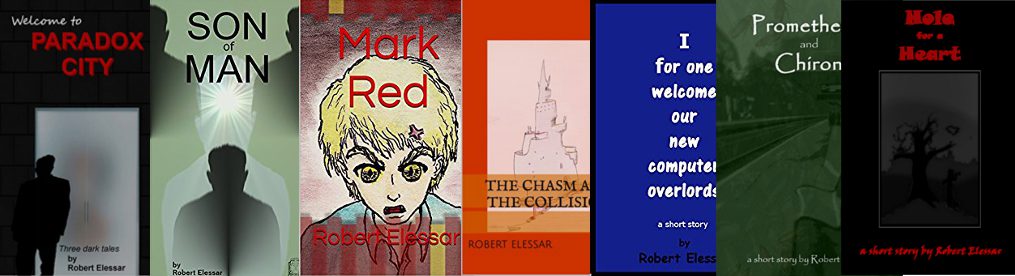
All that being said, it would really be nice to get some feedback on my writing, especially on my stories (from people who have read them). Of course, I would love it if someone loved my stories and told me so and told me why. The closest I think I’ve come is a review on Amazon of Welcome to Paradox City that was written by a former high school friend (he has since died of cancer, sadly) who had actually honestly bought the book for himself when it came out. He wrote that the three stories in that collection each made him wish they were the beginning of a whole book, basically implying that he wanted to know what happens next.
That’s a good thing about short stories—you can leave people hanging and that’s just “too bad” for them (though it can be enjoyable). Short stories also don’t have to have “happy” endings, which is good for me, since only one of the three in the above collection ends happily in any reasonable sense.
Of course, as I’ve noted before, my short stories are rarely short enough ever to have been, for instance, published in a magazine in the old days. The only real exception to this is Solitaire, which I don’t think any magazine would have published, because it is very, very dark indeed.
Okay, well, I guess I ended up writing something today, even if it was all just figurative omphaloskepsis. I don’t know whether you readers consider this good or bad or ugly, or how it compares in your estimation to posts like I posted yesterday and/or the day before. If you’re so inclined, please let me know.
And if you have actually bought and read any of my books, I do beseech you to leave me a review on Amazon (or wherever) if you get the chance. Thanks.
I’ll write at you tomorrow, barring—as always—the unforeseen.
*It is not, on the other hand, impossible for 90% of people to be above average (i.e., above the mean). I’m sure I’ve addressed this before, but imagine one had administered a test, and 100 people took it. Imagine that 90 of those people got 51/100 on the test, whereas the remaining 10 people scored zero. Then, the arithmetic mean (what people usually mean by “average”) would be (90 x 51)/100**. That goes to 4590/100, or a mean score of 45.9. So, 90% of those people scored above average. That’s not saying much, but it’s true.
** Yes I know I don’t really need the parentheses there, but I’m leaving them in for clarity.

Well, it’s Friday the 13th. That’s at least one good thing about today. And, of course, next month will also have a Friday the 13th, as I’ve noted previously (I don’t know specifically in which post I noted it, and I don’t really have the urge to go figure it out, so I’ll leave that to you to do if you’re interested).
It is slightly interesting to think about the fact that, on average, one of every seven Februarys will have a Friday the 13th, but not all of those will then lead to a subsequent Friday the 13th in March, because every 4th February will have 29 days*, by the Gregorian calendar, which is the one the world uses overall.
So, the total fraction of years with dual Fridays the 13th would be something like 1/7 minus a further ¼ of that one seventh—so 4/28 (i.e., 1/7) minus 1/28 (1/4 x 1/7), which leads us to the rough conclusion that only three out of 28 years will entail February and March each having a Friday the 13th. That’s slightly less than one out of every nine years. And since I’m 56, which is twice 28, I should have experienced about 6 such years in my life (perhaps counting this year).
Mind you, the numbers aren’t quite right overall. The Gregorian calendar waives the extra day in February on years that are divisible by 100, i.e., the turns of centuries. However, there’s a further exception to that: the turn of a millennium, like what we all just had in the year 2000, does keep its 29 days in February. So that brings the average closer to the raw number, but doesn’t account for the extra ones that happen at more ordinary turns of centuries.
Of course, the only turn of a century through which I have lived—and through which I am likely to live**—was indeed the turn of a millennium, so I guess for me, the fraction 3/28 should be fairly accurate.
I could, if I were so inclined, go back to the first year in which I experienced a February—that would be 1970 (AD or CE)—and work through them to find out just how many dual Fridays the 13th I’ve experienced. With modern computer-based calendars it would even be relatively easy. But I don’t think I am so inclined.
Okay, that’s enough of that for now. Actually, it’s probably too much of that, at least from any normal person’s (i.e., not my) perspective. On to other things.
I’m writing this post on my mini lapcom, and I wrote yesterday’s post on the lapcom as well; I am doing this partly to spare my thumbs, but also to try to encourage myself to use the lapcom more and maybe even to write fiction again. I don’t know whether or not that will happen, but it’s also just more natural for me to use the lapcom. I’ve been typing, in one way or another, since I was 11 years old, if memory serves. Clearly I have not been using a smartphone nearly that long, because they have not existed for that long.
Also, even when I saw the imagined future tech on Start Trek: The Next Generation of tablets with virtual keyboards, I thought they looked like a terrible idea. How lame, how unaesthetic, just to tap at a flat screen with no real keys. Also, the “keys” on such devices in the real world are too effing small to be used to type in any traditional way. Not but what one can get to be pretty speedy with them—I can zip along pretty well on my smartphone—but it’s nothing compared to being able to use one’s whole set of fingers to write.
Although, I’ve often touted the value of writing things longhand before retyping them into the computer, especially for fiction, because it can slow one down beneficially. I did that—because I had no choice, being at the time a guest of the Florida DOC—with Mark Red, with The Chasm and the Collision, and with the “short” story Paradox City. I don’t know whether they come across as better or worse or indistinguishable from the stories I have written directly onto the computer.
I would say that they might tend to be shorter, but Paradox City is a nominally short story that was about 60 hand-written pages long, so that didn’t make things much shorter. Also, I think The Chasm and the Collision is longer than Son of Man, but that may just be a function of the nature of those stories.
Certainly Unanimity is longer than anything else I’ve written, by quite a margin, but that surprised me as much as it might anyone else. I just started writing the story and it ended up taking that long to tell it. That happens. Outlaw’s Mind began as an idea for a short story, but there was definitely a lot there implicitly, even in the original idea, that made it unreasonable to plan to make it “short”.
Anyway, if any readers of this blog have also read my stories and have noticed any tendency toward difference between the initially handwritten and the entirely computer written (meaning written on a computer, not by a computer, unless one is referring to me as a computer) ones, I’d be pleased to get your feedback.
In other personal news, well…my pain is leveling off a bit, though my leg joints still feel loose and floppy and unstable, so I have to be careful, and I have my general persistent tension and neuropathic discomfort in my lower body. I’ve tried to adjust (and decrease) my workout a bit to compensate, and that seems to be doing some good, but I cannot go without working out, because that tends to make my pain worse.
My mood is pretty much as it usually is, but I’ll spare you that hellscape out of courtesy.
Tomorrow is Saturday, and I am not supposed to be working this weekend. If that changes—in other words, if I do work—I guess I’ll write a post. Though, really, I should try to get back into Outlaw’s Mind and finish what I had started earliest so I could then get on to newer things. And if wishes were horses, we’d all be drowning in manure***.
Tomorrow is also Valentine’s Day, but this is of no relevance to me, and that holiday hasn’t been relevant to me for more than 15 years, possibly quite a bit more. It is not likely to be relevant to me again this side of the grave (and even less likely to be relevant on the other side).
I hope you all have a good weekend, even those of you who have loved ones with whom you can revel in the romance of the holiday. It’s not your fault that you piss me off.
*This means, of course, that there will be some March Fridays the 13th in years where there was no February Friday the 13th. If my figuring is correct, those will be the leap-year Februarys in which the 13th falls on a Thursday.
**If I were to be alive in 2100, I would be 130 years old, which would make me even with the Old Took, and which would be substantially older than any human is known to have lived.
***And ironically, any wishes for the manure to go away would just make things worse!

It’s Friday. yay.
Today’s date (February 6, 2026 CE or AD) has a mildly amusing coincidence/repetition of digits, 2-6-26 in the shortened American version of the date layout. In the European system, the date would be almost palindromic (6-2-26) but that’s leaving out the zeroes in front of the day and month digits and ignoring the number of the millennium. So it’s not quite as cool as it could be.
Some might say that such numbers and the arrangements and the noticing thereof can never be “cool”, but such people are troglodytic idiots. They live in a world full of and shaped by complex ideas, by innovation and technology they could not have invented themselves, and which they don’t bother to try to understand because other people take care of and do all that stuff.
I’ve said before, many times (with sadness and regret and yes, quite a lot of anger) that if it were up to most people, we would all still be living in caves (the few who remain alive, at least). That’s metaphorical, mind you; very few humans actually ever lived in caves as far as we can tell. It’s just that the remains of those who died in caves (and their artifacts) are much more likely to endure to be discovered than the tools and remains of those who lived on the savannahs and such.
Anyway, the troglodytes have a quite common attribute, one that might explain a good deal about them: even though they may have the capacity to read, even though they may have been taught to read, they don’t choose to do it. It’s both sad and quietly horrifying.
Even those who claim to read just one book (e.g., the Bible, the Koran, etc.) don’t even really read those books. You can tell, because they clearly don’t live their lives respecting all the precepts of those books.
This fact can sometimes be bad, but more often than that, it’s just as well. Those books are horrific (and often just horrible, aesthetically). They also tend to be rather stupid by modern standards, but it’s hard to hold them too much to task for that. They were, after all, written from depths of profound ignorance about the universe. One cannot know a truth before it has been discovered.
Of course, if those books really had been written, or at least inspired, by an omniscient being or beings, they could reasonably be expected to be very smart books by any standards. Alas, they are not. Trust me, I’ve read many of them, as well as many other books that don’t claim to be the products of omniscience, but which would be far more convincing* if they did than those ancient compilations of legend and myth and mental illness that are the so-called holy books.
Ironically, the Tao te Ching is much wiser than the aforementioned holy books, and it was never said to be written by anything other than a man. It’s not perfect, of course, but it doesn’t really claim to be so. Perhaps some of its adherents think it’s somehow “perfect”, but that doesn’t really matter. After all, there are probably those who “think” Mein Kampf and The Art of the Deal are perfect.
Weirdly enough, some of these people would probably also say the Bible is perfect [Disappointed shrug and heavy sigh]. People are stupid. And there are none so stupid as those who refuse to think.
Sorry, I don’t even know how I got to dealing with this set of subjects today. It certainly was not planned. Then again, nothing here was planned, other than that I would write a blog post as usual, which is not surprising.
It’s not as though I have anything better to do with my life‒that is, nothing better other than to shut it off, I suppose. But so far, I am too much of a coward to do that.
I know, I know, there are those who (with truly very good intentions) will call continuing to be alive a “brave” choice, but though I appreciate such people’s kindness, that “choice” is very much the default. In a similar vein, it’s not brave to hunt, or to fish, or to farm, if hunting or fishing or farming is what you must do to survive. It’s just pragmatic.
I am not brave for still being alive. This is not to say that it would be brave for me to kill myself, either. But it also would not necessarily be cowardly.
Bravery in the usual sense is overrated, anyway. We can (and should) all be glad, of course, that there are people like firefighters, as well as honorable soldiers and honorable police officers. But if one stops to think about it, one can see that we should all very much wish to live in a world in which bravery was not required, a world where heroes are not merely not needed but are not useful.
It’s likewise with so-called leaders. If a society were functioning well, it would not need (or want) heroes or leaders, at least not in the traditional sense. In a well-functioning civilization, people would see their elected officials as their employees, as the public servants that they are. They are not, and should not be thought of as, leaders. That’s just a troglodytic way of thinking.
Alas, we are far from such a well-functioning civilization yet. Who knows if we ever shall achieve it?
I do know, however, that I will probably be working tomorrow, which means I will write a blog post, barring (as always) the unforeseen. Until then, I hope you each and all have a very good day by any reasonable criteria.
*Especially modern science books.

It’s Monday the 19th of January (in 2026 CA or AD). 19 is a nice prime number, but it’s one people don’t think about very often. Stephen King turned it into an “evil” number in his extended universe, which is much less obvious and predictable than using the unjustly maligned number 13. I’ve always* liked that he did that. It was clearly chosen at least partly because it was (and remains, and always will be) a prime number. But it’s not an obvious one. So, nice job King-sensei (not that he needs my moral support, though I would welcome such support from him).
I occasionally think about mailing Stephen King a copy of one of my books just on the off chance that he might read it some day when he’s bored. If I were to develop the chutzpah to do such a thing, what do those of you who have read my stories think would be the best one to send him?
Take your time, and don’t be shy. I’d love to hear from all…what, one of you? Two?
I don’t think there could be three, but I could be wrong.
Returning to the topic of prime numbers, I had a cool thing happen on Friday: I bought some stuff at the local convenience store, and my total was $19.07. I looked at it for a moment and thought that it was a cool-seeming number. I know 19 and 7 are both prime, and the digits don’t add up to a multiple of 3, nor is the total number a multiple of 4 or 5, obviously. I wondered if it might be prime.
Back in the day, I would have had to check that more or less manually, but nowadays, I was able just to type into the search bar “Is 1907 prime?”
It is! Or so claims Google. If necessary, I could check it myself, by hand, though that would be laborious. I suppose it wouldn’t be hard to write a quick computer program to check all the possible factors (among numbers less than 954**). I doubt that I will do either thing, though. I’m pretty confident in Google on this point.
And now, having said that, I’m starting to feel uncertain. Could Google be wrong about this? Am I really going to have to check for myself?
I remember when I realized I had never seen the Pythagorean Theorem proven mathematically (I grew up in a declining school system, sorry). So, I had to prove it to myself to my own satisfaction, which I did. Thankfully, it’s easier to prove something like that when the answer (so to speak) is well known.

Okay, enough numeracy, or whatever the best term for the preceding matters might be.
I did not work on Saturday, which is why I didn’t write a blog post on Saturday. The office was open, but my coworker was able to come in, and the boss specifically told me to take the day off. Apparently, my exhaustion really was beginning to show, even to other people, which seems not to be the usual case.
Of course, having one day of actual rest doesn’t cure my situation, but it is a minor respite. I have more fundamental issues than mere rest or lack thereof, but I am not sure there is any way to fix them, at least not in practice.
In principle, of course, it must be possible at least to improve the settings in my brain‒tweak this set of synapses and adjust sensitivity to this or that neurotransmitter, increase (or decrease) the blood flow to this and that region of the brain, etc. That sort of thing, done precisely and judiciously, could in principle correct or adjust any parameter of brain function one might want, in whatever ways lie within the realm of the brain’s potential.
We’re a long way from being able to carry out such manipulations, and it’s by no means certain that we will exist long enough for neuroscience to achieve such things. But there’s no principle of nature that precludes it.
Of course, people might be quite leery of even researching such things, even when we finally know enough to do so. After all, if we can adjust the brain specifically and precisely to make it less depressed or less anxious or less forgetful, we can adjust it in other ways, too. One could adjust someone’s brain to make them fall in love with a particular other person, like the mythical old magic love potion. I think most people would rather not fall in love that way (though there’s no reason to think such love would be any less delightful to experience than ordinary, clumsy, stochastic love such as what we have now).
Indeed, one could adjust human minds to make them happy, no matter what the circumstances. Of course, this could well be used to dominate whole populations of people; one could keep them under constant control because they would be happy, and you could keep them motivated and loyal and satisfied with whatever their lot might be. I think most people would find that notion repugnant, but it is at least somewhat morally ambiguous, because such people would be as legitimately happy as anyone who becomes happy “on their own”. Indeed, they might well be happier than any person had ever been before, and more “well-adjusted”, and more creative, and more psychologically healthy.
I get near some of these concerns in my book(s) Unanimity: Book 1 and Unanimity: Book 2. I wouldn’t say those specific ideas figure centrally, though matters of mind and free will and the nature of a person’s character and how it can be changed by physical events are a big part of it. Also, all sorts of horrible things happen, since it is a horror novel. And there’s a lot of room for all of it, since it’s as long (total) as the unabridged The Stand and It, to bring us back to Stephen King.
With that, I guess I’ll draw today’s post to a close. Hopefully, I won’t already be exhausted by tomorrow. I hope you have a good day. And if any of you know Stephen King, please ask him which of my books he might think he would want to read. I’d really appreciate it.
*Well, not always. I didn’t like it before it happened or before I knew about it.
**Incidentally, 953, which is the rounded-down answer to 1907 divided by 2, is also a prime number. That’s kind of nice.
