Don’t be afraid of “scare quotes”; they are–as am I–here to “help”

It’s Friday at last, the last day of a work week that has lasted at least 12 days already (subjectively speaking).  I am not working tomorrow, so there will be no blog post made again until Monday, barring‒as must always be the case‒the unforeseen.

I will try to remember to send myself the audio files for my last two audio blogs‒or perhaps it was three‒to turn into “videos” over the weekend.  I haven’t downloaded clipchamp or whatever it is to my home computer, but it should be no more difficult to do there than it was at work.  Of course, I may not do that, so don’t make any plans that depend upon my doing it‒goodness knows what such plans might be.

I’m not sure if anyone really likes those “video” versions of my audio blogs or is just as happy with the plain audio.  I’ve noted before that storage on YouTube is functionally limitless (as opposed to WordPress) but if I’m loading them here first, anyway, that’s a moot point at best.

You may have noticed that I tend to put quotation marks around the word “video” when I refer to the above, because though technically they are indeed video files, the visual portion is just a static image.  I’m a big fan of so-called scare quotes.  I think we should use them far more often than we do.  People often arrogate terms to themselves, or use epithets against others, as a means of manipulation, as if invoking some sequence of letters or sounds causes a thing actually to be the case, and I think it’s important to point out when one is unconvinced that the term is being used properly or accurately.

Perhaps the most prominent and pointed such ill-use might be regarding “progressives” and “conservatives”.  Both groups inherited the terms from people who came before, and who perhaps more accurately embodied the general meanings of the words, but they are now simply camouflage uniforms, at least in many cases.  You can call yourself a “freedom fighter” if you want, but using that term doesn’t mean you’re not a terrorist or that you’re actually interested in any legitimate form of freedom.

Of course, real conservatives and progressives being at hostile odds with one another doesn’t make much sense if one is considering the usual meanings of the terms rather than claiming them as team names in some tribal contest of primate dominance.  It makes sense to conserve those things in a society that are effective, that have been tested by time and found to be useful, but it’s just as reasonable that everyone should want to make actual progress whenever possible, to improve life and prosperity for everyone as much as is feasible.

The real, useful discussion would be about which things are working well and should be conserved, and which things require improvement and how to go about it.  There will be substantial disagreement on such questions, of course, and part of the discussion must always be how to decide what best to keep as it is and what is the most fruitful area in which to improve things

People of good will‒who do not think in terms of “us” versus “them” but in terms of usefulness and effectiveness and trying to get the best outcome for as big an “us” as possible‒can work in ways that will be beneficial by whatever measures one might want to use, keeping in mind always that all conclusions are in principle provisional and all processes and people are fallible, but that all problems are in principal soluble.

I’m not sure humans are clever enough primates to achieve such matters for long.  They seem to devolve so readily into conflicting tribes.  I guess this makes sense given the ancestral environment, with groups of only on the order of perhaps about 150 people living together.  But there’s no good excuse for not recognizing that tribal modes cannot function ideally in a setting in which 8 billion people are interacting in a massive and incredibly productive and complex economy and polity.  At higher levels of complexity, newer “rules” are going to tend to be required.

Humans aren’t necessarily all that good at adjusting to such things, though.  I often think that it will require a new and ongoing external threat, such as a supervillain or an alien invasion, to bring humanity together in total.  I’ve often been tempted to volunteer myself for the position, since humanity really can be contemptible and infuriating to me.

It’s not that humans are worse than the other life forms on Earth; I don’t think they are.  Life in general is frequently vicious and cruel and wretched, with all living things riding the knife edge of death and extinction much, perhaps most, of the time.  Nature’s equilibria are not achieved by some beautiful, fairy tale cooperation and self-restraint between forest creatures or what have you.  Equilibria are maintained by disease and death, by starvation and predation.  Agent Smith was just wrong, dead wrong, in his assessment of life’s tendency to form such natural equilibria.  He was too generous in his assessment of non-human forms of life.

Humans, however, are more competent than other animals.  They are also the only ones even capable of seriously planning ahead to strike a flexible and ever-changing balance between conservatism and progress.  It’s that they so often fail even to try to rise above their lizard-monkey minds that is so infuriating, and they themselves are among the worst of their victims.

Sometimes I think just wiping them all out would be a kindness‒not to the rest of the living world, which is certainly no more admirable or worthy of kindness than humans, but to humans themselves.  After all, if a function in time is always negative, then integrating the area “under” the curve will always yield a negative, and a permanent regression to zero would be a gain.  Maybe the universe, or at least the Earth, would be kinder in aggregate if it were sterile.

It’s food for thought, at least, and it is tempting.  What do you all think?  I’m not asking what you feel.  I hate feelings*.  But when you are as close to dispassionate and disinterested as you can make yourself, what do you think?  Does the human race (and by reflection, life itself) require an enemy to bring out its best?  If so, does it not then “deserve” that enemy?  And if it cannot defeat that enemy, does it not “deserve” to be destroyed?

I suspect that might be the case.


*Ha ha, that’s a little joke.

Stories and simulated universes and Laplace’s Demon and related stuff

Here are just some thoughts I spoke out loud this morning because I didn’t feel like writing.  They took a surprising course, but I hope they might be interesting.  Please let me know what you think.


Here are some links to my stories/books to which I referred in this audio blog.

Penal Colony

Dr. Elessar’s Cabinet of Curiosities

Welcome to Paradox City


And here’s the home page for Nick Bostrum, a very smart philosopher (he’s younger than I am!  I didn’t realize that before).

And here’s the link to Sean Carroll’s podcast, which I readily recommend.

Thoughts on confident statements about scientific fallibility

This is some audio I recorded this morning trying to follow up on the subject I brought up near the end of my last “audio blog”.  It relates to overconfidence about scientific pronouncements and so on both by the experts and by those who think they know the “real” motivations of the experts, particularly relating to the issues in the pandemic and so on.  It was triggered by a snippet of a conversation between Bill Maher and Seth MacFarlane, but I’m not sure where to find the original snippet.

As you will note, I did NOT make it shorter than my last audio.

[There is an interruption in the middle–presaged and followed by three chirps–in which I say what I had meant to say upon bringing up a particular subject, but then distracted myself completely by discussing some excellent YouTube channels about science and math.]

Here are some links to the YouTube channels I mentioned (along with one or two I did not) and which distracted me.  I heartily endorse them:

PBS Spacetime

PBS Eons

PBS Infinite Series

Be Smart

Numberphile

Sixty Symbols

Deep Sky Videos

Periodic Videos

Computerphile

Morgoth, Arda, redemption, morality, and blame (not the name of a law firm)

I was out sick yesterday, but the following is audio I recorded this morning about ideas of redemption and recreation in the world of J.R.R. Tolkien, especially as goes for beings and characters such as Melkor/Morgoth and Sauron and the like.  It’s a bit meandering, I fear, and it’s longer than other recent stuff has been, but please let me know if you find it interesting, and if you have any comments on the subject(s), or on such audio posts in general, I would be glad to receive your feedback. I’ll probably be turning it into a “video” eventually, for YouTube.  I don’t know, are those easier to partake of than the audio here on the blog?  Certainly the storage availability on YouTube is functionally unlimited, but I’m not yet anywhere near the limits of my personal storage here on WordPress yet, anyway.

This probably almost would count as a podcast, though I don’t know whether I feel comfortable arrogating that status to my measly ponderings.

Let me know what you think, please, and thank you.

Addendum:  Here is the link to In Deep Geek.  

I also highly recommend Nerd of the Rings.

Mad morning musings and “The End of All That Is”

It’s Wednesday morning again, and here I am, reverting to habit, writing a blog post (this time on my smartphone) because I frankly can’t seem to think of anything better to do with my time.

Well…I could sleep.  That would be a better use of my time.  Except I can’t sleep.  Even on weekends, the only way I get myself to sleep through the night is to take two Benadryl™ before I lie down.  But that’s not really effective, restorative sleep, and though I stay in “bed” later, I can tell the next day that I’m not really rested.  Or maybe that’s just residual effects of the antihistamine, I don’t know.

The best thing about when I was taking Paxil for my depression‒which didn’t work overall, and gave me bad side-effects‒was that it made me not just able to go to sleep at night, but to actually feel good going to bed and going to sleep, to enjoy the process.  I had never experienced that before, nor have I since.  But, as I said, there were other side-effects that made it quite bad.

Also, it made me gain weight, which would be particularly bad now, because I’m already heavier than I’ve ever been.  That’s what can happen when one’s only reliable pleasure comes from eating, and when one also eats as a sort of “stimming” and soothing thing to try to ease a constant sense of anhedonia and stress and dysphoria.  And it’s not as though I could simply “embrace” my body size, because it comes with worsening pain and other unpleasant consequences.

Unfortunately, I don’t get immediate worsening of pain when I eat.  It’s delayed.  If it were immediate, I would probably develop a habitual avoidance, and that would be great.  I try to remind myself, when my ankles and knees and back and hips are hurting a lot, that this is caused, at least partly, by eating too much, but that auto-suggestion doesn’t seem quite to work.

I’m pretty sure that I would eat less if I slept better.  Chronic sleep loss tends to affect one’s regulatory and stress hormones, and can stimulate appetite (especially for carbohydrates) in many people.  I appear to be one of these people.

I wonder if I could figure out a way to cause myself pain while eating‒maybe I could put a clothespin on the end of my pinky when I eat, every time I eat.  I don’t know if you all remember, but having a clothespin clamped on your fingernail hurts quite a lot, and hurts even more (albeit briefly) when you take it off and circulation returns*.

If I could arrange something like that to happen whenever I eat, that would be useful.  I did have a TENS unit that never helped my chronic pain, but some of its higher settings could be quite uncomfortable.  I suppose it might be useful to train myself, though it would require setting it up and activating it every time I ate.  Also, I’m almost sure that I threw it away in frustration because it didn’t work.

It would be really useful if I could somehow trigger nausea any time I ate, as in the style of aversion training seen in A Clockwork Orange.  I suppose I could try to force myself to eat eggplant with every meal…but no, I don’t think I could.  It’s very hard to force oneself to eat things that make one feel sick.  That’s the whole point of this line of thought.  I guess I could look for some syrup of ipecac.  I’ve never used that, but I think they used to use it to make people throw up if they’d eaten something poisonous or the like.  It might be worth a try.  I think I’ll send myself a reminder to look it up on Amazon.

The train just arrived.  I must say, Tri-Rail seems to have deteriorated slightly since changing their schedules, but maybe they’re just in the middle of making adjustments.  I try to give other people and organizations the benefit of the doubt when I can.  The Principle of Charity is one that I think would be very useful for society as a whole, or at least for humans:  the idea of trying to see what people say and do from the best possible light you can, instead of reflexively assuming the worst, of getting judgmental and self-righteous and assuming anything you find even slightly uncomfortable is a personal attack on you, precisely because you feel uncomfortable.

If I took that attitude, I could definitely see myself trying to destroy the world or even the universe, because a lot of reality bothers me a lot of the time.  Fortunately, I know that my feelings are my problem and my responsibility, not anyone else’s.

Not that I don’t fantasize about global and even universal destruction when I’m feeling particularly pan-antipathic.  I imagine working to perfect technology to adjust the course of asteroids.  I could even sneakily get government funding to do so, but then I could actually use the technology to steer near-Earth objects toward the Earth rather than away from it.  Some good asteroid hits might be extinction-level events, and a comet impact (of sufficient size) could wipe out nearly all life on Earth.

I say “nearly” because some microbes are remarkably resilient.

Of course, if one could study the possibility of vacuum decay‒causing, for instance, the cosmological constant or the Higgs Field to quantum tunnel to a lower energy level‒that would produce a wavefront process that would obliterate all forms of matter, a wavefront that would expand at the speed of light and wipe out everything.

Well…it wouldn’t literally wipe out everything, actually.  First off, it would leave behind whatever cosmos is entailed in the new Higgs (or other field) set-point.  And, of course, beyond our cosmic horizon, there are bits of reality that are moving away from us‒carried by the expansion of spacetime itself‒at faster than the speed of light.  So the vacuum decay wave would never reach them.  But it would obliterate everything in the observable universe, and that might be heartwarming enough.

Vacuum decay, though, may not even be a physical possibility‒it’s not a consensus prediction, though there are reasons to think it might be possible‒according to the best models we have of cosmic history, the Higgs field did settle out in a non-zero state after the electroweak era, and if inflationary cosmology is correct, then the “inflaton” field similarly decayed.

Still, we also have no idea how (or if) such a decay could be triggered.  There is no apparent risk of initiating it through highly energetic physics, because there are constant, extremely high energy processes happening in the cosmos, and everything we can see is all still there, as are we.

Oh, and contrary to the X-Men comics’ Phoenix/Dark Phoenix saga, unfortunately, a “neutron galaxy” would not be “The End of All That Is”.  If such a “neutron galaxy” were to “appear” in the middle of the Milky Way, that would be bad for us, though its effects would take a while, since even gravity doesn’t travel faster than the speed of light.  But effectively, a “neutron” galaxy would be no more cosmically devastating than a supermassive black hole with the mass of a hundred billion suns or so.  That’s a big black hole, bigger than any we’ve seen (and probably too big to be expected to exist at the current age of the cosmos), and as with any black hole, if you get too close it can be bad news**, but from a distance its effects would be no more harmful than an ordinary galaxy of equivalent mass.

Oh, well, I’ll have to keep brainstorming ways to destroy the world or humanity at least.  Maybe biology is the way to go‒it might be possible to genetically engineer something like the Blob or the Chicken Heart that Ate the World.  Or one could deliberately make an AI that has the terminal goal to turn everything into paperclips, not by accident but on purpose.  That would be humorously ironic.  Or one could just make an AI nanobot, Von Neumann probe-style thing that literally had the sole programming to replicate itself as much and as fast as possible, using every available resource.

I’ve written before about how such a thing could even instantiate a new kind of galaxy-level natural selection.

I wonder what would happen if I tried to crowd-source a project to end all life in the universe, maybe with a “GoFundMe” page…

Anyway, my station is coming up, so I’ll draw my insane musings to a close for now.  I don’t know if I’ll write anything tomorrow.


*Don’t worry, this was not something anyone else ever did to me.  This was something with which I experimented on myself, because while it was painful, it was quite fascinating that the pain got worse when I first took the clothespin off.

**Although, with one that big, you could probably traverse the event horizon without tidal forces killing you‒at least not just yet‒by spaghettification, so it might at least allow for some interesting final experiences.

Another pointless blog post on another pointless day

I’m writing a blog post today—a “formal” one, not merely sharing audio and embedding video, which is what I’ve done in the previous few—not because I have anything in particular to say*, but because I decided to bring my little laptop computer along with me yesterday.  I felt that I was neglecting it, and it was probably getting lonely and sad and rather depressed, like its owner.  Then again, if I were your owner, you probably would be depressed, no matter what type of mechanism you might be, and no matter whether or how often I used you.

Of course, I know that the computer does not experience such emotions; it doesn’t experience any true emotions, though I suppose one could make the argument that its automatic functions, the ones that it does all the time—such as recommending that you install updates and its tendency to go into sleep mode when left idle—might be in some ways analogous to the basic emotions and drives of so-called higher life forms.

Anyway, I’ve done a lot of things on this computer and especially on its nearly-identical predecessors, including writing quite a few stories and some books and the like.  It’s a shame to leave it completely fallow while I’m alive (Once I’m not alive, there won’t be much I can do for it or to it, one way or the other—that’s the way that whole “not being alive” thing works).

I’m weird that way; I tend to feel a serious loyalty not merely to people, but to inanimate objects that I know don’t have any actual reciprocal loyalty inherent in them**.  People are, to be honest, less reliable than things like computers, and they have their own agendas, anyway, so it’s not as though they need (or want) my loyalty, unless they’re people who want to use me for their own benefit, in which case, screw them.

That reminds me a bit of the old “riddle of steel” that ran through the movie Conan the Barbarian, and which I think was reasonably profound for such a movie.  In the beginning of the film, we see very young Conan with his father, who is telling him what turns out to be the first part of the riddle of steel, which is that in this life, there is no living being—men, gods, what have you—that you can trust.  But that you can trust steel.  I suppose you can also rust steel, but even though it can rust, that’s a slow, predictable process, and it can be staved off if you care for the steel appropriately.

Then, of course, near the end of the movie, Thulsa Doom reveals to Conan the other half of the riddle of steel, telling him that steel is not strong, flesh is stronger.  Only living beings have drive and will and the capacity to achieve things like revenge or religion or things like that.  It’s an interesting contrast, and like I said, it’s surprisingly deep for a sword and sorcery movie.

The sequel was nothing like as good.

Anyway, that’s part of the thinking process, or something like it, that leads me to feel literal loyalty and sorrow for inanimate objects that are mine—though it seems a bit unreasonable to call a computer an inanimate object, considering that it can do many extremely sophisticated and complex things, some of them without direct human intervention.

I remember when I was little that I felt something like a real, personal, almost familial attachment to some of my toys and stuffed animals—particularly Kermit the Frog*** now that I think about it—and if I dropped them or played with them roughly, I felt bad and would even apologize.  Again, I never actually thought they had feelings or thoughts or anything, but then again, I often can’t grasp other people’s feelings or thoughts, so it makes as much intuitive sense to assume them in stuffed animals as it does with humans.

I certainly don’t have any good, intuitive sense of what goes on in the heads of humans, though I often cannot help feeling their emotions and so on, when they are nearby.  And I try to discern their patterns and their meanings through various informal algorithms, and of course by paying attention to their literal words and actions.  I find this often gives me as good a result as those of the more “normal” people around me.

People don’t seem to do a very good job of reading or understanding each other, frankly, regardless of their supposed intuitive ability to understand social cues and mores and to be able to express and receive affection.  Well, okay, that latter one is something other people are definitely much better at than I am.  I have almost no comfort level with showing or receiving affection, even with people I know well, even with people I truly, deeply love.  It makes me feel very tense, which doesn’t help, and it certainly goes a long way toward explaining why I’m alone.

By the way, I still haven’t set up any health insurance.  I haven’t been able to bring myself to call either of the two brokers for whom I have contact information.  It’s quite troubling, at some level—it’s weird not to be able to get oneself to do something so mundane.  Then again, it was never my idea to get insurance, and I don’t particularly feel that I deserve to receive health care or that I want to take care of my own health.  But that strong, uncomfortable, unpleasant resistance is nevertheless rather strange.

Oh, well.  Who knows what I’ll do?  I don’t.  I don’t know if I’ll live long enough to need health insurance, anyway.  I don’t find any joy or happiness in being alive, and I haven’t done so for quite a long time.  It’s merely the automatic functions that keep me in motion; there’s no anima, no joy, no goal of any kind.  There is certainly no meaning.

Well, my train should be coming soon.  I’ll embed the “video” of yesterday’s audio here below, for those of you who want to experience it.  I don’t really remember what I talked about, so if anyone listens, do please feel free to let me know.  And try to have a good day, if you can.


*The things I do have to say I feel that I’ve said ad nauseam nearly every day, and they haven’t appeared to do anything at all other than to make other people feel depressed along with me, rather than to garner for me any help or relief or anything like that.

**Though there are other things, such as vehicles and other practical items, toward which I feel less loyalty and affection than other people seem to feel.  For instance, I couldn’t care less about the cosmetic appearance of any vehicle I own (not that I currently own any), or whether it’s any kind of status symbol or anything.  I can admire some kinds of vehicles, such as sports cars and so on, but if I owned one, anything but basic maintenance would be entirely neglected, and it wouldn’t really bother me.  Likewise for musical instruments:  as long as they perform their basic functions, I cannot care about their appearance or any special bells and whistles—not that I am any good at playing bells or whistles.

***But come on, who wouldn’t feel loyalty to Kermit?  He’s a righteous dude.

Let’s put the day in a box, or something

It’s Tuesday morning, the day after Christmas‒called Boxing Day in the UK and related places, though I’ve encountered no consistent, good explanation for that name‒and I’m sitting at the train station, waiting for the 2nd train of the day to bring me toward the office.

I’m writing this post on my smartphone because I semi-accidentally left my laptop computer at the office on Saturday.  I say “semi-accidentally” because although I realized that I hadn’t packed it in plenty of time to correct that oversight, I decided to give myself a wee break from carrying it.  It’s not that much of a chore, but considering how unenthusiastic I am regarding doing anything at all, I think it’s a tolerable reduction in load.

I haven’t yet signed up for health insurance.  I really ought to try to do it sometime this week.  My sister has offered to help me with it, since such processes are so unpleasant for me that I usually honestly feel I would rather sicken and die than do them‒I’m predisposed that way, anyway, so it’s not that big a leap‒but when I spoke with her on the phone yesterday, I completely forgot to ask how she might do that.  She’s over 1000 miles away, so I’m not sure what the help would entail.  I should check with her.

I certainly don’t want to go through any government services.  Quite apart from my own experiences of injustice at the hands of state and county and federal levels of government, the disgusting spectacle of how our government has run itself, and how our politics have become so moronically fractured, gives me not merely a lack of faith in their ability to carry out their roles, but a kind of anti-faith.  I believe, or at least suspect, that they will not merely fail to ensure justice and order but that they will actually engender and even enforce injustice and will, over time, make all things worse.

This is not a partisan position.  Though the specifics of their degeneracy and dysfunction differ, both political parties in the US have attributes ranging from the pathetic to the disgusting (and almost no remaining redeeming features).  They are mere mockeries of political parties that are supposed to represent the interests of the people of their communities and states and the nation.  Watching the misbegotten antics of the cretins in positions of power, it is only too obvious how much each and every one of them is but a baboon with delusions of grandeur, trying to work a machine which it has not even the capacity to understand.

All three branches of the federal government have become little better than frat boys from opposing universities at a college football game, chanting idiotic, drunken slogans at each other, getting into brawls, trying to show off for each other, painting their faces, going topless in below zero weather…not doing anything productive at all but definitely doing their best to prevent the “other side” from doing anything productive.  Meanwhile, the actual work that is supposed to be done by these people‒whose chosen and sought-after role was nominally to work for the good of the people they represent, regardless of party affiliation‒is not even addressed in anything but sound bite form.

Oh, asteroids and alien invaders, where are you?  We need a catastrophe that cannot be “blamed” on any other political affiliate to remind everyone of how government is a tool, not a fundamental entity, and that political parties are not-so-necessary evil.

The people in our local, state, and national governments are NOT our “leaders”.  They never have been.  Leaders create innovation, they march in front, they accept responsibility, and they put their personal well-being on the line in service of some (hopefully beneficial) goal.  We do not elect leaders‒that’s practically a contradictory notion.  At best, we elect managers.  These people are our servants, our employees, and we should treat them as such.  When they do a crappy job‒as almost all of them do‒we should fire them, not invent excuses to blame their poor performance on the “other side” or whatever.

It’s not really about “blame”.  It’s about actually getting the job done.  I don’t necessarily blame a person for being a bad carpenter, for instance‒maybe that person tries really hard but just doesn’t have the knack.  But once I realize they aren’t very good, I’m not going to use their services.  And even if I don’t know for certain how good a new person is going to be, if the current carpenter has less than a 20% approval rating, most random alternatives are likely to be better.  And we can keep trying new people until we find good ones.

I fear the system is going to have to burn itself down across the board before any better setup occurs.  That’s a shame, because at its root, the US Constitution has some pretty good ideas.  It’s a decent operating system*, and it has a built-in ability to be updated.  It’s certainly a better system than nearly all the people involved in elected positions based upon it, and that is the advantage of rule of law versus rule of person.

But of course, all laws have to be created and then carried out by naked house apes who are more driven by personal dominance hierarchy jockeying that serves inbuilt reproductive urges than by any higher brain functions.  Their cortexes** appear to be used almost entirely for making excuses, for post-hoc justification of actions they took on whims and urges of personal indulgence, instead of assessing reality and deciding what is honestly best to do.

As Eliezer Yudkowsky pointed out, if you enter the final balance in the ledger (or list of pros and cons) before you begin to do any figuring, all your figuring is irrelevant.  It does not provide any information.  At most, it’s there to deceive, and the fact that it serves to deceive the deceiver as well provides no absolution for the deceiver.  Reality gives no free passes.

Anyway, I don’t know how that got started.  I certainly didn’t plan to write about it.  But there it is.  I guess it wasn’t far from the front of my mind.  Honestly, if it weren’t for my children, and the children of my sister and some of my friends, I would just as soon see the whole world literally burn.  It’s going to happen someday, in any case, and if humans are just going to be carrying out their dumbshow over and over, with rises and falls of cultural intelligence, but with the lowest common denominator always thoughtlessly sabotaging the higher, it may well be a net gain simply to head off decades or centuries or millennia or eons of net misery with a return to zero.

Hope you’re having a happy holiday season!


*Maybe part of the problem is that, though the operating system is good, there’s never been any chance to reboot or even “sleep” the system.  So, it has continued to accumulate errors, inefficiencies, conflicting bits of data, until they make every program unable to run efficiently, or at all.  We don’t need to change the Constitution, and probably not even the laws (at least not to start); we need to change all the people (and the political parties).  We should just sweep them away, clearing the browser history and the cookies and the RAM and all that, and restart with the operating system unchanged, but without all the baggage.

**Should that be “cortices”?

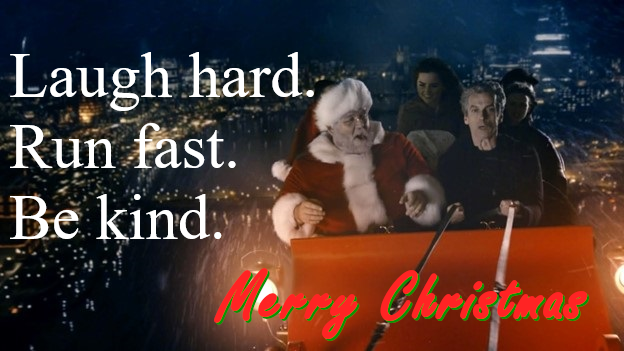
“Merry Christmas, you filthy animals!”

It is Saturday, the 23rd of December in 2023 (AD), and I am writing this while already at the office; I did not go back to the house last night.  It occurred to me yesterday that, even if the workday were to be called off, I needed to be here, since I had several deliveries—unimaginative Christmas gifts for coworkers—arriving today.  With that thought came the realization that I did not want to commute to the house and then back overnight, and that I would be just as comfortable, or nearly so, sleeping at the office.  It’s not as though there was anyone waiting for me at “home”.

To be fair, I probably did not quite sleep as well as I would have at the house.  Then again, sleep is a fickle friend for me at any time, in any place.  And Saturdays are rather slow workdays at the best of times, so I’ll be able to meditate and/or nod off during the day as needs may have it.  I really ought to do that more, anyway—meditating, I mean.  I used to either meditate or self-hypnotize every day, and over quite a long stretch of time during my teenage years.  I would say that I was more together and mentally stable at that time, but I cannot give all—or possibly any—of the credit for that to my introspective states.  It may be enough that I was also in my hometown, and had a core group of long-term friends, and of course, I was living at home with my family.

In any case, I think it would be good for me to engage in some form of mental practice or meditation practice regularly, just to try to calm my mind a bit.  I’m extremely tense very much of the time, and I think it contributes to my sleep troubles and to overeating.  I rarely eat from hunger—when I’m doing something in which I’m interested, I rarely even feel hunger.  Instead, I eat as a sort of self-soothing behavior, something that becomes less of a problem when I’m less depressed and unhappy.  So, as you can imagine, it’s been pretty bad for quite a while.

Of course, it’s hard to avoid indulging at this time of year, since there are holiday treats and goodies everywhere.  I think since around Halloween I’ve been going back and forth trying to do better with diet and exercise, with highly inconsistent results.  I think that, after Monday at the latest, I should be able at least to avoid most temptations, since even at the office people won’t be bringing or receiving sweets or special foods and people won’t be talking about them as much anymore.  Not that I can use such things as an excuse; the weakness is all mine, of course.  But I must strive to become stronger if I can, and this will at least be somewhat easier with the holidays over.

Speaking of holidays, though, let me use this as my opportunity to wish all of you who celebrate it a Merry Christmas!  It’s a good holiday, a family-oriented and uplifting holiday, whether you focus on religious observation or purely secular observation, and even if you go so far as to use it as a day to celebrate the birth of Newton (whose birthday was December 25th, albeit on the Julian calendar not the Gregorian calendar used in the modern world).

As far as religious observation goes, it should be noted that—as I understand it—Christmas wasn’t even a holiday in Christendom until the late Middle Ages or some such time, when it was more or less engineered to take over from other popular solstice-related celebrations such as Yule and Saturnalia and all that stuff.

It’s fair enough that they didn’t celebrate the birth of Jesus in December, because apparently most biblical scholars agree that he was born sometime in the summer (and that wasn’t in the southern hemisphere—see my post recently that discusses seasons and the solstice and such).  Still, I doubt he’d be too worried about the date of the celebration of his birth being moved.  After all, there’d been a hiatus of about one and a half millennia during which it wasn’t really celebrated at all, though the story—two different versions of it—is there in two of the Gospels (Matthew and Luke*).  He was probably only too willing to take what he could get, as long as it wasn’t frankincense or myrrh.

Sorry, I don’t mean to be disrespectful.  When I was giving the year above, I deliberately only put in the Anno Domini contraction as a show of respect and courtesy, and I did not do so ironically.  Though I don’t think Jesus was perfect as a moral teacher—C.S. Lewis himself admitted that much in an oblique way—even if you’re thoroughly areligious, there are a fair few good things in his sermons.  He certainly was no advocate of war or avarice or nepotism or xenophobia, and hypocrisy really ticked him off.

He did tend to teach in parables a great deal, and he got rather exasperated when people didn’t quite get the points he was making.  I don’t see how any Christian could read the gospels and then take the whole Bible as literal truth.  Jesus was practically screaming in everyone’s face that a lot this was metaphor, and if you take him as an incarnation of God, then surely this can apply to the whole shebang.

Anyway, I won’t get into all that anymore for now.  Belief is tricky.  I’m not good at it in general—I have to check and make sure I have my keys with me about 200 times a day—and I don’t really advocate it; I prefer to be provisionally convinced by evidence and argument and to remain open to have my conclusions updated by new evidence and argument to whatever degree is appropriate.  But I do believe there’s nothing wrong with wishing all of you a Very Merry Christmas (and with words borrowed from my favorite Doctor, at that).

santa-whoand merry

The Happy New Year stuff will come next week.


*Am I the only one who wants to say the gospels as “Matthew, Mark, Luke, and Leia”, or perhaps, “Matthew, Mark, Luke, and Han”, which would at least sound nearly the same?  Best not to read from the book of Boba Fett, though, or so I’ve heard.

Peculiar thoughts prior to the 1st of 2 holiday weekends

It’s Friday morning, and I did not walk to the train today.  Neither did I walk back from the train yesterday evening.  I didn’t really think I was going to do the “yesterday evening” thing, and I didn’t really intend to do the “this morning” thing, because I didn’t want to push it after having taken a long time off since doing any longish walking.

I don’t feel fatigued or sore or anything, but there is some chafing here and there that tends to happen when I restart walking seriously, but which I somehow forget every time until it happens again.  There’s some flaw there in the code I’m running in my brain, it seems.  Then again, there are many flaws in my brain code, so I guess I shouldn’t be too surprised.

I’m scheduled to work tomorrow, so I will be writing a blog post unless they cancel the work day because no one is going to show up.  As far as I know, though, I will be working, so keep a weather eye on the horizon.  If the workday is canceled, then I guess the next blog post I will write will be on Tuesday morning, since I think even our office is going to be closed on Monday.

I’m writing on my laptop computer today, since I have the time before the train comes, and I’m not sweaty and there are plenty of seats.  I’ve been trying to be upbeat and whimsical and so on in my recent blog posts, but I don’t think I’m going to do that today.  For one thing, those posts don’t seem to garner as much attention and readership as my despondent and despairing and hateful blog posts.

I’m not sure why that is.  Perhaps the things which I find interesting and entertaining and “positive” to discuss are not what most readers find engaging.  If one is to base one’s assessment on the “reels” that are shown on Facebook, which I’ve been sort of auditing lately out of (rapidly dwindling) curiosity, then people’s interests are very silly and rather pathetic, though they can often be quite funny.  Of course, it’s probably rather silly and very pathetic that I’m even indulging my morbid curiosity by looking at them.

I haven’t been reading any books at all for some time.  Just ask Kindle; it apparently keeps track of my “streaks” and “records” and whatnot.  That is ever-so-slightly disconcerting, but I know there are essentially no humans involved in keeping track of me personally—at least not with respect to my reading.  It’s all mindless, algorithmic stuff, and the algorithms aren’t all that good, it seems, because Amazon is pretty bad at recommending books in which I’m interested*.

Sean Carroll and Sam Harris are much better at finding people with ideas I want to explore; a good many of the books I’ve read in recent years have been by people I’ve first encountered in one of both of their podcasts.  I guess that’s not too surprising.  I’m interested in their thoughts, so I’m likely to be interested in people they find interesting.

I still haven’t set up my health insurance.  I have a real mental block about this, or an emotional block, or whatever.  I don’t know how much it’s going to cost, for one thing, but the real barrier is, I think, my self-hatred.  I worry that, if I get health insurance, I’m going to feel obligated in some strange way to take care of myself and try to maintain and then improve my overall health and lifespan.  But that’s only going to prolong my existence, which I don’t consider a win.

I’ve probably mentioned this before, but I have almost a fantasy of being diagnosed with some sort of inevitably terminal illness that will give me a short bit of time at least to try to connect with and say goodbye to people I love, and which will then kill me with relatively little mess.  It’s the sort of thing I think many people would want at the end of their lives (though they probably would want to put it off as long as possible) if the symptoms weren’t too unpleasant and could be palliated at reasonably low cost, so one wasn’t absolutely miserable in the time approaching one’s death.

Unfortunately, we usually do not get to choose, and we often get no warnings.

Well, actually, in a sense, we all get very long-term warnings.  Any sensible person is on constructive notice from an early age that someday death will come for them.  I suppose most people try to avoid thinking about it, but that doesn’t make it go away.

It’s interesting occasionally to think of the various other animals in the world and wonder how many of them ever recognize, at anything other than a rudimentary, acute, fight-or-flight response level, that they are going to die.  I think very few of them do.  Perhaps the cetaceans do, since many of them are both very intelligent and social, and they appear to communicate to some significant degree.  I’m not sure how much even the other great apes (apart from humans) actually recognize their own individual mortality.  I sometimes suspect that elephants know, but I’m not sure what gives me that impression.

If there are birds that are aware of mortality, I suppose it would probably be the corvids.  I guess it would be appropriate if ravens knew about death.

Huh.  That may end up being the substance of my pre-holiday message, ironically enough, though there really isn’t any substance or any point to what I’ve written today.  Of course, that’s probably entirely appropriate, since there is no apparent teleological substance to life itself.  It just happens, and then it stops.  This may be true even of the universe as a whole.

That’s okay.  Something doesn’t have to have some external purpose to be worth happening.  Just as one can enjoy reading a book or watching a movie or show, or listening to a song, that has no deep message or purpose or meaning other than itself, one can—potentially—enjoy a life without any meaning other than its own existence.

If only I could put that set of ideas into practice.  Alas, we here return to the faulty code I’m running.  If only I could update that more readily.  Goodness knows I’d do something more useful than Google and Microsoft and all the others do with most of their updates.  I may despise myself, but I do think comparatively highly of at least some of my capacities.

You would think that would give me at least some sense of satisfaction, but unfortunately it makes me feel worse about my character and nature.  And that seeming contradiction bring me back to lamenting my buggy code, and thus I appear to be stuck in a meta-level loop, or a perhaps in an old, Basic-style “Return without Gosub” error.

Oh, well.  Have a good day please, and if I don’t write anything else before then, I hope those of you who celebrate it have a Merry Christmas.


*YouTube has a better track record with video recommendations, but that’s deteriorating gradually, or I am, or both.

Weird pegs hammered into “normal” holes and spiders living in beehives

It’s Saturday morning, and I’m sitting at the train station very early—quite a bit too early for the first train—because I was awake anyway, and there was no point in waiting around at the house.  The train station (like the office) in many ways feels more hospitable than the house does.  That’s not saying much, but there it is.

There seem not to have been very many people reading my blog these last few days.  Evidently, when I’m not focused on my mental illness—and it is mental illness, it is not mental health—people don’t seem very interested.  Or maybe there’s a change to the WordPress Reader algorithm so that people don’t see my blog pop up.  I know something has changed, because I can no longer directly comment (or see the comments of others) on my favorite website through WordPress Reader.  That may be because the person who runs that website finds me annoying.  It’s easy enough for me to imagine that other people find me annoying.  I find myself annoying, so it’s not exactly a new notion.  Still, it’s very disheartening to be ostracized, deliberately or accidentally, from my usual interaction at that blog.

I don’t have much heart from the start.

I was approached—figuratively speaking—by someone yesterday morning asking me to please get health insurance, and making suggestions about how to do so affordably.  I listened, because of who it was and, even more importantly, because of on whose behalf they were probably partly speaking (though I am convinced of the caller’s true personal good intentions as well).  I agreed, fine, I’ll get health insurance of some kind.

It’s not the money, mainly, that’s been in the way of me getting insurance.  It’s my self-loathing that mainly gets in the way.  Why would I want to maintain my health and try to live longer or healthier?  What is the point of such an endeavor?  I’m personally extremely unhappy, and in pain, and sleepless, and alone, for one thing (I guess that’s more than one thing, but you probably know what I mean).

At this stage I’m just a net drain on the world, anyway.  Surely, the whole planet would probably cheer up slightly—but noticeably—if I were gone, like a pond that’s been muddied by heavy rainfall finally clearing after the silt settles out.  Most people wouldn’t know why the world felt a little more positive, a little more hopeful, a little more pleasant, but it would still be the case.

Anyway, I said I would do it, so I will, unless something kills me first.

I was in a weirdly upbeat mood part of yesterday morning before that event, although my blog post was rather angry.  To give you an idea of how weirdly upbeat I was, I had finished writing the draft of my post and was getting ready to lie down on the floor of the office (I do this a few times a day to help my back) and I set my computer to install updates in the meantime.  And as I saw the computer message that informed me that it was “updating”, I thought, “‘Updating’…that needs to be the title of a rom-com.”

Immediately, I thought up and quickly wrote out the plot synopsis for the romantic comedy in question and emailed it via my smartphone to myself.  Later, I told my boss about it, conveying the basic story line, and he said—with some enthusiasm—that it was quite good and he thought people would really like that story, and would read such a book.

I had thought of it more as a screenplay sort of thing, to be honest.  I considered getting on Skillshare or something similar and doing a quick course on screenwriting, to write it up.

Of course, I’m not in such a good mood as yesterday morning—it went away by early afternoon, when I suddenly felt a burst of severe tension, as if someone had injected me with epinephrine while I wasn’t looking.  It’s not a good feeling, but I have it a lot of the time.  Anyway, I’ve pretty rapidly and persistently gone downhill since then.

So, I guess I’ll sign up for some form of health insurance.  I have some degree of inherent resistance to the idea, of course, a big one being just my honest difficulty dealing with bureaucratic matters, with paperwork and personal records and trying to fit my weird and distorted metaphorical pegs into the square and round holes laid out—quite unthinkingly—by the world.

That latter comment about things being laid out unthinkingly is important.  No one should imagine that the world as it is was ever truly planned or designed by anyone, whether out of beneficence or malice or otherwise.  Individual people and so forth have had plans and goals and ideas, but no one is big enough actually to design a society or a government or an economy or whatever.  It all just falls together, like salt crystallizing out of a strong saline solution, or rock candy forming on a string in a cooling bath of saturated sugar water.

There are tendencies to form certain kinds of patterns, of course, because of the nature of the constituents and their interactions, but if one were to arrange ten million such rock candy baths, no two of the products would be the same.

Rock candy is simple, of course, and its point and purpose are simple.  So, it doesn’t really matter what specific shapes might be formed when making it.  Societies and civilizations, on the other hand, can take all manner of forms, and these can be truly better or worse by any criteria one might choose to use to measure them.  But they are not inherently real, they are not inherently good, they are not inherently stable or ethical or fair or just, and maybe they never will be.

Justice (however one may want to define the term) does not happen on its own.  Even if one tries to achieve it, one must constantly reevaluate, reassess, tweak, and adjust how one approaches it, because it is not a simple problem, and each local solution will engender new problems.  Problems are solvable, of course, but that doesn’t guarantee that they will be solved.  Wanting to solve them is not enough, and even trying to solve them is not enough.

To achieve justice, or at least to optimize it, for even a group of a hundred people would probably be computationally impossible even using a physically maximal computer.  Even assuming one had a fully agreed-upon definition of the term, the adjustments needed to get everyone in the best possible place seem fit make the traveling salesman problem trivial by comparison.

As for achieving optimal justice for 8 billion people, well…that’s not even a pipe dream.  It’s not even laughable.  At best it could only really be achieved at individual levels or perhaps in small groups, but then again, there’s not even an agreed-upon definition of the term.  This is one of the reasons to be suspicious of people who claim to have all the answers or a “real solution” or whatever, especially if you think they are sincere.

True believers are dangerous, far more dangerous than psychopaths or the mentally ill, and they have done vastly more harm throughout history than all the most self-centered of sociopathic villains could ever do, even if given absolute power (or so I predict).  This is at least partly because anyone who thinks they absolutely have the answers for civilization or even a society is simply wrong.  They always have been, they always will be.  Finite entities cannot even fully understand themselves, let alone ultimate, complex aspects of the world around them, so they can never be mathematically certain that they have the final word on any question.  It is always necessary, in principle, to be open to criticism and testing, to updating beliefs, even if one is very close to being sure.

Anyway, I have trouble dealing with bureaucracies and forms and paperwork and everything.  It feels utterly unnatural and uncomfortable.  It always has, but when I was younger and had people in my life, I was more able to put in the effort.  But it’s always felt unnatural to me, and deeply so.

It’s a bit like a spider trying to become a member of a beehive—seeking nectar and pollen and tending larvae and warding off invaders to the hive and all.  Some of the spider’s attributes may be useful—silk and venom and potent things—but a spider does not live on honey and pollen, and it will not thrive in a hive (if it even stays alive).  A spider is an alien in a hive; it can no more live like a bee than it can grow wheat and thresh it and grind it and then bake and live on bread.  However long it lives, it will simply be suffering.

That’s how I feel about a lot of this shit.  But I’ll do it.  Maybe I’ll even try to write that rom-com.  I can write pretty easily.  Of course, knowing me, the rom-com would probably devolve into a horror story, but maybe that would be good in a way.  After all, I’ve had romance of one kind or another in all my horror stories, and there’s usually at least a little bit of joking.  Sauce for the romantic comedy goose…

At bottom, though, I really don’t want to be healthy and alive.  I mean, it’d be nice not to feel physically miserable as long as I am alive, but that desire is preprogrammed into the organism, and I cannot rewrite that programming.  I can, however, shut it down, or let it come to a shutdown on its own, since I cannot update it, despite the title of my potential romantic comedy.  Life is shit—and if you’re a cockroach, shit is life, but that doesn’t mean you can make high art with it.

Anyway, here comes my train.  Have a nice weekend.