“And by a sleep to say we end the heartache…”

I am really groggy this morning.  I feel as if I slept very poorly, or at least not nearly enough.  Of course, both of those things tend to be true pretty much every night on which I don’t literally sedate myself.  But somehow I’m really feeling it today.

Usually, I’m so tense overall that even though I sleep poorly, I’m still alert bordering on hyperalert.  Maybe now I’ve had such poor sleep for so long that it’s finally catching up with me and wearing me down.  Or perhaps one might say it is Breaking Me Down[That was a shameless plug.  BTW, my songs are also available on Spotify and iTunes, and you can choose them as background music for Instagram and (so I’m told) even TikTok.]

Of course, it may be that I actually slept better than usual last night, but it was simply not enough of such better sleep, so I’m feeling very mentally tired because I started to get some rest, but have by no means made up for my deficit.  Does that make sense?

I suppose it doesn’t matter much.  I guess if I somehow develop better sleep and begin to be better rested, it will gradually produce some effects.  I don’t know what such effects might be.  Perhaps such sleep would improve my creativity, my energy, my optimism, what have you.

Maybe I would start writing fiction again.  Maybe I would start writing music again.  Maybe I would start drawing and painting again.  Maybe I would find the energy really to study the physics and mathematics I want to study, and even to master more of the science of biological and machine intelligence.

And maybe I would catch the flying pig to go take a skiing trip in Hell.  Unfortunately, I do not know how to ski (except in principle).  Also, snowboarding looks like it would be more fun.  In any case, I think such activities would be very hard on my joints and back.  But who knows?  Maybe if I were able to get enough sleep for long enough, even my chronic pain would improve.

We know how crucial sleep must be, because every single creature with a nervous system seems to do it, even though it puts us all into a vulnerable state at least part of every day.  If there were a way around it, you’d think that some creature would have developed that capacity, but the closest we have is things like dolphins and other marine and aquatic creatures that sleep with half their brains at a time.

That’s pretty remarkable and cool, when you think about it.  I know that not just marine mammals and some reptiles do this, but also some birds do it.

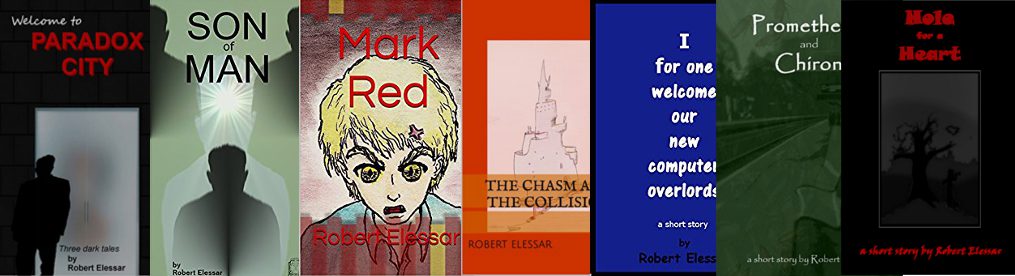
I also had Mark Reed do something akin to this in Mark Red.  As he developed into what he was becoming (a demi-vampire) he stopped needing to sleep at all, and Morgan (a full vampire) speculated that maybe during the day his vampire half slept, while at night his human half slept.

Of course, he was a supernatural being, so parallels with even the most esoteric of real creatures are at best quite a stretch.  It’s all pretty much a stretch for me, as well, though I am certainly not a supernatural being.  I’m quite weird, but that’s not the same.

Mind you, as I’ve said before, in reality there can be no such thing as the supernatural (at least as I would straightforwardly define the term) because anything that actually exists‒no matter how bizarre or inexplicable‒is part of nature, and so is natural.  If ghosts exist*, then ghosts are natural.  If vampires exist** then vampires are natural.  If Cthulhu and Azathoth and Nyarlathotep exist***, then they are natural as well.

Nature is big.  It’s not just the biosphere of Earth.  It’s the whole capital-U Universe, by which I mean everything, even if there is a multiverse or many different levels of multiverses.  It’s what I might call the Omniverse, as I did in The Dark Fairy and the Desperado.  I had planned on referring to it as the metaverse, starting from well over 20 years ago, but then Fuckerberg stole the term and applied it to his lame-ass would-be virtual reality thing.

Oh, well, what are you gonna do?  I suppose he has his uses.  I don’t know whether his existence is a net positive or a net negative, and such measures are always dependent upon what criteria one uses to judge things, anyway.  And as long as one is fairly rigorous and consistent and careful in applying one’s criteria, I would say that all such evaluations are reasonably valid within their own bailiwicks.  My own frustration, though perhaps likewise valid by those measures, is a bit petty and somewhat pathetic, even from my own point of view.

What else is new?

Not very much, I’m afraid.  Details change from moment to moment, though even that depends to some degree upon one’s perspective.  Certainly no human, nor indeed any manner of finite mind, has ever had or can ever have all the answers.  The best we can do is to try always to increase our knowledge, to improve our understanding.  It may take forever to learn every possible thing there is to know, but what better way could there be to spend eternity?

I hope you all have a good day and a good week, even though you can only learn and improve a finite amount in that time.  It’s good enough.


*They almost certainly do not.

**They also almost certainly do not, unless you count the bats and other blood-eating parasites like mosquitoes and fleas and the Masai people.

***Alas, even these beings almost certainly do not really exist.

Is this optimism?

Well, it’s Monday again.  That probably wouldn’t make as good a song title as It’s Raining Again by Supertramp, but I imagine it could be a nicely melancholy ditty.  That’s unlike the weirdly chipper, upbeat impression of that Supertramp tune, which certainly didn’t feel like someone lamenting the rain or a love that was at an end.

Perhaps I didn’t pay enough attention to the deeper meaning of the song.  Honestly, I don’t remember many of the lyrics, and that usually means I never really got into it.  If I get into a song‒assuming I can understand them‒I tend to remember the lyrics indefinitely.

That doesn’t necessarily mean I get a particular song, of course.  I may not really relate to a song, but like it nevertheless.  Sometimes it’s just about the music and the beat.

Of course, my understanding of a song may evolve with time, and it may be different from what the songwriter(s) intended.  This is fair game, as far as I can see, once a song is released for public consumption.  It’s certainly fair for other people to interpret my songs however they wish, for themselves.

For instance there are two Radiohead songs that I interpret differently from the way most people seem to interpret them (based on comments online).  The first is Lift which was one of the OKComputer era songs that was left off that album but released on OK/notOK.  Its tone apparently felt too upbeat for the rest of the album at the time of initial release.

But to me, the feeling the song and lyrics invoke is not of a person being literally rescued from being stuck in a lift, but being rescued from their life (which is close in spelling to “lift”) and escaping into the comparative freedom of death.  “Empty all your pockets, ‘cause it’s time to come home.”  It feels like such a release.

The ending may seem to be slightly against that, but Thom does sing “Today is the first day of the rest of your days” not the rest of your life as the saying usually goes.  I don’t know for sure if Thom intended it as I take it, but given the tone of songs like No Surprises and Exit Music (for a film) I don’t think it’s a huge leap.

I have a similar interpretation of Weird Fishes/Arpeggi which has such lines as “everybody leaves if they get the chance/and this is my chance/I’ll get eaten by the worms and weird fishes/picked over by the worms/and weird fishes” and of course the song’s repeated last line(s), “I…I hit the bottom…hit the bottom and escape…escape.”

I sometimes feel that Thom has (or maybe had) a similar feeling that life was…well, perhaps not torture but just terribly stressful and loud and full of unpleasant sensations and expectations and that it often becomes too much and one just wants to stop, to escape, to “come home”‒just to cease.

As I understand it, that’s kind of the idea of at least some versions of Buddhism:  the desire* to escape the cycle of karma and rebirth, to stop having to live.  But if you don’t believe in reincarnation‒and I really, really don’t‒then escaping from that cycle is as easy as just dying.  And dying is what happens when you stop taking actions necessary to live; death is the default state.

Of course, pushing in the other direction is the eons of natural selection that chose ancestors for their tendency to try to stay alive and thereby become ancestors.  Creatures that had no drive to continue despite pain or fear did not tend to leave that many offspring.  This is true across all Kingdoms, Phyla, Classes, Orders, Families, Genuses, and Species.  Natural selection is a merciless filter; it selects for life, even if life is torture.

So by the time humans (and humanoids) grew minds sufficient to contemplate whether these are worthwhile drives, it/they was/were long since embedded deeply into our natures‒deeper than the level of the nervous system, but also permeating that.

Wow, I didn’t really expect to go off on that tangent.  I thought I was going to mention that there are songs that lament Mondays but also some that seem to celebrate it and then go somewhere from there.  I guess that notion didn’t grab my attention enough.

Maybe I’m just chronically depressed and overwhelmed and stressed out and tired of trying to fight against feeling these things, of trying to want to continue.  There is nowhere that I feel that I “belong”, certainly nowhere available to me now.  I have very little energy for anything beyond stupid basic animal survival, and I’m not doing great at that.

And I’m in pain all the fucking time, even when I’m asleep.  How can I know that I’m in pain when I’m asleep?  Because I fall asleep in pain and the pain is then often what wakes me up, and just as one has a background time sense when sleeping, there is a background awareness of, or at least a background presence of, pain.

I’m very tired of it all.  There are not enough positive things to counterbalance the negative.  There may be plenty of people out there who truly love being alive‒many of the worst people seem to enjoy their lives quite thoroughly, providing strong counter-evidence against any kind of natural justice‒but I don’t.  I am basically alone, sitting around and stewing in my self-dislike.

I must be, in some weird way, the most idiotic optimist I know, because I’m still here, as if I expect at least a decent chance of things getting better at some point in the future.

But really, I don’t expect things to get better.  I can see no good reason to continue with the curve of my mental state so far below the x-axis all the time.  I’m just making the net integral of my life more and more negative with each instant, with each infinitesimal, that I live.

All that being said, I nevertheless hope that you all have a good day and a good week.


*Of course, in the end, as I understand it, the outcome of practice is to lose any sense of desire, and by doing so, one loses the tendency to experience dukkha.  The path ceases to be the means to a goal, but is, if anything, the goal itself…or rather, the concept of goal ceases to mean much.

The brain may devise laws for the blog, but a hot temper leaps o’er a cold decree.

Hello and good morning.  It’s Thursday, of course, and it is also the 2nd day of October.  Those two things don’t always coincide‒that probably goes without saying‒but in this case (and roughly one seventh of all October 2nds) they do.

It’s also Yom Kippur, and though if I were truly observant of the holiday, I would not be writing this or going to work, I still want to wish anyone out there observing (it’s not really celebrating) the day a very good and positive one (but if you’re observant, so to speak, you’re unlikely to see this until after the holiday ends).

And, of course, I have begun my fast.  That’s not very impressive so far, mind you; I just haven’t eaten anything since yesterday afternoon at about 4:30, which is not too much longer than usual at this time of day.  Of course, I feel fine, energy and hunger-wise, because I don’t usually eat anything by this hour.  I will be drinking water‒fizzy most of the time, but still water, even though it’s not still water, ha ha‒and possibly diet soda, but that’s it.  I have to have water, because I take a fair amount of medicine for my pain and such, and many of those things should not be sitting in an unlubricated stomach.

It’s not really that hard for me to hold off on eating once I commit to it.  Throughout high school at least, and part of college, I never ate breakfast and rarely ate lunch.  I was skinny, but my mind was as sharp as it’s ever been (though of course I am “smarter” now than I was, because I know a lot more, and that’s not just knowledge, but skills and habits as well).

I also had plenty of energy back then.  I’ve spoken before about how this makes biological sense.  In our ancestral environment, a lack of recent food would be associated with the need or urge to seek food out, and that requires alertness and motivation and energy for a hunting species or even a gathering species, and certainly for one that does both.

Anyway, I really hope not only that this fast helps to clear my mind a bit and to calm my “spirit”, but also that it helps reset my body somewhat.  At the very least, it would be good to get back to that high school (and college) tendency of spending less of my time eating.  It’s gotten to the point that what I do in my “spare time” is often just eating, for momentary pleasure, for distraction, for avoiding boredom, for escape, etc.  But, of course, that tends to lead to a negative cycle, and I feel physically worse and worse about myself afterward.

So, hopefully, I will cross the activation-energy barrier today and head on through towards a more stable plane (or plain) of mentality, and of metabolism.  I don’t know for sure how long the journey will last, or where I will end up, but I will probably keep you all posted.  Watch this space, as they say.

It would be very nice if I successfully get some degree of spiritual insight from this fasting process‒whatever that even means*‒but whatever happens, until the end, I will probably continue to post here every work day.

In the meantime, I’ve at least put in some absurd footnotes as tangential thoughts struck me while writing.  I even did one of my footnote-within-a-footnote thingys, which is always fun (for me, anyway).  But you have to be careful with such digressions;  it’s a bit like writing a computer program with lots of subroutines embedded within other subroutines embedded within yet other subroutines.  The potential for errors that confound your logic (and that make your program freeze, in the programming case) is quite high.

Anyway, G’mar chatima tova, everyone.  I hope you have a good day.  I think I will, too.  And if I uncover any special psychic powers though this fasting process, well…I probably wouldn’t say anything about it.  But who knows, I might.

TTFN


*I’m referring to “spiritual insight”, not “this process”.  I’m pretty sure I know what “this process” means in this particular case**.

**Actually, that’s a pretty unambiguous term nearly any time you might use it.  You might not understand what this process is, but you probably understand what “this process” means in most cases, assuming a decent command of English***.

***That’s a command of the English language, not command of the English.  Commanding the English, and the rest of the inhabitants of the British Isles, has historically been a tricky business, including by the English themselves.  Even the Romans had issues with the “English” and when it came to Scotland, well, Emperor Hadrian just said, “Screw it, put a wall up to try to keep them there up North, I don’t wanna have to deal with those crazy bastards”.  He probably said it in Latin**** though.

****I can’t even imagine the nightmare of trying to conjugate all the Latin verbs and so on in my imaginary quote from Hadrian.

“I’m coming down fast, but don’t let me break you.”

I’m writing this post on my mini lapcom, as I call it, following the lesson of my own reflections yesterday on how my thumbs and whatnot are getting particularly sore and tender while writing on the smartphone, and it’s just easier writing with the “laptop” computer.

Of course, I don’t know what subject on which to write, but that’s typical, even usual for me, though I probably wouldn’t call it “normal”.  It’s just my personal, weird way of approaching this blog.  I suppose my subconscious is probably working on some of it ahead of time.  But I don’t really ever plan the posts, though occasionally I think about a general, vague kind of thing that I will discuss, like “What is that flat, circular thing that they throw in the Olympics called, again?”

Sorry, that was a really stupid joke.

There are some imminently upcoming matters that are of at least personal interest to me.  For instance, this is the last day of September in 2025.  Tomorrow begins October, which is generally my favorite month, though down here you can’t readily tell October from any other month.  But it’s still a good month, and it culminates in my favorite holiday (which is Halloween, in case that wasn’t clear).

Tomorrow at sundown also begins Yom Kippur, the Day of Atonement.  Now, I clearly am not “observant” in any serious way, and I have no local (or other) community of any kind, but pretty much every year, unless I am physically sick, I fast for Yom Kippur, from sundown to sundown (at least).  One is supposed to fast from food and water, but since I’ve been in south Florida, I tend to skip the water fasting part; even at this time of year, it’s too easy to get dehydrated, and I sure as hell don’t want any more kidney stones if I can help it.

I may try to extend my fast this year, beyond just one day.  I’ve done it before.  Once I get past a certain point, it becomes comparatively easy just to continue not to eat, and for me, at least, that point of ease arrives pretty quickly.

Clearly one cannot fast indefinitely.  Or rather, if one does it for more than a certain length of time, one is likely to cease to eat permanently (if you take my meaning).  That’s not so bad a thing, really, and it doesn’t seem like a terrible way to die, to me, though I know a lot of people seem to think it especially horrible.

But the thing is, ketosis (which happens when fasting) is fairly pleasant, as I know from personal experience; the brain prefers to run on ketone bodies (in the sense that it runs better on them), and one’s hormonal status, such as one’s bouncing stress hormones related to insulin and glucose zooming up and down, at least become steadier when one has gone without food for a bit.

It’s not a mere coincidence that many religions and spiritual practices make use of fasts.  Up to a certain point, going without food for a while keeps one clear-headed, less emotional and distracted (once one gets over the initial hump of habit).  There are hypothetical biological reasons for this; an animal (such as a human, or even me) needs to be clear and sharp when food has been scarce, because they need to seek it.

I wouldn’t mind achieving some type of epiphany because of a fast.  I also have a (slim) hope that fasting might help some of my pain symptoms, at least the more recent ones.  I have a slight suspicion that maybe I have some form of psoriatic arthritis (though it certainly could be a “second year medical student syndrome” type of thing), since my fingers are particularly getting more painful and swollen lately*, and I have new tendonitis-type symptoms and even a proximal interphalangeal joint in my right middle finger that’s popping in and out as I move it.

The left hand is not as bad, but then again, I am right handed, so the right hand gets more use and stress—not least from controlling a computer mouse.  But I also get a lot of pain that has become more localized to my ileo-sacral region, shifting from side to side (and various other joints, not quite symmetrically) which is a common spot for psoriatic arthritis to affect.  So, it could be a somewhat atypical presentation of psoriatic arthritis (I do have a long-standing psoriasis-like rash).

More likely, though, all of these symptoms are merely part of my chronic pain syndrome, which leads to awkward postural adjustments that cause irregular strain on various joints and tendons, and it’s all made worse by the fact that I am way too fat (because I often eat for “comfort” when the pain is acting up, which is likewise often).  So, whether by one mechanism or another, perhaps fasting would help reset things.

I would not hope to get carried away and fast forever, but at least it would be nice not to die a fatty.  I guess we’ll see how everything goes.  But I am at least going to fast tonight until tomorrow night.  I have plenty of internal reserves on which to live, but I will keep taking my vitamins and pain medicine, of course.

That’s pretty much it for now.  I hope you all have a good day, and by tomorrow night I’ll have begun my fast.  If I keep it up, you’ll be able to follow my progress here.  It probably won’t be very interesting, but it might be.

Talk to you soon.


*That’s discouraged me from playing guitar very often, which is annoying in itself.

What title would be appropriate?

I’m writing this on my mini laptop computer, because I have a new backpack (the old one was really starting to fail, and has been for quite some time—I can relate, and I wish I could replace myself so easily) and it does a better job with the weight, however minor, of the little computer than the old one did.  Also, I just didn’t feel like dealing with the stupid little engine of distraction that is the “smartphone” today.

Ugh, it’s so stupidly muggy already here in south Florida at a quarter to five in the morning that the sweat around my eyes is fogging up my reading glasses while I just sit here and try to type.  Why do people live here?

Okay, well, I know why I live here, and it was because I was trying to accommodate others in the past—people I love, not just anyone—and so I was willing to go with their flow and go away from anywhere where I had long-term connections and such like.  So, I came here to America’s syphilitic dong, which harbors, or has harbored, such parasitic animalcules as Donald Trump, Pam Bondi, Dickless Scott, Michael McAuliffe, Ron DeSantis, and who knows how many others.  What a shit hole.

Mind you, the neighborhood in which I currently live is quite pleasant in many ways, though I cannot consider it home.  It’s extremely multi-ethnic and very community spirited, at least as far as I can see.  People keep out of each other’s business, they take care of their stuff, they take out their garbage, they mow their lawns, all that.  And the houses, though they and the yards tend to be quite small, were clearly built in a time when it was considered normal to construct dwellings that more or less laugh at hurricanes.  Full cinder-block walls on smallish scales make for structures that do not readily move in response to anything but a direct-hit nuclear attack.

I’m really exhausted, and it’s only just the beginning of the day.  I’ve been exhausted for so long now that I can’t readily remember a time when I did not feel exhausted.  I can remember that I have experienced times in the past when I was not exhausted, but I don’t remember what it feels like.  So often, it seems that I surely cannot endure much longer, that I surely must collapse at any moment, that I must just crumble to the ground, unconscious.

But biology is my enemy here.  Living organisms are selected to be prone to continue, since there’s very little natural selection based benefit in being able to choose to shut down at will.  Any being with such a capacity would be less likely to leave behind offspring than those whose bodies simply continued until there was no way for them to do so, or until something else killed them.

I hate it here.  And I don’t mean just where I am right now, though it does apply.  I hate it in south Florida, I hate it in America (a shocking and new realization to me), I hate it on Earth, I hate being in this stupid universe.  I cannot say that I hate everything about it, of course.  I love my children, I love my sister and brother, and I even have a few distant friends who matter to me.  But for the most part—the overwhelmingly “most” part—things here are nauseatingly pathetic.

I don’t just mean humans, by the way.  I’m not one of those idiots who romanticizes animals as innocent and pure and lovely, imagining that they would live in harmony with each other if not for humans.  That’s puerile nonsense.  Anyone who thinks that is mistaken and/or delusional.  This, to me, is the most annoying flaw in The Matrix:  the fact that Agent Smith says and seems to believe that other animals achieve some form of self-imposed equilibrium with their environments.  I think a sentient AI would not be prone to make such an idiotic mistake, but maybe I’m wrong.  It’s not as though I’m not an idiot, too.

But animals don’t choose to be in equilibrium with their ecosystems.  The equilibria are forced upon them (when they happen at all) by death, by disease, by starvation and predation, by famine, by pestilence.  They no more choose to be in equilibrium than the various atoms and molecules in a complex chemical chain reaction choose to be in their equilibria.

Humans are merely more competent than all other creatures (on Earth) have ever been, and so are capable of pushing their environments farther than any others.  That is, unless you count the earliest photosynthesizing organisms, which probably produced the greatest environmental catastrophe the world has ever known—the release of free oxygen in vast quantities, changing the atmosphere and the very crust of the very planet, killing off the majority of life forms until those that remained adapted and became addicted to this new atmospheric drug.

Okay, that last bit of that last sentence was highly melodramatic and judgmental.  I was trying to make a point about how non-innocent natural things are*, but I fell into rhetoric, and that actually cheapens one’s arguments if one is dealing with dispassionate interlocutors.  Then again, when does one ever actually deal with such creatures?

Anyway, life is dominated by suffering and by aggression of one kind or another, because nature overall does not tend to reward indiscriminate kindness.  Humans are, ironically, the only species that seems even capable of the “outside” view, of a compassion and thought for the future and for the suffering of others that goes beyond their local, personal, and even species-specific circumstances.  And they are also the only species that can be seen to vilify itself.

Weirdly enough, it is the “good guys”, or those who try to be good guys, those who consider that worthy of aspiration, who are most often subject to criticism, including self-criticism; certainly they are the only ones responsive to it.  If you criticize narcissistic assholes, they really don’t care.  They’re not trying to be “good” in anyone else’s eyes.  They are already great in their own minds.  They already love themselves.  Just imagine trying to get your average cat to do something by appealing to its guilt, and you will get an inkling of what I mean.

Self-esteem is overrated.  I’m not saying it’s valueless, but it is selling at a much higher price than it is worth, like a vastly overinflated stock for a corporation so leveraged that it could move the Earth if it could find a fulcrum and a place to stand.  A little self-criticism is good for everyone, at least if they want to be anything other than a force for destruction, decay, and patheticness**.

I don’t know.  Maybe destruction is the better way.  Creation, and creativity in general, certainly hasn’t served me very well.

Now, in closing:  I didn’t walk or bike to the station today.  I needed a physical rest.  Hopefully, if I can muster the energy, I will do one of the two things tomorrow.  But even thinking about it right now makes me feel out of breath.  I don’t feel short of breath; I’m not anxious, I’m not tremulous.  I’m just without vigor and cannot readily imagine having any.

Oh, well.  Life sucks.  Have a good day.


*Either everything and everyone is innocent, or nothing and no one is.  I mean this on a general scale, not regarding specific uses of the term relating to legal and criminal concepts.  I’m using the term from a fundamental, ethical/moral underpinning kind of way.  No one made themselves or their circumstances or their nature or their environments, and “free will” is a childish chimera.  As Eric Draven said, “Victims…aren’t we all?”

**Apparently that’s not a word, but “pathos” doesn’t carry the connotations I desired here.  Maybe “contemptibility” would be better?

“I don’t think I’ll ever get over the hill; those wounds run…pretty deep.”

It’s the penultimate day of July in 2025, and I can’t honestly say I’ll be sad to see the month go‒nor the year, nor the life, for that matter.

The word “penultimate” does make me wonder if any stationery company ever marketed a writing implement as the “Pen Ultimate”.  If so, I’ve not heard of it.  I guess it’s not a terrific marketing idea, just a mildly amusing play on words.

Anyway, it’s Wednesday, the so-called hump day‒because presumably once one passes the midpoint of the week, one finds it easier to coast through the rest of the week, as if one had reached the top of some hill (or hump) and was now loping, or perhaps sledding or skiing or snowboarding, down the other side.

Of course, that metaphor presumes there’s something akin to gravity applicable here, which is the force that makes it hard to go up a hill and easier to go down it.  But there is no such force applicable to time (though time is affected by gravity).

As far as I can see, no matter what you do, the days of the week proceed at the same monotonous rate, whether one puts any effort into it or not.  Time passes at the same rate (ignoring tiiiiiiiny adjustments for relative speeds and altitudes) for the most active athlete or business tycoon or person in the grip of mania as it does for someone idle or even someone in a coma.  And even if one can slow down one’s time relative to others‒for instance by going some substantial portion of the speed of light relative to them or by going into an area of strong gravity‒one’s own “proper time”, the time one experiences, will still be the same*.

One might effectively travel into the future of the people one left behind on one’s high-speed voyage, but one will also skip and miss all those years that one is “away”, and there’s no way to get that time back.  The nature of causality appears to preclude it.

So, yeah, the concept of hump day is purely psychological, and like so much of human psychology, it is stupid.  I wish I could say that my impression of such things has become less negative as my own proper time has passed, but alas, the young provide no more basis for hope with their presumed energy and creativity than the older ones do with their presumed greater experience and knowledge.

Almost all humans are really quite pathetic and come despair-inducingly far from achieving anything like their potential in wisdom or intelligence or creativity.  They mostly just bounce around like air molecules in a closed chamber, achieving maximal local entropy.

And don’t delude yourself that any other creatures on the planet are any “better” than humans.  Even the relatively smart ones like chimpanzees and porpoises and cephalopods and corvids tend to be often vicious, selfish, and violent.  That’s not all they are, of course, but it’s plenty.  They’re certainly not pure or innocent or fundamentally beneficent creatures.

Neither are dogs or cats or other mammals, or reptiles of any kind, nor fishes, nor birds, nor arthropods, nor annelids, nor protozoa, and so on.  Nothing in the world is inherently beneficent.  Even plants fight and harm and kill each other; trees waste their resources by growing taller to outcompete each other for sunlight, when if they all stayed shorter, at some uniform height, they would all be better off.

And fungi eat everyone, using other life forms for their resources and sometimes for locomotion, and they wage constant war with bacteria and so on.

There’s no good reason to expect any form of alien intelligence to be any better, nor AI either.  No matter how much smarter one being is than another, the most powerful defining factor of each is its limits.  Every finite thing is equally far from infinity.

Unfortunately, beneficence overall is not really an evolutionarily stable strategy.  Even if all beings in a given ecosystem were mutually benevolent, all it would take would be for one mutant to instantiate a degree of selfishness and ruthlessness and it would have a tremendous advantage over its kindly brethren, and its genes would spread and become more and more prevalent.

Of course, universal malevolence and selfishness are not stable, either.  That’s a recipe for overall destruction, as much as anything else is.  Prey are necessary for a predator to survive.  As Porter said in Payback about nice guys:  You’ve gotta have somebody to take advantage of.  The food web has to have a base somewhere.

It seems to me that there will never be any system that doesn’t have some such mixture of predators and prey‒even metaphorically within species and societies.  Of course, it makes sense to prevent and mitigate the depredations of the assholes and, if possible, to discourage them from existing at all.  That’s better for everyone.  But as with the trees**, it doesn’t happen on its own, and it is not self-sustaining.  The price of such freedom really is constant vigilance, and unerring vigilance of that kind is probably impossible in principle.

I’m not really trying to come to some point here.  Mostly I’m just expressing my frustration and despair and cynicism/nihilism.  There is not only horror in the world, but horror is always there and almost certainly always will be, at least until the ultimate (but at least peaceful) horror of universal heat death (or whatever) brings about the elimination of all experience of any kind in the universe.

The only enduring peace and freedom may be simple nonexistence.  But then there’s that damn Poincaré Recurrence!

Ah, well.  Have a day.  You can call it a hump day if it amuses you.  I don’t know why I care.


*And, of course, if one is traveling at a substantial portion of the speed of light, if one doesn’t have adequate shielding, one’s lifespan is liable to be shortened significantly due to exposure to induced cosmic rays:  When you travel at a very high speed through the elementary particles of open space, the elementary particles of open space travel at a very high speed through you.

**Think about it:  those beautiful California redwood trees are possibly the greatest, most glacially persistent testament to the “dog eat dog” nature of the non-human world; a centuries-long spectacle of cutthroat one-upsmanship, each tree fighting maniacally to outcompete the others for sunlight.  They are beautiful, of course, but so is a raging fire.

Songs from a life less interesting*****

In case it wasn’t obvious, I did not go to work yesterday.  I have a head cold of some variety that seemed to begin in the afternoon on Wednesday‒maybe it started sooner than that, I’m not sure.  Anyway, I stayed at the house yesterday, trying to rest.  But I was pretty stuffed up, which I still am, and now my mouth is dry from (apparent) mouth-breathing when I slept.

Sorry, I know this is really dull material.  Such is life, I guess.  Or, at least, such is my life.  I suppose a dull life is better than many of the lives that would make for more interesting reading.  This was a point I first recall encountering in The Hobbit, when Bilbo remarked that his time in Rivendell would make boring reading, though it was wonderful to experience.

I think it is possible to have an exciting or at least interesting life that does not fall prey to the curse of “may you live in interesting times”.  I think it is possible to have a life that most people would find fascinating to hear about, and which is also quite fulfilling to experience.  But it does seem that this is a relatively small subset of available lives.

For the most part, humans seem to prefer stories about harrowing, horrific things.  This is not restricted to fiction, but is also part of why news media tend to focus on the more dire and terrifying news stories.

Of course, there are probably good, sound biological reasons for this.  As a matter of survival, it’s crucial to attend to danger and threat much more so than to pleasant, routine, comfortable things, because those creatures that don’t become extra alert and energetic when danger is present are less likely to leave offspring than are those that respond with arousal*.  So the fact that many of our favorite stories describe horrible things may be analogous to why so many of our snacks are very sweet and/or very salty:  a supranormal stimulus increases engagement powerfully, and can easily become habit-forming.

How in the world did I get on that subject?  I’m not sure.  I guess I could go back and reread this to find out, but I’ll be doing that when I edit it, anyway, so I’m not going to waste my time now.

In other news, I wrote a second verse for my “weekly” song on Wednesday afternoon, and even took a little notebook with me with the song paper in it, so I can continue the process wherever I might be.  Unfortunately, I did not work on it at all yesterday, but then again, I didn’t really work on anything yesterday.  I’ll try to write a chorus and then a third verse today.

I have to remind myself that I’m not trying to produce something superb, even assuming I could do that on command.  I’m just trying to produce something**.  So if it feels a little inane and contrived to me, well, that’s okay.  It’s just got to be some “song”.

I use quotes there because I am really starting with the poem, the lyrics, which is “usually” how I do things.  I don’t know if I’ll be able to do lyrics and music within one week on the same song.  At least so far, that pace doesn’t seem to be in the process of being achieved, though I suppose I might finish the song and come up with a melody over the weekend.  Or maybe what I can do is make songs in a kind of assembly-line style:  lyrics this week, then next week, while coming up with lyrics for another song, do the melody for the first song.

I have heard that most songwriters tend to do melodies first and then come up with lyrics.  That may be a true statistical statement, but I know it’s not the way everyone does it, because at least two of my favorites do otherwise.

We know, of course, that Elton John writes the music after Bernie Taupin writes the lyrics, by their own description of their songwriting process.  And, of course, many operas and musicals start with the libretto***, and the music is written afterward.  And Roger Waters, one of the best lyricists ever****, implies in The Wall that he writes his lyrics as poems, e.g., “I’ve got a little black book with my poems in…”, and also e.g., the scene in the movie where young Pink has his poem book, which contains the lyrics for the song Money, discovered by the oppressive teacher.

So, writing lyrics and then making a melody afterward wouldn’t put me in bad company (though I don’t know how the band Bad Company actually wrote their songs).

Anyway, that’s enough for today.  Batman knows if I was even coherent.  I suppose the editing will make that somewhat clearer, but my mind might be fuzzy enough that I cannot even tell in the immediate editing period.  But you will know.  So, please, have patience with me.

And have a good day and a good weekend, also, if you’re able.


*There’s nothing sexy in this use of the word, just to be clear.  I’m not referring to creatures that get “turned on” by danger and threat; those types of creatures seem less likely to survive than their compatriots, ceteris paribus.

**Not the Beatles song.  I already did a cover of that, anyway.

***Italian for “little book”, in case that wasn’t obvious.

****As evidence:  He wrote almost all of the lyrics for Dark Side of the Moon, Wish You Were Here, Animals, and The Wall.

*****I feel like this could be a good album title.

“Wednesday morning, papers didn’t come.  Thursday night, your stockings needed mending*.”

Well, it’s Wednesday, and I’m feeling a bit better than I have so far this week.  Perhaps I really did have a virus of some type that my body has been fighting.  If so, it triggered/worsened symptoms of already existing pathologies in my body—in my back and hips and shoulders and other joints, and so on—in addition to making me feel achy and feverish, though without the actual fever.

I can’t really blame my psychopathology on a virus, unless it’s some form of mental virus**, or more likely some lifelong accumulation thereof.  Such “viruses” are rarely acute and self-limited, though they could be, I suppose.  What, after all, is a momentary fad or brief obsession, perhaps with a song, or the spread of a particularly funny new joke, that goes away before long?

I don’t really think my mental issues are primarily caused by acute memetic infection, if you will.  They started a long time ago.  In any case, my brain is apparently of an atypical type, at least based on my autism diagnosis, and that creates a substrate on which supervening inputs can become prone to cause certain forms of pathology.  Depression and anxiety are two of those things that are very common in those with ASD—significantly more so than in the general population***.  The statistics on autism indicate that suicidal ideation and attempted and successful**** suicide are much more common in people with ASD than in so-called neurotypicals.

I often think of depression—at least in some of its forms—as a sort of weather-pattern in the mind that becomes self-sustaining in the right circumstances, rather like a hurricane or other massive storm system.  One doesn’t find hurricanes in environments that are not conducive to them—Siberia and the like, for instance—but in minds that are the metaphorical equivalent of the tropics, such mental storm systems may be much more common, and sometimes very destructive.

Who knows, maybe ECT treatment for severe and recalcitrant depression is something akin to the (ill-advised) notion of dropping large nukes in the middle of a hurricane to disrupt its pattern.  If hurricanes occasionally had the tendency to obliterate all or even most life on Earth, we might be willing to try something as extreme as dropping nuclear weapons in a developing tropical storm system to disrupt it, if we could find no other solution.

I wonder if even the large storm cells that occur over places like the great plains of North America could be considered something like episodes of depression (the fact that some weather systems are called “depressions” relates to the barometric pressure, and should not be construed as in any way related to psychiatric depression, other than etymologically).  To what would a “super cell” that produces massive tornados be analogous?

Of course, there need be no actual analogy, because the weather concept is a metaphor, really.  But it is not completely a metaphor, so I don’t think it’s too frivolous to push the notion further in order to trigger some thoughts.  Complex systems like the brain and the weather, with internal feedbacks and feedforwards and “feedsidewayses” that can lead to vicious and/or virtuous cycles can have actual attributes in common if looked at in the right way.

It’s a bit akin to how the motion of a pendulum and the oscillation of a circuit and the “probability waves” of quantum mechanics can be described by very similar mathematics.  Also, the relations between pressure, flow, and friction in fluid dynamics with voltage, current, and resistance in electric circuits are almost spookily alike.

This probably demonstrates something rather fundamental in the nature of reality.  Perhaps it’s distantly related to the fact that geometry seems to have a deeper influence on the workings of reality than one might at first think, as evidenced by the ubiquity of Pythagorean relations and the appearance of Pi (π) in often surprising places.

This is all speculative stuff, and I’m not being very rigorous in my thoughts, though I’m trying not to be too frivolous.  But I think this is a good place to wrap up this post for today.  I hope you all are doing well and that you continue to do well, and even better, that you improve at least a little bit, in at least some way, every day.  You might as well.


*Has anyone reading ever actually mended their stockings (or darned their socks, as in another Beatles song, Eleanor Rigby)?  I have mended a sock at least once in my life, and probably more than once, but nowadays socks are so readily available that I tend just to throw them away when a hole develops.  I guess that’s a testament to how “spoiled” we are in the modern world.  Incidentally, I added the Thursday part of Lady Madonna to this quote-based title because I realized that I’m never likely to use it on an actual Thursday blog post, because for those I use mutated quotes from Shakespeare.

**In his classic book The Selfish Gene, Richard Dawkins coined the term “meme” as a replicator of the mind, and it has become a useful scientific term, in addition to being a slightly imprecise shorthand for usually humorous pictures of various kinds shared online.  Such memes can become highly potent self-replicators in various senses, and they can combine in ways that make them more prone to spread, in “meme-plexes” of various kinds.  Some are useful for the organism, and so could be considered beneficial viruses (memetic rather than genetic) while others can become terribly destructive, at least in certain circumstances.  Certainly the mind-virus(es) associated with the Jim Jones cult was/were lethal to most of those who were infected.  Likewise with the Heaven’s Gate viruses.  Some of such comparisons can be a bit glib, but others are robust and can be subject to rigorous study.

***I’m not referring to a prison-based “general population”, though at times the metaphor of modern society as a prison is truly warranted, especially for those of us with atypical brains.

****There are times when I would think of a completed suicide as indeed a thoroughgoing success, i.e., a positive thing overall, but here I’m just using the term “successful” to mean “having completed what was intended, as intended”.

Mind your vectors and terms of address

I’m writing this on my mini laptop computer again, because even though I find the extra weight of carrying it mildly annoying at the end of the day, at least sometimes the irritation of trying to write using my stupid smartphone is worse.

Although, since those two versions of me exist at different times, it’s hard to weigh their degrees of perceived irritation against each other.  In the morning, if I’m using my thumbs to try to type on a diminutive screen in a fashion that could be easily predicted to lead to some manner of repetitive stress injury, its all too natural for the “me” of that moment to hate the “me” of the previous evening who elected not to bring the laptop computer back with him.

But the “me” of the evening, when faced with the minor extra effort of the mini laptop, can feel very much overwhelmed and exhausted and think that the “me” of the following morning won’t find the process of writing using the smartphone particularly difficult.

The human consciousness clearly doesn’t have one, singular, constant terminal drive or goal as an imagined artificial general intelligence might.  I suppose one might think that the drive “to stay alive” would count as an ironically designated terminal goal, but that’s clearly not an accurate interpretation of the situation.

Not only are some people quite self-destructive and even actively suicidal—which you might credibly dismiss as dysfunction, not the lack of a dedicated system, though I think that would be imprecise—but there’s no good way to think that such a specific drive could evolve.  Evolution is blind to “death” as a concept or force, except as a failure, an accident, a lack, whatever you want to call it.

Before humans, as far as we can tell, no creature on Earth had a concept of “death” as the cessation of the biological processes of an individual organism.  Instead, there are proxies, such as the drive to avoid pain, and the related strong sensation of fear relating to danger and so on.

Similarly, there is no drive “to reproduce” in human (or other animal) minds.  Teens going through puberty don’t start feeling the literal desire to replicate their DNA in other bodies.  Instead, proxies for reproduction evolved, urges and drives that tended to lead to increased chances of reproduction, such as dominance hierarchy drives and displays in social primates such as humans, sexual attraction, and—of course—the pleasure of sex itself, with the reward-based drive to have it as often as feasible (with other inputs adjusting the strength of that drive and causing it to manifest differently in the two biological sexes and at different times and places).

The human brain—like probably all the other adequately complex brains on Earth—is a mélange of modules, with varying drives and processes that have evolved in parallel and sometimes independently, and also developed ways of interacting with each other.  Of course, at the root are the automatic drives that are all but undeniable—the respiratory drive, the thermoregulation drive, and so on.

There are even drives that are neurological in a broad sense, but that are so fundamental that they cannot be interdicted by the rest of the nervous system, only adjusted—I’m thinking here mainly of the heartbeat, the driver of which is in the sino-atrial* node and the Purkinje system of the heart, which is sort of a cross between muscle and nerve tissue.

The upshot is, if you ever feel that you’re “of two minds” on some particular subject, you’re probably not just speaking metaphorically, whether you know it or not.  Your final actions are produced by what I see as the final vector sum (and it can be quite small in the end or it can be huge in magnitude and surprising in direction) of all the drives or “pressures” in the brain that have any effect on decisions about behavior.  Then the action caused by the final behavior feeds back on the system**, changing the lengths and directions of some (perhaps sometimes all) of the contributing vectors, causing changes in the inputs and thus changes in the final vector sum of behavior.  Lather, rinse, repeat as needed, ad nauseam if not actually ad infinitum.

Please don’t imagine this as the sum of physical vectors in real spacetime.  The number of possible dimensions of such mental/neurological vectors is huge.  For all I know, there might even be spinors and tensors and matrices involved, but I don’t think those are necessary for my vague model.  “Simple” higher dimensional vectors probably do the trick.

What a curious set of things about which to write that was!  I had originally intended to start this post with some version of The Simpsons’ “Hi, everybody!”  “Hi, Dr. Nick!” exchanges, perhaps then noting that I could change “Dr. Nick” to “Dr. Robert” and thus reference both The Simpsons and the Beatles at the same time.

But then I might have noted that, although the Beatles song is so titled, “Dr. Robert” is not the way anyone has ever referred to me in actual practice.  It would be, honestly, a little weird for someone to refer to their physician as, for instance, “Dr. Joe” or “Dr. Judy” or whatever, certainly in our culture.

Mind you, there was that tendency for a while (it may still be prevalent) to have kids speak to adults such as teachers and daycare workers and people of that sort using their “title” and then their “given name”, such as “Miss Barbara” or “Mister Jimmy”.  I have always thought that was weird.  I mean, just imagine someone trying to address a certain prominent fictional character as “Dr. Hannibal”.

Alas, that all ended up being a discussion not worth having, except as an afterthought.  Though it’s debatable whether any discussion at all is actually worth having—including the discussion about whether any discussion is worth having.

You all can discuss that if you want; feel free to use the comments below, and to share this post to your social media platforms or what have you.  When you do discuss it, remember to define your terms ahead of time, and stick to them rigorously—i.e., the meaning of “discussion”, and of “worth”, and so on—so that you decrease your chances of getting involved in semantic games and misunderstandings and sophistry.

Whatever you choose to do, please try to have a good day.


*The “sino* in that term relates to its location in what’s called the sinus of the heart, and the “i” in it is a long “i”; it has nothing to do with China, though an identical prefix is sometimes used to mean “related to China”, but in this case with a sort of short “i” sound…or, really, a long “e” sound.

**And there are surely numerous other feedback loops all along the way affecting many, or perhaps all, of the vectors.

O heavy lightness, serious vanity, misshapen chaos of well-seeming blogs

Hello and good morning.  It’s Thursday, of course‒thus the “traditional” opening salutation‒and here I am again, writing another in a line of hundreds of Thursday blog posts.

Have I said all that I could say, already?  Probably not.  The number of possible 800+ word strings of English writing is surely unfathomably vast.  If I were going to try to give some kind of upper boundary, we would consider that there are a few million words in the English language, and I could just try to solve for a few million to the 800th power.  That’s a huge number (104800). But most of those combinations‒all of them, effectively‒would be nonsense.

By “all of them” I mean that, if one applies the constraints of grammar, or even just of making tolerable sense to a potential reader, the number of strings of 800 coherent words is so much smaller than the number of possible strings of 800 words without care for sensibility that, if one were looking at some shape or field that represented the latter, the former would probably be too small to see, given the constraints on the resolving power of visible light.

It’s a bit like the possibilities implicit in DNA.  The human genome is on the order of a billion or so base pairs* long, if memory serves, and each “site” on the genome has 4 possible “letters”.  So, the potential number of sequences of DNA in that genome is on the order of 4 to the billionth power, which would be 2 to the 2 billionth power, which is about 10 to the 600 millionth power (10600,000,000).

That’s a huge number. Remember, a googol is merely 10100, and it is already a number that far exceeds the number of baryons in the (visible) universe (which is on the order of 1080).  And remember how exponentials work:  every time you add 1 to the exponent you multiply by the base number, in this case 10.  So, 10101 is ten times larger than 10100.

As you can see, the number of possible DNA sequences is beyond astronomical, at least unless we get into, say, the measures of entropy represented by an event horizon, as an indicator of the number of possible quantum states it could have “within”.  But distances and times and numbers of particles in the accessible universe are unnoticeably small compared to the number of possible sequences of DNA**.

However, the vast majority of those base-pair combinations would certainly not code for anything that we would consider human, or indeed any other living creature that’s ever existed on Earth.  Most are the analogue of throwing random words together to make a blog post.  They wouldn’t come close to coding for anything that would be a living creature.

Nevertheless, even ruling out all the nonsense, the number of possible viable human genomes is vast.  It may still be larger than the number of particles in the visible universe, but don’t quote me on that‒I haven’t checked those numbers.  In any case, it’s much larger than the number of humans who have ever lived, and probably larger than the number of humans who will ever live even if the species goes on to become cosmically significant.

What this all comes down to, I guess, is that I haven’t come close to writing all the possible blog posts I could write, even ruling out ones that wouldn’t make any sense and even ruling out ones that differ from others only by a word or two.  I guess this blog itself constitutes a case in point.

But boy, it can be a lot of work trying to write something new every day, and even more work trying to write something interesting.  That’s why I don’t bother with the latter criterion; I just write whatever comes out, which is usually something at least mildly interesting to me, and I figure it’ll reach kindred spirits if they happen upon it‒and if such people even exist.

Speaking of kindred spirits, I hope you all have a lovely day.  At least I hope it will be as good as it can possibly be‒which it will, since once it’s happened, it can’t have been otherwise than it was.

TTFN


*In case you don’t recall, DNA is a long chain molecule of polymerized “nitrogenous bases”, adenine, guanine, thymine, and cytosine.  Because each DNA base can pair up only with its complementary base (A with T, G with C) this allows for high fidelity copying, and thus reproduction.

**Now, if the universe is spatially infinite‒which it looks like it is, but may not be‒then of course the number of particles or quantum states or even planets with life would be infinite, and thus larger than any possible finite number, no matter how big you might choose.  Fun things happen when one deals with infinities.