That small model of the barren earth which serves as paste and cover to our blogs

Hello and good morning.

Well, I forgot to bring my mini laptop computer back to the house with me last night, so I am writing this post on my smartphone.  At least that should tend to keep the post brief, I guess.

It feels a bit weird not to be discussing my kidney stone, doesn’t it?  Oh, wait, I guess I just brought it up, so to speak, didn’t I?  Although, you don’t want to bring up a kidney stone in any literal way, of course.  But it does seem that mine must have passed, since the symptoms are almost completely resolved.  It feels weird, in a way, to be able to go a long time between trips to the restroom!

There’s still pretty much nothing else going on in my personal news.  No creative endeavors are underway at all.  I thought about asking my boss if he could bring my black Strat back, but I haven’t felt much other than chagrin at the thought.  I imagine it sitting idle by my desk, mocking me with my apparent inability to do anything at all engaging or creative.

I don’t know what to do with what’s left of my life, if anything.  Why would I try to achieve anything of consequence when humans are, overall, so stupidly unable to recognize almost anything sensible about the world and their place in it, such as it is?  They are so small and provincial and tribal‒though perhaps it’s hypocritical of me to characterize them as such when I am expressing general misanthrope toward them, which is a sort of tribalism/xenophobia/prejudice in and of itself.

Still, I wouldn’t say that all human beings are any one thing other than human beings, and that’s just a tautology.  I don’t like to generalize about 8+ billion beings, except in the obvious, trivial ways.  Though humans are, overall, far more alike than they are unalike, there is nevertheless tremendous variation in their specifics*.  No two humans who have ever lived have been exactly the same; even identical twins have different development and local environments that make them diverge, at first subtly, but with growing potential difference, rather like the progression of a chaotic system.

Two first-degree relatives can diverge more, of course, or at least they are more prone to do so.  And two “unrelated”** humans can diverge still more.  Nevertheless, the phase space through which their trajectories may wander, while functionally limitless in certain dimensions, is nevertheless a tiny sliver of the phase space of all mammals, or of all vertebrates, or of all animals, or of all eukaryotes, or of all terrestrial life.  And we don’t even know what other possibilities may be available.

I guess my overall point is that I do not feel like a part of this species, or even of this biosphere.  I feel other.  I do not feel a sense of connection to the people or creatures around me, not in any deep and persistent way.  Maybe I used to feel that; I can’t recall right now.  Maybe I’ve just degenerated over time.

Oh, well.  I guess for the moment I will go through the motions as I have been and try to see if it gets easier.  I don’t expect it will, but I guess it’s technically possible.

TTFN


*Not in the biological sense of the word, though that ends up being a nice coincidence.

**I put the “scare” quotes around the word because of course all humans are related, and not in some absurd, Adam and Eve mythological way.  Indeed, all life on Earth is related‒yes, even octopuses.  It’s very unlikely that a life form that didn’t arise on Earth would be able to digest any form of sustenance here, because biological material, and the enzymes that break it down, are highly specific in their characteristics and interactions***.

***That’s why I currently inhabit this cumbersome, irritating body, despite all its failings****.

****I don’t really think that I’m an extraterrestrial consciousness trapped in a human body, of course.  That’s just a metaphorical way to express how I feel*****.

*****Or is it?

A hot and muggy morning blog post*

Okay, well, it’s Wednesday morning, and I didn’t write a blog post yesterday.  I didn’t go to work yesterday, either, because yesterday was my appointment to get the stent taken out of my right ureterovesical junction—you can look that up in case you don’t already know to what I refer.  In any case, my thought process was that, since to get to my appointment on time from the office would have taken most of two hours, I would’ve had to leave work very shortly after it started, and I was not feeling well at all on Monday, nor on Tuesday.

Now, I am pleased to report, the stent came out without much trouble, though it was terribly uncomfortable.  Nevertheless, it is a true relief to have it gone.  Now, without the access “thread” from the stent hanging out, I can actually not feel like I have to use the bathroom constantly.  That’s a tremendous relief.

The urologist recommended that I drink lots of liquid every day from now on, and when I suggested “At least three liters?” he shook his head and pointed up with his thumb The Accountant style, and told me “Four or five at least”.

I’m not going to resist that advice, of course.  I already live in south Florida, and the heat and humidity are ridiculous.  I probably need to drink quite a bit more than even that if I can; the threat of recurrent kidney stones is a powerful one.  What’s worse, my room’s air conditioner is on the fritz, and it has been for some time.  I looked this morning at a little digital thermometer that I have and that I had forgotten for a while, and the temperature in my room was 89.5 degrees Fahrenheit.  This was at four in the morning.

Well, I already have a new, portable air conditioning unit on the way, which should arrive no later than Friday.  I look forward to it because, although I have quite a good and powerful floor fan, that leaves me with more of a tendency to dehydrate because it cools by evaporation.

I know, all this is rather boring.  I apologize.  I never told anyone I have an exciting or interesting life, though it carries its share of intense drama and angst, I guess.  Still, I can write about much more interesting things than would ever happen to me, and I can even give people happy endings to their stories, which is something that is almost certainly not going to happen to me.

Oh, I forgot to mention, I am writing this blog post on my mini laptop computer, as I suggested I might on Monday (I think I suggested it then, but I’m not going to check to be sure—I’ll have put a link to it, so anyone out there who so desires can go check on my behalf).  It’s been just over a month since the last time I wrote on the laptop computer.  It is a pleasant change to be able to write so fluidly, and in a way that feels much more natural and easier.

That being said, I don’t really have much about which to write other than my recent medical issues.  I continue not to write fiction, and I continue not to play music, let alone to compose it, and I continue not to draw or paint, and I haven’t been reading anything educational at all, whether about physics or mathematics or neuroscience or biology more generally.

Maybe I should get Richard Dawkins’s recent work about the genetic book of the dead.  His stuff is usually pretty gripping, and I like biology.  It’s harder to find physics books that I want to read, because much of the popular writing about physics is stuff that I already know, and about which I know more than is usually discussed in popular books.

I guess that’s just the way it goes.  The world wasn’t built for any of us or for all of us.  It just happened, as did our so-called civilization.  That doesn’t mean it’s not worth trying to make it a better situation for as many of us as we can and to try to avoid committing injustice to others.  But that requires reflection and calm assessment, and humans in general are not strongly disposed to such things.

We can only try, I suppose.  Meanwhile, at least try to have a good day.


*By which I mean that the morning is hot and muggy, not that the blog post is hot and muggy.  What would that even mean?

How long should one keep smacking the bottom of that bottle?

I made it through Monday again, it seems.  It wasn’t particularly easy.  Starting in the morning, I developed a nasty, unilateral headache that I couldn’t seem to get to go away.  I finally left the office at lunchtime and went back to the house, where I mostly laid around and tried to sedate myself, with some success.

The headache didn’t really start to fade until around midnight, so I didn’t have quite the rest I might have desired, but at least I got some rest.  And now, only a faint residue of the headache remains.

It didn’t feel like a typical migraine, which I have from time to time‒thankfully not very often‒but almost more like a bad, unilateral sinus headache.  Hopefully, it has pretty much run its course now.

It might be nice if there could be a situation in which one could go through some period of painful illness, but then come out afterwards with one’s prior, chronic pain somehow eliminated.  Of course, that’s not likely to happen in real life.  It certainly hasn’t happened to me.

It is true, apparently, that a bad measles infection can effectively wipe out prior immunities, making one vulnerable to diseases to which one had previous resistance.  I suppose that might even be a boon in someone with an autoimmune dysfunction, though it would be difficult to time the infection just right.

I’m not aware of anyone having tried such a therapy, and I don’t think it’s something I would recommend, even if it were workable (which it really isn’t).  Better just to keep vaccination for measles and other preventable illnesses going and look for other avenues to treat autoimmune disorders.

As for what else to discuss…I’m coming up empty here at the moment.  Actually, it’s not just at the moment, is it?  I’ve been squeezing the dregs out of the mustard bottle that is my life force for a long time now.

Sorry, I know that’s a terrible metaphor, but I don’t feel that I’m really worthy of anything fancier.  Anyway, I’ve certainly spread that condiment out over a lot of sandwiches (that’s my continuing the rotten metaphor, with a sandwich representing a day).  But there’s hardly anything left in there, and there are no refills available, as far as I know, and now I’m really just going through the motions.  There’s just a dribbly little, watery remnant, with no flavor left and very little color.

I really pushed that one to the crumpling point, I fear.  But I hope I at least got my point across.  If I didn’t, that would be a real shame.  What a thing not only to have used a truly lame metaphor but to have it fail to do what one intended.  What a tragic joke that would be.

It wouldn’t be very tragic, of course‒it’s hardly anything of consequence.  But still, it would be sad.

I’m really tired and wiped out, even though I went back to the house early yesterday.  Well, I mean, I did just say that my headache didn’t really start to go away until about midnight, and as per my usual self, I was awake today well before three in the morning.

I know, I know, this is all so boring and repetitive!  I’m very sorry.  I wish I could be telling you all about a new story I’m writing, or about my return to a past story, or about some new music I was learning or writing, or even some new drawings I might have done.

Heck, I’d like to tell you I was making progress in studying quantum mechanics and general relativity or differential geometry or computer programming and computer science in general.  I wish I could tell you (and do so honestly) that I was learning more Japanese, or refreshing my Spanish or learning Russian or German, or even French, all of which languages are interesting.

But I’m not doing any of those things.  I’m not doing anything creative or productive or even just distractive (that’s probably not a formally recognized word, but maybe it is).  I don’t have the energy to do anything creative other than this, if this even counts.

Of course, I go to work and do my job, and that’s all well and good as far as it goes, since I don’t like being a burden to people.  But that’s as good as it gets, I think.

I don’t know what else I can do.  I’m just a mess.  I feel like a tattered and smeared old wrapper from a cheap, fast food hamburger.  I suppose some of the smeared matter on the wrapper might be mustard, if we want to keep the metaphor‒or simile, in this case‒consistent.

Well, my train will be here soon, so I’ll bring this to a close.  I hope I haven’t been too much of a downer.  If I have, well, take comfort in the fact that you are only reading these thoughts.  You don’t actually have to experience them.

Please try to have a good day, and try to have better thoughts than mine.

I have not become comfortably numb

     Well, I misjudged things a bit, and though when I wrote my post yesterday I didn’t realize it, I had developed blisters on my feet from my long walking‒especially the right one, on which I had been wearing a spandex brace (prophylactically*‒I hadn’t yet been having any ankle problems, but wanted to avoid them if possible).  So, today, I am not walking, at least not to the train/work.

     I have realized that topical lidocaine creams, such as the max strength versions of “Icy Hot”, dull the irritation of blisters.  That’s nice to know, in a pinch, though I don’t know if it would dull the pain of a pinch; it seems only to work with superficial pain, not deeper pain.  Curiously, it also seems to dull some of the local signs and effects of inflammation (though Ibuprofen contributed to that).  Don’t worry, I’m not expecting to cover up my pain and forget about it.  That doesn’t seem doable.  I’ve tried.

     If I could slather lidocaine all over my body and thus numb all my pain, believe me, I would do it.  But I always hit a wall beyond which the numbing doesn’t reach.  Heck, I’ve had multiple steroid/lidocaine epidural injections and they didn’t seem to do anything to my pain, even temporarily.

     I should probably study up on the nature of congenital insensitivity to pain, just to see if the metabolic pathways involved in the condition shed any light on the sorts of things that might make a person have their pain sense shut off.  Mind you, given the nature of that disorder**, I suspect that its effects come about through some aberrant development of the nervous system, not by the presence (or absence) of some neurotransmitter.

     If memory serves, the saliva of the vampire bat has significant pain-reducing as well as anticoagulant properties.  I’ve heard all my life about people thinking it would be good to investigate as a source of potential powerful analgesics, but nothing has come of it, as far as I’m aware.  It wouldn’t be all that hard to separate out the molecules in vampire bat saliva and examine them and try to replicate them.  Heck, if you can figure out the bat’s biochemical process for making the molecules, you could develop transgenic bacteria that could produce the substance en masse, like how replacement thyroid hormone is made.

     No, either there were unforeseen difficulties with using the vampire bat’s saliva analgesic, or no one was interested in doing the research (which seems unlikely but is not impossible), or “big pharma” has blocked the research because it would interfere with the sales of opioids and NSAIDs and so on (see picture below for an example of such interference).  I would like to think that’s unlikely; after all, there would be tremendous potential for legitimate profit in a revolutionary new pain treatment.

     Still, if it turned out that anyone in a big drug company or companies did block research into such a potential pain killer, then all the people involved would need to be strapped to tables and have all their joints and other “tender areas”, like genitals and nipples and lips and eyes, injected with some combination of‒for instance‒capsaicin and gympie-gympie leaf extract and fire ant venom, with some uric acid crystals*** thrown in for good measure.  Oh, and also they should be given constant, powerful stimulants so that they cannot escape their pain by losing consciousness.

     That’s if I don’t think of anything even better to do to them.

     Obviously, I take pain treatment seriously.  That should come as no surprise, given my personal, decades-long chronic pain and my own having gone to prison for trying (naively) to treat other people’s pain, only to be thrown under the bus by people who were taking advantage of my naïveté.  I have very little patience for those who would interfere with other people reducing their pain and suffering, or who would make light of the suffering of innocent people.

     Mind you, though I think vindictive thoughts and entertain vindictive fantasies, I would probably (like a moron and a sucker) feel pity even for people who had done such horrible deeds, and I would probably end their lives with minimal pain.

     I would not feel bad about that though.  People who willfully engender greater suffering in others for their own short-term (or long-term) profit, whatever form that might take (unless it is truly and honestly and reasonably something they perceive to be an emergency or an absolute survival need) are more than worthy of being erased from existence.  And while it might be reasonable for those who knew them to miss them, they would not deserve to be mourned.

     Look at me, getting all murderously vindictive about purely imaginary people, when there are so many real people who are thoroughly deserving of such animus.  But, anyway, that’s enough of this weird-ass blog post for today.  I’ll let you go to enjoy something more wholesome.  Please have a good day if you’re able.


*I am pleased to note that my right ankle is in no danger of an unwanted pregnancy.

**And yes, it is a disorder, not just a “difference”, because it significantly reduces the survival and thrival of people who have it.

***Look them up; they’re related to gout.

Udaimonic so-and-so, U.

It’s the last day of February, everyone.  It’s also Friday, the last day of the “typical” work week, and it is also the last day of my work week, since I am not working tomorrow.  It’s not as though I have anything particular to which to look forward this weekend, but I do need the rest.  I’ve been feeling exceptionally exhausted lately.

Alas, as you know, exhaustion does not translate into sleepiness for me, just weariness.  Somewhere in the neurologic centers and relays that connect such things as fatigue and sleep, I have a short circuit, or at least one that doesn’t perform up to spec.

Of course, my pain continues, though as always, I have tried to adapt my activity, my posture, my exercise, my shoes…even my underclothes to try to decrease my pain.  I have put a tremendous amount of mental energy into this over the years.  If I had devoted that time/energy/effort to the study of any abstract problem‒say, the dynamics of an accelerating near-light-speed spacecraft approaching its local Schwarzschild “radius” as length contraction and “relativistic mass” take effect and bring GR into play‒then I would have made significant, possibly really important, advances.

Alas, when one’s problem is chronic pain (coupled, causally or otherwise, with insomnia), it is very difficult to focus enough mental acuity upon other things.  The very nature of pain as a neurological process in animal systems does not allow it to be easily ignored, or indeed to be ignored at all for any length of time.

Those creatures which can readily ignore pain for long, or who don’t experience pain*, don’t tend to leave as many offspring as those for whom pain is both present and urgent.

It’s a similar problem for those rare people who don’t experience fear, though clinically this seems more likely to happen as a result of damage to the brain rather than being congenital, possibly because children without fear really don’t tend to reach adulthood.

It’s interesting to note that, anecdotally at least, people who don’t feel fear tend to be quite frightening to would-be bullies and predators.  They don’t behave like others do in response to potential threats, and predators tend to rely on fear in others.  A person who looks at them with no more fear than they would at a tree or a rock can be quite disconcerting for someone who has become dependent upon the fear of others.

This is one of the reasons it can be good to have dogs present if you’re guarding something.  They don’t fear guns (generally) so one can’t exactly threaten them with firearms.  And if they attack, they don’t hold back.

That was quite a series of little tangents, wasn’t it?  I think they were interesting, but then again, I was the one who brought them up, so that shouldn’t be surprising.  Whether or not anyone else is interested is difficult to guess.  It’s rather akin to the way things are with humor‒it can be very hard to know consistently what other people will find funny, or for them to know what you find funny, so you might as well amuse yourself.  Then, at least, you can watch to see who enjoys your humor, and those people are the ones with whom you can enjoy such things in the future, at least in principle.

I am horribly tired, and I’m in a great deal of pain as I write this, though for the moment at least I don’t notice any fear that might be present.  Time’s been my way when I’ve been so tired and depressed and in pain that I had no reaction to and felt no fear toward things that would normally have made me quite afraid, from minor things like wasps and bees all the way up to oncoming cars and trucks.  I don’t tend to be afraid of people much, never have been‒at least, I’m not afraid of them physically.  Socially, they can make me quite tense.  In that case, though, the tension is not the same as fear, though I guess it qualifies as anxiety.

Speaking of fear, I fear this is it for this week.  I truly hope that you all have a wonderful day and a wonderful weekend and that you are healthy and safe and eudaimonic**.


*There are people who have a genetic disorder called CIPA:  congenital insensitivity to pain with anhidrosis (i.e., they don’t sweat), and they basically don’t experience pain.  They also don’t live very long, and before they die their bodies tend to be quite damaged, often by such simple things as standing in one position for too long, since it doesn’t feel uncomfortable to do so for them.  They also don’t notice infections, and they don’t tend to get fevers.  It occurs to me, however, that though their lives are short, people with CIPA might well have significantly longer pain-free lifespans than, say, I have had.  I had pain issues starting at a pretty young age, after all.  Still, if I could be cured of all pain at this stage of my life, when I am hardly worried about my longevity anyway, I think it would be worth it.

**It’s interesting to consider the prefixes “eu” and “u” in words of Greek origin.  “Utopia”, for instance, literally means “no place”, making it clear that an imagined perfect society does not exist and may be impossible.  Whereas, if one were to write “Eutopia”, one would mean “true place” or “good place”.  Thus, my middle name “Eugene” means “true born” and is etymologically related to the term “eugenics”.  Mind you, only a fool would believe that I was actually the product of some eugenics program, that I am some true-life Khan Noonien Singh***.  “Eugene” was just my paternal grandfather’s name.  On the other hand, while eudaimonia means “good spirit” and refers to a state of general emotional and mental well-being, “udaimonia” would mean “no spirit”.  That sounds more pertinent to me, don’t you think? 

***Though I suppose one could speculate that I was a failure of such a program.

And I looked, and behold a pale cat

Well, I have some relatively good news, which is why I decided to write a post today instead of just leaving it:  Dorian, the light gray cat, has returned.  Well…he was back last night, at least, though this morning he was nowhere to be seen once again, which is itself somewhat unusual.

He was a bit scraggly, with some traces of dried blood around his fur on the side of his head and neck, but it didn’t look like it was his blood.  He actually looked lean and healthy, moving very much like the hard-ass stray cat that he is.

I’m guessing that he got into a pretty big fight at some point‒he seems prone to them‒and then hid away somewhere while he recovered his strength.  Then, that pale grey shadow took a new shape* and grew again.

I think stray cats, like defective and damaged people, don’t like to show any weakness to those around them.  Perhaps it’s more accurate to say that they are unable to show their weakness, even though they may crave acceptance and support.  There are good, sound biological motivations for this in stray cats and other mammals; showing weakness or injury can invite further aggression from other cats and even encourage predators.

Of course, human males (or anthropoid creatures living among humans, such as I) are no exceptions to that tendency.

It’s also been said that, in many ways, people on the autism spectrum are like cats, at least in some ways, and I can see the point, though it is an oversimplification.  Still, it leads me to speculate that, sometime in the relatively deep past, perhaps two separate subspecies of humans (maybe the legendary Neanderthals and Cro-Magnons) existed, one being more naturally ultrasocial, the other more constrained but with other capacities that aided their survival.  We know that Neanderthals, for instance, had bigger brains than so-called modern humans, but the structure appears to have been slightly different.

Perhaps it’s the genes from such a separate subspecies that led to some people having ASD or other versions of “neurodivergence”.  To be clear, I don’t know that there’s any good evidence that this is the case.  I did encounter at least one study that looked for markers known to be associated with the autism spectrum and the DNA residua of Neanderthals present in people of European descent.  There seemed to be some correlation, but I didn’t think it was particularly impressive.  So there’s not a lot of data to support the hypothesis.

It would be nice‒in some ways‒to think of oneself as just a different kind of human, not as something alien.  But I think that’s probably a silly dream for me.  I do not belong here in any serious sense; I am an alien, a mutant, a replicant, a stranger.  And to humans, of course, a stranger is presumptively an enemy unless and until proven otherwise.

Anyway, Dorian was back last night, but gone again this morning.  We’ll see if he returns.  There are other cats who come around.  But, of course, there is no real affection from most of them.  They come to me opportunistically, because I put food out for them.  I am useful to them.  Similarly, I am often useful to humans in the world.  I have many skills and abilities, so I have frequently found that people like to have me around to help them get things done.  But eventually, the negatives of my presence outweigh the positives, and people go away (or send me away).

I don’t blame them.  I want to go away from myself, though I have never had any desire to be anyone else.  I would prefer oblivion.  Or maybe I would just prefer rest.

Speaking thereof, I slept almost four hours last night, and of course, I awakened and couldn’t go back to sleep in the wee hours of the night, and I am now at the office finishing this post.  I don’t look forward to the weekend‒there’s nothing good about it‒but at least I can collapse and try to recuperate.  I don’t know if I’ll write anything next week, or just leave everything be.

I feel perched on the borderland between life and death, and the Undiscovered Country beckons.  It must be really great there, because no one who goes ever comes back.


*To be honest, it’s pretty much exactly the same as the old shape.

We skipped the light fandango…

Well, here I am, writing a blog post again on Tuesday, Batman* only knows why.  I don’t really have anything of substance to say.  Not that I had anything of substance to say yesterday.

Actually, come to think of it, I did encounter a neat fact last week.

One morning I decided to get in a bit of reading in one of the textbooks I keep in my office‒Classical Electrodynamics by John David Jackson.  I employed a technique I’ve often used for reviewing:  I flipped a coin to increasingly winnow down the textbook‒heads is first half, tails is second half, etc.‒and pick a random section to start reading.

I knew that much of the mathematical formalism and at least some of the technical matters in the book would be unfamiliar, so I didn’t expect to understand fully what I was reading.  But I also know that the stuff I do and don’t understand will linger in my brain, and as I’m exposed to other things that go with it or explain it or link up with it, the picture will form.  I don’t read or learn especially quickly, but I do learn deeply, and in a way that connects ideas and principles together in the end.

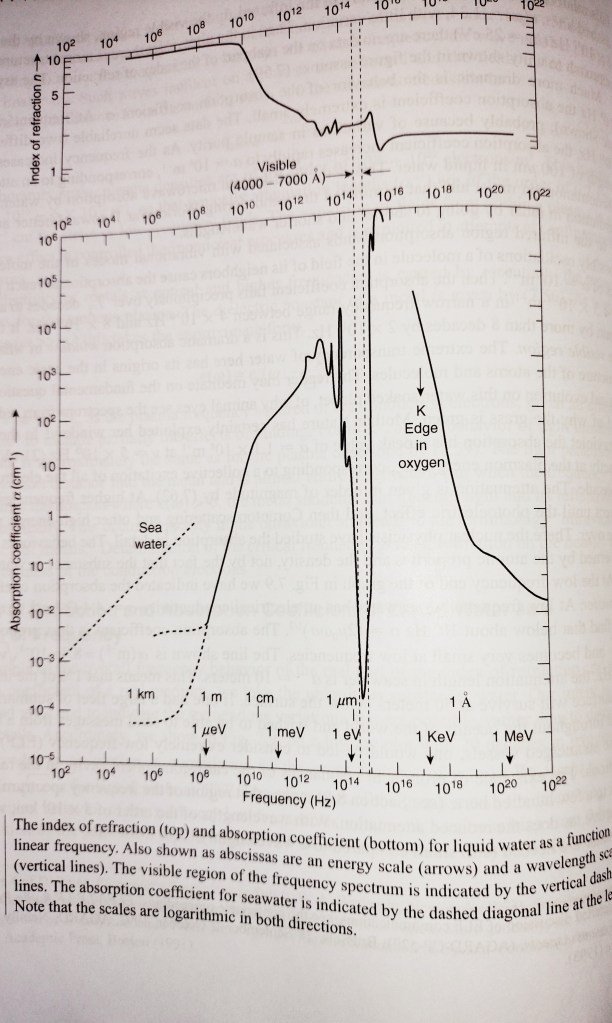
There was much of this brief section (which was about refraction and/or absorption of light** by water) that was slightly over my head.  Nevertheless, it was interesting, and the author introduced a graph (see below) showing at the top the refraction of light by water across wavelengths, and how it tends to vary.  I assume we’re all at least implicitly aware of the fact that different wavelengths are refracted by water differently‒thus the phenomenon of rainbows.

Below this is a table showing the absorption of electromagnetic radiation by water across frequencies.  Here there is a steep upward slope when coming in toward the center from highest and lowest frequencies.  It peaks at around the microwave/infrared wavelengths from the left and around the ultraviolet from the right.

Then a striking thing happens.  There is a sudden, precipitous drop in absorption down to very low levels in a fairly narrow range of frequencies in the “middle” of the graph, meaning that in this range, light passes through water with relatively little absorption.  This is the range we know as visible light.

The author took the time to point out that this fact about the nature of water‒that it is more or less transparent in this very narrow range of frequencies‒is exactly why we Earthlings tend to see only in that range.  It’s not an accident of evolution, some ancient, stochastic occurrence that is thenceforward cemented, unchangeable, into all descendants, like the DNA code and ribosomes and the chirality of biological molecules.  It is instead a fundamental fact of physics that determines where creatures will be able to see if they first developed vision while living in water and then developed eyes that, like the rest of them, were mainly made of water.

There’s no point in making retinal proteins that react to wavelengths of EM radiation that are almost entirely absorbed by water.

That simple fact‒simple in summary, at least‒is enough to explain a huge swath of the nature of our visual perception, and it doesn’t require any further explaining to understand why we see in the range of light we do.

That was just a randomly chosen section of a textbook that reputedly is extremely difficult.  I don’t disagree with that assessment of difficulty; it was a very dense bunch of material even in just 4 or 5 pages.  But to think that one can find such remarkable facts while just trying to read and learn in random order from a textbook!

So, that’s an interesting little tidbit that seems worth sharing, at least to me.  It’s far more interesting than anything going on in the human world right now.  What’s more, this is a fact that has existed as long as water itself has existed‒and implicitly, it existed even before that, lying there waiting in the fundamental laws of nature.  And it will be there long after everything but those fundamental laws is gone.

If you want to embrace eternity, and things like Hilbert’s Hotel and Cantor’s diagonal proof make you worry about your sanity (this happens to many of us, so don’t feel bad) then focus on this fact about visible light.  It’s there, it’s real, it’s quasi-eternal, and it’s concrete.

Though the absorption spectrum for concrete is…quite different.


*This harkens back to the reference from Batman Begins, when Flass says “I swear to God,” and Batman snarls “Swear to me!”  It seems fun to use Batman when one would normally say God.

**By “light” I mean all electromagnetic radiation, from radio waves to gamma rays.

Thoughts meander like a restless spore inside a humid room

In case you’re confused:  Yes, it is Monday, even though I’m writing a blog post.  I just decided that I might as well do something that gives the illusion of productivity, since, y’know, I’m awake and on my way to the office anyway.

As for topics about which to write, well, on that I don’t know.  I don’t think there are any momentous or interesting things worth discussing that are happening in the world right now (ba-dump-bump, chhh!).

Still, it is true that to a very good approximation every event that happens and that seems so earth-shattering and important in the moment is utterly forgotten by everything except quantum mechanics and Laplace’s demon.

Don’t believe me?  Do you remember that scandal in the Roman Senate when Cinna the Younger misdirected Republic funds to buy a “servant” for his household?  No?  Neither does anyone else.  Of course, that was 2000 years ago, so you may think it doesn’t count, but I’m sure almost none of you know about any of the “crucial” events of the day or the escapades of popular stars even 40 years ago.  I certainly don’t remember any, and I was fifteen at the time, and I have an unusually good memory.

Also, time‒with respect to online information, anyway‒is cycling more quickly nowadays.  Sure, information can last a very long time online*, but that doesn’t really matter in a dispositive way, because there is a constant gusher of new and distracting information coming in at all times, with signal and noise intermingling haphazardly.  It’s a bit akin to the fact that although Manhattan is crowded with millions of people in a small area‒so you might think your life would be less private‒in many ways it is more private than other places, because when there, you are one indistinguishable face among those millions.

The internet makes Manhattan look like Mayberry.

Still, it would be nice to be able to get my words and maybe my stories and maybe even my music out to more people who might find them interesting and/or entertaining.  It’s not immortality in anything like a literal sense‒nothing is‒but still, there’s at least some little internal drive to spread the memetic code of me out in the world.  I could think of myself like the fruiting body of a fungus, spewing the spores of my thoughts into the wind, seeing if they’ll be able to infest and infect any other people out there.

It might at least be interesting to give someone the psychological equivalent of a persistent, itchy rash thanks to my words.

Of course, the fungus metaphor is an ironic one for me, since I cannot stand mushrooms for eating, and even the smell of wild mushrooms after damp weather (or mildew for that matter) fills me with literal nausea.  Then again, given my own poor opinion of myself, maybe it’s right for me to think of myself and my ideas (my celium, perhaps…get it?) that way.

Fungi don’t have any qualifications or requirements to meet other than survival and reproduction.  And that’s very much the nature of online information exchange; the stuff that spreads most isn’t the “brilliant” or the “important”, it’s just the catchiest.  The whole process is stochastic.

Of course, there is an entire ecosystem of such meme-plexes, and they vary in their tendencies to spread quickly versus being more long-lasting.  Like the species in a rainforest, some spread quickly and germinate and reproduce quickly, but then quickly die, with short, frequently repeating cycles; others spread and grow more slowly, some perhaps becoming the mighty trees that dominate the structure of the forest, but which perforce have longer, slower growth and death cycles.  And, of course, the various other plants (and animals) in the jungle create and are each others’ environment.  There are even parasitic plants, and opportunistic ones that germinate only after a fire.  It’s very complicated, and no one plant is crucial or eternal**, though they may think they are.

Am I pushing the metaphor too far?  I don’t think so.  I think it’s important for people to recognize that no one controls the internet, just as no one controls the economy, just as no one controls the ecosystem, just as no one controls the evolution of the universe itself.  Everything just happens thanks to the interactions of numerous smaller elements interacting according to local forces and pressures.

That’s enough for a Monday, I think.  I hope you all have a good one.


*But not forever, despite what anyone says.  I fear no contradiction here, because to prove me wrong, you would have to wait until forever had passed.  At which point, if you are right, I will gladly concede the issue.

**Unless you count microbes‒some of those could be considered immortal.  Of course, in a sense, since it all has one common ancestor somewhere, life as a whole could be considered just one gigantic, very long-lived (but probably not immortal) organism.

The year is dead; long live the year. Whatever.

It’s Tuesday, December 31st, 2024‒New Year’s Eve.  Of course, as I’ve written before, every day is the first day of a new year, in a trivial but nevertheless true way.  The day to mark the new year is an arbitrary choice.  We could have had the new year begin “officially” on the first of any month.  Indeed, we could have started it in the middle of a month, or perhaps on the winter solstice.  Or we could have 12 months of thirty days, leaving a 5 day extra period which we could use as a long holiday and an official new year celebration, with an extra day every leap year.  We could do this around the winter solstice, or even around the summer one, like hobbits do.

Oh, well.  It’s not as though people are going to collectively change, any more than people are going to go back to really celebrating holidays:  with most workplaces closed except for hospitals and police and fire stations and the like, with people spending the holidays with loved ones.  Once one business stays open on those extra days, competitors (direct and indirect ones) will stay open, too, or suffer a disadvantage that may lead them to be more likely to go out of business.

The world of commerce is red in tooth, claw, and debt, so after a while, only those who push every edge they can without getting more negative marginal returns, will dominate.  And that will become the norm.

No one made it happen, no one planned it.  Everyone’s caught in the currents of chaos, but those able to use the flows to their advantage‒chaos surfing, as I call it‒will thrive, at least temporarily, even if they don’t realize why they are succeeding, which they usually don’t.

It’s similar with the workers:  once some small subgroup is willing to eschew holidays and to work longer hours, they will have advantages over other workers, at least as long as working more proves advantageous to them and their workplaces.  Soon, the marketplace of workers will skew toward people being willing to work longer hours in worse conditions, as long as it provides a relative, local advantage.  Those who cannot match this will fall by the wayside, perhaps becoming homeless, getting addicted to drugs, going to jail or prison‒self-destructing directly or indirectly.

This is not a conspiracy by employers or governments or anyone else.  No one is that clever, and they are all beset by their own local pressures and competitions.  Why else would the very wealthy do anything but sit back and eat ice cream until they die (figuratively speaking)?  They are no more happy or satisfied than most other people.

It’s analogous to the situation with trees and forests.  It takes a lot of effort and resources for trees to grow tall.  Why do they do it?  Because other trees do it, and any tree that doesn’t want the sun blocked out had better do the same*.  If all trees could agree somehow to stay short, they could all thrive and get adequate sunlight and nutrition and water and air at a fraction of their usual height and resource usage.

But once one tree grows taller, the arms race begins.  Such is the way of economies and ecologies.  They cannot be planned, they cannot even really be controlled or constrained (at least not without disastrous results).  At best, they can be “herded”.  That’s a metaphorical herding, by the way‒a careful nudging of things to keep the eddies in the phase space currents from driving the system toward deteriorating returns, along whatever axes one may use to measure such things.

None of this happens due to some malicious plot, and it is not generally evil.  This competitive jockeying and self-abnegation while seeking seemingly locally selfish ends, or at least responding to local pressures (internal and external), has led to all the many scientific and technological advances that we have, from improved farming techniques that allow the world to sustain billions, to better healthcare, better sanitation, better transportation, greater safety from the elements, greater understanding of the universe at large…and the sometimes-cesspool that is the world of electronics, computers, smartphones, tablets, and digital interactions.

No, this shit all just happens “on its own”.  Natural selection works in places other than biology, and it is a ruthless, blind, and amoral driver, here in the region of spacetime where increasing entropy is in the stage where that increase leads to local complexity rather than uniformity.

Whether or not the local manifestation of it will last long remains to be seen.  There are many ways for any particular state of a system to be obliterated, or for that system itself to decay and disintegrate.  It requires constant effort to maintain anything like homeostasis and growth, but not just any effort will do.  One must constantly reassess, course correct, look for mistakes from which to learn, adapt to all the new, varying states of the system, or perish.

I don’t know about you, but I’m very unsure that it’s worth it.  In all honesty, I did not want to see 2025, and really, I still don’t.  I want to find the courage just to check out.  There’s very little for me here, and of all the things in the world that frustrate and irritate and disgust me, I’m the worst.

I guess if I write a blog post on Thursday, you’ll know that I am still around to see 2025.  If so, please don’t congratulate me.  It is not a good thing; it’s yet another failure in my long string of them.

Anyway, I hope you all have a Happy New Year.


*I’m anthropomorphizing here, but don’t get confused.  The individual trees don’t get to choose, evolution just favors the tall in this situation, ceteris paribus.

If I could write the beauty of your blogs, and in fresh numbers number all your graces…

Hello.  Good morning.

Aaahhh, doesn’t that feel better?  Now I can use my standard Thursday blog post opening phrases, because today is, in fact, Thursday.  It’s the 21st of November, the third Thursday of the month, so in the USA you only have seven shopping days until Thanksgiving.

Speaking of Thanksgiving, since next Thursday is that holiday, I probably will not be writing a blog post then.  It is one holiday on which our office is always closed.  We will be open on so-called Black Friday, but I can’t guarantee that I’ll write a post on that day.

Of course, in principle, I cannot guarantee that I’ll write anything at all ever again after this post.  I may not even survive to post this entry*‒I am in the back seat of a Lyft, on the highway (I-95) of the East Coast of the US, so goodness knows there’s a non-zero chance of a fatal accident.  I would even wish for one, but I know such a thing would involve harm and possibly death to other, more innocent, people.

Also, of course, wishes don’t actually directly affect reality‒thank goodness.  Imagine if even one percent of wishes came true as wished.  The world would be thoroughgoing chaos…and not in a good way.  I tend to say of wishes that “If wishes were horses, then we’d all be hip deep in horse shit,” but it would be even more terrifying if wishes worked.

The “if‒then” character of the wishes saying (my version or the more SFW one that involves beggars riding) often makes me think of lines of computer code in some generic programming language, like:

If wishes==horses then execute beggars.ride

Or maybe 

If wishes==horses then horseshit_level = “hip deep”

I wonder what that would look like in machine language.  Or, I wonder what it would look like in straight binary.  Really, though, I know part of the answer to the latter piece of wondering:  it would look, to the naked eye, like a random string of ones and zeros, perhaps the tally of some very long record of flipping a coin and marking heads as 1 and tails as 0 (or vice versa).

Actually, of course, given a binary-based computer language, one can literally generate every possible computer program just by flipping an ever-increasing number of coins.  Or, to be honest, one can do it just by counting in binary:  0, 1, 10, 11, 100, 101, 110, 111, 1000…

This is why, if memory serves, computer science people and information theory people say that every program can literally be assigned (and described by) a number.  You could express that number in base ten if you wanted, to make it a bit more compact and familiar to the typical human.  Or, if you want to be more efficient and make conversion easier, you can use hexadecimal.  This is easier because a base-sixteen number system is more directly and easily converted to and from binary, since 16 is a power of 2 (2 to the 4th).

Even the human genome, or any genome in fact, could be fairly readily expressed in binary.  The DNA code is a 4 character language, so it wouldn’t take too much work to make it binary, however you wanted to code it.  Then, each person’s genome would have a single, unique number.  That’s kind of interesting.

It would be a bit unwieldy as an ID number, of course.  The human genome is roughly 3 billion nucleotides long, which means it would be roughly 6 billion binary digits (AKA bits).  And since every ten bits is roughly a thousand in base 10 (2^10 is 1024, which is very close to 10^3, aka 1000) then 6 billion bits should be roughly 2 billion decimal digits long (a bit less), which is much, much larger than the famously large number, a googol**.

It’s a big number.  This should give you at least some idea of just how unique each individual life form is at a fundamental level.  There are so many possible genomes that the expected time until the final heat death of the universe is unlikely to be long enough to have a randomly created duplication within the accessible cosmos.

Of course, within an infinite space‒which is the most probable truth about our universe as far as we can tell‒one will not only have every possible version that can exist, but will have infinite copies of every possible version.  Infinity makes things weird; I love it.

Of course, just as with the making of computer programs by simply counting in binary, the vast majority of genomes would not code for any lifeform in any kind of cellular environment, using any given kind of transcription code you might want (the one on Earth, found in essentially all creatures, uses three base pairs to code for a given amino acid in a protein, but that’s not all that DNA does).  Similarly, most of the counted up programs would not run on any given computer language platform, because they would not code for any coherent and consistent set of instructions.

But even so, you would still, eventually, get every possible working program, or every possible life form in any given biological system if you could just keep counting.

On related matters, there are things like the halting problem and so on, but we won’t get into that today, interesting though it may be (and is).

It’s quite fascinating, when one is dealing with information theory (and computer science) how quickly one encounters numbers so vast that they dwarf everything within the actual universe.

Mind you, the maximum possible information‒related to the entropy‒carried within any bounded 3-D region is constrained by the surface area (in square Planck lengths) of a black hole with that size event horizon.  For our universe, roughly 96 billion light years across, I think that’s something like 10 to the 124th bits, or at least it’s that many Planck areas.  That’s quite a bit*** smaller than the number of possible genomes, though I have a sinking feeling that I’m underestimating the number.

And information, at least when instantiated, has “mass” in a sense, and the upper limit of the amount of information in a region of spacetime is delineated by the Bekenstein entropy description.  So there’s only so many binary strings you can generate before you turn everything into a black hole.

Something like all that, anyway.

I may have been imprecise in some of what I said, but when you’re dealing with very large numbers, precision is only theoretically interesting.  For instance, we**** have found Pi to far more than the number of digits needed to calculate the circumference of the visible universe down to the Planck length.  It would require only about 40 digits of Pi to get to that precision to the size of a hydrogen atom, and those are only about 10^25 Planck lengths across, so we wouldn’t expect to need much more than 65 digits of Pi to get that precise, but let’s be generous and use 100 digits.

How many digits of Pi have actually been “discovered” by mathematicians?  Over 105 trillion digits.  Talk about angels dancing in the heads of pins!  It’s literally physically impossible, according to the laws of quantum mechanics, even to test whether that number precisely defines the ratio of any given circle to its diameter by measuring it.  One cannot, in principle, measure finely enough.

Still it just goes to show that mathematics is vastly larger in scope than any instantiated, superficial reality.  Information is deeper than one might think…so to speak.  But, then, so are minds themselves, vastly deeper.

As Idris/the TARDIS asked in Doctor Who, Series 6, episode 4, “Are all people like this?  So much bigger on the inside?”  Yes, Idris, I suspect they are, even those people we don’t like and feel the urge to denigrate.

That’s enough for today, I think.  I’ve achieved nothing, really, other than write a Thursday blog post, but then again, that’s all I meant to do.  I hope you have among the better half of all the vast number of possible days available to you.

TTFN


*If you’re reading this, though, I clearly did survive.  I have mixed feelings about that.

**How much larger?  Soooo much larger that if you subtracted a googol of something from 10^1,800,000,000 of something, you would not change it to any extent measurable even by the most precise instruments humans have ever created.  And a googol is already something like 10 to the 19th times as large as the total estimated number of protons and neutrons in the accessible universe.

***No pun intended.

****Actually, I had nothing to do with it; it’s just the sort of “royal we”***** kind of thing everyone uses when discussing the accomplishments of humanity as a whole.

*****Not to be confused with royal wee.  That’s the sort of weird, niche thing one might find for sale in mason jars on the dark web.  Be careful if you’re into such things.  I wouldn’t buy it unless you’re sure of the source, so to speak.