Monday’s blogger at least still likes to learn

Hurray, hurray.  It’s Monday.

It’s probably hard to tell from the printed words, there, but I was being sardonic with that opening pseudo-exclamation.  I’m not excited that it’s Monday and the beginning of a new work week.  Then again, I’m not excited by much of anything.  Staying at the house doesn’t seem likely to be exciting, either.  There’s not much I can think of doing or any place I can think of going that seems exciting.  Nearly all the things in the world are on some spectrum from boring to stressful.

I don’t recommend this as a way of being, not even to myself.  I’m trying to find ways around it, or rather, to counteract it, but all my previous attempts have not succeeded in any durable fashion, as should probably be obvious.  Various medications, various therapies, lifestyle changes, exercise‒none of it has worked.  Some time ago, I had some hopes that trying marijuana that a former friend had would at least help my pain, if not my depression, but it did neither after two tries, and when I tried too much when I was in particularly bad pain, it made me quite sick to my stomach.  I was throwing up for a few hours (not continuously, of course, but it was still pretty bad).

It’s ironic that THC is used to treat nausea in many cases.  Evidently, my nervous system is too atypical for such things.

I recently happened upon some videos about psilocybin, specifically that there’s a study beginning on using it to try to treat some of the negative symptoms of autism spectrum disorder.  I know it has been used to treat recalcitrant depression and related disorders, including depression in people facing terminal cancer.  Psychedelics have always sounded intriguing, and people make much of them, but I think, given my experiences with other meds, I would be very frightened to try any of them.  My mind is not my friend, and I worry that I would be particularly prone to a “bad trip”, and there’s no way to abort such a thing once it has started; one just has to go through it to the other end.

Speaking of being anxious and frightened of things that many people find beneficial, I had meant to retry riding my new bike yesterday, and perhaps to ride it to the train and then into the office today, but I find myself subtly terrified to do so.  The beginning of last week was just so exceptionally painful and horrible that I am frightened of reinitiating it.  I wish I could know that it’s something that would resolve after a time, but it seemed to worsen over the course of the three or four days I was riding, until by last Monday I was bed-ridden, and I was even grumpier and more cheerless than usual on Tuesday, if you can imagine such a thing.

I think I’ll have to forgo it.  My boss really liked the bike, and offered to buy it from me if I can’t use it, but then I need to get it up to the office, which would mean riding it.  I don’t see myself carrying it.

My train is coming in five minutes.  I’ll pause and then return to this once I get on the train.

***

Okay, I’m on the train now.  What was I talking about?  Oh, yeah, the bike.  I guess I could have it shipped up to the office.  I think Uber even provides services like that, or I could try to see if there’s a way to set up an Uber in a vehicle that can carry the bike.  It’s a thought.  I don’t see my boss making a trip all the way down to my place to pick it up.

I guess I should stick to walking, even though it’s slower.  At least I can listen to audiobooks and podcasts and such while walking.  Nothing beats The Fellowship of the Ring as walking accompaniment, since it’s all about a journey on foot.  Even walking has its troubles, of course‒I have spandex braces on my left knee and right ankle to address the little bit of walking I did yesterday, and the right side of my back is in moderate spasm.  But that sort of stuff is par for the course.  If/as I lose weight, some of that will decrease, and some of it may even disappear.

Life is annoying on so many levels.  But at least there are lots of videos on things like hyperbolic geometry and computers and tensors and matrices and Einstein’s field equations and things like that.  It’s often the case that if I find several different people explaining the same thing I end up with a much deeper understanding.  Each teacher or author or whatever approaches things in a slightly different way, with different emphasis.  When one sees a subject from multiple angles, one tends to get a more complete and thorough understanding of it.  In this, I guess it’s analogous to binocular vision, which gives us depth perception.

I really want to read Zee’s book on quantum field theory, but although these new glasses are better for such smallish print, I think maybe I should have gone even higher on the strength.  Maybe I’ll go to the drugstore over lunch and pick up a stronger pair.  It would get me a bit more exercise, at least.

Please don’t emulate or internalize my negative outlook on things; I have no desire to see a world where more people are depressed.  Do try to keep learning.  Try to build as accurate a map of the world‒in all senses‒as you can.  Be ruthless with yourself in that process.  Your biases will try to trick you, and they will never stop trying, so you need to apply active countermeasures against them.  It’s a pain, but it’s important (and often satisfying and even thrilling) to work toward as accurate a map as you can get, not one that shows a world the way you would like it to be or you believe it to be.  A poor map will be less likely to get you anywhere you might want to go.

The title of this blog post is unrevealing

It’s Tuesday morning, and this is my first post of the week‒which I guess is not so bad, since a few weeks ago I had said I might not write any more at all.  I’m not sure why I am still writing, other than simply as a matter of habit, which tends to be strong with me.  Perhaps that really is the only reason.

I was not out “sick” yesterday in any traditional sense, but was instead out with a severe exacerbation of pain in a slightly unusual distribution: left foot, knee, and hip/iliosacral areas in addition to a bad flare up in my back.  Every kind of movement was painful for me, so I mainly just laid around taking aspirin and Aleve and Tylenol and trying to give my body a break.  It’s a bit better now, though by no means ideal.

I fear this pain was because of riding my new bike, even though I didn’t ride it very far or very long over the weekend, and it felt okay while I was riding it.  That latter bit is typical, though.  Things that trigger exacerbations often don’t do so right there at the moment.  They take time to build up and catch one by surprise, so one is never quite sure what the real cause of the flare-up is.

For instance, a cold front came in over the course of Sunday afternoon, and the temperature dropped by nearly thirty degrees (Fahrenheit) by Monday morning.  That brought it down to about 50, which is quite chilly for south Florida.  That may have contributed to the increased pain, but I’m pretty sure it wasn’t the main cause.

I did at least get a bit of rest yesterday, napping whenever I could, which is nice.  But I’m quite frustrated to get pain flare-ups from riding the bike.  It’s very discouraging.  I was hoping the bike would give me more freedom of movement, not less.

I did get to talk to my daughter on the phone on Sunday.  We’d been planning to talk for a few weeks but stuff kept getting in the way on her end, but finally she was able to call me yesterday.  It was very nice.  I hadn’t heard her voice in about 8 years or so, and it has changed, since she was a teenager the last time we spoke.  We had a nice conversation, at least for me.  She seemed to be enjoying herself, also, but one can never easily be sure, especially when someone is talking to me.

Also, I spoke to my sister last night, but it hasn’t been nearly as long since I last spoke to her‒about a week, in this case.  We had a nice conversation, though, as always.  As for everything else, well…there is nothing else, really.  I haven’t written any new fiction or played any music or drawn any pictures or anything else of value.

I’m taking an Uber to the office because it’s still pretty painful to move and I want to keep it to a minimum.  It’s also hard on the bases of my thumbs, writing this in the back seat using my smartphone, but I don’t know what else to do about that.

Honestly, I don’t know what to do about much of anything.  I’m still very much at a loss about life in general.  I still haven’t been able to bring myself to look into health insurance.  I don’t have any future plans, really.  I’m basically empty‒except for pain, obviously, but I already mentioned that.

I also have a lot of free-floating anger a lot of the time, I guess that’s something.  At least, it is if you like being angry.  I never really have enjoyed it, though; it makes me feel guilty, even if I don’t act on it.  It’s not pleasant.  Maybe I should learn to embrace it, and all that.  At least it’s slightly energizing, temporarily.

Oh, well.  It doesn’t matter, I guess.  I’m not sure that anything does matter.  I guess that’s all a matter of perspective, so to speak.

That’s it for today.  Try to have a good one, if you can.

…sore labor’s bath, balm of hurt minds…

It’s Friday, but I work tomorrow, so the fact that it’s the last regular workday of the week means little to me.  I hope all of you (or y’all) are looking forward to the weekend.

Thanks for the kind words about my taking the day off from doing any writing or speaking yesterday.  I had a weird Wednesday afternoon to Thursday morning, so I was not really up to trying to write anything other than my note about how I wasn’t going to write anything.

I felt a strange surge of somewhat reckless energy on Wednesday afternoon‒possibly because I had finished payroll, possibly for some other reason‒and decided that it might be neat to try to walk all the way back from the office to the house.  It’s 30 miles, so I didn’t expect to be able to make it the whole distance, but I figured I’d get as far as I could and then Uber the rest of the way.  I really meant to do it.

Then, late in the afternoon, my sort of subacute-bordering-on-chronic lower GI discomfort came to a head, and I had to use the head several times in quick succession.  I realized that this would not be a good time to attempt my feat of endurance; I had no wish to be “caught short” on the streets of south Florida…or in some poor Uber driver’s car, for that matter.

So, instead, I waited at the office even after everyone left‒the train also not being a good place for GI emergencies‒and took some Imodium.  By the time everything settled, it was quite late, and so I just slept at the office.

Oddly enough, I slept better there than I usually do, and I half hoped that I might feel pretty good for the day.  That didn’t really pan out, and as you know, I didn’t even feel enough energy to write a post or do a voice recording.  I know I had already said that I’m not sure I’m going to continue this blog at all, but since I have been tending at least to post something on these days, I figured it would be polite to give notice.

It all just seems quite futile, though.  Of course it seems futile.  Everything seems‒and it may turn out to be feels‒that it will undoubtedly looks‒futile.  I don’t see any point in my continued life whatsoever.  I still haven’t gotten or even seriously investigated health insurance, partly because of the very severe tension and anxiety I have about initiating the process, but also because of my lack of desire to protect my health.

I really didn’t expect to be alive to see this year‒I didn’t plan to be alive, anyway.  Several times in the relatively recent past, I made plans to enact the end of my life, but one thing after another has gotten in the way.

I suspect there will be people who will say that I let things get in the way because I didn’t really want to die, and of course, at some level that was true.  I didn’t so much want to die as I wanted to be dead, but since there’s no quantum tunneling-style option, the one has to lead to the other.

I’ve often pointed out that the biological drive to survive can be absurd but is doggedly persistent, and it is very difficult to overcome via conscious thought.  I’ve tried.  I threw away a bunch of things I owned, I gave away some other things, and just in general attempted to put my house in order, so to speak.  I even wrote a draft of a will, of sorts, which I’ve updated a few times since.  But many things got in the way, not least the simple wish not to make things too inconvenient for other people.

And there’s the fact that, as I noted earlier, rather than say “I want to die”, it makes more sense to say “I want to be dead.”  If I had an “off” switch that could just be flipped, that might be the best thing.  But, of course, that’s not how biological organisms tend to operate, and the process of dying tends to be extremely unpleasant, for good, sound, biological reasons.

Sometimes I think if I could just get actual, restful sleep, that might be enough.  The last restful night of sleep I remember happened in the mid-1990s, and I remember it because it was such an outlier.  I was not used to waking up and feeling refreshed and rested and alive.  It was glorious.

Sleep clearly serves some important biological function; probably it serves more than one.  What it does is clearly complex, but I sometimes imagine it as a kind of automated pipe-scrubbing system in some intricate network of steam-punk machinery.  Every day, the system goes into idle, and the pipe-scrubbing/exhaust clearing system goes to work.  But my auto-maintenance, pipe-clearing system is faulty.  It doesn’t ever completely clear out the day’s accumulated debris and grime.

When the system is relatively new‒when one is young‒it’s possible for things to work relatively well, even if all the grime of a given day is never quite cleared away.  But the grime accumulates, the system accrues varying levels of obstruction, its auto-repair doesn’t work as well as it should, and gradually, over time, everything builds up, pipes get leaky, some junctions and connections get severely constricted and some fail altogether, and it gets harder and harder for the system to continue to function well.

People think I’m fairly smart; just imagine how clever I might be if I could just get a decent night’s sleep once in a while.

Probably the lack of sleep contributes to my chronic pain‒and then, of course, the chronic pain contributes to my sleep problems, which is not a paradox, but is actually an almost predictable occurrence in such spontaneously self-assembling, complex adaptive systems with all sorts of internal feedback systems and self interaction and all that.

“For want of a horseshoe nail, the kingdom was lost.”

“For want of the price of tea and a slice, the old man died.”

Oh, well.  Since I work tomorrow, I think I might try my walking home quest after work, then.  I have new socks that I ordered for just such a thing after Wednesday.  It would be cool if they help.  Perhaps I would sleep really well afterwards.  Or, hey, who knows, maybe I’ll get hit by a car (or other vehicle) on the way, and this will all be taken out of my hands.

There are worse things I can imagine.  One of them is simply my life continuing, as it currently is, indefinitely into the future.  The prospect of facing several thousand pounds of rapidly moving metal, perhaps steered by someone who has been drinking, seems much less unpleasant than that other, more banal and yet supposedly desirable alternative. 

Mad morning musings and “The End of All That Is”

It’s Wednesday morning again, and here I am, reverting to habit, writing a blog post (this time on my smartphone) because I frankly can’t seem to think of anything better to do with my time.

Well…I could sleep.  That would be a better use of my time.  Except I can’t sleep.  Even on weekends, the only way I get myself to sleep through the night is to take two Benadryl™ before I lie down.  But that’s not really effective, restorative sleep, and though I stay in “bed” later, I can tell the next day that I’m not really rested.  Or maybe that’s just residual effects of the antihistamine, I don’t know.

The best thing about when I was taking Paxil for my depression‒which didn’t work overall, and gave me bad side-effects‒was that it made me not just able to go to sleep at night, but to actually feel good going to bed and going to sleep, to enjoy the process.  I had never experienced that before, nor have I since.  But, as I said, there were other side-effects that made it quite bad.

Also, it made me gain weight, which would be particularly bad now, because I’m already heavier than I’ve ever been.  That’s what can happen when one’s only reliable pleasure comes from eating, and when one also eats as a sort of “stimming” and soothing thing to try to ease a constant sense of anhedonia and stress and dysphoria.  And it’s not as though I could simply “embrace” my body size, because it comes with worsening pain and other unpleasant consequences.

Unfortunately, I don’t get immediate worsening of pain when I eat.  It’s delayed.  If it were immediate, I would probably develop a habitual avoidance, and that would be great.  I try to remind myself, when my ankles and knees and back and hips are hurting a lot, that this is caused, at least partly, by eating too much, but that auto-suggestion doesn’t seem quite to work.

I’m pretty sure that I would eat less if I slept better.  Chronic sleep loss tends to affect one’s regulatory and stress hormones, and can stimulate appetite (especially for carbohydrates) in many people.  I appear to be one of these people.

I wonder if I could figure out a way to cause myself pain while eating‒maybe I could put a clothespin on the end of my pinky when I eat, every time I eat.  I don’t know if you all remember, but having a clothespin clamped on your fingernail hurts quite a lot, and hurts even more (albeit briefly) when you take it off and circulation returns*.

If I could arrange something like that to happen whenever I eat, that would be useful.  I did have a TENS unit that never helped my chronic pain, but some of its higher settings could be quite uncomfortable.  I suppose it might be useful to train myself, though it would require setting it up and activating it every time I ate.  Also, I’m almost sure that I threw it away in frustration because it didn’t work.

It would be really useful if I could somehow trigger nausea any time I ate, as in the style of aversion training seen in A Clockwork Orange.  I suppose I could try to force myself to eat eggplant with every meal…but no, I don’t think I could.  It’s very hard to force oneself to eat things that make one feel sick.  That’s the whole point of this line of thought.  I guess I could look for some syrup of ipecac.  I’ve never used that, but I think they used to use it to make people throw up if they’d eaten something poisonous or the like.  It might be worth a try.  I think I’ll send myself a reminder to look it up on Amazon.

The train just arrived.  I must say, Tri-Rail seems to have deteriorated slightly since changing their schedules, but maybe they’re just in the middle of making adjustments.  I try to give other people and organizations the benefit of the doubt when I can.  The Principle of Charity is one that I think would be very useful for society as a whole, or at least for humans:  the idea of trying to see what people say and do from the best possible light you can, instead of reflexively assuming the worst, of getting judgmental and self-righteous and assuming anything you find even slightly uncomfortable is a personal attack on you, precisely because you feel uncomfortable.

If I took that attitude, I could definitely see myself trying to destroy the world or even the universe, because a lot of reality bothers me a lot of the time.  Fortunately, I know that my feelings are my problem and my responsibility, not anyone else’s.

Not that I don’t fantasize about global and even universal destruction when I’m feeling particularly pan-antipathic.  I imagine working to perfect technology to adjust the course of asteroids.  I could even sneakily get government funding to do so, but then I could actually use the technology to steer near-Earth objects toward the Earth rather than away from it.  Some good asteroid hits might be extinction-level events, and a comet impact (of sufficient size) could wipe out nearly all life on Earth.

I say “nearly” because some microbes are remarkably resilient.

Of course, if one could study the possibility of vacuum decay‒causing, for instance, the cosmological constant or the Higgs Field to quantum tunnel to a lower energy level‒that would produce a wavefront process that would obliterate all forms of matter, a wavefront that would expand at the speed of light and wipe out everything.

Well…it wouldn’t literally wipe out everything, actually.  First off, it would leave behind whatever cosmos is entailed in the new Higgs (or other field) set-point.  And, of course, beyond our cosmic horizon, there are bits of reality that are moving away from us‒carried by the expansion of spacetime itself‒at faster than the speed of light.  So the vacuum decay wave would never reach them.  But it would obliterate everything in the observable universe, and that might be heartwarming enough.

Vacuum decay, though, may not even be a physical possibility‒it’s not a consensus prediction, though there are reasons to think it might be possible‒according to the best models we have of cosmic history, the Higgs field did settle out in a non-zero state after the electroweak era, and if inflationary cosmology is correct, then the “inflaton” field similarly decayed.

Still, we also have no idea how (or if) such a decay could be triggered.  There is no apparent risk of initiating it through highly energetic physics, because there are constant, extremely high energy processes happening in the cosmos, and everything we can see is all still there, as are we.

Oh, and contrary to the X-Men comics’ Phoenix/Dark Phoenix saga, unfortunately, a “neutron galaxy” would not be “The End of All That Is”.  If such a “neutron galaxy” were to “appear” in the middle of the Milky Way, that would be bad for us, though its effects would take a while, since even gravity doesn’t travel faster than the speed of light.  But effectively, a “neutron” galaxy would be no more cosmically devastating than a supermassive black hole with the mass of a hundred billion suns or so.  That’s a big black hole, bigger than any we’ve seen (and probably too big to be expected to exist at the current age of the cosmos), and as with any black hole, if you get too close it can be bad news**, but from a distance its effects would be no more harmful than an ordinary galaxy of equivalent mass.

Oh, well, I’ll have to keep brainstorming ways to destroy the world or humanity at least.  Maybe biology is the way to go‒it might be possible to genetically engineer something like the Blob or the Chicken Heart that Ate the World.  Or one could deliberately make an AI that has the terminal goal to turn everything into paperclips, not by accident but on purpose.  That would be humorously ironic.  Or one could just make an AI nanobot, Von Neumann probe-style thing that literally had the sole programming to replicate itself as much and as fast as possible, using every available resource.

I’ve written before about how such a thing could even instantiate a new kind of galaxy-level natural selection.

I wonder what would happen if I tried to crowd-source a project to end all life in the universe, maybe with a “GoFundMe” page…

Anyway, my station is coming up, so I’ll draw my insane musings to a close for now.  I don’t know if I’ll write anything tomorrow.


*Don’t worry, this was not something anyone else ever did to me.  This was something with which I experimented on myself, because while it was painful, it was quite fascinating that the pain got worse when I first took the clothespin off.

**Although, with one that big, you could probably traverse the event horizon without tidal forces killing you‒at least not just yet‒by spaghettification, so it might at least allow for some interesting final experiences.

The aged man that coffers up his gold is blogged with cramps and gouts and painful fits

Hello, all.  Good morning and welcome to Thursday again.  It’s time for another of my weekly blog posts.

Of course, the major news in the human world—such as it is—is the ongoing international tour de force of the COVID-19 virus.  I’ve expressed (elsewhere) my frustration with the irrationality with which people are responding to this pandemic*, including the hoarding of toilet paper, which makes little to no sense, and believing sub-moronic videos that say, for instance, that you can cure the virus or prevent its spread by aiming a hot blow-dryer into your nose and mouth.  These are such things as make me wish—only semi-facetiously—that people needed a license to reproduce.  Don’t even get me started on the various absurd prophecies and conspiracy theories many embrace and share about this and other global events.  It’s bizarre that people can simultaneously think so highly and so poorly of human nature, in such unjustifiable ways.

Behaviors such as these tend to exacerbate my baseline melancholy, and have in the past led me to, among other things, write a song about depression.  The song, in this case, was Breaking Me Down, of which I shared the “final release” earlier this week on Iterations of Zero and on YouTube.  When I originally wrote it, I wasn’t thinking explicitly about depression, but I was going through a pretty bad exacerbation, so when I wrote a poem/song about my thoughts and feelings, that was what came out.

I have recorded and released earlier versions of the song, but they suffered partly from my inexperience with mixing and production, and from initially being too low (the final product is up two full steps from how I initially wrote it), and too slow.  The original vocals were not so great, either, both in recording/mixing quality and in the singing.  However, as with most things, practice makes better, though it’s unlikely that it ever makes “perfect”**.  So, now, the song is in a higher key and at a quicker tempo, such that I playfully refer to it as a song about depression that you can dance to if you feel like it.  I think that’s a pretty cool accomplishment, though you may or may not agree that I’ve succeeded.

After fixing this song up, I realized that if I remaster my first, sort of jokey song, Schrodinger’s Head, I’ll have enough for about half an album(!).  That’s five original songs, running a total of roughly twenty-five minutes.  Of course, being the lunatic that I am, that thought immediately led me to go back and start tweaking Schrodinger’s Head, including re-recording vocals and doing some harmony.  That’s not so hard—the good thing about singing is, one always has one’s instrument.  And the actual remixing/remastering process, though time-consuming, is weirdly entertaining and satisfying.

The real issue is that once this is done, I will no doubt feel the urge, or the drive, or the compulsion, to make more songs for the other side of an album***.  I do have here and there the beginnings of other songs, and even have a longer portion of something I mean to write about a manga character, but I just know that this is going to consume a lot of time.  Of course, if I were in one of those industries that’s been forced to take a hiatus in response to COVID-19, writing and recording songs might be a good use of my extra hours.  Unfortunately—well, fortunately, really…let’s be fair and positive, if that’s possible for me—my job is going strong, and I continue to be in the office five to six days a week.  Thus, this little musical hobby tends to eat into my real work, which is writing.

That being said, though, Unanimity is coming along well.  I’m nearly done with the latest run-through, and it’s getting closer and closer to publishable form.  It certainly is a long story, but at least I don’t find it boring.  Whether anyone else will share my assessment only time can tell, but at least liking it myself is a good starting point.

That’s pretty nearly it for this week.  I hope you all do your best to stay well…but don’t do crazy and stupid things, okay? For my part, I’ve always frequently washed my hands and coughed and sneezed into the hollow of my elbow, but then, I am an MD.  As for social distancing, well, that’s something I haven’t ever had to think about much.  It seems to be a task at which I’m particularly gifted, and I’ve only gotten better, if that’s the correct term, over the years.  Remember what I said about practice?

Ironically enough, I—someone very far from being attached to existence—am relatively protected compared to all the many people who want so desperately to cling to their lives.  I wouldn’t call it cosmic irony—that would probably have to involve quasars, galaxies, black holes, dark energy, and the like—but it is certainly irony at a high level.

TTFN


*I know the root words are different, but I can’t help imagining that the word “pandemic” should somehow mean “bread for the people,” or maybe “bread made out of people,” such as Jack and the Beanstalk’s giant might enjoy.

**In most cases, the term “perfect” isn’t defined, and is probably undefinable.  Unless one has a clearly delineated set of criteria by which to judge something, declaring perfection is mere wordplay.  I’m a fan of wordplay, of course, but in this case, people seem to think they mean something, formally, when they use the term.  It leads to much confusion.  It also leads many people to drive themselves to distraction, often to despair, and occasionally to destruction in the dreadful pursuit of “perfection”, a hallucinatory goal that never comes nearer than the horizon.  By all means, strive always to improve yourself.  But sincerely trying to achieve perfection can lead to a life of frustration and self-loathing.

***Don’t ask me what I mean to do with such a collection once I make it, assuming that I do.  It’s not as though I have any experience in making or releasing albums.  I would, however, almost certainly call it “Iterations of Zero”.  Consistency is good.

Who would fardels blog, to grunt and sweat under a weary life?

[The initial part of this blog post was meant to be published a week ago, as will become clear.]

Hello, good morning, and good Thursday (it’s also the day before “Good Friday”).  I’m feeling rather poorly this morning, and I am, in fact, going to the doctor before work today.  Yes, I’m planning to go to work afterwards.  It’s not as though I have health insurance or anything, so if I’m going to go to the doctor—ironically—I needs must pay for it out of mine own pocket, even though I’m a qualified medical doctor myself.  This is the eminently sane and rational society in which we live.  Isn’t it grand?

As per last week’s posting, I’ve been focused almost entirely on editing this week, so I’m making significantly faster progress than before, though the road is long.  Also, I’ve just not felt well at all for a while, now, and it’s taking some of the wind out of my sails.  Ordinarily, it’s difficult to get me to slow down and shut up, and I can’t completely rule out the possibility that I’m being subtly poisoned by someone (or more than one) who finds me too annoying.

I’m kidding.  I really don’t suspect some nefarious plot.  It’s just the sort of thing that crosses my mind when I think of myself, so I occasionally imagine that other people might feel similarly.  Actually, other people tend to be more patient with me than I am with myself, but then again, they can get away from me, can’t they?  No matter where I go, as they say, there I am.

I have a few things in the works for IoZ, which might or might not be interesting.  I have an audio blog still to post, and I’m trying to write some posts long-hand (in first draft) to see if that makes me produce them more often.  I also have plans for another post that began its life as a response to a Facebook meme about the tides, stating that, since the moon affects the oceans, there’s no reason to think it wouldn’t affect us since we’re 70% water.  This meme was so misguided and riddled with misunderstandings about basic physics that I couldn’t resist going through the whole Newtonian universal law of gravitation, why there are tides, why they are not dependent upon water, and how tiny the tidal differences due to the moon are from one end of any given person to  the other end.  Yes, I did the math, and shared all the numbers (to significant figures, or thereabouts).  And I’m going to post a version of it on Iterations of Zero once I tweak it a little.

That notion of someone poisoning me doesn’t quite sound so crazy and paranoid now, does it?

I haven’t been promoting my already-published books much lately.  I’ve felt a bit of aversion to Facebook and so haven’t much wanted to give them money, but they really are the best venue I have through which I can promote, unless anyone out there has any better suggestions.  I ought to get back into it.  I just feel kind of obnoxious pushing my own stuff overtly.  I suppose this is why people hire agents and advertisers and marketing firms, but I don’t have that kind of money to spare.

Anyway, the editing of Unanimity and on Free-Range Meat is going well.  As far as short stories go, I still plan both to publish the stories from Welcome to Paradox City as individual Kindle editions and to eventually release a new collection, in hard copy and Kindle, of such “short” stories, so that’s something for you all to look forward to.

Always assuming I live long enough, of course.

TTFN


***


Okay, well, as you might have noticed, I didn’t, in fact, publish my blog last week, so I’m just going to do a follow-up now and continue the story, as it were, where I left off.

The reason I never posted last week was because, after going to the walk-in clinic and telling them my symptoms and my history, and after the doctor there gave me a once-over, he said (more or less), “Look…I can do some tests here and charge you for them, but unless they show a clear and easily treatable cause of your symptoms and problems, I’m going to recommend that you go the emergency room anyway.  So, let’s skip a step, I won’t charge you for this visit, and I’m going to give you a referral to the ER.”

I thought this was, perhaps, a little alarmist, but I was persuaded—not happily—to follow his advice, and I went.  I guess the ER agreed with the clinic doctor’s assessment, because they admitted me for about thirty or so hours, ruled out heart attack and DVT/pulmonary embolism, and did an echocardiogram (among other things).  They also, thankfully, gave me some antibiotics for a chronic/recurrent ear infection, which quite temporarily relieved it…though it’s already recurring even as I write this.

Then, at the beginning of this week, after a reasonably restful holiday weekend in which I neither celebrated any of various potential causes for celebration nor had any interactions with those with whom I would have wanted to celebrate, I got calls from both the cardiologist who read my echocardiogram and from the attending physician who managed my care during my brief hospitalization.

Before I get into what they said, let me give you a bit of back story:

When I was eighteen, I was diagnosed with an atrial-septal defect, secundum type (read about it here if you like), quite a good-sized one, with a greater-than-two-to-one shunt.  This was promptly evaluated, and I had open-heart surgery to close it, performed at Children’s Hospital in Detroit by the man who wrote the textbook on the surgery.  This experience, which was quite painful but at least interesting, was influential on my decision eventually to go to medical school.  Subsequent follow-up was unremarkable, the surgery was a success, I was discharged from ongoing care, etc., etc., etc.

Anyway, it turns out, based on this new echocardiogram, that my previous defect did not remain completely closed through the intervening years, and that I have some equivalent of a patent foramen ovale with, apparently as indicated on the echo, a shunt that is sometimes reversing…i.e. some blood from my pulmonary circulation is shifting to the systemic circulation without having passed through the lungs to blow off CO2 and get oxygenated.  This is why (as was the case before my initial surgery) I seem to have a high resting heart rate (or did when checked at the clinic and the hospital) and now tend to have a lowish oxygen saturation, at least in the right circumstances.

This is all not imminently life-threatening, but as I know, the fact that there is even occasional right-to-left shunting means that there is a potentially serious problem.  And the attending internist recommended that I start seeing the cardiologist before even coming to her for general medical follow-up, with plans for eventual intervention and closure of the defect.  But, of course, as stated above, I don’t have health insurance right now, and as it is, I’m going to be paying for this hospital visit for quite some time to come.  It is true that closure of such PFO’s nowadays is much less of an undertaking than it was thirty years ago, but I still don’t think it’s going to be cheap.

And, finally, what’s the point?  Apart from the inherent drive to stay alive that’s been beaten into my genes by hundreds of millions of years of multi-cellular evolution, I honestly don’t have any compelling reason to try to improve my health and/or prolong my existence.

I have neither colleagues nor close friends with whom I can really have any enjoyable conversations, or with whom I ever do anything fun…mainly because the things I think are fun are rarely what those around me find enjoyable, and vice versa.

I have a housemate who’s a good guy, and we get along well, but we don’t have a great deal in common (though I’ve bought some great guitars from him).

I’m a divorced, ex-con, MD who can’t practice medicine anymore, whose son won’t talk to him, and who is only able to interact with his daughter through Facebook and similar venues, who works merely to stay alive so he can write and publish sci-fi/fantasy/horror stories that few if any people will ever read, and who occasionally diddles around with writing, producing, and sharing songs, and drawing pictures, and stuff like that.

Oh, and I also make blog posts like this one.

I come from a line of people who tended to be somewhat socially restricted, by nature and choice, but my mother and father at least had each other through their natural life-spans, as was the general rule in the past.  I, however, am a card-carrying inhabitant* of the easy divorce era, bereft of my chosen and beloved family by the will of the love of my life.  I have no strong desire to go through the gauntlet of trying to find some replacement love who is no more likely to have a sense of enduring commitment than the one who came before her, especially when I have so little to offer anymore.

I’m inclined to think that this story’s gone on well past any reasonable degree of interest.  I guess I might change my mind; who knows?  But for now, it’s hard to see the point of bothering to go through all these medical processes again, even if the interventions are less severe and relatively less expensive than they were in the past.  What, as they say, is the point?  I’m basically a weird, weary, and alone person in a world in which the forces of stupidity seem not only to be ascendant now but always to have been so.

It’s enough, I’m thinking.

TTFN


*I don’t actually carry a card

They have their exits and their entrances, And one man in his time blogs many parts

Well, you wouldn’t think it would catch me by surprise—it’s something that happens every month, after all, in an entirely predictable fashion—but I didn’t realize until this morning that today was the second Thursday of October and is thus the “official” day for me to write an episode of “My heroes have always been villains.”  Obviously, since I wasn’t thinking about it, I haven’t given a second’s thought to what villain I should discuss today.  Rather than pick a random baddie from my memory’s hat and produce an off-the-cuff essay on him or her, I’ll push that project back until next week or next month.  I apologize if anyone out there was looking forward to a new episode today.  Then again, if there are such people, I haven’t heard from them; I’d be quite gratified if you’d make yourself or yourselves known.  I can exculpate myself a bit for my oversight by admitting that I’ve been rather worn down, tired, and slightly ill, this week (see my IoZ entry here for a brief discussion of the nature and effects of my troubles with insomnia), so I’m behind my mental curve.

Even as I wrote that last sentence, I realized that I’ve often made comment in these, my public venues, about being under the weather.  Now, I don’t think that I’m too whiny and hypochondriacal, as a general rule, but I certainly don’t seem to operate at my physical optimum much of the time.  It’s a problem that I need to keep in mind, going forward.

I will say this, in tangential reference to the above issue:  I’m glad that I decided to put my audio productions on indefinite hiatus.  It’s a melancholy gladness, if that’s not a contradiction in terms, because I really do like those audio productions, and if you’re interested you’re welcome to partake of the ones I’ve made, either here, or on my YouTube channel.  But making them requires a lot of mental energy and physical time.  Since putting the audios on pause, I’ve gotten more writing done on Unanimity, and I’ve worked steadily on my two other short stories during the the hours I would have spent recording and editing the audio, leading to an increased total output of about five pages a day versus only three on average (or roughly 2500 words versus 1500) before.  This is a serious improvement.

It would be nice to be able to do all this full-time, instead of in the interstices between actions of daily necessity required to put food on the table, so to speak.  Then I could write just as much and still make my audio files, which would be a lot of fun.  I hope someday to reach that state, but I obviously haven’t done it yet.

Unanimity goes well, though, and is honestly approaching its climax and resolution (I swear!  No, really!).  I still expect—if I work on it as steadily as I ought—its first draft to be finished before the end of the year, and probably well before that long novel is ready to be published, I’ll release one or both of the short stories I’m working on, Penal Colony and In the Shade.

It’s amazing how something can take so many hours, so much effort, and yet yield a product that can be consumed within the course of, say, a few days for a novel, or at most an hour or two for a short story.  It would be nice if I could give the readers of my work as much lasting entertainment as I get durable engagement from producing them, but I guess that’s the nature of all creative arts.  Even a small, independent film is created through untold hours of effort by astonishing numbers of people, to be then enjoyed within the space of two hours.  A great painting or sculpture can take perhaps less total work, but is then enjoyed in mere tiny, minutes-long chunks by even the most passionate enthusiasts of the arts.

I wonder how many people would have to read my books to make the “man-hours” of reading surpass the man-hours of production; it’s a hurdle I’d love to cross with all my stories.  I don’t know if anyone’s done the math on such a question—I assume that the numbers would be different for different people and different works—but if they have, I’d love to know about it.  I’m sure that Stephen King, for instance, passed that milestone decades ago.  He probably passed it with Carrie, and I doubt that he’s ever caught up in the time since, despite the staggering pace at which he writes.  To match such an outcome is a high bar for anyone to set, but as I’ve long said, only those who attempt the impossible can achieve the unbelievable.

And now, I think that will just about do it for today.  I’ll say, tentatively at least, that I’m going to put off the next episode of “My heroes have always been villains” until November, unless I receive any complaints or protests from those who don’t want to wait.

I’ll close with an exhortation—probably preaching to the converted, but there it is—that you all be cautious of falling prey too much, too often, to the easy distractions of videos and memes and other short-attention forms of entertainment.  Keep reading.  Read “real” books, read e-books (they’re just two forms of the same thing), read fiction and nonfiction, read articles and blogs, read poems, read plays, but do keep reading.  Written language is the lifeblood of civilization, and stories are the default mode of human thought (or so it seems).  To read, and to write, are affirmations of and contributions to the health and longevity of the human project and are well worth anyone’s time.

So I am convinced.  I may, perhaps, be biased.

TTFN

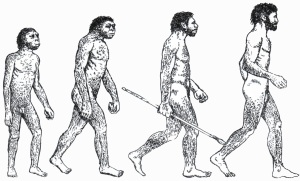
Walk Like A Caveman

There are many levels of irony about living in our modern, Western civilization.  One of the most striking, to me, is the fact that we find ourselves thinking that we have to “make time” for exercise.

Our ancestors–almost all of them–were never faced with this kind of problem, any more than are the millions of other species of animals living in the world.  Exercise is not a special task or chore for most creatures, it is part of the process of staying alive and being healthy.  Really, that’s what it should be for us as well.  We know that our bodies want to be used, they thrive with that use and become stronger and healthier, in general, the more active we are.  Yet, the progress of our civilization has, curiously, led us to alienate ourselves more and more from our natural, active natures.

Many of our modern conveniences were created to spare us from the “horrors” of physical labor.  Automobiles, escalators, elevators, tractors…these things are all, of course, truly remarkable and incredibly useful, but because we have them, we’ve gotten into the habit of relying solely upon them.  After only a little bit of time doing this, we realized that our sedentary, machine-driven lifestyles were often leading us to be terribly unhealthy.  Its not so much that our lives have been shortened…modern infection control, including vaccines, antisepsis, antibiotics and health codes have led us all to survive and even become unaware of the simple ailments that killed most of our forebears.  Our lives have instead been diminished, not in quantity but in quality.  It is wonderful to be able to drive hundreds of miles to see a distant relative at a moment’s notice.  It is NOT wonderful to have to drive to the corner store because we’re too out of shape to walk there.

In recent years we’ve learned that astronauts who spend very much time in space, without the need to fight gravity, rapidly lose bone density and muscle mass, and their hearts weaken as well.  To combat this tendency they have to use very clever means to engage their bodies and to keep those organs fit.  Yet we here on the ground, deep within Earth’s gravity well and not going through free-fall, often might as well be floating in orbit, for all the work we give our bodies.

Awareness of this issue has led to a huge industry of gyms, exercise equipment, supplements and how-to books about exercise.  We strive to fit time to go to the gym into our busy, modern schedules.  There’s nothing wrong with that, of course…I’m all for the gym.  But you don’t have to have a membership at the expensive local health club, nor even any special equipment, to keep your body as healthy as you can.  All you have to do is live just a little bit more like your ancestors did.

So, if you have to go to the store, and it’s not that far away…walk there instead of driving.  Obviously this won’t work if you have to buy a great many groceries at one time…but maybe multiple trips with smaller hauls spread throughout your week would be a better idea for your health, anyway.

If your local store isn’t QUITE local enough to walk to, well, then drive there.  Then, instead of jockeying around for the very closest spot you can find, park at the far end of the parking lot, and walk to the store from there.  It may not seem like very much, but if that’s so, then it also shouldn’t be very much trouble.

When you’re going into a building and need to go somewhere other than the first floor, why not take the stairs?  Walking up stairs is terrific, low-impact aerobic exercise and it keeps your quads nice and strong!  Okay, if you live in New York City and need to get to the 50th floor, walking ALL the way might be impractical unless you’re a marathoner with a lot of time on your hands.  Yet, even so, you can take the elevator up to two or three floors shy of your destination and walk the rest of the way.  Then you can do the same thing on the way down, which will, after all, be quite a bit easier than going up.

Also, if you live in a good enough climate, at least part of the year…ride a bike to work sometimes instead of driving.  This won’t be great if you have a sixty mile commute each way (again, unless you’re a distance athlete and have a rather flexible schedule), but if your commute is more reasonable, then biking is a great alternative.  It saves you gas money (a big deal in our current economic climate), and it produces less carbon dioxide than does an internal combustion engine…though it DOES produce some, since that’s one waste product our bodies produce just as our machines do.

All these simple measures can keep your body healthier and keep you feeling stronger.  They will probably also make you a bit thinner and shapelier, which is nice.  Still, feeling and being healthy is far more important than being thin…as any famine victim would gladly tell you if they had the chance.

In closing, the key to being physically fit and active in the modern world–and to feeling more alive and vigorous and strong–doesn’t have to involve expensive gym memberships, aerobic classes, treadmills and weight machines.  All those things are great, and I have nothing but praise for those who discipline themselves to make their bodies as healthy as possible.  Yet, even for those without the money and/or the time for the more advanced techniques, sometimes just letting go of a few modern conveniences can make you a little more like your robust ancestors…without the worrisome threat of infection and dangerous predators with which they had to contend!

The Treatment Trap

In America today, we rely far too much on pills and on procedures–on would-be “cures” for our problems–than we really should.

It may seem strange for a medical doctor like me to be saying this, but I have insight into the issue from multiple perspectives.  I’ve been one of the doctors who falls into the trap of trying to “treat” every issue rather than prevent or solve it, and I’ve been a patient who approaches things the same way.

The irony is that a great many of the health problems we face in the modern world–especially the most rampant and devastating ones, such as diabetes, high blood pressure, heart disease and their related problems and consequences–are governable simply by modifying our lifestyles.  Indeed, for many of us, these health concerns’ very existence AS problems is only CAUSED by our modern lifestyles.  I’ve already discussed in some earlier entries the mechanisms and effects of type 2 diabetes, a disorder which is becoming more and more endemic in our nation, and at younger and younger ages.  It’s absolutely clear why this is happening:  We are more sedentary and more overweight and we eat more rapidly absorbed carbohydrates than humans have ever done before in our existence.  What’s more, thanks to public health interventions and control of infectious diseases, we live long enough for these habits to matter more than they could have in the past.  We also know, quite well, many of the things that we can do to counter diabetes and its close relatives, hypertension and heart disease. Yet, instead, we allow our health to deteriorate and then rush to modern medicine to seek “cures” or at least treatments for the outcomes of our bad habits.

I suspect that this trap of habits was set for us, to some degree, by the brilliant innovation and success of antibiotics.  These are the quintessential medical cures:  When used against an infection caused by a sensitive bacteria, antibiotics actually CURE the problem (with the help of our own immune system).  To some degree anti-virals do the same, though they are more recent, and anti-parasitic agents are also analogous.

Unfortunately, most other kinds of medicines–unless you count the occasional Tylenol or Motrin to treat a tension headache or muscle soreness–don’t actually cure anything.  They simply “treat” it, governing the symptoms and consequences to some degree or other, but not addressing whatever underlying processes might be contributing to the issues.  In addition, they give the patient the illusion that the problem is now under real control.

There are, of course, times, when health problems are not soluble or easily controllable, and managing the symptoms and consequences is the very best we can do, at least for now.  So PLEASE do not think that I am advocating the elimination of Western medicine or that those being treated for chronic health conditions should just give up their pills and let nature take its course.  Yet with so many health problems, even if we have to resort to medication, we can also make lifestyle and behavioral changes that will mitigate our problems and decrease, though not always eliminate, the need for medications (and surgery, when applicable).

We all know, or should know, that taking medicine can be a double-edged sword.  Medications sometimes create new issues of their own.  The human body is an incredibly complex system–arguably the most complicated thing in the known universe, especially when you count the human brain–and when you manipulate such a  system in one way or location, unexpected consequences almost never fail to arise.  This leads to the horrible spectacle of patients receiving medication for one problem, but developing side-effects, which then need to be treated by other medications, and which cause toxicities and interactions that later have to be addressed.  The whole affair can become a vicious cycle of increasing biological chaos, like a metabolic Rube Goldberg machine.  In the elderly especially, it can sometimes be all but impossible to be certain whether new health problems are intrinsic or are caused by earlier treatments.

We try, of course, to mitigate and avoid this conundrum by studying medications as carefully as possible and learning what their possible side-effects are…but every human body is different, and that’s going to continue to be the case, since the number of possible genetically unique humans is vastly greater than the number of human beings who have ever lived.  So we can be guaranteed that the one expectation we can reliably entertain is the UNEXPECTED.

It is better by far to avoid developing problems whenever possible rather than trying to treat them.  This is true because it is simpler and more predictable, and also because it makes life better.  Rather than being a person who identifies themselves by their litany of ailments, for which they build their house-of-cards treatment regimens, we can work to maintain lifestyles that are GOOD for our health, that work with our natures, and that help us to think of ourselves as–and to feel like–healthy, vital and thriving human beings.

Medicines are indeed wonderful products of modern science and technology, and I strongly suspect that they have saved and improved many more lives than they have harmed, even despite what I’ve said above.  If I didn’t think that, I wouldn’t have gone into medicine.  Yet, it would be even better if we could avoid having the need for medications as often as possible in the first place.

I’m going to discussing more of this in future entries.  I’ll go into some fairly obvious lifestyle issues such as exercise and diet, but I’m also going to explore philosophical and psychological aspects of health that can make a great difference in not only how long you live, but also in how much you enjoy the time you have.

A life of a hundred years can be a tragedy and a life of a single day can be a triumph.  It all depends on what kind of life it is.