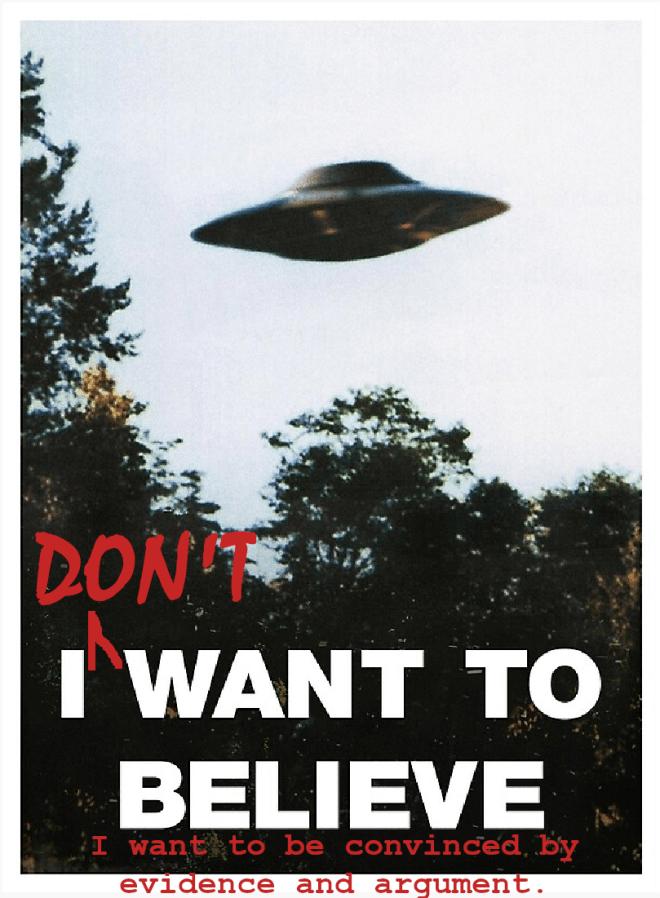
“There are times I almost think I am not sure of what I absolutely know…”

Since yesterday was Monday, the 30th of June, it’s almost inevitable that today would be Tuesday, the 1st of July.  And, in fact, that is the case, unless I am wildly mistaken.

If I were to be wildly mistaken about such a thing, it’s rather interesting to consider just how I could come to be so wildly mistaken about something so prosaic and so reliably consistent.  It is from such speculations that—sometimes—ideas for stories begin.

This is not one of those times, however.  I’m not thinking about any kind of story related to that notion at all, though at times I might consider it an interesting takeoff for some supernatural horror tale.  If any of you find yourselves inspired to write a story—of any kind—based on my opening “question”, you should feel free to write that story.  I, at least, will give you no trouble.

These sorts of thoughts also remind me of a post that Eliezer Yudkowsky wrote, and which also appeared as a section in his book Rationality: From AI to Zombies.  I won’t try to recapitulate his entire argument, since he does it quite well, but it was basically a response to someone who had said or written that, while they considered it reasonable to have an open mind, they couldn’t even imagine the sort of argument or situation that could convince them that 2 + 2 for instance was not 4 but was instead, say, 3.

Yudkowsky, however, said that it was quite straightforward what sort of evidence could make him believe that 2 + 2 = 3; it would be the same kind of evidence that had convinced him that 2 + 2 = 4.  In other words, if it began to be the case that, whenever he had two of a thing and added two more, and then he subsequently counted, and the total was always three, well, though he might be puzzled at first, after a while, assuming the change and all its consequences were consistent and consistent with all other forms of counting, he would eventually just internalize it.  He might wonder how he had been so obviously mistaken for so long with the whole “4” thing, but that would do it.

This argument makes sense, and it raises an important point related to what I said last week about dogmatic thinking.  One should always, at least in principle, be open to reexamining one’s conclusions, and even one’s convictions, if new evidence and/or reasoning comes to bear.

That doesn’t mean that all ideas are equally up for grabs.  As Jefferson pointed out about governments in the Declaration of Independence, things that are well established and which have endured successfully shouldn’t be cast aside for light or frivolous reasons.

So, for instance, if you’ve come to the moral conclusion that it’s not right to steal from other people, and you’re pretty comfortable with that conclusion, you don’t need to doubt yourself significantly anytime anyone tries to justify their own personal malfeasance.  Most such justifications will be little more than excuse making.  However, if one should  encounter a new argument or new data or what have you* that really seems to contradict your conclusion, it would be unreasonable not to examine one’s conclusions at least, and to try to do so rigorously and honestly.

There are certain purely logical conclusions that will be definitively true given the axioms of a particular system, such as “If A = B and B = C then A = C”, and these can be considered reasonably unassailable.  But it still wouldn’t be foolish to give ear if some reasonable and intelligent and appropriately skilled person says they think they have a disproof of even that.  They may be wrong, but as John Stuart Mill pointed out, listening to arguments against your beliefs is a good way to sharpen your own understanding of those beliefs.

For instance, how certain are you that the Earth is round, not flat?  How well do you know why the evidence is so conclusive?  Could you explain why even the ancient Greeks and their contemporaries all could already tell that the Earth was round?

How sure are you that your political “opponents” are incorrect in their ideas and ideals?  Have you considered their points of view in any form other than sound bites and tweets and memes shared on social media, usually by people with whom you already agree?  Can you consider your opponents’ points of view not merely with an eye to puncturing them, but with an eye to understanding them?

Even if there’s no real chance that you’ll agree with them, it’s fair to recognize that almost no one comes to their personal convictions for no reason whatsoever, or purely out of perversity or malice.  At the very least, compassion (which I also wrote a little bit about last week) should dictate at least trying to recognize and consider why other people think the way they do.

Sometimes, if for no other reasons, it is through understanding how someone comes to their personal beliefs that one can best see how to persuade them to change those beliefs (assuming you are not swayed by their point of view).

This is a high bar to set when it comes to public reasonableness, I know, but I think it’s worth seeking that level.  Why aim to be anything less than the best we can strive to be, as individuals and as societies?  We may never quite reach our ideals, but we may at least be able to approach them asymptotically.  It seems worth the effort.

But I could be wrong.


*I don’t have any idea what such an argument or such evidence would be, but that’s part of the point.  Presumably, if I were being intellectually honest, and someone raised such a new argument, I would recognize it for what it was.

Dreams of a rational culture

I’m writing this on my mini laptop computer again today, because I got tired of the frustrating process of doing stuff on the smartphone.  Really, writing and texting and everything else via the smartphone is more often than not terribly annoying.  I know Steve Jobs got inspired by Star Trek: The Next Generation and wanted to make some version of a tablet with their touch-screen controls and all, but that was fiction.  If he wanted to make something more useful based on Star Trek, why couldn’t he have put some money into warp drive or something?

Of course, he was mainly a software guy, not actually any kind of physicist or true engineer or something, any more than Elon Musk or Jeff Bezos or Peter Thiel or any of these other successful billionaires and so on are.  Don’t get me wrong; I’m sure they’re all reasonably clever, and they’re decent at business, especially at business that doesn’t require them to manufacture things that require serious production and safety and stress testing and all that.

Well, okay, Musk does make cars that are often quite decent (from what I have seen) and rockets that are sometimes quite impressive (and often not).  But mostly what these really successful business people seem to be good at is marketing, AKA self-aggrandizement.  Likewise for successful politicians.

They don’t actually have to be exceptionally good relative to their competitors, they just have to convince enough people that they’re cool and clever, and that if those people want other people to think that they are cool and clever, they should buy their products or use their services or whatnot.  It’s all rather pathetic on their part, and even more pathetic on the part of the people who faddishly embrace them.

Again, don’t get me wrong; I like things about Amazon, for instance, especially the ability to get books that I never was able to find even in Barnes & Noble or Borders (RIP) or Books-A-Million.  And I publish through Amazon when I publish my own books (or, rather, when I used to do so) because of their reach, not that it did me any particular good—I, unlike the humans to whom I referred earlier, am not a natural self-promoter.

I wish humans were less enamored of having obnoxious, “flashy”, egotistical (often male) tribal leader types and instead focused on competence and level-headedness.  Just imagine if most of our politicians were not interested in bombast and attention and rhetoric and recognition and “importance” and were just mainly interested in doing a good job on behalf of the people who elected (i.e., hired) them.

I don’t know what point I’m trying to make here.  I never plan these posts out ahead of time, so they are very much just whatever pops out of my mind on any given day.  In a way, all of you reading are only slightly more surprised by what you read here than I am by writing it.

Still, I don’t think I’m alone in wishing people would be less flash and more substance.  Then we wouldn’t have brain-worm-dead people like RFK Jr. in charge of the nation’s healthcare and medicine organizations when he is not merely unqualified but is anti-qualified.  Ditto for the one who appointed him (and for the abysmally cowardly congresspeople who approved the appointment and the poor misled people who elected them all).

If people in general were less interested in seeing who “owns” or “destroys” someone else in mere “debate”, but instead were interested in seeking reliable information and solutions together, things would likely be better.  If we want to try to model things in our society after Star Trek, I wish we could try to instantiate some version of Vulcan philosophy and practice.  Mr. Spock is so much more admirable as a character than nearly every other person on the original Enterprise, and Captain Picard in TNG is almost Vulcan in his own character.

We shouldn’t, of course, seek to eliminate emotion; that’s hardly possible.  Emotion is what gives us impetus, and indeed, that may be its entire biological “purpose”.  But we can try to govern our passions (to quote Spock) to make them our faithful servants rather than our capricious and chaotic masters.  This is not impossible by any means.

Not that I am a master of my own emotions, especially my negative ones.  But I do not consider them to be anyone else’s major concern, and certainly no other person is responsible for them or to blame for them.  I try not to let them destroy me, though I am so inclined.  But if we could all put more emphasis on, for instance, Stoic philosophy, on Vipassana and Metta and similar meditation practices and some of the ideas from, for instance, the Tao te Ching, I think all the world would be better.

I guess for now, at least, it’s a pipe dream—whatever it is I’m “dreaming” about, that is.  Frankly, I’m not sure what I’ve written here today, so far, or if there’s any coherence to it at all.  If there is not, I can only apologize at this point, because I have no intention of starting this post over.  Hopefully I’ll be able to get through this day less down and discouraged than I was yesterday*.

The world is terribly annoying and disappointing and, yes. discouraging, and my own personal life is in some ways even more so of all three of those things.  I try not to let it defeat me, but perhaps that very determination to keep playing the stupid game of the stupid human race and the stupid universe is the very thing that should count as being defeated—being fooled into taking part in the pantomime that is “civilization” instead of making my quietus, or perhaps finding some other path.

I guess I have to figure that out for myself, as with most things for most people.  Please try to have a good day if you can.  It would be nice if someone could do so.


*Apparently, I was so plainly depressed that someone (or perhaps “the algorithm” itself) on Threads thought that I might need help, and I got another one of those “someone thinks you’re having trouble and might need someone to talk to” or whatever that message is, along with a link to the mental health/suicide hotline.  Frankly, I’m amazed that I don’t get such suggestions every day, since I spend at least part of each day thinking about dying—and not thinking about it as a passive thing.

Dogmas are a disease, a cancer of the mind. Avoid carcinogenic thinking if you can.

I’m going to try to keep this brief this morning, so even though I brought the mini laptop computer with me when I left work on Friday*, I am writing this on my smartphone.  It does make my thumbs sore, or at least it highlights their inherent soreness and stiffness, but that’s part of what makes me tend to write less.  Or at least, I write more slowly; it is not always easy to get me to write less.

I’m choosing this partly because I am just very tired.  On Friday nights and Saturday nights, I can take a couple of Benadryl and so on to help me sleep‒I know it’s not truly good sleep, but just being unconscious for more than an hour or two at a time is such a relief‒but on work nights that’s no good.  So, especially after the artificially extended sleep on the weekend, I tend to have a bad sleep on…well, on every other night, really, but Sunday is the first such night in the work week.

Another problem, and part of my reason for worse sleep, is that I am having a bit of a flare-up of my back/hip pain, and that makes nearly every effort feel that much harder, including simply trying to sleep‒although that’s a somewhat different type of effort than many others.

So, yeah, if there’s anything noticeably different in my writing style today than in my last handful of blog posts, it may be because of the fact that I’m writing on the smartphone.  It may also be something else entirely, of course, or even a combination of things (this seems most likely).  Just because one idea seems to provide a good explanation‒a good story, if you will‒doesn’t mean it’s right.

That’s a common trap into which I frequently see people fall, and it always annoys me (especially when I’m the person).  Some situation will happen, some occurrence will occur, and someone will propose‒perhaps just to themselves‒some reason, some explanation for the event(s), and it will seem at least somewhat plausible, and at least physically possible, and it doesn’t have any glaring logical inconsistencies.  And that’s where they stop.  In their heads, that will be what they think of as the actual explanation for whatever it is they’re explaining.

Unfortunately, this is actually‒at best‒a hypothesis.

Now, if people just recognized that fact and kept the notion in their heads as a hypothesis, then this would be no problem.  All knowledge about the world is, in principle, provisional**.  There’s nothing wrong with having a hypothesis that you recognize as such.  All good science proceeds from speculation (first triggered and then confirmed or denied by observation and testing).

If one has relatively non-crucial concepts to address, one need not even be particularly bothered about confirming or denying one’s little hypothesis.  One can simply have it, tacitly implied, sitting there in potentia in the process of one’s mind.  Then if, quite by chance, one should encounter data or concepts or arguments that bear on the likelihood of that hypothesis, one can‒sometimes quite unconsciously‒adjust one’s hypothesis, or one can discard or replace it or even find oneself more confident in it.

This is all well and good.  But all too often, humans take their first plausible seeming notion and decide that they must now have the answer.  And then, depending on their emotional connection to the idea, if they encounter disconfirming evidence or argument, they twist away from it, dismiss it, seek out only pseudo-confirming ideas and evidence or even (shudder) just the company of other people who share their epistemologically suspect ideas.

These are such things as conspiracy theories are made on, or even religions (literal or figurative ones, including cultish forms of economic theories and philosophical ideas).  And when one does not update one’s ideas, when one is not aligned with reality, sooner or later, one will collide with it.  When one collides with reality, it’s never reality that is damaged.

If it were only the person who persisted in self deception that got hurt in the crash, it would still be tragic but at least at least it would be tolerable.  But as with literal crashes, the innocent are all too often harmed and made to suffer as a consequence of someone else’s poor judgment.

This is part of why I despise all dogmatic thinking.  I even coined an expression in relation to it:  Spay and neuter your dogmas!

Do not let them propagate.  Dogmas are among the most perilous of meme-plexes because they are so stiff and brittle and they tend to have sharp edges.  But even when they don’t, there is still the problem of going against reality.  One can imagine the real nature of the world as a kind of tunnel or pipe or tube‒in places it is very wide and in places very narrow.  In some regions, a fair amount of variability in course is tolerable within it, but sooner or later, if one is not moving parallel to the course of reality, one will hit a wall.

How bad the collision will be can depend on many factors; one can have a mere scrape, or a glancing blow, or one can have a true “crash and burn” situation.

Those are generally worth avoiding.

Okay, that’s it for today.  I feel a bit grumpy and curmudgeonly right now, largely because of my pain and poor sleep, but sometimes it leads to decent writing.  Whether that’s been the case today, I’ll let you be the judge.  I am not impartial.

Have a good one.


*In case it wasn’t clear, I did not work on Saturday.

**Even the old cogito ergo sum.  And don’t get me started on cogitum ergot hatto.

Mind your vectors and terms of address

I’m writing this on my mini laptop computer again, because even though I find the extra weight of carrying it mildly annoying at the end of the day, at least sometimes the irritation of trying to write using my stupid smartphone is worse.

Although, since those two versions of me exist at different times, it’s hard to weigh their degrees of perceived irritation against each other.  In the morning, if I’m using my thumbs to try to type on a diminutive screen in a fashion that could be easily predicted to lead to some manner of repetitive stress injury, its all too natural for the “me” of that moment to hate the “me” of the previous evening who elected not to bring the laptop computer back with him.

But the “me” of the evening, when faced with the minor extra effort of the mini laptop, can feel very much overwhelmed and exhausted and think that the “me” of the following morning won’t find the process of writing using the smartphone particularly difficult.

The human consciousness clearly doesn’t have one, singular, constant terminal drive or goal as an imagined artificial general intelligence might.  I suppose one might think that the drive “to stay alive” would count as an ironically designated terminal goal, but that’s clearly not an accurate interpretation of the situation.

Not only are some people quite self-destructive and even actively suicidal—which you might credibly dismiss as dysfunction, not the lack of a dedicated system, though I think that would be imprecise—but there’s no good way to think that such a specific drive could evolve.  Evolution is blind to “death” as a concept or force, except as a failure, an accident, a lack, whatever you want to call it.

Before humans, as far as we can tell, no creature on Earth had a concept of “death” as the cessation of the biological processes of an individual organism.  Instead, there are proxies, such as the drive to avoid pain, and the related strong sensation of fear relating to danger and so on.

Similarly, there is no drive “to reproduce” in human (or other animal) minds.  Teens going through puberty don’t start feeling the literal desire to replicate their DNA in other bodies.  Instead, proxies for reproduction evolved, urges and drives that tended to lead to increased chances of reproduction, such as dominance hierarchy drives and displays in social primates such as humans, sexual attraction, and—of course—the pleasure of sex itself, with the reward-based drive to have it as often as feasible (with other inputs adjusting the strength of that drive and causing it to manifest differently in the two biological sexes and at different times and places).

The human brain—like probably all the other adequately complex brains on Earth—is a mélange of modules, with varying drives and processes that have evolved in parallel and sometimes independently, and also developed ways of interacting with each other.  Of course, at the root are the automatic drives that are all but undeniable—the respiratory drive, the thermoregulation drive, and so on.

There are even drives that are neurological in a broad sense, but that are so fundamental that they cannot be interdicted by the rest of the nervous system, only adjusted—I’m thinking here mainly of the heartbeat, the driver of which is in the sino-atrial* node and the Purkinje system of the heart, which is sort of a cross between muscle and nerve tissue.

The upshot is, if you ever feel that you’re “of two minds” on some particular subject, you’re probably not just speaking metaphorically, whether you know it or not.  Your final actions are produced by what I see as the final vector sum (and it can be quite small in the end or it can be huge in magnitude and surprising in direction) of all the drives or “pressures” in the brain that have any effect on decisions about behavior.  Then the action caused by the final behavior feeds back on the system**, changing the lengths and directions of some (perhaps sometimes all) of the contributing vectors, causing changes in the inputs and thus changes in the final vector sum of behavior.  Lather, rinse, repeat as needed, ad nauseam if not actually ad infinitum.

Please don’t imagine this as the sum of physical vectors in real spacetime.  The number of possible dimensions of such mental/neurological vectors is huge.  For all I know, there might even be spinors and tensors and matrices involved, but I don’t think those are necessary for my vague model.  “Simple” higher dimensional vectors probably do the trick.

What a curious set of things about which to write that was!  I had originally intended to start this post with some version of The Simpsons’ “Hi, everybody!”  “Hi, Dr. Nick!” exchanges, perhaps then noting that I could change “Dr. Nick” to “Dr. Robert” and thus reference both The Simpsons and the Beatles at the same time.

But then I might have noted that, although the Beatles song is so titled, “Dr. Robert” is not the way anyone has ever referred to me in actual practice.  It would be, honestly, a little weird for someone to refer to their physician as, for instance, “Dr. Joe” or “Dr. Judy” or whatever, certainly in our culture.

Mind you, there was that tendency for a while (it may still be prevalent) to have kids speak to adults such as teachers and daycare workers and people of that sort using their “title” and then their “given name”, such as “Miss Barbara” or “Mister Jimmy”.  I have always thought that was weird.  I mean, just imagine someone trying to address a certain prominent fictional character as “Dr. Hannibal”.

Alas, that all ended up being a discussion not worth having, except as an afterthought.  Though it’s debatable whether any discussion at all is actually worth having—including the discussion about whether any discussion is worth having.

You all can discuss that if you want; feel free to use the comments below, and to share this post to your social media platforms or what have you.  When you do discuss it, remember to define your terms ahead of time, and stick to them rigorously—i.e., the meaning of “discussion”, and of “worth”, and so on—so that you decrease your chances of getting involved in semantic games and misunderstandings and sophistry.

Whatever you choose to do, please try to have a good day.


*The “sino* in that term relates to its location in what’s called the sinus of the heart, and the “i” in it is a long “i”; it has nothing to do with China, though an identical prefix is sometimes used to mean “related to China”, but in this case with a sort of short “i” sound…or, really, a long “e” sound.

**And there are surely numerous other feedback loops all along the way affecting many, or perhaps all, of the vectors.

That one might read the blog of fate, and see the revolution of the times

Hello and good morning.  This is my Thursday blog post.  There are many other blogs out there, but this one is mine.

That’s about all I have to say about that, honestly.  I don’t have any other clue.  If anyone has seen a stylized cartoon paw print anywhere, please let me know*.

I don’t know.  What should I write?  I don’t really want to deal with politics right now‒not even political philosophy, which I sometimes find quite interesting.  But watching the world now, it just seems clear that humans are pathetic and, at least when two or more are gathered together in the name of something, their net IQ seems to be the lowest one of all those present divided by the number of people present.

That’s probably harsher than reality‒by that measure, two people each with an IQ of 150 would together have an IQ of 75.  But I don’t have the patience to work out some more likely formula, which would probably involve natural logarithms and the like.  And how would one test such a thing?  The point is, as Tommy Lee Jones’s character in Men In Black pointed out, a person can be smart, but people are stupid.

If humans destroy themselves (whether or not they take the rest of the world with them) it will be a well and truly earned destruction.  It will be a shame, of course, since there is also great potential there.  But then again, in all the hydrogen atoms of the universe there lies the potential for fusion into larger elements and then the creation of beings and civilizations and technology and art and love and even the capacity to produce civilizations that could not only last well into the livable duration of the cosmos but could possibly even alter or steer the fate of the universe itself, doing cosmic engineering.

But of course, almost no hydrogen atoms will ever be part of such a thing.  Perhaps none of them will be.  Certainly, if humans survive and eventually become cosmically relevant, it will be entirely because of luck.  It will not be deserved.

Actually, I’m not even sure what “deserve” really means most of the time.  When people say things like “you deserve love” or “you deserve to be happy” I don’t see the logic**.  How does one come to deserve love or happiness?  Does one come to deserve them just by being born?

That may be a nice idea, but it doesn’t make a lot of sense.  How can one earn some reward by doing nothing?  One can have rights of course, but most real rights are rights not to have others interfere with you.  If you can be said to have a right to something that is in limited supply and to which there is no possible guarantee, then that “right” is pointless.  I might as well say that each person has a right to two unicorns and a wyvern.

All that aside, I suspect that the vast majority of humans are literally no more likely to make any significant contribution to becoming a cosmically relevant civilization than are typical nematodes.  The current (and past) political climate of the world provides strong evidence for that much.

And now that we have thoroughly unqualified public appointees calling for registries of the disabled‒very much like the governments of certain well known and rightly despised 20th century regimes did‒I return to thoughts that “neurodivergent” people should take a Magneto/brotherhood of mutants approach to things and rise up and throw off the control of the so-called neurotypical people.

Neurodivergent people are far less likely‒or so it certainly seems‒to succumb to mob mentality and populism.  I suspect they (we) are far more likely to make a cosmically relevant civilization than the troglodytes are.

As I’ve said before‒in some recent post on this blog, I think‒neurodivergent people are more like Vulcans, and the rest of humanity is like the Romulans.  Whom would you rather have guiding the future of your civilization?

Well, that’s all extremely nerdy and probably silly, but it’s nevertheless probably not wrong.  Maybe we can convince most of the morons to refuse to be vaccinated, and then encourage them all to live close together so they’re not “contaminated” by people who have been vaccinated, and then let the viruses fall where they may.

Whatever.  This is all stupid.  Everything is stupid.  Everyone is uncountably infinitely stupid.  And I am surely among the stupidest of all for even bothering, for even trying to do anything.

TTFN


*This is a reference to the kids’ show Blue’s Clues, which my kids (and I) really enjoyed when they were little.

**Probably because there is none.

“But more when envy breeds unkind division: There comes the ruin, there begins confusion.”

Hello.  Good morning.  It’s Thursday, which you could have guessed from my salutation if you’re familiar with my ways.

I’m sorry I’ve been such a downer lately (though anyone who reads my stuff regularly should not be surprised).  I started the week on a relatively optimistic note, or at least on an energetic one.  I suspect that was because I basically sedated myself on Friday night and Saturday night, and thereby got as much as five or so hours of uninterrupted sleep on those nights.  I also pretty much vegetated during the day on the weekend (other than doing my laundry) which was made all but obligatory by the residual effects of the sedation.  But the benefits didn’t last long.

I don’t know what to write, today.  I feel rudderless and with very little wind in my sails (to combine pleasingly nautical metaphors).  Maybe I’ll discuss a little bit about current events.  It’s been another weird week, as has almost every week since the beginning of the year.

Of course, the weirdness didn’t start there.  In the US at least, a lot of the weirdness really got going after 9-11, when everyone became overly paranoid about potential terrorism (especially involving planes) and security theater made everyone feel more afraid rather than less*.  Yet, as far as we know, most of it has saved no lives and it has immiserated countless people.

As part of the consequences of our neurotic response to the 9-11 attacks, what had been the longest unpatrolled border in the world (between the US and Canada, which did not even require passports to go between the two countries) became less amicable, marking the beginning of a feeling of separateness between what had been possibly the two closest allies and friendliest neighbors in the world.

Newt Gingrich helped with the radicalization of the Republican Party even before that, and through his slimy, slippery, poikilothermic mentality, he took what had been a party with principles down the beginning of its road to being the mockery of its former self that it has become.  Don’t get me wrong, the Democrats have responded in kind, in their own way, though their approaches are different**.

I think one of the biggest weaknesses that has led to the decline of global politics and especially of politics in the US is the indulgence of the tendency to demonize those who disagree with one, especially about anything that comprises a tenet of one’s political (and other) faith.  Speaking as a non-human, this is one of the attributes that makes humans so mutually self-destructive, and it is a tragedy.

This is the process that leads to the dehumanization of the “other”, which frees one to commit atrocities, because one does not see the other as having the same rights, or even the same consciousness, the same “soul”, as oneself.

It’s a particularly pathetic, utterly blinkered and myopic view, since all humans are infinitely ignorant and impotent in the final analysis.  While I do agree with Ayn Rand that humility—in the sense of presuming oneself inherently and inescapably worthless and valueless—is not a virtue, intellectual humility is always appropriate, because every person, every mind, no matter how brilliant, is as far from being infinite—and thus as far being incapable of error—as is the simplest flatworm, or indeed, the crudest virus.

One can only work on self-improvement if one actually recognizes and owns the fact that one has room for it.  This is one of the best lessons taught by Jesus in the Gospels (which I have read often, though I am no Christian).  It’s the one where he says, “Why lookest thou to the mote in thy neighbor’s eye, but considerest not the beam in thine own?  Thou hypocrite.  First take out the beam from out thine own eye, and then thou wilt see clearly to help thy neighbor with the mote in his eye.”  It goes something like that, anyway; I’m paraphrasing, but then again, so was King James’s editorial staff, since the original writing is, I think, in Greek, and if Jesus was a real person, he probably spoke Aramaic or something along those lines.

Anyway, his message was good.  If it were told in the modern world, it would probably be something like “the parable of the airplane oxygen masks”, i.e., make sure to secure your own mask before helping those who have difficulty securing theirs, because if you pass out and are incapacitated because you were focused only on others’ failings, then you’re no use to anyone.

This is plainly nothing new—after all, even though all the words attributed to Jesus were written decades to centuries after his crucifixion (if even that happened) and he may be entirely fictional, this message was considered important at least two millennia ago.

And warnings of the dangers of nationalism and blind loyalty to an “ethos” based largely on xenophobia and other rather pathetic fears have not been heeded by modern humans, though there were ample and terrible lessons about it throughout the last century.

Of course, Rupert Murdoch and his spawn helped spur this deterioration of discourse along—not out of any apparent sense of even misplaced idealism, but rather out of a seeming desire for ever greater profit and power.

Barnum’s Law still applies:  There’s a sucker born every minute, and two to take him.

This would seem to imply twice as many “takers” as “suckers”, but the two categories are not mutually exclusive (and of course, we have no word on the nature and character of all the other people born every minute).  Suckers can also be grifters; humans (and other people) don’t come neatly sorted and compartmentalized.  Even truly great people can have terrible flaws, but that doesn’t erase their greatness.  And seemingly unremarkable people can be (and do deeds that are) utterly inspiring.

The only time anyone goes beyond potential improvement or redemption is when they die.  That’s also the only time anyone becomes free of error.  It’s all very unsatisfactory, of course, but then, the Buddha long ago recognized that such is the nature of life itself.

All suffering is born of desire—but then again, so is all action.

I don’t know what my final point is; perhaps there can never be any single ultimate point, no “terminal goal” to use AI/decision theory terminology, not in minds that evolved with many, often competing, drives.  But at least I’ve been able to avoid just talking about my pain and depression and desire for self-erasure today.  You’re welcome.

TTFN


*Congratulations, Osama bin Laden and the rest of Al Qaeda.  You won.

**For instance, those on the “left” are big proponents of (and self-congratulators about their own) empathy.  For the most part empathy is useful, though Paul Bloom has quite reasonably pointed out some of its shortcomings.  Still, one place where the “left’s” empathy conspicuously and consistently fails them is in trying to empathize with or even to consider the points of view of those on the “right”, of “conservatives”.  It’s worth a bit of reflection.

“Don’t you know you’re gonna…”

It’s Friday morning, at last.  I don’t know whether or not I’ll be working tomorrow, but either way, I’m glad the main week is done.  I feel as though these five days have lasted for months.

My pain seems to be creeping back toward its baseline level, which still sucks, but it’s way better than it has been earlier this week.  I hope it doesn’t just bounce back up once I’ve become relieved (relatively).  That would really bite.

I’ve been trying to exercise carefully and consistently, and that’s at least been okay.  I’m also always trying to adjust my shoes and socks from day to day, just to see if they make any difference.  Sometimes they seem to do so.  Of course, I’m being quite unscientific about this, changing more than one variable at once (and of course it’s very hard to do blinded studies, let alone double-blinded ones, when one is working on oneself).  There is a fair amount of desperation involved in all of this, which is probably not too surprising when one is trying to relieve or at least diminish pain.

I have had no ideas or inclination regarding any new stories, nor have I even touched a guitar.  I’ve spent a fair amount of time puttering through Threads and occasionally Instagram to distract myself (and sometimes BlueSky and the other one).  I’m following them at least partly out of novelty; they are websites I’ve never really used prior to recent weeks to months, so they haven’t gotten too boring yet.  Also, it was through Threads that I found the place that did my autism assessment, so that’s a real benefit.  But such short-format, chaotic sites discourage (albeit unintentionally) any depth and nuance of discussion.

Of course the Website Formerly Known As Twitter has always been a bit of a cesspool, precisely because it just encourages the equivalent of interaction via sound bite.  And since Musk®, by Elon™  has taken it over, both it and he have gotten worse.  I almost cannot believe that he indulges himself in such illogic and irrationality as he seems to do on the site, and that it has so leaked over into his real life.  Then again, even Ayn Rand, a fierce advocate of reason, fell victim to her own personality cult.

These are examples of the fact that it can be very difficult to maintain one’s clear-headedness without any input from others, and firm input at that.  This is why we have peer review in science (and various incentives to disprove each other in rigorous ways).

No great mind is ever error free, not even the greatest, whoever that might be.  It’s probably not possible for any finite mind to be error free*, and I’m not sure that even an infinite mind, if such an idea makes sense, could be error free.

Of course, none of it really matters in the long run, but in the short run there is much needless suffering in the world that could at least be mitigated if people would just calm down a bit and try to let reason govern them.  Alas, that’s an awful lot to ask of naked house apes.  They are saddled with all the evolutionary history that leads such jumped-up monkeys to hurl their feces at each other more often than to seek mutual understanding.

They also have a regrettable tendency to feel that they are right, that they just know something, and to be aggressively opposed to self-doubt.  That, I suspect, may be the attribute that will lead to the demise of the human race and possibly all other life on this planet.

I know the studies have been inconsistently replicated, but there are some experiments that indicate that people with depression evaluate themselves (and presumably the world) more realistically than those who are not prone to it.  Other people all tend to rate themselves above the median in most things**, whereas depressed people seem inclined to accuracy, not merely to downgrade themselves (at least when not actively depressed).

I’ve said it before and I’ll say it again, self-confidence beyond a certain minimum requirement is inherently suspect.  I don’t trust people who trust themselves too much; they are much more likely to make errors and not to correct them, and then to compound and double down on such errors.  Current US politics is awash with this monkey-work, as is big business, and it can only be sustained for so long before the bubble must burst, and a bursting bubble is a violent event that can cause a great deal of harm.

This dysfunction of thought and communication is not isolated in the political right, though currently their pathologies are more immediately consequential and potentially disastrous.  But the left has its share of unthinking monkeys, too, and they often encourage and trigger the monkeys on the right.

As for me, I don’t consider myself a member of either camp.  I am orthogonal overall to the left-right axis of human politics.

And with that peculiar statement, I’ll bring this post, and hopefully this week, to a close.  If I work tomorrow, I’ll probably write a post.  Either way, please try to have a good day and a good weekend.


*Though errors are free in that you don’t have to pay for them in advance‒but they can cost you after the fact.

**It’s possible, in principle, for most people to be above average, when by average you refer to the arithmetic mean, but it is not possible‒by definition‒for the majority of people to be above the median.

Some of this is metaphorical

I’m back on the smartphone to write today’s post, and I’m on my way into the office quite early.  I’ve already been awake for hours, but there was truly no point in getting up so far ahead of time, so I just laid around*.

I did get a bit of extra rest, because yesterday I left the office early, after only about a quarter of a day.  I didn’t really get any extra sleep, but at least I decompressed a little.  This means, however, that I am well behind on preparing the payroll, so today is going to be irritating.  It must be done, though, and no one else is going to do it.

I guess it’s good to be useful.

Yesterday, my boss suggested that I ought to take about three or so days off sometime, and do something fun.  But I just shrugged, feeling worse for having to say it, and asked him, “Where would I go?  And what would I do?”  In my head, I added, “There isn’t anything.  Or anyone.”  I really do nothing for fun, and certainly there is no one with whom I do anything fun, or even just hang out.

On the other hand, I don’t want just to hang out with someone and do something.  Trying to do some random activity with some random person would be more stressful than doing nothing.  My tastes and my personality are at least somewhat esoteric.  I wish I could find another member of my species.  But I fear perhaps that I’m just a mutant or a hybrid or something, and there is no other member of my species.

Certainly I feel no real sense of kinship with any of the major figures in any of the political parties.  The most vocal people on both the left and the right are flagrant idiots, and most of their statements** are, as I think I said yesterday or the day before, “idiocy on performance enhancers”.

The specific idiocies tend to be different on the two sides of the current spectrum.  The most extreme people are as different as Hitler and Stalin‒very different in their ideological dogmas, but all too similar in all the ways that count the worst.

Never trust anyone who is sure they know what’s right, because it’s pretty clear that no one does.  And people who believe that they know what’s right‒not just for themselves, but for everyone‒are capable of committing grotesque atrocities, all the while fumigating their self-image with the fact that they have good intentions.

You know what was built with good intentions, right?

My inclinations tend toward classical liberalism, à la John Stuart Mill et al.  I have sympathy for the most sensible of progressives, and I am a fan of progress in general.  But, of course, arrogating the word “progressive” to yourself (or “anti-fascist” or “patriot” or any other such “Look at me, I’m a good guy!” terms) does not actually make you progressive by any sensible use of the term.

Likewise for conservatism‒I can  sympathize with the notion that one should not just haphazardly make changes to long-standing ideas and institutions.  All improvement is change but not all change is an improvement.  Random change is as likely to be bad as to be good‒probably more likely, like random mutations in the genome of a reasonably well-adapted organism.

But there are so very many “conservatives in name only” and “Republicans in name only” in the sense that they are not really in line with anything that the GOP has traditionally promoted, nor any sensible conservatism.

As DMX said, “Talk is cheap, motherfucker.”  Or, to paraphrase Forrest Gump, progressive is as progressive does, conservative is as conservative does.  And perhaps most egregiously, Christian is as Christian does.  Ugh.  Dealing with that hypocrisy*** would take a  whole post at least, and right now I don’t have the stomach for it.

So, to make myself a bit clearer, in case anyone was confused by my recommendations that the left should avail itself of its 2nd Amendment rights:  the reason I addressed them thusly was that they are traditionally the side that’s been more opposed to personal gun ownership and use, and so they are less likely on average to have guns.

It is the “right” who are currently in power (in the US) and they are pushing many boundaries of constitutionality (and they also tend to be fans of militarized police forces and the like).  So, if you fear that they are going the way of fascists and authoritarians in the past‒and there is at least some evidence to support this thesis‒then you must admit something the right has long since pointed out and of which it has in principle been aware:  it is harder to oppress an armed populace than it is an unarmed populace.

I’m against oppressors, authoritarians, totalitarians, etc., on any side, largely because I know‒to the extent that I know anything at all‒that they are mere flesh and blood, mortal, tiny-minded Naked House Apes.  This fact is not shameful in and of itself‒no one chooses their own nature‒but when nearly hairless, ridiculous-looking primates start thinking that they are something fundamentally superior or even divine, that they are anything but dust in the wind, then they start making messes.

If it were only themselves that they were hurting, things would be better.  Though it would still be sad, it would be morally tolerable.  But like drunk people getting behind the wheel of a car or like people who refuse quite safe vaccination against highly communicable and dangerous diseases, they become a danger to other, innocent**** people.  And, when threatened with the unrepentant use of force (deliberate or negligent, active or passive) by such supremely finite minds, people have the right‒if there is any right to anything at all‒to protect and defend themselves, and their loved ones, and the innocent, and the helpless, with force.

Of course, even this must be done judiciously, and one must always exercise the principle of charity against even one’s perceived opponents.  The presumption of innocence is crucial, and not merely at the obvious level.  Otherwise matters are prone to degenerate into mindless feuds.

It’s not that your opponents are not monsters; it’s that you are also a monster.

That’s enough for today.  I’m already exhausted.


*Weirdly enough, this is unrelated to getting laid or sleeping around.  Believe me; it’s completely unrelated.

**I was going to use the word “argument” but that would be an insult to the word.

***Based on the gospels, Jesus really did not approve of hypocrisy.

****In this matter, at least.

Random thoughts on Saturday morning

I’m on my way to the office this morning, so I figured I would write some reasonable facsimile of a blog post, since I might as well do something that’s vaguely creative and/or productive.

On Thursday, I wrote with my little mini laptop computer, but today I am writing on my smartphone, since I didn’t feel like carrying the laptop.  I think, unless I start writing fiction again*, I’m going to pretty much avoid using the mini computer, and instead use this even-more-mini one.

As for subject matter about which to write, well, there’s really not much that comes to mind.  I do sometimes wonder if I would ever write an entire book on Google Docs on my phone.  It feels almost appropriate, since my “nickname” is Doc.

Even the very young daughter of two coworkers knows me as Doc.

I seem to get along better with small children than I do with so-called adult humans.  Maybe it’s because their thought processes are more like mine, or maybe it’s just that they have potential to be wonderful and brilliant and creative, if only they can avoid being damaged in the wrong ways.

Unfortunately, it seems almost no one avoids that damage.  Weirdly enough, though almost everyone recognizes that children are (literally) the hope for the future of humanity, after paying lip service to that notion, everyone then just lets children grow and develop haphazardly, catch-as-catch-can, putting terribly few resources into education, let alone into research about how best to do education.  There should be as much rigor in the study of education as there is in the study of diseases and medicine in general, or even as much as there is in fundamental physics.

All these hugely successful billionaires ought to put their considerable resources into this area instead of making government “more efficient” or whatever, as if the most “efficient” government were demonstrably the best one.  But they seem to have no thoughts about education, that tremendous public good that can provide potentially unlimited returns for the future.

Imagine these entrepreneurs who consider themselves to be brilliant planners and producers** starting businesses or other projects with no plan, with no research, just old, hackneyed notions mixed with fashionable but untried and highly nebulous ideas, and with limited supervision or moment-to-moment adjustment, feedback, or attempt to improve.  If one in a million such businesses turned out to be successes, one would have achieved more than one deserved.

And yet we approach education with almost no more insight than existed a hundred or even two-hundred years ago.  And our societal attitude toward education (certainly in the US) is frankly unconscionable.  If there were appropriate punishment for people who don’t seem to care about the specific development of the minds of the next generation of humans, it would be hellishly severe and enduring, because such are the consequences of such attitudes toward education.

Oh, well.  Humans are demonstrably stupid, even more so than one might think from following the news, and the government officials and successful business people are by no means any exception to that tendency.  I suspect that large-scale intelligence would have been better coming from descendants of the dinosaurs (i.e., birds), since their brains often seem much more tightly woven.  Probably, though, I would be as disappointed by them as I am by all the fucking humans.

Well, I doubt they’ll change or improve.  And like unsupervised children playing with matches, eventually someone is going to burn the house down, and a lot of them are going to die in the fire.  Maybe all of them will die.  At this point, that wouldn’t break my heart, but then, my heart’s sort of like a scrambled egg already‒if you were going to make it even more shredded than it is, you would first have to unscramble it some.

Anyway, that’s enough of that.  As the YouTubers say so often, if you like my content, please give it a “thumbs up” (i.e., a “like”), subscribe, and share it on your own social media.  Seriously.

And have a good day, if you can. 


*It seems vanishingly unlikely‒more so every day‒which ought to be very sad to me.  Intellectually, it still is, I suppose.  But as for emotions, when I think of ever writing any more fiction, I just feel empty and dead and rotten inside.  Likewise with music.

**I suspect, for the most part, their huge success is largely, if not entirely, stochastic.  In other words, some very lucky things happened early on and they kept benefitting from that afterwards, but not because of any particular brilliance of their own.  It just seems that they must be brilliant because we only hear about those who lucked out and made it to the top, not the countless ones who failed using the same methods.  It’s a bit like imagining you could learn something about what makes someone successful by interviewing people who won the lottery, but paying no attention to the millions who lose.

No one is to blame

Well, as often happens on the day immediately following a Monday, it is now Tuesday.  Congratulations.

I don’t know why I wrote “congratulations” there.  I felt as if I were saying that the fact that Tuesday has arrived was some manner of accomplishment and not merely the universe continuing to do what it does and work through its laws as always.

Maybe the thought was to congratulate those of you who consider it a positive thing to live another day for succeeding at doing so.  Maybe it’s a supportive statement to those who really don’t want to go on, but who continue to endure because they don’t want to bring pain to their loved ones.  Making it through another day for a person in that situation is no joke, and those people should be recognized.

It would be nice if they could be recognized in a non-judgmental way by those loved ones for whom the people in question endure.  Not that I expect that the loved ones of the suffering have any better calibration than the people who love them.  Nothing finite is without imperfections (and I’m agnostic about the situation with infinite things, but I have my doubts).

So, it is hard for a person with depression to endure, even when they’re doing it for their family and friends and are suffering because of it, and those depressed people are worthy of sympathy and non-judgmental support from their loved ones and the world in general.  But the people around them are worthy of sympathy, too, and should not be regarded judgmentally for not being able to recognize or even help their loved ones’ suffering.

Here’s where we come to the concept of blame, and how utterly unjustified it is, in every single case.  And to be clear, I don’t mean to say we shouldn’t hold people responsible for their actions in the sense that they are the proximate causes of those actions, and their behavior can be adjusted and improved.  But they are not the ultimate cause‒not of what they are, not of their strengths and weaknesses, not of their limits and their experiences and their sensory acuities and their social skills 

If you have car trouble and your cousin, with whom you are hanging out, doesn’t know the first thing about cars‒doesn’t own one, doesn’t drive, never has‒you may well be disappointed that this cousin can’t help you and doesn’t even recognize that there is a problem until and unless your car completely breaks down.  But you don’t get self-righteously angry at your cousin for that lack of knowledge and skill‒not if you’re even remotely reasonable.  You don’t fully understand what’s wrong with your car, yourself, and you certainly don’t know how to fix it.  And it’s your car.  How can you expect others to be both able and willing to fix your car for you?  They have their own vehicular maintenance issues.

I’m pushing the metaphor, I know.  But I think it’s a good one.  We can all, of course, try to be there for those we love, and to be worthy of having others be there for us, and sometimes that’ll work out and sometimes it won’t.  It can be quite natural to feel resentful and wounded by the people who fail to see your suffering, even though they care about you and are important to you.  But, as Radiohead sang, “Just ‘cause you feel it doesn’t mean it’s there.”  So cut other people slack; and cut yourself some if you can, too.

You didn’t build the universe, or the world, or your nation, or your community.  Neither did anyone else, living or dead.  These things just happened, rarely with any kind of coherent, before-the-fact plan of any kind.  And on the rare occasion when people did try to plan things, those plans essentially always went aglee‒the stricter and more regimented and more dogmatic the plan, the greater the apparent tendency to veer wildly astray, as though there were some manner of Heisenberg’s Uncertainty Principle that applies at the scale of societies.

Civilization is a spontaneously self-assembled and self-assembling system, and like frost on a window, different parts of it carry different orientations and patterns that are not the product of any of the individual constituent water molecules.  The molecules can only line up in the crystal where there is a spot and only in particular orientations, based entirely upon where it is in the system and what the surrounding dynamics are‒and what came before.

This may be the case for the entire universe, as well.  The underlying quantum fields may just all “crystallize” out in particular ways that are highly stochastic and ultimately local, with different kinds of complexity in different places.

Anyway, I’m veering off topic.  The point is, there’s no call for and no use in blaming people for not knowing about your suffering and how they might have done differently and it might have helped you.  And don’t blame yourself, either‒unless you invented the universe.  If you did, well, you’ got some ‘splaining to do.