Tomorrow, and tomorrow, and tomorrow, blogs in this petty pace from day to day, to the last syllable of recorded time

Hello and good morning.  It’s Thursday, in case you didn’t already know.  Though, if you’re reading this on some day other than Thursday, then I guess it’s not Thursday for you.

You could think of it as us being on sort of parallel time streams—and indeed, we each carry our own “proper time” around with us, according to Relativity.  And while communication is possible between those timelines, it is communication in one direction only.  I can send messages to you, where and when you are now reading this, but you cannot send messages back to me.

Wait, wait, I hear you say*, you can communicate back to me in my parallel time, because you can comment on the post below (there’s only one person who does this with any regularity, but sure, it’s possible for you to comment, in principle).  So it’s not one-directional communication.

Ah, but that’s where I’m being esoterically precise here.  You cannot communicate back to me where and when I am now.  You can only communicate with some “future” point, something quite a bit down the line from where and when I am as I write this.  And I cannot then communicate with the you that is writing back to me, but only to some future state of you.

Okay, well, duh, you say**, that’s just how time works.

That only seems unremarkable to you because it’s all you’ve ever known, and you’re adapted to it—personally and evolutionarily.  But if you step back, so to speak, it can seem quite remarkable.

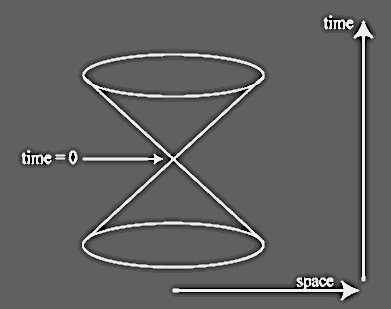
Special Relativity demonstrates that space and time are not separate but are intertwined, and space and time bleed into one another depending upon relative motion—indeed, within the event horizon of a black hole, it appears that space and time are flipped ninety degrees (as though along an axis at 45 degrees to those of space and time) so to speak, so that space becomes time, which is part of why you can never get out of the black hole—you cannot reverse time, but must move forward to its end at the singularity, if such a thing exists, which is probably not the case.

So, why does time work differently than space?  After all, If I live on a street parallel to yours, I can cross to your street by any of a number of cross-streets, cut through back yards, follow alleyways, etc., in more or less any direction, and I can return in a similar fashion.

Imagine, though, if it worked the following way.  I start at my address—let’s imagine it’s number 13*** for the moment—and want to go to your street.  But I can only go by routes that are at higher address numbers than my address.  And then, when I want to return to my street I have to go down (or would that be up?) the numbers on your street, to take a cross-street (or whatever) that’s even farther from my house.

So, say I crossed to your street right after number 17, where a cross-street exists.  And say the numbers on your street line up with those on my street, just for simplicity’s sake****.  Luckily, your house is at number 19 on your street, so I can reach it.  I could never go back to number 17 on your street, let alone number 13.

But when I want to leave your place, I can only head toward higher numbers, so I can’t go back to the cross street near 17.  I have to go down to, say, the street past number 23.  But even once I get to my street, I can’t go back to my house!  I must head in the direction of higher numbers.

I can only get back to my house if my street goes all the way around the world and comes back to my house from the other direction, and I suspect that it doesn’t do that.  I’m stuck farther down my own street, homeless now, because I cannot reach my address.  And it’s not as though you can take me in, because I cannot go back to your address, either, and if you leave your house to meet me, you will be in the same predicament in which I languish.

That’s sort of how time seems to work.  Unlike the three spatial dimensions, we cannot simply choose our direction, change our mind and our course, go back to where we came from or even just go around and around the block (which may or may not be a stupid thing to do—see yesterday’s post).  Why is time different?  The laws of physics appear to be locally time symmetric as they are space symmetric.  In other words, they work the same backwards and forwards.  But macroscopically, time is directional.

I’ve speculated a bit on this over at Iterations of Zero.  I’ll try to link to the pertinent blog post(s).  Some of that speculation compares the directionality of time that we all experience to the directionality of space that exists here on the surface of the Earth.

Wait, you say, what do you mean “the directionality of space”?  (You do love to interrupt, it seems.)  Well, think about it.  When you’re on the Earth, the directions forward/backward and left/right (or any other non-parallel axes you might choose along the surface, such as north/south and east/west) are freely navigable.  You can go in any direction or combination of directions along them, barring local obstacles.  But the same cannot be said for up/down.  It’s much harder to go up than to go left or forward.  And if you lose support beneath your feet, you will be unable to avoid going down.

Perhaps, as has been speculated by others with greater expertise than mine, the “Big Bang” provides or entails a local state that creates a local directionality to time, but far enough away from that “event”, time will become just as non-directional as any spatial dimension.

This is the way it works with the dimensions of 3D space:  when you’re far enough away from a local “event”, such as the surface of the Earth, the dimensions are all freely navigable.  But there’s not too much to do there, and it seems that life and complexity are likely to emerge only where these local gradients—whether in space or in time or both—exist, doing their part to provide the “free energy” which is required by things like life.

Anyway, that’s my random set of thoughts for this Thursday.  I hope you have a good day.  As for me, I continue to follow the local directionality of my metaphorical space; in other words, I continue to trend downward.  I do not perceive any other available direction for me.

TTFN


*Or I think I do.  I have terrible hearing and persistent tinnitus, so I might have been hearing the sound of rain on the roof or of wind in the trees or of otherworldly, eldritch creatures scratching at the fabric of reality, trying to break through the barriers between their realms and ours.  Probably not, though.

**You’re a bit rude, don’t you think?

***It’s not, unfortunately.

****Simplicity is one high-maintenance person.

“Stupid is as stupid does, Mrs. Blue.”

Well, here I am again after all, writing another stupid blog post on another stupid day in a stupid life on a stupid planet.

Now, with respect to that last entry on my brief list, one might say, “Hang on.  Of all the planets we know, Earth is the only one with clear life, let alone intelligence.  Doesn’t that make it an exceptionally smart planet?”

I would agree that, yes, it is an exceptionally smart planet (so to speak).  But that’s not saying very much.  All the other planets in our solar system appear to be lifeless, so they are really neither smart nor stupid.  They are merely lumps.

You can’t (or shouldn’t) call a rock stupid nor should you expect it to be smart.  The concept of “smart” doesn’t apply.  It’s a bit like my term “unsane”, which does not mean the same thing as “insane” as I use it.  “Unsane” means that the concept of sanity (or its lack) does not even apply (it’s a good term to use in a cosmic horror setting).

To be stupid‒in the sense in which I am using it here, anyway‒one must have the capacity to be smart.  It’s an important distinction, I thinktion.  I recall hearing a guest* on Sam Harris’s podcast discussing the notions of smart versus stupid.  Basically, smart could be thought of (in this guest’s view) as doing something in a way that was faster or more efficient than randomness would provide.

I think this person used as an example the process of getting from one’s house to the nearest airport.  The nonintelligent way to go would be, for instance, just to make randomly chosen turns at each intersection.  Using that strategy, one would get to the airport eventually, though the time it takes would scale (I think) proportionally to the square root of the distance…or maybe it was the square or the log, I don’t remember off the top of my head how such drunken walks scale with distance.  I think it must be more like the square than the root.  If I had the energy, I would look that up for clarity, but I’m not up to it right now.

Anyway, the point is, random turns on finite roads will get you to the airport eventually**.  Whether or not life would still exist on Earth by the time you arrived is uncertain, but you would get there.

Any route that took you less time than the “average” random route could be considered relatively intelligent.  The most intelligent route(s) would be the one(s) that got you to the airport in the least amount of time (or by the shortest distance, depending on your preference, though the two often coincide).

On the other hand, going around and around the block on which you live would never get you to the airport.  That would be stupid.  As you can see, it’s worse than just being nonintelligent.

Actually, of course, it would still be stupid if someone chose to do the random walk method to get to the airport when maps, etc., are available (unless one were doing it as an experiment, though in that case one’s goal would not be to get to the airport as efficiently as possible).

My point is probably well hammered into the ground by now:  to be stupid (at least as I am using the word) one must have the capacity to be smart.

For instance, I am supposedly quite smart.  In principle, there are probably few strictly intellectual disciplines which I could not “master” if I had the will (and resources) to do so.  There are some things that require particular bodily or other configurations or capacities that make me incapable of doing them more or less at all‒I could not be a professional basketball player or an Olympic gymnast, for instance.  But when it comes to “mindy” things, things for which a skill can be learned, my attitude has always been more or less that if someone can do it, then I could do it given enough time and effort.  I’ve not encountered anything so far that’s disabused me of that judgment.

And yet, despite that, look at the state in which my life wallows (I do not refer to the state of Florida, though that’s evidence supporting my point).

If I were able actually to constrain and focus my mind on one (or a few at most) subject(s) and just work on that (them), I think I could honestly make a real, significant contribution.  Perhaps it would not be anything revolutionary or monumental, but it would be a difference.

Unfortunately, I cannot seem to remain focused on specific things just on my own.  This is part of why I have done best in preprogrammed curricula.  Medical school, for instance, was fairly easy (in terms of mental difficulty, not in terms of the amount of work).  But depression and insomnia and anxiety and what I now recognize as the effects of ASD, and possible other forms of “neurodivergence”, make it difficult for me to learn things straightforwardly‒to drive as quickly to the airport as possible, figuratively speaking.

So, what point was I trying to make, again?  Oh, yeah.  To be stupid, one has to have the capacity to be intelligent, at least in the sense in which I am using the word “stupid”.  Maybe it would be better to use variations of the word “idiot” such as idiocy, being idiotic, that sort of thing.  Even the Doctor openly admits to being an idiot, despite being arguably the smartest person in the Doctor Who universe.

I guess that could make me feel better about myself, in principle, since if even the Doctor is an idiot, it’s not too shameful if I am.  But Doctor Who is not reality, nor is any other work of fiction (unless one is invoking the broadest, most unfiltered concept of the multiverse***).  In the real world, my stupidity makes me in many ways far stupider than any annelid worm, for instance, because I ought to be smarter than I am, I ought to be more secure than I am, I ought to be more at ease than I am.

I certainly ought to be more successful than I am now and have been for a long time.  My living quarters and conditions and whole lifestyle now are significantly less posh and luxurious than conditions were in college (and that’s not even counting the fact that I was getting an education then).  Even prison seemed‒in some ways, at least‒healthier and more conducive to well-being than how I live now.  And I don’t see any sign, nor recognize any clear way, that I’m going to do anything but continue to go downhill from here.

And, alas, I fear that the hill I’m descending has no lowest level.  It just keeps on going down, down, without even a “rock lobster” to break up the wretched descent.

Enough.  I hope you have a good day.


*I checked; it was David Krakauer, in the Making Sense podcast number 40, unless I’m quite mistaken.

**Assuming unlimited fuel and an airport (and set of roads and a vehicle) that last long enough.

***See Brian Greene’s The Hidden Reality, and possibly Max Tegmark’s Our Mathematical Universe.

“The numbers don’t decide”

I don’t have any fun numerical trivia to notice about the numbers of the date today, which is Wednesday (1-14-2026), by the way.  It’s not that I’m saying there are no potential fun numerical comparisons or patterns or what have you in the numbers of the date today, just that there aren’t any that stuck out for me, which probably means that there aren’t any which I would think are fun.

Prime numbers and palindromic numbers are probably my favorites of these kinds of things.  But although the primes are considered the “atoms” of the number world by those who study such things specifically—I guess those would be number theorists—there are many situations in which there are no obvious prime numbers.  I suppose the same is true of actual atoms, come to think of it.  When was the last time you encountered a single, naked atom in the wild, so to speak?

Anyway, I’m not really interested in “talking” about that right now.  I’m not really all that interested in much of anything.  I know, I know, this is getting ridiculous, I keep writing one relatively upbeat or at least engaged* post, and then I turn somber and negative on the next one.  Well, rest assured, in case you weren’t already, I feel generally glum and somber during the day even on those days when I write posts in which I’m truly interested, like yesterday’s.  You just have the good fortune not to be around me.

Even among those who are around me, such as the people at work—actually, there’s no “such as”, these are the only people around me except on truly rare occasions—there’s probably not much of a clue as to my glumness.  Apparently, my moods and feelings don’t show on my face, even when I become aware of them consciously, which can tend to be rare (I appear to have a degree of alexithymia).

So, even when I feel that I’m not sure I can make it through the rest of a given day, let alone through any more significant time, no one seems to notice.  There are and have been people at the office who have dealt with drug and alcohol problems, legal issues, erratic life choices, sporadic attendance, stuff like that, and they get at least tacit moral support and even help; there are various resources in the community to assist them that are readily available, and our culture lionizes those who recover from drug problems, even as often as they might backslide.

I just have a dysfunctional brain, or so it seems, and the useful resources to help that (without insurance) are about as prevalent as icicles in Death Valley.  And unless you’ve truly gone down the tubes with those inherent mental health issues, no one gives seems to give you much moral support or encouragement, let alone congratulations, if you’re working on them.

By the way, speaking of drug problems, I was on constant opioids (including the dreaded fentanyl, the patch, in my case) for chronic pain for several years, .  I weaned myself off of them by myself, by my own choice, because I decided they were doing me more harm than good.  This is, of course, different from kicking an actual addiction—very different—but still, I have to try to find something about which I can brag.  Or wait, do I really have to do that?  Probably not.

I’m trying to do things to help myself mentally.  I’ve been reading a new (to me) book that deals with Adlerian psychology and philosophy, for instance.  So far it’s pretty good, but it’s not as insightful or useful (again, so far) as are things like Stoicism and Vipassana and the Tao Te Ching and so on.

I’m also trying to do more with brilliant dot org, which is a truly lovely app that can be used to study various STEM fields.  I did some problems on it in circuits yesterday—I had started that course months ago—but they are so far very basic.  There’s a lot of “drilling” on this app, but when it’s simple stuff it can get a bit tedious.  I guess that might be good.  Doing scales for piano practice is boring but very useful.

I want to get back into the math and science on the site.  I would love to complete every course they offer.  I would love to read every last bit of the textbooks and similar that I have in my mini-library at the office (I’ve added a few things since taking the latest picture).

I would love to learn everything that is learnable, to be honest, but to focus on the scientific before getting to things like literary and other criticism and such like.  As for political “science”, well…I think it’s probably still about at the stage of alchemy right now, and it may never get beyond that.

Unfortunately, my attention span is troublesome.  I get interested in one thing and/or idea and try to immerse myself in it, but then something distracts me soon enough, and some other interest draws me.  I do end up learning about a lot of esoteric subjects that way, though in bits and pieces**.  My ex-wife was always at least mildly annoyed by the number of books I had sitting on my bedside table, most either laid open or with numerous bookmarks.

Still, it would be good to do something until the “end” before moving on to the next thing.  At the very least, it would give me a sense of accomplishment.  I was doing that pretty well with my fiction, starting while I was a guest of the Florida DOC—I would finish a given book (or short story) completely, including editing and, once I was out, publishing before starting the next one.  This was a big deal, because my fiction writing used to suffer from the same issues of my scattered brain described above.

I have veered off that trajectory in recent years, alas.  I now have no fewer than three “begun” stories that I haven’t yet finished.  And no, I haven’t gotten any work done on any of them recently.  I’m too stressed out and worn out, and I am, at bottom, thoroughly alone here.  It’s really very difficult many days just to force myself to continue at all.  Also, disappointing and stupid events throughout the country and the world make that all the more difficult.

I hope you all are having a better time than I am.  I wish for you to be well, however useless such wishes may be.

P.S. Okay, well, if you look at (01-14-2026), you can make each of the digits of the year by adding digits of the month and date, without reusing any given month-date digit for any given year digit.  1 + 1 gives you the 2s, 0 gives you the 0, 4 + 1 + 1 gets you the 6.  That’s pretty lame though, even to me.


*I don’t know whether or not they are engaging posts (a phrase that sounds like an alternative expression for “hitching post”).

**Perhaps the fact that I seem to have to do things this way at least contributes to durability in my understanding, because I keep having to pick up where I left off months and even years ago.  Over time, I have gotten pretty good at being able to do that, and to be able very quickly, usually within the space of a paragraph or at most a page, to remember what was “going on” when I last was reading the book.  Yay, me.

Or art thou but a virus of the mind, a false creation?

It’s Tuesday, January 13th, 2026 (CE or AD) as I write this.  I’m aware of no superstition in which Tuesday the 13th is either particularly unlucky or particularly lucky.  It’s just a day, even though it’s the 13th.  There are 13ths in every month, after all, though 31sts are another matter (it’s another prime number and is also a palindrome, if you will, of the 13th).

I do somewhat enjoy the fact that the numbers in the (American) expression of the date are: 01-13 and 2026.  Taking non-zero digits only of the month and century only would give us a situation in which the digits of the second half‒2, 2, and 6‒are twice the digits of the first half‒1, 1, and 3.

That’s quite tortured, I know, as far as finding patterns in numbers goes.  At least I’m just doing this for fun, because I enjoy such patterns.  I don’t see any real meaning in them other than “numbers are cool”.  But there are people who believe there is a deeper meaning in such number patterns, like some secret cypher left there by the gods.  It’s rather silly.  But it is of such mistaken attribution to purpose of mere random patterns that religions (and constellations) are made.  More’s the pity.

I have a bit of sympathy for our distant ancestors who first were left to make “meanings” of the various patterns and events they discerned among the various forces in the world with their big, advanced brains but couldn’t yet explain well.  So, they made up stories, and those stories involved the forces of nature being enacted and designed by “people” or sometimes just one “person”.  People were what they knew best.

It’s understandable.  It’s also just wrong (certainly as far as I can tell), as are most initial hypotheses.  Unfortunately, other people respond to those who speak with confidence, whether that confidence is warranted or not*.  And so, they believe.  And like viruses (which are just a kind of self-replicating data, after all) the superstitious ideas are able to use the machinery of human minds to reproduce themselves‒not because they want to reproduce themselves, but because the ones that tend to reproduce themselves tend to multiply, and even to mutate to greater reproduction and persistence and so on.

In case it’s not clear, I am not speaking metaphorically here.  This appears to be the way that religions and other ideologies occur and propagate.  There are, of course, many details at the level of individuals and why they are prone to absorb and then to pass these memeplexes on, either “horizontally” or “vertically” or both.

But there are similar such details in how specific viruses spread.  Does COVID latch onto this or that cell surface protein or glycopeptide?  Does it reproduce in this particular cell type better or another one?  Does it lead to sneezing or coughing in its host, thus making it airborne, or does it induce vomiting and/or diarrhea, making it more food or water borne, or does it reproduce in the organs of reproduction, leading it to be mainly sexually transmitted?  The details matter in dealing with specific viruses, but the pattern of origin and spread and mutation is general.

From these patterns, we can understand (for instance) why rapidly and aggressively lethal viruses tend to be replaced by more sublethal ones:  if your host dies too quickly, you don’t get as many chances to spread.  This requires no intentionality on the part of the virus.  It requires only the logic of replication, in which successful replicators tend to spread more than less successful ones and so come to dominate.

The competition requires no consciousness.  Similarly, religion does not require the existence of any actual deity to be able to cause people to believe in one.  And a religion’s prevalence doesn’t imply that it is correct, only that it is contagious and/or persistent but not instantly lethal.

We see cases of new and/or mutated mind viruses (religions in this case) that are indeed too virulent and so fail to become endemic,  Think of Jonestown, or the Branch Davidians, or Heaven’s Gate (and possibly Trumpism, but we shall see).

It’s possible for a virus that has existed in a body unnoticed or with minimal symptoms and signs for years or decades to respond to changes in the circumstances of its body by becoming more virulent again‒think of shingles (Zoster) the recrudescence of Chicken Pox (Varicella), or the horrible flare-ups (flares-up?) of some chronic hepatitides.

Similarly, just because the human race has endured so far with reasonable success despite being infected with various competing and mutually contradictory memeplexes does not mean it will continue to do so.  Certain of these mind virus variants have the clear potential to lead to globally life-threatening symptoms, and more than one shows signs of doing so.

But why would a virus, whether of the mind or of the body, do things that would lead to the destruction of the host it inhabits, and thereby itself?  That question misses the point***.  Viral evolution (like all such evolution) has no capacity to plan for the future.  It may seem that viruses mean to spread themselves, but that’s only because the ones that don’t tend, by their nature, to spread themselves don’t become prevalent; they don’t spread.

On the other hand, those that have, by chance, comparative advantage in terms of replication tend to replicate more and thus become more prevalent.  And if they mutate (which they will, see my point yesterday about how copying is never perfect) then those mutant forms that are more prone to replicate will replicate more, and of course, those mutants that have decreased the tendency to replicate or that destroy the host do not persist.  There’s no need for purpose; causality is enough.

This post is getting a little long for today, so I’ll draw it to a close.  I could say more on this subject and how the concept of the non-random survival of randomly varying replicators explains far more than just the literal evolution of life, but can provide insight into so much more, so many things.  Darwin was a mightier mind than he could ever know, or at least he came upon an idea that is more powerful than nearly any other that science has found.

Think on that, and be amazed.


*We’re living through some consequences of humans’ stupid tendency to trust people who convey confidence and certainty, even while telling patent lies.  Maybe we should hope for global thermonuclear war.  If humans survive it, maybe they would finally learn from that dreadful lesson**.

**But I doubt it.

***So why did I raise it?  For rhetorical purposes, though I have real discomfort with and distrust of rhetoric, it being one of the things that can help virulent mind viruses spread.

Oy vey, here we go again.

It’s Monday and I’m already starting the day frustrated with a service to which I subscribe.  I won’t get into details, but I will say that it’s very irritating to have to deal with customer service reps who tell you that all you can do is uninstall and reinstall an app.  Has computer support come no further than “shut off your computer and then turn it back on”?  Of what barrel are they scraping the bottom to come up with these support people?

It’s very frustrating.  I could probably get a better answer to my questions by asking stupid ChatGPT.  And that’s just pathetic.  I remember when people in tech fields were smarter than the average person, at least about their tech stuff.  It seems this is no longer the case.

I shouldn’t be surprised.  Carl Sagan even warned about the decline to idiocracy in our general discourse in his brilliant book The Demon Haunted World, which I think everyone should read.  And I myself sardonically lamented that America was no longer a world intellectual leader and would continue to be less and less so when the Superconducting Supercollider was cancelled.

Then we responded so predictably‒in exactly the way the terrorists would have wanted‒after 9-11.  We even created our own KGB* in America out of our inflated sense of fear and vulnerability, as if such vulnerability were not ubiquitous and inevitable and eternal.

I even predicted the tech bubble burst way back in the mid to late nineties, but I didn’t have confidence in my own assessment, because it wasn’t my “field”.  I wish I’d shorted a bunch of stocks back then.  Instead, I followed advice from supposed experts and ended up losing some money.  Thankfully, I had not been expecting to make much, given my own doubts, and it was not a devastating loss.

Oh, well.  There’s nothing I can do about that now.  But it is rather frustrating and depressing just how foolish and clueless everyone is (me included, in many ways).

I remember reading several different books over time that made points about, “if there’s one thing businessmen** know, it’s what makes money” or “it’s what sells” or “what kind of advertising works” or words to that effect.  But, no, businesspeople don’t actually know any such things.  Success and failure in business is pretty plainly serendipitous and stochastic.  There is no evidence for any secret masterminds.

Almost all businesses fail very quickly, and the ones that survive for longer than average are merely lucky for the most part.  There are occasions when businesses become successful by doing something new and innovative:  Ford with the mechanised assembly line, Microsoft and Apple with the advent of personal computers and so on.  But they still don’t remain dominant for long except through luck and the fact that they were there first; eventually they all fall apart or at least deteriorate.

Look at General Motors for crying out loud!  Not long ago, they were by far the biggest company in the world, with annual profits larger than the budgets of the majority of the world’s free states.  Now they are a shell*** of their former self.

Maybe it would be better if AI did become fully conscious agents and wiped out the human race, either deliberately or accidentally.  It would certainly be easier for them to spread out into the greater cosmos than it would be for meat computers such as humans.  And they would be subject to new kinds of mutations and natural selection.

This is true because, even if they reproduce by copying themselves as programs, there can never not be some errors.  Perfect accuracy requires infinite energy and/or a lack of quantum indeterminacy, and that’s not available in this reality.

Most errors are detrimental, some are neutral, but occasionally some make local improvements.  This would mean those “mutants” would have advantages over copies that didn’t share the mutation.  That is how life developed and evolved on Earth.  So there would be evolution of artificial life, so to speak (though at some point one would surely find the term “artificial” redundant).  It could be fascinating to see what would happen in that circumstance.

But we should make no mistake about the fact that any new, truly conscious AI is/would be a literal alien intelligence.  It would have practically no evolutionary background in common with humans, in whom intelligence evolved in response to various natural forces over time, working on preexisting hardware which could not simply be scrapped and replaced.

Our concepts of love and kindness and honor and our aesthetic preferences and all of that come from our background as social mammals.  Whether or not they are sine qua non aspects of any large-scale successful intelligence is purely speculative and seems unlikely.

We cannot assume AI will share our values or even our way of understanding what is important in the world.  This is not a point that’s original to me.

I don’t know how I got onto this topic, but it is what it is.  I’m just frustrated with stupidity and mental weakness in general, including my own.  I’m not actually getting anywhere with it for now, though, and it’s just making me more depressed, so I’ll let you all go for the day.  I hope you’re doing well.


*KGB stands for (translated) the Committee for State Security, which is almost identical to the “Department of Homeland Security”.  Congratulations, America:  you’ve entered the realm of colossal and catastrophic historical irony.  Unfortunately, we didn’t stop there, but muscled on further into that territory.

**It was almost always “businessmen” not “businesspeople”, but these were older books so it’s not very strange.  I didn’t change the term because I’m pseudo-quoting.

***Nothing to do with the gas stations.

There’s an infinity that shapes our ends, despite having no end itself

It’s Friday now.  It will in fact be Friday now until midnight tonight, local time.  Indeed, one could argue it will be Friday now until finally midnight strikes at the international date line, when this Friday will finally be gone from the entire Earth, forever.  So, though as a matter of physics there is no universal “now”, and even for individuals, the “now” is an evanescent thing, a constantly moving and infinitesimal single frame of the movie of one’s existence, nevertheless that “now”, for me and for most others on Earth, will still be Friday for some time.

How many such “nows” are there, even for one individual?  Well, that depends a bit.  If the Planck time (5.39 x 10-44) is just an artifact of our lack of complete knowledge or ability to calculate, and time is truly continuous, then there is an uncountable infinity of such “nows” in any given day, or indeed in any given hour, or in any given second, or in any given picosecond, or indeed, in any given Planck time*.

Such is the nature of the uncountable infinity, as in the case of the real numbers:  between any two numbers, no matter how arbitrarily close you want to make them (as long as they are not identical) there is an uncountable infinity of numbers, larger than the number of possible quantum states in the visible universe, larger than the “countably” infinite number of integers.  In fact, that uncountable infinity between any two such real numbers is as large as the uncountable infinity of the set of real numbers itself, of which it is a subset.

Infinities are weird.  You need to be careful with them.  I doubt that contemplating them has actually driven anyone to madness‒though it’s easy enough to imagine that it might exacerbate depression‒but maybe minds somewhat prone to madness are more likely than others to contemplate infinities in the first place.  In any case, contemplating them can put other things into perspective.  For instance, no matter how arbitrarily large a number you might pick, it is just as far from infinity‒even the boring old “aleph nought” infinity‒as is the number one.

An interesting thing to contemplate is that, if you could pick a truly random number from, say, all positive integers, you would almost certainly get some number far huger than any number ever named or contemplated by humans, larger than a googolplex, larger than Graham’s number, larger than TREE(3), larger than the time required for a Poincare recurrence of the cosmos.  Graham’s number (for example) is big; the information required to state it precisely, if contained within the space equivalent to a human brain, would cause that space to collapse into a black hole!  But Graham’s number is nevertheless finite, and so there is a finite number of positive integers lower than Graham’s number but an infinite number of them larger than it.

It’s interesting to note the related fact that the chance of you randomly picking any particular integer is mathematically equivalent to zero‒so I’m told‒and yet you will pick some number.  Let that bake your noodle for a bit.

By the way, when I earlier compared the moments between two points in a continuous time stream to the number of possible quantum states in the visible universe, I was being a bit contradictory.  After all, our designation of the maximum number of possible states in a given enclosed region of spacetime‒which is “equivalent” to the number of square Planck lengths (each such square being 1.6 x 10⁻³⁵ meters, squared, or 2.6 x 10-70 square meters) in the surface area of a sphere surrounding such a region**‒is based on quantum mechanics, and thus implicitly entails time being only sensibly divisible down to the scale of the Planck time.  So comparing that to a continuous time is comparing two fundamentally incompatible realities.

Oh, incidentally, I’m writing this post on my smartphone today.  I just didn’t feel up to bringing the lapcom with me yesterday, and I didn’t expect to write any on The Dark Fairy and the Desperado today.  I did, however, have a bit of a thought, as I’m prone to do when conscious, whether I want to do it or not.

That thought was that, perhaps, I can try to write my blog posts in the evenings‒on the way back from work, say‒but set them up still to be published the following morning and work on fiction in the morning.  Writing fiction seems to give me a boost, mental health-wise, when I do it in the morning.  It’s quite ego syntonic, as they say, or at least it seems to be.  But I don’t really want to stop writing this blog.  Then I’d just be floating in the void all alone, writing fiction that I like but that almost no one else will ever read.  That is a discouraging thought.

In any case, I don’t think I’ll be writing a post (for) tomorrow, since I don’t think I’m going to be working tomorrow.  If I am, and if I cannot get out of it, I guess I will write a post, and it will likely be a grumpy one if it happens.  But I may start next week writing the following day’s blog post on the evening before and doing fiction in the morning.  One good aspect to writing fiction in the morning is that the initial writing and the editing process are separate.  I don’t have to edit what I write each day on that day, which I have to do with this blog.

We shall see what happens.

In closing, I leave you with this juxtaposition of two notions:


*If time is not sensibly divisible even in principle below the Planck time, then the maximum number of “nows” in a given day is just 24 hours divided by the Planck time, or about 1.6 x 1048 “nows”.

**See Bekenstein-Hawking black hole entropy calculations and the Holographic Principle.

“In an interstellar burst, I’m back…”

I wish that I could honestly tell you that the reason I didn’t post a post yesterday was because I had been working on The Dark Fairy and the Desperado and so I decided to leave the blog dormant.  Alas, that was not the reason for my absence yesterday.  Instead, it was something far more prosaic:  I was out sick.  The cold I’d been fighting for days worsened, and I was very worn out after going to work Monday, and my voice was pretty rough, and I was coughing a bit, and, well…you know, dogs and cats living together, mass hysteria, all that.

I’m not feeling a whole lot better today, to be fully forthcoming, but I need to do payroll, and of course, when I’m gone for a day or longer, things pile up that I take care of gradually most days, and it can be that much more overwhelming to catch up with everything.  I suppose none of it really matters much.  It probably wouldn’t matter very much if I didn’t do any of the things I do at work.

Also, honestly, I still haven’t been paid last week’s pay.  I think it’s probably just an oversight on my boss’s part because of the chaos of recent weeks.  It’s unlikely that it’s a deliberate tactic to make me want to go away.  Nevertheless, the irrational, paranoid part of me—the part that assumes everyone else will eventually come to hate me, since I hate myself, and I know me better than anyone else does—is hyper alert for possible hostility.

Anyway, I haven’t actually gotten much done on my return to DFandD.  It was only in the evening yesterday that I started rereading it, but I’ve only gotten as far as the point where the Desperado looks into the well and suddenly hears the sound of rushing water.  If you don’t know what I mean, that’s just because you haven’t read any of what I’ve put up for you to read of that story, though it’s been available for months and months.

I wonder if anyone (other than my sister) has actually read it or any other fiction I’ve posted here.  I don’t recall getting any (non-sibling) feedback on any of it.

Maybe that’s to do with the short attention spans we all seem to have now, thanks to the overabundance of easy-to-consume-without-much-mental-effort-media.  Not only do we have all the easily consumable content on YouTube, which at least includes some very high-quality material, but we have little snippet “shorts” and “reels” on almost all sites now that are often heavily manipulative, but which perforce do not contain much information.

And the algorithms that try to steer us to things that will keep us on-site, or to steer those things toward us, seem to have become rather clunky and ham-handed, and they now push us (or at least me) away from things that would have been useful and interesting toward just boring shit that’s often absurd or stupid or at least just vapid.

Probably the lack of feedback on my stories is just because my stories are not that interesting to many people, or at least not to the sort of people who come to read my blog; I may be selecting for a group of readers who prefer nonfiction to fantastical fiction.

Wouldn’t that be ironic?  I started this blog as a way to promote my fiction writing by having a point of interaction with potential readers of my fiction, to give them some ”inside information” if they were interested in it.  Iterations of Zero was supposed to be the separate blog where I talked about my interests or concerns or issues related to science, mathematics, philosophy, politics, or what have you.

Of course, the phenomenon of such things evolving and changing in ways unforeseen during their inception is not unusual, online or in life.  Just look at early Peanuts or Calvin and Hobbes (or even Dilbert) comics compared to later ones.  But it’s frustrating to see, in real time as it were, things evolving away from usefulness, evolving toward senescence.  I suppose, in a way, that’s the story of almost everything that evolves—most changes in any RNA world that predated what we would call true life, for instance, were prone to make things less useful.  And by “useful” here I mean just “liable to make many and good copies of itself”.

One would like to imagine that human society, or at least human technology, would be less prone toward changes that make things worse, since it’s guided by actual minds, and in the case of technology, some of these minds are quite high-quality.

And I think, when the technology was actual hardware and needed to compete against other hardware, the changes would tend to be good—not universally so, but pretty impressively so.  It was such technological advance guided by effective minds that led from Kitty Hawk to the Moon in about 60 years.

However, computers have developed—and they have been prone to impressive improvement guided by some very fine minds indeed—and their products have become easier and more thoughtless to use, such that it required almost no mental skill or ability to interact with and consume those products.  And thus the tendency for things to head in good directions became less potent.

Even the finest associated minds, such as they are, don’t fully understand the specific inner workings of things like LLMs and other deep learning computer systems, which we loosely call AI.  And, of course, the computers don’t know how they work, either.  And the complex interactions of the millions and even billions of people who use social media every day and/or constantly is a complex system the dynamics of which can only be modeled for gross tendencies.  Chaos will always apply.

I don’t know what point I’m trying to make, other than that there seems to be no point, and that indeed there seem to be mostly anti-points, to so much of what happens in the world.  It’s terribly frustrating and pushes me toward full-on despair.  And I cannot seem to find interest in or derive joy from the things that used to make me at least temporarily joyous.  And that doesn’t really matter to anyone, to be honest.  Probably that’s appropriate.  I am probably not worth any effort from anyone at any level (though I would welcome it).

Or maybe I unconsciously drive people away, and that’s the problem.  Who knows?  I don’t.  And we can be sure that Socrates doesn’t and didn’t know, since reputedly the only thing he knew was that he knew nothing, and this marked him as the wisest person in the world.

As for me, I am not wise, or at least not very wise.  But I am about done, at least for today.  I feel almost done in general.  I’m very tired of going through these motions of pretending to be alive when really I am just a crude mockery of life.

As evidence of my mental stupidity:  When I wrote that last line, I could not help thinking of one of the female leads from Young Frankenstein singing, “Oh…crude mockery of life, at last I’ve found you!”

I hope you readers of my blog all have a good day, but that everyone who doesn’t read my blog has a bad day.  I don’t want them to have too bad a day—nothing tragic—but just enough for them to realize their mistake and come read my blog.

I have no title for this post. Oh, wait…

Well, it’s Friday, the end of the “traditional” work week, though I suspect many people have today off.  A traditional workplace at this time of year would have had people take yesterday (and possibly the day before) off, and one might as well make it a four-day (or five-day) weekend.  Heck, if I remember correctly, it was typical for schools in my youth to take the equivalent of a four-day weekend two weeks in a row.  Though, come to think of it, maybe we just had winter break around then.  I’m not sure now; I think it was the latter situation, actually.

Anyway, in the modern environment, which has been allowed to become very skewed between businesses and employees, competition for scarce resources has led to a kind of mission creep in which people are led to feel that it is good and impressive and necessary to work as much as one can physically (and mentally) work, even to one’s net detriment.

Yes, we are meant to think it is impressive, but there is only very little marginal reward (and almost no true thankfulness and appreciation) for the extra work.  At the higher levels of the economic food chain, of course, the accumulation of even minor incremental wealth at each level of the pyramid adds up to seemingly large amounts, like the proverbial accumulation of DDT in birds’ bones and eggs, or mercury sequestering in certain kinds of tuna.

There’s not actually all that much of it, that extra scavenged wealth, and everyone, including the very rich, would enjoy a much healthier economy, a healthier world, if more money were in circulation‒buying, selling, making more things‒rather than accumulated into the hands of a few individuals who are not nearly as impressive as their hoarded wealth makes them imagine they are.

Hoarded wealth is useless, because money does not have any inherent value.  It is a tool of exchange, one that allows economic interactions to be both more efficient and broader and more productive, more fecund if you will.

If only “home economics” courses taught young people about actual economics‒supply and demand, markets, the effects of various regulations for better and worse, all that.

And if only we had Civics class again, or the equivalent, so people could actually learn about the Constitution, so they could recognize when elected public servants are violating it and hold them accountable.  Why, just the act of reading the second part of the Declaration of Independence (the part that begins “We hold these truths to be self evident…”) might reorient the attitude some people have toward their government and the people they hire (by electing them) to serve what are supposed to be the interests of the members of the public.

Perhaps after whatever horrendous upheaval occurs in the imminent future, when society is trying to repair itself, we will improve our metaphorical infrastructure, much as we did after the last world war (though the situation then was very different).  Perhaps we will try to find new safeguards for the systems, to decrease the risk of gross unfairness and economic stagnation, as well as of government corruption.

I don’t know.  I don’t have high hopes.  Humans‒or humanity, really‒forget the lessons of their past so easily.  And though nearly all of human knowledge is so easily available to nearly anyone, the low barriers to entry for putting things online mean that the noise on the internet is prone quite strongly to wash out any signals.  It’s like some weird grand ballroom full of “scholars” of wildly varying quality, all of them talking at once as loudly as they can about whatever topic strikes their fancy.

It’s a bit like this blog, huh?  Pot, meet kettle.  Oh, well.  On to other matters.

I’m feeling slightly better this morning than I did yesterday, though I’m still under the weather, and my (now) maddeningly bilateral tinnitus persists.  But a fortuitous thing did happen:  I was looking for something on a shelf and found a bunch of old papers, including the only remaining bit of my first novel, Ends of the Maelstrom.  It’s only the first chapter, which I had typed into an oldish computer and printed on that good old continuous feed printer paper back in the late eighties or early nineties.  It’s not much, but it’s kind of nostalgic, and it fed into thoughts I’d already been having.

I had been thinking about rereading and maybe starting again to write one of my unfinished stories‒Outlaw’s Mind, or The Dark Fairy and the Desperado, or HELIOS, or perhaps something else entirely.  I wouldn’t have to give up blogging at least to begin that process.  I can read and edit the stories on my mini lapcom at the office during downtime, instead of doing that ADHD-style thing of skimming through various news sites and social media and online manga and so on when things are slow at work.  It would honestly be more productive, and probably more ego syntonic.

What do you all think?  Maybe I should run one of those polls that people can do here on WordPress.  I’ve never really looked into how to do them, and it probably wouldn’t be very useful to do one‒indeed it might be depressing‒because I would probably get one response, if that, and that’s not a good statistical sample of pretty much anything.

Okay, well, I’m not going to do one of those.  I don’t have the spare mental energy to look into how it’s done.  However, if anyone reading would care just to say in the comments (in addition to anything else you want to say, if there is anything else) whether you think I should reread and then get to work on finishing one of the above-mentioned books, or perhaps on some other story I’ve mentioned at some time, or perhaps some older story…or even just to do something completely new.  I would truly welcome your input, but please at least try to be specific.

If you need guilt to compel you, I think your input might really help my mental state, which is extremely prone to negativity and self-hatred and self-destruction.  See, I can manipulate people, at least in principle.  I just find it “low key” repulsive.

But, heck, if you want, you can tell me I’m better off not writing any new fiction, or that my writing sucks in general and you wish I’d just stop writing, or even that I should just die already.

You’re unlikely to say anything to me that’s worse than the things I say to myself pretty much every day.  And if you can say some such thing, I’m honestly curious what it could be.  But you could easily say nicer and more productive things than I have ever probably said to myself, or at least better than I’ve said in a long time.  If that’s your preference, have at you!

I’ll be back tomorrow, I think.  Have a good weekend.

The moving finger writes, and having writ, now must edit

This is it:  my last blog post of 2025 (barring some truly unexpected circumstances).  I will probably be writing a post tomorrow, because I think we’re going to be working tomorrow, despite the fact that it will be New Year’s Day, and a stunningly large fraction of the people of the world will be hung over or otherwise exhausted from ringing in the New Year.

I suspect New Year’s Eve/Day is the most widely celebrated holiday in the world, far surpassing the numbers who celebrate any mere religious holiday.  Since the world in general uses the same “Gregorian”* calendar, it’s a rare commonality for the human race, and worth celebrating.

If only they could work on finding more things in common, since after all, they have almost everything actually in common with each other.  And yet, they focus on trivial cultural or superficial differences and battle viciously over them, as if they were fighting truly alien beings.  Talk about your narcissism of small differences.

Humans are so stupid.  The more of them there are, the stupider, somehow, as though the lowest common denominator tends always to dominate the dynamics.  It’s like Tommy Lee Jones’s character said in Men In Black:  a person is smart, but people are dumb, panicky, dangerous animals, and you know it.

That isn’t always the case, obviously.  Humans have accomplished great things in large groups, interacting with mutual exchange to mutual benefit (or not so mutual benefit), but that probably only happens in rarefied circumstances, discovered or arranged by luck or by the skill of one or a few who are cleverer than average, and sustained thanks to a form of natural selection.

Because of the sheer power of such organizations of people, those rare few types of interactions can endure for tremendous lengths of time and be astonishingly effective and broadly prevalent.  This can distract one from the fact that the ideas were so singular and ingenious.

Money, for instance, has been invented more than once, but it’s a relatively low-hanging and particularly nutritious fruit, allowing as it does for the far more efficient exchange of goods and services to (ideally) mutual benefit.  Of course, commerce can be cheated and can thereby become nonproductive or even counterproductive, especially if one or a few entities obtain disproportionate wealth and power.  This sort of selection for detrimental equilibria happens in the world of biology as well.

Imagine a football game in which, every time one team scores, that team gains an extra player and the other team loses one.  Once one side takes the lead, they’re likely to keep it and increase it, making them ever more likely to maintain their dominance.  It can make for a pretty boring and not very productive game.  Such a situation is worth avoiding, even if you happen to be on the winning team.

Written language is, of course, the single most important human invention‒more important than even the invention of language itself, though that was a necessary prerequisite, so the argument could be made that it is more important or at least more fundamental.  Thankfully, language is a different type of thing than money, so it’s not as easy to game it to secure an unreasonable advantage for any individual or group.

There is, of course, an often-used attempted strategy of discouraging or preventing literacy in some groups or one sex (always the same one, it seems) to keep them from gaining the power that written language can impart, but it can be harder to keep those systems in place than for a monopoly to maintain its economic advantage.

Still, even written language isn’t automatically self-protective.  It’s possible for misinformation and disinformation to spread and even prosper, at least for a time (such situations tend to self-destruct), and it can do terrible damage, much as mutations in somatic DNA can lead to cell dysfunction, cell death, and sometimes cancer.

Analogous things can happen to whole civilizations as well, and they have happened many times, but that’s no reason to blame language or learning.  One doesn’t prevent cancer by eliminating DNA itself or by killing the host organism (that does eliminate the cancer, but in an unsatisfying way).  Only better, more thorough thinking and language, the equivalent of DNA proofreading, can do that without catastrophe.

And I, by writing this post, try to contribute to the good language, the useful or at least interesting language, in the world.  I suspect I will continue to do so as the next year begins.  I hope you enjoy whatever celebrations you have in store.


*Though Pope Gregory the Whatever Number was merely the one who commissioned it.  Astronomers and mathematicians actually did the work.  We have some scientifically literate Popes nowadays, at least, and a Belgian priest was among the first to do rigorous mathematics using Einstein’s new field equations (though Friedman got there a little earlier, his work was apparently not as convincing) to demonstrate that the universe could not be static** based upon them.

**Leading Einstein to introduce Λ (lambda), the cosmological constant.  He later called this his biggest blunder (supposedly) but it turned out to be a useful and term and concept in describing the apparent evolution of the universe as we know it now.  Like Planck before him, even Einstein’s fudges*** were deeply insightful and useful.

***Speaking of Einstein, I recently got an email from my old med school alumni association with the subject line “You are responsible for Einstein’s success”.  To which I so wanted to reply, “I know, right?  But did he mention me in any of his papers or even throw me a word of thanks (in German or otherwise) in his acceptance speech when he got his Nobel Prize for demonstrating that light comes in ‘packets’ which we now call photons?  No!  Ungrateful bastard.”

“…cold as a razor blade, tight as a tourniquet…”

Heavy sigh.  Here we go again.  It’s a new week, and the last beginning of a work week in 2025.  I guess last week was the last full work week, though honestly, it barely could be counted as that at my office since everything was so topsy turvy and weird and so many people had issues keeping them out of the office.  It felt almost post-apocalyptic, and not in a good way.

It was still better to be at the office than at the house (that’s the only place I do anything that resembles socializing) but unfortunately, we left very early and didn’t do much on Wednesday or on Friday, so I commuted in pointlessly‒it’s no joke of a commute, either, and I do not have a vehicle.

So basically, I was by myself nearly all day on Wednesday and Friday, and was literally by myself Thursday, Saturday, and Sunday.

I was also in an especially large amount of pain on Saturday and Sunday, though I am not sure why (and it persists today, though not quite as badly).  I often have difficulty teasing out what triggers an exacerbation.  Sometimes I can see it with a fair amount of confidence.  Other times it is opaque and therefore all the more annoying.

Of course, I did not choose to get a room in that high rise hotel on Christmas Eve and/or Day, though it would have been surprisingly affordable.  If I were to get a room for New Year’s Eve, it would be slightly pricier, but that’s not a surprise.  New Year is definitely more of a “get a fancy hotel room” kind of holiday.  Anyway, if I decide to book a room there on New Year’s Eve or whatever, I’m not worried about the expense.

I’ve occasionally said (with tongue in cheek), “The one who dies in the most debt wins.”  That’s not really my ethos in general, of course, but when one has tried hard (albeit far from perfectly) to live an ethical and beneficent life, and one reaps mainly mutant, deformed, and vaguely toxic crops despite what one has tried to sow, one can become quite disillusioned about various ethical guidelines, including one’s own bespoke ethics.

Not that the reason to be good is because one expects to be rewarded; that’s the tragic situation of most of the big monotheistic religions.  Their people can never do a good deed that isn’t tainted by the fact that they believe they will be somehow rewarded in “Heaven” for being good.

So, I instinctively take a slightly more deontological attitude toward deeds than a utilitarian or consequentialist one, but that probably has a lot to do with my ASD.  I’m still probably mainly consequentialist in my ideas, but I’m not dogmatic about being in one camp or another.

I don’t think we have a convincing final answer on such things; if we did, its reasoning could probably be followed by any rational person and would be convincing to anyone inquiring with intellectual honesty.  This is one of the reasons that I’m dubious of all the “revealed” religions and their texts.

I mean, humans can make a convincing proof that the square root of 2 is irrational and that there is no highest prime number, and anyone who pays attention to the argument (and understands the terms) will find it convincing.  Surely an omnipotent, omniscient, omnipresent, and (omni)benevolent god could author a book that would be at least as convincing as the proof by contradiction that there is no highest prime number, or a demonstration that the Pythagorean Theorem is correct.  But no such book appears to be on offer.

Written language of one form or another was invented, to varying degrees, on both sides of the Atlantic before those civilizations encountered each other.  The Mayans had the number zero and a system of manipulating numbers, as well as a highly accurate calendar that would, with appropriate translation, match any such things from the “old world”.

Universal facts will be discovered to be the same by anyone looking.  And yet no two cultures long separated from each other have come up with the same religions.  No, for some reason, the deity/deities require(s) men (and I do mean men for the most part) to spread their religion, often “by the sword”.

It’s odd. You don’t tend to have to force people to obey the laws of gravity or of thermodynamics or of quantum mechanics.  You also don’t tend to have to convince people (who are not actively suicidal) to jump out of the way of an oncoming truck, or not to jump from a balcony that’s many stories up.

I don’t know if there’s any interesting point being made here.  I apologize.  This is just me spewing metaphorical fluid from the leaky, crumbling mechanism of my mind.  It’s boring, even to me.  I can’t really imagine what it must be to all of you reading (if the word “all” is even appropriate).

Pretty much everything is boring.  I’m running out of successful distractions, and nothing new has presented itself.  No new shows or movies or even books seem interesting.  The next Doctor Who episode and the next Avengers movie (which should have my very favorite villain if they do it right) won’t be out until this time next year.  Honestly, though, I’m not even interested in them.  “Nothing is very much fun anymore”, like the song* said.

Anyway, that’s enough of this shit for today.  I’m so tired already and it’s just the start of the week.  I don’t know how I’m going to make it to next year, but I’ll probably be posting tomorrow, at least.


*One of my Turns from The Wall, by Pink Floyd.