Some thoughts (on an article) about Alzheimer’s

I woke up very early today‒way too early, really.  At least I was able to go to bed relatively early last night, having taken half a Benadryl to make sure I fell asleep.  But I’m writing this on my phone because I had to leave the office late yesterday, thanks to the hijinks of the usual individual who delays things on numerous occasions after everyone else has gone for the day.  I was too tired and frustrated to deal with carrying my laptop around with me when I left the office, so I didn’t.

I’m not going to get into too much depth on the subject, but I found an interesting article or two yesterday regarding Alzheimer’s disease.  As you may know, one of the big risk factors for Alzheimer’s is the gene for ApoE4, a particular subtype of the apolipoprotein gene (the healthier version is ApoE3).  People with one copy of the ApoE4 gene have a single-digit multiple of the baseline, overall risk rate for the disease, and people with 2 copies have a many-fold (around 80) times increased risk.

It’s important to note that these are multiples of a “baseline risk” that is relatively small.  This is a point often neglected when discussing the relative risks of a disease affected by particular risk factors when such information is conveyed to the general public.  If the baseline risk for a disease were one in a billion (or less), then a four-times risk and an eighty-times risk might be roughly equivalent in the degree of concern they should raise.  Eighty out of a billion is still less than a one in ten million chance for a disease; some other process would be much more likely to cause one’s deterioration and demise rather than the entity in question.

However, if the baseline risk were 1%‒a small but still real concern‒then a fourfold multiplier would increase the risk to one in 25.  This is still fairly improbable, but certainly worth noting.  An eighty-fold increase in risk would make the disease far more likely than not, and might well make it the single most important concern of the individual’s life.

Alzheimer’s risk in the general population lies between these two extremes, of course, and that baseline varies in different populations of people.  Some of that variation itself may well be due to the varying frequency of the ApoE4 gene and related risk factors in the largely untested population, so it’s tricky to define these baselines, and it can even be misleading, giving rise to false security in some cases and inordinate fear in others.  This is one example of how complex such diseases are from an epidemiological point of view, and highlight just how much we have yet to learn about Alzheimer’s specifically and the development and function of the nervous system in general.

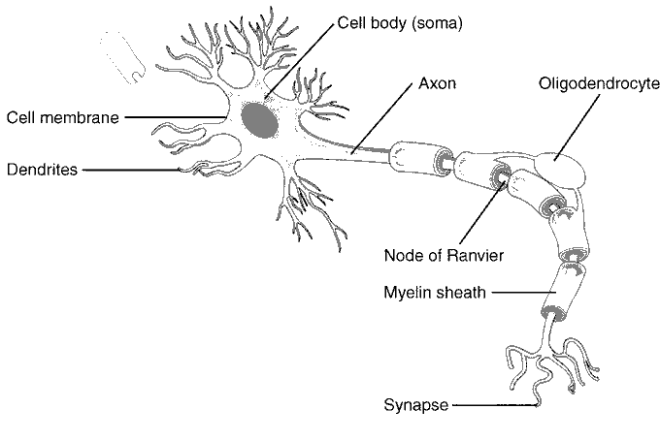
Still, the article in question (I don’t have the link, I’m sorry to say) concerned one of the functions of the ApoE gene (or rather, its products) in general, which involve cholesterol transport in and around nerve cells.  Cholesterol is a key component of cell membranes in animals, and this is particularly pertinent in this case because the myelin in nerves is formed from the sort of “wrapped up” membranes of a type of neural support cell*.
cns myelin

This particular study found that the cells of those with ApoE4 produced less or poorer myelin around nerve cells in the brain, presumably because of that faulty cholesterol transport, and that the myelin also deteriorated over time.

Now, the function of myelin is to allow the rapid progression of nerve impulses along relatively long axons, with impulses sort of jumping from one space (a “Node of Ranvier”) between myelin sheath and another rather than having to travel all the way down the nerve, which a much slower process, seen mostly in autonomic nerves in the periphery.  When normally myelinated nerves lose their myelin, transmission of impulses is not merely slowed down, but becomes erratic and often effectively non-existent.

myelin in general

The researchers found that a particular pharmaceutical can correct for at least some of the faulty cholesterol transport and can thereby support better myelin survival.  Though this does not necessarily point toward a cure or even a serious disease-altering treatment over the long term, it’s certainly interesting and encouraging.

But of course, we know Alzheimer’s to be a complex disease, and it may ultimately entail many processes.  For instance, it’s unclear (to me at least) how this finding relates to the deposition of amyloid plaques, which are also related to ApoE, and are extracellular findings in Alzheimer’s.  Are these plaques the degradation products of imperfect myelin, making them more a sign than a cause of dysfunction, or are they part of the process in and of themselves?

Also, it doesn’t address the question of neurofibrillary tangles, which are defects found within the nerve cells, and appear to be formed from aggregates of microtubule-associated proteins (called tau protein) that are atypically folded and in consequence tend to aggregate and not to function and to interfere with other cellular processes, making them somewhat similar to prions**.  It’s not entirely clear (again, at least to me) which is primary, the plaques or the tangles, or if they are both a consequence of other underlying pathology, but they both seem to contribute to the dysfunction that is Alzheimer’s disease.

So, although potential for a treatment that improves cholesterol transport and supports the ongoing health of the myelin in the central nervous systems of those at risk for Alzheimer’s is certainly promising, it does not yet presage a possible cure (or a perfect prevention) for the disease.  More research needs to be done, at all levels.

Of course, that research is being undertaken, in many places around the world.  But there is little doubt that, if more resources were to be put into the study and research of such diseases, understanding and progress would proceed much more quickly.

The AIDS epidemic that started in the 1980s was a demonstration of the fact that, when society is strongly motivated to put resources into a problem, thus bringing many minds and much money to the work, progress can occur at an astonishing rate.  The Apollo moon landings were another example of such rapid progress.  Such cases of relative success can lead one to wonder just how much farther, how much faster, and how much better our understanding of the universe‒that which is outside us and that which is within us‒could advance if we were able to evoke the motivation that people have to put their resources into, for instance, the World Cup or fast food or celebrity gossip.

I suppose it’s a lot to expect from a large aggregate of upright, largely fur-less apes only one step away from hunting and gathering around sub-Saharan Africa that they collectively allocate resources into things that would, in short order, make life better and more satisfying for the vast majority of them.  All creatures‒and indeed, all entities, down to the level of subatomic particles and up to the level of galaxies‒act in response to local forces.  It’s hard to get humans to see beyond the momentary impulses that drive them, and this shouldn’t be surprising.  But it is disheartening.  That, however, is a subject for other blog posts.

I’ll try to have more to say about Alzheimer’s as I encounter more information.  Just as an example, in closing, another article I found on the same day dealt with the inflammatory cells and mediators in the central nervous system, and how they can initially protect against and later worsen the problem.  We should not be too surprised, I suppose, that a disease that leads to the insidious degeneration of the most complex system in the known universe‒the human brain‒should be complicated and multifactorial in its causation and in its expression.  This should not discourage us too much, though.  The most complicated puzzles are, all else being equal, the most satisfying ones to solve.


*The cell type that creates myelin in the peripheral nervous system (called Schwann cells) is different than the type that makes it in the central nervous system (oligodendrocytes), and this may be part of why Alzheimer’s affects the central nervous system mainly, whereas diseases like ALS (aka Lou Gehrig’s Disease), for instance, primarily affect the nervous system outside the brain.

**The overall shape of a protein in the body is a product of the ordering of its amino acids and how their side chains interact with the cellular environment‒how acidic or basic, how aqueous or fatty, how many of what ions, etc.‒and with other parts of the protein itself.  Some proteins can fold in more than one possible way, and indeed this variability is crucial to the function of proteins as catalysts for highly specific chemical reactions in a cell.  However, some proteins can fold into more than one, relatively stable form, one of which is nonfunctional.  In some cases, these non-functional proteins interact with other proteins of their type (or others) to encourage other copies of the protein to likewise fold into the non-functional shape, and can form polymers of the protein, which can aggregate within the cell and resist breakdown, sometimes forming large conglomerations.  These are the types of proteins that cause prion diseases such as “mad cow disease”, and they appear also to be the source of neurofibrillary tangles in people with Alzheimer’s disease.

Though there’s only one lunar day per month, this is the weekly day of the moon

Okay, it’s Monday morning, and I’m writing this on my smartphone, so I’m not going to try anything too ambitious.  I didn’t bring my laptop back with me to the house because, again, I brought home some music (sheets and a book) under the absurd notion that I might play some guitar or possibly “piano” this weekend.  I don’t know if that was me being in an optimistic frame of mind or me deceiving myself‒or if, indeed, there is any difference at all between the two things.

In any case, as is presumably obvious, I did not play or even listen to any music this weekend.  I barely did anything at all.  I mean, on Sunday I did my laundry, getting terribly stressed before starting it that I would find the machine in use already, even early on Sunday morning, but thankfully that didn’t happen.

I suppose I got a lot of rest, which I needed, because I was still pretty wiped out from the virus or whatever that I’ve been fighting.  I watched some YouTube videos of mainly British comedy panel shows, most of which I’ve seen numerous times already, and on Sunday I watched The Accountant again; that’s becoming one of my favorite movies.  And I watched the Gallifrey Gals’ latest reaction video to Doctor Who.  And I took a few moderate walks, during one of which I spoke to my sister on the phone, which is always nice.  That was pretty much all the socializing I did…for the week, really, not counting interactions at work.

I didn’t read at all this weekend‒not a single page of a book.  Nothing gripped me enough to make me even open the Kindle app on my phone, let alone to grab one of the books I have in my room.  Last week, as you may recall, I reread The Chasm and the Collision.  I also reread one of the stories from Welcome to Paradox City, and I reread “I for one welcome our new computer overlords” in the version that’s in Dr. Elessar’s Cabinet of Curiosities.  They weren’t as fun as CatC, but they were decent stories and I still like them.  But I didn’t feel the urge to read even any of my own stuff this weekend.

I’m on the train on my way to the office now, and wondering what I’m going to do in general.  I keep intending to get back into some kind of better shape, so I don’t die a corpulent grimace of a blob of some kind.  I’m working on it.  I am walking some, trying to work my way up, and I do upper body training to at least some degree every day (except when sick…and after even a few days, it’s remarkable how much more difficult it becomes).  I’m trying to adjust my diet, but that seems to be my most difficult hurdle; eating is one of those rare self-soothing behaviors that’s biologically reliable, and from which it’s difficult to quit cold turkey as it were*.  Still, there are further interventions on which to work.

I’m not giving up on it.  I have something I want to try to do sometime in the relatively near future, and I would need to lose weight before doing it.  I’ve also toyed with the notion, in the past, of perhaps running a marathon some day.  I’ve had difficulties with jogging because of my back, which has at times been sensitive to me running, and some chronic ankle and knee weakness, but since I’ve been walking my two plus miles a day just from and to the train station, I think those areas are getting stronger, and sleeping on the futon on the floor is probably also helping.  Maybe I can gradually work my way up.  I’m not as young as I was in college when I first got into serious running condition, but if anything I am more stubborn.

I need to have something to do with my time, and I certainly don’t “have a life” as the expression goes.  I’ll try to get back to my medical postings soon, anyway, and I apologize for frequently putting them off.  There’s the follow-up to the neurology based post and the discussion of sugar I first sort of introduced last Thursday.

I don’t know what else I might end up doing.  I’m really rather rudderless now, and feel like I’m becoming more so as time goes on.  I have no real sense of a future, just the endless trudge that is the directionless present.  At least the weather is a little cooler down here for walking.  That’s a slight boon.  So much of the year it’s way too hot and humid.

Anyway, that’s it for today.  I hope you all have a good start to your week.


*Ha ha

I don’t feel well this morning.

Okay, well…sorry, I’m not going to be picking up today on the rest of the sugar-based post that I mentioned and half-started yesterday.  I also won’t be doing a follow-up neurology post, either.  I’m actually just going to write a very brief dispatch, if I can do that, mainly to let you know why I won’t be doing those things I just mentioned.

I just really don’t feel well this morning.  I was up during the middle of the night, but that’s not unusual; I even sort of felt somewhat clear-headed for a time.  But then, when I woke up this morning, before my alarm, I felt somewhat confused and disoriented.  This was not in any seriously alarming way.  I knew where I was and who I was and what day it was and so on.  I just felt vague and hazy and out of it, like I hadn’t truly slept at any point at all during the night, or had maybe had apnea episodes or something.  I felt rather uncoordinated as I got ready for my shower and got my clothes and all that stuff out, but not as though I were having an inner ear problem.

Well, perhaps just a little like that.

Anyway, I got showered and dressed, though I felt like it all took me longer than usual.  And now I’m waiting on my morning train.  I’m going to work, even though I feel under the weather, because I already missed one day this week, and because last week the office had a poorish week because of the holiday, and yesterday my coworker with whom I share some responsibilities had to take the day off because he was having particular trouble with his back.  I’m hoping he’ll return today, because I’m really not feeling great, and also because this is supposed to be my weekend off, after having worked the previous two Saturdays.

It seems I’m not the only one who is off kilter.  When I got to the train station, a northbound train was just arriving (I missed it), and I thought I must have lost more track of time than I’d appreciated.  But it turned out that it was the first train, the one I only catch when I really can’t sleep at all, and it was running almost 15 minutes late.  And now, my train is running about 30+ minutes late, and the southbound trains are running late, and the next northbound…well, you get the idea.  I wonder if there’s some computer virus issue going around that affects train systems and weird devices like me.

Probably not.

Anyway, it’s frustrating, because if I’d gotten here as early as I usually do for my usual train, I would have caught the delayed 1st train, and would already be on my way, instead of having to wait here, already feeling crappy, for a more-delayed train that will be more crowded because of the delay, as is always the case.

There are apparently a full three trains now expected to arrive at the Hollywood Tri-rail station, according to the tracker app—all late, but set to arrive within ten minutes or so of each other.  I would frankly wait for the second one if I weren’t sure that it too might not be even more delayed than currently listed*.

Geez, Louise, I don’t need this on a morning when I feel like I do.  I just want to lie down and go to sleep and stay that way.  I hate this stupid world and this stupid life.

So, anyway, my apologies for being so erratic and not doing what I had meant to do yet on the requested topics.  Hopefully I’ll be able to get a good rest this weekend, and by Monday I’ll be prepared to pick up on one of them.  Meanwhile, I hope you all forgive me, and that you have a good weekend.


*I did end up doing that, since the app and a security officer confirmed that the next train was only ten minutes after my delayed one, and that one was packed, and all my usual seats were taken.  Now I’m on a nice and sparsely populated train, at least, though I’m still quite behind my usual schedule, and that’s stressing me out.  But it’s better than being packed into an overcrowded and delayed train.

The sweetest honey is loathsome in its own deliciousness. And in the taste destroys the appetite. Therefore, blog moderately.

Hello and good morning.  It’s Thursday again, so I return to my traditional weekly blog post, after having taken off last Thursday for Thanksgiving.  I’m still mildly under the weather, but I’m steadily improving.  It’s nothing like a major flu or Covid or anything along those lines, just a typical upper respiratory infection, of which there are oodles.  Most are comparatively benign, especially the ones that have been around for a while, because being not-too-severe is an evolutionarily stable strategy for an infectious agent.

An infection that makes its host too ill will keep that host from moving about and make itself less likely to be spread, to say nothing of an infection that tends to kill its host quickly.  Smart parasites (so to speak) keep their hosts alive and sharing for a looong time.  Of course, “smart” here doesn’t say anything about the parasite itself; viruses are only smart in the sense that they achieve their survival and reproduction well, but they didn’t figure out how to be that way—nature just selected for the ones that survived and reproduced most successfully.  It’s almost tautological, but then again, the very universe itself could be tautological from a certain point of view.

It’s an interesting point, to me anyway, to note that today, December 1st, is precisely one week after Thanksgiving.  Of course, New Year’s Day (January 1st, in case you didn’t know) is always exactly 1 week after Christmas.  It’s unusual for Thanksgiving to precede the first of December by a week, because the specific date of Thanksgiving varies from year to year (and, of course, if Thanksgiving were to fall on the 25th of November, December 1st would not be exactly one week later).  It’s an amusing coincidence; there’s no real significance to it, obviously, but I notice such things.

Anyway.

My sister asked me to write something about the vicissitudes of sugar (not her words), and though I don’t mean to finish the topic here today, I guess I’ll get started.  Apologies to those who are waiting for me to finish the neurology post, but that requires a bit more prep and care, and I’m not ready for it quite yet.  Life keeps getting in the way, as life does, which is one of the reasons I think life is overrated.

It’s hard to know where to start with sugar.  Of course, the term itself refers to a somewhat broad class of molecules, all of which contain comparatively short chains of carbon atoms, to which are bonded hydrogen and hydroxyl* moieties.

Most sugars are not so much actual free chains as they are wrapped up in rings.  The main form of sugar used by the human body is glucose, which is a six-membered ring with the rough chemical formula C6H1206.

glucose2

This is the sugar that every cell in the body is keyed to use as one of its easy-access energy sources, the one insulin tells the cells to take up when everything is working properly.  Interestingly enough, of course, though glucose is the “ready-to-use” energy source, it only provides about 4 kilocalories** per gram to the body, as compared to 9 kilocalories per gram for fats.

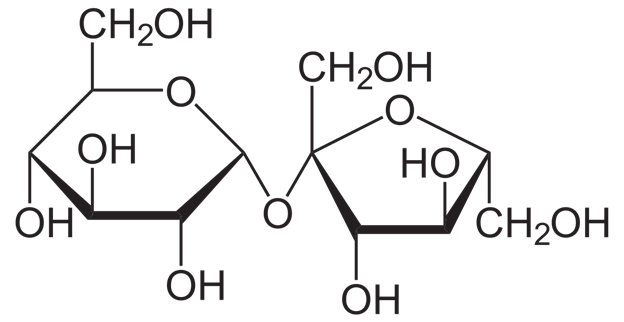
But the sugar we get in our diets is not, generally speaking, simple glucose.  It tends to be in the form of disaccharides, or sugars made of two combined individual sugars.  Sucrose, or table sugar, is a dimer of glucose and fructose, joined by an oxygen atom.

sucrose

Okay, I’m going to have to pick this up tomorrow.  I’ve gotten distracted and diverted by a conversation a few seats ahead of me.

There are two guys talking to each other at the end of this train car, and they are each seated next to a window on the opposite side of the train, so they’re basically yelling across the aisle to each other.  Their conversation is perfectly civil, and though they’re revealing a certain amount of ignorance about some matters, they are mainly displaying a clear interest in and exposure to interesting topics, from history to geography and so on.

At one point, one of the men started speaking of the pyramids and how remarkable their construction was, and I feared the invocation of ancient aliens…but then he followed up to say that, obviously, there were really smart people in ancient Egypt, just like we have smart people today who design and build airplanes and rockets and the like.  Kudos to him!

These men are not morons by any means.  They clearly respect the intellectual achievements of the past and present, and that’s actually quite heartening, because I think it’s obvious that neither one is extensively college-educated, if at all.

But why do they have their conversation from opposite sides of the train, so that everyone nearby has to hear it?  It’s thrown me off my course.

I’ll close just by saying that yesterday I finished rereading The Chasm and the Collision, and I want to note that I really think it’s a good book, and to encourage anyone who might be interested to read it.  The paperback is going for I think less than five dollars on Amazon, and the Kindle edition is cheaper still.  If you like the Harry Potter books, or the Chronicles of Narnia, or maybe the Percy Jackson books, I think you would probably like CatC.

CatC cover paperback

I’d love to think that there might be parents out there who would read the book to their kids.  Not kids who are too young—there are a few scary places in the story, and some fairly big and potentially scary ideas (but what good fairy tale doesn’t meet that description?).  It’s a fantasy adventure starring three middle-school students, though I’ll say again that, technically, it’s science fiction, but that doesn’t really matter for the experience of the story.

Most of my other stuff is not suitable for young children in any way—certainly not those below teenage years—and Unanimity and some of my short stories are appallingly dark (though I think still enjoyable).  If you’re old enough and brave enough, I certainly can recommend them; I don’t think I’m wrong to be reasonably proud of them.  But The Chasm and the Collision can be enjoyed by pretty much the whole family.  You certainly don’t have to be a kid to like it, or so I believe.

With that, I’ll let you go for now.  I’ll try to pick up more thoroughly and sensibly on the sugar thing tomorrow, with apologies for effectively just teasing it today.  I’m still not at my sharpest from my cold, and the world is distracting.  But I will do my best—which is all I can do, since anything I do is the only thing I could do in any circumstance, certainly once it’s done, and thus is the best I could do.

Please, all of you do your best, individually and collectively, to take care of yourselves and those you love and those who love you, and have a good month of December.

TTFN


*Hydroxyl groups are just (-OH) groups, meaning an oxygen atom and a hydrogen atom bonded together, like a  water molecule that lost one of its hydrogens.  This points back toward the fact that plants make sugar molecules from the raw building blocks of carbon dioxide (a source for the carbon atoms and some of the oxygen) and water (hydrogen and oxygen) using sunlight as their source of power and releasing oxygen as a waste product.  This was among the first environmental pollutants on the Earth—free oxygen—and it had catastrophic and transformative effects on not just the biosphere of the Earth but even on the geology.  The fact that the iron in our mines, for instance, is mainly in the form of rust is largely because of this plant-born presence of free oxygen in the atmosphere.

**A kilocalories is defined as the amount of energy needed to heat a kilogram of water by one degree centigrade.  We often shorten this term just to “calorie”, but that is actually only the amount of heat needed to raise a gram of water one degree centigrade (or 9/5 degrees Fahrenheit).  It’s worth being at least aware of the fact that what we tend to call calories are actually kilocalories.

You are not I, but I have a URI

In case anyone was worried, I apologize for not writing my blog post yesterday.  I was “home” sick with an upper respiratory infection, and had neither the energy nor the inclination to try to write a post.  I’m obviously not completely recovered today, but I am going in to the office—it’s payroll day, after all—and I feel a bit better than I did on Monday afternoon and yesterday, at least physically.  My mind feels quite foggy, but that’s not that unusual.

Of course, I’m not going to write either my follow-up neurology post nor the post about sugar and its discontents (so to speak) yet.  My mental acuity is not up to those at the moment, nor am I completely prepared for the former article, so I won’t be getting to them quite yet.  For those who might be waiting, again, I apologize.

There’s not much happening that’s particularly interesting.  I have been rereading the latter part of The Chasm and the Collision over the past few days, and I’m pleased to note that I still enjoy the story.  Parts of it even bring me near tears, which is a curious experience for the author, but then again, I guess it is more personal to me than it might be to others.  I’ve found a few typos—less than a handful, I would say—that were missed before, and if this were a world in which I had time and will and executive function (as they call it), I’d fix them and try to go and adjust the text for future purchasers, but I’m not up to that.

Anyway, it’s nice to know that at least I like the book, still, but I think there would be a lot of people out there who would like it, if it could be brought to their attention.  Unfortunately, I’m not good at self-promotion in any serious way.  This blog is as close to promotion as I get, and you all see how upbeat and enthusiastic I am with it.

Speaking of typos—I was, you can check for yourself—I’ve been making an awful lot of them while typing this.  I guess it’s part of being sick, or sicker than usual, or sick in more ways than usual.  I also, after waking up many times through the night, actually didn’t hear my alarm clock until the second repeat, ten minutes after it first goes off, because apparently I was sleeping on my left side, and I’m very hard of hearing in my right ear.  Probably at least a bit of it is also because I’m sick.  I wish I could say I felt more rested, but who feels better rested when sick?  Maybe afterwards, but not while it’s going on.

I’m wearing a mask on the train today, since I am sick, whereas lately I’ve been occasionally going without it, since often I’d literally be the only masked person in sight.  Perhaps going without a mask is why I’ve gotten sick.  It would make a certain amount of sense.

I think I may try to reread some of my other stories.  Somebody ought to read them, since they’re out there, and it’s not their fault their author isn’t good at promotion.  There are whole communities of people on Twitter and the like who promote independent writers and publishers, and I’ve tried to be an active member of such things in the past, but I’m afraid I have a hard time not getting stressed out by the whole process.  I guess this is why authors get agents and work through publishing houses, but frankly, the notion of dealing even with those situations—getting an agency or a publisher or any of that—is too daunting.  I barely have the will to get up and out of “bed”, frankly, but staying there would be more unpleasant than getting up, so…

Anyway, all that isn’t very interesting.  I guess the only other moderately interesting thing I have to note is that, Monday evening, as I was on my way back to the house, and already feeling the effects of this URI, I was “inspired” to write lyrics to the chorus and after that the first verse, and then a slightly altered second chorus, to a new song.  I even had a little melody in my head to go with it at the time, though I don’t recall that now.  I recorded the initial chorus, sort of, on my voice recorder, though I’m not sure I really caught the tune I had in my head for it, and then I wrote that chorus and the rest in the note-taking app.  I suppose I should email them to myself, lest my phone die and they be lost (though that wouldn’t exactly be a tragedy).  It was a slightly upbeat sounding melody, which was mildly ironic given that the words were rather negative—a cautionary note against complacency and overconfidence.

Is it any surprise that new song lyrics I would write would be so?

Anyway, that’s all that’s going on right now.  For me, I mean.  I don’t know if I’ll go any further with the song idea, but one thing I will do is try to avoid getting too wordy with it, since I tend to do that and end up making songs that are quite long.  I’ll add at most one or two other verses* and maybe a vocal bridge section if the mood for that strikes me.  We’ll see.  Odds are nothing is ever going to come of it, which is fine, because it’s not as though anyone makes a habit of listening to my music, anyway.

Okay, that’s enough of that nonsense.  I hope you all had a decent Tuesday, and have a good last day of November today.  Tomorrow begins what by name should be the tenth month, but which is actually the twelfth month—December, in case you didn’t know.  Yippee.


*To be clear, the verses and chorus such as I have are remarkably unwordy for me, so two to three verses, a chorus (with minor changes in its second repeat) and maybe a little bridge would not be too much.

Calling 988 is NOT painless with T-Mobile

I’m probably not going to write too much this morning.  I don’t feel much like writing.  In fact, I almost just decided to use my phone for this, even though I brought my laptop with me when I left the office yesterday.  But I thought about the pain in my right thumb and decided, you know what, since I have the laptop with me, I’ll use it.

I left work precipitously yesterday, over the fact that, once again, I was being asked to tacitly approve of a bending of the rules that were set not just by me but also by the boss and the other people who were now wanting to bend them, and all at the behest of the same miserable worm that often pushes us into that situation.  And maybe because of my apparent Asperger’s, or just because of my moral code, or just the truly abysmal mood I was already in (just check yesterday’s blog to find out about that), but I just basically said, “Fuck this,” and got up, packed up my laptop, and left the office.

I texted my main coworker to apologize, and told him that I was going to call 988 once I got back to the house, because I’m at my wit’s end.  I also texted my sister, who was also very supportive, and my coworker told me that the boss apologized to me for putting me in that position.

Anyway, I ended up at the house, which I don’t consider home, and it took me some time and a breather to work my way up to calling the helpline.  This is because, the last time I called the helpline, many years ago, while I was out on bail during my personal downfall/debacle, I got picked up by the PBSO, handcuffed, and taken to a place I think was called the South County Treatment Center.  The deputies didn’t know how to use their handcuffs very professionally—trust me, I’m a connoisseur—and did some nerve damage to my left wrist in the process that lasted almost a year.

So, I finally decided to call 988 yesterday, only to find that T-Mobile prepay would not allow the call to go through, even though I’m paid through December 11th.  I got online to investigate this, and signed into the account, just to confirm that, yes, I was paid up, and I was.  So then I got on their chat function, trying to tell them about the issue and asking, basically, “What the fuck?”

But the person on the chat said that I had to call the toll-free number specifically for T-Mobile’s prepaid system, that they couldn’t do anything or even say anything about it on their end.  And, of course, even though I’d said that I was trying to call the suicide prevention hotline, they used their same cheerful but useless prepackaged, computer-generated phrases to say I had to call their stupid other service first.

Well, it occurred to me that if I could call their stupid toll-free number, I could probably call another, so I told them to fuck off (or words to that effect), and then looked up the 800 number for the old helpline, and I found that it was still active and would redirect automatically to the same place to which 988 goes.  When I started dialing it, I realized that I still had that old number as a contact in my phone, having put it in there just in case, some time ago.

Anyway, I spoke to a pleasant woman who was quite supportive and calming, until I had to use the restroom.  One reassuring thing was, she asked me if I had any immediate plan or method of killing myself, or if I was thinking of killing myself.  I told her, I think about killing myself every day, and have all sorts of possible methods, but I don’t want to be rude or make a mess for other people to clean up or to inconvenience them, so that was why I was calling them.

I guess if they think you are imminently in danger of killing yourself, then they would call the sheriff.  Which leads me to wonder, what if that was your plan?  What if you deliberately wanted to call the sheriff and then when they came, attack them and make them shoot you?

That was not my intention, of course, though such ideas have occurred to me at times.  I finally got off the phone and took care of the restroom business, let my sister and my coworker know that I had called, and that I was going to bed.

I wish I could say it had solved my problems and I felt worlds better, but I don’t think anyone expects that to be the case.  Still, I’m here, for what it’s worth*, and I’m writing this blog, though I’m not working yet on the follow up to my initial neurological post.

But I will close with a public service announcement, or two of them:  First, if you or someone you know has trouble with depression or other mental health issues, or what have you, please keep the following information in mind:  The three digit number for the national suicide helpline in the USA is 988, and the 800 number is 1- 800-273-8255.

The second suggestion is, if you think there’s any chance you or a loved one might need urgent mental health help, don’t do business with T-Mobile.  The fact that I couldn’t get through with the initial 988 number was almost enough to make me decide that it wasn’t worth trying to get help, that this was the world telling me I should just die.  Fortunately my combative stubbornness came to my aid, and I had to try to solve the problem because it did not make sense.

Fuck T-Mobile.  But thank goodness for the people at the suicide help line.


*Nothing, in the greater scheme of things.

You’ve got some nerve!

It’s Saturday, the 19th of November in 2022, and I’m going in to the office today, so I’m writing a blog post as well.  I’m using my laptop to do it, and that’s nice—it lets me write a bit faster and with less pain at the base of my right thumb, which has some degenerative joint disease, mainly from years of writing a lot using pen and paper.

The other day I started responding to StephenB’s question about the next big medical cure I might expect, and he offered the three examples of cancer, Alzheimer’s and Parkinson’s Disease.  I addressed cancer—more or less—in that first blog post, which ended up being very long.  So, today I’d like to at least start addressing the latter two diseases.

I’ll group them together because they are both diseases of the central nervous system, but they are certainly quite different in character and nature.  This discussion can also be used to address some of what I think is a dearth of public understanding of the nature of the nervous system and just how difficult it can be to treat, let along cure, the diseases from which it can suffer.

A quick disclaimer at the beginning:  I haven’t been closely reading the literature on either disease for quite some time, though I do notice related stories in reliable science-reporting sites, and I’ll try to do a quick review of any subjects about which I have important uncertainties.  But if I’m out of date on anything specific, feel free to correct me, and try to be patient.

First a quick rundown of the two disorders.

Alzheimer’s is a degenerative disease of the structure and function of mainly the higher central nervous system.  It primarily affects the nerves themselves, in contrast to neurologic diseases that interfere with supporting cells in the brain*.  It is still, I believe, the number one cause of dementia** among older adults, certainly in America.  It’s still unclear what the precise cause of Alzheimer’s is, but it is associated with the development of “cellular atypia made of what are called “neurofibrillary tangles” within the cell bodies of neurons, and these seem to interfere with normal cellular function.  To the best of my knowledge, we do not know for certain whether the plaques are what directly and primarily cause most of the disease’s signs and symptoms, or if they are just one part of the disease.  Alzheimer’s  is associated with gradual and steadily worsening loss of memory and cognitive ability, potentially leading to loss of one’s ability to function and care for oneself, loss of personal identity, and even inability to recognize one’s closest loved ones.  It is degenerative and progressive, and there is no known cure and there are few effective treatments that are not primarily supportive.

Parkinson’s Disease (the “formal” disease as opposed to “Parkinsonism”, which can have many causes, perhaps most notably the long-term treatment of psychiatric disorders with certain anti-psychotic medicines), is a disorder in which there is loss/destruction of cells in the substantia nigra***, a region in the “basal ganglia” in the lower part of the brain, near the takeoff point of the brainstem and spinal cord.  It is dense with the bodies of dopaminergic neurons, which there seem to modulate and refine motor control of the body.  The loss of these nerve cells over time is associated with gradual but progressive movement disorders, including the classic “pill-rolling” tremor, shuffling gait, blank, mask-like facial expression, and incoordination with tendency to lose one’s balance.  There are more subtle and diffuse problems associated with it, including dementia and depression, and like Alzheimer’s it is generally progressive and degenerative, and there is no known “cure”, though there are treatments.

Let me take a bit of a side-track now and address something that has been a pet peeve of mine, and which contributes to a general misunderstanding of how the nervous system and neurotransmitters work, and how complex the nature and treatment of diseases of the central nervous system can be.  This may end up causing this blog post to require at least two parts, but I think it’s worth the diversion.

I mentioned above that the cells of the substantia nigra are mainly dopaminergic cells.  This means that they are nerve cells that transmit their “messages” to other cells mainly (or entirely) using the neurotransmitter dopamine.  The term “dopaminergic” is a combination word, its root obviously enough being “dopamine” and its latter half, “ergic” relating to the Greek word “ergon” which means to do work.  So “dopaminergic” means those cells do their work using dopamine, and—for instance—“serotonergic” refers to cells that do their work using serotonin.  That’s simple enough.

But the general public seems to have been badly educated about what neurotransmitters are and do; what nerve impulses are and do; and what the nature of disorders, like for instance depression, that involve so-called “chemical imbalances” really entails.

I personally hate the term chemical imbalance.  It seems to imply that the brain is some kind of vat of solution, perhaps undergoing some large and complex chemical reaction that acquires some mythical state of equilibrium when it’s working properly, but when, say, some particular reactant or catalyst is present in too great or too small a quantity, doesn’t function correctly.  This is a thoroughly misleading notion.  The brain is an incredibly complex “machine” with hundreds of billions of cells interacting in extremely complicated and sophisticated ways, not a chemical reaction with too many or too few moles on one side or another.

People have generally heard of dopamine, serotonin, epinephrine, norepinephrine, and the like, and I think many people think of them as related to specific brain functions—for instance, serotonin is seen as a sort of “feel good” neurotransmitter, dopamine as a “reward” neurotransmitter, epinephrine and norepinephrine as “fight or flight” neurotransmitters, and so on.

I want to try to make it very clear:  there’s nothing inherently “feel good” about serotonin, there’s nothing inherently “rewarding” about dopamine, and—even though epinephrine is a hormone as well as a neurotransmitter, and so can have more global effects—there’s nothing inherently “fight or flight” about the “catecholamines” epinephrine and norepinephrine.

All neurotransmitters—and hormones, for that matter—are just complex molecules that have particular shapes and configurations and chemical side chains that make them better or worse fits for receptors on or in certain cells of the body.  The receptors are basically proteins, often combined with special types of “sugars” and “fats”.  They have sites in their structures into which certain neurotransmitters will tend to bind—thus triggering the receptor to carry out some function—and to which other neurotransmitters don’t bind, though, as you may be able to guess from looking at their somewhat similar structures, there can be some overlap.

dopamine

Dopamine

serotonin

Serotonin

epinephrine

Epinephrine

Neurotransmitters are effectively rather like keys, and their functions—what they do in the nervous system—are not in any way inherent in the neurotransmitter itself, but in the types of processes that get activated when they bind to receptors.

There is nothing inherently “rewarding” about dopamine, any more than there is anything inherently “front door-ish” to the key you use to unlock the front door of your house, or “car-ish” to the keys that one uses to open and turn on cars.  It’s not the key or the lock that has inherent nature, it’s whatever function is initiated when that key is put into that lock, and that function depends entirely on the nature of the target.  The same key used to open your door or start your car could, in principle, be used to turn on the Christmas lights in Rockefeller Center or to launch a nuclear missile.

Dopamine is associated with areas of the nervous system that function to reward—or more precisely, to motivate—certain behaviors, but it is not special to that function.  As we see in Parkinson’s Disease, it is also used in regions of the nervous system involved in modulating motor control of the body.  The substantia nigra doesn’t originate the impulses for muscles to move, but it acts as a sort of damper or fine tuner on those motor impulses.

Neurotransmitters work within the nervous system by being released into very narrow and tightly closed spaces between two nerve cells (a synapse), in amounts regulated by the rate of impulses arriving at the bulb of the axon.  Contrary to popular descriptions, these impulses are not literally “electrical signals” but are pulses of depolarization and repolarization of the nerve cell membrane, involving “voltage-triggered gates****” and the control of the concentration of potassium and sodium ions inside and outside the cell.

synapse

A highly stylized synapse

The receptors then either increase or decrease the activity of the receiving neuron (or other cell) depending on what their local function is.  It’s possible, in principle, for any given neurotransmitter to have any given action, depending on what functions the receptors trigger in the receiving cell and what those receiving cells then do.  However, there is a fairly well-conserved and demarcated association between particular neurotransmitters and general classes of functions of the nervous system, due largely to accidents of evolutionary history, so it’s understandable that people come to think of particular neurotransmitters as having that nature in and of themselves…but it is not accurate.

Okay, well, I’ve really gone off on my tangents and haven’t gotten much into the pathology, the pathophysiology, or the potential (and already existing) treatments either for Parkinson’s or Alzheimer’s.  I apologize if it was tedious, but I think it’s best to understand things in a non-misleading way if one is to grasp why it can be so difficult to treat and/or cure disorders of the nervous system.  It’s a different kind of problem from the difficulties treating cancer, but it is at least as complex.

This should come as no surprise, given that human nervous systems (well…some of them, anyway) are the most complicated things we know of in the universe.  There are roughly as many nerve cells in a typical human brain as there are stars in the Milky Way galaxy, and each one connects with a thousand to ten thousand others (when everything is functioning optimally, anyway).  So, the number of nerve connections in a human brain can be on the order of a hundred trillion to a quadrillion—and these are not simple switching elements, like the AND, OR, NOT, NAND, and NOR gates for bits in a digital computer, but are in many ways continuously and complexly variable even at the single synapse level.

When you have a hundred trillion to a quadrillion more or less analog switching elements, connecting cells each of which is an extraordinarily complex machine, it shouldn’t be surprising that many things can go wrong, and that figuring out what exactly is going wrong and how to fix it can be extremely difficult.

It may be (and I strongly suspect it is the case) that no functioning brain of any nature can ever be complex enough to understand itself completely, since the complexity required for such understanding increases the amount and difficulty of what needs to be understood*****.  But that’s okay; it’s useful enough to understand the principles as well as we can, and many minds can work together to understand the workings of one single mind completely—though of course the conglomeration of many minds likewise will become something so complex as likely to be beyond full understanding by that conglomeration.  That just means there will always be more to learn and more to know, and more reasons to try to get smarter and smarter.  That’s a positive thing for those who like to learn and to understand.

Anyway, I’m going to have to continue this discussion in my next blog post, since this one is already over 2100 words long.  Sorry for first the delay and then the length of this post, but I hope it will be worth your while.  Have a good weekend.


*For instance, Multiple Sclerosis attacks white matter in the brain, which is mainly long tracts of myelinated axons—myelin being the cellular wraparound material that greatly speeds up transmission of impulses in nerve cells with longish axons.  The destruction of myelin effectively arrests nerve transmission through those previously myelinated tracts.

**“Dementia” is not just some vague term for being “crazy” as one might think from popular use of the word.  It is a technical term referring to the loss (de-) of one’s previously existing mental capacity (-mentia), particularly one’s cognitive faculties, including memory and reasoning.

***Literally, black substance.

****These are proteins similar to the receptors for neurotransmitters in a way, but triggered by local voltage gradients in the cell membrane to open or close, allowing sodium and/or potassium ions to flow into and out of the cell, thereby generating more voltage gradients that trigger more gates to open, in a wave that flows down the length of the axon, initially triggered usually at the body of the nerve cell.  They are not really in any way analogous to an electric current in a wire.

*****You can call that Elessar’s Conjecture if you want (or Elessar’s Theorem if you want to get ahead of yourself), I won’t complain.

Nothing of worth can ever truly be “unconditional”

It’s Friday now, and for many it is the last day of the work week.  If you are one of those people, congratulations.  If you expect to work tomorrow, as I do, then, well, congratulations on having gainful employment.  It’s not a contradiction to consider both cases worthy of celebration.

I’m writing on my phone today because I didn’t want to take my laptop to the house with me‒I took my Radiohead guitar chords book home with the notion that I might actually get the acoustic guitar out and do some strumming, and the book and laptop together seemed likely to make my backpack unpleasantly heavy to carry.  Alas, the strumming part didn’t happen, but I couldn’t retroactively choose to take the laptop with me.

Because of that, I’m not going to write about Alzheimer’s and/or Parkinson’s disease today; I feel that I can deal with them better when I can type more naturally, and so I’ll address those things perhaps tomorrow.  Today, I’ll try to address a random, walk-in set of topics that crowded my head this morning for unclear causes.  The things that popped into my mind as I headed to the train station included the notions of healthcare as a human right, unconditional love, and free education (free anything, really), all loosely linked to something a coworker of mine said yesterday.

I’ll start with the middle one, because it presents itself (rather intrusively) in my mind in the form of the old song, Unconditional Love, performed way back when by Donna Summer and Musical Youth.  The chorus goes, “Give me your unconditional love; the kind of love I deserve; the kind I want to return.”

I may have written about this notion before, but do you spot the logical flaws there?  First of all, the notion that one can (apparently) demand another’s love, conditional or otherwise, is rather obscene and also unworkable.  But that’s a separate issue from the notion of “unconditional love”.  One big problem with this is revealed in the second line of the chorus:  that such love is the kind the singer deserves.  But if it’s unconditional, then‒to quote the movie Unforgiven‒”deserve’s got nothing to do with it”.  If love is unconditional, then everyone and anyone (and presumably anything) deserves it.  That’s what unconditional means!

Perhaps they might have meant something along the lines of “non transactional” love, but if so, they reveal hypocrisy in the next line, “the kind I want to return”, because they’re saying, openly, that their own love is not merely conditional but also transactional…I’ll love you if and only if you love me unconditionally.  Maybe that was supposed to be the message of the song, to ridicule such words and thoughts and attitudes toward love by revealing their absurdity, but it certainly didn’t come across that way.

On we go to the notion of healthcare as a human right.  This is something one sees at times brought up and bandied about by activists of various stripes, and I can readily understand and sympathize with the urge, but it is illogical.  One cannot have a right to anyone else’s skill or work or abilities or resources, and the provision of healthcare requires these in spades.

True rights are and can really only be rights to be free from things‒free from coercion, free from threats and violence, free from theft, free from censorship and from unjust imprisonment, that sort of thing.  To claim a right to the work of other people, especially if one claims that right precisely because that work is so important, is the opposite of any kind of right or freedom; it is coercion in and of itself.

Now, it may be that a society could decide that it is best for everyone, as a whole and as individuals, to provide (and therefore to pay for) healthcare for all its citizens without any at-the-time-of-service charge, since illnesses and injuries are often unpredictable, and they do not choose convenient times to strike.  A society may decide that taking away some of that danger, that threat, that uncertainty, will be better for everyone and anyone.  It’s not an unreasonable idea.  But that doesn’t describe any kind of right, even if one is a citizen of a society that has chosen that path.  Give it the credit it deserves and call it a privilege, and one that should be cherished, not a right.

This ties in nicely with the notion of other “free” programs or privileges, the main one that comes to my mind being that of “free college education”.  As with most positive, physical things, the notion of “free” simply doesn’t apply.  Air is free (for now), because it’s pretty much everywhere, and it doesn’t require any work apart from the effort of breathing.  But education requires many resources, including the information gleaned by the innumerable predecessors who worked to develop the knowledge that is being shared, and the time and effort of the scholars and teachers who are sharing it.

Some of this is getting cheaper and easier thanks to advancing computer and communications technology, but those things also required the efforts and resources of numerous people before they became available to so many others, most of whom do not have the knowledge or skill to recreate such resources on their own.

Again, this is not to say that it is not worth considering whether a society might be well-served by making education available without local charge to all citizens who wish to participate.  It may be well worth the expense and effort involved for the society, in the long or even the short term.  I’m a big fan of public primary and secondary schools, and I wish they were better funded and in a more egalitarian way, because there are untold numbers of people with great potential who have not been able to realize it because they had effectively no local resources available to do so.

This is truly a shame and a tragedy.  Who knows what scientists or artists or innovative business people (and so on) we have lost without knowing that we lost them?  But calling for there to be “free” education is silly.  Someone, somewhere, has to “pay” for every good thing that requires effort in transforming the world into a desired form, decreasing local entropy by expending energy and producing compensatory entropy increase through the efforts made.

This all ties in‒in spirit‒with the complaint by a coworker yesterday, who moans frequently about lack of money and a fear of being unable to pay rent, etc., but when the boss asked her to come in this Saturday to work, so she could make more money, said she just can’t work six days a week.  Of course, she doesn’t work six days a week, she hasn’t worked six days a week that I can remember.  I work six days every other week; if I don’t, things don’t happen for the many people who come in on Saturdays voluntarily, to try to make a little extra money for their own expenses.

The problem was not with her choosing not to come in on any Saturday‒that’s her decision, and she is the one who loses the opportunity to make more money‒but with her complaint to me that it’s just “not fair” to have to work six days, which is truly nonsensical given to whom she was speaking, and given the number of people who voluntarily come in and work more Saturdays than not.

My response was pretty unsympathetic.  I told her that “fairness” is a fiction, at least as she’s apparently imagining it.  There’s no injustice in her being encouraged to work an extra day once in a while to make extra money, if she’s truly worried about her expenses.  If anything, it would be unfair for her to expect to make more money without doing extra work.

In a sense, nature is always fair; the laws of physics apply everywhere and for all time, as far as we can tell.  They make no exceptions and provide no “get out of jail free” cards or cheat codes to anyone regarding their application.

Other than this, any notion of fairness is purely a human invention.  It may, in some senses and cases, be very good to seek and to create, for a society and for the individuals within it.  Indeed, I would say that it is worthwhile.  But it too is not free; it requires effort, and it requires ownership of one’s responsibility for one’s share of the effort.  It is not unconditional.  To expect unconditional anything from anyone or anything is not fair, but is in many ways quite the opposite.

Education is very good and beneficial, and probably the more of it we have, the better, all other things being equal.  Reasonable pay for good work is certainly a good thing.  Healthcare is an almost miraculous good that we take for granted at our peril, but which would almost certainly benefit all of society more if it were more efficiently and evenly available.  And love is, quite possibly, the most wonderful and beautiful thing the universe has ever brought into existence.  We should show these things the respect they deserve by not taking them for granted in any way.

deserve

Some discussion of cancer–not the zodiac sign

Yesterday, reader StephenB suggested that I write about what I thought might be the next big medical cure coming our way—he suggested cancer, Alzheimer’s, and Parkinson’s diseases as possible contenders—and what I thought the “shape” of such a cure might be.  I thought this was an interesting point of departure for a discussion blog, and I appreciate the response to my request for topics.

[I’ll give a quick “disclaimer” at the beginning:  I’ve had another poor night.  Either from the stress of Monday night or something I ate yesterday (or both, or something else entirely) I was up a lot of last night with reflux, nausea, and vomiting.  So I hope I’m reasonably coherent as I write, and I apologize if my skills suffer.]

One hears often of the notion of a “cure for cancer”, for understandable reasons; cancer is a terrifying and horrible thing, and most people would like to see it gone.  However, my prediction is that there will never be “a” cure for cancer, except perhaps if we develop nanotechnology of sufficient complexity and reliability that we are able to program nanomachines unerringly to tell the difference between malignant and non-malignant cells, then destroy the malignant ones and remove their remains neatly from the body without causing local complications.  That’s a tall order, but it’s really the only “one” way to target and cure, in principle, all cancers.

Though “cancer” is one word, and there are commonalities in the diseases that word represents, most people know that there are many types of cancers—e.g., skin, colon, lung, breast, brain, liver, pancreatic, and so on—and at least some people know that, even within the broader categories there are numerous subtypes.  But every case of cancer is literally a different disease in a very real sense, and indeed, within one person, a single cancer can become, effectively, more than one disease.

We each* start out as a single fertilized egg cell, but by adulthood, our bodies have tens of trillions of cells, a clear demonstration of the power of exponential expansion.  Even as adults, of course, we do not have a static population of cells; there is ongoing growth, cell division/reproduction, and of course, cell death.  This varies from tissue to tissue, from moment to moment, from cell type to cell type, under the influence of various local and distant messengers, ultimately controlled by the body’s DNA.

Whenever a cell replicates, it makes a copy of its DNA, and one of each copy is sent into each daughter cell.  There are billions of base pairs in the human genome, so there are lots of opportunities for copying errors.  Thankfully, the cell’s proofreading “technology” is amazingly good, and errors are few and far between.  But they are not nonexistent.  Cosmic rays, toxins, other forms of radiation, prolonged inflammation, and simple chance, can all lead to errors in the replication of a precursor cell’s DNA, giving rise to a daughter cell with mutations, and when there are trillions of cells dividing, there are bound to be a number of them.

The consequences of such errors are highly variable.  Many of them do absolutely nothing, since they happen in portions of the genome that are not active in that daughter cell’s tissue type, or are in areas of “junk” DNA in the cell, or in some other way are inconsequential to the subsequent population of cells.  Others, if in just the wrong location, can be rapidly lethal to a daughter cell.  Most, though, are somewhere in between these two extremes.

The rate of cell division/reproduction in the body is intricately controlled, by the proteins and receptors in that cell, and the genes that code for them, and that code for factors that influence other portions of the genome of a given cell, and that make it sensitive or insensitive to hormonal or other factors that promote or inhibit cell division.  If a mutation in one of the regions of the cell that is involved in this regulatory process—either increasing the tendency to grow and divide or diminishing the sensitivity to signals that inhibit division—a cell can become prone to grow and divide more rapidly than would be ideal or normal for that tissue.  Any given error is likely to have a relatively minor effect, but it doesn’t take much of an effect to lead to a significant increase in the number of cells in a given cell type eventually—again, this is the power of exponential processes.

A cell line that is reproducing more rapidly will have more opportunities for errors in the DNA reproduction of its many daughter cells.  These new errors are no more likely to be positive, negative, or neutral generally than any other replication errors anywhere else in the body, but increased rate of growth means more opportunities** for mistakes.

If a second mistake in one of the potentially millions (or more) of daughter cells of the initial cell makes it yet more prone to divide rapidly than even the first population of mutated cells, then that population will grow and outpace the parent cells.  There can be more than one such daughter populations of cells.  And as the rate of replication/growth/division increases in a given population of cells, we have an increased chance of more errors occurring.  Those that become too deleterious will be weeded out.  Those that are neutral will not change anything in the short term (though some can make subsequent mutations more prone to cause increased growth rates).  But the ones that increase the rate of growth and division will rapidly come to dominate.

This is very much a microcosm of evolution by natural selection, and is a demonstration of the fact that such evolution is blind to the future.  In a sense, the mutated, rapidly dividing cells are more successful than their more well-behaved, non-mutated—non-malignant—sister cells.  They outcompete for resources*** against “healthy” cells in many cases, and when they gather into large enough masses, they can cause direct physical impairments to the normal function of an organism.  They can also produce hormones and proteins themselves, and can thus cause dysregulation of the body in which they reside in many ways.

Because they tend to accumulate more and more errors, they tend to become more dysfunctional over time.  And, of course, any new mutations in a subset of tumor cells that makes it more prone to divide unchecked, or that makes it more prone to break loose from its place of origin and spread through the blood and/or lymph of the body will rapidly become overrepresented.

This is the general story of the occurrence of a cancer.  The body is not without its defenses against malignant cells—the immune system will attack and destroy mutated cells if it recognizes them as such—but they are not perfect, nor would it behoove evolution (on the large scale) to select for such a strictly effective immune system, since all resources are always finite, and overactive immunity can cause disease in its own right.

But the specific nature of any given cancer is unique in many ways.  First of all, cancers arise in the body and genes of a human being, each of which is thoroughly unique in its specific genotype from every other human who has ever lived (other than identical twins).  Then, of course, more changes develop as more mutations occur in daughter cells.  Each tumor, each cancer, is truly a singular, unique disease in all the history of life.  Of course, tumors from specific tissues will have characteristics born of those tissues, at least at the start.  Leukemias tend to present quite differently from a glioblastoma or a hepatoma.

Because of these differences, the best treatments for specific cancers, even of classes of cancers, is different.  The fundamental difficulty in treating cancer is that you are trying to stop the growth and division—to kill—cells that are more or less just altered human cells, not all that different from their source cells.  So any chemical or other intervention that is toxic to a cancer cell is likely to be toxic to many other cells in the body.  This is why chemotherapy, and radiation therapy, and other therapies are often so debilitating, and can be life-threatening in their own right.  Of course, if one finds a tumor early enough, when it is quite localized, before any cells have broken loose—“metastasized”—to the rest of the body, then surgical removal can be literally curative.

Other than in such circumstances, the treatment of cancer is perilous, though not treating it is usually more so.  Everything from toxic chemicals to immune boosters, to blockers of hormones to which some cancers are responsive, to local radiation are used, but it is difficult to target mutated cells without harming the native cells to at least some degree.

In certain cases of leukemia, one can literally give a lethal dose of chemo and/or radiation that kills the bone marrow of a person whose system has been overwhelmed by malignant white blood cells, then giving a “bone marrow transplant”, which nowadays can sometimes come from purified bone marrow from the patient—thus avoiding graft-versus-host diseases—and there can be cures.  But it is obviously still a traumatic process, and is not without risk, even with auto-grafts.

So, as I said at the beginning, there is not likely to be any one “cure” for cancer, ever, or at least until we have developed technology that can, more or less inerrantly, recognize and directly remove malignant cells.  This is probably still quite a long way off, though progress can occasionally be surprising.

One useful thing cancer does is give us an object lesson, on a single-body scale, that it is entirely possible for cell lines—and for organisms—to evolve, via apparent extreme success, completely into extinction.  It’s worth pondering, because it happens often, in untreated cancers, and it has happened on the scale of species at various times in natural history.  Evolution doesn’t think ahead, either at the cellular level, the organismal level, or the species/ecosystem level.  Humans, on the other hand, can think ahead, and would be well served to take a cue from the tragedy of cancer that human continuation is not guaranteed merely because the species has been so successful so far.

Anyway, that’s a long enough post for today.  I won’t address matters of Parkinson’s Disease or Alzheimer’s now, though they are interesting, and quite different sorts of diseases than cancers are.  I may discuss them tomorrow, though I might skip to Friday.  But I am again thankful to StephenB for the suggestion/request, and I encourage others to share their recommendations and curiosities.  Topics don’t have to be about medicine or biology, though those are my areas of greatest professional expertise.  I’m pretty well versed in many areas of physics, and some areas of mathematics, and I enjoy some philosophy and psychology, and—of course—the reading and writing of fiction.

Thanks again.


*I’m excluding the vanishingly rare, and possibly apocryphal, cases of fused fraternal twins.

**There are also people who have, at baseline, certain genes that make them more prone to such rapid replication, or to errors in DNA replication, or to increased sensitivity to growth factors of various kinds, and so on.  These are people who have higher risks of various kinds of cancer, but even in them, it is not an absolute matter.

***Most tissues in the body have the inherent capacity and tendency to stimulate the development of blood vessels to provide their nutrients and take away their wastes.  Cancer cells are no exception, or rather, the ones that are do not tend to survive.  Again, it is a case of natural selection for those cell lines that are most prone to multiply and grow and gain local resources.

How strange or odd some’er I blog myself

Hello and good morning.

It may not be morning when you’re reading this, but it is morning when I’m writing it, and since the time any given person reads it is variable—it could be anywhen from noon back round to noon, and in any time zone—the only stable point from which to make departure is that time in which I am writing.  Thus, again:  good morning.

I’m using my laptop today, which is easier and faster, though it may lead to the post being more wordy and rambling than the ones I wrote on my phone.  Perhaps not.  Those who’ve said anything at all have said they can’t tell the difference.  It feels different, of course, but then, it would feel different, wouldn’t it?  A laptop and a smartphone are, despite many common attributes, very different devices with which to work.

I’m waiting for the second train this morning, rather than having gotten up for the first as I did the previous two days.  It’s not that I wasn’t up frequently during the night; I was awake well in time to come for the first train, but somewhat ironically, since I’m not feeling quite as physically ill, I was able at least just to lie there “in bed” and wait until five minutes before my alarm went off before getting up.

Of course, given my traditional greeting, in case you don’t know, it’s Thursday, the day I’ve long reserved for writing my blog posts, even when I didn’t write them any other day.  As with the time, you might be reading this on pretty much any day of the week, but I’m writing it on Thursday, and that’s not going to have changed, unless reality is far more fluid than it seems.  I’m pretty sure it’s not.

I’ll briefly relay an issue I had when I arrived at the office yesterday, already sick and uncomfortable, forcing myself to go in when I should have stayed in bed because it was payroll day.  Suffice it to say that I had to rush to the restroom when I arrived, only to discover that the toilet paper had not been maintained as I’ve always asked people to do, even in my absence, and I was caught rather short.

I decided to enact a temporary, prison-style system of people having to be responsible for their own toilet paper, since they couldn’t be responsible for looking out for each other according to very simple procedures of letting someone know when they take the last replacement roll from the cupboard.

I’ll revert to the old system today, for stability’s sake, but it’s frustrating that grown people don’t take simple steps to be considerate.  I wish I could fit everyone at work—including myself—with a shock collar, to activate when someone does something rude or inappropriate.  Of course, the person I have most complaints about is myself; the very fact that I get so angry about everything, and always feel so tense, just makes me hate myself more every day.

I have an electric stunner at the office—I bought it because in Unanimity, some characters use them for specific purposes, and I needed to know how they sound and look when activated, and how easy it was to get one.  I do various things to hurt myself when I’m either too angry at myself to hold back, or so stressed out by various things people do that I want to lash out, but I can’t allow myself to do such things, so I let it out where I can, at myself.

I’ve destroyed my own writing and art work, I’ve banged my head against desks and walls and tables until I bruise myself, I’ve punched walls—the first two knuckles of both of my hands are slightly bulbous from my having done this often over many years—I’ve thrown away precious items and books, and I’ve hurt myself in more extreme ways than these, but I won’t get too much into that*.  I don’t want to have to title another blog post with a trigger warning, especially not on a day when the title is supposed to be a minced Shakespearean quote.

The point is that I’ve never tried using my stunner on myself, mainly because I’m nervous about how it might interact with my chronic pain, which is at least partly neuropathic in character.  I don’t want to trigger muscle spasms or neural feedback loops or the like.  It probably wouldn’t do any bad or good, though; I’ve used TENS units with no particular benefit, even at very high power.

That’s the character of my life.  Each day is a loosely connected string of things I do to try to distract myself from chronic pain, tension/stress, sleep loss, dysthymia/depression, and deep inability to connect with anyone despite being profoundly lonely.  It’s a shitty ride, I’ve gotta say.  I’m not even going to give it one star on TripAdvisor.

People sometimes say** things like, “Hang on, keep going, there are people who care about you, you’re not alone.”  And that’s nice, and I’m sure there are people who care, at least in the abstract sense.  But it’s at least a bit like saying, “Hang on, keep going, there’s a supermassive black hole in the center of most galaxies!”  It’s true, and it’s interesting.  It’s something I care about.  But it has no apparent impact on my daily existence and the fact that I hate myself and hate my life.

I don’t have any answers for myself, in case that’s not obvious.  But I’m getting wearier and wearier of just plodding along, without any goal, and with no one nearby to talk to, with all the people I’ve cared most about not wanting to be around me.  Who can blame them?  You’ve read my writing; how much time would you want to spend with me?

Anyway, that’s enough for today.  I hope all of you out there are doing well, and have things for which to live, and people around you who love you and care about you and want to spend time with you.  If you do, please be grateful and treasure them.

TTFN

me distorted


*Although I will give a caution about one long-past event:  don’t hit yourself in the kneecap with a ball-peen hammer, even if you’re doing it to distract yourself from chronic pain.  Just…don’t.

**Or, to pick nits, they write such things.


This is an addendum, to be added to today’s blog post at the end.  The train I’m waiting for is delayed, and they keep running an automated announcement overhead that it’s delayed “10…15 minutes”.  But it’s already 25 minutes late, and according to the app that tracks the trains, it’s going to be at least 10 more minutes before it gets here, so the announcement is just wrong, and that grates on my nerves far more than it ought to do.  Of course, as always with delays, the train will be more crowded, because people who would have missed the usual scheduled time, or who arrive early for the next train, will be aboard.  I feel like I’m going to split in half because I’m so tense about it.  When the whole universe, or at least everything related to humans, feels like the Enemy, it doesn’t take all that long to become shell-shocked.  I feel that I have no escape and no comrades, like I’m the only member of my species in a strange, foreign universe.  I think I’m on the verge of some breakdown.  Hell, maybe I’m already in the midst of it.  I don’t know what to do.  I need help, but my need is no claim on anyone else’s abilities; my need is my own problem.  It’s a need I don’t think I’m going to be able to meet, and when one is unable to meet one’s needs, one deteriorates and/or suffers and/or dies.