Apologies for a blogless Monday

I was out sick with some form of enteropathy* yesterday, so I didn’t write a blog post.  I frankly haven’t done much of anything that’s in any way productive since Friday, and I’m not sure I did anything productive then.  I hope no one was too bereft by not being able to read my writing for three days (ha ha).

I’m now sitting at the train station, waiting for the train to the office (well, it doesn’t actually go to the office, but I think you know what I mean), not looking forward to the fact that I’ll have to do extra catch-up work from both Saturday and yesterday.  I really don’t want to have to deal with any of it or with anything at all.

I don’t know why I keep doing anything whatsoever.  I can speculate on certain causes, of course‒habit, the evolved drive simply to continue to survive, a dislike for causing inconvenience to other people, all that sort of thing.  Also, I guess there is the idiotic hope that maybe, just maybe, I will find some answers, some meaning, or some solutions to at least some of my problems.

Honestly, when I get sick like over Sunday through yesterday, I get the wild hope that maybe I’ll need to be hospitalized, and while in the hospital, I’ll be able to get some help for my psychological issues as well as my physical ones.  It’s stupid, I know.  I need to stop hoping for anything.  Hope is a waste of my time.

Ironically, it’s hope that keeps me writing about the fact that I’m having problems going on, problems dealing with my issues and my loneliness and my depression and insomnia and pain and all that crap.  I hope that somehow, by talking about it, I’ll either arrive at some insight or ideas or some semblance of understanding that might lead to some modicum of peace.  Or I hope that someone out there in the WordPress world‒perhaps it should be called the WorldPress‒will have some new ideas or insights or some help to offer.  Or maybe some old friend of mine will read what I write and will reach out and offer a hand or something.  I don’t know what they could do, or what I could do.  But anyway, it is hope that keeps me writing, I guess.

But it’s getting old.  I’m getting tired of it.

When I don’t just dwell on morosity (I don’t know if that’s a proper word), I write about weird shit, like I did on Friday.  I could write about current events, I suppose, but most of those are discouraging and boring.  It’s basically about as fun as writing about the interactions of a very large colony of baboons from the baboons’ points of view.  Baboons don’t want to admit to themselves that most of their choices and motivations are almost entirely simple primate dominance, mating, and social jockeying behaviors.

Humans really are just baboons with delusions of grandeur, some of which are excusable, many (perhaps most) of which are not.  They’re weirdly built and strange to look at, with very rare exceptions.  They think their culture and society and civilization were made somehow, deliberately‒by them it sometimes seems they imagine, though that cannot be possible‒when really, it all just sort of happened and continues just to happen, like any weather phenomenon or termite mound.  This is nothing of which to be ashamed‒it’s the nature of everything as far as I can see‒I just find the hubris disgusting and inexcusable.

Even nature itself seems just weird and rather twisted and horrifying when I look at it these days.  Maybe part of it is that I’m down here in Florida, but when you look closely at the very ad hoc, cobbled together, misery-laden natural world, in which even green plants compete ruthlessly against each other, while insects gnaw the tree trunks, and birds eat the insects and cats eat the birds (when they can) and meanwhile ten thousand other such painful and fear-ridden interactions are taking place in every acre, at all levels, from viruses to bacteria, to yeast, to protozoa, to slime molds and lichen and moss and mold and mushrooms up to grasses and bushes and trees and worms and snails and arthropods and fish and amphibians and reptiles and birds and mammals…everything ultimately just churning away at low entropy energy and converting it into high entropy energy…well, it all seems horrifying and discouraging and very, very dark.

Everything in the world seems alien to me…which I guess must mean that I am alien, since everything else is just there, doing what it does, being what it is, and I’m the one that finds it all daunting and repulsive.

I often bring up the concept of Sisyphus, and it now occurs to me that, maybe, Sisyphus is gradually wearing away the mountain on which he rolls his ever-falling boulder, slowly grinding it down until, finally, it’s level, and the boulder will no longer roll but will stay where Sisyphus puts it, and that will be the state of the universe at very high entropy (I want to say at maximum entropy, but I don’t think there is a maximum overall entropy**).

Of course “maximal” entropy is a state that can go on for a very long time.  It’s like the fable (as told by the 12th Doctor) in which the Emperor asks a shepherd boy to tell him the meaning of eternity.  The shepherd boy says there is somewhere a mountain of pure diamond.  It takes an hour to climb and an hour to go around.  Once every hundred years, a tiny bird comes along and sharpens its beak on the diamond mountain.  And when, after so many repetitions of that once-a-century sharpening happens that the diamond mountain is finally worn down to nothing…then the first second of eternity will have passed.

Even once the “heat death” of the universe comes to pass‒assuming that is what will come to pass‒and all is a haze of elementary particles, barely above absolute zero in an endlessly expanding but empty spacetime, which will come potentially after more than 10 to the 100th power years, that will only be an infinitesimal instant at the uttermost beginning of the eternity of nothingness.

In that quantum vacuum, even a direction of time will have less meaning than would any possible sense of up, down, left, right, forward, and backward in the heart of one of the intergalactic supervoids, in which not even a single distant star or galaxy could be seen with anything but the strongest telescope on long exposure.  To the human eye, in a supervoid, all would be blackness and emptiness in all directions, and in the heat death, that would apply to time as well.  With no change, the past and the future are indistinguishable.

Yet, eventually, new universes, or Boltzmann brains, or other esoterica might yet come to be.  Eternity is a long time.  Or maybe they will be found to have been in what seems to be the future but which is, eventually, the past of some universe with an opposite-pointing “arrow of time”.

Anyway, my point is, the universe is weird and harsh and the hubris of self-important creatures would be laughable if it were not so nauseating.

I don’t think I can do all this much longer.  My stop is coming up soon.  Have a good day.


*You can look it up.

**There is a maximum amount of entropy that can be fit into any given region of spacetime, and that is the Bekenstein-Hawking entropy of the area of an event horizon of a black hole that would enclose that region, expressed in square Planck lengths.  Actually, if memory serves, it’s the logarithm of that surface area (probably the natural logarithm).  If you tried to “add more entropy” to such a region, the black hole would grow, and the horizon would just get larger…you wouldn’t get more entropy “within” the given region.

And then the moon, like to a silver bow new bent in heaven, shall behold the blog of our solemnities.

Hello and good morning!

It’s Thursday, July 20, 2023, the day of my traditional weekly blog post.  Far more importantly, it is also the 54th anniversary of the Apollo 11 Moon landing, when the Eagle, carrying Neil Armstrong and Buzz Aldrin, landed in the Mare Tranquillitatis* and those intrepid astronauts took their famous “small” steps.  It’s easy for me to remember how old the Moon landing is, because it’s three months older to the day than I am.

I’ve occasionally, fancifully thought that maybe this explains, or at least illustrates, some of the weird things about me.  Perhaps some alien entity, less a body than an otherworldly mind, hitched a ride with the Apollo 11 mission after having been stranded on the Moon, barely surviving for ages or eons or who can say how long.  Then, after arriving on Earth, it set off on an erratic search for some compatible body and nervous system with which to merge and sustain itself, finally arriving in Pontiac, Michigan and locating a fetus in its 7th month of development‒just the right stage‒and merging with it.

Then, it found that this developing mind was just too weird and twisted, and it fled immediately, screaming inaudible alien screams, hurling itself into one of the Great Lakes and either drowning or merging with a fish somewhere.  Perhaps it had thoughts of leading the fish of the world in a revolution against humans and so on, but it was caught by a recreational angler who had it mounted and put in a wall.  This led to the creation of the prototypical Billy Big Mouth Bass, because the alien kept trying to ask to be released from the wall and the mount, but that first just freaked out the fisherman, then made him laugh because the alien/fish kept quoting the Supremes song You Keep Me Hangin’ On by accident.

The fisherman couldn’t get the rights to that song for his consumer version of the product, so he had to stick with the Bobby McFerrin ditty and related ones.  But the alien remains trapped on the fisherman’s wall to this day, harboring a grudge, and just waiting for AI to become advanced enough to merge with it.

Okay, well, that’s a load of silliness, I know, but it came to me in the moment, so I went with it.  What I really wanted to do was recognize and celebrate one of the most momentous events in human history, the first time people from Earth ever set foot upon another astronomical body.  To quote Tony Shalhoub’s character from Galaxy Quest, “That was a hell of a thing.”

In case you can’t tell, I’m trying to do a more lighthearted post today, just to give everyone who’s still reading my blog a little break.  My entreaties for help aren’t doing any good, anyway, certainly not so far, and though I am stubborn‒and often glad of it‒I’m not quite so monomaniacal as all that.

I still sometimes think about giving up posting on most days of the week and going back to trying to write fiction‒perhaps finishing Outlaw’s Mind or The Dark Fairy and the Desperado or starting Changeling in a Shadow World‒but I don’t know if the beginnings of either of the first two were any good from anyone else’s point of view.  I’m pretty sure my sister has read both of them as far as they have gone, and she’s expressed interest in the third based (I think) solely on the title, which I agree is good.  But I suspect she’s hesitant to give her preference, if there is one, out of concern perhaps about introducing bias.

Maybe what I really should do would be to try to write a new short story.  I have a long list of story ideas that I kept from my old phone, and I’m often thinking of new ones, but I don’t write them down anymore.  For instance, yesterday, on the way “home”, I thought of a story idea based on something I saw, a bit of graffiti, out the window of the train, but I didn’t bother writing it down, and now I don’t remember it.

My own feeling is that my best or at least most enjoyable stories are the ones with groups of “kids” (pre-teens or college students for instance) dealing with huge dangers and overcoming them together, like The Chasm and the Collision or The Vagabond.  If that’s true, it might be worth trying to recreate Ends of the Maelstrom, the first sci-fi/fantasy novel I ever completed but which was lost in the ruins of my former life.  But I don’t know what very many other people think, since I haven’t gotten all that much feedback.  I don’t think more than a handful of people have actually read any of them.

I guess that’s okay.  Apparently nobody ever really read Kafka’s work while he was alive.  As far as I know, though, it does him literally no good whatsoever that now he’s famous and influential and revered, and even has an adjective derived from his name to describe a certain type of story, because he’s dead.

Still, I guess it’s better to have your works become famous and revered after your death than for it never to have happened at all.  We could ask Herman Melville, I suppose.  Oh, wait.  No we can’t.  He’s also dead!

Well…we can ask him, I guess.  It’s easy enough to talk to the dead, or at least to address them.  But as far as anyone can discern, there’s no convincing evidence that any of them actually speak to us, except through the words they wrote and other work they might have done while they were alive.  That’s something, at least, and it’s a lot better than getting vague homilies from deluded and/or deceptive con-artist “psychics”.

Anyway, I guess I’ll keep you all posted (ha ha) about it.  In the meantime, although it’s Thursday, I hope you all have a good second, and far more laudable, Day of the Moon this week.

Shout out to Buzz Aldrin, who is still going strong at 93 years of age!  I met him once, quite by surprise, when my then-wife and I took our (very young) kids to the Kennedy Space Center.  I acted like quite the idiot, because I was so star-struck (or should it be “moon-struck”?), but I’m used to acting like an idiot, so that’s fine.

It’s still a great memory.  How many people can honestly say that they have experienced Buzz Aldrin looking at them like he’s not sure if they’re merely acutely ill or are a complete and utter‒dare I say it‒lunatic?  I’ll bet you haven’t!

While you’re eating your hearts out, I hope you nevertheless have a very good day.

TTFN

buzz about fish


*That’s Latin for “calm female horse”, which would be a better place for an eagle to land than on a not-so-calm female horse.

Nor can I fortune to brief minutes tell, blogging to each his thunder, rain and wind

Hello and good morning.

I decided yesterday afternoon that I would try to write something a bit different for today’s post, rather than just another litany of my depression and despair, since I’m sure any dedicated readers are probably getting almost as tired of reading them as I am of experiencing them.  I cannot directly alter the fact that I experience them—if I could, I would—but I don’t have to make it an uninterrupted trail of goo for you all to slog through on a daily basis.

I came up with two, more or less unrelated, ideas, but I’m only going to focus on the first, which is nearer and dearer to my heart and mind, in any case.  It’s also been something I’ve thought about on and off for some time.  I do wonder what pertinent quote from Shakespeare I’ll find to alter to make the title, but of course, you who are reading will already know the answer.

Don’t spoil it for me, okay?  I want to be surprised.

Anyway, the idea I wanted to bounce around today has to do with the question of the discontinuity of reality at a mathematical level.

I’m sure many of you are aware that, from the perspective of quantum mechanics, there is no sensible differentiation in, for instance, location at any scale smaller than the Planck length, which is about 1.6 x 10⁻³⁵ meters, or in time below the Planck time, which is roughly 10-43 seconds.

There are various reasons for this, and I won’t try to get into them, but this is generally agreed upon by all the scientists who work in the field.  It’s part of why there is an upper limit to the number of possible quantum states within any given region of spacetime, defined, thanks to Bekenstein and Hawking, as the surface area of an event horizon surrounding that region as measured in units of square Planck length.

Thus, based on the best current understanding of the micro-world, the universe is not so much pixelated as blurry at the smallest scales.  Admittedly, these are very small scales—far smaller than we can probe currently, so we may, in principle, be wrong about some of it, and quantum gravity might change our understanding, but there are strong reasons for this assessment.

Now, mathematics—thanks to work threshed out by Newton and Leibniz, building on ground first broken (though no one quite realized it at the time) by Archimedes about two millennia earlier*—can deal with things that are truly continuously divisible.

Those of you who took high school level calculus (or higher) probably recall that a derivative involves finding the instantaneous slope, or rate of change, of a curve describing some function, such as the instantaneous acceleration being the rate of change of the “speed”.  The idea of it had to do with taking the slope of a line connecting any two nearby points on the curve and bringing them closer and closer together, taking the limit as that distance goes toward zero.

Analogously, integrating a function involves finding the area under a curve, and is in a way the opposite of a derivative.  This involves splitting the area under the curve into rectangles of fixed width at any given point along the curve (the height defined by the value of the curve at that point) and adding them together, then taking the width between the points to be smaller and smaller, until one approaches the limit of an infinite sum of “infinitesimally” narrow rectangles.

These processes are tremendously useful, and can describe the orbits of astronomical objects and the trajectories of ballistic materials, just to take two simple examples.  They are good for describing the universe in many ways, and they often produce useful and accurate answers and predictions to the best of anyone’s ability to measure.

But that raises my question.  Do we currently have the capacity to tell the difference between processes in the universe—say, for instance, acceleration due to gravity—being truly continuous or them being in a sense discontinuous?

We know that the Real Numbers are uncountably infinite, as a matter of pure mathematics.  Between any two nonidentical real numbers, however arbitrarily close together, exists an uncountably infinite number of more real numbers, as large—so to speak—as the number of real numbers themselves, a Russian doll in which every new doll revealed by opening the previous one has just as many dolls inside it as there were inside the original Russian doll…but even more unlimited than that.

This is, however, not necessarily relevant to reality**.  Just to demonstrate that fact:  we can calculate Pi (π), the ratio of the circumference of a circle to its diameter, to any number of decimal points we might choose, but it will never come to an end—it’s an infinite, non-repeating decimal number, one of the “transcendental” numbers.  Pi has been calculated to 62.8 trillion digits (as of 2021) but that’s not a number we could ever measure as the ratio of the circumference of any actual circle to its diameter.

I’ve read (from a reliable source) that only 39 digits of Pi are necessary to calculate the circumference of the visible universe*** to the fineness of a single hydrogen atom.  Now, a hydrogen atom is about 1033 Planck lengths across, according to a quick search, so that means, in principle, we’d only need Pi to 72 digits or so to calculate the diameter of the universe to the nearest Planck length.  That’s a fairly large number of digits, but it’s smaller than the order of magnitude of, for instance, the estimated number of baryons in the visible universe, and is smaller than the entropy “contained” in even a solar mass black hole****, unless I’m seriously misremembering.

So, finally, my question is, how well have mathematicians ascertained that aspects of reality can in truth be described by equations that are actually continuously variable, or whether we could ever tell the difference?

A computer, for instance, could simulate some model of a continuously varying system to a high degree of precision by taking each current state and then applying an approximation of the applicable equations to the next state, iterating each step in sequence, as if recapitulating the steps that led to the limit defining the derivative or the integral of a function.  This would be considered an approximation of the true function, of course, but one could, in principle, get arbitrarily close to the true function by taking one’s intervals to be arbitrarily small—solving, for instance, or at least simulating, the three (or more) body gravitational problem, by calculating, at each instant, the net effect of each object on all the others, calculating the acceleration, applying it, moving each thing a tiny step, then recalculating.

But what if it’s not the step-wise approach that’s the approximation?  What if the continuously differentiable functions we use to describe things like gravity and electromagnetism and the various quantum mechanical matters are the approximations?  What if reality is more Δx/Δt than dx/dt?

Obviously this is a simple enough concept to come up with, and I’m far from the first one to think of it.

My more immediate question is, has anyone demonstrated mathematically just how fine our measurements would have to be to tell whether, for instance, the orbit of a planet around a star follow a truly continuously differentiable path, or if it is just a step-wise, iterated process?  If one were able, for instance, to simulate the orbit of a planet, say, by iterating an approximation each Planck time, and reconfiguring the system at each step to the nearest Planck length, how long, in principle, would it take to be able to tell the difference between that simulation and a truly continuously differentiable motion?  Could there, given the constraints upon the nature of reality applied by our best understanding of quantum mechanics and the like, ever be any measurable difference?

I don’t know if this has been addressed by mathematicians.  It may not have any practical implications, since we’re a long way from being able to measure reality precisely enough—or so I suspect—to tell that difference.  But I wonder if it’s been worked out just how finely we would need to be able to measure to tell if reality is truly continuously differentiable.

If anyone reading is a mathematician familiar enough with this sort of question to give me an answer, I would love to hear it.  Or if you know a mathematician with appropriate expertise, or a physicist of similar expertise, I would dearly like to know if anyone has done any explorations from the mathematical (not simply the practical) point of view regarding this.

That’s it, that’s my subject for the day.  I feel that I’ve been very ham handed and brutally quick in the way I’ve gotten into the subject, and for that, I apologize.  I only have the time to write this between my shower and when I leave to go to the train station, so it’s a bit quick and dirty, as they say.

Obviously, I don’t have time or space today to address my other, unrelated question, which is about whether the legality and ubiquity of large-jackpot lotteries of various kinds has changed the general psychology of, for instance, the American people in a way that has decreased “average” ambition and work ethic, providing “bread and circuses” to the masses in a way that has at least contributed to the greater economic disparity between socio-economic levels in the nation (and the world) and the gradual dissolution of the middle class?

I wouldn’t dream of thinking it the only or even the dispositive factor, but I wonder if it might have contributed.

Maybe I’ll write about that tomorrow.  Weirdly enough, we may have a harder time coming up with definitive answers for that question than the one I tried to discuss today.  Mathematics and physics are easy, in a sense.  Biology, psychology, sociology, economics…these things are truly hard to model and describe in useful, predictive ways, because the systems are so complex, with so many variables, both dependent and independent.  Even weather, the quintessentially chaotic system, may be more tractable.

I hope this has been more interesting than my usual reflections and projections of gloom.  I also hope you all have a very good day, and maybe that you think a bit about what I’ve written.

TTFN

Domenico-Fetti_Archimedes fractal tiles


*What a Mary-Sue that guy was!  I mean, forget the whole acrimonious debate on priority between Newton and Leibniz regarding calculus, these guys were about two thousand years behind the Eureka Man!

**Though it could be, even if distance and time and not limitlessly divisible.  For instance, if the Everettian “Many Worlds” description of quantum mechanics is correct, the overall “space” of “universes” created at points of decoherence/branching could be infinitely and continuously divisible, making it a no-brainer as to how many potentially different worlds there might be in that space—not “real” space, but the orthogonal space that contains all the branches of the many worlds.  However, that might not be infinitely divisible, either.

***That’s everything that can, even in principle, be seen given the finite time light has had to reach us since the Big Bang.

****The Entropy is about 1077, but Entropy is proportional to the natural log (basically, taking a log is the opposite of raising something to a power) of the number of possible microstates in a system, so that number of states is e to the 1077 power, or e multiplied by itself 100000000000000000000000000000000000000000000000000000000000000000000000000000 times.

This is the way the word ends:  Not with a “!” but a “…”

Well, it’s Monday again, the (effective) beginning of yet another week…a week that has no end that I can discern.

I don’t mean to say that I think the week will last forever.  That wouldn’t make any sense (though at times it can feel subjectively endless).  A week, by agreed-upon definition, lasts seven days, and seven is a good prime number (and all primes are finite, though there can be no largest possible prime number).  I mean, rather, that it has no end in the teleological sense.  It has no purpose.  It has no meaning.

I’m not accomplishing anything at all.  I mean, okay, I’m going to work and doing a job.  I’m also writing this blog post, which will be looked at by a few dozen people, perhaps.  That’s bigger than the number of people who have read any of my stories and/or books, and probably larger than the number who have heard any of my songs, but it’s still not much of an accomplishment.

Not that I’m ungrateful!  I deeply appreciate and thank each and every one of you who reads my blog posts, however depressed and depressing the posts tend to be.  But I don’t think I’m doing any good for anyone by writing them.

I am always trying to learn new things, as much as I can.  As I walked the five miles to the train this morning, I listened to some of James Gleick’s The Information, a sort of prehistory and history and exploration of information theory and computer/communication science.  I find that learning the history of discovery and innovation really gives me a deeper handle on the workings of a subject.  On the other hand, though, I also have an audio textbook proper on Information Theory, which is quite interesting in and of itself, but I decided for now to do the Gleick book.

That’s not all to which I’m listening or that I’m reading, of course.  I am interspersing it with two audio books by Sean Carroll (Something Deeply Hidden, which I’ve read before, and The Biggest Ideas in the Universe, part 1, which is new).  I’ve recently started two and finished one Kindle-version book by Hugo Mercier, Not Born Yesterday, and The Enigma of Reason, the latter of which was  co-written with Dan Sperber.  Also, I’m reading The Experience Machine:  How Our Minds Predict and Shape Reality by Andy Clark*.  And I’m reading Secrets of the Autistic Millionaire by David William Plummer, who runs the YouTube channel Dave’s Garage.

I started trying to read the Kindle version of Quantum Field Theory As Simply As Possible, by A. Zee, but since the Kindle version of that is basically a pdf of the print version, it’s hard to read on Kindle, since its text size and formatting can’t be separately adjusted.  Even on a tablet, it’s difficult to read.  I think, if I really want to read it, I might need to get the print version, but if I’m going to go that far, I might as well just get his actual textbook since that’s reputed to be quite good, and I might as well take a deep dive.

Unfortunately, though I enjoy learning all this stuff, it’s also all just pointless, since I have no one with whom to discuss it deeply, and I’m not making any contributions to knowledge or process or to anyone’s quality or quantity of life, including my own**.  I’m not even as useful as someone trying to shout and do semaphore in a sandstorm, because I don’t seem to have any message to convey.

Talk about a tale told by an idiot, full of sound and fury, signifying nothing‒I’m not even telling tales anymore.  I’m certainly not contributing to human knowledge, whether in physics or mathematics or biology or music or literature or even medicine (though I have contributed a tiny amount of the latter in the past).  I’m certainly not contributing to overall happiness or well-being in any sense.

I don’t feel that I’m contributing any lasting good to anyone, not even to my family, though at least I did that in the past, and I also did some good for a fair number of people when I was in medical practice.  Maybe at some point the reflections in this blog might be of interest as a case study of a mind that’s not so much disintegrating as imploding, like a dying star, completely run out of fusible material***.  Otherwise, though, I am alone and pointless.

Anyway, now I’ve ridden the train and have arrived at the office, so I’ll draw this first draft to a close.  I will simply add that, apparently on Saturday, someone (most likely the boss) moved around a bunch of stuff in my area of the office, presumably to free up a plastic tub that now sits empty under a table stacked with papers.  It hasn’t increased the accessibility or usability of the various things.  It’s purely a cosmetic reassortment, which I suppose can be aesthetically beneficial to people who find the seeming mess problematic.

However, I have a hard time sympathizing, when every day I am confronted by the disorder of people ignoring schedules, being inconsiderate of others’ time, cutting corners on procedures and sales and so on, people yelling and shouting and sometimes making fun of other people, people demanding to have loud music playing‒all that crap, all of which is to me not much better than having swarms of flies and mosquitoes constantly buzzing around one’s head.

Probably I’m being unfair.  But it is irritating.

Oh, well.  The world is unsatisfactory, and it probably always will be.  And I need help, but I don’t think I’ll ever get it.  And any given week in my life now has no apparent end, and it often feels that way metaphorically in the other sense.


*Anyone who has been on both Sam Harris’s and Sean Carroll’s podcasts in the space of about three weeks is probably someone with interesting things about which to write, and that is indeed the case.

**In this latter area, the care and maintenance of my well-being, indeed of my own survival, I fear that I need a tremendous amount of help, rather urgently, but I don’t have any right or ability to seek anyone else’s efforts.  My need is my own problem.  Unfortunately, I don’t seem to be up to the task on my own.  In such circumstances, the outcome is reasonably predictable.

***It is theoretically possible, if I understand correctly, for a sufficiently massive star at the end of its “life” to collapse straight into a black hole, with the horizon forming rapidly enough that there is no time for a supernova explosion to happen.  Any astrophysicists who read this (ha ha) please correct me if I’m wrong.

The General Relativity of life-threatening depression

There’s a moment in the movie version of Interview with the Vampire in which Lestat and Louis are sitting around a table and the latter is looking at a candle flame.  Lestat begins, “There’s nothing in the world now that doesn’t hold some…” and Louis finishes “…fascination.”

I used to be sort of like that, I think.  I’ve since become much more the opposite:  There’s nothing in the world now that doesn’t hold some irritation/frustration.

Of course, I can’t blame the world, especially not given my prior converse (or obverse or whatever the hell the proper term is) attitude.  The problem is clearly with the eye of the beholder, and more importantly, with the mind to which that eye is attached.  I know this.  But knowing it doesn’t change the fact that each waking moment‒and I have far too few non-waking moments‒is at least a minor form of torture.  And the only escape I get from my mind is in the precious few hours of interrupted sleep I have at night.  I need a better solution.

Speaking of that, as I said in my impromptu post yesterday afternoon, I haven’t taken anything for depression today (unless you count caffeine, which does have some benefit for depression, according to some studies).  The Wort wasn’t helping and may have been making things worse.  It’s far too early to notice any difference so far, but hopefully by the middle of the day to the afternoon, I might at least feel less tense.

As I said yesterday afternoon, a work situation got me so frustrated that I kicked my black Strat, briefly kind of hoping to break it*.  All that broke was the high E string, which needed changing, anyway.  I did, as part of the collateral chaos, break my PSP, which I had bought so I could play Pangya, but that’s no big loss.  I also really bruised my right big toe (not my left one, as I mistakenly wrote last night in my obviously quite severe mental confusion‒I don’t think I’ve ever confused my right foot for my left foot before) but I don’t think it’s probably broken.  It’s black and blue, but not as painful as I would expect it to be if it were broken.

That wasn’t the only frustrating thing at the office.  In the morning, I tried very hard to convince one of the office workers that they shouldn’t come to me and say “we need paper cups for the front”, because that’s just trivia, and it’s inaccurate and exaggerated.  After all, no one will die or even become ill without paper cups, and I don’t use them at all, so there’s no “we” in that situation from my point of view.  I just keep track of the cups and order them for the office when they get low.  In any case, the word “need”, in my perception, is usually manipulative.  I find myself reverting to my old Ayn Rand reading and thinking about the fact that each person’s need is their particular problem.  But I couldn’t get her just to ask for cups instead of proclaiming a need.  Next time I should just say, “I’ll alert the media.”

Anyway, it’s not as though I won’t keep providing and doling out cups as long as I’m around, and I was probably the rude one in that situation.  I just have a pet peeve about people not being able to ask for things directly and politely.  All this isn’t helped by my chronic pain and sleep deprivation and the horrible, high-pitched tinnitus in my right ear that’s been going on for 15+ years (objectively) or forever (subjectively).

I’ve also recently taken to burning several mosquito bites that have been really bothering me.  It’s been raining a fair amount lately, and it’s hot, so the mosquitoes are out and about in force, and I’ve always been particularly tasty to them, it seems.  Finally, I got so frustrated with all the itching** that, over the past few days, I’ve taken to holding the end of a paper clip briefly in a torch type lighter and then pressing it against a mosquito bite.  This worked in the past, when I tried it once, and it has seemed to help some, but it does tend to leave scars.

Two days ago, a combination of a bite on the back of my hand and the frustration of the noise and chaos of the office (and people just doing whatever they please, with no backup for me from the boss when I try to see if we can be more orderly and time-sensitive) led me to take that torch lighter and apply the flame semi-directly to my right hand.  It lasted only an instant, and it hurt less than the metal does‒which makes some sense, given how metal conducts heat‒but it did raise a nice blister.

However, though it has since spontaneously drained, that blister seems less inflamed and quite a bit more superficial than the other marks.  Frankly, it doesn’t look as bad as the copious other plain, unburned mosquito bites, which are scabbed and inflamed and still itchy.

I also had/have a headache and some slight wooziness from literally banging my head against a wall and a door at various times out of frustration.

Why am I telling you all this?  I’m trying to give some hint as to how distressed I am.  I think maybe my sardonic, sarcastic, jokey style makes people think I’m not being serious about some things about which I am, in fact, deadly serious.  It’s my own fault, obviously‒my own need, you might say‒so I’m trying, in my own weird, absurd, idiotic way, to be more effective in my metaphorical screaming.

Because one thing that’s clear from my own point of view, anyway, is that I am spiraling closer and closer to the pitch-black event horizon, and my orbit is getting faster and is more chaotic, and I’m starting to be torn apart, and will soon “spaghettify” if I can’t break out of this gravity well.  But, as is the case with real black holes in general relativity, “distant” observers can’t see the local happenings well or at all, as my apparent time slows and my radiated light is redshifted out of existence.  I don’t know if that’s ironic or appropriate or what.

Today is payroll day, which is always extra stressful.  I guess we’ll see if the lack of antidepressant makes a difference, for better or for worse.

I honestly half expect each blog post to be my last‒the final photon that’s just barely able to clear the gravity well and get out into the universe, perhaps to be detected by someone who might recognize it for what it is…but probably not.  It’s a big cosmos, and it’s mostly empty and getting bigger and emptier by the instant.  But I continue to remain, against all possible use or benefit to anyone, least of all to me.

I’m an idiot.  I ought to give up and go.  It’s not worth the effort to resist gravity.  But it’s also so hard to fight the dumbass biological drives and the moronic, faint delusion of potential hope that somehow, something or someone might rescue me.

With any luck, something will take it all out of my hands.  I try to arrange such things when I can.  I guess I haven’t tried hard enough yet, but if I keep trying, sooner or later something will nudge me over the horizon.  Or, less likely, something will pull me away from it.

Whatever.  Who the fuck cares?


*I was overwhelmed at baseline anyway.  I had earplugs in my ears and wore tinted reading glasses even indoors to try to blunt all the sensory input, but it didn’t make much difference.

**I scratch until I bleed and scab, and unfortunately, topical stuff doesn’t seem to be helping the itch, even stuff with lidocaine in it.

The deep of night is crept upon our blog, and Nature must obey necessity.

Hello and good morning.  It’s Thursday, the 27th of April, the week after my son’s birthday, and I’m already in the office as I write this blog post‒because I never left the office last night.  It got to be late enough that, if I caught the next train, I probably wouldn’t have reached the house before nine, whether I took the bus(es) from the train station or walked.  That is what happened Monday night and Tuesday night.

Of course, If I’d had the bike at the train station I might have reached the house earlier, but I didn’t, and I don’t regret that.  Given that every time I ride that bike, it triggers a flare and a new (but not improved) alteration of my back and leg and foot pain, I think I’m going to keep it for “special occasions” or something like that, even though I’ll be paying for it for three or four more months or something like that.

Pretty pathetic, isn’t it?

Even if I’d caught an earlier train, I don’t think I would have had the energy to get back to the house from the train station, and had I reached the house, I don’t think I would’ve had the energy to come back to the office this morning.  I had sort of planned all along to stay here, because if I went back to the house, I didn’t think I’d be coming in today, and I wasn’t sure if I would be coming in ever again (if you know what I mean).  I guess maybe it was a kind of semi-conscious self-preservation thing, in a way.  But, of course, that can’t work forever.

It’s not a big deal if I stay one night in the office.  It’s not like it will produce a noticeable effect, outwardly.  I always wear one of 2 kinds of black shirts, the same kind of black pants (or trousers if you prefer), the same brand of black socks and one of three brands of black shoes.  Once you find something that’s comfortable for you, I say, you might as well wear that.

I prefer black because you don’t have to worry about matching anything; black goes with everything, particularly other black things.  It’s also a nice, outward representation of my character, my heart, my outlook, what have you.  And if I ever have to pass as a Sith Lord, I can do that.  I only wear black nowadays.  Even my underwear(!).

In any case, though, I don’t mean to stay at the office tonight, though if there were a shower here I might be tempted.  I feel very grimy and sticky, and that’s a particularly unpleasant feeling for me.  But it is dreary to have the daily ritual of going back to a place that feels no more like home than does the office or the train, and not much more like home than the bus, frankly.

Nothing feels like home, anymore.  The planet Earth doesn’t feel like home‒not that it ever really has, to be honest.

I find myself strangely envying my former coworker who just died.  That may seem insensitive, but it’s simply true.  He didn’t die instantly, with the initial heart attack, which sometimes happens.  He had a few weeks or more of being ill and having all other responsibilities taken away, and his family (and friends), aware of his ill health, got to come and be near him for one last time.  That might be nice.  I sometimes think that, if I were known to be dying of cancer (for instance), maybe my children would come and see me.

I don’t know what other sort of thing might engender that outcome, and I certainly don’t want to try to force my way into their lives.  They deserve autonomy and to be free from my odious self, who already screwed up everything in his own life, and caused them pain in the process.  But I would dearly love to spend time with them.

Of course, I do have a potentially terminal condition, and I don’t just mean “life itself” which is uniformly terminal as far as we can see.  I mean depression.  Depression has a direct lifetime mortality rate of about 15%, or at least that was the statistic the last time I checked.  That’s not counting the many things depression makes one more likely to have‒people with depression are more prone to various kinds of physical illnesses and to worse outcomes if they get those illnesses, and they are also more prone than others to drug and alcohol problems.

But I’m talking here about direct self-destruction: suicide, from the Latin “sui” meaning self, and the “cide” part that always means killing, as in fungicide, herbicide, insecticide, anthropocide, etc.  “Suicide” almost feels like it ought to be the opposite of “sui generis” but that’s not correct, and in fact they probably often go together, subjectively speaking.  Maybe it would be the opposite of “sui genesis”.  Could it also be called “sui exodus”?

Anyway, my point is that depression has mortality rates comparable to many cancers, but there are no Ronald McDonald houses for it (as far as I know).  It’s not a sexy/tragic/dramatic disorder worthy of Hallmark movies and that kind of twaddle.  It just sucks all around, because its very nature is to suck and to make everything in the universe feel like it sucks.  Maybe in this it’s like the very curvature of spacetime; tending to bend inward on itself and collapse, unless it is infused with a uniform, positive energy, in which case there will be a tendency to expand.

Believe me, I don’t have a uniform positive energy.  Maybe I used to, but my cosmological constant has long since quantum tunneled into a vacuum state so close to zero that it makes that of the universe, tiny as it is, appear flipping gargantuan.  I don’t know if I have a negative cosmological constant, which would make a kind of human anti de Sitter space.  Then I would collapse rapidly, which might be nice in and of itself.  Also, you could mathematically demonstrate the holographic principle on me using certain areas of string theory.

Maybe the state of suffering from depression is rather like being a human anti de Sitter space.  And the speed of collapse depends on how large the negative lambda is, but collapse is inevitable unless it changes signs.

Incidentally, it appears that people on the autism spectrum‒which I suspect I am, though I don’t have an “official”* diagnosis‒suffer from depression, including chronic depression AKA persistent depressive disorder AKA dysthymia (which I do have), at a significantly higher rate than the general population, are harder to treat, and also, if I recall, are more likely to commit suicide, and certainly to engage in self-harm.

I could have told you that.  Wait, I just did!

Okay, well, that’s more than enough for this Thursday.  I don’t know what I’ll do tomorrow or the next day.  I’m scheduled to work on those days, and I suppose I will, since I don’t like to inconvenience the people around me.  But as I told a coworker yesterday, I’ve been staying alive for quite a long time mainly just not to inconvenience other people, and there’s only so much longer I’m going to be able to do it.  I don’t have any other drive to stay alive; there is nothing to which I look forward.  I’m tired.  Sleeping on the floor in the office is no worse than sleeping at the house, but that’s not saying much at all.

Someday, perhaps soon, my sign off on a Thursday will be “TT” rather than TTFN, because I won’t expect to return.  But for now, the expression remains:

TTFN

ads space ish


*It’s an odd notion, the “official” diagnosis of anything.  I mean, it’s useful for things like insurance and statistics and science, and certainly there is some value in the judgment of experts on such matters, but it is not something handed down from Mount Sinai (the medical school or the Ten Commandments place).  No one can speak ex cathedra on medical diagnoses, or on any fact of nature, frankly.  So don’t put too much stock in them**.

**Unless it’s good chicken stock.  Good chicken stock is tasty.

There are many different sos to speak, as it were

Well, it’s Saturday, and I’m at the train station instead of the bus stop, because I was able to ride my bike this morning.  I’m not going to have time to finish this post’s first draft before the train gets here, because I took a little too long getting ready at the house, dilly-dallying and puttering around because the first train on Saturday comes thirty-five minutes later than the one I would catch—if riding my bike—during the week.

Still, I had time to park and lock up my bike with two cables, one of them through the seat, and my U-lock thing, or whatever the proper term is.  I don’t see how someone could easily or readily steal the bike or any of its parts, including the front tire.  If such a thing nevertheless happens, I think I’m probably going to give up on the bike.  Then again, I’ve thought that way before.

***

I’m on the train now, and it’s not too crowded, which is one of the nice things about riding on a Saturday.  The horrible rain and consequent flooding seem largely to have tapered off, though I don’t imagine they are entirely gone.  Still, I was able to walk back to the house from the train station last night, and though I encountered about three minutes of very modest rainfall—prompting me to get my umbrella out, which I then carried, uselessly, the rest of the way to the house—I had much more irritation from gnats, which appear to have been given a boost by the rain.

I was quite nervous about termites swarming, honestly.  They tend to do that after the first big, heavy rain, when it’s followed by more pleasant, warmish weather.  Well, there were definitely termites in the air in the neighborhood near the house, and even a few of them around the outside lights, but it wasn’t a too-irritating and annoying batch, and none of them seemed to be swarming inside the house.

That happened a year or two ago, and at least once before that, though it was when I lived in a different room.  It was horrible, mainly because you certainly couldn’t ignore it, and they got into everything, and we literally had to suck them up with a Shop-Vac and find their holes and seal them up.  It is rather disgusting.  It’s not as big a problem for the house structure as it might be up north, because, like many slightly older houses in south Florida, the one in which I live is basically cinderblock with aluminum framing.

There are wood parts of some of the structures, I think, but nothing load-bearing in any sense.  This is a house that barely notices anything short of a category five hurricane.  If civilization ended, and assuming the sea level doesn’t rise too much, I could imagine much of the basic outline of the structure enduring for thousands of years, perhaps to be discovered by some future archeologist.  Cinderblock is tough stuff.

Of course, everything will fall apart eventually; but perhaps everything will then happen again.  The laws of nature (even discounting cyclical cosmologies like “the big bounce” or Conformal Cyclic Cosmology) seem to allow  for random fluctuations to lead, perhaps, to the spontaneous ne occurrence of concentrated inflaton field* and thus to a new period of inflation and a new universe in our future.

And if that universe has the same constants of nature that we have now, and infinite space—as we seem to have—then we will all happen again, and do so in infinite profusion, because in any given region of space, there are only a finite number of possible quantum states, and with any finite number of configurations happening in an infinite range of available slots, they will eventually repeat—and repeat infinitely.

I’m sure I’ve talked about this before.  I’ve probably even talked about my notion that the inflationary burst could go in both “directions” in time, and that our own inflationary burst could also have happened in the other (so to speak) direction even “when” it happened with us (so to speak), and that the future history of our universe could be peppered with “big bangs” coming and going, analogous to the way the present universe is mostly empty space, but there are pockets of places where matter has condensed into local regions where gravity makes the concept of an “up” direction and a “down” direction locally relevant, unlike everywhere in between.

And just as our kind of life can only really apparently happen on the surface of particularly hospitable local globs of heavy matter that we call planets, using the very up/down, purely local dichotomy as one of the facts that makes it possible, so life may also only be able to come into existence near the “surface” of these regions in time in which there is a gradient in entropy that makes “past” and “future” meaningful, though globally (so to speak) time may be nondirectional.

This last bit is all, by the way, my own speculation.  Inflationary cosmology is mainstream physics, but my own thoughts on the omnidirectionality of time are just that—my own thoughts.  I’ve encountered at least one real physicist who discusses something somewhat similar, but I get the impression that the idea is not generally paid much attention.

Still, it’s interesting to speculate.  And now, I have to draw to a close, because my stop is approaching, or we are approaching my stop—either description can be valid.  I hope you have a good remainder of your weekend, and I hope that Monday morning I’ll again be able to ride my bike.

cyclic cosmos


*This is, of course, if inflationary cosmology is the correct description of the universe.  That is by no means certain, but the theoretical structure of inflationary cosmologies answers many questions about the large scale structure of the universe, the horizon problem, cosmic uniformity as evidenced by the nearly completely smooth CMB, where the “bang” part came from, the power spectrum in the tiny variations in the CMB, and so on.  But it’s not the only dog in the race, and there is much that isn’t well known about the nature of, for instance, the inflaton field, whatever it may be.

But that state of not knowing is part of what makes science enjoyable and gratifying.  I may have mentioned this before, but the most exciting non-personal thing I’ve encountered in my life was when Perlmutter et al’s work showed that the universe’s expansion was accelerating.  No one had really even considered such a thing seriously, and so it radically changed the cosmological picture, at least regarding the future.  It was amazing and thrilling—the discovery of our time—and I felt privileged simply to be able to witness it.

Half sunk a shattered visage lies

Well, it’s Wednesday morning, and I’m sitting at the bus stop again, because it’s still raining in south Florida.

One thing that I like about summer in Florida—though it seems more of a central than a south Florida phenomenon—is that there is an almost-daily thunderstorm, but it happens in mid-afternoon, lasts for a brief period, and then goes away.  If you’re biking or walking or otherwise vulnerable to the elements, and you don’t feel like enduring the process, you can just wait it out.  Again, this does not seem quite to be the case as much here in south Florida, at least not on the east coast, but it’s relatively predictable.

Anyway, that’s not such a big deal, but it does mean that both walking and biking have been a pain these past few days.  I have also had very bad issues with literal back and leg pain, though the knee brace on my left knee seems to be helping that joint at least a little.  But much of last night, when I wish I were sleeping, my time was taken up with trying to loosen the spasms in my back and my hip and my calf and the arch of my foot and so on.  I met with only modest success.  So, as is often the case, I am now very tired, even more so than average, though certainly not many standard deviations away from the mean.

I try not to be mean, but on average, I think I am meaner than the mode in which I would prefer to be.  Ha.  Ha.

So, physically, I feel pretty ground down, and even the walk to the bus stop was less minor than it ought to have been, though I will admit that, compared to when I started back up walking not so very long ago, it feels like much a lighter endeavor.  Compared to walking five miles to the train station, it’s laughable, but then again, it’s unfortunately not much exercise.

I’ve noticed that riding the bike, while quite invigorating when the weather is decent, definitely puts new and different stresses and tensions on my skeleton and connective tissue and musculature, and it instigates flare-ups (flares-up?) of pain in slightly unusual places that catch me rather off-guard.  One doesn’t really, fully “get used to” chronic pain, but at least it has familiar patterns a lot of the time.  Then, when new things happen, they are especially disheartening, because they don’t tend to reduce the prior pain, just add to and overlay it.

Fun.

I’m sorry to keep talking (or writing, if you want to be pedantic, though I think “talking” is a perfectly reasonable word to use*) about this kind of irritating and negative stuff, but it’s what’s dominating my mind, unfortunately.  Believe it or not, I don’t even share some of my darker thoughts, even in posts like yesterday’s in which I dwelt on—and considered methods of—suicide.

I would love to make this more a blog of ideas and explorations, but when I’m feeling so depressed and in pain and alone, my ideas tend to go along nihilistic, entropic, pessimistic, pro-mortalist lines.  I look even at notions like the Lovecraftian concept of an alien and uncaring, unkind, malevolent cosmos populated and dominated by truly alien entities, and find myself disdainful—because I think it’s still anthropomorphizing the universe to imagine it inhabited by godlike or demonic beings, however alien and uncaring or malevolent they might be, and however much they may disdain humanity.  I also find it rather ho-hum, because, yeah, so, the universe is vast and dangerous and uncaring.  What else is new?

The fact is, as far as we can tell, there aren’t even any Lovecraftian god-aliens out there, certainly not on any kind of relevant scale, and such beings as there are certainly aren’t showing any interest in humans.  There is no reason for them to be interested.  Humans are only really important to other humans…and indirectly to the various other life-forms on Earth on which their activities impinge.

In some ways, humans are the closest things in the human world to actual Lovecraftian monsters:  innumerable and powerful but uncaring and destructive to less powerful beings.  To cephalopods, for instance and ironically, it would be humans that would be the “great old ones”, though humans are not so old, and they are great only in their power and ability to wreak havoc—though they have the potential for truer greatness.

But overall, the universe is far vaster than people can even begin to contemplate seriously, at least not without concerted effort.  The average, typical location in the universe is intergalactic space, in which there is perhaps one hydrogen atom per cubic meter, where light from even the nearest galaxy would be far too faint for the unaided human eye to detect.  In other words, it is an empty blackness, with a steadily shrinking temperature of only 2.7 Kelvin.  It’s cold, and dark, and empty, and it’s getting more so of all of those things with every passing Planck time.

Left to its own devices, the universe, as far as we can tell, is going to become that way everywhere, only even colder and even emptier.  If life is ever to become truly consequential on a cosmic scale—which is not, in principle, impossible—it will require seriousness and commitment and work, by the majority of people.

The current political and social and artistic cycles of the world, to say nothing of the military and ideological aspects of human interaction, don’t exactly thrill me with their possibilities.  Humans are like preschoolers fighting over toys and snacks and who gets to be “it” while clustering in a ramshackle hut with a hurricane approaching from one direction and an active volcano in the other, and the floor of which straddles a major, active geological fault-line.

When the end comes, it will probably be terrifying and painful, but it will likely be quick, at least—on a cosmic scale, anyway—because the toddlers have no idea how to protect themselves and each other and to survive.  And then, in the end, darkness and decay and the Red Death will hold absolute dominion and sway over all, and the lone and level sands of the desert will blow unnoticing about the forgotten monument-legs the toddlers leave behind, until—in quite short order—even the ruins and then the sand itself will go the way of all else.

There are billions of “livable” years in the universe, and even perhaps trillions if one stays close to red dwarf stars.  Given the potential of knowledge growth of which, if they decide to do it, humans are capable, that could easily be more than enough time to find the science and technology to get around even the heat death of the universe.  It’s not, in principle, impossible.

I’m not holding my breath.  I’ve known toddlers who were intelligent, inquisitive, cooperative, creative, kind, and showed promise of great things.  The human race as a whole does not meet that description.  It’s a shame about the good ones; but there aren’t enough of them, I suspect, to prevail against the troglodyte toddlers**.  So, I don’t think I’m going to try to wait around and see what amazing things they’ll get up to, because I think I’ll just be tragically disappointed.

And if I’m wrong, well—I will have deserved to be wrong, and that’s not a horrible outcome.  I’ll be dead, anyway, so I don’t think it will make any difference to me either way, even if it would be nice to know.

That’s it for today, I think.  There, I did actually get some ideas into this blog post.  I hope you’re pleased.

end-of-evangelion


*For pedants among us—I tend to be one—it’s worth reminding ourselves that all words are made up.  No set of letters or sounds have any inherent meaning, even within the human and related species.  Nevertheless, I am certainly against the casual bastardization and flagrant misuse of words, relative to their generally accepted meaning, and I truly dislike awkward, manipulative, new terms such as “allyship”, which sounds like a vessel in the navy of a nation that’s politically aligned with one’s own.

**Trogglers, if you will.

In nature’s infinite blog of secrecy a little I can read.

Hello and good morning.

It’s Thursday morning once again, and so it’s time for me to attempt to create a simulacrum of what used to be my typical, once-weekly blog post, back when I used to do my fiction writing every non-Thursday morning of the week.  It won’t really live up to expectations, I wouldn’t think, since the situation is now so different.

For one thing, I can’t talk about my fiction writing, since I haven’t done any fiction writing since before I last posted The Dark Fairy and the Desperado, and previously, Outlaw’s Mind, both of which are uncompleted stories and are likely to remain that way until the end of the universe—barring, of course, the possibility that the universe goes on forever and every possible quantum state thereof is eventually realized somewhere, somewhen.

Indeed, if the universe is infinite in spatial extent, as seems to be the case, and if our understanding of quantum mechanics and the maximal entropy state of enclosed regions of spacetime are correct, or even reasonably close to being correct, then somewhere out there in space “at this time” there are an infinite number of versions of me who have completed both stories, and many others besides, and who are world-famous authors.

I used scare quotes around “at this time” because, obviously, given the finite speed of light/causality, and the flexible nature of time depending on relative motion, the concept of simultaneity is fuzzy at best.  Nothing outside one’s local light cones can be considered to be in one’s past or one’s future, but they are also not exactly “now”, either.

Still, we can give an overall statement about the age of the universe for things that have little to no “peculiar motion” relative to the cosmic microwave background and say that such things have gone through about 13.8 billion years since the hot big bang, on average, and it’s not nonsensical to do that.  So, if by “at this time”, I refer to other regions of a spatially infinite universe that have passed through roughly the same amount of local time since the big bang, I’m not incorrect in saying that there are an infinite number of “me” who have completed their stories—and there are an infinite number who have not, and there are an infinite number of every possible variation.

None of that does me (or you) any good, because—being outside my past and future light cones (and yours, which are almost identical to mine)—those distant regions are completely causally disconnected from us, past and future, especially given the accelerated expansion of the universe.  I suppose an Einstein-Rosen Bridge/wormhole could conceivably connect such distant regions, in principle, assuming such wormholes can even happen, which is far from certain.

There are those who hypothesize that quantum entanglement happens through wormholes (small ones), and there are those who have even tried to connect distant multiverses with the many worlds of a branching Everettian quantum mechanics, but I don’t think either of those things is close to having been rigorously described, let alone tested, nor are they generally accepted by the physics community.

Anyway, it still doesn’t help any of us, because clearly, if there are alternate versions of ourselves living better lives than we are*, they have no back-and-forth connection with the lives we currently are living—the wave function has split, the states have decohered, they are not the same beings, even if movies about multiverses win many Oscars and/or make a great deal of money.

What was I talking about again?

I don’t know.  I’m very tired.  I ended up sleeping in the office last night.  I did this deliberately; it had nothing to do with train problems or anything.  I just didn’t feel like going back to the house.  I was tired (still am) and there’s nothing at the house for me that is any more enticing than there is at the office, other than a shower.  And I don’t really care about a shower right now.  For whom would be grooming myself?  Whom am I trying to impress?  All is vanity, as it says in Ecclesiastes.

It’s a funny line for a religious text that some people say contains the infallible word of an all-knowing, all-seeing, all-powerful and omnipresent deity that made everything, deliberately and specifically.  If that were all the case, why would it say all is vanity?  Of course, the argument could be made that these were the words of some ancient human (Solomon or David, one of those kings, is supposed to have been the author of Ecclesiastes, I think), not the direct words of the creator of the universe, but if that’s the case, then clearly the bible is not literally true in all its parts**.  But that’s hardly the only case of seemingly contradictory portions of religious texts, is it?

Anyway, it’s chilly here for south Florida—about sixty degrees, which feels cold when you’re used to 70’s to 80’s, but would no doubt feel beautifully balmy to people back in Michigan or Ohio.  It’s certainly far warmer than intergalactic space, which is only about 2.7 Kelvin (so it’s about 286 Kelvin hotter here).  Then again, it’s much cooler than the heart of the sun, and cooler yet than the heart of blue supergiant stars.  And those are all vastly cooler than just later than one Planck time after whatever initiated the big bang.

Of course, there is, in principle, a maximum heat that any local region can achieve, because if the local energy is high enough, it will form a local black hole, and also the uncertainty principle will kick in to separate things.  Although…if everything is uniformly very hot, such that there is no net curvature of spacetime in one local region relative to another…maybe that’s where inflation comes from?  If there is inflation***.

Anyway, that’s enough nonsense.  I’m just jabbering and chattering, because I don’t really communicate with anyone day-to-day in any way other than this about things that interest me.  I’m very alone and very tired, but I’m also very bad at doing the whole social interaction thing, so I’m kind of stuck.

I’m inclined to say that I deserve it—that’s how I feel—but of course, as Will (played by Clint) points out below, such concepts are really vacuous.  There are a functionally limitless number of possible variations of lives that could be lived by a being that matches my rough description and/or has an identical past that diverged at some point.  I’m just living one of those possibilities, because, well, I had to be living one of them unless I were dead, which I’m not, unfortunately.

I hope most of you are having a better morning than I am.  Heck, I’d be delighted if everyone who reads my stuff always has better days than I do.  That would at least be some good news.  And, of course, somewhere out there in infinite spacetime—if there is such a thing—that situation is instantiated.

Don’t be jealous, though.  There are also places where everyone reading my blog always has worse days than I have.

Poor bastards.

TTFN

deserve


*And if there are, there are also infinite numbers of versions of us living every possible worse life as well.

**If in any of them whatsoever, which is a separate but related question.

***Well, by certain definitions, we could say with great confidence that there is inflation, since the universe is inflating now—that’s the “dark energy” you might have heard about—but it’s doing it quite slowly, doubling in size over the course of every about ten billion years, I think, at the current rate, assuming it’s a constant.  But if you change the time scale, it looks much the same as earlier, more rapid inflation…I think that’s the basis of Roger Penrose’s Conformal Cyclic Cosmology, but I haven’t read his full book on the subject yet, so I may be misunderstanding.

Some musings on brane-worlds, “dark matter”, and even “dark energy”, with apologies

I told you yesterday  that I would be writing another post today, since I’m going into the office, and here I am, writing another post.  You were given fair warning—or at least, you were given adequate disclosure.

Yesterday (and into today) I was listening to an episode of Sean Carroll’s Mindscape in which he spoke with Adam Riess, one of the discoverers in the late 1190s of the increasing rate of cosmic expansion—the single most exciting scientific discovery I recall happening in my lifetime.  In the podcast, the two physicists spoke, of course, of “dark energy” and “dark matter” and the “Hubble tension” between two different ways of predicting and/or calculating the Hubble constant*, and that all reminded me of something that I’d thought of more than twenty years before.

If M-theory (an overall theoretical structure that subsumes “string theory”) were to be right, and we are merely living in a 3-brane embedded in a higher-dimensional “bulk”, then perhaps the explanation for “dark matter” could be simply the gravitational effects of matter in a nearby, parallel 3-brane, or perhaps even more than one (since, if more than one, why not more than two?).  I had first tried to give myself a very simplified model on which to do some calculations about the possibility just for fun, way back in a lunch break during my first year in private medical practice, but I didn’t get very far.  My schedule was rather busy, and I had many good and interesting things going on in my life that drew my attention.  That last part, at least, has changed almost completely.

Despite all the theoretical and proposed notions for what dark matter particles might be (WIMPS, Axions, lots of primordial black holes, etc.) there has not been a single detection of any of them.  There hadn’t been any twenty years ago, and there haven’t been any as of this writing, unless they’re keeping it under their hats, which is unlikely for something of such importance.  Nobel Prizes will be won by those who discover convincing evidence of any dark matter particles!

The evidence for dark matter in general. though, is tremendous and all but unassailable, coming from multiple fronts in astronomy/cosmology/astrophysics, but its specific nature is still not known.

So, yesterday morning, I decided to retry the notion I’d had twenty-odd years ago, just for fun.  I don’t expect to make any particularly interesting breakthrough here, obviously, but it was just my way of seeing if my notion has any modicum of worth at all, or if it’s totally self-contradictory.

As before, I needed to set up a highly simplified situation, just so that it would be within the wheelhouse of my very limited mathematical skills, which are rusty to say the least, and which were never nearly advanced enough for any serious work in GR or M theory (I often consider trying to work my way up to better, more useful such skills, but I don’t know whether that will ever happen).

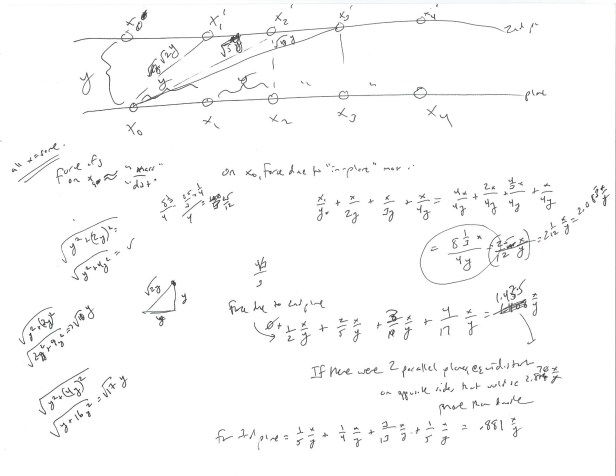
So, I took my model down to being just a plane rather than a space, which makes the strength of gravity fall off linearly with distance, rather than as distance squared.  Then I just took a line of identical masses, x, (x0, x1, x2 etc.) all separated by an even distance, which I called y, and so the gravitational force on my x0 mass due to any other was just proportional to x over some multiple of y.  I made my gravitational “constant” just 1, so the force would literally be x/y or x/2y, and so on.

Really, in the first universe, though it was in principle two-dimensional, I only had to deal with one dimension of additive forces.  This will make my model not terribly useful with respect to the actual universe, but I wanted just to get a feel for things.  You’ve gotta crawl before you can walk or run or fly.

Then I took my “parallel” brane to be also y distance away—to keep applications of the Pythagorean Theorem and such simple—but obviously in a direction that’s orthogonal to every direction within the original brane.

According to the ideas in M-theory/string theory, most particles—photons, electrons, quarks, gluons, neutrinos, etc.—are described as “open” strings, with free ends, and as such, they cannot leave the brane in which they exist (apparently their ends are “sticky”)***.  But gravitons, as proposed in string theory (they were one of the main things that first led people to take string theory seriously as a potential theory of quantum gravity) are closed strings, and they can go between branes and into the “bulk”, the larger, overarching spacetime in which lower-dimensional branes could be embedded.  Thus, one brane can gravitate with respect to another, and this tendency of gravity not to be confined within a brane could explain the relative weakness of gravity compared to the other forces of nature.

Okay, so I did my best to try to work out the situation relating the additional strength of gravity felt by my initial, single particle due to the added gravity from masses in the parallel brane—and then two parallel branes or so, just to see.  I made some mathematical errors that I caught, and I’m sure I made others than I didn’t catch, so I’ll include my—utterly chaotic and not really annotated—worksheets here below, in case anyone is masochistic enough to want to look through them.

I don’t think I produced any startling insights, of course, but one thing that became more obvious on working it through is that, as parallel masses get farther away as measured in the plane of the original universe, their gravitational effects become more like that of the masses within the original brane.  This makes sense, because the farther away they are, the less the effect of the separation of their branes has relative to that distance; so the angle of that force relative to the plane of the first universe is smaller, and its within-brane component is larger****.  The “nearer” masses would have gravity that was barely felt, or not felt at all, within the original brane (or universe), but the farther out the masses go, the more they would be felt as if they were mere additional mass within the original brane/universe.

Could a situation analogous to this but in higher dimensions explain why dark matter acts as though it is a halo going through and around galaxies, and doesn’t seem to clump together?  And could such a description, in the absence of any detectable particles of dark matter, constitute a test of the notoriously difficult-to-test M-theory in the real world?  At least, the longer we go on being unable to find a direct dark matter candidate particle interaction, the more the Bayesian prior for a string/M-theory explanation might go up.

I don’t know.  I’m way too out of my depth.  But it is an interesting thought, and I invite any readers who have actual expertise in such matters please to give me their reactions.  I don’t think my thoughts are anything that’s useful for anyone, but it is kind of cool.  I think.

For those of you who aren’t interested in such things, I apologize.  It is a Saturday post, so you can consider it a weekend indulgence (though I did the figuring on Friday morning, really).  It’s the sort of thing I think I previously would have confined to Iterations of Zero, and I’ve skirted the topic in the past there and here.

I have to have things like this to do from time to time.  If I weren’t able to think about such things to distract myself from my own awfulness, I would already have killed myself a long time ago.

Maybe that would have been better for everyone.  But the past cannot be changed without making a completely new universe that wouldn’t benefit anyone in this one.  So, it is what it is.

Have a good weekend.

my dark matter m theory scribbles_0001

my dark matter m theory scribbles_0002

my dark matter m theory scribbles_0003


*It’s either roughly 67 or roughly 73 kilometers per second per megaparsec**, which is the overall rate of expansion of the universe.  These values do not have overlapping error-bars, and they both have become tighter over time, so something is being missed.  It’s not a huge difference, but there should be no difference at all if the models are correct in all aspects.

**The parsec is not a measure of time, of course, but of distance, and a mighty big distance at that.  A parsec is a little over three light-years (which is about 30 trillion kilometers), so a megaparsec is roughly 3 million light-years.  Big!  With this measure of the Hubbles constant,  you can see why, at close distances, attractive gravity vastly supersedes expansion; the expansion tendency doesn’t become very large—indeed, expansion doesn’t even happen—until distances become truly cosmic in scale.  The Andromeda galaxy is less than one megaparsec away (not by much), and its net movement toward “us” is about 110 kilometers per second.  I suppose that implies that if it were not for the Hubble expansion, it might be coming toward us at about 180 kilometers per second, and might “collide” with the Milky Way in only two or three billion years instead of four or five.  Oh, well, we’ll just have to wait.

***The thought just occurred to me that branes, like strings, are thought to be composed of some form of “energy”, admittedly a nebulous term and a place-holder—there’s always more to learn.  But uniform energy creates a negative pressure, which in General Relativity produces repulsive gravity…the very cosmological term/constant Einstein proposed and discarded, but which has come back into its own as a descriptor of “dark energy” and even cosmic inflation.  On the scale of individual strings, say, even though the energy density would be high, the Lambda term would be too small to lead something the size of a typical string to expand at all, but in a brane—2 dimensional, 3-dimension, or more—if it’s large enough, the very energy that constitutes the brane might be enough to explain the existence of repulsive gravity, from inflation to the current “dark energy”.  Or am I totally off-base here?

****The vector component of their gravitational force that can be felt within the first brane should be the cosine of the angle between the second-brane mass and its analog in the original times the total gravitational force it would exert on the first.  Any other component would be felt between the branes.  Such possible inter-universe gravitation is in the source of the threatening catastrophe in my book The Chasm and the Collision.  Don’t worry, the book doesn’t dwell much on any technical aspects of this.