And the mazèd blog, by their increase, now knows not which is which.

Hello and good morning.

I’m writing today’s blog post on my smartphone, because I walked to the train this morning.  That’s not quite the non sequitur it might seem to be.  Given the new train schedule, I arrived here only a few minutes before the 6:20 train is due to arrive, whereas on the old schedule, I would have just missed the 6:10 and sat down to wait for the 6:30.  Of course, I could simply let the 6:20 pass and wait for the 6:50 and pull out my laptop to write my post while I wait.  Perhaps, in the future, I will do that.  Today, though, I don’t want to push back my departure any further.

I’m now on (actually, in) the train, and I was surprised to find my preferred, relatively isolated seat on the older style car free.  Combined with the feeling of achievement from already having walked about five miles today, that’s pretty nice.

Today is the Winter Solstice, at least for those of us in the northern hemisphere, meaning it’s the day of longest night, if you will.  Going forward, now, the nights will become shorter, though the change will be hard to notice at first, since, near their maxima and minima, the derivative of sine and cosine curves (well, any smooth curve, really) is around zero, meaning the rate of change of the function is very small.  For one brief instant‒one infinitesimal moment of time‒during this 24-hour period, that rate of change will be exactly zero.

But, of course, the rate of change itself is constantly changing.  This isn’t true of all functions, obviously.  The rate of change in a linear function is a constant, and the rate of change of a constant is zero.  That’s why it’s called a “constant”.  And the rate of change of zero is still zero, no matter how many times you would like to take that derivative.

Sine waves, however, are cyclical, and their derivatives are also cyclical.  The derivative (i.e., the rate of change) of a sine is a cosine…and the derivative of a cosine is a sine (inverted, I think, if memory serves, but that changes nothing fundamental).  So, even the derivatives of such cyclical functions are eternally cyclical.  There’s something very pleasing about that, at least to me.

Oh, by the way, it is the Summer Solstice today for those who live in the southern hemisphere.  This has been a smaller number of people than live in the northern hemisphere for as long as human civilization has existed, I think, largely because there simply is more land in the northern hemisphere.  Nevertheless, there are now many millions of people south of the equator, and so there are oodles of those for whom Christmas and New Year’s are summer holidays.

Summer ought to be slightly warmer for those in the southern hemisphere than for those in the north, since technically the Earth is at its closest approach to the sun in January.  However, the Earth’s orbit is very nearly circular, so the difference between aphelion and perihelion is tiny, fortunately for us.  Also, there is much less land in the south, and land heats up much more rapidly and noticeably than water, so that may completely swamp the effects of slightly different nearness to the sun.  I’m not sure.  If anyone out there has that information, please let me know.

It’s a bit interesting to think of those people who have grown up in the southern hemisphere, seeing all the movies and shows (and before that, books and legends) that associate snow and cold and the like with Christmas time and New Year’s.  Of course, the reasons would not be a mystery, but it still might feel peculiar, just as it might feel rather alien for a northerner to hear of someone going to the beach to celebrate Christmas.

Instead of building a snowman, maybe such people might build a sandman.  Actually, given the old horror short story about the Sandman‒not to be mistaken for Neil Gaiman’s admittedly also quite dark creation‒it might not be great to make a sandman as part of a joyous celebration.

Although, being rather dark myself, I consider the notion somewhat amusing.  Maybe there could be a kids’ story called Gritty the Sandman, instead of Frosty the Snowman (Anakin Skywalker would hate that).  But Gritty would be much harder to destroy than Frosty.  It takes serious heat to cause sand to melt, and even then it just becomes glass.  Imagine that:  they try to kill Gritty with heat and fire, and he just turns into a misshapen blob of living glass, with razor sharp shards for fingers‒more deadly even than he was before!

Wait, that was supposed to be a kids’ story, wasn’t it?  Sorry, I got distracted.  Still it would be fun to hear a song with the lyric, “There must have been some madness in that old silk hat they found.  For when they placed it on his head, he began to…”

…who knows what?

Anyway, I’ve reached the office now.  My pedometer seems to have accidentally reset while I was on the train, as it’s only showing one mile of walking, which is the distance between the station and the office.  That’s a bit frustrating, but I know that the distance to the station from the house is almost exactly five miles, so I’ve walked six miles so far, and I’ve now reset the little bastard, so we’ll see what I’ll do for the rest of the day.  Maybe I’ll have the gumption to walk back to the house from the train in the evening.  I feel okay now, from my walk, but I don’t want to overdo things and set myself back.

I’ll sign off for the moment.  Have a lovely solstice if you can, be it your summer or your winter.  But if you’re in the south, and you make a sandman, try not to bring it to life.  Quite apart from it having the nefarious power to put you to sleep at will, remember that sand is basically just ground glass, and that can have dreadful effects on bare skin or on your mucus membranes.  And you certainly don’t want it in your eyes!

I think I’m imagining a new kind of horror story here, albeit a spoofy more than spooky one.  We’ll see what comes of it.

TTFN

stonehenge solstice merged

It’s all a matter of degrees

It’s Tuesday morning, and I’m waiting for the second train of the day, the one I caught yesterday.  I slept a bit better last night than Sunday night.  That’s not saying much, but beggars can’t be choosers, as the saying goes.  It still feels a bit better, at least.  You know you’re in some weirdness when four or five hours of heavily broken-up sleep feels fairly restful, and you don’t even really consider bothering to go and catch the 4:20 train.

It’s relatively cool here in south Florida, by which I mean the current temperature is 57 degrees* according to my weather app.  This is, rather amusingly, lower than the app’s statement of what the low temperature overnight is supposed to have been.  Anyone paying attention might be excused for feeling that the app, in contradicting itself so flagrantly, should not be considered reliable.

Of course, it’s obvious that the app, or service, or whatever it is, simply doesn’t bother to update its “printed” overnight low prediction just for local minutiae.  It’s not meant to be too precise, and in any case, local temperatures can vary quite a bit.  The predicted low was 60, so it’s only off by 3 degrees.

Those who have not been thoroughly enough educated might think this is a five percent error—small, but not negligible.  That is not correct.  Both Fahrenheit and Centigrade are relative temperature scales, based around the freezing and boiling points of water, which is a useful, but provincial, set of benchmarks.

No, to get the correct error estimate we must work with the absolute temperature scale, or Kelvin, which begins at “absolute zero” the coldest “possible” temperature and goes up to whatever the maximum possible temperature is**.  So, the error in absolute degrees (which are the same size as degrees in Centigrade, by convention) would be 3 degrees times 5/9, or 15/9 degrees Kelvin.

Now, to get the predicted temperature in Kelvin, we first convert to Centigrade—by taking (60-32) x 5/9, or (28 x 5)/9, or 140/9, or about 15 and a half—then add 273 (which is what zero degrees Centigrade is in Kelvin, ignoring the digits after the decimal point).  So, the predicted temperature, in Kelvin, was about 288 degrees.  15/9 is one and two thirds degrees, so 1.67 degrees (taking 3 significant figures).  As a percentage of 288, that’s pretty tiny.

Here, I’m going to go to the calculator program on my laptop, and it gives me…roughly 0.58%.  That’s just over half a percent error.  Not too bad, when you think about it.  How often are your own estimates that accurate?  If you could pick stocks that well, you could rapidly become a billionaire, I would think.

Here’s a funny little aside:  the southbound train just pulled in across the tracks, and I’ve apparently used the Wi-Fi on that specific train before, because my laptop just prompted me to sign in.  The train is pulling away now, and it’s too late, but it must have a pretty good Wi-Fi signal.

Okay, on to other matters, none of which seem nearly as interesting to me.

I think I’m going to try to use the same person who helped my coworker (the one who had a stroke) get new health insurance at what appears to have been a very good rate to sign up for some for me.  I don’t even want to try to use Medicaid or Obamacare if I can help it.

I don’t trust the human government, anymore—as Radiohead sang, “they don’t…they don’t work for us”.  It’s not that I think the government overall is malicious or evil or whatnot.  It’s just that everyone in it is very small and parochial, working for their own local self-interest under local pressures and incentives.  It’s astonishing that they ever accomplish anything useful at all.

Ants and bees (and termites) do a much more impressive job when they build their hills and hives and mounds, but then again, they are individually less self-serving in many ways.  That’s not to their particular credit—it’s the just way nature has shaped them for their lifestyle and reproductive strategies—but it’s true, nevertheless.

Human governments, meanwhile, are made up of individually motivated creatures whose reproductive processes (and thus their drives and fears) are not much different from any other mammals’, but who try to work in ultrasocial settings as if they were some close relatives of Hymenoptera.  It’s a testament to the incredible power of language (particularly written language) that they accomplish anything at all.

When it has dealt with me specifically, “the” government has done far more harm than good, and most unjustly***.  The less I have to do with any level of their power—I will not grant them the word “authority”—the more comfortable I will feel.  I have a learned aversion and probably some form of complex trauma associated with such things.

I don’t see any reason to overcome that aversion, because I don’t see how it would make my life any better.  It certainly would not make local or state or national governments any less likely to grind me—or anyone else who isn’t massively wealthy and unscrupulous, which probably includes you—into bone meal.

With that, I’ll start to wrap things up for today.  It’s the fifth day of Hanukkah, so enjoy it.  Also, there are only a lucky 13 days left until the annual celebration of Newton’s birthday (they also celebrate some other guy’s birth on that day as well, and though he seems to have been a good sort of guy overall, he really wasn’t born on anything like December 25th).

Christmas was, of course, grafted on to a pre-existing solstice festival, and why not?  Heck, Newton’s birthday was only on December 25th according to the Julian calendar, so it’s at least a week or two out from the Gregorian “date of his birth”.  I could figure out the correct Gregorian date, but I can’t be arsed.  It’s a question with no gravity, no momentum, not even any real significant potential energy.  One might say it is of infinitesimal importance.

Have a nice day.


*Fahrenheit, of course.  If it were 57 degrees Centigrade, global warming would indeed have taken an abrupt turn for the very much worse, and we would all be in the express lane to extinction, unless it were a very transient phenomenon.  And, of course, if it were 57 degrees Kelvin, we would all already be frozen to death quite nicely, since even the nitrogen in the atmosphere freezes below 63 Kelvin, and oxygen is a liquid below 90 K (both of these numbers are at “normal” pressures, which would not prevail in these circumstances).  I don’t know quite what it would mean to be at a 57 degree angle outside—would that simply mean that everything in the universe had been rotated by slightly less than a sixth of a full circle?  Given the rotational symmetry of the laws of physics, from which comes the conservation of angular momentum, I don’t think anyone would even notice.  And, of course, the Earth rotates locally 360 degrees a day, by definition.

**If memory serves, it’s called the Planck temperature.  Anyway, this would be the temperature at which each local point in spacetime would be so hot that the local energy would make a black hole, and in any case, the usual laws of physics would break down.  However, of course, if that energy is uniformly spread out, as presumably it would have been in the very early universe, any local spacetime curvature might be entirely effaced, so there would be no such black holes, as all the universe would be full of such energy.  I think inflationary cosmology would imply that there never really was an era of such intense local energy, unless that would be the “inflaton field” itself, but I may be misremembering this.  Anyway, that’s getting well into speculative physics.

***I am, of course, inescapably biased in this assessment, and I honestly could in principle be convinced by argument and evidence that I am wrong.  Nevertheless, I don’t think I’m incorrect in considering that statement to be accurate and true, with a fairly high credence—certainly well into the mid to high 90 percent range.  In other words, if I considered about a hundred assessments in which I was comparably confident as I am to this one, I would expect to be wrong about only a handful of them.

Believing in “believing in” matters of empirical reality…or not

The other day, I was scrolling through The Website Formerly Known as Twitter—which I tend to do after sharing my blog posts there, since it seems the polite thing to do—and I saw a “tweet” or an “X-udate” or “X-cretion” or whatever one calls them now, that asked, “Do you believe in global warming?”

Such questions always seem bizarre to me.  It’s similar to the old, “Do you believe in UFOs?”  Though, with the latter, one can always snarkily reply, “Why, yes, I believe in unidentified flying objects.  I think people often see things in the sky that they cannot properly identify, especially if they are not experts and conditions are not ideal.”  But really, even that sarcastic response misses the point and can be misleading, so it’s best to be avoided.

The problem is, the question entails a kind of category error.  The reality of global warming—by which I assume the questioner means some form of anthropogenic climate change—is an empirical question.  It is a statement about reality itself, and is either true or false whether or not anyone even knows about it as a possibility, let alone “believes in it”.

It’s more reasonable to ask, “Do you believe that anthropogenic climate change—AKA global warming—is happening?”  That, at least, is a sensible question, when using the form of the word “belief” that means that, based on the evidence and reasoning one has available, one has arrived at the provisional conclusion that global warming is happening (or is not).

In using this term “belief”, one would usually imply that one is reasonably convinced, but open in principle to alternative explanations and counter arguments and new evidence—as one always should be in matters of empirical fact, at least if one is committed to always trying to make one’s map describe the territory as well as possible (to borrow a phrase from Eliezer Yudkowsky).

But when people say, “Do you believe in…” something, it doesn’t come across—to me at least—like a question about facts, but rather as a question about ideologies, about team membership, about religion, in a way.  It can be at least excusable and appropriate, if still rather nonsensical in my view, to ask someone if they believe in Santa Claus, or in Communism, or in God.  It doesn’t necessarily have anything to do with external reality other than the state of certain people’s minds, but at least it’s reasonably appropriate.

The absurdity of this conflation of “believing in” something with an assessment of a thing’s actual reality is pointed out well in Terry Pratchett’s delightful Discworld novels—in either Wyrd Sisters or Witches Abroad, if memory serves.  I don’t recall how the point comes up, but it relates to belief in the gods of Discworld.  The narration says that, of course, witches knew that the gods were real, they had dealings with them, they sometimes met them.  But that didn’t mean there was any call to go believing in them.  It would be like believing in the postman.

If someone were to ask me whether I think that climate change is real, and why I think whatever I think, I might reply that the general consensus of the world’s climate scientists—people who actually specialize in the area—seems to be that it is happening, and though their most specific predictions can be highly uncertain, as can all specific predictions in science beyond the realms of simple linear dynamics, most of them conclude that it is really happening.

I read a statement once that claimed that the percentage of climate scientists who are convinced that human-caused global warming is really happening is higher than the percentage of medical scientists who are convinced that smoking tobacco increases the risk of lung cancer.  I don’t know whether that statement is true, and I don’t recall the source—it sounds more like a rhetorical point than an actual argument, which makes me suspicious.  If it is true, it’s remarkable in more than one direction.

One can look up in journals the papers and the data that is being gathered and analyzed by climate scientists.  Google Scholar works nicely for searching out real, published scientific studies on almost any amendable topic.  One can also go to pre-print servers such as arXiv, to see papers that have not yet been peer reviewed.

If one is judicious, one can even find decent science news in less technical publications—phys.org seems to be pretty good—but mainstream reporting on such things is often unreliable and inconsistent, since after all mainstream media exist primarily to sell themselves, not necessarily to promulgate the most rigorous truth they can uncover.  Even Scientific American has turned into a twisted mockery of its former self.

I understand at least some of the physics behind the “greenhouse effect”, without which the Earth would be uninhabitably cold.  Visible light passes through the atmosphere without interacting much with the gases therein—which is why air is mostly transparent, other than the modest scattering of blue light that leads to the sky’s daytime color (and inversely to the color of sunsets).  But such relatively low-entropy, high frequency light is absorbed by the ground, then reemitted as higher entropy, lower frequency light, such as infrared, which is much more readily absorbed by molecules like CO2 and H2O and methane (CH4).  The reasons for this are quantum mechanical in nature, but the fact that it happens is basic physics that’s been well known since before anyone currently alive was born, as far as I know.

And so, these atmospheric gases heat up (and in turn heat up the other atmospheric gases) until the outer surface of the atmosphere is warm enough to radiate out as much energy as comes into the Earth.  Such is the nature of so-called black body radiation.

But for the outer atmosphere to be warm enough to do this, the middle atmosphere must be warmer, and the layer below warmer still, and so on, since outer layers radiate inward as well as outward.  The outer layer of the atmosphere will always be just warm enough to radiate out just as much energy as the Earth receives in light from the sun; if it were not, the Earth would rapidly get hotter until a new equilibrium was reached.  The final radiating surface might end up being higher in the atmosphere, which would mean that, closer to the surface, things would be warmer.

Anyone who has dressed in layers in cold weather should understand this intuitively.

[By the way, there may be some slight imprecisions in my very quick summary above of the thermodynamics of atmospheric gases, so if any experts in the matter would like to make any corrections—especially if such corrections are truly substantive—please feel free to do so in the comments.]

There are other atmospheric effects that are even easier to understand at basic chemical levels, such as the fact that increasing CO2  concentration leads to increasing acidification of the oceans.  This is fairly straightforward chemistry—carbon dioxide, when dissolved in water, partially reacts to form a weak acid—“weak” meaning just that the hydrogen ions do not completely dissociate from the molecule H2CO3*.  This can be demonstrated easily by getting some pH paper (readily available at all high street pH paper shops), testing some neutral water (to confirm its baseline neutral pH) and then blowing through a straw into the water for a few minutes.  You can then check if the pH has dropped, which—if you are a typical mammalian creature from Earth—it will have done.

I think this experiment can also be done with phenolphthalein, which is wine-red when in a basic (alkaline) solution and clear when in an acidic environment.  You can do a sort of magic trick, turning “wine” into “water” with just your breath through a straw bubbling in a glass.  Don’t drink it, though.  I don’t think phenolphthalein is particularly dangerous, but I wouldn’t want to endorse someone imbibing it.

I’m not going to tell you my conclusions about the empirical fact of whether or not “global warming” is happening and how and why and all that.  You can explore the subject as a homework assignment (but don’t hand it in to me).  But I will tell you my conclusion, which is probably obvious, about “believing in” things.  I don’t believe in “global warming” nor in the lack thereof.  I don’t believe in Santa Claus.  I don’t believe in Capitalism or Communism or Socialism or Fascism or Scientism** or Antidisestablishmentarianism.  I don’t believe in the Tooth Fairy, and I don’t believe in life after love.

And I really don’t believe it’s useful or good or anything but an irrationality to “believe in” matters that involve claims about the nature of reality itself.  Reality is that which exists whether or not anyone believes in it—indeed, whether or not anyone exists to be capable of believing in it.  That’s why it’s reality, as opposed to fictions and ideologies and other abstract concepts of various kinds.

I know*** that Amazon delivery people exist.  That doesn’t mean there’s any call to go believing in them.


* H2O + CO2 ⇌ H2CO3 ⇌ H+ + HCO3.  Something like that, anyway.

** Though I have more sympathy for Scientism than most “isms”.

***Not to a mathematical certainty, but to such a high degree that there’s no clear point in considering other possibilities, pending new evidence and/or arguments.

Be thankful you’re not a simulation. Or are you?

I’m writing this on my phone for the first time in quite a while, seated in the rear of an Uber, on the way to the office.  This was something of a whim‒the phone writing, I mean, not the Uber.  The Uber was a carefully considered choice, and it is relatively cheap because of the hour at which I’m taking it.  It’s not something I would do on a regular basis, at least not for long.  Maybe if I finally give up and decide to die in short order I might just burn a lot of money on Ubers.  I doubt it, though.

No, the whim is deciding to write on the phone, since I have some down time in the back seat.  I could use my laptop, but that feels slightly weirder or more uncomfortable to me, though I’m not sure why that’s the case.  I could also just wait until I got to the office to start, because I’m going to be very early.

The reason for going to the office by Uber is that I made the mistake of ordering an Amazon “Try Before You Buy” article of clothing‒a somewhat expensive one.  It did not fit right.  But then I learned that Amazon doesn’t do a pickup to return items like that; you need to drop them at a Whole Foods or a UPS store or similar.

That was not clear to me when I was using the option, or I wouldn’t have done it.  I have no straightforward way to get to any of the above locations, and even to use Uber to get to one would require going during working hours.  I had to arrange for a UPS pickup, at my expense, but I had to set it up to happen at the office, because I won’t be at the house during the day for ten more days (at least on days UPS does such pickups) and that’s past the pickup time window for the “Try Before You Buy” system.

So, here I am, bringing a cumbersome, and not too light, package to the office with me so that UPS can pick it up between 9 and 6.  I never want to do this sort of thing again.  It was foolish of me to try a rather expensive article of clothing anyway, but I guess it was sort of an attempt to cheer myself up with an indulgence.

That sure misfired, didn’t it?

Speaking of cheering oneself up with indulgence‒or with the inability to do so‒tomorrow is Thanksgiving for my fellow United Statesians.  We don’t call this evening “Thanksgiving Eve”, which feels like a shame to me, but certainly people do start celebrating the holiday, in a sense, quite early.  I think many people take the whole week off work.

I, on the other hand, am not really going to be doing anything to celebrate.  The closest I might come is walking to a gas station not too far from the house, where they tend to have pretty decent pre-made turkey sandwiches with mildly cranberry-associated topping.  It’s not very impressive, nor is it terribly satisfying.  I’d feel much better, I think, if I were able simply to go to sleep tonight and sleep through until Friday morning.  As it is, I probably won’t be able to sleep or rest any more than usual, and that’s even counting my plan to take some Benadryl tonight.

I’m almost at the office, so I’ll take a brief pause here and resume after I arrive.  You may not notice the gap.

Did you notice it?  I’m guessing you probably recognize that it happened, but only because I told you that it was happening.  Like the scenes in a movie that’s been filmed over months and months, or the paragraphs of a long novel like my forced two-parter Unanimity that was written and edited over the course of more than a year, the final product may end up relatively seamless despite a long and discontinuous origin.

I’ve occasionally imagined that it might be possible (in principle, anyway) for our reality to be a simulation in which each moment‒maybe each Planck time‒in every location in space‒perhaps each cubic Planck length‒is prepared individually, one by one, then subsequent and nearby ones are calculated based on the laws of physics, and each next place and time is then updated piece by piece, one infinitesimal space and one instant of time at a time, as it were*.

The simulator could take a trillion years to calculate even one second of the spacetime in the visible universe, probably far longer.  But it wouldn’t really matter, necessarily**, how long it took, provided there was enough memory available to keep everything stored.  From the outside, the process of one human life (and its past and future light cones) might take a googol years to calculate, but from the inside point of view, for the human being “simulated”, time would just progress normally.

It doesn’t matter to the people in a video, for instance, if their video is viewed at 2x speed or .25x speed; for them it all happens the same way no matter what.  It doesn’t matter to the characters in a Studio Ghibli movie that their individual movie cels each took hours to be painstakingly drawn and painted, or if a Pixar character took even longer to be computer generated.  Their “experience” would pass at one frame per frame, or 24 frames per experienced “second” for them (at traditional movie frame rates).

Even if each second of the person’s life took a trillion eons to simulate, it would still be experienced just as a second for that person.

A rather weird and possibly disquieting implication of this is that, if those simulating the person stopped doing it‒perhaps they got bored, or had a power cut, or suffered a natural disaster or catastrophe in their meta-level universe‒the simulation would just…stop.  It’s not that the people in the simulated universe would die in any conventional sense; certainly they would not die in the usual within-the-universe meaning of dying.  Nor would their universe “die” as if some cataclysm like a phase change in the vacuum energy occurred***.  It would just stop.

There would be no next moment, no next occurrence*****.  If someone were later to restart that simulation for whatever reason, even if it was ten to the thousand to the googol years later or more, the people within the simulation would experience no difference between the before pause and after pause moments than between any other two moments in their existence.

But if the simulation were stopped and never restarted, with perhaps all associated memory erased…well, again, the inhabitants would not experience it in any possible, conceivable sense, any more than a video game character experiences the moments when and after you reset the game or the power goes out.  If you are a simulated existence, and the simulation is permanently stopped, you will not so much die as cease to have any manner of existence whatsoever.

Have a happy Thanksgiving.

happy-thanksgiving-from-the-farm-maria-keady


*It’s interesting also to think of, for instance, two “people” starting to simulate such a universe from different points in space and time, and to wonder what would happen when they came together if their simulations did not mesh perfectly, like frost on a window-pane with multiple initial points of nucleation leading to a “fractured” pattern.  But that’s a different, if related, thought process.

**From the point of view of the “simulated” universe, anyway.  It’s hard to see anyone having the commitment or desire to bother actually carrying out such a laborious simulation; that would be quite a dreary task.

***This is a possible occurrence in an ordinary, physics-related sense.  If the “dark energy” is indeed the cosmological constant (called lambda, Λ, as in the ΛCDM model of cosmology) but is not at its lowest “vacuum state”, then it could spontaneously “tunnel” down to a lower, more stable set-point.  This would wipe out every particle in the current universe in a growing sphere, with its outer shell expanding at the speed of light.  Of course, that means that you could never, in principle, have any warning that it was happening, nor could you, even in principle, experience your destruction and that of everything else that exists.  This is not the same manner of cessation as what I discuss in the main body of the post‒it is very much a within-simulation event, not a meta-level one‒but it would still be just an instantaneous erasure of sorts, happening too fast to be experienced even in principle****.  There are many worse ways to die.  Indeed, almost all ways humans do die are much worse than this.

**** Presumably, quantum information would be conserved even in this catastrophe, whereas in a halted and erased simulation, that principle wouldn’t apply, at least within the simulation.  Whether it would apply to the process of simulating and then ceasing to do so would depend on the nature of the meta-level universe.

*****I suppose this is analogous to what will happen to everything in the universes of my stories Outlaw’s Mind and The Dark Fairy and the Desperado if I never finish those stories.

Blogs without all remedy should be without regard

Hello and good morning to everyone who is reading this.

And to everyone who is not reading this‒well, nothing, really.  It doesn’t matter what I say to the people not reading this, because, until and unless they actually read this, there will be no way for them to know what I am “saying” to them.

I suppose it’s possible that someone might read this blog post out loud to someone else, in which case the listener can know what I’ve written without literally reading it.  But, if you can consider listening to an audiobook to be “reading” the book‒and you can, though you’re not required to do so‒then that would count very much as the same thing.

It’s a bit like, for instance, the wave-front of the wave equation of a photon that was released from the last scattering surface of the early cosmos, just as the universe became cool enough for electrons and nuclei to join together and stop being plasma.

Imagine such a photon’s wave function progressing through the expanding universe, on and on, its wavelength increasing with the expansion of spacetime, red shifting and red shifting and red shifting.  What if it never interacts with anything else in the cosmos?  What if it’s never absorbed or scattered or reflected, “measured” by nothing but spacetime itself, on into the heat death of the universe, until there’s no longer even anything within its cosmic horizon with which it can interact?  Its wavelength stretches and stretches, perhaps eventually becoming light years in size*.  At some point it’s going to be completely swamped and washed out by the random quantum oscillations of the universe, even if that universe is immeasurably close to absolute zero in temperature.

Imagine such a photon given off by that last scattering surface and then traveling for a trillion years, a googol years, then for so long that a googol years seems as vanishing as a microsecond, never interacting, perhaps, until some version of a Poincare recurrence of the universe happens.  In principle, it might not interact even then***.  In what deep sense can that photon be said to be “light”?

It might even count as some manner of “virtual” photon, though certainly not the kind that is usually meant when that term is used.  It might seem lonely and depressing to be that photon, but we can console ourselves with the fact that, as far as any sensible notion of reality appears, photons have no subjective experience*****.  Even the absurd notions of panpsychism don’t literally imagine that photons are individually, actually conscious, in the sense of having internal “qualia“.

So, if I write something that no one reads, then what I have written cannot matter to those who have not read it.  Of course, in principle, all measurable remnants of even Shakespeare’s writing will someday be read and/or uttered for the very last time, but that’s different‒they will already have interacted immeasurably often before then.  The outcome will be nothingness‒or as near to it as possible‒but in the meantime, much will have happened.

Of course, according to quantum mechanics, quantum information is conserved, so everything from Hamlet to my imagined stray, lonely photon would be, in principle, recoverable.  But that’s a very rarefied “in principle”.

So, for those of you reading this, you really don’t have to worry about what people who have never read nor will ever read it will think about it.  They simply won’t have read it.  Likewise, I don’t have to worry about the reaction to my writing from people who don’t read it.

And, of course, if people “react” without ever having read a thing, which certainly does happen, those opinions are not worth considering.  I don’t need to take thought for some criticism of the Mona Lisa by a person who has never seen even any manner of reproduction or image of the painting.

Nor should I worry about being offended by the chattering of a squirrel in a nearby tree, or the noise arising from leaves stirred by the wind.  It’s merely noise, not too different from those quantum jitters that happen even in a region of the universe that’s as close to absolute zero as it can be.  There is always noise‒though it can become vanishingly close to silence (which sounds quite nice, so to speak).

Anyway, that’s enough of that.  I had a long day of walking yesterday‒about 15 miles total distance, and my joints and muscles still feel pretty good, so the shoes are all right******.  I did not walk to the train this morning‒I figure just a bit of recovery time is warranted‒but I may walk this evening.  I hope you have a good day, and that all your metaphorical photons have lots of interesting and enjoyable interactions before they dissipate.

What more could you reasonably ask?

TTFN

Keds cartoon


*That seems an interesting possibility.  What does it mean for a photon to have a wavelength measured in light years**?  If one wavelength takes a year to pass, is it really even a wave anymore?

**Okay, one can literally measure any wavelength in light years if one is so inclined, but for ordinary wavelengths such as those of more usual light, on the scale of nanometers and such, it’s a bit absurd.  One might as well measure the energy output of an LED bulb in megatons of TNT per second.

***Though, if it arrives at another “Big Bang” coming from the other direction in time, as I speculate could be possible, then it’s hard to see it approaching a state of new, lowering entropy from an impending region of inflation and another “last scattering surface” without actually scattering off the dense plasma‒and then our photon would end as it had begun, a quantum event going from the remnant of one Big Bang to another, countless years “later”****

****Though the notion of “later” might be irrelevant, since the directionality of time is determined by the direction of increasing entropy, and that would be inconsistent and reverse itself in my conjectured scenario.  It’s a bit like floating in intergalactic space and saying one is trying to go “higher”.  You can say it if you want, but it’s not really apposite‒it may even be the opposite of apposite.  Higher from one point of view becomes lower from another, even if one is traveling from planet to planet within a solar system.  Likewise for “later” and “earlier” when moving from one inflating region to another…if such a thing can happen, of course.

*****And they also don’t “experience” any passage of time internally…from the point of view of a photon, so to speak, it starts and ends instantaneously.

******That makes me wish I were wearing Keds, so I could honestly say. “The Keds are alright.”

[Put some quote from a Pink Floyd song here]

I’m writing this on my smartphone after having walked to the train station this morning.  It’s cool enough weather that I even wore a hoodie for the walk (though if the sun had been up but the temperature the same I probably would not have done so), and I certainly don’t feel dehydrated.  I didn’t walk back from the train last night, but that was only because we got out of the office late, and then the later train I caught was a further 20 minutes behind schedule.  That was really irritating.

The 610 train is just arriving now, but I will catch the next one (and I only feel a little bit of anxiety over that decision).  I made good time, and I also got up a bit earlier than scheduled, because that seems to be the general trend of my life.  If this continues long enough, I might end up getting up in the morning before I go to bed.  I need to do something about this before I arrive at a contradiction and make the World Program™ crash and shut down.

I wore my boots this morning, and as I had intended yesterday, I did not overtighten the laces.  This has helped a little, at least, but I fear it’s not enough.  My right Achilles tendon is burning, and the arch of my left foot, just a bit behind the 1st metatarsophalangeal joint, is already feeling tight and achy.  That’s not too terrible after five miles of walking at a pretty brisk pace, but it didn’t seem to happen with the New Balance walking shoes at all.

I’m very disappointed, but I may need just to nix the boots.  It’s very sad to me, though I know it’s not truly a big deal.  I think I’ve just gotten to the point of having so little of value or meaning in my life that the loss of even the option to use the shoes that most aesthetically appeal to me feels like the death of an old friend.

It’s all rather pathetic, and not in a good way.  Still, I must do what I must, tautologically speaking.  So, I’ll try to do the walk again tomorrow morning, wearing the walking shoes, and see if it really is easier on the joints of my feet.

By the way:  of course, I have not started writing any kind of short story, or any other story.  What’s more, I haven’t practiced my guitar at all, nor have I listened to any more of the Spanish version of Harry Potter.  I also didn’t translate beyond the first sentence of the Japanese version of Harry Potter.  Nor did I read more than a few paragraphs past the preface or opening note or whatever he called it of Robert Sapolsky’s new book.

I didn’t even finish listening to the podcast with Sean Carroll and David Deutsch.  I tried to listen to a playlist of my favorite songs yesterday while waiting for the train in the evening, but after skipping about a dozen or so of my favorite songs because I just wasn’t interested in listening to them, I concluded (correctly) that I just didn’t want to listen to anything.  Nothing is interesting.

Of course, a famous (and fatuous) saying is that only boring people are bored, but in my case it’s not completely inaccurate.  I am dreadfully boring, even to myself.  Having to listen to me talk, or even just to be around me, for any length of time would probably count as cruel and unusual punishment.  I know it’s punishment to me.

I just got on the train.  It’s mildly interesting to note that there was enough breeze blowing up the tracks as I waited that, given my underlying sweatiness, I actually felt a bit chilly, and had to put my hood up.  That worked well, though.  And once I get to the office, I have other clothes into which to change.

This week has already seemed very long, and it’s just now Wednesday.  It’s kind of a weird inversion or subjective tension when one compares this to the lyrics of the song Time.  Whereas those lyrics note that “every year is getting shorter”, to me it feels‒though the year thing still seems true‒that every day is getting longer.  If the two tendencies continue, I could run into another paradox, in which a day eventually feels longer than a year, and then, again, the world might come to an end because of a logic error.

Actually, I guess it’s not always a contradiction for a day to be longer than a year.  If memory serves, for instance, Mercury is almost tidally locked with the sun, so its days and years are nearly the same length.  And if I recall correctly, I think that a day on Venus‒meaning a complete planetary revolution‒is longer than a year*.

On Earth, though, days are much, much shorter than years.  That’s even truer on Jupiter, where the days are about ten hours long, but the years are nearly a dozen times as long as Earth’s, because of its greater distance from the sun**.

Anyway, all this trivia is beside the point.  I am almost entirely without any sustained joy or happiness, nor do I see any reasonable prospect of that changing.  What would change about it?  I don’t really even care about the upcoming 60th anniversary Doctor Who special!  There are no books or movies or shows or whatever that seem interesting.

And I’m very tired.


*I did recall correctly; that is in fact true.

**This follows from Kepler’s 3rd law of planetary motion, which states, if memory serves, that the period of a planet’s orbit is proportional to the 3/2 power of the length of its orbit’s semimajor axis.  This would mean Jupiter orbits at just under 12^(2/3), or 5.24, times the distance of Earth…and indeed, according to Wikipedia, Jupiter’s semimajor axis is indeed 5.2038 astronomical units.  See, all that math we learned in school is useful for something.

Feel free to imagine your own illustration to accompany this post

As so often seems to happen, I arrived at the station this morning just in time to see the first train of the day arrive and pull out.  That’s fine; I hadn’t been planning to take it, anyway, and there was really no possible way for me to have done so.  If I had gotten up and left five minutes earlier, I very likely would have caught that one, but of course, there’s no true point to getting on that earliest train, since I’ll either be killing time at the office or at the train station or at the house.

I prefer to leave early, since I’m awake anyway, and have been for hours, and traveling early means things are less crowded.  I used to spend time in the morning practicing guitar after writing, but I don’t do that anymore, so there’s no huge benefit to being at the office.

Now, I’m sitting at the station and writing this post on my smartphone.  I’ve been writing all my posts on the phone, lately, since it’s just so convenient.  In fact, I took my little 11-inch laptop back to the house with me last night and I left it there.  I don’t think I’m going to be writing on it again.  I may, possibly, use it for something else, but that’s an iffy possibility.  I guess I’ll have to see.  Anyway, there isn’t much point in keeping it at the office.

I threw out some other things at the office that I don’t need, so it’s getting a little less cluttered.  That’s good, I guess.  It’s probably more pleasant for everyone else.  I still need to clear out some more of the crap there, and even more at the house.  I live in a small room, but there’s still too much useless drek in it, stuff that no one is ever going to want or need.  Better to do my part to contribute to the unsustainability of landfills.

I tried out a corrected-size pair of boots yesterday, since I think part of the issue with the others was that the sizes made by Timberland might be a bit larger than my usual.  Anyway, half a size down seems very good.  I had no adverse effects, and I plan to try a longer walk today, heading back to the house from the train after work.  I wasn’t going to do that yesterday, after a 24 hour food and water fast.  The food wouldn’t be an issue, but I might have become a bit too dehydrated.

The fast yesterday was interesting, as it always is.  I moved rather slowly and was not quite as mentally sharp as I normally am, though that was more due to lower caffeine levels than anything else.  I had one incidence of “head rush” when rising from a seated position, but it was pleasant and a good sign that I’m probably losing weight, which I want to do.

I’ve had head rushes before, and I’ve even had them bad enough to make me lose consciousness completely, including once while in jail.  I didn’t like smacking my head on the concrete (I didn’t feel it at the time; I definitely did afterwards), but passing out suddenly is not a bad feeling.  Indeed, it’s more or less no feeling at all.  That’s what’s great about it.  There’s just that hint of a head-rushy sensation, then everything goes white and then blank.  Even those sensations are probably reconstructed memories after the fact.

I suspect, based on actual expertise, that this is what it “feels” like to die of a sudden ventricular fibrillation arrest.  I don’t mean a heart attack; heart attacks are almost always quite painful and unpleasant, and in and of themselves, they don’t usually cause one to lose consciousness.  Though they can induce dangerous arrhythmias such as ventricular fibrillation, the process leading up to it is decidedly uncomfortable and generally terrifying for the person involved. Trust me; I’ve seen it many times, and I have a very good memory.

But in a V-fib arrest or similar process, the heart basically stops pumping blood all of a sudden, and the brain stops getting perfused‒it’s much like what happens in a sudden fainting spell, but more persistent‒and when the brain suddenly loses all blood flow, it pretty much suddenly blanks out, or at least consciousness does.

There’s no fear, there’s no pain, there’s not any experience of what’s happening.  One isn’t confronted by the threat of permanent cessation*, and there is no potential to “rage, rage, against the dying of the light”, anymore than a computer that is abruptly deprived of all power can struggle to stay “on”.  It simply doesn’t work that way.  The thing that does the raging is what is shut down, and quite abruptly.

Your brain (i.e., you) can no more fight to stay conscious or alive when suddenly deprived of blood flow than your lungs can successfully draw in oxygen if you suddenly find yourself in outer space without a space suit.  Though, even that seems likely to be less unpleasant than movies make it seem, because while you can’t get oxygen, you will still be able to expel carbon dioxide, and it’s the CO2 in your blood that drives your sense of needing to breathe.

So, you won’t feel like you’re suffocating; you’ll just get rapidly light-headed from the lack of oxygen.  Some of the other effects of vacuum might be unpleasant‒your saliva and mucus bubbling into gas phase, perhaps some bubbles forming within your eyes, some other outgassing here and there, but you won’t experience them for long, if at all, because the lack of oxygen will deliver a slightly slower version of the effect of the V-fib arrest.

Oh, by the way, you will not suddenly freeze or even accumulate frost in seconds, like in some movies.  Space is very cold, yes‒the overall temperature of the vacuum is about 2.7 degrees above absolute zero‒but there’s nothing there to conduct your heat away from you, so you only lose it through radiation (mostly infrared and such, but humans do give off a tiny amount of “visible” light), and that is a very slow process.

Think about it.  You can survive indefinitely and even feel pretty comfortable in 70 degree (Fahrenheit)** air, even without much clothing, and that is far from vacuum.  But if you are dropped in water at the same temperature without a wetsuit or similar, you will probably die from hypothermia before long.  And that probably would be quite unpleasant.

Anyway, that’s all quite a digression, but it does reinforce a point I sometimes make:  if you have a choice of how to die, do it by some means that suddenly and completely cuts the blood flow to your brain.

As for other fasting-related matters, well, there was, as always, a slight feeling of detachment from my body by the and of the day, not quite like my numerous experiences of depersonalization***.  It’s a good sort of feeling, a sense of being slightly out of sync with the physical world, but not in a confusing or disturbing way.  Maybe it’s akin to a much slower version of the fainting/V-fib experience.  Anyway, the less I experience being me, usually the better, from my point of view.  Not that I want to be someone else!  That would be even worse.

So, I’ve learned nothing new from fasting, really‒certainly there were no epiphanies‒but I have re-experienced things I’ve experienced before that I found worth repeating.

And now, we’re nearing my train destination, so I’ll let you all go, at least for now.  Have a good day, if you can.


*Or “death” as it is sometimes referred to in the medical literature…but I wanted to avoid too much jargon.

**70 degrees Centigrade/Celsius would be another matter entirely.

**I think that’s the term.

Despite some personal and global grumbles, today is a day worth celebrating

Well, it’s another morning, as usually happens at this time of day, and I’m sitting at the train station.

I did not walk to the station this morning.  I get too washed out if I do that too often in a row while it’s this hot and muggy.  If it were a bit cooler, I could walk back and forth, to and from the train station, and as long as I gave my ankle(s) and Achilles tendon a rest when needed, I think I wouldn’t bat an eye*.  But, as is generally the case at this time of year, the weather in south Florida is disgusting.

Don’t get me wrong; in winter, and especially in late fall and early spring, it’s quite pleasant here.  But at this time of year, it’s sticky and rather gross.

Enough of all that.  I’m here at the train station now, and I’m writing this on my miniature laptop computer.  I needed to give the base of my thumbs a rest—speaking of resting sore parts of one’s body—because they have really been acting up lately.

It also just feels so much more natural to write this on the computer.  This computer—most any such computer, really—feels like an extension of me when I’m using it, much more so than my phone ever feels.  I’m not a huge fan of the smartphones, though I would never deny that they are tremendously useful in many ways, and I do make such use of them.

But I don’t find them handy for talking on the phone; I cannot hear properly using the inbuilt speaker, unless it’s absolutely quiet around me, and even then I have to focus.  So I use earphones, which take care of that, but regular office phones are still easier.  Anyway, the only person I talk to on the phone is my sister, so I guess that’s only an issue in that circumstance.

I do find texting reasonably convenient, but of course, when my thumb bases are suffering from arthralgia**, texting is uncomfortable.  It’s also terribly irritating when one is part of a texting group and there are texts going back and forth and back and forth, so there are text alerts every few seconds, preventing one from doing anything that one is trying to do, because one can’t just ignore the texts—they might be important.

Usually they aren’t.  They’re often just the cyber equivalent of moronic small talk.  It’s maddening.

I do like being able to listen to podcasts and audiobooks on my phone—using the aforementioned headphones—so I can hardly complain about that.  And few people have used a phone for reading Kindle books more than I have.  I also play Sudoku or Euchre when I need to kill a bit of time.

Maybe I’m actually a big fan of the smartphone.  Or perhaps I’ve merely been ensnared, put under a spell, forced to become dependent upon a nefarious technology.  It is a tad annoying that there are more things I can readily do on the phone than on the laptop, when the latter really ought to be more versatile and useful.

The computer certainly has, for me, a much better user interface.  But it doesn’t have the ability to connect to any “phone” networks in and of itself, and using public Wi-Fi makes me slightly nervous, at least in principle.  Of course, I can set up my phone as a mobile hotspot to which the computer can link.  I have done that before, but it uses up a fair amount of phone data and—appropriately—makes the phone get literally quite hot.  After all, processing information generates quite a lot of high-entropy waste heat.

This is, of course, part of the reason why crypto-currency mining is more harmful for the environment than automobile exhaust (if I understand correctly).  “The cloud” is far from carbon-neutral, also.  All those servers running the internet and web, and all those GPUs running all the time to do the “mining” and so on use tremendous amounts of energy, and that has to be generated somehow.

And as far as alternatives to burning stuff:  people are illogically afraid of nuclear power***, and solar is not yet at full efficiency, though there are no big and obvious reasons that it cannot become so in reasonable time.  Mind you, solar power is just a form of fusion power—natural fusion, but fusion nonetheless—when you get right down to it.  But we obviously can only harness the tiniest fragment of the fusion power from the sun.

Still, there’s so much power coming from the sun that even getting a tiny amount is pretty good.

I don’t know why I’m writing about these particular random things at the moment.  I have to write about something though****.  So I just write whatever comes to mind, and since it’s my mind, it’s often rather peculiar.

It is an important, good day globally today, though I won’t get into the specifics.  I’ll just say that one of the two most positive events in the history of the universe happened on this date, twenty-two years ago.  So, if anyone out there has the opportunity to celebrate, you should certainly do so, in whatever way gives you greatest and most durable joy (without causing physical harm to others).  You have ample reason, even if you don’t know what it is.  It’s that good.

You can also celebrate the fact that I am now drawing this blog post to a close, since it’s getting a bit long by now, counting the footnotes.  Please, really, do have a very good day if you can manage it.  Thank you.

celebration scaled


*And I certainly wouldn’t eye a bat.

**Which literally just means “joint pain”.

***Not realizing, perhaps, that probably more people die every year from simple air-pollution-related causes due to traditional power generation than have died from nuclear events since nuclear power has existed.  I’m only guessing, but I do guess, that’s probably even counting the bombings of Hiroshima and Nagasaki.  But the deaths due to air pollution are covert deaths.  They happen in the background, they exist as an uptick in baseline mortality across populations, and each individual untimely death is all but unnoticeable, so it’s hard to recognize that large-scale tragedies are caused—or worsened—by pollution.  People aren’t good at statistics and probability, and they aren’t trained to become better, by and large.

****I really do.  It’s a compulsion.  Not to write on a given morning before work would be extremely stressful for me.  Imagine being forced to watch one of your loved ones (who perhaps has a bit of dyspraxia) trying for the very first time to snow-board, and doing so on a high mountain course with canyons and cliffs and numerous trees and very steep, treacherous paths, after having gotten quite drunk the night before.  It’s that kind of tension.  Or so I imagine.  I’m probably exaggerating.  But it isn’t good, that for certain.  Even thinking about not doing it makes me feel as if I’m in the presence of hostile others.

A mad moon and a mopey Monday morning

Well, here I am at the train station, waiting to get on the train to go to the office to start another week of work.  Yippee.  Yippee, I say.

I’m writing this on my phone, but the base of my thumbs are feeling sore, so I’m going to try to keep it brief*.

There appears to be some issue with the Tri-Rail this morning; the first train of the day is apparently delayed, which is going to mean that the second one is as well.  I may just Uber to the office and blow yet more money.  At least part of that money will go to someone who’s trying to earn a living by driving.  And late trains are always crowded.

I think I’ll do that.  I should’ve walked to the train, anyway, but I didn’t feel like starting the day sweatier than I already am.  Hopefully I’ll have the willpower to walk in the evening.

***

I’m in the Uber now**.  There’s been no sign of any of the trains approaching, and even the Tri-Rail tracker and the main Tri-Rail websites are not responding.  One might be inclined to guess there had been some kind of cyber-sabotage, but the automated (but specific) overhead announcements were working fine.  Probably it’s all something (or things) far more prosaic.  But the 1st train of the day was announced to be arriving 35 to 45 minutes late, which is already later than the second train of the day, so that one’s likely also to be late.

It’s a bit of a challenge to type on the cell phone while in a car going up I-95, and I wonder whether it would be easier or harder on the laptop (computer).  I’m not planning to write the whole remainder of the post here in the car.  I like to keep track of an Uber trip both on the app and outside, sort of watching how fast (or slowly) it updates.  It’s not important, but it’s oddly engaging, and I can’t do that and write at the same time.

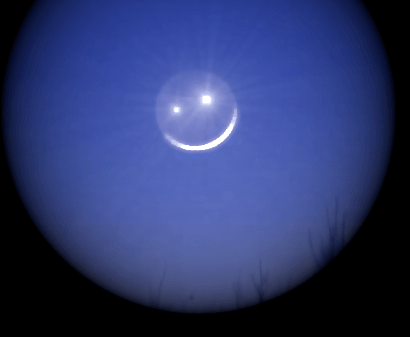
I can see the rising crescent moon outside the right window as I’m heading north (obviously).  I saw it first thing when I stepped out this morning, and thought it looked like some kind of insane (lunatic, if you will) exaggerated grin.

Of course, when the crescent moon is bright and near the horizon, it will always be a grin, not a frown.  The crescent always faces the sun, so if it’s “frowning” it will be following the sun in the morning or leading it down in the evening.  Thus, a frowny moon is going to be a daytime moon, and so less visible than a grinning one.

I think I’m right about this, based on positions and optics and stuff.  I’ve never read about it specifically, but it seems that this is the way it has to be.  Someone please correct me if I’m wrong.

My Uber driver is driving a Tesla, which means I’m sitting in a Tesla.  I must say, the front end of Teslas look disquieting to me, because there is no grill (there doesn’t need to be air intake for an electric motor, other than perhaps for cooling, since it doesn’t use combustion).  Though it makes sense, it always reminds me of the scene in The Matrix, when the Agents made Neo’s mouth disappear, or the fate of the formerly shouty sister of Anthony in the Twilight Zone movie version of It’s a Good Life.  A human face with nose and eyes and no mouth is disquieting to see.  Still, they seem to be good cars, and the lack of a grill probably improves the aerodynamics.

***

Now, here I am at the office.  Though I could finish this on the desktop (the computer, that is‒I am sort of leaning on the desktop at the moment), I’m continuing it on the phone because it feels better to finish where I started.  I’ll do the editing on the desktop (computer), though.

There is a crosswalk on the way to the office****, and the walk signals there have been hosed for months, and nothing seems to have been done about it.  When one is on the west side of Military, waiting to cross Hillsboro, the walk signal never activates.  This is despite the fact that I push walk signals buttons in ascending primes.  In other words, I first push twice, then I pause, push three times, pause, push five times, pause, seven, pause, eleven, pause, thirteen, pause, seventeen, pause…and so on.  It rarely gets that far.  Usually, during the main part of the day, the simple needs of traffic on Military make the thing turn before too long and stay turned for a decent duration, despite the fact that it is, as I say, hosed.

However, this early in the morning, the wait is longish‒there’s much more Hillsboro than Military traffic‒and then when it does change, the change is very brief.  This, at least, demonstrates that it’s not merely a problem of the signal, i.e., it’s not just that the walk sign is not lighting up while the system is otherwise processing things as it is supposed to process them; in other words it’s not just an indicator light problem.  No, the actual walk signals’ input and activation systems (north and south directions) on the west side of that intersection are not functioning.

I had to cross, though, so once the light turned green for traffic in my direction (and once I was reasonably sure the guy in the eastbound truck on Hillsboro, who was going way too fast coming up to a red light, was going to stop before the crosswalk) I scuttled off to cross the street.  But the light turned after the one car each going north and south passed, and it was red before I was much more than halfway across the street (and green for cross-traffic) even though I walk rather quickly.  So, if anyone works for Broward County in the division that manages such things, or knows someone in that division, please let them know this thing needs fixing.

I’m not sure how one would go about alerting them to the problem.  I suppose there might be some phone number or email system online.  I often toy with the thought of deliberately getting hit by an oncoming vehicle while crossing that street and, assuming I survive, explaining that the signal was broken.  It would be making a point and chastising reckless drivers at the same time.  It would also give me a break‒figuratively and perhaps literally.

I doubt I’ll do that.  I tend to be much less careful about entering crosswalks than I used to be, though.  I figure, if I have the right of way and get hit by someone driving inappropriately, well, that might kill two birds with one stone‒or two anthropoid idiots with one vehicle.

I doubt I’ll kill myself using traffic, though I suppose I might act on an impulse if the circumstances were just right.  It’s just generally rude to the innocent drivers out there‒people commuting, all that stuff.  I’d much rather do something quieter and less messy and more polite.  I’m working on it.  I’m reasonably clever and creative, so whatever I choose from among the options I’m considering, it will probably be both effective and not too messy.  Unless I change my mind about avoiding that.  My mind is not my friend, in many ways, so I can’t be sure it will always stick with my preferences.  After all, I’d prefer not to be stressed and angry and depressed and insomniac and in pointless chronic pain, but, oops, it’s all there.  I would rather be reasonably happy and together and have friends and my family and have all of us be reasonably healthy.

I would also prefer you all to have a good day and a good week.  Look after yourselves and those you love; you can’t count on anyone else to do it.

mad morning moon


*I did not succeed.

**I’m not behind a plow***.

***Or “plough” if you prefer the British spelling.

****They do not call it the Rising Sun…or even the Rising Moon

Moods and moons and musings on mythology and morality via Middle-earth

I’m mainly over my weekend gastroenterological difficulty, so physically I’m definitely doing better than I was.  That can’t help but bolster my mood at least a bit, though the elevation bears all the hallmarks of being a supremely temporary state*.  Perhaps you think I’m being pessimistic, but I know myself and my moods reasonably well‒although I will freely admit that it is impossible to be fully objective about such things, given their very nature.

It looks like the moon is very close to its full state this morning, so if it’s not truly “full” now, then it’s one day before or one day after.  If I were a werewolf, I suppose this would be bad news for people around me.  However, I clearly am not a werewolf.  Nor is anyone else**.

I’m also not one who follows all the supposed names of the full moons and all that.  There’s nothing wrong with it, and if paying attention to whether it’s a harvest moon, or a hunter’s moon, or a sun myung moon, or whatever, makes you happy, then do please enjoy yourself.  The whole “super moon” thing is a bit more laughable, though.  The difference in angular size between the moon at perigee and the moon at apogee is too small to be detectable by the naked eye.  Sorry.  Also, by the way, the fact that the moon looks bigger when near the horizon is not even an optical effect***, but is merely an optical illusion.

The weather is slightly more pleasant right now than it has been, because we have a good, strong breeze, thanks to Idalia.  Other parts of Florida are having much worse weather, with the aforementioned hurricane and all, but that’s hitting the northwestern coast of the state, and will cross farther north and east.  We are on the real outer periphery of the storm’s effects down here; we just have more wind than usual, some intermittent rain (not truly unusual) and the very nifty spectacle of the fast-moving clouds all traveling in the same direction, following their course counter-clockwise relative to the center of the storm, hundreds of miles away.

I guess, from a Tolkien-based mythological perspective, a hurricane is sort of a partnership/game between Manwë and Ulmo, though those two don’t ever really come across as overly playful, and I guess they probably wouldn’t willfully do something to cause grief to the Children of Ilúvatar.  That might be more Ossë’s thing; he was apparently associated with storms and whatnot.  Of course, most unfairly, Melkor gets blamed for all the negative stuff‒burning heat and bitter cold immoderate and all that‒but Eru himself plainly and clearly said that everything comes from him.  “Thou shalt prove but mine instrument…” and all that.

Really, Melkor is just a convenient scapegoat so that people don’t get ticked off at Ilúvatar, who gets the credit for the good stuff and gets to foist off blame for the bad stuff, even though he is the one responsible for all of it.  Indeed, he’s the only one**** who could be responsible.

From a certain point of view, Melkor is the being in Ilúvatar’s creation that suffers the most.  He is given the greatest gifts of knowledge and of power of all the created beings in that universe, but he is fated, by his creator, to be disconnected, to be alienated, to feel an emptiness that his brethren don’t seem to share‒he lacks something, he is different, his thoughts are unlike those of his brethren (I can sympathize), and that torments him into becoming the original Dark Lord, the supposed source of all evil in Arda.

But of course, as openly admitted by the being himself, Ilúvatar is the source of all evil in Arda.  It may be worthwhile‒perhaps the gain in beauty and heroism and triumph and courage gained by those who live in his creation more than makes up for the suffering caused by and to the evil creatures.  But those evil creatures are still victims‒perhaps the greatest victims.

Ilúvatar could just have repaired Melkor (and Sauron, etc.).  He could have shown them his wisdom, the error of their ways, could have cured their dysfunction.  But no, that would be boring; that wouldn’t make a good story.  How could he have a heroic and triumphant journey for Frodo and Sam without sacrificing the soul of Sauron to endless emptiness and loneliness and bitterness and fear and hatred, and finally to being blown away into the Void, to suffer there forever (or at least until Ilúvatar decides it’s time to remake the world)?

And let’s not forget Melkor, with his feet chopped off and his head chained between his knees, floating immortally in the Void, with no respite from pain and suffering, no treatment or correction for the flaws and lacks that made him what he was, that Ilúvatar put there to make him an instrument for devising things of greater beauty.  He’s the clay mold around a bronze statue, broken and cast away once the metal cools.

Melkor can’t die, can’t sleep, can’t even change his form anymore.  No wonder he has always hated and envied the favored golden Children.  No wonder he hates Ilúvatar.

Okay, that was a weird digression, and of course, it’s all fiction, though it’s great and wonderful fiction.  But it is a way of highlighting a conclusion that I think is inescapable:  if there is/were a universe created by an infinitely powerful, omniscient, omnipresent being, then that being, and that being alone, would be responsible for all suffering, for all evil.  Everyone else is just a puppet by commission or by omission.

Fortunately(?), there is no reason to suspect such a thing, and I give it quite a low Bayesian credence (though not, perhaps, as low as werewolves).  That doesn’t mean that “free will” and “blame” and “retribution” make any more ethical or moral sense than they would have made otherwise‒they don’t.  But at least we can all cut ourselves and the universe a bit of slack, all the while recognizing that we’re on our own, no one’s going to help us, and it’ll be up to us to sink or to swim…or, maybe, to try to swim but sink anyway.

I don’t know what I’m getting at, but thanks for your patience.  Have a good day, please, if you’re able.


*It was.  Even as I’m editing this, my mood is crashing.  I don’t think it was some manner of self-fulfilling prophecy, but even if it was, I don’t know what I could have done to avoid fulfilling it.  My nature is what it is, while I’m alive‒which doesn’t go a long way to making me attached to that state of existence.

**While, in principle, one cannot really assign absolute certainty to some given proposition, this is a case where my Bayesian prior‒if prior it really is‒is well above 99%.

***Unlike, for instance the fact that, due to atmospheric refraction, we see the sun in the morning before it would technically be directly in view without such refraction, and continue to see it longer than it is truly in line of sight in the evening.  That wouldn’t happen if the Earth had no atmosphere, but then we wouldn’t really care because we probably would all be dead.

****Apart from Tolkien (the author), but I’m approaching this from the point of view of Arda being real, so we’re not going to address that.  Of course, it is a fact that the bad guys in the story are used by the author to create beauty that would not exist if it were not for the hardships and struggles of the heroes.  I know all about this.  I’ve tortured the characters in my stories beyond anything any real people could ever experience.  I guess no creator of any but the simplest of things can ever be truly innocent.