There’s a divinity that shapes our blogs, rough-hew them how we will

Hello and good morning.  It’s Thursday, and as I promised‒or threatened, depending on your point of view‒here I am, writing my weekly blog post as before, back when I was regularly writing and publishing my fiction.

I’m not sure what topic(s) I should cover here, today.  I rarely seem able to plan these posts in advance, and when I do plan them, I don’t think they often come out very well.  That’s from my point of view, of course; maybe other people have found my planned posts excellent and wish I would write them more often, but if so, they haven’t given any clear feedback.  So, I don’t really know what will happen from now until the end of this blog post.

Of course, if the universe is deterministic, then whether I or anyone else knows it or not, what I will write is already a certain thing, as is the fact that I don’t know it‒indeed one could legitimately claim that it “already” exists in a sense, particularly if one is invoking the picture of Special and General Relativity and the “block” spacetime concept.

However, the Copenhagen interpretation (if that’s the correct term) of quantum mechanics states that wave-function collapse is truly “random”, and so the future is not determined, at least at the smallest level.  But if the wave function truly collapses, then that would be the only fundamentally irreversible temporal process known in physics so far, and that seems suspicious to me.

I’ve been reading the original EPR paper and thinking about this subject at least a little bit lately.

Of course, in a way, the Everettian “many worlds” interpretation of quantum mechanics would say that the future really is determined, but that at every instance of decoherence, the wavefunction becomes subdivided into waves that no longer interact with each other directly.  People interpret this as if new universes were coming into existence each time, and that’s a decent way to conceptualize it, but to me it seems misleading.

To my mind, it’s just waves that are traveling along in “parallel” and not influencing each other.  But that’s not really any different from the sounds of two separate conversations happening in a crowded room‒maybe one involves a group of people discussing a recent sporting event and another gaggle is talking about some new show on Netflix.  Maybe the conversations are even in different languages.  The sound waves propagate from each conversation independently, and though there may be places where troughs and crests pass and add or subtract for an instant, locally, they are very much different processes.  But there is no mystical invocation of “new universes” such as what troubles some people about Everettian quantum mechanics because of a misunderstanding of Occam’s Razor.  There are just separate, “parallel” things happening within the same overall universe.

That’s not a perfect analogy, of course.  The “waves” of the quantum mechanics are more complex* than sound waves, and are more fundamental, and once they decohere, it seems they are far less likely to interact with their other “branches” than are even sound waves of parallel conversations in different languages.  But even those are more separable than we think.

We have an exquisitely evolved capacity to parse the information out of human conversation, decoding the waves without thought, and so we don’t think very often about how astonishing that process is.  If aliens who communicated only by light flashes were trying to interpret such a set of conversations, they would have a daunting task, indeed.

Just think about how hard it has been even to decode the communications of dolphins and whales‒highly intelligent and social creatures that clearly communicate with each other.  And these are our fellow mammals from the same planet, who also use sound for communication!  We vastly underestimate the complexity of what we’re doing when we understand conversation and other noises, because our auditory processing systems do it without our conscious intervention, and they have been honed over hundreds of millions of years by the brutal and pitiless sieve** of natural selection.

Likewise, we thoroughly underestimate the complexity involved in catching a pop-up fly ball, or a thrown football, or the process of walking, or of throwing a ball, or of finding a specific item on a cluttered desk.  It shouldn’t surprise us that even if the future “division” of the universal wave function seems random, it can be utterly deterministic, and in that sense each branch “already” exists.  But each “branch” that no longer interacts with others after an instance of decoherence will “feel” to given humans*** as if it were the one and only “universe” and that all others have collapsed out of existence somehow, when they’re really just there but not interacting anymore with the person in question.

Maybe I’m wrong, of course.  I mean, I’ve been right before, but not often enough to make it my default presumption.

Anyway, there you have it, the stuff about which I was “destined” to write, though I had no specific plans.  That’s fair enough.  “Life is what happens while you’re making other plans,” as the saying goes.

Speaking of plans, though, I plan to write tomorrow and Saturday**** on my fiction (probably just on Extra Body).  I may take my laptop with me to do it; the experiment with my smartphone seems to be working okay (see my reports from Monday, Tuesday, and Wednesday), but it doesn’t feel quite as “natural” to me, still.  Who knows, though?

Only Laplace’s Demon® (Quantum Version™) knows.  But of course, that entity would feel, if anything, less “free” than those of us who know not yet what is to be and know not fully what has been.  For an entity that can see every detail of the past and the future laid out deterministically and in full detail is utterly incapable of taking any action on such knowledge‒for its own actions are as determined as all others, and it “knows” this.  Indeed, it cannot but know it.

Ignorance is not bliss, but it does at least give you room to improve, and that can be ego syntonic.

Have a good week, if such is your destiny.

TTFN


*Ha ha, that’s a little physics joke there, when you think of how quantum wave functions involve complex numbers.

**Mixed metaphor alert!  How would a sieve hone anything?  Oh, well, I’m not going to change it; it works too well to communicate my meaning.

***And the very process of “feeling like something” is extraordinarily complex, and we only really understand the bare rudiments of how this happens.  This relative ignorance engenders the propagation of nonsensical, conceptually vacuous ideas like panpsychism and the like, and the pseudo-mystery of the “hard problem” of consciousness.  Well, it is a hard problem in a sense, but not the way philosophers of consciousness seem to express it, as far as I can see.

****I think I will be working Saturday, but I’m not certain, because of the highly atypical thing that happened last Saturday, with the office being closed.  This coming Saturday will be my son’s 24th birthday, and I will now literally have missed half of his life more or less completely.  That’s his preference, not mine, though it started as a consequence of my own misadventures‒our personal wavefunction decoherence if you will.  Still, when enough people repeatedly decide they don’t really like having you around or interacting with you too much, you have to think there must be some powerful causes for the consistency, especially when you don’t even really want to be around yourself.  So, I am profoundly sad about the state of things, and I miss my children terribly, but I have to conclude provisionally that they’re making a reasonable decision.  At least I “talk” to my daughter from time to time, and that’s not a small consolation.

Blog post for 4-10-2024 Wednesday

I’m not writing any fiction again today, it seems.  I just don’t have any urge to do it.  The very prospect of it feels almost entirely pointless, though that could be at least partly due to the fact that I’ve felt so gormy these last few days.

I’m not as nauseated as I was yesterday (though I’m probably just as nauseous, ha ha ha), since I took two omeprazole tablets last night, and also I didn’t take any aspirin or naproxen yesterday.  I did take a few acetaminophen, though those don’t tend to work as well on their own as they do in combination with aspirin and so on.  Still, I hate the feeling of nausea*, and would rather have at least a little pain than be nauseated.  It would have been one thing if I were sick enough just to throw up and get it over with, but all I had was just general gastro-intestinal distress and discomfort throughout the day, which really sapped my energy.

I don’t know what I’m going to do about my fiction.  This week I just haven’t had any enthusiasm for it (nor for any other positive thing in life, really).  Maybe I should try to reignite my energy by sharing more of the links to my pre-existing fiction on Twitter and Facebook and the like.  Maybe if I got any feedback of any kind on any of those posts or shares it might stoke the fire of creativity a bit.

Of course, it’s hard to see why anyone other than the people who already read my stuff would respond to my posts, but who knows?  It’s difficult for me to predict what might motivate other people to do something, at least some of the time.

I feel slightly awkward sharing my links and stuff on the various anti-social media, particularly because I’m currently reading Jonathan Haidt’s new book The Anxious Generation, about the detriments of social media and smartphones to younger people.  On the other hand, unless you’re asking an elf or a vampire, I probably would not be considered a younger person.  Also, I developed my neuro-psychiatric issues long before smartphones and even before the Worldwide Web—I come by them naturally, so to speak—so I shouldn’t have to worry too much about them twisting me in some negative way.  My personality, such as it is, is already formed.  Though, as I discussed yesterday, I do seem to be reasonably good at learning new things even though I’m an old geezer.

I guess maybe I will share my stuff on at least X** and Facebook, and maybe even LinkedIn, though I have less interest in the latter, since I don’t do the whole networking thing.  I might as well make those old posts in which I “advertised” my new stories and such work for me.  And I might as well make Zuckerberg’s and Musk’s endeavors serve some useful purpose, since it’s not as though they pay much in taxes or anything.

I don’t knew where I’m going with this today, otherwise.  At least I’m not going off on weird tangents about playing with infinite series that have obvious outcomes once you work them through.  I mean, yes, it’s rather fun to fiddle with such things in the moment, particularly when one has nothing better to do, and it’s even good when it comes back around and you realize it’s revealed something that should have been obvious with much less work***.  That’s okay.  There’s nothing too wrong with coming at something in a complicated way and finally realizing how simple the answer is.  As I mentioned yesterday, at the very least, it’s good mental exercise.

Still, I shouldn’t go off on too many tangents like that too often.  I don’t think people like those posts very much.  Though, for all I know, they might think they’re the greatest thing anyone’s ever done, they’re just too shy to say anything about it.  I simply don’t know.  It’s like firing a photon off in the direction of an intergalactic super-void:  I’m not ever going to get any feedback about what happened to that photon if it doesn’t interact with something relatively nearby very soon****, and even if it does, unless it reflects back, or unless some intelligence sends a signal in response, it’s still going to be lost.

Anyway, that’s enough for now.  I expect to write my usual Thursday post tomorrow, so if you look forward to such things, you can look forward to that.  If I don’t write it, it will be either because I’m not feeling well (more so than is typically the case) or I’m dead, or perhaps that some other, unpredicted alternative possibility has interfered.  I’d give well over 50% odds that I’ll write a post tomorrow.  But for today, this post is already too long and is almost entirely without substance (and I don’t mean that just because it’s written on a word processor and shared online).

I really do hope that you all have a good day.


*I know, how unusual, right?

**Does Mr. Musk realize that by calling his platform “X” and putting its symbol in the upper right corner of the various X-cretions, he makes it look as though one is supposed to click on that symbol to make a “tweet” go away?  I know that’s the way I feel, and I’ve even tried to do it once or twice when I was distracted.

***In this case, for instance, if you add some (single) fraction of an original number to that starting total, the amount that you added is now one integer step smaller fraction of the new total.  In other words, if you start with some number, then add a ninth, say, of the original number, you now have ten of those ninths in your new total, i.e., 1 and 1/9.  But that 1/9 is now 1/10 of your new  total, trivially.  So, if you want to tip, for instance, 20% of the new total (including the tip) then you need to tip 25% of the original amount before the tip.  In other words, to tip one fifth of the total including the tip, you tip one fourth of the original, pre-tip total, since then you will have five fourths.  Anyway, let me stop this now.

****Unless, I suppose, the universe if both closed—i.e., it loops around on itself like a torus or a sphere—and smaller than anyone has any reason to suspect.  It would have to be small because, based on the expansion rate of the universe as currently measured, any photon of reasonable wavelength would probably have red-shifted into undetectability long before the time I could receive it from the other direction if it circumnavigated a closed universe on anything like the minimum scale we think the universe is.  A photon of too tiny a wavelength, i.e., of high enough energy, would have too high a chance to spontaneously decompose into some particle-antiparticle pair somewhere along the way…I think.

Would YOU eat Zel’dovich pancakes for breakfast?

It’s Tuesday, and I’m writing another blog post rather than throwing some kind of curve ball and doing my fiction writing today, since I wrote a blog post yesterday, when I had scheduled myself to write some fiction.  I don’t know if that counts as a double curve ball or as a capitulation to a simple, over-the-plate, none-too-fast soft pitch.  It’s probably the latter, but I suppose there is no absolute right answer, and the judgment would depend upon one’s point of view.

I’ve realized that, contrary to what I wrote yesterday‒to what I honestly thought was the case‒I did not bring my small laptop computer with me when I left the office on Thursday.  I had unplugged it with the intention to pack it, but then I had left without it.  I can’t recall ever having done that before.  It goes to show just how crappy I felt on Thursday, I guess.

I really want to keep writing fiction.  It would be a shame to take this new story that I’ve well begun, with over 10,000 words written so far, and let it just fall by the wayside.  Then again, I’ve left The Dark Fairy and the Desperado hanging, and more egregiously, I’ve left Outlaw’s Mind hanging, so it’s not as though there is no precedent.  And, of course, in the past I’ve left stories incomplete many, many times.  But it seems particularly sad, now that I’ve published 5 novels and 2 collections of “short” stories, to fall back into that pattern.

But I need to find a way to be able to work fiction writing into my daily routines without messing up habits that have become somewhat compulsory for me.  I’ve tried to find ways to block out the noise in the office, so far without much success.  Yesterday I bought a rather inexpensive pair of noise-canceling headphones.  They didn’t do that good a job at the noise canceling; they reduced it a bit, but it was still there, though if I put in earplugs as well and then also played a YouTube video about field theories and similar stuff, if helped, but that is certainly not a combination of measures I could take while trying to write fiction.

I’m of two minds (at least) about the headphones.  I’m glad I didn’t spend very much on them, since they don’t turn out to be as effective as my more old-fashioned, gun-range and airport style ear defenders (when combined with ear plugs).  They can also play music or the sound from videos, but I didn’t get them for that.  I already have things that can do that.  But I wonder if more expensive ones would do any better.

It’s a shame that no high-powered movie executive has read any of my books or stories and approached me to option them for movies or shows or anything, but it’s obviously not surprising.  I’m terrible at self-promotion, more by temperament than merely due to lack of skill.  This blog is my closest approach to self-promotion, and I spend most of my time here spewing my random and often depressed and depressing thoughts in some wishful, pseudo-Freudian free association kind of exercise.

Of course, it’s about as useful to me as Freudian psychoanalysis* ever has been clinically demonstrated to be for anyone, which is to say, very little, if at all.  Nevertheless‒and also like psychoanalysis for many of its patients‒it has been habit forming, and I feel awkward and disjointed without it.

Also, as I noted yesterday, it’s the only means by which I keep contact with anyone other than my sister in the world outside of the office.  I’ve really become a shell of my former self, and the fact that there is physically more of me now than there has ever been before only makes that more biting, the irony enhancing the contrast with the past, when I used to relieve suffering and save lives and be beneficial to the world.

Ah, well.  From a cosmic perspective, all such benefits will probably be transitory, or effectively be nonexistent.

Which reminds me:  yesterday I was looking at the abstracts of some recent papers on “quantum cosmology” uploaded onto arXiv, the preprint server.  Obviously, most of these subjects were well beyond my expertise truly to be able to follow, but I get the concepts involved in most of them.  Also, exposure to the mathematical formalism when I don’t know how to manipulate it often makes it easier to understand later, as there is familiarity and applicability that helps add to the more complete picture I gradually build in my mind about such things.

This has happened to me more than once in the past.  I don’t learn by rote, I learn by building mental models and maps and structures that link areas of knowledge and understanding together.  So, I don’t learn quickly, but I learn deeply and durably.  I think this is a much better way to go.

Anyway, that’s tangential.  What was amusing is, I read about a paper involving some deSitter** models of inflation in a universe which (if I recall the abstract correctly) was matter-dominated in early moments and so had no uniform pressure (unlike radiation-dominated situations, which, if I’m remembering correctly, is pressure intensive and homogeneous, and is how our early universe probably was).  In such models, if I understood the point correctly, you could find more noteworthy inhomogeneities than seen in radiation-dominated phases, which makes sense, since the radiation pressure works against gravitational collapse.

So, the model discussed would be unlike our universe, in which the CMB demonstrates extreme homogeneity, down to a few parts in a hundred thousand, even from one edge of the cosmic horizon to the opposite edge, encompassing regions that could never possibly have been in any form of direct causal contact at least since the hypothetical time of inflation.  The light from each side has only just now reached us, and so is only halfway across to the other side, and may well never reach it if the universe expands quickly enough.  Yet the temperatures are the same to a few parts in a hundred thousand, which is probably more than can be said about the room you’re sitting in now.

One type of this theoretical homogeneity in the model in the abstract had apparently been previously described as a “Zel’dovich pancake”.  This is apparently nothing new (first described in the 1970s), but is a really amusing way to think of a cosmic structure, and I kind of want to look into it and see what it describes, to see if I can understand, at least superficially, the math behind it.

Wow, that was a whole ‘nother tangent of much greater departure than before.  I think I’ll call that good for now for this day’s blog.  I’m kind of all over the place, and if I’m not too careful, I might undergo decoherence and split into multiple versions of myself.  That seems all too possible, since I’ve never been naturally inclined to very impressive coherence in the first place.

I will probably be writing here tomorrow.


*Not to be confused with the more general term “psychotherapy”, which can be useful depending on the type of therapy and the person receiving it.  CBT is one of the most effective of these; it didn’t work all that well for me, but I’m annoying and perverse, so that’s no surprise.

**DeSitter spacetimes are just spacetimes with positive cosmological constants‒like our universe, with its apparent “dark energy”‒which will tend to drive accelerating expansion.  The whole “holographic universe” concept was motivated, or perhaps inspired, partly by the Bekenstein-Hawking recognition that the maximal entropy of any region of spacetime is defined by the surface area of an event horizon the size of that region.  Any greater entropy in the region would add to the mass of the black hole associated with that horizon, and so would make the horizon larger; thus that is the maximal entropy for that initial region.  QED (Quod erat demonstrandum, not quantum electrodynamics) if you will.  The holographic principle regarding a universe has only ever been worked out for anti-deSitter spaces, with negative cosmological constants, which we know is not the case for the universe in which we live because…well, because we’re alive, and those spacetimes tend to collapse rapidly.

Whither one goes affects whether the effects of the weather are noteworthy

It’s a bit chilly this morning, at least for south Florida.  As I looked at the weather app when I was getting up, it reported that the temperature near me was about 51 degrees Fahrenheit.  We can take 32 away from that then multiply by 5/9‒so that’s 19 x 5, which is 95, divided by 9‒which gives just over 10 degrees Centigrade (or Celsius, depending upon whom one asks).

I guess that’s pretty cool, though certainly there are many places north of here where people would welcome it as a relatively balmy day for this time of year.  Alternatively, in parts of the southern hemisphere, where it is summer, it would seem aberrantly cold, even more noteworthy than it is in my neck of the subtropical woods.  Going farther afield, on Mars it would be truly a record-setting heat wave, whereas on Venus, such a temperature would be impossibly, unfathomably cold.

The surface temperature of Venus is, if memory serves, around 900º Fahrenheit, or nearly 500º Centigrade, or nearly 800 Kelvin (I am rounding the Kelvin “273” addition to Centigrade because I only have one significant figure in my recalled estimate of Venus’s average temperature in Fahrenheit, and adding other specific digits would be misleading and unjustified).

It’s interesting that Venus, the planet named for the goddess of sexual and romantic love, is the most hellish planet in the solar system.  It’s hot enough at the surface to melt lead.  The atmospheric pressure is 90 times that of Earth and largely consists of carbon dioxide.  The cloud cover is constant and it rains sulfuric acid.

Perhaps Venus, the morning “star” (and the evening “star” too, depending on which side of the sun it’s currently on from Earth’s point of view) is more appropriately given one of its other names, which is:  Lucifer, the light-bearer, herald of the dawn, who in later mythology was associated with the Devil (at least before his fall).

Of course, it’s hard to reconcile Lucifer’s supposed fall with the fact that the planet is still conspicuously up there in the sky.  And I do mean “conspicuously”.  Apart from the sun and the moon, Venus is easily the brightest thing in the night sky.  Sometimes one can still see it even as the sun is beginning to rise; the cloud cover of Venus makes it highly reflective of visible light.

Anyway, I find it sardonically and cynically amusing that the goddess of love is associated with a nightmarish hellscape, but I have a personal history that makes me look askance at romance.  I am, in other words, biased.

Venus is a good object lesson in the potent effects of carbon dioxide’s tendency to allow visible but not infrared light to pass easily through it, and so to create a “greenhouse effect” even in the modest concentration it achieves on Earth.

The physics of this is well understood, relating largely to the resonant frequency of the bonds in the molecule as well as its size and shape.  Smaller, tighter molecules like molecular nitrogen and molecular oxygen, the two gasses that make up the vast majority of Earth’s atmosphere, don’t interact much with infrared light, and are more prone to scatter shorter, bluer wavelengths of visible light‒this is a rough explanation of why the sky is blue (and why the sunrise and sunset are much redder, as that sunlight is going through more of the atmosphere due to the angle at which we see the sun at those times of day, and the blue is partly scattered out of it, leaving relatively more redder light behind).

Anyway, the broad physics of the greenhouse effect is almost elementary, and has been understood for a long time.  The specifics of what precisely will happen in any given set of circumstances can be tricky to tease out, given the complexity of reality‒you might say that Venus is in the details‒but the specifics are often less important than the broad strokes.

After all, when a giant asteroid is heading toward the Earth, it isn’t that reassuring to know that only, say, 75% of species will be driven extinct by its impact, and that life will survive and eventually once again thrive.  How much would someone have to pay you for you to be willing to accept a 75% chance that just you will die, let alone everyone like you on the planet?

There might well be a big enough sum for you to be willing to risk your own life, especially if you got to enjoy the money for a while before the dice were thrown, or to leave it to your heirs.  But for your whole species?  Is there a reward big enough to be able to take that chance?  Let’s assume you’re not a raging misanthrope/panantipath like I am for the sake of this question, since depending on my mood, I’d be inclined to negotiate for a higher chance of extinction.

Also, of course, by pretty much every possible form of ethics you might follow, you don’t have the right to roll the dice on all the members of your own species.   You don’t have any right to roll the dice on the members of your own family, unless they unilaterally and spontaneously and freely grant you that right.

Sorry, I don’t know why I’m writing about these topics today.  They are just what spewed out of me, like vomit from the proverbial drunkard or pus from a squeezed abscess.  I wish I could write something more interesting, or write something that helped my mood some.  Writing fiction did at least help fight my depression, but it’s hard when almost no one reads my stuff.

Maybe I should take to writing at least a page of fiction a day by hand, on the notebook paper and clipboard I have at the office, during downtime, instead of watching videos.  Yesterday I mainly watched ones about spontaneous symmetry breaking and the electro-weak era and the Higgs mechanism.  To be fair to me, it’s very interesting stuff, and it actually would have some relevance to my potential comic book turned manga turned science fiction story, HELIOS.

Of course, that’s named for another mythological figure, one that’s even hotter than Venus.  But I don’t know if I can write it.  Motivation is difficult.  Still, as Stephen King reputedly once told Neil Gaiman, if you write just one page a day, by the end of a year you’ll have a decent-sized novel*.

Once I get writing, I have a hard time stopping at only one page.  If you’re a regular reader of my blog, you’ll probably know this implicitly‒my general target for post length is about 800 words, but I almost never am able to keep it that short.

I guess we’ll see what happens.  And, of course, I’ll keep you all…posted.


*He has also noted that, for him‒as I have often found it to be for me‒writing fiction is the best form of therapy.

Chaos surfing and the omni-curious mind

It’s Saturday morning and‒as I warned you‒I am writing a blog post today.

I just experienced a tiny little frisson of déjà vu, which is always interesting when it happens.  It involved that seemingly obvious, curious sensation that I could remember dreaming about the process of writing this particular blog post, in the location in which I’m writing it, at some time in the past.  Of course, I have no reason to suspect that precognitive dreams are actual things, except occasionally, by coincidence, due to the large number of dreams that happen and the brain’s capacity to model/predict its world with decent accuracy due to the regularities therein.  But déjà vu is still an interesting and sometimes enjoyable experience.

In case you haven’t noticed, mine is very much a stream-of-consciousness kind of blog.  I sometimes wish I were writing something more useful or informative or thought-provoking.  Then I could imagine I was contributing to the world in some way.  I have a wide range of knowledge on lots of topics‒science in general, some physics and cosmology, biology and medicine, some mathematics, a tiny bit of computers, and of course some philosophy (and psychology).

I sometimes regret not having explored philosophy more at an earlier age.  There was a philosophy class in my high school; it was one of my favorite classes, and the teacher was great, but I avoided philosophy in college deliberately.  I had little understanding of how good and useful it‒as well as pure mathematics, not solely for use in physics‒is in improving one’s ability to think about all subjects.

At its “worst” it’s at least analogous to doing calisthenics to get stronger and more fit.  One doesn’t do push ups in order to become a world champion at push ups‒usually‒and one doesn’t do push ups because one expects to become a professional pusher up and to make one’s living that way.  As far as I know, there is no such profession.  One does it to keep one’s body fit so it is more capable of responding to any of a functionally limitless number of specific challenges throughout life.  So it is with the mind, but the mind is far more capable of growth and strengthening than even the greatest athlete’s body has ever been.

I get so frustrated when I hear people whining about, say, the fact that they never use the Pythagorean Theorem in their daily lives, or haven’t used algebra since they left school.  My first reaction when I hear such moans is to think, “If that’s true, then too bad for you; you’re missing out.”

But I also find it noteworthy that most people don’t complain of the fact that they’ve never played kickball or tag or used their sandlot baseball skills in their later life.  Similarly, very few people get jobs playing video games‒there is a vanishingly small few who make at least temporary livings playing video games competitively, but that’s not a reliable long-term strategy for almost anyone.  Such skills are, for the most part, far less useful than those of algebra and calculus‒though I understand that there is some evidence that playing video games can make people better drivers by improving their alertness and response times.

Breadth and depth of knowledge are ends in themselves; they are their own reward, one might say.  When one learns something new, one makes oneself “larger” without taking anything away from anyone else*.  Information can be shared without loss, and one can contain whole universes‒real and/or imaginary‒in one’s mind.  It’s remarkable.

But also, knowledge, even of esoterica, is of practical, basic value.  Insights gained from having studied epistemology or Boolean logic may become useful, unexpectedly, in a business negotiation or a plumbing emergency.  Who knows?  The world is too complex for one to be able to predict the specifics of local events very far ahead of time‒and even the precise knowledge of that fact is based on an originally obscure branch of mathematics and information theory, and was formally born of the use of a “primitive” computer weather simulation.

You cannot fundamentally alter the chaotic nature of reality.  You cannot effectively steer the chaos‒but you can learn to surf on it.  And the more you know and the greater the breadth of your mental skills, the more likely you are to be able to catch the right waves and ride them to someplace you’d like to be.

Anyway, back to what I was saying earlier:  I sometimes imagine myself doing a more informative or exploratory blog, a discussion of sorts, albeit one-sided.  When I leave it to my stream of consciousness, my blog is often depressing (or at least it’s often depressed).  But I don’t know what people might like to read my thinking about; I have a great deal of difficulty understanding what other people find interesting or engaging, let alone why.  So, if anyone has any general subjects they’d like me to explore, whether truly broad or regarding current events or science news or anything within my relative wheelhouse**, feel free to let me know in the comments…or, I suppose, via Facebook or Twitter.  I don’t like to encourage such things, but these “social media” can be entertaining and even useful in certain rarefied situations.

In the meantime, have a good weekend if you’re able to do so.


*Apart from the tiny, tiny increase in overall universal entropy that all learning entails.  But that’s going to happen anyway, and the entropy created by a lifetime of astonishing erudition is unnoticeably small next to, say, that produced every day simply by the Earth absorbing sunlight, warming up, and releasing higher-entropy heat back out into the cosmos.

**My wheelhouse walls are made of rice paper, so I can easily knock them down and expand that chamber as desired.  I dream of my wheelhouse eventually being as large as the cosmic horizon‒or even larger!  Why not?

There may be no firm fundament but is there a fun firmament?

It’s Tuesday morning, now, and I’m writing this on my laptop computer, mainly to spare my thumbs, but also because I just prefer real typing to the constrictive and error-ridden twiddling of virtual buttons on a very small phone screen.

Speaking of the day, if the Beatles song Lady Madonna is correct, then it’s still Tuesday afternoon, and has been at least since last Tuesday, since “Tuesday afternoon is never-ending”.  Of course, if Tuesday afternoon really is never-ending, then it has been Tuesday afternoon ever since the first Tuesday afternoon.  From a certain point of view, this is trivially the case.  After all, every moment after 12pm on the first Tuesday that ever happened could be considered Tuesday afternoon—or, at least, they could be considered “after Tuesday noon” if you will.

Enough of that particular nonsense.  I only wrote that because there’s nothing sensible about which to write that comes to my mind.  But, of course, in a larger sense, there is nothing “sensible” at all.

There are things that can be sensed, obviously.  I can see, hear, and touch this computer, for instance.  If I wanted, I could probably smell it, though I think its odor is likely quite subdued.  But I mean “sensible” in the more colloquial, bastardized, mutated sense—as in the word “sense” just there—which has to do with something being logical, reasonable, rational, coherent, that sort of thing.  Indeed, it has to do with things having meaning.

Deep down, though, from the telos point of view, there is no true, inherent meaning to much of anything, as far as anyone can see.  Certainly there’s no meaning that anyone has ever demonstrated or asserted convincingly that I have encountered at any point in my life.

Of course, people have beliefs and they have convictions, and humans assign meanings to various things.  All the words I have used in writing this post so far, and all the words I will use henceforth, have “meanings”, but those are invented meanings.  There is nothing in the collection of letters—nor indeed in the shapes of the letters themselves, nor the way we put them down on paper or a screen—that means anything intrinsically.  They were all invented, like justice and morality and the whole lot of such things.

That something is invented doesn’t mean it isn’t real, of course.  Cars are an invention, and only a fool (in the modern world) would deny that cars are real.  But they are not inherent to the universe; they are not in any sense fundamental.

In a related sense, even DNA and the protein structures for which it codes are very much not fundamental; they are quasi-arbitrary.  Of course, one cannot make DNA or RNA or proteins out of substrates for which the chemistry simply will not hold together.  But the genetic code—the set of three-nucleotide-long “letters”, the codons, in the genetic code that each associate with a given amino acid (or a stop signal, or similar) as they are transcribed into proteins—is arbitrary.  There’s nothing inherent in any set of three nucleotides that makes it associate with some particular amino acid.

This sort of thing took me quite a long time to realize as I was growing up and trying to understand biology and chemistry and such.  What, for instance, was the chemical reaction with, say, adrenaline that made things in the body speed up and go into “fight or flight” mode, as it were?  How was it that aspirin chemically interacted with bodies and nervous systems to blunt pain?  How many possible chemical reactions were there, really?  It was mind-boggling that there could be so many reactions, and that they could all produce such disparate effects on various creatures.

When finally I was shown the real nature of such things, it was definitely a scales-dropping-from-eyes moment.  There is nothing inherent in the chemistry of DNA, or of drugs or hormones, that produces their effects.  There is no inherent “soporific” quality to an anesthetic.  You could give a dose of Versed  that would kill a human to some alien with a different biology, and at most its effects would be those of a contaminant.

It’s all just a kind of language—indeed, it’s almost a kind of computer language, and hormones are just messengers*, which are more or less arbitrary, like the ASCII code for representing characters within computer systems.  Likewise, there’s nothing in the word “cat” that has direct connection with the animal to which it refers.  It’s just keyed to that creature in our minds, arbitrarily, as is demonstrated by the fact that, for instance, in Japan the term is “neko” (or, well, it sounds like that—the actual written term is ねこ or 猫).

Of course, there are things in the universe that, as far as we can tell, are fundamental, such as quantum fields and gravity and spacetime itself.  But even these may yet peel away and be revealed to be arbitrary or semi-arbitrary forms of some other, deeper, underlying unity, as is postulated in string theory, for instance.

The specific forms of the fundamental particles and forces in our universe may—if string theory and eternal inflationary cosmology for instance are correct—be just one possible version of a potential 10500 or more** possible sets of particles and forces determined by the particular Calabi-Yau “shape” and configuration of the curled up extra dimensions of space that string theory hypothesizes.  So, the very fundamental forces of nature, or at least the “constants” thereof, may be arbitrary—historical accidents, as much as are the forms and specifics of the life that currently exists on Earth.

And what’s to say that strings and branes and Calabi-Yau manifolds are fundamental, either?  Perhaps reality has no fundament whatsoever.  Perhaps it is a bottomless pit of meaninglessness, in which only truly fundamental mathematics are consistent throughout…if even they are.

I’m not likely to arrive at a conclusion regarding these matters in a blog post written off-the-cuff in the morning while commuting to the office.  But I guess it all supports a would-be Stoic philosophical ideal, which urges us to let go of things that are outside our control and instead try to focus on those things over which we have some power:  our thoughts and our actions.

Of course, even these are, at some deeper level, not truly or at least not fully ours to control—we cannot affect the past that led to our present state, after all, and the future is born of that present which is born of that past over which we have no control.  But, for practical purposes, the levers that we use to control ourselves are the only levers we have to use.

We might as well keep a grip on them as well as we can, and not worry too much about things that are not in our current reach.  Though we can try to stretch out and limber up, maybe practice some mental yoga, to try to extend that reach over time, I suppose.  But that’s a subject for some other blog post, I guess; this one has already gone on long enough.


*For the most part.  Things like cholesterol and fatty acids and sugars—and certainly water and oxygen—and other fundamental building blocks do have inherent chemical properties that make them useful for the purposes to which bodies put them.  Then again, words can have tendencies that make them more useful for some things than others, too.  “No” and “yes” are short and clear and clearly different sounds, for instance; it makes sense that such words evolved to be such important, fundamentally dichotomous signals.

**That means 10 x 10 x 10 x 10… until you’ve done that multiplication 500 times.  You may know that a “googol” is a mere 10100, and that in itself is already roughly 20 orders of magnitude (100,000,000,000,000,000,000 times!) larger than the number of protons and neutrons estimated to exist in the visible universe.  So 10500 is a number far vaster than could ever be written out within the confines of the universe that we can ever see.  There’s not enough space, let alone enough matter, with which to write it.  It’s a googol times a googol times a googol times a googol times a googol!

Most people are dead, and it will probably always be that way

I sometimes think about historically based films in which tragedies happen and deaths occur.  I know they’re highly fictionalized, but think of Braveheart and of Gladiator* and movies of that sort, where the loss of loved ones makes viewers sad but drives the protagonist to “great” deeds that change the course of local history‒or, well, that make the course of local history.  After all, one only knows history after it happens, and once it’s happened, one cannot change it.  One can be mistaken about it, one can misrecord it, one can lie about it, but one cannot actually change it.

Even if it were possible to time travel, going into the past to alter something, it wouldn’t change the history from which you came‒as even the Marvel movies have pointed out, you’d just have created a new future, a new history, local to you.  It wouldn’t change your previous one‒that would be paradoxical.

Yes, Back to the Future is bullshit.  This really shouldn’t surprise you.  It’s still a fun movie.

Anyway, that’s beside the point I planned to make.  I think of tragic deaths in historical dramas that we see and about which we feel heartbroken, or even about real historical horrors‒human made, like the vast slaughters of Genghis Khan’s hordes or natural, like earthquakes and volcanoes and tsunamis and the like‒and about all the deaths involved, and sometimes I think:  “They would all be dead now, anyway, no matter what.”

Not one single person who was born before 1900 is alive today, as far as I know.  If there is one, that human is an all-time record holder in longevity, and is unlikely to live much longer.  And I would probably bet my own life** on there being no one alive who was born before 1850.  Indeed, the majority of humans who have ever lived are dead.  It’s not as big a majority as it might be, given how long humanity has existed, but that’s only because of recent exponential population growth.

In principle, of course, with a fast enough exponential population growth, it would be possible for the majority of humans to be presently alive, even with current lifespans.  But that’s not sustainable in the real universe.  For it to be sustainable in the long run, eventually humans would have to expand their empire over matter and space at faster than the speed of light, and reach far beyond the cosmic horizon, which is impossible in principle, as far as we know.

I say “eventually”, but don’t let that mislead you.  It would happen with surprising speed.  There’s a well known fact that, given a typical doubling/generation time of about 20 minutes, and assuming enough resources, a single bacterium could multiply to a volume greater than that of the visible universe within a month.  I’ll try to check my math on that when I get to sit down with a pen and paper***, but whether the specific time of a month is not quite right, it’s in the right ballpark.

This is the sort of doubling that is thought to have happened‒at an even faster rate, of course‒during the “inflationary” stage of the universe, if inflation happened.  Of course, in a sense, if “dark energy” is really the cosmological constant, then we are still undergoing inflation even now, just with a slower doubling time.  That doesn’t help is with our exponentially growing human population, though; spacetime itself can expand at, functionally, faster than the speed of light****, but nothing travels through spacetime faster than light.

Anyway, we’re already slowing down our population growth rate, which is good, since Malthusian growth tends to be unpleasant for almost everyone.  Therefore, as time goes by, the fraction of all humans who are dead will probably more and more overtake the fraction who are living.  And all early deaths are, in hindsight, not too terribly early.

This is one reason I get slightly irritated by people who talk of “saving lives” or characterizing a person’s death, per se, as a tragedy.  If every death is a tragedy, then the anti-natalists are right, and each new life should be avoided.  But, of course, it’s not that death in and of itself is a tragedy‒or if it is, it’s an inevitable one that’s going to happen to us all, sooner rather than later.  Even a being that lived for thousands or billions or googols or googolplexes of years would come no closer to living eternally than does a mayfly.  This is a mathematical fact.

It’s suffering that is the tragedy, not death.  Death can be a decent shorthand, in certain circumstances, because‒as Carl Sagan pointed out‒if one is dead, there is very little one can do to be happy.  Then again, if one is dead, there is also very little that can happen to make one disappointed or sad or in pain or afraid.  And since these things are more common and sustainable, or at least more reliable, than joy is, life itself, as a shorthand, is at least as good an indicator of suffering as death is of loss of possible joy.

It’s possible, I think, to live without joy‒meaning that it can happen, not that it’s a state one can or should seek.  But I don’t know that it’s possible for any true living things, or at least any living things with any equivalent of a nervous system, to exist without suffering.

So, perhaps Dumbledore’s post-mortem***** admonition to Harry Potter could be truncated to “Do not pity the dead, Harry.  Pity the living.”  Full stop.


*Which should have been the title of the sequel to Jaws.

**That’s maybe not as impressive as it might seem, since much of the time I hate my life and myself.  But it’s the only life I have with which to bet.

***With a typical length of 1 micrometer (10-6 meters) and a doubling time of approximately 20 minutes (leading to 72 doublings a day), after only one day, a colony of bacteria would be roughly 4700 cubic meters in size, a cube more than 16 meters (just over 50 feet) on a side.  After 2 days, its volume would be about 2 x 1026 cubic meters, or a cube 280,000 kilometers long on a side.  That’s nearly the distance from the Earth to the Moon.  After the 2160 doublings involved in a month of doubling, that would yield a volume of 2 x 10632 cubic meters, or with a side length of about 5 x 10210 meters.  A light year is 10 trillion kilometers, or 10 quadrillion meters, which is “only” 1015 meters.  So that’s a cube with a side length of 5 x 10195 light years‒waaaaaay more than a googol light-years.  Indeed, if you subtracted a googol from that number, it would not change it to any degree measurable by any means known to humans (5 x 10195 minus 1 x 10100 is still, basically, 5 x 10195).  The visible universe is only about 92 billion light-years across, yielding a sphere with a volume of “only” 4 x 1080 cubic meters.  It’s not even close to the order of magnitude of a volume of 2 x 10632 cubic meters!  My estimate was far short of the mark.  But that only strengthens my point, doesn’t it?

****It doesn’t actually do so locally‒I suspect that is also impossible, since it would defy the speed of local causality.  It’s only the summation of all the local doublings spread across the entirety of space that can make distant points separate at faster than the speed of light.  Then again, can “traditional” inflation cause any kind of local superluminal expansion?  I don’t think so.  Could two points in space a Planck length apart separate at a local speed that exceeds c even during inflation?  I doubt it, though I’m not absolutely sure.  Of course, if space is mathematically continuous, then there are no two closest possible points, anyway.  Between any two points on the real number line, there exists an uncountable infinity of other points, no matter how arbitrarily close you make them.

*****Of course, if one can deliver admonitions, one is not really dead in any useful or meaningful sense.  But it’s fiction, and it’s magic within fiction, so leeway can be given.  We have no evidence nor have I encountered any even borderline convincing arguments for any “life after death” in the real world, unless you count things like multiverses or Poincaré recurrences or the like, and I don’t, since they really entail other versions of a person, not a continuity of personhood.

Learning about science, troubles with reading and socialization, and (not) writing fiction

It’s Saturday morning, and boy was yesterday’s audio blog a little weird.  I think it’s not so much that I said anything particularly weird—certainly not for me—but rather the odd meanderings thing took, from musing on the fact that I’ve been losing any joy of any kind in my life, becoming more and more bored or even irritated by more and more things that used to be interesting, on to the various declining cinematic universes and finally to thoughts about General Relativity.

At least that latter part encouraged me to read some material and watch some relatively hard-core YouTube videos about General Relativity and its mathematics.  By “hard-core”, I don’t mean there was any graphic sex involved.  First of all, I don’t think they allow stuff like that on YouTube, but even more to the point, I don’t see how one could work such a thing into an educational video about matrices and tensors and stuff like that.  I mean “hard-core” as in being more in-depth than just a general information, analogy kind of educational presentation, and especially that it talked about the mathematics underlying the science.

Not that I’m against the more general stuff.  I certainly began all of my interest in science with general knowledge/information.  When I was a kid, growing up (which is what kids do if things go well), I had a whole bookshelf I called my “science shelf” full of various kid-level books about everything from biology to paleontology (there were lots of dinosaur books—my first career ambition was to be a paleontologist) to “how things work” kinds of books and so on.

I didn’t really start to have as much physics and astronomy related material until after Cosmos came out.  That show was the reason our family got our first color TV.  I also asked for (and received) a hardcover copy of the book for my 10th or 11th birthday (it came out in 1980, I think, so it should have been 10th), and I was very pleased.  That book and show really triggered my love of space-oriented and physics-oriented science, including—of course—cosmology.

I chose my undergraduate college precisely because it was where Carl Sagan was a professor, though I never did meet him.  I would have thought it presumptuous and appalling to try to seek him out and bother him with gestures of my admiration and thanks.  I tend to feel that way about inflicting myself upon anybody—friend, foe, or stranger.  I just feel that I don’t have any right to intrude upon anyone else’s life or time, and also that I frankly don’t know what to say if I do meet them.

It’s a bit sad, though.  By most accounts, Professor Sagan tended to be quite pleasant and positive toward people who liked his work, and he considered himself—according to him—first and foremost a teacher.  He certainly taught me a great deal.  Though his books are now somewhat out of date, they are mostly still great repositories of fact and interest, and they remain overflowing founts of wonder.  I feel confident in recommending them to anyone, most prominently Cosmos, Pale Blue Dot, and especially The Demon-Haunted World.

Of course, I’ve read a lot of his intellectual descendants since then, and his cousins as well in other fields (Stephen Jay Gould’s and Richard Dawkins’s books and collections about biology are wonderful, too, for instance).  One thing I like about listening to podcasts that focus on ideas is that the guests are often people who have recently (or not-so-recently) written books, and if the subject is interesting I can read their books to get more deeply into their work.  I first encountered David Deutsch and Max Tegmark (and many others) on Sam Harris’s podcast, for instance.

And, of course, I have also read books by Brian Greene and Sean Carroll (and others) about physics in general.  It was to The Big Picture that I turned yesterday after my audio blog, in addition to the aforementioned video, to review some of the mathematical basics of General Relativity.  From there, maybe I’ll go on to the YouTube videos of Leonard Susskind’s* real graduate level lectures at Stanford, and to reading Sean Carroll’s textbook.  I’d also like to read through Zee’s Quantum Field Theory, As Simply As Possible, which I’ve mentioned before (with the thought of going on to his textbook if I can).

I have Zee’s layperson-oriented book in hardcover, but the print is small, and it’s difficult to read.  Still, I took delivery yesterday of a new set of reading glasses that are slightly stronger than the ones I was using, so I hope they’ll make it easier.  I’d really prefer to learn by reading than even by watching videos.

Of course, all this is probably just “pie in the sky” thinking.  My biggest difficulty is just summoning the will, the energy, to do these things.  It’s similar to the trouble I have with writing fiction.  I have quite a few story ideas I could write, but I have no drive, no desire to do the writing.  There’s no percentage in it, so to speak.  It’s not as though I have any fans out there telling me how much they like my books and want more.  I mean, my sister has read them all, and she liked at least most of them, and says she really liked The Chasm and the Collision.  That’s very nice, and I do appreciate it.  Apparently, though, it’s not the required stimulus for me to want to write more fiction.

Perhaps nothing would be.  Perhaps I’m just deteriorating too much, or have deteriorated too much.

Or perhaps it’s that I feel that a truly tiny minority even of people who engage with fiction do so in written form nowadays.  There’s too much competing immediate gratification out there, and primates—probably almost all life forms—are prone to fall for immediate gratification, and to someone else doing the imaginative work for them.

I fear that much of the general population has allowed their personal imaginations to atrophy, much as physical health atrophies when someone goes everywhere by car.  People even play Dungeons & Dragons online now, apparently.  That seems weird to me.  I don’t think I could really stand to play role playing games with strangers.  Playing them with my friends, as I did back in junior high and high school, for countless hours, was greatly enjoyable, and I think it did exercise and improve my imagination and my story-telling and story-creating “muscles”.

Oh, well.  I don’t have anyone with whom to do any of that stuff now, and I can’t even really imagine trying to find new people with whom to do it—see my above discussion about inflicting myself on people for part of the reason, but that’s not the only one.  I also don’t want to invest the considerable necessary stress and effort and anxiety into trying to find friends with whom I actually share interests—if such people even exist—and then have it all go sour or just go away as nearly every other relationship of any kind that I’ve ever had has done.  The juice, however delicious, is not worth that old vice-grip-on-the-testicles (and on all the joints and tips of one’s fingers) level squeeze.  The juice doesn’t last, anyway.

I’m on the train now, and I’m not exactly producing anything edifying, am I?  I’ll bring this week’s writing to an end, but I hope I’ll have the will to keep studying, at least.  And, of course, I hope most fervently and sincerely that all of you have a very good weekend.


*I also have his series The Theoretical Minimum in kindle and/or paperback and/or hardback form; his most recent one was about GR.  But I’ve had trouble reading physical books of any kind (let alone the Suss kind…ha ha) lately; I’m hoping my new reading glasses will help that.

Causality, relativity, uncertainty, and attractive versus repulsive gravity–these are worth celebrating

Okay, well, I’m writing this blog post from the office, because this is where I slept last night after the holiday party.  We did not have the party at the office, just to be clear.  We had it at a very decent restaurant called Maggiano’s, which may be part of a chain to some extent, I think.  It was a nice enough restaurant, food-wise, and the building and the outside lights were quite beautiful (see below).  However, inside, it was way too crowded and noisy, and we were seated at a very long, narrow table against a wall.

I felt incredibly stressed when we first arrived; I can hardly hear out of my right ear for one, and I have had tinnitus in it since about 2007 or so, and everything else was a tumult and commotion.  There was too much visual sensory overload also, and way too many people in too close quarters.  I miss the social mores of the pandemic, honestly.  I was barely able to endure long enough for our server to get me a drink so I could calm down a little.  I almost left and just walked back to the office.

My difficulties with such things have gotten worse over time, probably at least partly because I only ever used to go to restaurants and whatnot with people with whom I felt quite comfortable—my family, near and extended, then my wife, her family, our family, and so on—so there was always someone on whom I could focus, and with whom I could speak.

The drinks were rather weak, which may be good, since it was a work night, but I had to drink several to keep from tensing up.  Even so, at the end of the night, when they wanted to take a big group photo, I just walked away.  I had been dodging pictures all night already; there was a terribly annoying number of them, because everyone has their own little cameras in their smartphones, so instead of conversation—which was very difficult with anyone more than one seat away, and pretty hard even with those neighbors—people just took their little, instant, digital snaps, which I suspect will never really be used for recalling memories.

I’ve said it before, it’s not the case that things on the internet (or smartphones or whatever) are forever, as is sometimes claimed.  There is such a cacophony of data and images and whatnot, a good portion of it now not even being “real”, that most things will be swiftly lost like a drop of ink in a roiling, stormy ocean, or the quantum information of something that’s fallen in a black hole.  In principle it’s all there, but in practice it’s as lost as the echoes of Julius Caesar’s death rattle.

I guess it was a pretty nice evening, and the food was pretty good.  The salad was above average, and the broccoli I had on the side with my ziti dish was good.  It was all certainly well above the level of, for instance, the Olive Garden, but it was terribly noisy, literally and figuratively.  By the end, when we were the last party in the restaurant, it was still noisy, because our group was terribly noisy, and it was embarrassing and unpleasant.

I think I mostly at least prevented anyone from capturing my disgusting current face and form on camera in anything other than, perhaps, an oblique angle.  I really don’t like how I look, or how I feel, and certainly don’t want it memorialized, even if it’s evanescent and ephemeral*.

After the party, I was brought back to the office, which is only about four miles from the restaurant.  I could have walked, since the night was reasonably cool, but since I knew I wouldn’t be taking a shower, I decided not to do that.  I have washed up this morning and applied antiperspirant and aftershave (or whatever you call it when you haven’t actually shaved) and I brushed my teeth and everything.  I slept on the floor, with my backpack as my pillow, and it was about as comfortable as sleeping at the house, and I got about 3 hours of sleep.

This is the state in which my life is and has been for years now:  sleeping at the office and spending time here (by myself) is just as pleasant as being at the place where I nominally live.  That’s because I have no life, and I don’t expect one to occur again for me.  I’m really absolutely dismal and morose and unpleasant, even to myself.

I’ve hardly even read anything in over three weeks now, which is very weird and rare for me.  The single thing to which I’m now looking forward is the Doctor Who Christmas special, and that’s not a huge draw, just a pleasant one.  It’s not as though I’m actually watching it with anyone or can talk about it with a friend or anything.

I got out the hardcover books Spacetime and Geometry and Quantum Field Theory, As Simply as Possible at the office.  I have them resting on the desk, hoping to entice myself during any downtime I might have at work.  So far it hasn’t paid off, but I would like to master the mathematics of GR well enough that I can understand intuitively why a uniform energy field permeating space generates “repulsive gravity”.  I understand that it does, but I don’t have a good picture of it in my head, whereas I do have a much clearer intuitive sense of why the curvature of spacetime (especially the time part) leads to the apparent force of attractive gravity.

In a way, that’s my only remaining unaccomplished (and reasonably achievable) goal.  Quantum field theory is interesting and all, but the basic concepts of it seem fairly straightforward to me**.  Contrary to what people often say, quantum mechanics (et al) are only really counter-intuitive if you insist upon trying to apply macroscopic and mesoscopic intuitions to phenomena that happen at much smaller scales.  It’s a bit like expecting one of your bathroom tiles to behave just like the Burj Khalifa, only the scale is much more disparate between the quantum and the macroscopic.

People seem somehow puzzled by the notion of how complementary pairs of one’s measurements of quantum “particles” can never be more accurate than a certain level, as if this is truly different from measurements of macroscopic phenomena.  I’m quite sure that the errors when measuring, say, the mass or velocity of something as large as an elephant, or a car, or what have you, are waaaaaay huger than the absolute uncertainty in measurement of the position and/or momentum of a particle.  They’re just not as noticeable because the thing itself is big, and so the percentage of the error might be smaller and less consequential.

But we know things change with scale, like surface to volume ratios and whatnot.  An uncertainty of a millimeter when measuring a blue whale is hardly relevant, but if you’re measuring an ant, it could easily be crucial, and if you’re measuring a dust mite that error would be larger than the organism.

I also don’t get the objection to the possible “many worlds” description of quantum mechanics that derives from the fact that we only ever see and experience one world.  I don’t know why that puzzles people.  It’s not as if you can see both the outside and the inside of all the solid objects around you.  If you touch the near surface of a basketball with one finger, you can’t feel the opposite side of the ball with the same finger at the same time.

Yet, there’s no real doubt that the inside and the other side of physical objects really exist.  We just can’t sense the whole of any given thing at once.  Any part of space that will never enter our future light cones is something we will never, ever see at all***, but we don’t have any good reason to doubt that far distant regions of spacetime exist.  Internal consistency of reality and logical coherence of the world seem to demand many things existing with which we will not, and sometimes cannot, ever interact.

Okay, that was a weird tangent.  My apologies.  Anyway, I doubt that I’m going to achieve my “dream” of getting an intuitive, mathematical understanding, something I can feel, about why spacetime expands in the presence of a uniform energy.  After all, it’s something about which I honestly care, and my track record with such things is abysmal.  I don’t expect to achieve anything else of value, even to me, in my life.

I’m tired, I’m sad, I’m depressed, I’m alone; the only person in whose presence I always find myself is a person I despise (me).  My catharsis via this blog isn’t working.  I’m getting no help, though I wish for it, but I’m not sure how well I would respond if some were to come.  Maybe, like the wonderful simile Sting used in Be Still My Beating Heart, I would wriggle like a fish caught on dry land, unable to tell the difference between help and danger, between an offer of comfort and a warning of pain.

Whatever.  Sorry, that’s all pathetic, isn’t it?

In closing, I wonder if anyone listened to my little audio snippet yesterday, and if anyone thought it was worth it for me to try to do such a thing more often.  Let me know in the comments (on WordPress) if you have any feedback to offer.  Thanks.

maggianos


*Performing together live, for the first time.

**Straightforward for quantum field theory type things, anyway, to be fair.  I don’t mean that it’s not complex (ha ha! it uses complex numbers all the time, get it?) but I have a sort of picture of how the processes work, and it makes sense.  The rest would just be building details and specifics on top of the basic framework, which is a lot, of course, but there’s no real intellectual hurdle to be cleared.

***Assuming we do not discover any exceptions or workarounds to special relativity and the speed-of-causality limit.  There could in principle be workarounds, but it seems unlikely that there are local exceptions to the cosmic speed limit.  In any case, even such exceptions shouldn’t violate chains of causality.

Believing in “believing in” matters of empirical reality…or not

The other day, I was scrolling through The Website Formerly Known as Twitter—which I tend to do after sharing my blog posts there, since it seems the polite thing to do—and I saw a “tweet” or an “X-udate” or “X-cretion” or whatever one calls them now, that asked, “Do you believe in global warming?”

Such questions always seem bizarre to me.  It’s similar to the old, “Do you believe in UFOs?”  Though, with the latter, one can always snarkily reply, “Why, yes, I believe in unidentified flying objects.  I think people often see things in the sky that they cannot properly identify, especially if they are not experts and conditions are not ideal.”  But really, even that sarcastic response misses the point and can be misleading, so it’s best to be avoided.

The problem is, the question entails a kind of category error.  The reality of global warming—by which I assume the questioner means some form of anthropogenic climate change—is an empirical question.  It is a statement about reality itself, and is either true or false whether or not anyone even knows about it as a possibility, let alone “believes in it”.

It’s more reasonable to ask, “Do you believe that anthropogenic climate change—AKA global warming—is happening?”  That, at least, is a sensible question, when using the form of the word “belief” that means that, based on the evidence and reasoning one has available, one has arrived at the provisional conclusion that global warming is happening (or is not).

In using this term “belief”, one would usually imply that one is reasonably convinced, but open in principle to alternative explanations and counter arguments and new evidence—as one always should be in matters of empirical fact, at least if one is committed to always trying to make one’s map describe the territory as well as possible (to borrow a phrase from Eliezer Yudkowsky).

But when people say, “Do you believe in…” something, it doesn’t come across—to me at least—like a question about facts, but rather as a question about ideologies, about team membership, about religion, in a way.  It can be at least excusable and appropriate, if still rather nonsensical in my view, to ask someone if they believe in Santa Claus, or in Communism, or in God.  It doesn’t necessarily have anything to do with external reality other than the state of certain people’s minds, but at least it’s reasonably appropriate.

The absurdity of this conflation of “believing in” something with an assessment of a thing’s actual reality is pointed out well in Terry Pratchett’s delightful Discworld novels—in either Wyrd Sisters or Witches Abroad, if memory serves.  I don’t recall how the point comes up, but it relates to belief in the gods of Discworld.  The narration says that, of course, witches knew that the gods were real, they had dealings with them, they sometimes met them.  But that didn’t mean there was any call to go believing in them.  It would be like believing in the postman.

If someone were to ask me whether I think that climate change is real, and why I think whatever I think, I might reply that the general consensus of the world’s climate scientists—people who actually specialize in the area—seems to be that it is happening, and though their most specific predictions can be highly uncertain, as can all specific predictions in science beyond the realms of simple linear dynamics, most of them conclude that it is really happening.

I read a statement once that claimed that the percentage of climate scientists who are convinced that human-caused global warming is really happening is higher than the percentage of medical scientists who are convinced that smoking tobacco increases the risk of lung cancer.  I don’t know whether that statement is true, and I don’t recall the source—it sounds more like a rhetorical point than an actual argument, which makes me suspicious.  If it is true, it’s remarkable in more than one direction.

One can look up in journals the papers and the data that is being gathered and analyzed by climate scientists.  Google Scholar works nicely for searching out real, published scientific studies on almost any amendable topic.  One can also go to pre-print servers such as arXiv, to see papers that have not yet been peer reviewed.

If one is judicious, one can even find decent science news in less technical publications—phys.org seems to be pretty good—but mainstream reporting on such things is often unreliable and inconsistent, since after all mainstream media exist primarily to sell themselves, not necessarily to promulgate the most rigorous truth they can uncover.  Even Scientific American has turned into a twisted mockery of its former self.

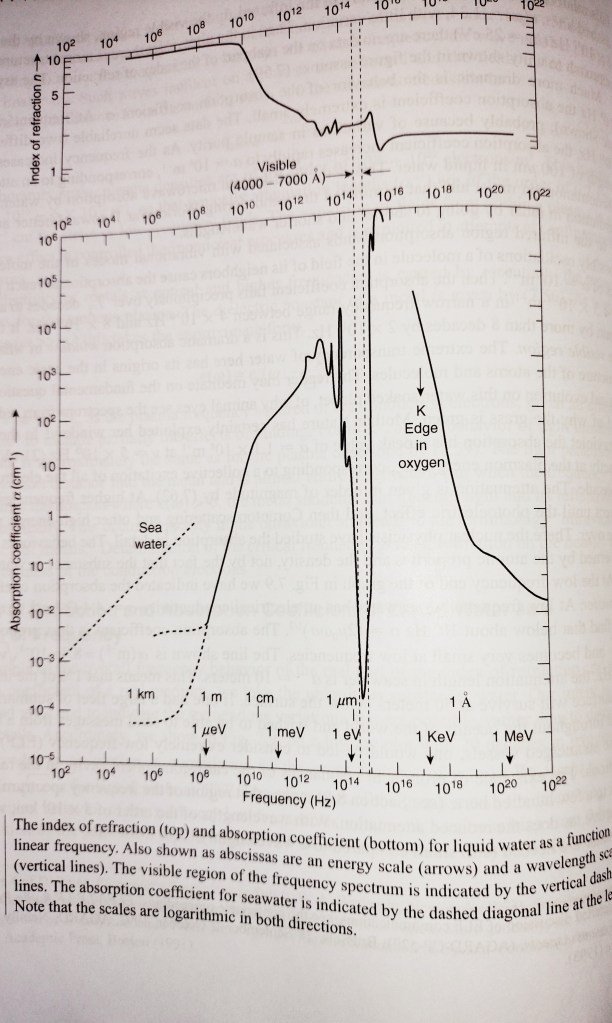
I understand at least some of the physics behind the “greenhouse effect”, without which the Earth would be uninhabitably cold.  Visible light passes through the atmosphere without interacting much with the gases therein—which is why air is mostly transparent, other than the modest scattering of blue light that leads to the sky’s daytime color (and inversely to the color of sunsets).  But such relatively low-entropy, high frequency light is absorbed by the ground, then reemitted as higher entropy, lower frequency light, such as infrared, which is much more readily absorbed by molecules like CO2 and H2O and methane (CH4).  The reasons for this are quantum mechanical in nature, but the fact that it happens is basic physics that’s been well known since before anyone currently alive was born, as far as I know.

And so, these atmospheric gases heat up (and in turn heat up the other atmospheric gases) until the outer surface of the atmosphere is warm enough to radiate out as much energy as comes into the Earth.  Such is the nature of so-called black body radiation.

But for the outer atmosphere to be warm enough to do this, the middle atmosphere must be warmer, and the layer below warmer still, and so on, since outer layers radiate inward as well as outward.  The outer layer of the atmosphere will always be just warm enough to radiate out just as much energy as the Earth receives in light from the sun; if it were not, the Earth would rapidly get hotter until a new equilibrium was reached.  The final radiating surface might end up being higher in the atmosphere, which would mean that, closer to the surface, things would be warmer.

Anyone who has dressed in layers in cold weather should understand this intuitively.

[By the way, there may be some slight imprecisions in my very quick summary above of the thermodynamics of atmospheric gases, so if any experts in the matter would like to make any corrections—especially if such corrections are truly substantive—please feel free to do so in the comments.]

There are other atmospheric effects that are even easier to understand at basic chemical levels, such as the fact that increasing CO2  concentration leads to increasing acidification of the oceans.  This is fairly straightforward chemistry—carbon dioxide, when dissolved in water, partially reacts to form a weak acid—“weak” meaning just that the hydrogen ions do not completely dissociate from the molecule H2CO3*.  This can be demonstrated easily by getting some pH paper (readily available at all high street pH paper shops), testing some neutral water (to confirm its baseline neutral pH) and then blowing through a straw into the water for a few minutes.  You can then check if the pH has dropped, which—if you are a typical mammalian creature from Earth—it will have done.

I think this experiment can also be done with phenolphthalein, which is wine-red when in a basic (alkaline) solution and clear when in an acidic environment.  You can do a sort of magic trick, turning “wine” into “water” with just your breath through a straw bubbling in a glass.  Don’t drink it, though.  I don’t think phenolphthalein is particularly dangerous, but I wouldn’t want to endorse someone imbibing it.

I’m not going to tell you my conclusions about the empirical fact of whether or not “global warming” is happening and how and why and all that.  You can explore the subject as a homework assignment (but don’t hand it in to me).  But I will tell you my conclusion, which is probably obvious, about “believing in” things.  I don’t believe in “global warming” nor in the lack thereof.  I don’t believe in Santa Claus.  I don’t believe in Capitalism or Communism or Socialism or Fascism or Scientism** or Antidisestablishmentarianism.  I don’t believe in the Tooth Fairy, and I don’t believe in life after love.

And I really don’t believe it’s useful or good or anything but an irrationality to “believe in” matters that involve claims about the nature of reality itself.  Reality is that which exists whether or not anyone believes in it—indeed, whether or not anyone exists to be capable of believing in it.  That’s why it’s reality, as opposed to fictions and ideologies and other abstract concepts of various kinds.

I know*** that Amazon delivery people exist.  That doesn’t mean there’s any call to go believing in them.


* H2O + CO2 ⇌ H2CO3 ⇌ H+ + HCO3.  Something like that, anyway.

** Though I have more sympathy for Scientism than most “isms”.

***Not to a mathematical certainty, but to such a high degree that there’s no clear point in considering other possibilities, pending new evidence and/or arguments.