Thoughts meander like a restless Melkor in the Outer Void…

It’s Friday, and this week I can be thankful therefor, because I do not work tomorrow.  The office will be closed (and locked) on Saturday.  Only those who have keys and the alarm code and some other reason for being there would be there (I suppose someone could break in, but there are cameras and alarms in place, and there is nothing of any significant net value, i.e., value worth risking the alarms and cameras to reach, inside).

Next Friday won’t be as good from a strictly work/not work point of view, but at least it will be Friday the 13th again, for the second month in a row.  Then we will have to wait an average* of 7 years for it to happen that way again.

***

Okay, I guess I’ve always known that I’m weird, but I just wrote a series of footnotes about Friday the 13th and year lengths and lengths of weekly cycle recurrences that dwarfed what I had yet written in the main body of this post.  I think I’m probably the only being in the universe that would write about such things and imagine that anyone else would be interested.

Yeah, definitely weird.

Still, I guess that sort of thing just happens when you talk to yourself in print and share it with any interested parties who might stumble upon it.  Also, when one is without companions or interactions one can, like Melkor, develop thoughts and thought patterns that are unlike those of one’s brethren.

I suppose that can sometimes be a good thing, though it can also sometimes be a very bad thing (rarely as bad as in the fictional Melkor case).  Though all improvement is change, most change is not an improvement‒at least not if it’s not deliberate and directed change.  So if one develops thoughts that are significantly divergent from those of all of one’s peers, odds are that they will not be a net improvement over most of the peer-born thoughts.

I have, of course, mitigated against this somewhat by reading a lot (and consuming other media that deal with science and mathematics and philosophy and such, as well as comedy panel shows).  That’s not randomly chosen reading, either; it’s carefully chosen reading.  I think this has helped improve the general content and tendencies of my thought, because I’ve influenced myself with the carefully thought-out thoughts of very bright people.

I suppose, though, that if one can read what one wants and does so, one is not really isolated from all other thoughts, so one’s own cannot be too very different, or at least are not very likely to be.  That’s good, I think.  Simply developing new thoughts without much input from others would be most likely to lead to some sort of feral state or something akin to schizophrenia.  

So, I guess it can be good to take tangents in one’s thinking, as long as they are not too many and too extreme.  But even given that, it’s clearly useful to have someone to rein one in, if one can, when one goes too far off the rails (yes, that’s a bad metaphor, since a train going off the rails at all is in huge trouble, rails representing a near-binary situation‒if one is a train and one is not on the rails completely, one has experienced a failure of locomotion).

Well, I guess that’s that for this week.  Actually, I suppose that is always that, by some principle of identity or self-reflection or something; I’m sure there’s an “official” name.  “It is what it is” as they say.  What I mean, though, is that I am drawing this post, and this week of posts, to a close now.

I hope you have a very good weekend.

After that I don’t give a shit.

(I’m kidding.)


*I know, I know, we won’t have to wait an average number of anything.  There is a specific and exact number of years before the next time February and March have Fridays the 13th, but I cannot be arsed to work it out just now**.

**Okay, well, since I am unable to keep myself from thinking about it at least a little, I think it’s going to be 6 years from now.  That’s because each regular year is 1 day longer than a multiple of a week:  365/7 is 52 with a remainder of 1, so one day longer than an even number of weekdays.  So next February should have the 13th on a Saturday, then a Sunday the following year, but then on a Tuesday the year after that because of the leap year (366/7 is 52 with remainder 2).  Then it will be Wednesday, then Thursday, then Friday.  So 6 years, if my figuring is correct***.

***If it seems counterintuitive that it’s 6 years when the average should be 7, remember that while in this case the leap year makes the next instance come faster, there will be occasional years when Thursday the 13th falls on a leap year and the following year will go straight to Saturday the 13th, the first of another six years (I think) that will be needed for the subsequent Friday the 13th in February.  In any case, 6 plus (6 x ⅙) equals 7, as does 6 + (a x 1/a) no matter what a is****.

****This doesn’t factor in those leap years in which February has a Friday the 13th, but March will not.  That may change the overall calculations somewhat regarding the average time between dual Fridays the 13th, but not the calculations about when the next one will be.

The painful truth – the truthful pain

Please forgive me if I behave or speak as though today were Tuesday.  I know that it is in fact Wednesday as I write this‒it’s anyone’s guess on what day of the week you might be reading it (though I suspect that, for the most part, if one doesn’t read my blog on the day it’s posted, one is unlikely ever to read it)‒but I didn’t write a post yesterday (Tuesday) so I may be a bit thrown off.

I didn’t write a post yesterday because I didn’t go to work yesterday.  And I didn’t go to work yesterday because of pain.  I had already been having a bad pain day on Monday, one in a long string of worse-than-average pain days.  Then, in the evening on Monday, while trying to reach for something in my room, I took a bad step on the tile floor and slipped and nearly fell.

I caught myself, as is implied by the “nearly” in that last sentence, but I wrenched my back significantly, and the night and morning and so on were particularly bad, and I hardly slept and I did not have the energy to go to work, or at least to do so and not spend all my time writhing and snapping at people.  So I stayed at the house.

Regarding chronic pain, I’m fond of quoting Ulrich’s description of Vermithrax from Dragonslayer:  “When a dragon gets this old it knows nothing but pain, constant pain.  It grows decrepit.   Crippled.  Pitiful.  Spiteful.”  I had to double-check and fix a few words to get the quote exactly correct, but the most important parts are always remembered correctly.  And the whole thing feels like it describes me pretty well.

I used to be much more pleasant and amiable than I have become since my chronic pain began.  Though I’ve had problems with depression since my teens and anxiety before that and ASD since I was born (in two different senses), I always tried to be polite and amiable and kind as much as I could.  I always figured that was the real position of strength:  not being in competition with other people but just trying to do your best while others do similarly.

But when one is in chronic pain, it is hard not to be grumpy (presumably even if one hasn’t lost almost everything one had worked to achieve through the first thirty plus years of one’s life, though I cannot know for sure).  I think there are people who have only known me since the time of the beginning of my back problem who would be surprised by how pleasant I was back in the day.

Though, there are those who read this blog who did know me in the past, before the aforementioned time, and maybe they would give a different report.  I can only share my own perceptions and perspective, and I could to a certain degree be mistaken about how I came across to other people.

I’ve never been all that good at knowing what other people think of me.  Because of that, I generally try just to take people at their word, and take those words to have their most straightforward meaning.  If someone hopes to hint at something and I don’t get it, that’s on them.  Hints are overrated even when given and received by people who embrace the practice and consider themselves good at it.  There are too many possible variations and points of incomplete information.

Anyone who has saved and transferred a video file and has also saved and transferred word processor files should grasp the difference, at least if they have been paying any attention.  A video only a few moments long can, despite the latest compression algorithms, have a storage size that dwarfs the size of even, for instance, the word file for the unsplit book Unanimity.

Now, Unanimity is about half a million words long.  It’s certainly the longest thing that I have written.  But a video I did on my phone last week for minor fun, which was maybe 20 seconds long, takes up more than 16 meg, while the combined file size for the Kindle versions of both Unanimity: Book 1 and Unanimity: Book 2 is about 3.5 meg*.

That’s a few minutes of stupid and pointless video which will never be shared anywhere versus a work that took more than a year for me to complete, edit, and publish.

At least it’s fair to say that, from a useful information point of view, my book was and is much more efficient.  Though it requires enough shared experience for others to fill in meanings and images of things described, this is not a requirement that isn’t met by nearly every human on the planet.  Perhaps videos would be better for a truly alien species that was hitherto unfamiliar with human civilization.

Okay, well, that was a weird post, I guess.  I mean that in absolute terms, mainly; I don’t know if this post is much weirder or much less weird than my usual posts.  Possibly every potential interlocutor would have different things to say about that.

I guess that’s okay.  It had better be okay, if it’s true, because if it’s true, there’s nothing anyone can do about that, and they’re already living with it.  This is the Litany of Gendlin, as quoted by Eliezer Yudkowsky, of which I have a screenshot from his book Rationality:  From AI to Zombies, below.

Well, I hope you have a good day, whatever the truth is that you and all the rest of us are living.


*This is according to the AI summary of Google’s search for “Robert Elessar Unanimity file size”.  It’s almost certainly correct, because the info is part of the Amazon description of the book.  But it’s humorous to me that it’s easier to do an AI based web search to find the file size of my own novel than it is to look up the file, since I’m using my phone and don’t have direct access to the original at the moment.

And his brain ate into the worms…

Ugh.  Didn’t we just leave this party?  Evidently, we did not leave it precipitously enough, because here we are‒or at least, here I am‒rejoining it in the morning.

It seems like an ill-advised notion, but then again, I’m not sure who specifically advised me, or any of you, to do it.  There probably were a few literal, formal pieces of advice that we all or each received throughout our lives‒advice about getting up early and going to work and striving to fulfill our potential, and how if we didn’t we were somehow letting ourselves and (more importantly) letting everyone else down.

“The early bird gets the worm” is a typical phrase about such ambition and dedication and hard work.  But like many of us, I’ve often thought that worms are overrated.  They’re not rated highly at all, I’ll admit, but nevertheless, I think they are rated too highly.  Evidently‒according to what I have read‒all earthworms in at least the northern part of North America were killed off in the last ice age.  Nevertheless, plants grew and flourished without verminous help in the soil before Europeans accidentally brought their own earthworms here.

Of course, the saying is metaphorical, I know that.  We’re not really advised to seek earthworms early in the day, though perhaps liver flukes and flatworms and tapeworms and roundworms are also considered as among the worms that might be caught.

No, probably not.

But anyway, even though metaphorical, that saying raises higher level questions, such as, “Is the life of a metaphorical early bird worth having?”

Consider what that life entails:  Getting up (early), pecking around on the ground for worms and probably also for various other insects and their larvae and a few arachnids as well*; trying to avoid, in that process, being caught by some predator (such as a house cat); trying to find and attract a mate when the season is right; helping build a nest, if you’re that kind of bird; guarding the eggs and maybe sitting on them yourself, until they hatch; then, feeding and protecting them until they can fly on their own; then repeating these steps until disease or starvation or one of those house cats gets you.

That’s it.  And while there are many embellishments and flourishes and complications in the typical human life cycle, overall it is much the same as that of the bird.  Why would we expect it to be otherwise?

Admittedly, humans (and humanoids) can dream up other things to do, and some of them are more interesting and fulfilling, from their own points of view at least, than the ordinary early bird pattern.  But though, in the long run, humans as a whole may become significant enough to do something truly meaningful on a cosmic scale, almost all of them have no deeper lives than those lived by the early birds.

That’s not necessarily a bad thing, of course.  Taken with the pertinent attitude, such a life can be well lived and fulfilling.  It probably won’t end happily, because it’s not in the nature of life to be happy when ending; there’s just no real evolutionary benefit to having such a tendency.

Still, before imbibing the so-called Kool-Aid™ of the motivational life-messages‒those social moralities that keep us getting up and joining the rat race (to shoehorn in another animal-related metaphor)‒it would probably behoove us to consider whether that is the life we think we want, to ponder if that overall shape and experience are okay with us as the outline of our lives.

If so, there’s nothing wrong with that.  As long as you’re not interfering with other people’s ability to try to live their lives as they try to see fit**, then do what seems best to you.

But it’s useful to think about what might be the overall shape of your life if you continue as you currently are and if that shape will be aesthetically (or otherwise) pleasing to you.  If not, what change might improve that overall shape, trying to take all reasonably plausible inputs and outputs into consideration?

I won’t say that the unexamined life is not worth living, because, if it’s unexamined, how do you know that it’s not worth living?  Huh?  Huh?  Nevertheless, I will say that the unexamined, unconsidered life could be fulfilling only by accident, whereas it may be possible, with deliberation, to steer toward a better one.

Not that I’m a good piece of evidence in favor of this.  I think and overthink to the point that I hate the noise of my own mind, but I haven’t been able to steer myself into an optimal shape***.  But at least I make a lot of “noise” about such things.  That might be worth something.

Anyway, have a good day.  Enjoy your worms or salads or whatever other life forms you kill and consume to remain alive today (I’m assuming you are not a green plant).  Watch out for the Kool-Aid™ and even more so for the cats.


*I am quite sure that, to such a bird, these things taste delicious, so I don’t mean to disparage their diet as unpalatable.  Appetites of various kinds are species specific; what’s appetizing or sexually attractive to, say, a housefly is unlikely to appeal to any psychologically healthy human.  Likewise, the most beautiful human woman ever is not going to do anything for a male tarantula.  He also probably would have no interest in having a bite of her salad.

**This is more difficult to navigate than it may seem at first, because even when one is acting on one’s own, there are always effects at some level, there are always “externalities”, and occasionally these will have an impact on other people‒a foreseeable but perhaps unforeseen impact.  And vice versa.

***Should there be a “yet” at the end of that sentence?  I don’t know; we’ll have to see what happens to me in the future.  We can be reasonably sure, though, that there shouldn’t be a yeti at the end of that sentence, or of any sentence except one that mentions such creatures.

A notification of whatever

I expect this post to be brief today, though I’ve been known to be wrong about that sort of thing.  I had sort of “intended” to make my headline “Oh, well, whatever…” and then make the entire body of the post “…never mind.”  Thus I would be quoting the last verse-line of Smells Like Teen Spirit by Nirvana.  The subsequent words in the song are just the chorus and then a refrain of “A denial” repeated nine times (if memory serves).

I wasn’t sure I hadn’t already done this before, though.  I could have checked, but I didn’t have the mental energy.

Still, using that last line from a Kurt Cobain song carries a certain subtext which would have served my purposes well.

Or, well, actually, given past history, it probably wouldn’t have served my purposes at all.  None of this sort of thing seems to serve my purpose, no matter what I do.  As far as I can tell, only one person actually read my (admittedly somewhat long) post yesterday, but though I was borderline explicit about my meaning, I don’t think it did any good whatsoever.  That’s not unusual, of course; much if not all that I do never ends up doing me much good.

Sometimes I have to be subtle because I cannot force myself to be open about my internal states after a lifetime of fighting to appear “normal”, to the degree I can achieve that, and to avoid being too much trouble for other people, since I don’t think I have the right to trouble them, and in fact I think (or feel) that I’m fundamentally reprehensible.

I shouldn’t worry, though.  The times I am more open and obvious‒even when I am borderline explicit‒don’t appear to be any more successful than when I am at my most cryptic.  Possibly, I am just not able to communicate my feelings effectively with humans.

At the very least, my success rate must be below one percent.  It’s not quite as bad as playing the lottery, but it’s pretty pathetic.  Then again, so am I.

Whatever.  Never mind.  Ha ha.

But really, though, I don’t have much to say.  Quoting iconic songs may be the extent of my capacity to convey myself.

Ironically, I don’t feel the urge to share quotes from my own songs (or my fiction).  You would think they would be the best choice for conveying my inner thoughts.  That’s not always the case, though.

In fact, though I like my songs well enough, and Breaking Me Down is meant to be fairly explicitly about depression (at least my species thereof), none of them have enough oomph, as it were.  Or maybe it’s just that they are not well known*, so no one recognizes and identifies with the words.

I think I have some pretty good lines in Come Back Again, including what’s probably my favorite:

“Only meeting strangers

always losing friends.

Every new beginning

always ends.”

It may seem a bit bleak, but it’s also true more or less by definition.  If you’re meeting someone for the first time, they had been a stranger until that point.  And friends do become “lost”.  And the next two lines are rather obviously true.

Of course, a very good signing (singing?) off quote would be from Pink Floyd’s Time:  “The time is gone, the song is over, thought I’d something more to say.”

I’ve always been annoyed that they added the little reprise of Breathe after that and made it officially part of the song, because those other two lines constitute a perfect song ending.  I always figured they didn’t want to make the song end on too much of a downer, so they threw in the reprise as part of that song instead of as a separate one.  Maybe they were unwittingly invoking a version of the peak-end rule I mentioned the other day.

Anyway, I have a locked and loaded draft of a blog post that already applies that couplet from Time, with the headline being the first half, continuing into the post which consists only of the second half of that quote, followed by the embedded “video” of the final song on the first album of The Wall.

That, of course, is still a draft, and has been waiting there for a while, because if I use it, it’s meant to be my final blog post, and practically my final anything.  So I wasn’t going to use it today.  Not quite.  But I’m close.  The Nirvana quote isn’t quite as final, but it is a warning, especially given the fate of the guy who wrote it.

Anyway, consider yourselves on notice.  On notice of what?

Figure it out.


*That’s an understatement, eh?

This is not an attention-grabbing headline

I’m writing this post on my smartphone, even though I brought my lapcom with me yesterday evening.  I did not use my lapcom for yesterday’s post, such as it was.  I didn’t even write that post in the morning yesterday, or at least, I didn’t write the “first draft” of it then.

By the end of the workday on Wednesday, I didn’t feel like I was going to want to write a blog post on Thursday.  So I went to the site directly and just wrote the “Hello and good morning,” and the “TTFN” and set it to publish later.

I already knew what title I was going to want to use for it.  I wanted to use Polonius’s dithering, meandering jabber about brevity being the soul of wit, as a sort of left-handed self compliment about my own brevity in that post, and because, in the original form, it would have made the headline longer than the post, which would be ironically funny, in principle.

Then, yesterday morning, I got the urge to put my little “insert here” bracketed bit in the post, the better to convey how disgruntled and disaffected and self-disgusted I (still) felt, as well as how tired.  It did sort of spoil the joke about the headline being longer than the post, of course.  At least the older joke about Polonius still holds water.  Then again, that joke was made by Shakespeare, so we shouldn’t be too surprised if it has serious legs (though this raises the question of how serious legs could possibly hold water).

One thing worth at least assessing this week might be whether there is an aesthetic difference between this post (for instance) and the posts I wrote earlier this week, on the lapcom.  Writing on the lapcom is quite different for me in many ways.

On the lapcom, I generally have to work to stop myself before a post, or whatever, gets too long.  Whereas on the smartphone, that isn’t as frequent a problem.  Not that I can’t yammer on and on even with the smartphone, of course.  Some might say all I ever do is yammer on and on.  But anyway, I can’t write as “effortlessly” on the smartphone as I can on a regular keyboard*.

Sorry, I’m retreading a lot of old ground here, which I guess is better than retreading a lot of old tires. I know how to tread on the ground; indeed, I cannot recall a time when I didn’t know how to do that kind of treading.  Whereas retreading a tire sounds like something that requires special skills and equipment, both of which I lack.

I don’t know, I’ve heard of “retread” tires, but I don’t know if such things still abound, or if they ever did.  It sounds vaguely like a bad idea, like such tires might be more prone to blowouts.  But latex is a finite resource, and there aren’t very good synthetic alternatives, so maybe there’s at least some cost/benefit tradeoff (or treadoff?) there.

Ugh.  With that last joke, I probably convinced at least some of my readers that, yes, the world would be better off if I were dead.  Actually, I say that as if it were conditional, but it’s not.  It would be more in line with reality to say “the world will be better off when I am dead”.

There’s a quote by which to be remembered, eh?

I cannot say whether I will be better off when dead.  It’s probably a nonsensical question.  When I am dead, I will not be anything at all, not better, not worse, not uglier.  What happens to virtual particles after they have annihilated?  Nothing, and less than nothing, for they truly no longer exist, and in some senses they never existed.  Indeed, as physics goes, they probably never do exist; they are a shorthand description of what happens in quantum fields when perturbances in the fields have effects that do not rise to the level of actual, true particle production.

Or so I am led to understand.

From another point of view, it is possible for something to improve, at least in a sense, by ending.  I’ve mentioned this before, but if the curve of a function‒perhaps a graph of the “quality of life” or one’s “wellbeing”, to say nothing of happiness‒is persistently negative, then returning to zero is a net gain.  It can be a huge net gain, in fact.  This is related to the origin of my own version of an old saying, which I use with tongue definitively in cheek:  The one who dies with the most debt wins.

Now, of course, the integral, the area “under” that wellbeing curve would not be improved by the curve reverting to zero and stopping.  But at least that integral would not keep getting more and more negative over time.

Some might say, “well, the integral can become less negative over time, and might even become positive”.  This is, in principle, true.  And when one is younger enough, it’s relatively easier to tip the curve, and its integral, into positive territory.  But as the curve goes on, having been negative for a longer and longer time, it’s going to become ever harder to bring things to a net, overall positive integral, even if one could reliably make one’s curve positive (which one often simply cannot do).

Of course, the moment to moment experience (which is all the mind really gets) of an ascending curve could be pretty darn good, and might well be worth experiencing, even if it’s not enough to bring the integral into positive territory.  We are straying into the “peak-end” rule here, which was elicited regarding (among other things) colonoscopies but applies to much else in human experience.

Speaking of peak endings, I’ll mention in passing the curious fact that, no less than twice in the last week, the evening train service has been disrupted by someone either getting hit by or becoming ill next to the train.

Earlier this week, right by the station where I catch the train to go back to the house, there was a man who looked like he was probably homeless and had collapsed next to the train tracks not far from the station.  I saw him brought away, finally, on a stretcher.  He didn’t look physically injured‒certainly not in the ways I would expect someone who had actually been hit by a train to look‒but he did look cachectic, which is why I thought he might be homeless.

Then, last night’s commute was interrupted by what they call a “trespasser strike”, one that did not involve the train I rode but which always slows everything down.  I’m vaguely amused by the euphemism “trespasser strike”.  A “trespasser” here is a non-passenger who doesn’t work for the train company (or whatever) who is in the area adjacent to the tracks.  The “strike” part is probably self-explanatory.

I suppose it’s literally true, at least from a legal point of view, to call the person a trespasser.  But it’s amusing that the train people have to say something derogatory about a person hit by a train‒even if the person deliberately put themselves in harm’s way‒to sort of, I don’t know, assuage the company’s conscience.

But we are all trespassers, in at least some senses.  We are also, in other senses, all owners.  We are all innocent, and we are all, in some other senses, guilty.  “Every cop is a criminal and all the sinners saints.”  Above all, we are all very much just passing through, staying only a very short time.  We are all virtual particles.  Or you might say, we are all Iterations of Zero.

Have a good weekend.  I should not be writing a post tomorrow (in more than one sense).


*I wish I could honestly say that my use of a piano-style keyboard were as effortless, but I am terribly rusty with that, though I started learning it when I was 9, a rough 2 years earlier than when I got my first typewriter.

“Like”, “comment”, and “share” (if you feel like it)

I’m very tired this morning.  By which I mean I’m more tired even than usual.  My head is a bit foggy—more so than usual, again—and I feel like I just belong lying down inert, perhaps in an open-topped coffin.  I’ve occasionally thought that they looked like good places to sleep.  It seems a shame to waste them on people who are already dead.

It’s Wednesday today, and I don’t think I’m going to have anything nearly as thoughtful to say as what I wrote yesterday, which was at least rather “deep” if not particularly useful or helpful or interesting to any of my readers.  I did get an interested comment on my take on one of the reasons mindfulness is useful, and that’s always nice.  I’d love to encourage greater feedback from more of my readers, here on the site in the comments, but I don’t know what to do to encourage them [I decided just to do a little cajoling in the headline, in case that works].

Probably there is just some percentage of people who tend to comment, no matter the situation.  It’s a bit like the long-known “fact” (which may or may not be a true fact) that every advertisement, from flyers/mailings to commercials, actually elicit a response in only about two percent of people who interact with it.  I suspect it’s probably similar with things related to blogging and social media and the like.

One sees it most readily on places like YouTube.  The number of views of a video is almost always something like an order of magnitude greater than the number of likes (and often it’s larger than the number of subscribers), and that’s still larger, though by a ratio that’s not as clear to me, than the number of people who comment (let alone share).

My own YouTube videos (and those of my published songs) are poor examples, or perhaps one might say “poor samples”, not representative of the phenomenon as a whole.  I have a number of “views” on my music videos that is generally a couple of orders of magnitude larger than the number of “likes”, but I know why that is.

Almost all of those views are from me, because I put my songs in my YouTube music playlist, and so I have listened to them often, back when I used to ride my scooter to work and back.  I had a lovely Bluetooth enabled helmet.  I like to listen to songs and sing along in a car, or similar, when I’m on my way places*.  So I’ve listened to my own songs probably orders of magnitude more times than everyone else put together has listened to any of my songs.

It’s kind of pathetic, isn’t it?  I’m also the one who has bought more copies of my books—because I gave copies to the people in the office—than everyone else put together, I’m fairly sure.

As for this blog, well, I get a higher number of likes relative to number of readers than I do with anything else, and I even recently have been getting a comment or so most days, which is very nice.  There’s at least some interaction.  It would be nice if I could reach a larger audience, but I’m not terribly good at self-promotion.  I am pretty good at self-denigration, though.  In fact, I’m one of the best there is at it!

Ha ha.

Well, like the song says, it’s all just a drop of water in an endless sea.  Or, it’s all just spit in the ocean** as more people probably say.  My spit may be more purulent than average, but it’s all still just spit.

Anyway, I don’t know what else to discuss today.  I’m very tired and worn out and I’m in ongoing pain that only responds somewhat to all the mitigating things I try to do, at least so far.  I’ve been through a quarter of a century of trying, and I have not been passive nor uncreative nor ignorant in my attempts.  As those reading might notice, I’ve thought about this matter a lot.  You probably would also if you were in chronic pain for nearly half of your life (so far).  It has a way of garnering your attention.  It’s built that way.

It’s interesting to note that shortly after I’m sixty, if I’m still alive***, I will have been in essentially constant pain for half my life.  After that it will become a majority (unless I’m cured at some point along the way, of course).

I occasionally (not often, though, because it’s too disheartening) wonder what my life would be like, what I would be like, if not for my chronic pain.

Things would almost certainly be vastly different.  I cannot be certain that they would be better—there are probably at least a few things that would be worse.  But it seems likely that my life would be much better overall, if only because I wouldn’t have a huge chunk of my will and energy stolen by being in pain all the time.  That constant pain really does make everything else harder.

But no matter the state of the rest of my life, at least one thing would be true (by “definition” in this case), and that is that I would not be in pain every fucking day of my stupid useless life.

Surely that must be worth something.  It would not be worth not having my children exist, but almost everything else would be worth trading.  I sometimes think of it as parallel to a line from Me and Bobby McGee:  “I’d give all of my tomorrows for a single yesterday, holding Bobby’s body next to mine.”  It’s nice poetry, albeit a bit weird to think about temporally.  But in my case, I think of it as basically saying I would gladly give up some significant fraction of what would otherwise have been my future if I could be out of pain.

But, of course, my future is less valuable to me now at least partly because I am in pain.  If I were not in pain, ironically, the future would be much more valuable, since it would be at least somewhat less uncomfortable.  If I could be free of depression, and the tendency thereto, that would make things better still.  That might even constitute a future worth having.

Yeah, yeah, I know, wishes, horses, manure, beggars riding, dogs and cats living together, watermelon, cantaloupe, rutabaga, yada, yada, yada.  I’m wasting my time and yours.  And I’m writing too much, because I’m using the lapcom, and I’m not saying or doing (or being) anything at all worth saying or doing or being.  This is all just stupid.

I hope you all at least have a good day.  I would not mind if this were my last one.


*I can’t do it anymore because I don’t ride or drive anywhere anymore, so I am not “alone” when commuting anymore.  I’m also not alone at the house.  It’s really quite disappointing.  I like to sing.

**This is a bit amusing:  I made a typo when I first wrote that phrase, and it was rendered as “spit is the ocean”, which seems almost like some vaguely deep thought about how oceans are lived in, swum in, excreted in, and bled in by numerous living creatures.

***Right now that seems a horrifying prospect.

Pain, pain, go away…and don’t come back some other day

I’m writing this post on my smartphone today, because I decided not to bring the lapcom back with me on Saturday.  I was very tired and sore and worn down from the week and felt that even that small extra weight was more than I cared to carry.

I got at least a bit of physical rest yesterday, but my mental rest was poor, and was somewhat disrupted by a few seemingly minor things that happened.  Worse, though, is the fact that I tried to sedate myself on Saturday night somewhat, but still woke up by two in the morning, after maybe four hours’ sleep.

It’s quite frustrating, as I’m sure you can well imagine.  I suppose it’s better than being one of those people who never seems to be able to wake up on time or to get places on time.  I don’t know how such people would have survived in the ancestral environment.  I suppose it’s just as well for them that they don’t live in such an environment.

So, anyway, I was both rather stressed out and unrested on my “day off” and now I’m no better rested, because I slept even less last night.  Also, my pain, which doesn’t like to become too boring (except in describing the character of the pain), has shifted its focus, and now it is my entire lower half (umbilicus down) that is achy and sore and doesn’t want to move.  Neither side is worse, but neither side is better*.  Although my left middle back and side are way more tight and sore than the right, and my left shoulder still has that weird, seemingly neurological, stiffness and pain.

It would be nice to be able to walk to the train this morning; the weather is not bad for it, and it would be a slight money-saver, though a time loser (but my time is mostly wasted time, anyway).  Unfortunately, I don’t know that I am physically up to the task, and I fear it might exacerbate my pain.  That’s never a good thing.

I wish I still had a scooter, or one of those electric scooters or bikes‒or better yet, that I could ride the bike(s) I have without having to fix their tires and such.  Maintenance of such things is really difficult for me, though; it’s not difficult to do as it were, i.e., the tasks are not in themselves particularly challenging physically or with respect to knowledge or dexterity.

It’s a matter of will in a sense.  Also, these kinds of tasks seem to do something akin to or analogous to creating an allergic reaction:  they make my mind itch horribly, and itching is, of course, a kind of pain, and my mind only has the reserves to deal with so much pain at any given time.

I seem able to regenerate less and less of that reserve each day‒either that or just my reserves are constantly being depleted at a rate faster than they can recover and so there are no “reserves”, just a base rate process that is in the net negative on average every day, and which will eventually run out and that will be that.

I don’t know what will happen then.  I’m honestly surprised that it hasn’t happened already.  Maybe it has.  Maybe this is me without any actual capacity to deal with anything other than those things which are more painful for me not to do.  Hmm.  That’s a vaguely interesting thought.

Whatever the best description is, I am very worn out.  More and more‒or so it seems right now‒I have no sense of any future for me.  I can’t even readily imagine my own future; I can’t see how a future can possibly happen that entails anything but quietly catastrophic dissolution.  And, of course, my pain doesn’t help my mood disorder(s) and my mood disorder doesn’t help it.  It’s another one of those cycles that has a vicious streak a mile wide.

Whenever I mention a vicious cycle, part of me nearly always thinks of the words “viscous cycle”, and I think vaguely about what might constitute a viscous cycle.  If any of you have any amusing thoughts about that, I would be delighted to hear them.  I could use a bit of a laugh today.

I’m really worn out, and it’s only Monday.  I don’t know why I bother.  I mean, I could give causal explanations, of course‒all things that happen in the ordinary world have causes‒and my descriptions would probably be fairly accurate and correct, though probably incomplete.  But as for reasons, that’s another matter.  Coming up with those is more difficult, and some of them are quite tortured.

In Man’s Search for Meaning, the author and psychologist Viktor Frankl points out the notion, not original to him but poignantly and painfully rediscovered by him in a profoundly visceral way in the concentration camps of Nazi Germany, that a person can endure nearly anything if they have a purpose, a reason, a meaning.  But such meaning is not always there to be found, and I don’t want to try to embrace a false one; and though it is possible for people to make meaning for themselves, my knack for that has worsened over time.

Again, the pain wears away so many things, as it has also stripped away so many people and so much property and so many accomplishments in my life.  I think I would be quite a different person, or at least there would be a real difference in balance in my personality, if I could be free of anything but more ordinary pain.

I wouldn’t even complain about being “comfortably numb”.  I know pain is biologically important, of course, but mine has gone well into the region of diminishing marginal returns, then rounded into negative marginal returns, and its net value crossed the x-axis downward a long time ago.  It might be nice to experience at least a brief period of having pathologically too little pain.  Even if it would make me vulnerable to injury and illness, I wouldn’t mind much.  It’s not as though I don’t crash up against illness and injury (in some sense) every day anyway.

Oh, what’s the point?  I’m sorry to bore you all with this nonsense.  I really should just call it quits, because this is at least as pointless as anything else I do, and that’s saying a lot.  It almost certainly does not do the world any net good, and I’m not sure whether it does me any good.

I guess I’ll keep doing it until it becomes more painful to do it than not to do it.  Or until I die, I guess.


*I sometimes like to indulge a clever paradoxical descriptive trick I picked up from Piers Anthony by saying something like “each leg hurt worse than the other one”.

Happy Valentine’s Day, you filthy animals.

Well, guess what.  It’s Saturday now, and I’m writing a blog post, which can only mean that I am working today.  At the last minute, the schedule of the office was changed and now we’re working.  And we’re supposedly going to be doing this now every other (meaning alternating ones) Saturday.  But, of course, I worked last Saturday.  And who knows how things will change in the future?  I’m pretty sure not even the boss knows, because he changes the specifics somewhat irregularly, though there are always colorably reasonable purposes behind such changes.

I suppose I could merely have said, “No, I’m not coming in this weekend.  I worked last weekend, I had to walk to the bank after work and I caused my knees and my pain in general to flare up badly, and that problem continues.  I need a fucking break.”  But, of course, I’m not really built quite that way.  I have been too strongly trained to operate on the approach that to shirk going to work is to be a jerk*.

So, here I am, at the office, and it’s the middle of the night.  That’s right, when it got to be time to leave, I was in too much pain to want to ride the train‒it’s not comfortable to sit in, and I usually have to go to the upper levels to find a seat, which is a little exacerbating and occasionally exasperating‒and I didn’t want to pay to Uber back to the house like I did on Monday and then Thursday for the above reasons, so…I stayed here in the office overnight.

I’m tired of being in pain, I can tell you that.  I wish it were the sort of thing one could simply “get used to”, but biology does not tend to select for creatures that can get used to and ignore pain.  That would defeat the whole usefulness of pain.  Make no mistake:  like fire alarms, pain was and is (and probably always will be) terribly useful.  And “terribly” has more than one legitimate meaning here.

The trouble is that in the modern world, we suffer from and yet survive injuries and disorders that would almost never have been survived by our ancestors, and we can live on with the consequences of these injuries and illnesses for decades, but our nervous systems don’t have any clear function that suppresses or diminishes pain after a while.  There’s no selection pressure favoring such a thing.  Even for our ancestors who might have survived to have chronic pain, that problem tended to develop after peak reproductive years had already passed, and so evolution literally could not and cannot detect the issue.

Indeed, it’s just barely conceivable, though by no means demonstrated, that it might be good for male humans who have injuries that hamper them to feel the pain worsen, to have it lead to them removing themselves from the population in one way or another.  When they can no longer be physical providers, in order to increase the share of resources for their offspring and their other kin, they can kill themselves, directly or indirectly, giving the genes they share with close relatives that harbor that tendency a selective advantage.  This is hypothetical, bordering on speculative, but it might make some sense.

This could also be related to female humans being better suited to endure long-term pain than males, since matrilineal support among human tribes is common***, but that’s getting ever more speculative.

Don’t get me wrong; the ideas are plausible.  But it’s just when one’s ideas are strongly plausible‒but not specifically tested or backed by clear and specific evidence‒that one must be especially harsh and strict with oneself.  It’s comparatively simple, and psychologically rewarding, to come up with plausible and logical hypotheses, but even if one is very smart, most of one’s hypotheses are going to be incorrect.  Whether you’re more Popperian or more Bayesian, the crucial usefulness of testing a hypothesis to try to refute it or to see how your credences shift is inescapable.

This mildly interesting digression doesn’t change the fact that I am in searing pain lately, and it doesn’t seem to diminish much for long.  I’m already prone to dysthymia/chronic depression (veering into the acute stage frequently) and anxiety with at least some obsessive compulsive patterns, all of it occurring in a nervous system that is…atypical from the start.

I hate the world.  I hate my body.  I hate the twisted mockery my life has become.  I hate large parts of my mind (but not all of it).  I hate being around people.  I hate being alone.  I really just ought to stop the whole fucking ride and get off.  I just need to work up the nerve and the commitment.  I’m getting there, believe me.

Anyway, I hope you’re having just a lovely Valentine’s Day.


*And to rhyme all the time is to act like a slime and be covered with grime**.

**I know, none of that makes sense.  It’s not really meant to make sense.  I just accidentally did some internal rhyming in a sentence and that stimulated me to do more of it.

***There are good biological reasons for this as well.  Mothers, and therefore maternal grandmothers, all know whether a child is their child or not, so it’s easier to know that it’s a good idea to spend effort and resources on those descendants.  Males, in general, can not be as certain.

“‘Cause I’m your superhero. We are standing on the edge…”

Well, it’s Friday the 13th.  That’s at least one good thing about today.  And, of course, next month will also have a Friday the 13th, as I’ve noted previously (I don’t know specifically in which post I noted it, and I don’t really have the urge to go figure it out, so I’ll leave that to you to do if you’re interested).

It is slightly interesting to think about the fact that, on average, one of every seven Februarys will have a Friday the 13th, but not all of those will then lead to a subsequent Friday the 13th in March, because every 4th February will have 29 days*, by the Gregorian calendar, which is the one the world uses overall.

So, the total fraction of years with dual Fridays the 13th would be something like 1/7 minus a further ¼ of that one seventh—so 4/28 (i.e., 1/7) minus 1/28 (1/4 x 1/7), which leads us to the rough conclusion that only three out of 28 years will entail February and March each having a Friday the 13th.  That’s slightly less than one out of every nine years.  And since I’m 56, which is twice 28, I should have experienced about 6 such years in my life (perhaps counting this year).

Mind you, the numbers aren’t quite right overall.  The Gregorian calendar waives the extra day in February on years that are divisible by 100, i.e., the turns of centuries.  However, there’s a further exception to that:  the turn of a millennium, like what we all just had in the year 2000, does keep its 29 days in February.  So that brings the average closer to the raw number, but doesn’t account for the extra  ones that happen at more ordinary turns of centuries.

Of course, the only turn of a century through which I have lived—and through which I am likely to live**—was indeed the turn of a millennium, so I guess for me, the fraction 3/28 should be fairly accurate.

I could, if I were so inclined, go back to the first year in which I experienced a February—that would be 1970 (AD or CE)—and work through them to find out just how many dual Fridays the 13th I’ve experienced.  With modern computer-based calendars it would even be relatively easy.  But I don’t think I am so inclined.

Okay, that’s enough of that for now.  Actually, it’s probably too much of that, at least from any normal person’s (i.e., not my) perspective.  On to other things.

I’m writing this post on my mini lapcom, and I wrote yesterday’s post on the lapcom as well; I am doing this partly to spare my thumbs, but also to try to encourage myself to use the lapcom more and maybe even to write fiction again.  I don’t know whether or not that will happen, but it’s also just more natural for me to use the lapcom.  I’ve been typing, in one way or another, since I was 11 years old, if memory serves.  Clearly I have not been using a smartphone nearly that long, because they have not existed for that long.

Also, even when I saw the imagined future tech on Start Trek:  The Next Generation of tablets with virtual keyboards, I thought they looked like a terrible idea.  How lame, how unaesthetic, just to tap at a flat screen with no real keys.  Also, the “keys” on such devices in the real world are too effing small to be used to type in any traditional way.  Not but what one can get to be pretty speedy with them—I can zip along pretty well on my smartphone—but it’s nothing compared to being able to use one’s whole set of fingers to write.

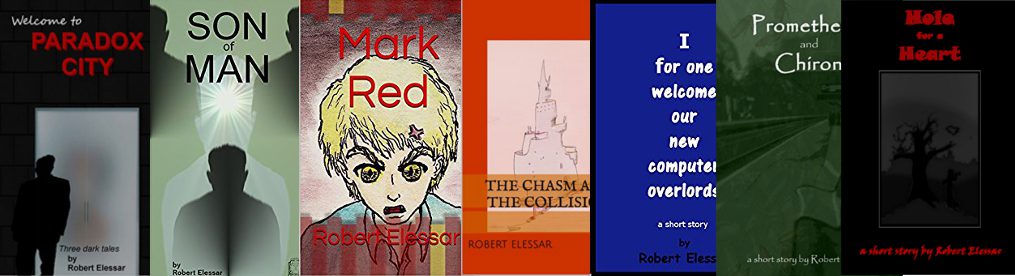
Although, I’ve often touted the value of writing things longhand before retyping them into the computer, especially for fiction, because it can slow one down beneficially.  I did that—because I had no choice, being at the time a guest of the Florida DOC—with Mark Red, with The Chasm and the Collision, and with the “short” story Paradox City.  I don’t know whether they come across as better or worse or indistinguishable from the stories I have written directly onto the computer.

I would say that they might tend to be shorter, but Paradox City is a nominally short story that was about 60 hand-written pages long, so that didn’t make things much shorter.  Also, I think The Chasm and the Collision is longer than Son of Man, but that may just be a function of the nature of those stories.

Certainly Unanimity is longer than anything else I’ve written, by quite a margin, but that surprised me as much as it might anyone else.  I just started writing the story and it ended up taking that long to tell it.  That happens.  Outlaw’s Mind began as an idea for a short story, but there was definitely a lot there implicitly, even in the original idea, that made it unreasonable to plan to make it “short”.

Anyway, if any readers of this blog have also read my stories and have noticed any tendency toward difference between the initially handwritten and the entirely computer written (meaning written on a computer, not by a computer, unless one is referring to me as a computer) ones, I’d be pleased to get your feedback.

In other personal news, well…my pain is leveling off a bit, though my leg joints still feel loose and floppy and unstable, so I have to be careful, and I have my general persistent tension and neuropathic discomfort in my lower body.  I’ve tried to adjust (and decrease) my workout a bit to compensate, and that seems to be doing some good, but I cannot go without working out, because that tends to make my pain worse.

My mood is pretty much as it usually is, but I’ll spare you that hellscape out of courtesy.

Tomorrow is Saturday, and I am not supposed to be working this weekend.  If that changes—in other words, if I do work—I guess I’ll write a post.  Though, really, I should try to get back into Outlaw’s Mind and finish what I had started earliest so I could then get on to newer things.  And if wishes were horses, we’d all be drowning in manure***.

Tomorrow is also Valentine’s Day, but this is of no relevance to me, and that holiday hasn’t been relevant to me for more than 15 years, possibly quite a bit more.  It is not likely to be relevant to me again this side of the grave (and even less likely to be relevant on the other side).

I hope you all have a good weekend, even those of you who have loved ones with whom you can revel in the romance of the holiday.  It’s not your fault that you piss me off.


*This means, of course, that there will be some March Fridays the 13th in years where there was no February Friday the 13th.  If my figuring is correct, those will be the leap-year Februarys in which the 13th falls on a Thursday.

**If I were to be alive in 2100, I would be 130 years old, which would make me even with the Old Took, and which would be substantially older than any human is known to have lived.

***And ironically, any wishes for the manure to go away would just make things worse!

Self-love, my blog, is not so vile a sin, as self-neglecting.

Hello and good morning.  It’s Thursday again, despite all misgivings, and I’m writing my official Thursday-style blog post because I cannot think of anything better to do.  Okay, well, I can think of better things to do—surely there is a functionally limitless number of possible better things—but I am not up to or capable of doing anything better, so here I am.

It would be great if I were writing fiction instead, here in the morning before/on the way to* work.  Then I could feel as if I’m accomplishing something.  Even if nearly no one reads my fiction during my lifetime, there’s always at least a chance that someone will pick it up and it will become beloved after I’m gone.

Heck, Moby Dick didn’t do well in Melville’s lifetime, but it’s now considered one of the great American classics of literature.  Even Khan quoted and paraphrased it in Star Trek II:  The Wrath of Khan.  Not that he’s maybe the best role model (and he is a fictional character) but nevertheless, the book is a classic great enough to have been imagined to live on into the 23rd century.

I guess this conundrum is part of why authors use agents to try to sell their works to publishers and use publishers to try to sell their works to the general public.  It’s a sensible division of labor, of course, and specialization often improves efficiency.  But who is available to help sell authors to agents at that level?

The way things are set up in our culture—and no, there’s no indication that this was planned by anyone, it just sort of happened emergently—we reward those not necessarily who are the best at doing something, but who are the best at self-promotion.  In other words, we reward those with a tendency toward narcissism, and the results show themselves all too well in our entertainment, in our businesses, and perhaps most horrifically and pathetically, in our politics.

Then, of course, you get gifted artists like Kurt Cobain, who was never really narcissistic as far as I can tell—he said he had wanted just to be in a band in the background, maybe playing rhythm guitar, but was instead the front man of a huge band and almost the face of a genre of music in the nineties.  Having him there made all the other people (and him as well) lots of money, and it brought joy to many fans.  This latter bit is good, of course—more joy, ceteris paribus, is better than less—but it can put a lot of pressure on someone who has negative self-esteem issues.

How many of the premature deaths—by clear suicide as in Cobain’s case or by effective suicide among people like Janis Joplin, Jimi Hendrix, Jim Morrison, etc.—of successful artists are due to some form of rock star imposter syndrome?

This is not to say that sometimes narcissism, in moderate doses, cannot pay off, for the person and for everyone else.  Mick Jagger probably has a bit of narcissism in him, for instance; I remember him once describing himself as “just another girl on the runway” with a smirk on his face.  He clearly liked/likes attention.  But you don’t get the impression that it’s too pathological in his case, and the world got some great songs out of it.

Then there’s Freddy Mercury, who was certainly a bit of a diva, but popular music was all the better for that fact.  He did, of course, end up cutting his life short, but in a very different way from the Joplins** and Cobains.

Then there is someone like David Bowie, who changed rather constantly across his career and who always seemed just to be who he was, even when he was assuming other identities.  He was just an artist, I think (though he had his own issues with drugs, etc.).  Though, he had a competitive nature, too (his Life on Mars was his “revenge” on the song My Way, for which his proposed lyrics had been rejected).

I think it’s a bit more complicated but similar in the case of Radiohead, though all the attention and touring surrounding OKComputer did apparently nearly drive Thom Yorke to a “nervous breakdown”.  I have my own theories about why this was so hard for him, but I won’t get into them now, because they are very self-referential and, well…narcissistic in a sense.  In other words, I suspect Thom Yorke is in some ways like me and had troubles similar to ones I would have in his exact situation.

Anyway, that’s probably enough BS for today.  My pain is not quite as severe as it was, but my various joints still feel like they are not fully connected, and moving is painful—but sitting still gets painful after a while, too, so it’s not an easy way out.

Hey, you know what?  I thought of an idea.  If anyone out there has the resources and the desire to take in and support an author so he can work full-time writing fiction (and even some nonfiction and possibly some music, since I would have more time), please get in touch.  I can’t honestly say that I’m the tidiest person in the world, but I do my best to keep my untidiness to my own areas.  I am also a decent cook; that’s practically genetic in my case.

I would put you in the dedication to any books and other stories I finish, and of course, if I make it big, you’ll get your share.  If you have promotional skills (or connections), they would be a definite plus.  I am neither spayed nor neutered, of course, but I am woefully, painfully shy and self-effacing, so you don’t have to worry too much about “unwanted litters” and related issues.

Okay, enough silly pseudo-personal-column nonsense.  I am trying to be upbeat and silly**** to distract myself from pain and avoid despair, at least to the degree possible.  It may be true that “freedom’s just another word for nothing left to lose”*****, but despair is still not very much fun.  It can be weirdly freeing—thus the lyric—but it’s not fun.

TTFN


*If you simplify that expression, discounting the spaces, you’re left with bfre/nt2hwayo.  I think I did that correctly.  If anyone catches something I’ve missed, please let me know.

**I remember when I was quite young and first heard of Janis Joplin; I wondered if maybe she was a descendant of Scott Joplin, the great ragtime pianist and composer who gave us such works as The Entertainer and The Maple Leaf Rag.  Yes, that’s the sort of background I had—I knew about ragtime musicians long before I knew about someone like Janice Joplin.  To be honest, I still prefer Scott’s music, and I like the version of Me and Bobby McGee*** sung by Roger Miller way more than I like the one Janis did.

***Of course, the song was written by Chris Christopherson.  He’s one of those songwriters who wrote a lot of songs that other people ended up playing and making famous, rather like Carole King.

****By the way, just because it’s silly doesn’t mean I wouldn’t necessarily jump at an offer in response to my proposal.  I’m silly but not stupid, or at least I’m not stupid in that way.

*****Now that was some good lyric-writing, Mr. Christopherson.  It’s one of the best lines ever in any song.