Free will with any purchase of $100 or more

Happy Boxing Day, everyone.

For those of you in the US who don’t have much interaction with Great Britain or Canada (or the “antipodes”, where I think the day is also “celebrated”), Boxing Day is the official name for the day after Christmas, and since Christmas was yesterday, today is Boxing Day.  QED.

There is, no doubt, a thorough and accurate explanation for why this day is called Boxing Day, but I have not yet encountered it, despite occasional half-assed searches.  I also, honestly, don’t care very much.  I have a vague set of notions for possible explanations, existing in a sort of quantum superposition/probability cloud in my head, and that’s good enough for me.

On the other hand, if anyone out there knows the definitive, accurate, appropriately cited and replicated explanation for the source of the term Boxing Day…just keep it to yourself.  I’m not interested in reading any comments about it.

I am also not interested in reading any comments about Christmas, but I hope those of you who celebrate that holiday had a very lovely day, and enjoyed it in the best possible way with the best possible company.

By “best possible” please don’t take me to refer to some idealized, perfect*, eutopian** day.  I mean, the best possible day you could have given the circumstances of all the people and events in your life and around you.  I don’t expect it was without any unpleasantness or drama or minor irritations.  At the very least, most of us have to use the toilet several times a day, and those who don’t are generally worse off, not better off, than those who do.

But if you got to spend the day (or a significant chunk of it) with at least one person you love and who hopefully loves you, then you have at least some reason to think of it as a good day.  I did not have a good day, but hey, this is me, right?  When do I ever have a good day?

The next big holiday coming up is New Year.  Of course, if the universe overall is a closed loop of time (I have no real reason to suspect that it is, but no strong reason to be convinced that it is not) then this year is not new, nor is it old, it is just fixed.  From within any kind of deterministic spacetime, loop or otherwise, it can feel as though time has passed, but as Einstein pointed out, this would be an illusion (albeit a persistent one).

If things are nondeterministic, then all bets are off with respect to whether time is an illusion or not.  But please, don’t fall for the notion that the facts of quantum mechanics mean that the universe is non-deterministic.  They can mean that, depending on the truth underlying the mathematical descriptions, but quantum mechanics can be just as deterministic‒in a slightly more complicated way‒as Newtonian or Einsteinian classical physics.  Two examples are “superdeterminism” and the Everettian, many-worlds description of quantum mechanics.  There are probably others.

The point being, if the universe is deterministic, then each moment, each year, each Planck time is in a way permanent and “eternal”.  Each event is not only implied in the prior state of the universe, but it is also implied in the future state of the universe.

Some might complain that this would imply that there is no such thing as free will.  I think you are correct.  But so what?  Your will is patently less free than you imagine even in simpler, more straightforward terms.  Can you quickly drink a fifth of Wild Turkey 151 on an empty stomach (with no regurgitation) and choose not to become intoxicated (and possibly dead)?  Can you choose just not to feel tired after being awake for 36 hours?  Can you choose not to feel acute or chronic pain?  If you can do that last thing, I’d be interested in knowing how, so feel free to put that in the comments, but don’t waste my time with nonsense, please.

Anyway, as I like to say, I either have free will or I don’t, but I don’t have any choice in the matter.

It’s a bit like when people say absurd things such as “I wouldn’t want to live in a world without a God”.  My response, usually internal, to such statements is, “I don’t recall being given a choice about which kind of universe I would live in.  Did I miss some prenatal, preconceptual meeting where people were given the various options regarding into which universe they would be born?”

Anyway, it is whatever it is.  In a certain sense, it can of course be useful to consider what the nature of reality most truly and completely is, so we can navigate it in the best available way.  But in another sense, the ability to learn about a deterministic universe is just baked in.  And like everything else, it is permanent, albeit not in the usual, prosaic sense of enduring through time unchanging, since time itself is one of the permanent things.  Does this imply some “meta-time”***?  Not necessarily, but it could in principle.

I don’t think we know enough about the deep roots of reality to do more than speculate about such things.  The speculation can be fun, though, and occasionally it can briefly distract one from the unbearable shittiness of being.  Alas, that distraction never lasts for long; mine is fading rapidly even now, and I don’t feel like writing or even breathing any more.  I can’t do much about the latter process without causing a big to-do, but the writing I can stop any…


*Whatever that even means.

**This is not a typo or a misunderstanding or misspelling.  This is my (apparent) neologism for a truly and realistically ideal place.  The word “utopia” means essentially “no place”, highlighting the fact that such a place does not exist, even potentially.  Whereas my term uses the prefix “eu-” which means “true or good or well” as in eukaryote or eugenics or my middle name “Eugene”.

***This term has nothing to do with Facebook or Instagram or whatever else to which Z*ckerberg has tried to arrogate the term “meta”.

Here we go again. Heavy sigh.

It’s Tuesday now, in case you didn’t know, though of course you might not be reading this on a Tuesday.  If by some bizarre set of circumstances my writing is still being read in the far future‒or even more improbably that it goes backward in time somehow or tunnels across to some other part of the universe that nevertheless has people who can read English‒there may not even be Tuesdays where and when you exist.

In case that’s the case, I will just say that in the 20th and 21st centuries‒and actually for quite some time before‒we divided the days into groups of 7, which we called weeks*.  There were roughly 52 of these in a year (52 x 7 = 364, one day and some change less than a full year).

In the English-speaking world we called these days Sunday, Monday, Tuesday, Wednesday, Thursday, Friday, and Saturday.  I could go into the etymology of those names, but that’s a bit of a pain.  Anyway, you’re the ones who are in some future, presumably advanced civilization; why can’t you look that stuff up for yourselves?

Anyway, our “official work week” ran from Monday through Friday, with Saturday and Sunday off.  However, that was far from the only schedule people followed, and in a form of evolution due to mutual competition, people vied with each other to work more days and longer hours for less pay, because other people were willing to do it.  Not to participate would lead one to be less likely to get or keep a job, and that could lead to destitution‒at least somewhat more quickly than does steadily working longer and longer for less and less, which is a kind of creeping but pernicious societal malaise.

Of course, other, parallel forces led to decreasing regulation of companies’ ability to “encourage” their workers to work more for less, and since in the short term** everyone works in response to their local incentives, people tended to allow these things to happen.  And lawmakers and regulators, subject to the inherently woefully dysfunctional political party system, became less and less incentivized to care about the needs and worries of those they nominally represented, and to whom they had sworn their service***.

They were happy to allow the fortunate wealthy and powerful to take advantage of the foolishly earnest and mutually (and self-destructively) competitive citizens, because they were rewarded for allowing it.

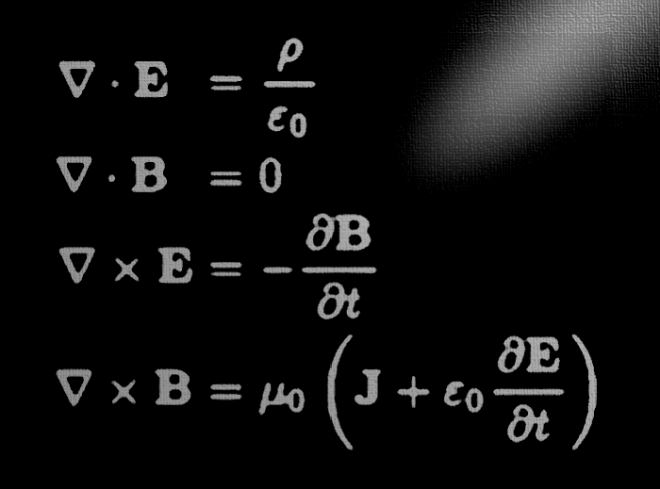
Everyone responds to local forces, of course.  Even spacetime itself responds to the spacetime immediately adjacent to it, as the electromagnetic field responds to the state of the field immediately adjacent to it, as demonstrated by the implications of Maxwell’s famous equations, which I’m sure jump right out at you:

Of course, the meaning of “local” is circular here, almost tautological, since the definition of local is merely “something that can affect another thing directly” more or less.

So it’s only too possible for a system to evolve itself into a state that is overall detrimental to those within the system.  Everyone, even the most seemingly successful, can be in a worse situation than they would be in otherwise, but it’s very difficult to see the way out, to get a “bird’s eye view” of the landscape, if you will.

One can therefore get stuck in situations where, despite the overall equilibrium being detrimental to everyone, any one individual taking action to try to move things in a better direction would make their local situation worse for them.

How is one to respond to such a situation?  Well, one can simply go along with it and try to do what’s best for oneself locally, and that is what most people do most of the time‒understandably enough, even though the overall situation may be evolving toward its own miserable destruction.

Or, of course, one could do what family therapists are often said to do:  effectively setting off a bomb***** in the middle of a difficult situation and seeing what happens when the dust settles, figuring that nothing is likely to be much worse than things are at a given present.  At least this allows for a new system to form, like the biosphere after the various mass extinctions.  Maybe it will become better than the previous one.

Maybe they all will always evolve toward catastrophe, to collapse and then be replaced by a new system.

It would be better if people could learn, and could deliberately change local incentives in careful and measured ways, adjusting settings to correct for and steer things away from poorer outcomes and so on, in ways that are not too disruptive at any given place or time.  That’s nominally what many of our systems are meant to be doing, but they don’t do a very good job at it.

Probably it would be better to do a hard reset.  But I’m not sure.  And it’s probably not worth the effort.  The odds of humanity surviving to become cosmically significant seem very low to me, and I’m not sure it would be good for the universe‒whatever that might mean‒if they do.

It’s probably all pointless, and I’m tired of it, anyway.  I don’t want to be part of this equilibrium or lack thereof anymore.  I want to make my own quietus.  Maybe “civilization” should do the same.


*Not to be confused with “weak”, which sounds the same but means more or less “the opposite of strong” and has little or nothing to do with divisions of time.

**And that’s pretty much the only term that comes naturally and easily to humans, for sound biological but horrible psychological and sociological reasons.

***If they were Klingons, they would surely be slain for their dishonor.  I don’t necessarily disagree with such an outcome morally, but practically, it would probably lead to increasing chaos****, so we understandably avoid it most of the time.

****It’s an open question whether such chaos is inherently bad.

*****Metaphorically, of course. At least, it’s usually metaphorical.

“And, to SLEEP, you must slumber in just such a bed.”

Well, it’s f*cking Saturday, and I’m going in the to f*cking office to f*cking work, because it’s not challenging enough for me to recover my limited mental equilibrium when I have two days off, so I should try to do it with one as often as possible.  Oh, and the one day I supposedly still have to take off is the day I have to do all my laundry, which means I have to go into the other part of the house and, more often than not, deal with their overly energetic and poorly trained dog‒and it’s a big dog.

I’m not afraid of dogs.  I like dogs, even very large ones.  But I have little sympathy for dogs that have not been trained, and who act like they’re still teething or something.  If it were my dog, I could rapidly train it out of the habit of putting its moronic jaws around peoples’ forearms, and it and I and others would be happier overall.

Maybe next time I’ll go out with suntan lotion or even pepper spray all over my arms, so it gets an unpleasant mouthful if it tries.

Honestly, sometimes I’m tempted just to slip it a few chunks of the rat bait/poison that I have.  It’s not the neurotoxin one, which is supposedly less harmful to people and pets than to rats.  It’s the super-coumadin, blood “thinning”, anticoagulant one.  To be honest, though, I would probably not be willing under nearly any circumstance to poison a dog, since the agency of such a creature is limited and its poor behavior is largely due to the humans in its life.

And yes, of course I have a big, multi-pound bag of rat poison.  Who knows, I might get peckish at some point and want it as a snack.  The holidays are upon us, after all, and it can be so hard to stay on a diet at this time of year.

Anyway, that’s just one possible nosh that I have for potential last meals.  I even have a couple of emptied out fiber capsules that I’ve refilled with broken glass pieces.  They would actually go nicely with the previously mentioned snack, wouldn’t they?  Like salted caramel, the two components could really enhance each other.  You might even call it synergy.

Enough about such tempting treats.  The point is, I’m going to the office today.  Then I’m heading back to the house.  Then I’ll be trying to rest if I can for the remainder of the weekend, though when I think of my own mind, I am inescapably reminded of Boromir describing Mordor:

That works pretty well to describe my very annoying brain/body.  I cannot seem to sleep very long, and I never feel like I sleep “all the way” if you will.  I am always somehow on yellow alert; I don’t know why.  It’s exhausting.  There are plain few upsides or effective distractions, and almost never any relief.

I don’t even know what I’m writing about right now, really.  I just feel a general, free-floating hostility and even hatred for most things in existence.  Sometimes I just want to wipe out the whole universe.  It can be done rather easily, at least from a certain perspective.

Incidentally, creating a new local source of the hypothetical inflaton field would probably not do the trick, assuming that inflationary cosmology is correct.  Most of the mathematical solutions to that possible situation indicate that, such a field would initiate a new, rapid, inflationarily expanding “universe”, but from the perspective of our universe the created bubble would just plop through and out of spacetime.  I haven’t done the math myself‒I am not adequately trained to do it at this time‒but I have this from more than one fairly reputable and reliable source, including people who actually do have the necessary expertise.

I’ve previously discussed vacuum collapse; if one could figure out how to trigger that‒assuming it is possible‒one could literally wipe out everything in the current universe.  Though, of course, it would take a long time, since it could only happen at the speed of light, so really, you’d only be wiping out everything in your future light cone.  There may be no way to destroy the universe that doesn’t effectively take a limitless time to accomplish.

On the other hand, when I spin around, it’s possible to view that action as the universe spinning around me while I’m stationary.  There are legitimate reasons why we don’t tend to think of it this way, but it’s a perspective that can be taken.

From that sort of perspective, when one dies (from one’s own point of view at least) the entire universe ceases to exist.  It’s very simple and thorough!  Of course, if there is an afterlife, that plan would fail, and one would be forced to go back to the drawing board.  But I’ve never encountered even borderline intriguing evidence or argument that might indicate an afterlife exists, unless you count things like a Poincare recurrence*.

So there is at least one reasonably reliable and plausibly achievable way to destroy the universe, from my point of view.  And the good thing about that is, from other points of view, the universe would still exist, and this would be no more contradictory than the fact that someone falling through the event horizon of a large enough black hole wouldn’t even notice it happening, but those far away would see the faller as never even quite reaching the event horizon.

Anyway, that theoretical stuff isn’t really very interesting for present purposes.  What matters is, at the very least, I can destroy the universe in a sense, if I so desire.  And every day it seems to become more and more tempting to do so.  This world is just so disgusting so often, and it’s not just humans that meet that description.

Ah, well.  Try to have a good day if you can for as long as the universe does exist.  After that, you’re on your own.


*Or the possibility of quantum immortality in the context of Everettian quantum mechanics.  But the various other possible alternate versions of me in such a theoretical quantum multiverse are not “me” even now, from my point of view‒not exactly, anyway, not in any sense that I can experience.  So future possible subsets of the wave function of the universe that contain randomly immortal versions of me are not worth taking into account, and they are vanishingly rare**.

**Though I suppose, as time goes by and all mortal things die, the quantum wavefunction of the universe might come to be dominated by such versions of…well, everyone.  None, however, would be able to interact with each other as far as I can see.

A very low magnitude happiness vector

It’s Friday now, for those of you who have been drinking heavily in the run-up to the big holidays and have lost track of the days.  I’m certainly working today, but I don’t know if the office will be open tomorrow, so I don’t know if I will write a blog post tomorrow.  If you’re interested, feel free to check this site in the morning.  Or, if you like, you can subscribe, and you’ll be sent emails for new posts.  But take that suggestion like a broken barometer:  no pressure.

That’s almost all that I feel I have to say.  Ordinarily, not having anything to say doesn’t mean I won’t write a post.  I’ll just blabber and blather for nearly a thousand words, just to see myself write*.  But there won’t be anything of substance.

Probably a good fraction‒perhaps even a significant majority‒of everything you can find on this blog is pointless nonsense.  Though, of course, I might contend that everything is pointless nonsense.  But here in this blog, you will sometimes find it concentrated, distilled, freeze-dried, and vacuum sealed.

No, I don’t know what some of those things might mean here, metaphorically, any more than you do.  I was just saying words that I thought seemed good.  I have curious tastes, though, so I’ve no idea what others might think of them.

Anyway, that’s me trying to act all silly and funny and whatnot, as if I might be even slightly happy, so that other people don’t have to worry about me.  Well, don’t worry about me.  I’m not happy at all, but it doesn’t matter in the slightest, because neither do I.  Maybe that’s just the way everything is, or maybe it’s just me.  Neither would particularly surprise me.

So, anyway, yeah, I’m not happy, not in any useful sense of the term.  John Galt said that happiness is a state of noncontradictory joy, and that’s always seemed to me like a pretty useful definition of the word, though it’s not the only useful one.  But I like how it separates joy from happiness.  Even people going to the gallows can sometimes joke and laugh, if only as a defense from fear, and in those moments of laughter they may feel joy.  But it is perforce transient, and it’s unlikely that they would be willing to say that they were happy**.

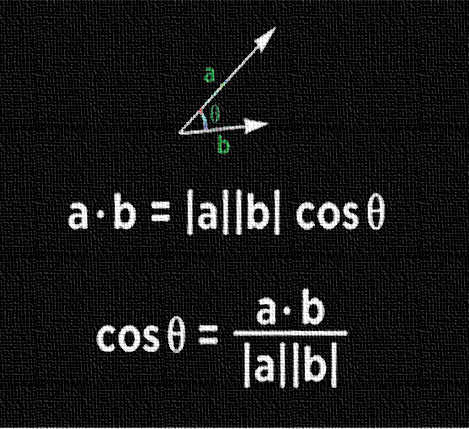
So, in that usage of the word happiness, joy would be necessary but not sufficient for actual happiness.  And both might be relatively orthogonal to a state of wellbeing (which is another word that has more than one interpretation).  Still, though the dot product of happiness and wellbeing may be surprisingly small***, I don’t think it could be zero.

Yes, I use vector multiplication as metaphors for such things, though honestly, it’s not really even so far separated as to be merely a metaphor.  Vectors can be useful for tremendous numbers of things that may seem far afield from each other, from computers and artificial intelligence to physics to biology to economics and ecology.

They can even be of use in psychology, though I don’t know how often they are used therein.  I haven’t dived into a lot of more formal psychology recently, though I like the popular works of Daniel Kahneman and of Jonathan Haidt.  And Paul Bloom is great fun.  But popular works of psychology rarely involve measuring aspects of mental functioning as vectors in a phase space.

Though, as you might have picked up if you’ve read a lot of what I’ve written here, I think it’s useful to think of human behavior and actions as the outcome of a vector sum of all the various “pressures” in the brain/mind, which end up with a resultant that determines what one’s actions will be in that moment.

But, of course, the action itself can feed back on the input vectors, altering them in various ways (maybe their angles, maybe their magnitudes, rarely but possibly their actual sign, which admittedly would just be equivalent to an angle change of 180 degrees, or 𝜋 radians).

Likewise, the state of many of those vectors can change with time.  For instance, one could imagine a vector associated with one’s degree of alertness.  Such a vector would tend to have greater magnitude in the daytime than late at night in most humans, so it waxes and wanes inherently (though even this is likely a result of input vectors delivered by various aspects of the sensory systems).

But the actions taken as a product of previous moments’ vector additions can affect this vector, too.  If a previous resultant led to one having a strong cup of coffee, that might increase the magnitude of the alertness vector, though there would be a delay.  Alternatively, if the previous outcome had led to one drinking a significant amount of Wild Turkey 151 on an empty stomach, the alertness vector might soon start decreasing in magnitude.

Okay, I’ve reached the point in the blog post where I’m using vectors to describe the effects of coffee versus whiskey.  I think it’s reasonable to bring things to a close now.  I hope you all have very good days, by any reasonable measure.  If I work tomorrow, I’ll write a post tomorrow.  I’ll leave figuring out what effect that will have on your own wellbeing for your consideration.


*Analogous to speaking to hear oneself talk.

**Though I can imagine possible situations in which one might be literally happy even on the way to the gallows.  It would be a very brief happiness, nonetheless.

***I doubt that it is, but I also doubt that it is the full, direct product of the magnitudes, as it would be if there were no angular difference at all.  Wellbeing, I think, is more complicated than happiness, which is itself by no means simple.

I never may believe these antique fables nor these fairy blogs.

Hello and good morning.  It’s Thursday, as the savvy/experienced can tell from the fact that I said “Hello and good morning” or similar words at the beginning of the post.

I’m not at all sure what to write now.  There’s nothing coming into my thoughts that seems interesting.  There are many annoying things, things that make me want to swat or poison or burn them like a swarm of mosquitoes and other bloodsucking, disease carrying pestilentia.  I don’t know if that last word is “really” a word, as in one that’s used and recognized by many people.  But it’s a word that feels right, and does at least some job of conveying the formication* that so many things in life induce for me.

Everything in my life is either dominated or highlighted by pain and/or tension-anxiety and/or depression, and all of that tends to make me feel angry or at least grumpy a lot.  It’s not pleasant, as I’m sure you’d agree.

Ugh, this is all so tedious and pointless.  I’m spitting in the ocean as if there’s any real chance that my loogie could change the course of the Gulf Stream even at a small scale.  But its impact is entirely washed out by thermal and other noise.

I’m having a hard time getting interested in anything positive‒I haven’t watched any science videos or read any science books or philosophy or whatever for a while.  I have plenty, and there are many things I would wish to understand better than I do.  But I have no available energy for such things.  It takes all the energy I have to get up and go to work and try to pretend to be human and productive, and then to get back to the house at the end of the day.

Time’s been my way when I would have thought it would be a shame if humanity dies out without ever leaving this solar system, without ever expanding and maybe, potentially, becoming cosmically significant, as described in David Deutsch’s The Beginning of Infinity.

Now, at least some of the time, I think it’s probably appropriate.  Why inflict the naked house apes and their progeny (literal or figurative) upon the greater, future cosmos?  Let there be disharmony.  Let there be dissonance.  Let there be cacophony.  Let there be chaos.  And finally, let there be silence.

I don’t know what point, if any, I’m trying to make here.

I need to clear my head, or at least I wish to clear my head.  My brain always seems to be cranking away at about a mile a second, in a random, drunken walk through the phase space of my possible thoughts.  I think it’s been like that pretty much all my life, but in the past, when the machine was newer, it ran more smoothly, and all the pipes and tubes and wires and hoses and fans and transistors and every other metaphorical part were functioning more efficiently.

What’s the point of all this nonsense?  I’m sorry.  I’m sure this is very unpleasant.  I’m sure that I am very unpleasant; I’ve been told so before, and the cases made were not unconvincing.

I used to be able to hide that part of me a lot of the time.  I used to be able to pretend to be positive and upbeat and to help the people around me to feel good sometimes.  I’ve even done some good at times in the past.  It’s been a long time since that’s been the case.  But that’s not too consequential, since I am now alone, and probably will be for the rest of my life, which feels pretty appropriate to me.

Anyway, whatever.  Try to have a good day.

TTN


*That one is a “real” word**, and no, it has pretty much no common ground with the word “fornication” beyond similar sound and shape.

**And I looked up and confirmed that “pestilentia” is a recognized word also and means roughly what I used it to mean when I “reinvented” it.  I guess that shows that it’s a well-crafted word.

“Language is the lifeblood of civilization. Courtesy is the lubricant.”

It feels like Tuesday to me today, since I was out sick on Monday, but of course it’s actually Wednesday.  I need to do payroll today at the office, for one thing, and I don’t do that on Tuesdays‒barring some holiday making it necessary‒since before Wednesday we don’t have all of our own reports in.

Don’t worry, by the way, that wasn’t a preposition that I ended that last sentence with*.  In that case “in” acted more as an adjective (I think) than a preposition, a description of where the reports are, not the beginning of a phrase such as “in a world of hurt”, or even “in that case”.

Of course, the specific rules of language are somewhat arbitrary.  They do have to achieve the desired end of coherent communication, and they need to have structure and dynamics that make that end readily achievable.  But there are multiple ways to achieve any given end, usually.  For instance, in Japanese one has postpositions rather than prepositions (if I recall correctly, anyway).  But it is useful to be consistent with grammar, because it tends to make communication more reliable, ceteris paribus.

Oh, and if I come across as pretentious for using expressions like ceteris paribus instead of “all else being equal”, there’s a good reason:  I am pretentious**.  Actually, though, I just really enjoy using interesting language, and learning at least a little bit of other languages.  Learning other languages improves your grasp of your own language and sometimes of your own thoughts.

It’s analogous to Mill’s statement that defending your arguments against those who disagree and hearing their reasons for disagreeing will tend to improve your own understanding of your “side” of the disagreement.  Perhaps more importantly, it might just get you to see some errors in your own position, and even if it does not lead you to change your mind in the moment, it might eventually lead you to improve your thinking.

If this process is to work, it’s essential for one to have honest interlocutors‒at least relatively speaking‒who are not frankly bigoted or otherwise inappropriately prejudiced against their discussion partners.  And I do mean “discussion” not “debate”.  Debates are contests, put on for show, and if you have your mind changed during one and you admit it, you will have “lost”.

That’s perverse and disgusting to me, as well as a real shame.  When you change your mind because you’ve learned new (reliable and convincing) information and/or have heard arguments you hadn’t considered, you have won.  You have grown, you have improved, your map has come to represent the territory at least a little better; your model has become more useful.

But if you’re going to grow in that sense, you cannot be dogmatic.  I’m very much not a fan of dogmas of any kind***.

Social media, unfortunately, does not encourage open and honest discussion and persuasion, but rather enmity and spite and “hooray for our side, the other side sucks” thinking, as well as interactions that barely rise to the maturity level of a kindergarten playground shouting match.  Honestly, “I’m rubber, you’re glue” is a better argument than many of the things one sees online.  And this is not something exclusive to one or another side of any political or social divide.  Almost all forms of social media are often just arenas full of monkeys throwing feces at each other while shrieking monkey noises.

That’s metaphorical, of course.  If there were just lots of videos of actual monkeys doing this, it might at least be funny the first time or two.  Humans, on the other hand, are not really that charming when they’re being nasty to each other.  Maybe it’s the lack of tails that’s the problem.

I do agree that one does not owe reasoned arguments against someone who is openly and actively arrogating their “right” to take that which does not belong to them or to do harm to others in some other, willful way.  However, when one is not openly and actively engaged in literal self-defense, it’s worthwhile to try to be understanding or at least compassionate even for people who have odious ideas.

At the very least, it’s useful to try to understand how such people came to believe what they seem to believe, or otherwise to understand their thought processes and so on as best as possible, because such things do not happen without causes, even if they lack anything that could honestly be called “reasons”.

And if one is going to correct a problem‒or fight a disease, to use a more loaded metaphor‒one will have a better chance the more one understands, with minimal bias, how that disease works.  Understanding such things about others can even‒hard as it may be to believe‒help us see how we are similar, and help us recognize the flaws in our own ideas.

Perish the thought.


*Ha ha!

**Ha ha again!

***And I see no reason to suspect that karma is a real thing, before you go for the “my karma ran over your dogma” joke.

“Well…I’m back.”

First off, I apologize for not writing a post yesterday.  I did not go to work because I was not feeling at all well.  And, of course, the office was not open on Saturday, so I didn’t do a post then.  I ought to have been well rested, at least, but I wasn’t.  Being alone at the house is not conducive to restfulness and recharging for me, though it’s better than not getting days off.  But I have only my own company, and I hate that guy, so it’s not pleasant.

One of my main weaknesses in the realm of the physical is my GI tract, and that was the main problem over the past few days.  I’ve taken a lot of meds for my chronic pain‒aspirin, acetaminophen, ibuprofen, naproxen, all that stuff‒over the last 20+ years (and more, day per day, over the past 10 years or so), so there are no doubt chronic toxic effects on my stomach and even intestines (and possibly liver and kidneys).

Also, I have to take proton pump inhibitors or at least H2 blockers to prevent myself from getting gastritis and ulcers from all the NSAIDs I take.  That’s probably interfering with the absorption of at least some nutrients, such as perhaps calcium and iron, for instance.  I try to counter that with supplements, but it only can go so far.  Also, they tend to cause their own troubles.

Why do I do it?  Well, chronic pain really sucks, I can tell you.  I actually have told you, many a time and oft, probably to the point of making you feel nauseated*.  So I have to make choices about what I value more at any given moment.  And future selves of me don’t always agree with the past selves about these things‒that’s how brains/minds work, I’m afraid.

So, there’s the added frustration of trying to tell myself not to overdo it on aspirin, say, and to cut back on the omeprazole and maybe replace it with famotidine, but failing and becoming physically ill when pain is too much and then stomach upset is too much.  But nothing is ever just right.  And pain is never-ending but not constant, in the sense that it waxes and wanes at least a bit, and some days it is harder to keep to a manageable level than others.

Sometimes it helps if I do things that hurt myself, deliberately, to distract me at least a bit.  That’s difficult to grasp, maybe, for someone who hasn’t experienced such things, but it’s the way it is.  Also, hurting oneself physically can help distract from psychological pain, and give one a sense of at least some control of one’s pain.

Unfortunately, and perhaps strangely, chronic pain does not distract from psychological pain; it makes it worse.  No wonder Darth Vader was always so grumpy‒he was in chronic pain that must have been horrible (which he brought upon himself, of course).  Mind you, the “dark side” of the Force probably didn’t help.

I often think it’s very strange for something like the Force to have a “light side” and a “dark side”.  It feels very much that the sentient beings are projecting their own values onto something that is, finally, a natural phenomenon.  Also, I don’t get why someone would pick a part of the Force to “use” or to follow, but try to avoid the other “side”, if one is truly trying to discern and follow the “will” of the Force.

Oh, well, the metaphysics and metaethics of fictional universes can sometimes be entertaining, I guess, but this is not one such time.

In some ways, it’s just as well that I didn’t write a post yesterday, since it was the 45th “anniversary”** of the murder of John Lennon.  I might have dwelt on that a bit much, since it’s a horrible event that still grinds away at my sense of whether the human race has any net value whatsoever.

John Lennon has now been dead for five years longer than he lived, while his murderer turned 70 this year, alive and at least somewhat healthy.  Well, that little purulent exudate can at least count himself lucky that he has not found himself in my power in the time since 1980.  I would use all my knowledge and all of my quite active and very dark imagination to keep him alive and begging for death as long as I possibly could.  The Spanish Inquisition were pussies.

Anyway, that’s enough of that.

In closing, I just want to share a notion and question that came to me (and has done so on and off):  I wonder if I would get more, or at least second-level, response to my words if I did a sort of vlog in which I read out loud some of my prior posts.  What do my readers think?  Would it be worth it?

Anyway, try to have a good day.  Remember, “do” or “do not” is never fully in your control; there is only “try”.  Or as the Japanese say, you are responsible for the effort, not the outcome.

Yoda’s a moron.


*Ad nauseam, in other words.

**It seems almost disgusting to use that word here, since often anniversaries are celebrated, and this is not something worthy of celebration, but I had a hard time coming up with another word that worked.  And etymologically, the word “anniversary” doesn’t carry value judgments, it just means something that comes every year.

All ideologies are wrong

I don’t know if what follows will be clear or will convey my thoughts very well, but here goes.

I was in the shower this morning, thinking about nothing specific, and somehow I started feeling irritated, as I often do, at people who are dogmatic about ideologies and try to apply them to every possible situation or state of the world.  Then a connection of ideas clicked into position for me in the phase space of the mind, and I thought about the notion of scientific models.

There’s a famous quote about model-building/using in science that says, “All models are wrong, but some are useful.”  (I don’t recall who said it, but I’ll look it up before posting this and I’ll put it in the footnotes*.)  The statement refers to the fact that, to try to understand the world, scientists build models—not usually literal, glue-together type ones, though that occasionally does happen—and see how well those models replicate or elucidate facts of external reality.

They are all simplifications, as they must be, since only the universe itself appears to have enough processing power to simulate the universe fully.  Being simplifications, and reality being complex and prone to chaos (the mathematical form thereof, though the classical kind does occur as well) a simplified model can never be entirely correct.  But some of them are nevertheless quite valuable and useful—take General Relativity and Darwinian natural selection as two good examples—though we know they do not fully encompass every aspect of reality.

Some models are misleading, such as the old notion of the brain as a cooling mechanism for the blood, and some are simply not that useful, such as seeing the brain as a system of hydraulic tubes and valves of some sort.  And when you try to apply a model to a situation in which it doesn’t apply, it will give you wildly wrong (or “not even wrong”**) answers.

It occurred to me there in the shower that human ideologies are quite similar.  They are simplifications, models of the world.  Some are useful in some ways and to some degree, and some are about as applicable as the notion of a spherical cow (which, despite being the punchline of a physics joke, could in principle be useful somewhere sometime).  But it is as absurd to measure every event or occurrence or interaction against some finite ideology as it is to try to apply the germ theory of disease to the question of “dark energy”.

It’s absurd—if you’re being rigorous and serious—to think that the ideas of Karl Marx contain all that is needed to produce a good, fair, productive, and stable society.  But it’s just as absurd to think that laissez-faire, free-market capitalism will for its part provide everything that could possibly be needed for a robust and free and beneficent world, or that the ideas of “post-modernism” contain all that need be said about civilization.

The world is complicated, with many forces interacting at many levels, and no single idea, however personally attractive, can encompass all of it in a useful way.  Capitalism can encourage the production of great innovation and abundance, but it has no inherent justice, despite some popular belief and the works of Ayn Rand.  It can leave people utterly bereft and tortured and miserable through no fault of their own but bad luck.  It can also evolve into inadequate equilibrium states in which isolated, hoarded wealth sits still and does no one any real good while the whole of civilization collapses around it, just as biological systems can evolve into self-destructive states, like cancers, when an individual mutated cell becomes so successful at reproducing itself that it kills off the body in which it resides.

But if people are not rewarded for their work or their creativity or their acumen to some degree that is at least on some level commensurate with the value they produce, then people will stop producing.  Nature does not tend to evolve creatures that act purely to their own detriment without any “personal” gain of some kind  It’s not an evolutionarily stable strategy; such creatures are rapidly selected out.  Humans are no exception.

And history (and mathematics) has shown that economies are too complex to be planned by anyone or any group, and probably by any form of individual intelligence, no matter how advanced.  The information and knowledge required is too staggeringly vast.

It’s not merely political or economic ideologies that are limited and imperfect, either.  All religions fall into this same category.  Some have good and useful ideas, but only the indoctrinated could imagine that highly limited ancient collections of stories or poems or proscriptions and prescriptions can provide even vague guidance about all the things in the modern world, let alone the potential future world.  “Eastern” religions do no better than “Western” ones, though again, some are more useful and some are less so.

Of course, any ideology that is dogmatic is much more likely to be useless or detrimental than one to which inheres the potential for updating and improving itself.  It’s more or less mathematically impossible for a finite set of ideas put down on paper (or wherever) to have successfully discerned all that can be known about how to approach reality.

I think it would be much better if we thought of our various ideologies as models, hypotheses—theories*** at best.  Then we could have many options available to measure and address issues as they arise, and we could honestly assess whether the notions of, say, existentialism or deontology or utilitarianism best apply to a given moment or challenge.

Again, I’m not sure how well I’ve expressed my thoughts here, and I’m sure I could go on and on about this, trying to tease through it as well and thoroughly as possible.  I’ll spare you (and me) that for the moment.  But I think it was a useful realization.  Though I doubt even this has universal applicability in all possible worlds.

Have a good day.


*It was George Box, a statistician, who is credited with this particular phrase, but the idea had been expressed in terms of maps and territories in similar overall fashion previously.

**This expression is attributed to Wolfgang Pauli (of the eponymous exclusion principle fame), one of the early giants of quantum mechanics.

***In the scientific, not the colloquial sense.

Knock there and ask your blog what it doth know

Hello and good morning.  It’s Thursday.  At least, I think it’s Thursday.  I’m wearing my Thursday trousers and my Thursday boots.  You may think I’m joking, but I’m not; I have a specific pair of each of those things for Thursdays.  The other days of the week are not quite as specific because all my other trousers and shoes are identical one to another, at least in “make and model”, if you will, though some have seen more wear than others.

I don’t like having to choose what to wear anymore, and I don’t want to have to worry about matching colors or styles or anything like that.  So it’s all black, same shirt brand and model, same trousers, underwear, socks, and shoes.

But on Thursdays, I wear a pair of‒get this‒gunmetal gray trousers*.  They are the same brand and “model” as the others, though.  Interestingly, the gray ones don’t hold a crease nearly as well as the black ones do; possibly something about the dyeing process affects the fabric.

Oy, this is boring, huh?  I can’t believe I’ve been writing about my clothes!  The thing I meant to address when starting this post was that I feel mildly unsure about days and dates lately.  I’m not completely lost, of course; I can check my phone and computers and whatnot to confirm the day and the date and the time.  Also, of course, I remember writing in yesterday’s post about how the date numbers were 1-2-3 in order, so it was December 3rd.  And yesterday I did the payroll, which means yesterday was Wednesday**.

There is, however, a circuit or module or subroutine in my brain/mind that seems weaker than it is in many other people:  the feeling of being right (as in “correct factually”, but to a lesser degree, also the feeling of being morally right).  This is not to be confused with the intellectual process of discerning whether something is correct, in either sense.  I’m talking about the feeling, the belief if you will, that one is right, which often has very little to do with actually being right.  One is an intellectual process while the other is an emotion, and emotions are unreliable indicators of truth or guides to action‒but they are powerful***.

This is an important and consequential dichotomy.  It gives rise to the tendency for a particular societal issue, so nicely put by Yeats:  “The best lack all conviction, while the worst / are full of passionate intensity.”

I strongly suspect that it’s not being “the worst” that leads to such passionate intensity, but rather passionate intensity‒that feeling that one is right‒that makes one prone to do horrible things.  If you feel that you are right, you’re more inclined to give yourself license to do whatever you think is “for the greater good”.

I think this is also part of the explanation for OCD****.  Sufferers have some dysfunction in the parts of their brains that produces the feeling of being right, so they have to keep rechecking and can become more and more unsure of more things, developing “rituals” and repetitive behaviors to try to stave off the anxiety of not being able to feel that one has, for instance, turned off the stove, even when intellectually one knows, or at least has good reason to think, one has done so.

I have at least a little of this problem, perhaps best exemplified in my use of mental arithmetic.  I keep track of ongoing sales at an individual and group level in the office, by dollar amount and by what is sold and so on, and I put it up on “the board” to update it as it happens.  Over time, I’ve gotten pretty good at mental arithmetic‒I never was very bad at it‒and I’ve even gotten to the point where, for fun, I will do some algebra and calculus equations in my head, say if I see one as the thumbnail of a YouTube video.

But even though I’m generally confident of my results intellectually, I never feel okay enough not to check my numbers using the functions of, for instance, Excel.  So, I can run many numbers faster in my head than I could using a calculator, but I cannot trust my answers.

At some level, I think this is better than the alternative.  We can probably all think of people who are quite sure of themselves, quite confident in the results of whatever “thought” processes they have gone through, and yet are woefully off-track or unqualified or just fucking wrong.  And we see what such people do to the world, because they are quite comfortable asserting themselves and seizing power and resources, because they feel that they are in some sense correct.

When you feel that you’re right, you don’t tend to check yourself as often as you would otherwise.  You also are less open to criticism and suggestions, because they fly in the face of your feelings.  This phenomenon is nicely explored in the book On Being Certain: Believing You Are Right Even When You’re Not by Robert Burton, MD*****.

I could go on and on and on about this, I’m sure.  But it’s time to draw this to a close for the day.  I will finish with one of my favorite quotes from Radiohead:  “Just ‘cause you feel it doesn’t mean it’s there.”

TTFN


*Why do I use the word “trousers” rather than “pants” when I’m an American?  Well, I watch a lot of British comedy panel shows, to the extent that I find if I say “pants” I feel that I’m talking about underwear, since that’s to what the British term “pants” refers.

**Last week, though, due to the holiday, I did the payroll a day early.  And, of course, I didn’t wear my Thursday pants (trousers) at all last week; I wasn’t going to work, so I just rewore the clothes from the day before.  It wasn’t as though I was planning to interact with anyone else, and indeed I did not.  Still, maybe the holiday has thrown me off a bit.

***For good, sound biological reasons as I always say, but such reasons can easily overshoot usefulness and become detrimental.

****It may also contribute to chronic tendencies toward depression, in which one never feels one is “right” either literally or morally or existentially, and also to the tendency for people with depression to be more prone to be accurate in their self-assessment of things such as, for instance, driving ability.

*****I just realized that “On Being Certain, by Robert Burton” rhymes.

Another day, same old stories

Well, it’s Tuesday the 2nd (of December) and that two/Tue coincidence has to be worth something doesn’t it?  I suppose it would be better if this were February (the 2nd month), but perhaps it’s enough to note that the difference between the official number of this month (12) and its nominative number (10) is 2.  Anyway, having two twos might make more “sense” than having three of them.

Is that important?  Almost certainly not.  In 56 years of time and space, I’ve never encountered anything that was truly and objectively “important”.  But it is the sort of thing that engages my (admittedly rather odd) aesthetic sense, and this is my blog*, so I will indulge myself.

Anyway, it’s the second day of the work week, and I’m going to work.  The reason I go to work is, at root, nominally to keep myself alive and “thriving”, so I can…what?  Keep working?  I don’t have any other, deeper or longer-term reasons.  It’s fairly absurd when you think about it.  It’s a self-referential, almost tautological, ouroboros-like situation.

By the way, I don’t see any reason to think that this state of affairs is the product of some conspiracy‒centuries or even millennia long as it would have to be‒by the powerful to keep the masses toiling away for their benefit.  For one thing, as we can all plainly see (I hope) the powerful are at least as idiotic and moronic and clueless as anyone else, and they probably tend to be less self-critical, so they are more prone to do really stupid things without anyone protecting them from their own stupidity.

They no more really, actually control anything‒including themselves‒than a queen bee (or ant or termite) runs its hive/hill/colony.  The queen just happens to be the breeding female.  And even that is not a role based on any merit, other than being capable of developing active ovaries.  The queens are “chosen” randomly, as far as we can tell.

It’s all just shit that happens in a region of spacetime in which entropy is moving from low to high, as it tends to do, but in which there’s enough movement involved in the process to allow for locally highly complex phenomena based on carbon’s extraordinarily fecund chemistry, which occasionally forms self-replicating molecules that undergo natural selection.

But people tell stories about things.  It’s one of our strongest attributes, and it serves in us roughly the same “purpose” as the various pheromone trails and hive dances in the aforementioned ants and bees and termites.  Our stories allow us to act in concert with many other people, on a scale that puts even the social insects to shame.

We often believe that our stories are true, at least to some degree.  And some of them, in a limited sense, really are “true”.  But most of them are just stories, made up “just so” explanations of things we either haven’t figured out or that have a nature too complicated or too daunting for us to want to face them as they are.

As someone who has a penchant for creating stories, I can tell you, it’s quite easy to make up plausible-seeming, internally consistent tales about worlds and characters and events, real or otherwise, that have little to do with reality other than that it is a fact of reality that I made up those stories.

I consider all religions and all their related tales to be part of this phenomenon.  This is not an insult to them per se, and the tendency for people to take it as an insult or an attack belies the faith such people claim to have in their religions.  But people who really think a particular thing is true don’t have to defend it with anger, let alone violence.

Imagine if the classical physics people had crucified Planck for solving the “ultraviolet catastrophe” by positing that only certain chunks (quanta) of energy can be produced, or if they had burned Einstein at the stake for not only showing that light comes in such quanta but that matter is also finely divided***.

Science does also work with stories.  Every hypothesis is a story, and some of them can seem extremely compelling.  Some of them we really want to think are true.  And that’s why, ideally, science takes every such story and pokes the hell out of it, trying to show if and where it’s wrong, where it’s internally inconsistent, where it doesn’t match what actually seems to happen in the world.  It’s not perfect, but it does improve in an incremental, ratchet-like fashion, at least as long as we hold to the rigorous, ruthless, but honest criticism of those stories.

With that, I’ll draw the main body of this post to a close.  I have no idea why I’ve written what I’ve written, or at least I don’t know very well.  I doubt there’s any internal consistency or coherence to it, but I guess that supports my point.

Please try to have a good day.


[Aside: a thought occurred to me yesterday that, as we approach the era of humane, lab-grown meat derived from animal stem cells, what, if any, would be the moral implications of using human stem cells, taken from a volunteer‒I’m willing‒to grow meat in the lab and have people eat it?  There’s no risk of parasites or infections, assuming reasonable genetic screening, such as might explain an evolved revulsion for cannibalism.  There’s no one being harmed.  What do you think?  I’m not concerned with whether you feel it’s somehow “icky”; that’s just misfiring evolution-based taboos.  Do you think there is any moral reason not to grow and eat such meat?  If so, what are they?]


*There are many others like it**, but this one is mine.

**Are they really like it, though?  You tell me.

***These are two of the things Einstein demonstrated during his annus mirabilis (i.e., “miraculous ass”***) in 1905, the same year he published his paper introducing special relativity.

***That’s not really what it means.