Surprisingly (for me) positive thoughts on a Saturday morning

[Note:  At the bottom of the post, below the footnotes, I’m including a thought that occurred to me between the initial writing and the final editing of this post, but which doesn’t directly relate to the post itself.]

Well, it’s Saturday morning (the 17th of September, a nice prime number), and I’m waiting at the station for the first train of the day, because I woke up before my alarm again and there was no point trying to go back to sleep.  I’m working again today, and I may be working again next Saturday as well, since I don’t know how long the coworker with whom I split Saturdays will be out with his recovery from surgery.

I can’t begrudge him the time off—surgery is no small thing, even if it was “minimally invasive”, to say nothing of the problem that required surgery.  I’ve had major surgery myself, open-heart when I was 18 and back surgery when I was about 35 (hopefully I won’t have another when I’m 53!).  I don’t remember how long my own laminectomy and fusion left me hobbled, because at the time I was already on temporary disability because of the injury, but it wasn’t a minor inconvenience.

That whole process contributed to the eventual catastrophic collapse of the life I had built, partly because I technically have “failed back surgery syndrome”, which means that, despite my back surgery, I still have chronic pain.  I think the term “failed” is a bit uncharitable, though, because my pain was reduced, it just didn’t come close to going away completely.  It’s there every day, and it has been for about 20 years (for those of you doing the math, I had the pain a good three years or so before I had the surgery, and I am currently 52).

Speaking of the collapse of my previous life, and the loss of so many things that were important to me, I sent an email to my son not long ago—I might have mentioned this previously—to the email address he had used the thank me for his last birthday present.  It was basically a long apology for all the things I screwed up with him (and his sister), and a reminder that I love him and always will, and of course that I miss him.  I didn’t know if he even regularly checks that email, so I asked his sister to let him know I had sent it.  He apparently does, and he’s seen it.

I don’t know what he thinks about it, since he hasn’t replied so far.  I don’t know if he ever will.  That’s up to him, which I guess is obvious.  What I mean is, that it wouldn’t be fair or right for me to expect, let alone demand, a reply from him.  I at least know that, if he wants to know what his father has been thinking and doing for the last quite some time, he can always come to this blog and read it.  I don’t know what he would think if he did that, but it is whatever it is.

I’ve always felt—at least, for as long as I’ve seriously thought about such things—that it’s important to remember that children don’t belong to their parents.  Parents belong to their children.  This is so for good, sound, biological reasons, and also for deep moral ones.  A parent can make the decision to have a child—or well, two parents can make that decision.  The child literally has no say in the matter, for the child does not even exist when the decision is made.  They cannot be held morally accountable for anything to do with that decision, and they cannot incur any obligation because of it.  Of course, good parenting and good socialization can mean that a child will be naturally grateful to the parents, and that’s nice when it happens, but it isn’t required.  It cannot, ethically, be required.  It cannot, in good conscience, be demanded.

That reminds me tangentially of the concept creep problem our culture has with the terms, “respect” and with “self-esteem”.  People cannot demand respect.  Respect is in the eye of the beholder.  Courtesy is presumptively expectable, since simple politeness is the lubricant of civilization, but respect can only be freely given if it is to be of any value at all.

Likewise with self-esteem.  It doesn’t make sense to encourage people to have just a general, free-form, positive self-image based on nothing; that leads to narcissism and all the problems it entails.  One should not feel “proud” merely of the fact that one exists.

A student who cannot seem to master math well should not necessarily feel proud of his or her math skills, though if that student has worked hard to learn as much as they can learn, they should feel proud about that!  And that person almost certainly has other strengths and abilities that they can feel good about, and of which they should feel proud.

Hard work is worthy of esteem, and thus of self-esteem.  But I don’t need to esteem my own ability to play basketball, for instance, and I shouldn’t, because I’m terrible at basketball.  On the other hand, I write reasonably well, and I write a lot.  I also have good skills at general mathematics and science, and I am deeply curious about the way the universe works, and have learned a lot about what people know about how it works, and how that knowledge has been gained.  I should feel good about that, at least.  I certainly enjoy it.

“Pride” in general is a tricky concept.  Its legitimacy depends on how one uses it, and what one means by it.  None of us made ourselves, obviously; we operate according to the laws of nature*, and we are shaped by our nature—our genes and other physical factors—and our experience, our background, our society, our upbringing, our education, and so on.  And in a sense, all of these things are also part of “our” nature.

A person may have the tenacity to work hard and improve themselves from an otherwise unpromising-seeming background, but even then, they did not create that tenacity—it was their luck, or their blessing, however you want to characterize it, that they had it.  There’s nothing wrong with that.  Use the assets you have to their best effect.

You can’t use assets you don’t have, after all.  It would be much easier, for instance, for me to get to work in the morning if I could teleport, or even if I could fly.  But I cannot, and there are no reasonable technological solutions to that lack right now, so I just don’t have that ability.  It would be the height of silliness for me to feel proud of myself for my ability to fly, since I cannot.  But I’m glad of my ability to learn and use the public transportation system in south Florida, and I’m grateful that it exists; I admire the people who put it into place, and I esteem the people who keep it running every day.

Maybe gratitude is a better notion and virtue than pride or self-esteem.  I know some religious systems place an emphasis on it, and I think that’s far from a bad thing.  It’s good to be grateful for the inherent and learned abilities that you have, and it makes sense to instantiate that gratitude by using those gifts to the best of your ability.  Otherwise, it’s not very impressive gratitude.

It’s the converse** of the situation in which a person apologizes for something, but keeps up the behavior that led to the apology.  That’s not much of an apology.  I often find myself saying to people, “I don’t need your apology, I want you not to do the thing you’re apologizing for.  If you apologize but keep doing the same thing, the apology is useless, and even insulting.”

Okay, I use words to that effect, adjusted to match the situation.  I hope you get the idea.

These are my thoughts for this Saturday morning, such as they are.  I hope most of you are looking forward to an enjoyable weekend, hopefully with some time spent with family and/or friends.  Be grateful for them, certainly, if you have them around.  No one is guaranteed to have them, and even if there were such a guarantee, with whom would you lodge the complaint if the guarantee were not met?  Feel good about the things you are good at, and feel grateful for the good things you have in the world, and show your esteem and gratitude by doing the best you can with both.

Those are good words, I think, and I’m astonished that I am the one who actually just wrote them.  The trick will be to live up to them!


*And of Nature’s God, if you believe in God, to paraphrase the Declaration of Independence.

**Or maybe the obverse—I’ve never yet been able to get those concepts clearly differentiated in my head.  Neither term may actually be the correct one, come to think of it.

[As noted above, here is my thought below the footnotes:  Is it ever possible for any kind of mind, whether natural or artificial, instantiated in hardware or software or both, to be complex enough to accurately model its own workings in detail?  As it becomes more complex, modeling its own function will also become more complex.  I suspect that this complexity will increase more quickly than the ability of the increasingly complex mind to parse it.]

A soothsayer blogs you beware the Ides of…

Hello, good morning, and welcome to Thursday, the Ides of September.  Actually, I’m not sure it’s technically correct to call it the Ides of September just because it’s the 15th, but it seems a shame for only March to have an Ides, so I’ll give it a go.  I think I’ll look up the formal definition of an “Ides” sometime soon, but right now I’m sitting at the train station with no Wi-Fi access, so it’ll have to wait.

Of course, since this Thursday is the 15th of September, that means next Thursday will be the 22nd of September, which is not only the beginning of Autumn, but is—much more importantly—Bilbo and Frodo Baggins’s birthday.  In The Lord of the Rings, Bilbo made his final departure from the Shire on his birthday, and of course, Frodo began his great journey on the “same” day, years later, after selling Bag End to the Sackville-Bagginses.  It’s an auspicious day.  I ought to do something grand and epic next Thursday, really.  I’m at least tentatively hoping to do so.  I’m not going to let you know what it is, but if I do it, it will become obvious here, I should think.  It will at least be obvious that I’ve done something, though I’m not sure if it will be obvious just what I have done.

In the meantime, I’m still sick with the virus I’ve been fighting, and my chronic pain continues, and I’ve had less than four hours’ sleep, all as per usual.  Fun!

I arrived at the train station this morning to a mildly unnerving sight:  there was no one waiting for the trains on either side of the tracks.  For a moment, I wondered if there had been some national emergency or holiday declared, or if the trains just weren’t running, but all the stairways and elevator ports and payment kiosks were open, and the announcement boards were displaying their repetitive notice that, on Thanksgiving, the Tri-rail system will be operating on a Sunday schedule.  Also, there was a security guy near where I had entered, so I knew it wasn’t as though all life in this area had disappeared*.

What happened, of course, is that I arrived very shortly after the most recent northbound and southbound trains had come and gone, so that anyone waiting for those trains had boarded, and no other people apart from me had yet arrived for the next ones.  This is because I woke up too early again, but didn’t leave the house quite in time to catch the first train of the morning.  Ah, well.  I prefer to ride the same train, and wait on the same bench before doing so, and sit in the same seat on the train, if I can help it, every day.

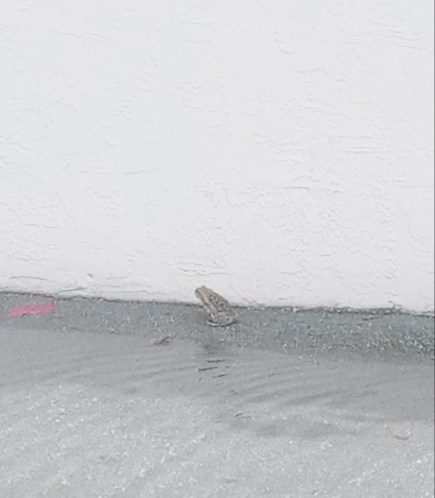
Speaking of living things (I was, just two paragraphs ago, you can check for yourself), it has been raining steadily and drearily for the last several days and looks to be doing so quite a bit over the next several more days.  Because of this, the access alleyway behind the place where I work is largely flooded—but that has produced at least one good outcome.  Specifically, yesterday morning, when I got to work, I could hear an astonishingly loud bunch of creaking and croaking noises from behind the office (while I was inside!) and I peeked out to confirm that, yes, it was the sound of lots of frogs.  I only actually saw one—it was quite dark—but I heard oodles, and even tried to take a “video” of the noise (I actually hoped but failed, to catch sight of one of the frogs while my video was going).

It’s nice to know that there are frogs about, because it seems like it’s been a long time since I’ve seen any serious number of frogs or toads here in Florida.  When I was a kid, visiting my grandparents, almost every time it rained, loads of the critters would appear, but not in recent years.  I read that there was some international blight that had affected frogs for a while, but maybe it’s run its course.  Probably not.

***

I’ve gotten on the train now, and someone is sitting in my usual seat, someone who doesn’t normally ride this train, or at least doesn’t usually sit in this general seating area.  That’s irritating.  Also, the train stopped at a different spot in the station than usual, which is doubly irritating, since I stand at the platform roughly where the front-most available door lines up starting about five minutes before the train arrives, so I can swiftly hop on the train (well, “hop” is an exaggeration) and get to my seat.  Because it was out of alignment, though, I got caught behind several other people, some of whom were slow-moving.  That was also irritating, but only a bit.  At last they’re people who wait for the train every day, and are familiar sights to me.

Incidentally, another issue with having someone sit in the seat I usually use is that I now have to sit somewhere else, and may be taking a seat that some other regular passenger uses nearly every day.  I don’t like the thought of doing that to someone.  I have a hard enough time justifying my existence at all to myself, and when I inconvenience other people in ways that I don’t like to be inconvenienced, it is rather mortifying.

I’m a weirdo, I know, but I guess I’ve always been a weirdo, and I guess I’ve always been aware of the fact that I’ve always been a weirdo.  I’m not too bothered by being weird; much of the time, “normal” people seem absolutely idiotic.  Why would anyone want to be like most people in the world, even the successful ones?  The things they think are precious, and the things that pass for knowledge to them, and the things they think are useless, I can’t understand, as Steely Dan said.  And I don’t want to understand them.  I don’t think they understand themselves, or each other, most of the time, nor do they stop even to think about trying to do so.  That’s the way it seems, anyway.  It may be that I’m just prejudiced against humans.  Perhaps this is all just sour grapes.

Anyway, that’s about it for today.  No fiction, no music, none of that good stuff going on.  Just drudging through the day-to-day, smelly, moronic, loud, ugly, and in a million other ways unpleasant human world.  I can’t wait to get off this planet.

TTFN

sees her smaller


*There is also the presence of these annoying termites or winged ants that live in this area, and which episodically land on one’s hands or arms or neck or computer, so clearly there are living things here.

Demonstrandum in the middle of nowhere

Good morning, everyone.  It’s Tuesday, the 13th of September, and I’m coming down with something again.  Meaning I think I have some upper respiratory virus, because I started getting mild chills overnight, and a low-grade elevation of my temperature, and my throat has that sore, itchy, irritated feeling that comes with fighting a virus.

I’m assuming it’s a virus—well, not truly assuming; I’m drawing a tentative conclusion based on experience and knowledge.  It doesn’t seem like a bacterial infection, those tend to be more localized, and I don’t think it’s a fungus, since those are rather rare and occur only in specific circumstances…and I’ve never heard of a prion disease that presents in this fashion.  Whereas I’ve had many iterations of “colds” throughout my life, and this feels a lot like most of them.

It doesn’t seem like Covid, but I suppose it could be one of the later variants, tempered down by my already-exposed immune system.  In any case, although I must go to work—that’s why I’m writing this blog post today—I am masking even more thoroughly than usual.

It’s remarkable that the wearing of masks was resisted so much by so many crybaby wusses in America.  People in east Asia have been regularly wearing masks when they get a cold since long before the first SARS virus.  It’s simple courtesy to recognize that, though you may have to go to work because there are people and things depending on you, it’s good to take some minor precautions to decrease the risk of spreading your sickness to the people around you.

I understand the spirit of independence, and I am glad to live in a country where the more common saying is, “The squeaky wheel gets the grease” rather than “The nail that sticks up gets hammered down”.  But it’s not independence or free spiritedness to refuse to take simple, easy precautions to reduce the chance of you spreading a disease to your fellow Americans (as the case may be).  That’s just being a spoiled and entitled ass-wipe.  And the only good thing to do with ass-wipes is to flush them down the toilet.

Anyway, that wasn’t what I was going to write about today.  Actually, I didn’t have anything specific in mind to write about today, which is why I know that wasn’t what I meant to write about today.  Logic.  If there exists no class of things: [Topics considered to write about on Tuesday, September 13th, 2022, AD] then {the inexplicable and inexcusable refusal to use masks when ill} cannot be a member of that class.  Quantum Electro Dynamics*.

Ah, Logic.  Ah, Reason.  Ah, Evidence and Argument.  How I pine for you in the human world.  Of course, I don’t hold it against anyone that they have emotions, even strong ones.  It’s not like people designed themselves, after all, and emotions exist for good, sound biological reasons.  They are the drives, the utility functions, of organismal behavior.  And they served humans well in the ancestral environment, else humans wouldn’t be around.

But reasoning minds have achieved much more; they are much more versatile and powerful, and modern civilization is largely due to their work, though motivated by those underlying emotions and their various, often-conflicting, utility functions.

But you’ve got to tame your elephant, to borrow Jonathan Haidt’s metaphor.  Otherwise it’ll run rampant and trample everything, and it won’t get you anywhere you really want to go, except perhaps by luck.  Train it.  Maintain discipline.  Reward it when it’s good and correct it when it’s not.  Don’t just be the rider of your older brain, be the pilot, be the driver.  It requires effort, obviously, but I think it’s probably worth it.

In other words, what I’m saying is, don’t trust your emotions to guide you—they’re not reliable.  Listen to them, notice them, but don’t trust them.  They developed to help make quick decisions about hunting and gathering, avoiding lions and hyenas, and interacting with a tribe of maybe forty or fifty people at a time.

Every complex animal in the world has emotions of some kind; anyone who doubts that is simply in denial.  Only humans (among species native to the planet) have human-type brains, with big, complex frontal lobes and complex, symbolic language with syntax and grammar and logic and all that jazz (sometimes literally).

But those brains are powerful—again, see Jonathan Haidt’s metaphor of the elephant and the rider.  If they are not managed, they can be horrifically destructive.  And if you get a herd of unmanaged elephant-brains** or brain-elephants, they can do a terrific amount of harm, especially if they’re armed with modern technology (most of which was not made or designed by people with no control over their personal elephants, but is nevertheless available now to the billions of people who could not have made it, and who don’t bother even trying to steer).

Anyway, this has all been meandering and peculiar, I guess.  As I said, I’m a bit under the weather.  It’s annoying to be in south Florida and to be both sweaty and chilly.  I wish I could just lie in bed somewhere, maybe have some Jell-O or something.

I must be feeling sick.  I don’t particularly like Jell-O.  But it is easy on the throat.

I wish I didn’t have to go to work today.  Though it’s not a wish I would waste on a genie if I found a magic lamp.  I’d probably ask for some kind of special, personal powers that I could use to achieve world peace…through my absolute dominion over everyone and everything!  Bwa-ha-haaaa!!

Again, anyway…that’s enough silliness.  I’m really not going anywhere with anything today.  I just wish I could rest for the day, but I can’t, so tough luck.  A person has to do what a person must do; willingly accepted duty, and a reasonable sense of honor, and a general sense of courtesy should guide one in one’s actions, if one wishes to be other than merely a jumped-up monkey throwing feces…or an idiot protesting against a simple health precaution, pretending to take a stand on principle when one is actually simply throwing a tantrum because one doesn’t want to do something sensible and healthful, like take a nap.

Naps are good.  So are masks in the right circumstances.


*Q.E.D. in other words—quod erat demonstrandum, “what was to be demonstrated”.  That’s my little nerdy joke, playing on the earlier nerdy “joke” that was the naming of quantum electrodynamics by physicists, shortening it to QED, because why would you not?

**The elephant is a metaphor of a powerful beast carrying around the conscious mind.  I am not implying that elephants themselves are destructive by nature, though of course, they can be.

Tangents of tangents of tangents, oh my!

It’s Wednesday, the middle of the week based on our usual reckoning of things.  Welcome.

Of course, the universe at large doesn’t give any preference to days of the week, or months, or whatever.  Days, per se, are more or less natural units of time, as are years.  Both are related to regular, physical phenomena in the solar system*.  Now, one could argue that since the moon’s orbit around the Earth is roughly twenty-eight days, that seven days in a week is a sort of natural division, since 28 divided by 4 is seven.  That’s not an unreasonable thought, but it is derivative, unlike the measure of a year or a day.

Of course, rather irritatingly, the days don’t evenly divide into the years, nor do the months (orbits of the moon, which itself isn’t quite an even number of days), which means we have to do all sorts of mucking about with the number of days in months to get a reasonable number of them per year, and only one of them has 28 days, but even that changes every 4 years, except every hundred years when it’s 28 again, except every thousand years when it’s 29 again, and so on.  And then, of course, we have to add and subtract “leap seconds” on an irregular basis to adjust things to keep them consistent, lest the seasons creep steadily in one direction or the other relative to the calendar as the years pass, even as the times of day and night also shift.

If the period of the moon’s orbit around the Earth divided evenly into the orbit of the Earth around the sun; and the length of days on Earth** also evenly divided into the orbit of the Earth around the sun; and if those divided evenly, say, into the orbits of the sun around the center of the Milky Way; and then if the second, as we decided it, turned out to be some round number of oscillations of a cesium atom being pumped by a particular wavelength of light—say 9 billion exactly, when measuring a previously decided interval of one sixtieth of one sixtieth of one twenty-fourth of a day…that would all be quite a collection of coincidences!  That would make me start wondering if the whole thing was designed by someone.  As it is, though, it looks very much like it just all kind of happened, with no inherent direction or purpose or goal.  Which makes more sense of most of human history and the natural world than the alternative does.

It would also be quite a coincidence if, for instance, pi turned out to be 3.141618110112114…or some other regular pattern alone those lines.  Especially if some similar pattern of interest showed up when it was measured using other number bases, like base 2, base 16, whatever.  That would be something.  Or imagine if pi were an exact integer.  Of course it’s hard even to imagine what it could possibly be that could make the ratio of a circle’s circumference to its diameter into an integer, how that could actually be achieved, since the number pi is something born of what appears to be fundamental geometry, constrained by internal logical and physical consistency.

Anyway, the universe looks very much like, as I said yesterday, a spontaneously self-assembled system.  For all we know, it’s just a collection of quantum building blocks of some kind that fall together in a bunch of spin-networks, if that was the right term, to form spacetime that acts like General Relativity when there are enough of them***.

And, maybe the other quantum fields are just emergent phenomena that develop as part of the properties of these conglomerated spin-networks, and the net result of their gross uniformity leads them to mutual repulsion, and then—rather like quarks being forcefully separated leading to formation of new quarks if you could do it, which you can’t—when spin-networks are stretched apart, they simply generate new, connecting networks in between, out of the energy from the tension of their repulsion.  Thus, spacetime can expand forever, generating new space-time as it does, and perhaps the other quantum fields, again, are mere epiphenomena that arise when enough spacetime exists.  And everything else, as we can already tell, is a bunch of epiphenomena overlying, or produced by, that.

Here’s a question that just occurred to me:  If spacetime can be continuously created by stretching of the preexisting network, in response to “dark energy” or “inflaton field” or whatever one might call it, popping little new nuggets of spin networks or whatever spacetime is made of into existence, can it, on the other end of things, be made to disappear?  Can quantum spacetime be unmade as readily as it is made?  I don’t think it would have to happen, say, in the “singularity” at the center of a black hole.  I can see that as potentially being a thin and narrow “tube” of spacetime stretching off and continuing to grow but only in one direction, like the function 1/|x| as it approaches zero, with a finite “volume” perhaps, but an infinite “surface area” that can keep growing indefinitely if spacetime really can just keep reforming itself.  Though maybe, if the chunks are of finite size, the tube can never narrow past some certain minimal “circumference”.  I wonder what the implications of that could be.

But can spacetime ever un-form?  Quarks that could be formed from, for instance, stretching the gluon field between two of them could, in principle, “un-form” if they encountered an anti-quark of the proper character.  They can even decay, I think.  But they wouldn’t simply disappear, they would convert into, presumably, some pair of high-energy photons, and maybe something else, too.  But spacetime itself doesn’t always obey the straightforward law of conservation of energy/mass, as GR has already shown.  Conservation of energy is a property of things within spacetime, and is born of the mathematical symmetry of time translation, as per Emmy Noether’s**** Theorem.  It doesn’t necessarily apply to spacetime itself.  So under what circumstances, if any, could it simply spontaneously disappear, and what affects would that have?

Well, that’s something I’m not going to figure out right here right now, I’m afraid.  But, boy, have I gone off on some tangents!  It’s rather like a moon or a planet suddenly released from the gravitational embrace of that which it orbits, to go off into eternity like a rock from a King David-style sling.  Or like the derivative of any continuous function, or the derivatives of derivative of derivatives, “most” of which end up settling out at some constant, if memory serves (but not the exponential function, ex!).

All this is, apparently, just what happens when one cannot stay asleep after three in the morning and so gets up very early and waits for the first train on Wednesday morning.  One thing leads to another, but with no inherent direction or purpose or goal.  Things just happen.

That sounds familiar.


*The rotation of the Earth and its orbit around the sun, in case you didn’t already know.

**Of course, there are different ways to define a day.  There’s a solar day, which—if memory serves—describes the time it takes for the Earth to turn until the same longitude line (so to speak) is facing the sun, which, because of the motion of the Earth in its orbit, is going to be slightly longer than a sidereal day, which—again, if memory serves—describes when the same longitude line returns to its place relative to the distant, “fixed” stars.  Of course, the stars themselves are not truly fixed, but their angular location changes so slowly that that’s an adjustment that doesn’t have to be made often.  I think there are other day measures, but they aren’t popping into my head right now.

***I realize that this is very loosely a description of loop quantum gravity, and that one prediction of one form of that model predicts that light speed even through a vacuum varies ever so slightly by frequency—and that our best measurements of light from distant quasars and the like seem to disconfirm that prediction.  But I don’t think the jury is completely in on that question.  And maybe that specific form of LQG is not quite correct, or the difference is smaller than expected.  I don’t know the subject well enough to opine.

****Look her up.  Einstein called her a mathematical genius.  Hilbert invited her to teach in the University of Göttingen (fighting against the powers that be that didn’t want a woman professor).  She should be a household name.  Her face should be on currency.  She should be bigger than every TikTok “influencer” combined.  That she is not should bring every human shame.

Chaos surfing is difficult, but it’s the only sport there is

Happy Labor Day to those of my readers who live in the United States.  If any other countries celebrate a similar holiday on the same day, well, happy holiday to you as well.  And to everyone, Happy Monday.

At my office, we’re celebrating workers’ rights by working a half day today, and based on the fact that quite a few other people are at the train station already—though it’s operating today on a weekend schedule—we’re not the only ones.

It’s just another case of competition leading to inadequate equilibria of over-exertion, to the relative detriment of everyone in the system, like trees in a forest having to compete against each other for light, so they all have to keep getting taller, even though it would be saner if they could somehow agree to stay shorter and collect the light of the sun without wasting so many resources on competing with each other.  But they can’t and even if some of them could, they would be vulnerable to any mutant tree that grew taller than the others, and then that one would outcompete and out-reproduce, until all the trees got taller again, until they reached the point where the costs of getting taller were greater than the benefits, on average, and they would level off there, in a state of mutual strain.

Evolution is a bitch goddess, that’s for sure.  But trees are very pretty and majestic, so there are at least minor compensations.

As with trees, human businesses compete with each other, and the ones that stayed open on holidays had advantages over ones that did not, until a great many businesses—ones not constrained by laws forbidding it, otherwise, or union rules and agreements—stayed open on holidays, and ultimately, there are essentially no holidays on which everything is pretty much closed, when everyone stays home with their families.

That’s assuming, of course, that people have families with whom to stay home.  As for me, the only people I really interact with personally anymore are the people at work, so going in to work is my only serious socialization.  When I had my family around, I would have been happy to stay home; my family was probably an equivalent to one of my “special interests”, as they describe it for people with the Syndrome Formerly Known as Asperger’s and related disorders.  Now, though, I mainly just loll about on days when I don’t work.  If I didn’t have my chronic back pain problem, I might feel like doing other things—maybe going to bookstores or something similar.  But as it is, I just try to rest and not pay attention to how utterly empty and pointless my life is.

Hopefully, most of you who are celebrating this holiday are going to spend time with your families and/or friends, maybe having a cookout or something.  That’s the way it was when I was a kid.  Most of the people in my family worked for General Motors and related businesses, so they had the day off, thanks largely to union efforts and the like, such as—I believe—are celebrated by Labor Day.

However, businesses obviously lost money by having their factories idle when they could otherwise be productive, and so once they could transfer at least some of their manufacturing to other countries, they did, and got more work with less cost, and then so did all the other companies, and the equilibrium led to anyone who wanted to stay competitive keeping their businesses open as often as they could for as long as the costs of staying open were lower than the costs of being closed.  And the wheel turned, grinding ordinary lives into powder underneath it.

Okay, that’s a bit melodramatic, but it still does in fact suck.  In the past, there were those who predicted that rising technology would lead to people having more and more leisure time, and yet still being able to produce more than ever in the past.  These people had never studied evolution and natural selection carefully enough, it seems.  Success is always relative to other success in the environment; there’s always an arms race.  Now we work longer hours than ever before, and the most successful people are often the people with the least leisure time as opposed to the other way around.

That’s a bit ironic, I guess.  Success breeds more work rather than less, and the society it creates is so mind-numbing and stressful that hundreds of thousands of people every year die prematurely simply from drug overdoses, because drugs are the only reliable source of any solace or escape many people are able to find.  This is, of course, one of the reasons drugs are illegal; they harm productivity.  Why else would a society be against people doing something to their own bodies, as long as they don’t directly harm others by doing so?  The most popular drug in the world by far—caffeine—increases people’s productivity, at least temporarily, and there is no serious thought of restricting it.

Many of the costs of people’s drug problems are entirely due to the fact that some drugs are illegal.  In many cases, having been convicted of a felony related to drugs makes a person less able to get gainful future employment such as they might otherwise be able to do.  It likewise affects what kind of housing they can get.  And so, far from having “paid their debt to society”, these people never stop paying, for the rest of their foreshortened lives.  Why would one not be willing to risk death by taking unregulated drugs, when life is an empty competition without any good reward even for the most successful?

Then again, life has never really promised any good and lasting reward.  Any creature that found truly lasting satisfaction in a meal, for instance, would live a happy but short and less-reproductive life.  Lions and gazelles don’t have job security, and they don’t get to take vacations from each other.  Every day is a struggle to survive and if possible reproduce, no matter what or who you are.

Economies no more have souls than ecosystems do, because they are both spontaneously self-assembled systems in which whatever survives is just, well, whatever survives and becomes self-sustaining.  They’re conspiracies without conspirators.  There is no master plan behind it all.  Most conspiracies—even ones that would be recognized by all as such—were not nefariously planned by any cabal behind the scenes.  They just happen, and the ones that persist do so because they become self-sustaining, like bureaucracies and governments and businesses and whatnot.

It shouldn’t be too much of a surprise that we aren’t able (so far) to throw off such self-created situations.  Each person and thing can only act in response to the vector sum of all the forces acting on it locally.  Even the laws of physics only act locally.  Gravity doesn’t actually reach across the universe; each change in a local bit of the gravitational manifold affects the bit next to it, which affects the bits next to it, and so on, spreading out at the speed of light as it changes.  This is why there are gravitational waves, and why black holes continue to gravitate even though nothing can actually pass through the event horizon outwards.

Likewise, each bit of the electromagnetic field influences the next bit, which influences the next bit, and spreads along, again, at the speed of light.  That speed of propagation can fool people, whose reactions happen at most at a few meters a second, into thinking that things are truly and directly interconnected instantaneously, but they are not.  Every point in spacetime is influenced directly—as far as we know—only by the points immediately around it at any given time.  The universe itself is, in a sense, just a spontaneously self-assembled system, an unplanned conspiracy.

Humans have the advantage of being able to think about such things and their implications more deeply, and a few of them even do so.  But it’s hard for one bit of water in the middle of an ocean to deliberately change the specific configuration of the world’s seas by the effects of what it can do locally.  A butterfly flapping its wings in the Amazon Rainforest™ may indeed affect whether a tornado happens somewhere thousands of miles away months later…but the butterfly doesn’t know this, nor does it know how to flap its wings in just the right way at just the right time to cause or prevent any weather formation.  It just flutters around looking for nectar and looking to mate and lay eggs and so on.

Humans are more sophisticated than butterflies, but the equations that govern the interactions of the world are generally higher-order, emergent equations that cannot be solved even in simplified forms, not within the lifetime of the universe.  Only the universe itself has the processing power to compute them, and even it can do so only by enacting them.

And while the Schrodinger equation is, apparently, a linear equation, and remains so in perpetuity, it’s still not readily solvable for anything beyond the simplest of systems.  And anyway, people are not completely sure what it really represents, they just know that it works really well.

Oh, well.  What are you gonna do?  Have a hamburger or a hot dog or some potato salad today with your family if you can.  Give a hug to someone you love and who loves you.  The chaos may be inescapable, but there are still benefits that can be squeezed out of it, if you can learn to surf it for a while.  You might even be able to have fun doing it.

What does the moon think it’s smiling at?

It’s Monday morning again.  This keeps on happening, no matter what we try to do about it.  Somehow, we’ve got to get together as a civilization to end this disastrous, senseless litany of workweek beginnings.

Human civilization is about as likely to be able to do that as it is any more important or “realistic” goals it might want to achieve.

That reminds me—I followed the YouTube channel of that guy who did the video on the strong force (see this post), because I thought he seemed like someone worth checking out.  I was right.  He has another video, not as popular, but which I think is even more thought-provoking.

It’s about seeing our governments as a kind of AI (Artificial Intelligence) which have, as a part of their nature, the same issues we have with AI alignment in general:  that unless we are very careful with what terminal goals we give our AIs, they are likely to find the easiest workarounds—cheats, if you will—to satisfy the letter of their terminal values, because they certainly are not capable of grasping the “spirit” of them unless we are smart enough to give them that nature.  The same is true of governments.  The video maker brings this up as a way of possibly explaining the so-called Fermi Paradox*.  His conjecture is that perhaps all governments in the long run tend to evolve into dystopias, and dystopias are not going to colonize the galaxy, and all alien civilizations that might have done so are stuck in dystopias.

I’ll embed the video here for your delectation.  It’s not as polished and fancy as the one about the strong force, and it has no animations, but I think it’s an original, interesting, and troubling idea.  I’d be curious to know what you all think.

Let’s get back to Monday, though, and what we can do about it.  One possible solution to Mondays would be to develop our technology to the point where we don’t need to work at all, where all our actual goods are produced by robots and AIs and the like, so there’s no longer any need to get up and go to “the office” on Mondays.

I don’t think that’s going to work, so to speak.  There’s the alignment problem mentioned above, of course, but there’s also simply the fact that we don’t work merely for sustenance.  If that were the case, many people in the western world, at least, would only have to work 10 to 15 hours a week, maybe, if that.  Unfortunately, humans are competitive—for individual resources, yes, but also for status, prestige, sex, power, all sorts of other things that will always be, in effect, scarce resources, because success in such things is always relative to other people.  We work longer hours now than people did in the 1950’s, despite all the technological advances we’ve made since then.

Maybe we’re already in a dystopia.  Maybe dystopia is the natural state of human civilization, just as it’s (arguably) the state of all those monstrous, gigantic trees, growing ever taller and taller only because they have to compete against other trees for sunlight.  Humans are, after all, really just souped-up chimpanzees with delusions of grandeur.

Maybe the proverbial “quiet desperation” of daily life is the natural state of humans, because, even when basic and not-so-basic needs are met—food, shelter, water, sanitation, protection from most natural disasters, all that stuff—people always want to do more, to compete for higher social status, bigger houses, sexier mates, more “important” jobs, flashier bling, fancier cars, “better” smartphones.  And, of course, like everything else in the universe, people can only respond to local forces, local incentives, so fixing things that are out of whack but in an equilibrium state (of sorts, anyway) is hard even to get started.

Ah, well.  Life is complicated.  We didn’t make the world, nor did we make civilization; it made itself, as I think I’ve mentioned before.  It’s a spontaneously self-organized system.  We’re ants in ant-holes.  And remember, the queen ant, or queen bee, or queen termite, is no more in charge of the ant hill (or beehive or termite mound) than the Queen of England is actually in charge of running the day-to-day business of Great Britain or the British Commonwealth.

Even Putin isn’t really in charge of the moment to moment happenings in Russia.  He has great influence, of course, but it is tenuous, and it is ephemeral.  When he is gone, Russia will still exist, as it existed after Stalin, after the Tsars, after Genghis Khan, and so on.  Essentially no one who was alive during the reign of Queen Victoria is alive today (no human, anyway—there might be a tortoise or two), and that includes Queen Victoria.  And by the year 2150, unless very surprising things happen with respect to trans-humanism, no one will be alive who was alive during the reign of Queen Elizabeth II.  Though she herself is surprisingly durable.

I don’t know what point I’m trying to make.  Maybe I’m trying to make the point that there is no inherent or meta-level point at all, and I’m doing that by not trying to make a coherent point.  That sounds cleverer than I’m likely to be, but maybe my subconscious is smarter and cleverer than I am consciously—well, it almost certainly is those things—and it arranged this on purpose.  I doubt it, but I don’t completely rule it out.

In the meantime, though, remember that Monday is the day of the moon—the moon that was smiling madly but cheerily down at me this morning when I looked up.  It should have looked much the same for anyone else seeing it at that time.  And the moon is pretty cool.  Remember Sting’s description of the moon, by way of Shakespeare, when confronted by a drunk who asked him to describe it:  “My Mistress’s are nothing like the sun.”


*Basically, that our galaxy is at least twice as old as our solar system, and there have been potentially billions of years for other planetary systems somewhere in it to develop first life, then multicellular life, then intelligence, then civilizations, then high technology, and then presumably space-faring civilizations.  Even at a slow rate, any one civilization—and there could have been countless such civilizations, potentially—could have colonized the galaxy by now, or least have produced technology some of the signatures of which we should have been able to detect.  Yet we have found nothing.  So, where is everybody?

His intellect is not replenished; he is only an animal, only sensible in the duller blogs.

Hello and good morning.  It’s Thursday, the “traditional” day for my “traditional” weekly blog post, and so I began with one of the variations of my traditional “Hello and good morning” greetings.  I’m probably the only person even to notice such things, let alone to care, but I can’t seem to help but do both.

I don’t have many interesting things to report about myself lately, as you probably know, since I’m still not writing any fiction, and I haven’t played any music—either in the sense of playing an instrument, such as a guitar or cello or keyboard, or playing music on a device just to listen to it—in recent weeks, either.

Yesterday, though, when I was taking out garbage from the office, I encountered the little owl below, of whom I got a few grainy pictures and even a grainy video (it was still pretty dim out, and I didn’t want to try to get too close and scare the creature).  The video is silent because my phone, due to the humidity, had done as it often does and gone into headphones mode, even though there were no headphones attached to it.

20220810_063950_(1)

The owl and I startled each other nicely, because when I came out, it was barely three feet from me.  We both jumped a little, almost identically and simultaneously.  I’m pretty sure, after doing some Google searching, that it’s an Eastern Screech Owl, perhaps a juvenile one.  It didn’t fly away from me, just sort of hopped and trotted, but its wings appeared functional and symmetrical from what I could see, with no clear sign of injury.  After I made the video, it let me get about 4 feet away, where I knelt down and said hello.  It looked healthy and not terribly alarmed.

There is quite a lot of wildlife in south Florida, and particularly there are many birds and reptiles.  In fact, I wouldn’t be surprised if the owl and its ilk are gorging themselves on the many lizards, including the unusually large number of young iguanas we’ve had lately.

20220808_133054_(1)

Earlier this week, I saw the subject of this picture outside in the back, and it ran and ran, then I went past a construction dumpster, carrying garbage destined for a more standard dumpster, past where it had been.  I thought it might have already headed toward the little, wooded seating area in the shopping plaza, but then I realized it had tried to climb away only to find itself in the pictured basket, apparently puzzled about what it should do next.

Iguanas don’t seem to tend to be that all that bright.

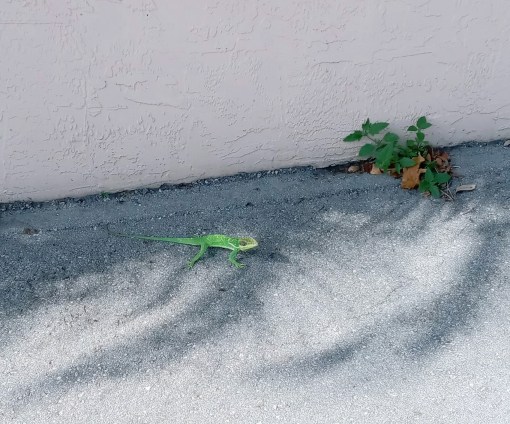
We’ve had some other life in the long alley behind the office, including some good-sized frogs and their tadpoles, and what I think is a Cuban Knight Anole, pictured below, and one of which I saw quite a while back on the fence beside the house in which I live.

20220521_105221_(1)

20220419_163548_(1)

But perhaps the most interesting—in some senses—life form encountered was that seen in this video, in a wooden fence behind the aforementioned slightly wooded, rather pleasant, outdoor seating area in the shopping plaza/strip mall.

There was a time in my life when I would have been terrified even to get this close to such a swarm, but nowadays I just find it fascinating, and I wasn’t the only one.  I’m not sure what I meant when I asked about where the bears are in the video—apparently it was a sensible joke, because my coworker laughed about it.  But all I can think of now is fictional bears trying to get honey from beehives, a la Winnie the Pooh or similar.  And I don’t know why I should have thought of such a thing, even for comical purposes.

Oh, well.  I say and think a lot of things that are bizarre and peculiar, even to myself.

Of course, there is other “wildlife” in south Florida, both native species, like the owl, and invasive species, like the iguanas, the anole, and the humans.  There are other mammals besides humans, as well.  Around the house in which I currently live, there are of course quite a few semi-stray cats, and last night when going out back, I encountered a youngish male raccoon, who was at first nervous of me, though he hadn’t even realized I was there until he practically walked into me, at which time he retreated a bit—apparently I’m pretty quiet.  I spoke calmly to him, and he seemed reassured enough to come back past me to go wherever he was going, through a gap in the fences.  I took no photos, but who hasn’t seen raccoons before?

There’s plenty of food in the neighborhood for an enterprising raccoon or twelve, so I’m not surprised he looked quite healthy.  I know he has older kin, because I’ve seen other, chunkier relatives (presumably) of his in the area in the past, including once what I believe was a mother with her child.  There are also at least two opossums, probably a mother and child based on their relative sizes.

It’s all rather interesting, I suppose.  Unfortunately, nothing about me or my life is nearly as interesting as these animals, except perhaps in the “Chinese curse”* sense.  I still have my usual chronic pain, and this morning my back and side were quite stiff, so before I got dressed I rolled on lots and lots of “Icy Hot”.  I don’t think that was a good idea, because all I have now is that irritating, burning sensation all around my skin in the left half of my midsection, overlaying the stiffness and pain that was already there and persists.

Maybe such products do their work by making you feel relief when they fade away, so you think you feel better when you’ve just reverted to baseline.  It would be a pretty good joke by way of a pain-treating product.

Icy Hot does actually tend to help when I’ve got inflammation and soreness in joints, such as the base of my thumb, so I don’t want to denigrate it too much.  I’m just speaking tongue in cheek—which is a good way to set yourself up to bite your tongue badly if you hit a bump or just forget what you’re doing with your tongue.

That’s about all I have for today.  At least there are some interesting animals, and some exceptionally mediocre pictures and videos of some of them.  If it weren’t for all the people (me included) south Florida would be a really cool—though actually quite muggy and hot—place to be.

Wherever you are, please take care of yourselves and your loved ones.  Relish the time you have with them; it is finite, and you will not necessarily have any warning before it comes to an end.  Revel in your time, as Tyrel said to Roy.

TTFN


*I.e., “May you live in interesting times.”

“It’s just the kind of day to leave myself behind”

It’s Tuesday now, which generally follows Monday, which was yesterday.  Of course, in a sense, Tuesday also precedes Monday, and has done so for practically every Monday we’ve officially had.  But it’s not guaranteed either way.  There may, for any of us and even possibly for all of us, come a Monday not followed by any Tuesday, or a Tuesday not followed by any Monday.  But I don’t think that both things can happen, not for any given person.

Someday I will see my last Tuesday, and it will follow or be followed by my last Monday—but one cannot be certain of the order of those two final iterations of days, can one?  For those who die on a Monday, their last Tuesday is followed by their last Monday.  Otherwise the reverse is true.  I suppose that means that there is a six out of seven chance that one’s last Tuesday will follow one’s last Monday.  Which makes it quite likely but far from certain.

This Monday was a frustrating day at work for me—more so than most Mondays, to be honest.  But I suppose that isn’t terribly unusual.  Work is work, and for most people, it’s not expected to be a place one goes for fun.  If it were, why would they need to pay one to go?  Well, mainly because, even if you enjoy doing what you do at work, you still have to earn a living.  If you don’t do it, then someone else has to earn it for you.

I do think it’s fair to guess that, a lot of the time, even if they would have needed to do it anyway or else die, our ancestors enjoyed hunting and gathering.  Those who enjoyed doing the activities that kept them alive were more likely to do those things, and to do them well, and so were more likely to thrive and to leave more offspring and all that.  It’s one reason cats, for instance, like to hunt and kill things even when they’re well fed.  People are quite similar to cats in many ways, but our social milieu is far more complicated than that of cats—even in the wild—so we have more complicated things that we are built to enjoy, like both hunting (and gathering, presumably) and also doing social things with other members of the tribe.

I say “we”, but of course, I really mean “you”, using that word as a collective pronoun rather than a singular one.  I’m able to learn to do the whole social interaction thing, but it doesn’t come naturally; it often seems unintuitive to me, and I don’t tend to enjoy it except with a highly select few people.  And even most of the people I like to socialize with end up not wanting to socialize with me, so apparently, even when I like socializing with someone, I don’t do a very good job at it.

Maybe that’s because, with the people I really love and want to spend time with, I let me guard down and act like my natural self more, and my natural self is unpleasant to most humans.  I don’t really know.  I know that my natural self is unpleasant to me, at least when I’m not around the people I love, which is all the time nowadays.  But you can’t judge by me, since I don’t tend to like the same things the average human likes in many cases, or not in the same way.  I’m apparently quite weird.  That can work nicely to make interesting characters and situations in sitcoms and movies and the like, but in real life it causes trouble and is not fun.

Not that I want to be normal, either.  The antics and depredations and pantomimes of “normal” people are puzzling and disheartening and disappointing and frankly embarrassing and often infuriating.

Anyway, I don’t know what the hell I’m writing about today or why.  I honestly just feel exhausted and overwhelmed.  I don’t know what to do to try to alleviate my mental and physical discomfort…I’ve tried lots of things, believe me; I am very stubborn, and I don’t give up easily.

I honestly almost wish I had a drug problem.  If you have a drug or alcohol problem, at least you have those occasional, (apparently) sweet moments of escape, and even if your life begins to crumble, there are resources and people all around the place who will stage interventions and help you get back on your feet and will sometimes even praise you for your courage in fighting your problem.  Even jail can be a respite, and badge of honor in some circles.  And if you fail ultimately, and die from an overdose, for instance, well…I guess that’s no worse than most deaths, and better than some*, and people will mourn it and see it as a tragedy.  Not that this will do you any good once you’re dead, but still…

If you just have dysthymia/depression and an ASD (apparently), but you don’t find drugs or alcohol pleasant or relieving of your issues, people just think you’re shit to be around, just a downer, and they don’t like to spend time with you or certainly to spend your life with you.  And if you die because of your illness**, people kind of blame you and have the temerity to wonder why you would choose a “permanent” solution to a “short-term” problem.

As if depression were a short-term problem.  Depression is eternal.  Depression can make a single day feel like an infinity of freezing, caustic, malodorous, gray emptiness, like a bad acid trip that’s produced by the malfunctioning circuitry of your own brain, without the need for external pharmaceuticals.

Whatever else depression is, it entails a malfunction or lack of function in one’s very ability to feel joy, analogous in some ways to how one can lose one’s ability to see or to hear***.  The term is anhedonia, but that word doesn’t capture the Lovecraftian horror of it.  Imagine (if you’ve never experienced it for yourself) doing the things you’ve previously most enjoyed—eating your favorite meal, watching your favorite show or movie, reading your favorite book, going on your favorite vacation, just spending time with the person or people you love most—and being unable to feel that joy anymore, except perhaps in a very blunted and transient way, just a teasing reminder, while all your senses of the unpleasant and painful**** are working quite well, thank you very much.

I won’t say I wouldn’t wish it on my worst enemy.  For one thing, I frankly don’t have any actual enemies.  Also, I think there are and have been people in the world who might “deserve” such a thing, or in any case in whom anhedonia and depression would be a benefit to society at large; I’m thinking of some world “leaders”, past and present.  But in general, I don’t recommend it.

Again, I don’t have any idea what point, if any, I’m trying to make.  But maybe that’s appropriate, since I don’t see any point or purpose to my day-to-day life, either.  It makes sense that my daily blog posts should seem meandering and senseless and unpleasant.  That’s simply a reflection of my true nature, I guess.


*Cancer, or COPD, or liver failure, things like that.  We keep ourselves alive long enough to die horrible, slow, painful and erosive deaths nowadays.

**And, by the way, depression has a mortality rate comparable to many cancers, and at least in some senses can engender greater suffering in those stricken with it, certainly for longer times—sometimes for decades, many of the days of which feel paradoxically as if they last for years.  And you never do hear anyone praising someone’s “courageous battle” with depression, do you?  Depression is too horrifying…a malfunction or malignancy in the very “soul”, and people stricken with it have a hard time coming across as “heroic”.

***You’d never really imagine, though, a scene in a movie where someone slaps a blind person and tells them to “snap out of it” and just start seeing again, already, would you?

****Which are, of course, more fundamental for survival.  People who don’t feel pain and/or fear die much more quickly and certainly than those unable to feel joy.  By logical implication, at least they don’t die in pain or in fear, and that’s good, I think that’s a kindness.  But they also don’t tend to leave many offspring.

O heaven! that one might read the blog of fate, and see the revolution of the times.

Hello and good morning.  It’s Thursday again, and so it’s time for what is, “historically”, my weekly blog post, though in fact it’s merely another iteration of my now-nearly-daily blog post.

It’s getting harder at times to think of what to write about.  I’m more or less committed to doing this whole thing stream-of-consciousness style, since I’m hoping that—just maybe—it might act at least as a form of “talk therapy”, though there are fewer questions and less feedback than one receives from real, usual therapy sessions.  Still, maybe just expressing my thoughts in this fashion will help me to organize them in some way.  I’m certainly not writing fiction or playing music, so I don’t have anything to speak about with respect to those subjects now.

It’s the first Thursday in August 2022, now that I think about it.  That doesn’t seem particularly noteworthy; I can’t think of any major holidays in August, though I suppose I could be forgetting about something.  August is one of those comparatively dull months, though it is a month of “pure” summer, in the sense that, in the northern hemisphere, it’s all in summer, like July, not split up into two seasons like June and September.

It is a bit curious that we don’t start our years at the winter solstice.  People have known about the solstice, about it being the “shortest” day of the year, for who knows how many thousands of years, and many festivals worldwide have been associated with celebrating this renewal of the length of days, dominated in the west of the modern world by Christmas and then New Years.  I think it’s mildly weird that we don’t simply begin the next year on the solstice, or the day after it.  We do start it thereabouts, but why not right on that day?

Maybe the issue is that the solstice changes subtly over time, and occasionally happens closer to one day than another?  I don’t know quite enough about it to say for sure.  If anyone out there does know to what degree the solstices change, feel free to comment about it below—not on Facebook or Twitter, unless you don’t care about the comment being seen for a while, anyway.  I don’t interact much via Facebook anymore; it’s too stressful and depressing, though I miss knowing what many of the people I used to know are doing, seeing pictures of them and their families and whatnot.

Twitter is slightly less stressful, largely because I don’t feel personally involved in any of its stupider aspects and don’t tend to follow people who are.  Twitter, to me, is a good place for sharing links to articles and videos and for one-liners and “What’s your favorite of the ________ movies?” types of questions and answers.  Even with the “enhanced” 240 character limit, it’s simply not a venue for expressing or discussing any deep or complex thoughts.  No wonder “discussions” on the site almost inevitably devolve into monkey-style feces flinging (metaphorically).

Speaking of days and equinoxes*, I read recently that the rate of the Earth’s rotation has speeded up, and indeed, that we recently had the “shortest” day recorded—that’s not shortest in the sense that the winter solstice is the shortest “day” of the year, but that the actual period of the Earth’s rotation has decreased.  It’s not by a lot, of course—I think it was on the order of a microsecond or so, though I may be misremembering that order of magnitude.

It’s certainly not something a person would notice, but the international group that manages the Universal Time standards and sidereal versus solar days and the like needs to pay attention and note such changes.  And if they adjust years—adding leap seconds for instance—that all has to be coordinated with things like GPS satellites and so on, which already have to be managed with respect to General Relativity and Special Relativity; their function depends on highly precise time-keeping, and time is different farther up in “space” and at higher speeds.

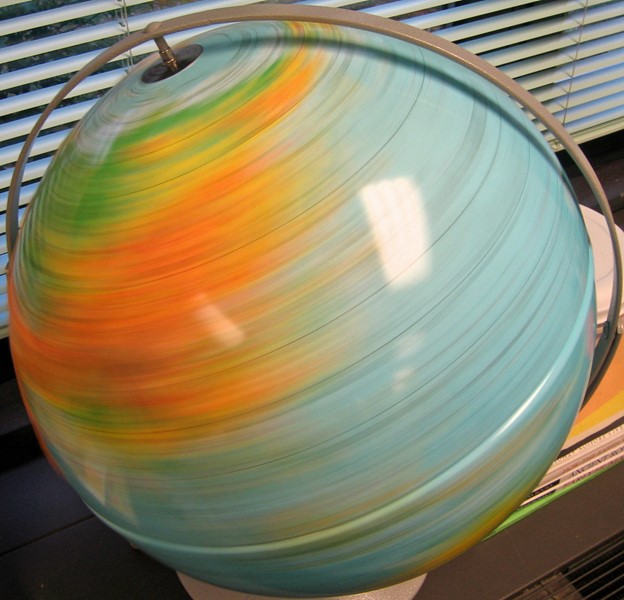
As for why the Earth is speeding up, well, I haven’t read any speculation, but at first glance it seems odd.  One might expect that, over time, if anything, the Earth’s rotation might slow down, and I believe that has been the overall trend over billions of years, with tides and the like very, very slowly dissipating angular momentum.  For a rotating body to begin to rotate faster requires—by conservation of angular momentum—that its overall mass distribution gets closer to the center of rotation, like the proverbial spinning ice-skater pulling his or her arms in closer to his or her torso and thereby speeding up.

spinning skater

I wonder if, perhaps, there is some change in the distribution of the Earth’s mass in the form of water from glaciers, such as in Greenland**, and mountain glaciers in other places, decreasing the amount of mass that was higher up and away from the center of the planet and bringing that mass down into the sea, which by default is as close as things like water can get, since liquid water “seeks” the lowest level.  Of course, general erosion of mountains and even adjustments of the planet’s crust due to plate tectonics could have effects on rates of spin, but it seems to me that they would be too slow in their effects to be so noticeable—so to speak.

I’m sure we’ll be hearing more about this phenomenon, particularly if it continues.  It’s unlikely to make a difference in our day to day lives that could possibly be noticeable to people who aren’t measuring with the most precise instruments science and technology can produce, but the information is a curiosity, and it could be at least a marker of the effects of climate change.  Or perhaps not.  There may be another explanation.

Maybe by sheer chance the Earth got hit with meteorites that, for this one small bit of time, happened to, on average, deliver their kinetic energy in the direction of the Earth’s rotation.  It’s not something that’s likely to be a trend, but it could, in principle, happen briefly just by chance.  It seems highly unlikely to happen in such a way as to cause a measurable change in the rotation rate, but what do I know?

Anyway, that’s about enough meandering thoughts for today.  I hope you are all having reasonably good days—even if they are shorter, and you have a microsecond or so less to get your daily chores done.  Please use that diminishing time by spending it with those you love and who love you, if you can.  Take advantage of the moments you have by doing things that are affirming for your relationships and families and so on.  Entropy is always increasing—that’s the 2nd Law of Thermodynamics, and it is as inexorable as any law we can imagine.

We could find someday that there are exceptions to the speed of causality (aka the speed of light), but no one who knows anything about thermodynamics thinks anything is ever going to overthrow the 2nd Law, since it’s based in the fundamental nature of mathematics and probability.  The universe might start again in a Poincaré recurrence, but that’s not going to be for another 10120 billion years or so, so don’t hold your breath.  Or do, if it pleases you; we’re all going to be long gone before any recurrent universe happens, anyway, even if nothing like the “big rip” makes such recurrence impossible.

As I said, don’t waste time.  Love your loved ones and spend time with them if you can—and if they want you around.  Don’t take such things for granted.

TTFN

whirling globe


*I was, you can go check for yourself.

**I feel that the ones in Antarctica might be less impressive in effect only because they are so much closer to the axis of rotation already.

Talk about digits, my blog’s got ‘em.

It’s Monday again, and it’s also the first day of August in 2022.  This makes it interesting, in a sense, but I always need to remind myself that, no, Monday being the first of the month does not mean that we’re going to have a Friday the 13th.  It’s when Sunday is the first day of the month that we have a Friday the 13th.

That’s not really important, of course—I have no superstitious beliefs about 13 or Friday the 13th.  In fact, 13 is one of my favorite numbers, so I rather like a Friday the 13th.  This is partly because some people think it’s an unlucky day, and partly because of the bad reputation 13 has with the public among the primes, especially when compared to 7, which is not even as interesting a prime, in my opinion, as 13.  Though, when added together, 13 and 7 do make 20.

This is not a big deal, though.  According to Goldbach’s Conjecture, every even number greater than 2 can be made from the sum of 2 prime numbers.  As far as I know this still hasn’t been proven in a rigorous mathematical sense, but I also don’t think they’ve been able to find any exceptions, and since they have supercomputers and the like with which to work these problems, they’ve gone pretty darn high.

Similarly, they’ve solved π (pi) to about 62 trillion digits or whatnot.  Think about that incredible number of digits.  By comparison, a googol—which is a number larger by far* than the number of elementary particles in the accessible universe—is only 100 digits long.  The Planck length itself is 1.6 x 10⁻³⁵m.  So, it has 35 digits of significance, really, taking the most generous possible meaning of “significance”.  And that’s the fundamental, measurable minimum sensible distance quantum mechanics, in its current best form, says exists for reality**.

In other words, even if we had the greatest possible precision that is physically within the realm of reasonable speculation, we could not measure the radius and circumference of any instantiated circle precisely enough to come close to telling if it matched the current figured length of π.

Of course, no actual, physical circle is going to be a perfect, mathematical circle.  See above regarding the Planck length; that alone will screw up how perfect a circle can be.  Also, spacetime itself is not perfectly flat (although it can locally be extremely close to flat, and on the largest scales it appears to be flat).  Even the presence of the person doing the measuring would probably be enough of a spacetime distortion to make a circle’s ratio of circumference to diameter mismatch against π.

Don’t even start trying to compare the ratio of circumference to radius in a massive body like the Earth or the Sun.  Those ratios are measurably (in principle at least) below π because of spacetime distortion as described by General Relativity.  And, of course, a black hole’s radius, as measured from within, would be functionally infinite.  So, its local equivalent of π would go to zero.

But π is a mathematical constant, describing ratios of mathematical objects that are precisely defined in flat, Euclidian geometry, and as such, π is a real thing…indeed, a transcendental thing, you might say.  It is known to have an infinite number of non-repeating digits.  Which is not to say that there are no repeats at all, just that there is no repetitive pattern.  Obviously, in base ten we have only ten digits with which to work, so there are quite a lot of reuses of each digit—an infinite number of them, in fact.

In fact, I suspect—though I don’t know—that if you πcked any finite number of contiguous digits of π, you would eventually be able to find a recurrence of them somewhere down the line, though it might be far beyond what’s been calculated to date.  The reasoning, at least as I’m thinking about it, is similar to the reasoning that demonstrates that the “Level 1 Multiverse” is a real thing, if spacetime is infinite in spatial extent.  The best data we have now seem to indicate that either space really is infinite or at least it’s waaaaaaaaaaaaaaaaaaaaaaaaaaaay bigger than the 93 billion light-years-across visible universe.  This is part of that spacetime flatness I mentioned before.

To think about it from a more mundane point of view:  the Earth, locally, looks flat (ish), but if you start precisely measuring the angles of bigger and bigger triangles, you’ll find that they’re adding up to more and more above 180 degrees, showing—even if nothing else did show it***—that the Earth is not flat, and in fact has “positive” curvature in Riemannian geometry.  But if you kept on measuring the sums of the angles of bigger and bigger triangles and they all stayed at 180 degrees to the greatest precision you could possibly muster even at immense size, you’d come to the conclusion that, well, either the world on which you stand is flat, or if it’s a spheroid, it’s a really, really BIG spheroid.

The analogous measurements (in three spatial dimensions, obviously) have been done on the scale of the microwave background radiation, which is as far back (and thus as far away) as we can see with light (microwaves, specifically):  about 300,000 years after the Big Bang.  They are consistent with a flat spacetime.  So, as I said, the universe is either spatially infinite, or WAAAAY bigger than what we can see.

This infinity doesn’t really do us any good, of course.  We still couldn’t reach almost any of it, even if we were traveling at the speed of light, since the expansion of the universe appears to be accelerating, and thus distant regions are moving away from us faster than light.  But, since quantum mechanics appears to dictate that, within any closed region of space, there is a maximum number of possible configurations (defined, at its upper limit, by the event horizon of a black hole with that apparent volume, the number of possible states (or its entropy) of which is related to the surface area of the horizon expressed in Planck lengths squared…so, it is big, but it is finite), then if space is infinite, there will be regions of space “out there” that are precisely the same as any finite region you might choose to compare them to, from the size of a human to the size of the accessible universe.  Indeed, in a spatially infinite universe, there are an infinite number of them.

If it helps, you can think of decks of cards being shuffled.  There are 52! (read as “fifty-two factorial”****) ways for a deck of cards to be ordered if they are shuffled randomly…that’s about 8.06 x 1067 ways.  It’s a big number, and though it’s nowhere near the number of elementary particles in the visible universe, it’s so big that we can be mathematically all but certain that no two fairly shuffled decks of cards have ever in human history come out the same.

However, if we have an infinite number of decks being shuffled, not only will any given ordering be repeated, it will be repeated an infinite number of times, though there might be quite a large average distance between repeats.  So it will be with iterations of any person or planet or galaxy or locally causally connected “universe”.

Don’t worry about it too much.  Though in an infinite universe there are an infinite number of any given person (as well as every possible variation thereof), these doppelgängers will have no effect upon you, except perhaps to blow your mind, as your existence will blow theirs.

Well, I don’t want to keep going on forever (har!), so I’ll call it to a close now, by noting in passing that this month (August, see above) is named (as many know) for the first “official” Roman emperor, as July was named (also as many know) for the first “de facto” Roman emperor, and June was named (as very few know) for June Cleaver, the empress of late 1950’s to early 1960’s American television.


*How far?  About 10,000,000,000,000,000,000 or 100,000,000,000,000,000,000 times as big.

**That doesn’t mean there are no finer distances, necessarily—though it might—but unless quantum gravity or whatever changes things significantly, it sure seems to be a limit…a physical one, not a mathematical one.

***Other things do.  The Earth is round, and people have known this for thousands of years, contrary to popular belief.  2200 years ago, Eratosthenes figured out the Earth’s circumference by measuring shadow lengths at different latitudes and doing some basic trigonometry.  He got the right answer, too.

****Which is 52 x 51 x 50 x 49 x … x 3 x 2 x 1.  The 1 is a really superfluous, since anything times one is just the thing itself, but it’s there for completeness.