In nature’s infinite blog of secrecy a little I can read.

Hello and good morning.

It’s Thursday morning once again, and so it’s time for me to attempt to create a simulacrum of what used to be my typical, once-weekly blog post, back when I used to do my fiction writing every non-Thursday morning of the week.  It won’t really live up to expectations, I wouldn’t think, since the situation is now so different.

For one thing, I can’t talk about my fiction writing, since I haven’t done any fiction writing since before I last posted The Dark Fairy and the Desperado, and previously, Outlaw’s Mind, both of which are uncompleted stories and are likely to remain that way until the end of the universe—barring, of course, the possibility that the universe goes on forever and every possible quantum state thereof is eventually realized somewhere, somewhen.

Indeed, if the universe is infinite in spatial extent, as seems to be the case, and if our understanding of quantum mechanics and the maximal entropy state of enclosed regions of spacetime are correct, or even reasonably close to being correct, then somewhere out there in space “at this time” there are an infinite number of versions of me who have completed both stories, and many others besides, and who are world-famous authors.

I used scare quotes around “at this time” because, obviously, given the finite speed of light/causality, and the flexible nature of time depending on relative motion, the concept of simultaneity is fuzzy at best.  Nothing outside one’s local light cones can be considered to be in one’s past or one’s future, but they are also not exactly “now”, either.

Still, we can give an overall statement about the age of the universe for things that have little to no “peculiar motion” relative to the cosmic microwave background and say that such things have gone through about 13.8 billion years since the hot big bang, on average, and it’s not nonsensical to do that.  So, if by “at this time”, I refer to other regions of a spatially infinite universe that have passed through roughly the same amount of local time since the big bang, I’m not incorrect in saying that there are an infinite number of “me” who have completed their stories—and there are an infinite number who have not, and there are an infinite number of every possible variation.

None of that does me (or you) any good, because—being outside my past and future light cones (and yours, which are almost identical to mine)—those distant regions are completely causally disconnected from us, past and future, especially given the accelerated expansion of the universe.  I suppose an Einstein-Rosen Bridge/wormhole could conceivably connect such distant regions, in principle, assuming such wormholes can even happen, which is far from certain.

There are those who hypothesize that quantum entanglement happens through wormholes (small ones), and there are those who have even tried to connect distant multiverses with the many worlds of a branching Everettian quantum mechanics, but I don’t think either of those things is close to having been rigorously described, let alone tested, nor are they generally accepted by the physics community.

Anyway, it still doesn’t help any of us, because clearly, if there are alternate versions of ourselves living better lives than we are*, they have no back-and-forth connection with the lives we currently are living—the wave function has split, the states have decohered, they are not the same beings, even if movies about multiverses win many Oscars and/or make a great deal of money.

What was I talking about again?

I don’t know.  I’m very tired.  I ended up sleeping in the office last night.  I did this deliberately; it had nothing to do with train problems or anything.  I just didn’t feel like going back to the house.  I was tired (still am) and there’s nothing at the house for me that is any more enticing than there is at the office, other than a shower.  And I don’t really care about a shower right now.  For whom would be grooming myself?  Whom am I trying to impress?  All is vanity, as it says in Ecclesiastes.

It’s a funny line for a religious text that some people say contains the infallible word of an all-knowing, all-seeing, all-powerful and omnipresent deity that made everything, deliberately and specifically.  If that were all the case, why would it say all is vanity?  Of course, the argument could be made that these were the words of some ancient human (Solomon or David, one of those kings, is supposed to have been the author of Ecclesiastes, I think), not the direct words of the creator of the universe, but if that’s the case, then clearly the bible is not literally true in all its parts**.  But that’s hardly the only case of seemingly contradictory portions of religious texts, is it?

Anyway, it’s chilly here for south Florida—about sixty degrees, which feels cold when you’re used to 70’s to 80’s, but would no doubt feel beautifully balmy to people back in Michigan or Ohio.  It’s certainly far warmer than intergalactic space, which is only about 2.7 Kelvin (so it’s about 286 Kelvin hotter here).  Then again, it’s much cooler than the heart of the sun, and cooler yet than the heart of blue supergiant stars.  And those are all vastly cooler than just later than one Planck time after whatever initiated the big bang.

Of course, there is, in principle, a maximum heat that any local region can achieve, because if the local energy is high enough, it will form a local black hole, and also the uncertainty principle will kick in to separate things.  Although…if everything is uniformly very hot, such that there is no net curvature of spacetime in one local region relative to another…maybe that’s where inflation comes from?  If there is inflation***.

Anyway, that’s enough nonsense.  I’m just jabbering and chattering, because I don’t really communicate with anyone day-to-day in any way other than this about things that interest me.  I’m very alone and very tired, but I’m also very bad at doing the whole social interaction thing, so I’m kind of stuck.

I’m inclined to say that I deserve it—that’s how I feel—but of course, as Will (played by Clint) points out below, such concepts are really vacuous.  There are a functionally limitless number of possible variations of lives that could be lived by a being that matches my rough description and/or has an identical past that diverged at some point.  I’m just living one of those possibilities, because, well, I had to be living one of them unless I were dead, which I’m not, unfortunately.

I hope most of you are having a better morning than I am.  Heck, I’d be delighted if everyone who reads my stuff always has better days than I do.  That would at least be some good news.  And, of course, somewhere out there in infinite spacetime—if there is such a thing—that situation is instantiated.

Don’t be jealous, though.  There are also places where everyone reading my blog always has worse days than I have.

Poor bastards.

TTFN

deserve


*And if there are, there are also infinite numbers of versions of us living every possible worse life as well.

**If in any of them whatsoever, which is a separate but related question.

***Well, by certain definitions, we could say with great confidence that there is inflation, since the universe is inflating now—that’s the “dark energy” you might have heard about—but it’s doing it quite slowly, doubling in size over the course of every about ten billion years, I think, at the current rate, assuming it’s a constant.  But if you change the time scale, it looks much the same as earlier, more rapid inflation…I think that’s the basis of Roger Penrose’s Conformal Cyclic Cosmology, but I haven’t read his full book on the subject yet, so I may be misunderstanding.

“What the hell am I doin’ here? I don’t belong here.”

I apologize for my rather boring blog posts over the past few (or several) working days.  I was trying to be as upbeat as I could, and to stop dwelling quite so much on my mood disorder and my otherwise disordered mental state, such as it is, because I feared that I would end up just turning readers off.  So, instead, I’ve focused on walking and blisters and silly things like that which, upon occasion, and in passing, would give a glancing blow at some interesting (in my opinion) subject matter like yesterday.

The fact is, I’m having severe, ongoing, worsening problems with my depression, and I feel like nothing I’ve done here or said here has been of any benefit to it or to me.  Or, well, what I’ve said and done might benefit the depression in and of itself, i.e., it might have made it stronger.  But that’s not necessarily good for the larger organism (me).

This is referring to the depression as if it were a being or entity in and of itself, with a separate nature and goals and criteria for thriving and so on.  It’s not, of course.  It’s a state of my own brain/body, a sort of self-sustaining but destructive pattern of internal and external interactions in a brain that’s already not exactly functioning in quite what might be considered a normal, or at least normative, way.

I’ve previously likened depression, as a state or an “attack”, to a hurricane—a self-sustaining pattern that forms and grows when conditions are right and is very difficult to break once it gets going.  I think that’s actually a decent analogy.  It’s certainly vastly better than the popular “chemical imbalance” notion upon which I’ve spat my vitriol more than once in the past.

As with hurricanes, I think it’s not entirely unreasonable to think of depression as if it were an entity of its own that tends to act to sustain and strengthen itself, as if it had intentions and a will, as long as one maintains the implicit awareness that this is a metaphor.  It’s easy to get into the habit of using metaphors so often that they stop behaving like metaphors in one’s head and start being, effectively, literal interpretations of things that are fundamentally otherwise, and it’s important to try to avoid doing that.  That way madness lies, as they say.

And madness does lie—almost always.  That’s one of the big problems with it.

Anyway, the point I’m trying to make and to which I’m struggling to stick, is that depression acts as if it has a life of its own, rather as a tumor more or less literally acts as an entity in and of itself within the body, with its own “agenda” of self-sustenance and growth.

I’ve said to others, and to myself, that my mind is not my friend.  This is one of the reasons, for instance, that though I’m intrigued by them, I don’t think I would ever seek out an experience with any form of psychedelic.  My mental state often already has the feel of a bad trip of sorts, as I’ve heard them described.  I don’t want to pour gasoline onto that fire.

But I’ve fought with this entity in my head for almost as long as I can remember.  My brain, my mind, has always been weird—to me, relative to the people around me, and to many of them as well—though others also often seem inscrutable and inexplicable to me, at least in the sense of feeling things “in my bones”, though I’ve read and learned many things that give me at least an academic, intellectual understanding of things people do.  But I can’t say I grok them.

I’ve often said that basic primatology—particularly that which applies to primates that live in large groups—provides a sufficient framework on which to hang the vast majority of human behavior.  I suppose this should not be too surprising, since humans are primates, after all.  But it’s disheartening how rarely humans fully depart from the simple, chest-thumping, fang-baring, hierarchy-climbing, mate-seeking, dominance-submission behavior patterns that could with only a little simplification be transplanted onto the average baboon flange.

I cannot claim any superiority, of course.  My own, apparently “neurodivergent”, brain* is erratic and irrational even by its own—my own—standards, and I certainly cannot claim to be a well-adjusted machine running in optimal condition.  There are aspects to my machine that really are well put-together, and I’m glad for those, of course.  But they don’t seem to be enough to keep the whole thing operational.

I decided to give up even trying to look for help or improvement or to expect myself ever to get any better, and I tried not even talking—or writing—about it.  But that didn’t make for very good blog posts, apparently.  So maybe this one will at least be more interesting.  It’s truer to my inner state, if nothing else.

So, welcome to Hell, population one—I would like to say welcome to Purgatory, but there is no process of cleansing or improvement—of purgation—going on here.  There is only malicious, sadistic, hateful torment meted out by the demonic overlord of a realm repurposed for the eternal excoriation of a lost soul that is also the demon itself.

Okay, well, that paragraph was gratuitously melodramatic and misleading.  Sorry.  It makes the whole thing sound more exciting and impressive than it actually is.  Oh, well.  At least it’s not boring.  Except when it is, which is actually quite a lot of the time, come to think of it.  That’s one of the many forms of torture it entails.  Actually, that’s one of the big issues about it; even things that ought to be interesting are utterly mind-numbing, or seem so because the mind itself is numb (not comfortably) in the first place.

This is all a bit of mess here.  Again, sorry.  Returning to an earlier point, I’ll say that though the hurricane analogy is good as far as it goes, hurricanes have a tendency to peter out, eventually, as they move through the atmosphere, certainly once they go over land and lose the source of their water and heat, and then they kind of just fade away.  Certainly, no hurricane is going to destroy the Earth itself.

Depression, on the other hand, can absolutely do the equivalent of such planetary destruction.  In this, it’s much more like a tumor than a hurricane.  It’s a slow-growing tumor, perhaps like an indolent prostate cancer—the sort of thing you can have, and not treat, and yet you still might die of something else before the cancer ever would kill you (though kill you it may).  But even if it doesn’t kill you, it certainly doesn’t make you stronger.  It affects everything else in the system.  It steals energy from all the “good” things, when there even are any, and it further whittles away at those few good things by making a person intolerable to the people and things that are good in that person’s life, until nearly all of them are gone.

I don’t have any answers to this problem.  I know of ways to end the problem, but not to cure it.  Unfortunately, I don’t see any evidence that anyone else out there has any good answers.  Believe me, I’ve looked, and I’m “qualified” to evaluate such matters, in more than one sense.

The world was not made for us; it was not made for anyone; as far as we can tell, it just happened.  Ditto with human beings and other forms of life—even weirdo, alien, replicant, robot, changeling, mutants like me.  Ditto with culture and civilization.  There’s no reason to expect them to work flawlessly or efficiently.  They just have to work “well” enough to be self-sustaining.  That’s natural selection, and it’s not pretty.

Well, it can be quite beautiful, depending on your point of view, but even Darwin noted how slow, cruel, wasteful, and harsh it all is.  Nevertheless, it’s the only game there is, as far as I can see.

I so just want to fold and walk away from the table.  Right now the blister on my foot is inhibiting that somewhat, but it’ll heal**.  Then maybe I can finally take a long walk off a short planet.  I don’t see any better options.


*Every time I take new or repeated tests to check on whether it’s accurate to describe it that way, I keep getting results pretty resoundingly supportive of that hypothesis.  I recognize that I am not performing scientifically rigorous evaluations, since the one administering and the one to whom the tests are being administered is the same, and it’s only too easy to introduce bias.  But I don’t have ready access, nor the mental wherewithal to take advantage of it, to resources to get a more objective assessment.  And when I go online and watch videos and when I read books and articles, when I go to social media and look at available resources and groups there, and so on, I find that, while these people all make somewhat more sense to me than most other people do, I still feel severely weird even in comparison to them, and I could not feel comfortable among them or interacting with them.  I feel no sense that I could connect to the related communities—to any communities, really.  I feel like a creep and a weirdo relative to every potential group or person with whom I could consider engaging.

**I almost accidentally wrote “it’ll heel”, which would be funny, but the blister is on the ball of my foot, not the heel, so as a joke, even an unintentional one, it just wouldn’t work.

Some blistering insights into soles like hobbits’ (and holes like ants’)

It’s Monday again.  Yippee ki yawn.  Aren’t you all just so excited?

I don’t have much interesting to report or discuss today, because I haven’t really done anything interesting to report or discuss, nor thought anything interesting to report or discuss since my last blog post.

I have continued trying to sort out different shoes and related footwear.  I walked home from the train station on Friday, but it turned out that the new blister on my right foot had not resolved itself very well during the two weeks since it had happened, which is quite annoying.  The blister on the left foot was fine; I had very carefully, and under effectively sterile conditions, poked a pin-hole in it the day after my very long trek, to drain the fluid, and it basically has now become just a thickened area of foot sole, and it gave me no trouble over the course of my five mile walk on Friday evening.

On the right foot, for reasons I don’t recall clearly, I had elected not to drain the blister—I think it just didn’t seem to have as much fluid in it—and a little more than halfway through my trek on Friday, it started to give me more trouble, as if I had something sharp stuck in my shoe.  I didn’t have any such thing; I checked.

Anyway, I rested on Saturday, during which my right foot was sore still, and I decided to drain that blister as I had the other.  I then walked about six miles (total) yesterday, and though the blister is still irritating, it’s better than it was.

Here’s my off-the-cuff hypothesis for why the course of the left and right blisters was different:

By draining the fluid from the left blister, I allowed the two layers of affected skin to re-adhere to each other, and through that process to become firmer and tougher—at least tougher than they were when the fluid of the blister was present.  On the right foot, however, even as it was recovering, there was still fluid in the blister—it never got completely reabsorbed, and the skin layers thus never re-adhered.  So, once I walked a long enough distance, those two layers of skin were effectively separate and lubricated, and began to rub back and forth against one another.  Just as pertinently, at the edges of the former blister, shearing forces pulled the aforementioned layers of skin further apart, causing new damage.  So, it was actually therapeutic to drain the fluid—as long as I protected rigorously against the risk of infection—than to allow the other to retain its fluid in this case.

As I thought about this, I wondered why such a thing might be the case.  Why would our evolutionary heritage saddle us with a process, on the base of our feet of all things, that would be counterproductive to healing?  Then it hit me*.  Our ancestors throughout almost all of evolutionary time did not wear shoes or boots or any such thing, and they certainly didn’t walk for long distances on paved roads.  They would have formed calluses on the soles of their feet, starting at an early age—presumably as soon as they were able to walk—and repetitive shearing forces, such as are produced by the rubbing of the sole of a shoe, would not apply.  They would have had the soles of hobbits, if you will, and those are pure, tough soles indeed.

So, in some senses, our footwear is detrimental.  Of course, in other ways, it’s extremely useful, and does protect us from sharp and hard objects on the ground against which even thicker skin wouldn’t have defended adequately.  Broken glass is certainly something one wouldn’t want to encounter with bare feet.

Then again, I recall that once, quite a while back, a Kenyan athlete won the Olympic marathon in bare feet, so there aren’t severe disadvantages.  It’s got to be pretty hard to do on pavement, though, and the next time that athlete ran, and won—if memory serves—he did wear shoes.

And you wouldn’t want to go walking through a snowy landscape without something on your feet, at least for warmth.

Still, it makes one wonder how many of the things we wear on our feet are relatively unnecessary and even counter-productive.  If I had gone barefoot a lot over the years, would I not even require footwear much anymore, living as I do in south Florida, where there is almost never anything close to snowy weather?  It’s certainly likely that the risk of fungus would be lower!  It’s interesting to wonder whether even the problems I have with my right ankle, due to an old severe sprain, would be fewer if I had not worn various types of footwear.

It’s also interesting to think about how much of the footwear industry is just a self-sustaining fiction, like so many other industries.  Just to be clear, though, I would not claim that this is any kind of conspiracy or evil plot by malevolent capitalists at Nike and Adidas and Reebok and New Balance.  That’s just a stupid thought, and if you seriously entertain it, you should probably slap yourself.

I’m sure there are worse and better people (by whatever criteria one might specify) at nearly all levels in such companies, as there are in the ranks of social services, as there are working in governments, as there are in charitable organizations, as there are in hospitals.  No, the footwear industry, at all its various levels, is just a big, spontaneously self-organizing system, like everything else about civilization.  There is no master plan, and there is no master**, any more than there is a planner, architect, CEO or Personnel office in an ant hill or a termite mound or a bee hive or a school of fish or a flock of birds.  Things happen, and the things that tend to be self-sustaining tend to sustain themselves***, while the things that don’t tend to do so simply fade away with relatively little fuss.

This is part of, or at least related to, why I hate people calling elected officials our “leaders”.  They’re not leaders, nor should they be, and they certainly don’t “run” the country or state or city or whatever.  They’re employees, managers, servants.  And believe me, they are just as fundamentally clueless as everybody else about what’s happening in the world and what to do about it.  They just sometimes pretend otherwise, even to themselves.  But just because they fool themselves, doesn’t mean you have to let them fool you.

That’s about it for today.  It’s been a weird progression of thoughts, but that seems appropriate, given the eventual topic of discussion.

caveman walk


*It’s just like what happened when I was standing in a park and wondering why a frisbee appears to get larger and larger as it gets closer and closer.

**Except the Time Lord called The Master.

***Duh.

Some musings on brane-worlds, “dark matter”, and even “dark energy”, with apologies

I told you yesterday  that I would be writing another post today, since I’m going into the office, and here I am, writing another post.  You were given fair warning—or at least, you were given adequate disclosure.

Yesterday (and into today) I was listening to an episode of Sean Carroll’s Mindscape in which he spoke with Adam Riess, one of the discoverers in the late 1190s of the increasing rate of cosmic expansion—the single most exciting scientific discovery I recall happening in my lifetime.  In the podcast, the two physicists spoke, of course, of “dark energy” and “dark matter” and the “Hubble tension” between two different ways of predicting and/or calculating the Hubble constant*, and that all reminded me of something that I’d thought of more than twenty years before.

If M-theory (an overall theoretical structure that subsumes “string theory”) were to be right, and we are merely living in a 3-brane embedded in a higher-dimensional “bulk”, then perhaps the explanation for “dark matter” could be simply the gravitational effects of matter in a nearby, parallel 3-brane, or perhaps even more than one (since, if more than one, why not more than two?).  I had first tried to give myself a very simplified model on which to do some calculations about the possibility just for fun, way back in a lunch break during my first year in private medical practice, but I didn’t get very far.  My schedule was rather busy, and I had many good and interesting things going on in my life that drew my attention.  That last part, at least, has changed almost completely.

Despite all the theoretical and proposed notions for what dark matter particles might be (WIMPS, Axions, lots of primordial black holes, etc.) there has not been a single detection of any of them.  There hadn’t been any twenty years ago, and there haven’t been any as of this writing, unless they’re keeping it under their hats, which is unlikely for something of such importance.  Nobel Prizes will be won by those who discover convincing evidence of any dark matter particles!

The evidence for dark matter in general. though, is tremendous and all but unassailable, coming from multiple fronts in astronomy/cosmology/astrophysics, but its specific nature is still not known.

So, yesterday morning, I decided to retry the notion I’d had twenty-odd years ago, just for fun.  I don’t expect to make any particularly interesting breakthrough here, obviously, but it was just my way of seeing if my notion has any modicum of worth at all, or if it’s totally self-contradictory.

As before, I needed to set up a highly simplified situation, just so that it would be within the wheelhouse of my very limited mathematical skills, which are rusty to say the least, and which were never nearly advanced enough for any serious work in GR or M theory (I often consider trying to work my way up to better, more useful such skills, but I don’t know whether that will ever happen).

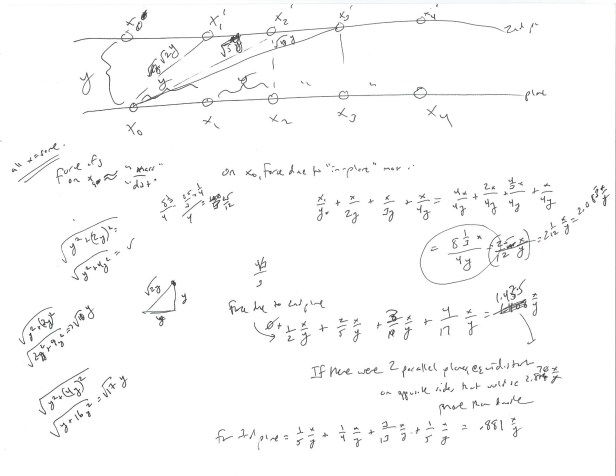
So, I took my model down to being just a plane rather than a space, which makes the strength of gravity fall off linearly with distance, rather than as distance squared.  Then I just took a line of identical masses, x, (x0, x1, x2 etc.) all separated by an even distance, which I called y, and so the gravitational force on my x0 mass due to any other was just proportional to x over some multiple of y.  I made my gravitational “constant” just 1, so the force would literally be x/y or x/2y, and so on.

Really, in the first universe, though it was in principle two-dimensional, I only had to deal with one dimension of additive forces.  This will make my model not terribly useful with respect to the actual universe, but I wanted just to get a feel for things.  You’ve gotta crawl before you can walk or run or fly.

Then I took my “parallel” brane to be also y distance away—to keep applications of the Pythagorean Theorem and such simple—but obviously in a direction that’s orthogonal to every direction within the original brane.

According to the ideas in M-theory/string theory, most particles—photons, electrons, quarks, gluons, neutrinos, etc.—are described as “open” strings, with free ends, and as such, they cannot leave the brane in which they exist (apparently their ends are “sticky”)***.  But gravitons, as proposed in string theory (they were one of the main things that first led people to take string theory seriously as a potential theory of quantum gravity) are closed strings, and they can go between branes and into the “bulk”, the larger, overarching spacetime in which lower-dimensional branes could be embedded.  Thus, one brane can gravitate with respect to another, and this tendency of gravity not to be confined within a brane could explain the relative weakness of gravity compared to the other forces of nature.

Okay, so I did my best to try to work out the situation relating the additional strength of gravity felt by my initial, single particle due to the added gravity from masses in the parallel brane—and then two parallel branes or so, just to see.  I made some mathematical errors that I caught, and I’m sure I made others than I didn’t catch, so I’ll include my—utterly chaotic and not really annotated—worksheets here below, in case anyone is masochistic enough to want to look through them.

I don’t think I produced any startling insights, of course, but one thing that became more obvious on working it through is that, as parallel masses get farther away as measured in the plane of the original universe, their gravitational effects become more like that of the masses within the original brane.  This makes sense, because the farther away they are, the less the effect of the separation of their branes has relative to that distance; so the angle of that force relative to the plane of the first universe is smaller, and its within-brane component is larger****.  The “nearer” masses would have gravity that was barely felt, or not felt at all, within the original brane (or universe), but the farther out the masses go, the more they would be felt as if they were mere additional mass within the original brane/universe.

Could a situation analogous to this but in higher dimensions explain why dark matter acts as though it is a halo going through and around galaxies, and doesn’t seem to clump together?  And could such a description, in the absence of any detectable particles of dark matter, constitute a test of the notoriously difficult-to-test M-theory in the real world?  At least, the longer we go on being unable to find a direct dark matter candidate particle interaction, the more the Bayesian prior for a string/M-theory explanation might go up.

I don’t know.  I’m way too out of my depth.  But it is an interesting thought, and I invite any readers who have actual expertise in such matters please to give me their reactions.  I don’t think my thoughts are anything that’s useful for anyone, but it is kind of cool.  I think.

For those of you who aren’t interested in such things, I apologize.  It is a Saturday post, so you can consider it a weekend indulgence (though I did the figuring on Friday morning, really).  It’s the sort of thing I think I previously would have confined to Iterations of Zero, and I’ve skirted the topic in the past there and here.

I have to have things like this to do from time to time.  If I weren’t able to think about such things to distract myself from my own awfulness, I would already have killed myself a long time ago.

Maybe that would have been better for everyone.  But the past cannot be changed without making a completely new universe that wouldn’t benefit anyone in this one.  So, it is what it is.

Have a good weekend.

my dark matter m theory scribbles_0001

my dark matter m theory scribbles_0002

my dark matter m theory scribbles_0003


*It’s either roughly 67 or roughly 73 kilometers per second per megaparsec**, which is the overall rate of expansion of the universe.  These values do not have overlapping error-bars, and they both have become tighter over time, so something is being missed.  It’s not a huge difference, but there should be no difference at all if the models are correct in all aspects.

**The parsec is not a measure of time, of course, but of distance, and a mighty big distance at that.  A parsec is a little over three light-years (which is about 30 trillion kilometers), so a megaparsec is roughly 3 million light-years.  Big!  With this measure of the Hubbles constant,  you can see why, at close distances, attractive gravity vastly supersedes expansion; the expansion tendency doesn’t become very large—indeed, expansion doesn’t even happen—until distances become truly cosmic in scale.  The Andromeda galaxy is less than one megaparsec away (not by much), and its net movement toward “us” is about 110 kilometers per second.  I suppose that implies that if it were not for the Hubble expansion, it might be coming toward us at about 180 kilometers per second, and might “collide” with the Milky Way in only two or three billion years instead of four or five.  Oh, well, we’ll just have to wait.

***The thought just occurred to me that branes, like strings, are thought to be composed of some form of “energy”, admittedly a nebulous term and a place-holder—there’s always more to learn.  But uniform energy creates a negative pressure, which in General Relativity produces repulsive gravity…the very cosmological term/constant Einstein proposed and discarded, but which has come back into its own as a descriptor of “dark energy” and even cosmic inflation.  On the scale of individual strings, say, even though the energy density would be high, the Lambda term would be too small to lead something the size of a typical string to expand at all, but in a brane—2 dimensional, 3-dimension, or more—if it’s large enough, the very energy that constitutes the brane might be enough to explain the existence of repulsive gravity, from inflation to the current “dark energy”.  Or am I totally off-base here?

****The vector component of their gravitational force that can be felt within the first brane should be the cosine of the angle between the second-brane mass and its analog in the original times the total gravitational force it would exert on the first.  Any other component would be felt between the branes.  Such possible inter-universe gravitation is in the source of the threatening catastrophe in my book The Chasm and the Collision.  Don’t worry, the book doesn’t dwell much on any technical aspects of this.

Brief thoughts on candy, carbon, communication, and a shared “video”

Well, it’s Wednesday, the day after Valentine’s Day.  I know it’s not technically the Ides of February or anything—at least I think I know that—but there ought to be an official day for the day after Valentine’s Day, some equivalent of Boxing Day after Christmas.  Maybe we could call it Barfing Day; that might be both fun and appropriate.

I was thinking that yesterday would have been an excellent day for me to have a heart attack.  It seems an appropriate potentially fatal healthcare crisis to have on a day when everyone is sharing “heart-shaped”* treats, many if not all of which are not great for the coronary arteries.  However, though I did in fact find myself once sprinting to beat a light and then later sprinting to catch a bus—one can’t get much more cliché than that when it comes to myocardial infarctions—I felt not a hint of chest pain, shortness of breath, palpitations, or what have you.  Disappointing.  And the only nausea I felt was that sort of subjective nausea that isn’t a true physical feeling, but which is a projection of disgust over the very silly and stupid things people say and do.

This queasiness was not in response to Valentine’s Day activities!  Don’t get me wrong.  I thought Barfing Day was a good follow-up day because eating too many sweets in one day can lead to GI upset.  For the most part, I think it’s nice that people express love, romantic and/or otherwise, to those important to them.  It may be frustrating that it’s such a ritualized, scheduled expression of love, but unfortunately, if it were not for such rituals, it’s probable that many people would never make or think of any such expression at all.

Sometimes, it seems, humans need rituals to make them realize their own feelings, and perhaps even to confront their own feelings.  This can apply to bad feelings as well as to good, as when, on the approach to a holiday such as Valentine’s Day, someone realizes that the person with whom they are currently linked is someone with whom they don’t really feel that strong a bond.  Hopefully such a realization occurs before too much has been invested in a relationship.

I suppose the need to act in recognition of such a fact can sometimes lead to a stereotypical Valentine’s Day breakup, which is harsh, but perhaps better than the alternative of a long, unpleasant relationship with increasing acrimony and emotional (if not physical) abuse.  Maybe I’m wrong.  I don’t know; I’m making this up as I go.

In distant parallel to the above, I sometimes think that maybe we should lace all Valentine’s Day candies with hormone blockers or something along those lines to diminish the sex drive of those who eat them.  Surely, anything that can be done to decrease the breeding of new humans is probably going to be a benefit for the rest of the planet, and evolution just isn’t likely to get to that solution on its own.

On second thought, that may actually be a foolish notion.  Honestly, I’d worry more about people if they didn’t have any children, because the nurturing of children is one of the most potent triggers and encouragers of love—not to mention forethought—in humans.  As I think Fagin said in the musical Oliver, I think I’d better think it out again.

Anyway, that’s all for you guys to worry about.  I’m giving up on it, and with any luck, none of what humans do will have any impact on me, other than perhaps to alter slightly the rate of decay of my corpse.  Though it would be useful, I think—and as I’ve written before—to enact a policy, or even a tradition, of storing the bodies of the deceased in deep ocean subduction zones, to get them out of the carbon cycle.

Cremation seems like a terrible idea; it just gives everyone one last lunge to increase their individual carbon footprint!

It probably doesn’t make much difference, though, honestly.  Such minor sequestering and the like on local, individual level is unlikely to accumulate into anything of significance to the global atmosphere.  I think it will only be the development of new science, technologies, and processes that will engineer out the excess carbon from the atmosphere, perhaps using some adjusted and enhanced equivalent of photosynthesis on an industrial scale (among other thing).  After all, photosynthesis takes carbon dioxide and water—potent greenhouse gases—from the atmosphere and ultimately converts them into carbohydrates and fats and such.  These can then be sequestered, if necessary, or converted to bioplastics, and biofuels, to use for things we currently do with fossil fuels.

The local energy for those processes can be derived from the products of the photosynthesis (ultimately from the sun) and so on, so that even when not truly “carbon-negative” it will be at worst “carbon-neutral”.

Of course, it’s stupid to be carbon neutral as a matter of personal, aesthetic judgment.  Carbon is the backbone of life as we know it, and probably will be for most if not all other life in the universe, if there is any.

I know, in these matters, “carbon” is just a shorthand for greenhouse gas reduction and whatnot, but I wonder how many people really think about that when they use the term, especially when one considers that water vapor, which is more potent than CO2  as a greenhouse gas, has no carbon in it at all, and methane, which is also more potent a greenhouse gas than carbon dioxide, has only one carbon atom for every four hydrogen atoms.  And a molecule of methane burns to make one molecule of CO2 and two molecules of water.

If more people were more scientifically literate and careful in their thought, a great many of our problems would probably be diminished, so my biggest local lament here is that many of the more vocal activists on all sides may refer to things like carbon and economics and communication and the like without even really thinking about the words they are saying.  Such words in such cases aren’t tools of communication, but are, as Eliezer Yudkowsky notes, just soldiers going into battle.  What a horrible bastardization of the greatest invention of the human species.

In closing, I just want to let you know that I recorded myself reading aloud the last blog post I made on my alternate blog Iterations of Zero, and I’ve turned it into a video to put on YouTube.  I’ve embed it here, below.  It’s only three minutes long, and some of that is a lead-in moment of silence.

You can read it or listen, whatever you like, but I hope if you “watch” it you’ll give it a “thumbs up” on YouTube.

It’s a brief discussion of a thought experiment or story of a person trapped in a peculiar prison and trying to send messages for help without alerting the jailer, but it’s not as simple as it seems, and it’s not actually fiction.

Enjoy.


*And they are truly sort of heart-shaped, especially if you look at the interior shape of a heart.

Brief thoughts on habits, and locality of points of view, and the causes of headaches

I’m going to try to make this short today.  Of course, it won’t be as short as yesterday, when I didn’t write a blog post at all; my apologies for that if you were disappointed or concerned.

I was “at home” yesterday with a migraine headache, which I suspect was triggered partly by the tension from my sore thumbs, though obviously that’s not the whole story.  Then again, when is anything the whole story?  If the universe is infinite, and especially if there are multiverses‒of various levels‒then even describing everything in our visible universe would not be “the whole story”.  We’re left relying on some analog of perturbation theory to try to make sense of most things in the world.

I’m also going to try to make this short because‒stupidly enough‒I’m writing this on my phone again.  I had intended to bring my laptop with me when I left work on Wednesday, but I was stressed out, and (ironically) distracted by the pain in my hands, and by the usual person who keeps us late, who kept us late.  So, I was a bit rushed when leaving, and I screwed up and left the laptop behind.  Habits are things of powerful inertia, which is a good reason to cultivate useful ones.

Yesterday I spent almost the entire day lying in my room with the lights out, listening to some YouTube videos with the sound low.  My brain still feels rather soggy and squishy, like a wrung-out, beat-up old sponge, but I doubt that comes across as being any different than how I usually come across.

Hopefully no one was too worried about me when I didn’t write my usual blog post yesterday.  Honestly, someone who reads my blog regularly enough to notice that I didn’t write one as usual would probably long since either have seriously started to worry about me in general or would simply have given up on me as a lost cause.  They would not be unjustified in either case.  I don’t know what to say to such a person, since I don’t really know what to say to myself.

I’m not sure what topic readers might be interested in discussing, today.  I’m too frustrated to want to get into politics, because frankly, most politics seems to be a panorama of billions of apes who could easily get together and come up with workable solutions to their problems, or at least with working solutions, things that could be tried and adjusted and tweaked, but they simply are not in the habit of rising above their immediate monkey natures.

It’s not so much a problem that they respond to local pressures and incentives‒that’s the nature of reality itself, and me indeed be a good definition of locality; it can’t be avoided, any more than a closed system can choose to ignore the conservation of momentum or the 2nd law of thermodynamics.  It’s that they don’t even try to lift their heads up and look out beyond their own habitual points of view, their own emotional reactions and pre-digested judgmentalism, to try to get a bigger and deeper awareness of objective versus subjective reality.  Ironically, this would have the effect of potentially making those more distant pieces of information into local pressures and incentives, because they would be in their heads.

I don’t have high hopes for the human race, though there are occasional glimmers of promise here and there.  Unfortunately, it seems that too many people think that anyone who doesn’t agree with them about all matters other than purely aesthetic taste‒and sometimes even that becomes a dividing line‒is not merely wrong but is actually evil.  But no two people will agree on absolutely everything, because the phase space of possible thoughts and values, if not infinite, is vastly larger than the space of all thoughts that have ever been.  So, this attitude effectively balkanizes the whole human race into 8 billion individual instances of solitary versions of “Us” set against a vast sea of Them.

Maybe we should take a hint from George Harrison and have all people who so “proudly” display their pronouns on various social media* simply use “I/Me/Mine”.  Most of their little proclamations appear‒to those of us observing humans from the outside‒simply to be akin to the non-functional constructions of bower birds or the dances of bird of paradise, not the well-considered but provisional positions of creatures with sophisticated minds.  They might as well pin a leek on their lapels or put a sign in their shop windows reading “worker of the world unite”.  Or they could just whistle “Dixie”.

Okay, well, I guess that’s what I was going to write about today.  Who would have guessed?  Who would have bothered to make a guess?  Probably no one.  Why would anyone bother thinking about a creature like me?  I wish I didn’t have to think about me, frankly, so I can’t hold it against you if you don’t want to do it.  I’m tired of the whole mess already.

Oh, and incidentally, my pronouns are “It/it”…other than first person pronouns, obviously.  Those are “I/Me/Mine”.


*Which, I suspect, most of them do as a badge of fashion‒like wearing a ball cap with the emblem of a sports team‒not as any deeply thought out statement about the importance of such tags and identifiers.  Perhaps I’m wrong.

I blog not you, you elements, with unkindness

Hello and good morning.  It’s Thursday, February 2nd, and the day of the week on which I’ve long done my semi-traditional blog posting.

I don’t know whether I have the energy to hunt for a Shakespeare quote to alter and/or a picture to put at the bottom, both vaguely related to whatever “subject” I address in the blog.  But, of course, by now, you readers will know what decision I, the writer, will have made, even as you read the words I’m writing while I do not know.

It’s a bit wibbly-wobbly, timey-wimey, isn’t it?

Of course, the biological experience of time is much more malleable and irregular than the actual nature of time, but time is not a simple, straight, linear dimension.  It’s warped by the planet beneath your feet, among many other things.  Your physical body’s tendency to want to follow the most “direct” path through it‒and the fact that the planet is in the way, preventing you from following that path‒creates what we call gravity, locally.

When you’re free-falling, you’re coasting through time (and space, of course), and it’s the ground that actually accelerates you once you reach it.  It’s a hell of an acceleration if you’ve been pursuing your geodesic unimpeded for long by the time the ground throws itself into your path.  Human’s aren’t built to withstand that kind of acceleration.

I’m writing with my smartphone again, today, by the way.  It’s just too annoying to deal with the laptop at the bus stop.  I also wrote more words than I really had meant to write yesterday, probably because I type faster on the laptop, but I don’t think the increased number of words was associated with an increase in actual content.  I think the signal-to-noise ratio, if you will, of my blog post yesterday was lower than it has tended to be with the phone.  That’s not an objective measure, however, and others may disagree.

As for my thumbs, they already feel a bit better than they did, and they’re not giving me too much trouble now.  I have some Voltaren cream (or is it an ointment?) that I can apply to the joints if necessary, though I already take round-the-clock NSAIDs every day for my chronic pain, so it’s not really recommended that I add the Voltaren, a strong NSAID in it’s own right.  It increases the risk for kidney damage and liver damage and stomach issues and so on.  But I’m already at risk for those things (though I take Omeprazole for my stomach protection) and I don’t see easy short-term solutions to the problem.

This is one of the conundrums (conundra?  Probably not) that make opiates and opioids both necessary and yet culturally difficult‒our non-psychoactive pain medications are literally toxic to our bodies above a quite low threshold relative to their analgesic powers.  Yet pain does not easily just go away on its own in many cases‒biology is subject to much stronger pressures for pain to persist than to allow it easily to be relieved, and those incentives will remain so in any evolutionarily stable form of life.

Opiates and the like can work against nearly any degree of pain with limited direct toxicity, but with diminishing success and tolerance, requiring increasing doses over time*.  But they do affect neural circuitry, reward, and motivation, among other things, and so their use is complicated‒and it’s additionally complicated by the fact that the treatment of pain, physical and psychological, is somewhat taboo in our society.

The use of various substances in one’s own body is even criminalized, and so black markets arise to take advantage of the inevitable demand.  And without matters being out in the open and subject to expert scrutiny and monitoring and education, various abuses and issues relating to lack of access to appropriate guidance and treatment and support arise and worsen.

And they will persist.

Do you think continuing to criminalize the use of drugs of various kinds will decrease abuse and death and even violence related to the drugs?  You hypocrites!  I say to you that it is the criminalization of that use that created the black markets and abuse and danger and sordidness‒and, indeed, the majority of the deaths‒in the first place!

You punish people for trying, however imperfectly, to treat chronic pain and those who suffer from it from addressing it, and are surprised that sufferers turn to the market you have created for illicit meds.  You have the temerity to be “shocked” that people die from the unmonitored, unregulated, inexpert use and manufacture of these things which you have removed from the bailiwick of expert awareness and oversight and monitoring.  You took an area that should have been medical and made it criminal and are stupid enough to be surprised that opportunistic criminals (whether they be gangs or governments or otherwise) are not as careful and caring as actual medical professionals.

And sometimes you are so hopelessly moronic as to imagine that further punishments of both producers and suppliers‒and even users‒of drugs will change the problem or decrease it or make it go away.  As if making an already suffering person’s life even more difficult and miserable is going to diminish their urge for relief and escape from at least some forms of pain, and their willingness to risk the permanent end to their pain that is death by overdose.  I’d need to exist macroscopically in all the ten spatial dimensions of M Theory to be able to give that the eye roll that nonsense deserves.

Phew.  That was a heckuva tangent.

I don’t actually use opioids or related medications, though I have been prescribed them in the past.  They interact with my rather peculiar nervous system in ways I find truly unpleasant, though they can help with pain.  So, instead, I suffer constant daily assaults on my kidneys and GI tract and my liver, and I accept that.

It’s not as though I will seek treatment if my organs fail.  I have no insurance, for one thing, but also, I just don’t see any point in trying to preserve my existence.  Heck, I’ve been told I have a possible recurrence or deterioration of my congenital heart problem‒I’m not fully convinced that it’s really any kind of recurrence‒for which I had heart surgery when I was 18, but I have no interest in pursuing possible further exploration or treatment of it, anyway.

Let my kidneys fail, let my liver fail, let my heart fail!  Blow, wind, and crack your cheeks!  Why would I try to preserve or prolong my existence when I don’t even like myself, let alone have anyone else nearby who likes me and spends time with me***?

Anyway, that went off the rails pretty quickly, didn’t it?  It also got longer than I expected.  Sorry.

I still don’t know the answer to my initial wondering about titles and pictures‒but you all do.  And I love you for it.

TTFN

windstormandmanscaled


*Though at least they don’t directly poison livers and kidneys, and the needed doses don’t keep going up without limit, though they are nevertheless often higher than most doctors are willing to prescribe.  This is largely because doctors fear having what happened to me happen to them, and who can blame them?  The only exception to this general hesitancy is with cancer.  People with cancer are allowed to be treated with whatever level of pain medicine it takes to reduce their pain, because in the typical human “mind” having cancer pain is different, and people with cancer are special.  They’re allowed to be dependent on pain medications, because surely they have the only type of pain that can go on and on without resolving and can steal all the joy from their lives, eventually killing them.  Anyone else is just a disgusting drug addict, a scum of the Earth, and deserves merely contempt**.

**The latter portion of the above paragraph is sarcastic.

***I cannot blame them, so don’t be defensive on my behalf.  I find myself infuriating and disgusting.

Wandering through fields of deer

I work in a city in Florida called Deerfield Beach.  People often refer to it simply as “Deerfield”.  Being who I am, I can almost never hear or see that word without thinking something along the lines of “What kind of field is a deer field?”. Then I usually begin some lighthearted speculations on the matter.

I will now share some of these with you, because why should I be the only one to suffer from such stupidity?

I often speculate to myself that perhaps the deer field is a recently discovered quantum field, along the lines of the electron field and the gluon field and all the rest.  If that is the case, what we see as “deer” would be, fundamentally, just local disturbances or vibrations in the “deer field”.

Obviously the deer field interacts with the Higgs field, because although deer can be quite speedy, they never move anything close to the speed of light, and they can even be at rest; they clearly have a rest mass.  As everyone knows, “massless” particles, the ones that don’t interact with the Higgs, always travel at the speed of light*, which is just another term for the speed of causality.

Speaking of which, of course, an individual deer is very massive for a fundamental particle.  The median mass of a deer is around 50 kg.  Putting that in terms more typical of particle physics, it’s roughly 3 x 10^30 eV**.

To give you some perspective, the most massive of the quarks, the top quark, which is (I think) the most massive previously recognized fundamental particle is about 170 GeV (giga-electron-volts).  That’s 170 billion eV, or 170 x 10^9 eV, or 1.7 x 10^11 eV.  That would make a typical deer particle nearly 2 x 10^19 times as massive as a top quark.  Writing that out in terms that might hit home more powerfully, that’s 20,000,000,000,000,000,000 times as massive.

No wonder it’s never been produced in any of our particle accelerators!

Yet the deer field must have very weak coupling with other fields, because individual deer particles are extremely stable.  We can feel reasonably confident that not one single deer particle has decayed spontaneously into other, less massive particles in all of human history, because if it did, the energy released would dwarf the largest nuclear explosion ever set off by humans.

Recall that the explosive force of the original atom bombs at Trinity, Hiroshima, and Nagasaki was produced by the conversion of less than a gram of matter into radiant energy, yielding a blast equivalent to the explosion of about 20 thousand tons (aka 20 kilotons) of TNT.  The energy released by the “decay” of a single deer particle would be about 100,000 times as great, if my figuring is right, or 2 gigatons.  I’m sure you’re all aware that the Tsar Bomba, the largest ever nuclear explosion set off by humans, was “only” about fifty megatons, or about one fortieth as large.

So, don’t stand too close to a decaying deer…and “too close” would probably be “within a few hundred kilometers”.

All this leads me to speculate, given their mass and stability, that perhaps the deer is one of the theorized “supersymmetric” particles, thought to be paired with each of the more “typical” particles of the Standard Model, but which have not yet been detected in any particle accelerators‒again, given the rest mass of a deer, we should not be surprised.

I don’t know whether deer are fermions or bosons; my initial thought is that they would be spin-zero, since I’m not aware of deer showing, for instance, any tendency to align with magnetic fields.  Then again, maybe they’re too massive for spin-related magnetic alignment to be detectable.  They certainly appear to be electrically neutral, though again, if they had a charge comparable to an electron or proton, its effects might hardly be noticeable given their mass.

I would hope that particle physicists would flock‒or perhaps “herd” would be a better term‒to the places where these amazingly stable particles are plentiful, the better to study their characteristics.  Ironically, although I work in Deerfield, I have never seen a single deer particle there, but up north‒particularly in New Jersey‒I’ve seen many.

What is it about New Jersey and similar locales that leads to the local aggregation of so many of these ultra-massive “particles”, which seem likely to be primordial remnants of the big bang***?  Is it perhaps that they interact somewhat strongly with the prominent local corn fields?

Wait a minute!  Corn field?  What’s the nature of that quantum field and particle?!?!?

Anyway, this is the sort of shit that goes through my mind almost every time I see or hear the word “Deerfield”, and it’s only one example of that sort of thing.  There are countless others.

Just in case you ever wonder why I’m always so depressed.

deer-in-field


*The two most well-known such “massless” particles are the photon and the graviton.  Of course, the graviton has not ever been measured as an individual particle, but it has been confirmed‒as expected‒by LIGO, VIRGO, et al, that gravitational waves travel at the speed of light, and so are massless.  I can’t help think that’s a good thing, because if gravitons had/have mass, there would be what I would assume to be some quite complicated self-interactions‒gravitons would themselves interact strongly with the gravitational field‒that would make their theoretical characteristics and so on quite complicated.  The very fact that they carry energy means they must self-interact at some level, since energy interacts with gravity, but they are expected individually to have very low energy, gravity being far weaker than the other “forces” of nature.  Of course, gravity is in some ways not quite like the other forces in character, but don’t get me started on that.

**Short for electron volts, defined as the amount of energy gained by an electron from being accelerated through a potential difference of one volt.  It’s a measure of energy, and it’s used as a measure of mass as well, because in the realm of fundamental particles, E=mc2 really comes into its own.

***It’s hard to imagine any subsequent processes generating such particles, though perhaps supernovae could occasionally create a few.

Introspection, Extrospection, Emergence, Reductionism…let’s call the whole thing off.

I’m sorry about how long yesterday’s post was.  It’s amazing, as I think I’ve mentioned before, just how much I can write‒on my phone, no less‒when I literally have nothing planned about which to write.  Small wonder that, when I do have a subject, or a story to tell, I tend to write perhaps too much.  Though I guess that assessment is really the individual reader’s to make.  Some may think I’ve written too much, and some may think too little.  Most will never know because very few people know about my books at all, and I have no knack, nor money, for self-promotion.

Speaking of stories, some woman was standing in the street median across from the bus stop, screaming as if in heated conversation at 5:20 this morning (just now, in other words) about someone having cheated on her after having gotten her pregnant.  If this were twenty years ago, I would have thought she was psychotic.  Nowadays it seems safe to draw the tentative conclusion that she is actually talking to someone on her smartphone‒though perhaps that’s a misnomer for such devices when they are used for such purposes.  Honestly, why do people even want to be with other people?  Everyone is so pathetic, and I’m certainly no exception.

There are those who say that an appetite for delusion is necessary for people to find any will to live at all‒from delusions about their driving abilities and personal attractiveness to delusions about meaning in the universe.  And there are those who speculate that one of the hallmarks of clinical depression is a diminution of that ability to delude oneself, particularly about oneself.  Perhaps.  It’s probably not quite so simple as that, but that does capture at least part of the character of the experience.

Oh, well.  It is whatever it is at root.  The underlying causal structure may have little resemblance to the overarching phenomenon.  Nerve cells don’t resemble little brains, individual starlings don’t have the appearance of tiny murmurations, and water molecules do not in any way resemble ultra miniaturized oceans.

The materials to which the laws of quantum mechanics directly apply do not behave in ways that are analogous to any “large” phenomenon which they engender when gathered together and interacting in their trillions of trillions of trillions of trillions, etc.  Anyone who finds this surprising at all has really not thought about things very hard or very clearly.

It may be fallacious to imagine that a wave function collapses when measured, or when it interacts with other “particles” and decoheres; it may be that our experiments of such things are simply too artificial to capture the nuances of the immensely common submicroscopic interactions of such fundamental things (though I don’t doubt that they actually have bearing on how quantum mechanics behaves).

The problem with concepts like imagining that, for instance, the Copenhagen Interpretation is “correct”, and that measurement and observation is what causes the wave function to “collapse” is its implicit assumption that if we cannot “see” something in any strong sense, it can’t be considered “real”.  To me that seems an astonishing level of hubris and narcissism, especially from a species as pathetic and benighted as humans.

By this I do not, by the way‒and this is very important‒mean to open the door to subjectivism and any relativism of objective facts, or any version of the “perception is reality” bullshit.  There is all the evidence anyone might need that there is an external reality, utterly independent of any consciousness that might or might not perceive it.  But its nature is not necessarily directly perceivable all at once, or understood at first glance.  It requires rigorous detective work.

How did I get on that subject?  By stream of consciousness, I suppose…or perhaps it would be more accurate to say that it was by the stream of the unconscious, bubbling away and spilling over onto the surface of thought.

That stream is not like a stream of clear water, though.  Perhaps it might be said to resemble turbid water, but often it seems more like thick paint.  We can only see the surface of the stuff, but that doesn’t in any way imply that the interior doesn’t exist.  It’s merely not directly accessible to our eyes.

Then again‒and this applies also to what I was writing earlier‒the process of seeing and experiencing that sight is a neurologic process that is constrained by inputs from sense organs, not a direct, unmediated apprehension of the world outside.  Mere photons, unprocessed, can only deliver chaos to any random bits of photosensitive material they might encounter.

Thought‒of some form or other‒is required for sight to be in any way useful, or even actual, to any organism.  A closed-circuit TV camera and monitor do nothing but send signals, and cannot interpret or act upon the information.  If no one, or no program, or no other mechanism is being influenced by the information in any sensible way that affects its outcome, it might as well be a camera pointed at the surface of an uninhabited planet and sending those signals to a screen on some other uninhabited planet.

Again‒or still‒I don’t know what, if any, point I’m trying to make.  Probably nothing worth delving into too deeply, so I won’t bother with it much more, I think.  Instead, I’ll switch topics.

In the past, I’ve asked about whether people would want to have me write more of Outlaw’s Mind or The Dark Fairy and the Desperado.  One particularly astute reader pointed out that it was impossible to make any reasonable judgment without having the opportunity to read any of the latter story.  So, I think I’ll post that story here, all in one go, if I can fit it.

Don’t worry, I’ll insert one of those “continue reading” clickable thingies after the first few paragraphs.  Otherwise, it would be a ridiculously long blog post to get past if one wanted to scroll down to the previous one.

This doesn’t mean I promise to write more of it or of Outlaw’s Mind, or to write Changeling in a Shadow World, for that matter.  I haven’t yet figured out even how to check the results of my poll, and I’m pretty sure that it can’t be all that difficult, so don’t expect much.

Hell, I don’t even promise to keep writing this blog.  I’m getting tired of it, as I’m getting tired of pretty much everything, and particularly of myself.  There’s very little to be gained by pursuing anything at all.  But, perhaps, by posting DFandD, I’ll at least create the pseudo-closure of having all of my fiction to date be out there somewhere to read.  In case anyone wants to read it.

So, either I’ll post that later today, or I’ll just use it as my post for tomorrow.  I guess you’ll find out, if you care to look.

One Stone to bring them all and in Dark Energy bind them

Well, well, as the oil baron said, it’s Tuesday again, the 10th of January.  And two times five makes ten, so I guess this day has something to do with prime numbers other than just the year (the last 2 digits, anyway) and my age.

Of course, all numbers have to do with prime numbers, in a sense.  I’ve heard mathematicians say that prime numbers are the “elements” of the numbers (or of the whole numbers, at least, I suppose), comparable in a way to the entries in the periodic table.  But 1 (the number of this month, as it were, and surely the more fundamental building block of all the whole numbers) is not considered a prime, because of it were, then every number’s prime factorization could stretch to as long as you like, since any number times one, no matter how often you multiply it, is still the number with which you started.

Mentioning the elements/the periodic table reminds me of a joke that I sometimes see on shirts or mugs or similar that really irritates me every time I encounter it.  It might have been appropriate way back when someone first came up with it, but now it’s just too incorrect, given what we know, to be funny.  That joke is any version of the line, “Never trust an atom/element…they make up everything.”

It’s a silly little play on words, obviously enough, but the fact is, we know now that the elements/atoms don’t even come close to making up everything, so the joke doesn’t even work as a pseudo-nerdy pun.  Atoms, indeed all so-called baryonic matter (which to us might be thought of as “ordinary” matter*) make up only around 5% of the total mass/energy of the universe, according to the latest best estimates.

Another 25% (all these figures are rounded off a bit) of the universe’s mass/energy is so-called Dark Matter (which is dark only in the sense that the Ringwraiths are dark, being invisible, i.e. not interacting at all with light, nor with the strong force, nor (except neutrinos, if you’re counting them) the weak force, as far as anyone can tell).   They only definitely interact with gravity.  And, of course, according to General Relativity, gravity isn’t technically a force, it’s just the shape of spacetime**.

Speaking of spacetime, the remaining 70% of the mass/energy of the universe is what is called Dark Energy, though really that’s just a name that’s kind of sexy-cool, and it’s only “dark” in that it seems to have nothing to do with the electromagnetic fields (aka light).  This stuff, whatever it is, has characteristics consistent with the “cosmological constant” that Einstein supposedly considered his “greatest blunder”, though as it turns out, he was apparently right, albeit for the wrong reasons.

Yes, when you’re Einstein (you’re not, though) even your mistakes are remarkably fruitful, and eightyish years later they can end up being legitimate descriptions of the universe’s large-scale structure, function, and evolution***.

Of course, whether the Dark Energy is really that uniform energy of spacetime itself that creates a negative pressure throughout its reach and thus repulsive gravity, or if it’s some other process with roughly the same overall effect, we know it’s not what scientists had tried to describe using quantum field contributions, because that was too big by (if I remember correctly) about 123 orders of magnitude.  That’s a factor of 10 to the 123rd power, or a 1 followed by 123 zeroes.  That’s a number so big that if you set it down next to a googol in a form visible to the human eye, you wouldn’t even be able to see the googol.  It would be too vanishingly tiny.  So that’s not the right answer.

Anyway, that’s why I don’t like that joke about atoms or the elements.  It’s just too wrong to be funny.  And now that you know why it’s so wrong, you may be able to stop thinking it’s funny, too.  Am I not generous?  Are you not entertained?  I hope you’re not entertained by that joke, anyway.  People only tell that joke (or so I suspect) to try to make themselves look vaguely scientifically knowledgeable.  But in fact, they do the opposite.

Oh, well, I guess if they’re enjoying themselves…they’re not really doing too much harm…other than spreading misinformation regarding the structure and nature of matter and the cosmos, of course!

Ugh.  Why do I care?  What’s wrong with me?

Well, I know some of the answers to that last question, but knowing doesn’t help much.

I’m currently on the bus, by the way, approaching the train station.  It’s just another day.  Obviously, my recent setback has not resolved itself, and indeed, it may never do so to anyone’s satisfaction.  But I am at least just about done with this blog post in time for the train, which is now 5 minutes away.

I don’t think I’m going to be writing fiction again after this; I still haven’t even figured out how to check the results of the poll I put up (I haven’t tried, to be fair to me).  Oh, well.  Life is either so tragic that it’s comical or so comical that it’s tragic.  But then, at least, it’s over.

Of course, if the universe is infinite in space or in time (or both) at some level, any given life will just start over again, somewhere, somewhen, somehow, and no matter how big the distance between the two iterations, the individual won’t notice the passage of time.  Or it may be that our lives are fixed phenomena in a spacetime block universe as implied at least to some degree by General Relativity, and the instant our lives end, we may just start over again at the beginning, like a DVD (or Blu-ray) played on a loop, never doing anything different, never changing, never learning anything new we hadn’t learned the last time around.  It’s possible, in principle.  We don’t know if it’s true, though quantum mechanics suggests, at least, that it’s not the full picture.

Like the fella said, ain’t that a kick in the head?

einstein_sticks_his_tongue_1951


*As you can see, it’s hard to justify calling something that makes up only around a twentieth of the matter and energy in the universe “ordinary”.  You could be forgiven for calling it “familiar” matter, I would say.  That might be better.

**Maybe M. Night Shyamalan can make that movie.

***It’s a bit like the paper he did with Podolsky and Rosen that was intended to demonstrate that quantum mechanics was incomplete, i.e. that there must be “hidden variables” beneath the seeming randomness, using descriptions of what must happen to two particles produced by the same event but which head off in their usual opposite directions, and whose characteristics, due to conservation of charge, momentum, spin, etc. must be complementary.  Years later, J. S. Bell devised a famous theorem, a test by which one could ascertain whether Einstein was right in that there were hidden variables, or that the states of a particle truly happened randomly but that nevertheless the state of one constrained the state of the other of the pair, however distant.  And just last year, Alain Aspect et al got the Nobel Prize (it took a while) for their experiments confirming, using polarization of photon pairs produced by single quantum events, via Bell’s theorem, that Einstein was wrong, there are no hidden variables in the sense he suspected.  But Einstein’s (and Podolsky’s and Rosen’s) quite legitimate question set into motion the concept of quantum entanglement, a truly important idea in quantum mechanics, just as he had pioneered the early field of quantum mechanics itself in 1905 with his (Nobel Prize winning) paper demonstrating that light comes in what we call photons, the energy of each individual one was described by Planck’s equation of h time the frequency.  One of his other papers from that year used Brownian motion to demonstrate that atoms and molecules‒you know, those things that “make up everything”‒really must exist.  He also did a few somewhat interesting papers on the nature of the speed of light and how it relates to time and length and distance, and something about the equivalence of mass and energy****.  As Sabine Hossenfelder would put it…”Yeah, that guy again.”

****But of course, the paper “On the electrodynamics of moving bodies” didn’t win a Nobel prize, nor did it’s follow-up containing a certain formula relating “rest mass” to energy via the speed of light squared.  So those papers couldn’t have been that important.  Right?