I have rather blogged as mine own jealous curiosity than as a very pretence and purpose of unkindness.

Hello and good morning.  It’s Thursday, the 2nd of April in 2026 AD/CE, the 1st Thursday in April this year.  It has to be the first one.  Any date that is the 7th or lower has to be the first whatever day in a given month.

That’s probably fairly obvious, but I think it can be useful to review‒from time to time‒the patterns of things that are “obvious”.  It’s not likely that one will discover that these seemingly obvious things are oversimplified and not so obvious after all, but at least one will gain a slightly deeper feel for the things, rather than simply going through life with a bunch of predigested “facts” which one has never examined seriously.

That sounds pretty good, doesn’t it?  I don’t know if it’s deep or anything, but it’s at least a good-sounding excuse for me to overthink and overanalyze things as I am prone to do by nature.

I still have no indication that my Meta-based accounts are anything but permanently disabled.  Then again, I probably wouldn’t expect to have such an indication, since I haven’t even tried to use them.  I very quickly uninstalled the Meta-based apps I had on my phone (Threads and Instagram‒I did not have the Facebook app, because when I tried installing it once, it rapidly became very annoying, and I uninstalled it forthwith).

I miss some of the interactions on Threads a bit, but although I enjoyed following the exploits of some other people on there, no one actually paid any attention to me.  Even when I shared or posted words of distress and self-destructive feelings, almost no one even saw them, let alone providing any kind of support.

Not that this is an unusual situation, of course.  It certainly wasn’t unique to Threads, nor to Instagram*.  It’s not as though anyone on Bluesky or Substack has expressed any concern for my wellbeing.  So, I shouldn’t unfairly vilify the Z(f)uckerverse.  It is what it is.

But I came up with the term “metaverse” (dammit!) years and years ago, intending to use it to refer to the broader, connected reality of The Dark Fairy and the Desperado, as well as other works of my fiction, going all the way back to Ends of the Maelstrom, the first sci-fi/fantasy (or any genre) novel I ever finished.

That novel, all handwritten, is now lost, of course, along with all but a smattering of everything I ever had up to 2012.  So, the loss of, for instance, Facebook, is really just more of the same, and not even very much of that.  What’s Facebook compared to the cello I’d had since high school, or the piano (an unused one they’d had for many years) I’d been given by my in-laws when I graduated medical school, or the thousands of books and comic books I’d accumulated since I was very young?

Okay, so, if it’s so relatively minor, this debacle regarding Facebook et al, why am I harping on about it?

Well, it has only been three or four days.  I’m sure I’ll get bored of it soon.  But I still hold a deep grudge against the Zuckster for “stealing” that term from me, though I do recognize that I had no actual, reasonable, proprietary right to it.  It’s just frustrating, and he is the source of that frustration, however unintentional it was with respect to me.

I don’t really hold too much against him for the foibles of his social media, and only feel slightly ill-used for having been kicked off them.  I can use my time in better ways.

However, I did not open Brilliant or Babbel yesterday, despite my wish to get more use out of them.  I didn’t even get on Arxiv to see what’s going on in physics/math/computer science papers lately, which can often be intriguing.  I once found a paper by David Deutsch on there, and I could even follow it, more or less, though the mathematical formalism was a bit outside my expertise.

No, I’m afraid I have not yet been able to turn my mind toward more long-term-interesting and beneficial matters.  But my life isn’t over yet, at least not as I write this.  I suppose, depending upon when you read this, my life may be over.  Indeed, I aspire to have the sort of durability in my writing such that, eventually, more people will have read my work after my death than before.  I would, in fact, prefer it to be orders of magnitude more.

I won’t be around to know it, of course, but no one ever is.  That doesn’t mean that hopes for things to happen after one has died are necessarily irrational.  We just need to recognize that it’s not our future selves that we’re actually serving.  We are serving the image of our future selves that we have in the present.  But that’s all we ever really do.  Despite the words of Ted Stryker in Airplane II (see 1:19) the future never arrives; everything is always the present.

TTFN


*Which, to be fair to it, has delivered several times a pop-up screen saying that “someone thinks you might need some help” or something, and gave me links to support ideas and the suicide crisis line.  Mind you, they were links to things I’ve tried before, multiple times**, and none have been terribly helpful, but at least Instagram’s “heart” was in the right place.

**Of course, even something that has never happened could technically be said to have happened “multiple times”; it’s simply that the multiple is zero, and anything but a gleeb*** multiplied by zero gives you zero.  But that’s not the spirit of the expression.

***A gleeb is a number (or concept, I suppose) that I invented long ago.  A gleeb multiplied by zero equals one.  I worked through some of the algebra of it while I was “up the road” and it’s rather interesting.  For instance, a gleeb taken to any positive power is still just a gleeb.

I Meta traveler from an antique land…

I brought the lapcom back to the house with me yesterday, but I’m writing this on my smartphone even so.  Part of the reason for that is that the way I have to sit in the train to use the lapcom can sometimes put tension on my hips and back and knees, and I’m already having a particularly bad 36 hours (so far) with my chronic pain.  This is on top of being still sick and then also having had all of my “Meta™” based accounts‒Facebook, Instagram, Threads‒permanently disabled.

Yes, that’s right, I did the little appeal button thing and in very short order (a time so short that we know that no sentient being was involved in the entire process) it was denied and my accounts were permanently disabled.  I did put in a request for a downloadable file with all my info but that hasn’t worked so far‒the only link I received requires me to access my no-longer-existing account to get my data.

I’m sure there’s some legal process through which one could go if one wanted truly to fight the thing.  Lawsuits could be filed.  Or, what would be more satisfying, Luca Brasi could be sent to visit.  But though vengeance is always attractive, I don’t have the energy even to fantasize about it right now.

Honestly, I’ve lost everything I literally, physically had more than once* in the past 20 years.  This virtual stuff is chicken shit.

I enjoyed the sites mentioned, of course.  It was fun watching cosplayers and seeing funny memes and the various video rants on Instagram.  Facebook was nice for seeing what people from my past are doing and keeping in vague contact with them.  Threads was actually, literally useful for my mental health on at least one occasion.

But beyond the basic, straightforward bit, I’m sure as gravity not going to fight to try to keep them in my life.  If they want me gone then I want to be gone even more.  Actually, no, that isn’t really how I feel, that’s merely a bit of rhetoric.  I just don’t see those things as part of my identity, so while their loss is a disappointment, that’s one of the fundamental features of life:  it is inherently unsatisfactory.  I don’t see how it could be otherwise.

It is curious that only the Meta® platforms gave me grief.  I still have Bluesky, and The Website Formerly Known as Twitter, and Substack, and of course, here (WordPress).  You would think that the people at Meta℠ wanted to promote their competitors.

Or, perhaps, someone in other venues is hacking existing Meta©-based accounts, posting flagrantly inappropriate things, and getting all sorts of people kicked off those accounts so they’ll be forced to use one (or more) of the others.  It’s diabolical!

Not really, of course.  It’s actually more pathetic than anything else.  Or it would be, if it were happening, which I doubt it is.  Still, humans compete over sillier/stupider things than that in order to jockey for position in their particular baboon flange.  It would take a lot for them to shock me.

Given that I am, perforce, not using Instagram, maybe I should try TikTok, what do you think?

Not likely.  I’ve never felt seriously interested in that venue, though I gather it has similarities with Instagram.  It just feels like “more of the same”.  And I have some things in common with the “antagonist” of my short story Penal Colony, in that social media can be briefly engaging for me, but I get tired of it pretty quickly.

I use YouTube a lot, but that’s because it has actual, full-scale content, educational or entertaining or both, requiring an actual attention span.  I’ve learned a lot via YouTube, and I’ve had a lot of laughs, sometimes both at the same time.  But eventually, even I can only rewatch the same videos so many more times.  The same is true even for books, though, so no shade to YouTube there.

Substack, of course, has actual scholarly articles and discussions from serious thinkers of various stripes.  I’ve mentioned occasionally the possibility of either moving my blog there or maybe just reposting some posts there.  But that’s a lot of work, and I’m lazy (or, well, the vector magnitude of my interest is not as great as the vector magnitude of the anticipated irritation of the process).

Who knows, maybe this will be a beneficial occurrence?  Then again, almost anything can be seen as beneficial depending on what measure of beneficence one uses.  As the saying goes, “it’s an ill wind that blows no man any good”.  Something has to be very, very bad indeed in order for no one and nothing at any level to benefit from it.

There are many paths to pretty much any destination, and the quality of one’s own path, judged retrospectively, is a measure that is heavily subject to cognitive biases.  This in itself can be useful, though it isn’t always so.

Anyway, for now, don’t look for me on Facebook or Threads or Instagram.  I’ll share these posts via Bluesky and Substack and X, but you can always find them here where you are now.  If you want to “message” me, well, the comments below are always open (within reason).

I hope you have a good day.


*Really, more than twice, depending on how completely and irrevocably lost one requires everything to be to count is a member of that set.

“Silence will fall”

Oh, right, today is Saint Patrick’s Day, a holiday celebrated more intensely (but far less religiously, I suspect) in the US than in Ireland.  It’s a holiday in which everyone here is said to be a little bit Irish.  I am largely Irish, in fact (by ancestry), so I feel no need to put on an act.  I also am not going to wear green today‒it’s been a long time since I’ve worn anything but black‒and I don’t recommend pinching me, or the only green you’ll have to be concerned about will be whether that will be the color of your rotting corpse or just the color of the bile leaking from your perforated gall bladder.

I certainly don’t expect to drink any beer or stout or even Irish whiskey today.  I do like corned beef and cabbage, and there’s a restaurant near work that makes a great meal of that, but they will probably be a bit oversubscribed today, and I really hate having to jockey with other people for such things.  I would rather go without.

I guess I’ll see what happens.  Getting corned beef from the restaurant is the sort of thing that’s enticing from a (temporal) distance, but the closer one gets, the more it loses its charm and feels not at all worth the effort.

There is an astonishing number of such things.  So many things are so much better in the anticipation than in the experience.  Even James Bond, in the Ian Fleming novels, noted that his favorite drink of the day was the one he had in his head before the first actual one*.

So, the anticipation is better than the payoff in many cases, which goes right along with my recognition that pleasure and joy cannot ever be durable outcomes, biologically speaking.  It’s not an evolutionarily stable strategy.

One might imagine that one could build up one’s anticipation of a thing, but then trick oneself and not give oneself the reward in the end, but the anticipation modules only really become active if you believe that they will be satisfied.

Failure to get the reward after anticipation can be more unpleasant than never anticipating it, as I think most people would agree.  And then, of course, after repeated disappointments, one stops anticipating, so one loses even that positive aspect of the situation.  “Edging”, as they call it, is only reliably pleasurable because of the knowledge that eventually there will be release.

Okay, that’s enough vaguely risqué crap.  I guess it may be better than dealing with all my dark stuff, which I have been withholding deliberately and consciously of late, since it just seems to make people uncomfortable but doesn’t engender any useful ideas or beneficial interactions or anything remotely resembling help.

So, apart from minor stuff like this, I’m going to just hold the negative thoughts back from sharing, and when I break, that will be it.  Like Keyzer Soze ( “And then, like that [fwoof]…he’s gone!”) you’ll probably never hear from me again. 

That will probably not be today, by the way, just in case you’re worried.  If someone thought some crisis were imminent today they might panic and actually, accidentally do something.  But of course, that’s a horrible way to approach matters, only intervening in a panic when catastrophe is right in front of one, at the very last moment‒when success is least likely‒when intervening earlier might actually have a decent chance of producing a good outcome.

It seems so intuitive.  If you’re trying to go somewhere, the sooner you realize you’re headed in the wrong direction and correct your course, the easier it will be to get where you want to go.  It’s easier to steer the future in the direction you hope to reach if you start the steering early (if you do it intelligently, anyway‒randomly twirling the steering wheel will almost certainly be worse for you the sooner you start doing it).

As Benjamin Franklin once wrote, “An ounce of prevention is worth a pound of cure.”  Sometimes the disparity is far more stark even than that.  Sometimes, without prevention, the possibility of a cure is moot, because a lost patient cannot be treated, let alone cured.

Enough.  This, like everything else, is stupid.  Where is Sailor Saturn?  Let there be no alarms and no surprises.  Let there be silence.


*This is second-hand information.  I did not read it myself.  I have tried on more than one occasion to read a James Bond novel, but I could barely last a few pages.  Somehow, I found it utterly non-gripping.  I’m glad other people liked the books enough to make movies, because I really like some of the movies, but man, based on my sample, those books are dry.  Pussy Galore would be ashamed**.

**I know, that’s a rather raunchy and not very good joke.  Sorry.  Let’s pretend I’m already drunk from celebrating the holiday, and that’s why my judgment is impaired.  It’s not true, but the fact that it isn’t true doesn’t stop us from saying it, curiously enough.

This is not an attention-grabbing headline

I’m writing this post on my smartphone, even though I brought my lapcom with me yesterday evening.  I did not use my lapcom for yesterday’s post, such as it was.  I didn’t even write that post in the morning yesterday, or at least, I didn’t write the “first draft” of it then.

By the end of the workday on Wednesday, I didn’t feel like I was going to want to write a blog post on Thursday.  So I went to the site directly and just wrote the “Hello and good morning,” and the “TTFN” and set it to publish later.

I already knew what title I was going to want to use for it.  I wanted to use Polonius’s dithering, meandering jabber about brevity being the soul of wit, as a sort of left-handed self compliment about my own brevity in that post, and because, in the original form, it would have made the headline longer than the post, which would be ironically funny, in principle.

Then, yesterday morning, I got the urge to put my little “insert here” bracketed bit in the post, the better to convey how disgruntled and disaffected and self-disgusted I (still) felt, as well as how tired.  It did sort of spoil the joke about the headline being longer than the post, of course.  At least the older joke about Polonius still holds water.  Then again, that joke was made by Shakespeare, so we shouldn’t be too surprised if it has serious legs (though this raises the question of how serious legs could possibly hold water).

One thing worth at least assessing this week might be whether there is an aesthetic difference between this post (for instance) and the posts I wrote earlier this week, on the lapcom.  Writing on the lapcom is quite different for me in many ways.

On the lapcom, I generally have to work to stop myself before a post, or whatever, gets too long.  Whereas on the smartphone, that isn’t as frequent a problem.  Not that I can’t yammer on and on even with the smartphone, of course.  Some might say all I ever do is yammer on and on.  But anyway, I can’t write as “effortlessly” on the smartphone as I can on a regular keyboard*.

Sorry, I’m retreading a lot of old ground here, which I guess is better than retreading a lot of old tires. I know how to tread on the ground; indeed, I cannot recall a time when I didn’t know how to do that kind of treading.  Whereas retreading a tire sounds like something that requires special skills and equipment, both of which I lack.

I don’t know, I’ve heard of “retread” tires, but I don’t know if such things still abound, or if they ever did.  It sounds vaguely like a bad idea, like such tires might be more prone to blowouts.  But latex is a finite resource, and there aren’t very good synthetic alternatives, so maybe there’s at least some cost/benefit tradeoff (or treadoff?) there.

Ugh.  With that last joke, I probably convinced at least some of my readers that, yes, the world would be better off if I were dead.  Actually, I say that as if it were conditional, but it’s not.  It would be more in line with reality to say “the world will be better off when I am dead”.

There’s a quote by which to be remembered, eh?

I cannot say whether I will be better off when dead.  It’s probably a nonsensical question.  When I am dead, I will not be anything at all, not better, not worse, not uglier.  What happens to virtual particles after they have annihilated?  Nothing, and less than nothing, for they truly no longer exist, and in some senses they never existed.  Indeed, as physics goes, they probably never do exist; they are a shorthand description of what happens in quantum fields when perturbances in the fields have effects that do not rise to the level of actual, true particle production.

Or so I am led to understand.

From another point of view, it is possible for something to improve, at least in a sense, by ending.  I’ve mentioned this before, but if the curve of a function‒perhaps a graph of the “quality of life” or one’s “wellbeing”, to say nothing of happiness‒is persistently negative, then returning to zero is a net gain.  It can be a huge net gain, in fact.  This is related to the origin of my own version of an old saying, which I use with tongue definitively in cheek:  The one who dies with the most debt wins.

Now, of course, the integral, the area “under” that wellbeing curve would not be improved by the curve reverting to zero and stopping.  But at least that integral would not keep getting more and more negative over time.

Some might say, “well, the integral can become less negative over time, and might even become positive”.  This is, in principle, true.  And when one is younger enough, it’s relatively easier to tip the curve, and its integral, into positive territory.  But as the curve goes on, having been negative for a longer and longer time, it’s going to become ever harder to bring things to a net, overall positive integral, even if one could reliably make one’s curve positive (which one often simply cannot do).

Of course, the moment to moment experience (which is all the mind really gets) of an ascending curve could be pretty darn good, and might well be worth experiencing, even if it’s not enough to bring the integral into positive territory.  We are straying into the “peak-end” rule here, which was elicited regarding (among other things) colonoscopies but applies to much else in human experience.

Speaking of peak endings, I’ll mention in passing the curious fact that, no less than twice in the last week, the evening train service has been disrupted by someone either getting hit by or becoming ill next to the train.

Earlier this week, right by the station where I catch the train to go back to the house, there was a man who looked like he was probably homeless and had collapsed next to the train tracks not far from the station.  I saw him brought away, finally, on a stretcher.  He didn’t look physically injured‒certainly not in the ways I would expect someone who had actually been hit by a train to look‒but he did look cachectic, which is why I thought he might be homeless.

Then, last night’s commute was interrupted by what they call a “trespasser strike”, one that did not involve the train I rode but which always slows everything down.  I’m vaguely amused by the euphemism “trespasser strike”.  A “trespasser” here is a non-passenger who doesn’t work for the train company (or whatever) who is in the area adjacent to the tracks.  The “strike” part is probably self-explanatory.

I suppose it’s literally true, at least from a legal point of view, to call the person a trespasser.  But it’s amusing that the train people have to say something derogatory about a person hit by a train‒even if the person deliberately put themselves in harm’s way‒to sort of, I don’t know, assuage the company’s conscience.

But we are all trespassers, in at least some senses.  We are also, in other senses, all owners.  We are all innocent, and we are all, in some other senses, guilty.  “Every cop is a criminal and all the sinners saints.”  Above all, we are all very much just passing through, staying only a very short time.  We are all virtual particles.  Or you might say, we are all Iterations of Zero.

Have a good weekend.  I should not be writing a post tomorrow (in more than one sense).


*I wish I could honestly say that my use of a piano-style keyboard were as effortless, but I am terribly rusty with that, though I started learning it when I was 9, a rough 2 years earlier than when I got my first typewriter.

Pain, pain, go away…and don’t come back some other day

I’m writing this post on my smartphone today, because I decided not to bring the lapcom back with me on Saturday.  I was very tired and sore and worn down from the week and felt that even that small extra weight was more than I cared to carry.

I got at least a bit of physical rest yesterday, but my mental rest was poor, and was somewhat disrupted by a few seemingly minor things that happened.  Worse, though, is the fact that I tried to sedate myself on Saturday night somewhat, but still woke up by two in the morning, after maybe four hours’ sleep.

It’s quite frustrating, as I’m sure you can well imagine.  I suppose it’s better than being one of those people who never seems to be able to wake up on time or to get places on time.  I don’t know how such people would have survived in the ancestral environment.  I suppose it’s just as well for them that they don’t live in such an environment.

So, anyway, I was both rather stressed out and unrested on my “day off” and now I’m no better rested, because I slept even less last night.  Also, my pain, which doesn’t like to become too boring (except in describing the character of the pain), has shifted its focus, and now it is my entire lower half (umbilicus down) that is achy and sore and doesn’t want to move.  Neither side is worse, but neither side is better*.  Although my left middle back and side are way more tight and sore than the right, and my left shoulder still has that weird, seemingly neurological, stiffness and pain.

It would be nice to be able to walk to the train this morning; the weather is not bad for it, and it would be a slight money-saver, though a time loser (but my time is mostly wasted time, anyway).  Unfortunately, I don’t know that I am physically up to the task, and I fear it might exacerbate my pain.  That’s never a good thing.

I wish I still had a scooter, or one of those electric scooters or bikes‒or better yet, that I could ride the bike(s) I have without having to fix their tires and such.  Maintenance of such things is really difficult for me, though; it’s not difficult to do as it were, i.e., the tasks are not in themselves particularly challenging physically or with respect to knowledge or dexterity.

It’s a matter of will in a sense.  Also, these kinds of tasks seem to do something akin to or analogous to creating an allergic reaction:  they make my mind itch horribly, and itching is, of course, a kind of pain, and my mind only has the reserves to deal with so much pain at any given time.

I seem able to regenerate less and less of that reserve each day‒either that or just my reserves are constantly being depleted at a rate faster than they can recover and so there are no “reserves”, just a base rate process that is in the net negative on average every day, and which will eventually run out and that will be that.

I don’t know what will happen then.  I’m honestly surprised that it hasn’t happened already.  Maybe it has.  Maybe this is me without any actual capacity to deal with anything other than those things which are more painful for me not to do.  Hmm.  That’s a vaguely interesting thought.

Whatever the best description is, I am very worn out.  More and more‒or so it seems right now‒I have no sense of any future for me.  I can’t even readily imagine my own future; I can’t see how a future can possibly happen that entails anything but quietly catastrophic dissolution.  And, of course, my pain doesn’t help my mood disorder(s) and my mood disorder doesn’t help it.  It’s another one of those cycles that has a vicious streak a mile wide.

Whenever I mention a vicious cycle, part of me nearly always thinks of the words “viscous cycle”, and I think vaguely about what might constitute a viscous cycle.  If any of you have any amusing thoughts about that, I would be delighted to hear them.  I could use a bit of a laugh today.

I’m really worn out, and it’s only Monday.  I don’t know why I bother.  I mean, I could give causal explanations, of course‒all things that happen in the ordinary world have causes‒and my descriptions would probably be fairly accurate and correct, though probably incomplete.  But as for reasons, that’s another matter.  Coming up with those is more difficult, and some of them are quite tortured.

In Man’s Search for Meaning, the author and psychologist Viktor Frankl points out the notion, not original to him but poignantly and painfully rediscovered by him in a profoundly visceral way in the concentration camps of Nazi Germany, that a person can endure nearly anything if they have a purpose, a reason, a meaning.  But such meaning is not always there to be found, and I don’t want to try to embrace a false one; and though it is possible for people to make meaning for themselves, my knack for that has worsened over time.

Again, the pain wears away so many things, as it has also stripped away so many people and so much property and so many accomplishments in my life.  I think I would be quite a different person, or at least there would be a real difference in balance in my personality, if I could be free of anything but more ordinary pain.

I wouldn’t even complain about being “comfortably numb”.  I know pain is biologically important, of course, but mine has gone well into the region of diminishing marginal returns, then rounded into negative marginal returns, and its net value crossed the x-axis downward a long time ago.  It might be nice to experience at least a brief period of having pathologically too little pain.  Even if it would make me vulnerable to injury and illness, I wouldn’t mind much.  It’s not as though I don’t crash up against illness and injury (in some sense) every day anyway.

Oh, what’s the point?  I’m sorry to bore you all with this nonsense.  I really should just call it quits, because this is at least as pointless as anything else I do, and that’s saying a lot.  It almost certainly does not do the world any net good, and I’m not sure whether it does me any good.

I guess I’ll keep doing it until it becomes more painful to do it than not to do it.  Or until I die, I guess.


*I sometimes like to indulge a clever paradoxical descriptive trick I picked up from Piers Anthony by saying something like “each leg hurt worse than the other one”.

Happy Valentine’s Day, you filthy animals.

Well, guess what.  It’s Saturday now, and I’m writing a blog post, which can only mean that I am working today.  At the last minute, the schedule of the office was changed and now we’re working.  And we’re supposedly going to be doing this now every other (meaning alternating ones) Saturday.  But, of course, I worked last Saturday.  And who knows how things will change in the future?  I’m pretty sure not even the boss knows, because he changes the specifics somewhat irregularly, though there are always colorably reasonable purposes behind such changes.

I suppose I could merely have said, “No, I’m not coming in this weekend.  I worked last weekend, I had to walk to the bank after work and I caused my knees and my pain in general to flare up badly, and that problem continues.  I need a fucking break.”  But, of course, I’m not really built quite that way.  I have been too strongly trained to operate on the approach that to shirk going to work is to be a jerk*.

So, here I am, at the office, and it’s the middle of the night.  That’s right, when it got to be time to leave, I was in too much pain to want to ride the train‒it’s not comfortable to sit in, and I usually have to go to the upper levels to find a seat, which is a little exacerbating and occasionally exasperating‒and I didn’t want to pay to Uber back to the house like I did on Monday and then Thursday for the above reasons, so…I stayed here in the office overnight.

I’m tired of being in pain, I can tell you that.  I wish it were the sort of thing one could simply “get used to”, but biology does not tend to select for creatures that can get used to and ignore pain.  That would defeat the whole usefulness of pain.  Make no mistake:  like fire alarms, pain was and is (and probably always will be) terribly useful.  And “terribly” has more than one legitimate meaning here.

The trouble is that in the modern world, we suffer from and yet survive injuries and disorders that would almost never have been survived by our ancestors, and we can live on with the consequences of these injuries and illnesses for decades, but our nervous systems don’t have any clear function that suppresses or diminishes pain after a while.  There’s no selection pressure favoring such a thing.  Even for our ancestors who might have survived to have chronic pain, that problem tended to develop after peak reproductive years had already passed, and so evolution literally could not and cannot detect the issue.

Indeed, it’s just barely conceivable, though by no means demonstrated, that it might be good for male humans who have injuries that hamper them to feel the pain worsen, to have it lead to them removing themselves from the population in one way or another.  When they can no longer be physical providers, in order to increase the share of resources for their offspring and their other kin, they can kill themselves, directly or indirectly, giving the genes they share with close relatives that harbor that tendency a selective advantage.  This is hypothetical, bordering on speculative, but it might make some sense.

This could also be related to female humans being better suited to endure long-term pain than males, since matrilineal support among human tribes is common***, but that’s getting ever more speculative.

Don’t get me wrong; the ideas are plausible.  But it’s just when one’s ideas are strongly plausible‒but not specifically tested or backed by clear and specific evidence‒that one must be especially harsh and strict with oneself.  It’s comparatively simple, and psychologically rewarding, to come up with plausible and logical hypotheses, but even if one is very smart, most of one’s hypotheses are going to be incorrect.  Whether you’re more Popperian or more Bayesian, the crucial usefulness of testing a hypothesis to try to refute it or to see how your credences shift is inescapable.

This mildly interesting digression doesn’t change the fact that I am in searing pain lately, and it doesn’t seem to diminish much for long.  I’m already prone to dysthymia/chronic depression (veering into the acute stage frequently) and anxiety with at least some obsessive compulsive patterns, all of it occurring in a nervous system that is…atypical from the start.

I hate the world.  I hate my body.  I hate the twisted mockery my life has become.  I hate large parts of my mind (but not all of it).  I hate being around people.  I hate being alone.  I really just ought to stop the whole fucking ride and get off.  I just need to work up the nerve and the commitment.  I’m getting there, believe me.

Anyway, I hope you’re having just a lovely Valentine’s Day.


*And to rhyme all the time is to act like a slime and be covered with grime**.

**I know, none of that makes sense.  It’s not really meant to make sense.  I just accidentally did some internal rhyming in a sentence and that stimulated me to do more of it.

***There are good biological reasons for this as well.  Mothers, and therefore maternal grandmothers, all know whether a child is their child or not, so it’s easier to know that it’s a good idea to spend effort and resources on those descendants.  Males, in general, can not be as certain.

Each new morn new widows howl, new orphans cry, new sorrows blog heaven on the face

Hello and good morning.  It’s Thursday (of course) and it’s also the 29th of January in 2026 (common era).  At least today’s date (the 29th) is a prime number, but other than that, nothing interesting about today’s date jumps out at me.

Not much interesting is jumping out at me about anything, come to think of it.  Not that there aren’t plenty of “interesting”* things happening in the US and the world at large; there are.  But they are largely just stress-inducing, and all too redolent of Yeats’s The Second Coming, i.e., “The best lack all conviction, while the worst / are full of passionate intensity.”  What rough beast indeed slouches its way toward Bethlehem to be born?

Meh.  It’s always been like that, though.  Peace and kindness in any populations are too easily infiltrated and spoiled by any freeloaders and parasites that come along‒on societal scales, these are often politicians as well as too many of the most wealthy individuals, though it would be foolhardy to say that they are all parasites or that they are the only ones.

In any kind of ecosystem that’s complex and productive enough, with enough thermodynamic “free energy”, there will be many means by which “life”** finds a way to garner resources and increase.  Some of these are generally useful and productive, the equivalent of green plants and earth worms and so on, creating or improving the resources that make the whole thing livable.

But when there are resources, and when there is a complex ecosystem (of any type) then predators (like the cows and horses and sheep that feed on the plants and then the other animals that feed on them) will evolve that prey ultimately on the primary producers, as well as parasites that just drain life from many levels of the system for their own benefit without providing anything that is useful for any other creatures.  There are also symbiotes of various kinds, instantiating various forms of mutual exchange to mutual benefit.

Of course, every living cell‒each of the tens of trillions in every human body and the bodies of all other eukaryotes on Earth‒is a symbiote, really.  The mitochondria (and chloroplasts when applicable) and probably other organelles were separate life forms that long ago took up and adapted to residence within other cells and have never left, to the benefit (in the “short term” at least) of all multicellular life forms.  And, of course, those life forms themselves are each massively symbiotic systems of countless cells.

But, unfortunately, even a life form that originated from a single ancestral cell‒and this applies not merely to each individual organism but to life on Earth as a whole‒can produce parasites that drain and ruin things for the rest.  Think of cancer, here, when applying the concept to “individual” organisms.

And even otherwise sensible and useful parts of an organism can experience a kind of mission creep that ends up making them detrimental to the whole.  Think of autoimmune diseases, or analogously, some of the judgmental and self-righteous excesses of the left that have caused their electability to deteriorate, allowing the already mutated cells on the right (which has seen its own healthy functions overwhelmed by its own cancers over time) to overgrow to general detriment.

Of course, cancers and severe autoimmune diseases and the like will end up destroying themselves, but they are prone to take the organism down in the process, and then all that will be left finally is a decaying corpse.  Am I speaking literally or metaphorically?  Yes, I am.

I know humans tend to think of themselves‒when they think of such things at all, or indeed, when they think at all‒as somehow different, separate, special, other than the various levels and stages and types of life and interactions.  They are not.  It’s just very difficult for them even to think to look at themselves dispassionately, as if from above and outside.

Of course, they are different from all the other things in reality‒as is everything else.  Everyone is “special”, which is just another way of saying no one is***.

If and when humans actually develop a civilization that goes beyond Earth and out into the greater cosmos to become significant at a galactic scale or higher, and in a durable way, I will recognize them as something special****.

Until then, nothing humans have done has really been much different qualitatively than ants making hills and termites making mounds and bees making hives.  Even the various space probes and messengers and, yes, astronauts are not much different than the scouts that bees “send out” to look for new sources of pollen and nectar.

Humans really could stand to develop a greater sense of humility.  I strongly suspect that they would do much better that way in the long run.

I don’t have high hopes for them, unfortunately.  But then, I don’t tend to have high hopes about much of anything.  That may be due to some degree of insight on my part, or it may be just the way my mind tends to work, or there may be other possibilities or combinations thereof.  In any case, I often find humans in general‒with noteworthy exceptions‒utterly exhausting and disgusting and pathetic.

But humans are not the only creatures that merit such reactions.  They are merely, for the moment, the most consequential ones to me.  Saddle me with an infestation of cockroaches or a swarm of mosquitoes or a massive overgrowth of mold and/or mildew, and I will be at least temporarily distracted from my (sad and disappointed) contempt for humans, and to some degree for everything else.  It will not, however, make that feeling go away.

The universe as a whole and in its parts is so noxious as to be barely, if at all, tolerable.  It doesn’t have to be that way.  But I suspect it always will be that way, at least unless and until the whole shmear evolves into a state of uniform, maximal entropy with no free energy and so no dynamic processes beyond those required fundamentally by quantum mechanics.

Oh, well.  I guess I can check out any time I like, and‒unlike the case with the Hotel California‒I can thereby leave.

I hope you all have a good day.

TTFN


*In the sense as used in the old curse, “May you live in interesting times.”  Or, as I have said many times in the past, one should try never to be interesting to one’s doctor.

**This can be literal, or it can be metaphorical‒businesses, nations, ideologies, etc., can be what we are considering when we say “life”, but many of the same patterns hold at every scale.

***Props to Dash from The Incredibles for this pithy insight.

****Or, well, if I am still alive then‒which seems unlikely‒I will so recognize them.

Or art thou but a virus of the mind, a false creation?

It’s Tuesday, January 13th, 2026 (CE or AD) as I write this.  I’m aware of no superstition in which Tuesday the 13th is either particularly unlucky or particularly lucky.  It’s just a day, even though it’s the 13th.  There are 13ths in every month, after all, though 31sts are another matter (it’s another prime number and is also a palindrome, if you will, of the 13th).

I do somewhat enjoy the fact that the numbers in the (American) expression of the date are: 01-13 and 2026.  Taking non-zero digits only of the month and century only would give us a situation in which the digits of the second half‒2, 2, and 6‒are twice the digits of the first half‒1, 1, and 3.

That’s quite tortured, I know, as far as finding patterns in numbers goes.  At least I’m just doing this for fun, because I enjoy such patterns.  I don’t see any real meaning in them other than “numbers are cool”.  But there are people who believe there is a deeper meaning in such number patterns, like some secret cypher left there by the gods.  It’s rather silly.  But it is of such mistaken attribution to purpose of mere random patterns that religions (and constellations) are made.  More’s the pity.

I have a bit of sympathy for our distant ancestors who first were left to make “meanings” of the various patterns and events they discerned among the various forces in the world with their big, advanced brains but couldn’t yet explain well.  So, they made up stories, and those stories involved the forces of nature being enacted and designed by “people” or sometimes just one “person”.  People were what they knew best.

It’s understandable.  It’s also just wrong (certainly as far as I can tell), as are most initial hypotheses.  Unfortunately, other people respond to those who speak with confidence, whether that confidence is warranted or not*.  And so, they believe.  And like viruses (which are just a kind of self-replicating data, after all) the superstitious ideas are able to use the machinery of human minds to reproduce themselves‒not because they want to reproduce themselves, but because the ones that tend to reproduce themselves tend to multiply, and even to mutate to greater reproduction and persistence and so on.

In case it’s not clear, I am not speaking metaphorically here.  This appears to be the way that religions and other ideologies occur and propagate.  There are, of course, many details at the level of individuals and why they are prone to absorb and then to pass these memeplexes on, either “horizontally” or “vertically” or both.

But there are similar such details in how specific viruses spread.  Does COVID latch onto this or that cell surface protein or glycopeptide?  Does it reproduce in this particular cell type better or another one?  Does it lead to sneezing or coughing in its host, thus making it airborne, or does it induce vomiting and/or diarrhea, making it more food or water borne, or does it reproduce in the organs of reproduction, leading it to be mainly sexually transmitted?  The details matter in dealing with specific viruses, but the pattern of origin and spread and mutation is general.

From these patterns, we can understand (for instance) why rapidly and aggressively lethal viruses tend to be replaced by more sublethal ones:  if your host dies too quickly, you don’t get as many chances to spread.  This requires no intentionality on the part of the virus.  It requires only the logic of replication, in which successful replicators tend to spread more than less successful ones and so come to dominate.

The competition requires no consciousness.  Similarly, religion does not require the existence of any actual deity to be able to cause people to believe in one.  And a religion’s prevalence doesn’t imply that it is correct, only that it is contagious and/or persistent but not instantly lethal.

We see cases of new and/or mutated mind viruses (religions in this case) that are indeed too virulent and so fail to become endemic,  Think of Jonestown, or the Branch Davidians, or Heaven’s Gate (and possibly Trumpism, but we shall see).

It’s possible for a virus that has existed in a body unnoticed or with minimal symptoms and signs for years or decades to respond to changes in the circumstances of its body by becoming more virulent again‒think of shingles (Zoster) the recrudescence of Chicken Pox (Varicella), or the horrible flare-ups (flares-up?) of some chronic hepatitides.

Similarly, just because the human race has endured so far with reasonable success despite being infected with various competing and mutually contradictory memeplexes does not mean it will continue to do so.  Certain of these mind virus variants have the clear potential to lead to globally life-threatening symptoms, and more than one shows signs of doing so.

But why would a virus, whether of the mind or of the body, do things that would lead to the destruction of the host it inhabits, and thereby itself?  That question misses the point***.  Viral evolution (like all such evolution) has no capacity to plan for the future.  It may seem that viruses mean to spread themselves, but that’s only because the ones that don’t tend, by their nature, to spread themselves don’t become prevalent; they don’t spread.

On the other hand, those that have, by chance, comparative advantage in terms of replication tend to replicate more and thus become more prevalent.  And if they mutate (which they will, see my point yesterday about how copying is never perfect) then those mutant forms that are more prone to replicate will replicate more, and of course, those mutants that have decreased the tendency to replicate or that destroy the host do not persist.  There’s no need for purpose; causality is enough.

This post is getting a little long for today, so I’ll draw it to a close.  I could say more on this subject and how the concept of the non-random survival of randomly varying replicators explains far more than just the literal evolution of life, but can provide insight into so much more, so many things.  Darwin was a mightier mind than he could ever know, or at least he came upon an idea that is more powerful than nearly any other that science has found.

Think on that, and be amazed.


*We’re living through some consequences of humans’ stupid tendency to trust people who convey confidence and certainty, even while telling patent lies.  Maybe we should hope for global thermonuclear war.  If humans survive it, maybe they would finally learn from that dreadful lesson**.

**But I doubt it.

***So why did I raise it?  For rhetorical purposes, though I have real discomfort with and distrust of rhetoric, it being one of the things that can help virulent mind viruses spread.

“Turning and turning in the widening gyre…”

Well, isn’t this a surprise?

I’m writing a blog post on a Saturday for the first time in quite a while, because at the last minute, the boss sprang on us the notion that he needs us to start coming in on Saturdays again.  Things have been a bit slow the last few weeks, and a company with whom we had made a recent contract has apparently stiffed us a bit.  This is hardly our fault, of course—we had no input in the decision-making process—but we are going to be bearing the brunt of it.

Unfortunately, the coworker with whom I used to alternate Saturdays has already been picking up some shifts at his bartending job on Saturdays, so he cannot work, at least for the foreseeable relatively near future.  So, I’m going to be coming in on Saturdays, it seems.  Because, of course, he has a wife and young daughter to care for and with whom to spend time, whereas I have absolutely no one, so I am expendable.

I admit that I don’t do very much on weekends at the house, but if there was one good thing, it was that on Friday nights I could at least take some Benadryl and force myself to sleep in a little bit on Saturdays.  It’s not ideal rest, of course, if it’s achieved via well-known side-effects of antihistamines.  But it was the best I’ve been able to do, and that extra rest, however far from ideal, did me some good.

I can’t sleep in on Sundays, because I need to do my laundry on Sunday mornings, and I don’t want to have to go traipsing through the other parts of the house while the other renters are up and about.  That’s more stressful than getting up early.

I swear, there are times when I suspect that my boss wants me to kill myself.  If so, I wish he would just say so.  I’m amenable to the idea, especially if I could get some help to make it go easier.

This has not been a very good birthday week for me.  In fact, I don’t think I exaggerate by saying that the birthdays that passed while I was in PRISON were better than this week.  At least then, I could hold on to the delusional idea that, once I got out, life would be better.

Ha ha ha ha ha ha ha ha ha!!

I think more and more often—or, well, it feels as though that’s the case—that I ought just to embrace my innate nature as a destroyer and commit myself to the destruction of the entire human race.  We have no business contaminating the rest of the universe with our presence, or with the presence of our emissaries, if we create some AI-based self-replicating robots or whatever to send out.  We can’t even manage the minor issues of our current “civilization”; what business have we trying to colonize the galaxy, let alone the universe?

We could wipe out everyone—and probably lots of other species—with another mass extinction, and then nature has plenty of time to develop another technological civilization if it’s so inclined before the sun goes red giant.  Of course, whatever they might be could be no better than humans are.  There’s no reason, for instance, to imagine that any kind of animal currently alive on Earth would manage things better if they were suddenly granted the capacity to have a technological civilization.  But at least it would be out of our hands.  We would be laid to sleep like the children in the nursery rhyme prayer, dying before we wake.

We certainly are not awake now.  Look around you.  The most powerful nations (ever) on Earth are in the hands of collections of moral imbeciles.  As always, as Yeats pointed out, “The best lack all conviction, while the worst / are full of passionate intensity.”  There are logical, causal reasons for this fact, but they do not make it easier to stomach.

I hate this fucking planet.  I hate this fucking species.  In fact, I’m not fond of the universe overall, at the moment.  If I could imagine a way to trigger a vacuum collapse that would wipe out everything, I would consider doing it.  But that’s at best a hypothetical possibility.

I guess I have to start somewhat smaller.

Contrary to popular imagining, there is no danger in creating, for instance, a small black hole in a particle accelerator, even if we had an accelerator with that capability.  Small black holes disappear almost instantly, vanishing in flashes of Hawking radiation.  Even if they didn’t, a miniature black hole would almost certainly just sink to the center of gravity of the Earth and perhaps do a bit of extra heating of the core.

Black holes don’t magically suck things into themselves, they merely gravitate just like anything else of equivalent mass (which would be tiny indeed for one produced from a particle accelerator).  Yes, anything that passes the event horizon cannot escape, but for a subatomic black hole, that horizon would be unimaginably tiny.  Even a black hole with the mass of the whole Earth would only be the (outer) size of a pea.

One could and can, of course, create thermonuclear reactions without requiring a fission explosion (which requires rarer materials) to trigger it.  A network of lasers triggering local fusion in appropriately placed samples could direct that energy toward a lithium deuteride* core and generate enough heat to trigger a growing chain of explosions.  But such a “bomb” would need to be large and stationary.

Still, one could set up a dummy corporation with branches in numerous large cities throughout the world and build those bombs, maybe also setting them up in “research outposts” in Antarctica and/or the Arctic, to melt the polar ice caps.  Possibly putting some similar “research facilities” near the thin-points of various volcanoes and super volcanoes would also enhance the outcome.

Alternatively, one could use a particle accelerator to generate anti-matter and store it.  Now this would be quite a technical challenge, since one cannot store neutral antimatter easily—it annihilates if it touches any normal matter, and so it is generally stored in electrically charged forms such as positrons and antiprotons, in evacuated chambers, contained by powerful magnetic fields.  It’s not an efficient way to do things, but one could, possibly, store enough of it that, once one released the magnetic containment, one could unleash an explosion that would make the Tsar Bomba look like one of those little paper poppers we used to play with when we were kids.

There are other ways, of course, to do things.  I’ve mentioned before that it wouldn’t be all that hard to use rockets to redirect the orbits of large asteroids so they were more likely to collide with the Earth.  Or one could genetically engineer and mass-produce a more hardy and virulent form of anthrax (for instance) and disperse it aerially over major cities.

I guess the point is I’m not in a good mood, and it would probably be better for all of humanity, as well as for me, if I were to cease to exist.  I’m so tired of everything.

I hope you’re having a nice weekend.


*Although, for the lithium to be converted to tritium most efficiently, on needs a source of neutrons, which are handily provided by primary fission explosions in usual thermonuclear weapons.  I suspect one could arrange alternate sources with only minimal effort.

If the vacuum collapses, everything gets messy

It’s Wednesday morning now, and I feel slightly better than I did yesterday, which should probably be no surprise.  I went back to the house last night, and I had a decent sleep‒for me, anyway‒and no major evening issues.  Now I am working my way toward the office.  It’s payroll day, so it should be at least mildly more hectic than most other days, but it shouldn’t be too unbearable.

Well, it shouldn’t be unbearable at all.  I mean, the state of being unbearable or not is a purely binary thing, isn’t it?  Either something is bearable or it is not.  If something is unbearable, then it cannot be borne.  So, saying something is not “too unbearable” is probably almost always nonsensical.  I suppose one could imagine something being only just unbearable, so that one could almost be able to bear it…but not quite, and one would finally be forced to succumb to whatever outcome that entailed, despite one’s possibly heroic struggles.

In some ways that sounds like it could be worse than something being thoroughly and unequivocally unbearable.  If one can see that something is truly unbearable, one will probably be less likely even to try to bear it.  One would not bother attempting to style out the brunt of a supernova; if one could not get far enough away, one would presumably just close one’s eyes and grit one’s teeth and take what comfort one could in knowing that the explosion will probably happen and obliterate one faster than any nerve impulse could propagate.

That’s one of the (tiny) comforts about the possibility of there being a “vacuum collapse” of the universe, in which the present “dark energy” vacuum state could, hypothetically, quantum tunnel down to a lower, truer vacuum state than the present one*, releasing that potential energy drop in such a way that wipes out all currently existing particles/fields.

This would erase everything in our visible universe (the “visible” part is deliberate and crucial; do you see why?**) in a sort of wave of collapse that starts at the site of the first state change, like the propagation of ice crystals forming in hitherto supercooled water.  But though it would be a shame, from our point of view, it would be one we would never experience, since the bubble of state change would expand at the speed of light.  It would thus be literally impossible to see it coming, because once you could see it, it would already be there, and you would be wiped away before you could possibly be aware that it was happening.

By the way, this possibility is “only” hypothetical; we aren’t even sure it could happen, not least because we’re not sure whether the vacuum state of the universe is as low as it can go or not, among other things.  But don’t worry:  if the vacuum collapse of the cosmos doesn’t kill you, something else will.

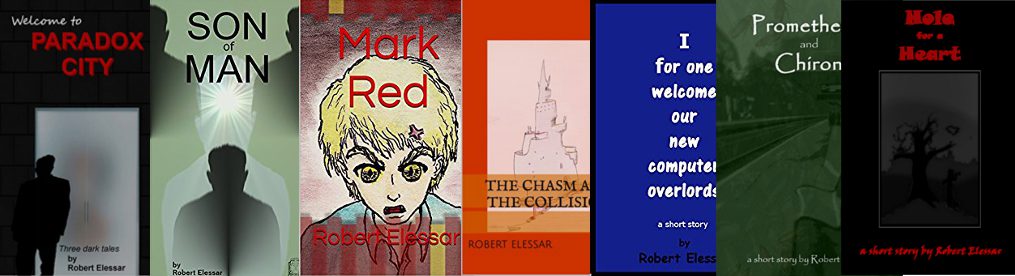
Even my truly immortal vampires in Mark Red might be wiped out by vacuum collapse.  I suspect they would, which might be a comfort to many of them, so to speak.  Of course, that would depend very much on how the “supernatural” forces in that book’s universe interact with the vacuum state and other quantum fields.  It’s not inconceivable that they might survive even that.  How’s that for horrifying?

These are odd thoughts for a Wednesday morning, aren’t they?  I mean, on a Thursday they wouldn’t be that odd, and even less so on a Friday.  On a Saturday they would be almost boringly predictable.  But on a Wednesday morning?  That’s just, well…odd, as I said.

I’m being silly.  My apologies.

I guess it’s more uplifting than is the prospect of universal Armageddon***.  Though, really, the Tao te Ching (in the version with which I am familiar) encourages us to embrace death with our whole hearts because that will help us to be prepared for most everything else we can encounter.

It does not encourage us to love death or to seek it; quite the contrary.  We are merely encouraged to accept it, not just intellectually but viscerally, to internalize***** it.  This is one of those curious circumstances in which the Tao to Ching and the movie Fight Club give the same advice, which is no indictment of that advice in either direction.

I try not to indulge in the vice of advice, but I will express my hope that every one of you who reads this post today or any of my other posts has a particularly good day, today and every day hereafter.

You’ve suffered enough already.


*This is analogous to what is thought to have happened when the “inflaton” field dropped down to a much lower energy level about 13.8 billion years ago, releasing the differential energy as the very hot soup of elementary particles that eventually became the universe we see.

**Okay, fine, I’ll explain.  It’s not just that the wave is expanding at the speed of light and so one would “see” it only as it hits.  But, given the current, accelerating expansion of the universe, the wave of change could never, even in principle, reach areas of the cosmos that are outside our cosmic horizon, because those places are receding from us faster than the speed of light/causality.  There is no causal influence from us that can ever reach them, or vice versa (assuming no wormholes or warp drives or similar).  Likewise, someplace beyond our horizon****** could be collapsing already, but we need never worry, because that collapse is not going to reach us (unless it changes the rate of overall cosmic expansion or even reverses it, which is not inconceivable.  We might then find ourselves in (or near) an anti-deSitter space, in which case, well…yeah).

***Not to be confused with the often misused**** term “apocalypse” which is basically just synonymous with “revelation”.  It’s become associated with the end of the world (and with lesser catastrophes) because one of the alternative titles of the book of Revelation is “The Apocalypse of Saint John the Divine” or whatever they called that nut bar.

****That rhymed, and it had a good rhythm too, both quite by accident.  I did that in yesterday’s or Monday’s post as well, but I didn’t call attention to it.  Can you find it now?

*****I would love to be able to use the term to grok it as in Heinlein’s Stranger in a Strange Land, but much as when Fuckerberg stole the term “metaverse” from me, likewise Elon Musk and the would-be tech boys who idolize him have arrogated the term “grok” and made it embarrassing to use.  Don’t even get me started on the disgusting theft of the word Palantir by Peter Thiel.  He deserves to be tortured interminably for the unmitigated gall he has shown in daring to use that term, but I would accept his immediate, painless disintegration and that of his company.

******Speaking of horizons, it is interesting to wonder what a vacuum state collapse would do to currently existing black holes.  I suspect they would basically be impervious to it, since the vacuum state is something that exists within spacetime, with the gravitational field as the backdrop of other quantum fields, but we don’t necessarily know enough about quantum gravity to feel very sure, as far as I know.  I suspect it might change the specifics of Hawking radiation at the level of the event horizon, and thus change the specific rate of black hole decay.  Also, I think in the first rush of particles generated by such a vacuum decay, most black holes would grow briefly with the influx of newly released energy all around them that had previously been bound up in the vacuum energy.  But that’s just my initial intuition.