I have rather blogged as mine own jealous curiosity than as a very pretence and purpose of unkindness.

Hello and good morning.  It’s Thursday, the 2nd of April in 2026 AD/CE, the 1st Thursday in April this year.  It has to be the first one.  Any date that is the 7th or lower has to be the first whatever day in a given month.

That’s probably fairly obvious, but I think it can be useful to review‒from time to time‒the patterns of things that are “obvious”.  It’s not likely that one will discover that these seemingly obvious things are oversimplified and not so obvious after all, but at least one will gain a slightly deeper feel for the things, rather than simply going through life with a bunch of predigested “facts” which one has never examined seriously.

That sounds pretty good, doesn’t it?  I don’t know if it’s deep or anything, but it’s at least a good-sounding excuse for me to overthink and overanalyze things as I am prone to do by nature.

I still have no indication that my Meta-based accounts are anything but permanently disabled.  Then again, I probably wouldn’t expect to have such an indication, since I haven’t even tried to use them.  I very quickly uninstalled the Meta-based apps I had on my phone (Threads and Instagram‒I did not have the Facebook app, because when I tried installing it once, it rapidly became very annoying, and I uninstalled it forthwith).

I miss some of the interactions on Threads a bit, but although I enjoyed following the exploits of some other people on there, no one actually paid any attention to me.  Even when I shared or posted words of distress and self-destructive feelings, almost no one even saw them, let alone providing any kind of support.

Not that this is an unusual situation, of course.  It certainly wasn’t unique to Threads, nor to Instagram*.  It’s not as though anyone on Bluesky or Substack has expressed any concern for my wellbeing.  So, I shouldn’t unfairly vilify the Z(f)uckerverse.  It is what it is.

But I came up with the term “metaverse” (dammit!) years and years ago, intending to use it to refer to the broader, connected reality of The Dark Fairy and the Desperado, as well as other works of my fiction, going all the way back to Ends of the Maelstrom, the first sci-fi/fantasy (or any genre) novel I ever finished.

That novel, all handwritten, is now lost, of course, along with all but a smattering of everything I ever had up to 2012.  So, the loss of, for instance, Facebook, is really just more of the same, and not even very much of that.  What’s Facebook compared to the cello I’d had since high school, or the piano (an unused one they’d had for many years) I’d been given by my in-laws when I graduated medical school, or the thousands of books and comic books I’d accumulated since I was very young?

Okay, so, if it’s so relatively minor, this debacle regarding Facebook et al, why am I harping on about it?

Well, it has only been three or four days.  I’m sure I’ll get bored of it soon.  But I still hold a deep grudge against the Zuckster for “stealing” that term from me, though I do recognize that I had no actual, reasonable, proprietary right to it.  It’s just frustrating, and he is the source of that frustration, however unintentional it was with respect to me.

I don’t really hold too much against him for the foibles of his social media, and only feel slightly ill-used for having been kicked off them.  I can use my time in better ways.

However, I did not open Brilliant or Babbel yesterday, despite my wish to get more use out of them.  I didn’t even get on Arxiv to see what’s going on in physics/math/computer science papers lately, which can often be intriguing.  I once found a paper by David Deutsch on there, and I could even follow it, more or less, though the mathematical formalism was a bit outside my expertise.

No, I’m afraid I have not yet been able to turn my mind toward more long-term-interesting and beneficial matters.  But my life isn’t over yet, at least not as I write this.  I suppose, depending upon when you read this, my life may be over.  Indeed, I aspire to have the sort of durability in my writing such that, eventually, more people will have read my work after my death than before.  I would, in fact, prefer it to be orders of magnitude more.

I won’t be around to know it, of course, but no one ever is.  That doesn’t mean that hopes for things to happen after one has died are necessarily irrational.  We just need to recognize that it’s not our future selves that we’re actually serving.  We are serving the image of our future selves that we have in the present.  But that’s all we ever really do.  Despite the words of Ted Stryker in Airplane II (see 1:19) the future never arrives; everything is always the present.

TTFN


*Which, to be fair to it, has delivered several times a pop-up screen saying that “someone thinks you might need some help” or something, and gave me links to support ideas and the suicide crisis line.  Mind you, they were links to things I’ve tried before, multiple times**, and none have been terribly helpful, but at least Instagram’s “heart” was in the right place.

**Of course, even something that has never happened could technically be said to have happened “multiple times”; it’s simply that the multiple is zero, and anything but a gleeb*** multiplied by zero gives you zero.  But that’s not the spirit of the expression.

***A gleeb is a number (or concept, I suppose) that I invented long ago.  A gleeb multiplied by zero equals one.  I worked through some of the algebra of it while I was “up the road” and it’s rather interesting.  For instance, a gleeb taken to any positive power is still just a gleeb.

“We would zig-zag our way through the boredom and pain”

It’s Monday again; indeed, it is the last Monday in March in 2026 (AD/CE), for whatever that’s worth.  This Monday shall never come again.

Then again, of course, no Monday shall ever come again.  Such is the nature of time.  This is one of the facts that makes senseless the expression “That’s a [measure of time] I’m not gonna get back”.  Well, duh!  You never get any of your experienced amounts of time back.  That’s the nature of time, and the nature of its directionality, dependent upon the second law of thermodynamics.

Even if one could rewind time, one would not “get a moment back” the way people talk about it.  If, like the events of a movie or other video story, one could rewind life, it would not be you (the self who spoke of getting the moment back) who would experience the events anew.  It would just be a return to an earlier state, in which you would again be experiencing all the same events, not merely as if for the first time, but actually for the first time.  The posterior events would be erased for you as you traveled back.

It’s not like playing a video game where you can “regenerate” at your most recent save point, but you can remember what happened to your character before it “died” so that you can learn from your mistakes.  There is no one playing your character (i.e., you) and able to learn from a repeated past.  You are not the player of the game, you are the character.  You are part of the game.  You are part of the movie, not watching it from outside.  If it resets, you reset; if it rewinds, you rewind, and all memory of any events that happened disappear along with the future.

Whether or not you will repeat the same events, like the characters of a movie/show, or if you may do something different, like a video game character, is less clear, but it doesn’t much matter.  You are still going through each moment once, effectively, and you can only learn from mistakes to affect your behavior in the future.  If your mistake kills you, you’re just dead.

Even if time were a closed loop‒if the future of the universe wraps around and becomes “the past” again, forming a closed and fixed structure, as appears to be possible in principle according to General Relativity‒you won’t get to experience it as happening again.  Each time, you will experience reality for the first time.

Just as there is no fixed self looking out from behind your mind, there is no external rememberer hovering over your reality, able to experience your experiences for the first time but as if not for the first time.  You are a phenomenon within reality, not a sojourner through reality that accumulates knowledge that could be used in reliving the past, but better.

If you could rewind yourself except for your mind, somehow retaining your memory of “the future”, that would not be truly returning to the past.  Rather, it becomes the next set of events in your future.  This demands an answer to the question of how it could be possible for you to become your earlier self and yet remember your later self, since your memories are functions of your brain.

This is what makes things like Alzheimer’s and other forms of dementia or brain damage so tragic‒they literally are injuries to what makes us ourselves.  If you lose all memories of your past, then in a very real sense, the person you were is already dead.

Of course, even in healthy states, without brain damage, your past self is still “dead” with every new moment that arrives.  Every time you sleep and then wake up, it may as well be that you have died and then been recreated in the morning, just with implanted memories from the previous person, the one who died.  There would be no way for you to know if there is no difference in your brain and the rest of your body.  Indeed, it’s in principle possible that this actually happens with each passing moment, or even each passing Planck time.

Only the past can be remembered.  Only the future, even in principle, can be planned and affected.  And only the ever-moving present can be experienced.  There is, of course, a continuity that is required for us to have any sense of a unified personhood at all, but as Sam Harris has pointed out (more than once) your memories of your past are merely thoughts in your mind in the present moment, as are your plans for the future.

So it really can make sense to “get over yourself”, in more than one way.  It’s worth recognizing that you’re mortal and‒whatever you may believe‒as far as we know, death is the end, and all that you were will be gone after that.  But it’s also worth recognizing that, in a nontrivial sense, each day all that you were the day before is already gone.

Still, though you are only existing for any given present moment, memory at least allows for us to learn and hopefully do better in the future than we would have if we didn’t have memory.  That’s why memory is a trait that gets selected for and is evolutionarily stable:  because its presence makes creatures with that trait or attribute more likely to survive and reproduce than those that do not have it, ceteris paribus.

As with most such subject-specific blog posts, I could go on and on about this.  A thousand (or, well, a lot of) other thoughts arise that could be expressed as I write what I do write.  But I have finite space and finite time (even if spacetime is infinite) in which to write this post, so I’ll stop here for the moment.

Welcome to the new week.  I hope it’s a good one for you.  Heck, I hope it’s a good one for everyone, even “bad” people (with the caveat that, “a good one” entails such people becoming better than they presently are).

“Silence will fall”

Oh, right, today is Saint Patrick’s Day, a holiday celebrated more intensely (but far less religiously, I suspect) in the US than in Ireland.  It’s a holiday in which everyone here is said to be a little bit Irish.  I am largely Irish, in fact (by ancestry), so I feel no need to put on an act.  I also am not going to wear green today‒it’s been a long time since I’ve worn anything but black‒and I don’t recommend pinching me, or the only green you’ll have to be concerned about will be whether that will be the color of your rotting corpse or just the color of the bile leaking from your perforated gall bladder.

I certainly don’t expect to drink any beer or stout or even Irish whiskey today.  I do like corned beef and cabbage, and there’s a restaurant near work that makes a great meal of that, but they will probably be a bit oversubscribed today, and I really hate having to jockey with other people for such things.  I would rather go without.

I guess I’ll see what happens.  Getting corned beef from the restaurant is the sort of thing that’s enticing from a (temporal) distance, but the closer one gets, the more it loses its charm and feels not at all worth the effort.

There is an astonishing number of such things.  So many things are so much better in the anticipation than in the experience.  Even James Bond, in the Ian Fleming novels, noted that his favorite drink of the day was the one he had in his head before the first actual one*.

So, the anticipation is better than the payoff in many cases, which goes right along with my recognition that pleasure and joy cannot ever be durable outcomes, biologically speaking.  It’s not an evolutionarily stable strategy.

One might imagine that one could build up one’s anticipation of a thing, but then trick oneself and not give oneself the reward in the end, but the anticipation modules only really become active if you believe that they will be satisfied.

Failure to get the reward after anticipation can be more unpleasant than never anticipating it, as I think most people would agree.  And then, of course, after repeated disappointments, one stops anticipating, so one loses even that positive aspect of the situation.  “Edging”, as they call it, is only reliably pleasurable because of the knowledge that eventually there will be release.

Okay, that’s enough vaguely risqué crap.  I guess it may be better than dealing with all my dark stuff, which I have been withholding deliberately and consciously of late, since it just seems to make people uncomfortable but doesn’t engender any useful ideas or beneficial interactions or anything remotely resembling help.

So, apart from minor stuff like this, I’m going to just hold the negative thoughts back from sharing, and when I break, that will be it.  Like Keyzer Soze ( “And then, like that [fwoof]…he’s gone!”) you’ll probably never hear from me again. 

That will probably not be today, by the way, just in case you’re worried.  If someone thought some crisis were imminent today they might panic and actually, accidentally do something.  But of course, that’s a horrible way to approach matters, only intervening in a panic when catastrophe is right in front of one, at the very last moment‒when success is least likely‒when intervening earlier might actually have a decent chance of producing a good outcome.

It seems so intuitive.  If you’re trying to go somewhere, the sooner you realize you’re headed in the wrong direction and correct your course, the easier it will be to get where you want to go.  It’s easier to steer the future in the direction you hope to reach if you start the steering early (if you do it intelligently, anyway‒randomly twirling the steering wheel will almost certainly be worse for you the sooner you start doing it).

As Benjamin Franklin once wrote, “An ounce of prevention is worth a pound of cure.”  Sometimes the disparity is far more stark even than that.  Sometimes, without prevention, the possibility of a cure is moot, because a lost patient cannot be treated, let alone cured.

Enough.  This, like everything else, is stupid.  Where is Sailor Saturn?  Let there be no alarms and no surprises.  Let there be silence.


*This is second-hand information.  I did not read it myself.  I have tried on more than one occasion to read a James Bond novel, but I could barely last a few pages.  Somehow, I found it utterly non-gripping.  I’m glad other people liked the books enough to make movies, because I really like some of the movies, but man, based on my sample, those books are dry.  Pussy Galore would be ashamed**.

**I know, that’s a rather raunchy and not very good joke.  Sorry.  Let’s pretend I’m already drunk from celebrating the holiday, and that’s why my judgment is impaired.  It’s not true, but the fact that it isn’t true doesn’t stop us from saying it, curiously enough.

A notification of whatever

I expect this post to be brief today, though I’ve been known to be wrong about that sort of thing.  I had sort of “intended” to make my headline “Oh, well, whatever…” and then make the entire body of the post “…never mind.”  Thus I would be quoting the last verse-line of Smells Like Teen Spirit by Nirvana.  The subsequent words in the song are just the chorus and then a refrain of “A denial” repeated nine times (if memory serves).

I wasn’t sure I hadn’t already done this before, though.  I could have checked, but I didn’t have the mental energy.

Still, using that last line from a Kurt Cobain song carries a certain subtext which would have served my purposes well.

Or, well, actually, given past history, it probably wouldn’t have served my purposes at all.  None of this sort of thing seems to serve my purpose, no matter what I do.  As far as I can tell, only one person actually read my (admittedly somewhat long) post yesterday, but though I was borderline explicit about my meaning, I don’t think it did any good whatsoever.  That’s not unusual, of course; much if not all that I do never ends up doing me much good.

Sometimes I have to be subtle because I cannot force myself to be open about my internal states after a lifetime of fighting to appear “normal”, to the degree I can achieve that, and to avoid being too much trouble for other people, since I don’t think I have the right to trouble them, and in fact I think (or feel) that I’m fundamentally reprehensible.

I shouldn’t worry, though.  The times I am more open and obvious‒even when I am borderline explicit‒don’t appear to be any more successful than when I am at my most cryptic.  Possibly, I am just not able to communicate my feelings effectively with humans.

At the very least, my success rate must be below one percent.  It’s not quite as bad as playing the lottery, but it’s pretty pathetic.  Then again, so am I.

Whatever.  Never mind.  Ha ha.

But really, though, I don’t have much to say.  Quoting iconic songs may be the extent of my capacity to convey myself.

Ironically, I don’t feel the urge to share quotes from my own songs (or my fiction).  You would think they would be the best choice for conveying my inner thoughts.  That’s not always the case, though.

In fact, though I like my songs well enough, and Breaking Me Down is meant to be fairly explicitly about depression (at least my species thereof), none of them have enough oomph, as it were.  Or maybe it’s just that they are not well known*, so no one recognizes and identifies with the words.

I think I have some pretty good lines in Come Back Again, including what’s probably my favorite:

“Only meeting strangers

always losing friends.

Every new beginning

always ends.”

It may seem a bit bleak, but it’s also true more or less by definition.  If you’re meeting someone for the first time, they had been a stranger until that point.  And friends do become “lost”.  And the next two lines are rather obviously true.

Of course, a very good signing (singing?) off quote would be from Pink Floyd’s Time:  “The time is gone, the song is over, thought I’d something more to say.”

I’ve always been annoyed that they added the little reprise of Breathe after that and made it officially part of the song, because those other two lines constitute a perfect song ending.  I always figured they didn’t want to make the song end on too much of a downer, so they threw in the reprise as part of that song instead of as a separate one.  Maybe they were unwittingly invoking a version of the peak-end rule I mentioned the other day.

Anyway, I have a locked and loaded draft of a blog post that already applies that couplet from Time, with the headline being the first half, continuing into the post which consists only of the second half of that quote, followed by the embedded “video” of the final song on the first album of The Wall.

That, of course, is still a draft, and has been waiting there for a while, because if I use it, it’s meant to be my final blog post, and practically my final anything.  So I wasn’t going to use it today.  Not quite.  But I’m close.  The Nirvana quote isn’t quite as final, but it is a warning, especially given the fate of the guy who wrote it.

Anyway, consider yourselves on notice.  On notice of what?

Figure it out.


*That’s an understatement, eh?

Man overboard

As the real weekends go, it was better than most, to paraphrase The Wreck of the Edmund Fitzgerald.  By this, I’m referring to this last weekend, the two days before this day, of course.

I did not work on Saturday, which is good, because that would have been the third time in a row.  I also got to hang out with my youngest on Saturday, and we watched about four episodes of Doctor Who together, which was good, good fun.  I cannot complain about that in any way.

I have though a weird, disquieting, sinking sort of feeling that it may have been the last time I will see my youngest, or maybe anyone else that I love.  It’s is not one of those reliable sorts of feelings, like those that lead one to new insights in science or mathematics or what have you.  It’s probably more a product of depression and anxiety, the feeling that anything good in my life is sure not to last, if it happens at all, because I do not and cannot possibly be worthy of anything good happening to me.

Is that irrational?  Of course it is irrational.  It cannot be expressed in any sense as the ratio of two whole numbers, no matter how many digits they may have.

Wait, wait, let me think about that.  My thought, my feeling, was expressed above finitely.  That is, of course, a shorthand for what is really happening, but even if one were to codify those processes down to the level of each molecular interaction that affects any neural/hormonal process that contributes to my feeling, we know that must be a finite description (though it could, in principle, be quite large).

Even if we’re taking the full spectrum of quantum mechanics into account when describing my mental state, we know that quantum mechanics demands a minimum resolvable distance and time (the Planck length and the Planck time) below which any differentiation is physically meaningless.

A finite amount of information can describe the events and structures and processes in any given finite region of spacetime.  In fact, the maximum amount of information in any given region of spacetime is measured by the surface area (in square Planck lengths) of an event horizon that would span exactly that region, as seen from the outside*.

Any finite amount of information can be encoded as a finite number of bits, which can of course be “translated” to any other equivalent code or number system.  So, really, though the contents of my mind are, in principle, from a certain point of view, unlimited, they are finite in their actual, instantiated content, and can therefore certainly be expressed as an integer, and thus also as a ratio (since any integer could be considered a ratio of itself over one, or twice itself over two, etc.).

So, in that sense, my thoughts are not irrational.  Neener, neener, neener.

In many other senses—maybe not the literal, original sense, but in the horrified, cannot accept that not all numbers can be expressed as ratios of integers because that makes the universe too inconceivable, sense, among others—I can be quite irrational.

It’s very difficult to fight one’s irrationality from the inside, alone.  Even John Nash didn’t really beat his schizophrenia from within as shown in the movie version of A Beautiful Mind.  Also, his delusions in real life were far more extravagant and bizarre than those which appear in the sanitized version that made a good Hollywood story.

If one escapes from mental illness from within, one has to consider it largely a matter of luck, like a young child who doesn’t know anything about math getting a right answer on a graduate level, high order differential equation problem.  It’s physically possible; heck, if it were a multiple choice question, it might even be relatively common***.  But it’s not a matter of being able to choose to do it right and to know how it was done.

Severe mental health issues are going to need to receive assistance from outside, almost always.  This is not an indictment of them or of the need for help.

Surely, someone who has been swept off the deck of a ship by a rogue wave cannot be faulted for needing help from those still on the ship of they are to survive.  It would certainly seem foolish and almost inevitably fruitless if such a person tried to claw his way up the side of the ship to get back on board when there is no ladder and no handholds.  He should certainly not be ashamed that he cannot swim hard enough to launch himself bodily from the water and back onto the surface of the vessel.

One cannot reasonably fault such a person for trying to do the superhuman.  A person might try to do practically anything rather than drown or be eaten alive by some marine predator.  But, of course, barring an astonishing concatenation of events such as the time-reverse of the splashing entry into the ocean happening and sending the person out of the sea just as it was entered, such efforts will not succeed.

And though it might be heartening or at least positive for one to receive encouragement from those still on the deck—don’t drown, keep treading water, you can do it, you’ll make people sad if you drown, you deserve to stay afloat, I’m proud of you for treading water yet another day, it’ll get better, this won’t last forever, you’ve made it this far so you know you can keep going, you don’t want the people who know you to feel sad because you drowned, etc.—in the end it might as well come from the seagulls waiting to pick at one’s floating corpse.

Mind you, certain kinds of words can be more useful than others.  Words like, “Hey, around the other side of the ship there’s a built-in ladder; if you can get over there and time things right, you might be able to grab the lowest rung when the waves lift you, and then climb up,” might be useful because they are directions for using real, tangible resources that we know can make a difference.  Also, words like, “Hang on just a bit longer, we’re throwing down a life preserver on a rope so we can haul you up” would be useful, obviously, unless they were mere “comforting” lies.

Alas, though one could reasonably expect such literal assistance if one were washed overboard—the “laws” of the sea are deeply rooted in the hearts of those who work there, and they include a general tendency to help anyone adrift to the best of one’s abilities—when it comes to mental illness, the distress and the problems are difficult for others to discern and easy to ignore.  Calls of distress are often experienced as annoyances, and even treated with contempt, since those hearing them cannot readily perceive that they themselves might be similarly washed overboard at any time.

But, of course, they might be.

I don’t know how I got on this tangent, but I guess I never really do.  I just go where my mind takes me, and my mind is not a reliable driver.  It is, though, a reliable narrator.  It doesn’t matter, anyway.  Nothing does.

Anyway, here we go again into another work week, because that was what we did last week.  I wish I could offer you better reasons, but I’m really only good at breaking things down, destroying things, not at lifting anyone or anything up.  That comes from other regions and is conveyed by other ministers.


*From within an event horizon, the volume could be much larger than the spacetime that seems to be enclosed from the outside, because spacetime inside the horizon is massively curved and stretched.  It’s conceivable (at least to me) that there could be infinite space** within, at least along the dimension(s) of maximum stretch, just as there is infinite surface area to a Gabriel’s Horn, but only finite volume.

**See, mathematically, one can stuff infinite space inside a nutshell.  Hamlet was right.  He often was.

***Perhaps this explains why certain types of mental health problems can respond well to relatively straightforward interventions, and even to more than one kind of intervention with roughly comparable success, e.g., CBT and/or basic antidepressants and such.  These relatively tractable forms of depression are the “multiple choice problem” versions of mental illness.  This does not make them any less important.

This is not an attention-grabbing headline

I’m writing this post on my smartphone, even though I brought my lapcom with me yesterday evening.  I did not use my lapcom for yesterday’s post, such as it was.  I didn’t even write that post in the morning yesterday, or at least, I didn’t write the “first draft” of it then.

By the end of the workday on Wednesday, I didn’t feel like I was going to want to write a blog post on Thursday.  So I went to the site directly and just wrote the “Hello and good morning,” and the “TTFN” and set it to publish later.

I already knew what title I was going to want to use for it.  I wanted to use Polonius’s dithering, meandering jabber about brevity being the soul of wit, as a sort of left-handed self compliment about my own brevity in that post, and because, in the original form, it would have made the headline longer than the post, which would be ironically funny, in principle.

Then, yesterday morning, I got the urge to put my little “insert here” bracketed bit in the post, the better to convey how disgruntled and disaffected and self-disgusted I (still) felt, as well as how tired.  It did sort of spoil the joke about the headline being longer than the post, of course.  At least the older joke about Polonius still holds water.  Then again, that joke was made by Shakespeare, so we shouldn’t be too surprised if it has serious legs (though this raises the question of how serious legs could possibly hold water).

One thing worth at least assessing this week might be whether there is an aesthetic difference between this post (for instance) and the posts I wrote earlier this week, on the lapcom.  Writing on the lapcom is quite different for me in many ways.

On the lapcom, I generally have to work to stop myself before a post, or whatever, gets too long.  Whereas on the smartphone, that isn’t as frequent a problem.  Not that I can’t yammer on and on even with the smartphone, of course.  Some might say all I ever do is yammer on and on.  But anyway, I can’t write as “effortlessly” on the smartphone as I can on a regular keyboard*.

Sorry, I’m retreading a lot of old ground here, which I guess is better than retreading a lot of old tires. I know how to tread on the ground; indeed, I cannot recall a time when I didn’t know how to do that kind of treading.  Whereas retreading a tire sounds like something that requires special skills and equipment, both of which I lack.

I don’t know, I’ve heard of “retread” tires, but I don’t know if such things still abound, or if they ever did.  It sounds vaguely like a bad idea, like such tires might be more prone to blowouts.  But latex is a finite resource, and there aren’t very good synthetic alternatives, so maybe there’s at least some cost/benefit tradeoff (or treadoff?) there.

Ugh.  With that last joke, I probably convinced at least some of my readers that, yes, the world would be better off if I were dead.  Actually, I say that as if it were conditional, but it’s not.  It would be more in line with reality to say “the world will be better off when I am dead”.

There’s a quote by which to be remembered, eh?

I cannot say whether I will be better off when dead.  It’s probably a nonsensical question.  When I am dead, I will not be anything at all, not better, not worse, not uglier.  What happens to virtual particles after they have annihilated?  Nothing, and less than nothing, for they truly no longer exist, and in some senses they never existed.  Indeed, as physics goes, they probably never do exist; they are a shorthand description of what happens in quantum fields when perturbances in the fields have effects that do not rise to the level of actual, true particle production.

Or so I am led to understand.

From another point of view, it is possible for something to improve, at least in a sense, by ending.  I’ve mentioned this before, but if the curve of a function‒perhaps a graph of the “quality of life” or one’s “wellbeing”, to say nothing of happiness‒is persistently negative, then returning to zero is a net gain.  It can be a huge net gain, in fact.  This is related to the origin of my own version of an old saying, which I use with tongue definitively in cheek:  The one who dies with the most debt wins.

Now, of course, the integral, the area “under” that wellbeing curve would not be improved by the curve reverting to zero and stopping.  But at least that integral would not keep getting more and more negative over time.

Some might say, “well, the integral can become less negative over time, and might even become positive”.  This is, in principle, true.  And when one is younger enough, it’s relatively easier to tip the curve, and its integral, into positive territory.  But as the curve goes on, having been negative for a longer and longer time, it’s going to become ever harder to bring things to a net, overall positive integral, even if one could reliably make one’s curve positive (which one often simply cannot do).

Of course, the moment to moment experience (which is all the mind really gets) of an ascending curve could be pretty darn good, and might well be worth experiencing, even if it’s not enough to bring the integral into positive territory.  We are straying into the “peak-end” rule here, which was elicited regarding (among other things) colonoscopies but applies to much else in human experience.

Speaking of peak endings, I’ll mention in passing the curious fact that, no less than twice in the last week, the evening train service has been disrupted by someone either getting hit by or becoming ill next to the train.

Earlier this week, right by the station where I catch the train to go back to the house, there was a man who looked like he was probably homeless and had collapsed next to the train tracks not far from the station.  I saw him brought away, finally, on a stretcher.  He didn’t look physically injured‒certainly not in the ways I would expect someone who had actually been hit by a train to look‒but he did look cachectic, which is why I thought he might be homeless.

Then, last night’s commute was interrupted by what they call a “trespasser strike”, one that did not involve the train I rode but which always slows everything down.  I’m vaguely amused by the euphemism “trespasser strike”.  A “trespasser” here is a non-passenger who doesn’t work for the train company (or whatever) who is in the area adjacent to the tracks.  The “strike” part is probably self-explanatory.

I suppose it’s literally true, at least from a legal point of view, to call the person a trespasser.  But it’s amusing that the train people have to say something derogatory about a person hit by a train‒even if the person deliberately put themselves in harm’s way‒to sort of, I don’t know, assuage the company’s conscience.

But we are all trespassers, in at least some senses.  We are also, in other senses, all owners.  We are all innocent, and we are all, in some other senses, guilty.  “Every cop is a criminal and all the sinners saints.”  Above all, we are all very much just passing through, staying only a very short time.  We are all virtual particles.  Or you might say, we are all Iterations of Zero.

Have a good weekend.  I should not be writing a post tomorrow (in more than one sense).


*I wish I could honestly say that my use of a piano-style keyboard were as effortless, but I am terribly rusty with that, though I started learning it when I was 9, a rough 2 years earlier than when I got my first typewriter.

“Like”, “comment”, and “share” (if you feel like it)

I’m very tired this morning.  By which I mean I’m more tired even than usual.  My head is a bit foggy—more so than usual, again—and I feel like I just belong lying down inert, perhaps in an open-topped coffin.  I’ve occasionally thought that they looked like good places to sleep.  It seems a shame to waste them on people who are already dead.

It’s Wednesday today, and I don’t think I’m going to have anything nearly as thoughtful to say as what I wrote yesterday, which was at least rather “deep” if not particularly useful or helpful or interesting to any of my readers.  I did get an interested comment on my take on one of the reasons mindfulness is useful, and that’s always nice.  I’d love to encourage greater feedback from more of my readers, here on the site in the comments, but I don’t know what to do to encourage them [I decided just to do a little cajoling in the headline, in case that works].

Probably there is just some percentage of people who tend to comment, no matter the situation.  It’s a bit like the long-known “fact” (which may or may not be a true fact) that every advertisement, from flyers/mailings to commercials, actually elicit a response in only about two percent of people who interact with it.  I suspect it’s probably similar with things related to blogging and social media and the like.

One sees it most readily on places like YouTube.  The number of views of a video is almost always something like an order of magnitude greater than the number of likes (and often it’s larger than the number of subscribers), and that’s still larger, though by a ratio that’s not as clear to me, than the number of people who comment (let alone share).

My own YouTube videos (and those of my published songs) are poor examples, or perhaps one might say “poor samples”, not representative of the phenomenon as a whole.  I have a number of “views” on my music videos that is generally a couple of orders of magnitude larger than the number of “likes”, but I know why that is.

Almost all of those views are from me, because I put my songs in my YouTube music playlist, and so I have listened to them often, back when I used to ride my scooter to work and back.  I had a lovely Bluetooth enabled helmet.  I like to listen to songs and sing along in a car, or similar, when I’m on my way places*.  So I’ve listened to my own songs probably orders of magnitude more times than everyone else put together has listened to any of my songs.

It’s kind of pathetic, isn’t it?  I’m also the one who has bought more copies of my books—because I gave copies to the people in the office—than everyone else put together, I’m fairly sure.

As for this blog, well, I get a higher number of likes relative to number of readers than I do with anything else, and I even recently have been getting a comment or so most days, which is very nice.  There’s at least some interaction.  It would be nice if I could reach a larger audience, but I’m not terribly good at self-promotion.  I am pretty good at self-denigration, though.  In fact, I’m one of the best there is at it!

Ha ha.

Well, like the song says, it’s all just a drop of water in an endless sea.  Or, it’s all just spit in the ocean** as more people probably say.  My spit may be more purulent than average, but it’s all still just spit.

Anyway, I don’t know what else to discuss today.  I’m very tired and worn out and I’m in ongoing pain that only responds somewhat to all the mitigating things I try to do, at least so far.  I’ve been through a quarter of a century of trying, and I have not been passive nor uncreative nor ignorant in my attempts.  As those reading might notice, I’ve thought about this matter a lot.  You probably would also if you were in chronic pain for nearly half of your life (so far).  It has a way of garnering your attention.  It’s built that way.

It’s interesting to note that shortly after I’m sixty, if I’m still alive***, I will have been in essentially constant pain for half my life.  After that it will become a majority (unless I’m cured at some point along the way, of course).

I occasionally (not often, though, because it’s too disheartening) wonder what my life would be like, what I would be like, if not for my chronic pain.

Things would almost certainly be vastly different.  I cannot be certain that they would be better—there are probably at least a few things that would be worse.  But it seems likely that my life would be much better overall, if only because I wouldn’t have a huge chunk of my will and energy stolen by being in pain all the time.  That constant pain really does make everything else harder.

But no matter the state of the rest of my life, at least one thing would be true (by “definition” in this case), and that is that I would not be in pain every fucking day of my stupid useless life.

Surely that must be worth something.  It would not be worth not having my children exist, but almost everything else would be worth trading.  I sometimes think of it as parallel to a line from Me and Bobby McGee:  “I’d give all of my tomorrows for a single yesterday, holding Bobby’s body next to mine.”  It’s nice poetry, albeit a bit weird to think about temporally.  But in my case, I think of it as basically saying I would gladly give up some significant fraction of what would otherwise have been my future if I could be out of pain.

But, of course, my future is less valuable to me now at least partly because I am in pain.  If I were not in pain, ironically, the future would be much more valuable, since it would be at least somewhat less uncomfortable.  If I could be free of depression, and the tendency thereto, that would make things better still.  That might even constitute a future worth having.

Yeah, yeah, I know, wishes, horses, manure, beggars riding, dogs and cats living together, watermelon, cantaloupe, rutabaga, yada, yada, yada.  I’m wasting my time and yours.  And I’m writing too much, because I’m using the lapcom, and I’m not saying or doing (or being) anything at all worth saying or doing or being.  This is all just stupid.

I hope you all at least have a good day.  I would not mind if this were my last one.


*I can’t do it anymore because I don’t ride or drive anywhere anymore, so I am not “alone” when commuting anymore.  I’m also not alone at the house.  It’s really quite disappointing.  I like to sing.

**This is a bit amusing:  I made a typo when I first wrote that phrase, and it was rendered as “spit is the ocean”, which seems almost like some vaguely deep thought about how oceans are lived in, swum in, excreted in, and bled in by numerous living creatures.

***Right now that seems a horrifying prospect.

“But see, amid the mimic rout, a crawling shape intrude.”

First of all‒first today, anyway‒I would like to apologize to anyone who feels disappointed that I did not write a blog post yesterday.

I’m sorry.

Okay, there, I apologized.

I don’t know if anyone actually missed there being a blog post to read from me yesterday.  Probably, I ought really to be apologizing on the days when I do write a blog post.  I know that I probably make a lot of readers feel like crap when they read my blog, no matter how good their intentions.

Then again, no one is forcing them to read it, are they?  If I could somehow make it so that people felt some powerful compulsion to read my blog, I would probably make a lot more people read it.  Heck, I don’t know that I would waste the effort on my blog; I’d be more inclined to make people feel compelled to read my fiction, if I could do that.  At least then I might eventually make some money from it, and more importantly, my stories would be read by more people.  Some of those people might even end up finding my stories to be some of their favorite stories.

That would be much more important than having more people read my blog, as far as I can see.  No one is going to read blog posts to their kids or talk about them with other people.  No one will wistfully pull a volume of my blog posts down from a shelf on a cool and rainy afternoon in autumn to pass a quiet day reading with a cup of tea or coffee or cocoa, maybe with a quilt or an afghan over his or her or their lap (perhaps with a pet dog or cat keeping the reader company).

It would be just barely possible that someone somewhere might do that with one of my stories if enough people knew of them.

Anyway, that’s that.

I didn’t write a blog post yesterday because I was out sick from work.  “Sick” feels like it’s not quite the right word, though.  “Sick” feels as though it should refer to someone suffering from something infectious‒a bacterial or viral or fungal disease.  Of course, I know that’s not the only way for a body to become compromised, but it’s the first notion that comes to my mind when I hear the word “sick”; much like Forrest Gump, I’m inclined to ask, “Do you have cough due to cold?”

This is not to imply that I was well.  I certainly was not well yesterday, not even for me.  The pain about which I wrote on Monday did not improve through the course of that day, and I left the office right after lunch time.  I tried to rest at the house; however, the pain (like the proverbial horrors) persisted.  It also did its really annoying thing where it shifts its focus from one side of my body to the other, probably as I compensate for that one side when it’s flaring, which this leads to increased irritation of the other side and then I compensate for that, and so on.

That cycle’s got a vicious streak a mile wide!  It’s a killer!  Look at the bones!

Anyway, at this moment, it’s my left side pain that dominates, from my shoulder and wrist and thumb and fingers (not really my elbow, oddly enough) down to my ribs, my back, my pelvis, my hip, my knee, and my ankle, down to the arch and ball of my foot, and to some degree my toes.

The right side still hurts, but it’s slightly drowned out by the left side.  That will probably shift, though.  It may do so sometime today.

I’ve been trying to medicate myself adequately with what’s legally available, but it all has limits, and lots of the available things have significant toxicity.  NSAIDS like Ibuprofen and Naproxen (and aspirin) can do some good, but they are hard on the kidneys and on the stomach.  I’ve been having a fair amount of nausea these last several days, probably at least partly because of these meds.  Acetaminophen is not anti-inflammatory and it is easier on the gut and kidneys, but it’s dangerous to the liver* in significant doses, and it doesn’t do much in less than significant doses.

So, yeah, that’s all that.  CBD seems to help a little bit, and I do use it, but it (plus its related compounds) makes me feel rather loopy.  This isn’t always a horrible thing, but it can make it hard to get things done.  And, unfortunately, since I am here alone in a civilization without much of a safety net, I cannot simply not get things done and try to rest and recover somewhere.  If I were independently wealthy, I suppose I might be able to do that‒or if there really were a great many people who bought and read my books, I might be able to have a less stressful lifestyle.

Alas, I am not independently wealthy, nor am I a bestselling author, nor‒as Théoden says to Aragorn‒am I as lucky in my friends as some are.  That’s not to say that I have not had good friends; I feel I have had some of the best friends it is possible for a person to have.  But I don’t really have then anymore; at least I don’t have them around.

I cannot blame this on anyone but myself, if blame is to be had.  After all, I am the common denominator of the whole situation.  Occam’s Razor suggests that I am probably the single biggest contributing factor in the fact that I have no friends, and no family, around me now.

I am not a good pony; I am not a good investment; I am not a good risk.

It doesn’t matter, though.  I’m just tired and worn down and in a great deal of pain, and it’s more annoying with every passing day.

People will tend to say they don’t want other people to take their own lives when their pain (physical, psychological, or both) is too persistently great.  But they don’t offer any actual help dealing with it, just trite clichés and moral homilies and pseudo-comforting nothings (“You would be missed”, “there are people who will miss you”, “there are people who would be sad if you were gone”, etc.**) that are not far removed from “thoughts and prayers”.

Whatever.  I guess we’ll all see whether or not I write a blog post tomorrow.  Or, well, I guess those who bother looking will see.  I will either see or I won’t, depending on the circumstances, but even if I don’t see, others may still see, if they look.

See you then.


*Its metabolism uses up glutathione (if memory serves) which is a scavenger of free radicals in liver cells.  When it gets used up, the radicals generated by the various stages of hepatic detoxification chew up the liver’s own cells.

**Really?  How would they even know?  If I stop blogging and posting tomorrow, as far as anyone but one or two people could know, it might be because I just quit blogging or got hit by a car or got abducted by extraterrestrials.  It would have no significant impact upon anyone.

An angry and probably unpleasant rant

It’s Friday.  yay.

Today’s date (February 6, 2026 CE or AD) has a mildly amusing coincidence/repetition of digits, 2-6-26 in the shortened American version of the date layout.  In the European system, the date would be almost palindromic (6-2-26) but that’s leaving out the zeroes in front of the day and month digits and ignoring the number of the millennium.  So it’s not quite as cool as it could be.

Some might say that such numbers and the arrangements and the noticing thereof can never be “cool”, but such people are troglodytic idiots.  They live in a world full of and shaped by complex ideas, by innovation and technology they could not have invented themselves, and which they don’t bother to try to understand because other people take care of and do all that stuff.

I’ve said before, many times (with sadness and regret and yes, quite a lot of anger) that if it were up to most people, we would all still be living in caves (the few who remain alive, at least).  That’s metaphorical, mind you; very few humans actually ever lived in caves as far as we can tell.  It’s just that the remains of those who died in caves (and their artifacts) are much more likely to endure to be discovered than the tools and remains of those who lived on the savannahs and such.

Anyway, the troglodytes have a quite common attribute, one that might explain a good deal about them:  even though they may have the capacity to read, even though they may have been taught to read, they don’t choose to do it.  It’s both sad and quietly horrifying.

Even those who claim to read just one book (e.g., the Bible, the Koran, etc.) don’t even really read those books.  You can tell, because they clearly don’t live their lives respecting all the precepts of those books.

This fact can sometimes be bad, but more often than that, it’s just as well.  Those books are horrific (and often just horrible, aesthetically).  They also tend to be rather stupid by modern standards, but it’s hard to hold them too much to task for that.  They were, after all, written from depths of profound ignorance about the universe.  One cannot know a truth before it has been discovered.

Of course, if those books really had been written, or at least inspired, by an omniscient being or beings, they could reasonably be expected to be very smart books by any standards.  Alas, they are not.  Trust me, I’ve read many of them, as well as many other books that don’t claim to be the products of omniscience, but which would be far more convincing* if they did than those ancient compilations of legend and myth and mental illness that are the so-called holy books.

Ironically, the Tao te Ching is much wiser than the aforementioned holy books, and it was never said to be written by anything other than a man.  It’s not perfect, of course, but it doesn’t really claim to be so.  Perhaps some of its adherents think it’s somehow “perfect”, but that doesn’t really matter.  After all, there are probably those who “think” Mein Kampf and The Art of the Deal are perfect.

Weirdly enough, some of these people would probably also say the Bible is perfect [Disappointed shrug and heavy sigh].  People are stupid.  And there are none so stupid as those who refuse to think.

Sorry, I don’t even know how I got to dealing with this set of subjects today.  It certainly was not planned.  Then again, nothing here was planned, other than that I would write a blog post as usual, which is not surprising.

It’s not as though I have anything better to do with my life‒that is, nothing better other than to shut it off, I suppose.  But so far, I am too much of a coward to do that.

I know, I know, there are those who (with truly very good intentions) will call continuing to be alive a “brave” choice, but though I appreciate such people’s kindness, that “choice” is very much the default.  In a similar vein, it’s not brave to hunt, or to fish, or to farm, if hunting or fishing or farming  is what you must do to survive.  It’s just pragmatic.

I am not brave for still being alive.  This is not to say that it would be brave for me to kill myself, either.  But it also would not necessarily be cowardly.

Bravery in the usual sense is overrated, anyway.  We can (and should) all be glad, of course, that there are people like firefighters, as well as honorable soldiers and honorable police officers.  But if one stops to think about it, one can see that we should all very much wish to live in a world in which bravery was not required, a world where heroes are not merely not needed but are not useful.

It’s likewise with so-called leaders.  If a society were functioning well, it would not need (or want) heroes or leaders, at least not in the traditional sense.  In a well-functioning civilization, people would see their elected officials as their employees, as the public servants that they are.  They are not, and should not be thought of as, leaders.  That’s just a troglodytic way of thinking.

Alas, we are far from such a well-functioning civilization yet.  Who knows if we ever shall achieve it?

I do know, however, that I will probably be working tomorrow, which means I will write a blog post, barring (as always) the unforeseen.  Until then, I hope you each and all have a very good day by any reasonable criteria.


*Especially modern science books.

My way of life is blogg’d into the sere, the yellow leaf

Hello and good morning.

TTFN


Ha.  Ha.  Sorry about that.  Just, honestly, I don’t really feel much like writing right now.  There are no other twos here today (at least, I’m not going to be talking about them, except to the extent that saying that I’m not talking about them constitutes talking about them).

Actually, wait.  I will make a relatively fun note that includes the number two, since it just occurred to me that today is the fifth:  If you add (or if anyone else adds) the first two prime numbers together, they give you the third one.  2 + 3 = 5.

This is the only place in all the infinite realm of the prime numbers in which you will be able to add two consecutive primes to get the next prime, because all prime numbers except two are odd, and if you add (or anyone else adds) two odd numbers together, you (or they or he or she) will get an even number.  And the only even prime is two.

Actually, it’s worth noting that one can add two primes that are not consecutive to get a third prime.  If one takes any of the first member of a set of twin primes* and adds two (that solitary even prime) to it, one will get the second of the pair of twin primes.  This may be able to be done in an infinite number of cases; it’s thought that there are an infinite number of twin primes, i.e., that there is no largest twin primes set.

However, this has not been proven yet (as far as I know) though work has been done on it and progress has been made.  I won’t get much more into it than this, except to say that apparently a lot of the work has been done by large, decentralized groups of mathematicians (professionals and amateurs) through a site called “polymath”, if my memory is correct.

Now that is an excellent name for a collaborative mathematics website.

Oy, there I go again, talking about trivia about prime numbers and so on.  Maybe it would make sense for me to get into these things if I were truly involved, but I’m a spectator of mathematics (apart from my truly useless invention of the gleeb**, a number which, when multiplied by 0 gives you 1).  So my interest is entirely esoteric and reflected.  I apologize to those of you who find it tiring.  To those of you who like it, I’ll say “You’re welcome”.

You’re welcome.

See, I told you I would say it.  And then I said it.  I guess that’s one point in my favor.

I’m not sure there are any others.  At least, none of them appear to me to be in my favor.  I am all but completely worn out.  I’m running on fumes, or whatever other metaphor one might want to apply that is applicable (since applying inapplicable ones is stupid) and my incessant pain continues to wear me down, adding to my depression, and eroding what little joy I have left.

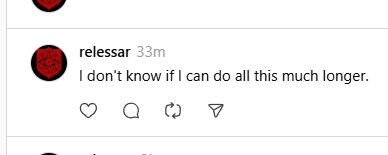
I really have wanted so often just to hang it up.  I came relatively close yesterday afternoon and considered leaving a “post” that just said, “I don’t think I can do this anymore.”  The would be the title and the content.

I didn’t do it, of course, which you can tell by looking, if you are so inclined***.  But I came closer than I’ve come before, at least subjectively speaking.  Last week—I think it was—I posted a similar sentence on most of my social media, just the line “I don’t know if I can do all this much longer.”  I’ll embed a screen shot here:


So, fair warning is being given, here and elsewhere.  The fire alarm is giving off little warning beeps.  The readout dial is high in the yellow range, perhaps already inching into the red.  Creaking sounds and little wisps of steel and concrete dust are issuing from the support beams of the bridge.  Small tremors and puffs of escaping steam are increasing in frequency near the hitherto dormant volcano.  There’s a red sky in the morning, today****.

But, I appear not to be able to stop yet.  I’m not yet able to escape.  I’m still pushing the stupid boulder up the stupid hill, like the stupid idiot that I am.  I’m even writing this blog post on my lapcom for the first time in two weeks (well, this is the first time at all that I’m writing this blog post, but hopefully you know what I mean), just because I felt mildly nostalgic.

One of these days, though, I’ll be able to end my blog post with just “TT” instead of “TTFN”, and it won’t be over just for now but finally and for good—not just the blog but everything.  And I don’t know if that will be sad or a relief for anyone out there, but I hardly think it will be a tragedy, nor will it be more than little noted, and it will certainly not be long remembered.

But for now, I must needs sign off with the annoyingly non-climactic

TTFN


*Primes that are two apart from each other, such as 29 and 31, or 137 and 139.

**Seriously, I worked out a lot of the algebra that involves it and everything (for instance, it turns out that a gleeb squared is still a gleeb, and 1 over a gleeb equals 0).  I’m sure I discussed it in a previous blog post.  If I can find which one without much trouble, I’ll leave the link here.

***In principle, you can tell by looking even if you are not so inclined, but you simply will not tell because you won’t look.  Should that count, then, as a “can” situation if it’s not physical impossibility but mental disinterest that leads one never to do a thing?  If it simply will not ever happen, can one not just then say that it cannot happen?  Are “cannot” and “shall not” synonymous here, as when Ian McKellen misspoke his most famous line when facing the balrog in The Fellowship of the Ring?

****This may be true somewhere—it probably is, come to think of it—but it’s not true for me, because it’s still fully dark as I write this; the sun is not even lightening the eastern horizon yet.  I’m just being melodramatic.