“And, to SLEEP, you must slumber in just such a bed.”

Well, it’s f*cking Saturday, and I’m going in the to f*cking office to f*cking work, because it’s not challenging enough for me to recover my limited mental equilibrium when I have two days off, so I should try to do it with one as often as possible.  Oh, and the one day I supposedly still have to take off is the day I have to do all my laundry, which means I have to go into the other part of the house and, more often than not, deal with their overly energetic and poorly trained dog‒and it’s a big dog.

I’m not afraid of dogs.  I like dogs, even very large ones.  But I have little sympathy for dogs that have not been trained, and who act like they’re still teething or something.  If it were my dog, I could rapidly train it out of the habit of putting its moronic jaws around peoples’ forearms, and it and I and others would be happier overall.

Maybe next time I’ll go out with suntan lotion or even pepper spray all over my arms, so it gets an unpleasant mouthful if it tries.

Honestly, sometimes I’m tempted just to slip it a few chunks of the rat bait/poison that I have.  It’s not the neurotoxin one, which is supposedly less harmful to people and pets than to rats.  It’s the super-coumadin, blood “thinning”, anticoagulant one.  To be honest, though, I would probably not be willing under nearly any circumstance to poison a dog, since the agency of such a creature is limited and its poor behavior is largely due to the humans in its life.

And yes, of course I have a big, multi-pound bag of rat poison.  Who knows, I might get peckish at some point and want it as a snack.  The holidays are upon us, after all, and it can be so hard to stay on a diet at this time of year.

Anyway, that’s just one possible nosh that I have for potential last meals.  I even have a couple of emptied out fiber capsules that I’ve refilled with broken glass pieces.  They would actually go nicely with the previously mentioned snack, wouldn’t they?  Like salted caramel, the two components could really enhance each other.  You might even call it synergy.

Enough about such tempting treats.  The point is, I’m going to the office today.  Then I’m heading back to the house.  Then I’ll be trying to rest if I can for the remainder of the weekend, though when I think of my own mind, I am inescapably reminded of Boromir describing Mordor:

That works pretty well to describe my very annoying brain/body.  I cannot seem to sleep very long, and I never feel like I sleep “all the way” if you will.  I am always somehow on yellow alert; I don’t know why.  It’s exhausting.  There are plain few upsides or effective distractions, and almost never any relief.

I don’t even know what I’m writing about right now, really.  I just feel a general, free-floating hostility and even hatred for most things in existence.  Sometimes I just want to wipe out the whole universe.  It can be done rather easily, at least from a certain perspective.

Incidentally, creating a new local source of the hypothetical inflaton field would probably not do the trick, assuming that inflationary cosmology is correct.  Most of the mathematical solutions to that possible situation indicate that, such a field would initiate a new, rapid, inflationarily expanding “universe”, but from the perspective of our universe the created bubble would just plop through and out of spacetime.  I haven’t done the math myself‒I am not adequately trained to do it at this time‒but I have this from more than one fairly reputable and reliable source, including people who actually do have the necessary expertise.

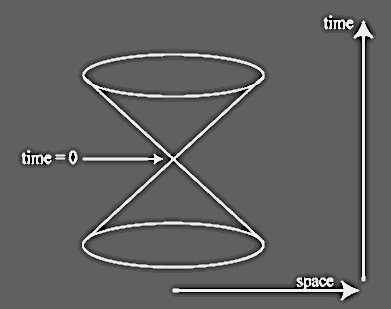
I’ve previously discussed vacuum collapse; if one could figure out how to trigger that‒assuming it is possible‒one could literally wipe out everything in the current universe.  Though, of course, it would take a long time, since it could only happen at the speed of light, so really, you’d only be wiping out everything in your future light cone.  There may be no way to destroy the universe that doesn’t effectively take a limitless time to accomplish.

On the other hand, when I spin around, it’s possible to view that action as the universe spinning around me while I’m stationary.  There are legitimate reasons why we don’t tend to think of it this way, but it’s a perspective that can be taken.

From that sort of perspective, when one dies (from one’s own point of view at least) the entire universe ceases to exist.  It’s very simple and thorough!  Of course, if there is an afterlife, that plan would fail, and one would be forced to go back to the drawing board.  But I’ve never encountered even borderline intriguing evidence or argument that might indicate an afterlife exists, unless you count things like a Poincare recurrence*.

So there is at least one reasonably reliable and plausibly achievable way to destroy the universe, from my point of view.  And the good thing about that is, from other points of view, the universe would still exist, and this would be no more contradictory than the fact that someone falling through the event horizon of a large enough black hole wouldn’t even notice it happening, but those far away would see the faller as never even quite reaching the event horizon.

Anyway, that theoretical stuff isn’t really very interesting for present purposes.  What matters is, at the very least, I can destroy the universe in a sense, if I so desire.  And every day it seems to become more and more tempting to do so.  This world is just so disgusting so often, and it’s not just humans that meet that description.

Ah, well.  Try to have a good day if you can for as long as the universe does exist.  After that, you’re on your own.


*Or the possibility of quantum immortality in the context of Everettian quantum mechanics.  But the various other possible alternate versions of me in such a theoretical quantum multiverse are not “me” even now, from my point of view‒not exactly, anyway, not in any sense that I can experience.  So future possible subsets of the wave function of the universe that contain randomly immortal versions of me are not worth taking into account, and they are vanishingly rare**.

**Though I suppose, as time goes by and all mortal things die, the quantum wavefunction of the universe might come to be dominated by such versions of…well, everyone.  None, however, would be able to interact with each other as far as I can see.

“Shadows of the evening crawl across the years”

Well, it’s Wednesday morning‒insert your joke of choice related to the Beatles song She’s Leaving Home here‒and here is my blog post for the day.  I will not be posting tomorrow (barring the very much unforeseen), since today is Thanksgiving Eve* here in the US, and therefore tomorrow will be Thanksgiving.  I will not be working on Thanksgiving, so there is to be no “traditional” Thursday post.  I’m sure you’re all devastated, but hopefully you can eat yourself into a stupor tomorrow to flee from your sorrow and loss.

Speaking of stupors, I slept a bit better‒or at least a bit longer‒last night than the night before.  This is because, despite it being a weeknight/worknight, I knocked myself out a bit with an OTC sleep aid.  So, if I seem a bit odd today‒for me, I mean‒that’s probably why.

Of course, I’m well aware that the sleep induced by such medications is not proper sleep.  That’s a very interesting fact for someone who gets proper sleep on their own, but it’s pretty theoretical to me.  It’s a bit like quibbling by saying, “going through a wormhole to get to a distant part of spacetime quickly isn’t really going faster than the speed of light”.  Well, okay, if I can find ways to break the laws of causality** I will, but in the meantime, I’ll use the wormhole.

Likewise, sometimes I just want to be unconscious, and I have a hard time achieving it on my own.  Oblivion is such a relief when and if it happens (so to speak).  Yet, even when I do sleep, there’s always a background watchfulness in my head, a feeling that where I am is not safe in some sense, so I cannot completely relax.

I almost never wake up without some manner of start, i.e., a bit of a jump in place.  I don’t know why***.  Maybe this is just the way it is when you’re nominally a member of a species of pack hunters but you’re functionally completely alone, separated from whatever group(s) there were to which you belonged and surviving on your own as best you can.  The world is never fully safe for such a creature.

Well, the world is never fully safe, period, full stop.  No one here gets out alive, after all.  Nevertheless, natural selection tends to lead to the state where the only surviving organisms are descendants of those who feel fear and who feel pain and who try to stay alive indefinitely, even when that survival is pointless (biologically speaking, I mean‒I won’t get into the deeper philosophical questions that can apply, because that would take too much time and energy).

I’m going to bring this to a close here pretty soon, if I can.  My thumb arthritis is acting up, today, and writing this is more painful than it usually is.  Well, actually, I don’t know that “arthritis” is the proper word, since that implies a process that is primarily inflammatory.  It’s probably more precise to say “arthropathy”, which just means “something wrong with a joint”.  “Arthralgia” works quite well here, also, meaning just “joint pain”, but it’s pretty darn vague in its implications of any possible cause.

I suppose it doesn’t make a great deal of difference.

Anyway, I hope everyone who is celebrating has a truly wonderful Thanksgiving Day tomorrow, and that you spend a pleasant time with friends and family (and maybe some football).  I will be back on Friday, barring (as always) the unforeseen.  I work at a sales office, after all, and Friday is “Black Friday”, traditionally the biggest sales day of the year in the US.  Though, there has been a significant degree of “feature creep” or whatever the best term might be regarding that, so now the whole of this time of year is becoming an extended “Black Friday”.  Natural selection tends to encourage such things.

Anyway, I expect to write a post on Friday, so I will “see youthen.  Or at least you will see me.


*There is no such holiday, official or unofficial, as Thanksgiving Eve, but it’s still obvious what I mean by it.  Isn’t it?

**The speed of light in a vacuum being the speed of causality.  This appears to be a large part of why nothing can travel faster.  How could something move more quickly than causality?

***As far as I can tell, it’s not because of having gone to prison.  For one thing, my sleep problems started way before that pleasant interlude.  For another, I didn’t have any real problems with people starting shit with me in prison.  Apparently, I looked (look?) a bit nuts or something.  Also, honestly, I got along okay with people there, all things considered.

“No need to get up-tighter”?

It’s Monday again, and though it is not raining down by me, I’m all but certain that it’s raining somewhere right now, so one could say “it’s raining again” without fear of being entirely wrong.  No matter how you might want to cut up spacetime based on “planes” of “simultaneity”, there is sure to be somewhere in the universe where it is raining now.

Actually, if the universe is infinite in spatial extent, one could probably prove that it is a mathematical certainty that it’s raining somewhere, since there are‒as far as we can tell‒only a finite number* of possible quantum states in any given region of spacetime, and some of these include rain.  Indeed, even if it were not raining on Earth, anywhere, in some given instant (an unlikely eventuality), the fact is that rain can happen in many places in many forms.  I’m led to understand that it sometimes rains neon in the atmosphere of Jupiter.

So, perhaps the song by Supertramp shouldn’t have been It’s Raining Again, but should have been It’s Raining Still.

I don’t know.  Maybe that wouldn’t suit the rhythm of the song.  Then again, it always was a song where the sentiments expressed in the lyrics didn’t quite match the upbeat character of the tune.  This was probably deliberate on the part of the band.

Oh, in case anyone was wondering, the reason there was no post on Saturday was that, indeed, we did not work in the office on Saturday.  We didn’t work out of the office, either, as far as I know.  Well, I know I didn’t work, so even if they worked, we did not work, so I guess I’m right there.

I did a fair amount of walking on Saturday, and nearly as much on Sunday, though Saturday’s walk was more interesting.  I walked in a “park” along a canal in south Florida, and found myself well down into Dade County before I found an exit from the park area that took me to a road on which I could get something to quench my thirst and a place to which to call an Uber (they have a hard time picking one up in a park alongside a canal).  I had walked about seven and a half miles, and I could tell I was getting a bit too much sun**, though my feet and ankles and knees seemed to be holding up okay.

On Sunday I went for another walk, during which I had enough sunscreen.  That was because on Sunday I took my walk solely for the sake of walking, unlike Saturday, on which I had a specific purpose, and my longer walk began on a whim after that purpose was achieved.

It wasn’t an interesting or noteworthy purpose, by the way.  I’m just not discussing it because it cannot have any bearing for anyone but me.

Let’s see, is there anything else going on that’s worth discussing?  Well, of course, there are things going on in the world, and in the universe, and so on, all the time, and probably many of them are worth discussing to someone, or would be, even if no one knows they are happening.  But, of course, pretty much anything that happens, no matter how locally momentous, is historically trivial, let alone cosmically trivial.

Probably there aren’t many things that aren’t cosmically trivial.  I suppose if inflationary cosmology is real and it started at some locus in spacetime, then that would not have been trivial.  But if there is eternal inflation, there’s a real question as to whether it started at all.

Of course, even then, with eternal inflation, the local drop of the inflaton field down to the vacuum state (or a pseudo-vacuum state) here in our bubble universe‒leading to the formation of our universe, all its matter and energy, and possibly the configuration of our natural laws and constants‒would seem to be significant.

But that would only be significant to us, the creatures in this bubble universe.  On the scale of the cosmos overall, it would be just one bubble universe formation in an endless sea of such bubble universes, each one no more striking than the cavitation bubbles that form and then collapse in water that’s starting to boil.  Indeed, if our universe is such that an eventual recollapse will happen, i.e., a “Big Crunch”***, then we really are a lot like a cavitation bubble.

I guess this has been a slightly odd way to start the week‒which is unfortunate, given that today’s date is an even number (24) not an odd one.  But I don’t think I’ve ever claimed not to be an odd person.  I think I’ve known that I was different and a bit peculiar‒perhaps more than “a bit”‒since I was very young.  That’s okay in and of itself.  If most people are “normal”, why the hell would anyone want to be normal?

With that, I wish you all an abnormally good day and week, and if you’re in the US, I hope you have a good holiday coming up, and that you are anticipating it with eagerness.


*It’s big, don’t be mistaken.  But the biggest finite number you can think of‒ever‒is no closer to infinity than is the number 1.  So, in a universe that’s infinite in spatial extent, all possible finite configurations will be instantiated somewhere‒indeed, they will be instantiated an infinite number of times.

**I hadn’t planned on such a long walk, so I was not prepared in that sense.

***Our best information right now seems to indicate that we are not going to recollapse, but that we will continue to expand, at an ever-increasing rate.  I suppose that would make us more akin to a bubble that fully forms and expands in boiling water, escaping from the liquid into the air above.  Such bubbles are no more important than the cavitation bubbles, though.  They’re merely different. 

Bing-bing-bing! Ricochet Robert.

I’m in a rather unusually bad amount of pain this morning, even for me, so please excuse me if my thoughts are somewhat incoherent or distracted or grumpy-seeming.  Though I don’t know how you would be able to tell if I’m grumpier than usual.

It’s Monday yet again, and it’s only been two days since my last post, not three, because I worked on Saturday, and on that day, I also wrote a very angry blog post.  I think some people might have found the degree of malice I expressed on Saturday disquieting or at least just not good, which I can understand.  I tend to think of such terrible things a lot more often than most people do (though I share them only infrequently); it’s one of the reasons I find my own company unpleasant.

But, of course, I’ve tried to compensate for my dark tendencies by doing as much good in the world as I’ve been able to do, such as by becoming a doctor.  I’ve never actually acted on any of my darkest impulses and dreams, except when I write horror stories, or when I write non-horror stories with horrible elements in them.

I guess maybe that’s one of the things that’s been therapeutic for me about writing fiction.  Maybe the trouble is right now that I don’t have a good outlet for my terrible thoughts.

Of course, I know that the idea of thoughts and emotions as “substances”, as if some manner of fluids, which can build up and need release is not merely incorrect, but is not even a good analogy for how emotions and other neurological states work.  This is part of why meditation is far more effective against stress and tension than is, for instance, the often counterproductive notion of catharsis.

Of course, sometimes things that work well for neurotypicals don’t work nearly as well for those on the autism spectrum*.  For instance, there is apparently some reasonable evidence that cognitive behavioral therapy, which often works quite well for neurotypicals with depression, is not as effective and can even be counterproductive for autistic people; we already tend to over-self-evaluate our cognitions, and so the tricks and workarounds of CBT often are not merely redundant but miss the issues entirely.

Along a line of possibly similar nature, I’ve written before about how meditation often serves to reduce my anxiety but at the same time worsens my depression.

And yes, in case you’re wondering, I think it’s all a matter of neurological states‒or neurohumoral states if you want to be slightly more precise.  I’ve spent nearly my whole life interested in such things; still, I have found neither evidence nor argument that has so far persuaded me that there’s any significant credence to the notion that humans are anything but temporary patterns of matter/energy, “spontaneously” self-assembled like any termite mound/colony or beehive/swarm**.

Once that pattern breaks because it can no longer sustain itself, due to injury or age or what have you, there is nothing more to it; it’s a hurricane that has passed.  There can be records and traces of its passing, and the damage it has done can linger for a long time, but there is no “afterlife” for weather patterns.

People are more complicated than hurricanes, at least in some senses, I will admit that.  But more intricate complexity doesn’t tend to make things more durable; it makes them more fragile, ceteris paribus.

Of course, all else is almost never equal.  Nevertheless, it’s often useful to consider complex matters as partial differential equations in more than one variable***; one explores the equation by holding all but one variable constant and differentiating or integrating along only one variable at a time.  As long as one thinks carefully about such things and never forgets that one is holding the other variables constant‒and by not forgetting, hopefully avoiding the oversimplification of one’s model of reality‒one can penetrate a great deal by recognizing when powerful tendencies persist even given the fact that other variables can influence matters.

For instance, the metallicity**** of stars influences the size at which they undergo certain levels of fusion, which is why it is thought that the earliest stars had different lifespans and luminosities relative to mass than later stars (like our sun).  But they still, overall, behave like stars, and the bigger ones shine brighter and last a shorter time than the less massive ones.  They are more alike than unalike, the narcissism of small differences notwithstanding.

Well…that tangent, or series of tangents, sure took me down unexpected paths!  But I guess that’s the nature of tangents; in any nonlinear but continuous function (even one as simple as a circle), there are a functionally infinite number of possible tangents.

I think that’s the right mathematical metaphor; isn’t it?  I guess it doesn’t much matter.  I’m just expressing my highly stochastic thoughts (I doubt they’re truly random) as they come.  But they would probably follow different courses if I did not express them in this fashion.

I hope your own thoughts are less troublesome to you than mine are to me and that you are at least at some degree of peace with yourselves and with each other.  You might as well be, though I know that’s not enough to guarantee it.  Still, do what you can, okay?


*Which I am, as you may know; I have written at least in passing about my recent, quite late, diagnosis.

**I don’t mean “like” here as “the same as” but rather “in the same fashion as”.

***My terminology is a bit sloppy here, but I’m not trying to be mathematically rigorous, I’m just trying to get my thoughts across with some clarity and accuracy.

****To astronomers/astrophysicists, a “metal” is any other element but hydrogen and helium (this no doubt irks chemists).  The earliest stars would have been almost entirely hydrogen and helium, certainly to start off.  Mind you, even later generation stars like the sun are still by far mostly hydrogen, but seemingly small “contaminants” can have noticeable effects on big systems, as in the fact that water vapor and carbon dioxide markedly affect Earth’s atmosphere and surface temperature despite being present in tiny amounts compared to nitrogen and oxygen.

If the vacuum collapses, everything gets messy

It’s Wednesday morning now, and I feel slightly better than I did yesterday, which should probably be no surprise.  I went back to the house last night, and I had a decent sleep‒for me, anyway‒and no major evening issues.  Now I am working my way toward the office.  It’s payroll day, so it should be at least mildly more hectic than most other days, but it shouldn’t be too unbearable.

Well, it shouldn’t be unbearable at all.  I mean, the state of being unbearable or not is a purely binary thing, isn’t it?  Either something is bearable or it is not.  If something is unbearable, then it cannot be borne.  So, saying something is not “too unbearable” is probably almost always nonsensical.  I suppose one could imagine something being only just unbearable, so that one could almost be able to bear it…but not quite, and one would finally be forced to succumb to whatever outcome that entailed, despite one’s possibly heroic struggles.

In some ways that sounds like it could be worse than something being thoroughly and unequivocally unbearable.  If one can see that something is truly unbearable, one will probably be less likely even to try to bear it.  One would not bother attempting to style out the brunt of a supernova; if one could not get far enough away, one would presumably just close one’s eyes and grit one’s teeth and take what comfort one could in knowing that the explosion will probably happen and obliterate one faster than any nerve impulse could propagate.

That’s one of the (tiny) comforts about the possibility of there being a “vacuum collapse” of the universe, in which the present “dark energy” vacuum state could, hypothetically, quantum tunnel down to a lower, truer vacuum state than the present one*, releasing that potential energy drop in such a way that wipes out all currently existing particles/fields.

This would erase everything in our visible universe (the “visible” part is deliberate and crucial; do you see why?**) in a sort of wave of collapse that starts at the site of the first state change, like the propagation of ice crystals forming in hitherto supercooled water.  But though it would be a shame, from our point of view, it would be one we would never experience, since the bubble of state change would expand at the speed of light.  It would thus be literally impossible to see it coming, because once you could see it, it would already be there, and you would be wiped away before you could possibly be aware that it was happening.

By the way, this possibility is “only” hypothetical; we aren’t even sure it could happen, not least because we’re not sure whether the vacuum state of the universe is as low as it can go or not, among other things.  But don’t worry:  if the vacuum collapse of the cosmos doesn’t kill you, something else will.

Even my truly immortal vampires in Mark Red might be wiped out by vacuum collapse.  I suspect they would, which might be a comfort to many of them, so to speak.  Of course, that would depend very much on how the “supernatural” forces in that book’s universe interact with the vacuum state and other quantum fields.  It’s not inconceivable that they might survive even that.  How’s that for horrifying?

These are odd thoughts for a Wednesday morning, aren’t they?  I mean, on a Thursday they wouldn’t be that odd, and even less so on a Friday.  On a Saturday they would be almost boringly predictable.  But on a Wednesday morning?  That’s just, well…odd, as I said.

I’m being silly.  My apologies.

I guess it’s more uplifting than is the prospect of universal Armageddon***.  Though, really, the Tao te Ching (in the version with which I am familiar) encourages us to embrace death with our whole hearts because that will help us to be prepared for most everything else we can encounter.

It does not encourage us to love death or to seek it; quite the contrary.  We are merely encouraged to accept it, not just intellectually but viscerally, to internalize***** it.  This is one of those curious circumstances in which the Tao to Ching and the movie Fight Club give the same advice, which is no indictment of that advice in either direction.

I try not to indulge in the vice of advice, but I will express my hope that every one of you who reads this post today or any of my other posts has a particularly good day, today and every day hereafter.

You’ve suffered enough already.


*This is analogous to what is thought to have happened when the “inflaton” field dropped down to a much lower energy level about 13.8 billion years ago, releasing the differential energy as the very hot soup of elementary particles that eventually became the universe we see.

**Okay, fine, I’ll explain.  It’s not just that the wave is expanding at the speed of light and so one would “see” it only as it hits.  But, given the current, accelerating expansion of the universe, the wave of change could never, even in principle, reach areas of the cosmos that are outside our cosmic horizon, because those places are receding from us faster than the speed of light/causality.  There is no causal influence from us that can ever reach them, or vice versa (assuming no wormholes or warp drives or similar).  Likewise, someplace beyond our horizon****** could be collapsing already, but we need never worry, because that collapse is not going to reach us (unless it changes the rate of overall cosmic expansion or even reverses it, which is not inconceivable.  We might then find ourselves in (or near) an anti-deSitter space, in which case, well…yeah).

***Not to be confused with the often misused**** term “apocalypse” which is basically just synonymous with “revelation”.  It’s become associated with the end of the world (and with lesser catastrophes) because one of the alternative titles of the book of Revelation is “The Apocalypse of Saint John the Divine” or whatever they called that nut bar.

****That rhymed, and it had a good rhythm too, both quite by accident.  I did that in yesterday’s or Monday’s post as well, but I didn’t call attention to it.  Can you find it now?

*****I would love to be able to use the term to grok it as in Heinlein’s Stranger in a Strange Land, but much as when Fuckerberg stole the term “metaverse” from me, likewise Elon Musk and the would-be tech boys who idolize him have arrogated the term “grok” and made it embarrassing to use.  Don’t even get me started on the disgusting theft of the word Palantir by Peter Thiel.  He deserves to be tortured interminably for the unmitigated gall he has shown in daring to use that term, but I would accept his immediate, painless disintegration and that of his company.

******Speaking of horizons, it is interesting to wonder what a vacuum state collapse would do to currently existing black holes.  I suspect they would basically be impervious to it, since the vacuum state is something that exists within spacetime, with the gravitational field as the backdrop of other quantum fields, but we don’t necessarily know enough about quantum gravity to feel very sure, as far as I know.  I suspect it might change the specifics of Hawking radiation at the level of the event horizon, and thus change the specific rate of black hole decay.  Also, I think in the first rush of particles generated by such a vacuum decay, most black holes would grow briefly with the influx of newly released energy all around them that had previously been bound up in the vacuum energy.  But that’s just my initial intuition.

Noisy events on the horizon of my attention span

It’s Tuesday, isn’t it?  Well, I guess it may not be Tuesday when you’re reading this, but it’s Tuesday as I’m writing it.  It’s the second day in the latest of a seemingly endless stream of utterly pointless “work weeks”.

Welcome to our world.  Welcome to our world.  Welcome to our world of noise.

That’s a paraphrase of the song that was (and may still be) sung by the dancing animatronic puppets in the main front area of the big F.A.O. Schwartz store that sits just by the southeast corner of Central Park in Manhattan.  I’m not sure why I felt like including it there, but it definitely expresses the sentiment I have that nearly everything in the universe is effectively “noise” in the information theoretic sense.  At the very least, the signal-to-noise ratio in the world is vanishingly tiny.

It’s not zero, mind you.  There’s some info hiding in all the nonsense.

Of course, whether something is signal or noise depends very much on what signal you’re seeking.  If you’re trying to detect gravitational waves, then nearly everything else around is “noise” in the sense that it is not evidence of gravitational waves, and is just going to make that evidence harder to find.  But if you’re an ornithologist, then at least some of that seeming noise might be the birdsong “signal” of a rarely seen species there in Louisiana, which I think is where the first LIGO observatory was constructed*.

And, of course, if you’re a seismologist, what you consider a significant signal would very much be noise to the LIGO people.  If there were a gravitational wave strong enough to be seismically significant, it would have to be from a very close and catastrophically violent event.

We don’t expect there to be such a thing any time soon.  And apart from such events, gravitational waves are so relatively weak‒gravity being by far the weakest of the “forces” of nature‒that so far they can only be detected from things like black hole and/or neutron star mergers, which are ridiculously violent events.

Incidentally, apparently recent observations of one such merger has given confirmatory evidence for Stephen Hawking’s black hole horizon theorem**.  That states that when two black holes merge, the (surface) area of the new, combined event horizon must be at least as large as the two prior event horizon areas combined.

In this, as in other things, black holes and their horizons act very much like the 2nd Law of Thermodynamics, and that is consistent with the Bekenstein-Hawking thesis that the entropy of a black hole is proportional to the area of the event horizon, as measured in square Planck lengths.  Indeed, the maximum entropy‒the maximum information‒of any given region of space is that which would be encoded upon an event horizon that would hypothetically enclose such a space.

As for the volume of a black hole within the event horizon…well, that’s harder to quantify.  The apparent radius, as judged from the sphere of the event horizon‒the Schwarzschild radius for a non-rotating black hole‒is almost certainly much smaller than the radius that would be perceived by someone within the horizon, for spacetime is very distorted there.  Indeed, I suspect that, at least by some measures, the volume within a black hole‒or at the very least the radius from the “center” to the horizon‒is infinite, with the “singularity” actually stretching down away forever.

Of course, an asymptotically infinite well of that sort need not always have infinite volume.  There is, for instance, the counter-example of “Gabriel’s Horn”, a shape made by rotating a truncated function (y = 1/x for x ≥ 1) around the x-axis.  This shape has infinite surface area, but it has a finite volume(!).  So you could fill it with paint, but you could never finish painting the inner and outer surface.  Weird, huh?

Of course, the dimensionality of things within a black hole’s event horizon is probably at least one step higher than things in the Gabriel’s Horn comparison, so the finite/infinite comparisons may not translate.

I’d like to be able to do a better job working that out with more than my intuition; that’s one reason why I own no fewer than four fairly serious books on General Relativity.

That’s not the only reason, of course.  I would also like to try to solve what happens to a space ship that accelerates near enough to the speed of light that its relativistic mass and relativistic length contraction puts it below its own Schwarzschild radius (at least in the direction of motion).  Also, how would that figuring be changed if the ship were rotating around the axis of its motion***?

Unfortunately, I rarely have the mental energy to put into pursuing adequate mastery of the mathematics of GR, and so I can (so far) just try to visualize and “simulate” the spacetime effects in my imagination.  That’s fine as a starting place, but even Einstein had to master the mathematics of non-Euclidean geometry and matrices and tensors before he could make General Relativity mathematically rigorous.

It’s almost certainly a pipe dream that I will ever get to that level of expertise.  My chronic pain and chronic depression (dysthymia) combined with the effects of my ASD (level 2****, apparently) and the effort that’s required for me to act “normal” enough to get along just really wear me out mentally.  It’s frustrating.  I have a stack of pertinent texts above my desk at work, where I hope they will entice me.  I even have a copy of my old Thomas and Finney college calculus text there too, so I can do some reviewing in that.

If only I were able to spend some time without pain and to get a good night’s sleep once in a while, I might even make progress.  I suspect that such things are not in the cards, however.

I would love to be dealt The Magician (in Tarot cards) but I fear that I am just The Fool.  Oh, well, that’s all just metaphorical, anyway.  It’s possible to predict the future, of course, but it is difficult, and it’s very unlikely that any set of cards‒however cool they may be‒is the way to do it.


*I remembered correctly.  It is in Louisiana.

**The theorem, being a theorem, is mathematically rigorous, but the question remains whether it describes the way our universe actually works.  That is always a matter of credences rather than “proof” in the mathematical sense.  In the real world, probabilities may come vanishingly close to zero or to one, but they never quite reach them.

***In Special Relativity, when something is traveling around a circle at a significant fraction of the speed of light, length contraction has the effect of “shrinking” the circle from the “point of view” of that which is moving at that speed.

****”Requiring substantial support” according to the official definition.  I do not have such support.

“The sun is the same in a relative way, but you’re older.”

Okay, well, here we are.  It’s Wednesday.  I don’t know what else there is to say about the day.  I guess…yeah, I don’t know.  It’s another day.  It’s a stretch of (roughly) 24 hours, the specifics depending on whether you’re using solar time or sidereal time or just the “self-contained” UTC time*.

UTC time is kept on a variety of clocks around the world and is based on the oscillations in the hyperfine transition frequency of the Caesium-133 atom.  That frequency has been defined as 9,192,631,770 Hz.  The international measuring community thing, whatever they call themselves, thereby agreed on defining the second as exactly 9,192,631,770 of those Caesium-133 oscillations.

Of course, oscillations of atoms, like all other processes that take time, slow down with increased spacetime curvature and with increasing speed relative to any given observer.  This is why the GPS satellites have to adjust their own time to account for both special and general relativity.  It’s pretty cool; you’re carrying proof of Einsteinian relativity in your smartphone.

You probably already knew that.

Then, of course, once they’ve decided on the precise value of a second‒knowing that the speed of light (or more precisely the speed of causality) is constant‒they then defined the meter as how far light travels (in a vacuum) in⁠ 1/299,792,458⁠ seconds (approximately 30 2/3 “vibrations” of a Caesium-133 atom).  Mind you, two observers moving relative to each other will see their meters as different each from the other, but c’est de la relativité.

It can be easy to imagine that definitions of units in science (and related fields) are not merely arbitrary but circular, almost tautological.  But really, given that these are attempts to codify specific attributes of reality itself, they would almost have to be self-referential with each other to be useful.

The length of a day is something that happens for real.  Thanks to the base 6 and 12 numbering system of the Babylonians, the day was long ago arbitrarily divided into 24 hours, each 60 minutes long, and each 60 seconds long, so a second was 1/(24 x 60 x 60) days or 1/86,400 of a day.

That worked well for a long time, especially since, before Galileo et al, humans couldn’t really measure time very precisely, anyway.  And then, until railroads allowed rapid travel between cities, it wasn’t necessary to worry too much about having the same time in different places.

But eventually that did become useful and necessary for many purposes, and eventually it was realized that a day wasn’t exactly what we were calling 24 hours, and indeed, that the length of a day varied slightly from day to day and year to year; also, a year isn’t a whole number of days long.  Also also, a day could be measured relative to the sun‒which is close enough that a day doesn’t end quite exactly after one full rotation since the Earth moves relative to the sun over the course of a day‒or with respect to distant stars, by which estimate a day comes closer to being exactly one complete rotation.

For most people most of the time, though, this precision, and that upon which it is based, are probably not merely irrelevant but unknown and unguessed.

Likewise, I don’t know how many people know about how Celsius made his temperature scale 100 degrees between the freezing and boiling of water at sea level pressure (a pretty reasonable choice, though I’m led to understand he initially had 100 assigned as the freezing point and 0 the boiling point!).

Then it was discovered that there existed a minimum possible temperature in principle, and they decided to set that scale, the Kelvin scale (named after William Thompson Scale**) using degrees of the same size as Celsius, but with zero defined as‒understandably enough‒absolute zero.

It’s all fairly interesting, if you’re in the right frame of mind.  But, alas, there’s every reason to suspect that all this information will be rendered moot and useless and perhaps even lost as the world winds down, or if life is replaced by artificial intelligence, or everything ends in some other way, as seems more than possible even in the relatively short term.

In any case, the laws of physics, as we know them, seem clearly to predict that the universe will tend toward ever-greater entropy and eventually all life, all structure will end.  Sometimes, I think it cannot happen soon enough for my taste.

Then again, there are cyclic universe proposals, such as Roger Penrose’s Conformal Cyclic Cosmology.  It bases its model on the fact that entropy, though always tending to increase, is not really an absolute quantity, not a substance, and that our universe’s “maximal” entropy may be the next universe’s low-entropy beginning, just on different scales; it doesn’t even require any “inflationary” burst of expansion to explain the uniformity of the CMB, I think.  I haven’t yet finished Penrose’s book about CCC, because though he is a stunningly brilliant mind, his writing can be a bit plodding and dry.

I guess it’s hard for any person to be good at everything, though Penrose has many strengths.  If memory serves, he invented a set of shapes which can be used to tile an infinite plane (in principle) with no gaps and no repeating patterns.  Supposedly this has been proven to the satisfaction of professional geometers, though I am not familiar with that proof.  Still, if it is a mathematical proof, then it is one of those rare things that we know to be certainly true, given its set of axioms.

It’s not necessarily useful in any practical sense, of course.  For instance, I think it’s probably true that any tiling system that can tile an infinite plane without repeating could not be used to tile a closed, finite, simple geometrically shaped portion of a plane‒such as a rectangular room.  I think you would always have to cut some of the tiles as they reach the wall, no matter how big the room is, as long as it is finite.  I do not know this for certain, that’s just my intuition.

Well, I guess I’ve wasted space and time enough here for now.  It’s no more wasteful than has been my entire existence, I guess, but also no less wasteful.  Or is it?  I don’t know.  In any case, for now I will stop wasting your time.

Please have a good day.


*Yes, it’s probably redundant to say “UTC time”, but the order of the acronym is sort of Yoda-esque‒it did not originate with an English term‒so I feel it’s tolerable to use it this way here.

**That’s a joke.  He was really William Thompson, the first Baron Scale***.

***I mean the 1st Baron Kelvin, of course, all joking aside.  A baron scale sounds like some long forgotten and unused (i.e., barren) bit of laboratory apparatus, left for eons, gathering dust in an abandoned world, like the broken statue of Ozymandius.  It’s very sad.

Gravid questions of time and gravity (and labor)

It’s Monday, the first of September, which was “originally” the seventh month, but which is now pushed back to the ninth by the two “caesarean” months.  Speaking of such things, it’s also Labor Day in the US (I’m not sure about other countries) a day on which we celebrate labor by giving most people the day off.  This isn’t quite as perverse as it might sound.  After all, what woman would want to work while in labor?

Ha ha.

Anyway, my workplace is open today, though only for half a day.  It has become more and more common for nearly everything to be open even on huge holidays like New Years and so on, let alone “ordinary” federal holidays.  The reasons are fairly straightforward, and they have nothing to do with any kind of formal, deliberate, corporate conspiracy such as is imagined by so many naïve people on social media.

It’s just the same problem‒or situation‒that leads trees to grow tall when it would make much more sense for them all to stay closer to the ground and not waste so many resources on trunks and xylem and phloem, on getting water and nutrients from the ground up to their highest leaves*.  The trouble is, if all the trees were low but then one variant appeared that was slightly higher, it would have a significant advantage over its species-mates (and other species), so it would be more effective at reproduction, ceteris paribus.  Its offspring would come to dominate, unless and until yet other variants occurred that tended to grow even higher.  And thus the “arms race” would begin.

So in the human world:  if everyone else worked four days a week, but one worker was willing/able to work more days or longer days, especially if for the same or only slightly higher pay, then that worker would have a job advantage, (again, ceteris paribus).  And so competition leads at least some workers to strive to outdo each other to the extent they can, and so on, working for local, individual advantage that inexorably leads to less pleasant outcomes for everyone.  It’s just game theory applied to economics.

Anyway, that wasn’t what I wanted to discuss this morning.  I wanted to discuss two physics-related ideas I’ve had in the last few days.  The later one is just a bit of silly fun, but the other is more interesting to me.

The second one happened this morning (at about 2 am, when I was awake, because of course I was).  I put on a YouTube video of Star Talk in which a string theorist was the guest, and Professor Tyson asked her about the possibility of more than one dimension of time, and she said most such theoretical possibilities fall afoul of paradoxes and trouble with causality.

But it occurred to me, if there were a situation with time travel involving, for instance, the “grandfather paradox”, maybe the fact that preventing one’s grandparents from meeting makes one no longer there to prevent the meeting doesn’t necessarily unravel the universe, but maybe the paths and events correct and change each other in a closed, repetitive loop of time, interfering with each other** until only one, complete resonant spacetime line is there.

It’s analogous to a plucked string*** in which all sorts of vibrations and waves go back and forth between the fixed ends, but most waves/vibrations end up canceling each other out except the ones that fit an even number of times within the confines of the fixed string.  So maybe the actual events of reality could thus only be the ones that are resonant within that spacetime…whatever the hell that might mean.

Anyway, that’s the frivolous question; though it’s a bit fun, it probably doesn’t really have anything to do with our actual world (though it could…remember my thought a bit ago about forces traveling backward and forward in time and interfering until only a fixed number of outcomes resonate****?).

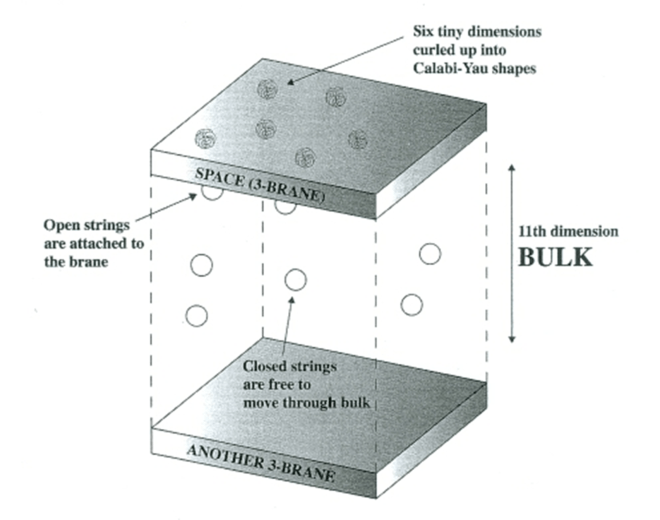
More interesting to me, really, was a question that occurred to me while I was reading Lisa Randall’s Warped Passages, a physics book (of course) and a particularly good one.  It was not really discussing the question that popped into my mind, other than that Professor Randall was reviewing the particles in the Standard Model.

We know that fermions cannot pile up one on another (cannot share quantum states), and that bosons can (e.g., in lasers).  We also know that massless force-carrying bosons such as gluons and photons travel at c, the “speed of light”.  The W+ and W- and Z bosons of the weak force do not because they interact with the Higgs field and so have “rest mass”.

Anyway, that’s not really the point.  The point is that gravitons, the hypothetical force-carrying particle of the gravitational field, are also massless bosons, and gravity travels at the speed of light*****.  But something popped into my head that had never occurred to me before and I’m not sure why:  do gravitons come in different frequencies?

We know that light has a limitless number of possible frequencies, across a very wide range, and that higher frequencies/shorter wavelengths are associated with higher energies per photon.  We also know that all matter radiates photons at a spectrum of frequencies that depends on temperature‒the so-called black body radiation.  Well, we also know that all matter “radiates” gravitons, or at the very least it all interacts with the gravitational field.  What if matter gives out gravitons in a spectrum that depends on total mass?

What would it mean for a graviton to have higher frequency or lower frequency?  Would that entail a stronger (and weaker) gravity?  Or would it correspond to something else entirely?

Of course, I know that gravitational waves are of varying frequencies depending upon the source‒that frequency and intensity (amplitude) increase as, for instance, two mutually orbiting black holes get closer and closer, orbiting faster and faster, before they coalesce.  Is that analogous to them producing large numbers of gravitons of those increasing frequencies?  Or are gravitational waves different types of things than “ordinary” gravitons?  Is ordinary gravity propagated by “virtual gravitons” much as the electromagnetic force is carried by “virtual photons”, which are really just mathematical shorthand for perturbations in the quantum field of electromagnetism?

I suspect that, because we don’t really have anything like a good quantum theory of gravity, there would be few clear answers to my questions about gravitons, but there may be constraints based on what we already know that would make my questions answerable or moot.

I mean, I know that “we” know that gravitons would be spin-2 particles, meaning that to rotate them 180 degrees would leave them unchanged******.  I don’t know how this or other aspects of gravitons would affect possible frequencies, though.  Also, can gravitons be polarized in a manner analogous to light?  I’m not sure whether my graviton questions are sensible or pertinent or utterly off the mark.  If anyone out there is a physicist specializing in such things, please, if you can spare a moment, let me know?

This post has gone on for a long time, I know.  I could meander around much longer on these subjects, probably for pages and pages and pages, but that would be a bit much for a daily blog post, if it isn’t already.  Maybe because it’s a holiday, at least some of you will have the time and interest in reading such thoughts, but I don’t want to push my luck.

However, I welcome any comments on the above subjects if you have an interest, and especially if you have relevant expertise (though I welcome all interested thoughts).

In any case, please try to have a good day.


*A fascinating physical process that’s only possible because continuous liquids can actually have negative pressures.

**Not in any inappropriate way, just that they interact and waves can cancel out.

***Not a “superstring” or heterotic string or what have you, just for instance a guitar string or a cello string.

****This is not unlike Feynman’s path integral/sum over histories notion, really.

*****We know this is so because there was a neutron star merger detected by LIGO and VIRGO that was quickly looked at using “light” telescopes as well, and the timing matched up (As a silly aside, since gravitons are bosons and could thus in principle share quantum states, one might, in principle, be able to create a coherent beam of them…a GRASER or GASER if you will).

******Spin-1 particles basically return to their identical state if you rotate them 360 degrees.  And for spin ½ particles, you need to rotate them 720 degrees (!) for them to return to their prior configuration.  Once you’ve rotated them 360 degrees they’re kind of the opposite of their prior configuration.  If that’s hard to think about, just imagine traversing a Mobius strip laid out in a “circle”:  once you’ve gone 360 degrees, you’re on the opposite “side” of the strip than that on which you began, and you have to go another 360 degrees (so to speak) to get back where you started.  Neat, huh?

Doff thy name; and for thy name, which is no part of thee, take all my blog.

Hello and good morning.  It’s Thursday again, and I’m going to try to be more upbeat today in my writing.  So, given my track record, I’ll simply now say…

TTFN


Ha ha, just kidding.  I would never let you off that easily.  I don’t, though, really know what I’m going to write today.  Of course, I never really know ahead of time, as you know (ahead of time) if you’ve read this blog for long.  But now we’re doubly ignorant*, because I have to choose from a much narrower realm of things about which to speak:  the Positive (or at least the Non-negative).

I suppose we could talk about electric charge‒that can be positive, if you’ll pardon the pun (and even if you won’t).  But of course, charge, and specifically positive charge, has interesting historical contingencies.  Because, of course, positive and negative are merely chosen terms; there’s nothing inherently “negative” about the charge of an electron, nor is there anything inherently “positive” about a proton.

As I understand it, Benjamin Franklin was the one who named the two charges and who began the convention that current moves from positive to negative along, for instance, a wire supplied by a voltaic pile (or “battery”, another term Franklin coined, according to what I have read and heard).

Of course, it was quite a long time before people discovered that‒oops!‒the moving particle carrying the charge in a flowing current is the electron, the “negatively” charged particle.  So, based on the already widespread convention, current, as described by physicists and engineers (and electricians I presume), flows in the opposite direction from the actual charge carrier that’s moving.

It’s a bit like relating stars’ intensity by describing how dark they aren’t.  And it turns out, given that the magnitude scale for stars indicates brighter stars by smaller/more negative logarithmic numbers, that’s actually‒in a sense‒how it’s done.  This is also due to historical contingencies.

These sorts of things happen a fair amount.  Remember when VHS beat out Betamax because it was basically first to the market, even though pretty much all reputable experts agreed that Beta was the better, more reliable, clearer, lighter-weight format?  Once people get used to something, they often don’t want something new, even if it’s better.  I get it, of course‒unnecessary change stresses me out severely‒but it’s definitely unfortunate.

It occurs to me now that the “demotion” (really just the redesignation) of Pluto from planet to “dwarf planet” was a rare exception to this, when humans, recognizing that the terminology they had been using was not ideal, changed it.  Of course, this was the work of an international astronomical society, a group of scientists, so certainly it wasn’t a typical situation or decision.

It also was basically a matter of necessity**.  Several other Kuiper Belt objects similar to Pluto had been discovered, some more massive than Pluto, and all with very elongated, non-circularish orbits (like Pluto’s), so either there were going to be a slew of highly irregular planets with highly eccentric orbits, outnumbering the “older” and more orderly planets, or we were going to have to call these things something else.

It’s useful to remember that the names and categories that we put on things are just our names and categories.  They are not arbitrary, at least not if they are useful; but they are our designations, like the little bits of code that let operating systems know where to find programs and files on a computer’s disk memory.  They let us talk to each other about things and address them with consistency and rigor, so that we can better understand them.

But Pluto doesn’t care whether we call it the ninth planet or a dwarf planet or a cartoon dog.  It doesn’t care if we call it Pluto or Hades or Osiris or Hel or Mandos.  It doesn’t have any idea what we call it or how we “define” it.  It doesn’t have any ideas at all, as far as anyone can tell.  It’s not the sort of thing that has ideas or cares about things.  To quote Mister Spock (who was not speaking about Pluto) “It is, essentially, a great rock in space”***.

For nearly 4.5 billion years, Pluto‒like Jupiter’s moons, like Ceres, like the Kuiper Belt and the Oort Cloud and so on‒was just there, and no one knew it was there, no one had seen it, no one was aware of it (as far as we know, anyway).  Intelligent awareness does not cause things in the universe to be; rather, things in the universe being and doing what they do sometimes, rarely, cause intelligent awareness, at least in one tiny place in the cosmos.

BTW, you are in that place and you are one of those intelligent awarenesses, in case you didn’t know that.  But I suspect you already did know that.

It’s quite the rarefied club to which to belong.  Even if there are countless intelligent species in the universe (however one might reasonably define intelligence) they must nevertheless be a tiny, petite, and wee part of all the stuff in the universe, at least for now.  In principle, that could change eventually, and intelligence could come to dominate the universe, but that’s probably a long way off, if it’s going to happen at all.

It can be hard to be optimistic about that possibility sometimes, given the state of humanity, which always seems abysmally stupid.  But remember, the smarter ones among humans have an advantage, the greatest advantage we have seen in our world:  they are smart.

And with that, for real this time:

TTFN


*I know, if there are fewer things from which to choose, one is in principle less ignorant, since there are fewer unknowns, the entropy is smaller, etc.  However, sampling from these spaces is not random; the negative concept-space is more well known and thus less random (and more likely to be chosen) than the positive space, about which I know but little.

**Not to be confused with the question of the necessity of matter.  That’s a whole sort of “metacosmological” notion.

***I know, I know, Pluto is largely made of water ice.  Trust me (or not), at the temperatures of Pluto, water is a rock.  And at the temperatures and pressures of Titan, methane is the stuff of lakes and streams (i.e., it is a liquid).  And at the temperature of the interior of the sun, tungsten is a plasma…or so I suspect.

Neither jot nor tittle, but just a title

It is Friday.  Friday it is.  I do not, though, plan to eat any green eggs and ham, nor do I intend to train Jedi.  I merely like to fiddle around with words.  I have also even been known to write and speak about cellos and violins and violas and basses‒wording around with fiddles, that is.

Anyway, this should be the end of the work week for me, so don’t expect a blog post tomorrow.  I’m not saying that there definitely won’t be one; it’s an outcome with a low probability, but it’s not zero.  In principle, the probability of any physically possible event happening is never zero.  But the odds can be so vanishingly small as to be zero for all practical purposes.

For instance, it’s physically possible for the entire Earth (the Moon included) to quantum tunnel to the Andromeda Galaxy, but I wouldn’t hold your breath.  I suspect that the odds of it happening are so low that the time scale between now and the evaporation of the largest black holes due to Hawking radiation (roughly a googol* years) would not even begin to make it likely to happen, even if it weren’t for the fact that the Earth and the Moon will have been so dead and so disintegrated by then that even the memory of their memory’s memories would have been long since lost to any mind that might still exist at that time…probably.

So, you can treat that Earth-Moon Andromeda tunneling as “impossible” for all practical purposes, but in principle, it could happen…

…right…

…NOW!

Okay, well, as far as I can tell, it hasn’t happened.  The sky is too hazy for me to see if the stars have changed, but I don’t think they have.  It would be quite something to experience the local stars of a different galaxy, but of course, if we tunneled into Andromeda, we might be in a relative star desert, or we might be in a place with too many stars for our long-term safety.  Also, if our solar system’s net momentum persisted, we would be unlikely to arrive in any kind of stable orbit of the center of that galaxy.

And, of course, I did not say the sun would come with us‒that would make the whole thing even more vanishingly unlikely‒so we’d all freeze in fairly short order, apart from organisms that use geothermal sources as the base of their food chains and energy cycles.  Those might survive for eons.

Anyway, it’s vastly more likely that I’ll work and write a blog post tomorrow than that we will quantum tunnel to Andromeda**, but it is still a very small likelihood***.  It may be less than one percent, I don’t know.  But it’s quite unlikely.

So, though it might be worth a quick glance to check in come the morning, especially if you were going to do that sort of thing anyway, I would not go out of your way, and I certainly wouldn’t recommend holding your breath.  I don’t think even a sperm whale could hold its breath that long, and I think they have the longest breath-holding record of any mammal (if anyone knows otherwise, please let me know).

In other news‒not that I’ve really given you any news so far‒my keyboard arrived safe and sound (so to speak) yesterday afternoon, so hopefully this morning I’ll be able to finalize the chords to Native Alien.  Then, maybe this weekend, I’ll record a little guitar-chord and voice demo so I don’t lose track of the song.

Then, next week, I can start working on a song based on the trigger “humility”.  I still have no clear conscious notion of an idea for such a song, but I’m not worried about that.  I know I can produce something (not the Beatles song).

I have to keep reminding myself that I don’t need to produce anything great as far as lyrics go‒I think the lyrics I have for Native Alien, which I shared the other day, are okay but not terrific‒I just need to get some words down.  I can always edit and alter things as the process evolves, just as the first draft of a story (or to a lesser degree a blog post) is just the beginning.

I’m also continuing with the circuit course on Brilliant, and I’m alternating reading that book Vector and The Lord of the Rings (yet again) and my own book, The Chasm and the Collision (also yet again, though LotR still holds the 2nd place record for my number of reads, well ahead of CatC and only bested in number of readings by The Chronicles of Thomas Covenant the Unbeliever).

All these are things that I can do alone, of course.  If there’s something to do that would require someone else’s participation, well, I’m shit out of luck.

I think that’s a phrase that applies fairly well to me, come to think of it.  And the word “alone” might as well have my picture next to it in the dictionary.  Though that might be confusing, since I can think of other words that would merit my picture even more than “alone” would‒words that would do their part to explicate just why I am alone, no doubt.

Batman knows I don’t want to hang around with me.

Anyway, I hope you all have a nice weekend, and if anything truly improbable happens to you, I hope it’s a very good improbable thing.


*That’s 10 to the 100th power, or a 1 followed by 100 zeros, in case you’ve forgotten whence the software company cribbed their name.

**Quantum tunneling is not rare on small enough scales, though.  It happens countless times every second in the heart of the sun, for instance.  If it did not, there would not be enough heat and pressure to overcome the coulomb barrier to fusion, and the sun would be some very large equivalent of a brown dwarf…or maybe it would contract more and get hot enough for fusion to take place without tunneling, but then I think the sun would be hotter and brighter and more short-lived, and I think it’s unlikely that the Earth would have produced any life, let alone humans.

***Think about it:  if you took something with odds of ten to the minus 120‒that’s 119 zeroes between the decimal point and the first non-zero digit‒and then made it a billion times more likely than it is, you’d still have odds of 10 to the negative 111th power, or 0.000000000000000000000000000000000000000000000000000000000000000000000000000000000000000000000000000000000000001.  This is a good reminder that relative risk (or probability) is not the same as absolute risk (or probability).