Really, Doctor Elessar, you must learn to govern your passions

I woke up this morning thinking‒or, well, feeling‒as though it were Saturday instead of Tuesday; I’m not at all sure why.  But it is Tuesday…isn’t it?  I suppose if I’m wrong I’ll find out soon enough.  But my smartphone and the laptop and the internet-connected clock all seem to support what I think, and what I thought when I woke up (as opposed to what I felt), which was that this is Tuesday, the 27th of January, 2026 (AD or CE).

It’s odd how emotions can be so bizarrely specific and yet incorrect.  I know that this is not merely the case with me.  We see the effects of people following their emotional inclinations over their reason all the time, even though those emotions were adapted to an ancestral environment that is wildly different from the one in which most of us now live.  It’s frustrating.

Though, of course, frustration itself is an emotion, isn’t it?  Still, it is simply an observable fact that emotions are unreliable guides to action.  We definitely could use more commitment to a Vulcan style philosophy in our world.  And by “Vulcan”, I mean the species from Star Trek™, Mr. Spock’s people, not anything related to the Roman god.

Of course, the specifics of the Vulcan philosophy as described in the series have some wrinkles and kinks that don’t quite work.  For instance, curiosity and the desire to be rational are emotions of a sort, as are all motivations, and the Vulcans do not avoid these.  Then again, in the Star Trek universe, Vulcans do have emotions, they just train themselves to repress them.

Still, the Vulcan ethos is not so terribly different from some aspects of Buddhism (and some of Taoism and also Stoicism), and the logic focus and internal self control are quite similar to the notion and practice of vipassana and other meditation types.  Perhaps metta can be part of that, too**.

Wouldn’t it be nice if everyone on this planet committed themselves to mindfulness and rationality*?  Perhaps it will happen someday, if we do not die as a species first.  It’s not impossible.

By the way, AI is not our hope for that future, specifically.  Just because AIs are run on GPUs that use good old digital logic (AND, OR, NOT, etc., i.e., logic gates) doesn’t mean that what they do is going to be logical or rational or reasonable.  We are creatures whose functions can be represented or emulated by circuit logic, but the functions‒the programs, if you will‒are not necessarily logical or rational or reasonable.

Humans’ (and humanoids’) minds are made up of numerous modules, interacting, feeding back (or forward) on each other, each with a sort of “terminal goal” of its own, to use AI/decision theory terminology.  They play a figurative tug-of-war with each other, the strengths of their “pulls” varying depending on the specific current state of that part of the brain.

I’ve spoken before of my notion of the brain/mind being representable as a vector addition in high-dimensional phase space, with the vector sum at any given moment producing the action(s) of the brain (and its associated body), which then feeds back on and alters the various other vectors, thus then changing the sum from moment to moment, which changes the feedback, which changes the sum, and so on.

The AIs we have now are at best analogous to individual modules in brains of creatures of all levels of braininess, doing specific tasks, like our brains’ language processing centers and spatial manipulation centers and memory centers and facial recognition centers and danger sensing centers and so on.  We know that these modules are not necessarily logical or rational in any serious sense, though all their processes can, in principle, be instantiated by algorithms.

If we imagine a fully fledged mind developed from some congregation of such AI modules, there is no reason to think that such a mind would be rational or reasonable or even logical, despite its being produced on logic circuits.  To think that AI must be reasonable (or even “good”) in character is to fall into a kind of essentialist, magical thinking‒a fairly ironic fact, when you think about it.

Okay, well, this has been a rather meandering post, I know (a curious phrase, “meandering post”‒it seems oxymoronic).  I didn’t plan it out, of course.  There is much more I could say on this subject or set of subjects, and I think it’s both interesting and important.  But I will hold off for now.

Perhaps I’ll return to it later.  I would love to receive lots of feedback on this in the meantime.  Also, I would still like to get feedback about yesterday’s post’s questions, such as those about Substack.  I won’t hold my breath, though.

Heavy sigh.  Have a good day.


*Not “logic” as they called it in Star Trek, because logic is not necessarily related to the real world, but can be entirely abstract.  Imagine if the logic to which Vulcans dedicate themselves were Boolean logic.  Of course, at some level, based on the Turing’s ideas, including the Church-Turing Thesis, all thought processes can be reduced to or represented by intricate Boolean logic.  But I don’t think that’s what the Vulcans are on about.  I’ve often wondered if perhaps the Vulcan word that translates as “logic” in English has more sophisticated connotations in Vulcan.  Maybe they don’t use “rationality” because they connect it to rational numbers, and maybe “reason” is too closely related in Vulcan to “cause”, which as I’ve noted before is not the same thing (“there are always causes for things that happen, but there are not necessarily reasons”).

**One can imagine a perverse sort of dukkha based meditation, in which a person focuses deliberately on feeling the unsatisfactoriness of life.  I doubt it would be very beneficial, but I can almost imagine ways in which it might be.  The very act of deliberately focusing on suffering and dissatisfaction might lead one to recognize the ephemerality and pointlessness of such feelings.  I don’t intend to try it, though.

I’m having difficulty coming up with a headline

Well, it’s Monday, 1-26-2026 (in the American ordering of dates), a sequence which is mildly but not very interesting because of the repeated “26”.  Now, come February 26th, writing the date in the more European fashion would be 26-02-2026, which will be almost palindromic, but not quite.  So that would be a sort of tease date, in a way.

None of it matters, of course.  Now, if there were a 62nd of February I would be somewhat tickled on that day.  Of course, in a way, you could say that the 3rd of April is the 62nd of February, if my math is correct.  I think that’s right.  Let’s see, there are 28 days in February (no more than that this year), then 31 days in March, which adds up to 59 days.  Then 3 more days will get you 62, so yeah, April 3rd.

Sorry, I know that’s probably terribly uninteresting to anyone but me.  A lot of things are like that.

I was able to get a decent night’s sleep on Saturday night by sedating myself with a combination of three (or so) different (legal and “over the counter”) medications.  Of course, I cannot do that on a weeknight or I will be useless the next day*.

Not to say that I’m particularly useful at any other time, but at least I can think with some clarity.  My emotions may tumble about‒though evidently they rarely if ever show on my face‒but at least I have a sharp mentality most of the time.  In fact, if I were able to bring myself into more durable focus, I think I could be more mentally acute than I’ve ever been in the past.

That’s because, although I’ve been through a lot of failures over time, I am at least always trying to learn, and I succeed in that quite often.  Whether or not I learn the things that are most interesting and/or most useful is another question.  But it’s hard to know for sure ahead of time what will be most useful to know, so it’s probably best to try to learn as much, about as many things, as well as you possibly can.

That’s probably as wise as I ever get.  Enjoy.

Let’s see, what else should I talk about?  I don’t know.  Is there anything you’re interested in discussing?  Do you have any questions for me that you would like answered**?

I suppose today I shall have to deal with the new format for entering the blog onto WordPress, which is somewhat irritating, because it is more difficult to read as I’m editing, and it is less user friendly.  I am at least half heartedly considering moving my blog to Substack (or something).  I have an account there, anyway, and quite a few of the people whose ideas interest me seem to publish there.

It’s a bit of a no-frills site, where you don’t make your page into a fancy-looking thing, you just publish your stuff, but it has its own sort of built-in social media thing where you can make the equivalent of tweets and respond to those of other people.  And, of course, it has a built-in capacity to set up paid subscriptions for people who want them, and one can choose which things are paywalled and which are not.

To be fair, WordPress has that capacity now, as well, but I’ve never seen it used nor looked too much into using it.  If any of my readers know about it and how it stacks up against other things, such as Patreon (and Substack) please let me know about your experience.  I would greatly appreciate it.

Of course, this is all pie in the sky thinking on my part.  I doubt that anyone cares either way, in any case.  And I don’t know if I’m going to crash and burn sometime in the near future.  I feel that the event is approaching rapidly, but I’ve felt that way often and for a long time, and yet against all odds (and certainly not by popular demand) I am still here.  I’m sort of like the world’s most verbose toenail fungus, in a way.

Anyway, I think this is enough for today.  Again, if any of you have experience with Substack, or with Patreon, or even with the subscription models on WordPress (this site is hosted through WordPress), I would appreciate your feedback.

In any case, I do hope that you have a good day.


*I will not, though, sleep more if I use this on weeknights‒I know this from bitter experience.  Something in my mind overrides even medication (within reason) and still wakes me up stupidly early on any day that I have anything to do, whether it’s work or laundry or what have you.  But the cumulative effects of pharmacological intervention nevertheless dull and slow my mind, so I feel worse very quickly.  Believe me, I’ve tried.

**I make no promise that I will answer just any question you might ask, but I will try to be forthcoming if I can.  I wouldn’t want to discourage someone who is taking an interest; such people are rare.

Saturday.  Blog post.  Work.  Why am I doing this?

Okay, well, if we must, then let’s go.  I’ll try to write something that’s at least intelligible (which may or may not correlate with being intelligent) so that people won’t feel they’ve completely wasted their time reading my blog today-or hopefully any day that they read my blog, though I cannot guarantee that.

Obviously, as noted, I am working today, though I’m not happy about it.  I’m very tired.  I’m still well within my latest flare-up of my chronic pain, and I was so uncomfortable yesterday that I couldn’t even find any interest in eating comfort food to try to distract me.

The boss actually bought lunch for the office, but I didn’t really want what they were getting.  He offered to get me whatever I wanted, and told me to order from Uber Eats and he would pay me for it.  But nothing, not even ice cream or tacos or burgers or pizza or anything appealed to me.  So I didn’t have lunch.  I had some corn chips in the afternoon, but not very many, and I had a bit of bacon in the evening, because even when you’re not really interested in it, bacon is fairly tasty.

Anyway, this morning is already starting out annoyingly, and that’s not counting the fact that I am getting up to go to work on a Saturday after working Monday through Friday*.  Not that I was asleep.  I woke up more than two hours before I got up, partly because of pain, but also because of just my chronic insomnia/low grade feeling of lack of safety in the jungle at night.

To be clear, though I am living in a subtropical region, I do not actually sleep out in the jungle.  That’s just the feeling I have, that inability to rest and stay asleep, as if I might be attacked at any instant.

I won’t get into the specifics of what is so annoying.  It’s the sort of thing that would annoy pretty much anyone, though it is not life-threatening nor is it life-deranging, in and of itself.  It is, however, one more thing, another little weirdly heavy straw placed on the camel’s back, added to the already all but crippling pile.  Also, there seems to be some kind of fungus or caustic toxin in this pile of straw, because it itches and burns like nobody’s business**.  This is metaphorical, of course, but not far from reality.

Anyway, I don’t feel well.  I’m tired, I’m in pain, I’m exhausted but can’t sleep, and even the things that often tend to give me some degree of joy are not catching my attention.  I feel chaos and decay and dysfunction everywhere, in the world and in myself, and now even in the (paid!) service I use to post my blog.

I feel almost as if I’m sliding along on a zip line over a field of lava far below, and the rope on which I’m hanging is frayed and unraveling.  I can’t tell how long it will last.  Nor can I tell how far it is to my destination.

Maybe there is no destination.  Maybe the zip line just keeps going until the rope finally gives way.  Or maybe, at the far end, you just run out of rope and your zip line rig‒whatever the proper term for it is‒zips off the end, off the top of that final pole, and you go slinging into the lava anyway.

I certainly see nothing that gives me any indication of even any relatively pleasant end to the trip.  It’s just dangling over lava until I eventually fall in, the scent of sulfur and other foul odors rising up to entertain me along the way.  But I’m strapped to the zip line, and to get free prematurely would require unbuckling the harness or cutting the line or perhaps bouncing on it to increase the rate of fraying.  It can be done, but it is intimidating because of the damnable instincts baked into my hardware.

I’m so tired.  And I have no future to which to look forward.  I wish I could just find the courage to take my exit, to unbuckle from or cut the line.  I’m all alone here, anyway, so there’s no one depending on me‒other than the people at the office to a limited degree, I guess.  But one cannot stay alive merely to continue to do a job that one does merely to be able to stay alive.

It’s not as though anyone is anxiously awaiting my next book or my next song, and even the people who read my blog every time I write it are surely not eagerly awaiting it.  No one will be significantly bereft when I’m gone.  They can’t be, because no one is significantly in my presence.  For the most part, with respect to other people, I’m just a concept, a theoretical entity.  I’m not really a person someone could look at and spend time with and potentially touch (let alone help).  I’m an idea‒and not a cool one like the idea of Batman, as discussed in Batman Begins.  Thus, any idea anyone has of me now, they can still have after I die.

Don’t try idly to persuade me that this is not true.  The evidence is strongly against you, so convincing me otherwise is going to be a serious task.

I hope you have a good day, though.


*Oh, and now it turns out the WordPress has changed the way their classic editor works, making it less user-friendly, with a smaller and less clear type-face, so there’s yet another irritating thing, this one involving something with which I deal every single working day.  Perhaps this is a sign that I should just call this blog, and everything else, quits.  I don’t know if I can stand this anymore.  Living in this world is like rolling around naked in a field of nettles and brambles.

**That’s a peculiar expression, isn’t it, “like nobody’s business”?

“I would rather discover one true cause than gain the kingdom of Persia.”

I’m going to try to keep this short today, because my energy level is petering out.  Although, ironically, depending upon one’s tendencies as a writer, it can take more effort to be brief than to ramble on*.  Still, my communication urge feels quite low.  I don’t think this will probably be all that long.

For the last several days, I’ve been striving to keep my discussions upbeat, though the topics I’ve chosen haven’t been as naturally uplifting as, say, sunflowers and hummingbirds**.  Still, for me they’ve been pretty positive (unlike the “time” component of the Pythagorean-style formula used to calculate the spacetime interval between two events).

But being positive is something that requires deliberate effort for me.  It’s not as much effort as is required for socializing in person, trying to be expressive, gregarious, and pleasant, but it is close.  And alcohol generally does not make it easier to be positive (in contrast to its helpful effects for socializing).

That’s probably good.  If alcohol were not such a very mixed and often unpleasant bag for me, I would probably be prone to have a problem with it.  As it is, its ill-effects almost always, and very quickly, overshadow its benefits.

I’ve had Valium™ I think twice or three times, all in medical circumstances, in my life, and that was revelatory.  Even though I had taken it for procedures such as wisdom teeth removal and cardiac catheterization (both happened when I was a teenager), its effects made me feel normal for maybe the only times in my life.

Normal is not necessarily better than abnormal, either practically or morally; it would probably be better to be an abnormally good and clever orc than to be a “normal” one.  But to feel at ease in one’s skin is a truly remarkable experience for someone who never has felt that way at any other time.

Maybe feeling at ease is not a good thing.  People don’t tend to accomplish much without at least a little tension and dissatisfaction.  I’ve written about the evolutionary inevitability of fear and pain before.  Well, for highly social mammals like humans, social anxiety can be a similarly inevitable tendency.  It can vary from person to person, of course, with some having it to such a degree that it becomes debilitating and some having too little, though what specifically appears as dysfunctional will depend on the overall circumstances.

Speaking of anxiety and pain, my own chronic pain has been flaring up severely for most of the last 48 hours, though I’m not sure what set it into overdrive.  Even if it’s merely some inherent cyclicity to the syndrome, there is still an underlying cause, or set of causes, as there is always a cause or causes for even the basic cycles in nature.  And if one can understand the causes of something, one has a far better chance to do something about them than if one does not.

There is not always a “why” to things, but there is always a “how” to everything that happens.  Telos (τέλος) is almost always misperceived, in the sense that it is almost always not even there (though there is a human bias to perceive it nearly everywhere, seemingly a byproduct of the human tendency, as social animals, to attempt always to read the intentions of others).  But it seems never to be utterly useless to look for ananke (ἀνάγκη) “force, constraint, necessity”.

I don’t know what I’m even getting at right now.  Probably, I’m not getting at anything, right?  I mean, think about what I just said about “how” versus “why”.  

Whatever.  I’m very tired, and not just physically‒except in the sense that everything that actually exists is physical‒but at a deep mental, one might say a “spiritual”, level.  Reality is too noisy and irritating and distracting and often disgusting.  I need some rest from it all, from everything, and probably even from myself.  If “need” is too extreme a word choice (after all, I can survive without it, so in some sense I do not need it) than I want it, and not just idly.

I crave rest from everything, I’m practically jonesing for it.  My metaphorical stomach is growling and my hands are shaking with hunger for it.  If I saw the prospect of a simple, painless, peaceful rest before me, I would probably drool.

Alas, I have merely the ongoing, ever-shifting flare-up of my always irritating chronic pain.  This doesn’t help my insomnia, of course, nor my depression.

And don’t even talk to me about my tinnitus and hearing difficulties.  No, seriously, don’t talk to me about them; I can’t hear you very well.  Just send me an email or a text or something.

Ha ha.  Okay, I guess I’m almost never grim and disheartened enough not to make stupid jokes.

Anyway, I hope you all have a better time than I’ve been having.  I think I’m going to be working tomorrow, and if I do, I will probably write a blog post.


*Thus the famous quote, attributed variously to Mark Twain or to Charles Dickens or to Pascal or even to Cicero:  “I didn’t have time to write a short letter, so I wrote a long one instead.”

**The reality of which pair is probably more brutal than anything I could say about the irreversibility of time or the nature of stupidity.

Tomorrow, and tomorrow, and tomorrow, blogs in this petty pace from day to day, to the last syllable of recorded time

Hello and good morning.  It’s Thursday, in case you didn’t already know.  Though, if you’re reading this on some day other than Thursday, then I guess it’s not Thursday for you.

You could think of it as us being on sort of parallel time streams—and indeed, we each carry our own “proper time” around with us, according to Relativity.  And while communication is possible between those timelines, it is communication in one direction only.  I can send messages to you, where and when you are now reading this, but you cannot send messages back to me.

Wait, wait, I hear you say*, you can communicate back to me in my parallel time, because you can comment on the post below (there’s only one person who does this with any regularity, but sure, it’s possible for you to comment, in principle).  So it’s not one-directional communication.

Ah, but that’s where I’m being esoterically precise here.  You cannot communicate back to me where and when I am now.  You can only communicate with some “future” point, something quite a bit down the line from where and when I am as I write this.  And I cannot then communicate with the you that is writing back to me, but only to some future state of you.

Okay, well, duh, you say**, that’s just how time works.

That only seems unremarkable to you because it’s all you’ve ever known, and you’re adapted to it—personally and evolutionarily.  But if you step back, so to speak, it can seem quite remarkable.

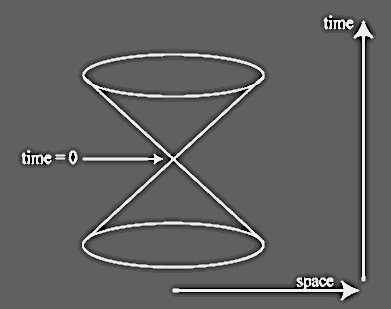
Special Relativity demonstrates that space and time are not separate but are intertwined, and space and time bleed into one another depending upon relative motion—indeed, within the event horizon of a black hole, it appears that space and time are flipped ninety degrees (as though along an axis at 45 degrees to those of space and time) so to speak, so that space becomes time, which is part of why you can never get out of the black hole—you cannot reverse time, but must move forward to its end at the singularity, if such a thing exists, which is probably not the case.

So, why does time work differently than space?  After all, If I live on a street parallel to yours, I can cross to your street by any of a number of cross-streets, cut through back yards, follow alleyways, etc., in more or less any direction, and I can return in a similar fashion.

Imagine, though, if it worked the following way.  I start at my address—let’s imagine it’s number 13*** for the moment—and want to go to your street.  But I can only go by routes that are at higher address numbers than my address.  And then, when I want to return to my street I have to go down (or would that be up?) the numbers on your street, to take a cross-street (or whatever) that’s even farther from my house.

So, say I crossed to your street right after number 17, where a cross-street exists.  And say the numbers on your street line up with those on my street, just for simplicity’s sake****.  Luckily, your house is at number 19 on your street, so I can reach it.  I could never go back to number 17 on your street, let alone number 13.

But when I want to leave your place, I can only head toward higher numbers, so I can’t go back to the cross street near 17.  I have to go down to, say, the street past number 23.  But even once I get to my street, I can’t go back to my house!  I must head in the direction of higher numbers.

I can only get back to my house if my street goes all the way around the world and comes back to my house from the other direction, and I suspect that it doesn’t do that.  I’m stuck farther down my own street, homeless now, because I cannot reach my address.  And it’s not as though you can take me in, because I cannot go back to your address, either, and if you leave your house to meet me, you will be in the same predicament in which I languish.

That’s sort of how time seems to work.  Unlike the three spatial dimensions, we cannot simply choose our direction, change our mind and our course, go back to where we came from or even just go around and around the block (which may or may not be a stupid thing to do—see yesterday’s post).  Why is time different?  The laws of physics appear to be locally time symmetric as they are space symmetric.  In other words, they work the same backwards and forwards.  But macroscopically, time is directional.

I’ve speculated a bit on this over at Iterations of Zero.  I’ll try to link to the pertinent blog post(s).  Some of that speculation compares the directionality of time that we all experience to the directionality of space that exists here on the surface of the Earth.

Wait, you say, what do you mean “the directionality of space”?  (You do love to interrupt, it seems.)  Well, think about it.  When you’re on the Earth, the directions forward/backward and left/right (or any other non-parallel axes you might choose along the surface, such as north/south and east/west) are freely navigable.  You can go in any direction or combination of directions along them, barring local obstacles.  But the same cannot be said for up/down.  It’s much harder to go up than to go left or forward.  And if you lose support beneath your feet, you will be unable to avoid going down.

Perhaps, as has been speculated by others with greater expertise than mine, the “Big Bang” provides or entails a local state that creates a local directionality to time, but far enough away from that “event”, time will become just as non-directional as any spatial dimension.

This is the way it works with the dimensions of 3D space:  when you’re far enough away from a local “event”, such as the surface of the Earth, the dimensions are all freely navigable.  But there’s not too much to do there, and it seems that life and complexity are likely to emerge only where these local gradients—whether in space or in time or both—exist, doing their part to provide the “free energy” which is required by things like life.

Anyway, that’s my random set of thoughts for this Thursday.  I hope you have a good day.  As for me, I continue to follow the local directionality of my metaphorical space; in other words, I continue to trend downward.  I do not perceive any other available direction for me.

TTFN


*Or I think I do.  I have terrible hearing and persistent tinnitus, so I might have been hearing the sound of rain on the roof or of wind in the trees or of otherworldly, eldritch creatures scratching at the fabric of reality, trying to break through the barriers between their realms and ours.  Probably not, though.

**You’re a bit rude, don’t you think?

***It’s not, unfortunately.

****Simplicity is one high-maintenance person.

“Stupid is as stupid does, Mrs. Blue.”

Well, here I am again after all, writing another stupid blog post on another stupid day in a stupid life on a stupid planet.

Now, with respect to that last entry on my brief list, one might say, “Hang on.  Of all the planets we know, Earth is the only one with clear life, let alone intelligence.  Doesn’t that make it an exceptionally smart planet?”

I would agree that, yes, it is an exceptionally smart planet (so to speak).  But that’s not saying very much.  All the other planets in our solar system appear to be lifeless, so they are really neither smart nor stupid.  They are merely lumps.

You can’t (or shouldn’t) call a rock stupid nor should you expect it to be smart.  The concept of “smart” doesn’t apply.  It’s a bit like my term “unsane”, which does not mean the same thing as “insane” as I use it.  “Unsane” means that the concept of sanity (or its lack) does not even apply (it’s a good term to use in a cosmic horror setting).

To be stupid‒in the sense in which I am using it here, anyway‒one must have the capacity to be smart.  It’s an important distinction, I thinktion.  I recall hearing a guest* on Sam Harris’s podcast discussing the notions of smart versus stupid.  Basically, smart could be thought of (in this guest’s view) as doing something in a way that was faster or more efficient than randomness would provide.

I think this person used as an example the process of getting from one’s house to the nearest airport.  The nonintelligent way to go would be, for instance, just to make randomly chosen turns at each intersection.  Using that strategy, one would get to the airport eventually, though the time it takes would scale (I think) proportionally to the square root of the distance…or maybe it was the square or the log, I don’t remember off the top of my head how such drunken walks scale with distance.  I think it must be more like the square than the root.  If I had the energy, I would look that up for clarity, but I’m not up to it right now.

Anyway, the point is, random turns on finite roads will get you to the airport eventually**.  Whether or not life would still exist on Earth by the time you arrived is uncertain, but you would get there.

Any route that took you less time than the “average” random route could be considered relatively intelligent.  The most intelligent route(s) would be the one(s) that got you to the airport in the least amount of time (or by the shortest distance, depending on your preference, though the two often coincide).

On the other hand, going around and around the block on which you live would never get you to the airport.  That would be stupid.  As you can see, it’s worse than just being nonintelligent.

Actually, of course, it would still be stupid if someone chose to do the random walk method to get to the airport when maps, etc., are available (unless one were doing it as an experiment, though in that case one’s goal would not be to get to the airport as efficiently as possible).

My point is probably well hammered into the ground by now:  to be stupid (at least as I am using the word) one must have the capacity to be smart.

For instance, I am supposedly quite smart.  In principle, there are probably few strictly intellectual disciplines which I could not “master” if I had the will (and resources) to do so.  There are some things that require particular bodily or other configurations or capacities that make me incapable of doing them more or less at all‒I could not be a professional basketball player or an Olympic gymnast, for instance.  But when it comes to “mindy” things, things for which a skill can be learned, my attitude has always been more or less that if someone can do it, then I could do it given enough time and effort.  I’ve not encountered anything so far that’s disabused me of that judgment.

And yet, despite that, look at the state in which my life wallows (I do not refer to the state of Florida, though that’s evidence supporting my point).

If I were able actually to constrain and focus my mind on one (or a few at most) subject(s) and just work on that (them), I think I could honestly make a real, significant contribution.  Perhaps it would not be anything revolutionary or monumental, but it would be a difference.

Unfortunately, I cannot seem to remain focused on specific things just on my own.  This is part of why I have done best in preprogrammed curricula.  Medical school, for instance, was fairly easy (in terms of mental difficulty, not in terms of the amount of work).  But depression and insomnia and anxiety and what I now recognize as the effects of ASD, and possible other forms of “neurodivergence”, make it difficult for me to learn things straightforwardly‒to drive as quickly to the airport as possible, figuratively speaking.

So, what point was I trying to make, again?  Oh, yeah.  To be stupid, one has to have the capacity to be intelligent, at least in the sense in which I am using the word “stupid”.  Maybe it would be better to use variations of the word “idiot” such as idiocy, being idiotic, that sort of thing.  Even the Doctor openly admits to being an idiot, despite being arguably the smartest person in the Doctor Who universe.

I guess that could make me feel better about myself, in principle, since if even the Doctor is an idiot, it’s not too shameful if I am.  But Doctor Who is not reality, nor is any other work of fiction (unless one is invoking the broadest, most unfiltered concept of the multiverse***).  In the real world, my stupidity makes me in many ways far stupider than any annelid worm, for instance, because I ought to be smarter than I am, I ought to be more secure than I am, I ought to be more at ease than I am.

I certainly ought to be more successful than I am now and have been for a long time.  My living quarters and conditions and whole lifestyle now are significantly less posh and luxurious than conditions were in college (and that’s not even counting the fact that I was getting an education then).  Even prison seemed‒in some ways, at least‒healthier and more conducive to well-being than how I live now.  And I don’t see any sign, nor recognize any clear way, that I’m going to do anything but continue to go downhill from here.

And, alas, I fear that the hill I’m descending has no lowest level.  It just keeps on going down, down, without even a “rock lobster” to break up the wretched descent.

Enough.  I hope you have a good day.


*I checked; it was David Krakauer, in the Making Sense podcast number 40, unless I’m quite mistaken.

**Assuming unlimited fuel and an airport (and set of roads and a vehicle) that last long enough.

***See Brian Greene’s The Hidden Reality, and possibly Max Tegmark’s Our Mathematical Universe.

Dysphoria, dat phoria, de udder phoria, to Hell with it, none of it matters

Well, we’ve reached the just-shy-of-two-thirds point in the month of January, and we’re exactly nine months out from the most important day of the year (Ha ha).  How exciting.

It’s still chilly here in south Florida; at least, it’s chilly for south Florida.  I don’t think we’re in any immediate danger of having snow in Miami‒we’re more than twenty degrees Fahrenheit* too warm for that‒but it’s cold if you’ve lived in the subtropical cesspool climate for more than a quarter of a century.

That’s way too long to be in Florida.  Florida is a nice place to visit, but given the overall quality of humans that tend to have influence here‒and we all know one extremely prominent one‒you wouldn’t want to live here.  Or, as a popular local saying goes, “Florida:  come on vacation, leave on probation.”  Even my grandparents on my mother’s side, who had lived in Florida for some years, moved back north for their final years.

I’m not sure what to “talk” about today.  Or, to be my usual unnecessarily strict self regarding such things, I am not sure about what to “talk” today.

Here’s a mildly amusing point:  when I try to construct that last sentence’s last phrase without ending it (not counting the word “today”) in a preposition, or a dangling participle, or whatever the proper term is, the stupid Google Docs word processor tries to suggest that I’m incorrect and recommends the less grammatically correct but more popular way to put things, such as what I wrote in the preceding sentence.  It’s pathetic and disgusting.  Google should be ashamed of themselves, every last one of them, to the point where they commit mass seppuku.

It’s almost as if someone said they wanted to listen to some lovely orchestral music, perhaps something by Rachmaninoff, and the respondent‒perhaps some artificial “intelligence” program‒played “Baby Shark”.

Anyway, so much of nearly everything is so very frustrating in this life.  Nothing is rewarding.  Well, nearly nothing is rewarding, and the few rewarding things are not just few but also very far between.

I see no future for me.  I cannot visualize actually having a remaining life that’s any better than that of a homeless drug addict.

Everything is maddening.  Or maybe it’s just that I am maddened by everything.  It hardly matters which is the more accurate way to put things, since the experience for me is the same:  unhappiness, loneliness, frustration, insomnia, chronic pain, constant tinnitus in both ears, professional and personal disgrace, and who knows how many other things I could list if I had the energy for it.

I don’t think I can do this much more, perhaps not any more.  I’m so frustrated and miserable and stuck.  Supposedly, someone with my level of ASD‒level 2** officially‒needs moderate support, not just “some” support.  I don’t have any.  I am on my own.

That’s not to say I don’t have people who care about me, but they are far away and have their own shit with which to deal.  They certainly don’t need to waste their energy on the added piece of shit that I am.

I don’t know how often I have felt that I really ought to kill myself, that it’s probably the most sensible course of action for me‒socially, biologically, ethically, what have you‒but I have not done so yet.  Each occurrence of such contemplation must carry some certain percentage of risk****, like a more metaphorical version of Russian Roulette (though I literally tried that once).  Eventually, probability suggests that my actual killing of myself would approach a mathematical certainty.

It will never quite reach certainty, of course, even if (when?) I finally kill myself, at least not as a matter of retroactive probability.  Just because someone won the lottery last week doesn’t mean we can retroactively say that their odds of winning were 100%.  One could say such a thing from a certain point of view‒the past being unchangeable and so fixed and deterministic‒but it’s not a useful way to think about probability.

Anyway, enough of this shit for now.  I don’t know if I’ll write a post tomorrow; I mean, it’s always uncertain, but it feels less likely than usual.  If I do, I guess it’ll show up here.


*Let’s see, in centigrade (or Celsius) that’s five ninths as many degrees as in Fahrenheit, so 20 times five is 100, divided by 9 is 11 and one ninth, or 11.1111111…

**Level 2:  Perfume, lingerie, women’s clothing, and jewelry***.  Everybody out of the elevator.

***That stuff would probably actually all be on level 1.  They usually keep things of interest mainly to women on the first floor of department stores, since statistically, those are the things that bring in the most business.

****If you want to call “risk” something that would end my constant dysphoria and also free other people from having to think about me in any other than a sad little, throwaway, “Aw, what a shame” kind of way.

Minding primes and priming minds

It’s Monday the 19th of January (in 2026 CA or AD).  19 is a nice prime number, but it’s one people don’t think about very often.  Stephen King turned it into an “evil” number in his extended universe, which is much less obvious and predictable than using the unjustly maligned number 13.  I’ve always* liked that he did that.  It was clearly chosen at least partly because it was (and remains, and always will be) a prime number.  But it’s not an obvious one.  So, nice job King-sensei (not that he needs my moral support, though I would welcome such support from him).

I occasionally think about mailing Stephen King a copy of one of my books just on the off chance that he might read it some day when he’s bored.  If I were to develop the chutzpah to do such a thing, what do those of you who have read my stories think would be the best one to send him?

Take your time, and don’t be shy.  I’d love to hear from all…what, one of you?  Two?

I don’t think there could be three, but I could be wrong.

Returning to the topic of prime numbers, I had a cool thing happen on Friday:  I bought some stuff at the local convenience store, and my total was $19.07.  I looked at it for a moment and thought that it was a cool-seeming number.  I know 19 and 7 are both prime, and the digits don’t add up to a multiple of 3, nor is the total number a multiple of 4 or 5, obviously.  I wondered if it might be prime.

Back in the day, I would have had to check that more or less manually, but nowadays, I was able just to type into the search bar “Is 1907 prime?”

It is!  Or so claims Google.  If necessary, I could check it myself, by hand, though that would be laborious.  I suppose it wouldn’t be hard to write a quick computer program to check all the possible factors (among numbers less than 954**).  I doubt that I will do either thing, though.  I’m pretty confident in Google on this point.

And now, having said that, I’m starting to feel uncertain.  Could Google be wrong about this?  Am I really going to have to check for myself?

I remember when I realized I had never seen the Pythagorean Theorem proven mathematically (I grew up in a declining school system, sorry).  So, I had to prove it to myself to my own satisfaction, which I did.  Thankfully, it’s easier to prove something like that when the answer (so to speak) is well known.

Okay, enough numeracy, or whatever the best term for the preceding matters might be.

I did not work on Saturday, which is why I didn’t write a blog post on Saturday.  The office was open, but my coworker was able to come in, and the boss specifically told me to take the day off.  Apparently, my exhaustion really was beginning to show, even to other people, which seems not to be the usual case.

Of course, having one day of actual rest doesn’t cure my situation, but it is a minor respite.  I have more fundamental issues than mere rest or lack thereof, but I am not sure there is any way to fix them, at least not in practice.

In principle, of course, it must be possible at least to improve the settings in my brain‒tweak this set of synapses and adjust sensitivity to this or that neurotransmitter, increase (or decrease) the blood flow to this and that region of the brain, etc.  That sort of thing, done precisely and judiciously, could in principle correct or adjust any parameter of brain function one might want, in whatever ways lie within the realm of the brain’s potential.

We’re a long way from being able to carry out such manipulations, and it’s by no means certain that we will exist long enough for neuroscience to achieve such things.  But there’s no principle of nature that precludes it.

Of course, people might be quite leery of even researching such things, even when we finally know enough to do so.  After all, if we can adjust the brain specifically and precisely to make it less depressed or less anxious or less forgetful, we can adjust it in other ways, too.  One could adjust someone’s brain to make them fall in love with a particular other person, like the mythical old magic love potion.  I think most people would rather not fall in love that way (though there’s no reason to think such love would be any less delightful to experience than ordinary, clumsy, stochastic love such as what we have now).

Indeed, one could adjust human minds to make them happy, no matter what the circumstances.  Of course, this could well be used to dominate whole populations of people; one could keep them under constant control because they would be happy, and you could keep them motivated and loyal and satisfied with whatever their lot might be.  I think most people would find that notion repugnant, but it is at least somewhat morally ambiguous, because such people would be as legitimately happy as anyone who becomes happy “on their own”.  Indeed, they might well be happier than any person had ever been before, and more “well-adjusted”, and more creative, and more psychologically healthy.

I get near some of these concerns in my book(s) Unanimity:  Book 1 and Unanimity:  Book 2.  I wouldn’t say those specific ideas figure centrally, though matters of mind and free will and the nature of a person’s character and how it can be changed by physical events are a big part of it.  Also, all sorts of horrible things happen, since it is a horror novel.  And there’s a lot of room for all of it, since it’s as long (total) as the unabridged The Stand and It, to bring us back to Stephen King.

With that, I guess I’ll draw today’s post to a close.  Hopefully, I won’t already be exhausted by tomorrow.  I hope you have a good day.  And if any of you know Stephen King, please ask him which of my books he might think he would want to read.  I’d really appreciate it.


*Well, not always.  I didn’t like it before it happened or before I knew about it.

**Incidentally, 953, which is the rounded-down answer to 1907 divided by 2, is also a prime number.  That’s kind of nice.

What do we call a day on which we bread and cook things in hot oil?

It’s Friday.  It’s also pretty cold here in south Florida; it’s about 44 Fahrenheit right now.  We are now just over halfway through the month of January in 2026.  Yesterday we were just under halfway through.

Actually, no, that’s not really correct.  Since January has 31 days, the 16th (today) should be considered the median day.  There were fifteen days before this, and there are 15 days after, and there is this one day in the middle that stands alone.  So, maybe I can reasonably say that we are now rather precisely halfway through January, or at least we will be at noon.

Enough of all the date and number nonsense.  I’m probably the only one here who enjoys or even notices such things.

With respect to anything else, “enjoyment” is an even bigger question.  I did spend a bit of time yesterday watching some of the rather nutty inventors/amateur engineers on YouTube making and testing various odd devices, including some particularly nifty ones, such as various kinds of homemade flame throwers.  I’ve made homemade flame throwers myself, with varying degrees of success, so it’s nice to learn from the successes and failures of these other people.

It’s briefly amusing, but that’s about it.

I didn’t do any more problems on Brilliant dot org yesterday.  I’ll try to do some today.  But so many things distract me and get in the way, and work is not the only issue.

Mainly, I think the issue is that I am mentally exhausted.  Work contributes to that, of course, but not as much as my chronic insomnia, which is no better than ever.  And, of course, there is the dysthymia, which I think is officially designated now as “chronic depression”.  I guess that’s a more straightforward term, and I cannot deny that it is fairly clear, but I like (the word) dysthymia better.  The “dys” part carries the very sharp, ancient-world imprimatur of things going wrong, of shit not working properly, as in dysfunction, dystopia, and so on.

Believe me, there is shit that is not working properly here in this head.

Speaking of working and not working, the office will be open tomorrow, I hear, but I don’t yet know if I’m going to work or not.  That will probably depend on what my coworker(s) are doing.  I guess if I am working I will write a post in the morning.  I don’t think it will be a happy one.

I tell you, that high-rise, fancy balcony room (with king sized bed) in the fancy hotel in downtown [name redacted] near me is looking more and more enticing.  The daily rate is not very expensive, even on the weekend‒especially if you’re not going to have any expenses at all afterwards.  I guess I’ll keep that option in mind and keep checking the rates online for the nonce.

I don’t know why the nonce wants me to keep doing that, but so it seems to desire.  I do a lot of somewhat irrational things for that annoying nonce.

Okay, that’s enough of driving that particular joke into the ground.

I am still having trouble calming my mind without making myself more depressed.  Still, I have to admit, depression (in general) is somewhat preferable to extreme tension and (mainly social) anxiety, especially because, in me, anxiety presents as hostility, sometimes global and even cosmic levels of hostility.  Chronic pain doesn’t help that particular set point, of course.

I’m reminded of two different movie quotes, the first regarding fear and its consequences, from The Phantom Menace, spoken by (the criminally overrated) Yoda:  “Fear leads to anger, anger leads to hate, hate leads to suffering.”  I always want to reply to that with, “Yeah…it leads to the suffering of the people who pissed me off.”  But that’s not very constructive.

The other quote comes from the (criminally underrated) movie Dragonslayer, when the old wizard, Ulrich, describes Vermithrax (the dragon) with the words, “When a dragon gets this old it knows nothing but pain, constant pain.  It grows decrepit.  Crippled.  Pitiful.  Spiteful.”

I feel you there, Vermithrax.

Incidentally, I’m not sure I understand the reason for the periodic eating of individual young virgin girls; that doesn’t seem to be nearly enough calories to sustain a giant, flying reptile that breathes fire.  I guess magic must be involved somehow.  And if the energy required for survival comes from some magical field, maybe food is only needed to provide raw materials but not to fuel metabolic activity.

I’m probably overthinking this.

I could use some magic now and then, I can’t deny it.  I don’t mean “magic” such as stage magic, though when I was little I got kind of into that stuff for a while, and I had several different books on how to perform magic tricks.  I mean “real” magic, like Harry Potter or Doctor Strange or what have you.  Of course, if such things existed in reality, they wouldn’t be “magic” except perhaps for nostalgic reasons.  They would be science.

I have long been irritated by the fact that there is no real “science of magic” in the Harry Potter universe.  They have all these classes about doing magic and so on, but as far as I can tell, even someone like Dumbledore (or Hermione) doesn’t get into the fundamentals of magic, the physics of magic, if you will.

But there has to be such a thing, of course.  Clearly the magic there has laws, it’s not just a “make a wish” kind of magic.  There must be a dynamics and kinematics and so on of magic.  But even the things they supposedly investigate in the Department of Mysteries don’t seem to have anything to do with fundamental magical laws.

Again, I’m probably overthinking things.

It’s a problem a lot of the time, and it often gets in my way.  I refer you to my point above that depression is probably better than the anxiety, tension, and hostility that seem to be my other option(s).  Maybe I should just lean into my depression, stop trying to be upbeat in any way, stop cracking jokes or even watching or reading comedy, stop trying to talk myself out of certain feelings, CBT-style, but rather just embrace and embody all my nihilism and pessimism and self (and other) loathing.

I don’t know if I can do it.  Still, it might be worth a try.  It’s hard to see it making things much worse.

What’s Hecuba to him, or he to Hecuba, that he should blog for her?

Hello and good morning.  By no one’s demand, it’s time for another Thursday blog post.  On the other hand, it’s also not as though anyone has demanded that I not write a blog post.  This combination of facts suggests more or less complete, tacit indifference to my posting.

That’s okay, I guess.  And it’s not as though I could just arbitrarily change things on a whim even if it were not okay.  I suppose it might be doable for me to become unpopular, and to have people at least suggesting that I should stop.  I’d just have to start writing truly deplorable things.  Of course, it would be a challenge to be so deplorable as to engender bipartisan hatred.

It sounds somewhat intriguing, I must be honest, but it also sounds like a lot of work.  And I am just increasingly exhausted all the time, mentally.  I’ve used the following analogy before, and I don’t want to run it into the ground, but I feel very much as Gandalf described the Nazgul or any mortal who keeps a great ring of power:  they do not die, but neither do they grow or obtain new life; they merely continue, until at last every breath is a weariness.  Or, as Bilbo described what he was experiencing:  he felt thin and stretched out, like butter that’s been scraped over too much bread.  And as Bilbo concluded about himself, I need a change.

Alas, I have no friends among the high elves, so I can expect no welcome in Rivendell, nor am I friends with dwarves, so Erebor is not available to me.  I don’t seem to be good at maintaining connections with any people who are not nearby (whether they are real or not).  I didn’t quite realize this while I was growing up, because I was the youngest of three kids, and I lived in the same house and so stayed in the same school system until I was 18 (or very nearly).  The people around me were relatively constant for a long time.

As it is, though, I have a difficult time imagining what other people are doing‒even people I know very well‒when they’re not with me, or even that they’re doing anything at all, let alone what they might be thinking.  I think fiction at least helped train me to imagine other people’s thoughts in many ways, and I think that’s invaluable; I think reading* fiction should be encouraged in all autistic children if possible.

But it requires effort to imagine what someone might be thinking or even that they’re thinking or doing anything at all when they’re not with me.  This doesn’t mean I don’t care about them, or about other people; that’s orthogonal to the question.  The people who are important to me are very important.  But I can’t feel them from a distance, so to speak.

This, unfortunately, is why it’s not much use if someone says that there are people out there who care about you, to whom you matter, or words to that effect.  It’s certainly well-intentioned, and it is no doubt sincere.  But however true it is, the emotional valence is low.  I cannot feel that those people, whoever they may be, care about me unless I’m interacting with them, though I may know it to a high degree of intellectual credence.

Maybe this is part of why I find it difficult to believe in ghosts, or any kind of afterlife, or any of the many invisible cosmic imaginary friends that people call gods.  Not that I think that I’m missing out in this case; intellectually as well as emotionally, empathically, I have found no reason to believe in any such things (though I have enjoyed writing fiction about them).

Indeed, the more I look, the less likely they seem.  But I do not give them zero credence, though it may come vanishingly close to zero over time.  But to give something an actual credence of zero, in Bayesian terms at least, means to say that there is no evidence or reasoning that could make you consider the proposition even possibly true.  That sounds terribly irrational to me, I don’t know about you.  It sounds like dogmatism, like blind belief, and I have no desire for such things.  I have very little tolerance for them.

What was I writing about?  Oh, yeah, that feeling of separateness and loneliness, of being almost cosmically, solipsistically alone, even though there are people out there (mostly far away) who care.

I have probably used this analogy before, but it’s a bit like being adrift in a small open boat on the ocean, and you have a radio that can only send in Morse code, but you can receive audio messages that there are ships out there, and they care about you, they feel bad that you are floating out there alone in an open boat, they support you.  And you believe them.  And the moral support is nice as far as it goes, but it doesn’t rescue you from being adrift at sea, with only the resources in your little boat, and you don’t actually know how long those supplies are able to last.  But they are finite.

Oh, who knows?  And why should anyone care?  I don’t know.  I have a hard time making good arguments for caring about me.

TTFN


*Reading is, I think, far superior to taking in TV shows, videos, movies, etc., though those things can be great fun.  With written fiction, one can literally get inside the minds of the characters and be given insight into what and how they are thinking and feeling.  With TV and movies, those feelings can only be inferred at best, and only when the acting is tolerably clear and those emotions are definitive.  For people with difficulty judging other people’s faces at times, that can be less useful than reading.