
O heaven! that one might read the blog of fate, and see the revolution of the times.

Hello and good morning.  It’s Thursday again, and so it’s time for what is, “historically”, my weekly blog post, though in fact it’s merely another iteration of my now-nearly-daily blog post.

It’s getting harder at times to think of what to write about.  I’m more or less committed to doing this whole thing stream-of-consciousness style, since I’m hoping that—just maybe—it might act at least as a form of “talk therapy”, though there are fewer questions and less feedback than one receives from real, usual therapy sessions.  Still, maybe just expressing my thoughts in this fashion will help me to organize them in some way.  I’m certainly not writing fiction or playing music, so I don’t have anything to speak about with respect to those subjects now.

It’s the first Thursday in August 2022, now that I think about it.  That doesn’t seem particularly noteworthy; I can’t think of any major holidays in August, though I suppose I could be forgetting about something.  August is one of those comparatively dull months, though it is a month of “pure” summer, in the sense that, in the northern hemisphere, it’s all in summer, like July, not split up into two seasons like June and September.

It is a bit curious that we don’t start our years at the winter solstice.  People have known about the solstice, about it being the “shortest” day of the year, for who knows how many thousands of years, and many festivals worldwide have been associated with celebrating this renewal of the length of days, dominated in the west of the modern world by Christmas and then New Years.  I think it’s mildly weird that we don’t simply begin the next year on the solstice, or the day after it.  We do start it thereabouts, but why not right on that day?

Maybe the issue is that the solstice changes subtly over time, and occasionally happens closer to one day than another?  I don’t know quite enough about it to say for sure.  If anyone out there does know to what degree the solstices change, feel free to comment about it below—not on Facebook or Twitter, unless you don’t care about the comment being seen for a while, anyway.  I don’t interact much via Facebook anymore; it’s too stressful and depressing, though I miss knowing what many of the people I used to know are doing, seeing pictures of them and their families and whatnot.

Twitter is slightly less stressful, largely because I don’t feel personally involved in any of its stupider aspects and don’t tend to follow people who are.  Twitter, to me, is a good place for sharing links to articles and videos and for one-liners and “What’s your favorite of the ________ movies?” types of questions and answers.  Even with the “enhanced” 240 character limit, it’s simply not a venue for expressing or discussing any deep or complex thoughts.  No wonder “discussions” on the site almost inevitably devolve into monkey-style feces flinging (metaphorically).

Speaking of days and equinoxes*, I read recently that the rate of the Earth’s rotation has speeded up, and indeed, that we recently had the “shortest” day recorded—that’s not shortest in the sense that the winter solstice is the shortest “day” of the year, but that the actual period of the Earth’s rotation has decreased.  It’s not by a lot, of course—I think it was on the order of a microsecond or so, though I may be misremembering that order of magnitude.

It’s certainly not something a person would notice, but the international group that manages the Universal Time standards and sidereal versus solar days and the like needs to pay attention and note such changes.  And if they adjust years—adding leap seconds for instance—that all has to be coordinated with things like GPS satellites and so on, which already have to be managed with respect to General Relativity and Special Relativity; their function depends on highly precise time-keeping, and time is different farther up in “space” and at higher speeds.

As for why the Earth is speeding up, well, I haven’t read any speculation, but at first glance it seems odd.  One might expect that, over time, if anything, the Earth’s rotation might slow down, and I believe that has been the overall trend over billions of years, with tides and the like very, very slowly dissipating angular momentum.  For a rotating body to begin to rotate faster requires—by conservation of angular momentum—that its overall mass distribution gets closer to the center of rotation, like the proverbial spinning ice-skater pulling his or her arms in closer to his or her torso and thereby speeding up.

spinning skater

I wonder if, perhaps, there is some change in the distribution of the Earth’s mass in the form of water from glaciers, such as in Greenland**, and mountain glaciers in other places, decreasing the amount of mass that was higher up and away from the center of the planet and bringing that mass down into the sea, which by default is as close as things like water can get, since liquid water “seeks” the lowest level.  Of course, general erosion of mountains and even adjustments of the planet’s crust due to plate tectonics could have effects on rates of spin, but it seems to me that they would be too slow in their effects to be so noticeable—so to speak.

I’m sure we’ll be hearing more about this phenomenon, particularly if it continues.  It’s unlikely to make a difference in our day to day lives that could possibly be noticeable to people who aren’t measuring with the most precise instruments science and technology can produce, but the information is a curiosity, and it could be at least a marker of the effects of climate change.  Or perhaps not.  There may be another explanation.

Maybe by sheer chance the Earth got hit with meteorites that, for this one small bit of time, happened to, on average, deliver their kinetic energy in the direction of the Earth’s rotation.  It’s not something that’s likely to be a trend, but it could, in principle, happen briefly just by chance.  It seems highly unlikely to happen in such a way as to cause a measurable change in the rotation rate, but what do I know?

Anyway, that’s about enough meandering thoughts for today.  I hope you are all having reasonably good days—even if they are shorter, and you have a microsecond or so less to get your daily chores done.  Please use that diminishing time by spending it with those you love and who love you, if you can.  Take advantage of the moments you have by doing things that are affirming for your relationships and families and so on.  Entropy is always increasing—that’s the 2nd Law of Thermodynamics, and it is as inexorable as any law we can imagine.

We could find someday that there are exceptions to the speed of causality (aka the speed of light), but no one who knows anything about thermodynamics thinks anything is ever going to overthrow the 2nd Law, since it’s based in the fundamental nature of mathematics and probability.  The universe might start again in a Poincaré recurrence, but that’s not going to be for another 10120 billion years or so, so don’t hold your breath.  Or do, if it pleases you; we’re all going to be long gone before any recurrent universe happens, anyway, even if nothing like the “big rip” makes such recurrence impossible.

As I said, don’t waste time.  Love your loved ones and spend time with them if you can—and if they want you around.  Don’t take such things for granted.

TTFN
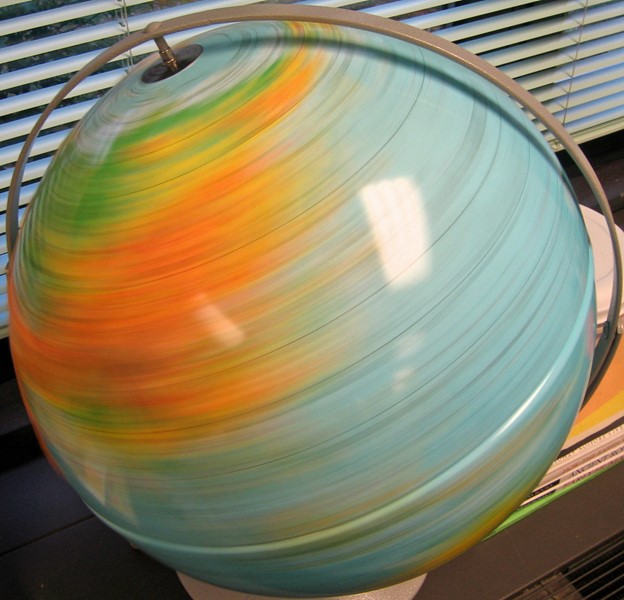
whirling globe


*I was, you can go check for yourself.

**I feel that the ones in Antarctica might be less impressive in effect only because they are so much closer to the axis of rotation already.

En route.  En passant.  En Comète, en Cupidon, en Tonnerre et la Foudre

It’s Wednesday morning, but it’s slightly after five o’clock as I write this, because I’m moving a bit slowly today, and if you find that this post is more disjointed or peculiar or bizarre even than is usual for me, that may, like my slowness, be because my sleep last night was even worse than usual.

I’m almost always plagued by early and frequent wakening, as I’ve described before, but last night I had trouble even getting to sleep before one thirty in the morning.  Then, of course, I woke up starting at about two-thirty and then three-thirty and so on.  So I’m feeling very frazzled and fuzzy and mentally fatigued, and that may come across in my writing.  I’m not sure, though.  Maybe there won’t be any difference that the unprimed reader would ever catch.  Though, since I’ve given you warning, you may be more likely to draw the conclusion that I seem tired than you would had I not let you know about my worse-than-usual sleep.

We’ll never know now, will we?

I think maybe my sleep is worse than usual partly because I’m now sleeping in the “new” room that I’ve moved to, and perforce, my sleeping position is on the opposite corner of the room relative to what it was in my prior room.  Also, the previous residents had cats in the room, and I’m allergic to cats (though I love them).

Anyway, the transition is irritating, partly because I didn’t have a great deal of choice in the matter.  In the first place, I only moved into the house I’m living in now, several years back, because I was asked to move there by my now-former housemate, because he was moving there at the end of work release, which I was ending also.  His friend, Barry, was the owner, but he (the housemate, not Barry) couldn’t afford to rent it on his own.  The location is really not terribly convenient to where I work, as you might be able to tell from the fact that I can write a daily blog post—and before that, quite a few long short stories and several novels, including one very long novel—during my commute.

Nevertheless, as I tend to do, I adapted myself to the situation as well as I could, and became used to the commute and my schedule.  Then, of course, my now-former housemate became my former housemate, with all of a week-ish’s notice before he moved out, and then I had new housemates who were terribly messy, so much so that I retreated even more completely than before into my little room.  I could hardly stand even to pass through the kitchen.  I’m not the neatest and tidiest of people in the world, but this was just intolerable.  There were fruit flies actually breeding in the food they left out on the counter.

Anyway, they moved out, and the landlord wanted to rent the rest of the house as one unit, and so “asked” me to move into the back room.  Most people would like this, I guess, because it is a bit bigger and there is an “en suite” bathroom, but the shower is tiny, and I’m going to have to go out of my area of the house to use the kitchen (including the refrigerator) and the laundry room, into the area that’s supposedly being rented “en bloc” to the other people.  I also am going to need to enter and exit at the back of the house, walking through sand and dirt to get there.

It’s far from a concentration camp or anything, but I wish I had just rented someplace a lot closer to work in the first place, or taken up my father’s offer to stay with him and my mother and sister after getting out of work release, to do my writing and spend time with them in their final years and so on.

I elected not to do that partly because my soon-to-be housemate was counting on me, but mainly because I hoped that by staying in/returning to Florida, I would be able to see and spend time with my own children.  That’s a bit of an unpleasant joke, looking back on it.  My kids didn’t want to see and spend time with me; my son doesn’t even want to interact with me*.  I could have forced visitation, but by the time I was done with work release, my children were both well into their teens, and more than capable of knowing and expressing what their preferences were.  I was hardly going to try to use the law—of which I had become less of a fan than previously in my life—to coerce them to disrupt their lives when they would only resent it.

I’ve never felt it acceptable to force my presence on others if I could help it; I dislike myself too much to think I’m doing anyone anything but a disservice by pressing myself upon people’s lives, even from a distance.  I had, in fact, just expected that my kids would want to see and spend time with me.  This, it turns out, was a foolish notion, which is not unusual for me.  I don’t understand people very well, it seems, including even my own children, whom I love more than anyone or anything else in the universe.

So, I missed out on the last few years of my parents’ lives, other than phone calls, and I’ve continued to miss out on my kids’ lives, including their entire teenage years and now into their early twenties (so far).  My brother and sister are in Michigan and Ohio, in that order, and they have their own lives and families.  And I’m still here in what I refer to as America’s syphilitic penis**, commuting a stupid distance daily to a job where at least I honestly like my boss and many of my coworkers.

I’ve made good use of my commute to write my books and short stories, at least; indeed, I’ve always said to myself that my reason to work is just to keep me alive, which I only want to do so that I can write my stories.  But now I’m not writing fiction anymore, and I suspect I never will again.  I’m also not doing any music.  The whole situation has been a rather dull farce perpetrated upon me mainly by myself due to my inability to grokk humans.

Partly because of that, I had been unable (and indeed, unaware of the need) to protect myself against a legal system that doesn’t really care that I never wanted or tried to do anything but take care of people who were suffering from chronic pain (like I was and am), because everything the system did was merely the politics of shit-throwing apes, not the workings of honest, reflective, intelligent life forms seeking something like actual justice.  I’m also apparently unable to be able to maintain personal relationships with other people—these beings who are becoming ever more inexplicable to me, or so it feels, as is the world itself.

To be clear, the physics and math and chemistry and biology of the world, and all that, are comprehensible.  All that stuff is straightforward.  And I suppose human behavior is no more inherently bizarre than the bobbing and bounding of bower birds and baboons.  But I don’t think I’d feel very at-ease living with bower birds or baboons for long, either.

I certainly can’t “feel” human behavior, even though I can see and understand it from an outsider’s perspective.  I used to be better at it, but then, I used to be either the youngest of a family of five, or a member of a group of friends and/or college roommates, or the member of a family of first two then eventually four.  So I’d had my built-in groups from whom I could learn, and to whom I could adapt, and on whom I could rely to accept and even embrace my weirdness—I’ve always known I was weird, but I thought that was “just one of those things”, and not necessarily a bad one—and love me for who I was.  I thought I could rely on such things, anyway.

All of this was, as I think I wrote earlier, farcical and foolish, and I’d laugh at my past self if it weren’t for the fact that it’s not even very good farce.  It’s all just rather pathetic, really—and, as with its farcicality***, it’s not even very good pathos.  It’s all just rather unpleasant and tedious, even to me.

I’m tired of it.

Or maybe I’m just tired.  Maybe if I could get a good night’s sleep from time to time everything would be easier—easier enough at least to make it tolerable.

I doubt that I’ll ever know whether that’s the case.


*I guess I can’t blame him.

**Florida.

***Is that really a word?  Microsoft Word seems to think it is.  Go figure.

Faces Look Ugly When You’re Alone

Well, it’s Tuesday, it’s morning, and as usual, I don’t have any idea what I’m going to write about today.  That didn’t stop me yesterday, of course, from writing quite a bit about various numbers and digits and physics and whatnot, and even choosing a nice paraphrase of a lyric from a song by the fictional band Spinal Tap as my title.  But I don’t think I’m going to have anything nearly as fun (to me) to write about today.

I suppose this is the sort of issue my therapists have had to deal with at various times in the past*:  is he just going to ramble on about some curious set of facts that popped into his head and struck his interest, and that he wants to share with someone else because he thinks it’s interesting, or is he going to be utterly—and sometimes contagiously—depressed?

Actually, for some people, even the first option might be depressing.

Of course, therapists get paid to deal with such things, so it’s hard to feel too sorry for them, though I always kind of did, even so.  I’ve usually felt bad for almost anyone who finds themselves forced to deal with me, even if they’re being paid to do so, and even if they are (like you) coming to read my words voluntarily.  I suppose it’s probably a kind of projection; I don’t like myself, nor do I like to deal with myself most of the time, so I assume other people find me as unpleasant as I find myself.  Of course, they at least get me in smaller chunks than those in which I get myself, which is basically a continuous stream**.

Still, I suppose being exposed to my written thoughts in chunks of 1300 words or so (I think that was about how long yesterday’s blog post was) isn’t so bad.  At least you don’t have to live with me.  Everyone who has ever had to live with me, from my parents to my spouse to my children, has ended up deciding that it was not worth the effort, and they didn’t want to do it anymore.  So they don’t.  To be fair, my parents have since died, after having reversed course and helped me out through some real difficulties, but they still didn’t have to live with me.

It’s weird, isn’t it?  There are people who don’t really want to be around you…but they don’t want you to kill yourself, either.  And all the various clichés about why you shouldn’t commit suicide talk about how it will hurt the people who love you and whatnot.  Okay, probably not all the clichés.  But a lot of them.

Weirdly enough, it has traction, that argument.  The anticipatory guilt actually gets in the way, that feeling of not wanting to cause sorrow for people who don’t even want to be around you, and who in fact are not around you, but who don’t want you to die, because then they would feel “sad”, which I guess is a euphemism for “guilty”.

The funny thing is, if you simply disappeared—not in any kind of dramatic sense, but simply in the sense of no longer being someone they heard from or about—they probably would never even notice that you were gone, except maybe, upon rare occasion, when something triggered the thought, “I wonder what ever happened to him?”  Then they would shrug and go on about their day.

It’s bizarre to feel bound to the world by ties to distant people whom you don’t want to hurt or inconvenience, and who would ask you not to die if given the chance, but who don’t seem to mind thereby condemning you to a life of daily suffering, all alone, without any apparent available cure or recourse, just because your death would cause them a passing pang.  It’s very strange.

It doesn’t exactly seem moral to me.  I mean, I know there are people who say that depression is a passing thing, that suicide is a long-term answer to a short-term problem, all those trite memes, but I’ve had dysthymia (aka chronic depression) since I was a teenager at least—so, for more than thirty years—and apparently, I’ve had “ASD” since I was born (or before, technically), and trust me, nature is NOT guaranteed to give you only problems that you can handle or solve.  Nature is allowed to destroy you—indeed, it will destroy you eventually—and it is allowed to do so swiftly or slowly, mercifully or with Lovecraftian cruelty.

Believe me, I’ve seen it.  You have, too, though you might not be willing to admit it to yourself.

It’s so very strange.  We don’t want other people to destroy themselves so they can at least escape thereby from a life dominated by suffering—from whatever source, of whatever nature—but we don’t want to go to the trouble actually to try to relieve such people’s suffering.  That would require a lot of work.  So we’ll manipulate and cajole and occasionally reach out and try to discourage someone who feels suicidal from going through with their escape plans.

Sometimes we’ll even lock them up by force (or, well, we’ll have someone else do that for us).  And we’ll thereby leave them suffering because, I’m sorry to inform you, we don’t have very good and reliable treatments for depression/dysthymia, particularly associated with “neurodivergent” circumstances***, or for many kinds of chronic pain, and so a life can be both solitary and dominated by discomfort (mental, emotional, and physical) for decades at a time without significant respite.  And while Cognitive Behavioral Therapy, with and without SSRIs and other antidepressants and whatnot, can improve things to some degree, none of them have been studied for very long-term outcomes very well—there’s no money for that—and there’s no treatment that works for everyone.

It gets old.  It’s a lot to handle on one’s own.

Anyway, I don’t know the point of all this, but really, if you’re trying to talk someone out of suicide or something like that, don’t tell them not to do it because it would hurt you unless you’re going to put your money where your mouth is, so to speak.  If you are able and willing, then yes, for God’s sake, do help!  PLEASE!  Don’t expect people who are mentally ill to be able to help themselves.  That’s absurd and frankly idiotic.  It’s like typing the words “Change your operating system from Android to iOS” into your smartphone’s search bar and expecting it to do so.  It’s like telling someone with a severed leg just to grow it back and expecting them to cast aside their crutches or prostheses, to rise, and to walk away on a new limb, as though the notion just hadn’t occurred to them until you suggested it.  It’s like telling someone just to choose to stop having lupus, or asthma, or cancer and expecting them to be all better.  It’s not something a person can just bootstrap themselves out of.  Such people are going to need initiative from other people if those other people really, actually want them to survive and (perhaps) thrive.

But if you’re not actually going to try to help, then maybe you shouldn’t try to guilt someone into not killing themselves.  Maybe you should just shut the fuck up.

Actually, maybe I should do that.  I’m not being very positive and I’m not getting anywhere.  I apologize.


*That’s “in the past” because I no longer go to therapy.  It’s too expensive, I don’t have the time or the wherewithal to get to a therapist, the BetterHelp online experiment I tried didn’t last long before my therapist had to take maternity leave, and I hate trying to start all over again with someone new; difficulty feeling comfortable with other people is one of my big problems.  Anyway, obviously it has all never had many long term benefits.

**One might imagine that it’s broken up by sleep, but weirdly enough, I never feel that I “get away” from myself in sleep, and I certainly don’t sleep very continuously.  I rarely sleep for more than an hour or so before waking up at least for a moment, looking around, realizing that I’ve only been sleeping for an hour or so, and that there was no reason to wake up.  Then I try to go back to sleep, succeed for a short while, and begin the cycle again until finally it’s late enough that I might as well just get up.  The last good, restful night of sleep I can remember happened in the mid-nineties, in White Plains, New York, at 205 Pondside Drive.  It was amazing!

***This is neither surprising nor anything for humans to feel too bad about.  The brain is the most complicated thing humans know in the universe, by a significant margin, and everyone is a very long way from understanding it fully.  Rocket science is easy.  Neuroscience is hard.

Talk about digits, my blog’s got ‘em.

It’s Monday again, and it’s also the first day of August in 2022.  This makes it interesting, in a sense, but I always need to remind myself that, no, Monday being the first of the month does not mean that we’re going to have a Friday the 13th.  It’s when Sunday is the first day of the month that we have a Friday the 13th.

That’s not really important, of course—I have no superstitious beliefs about 13 or Friday the 13th.  In fact, 13 is one of my favorite numbers, so I rather like a Friday the 13th.  This is partly because some people think it’s an unlucky day, and partly because of the bad reputation 13 has with the public among the primes, especially when compared to 7, which is not even as interesting a prime, in my opinion, as 13.  Though, when added together, 13 and 7 do make 20.

This is not a big deal, though.  According to Goldbach’s Conjecture, every even number greater than 2 can be made from the sum of 2 prime numbers.  As far as I know this still hasn’t been proven in a rigorous mathematical sense, but I also don’t think they’ve been able to find any exceptions, and since they have supercomputers and the like with which to work these problems, they’ve gone pretty darn high.

Similarly, they’ve solved π (pi) to about 62 trillion digits or whatnot.  Think about that incredible number of digits.  By comparison, a googol—which is a number larger by far* than the number of elementary particles in the accessible universe—is only 100 digits long.  The Planck length itself is 1.6 x 10⁻³⁵m.  So, it has 35 digits of significance, really, taking the most generous possible meaning of “significance”.  And that’s the fundamental, measurable minimum sensible distance quantum mechanics, in its current best form, says exists for reality**.

In other words, even if we had the greatest possible precision that is physically within the realm of reasonable speculation, we could not measure the radius and circumference of any instantiated circle precisely enough to come close to telling if it matched the current figured length of π.

Of course, no actual, physical circle is going to be a perfect, mathematical circle.  See above regarding the Planck length; that alone will screw up how perfect a circle can be.  Also, spacetime itself is not perfectly flat (although it can locally be extremely close to flat, and on the largest scales it appears to be flat).  Even the presence of the person doing the measuring would probably be enough of a spacetime distortion to make a circle’s ratio of circumference to diameter mismatch against π.

Don’t even start trying to compare the ratio of circumference to radius in a massive body like the Earth or the Sun.  Those ratios are measurably (in principle at least) below π because of spacetime distortion as described by General Relativity.  And, of course, a black hole’s radius, as measured from within, would be functionally infinite.  So, its local equivalent of π would go to zero.

But π is a mathematical constant, describing ratios of mathematical objects that are precisely defined in flat, Euclidian geometry, and as such, π is a real thing…indeed, a transcendental thing, you might say.  It is known to have an infinite number of non-repeating digits.  Which is not to say that there are no repeats at all, just that there is no repetitive pattern.  Obviously, in base ten we have only ten digits with which to work, so there are quite a lot of reuses of each digit—an infinite number of them, in fact.

In fact, I suspect—though I don’t know—that if you πcked any finite number of contiguous digits of π, you would eventually be able to find a recurrence of them somewhere down the line, though it might be far beyond what’s been calculated to date.  The reasoning, at least as I’m thinking about it, is similar to the reasoning that demonstrates that the “Level 1 Multiverse” is a real thing, if spacetime is infinite in spatial extent.  The best data we have now seem to indicate that either space really is infinite or at least it’s waaaaaaaaaaaaaaaaaaaaaaaaaaaay bigger than the 93 billion light-years-across visible universe.  This is part of that spacetime flatness I mentioned before.

To think about it from a more mundane point of view:  the Earth, locally, looks flat (ish), but if you start precisely measuring the angles of bigger and bigger triangles, you’ll find that they’re adding up to more and more above 180 degrees, showing—even if nothing else did show it***—that the Earth is not flat, and in fact has “positive” curvature in Riemannian geometry.  But if you kept on measuring the sums of the angles of bigger and bigger triangles and they all stayed at 180 degrees to the greatest precision you could possibly muster even at immense size, you’d come to the conclusion that, well, either the world on which you stand is flat, or if it’s a spheroid, it’s a really, really BIG spheroid.

The analogous measurements (in three spatial dimensions, obviously) have been done on the scale of the microwave background radiation, which is as far back (and thus as far away) as we can see with light (microwaves, specifically):  about 300,000 years after the Big Bang.  They are consistent with a flat spacetime.  So, as I said, the universe is either spatially infinite, or WAAAAY bigger than what we can see.

This infinity doesn’t really do us any good, of course.  We still couldn’t reach almost any of it, even if we were traveling at the speed of light, since the expansion of the universe appears to be accelerating, and thus distant regions are moving away from us faster than light.  But, since quantum mechanics appears to dictate that, within any closed region of space, there is a maximum number of possible configurations (defined, at its upper limit, by the event horizon of a black hole with that apparent volume, the number of possible states (or its entropy) of which is related to the surface area of the horizon expressed in Planck lengths squared…so, it is big, but it is finite), then if space is infinite, there will be regions of space “out there” that are precisely the same as any finite region you might choose to compare them to, from the size of a human to the size of the accessible universe.  Indeed, in a spatially infinite universe, there are an infinite number of them.

If it helps, you can think of decks of cards being shuffled.  There are 52! (read as “fifty-two factorial”****) ways for a deck of cards to be ordered if they are shuffled randomly…that’s about 8.06 x 1067 ways.  It’s a big number, and though it’s nowhere near the number of elementary particles in the visible universe, it’s so big that we can be mathematically all but certain that no two fairly shuffled decks of cards have ever in human history come out the same.

However, if we have an infinite number of decks being shuffled, not only will any given ordering be repeated, it will be repeated an infinite number of times, though there might be quite a large average distance between repeats.  So it will be with iterations of any person or planet or galaxy or locally causally connected “universe”.

Don’t worry about it too much.  Though in an infinite universe there are an infinite number of any given person (as well as every possible variation thereof), these doppelgängers will have no effect upon you, except perhaps to blow your mind, as your existence will blow theirs.

Well, I don’t want to keep going on forever (har!), so I’ll call it to a close now, by noting in passing that this month (August, see above) is named (as many know) for the first “official” Roman emperor, as July was named (also as many know) for the first “de facto” Roman emperor, and June was named (as very few know) for June Cleaver, the empress of late 1950’s to early 1960’s American television.


*How far?  About 10,000,000,000,000,000,000 or 100,000,000,000,000,000,000 times as big.

**That doesn’t mean there are no finer distances, necessarily—though it might—but unless quantum gravity or whatever changes things significantly, it sure seems to be a limit…a physical one, not a mathematical one.

***Other things do.  The Earth is round, and people have known this for thousands of years, contrary to popular belief.  2200 years ago, Eratosthenes figured out the Earth’s circumference by measuring shadow lengths at different latitudes and doing some basic trigonometry.  He got the right answer, too.

****Which is 52 x 51 x 50 x 49 x … x 3 x 2 x 1.  The 1 is a really superfluous, since anything times one is just the thing itself, but it’s there for completeness.

Is it really?

Okay.  Um…it’s Friday now, which tends to happen on the day that follows Thursday, and since yesterday was Thursday, I suppose it shouldn’t surprise anyone, let alone me, that today is Friday.

I suspect there are plenty of people for whom Friday is a good thing in and of itself.  Or, well, not really “in and of itself”, now that I think about it.  In and of itself, it’s just another day, with nothing to set it apart from the 1.6 trillion or more others since the Earth first coalesced and cooled and the similar number that will pass in the future, until the sun’s expanding surface envelopes Earth and reduces it to cinders and dust in the eventual ring nebula that our solar system will become.  But within our current social system, Friday is the end of the “work week” and the “school week”, and so for many people it is a harbinger of pleasant—albeit brief—times to come.

This will be my weekend off, meaning I won’t be working tomorrow (the office is never open on Sundays), so I don’t expect to be writing anything tomorrow.  I also don’t think I’m going to be making and uploading any videos, but that’s not unusual.  Eventually, I expect I’m going to do a bit of the latter for a while, though it probably won’t last for long.  If I do end up successfully following that plan, I will no doubt share/embed such videos here, for posterity and for the ease of my regular readers.

I’m sure that I’m not alone in feeling discouraged that there are so few regular readers out there in the world.  Has it been this way my whole life?  I feel that when I was younger there were more readers around, as a percentage, than there are now, but perhaps that’s a misperception on my part.  I lived in a family that embraced and celebrated reading; both of my parents read to me when I was young (as did my sister), and certainly my sister was (and is) at least as avid a reader as I am.  My brother is not as big a reader of fiction as I or our sister, but still, he read quite often when I was young.

I think my Dad didn’t read as much as he wanted to, because he worked a full time job, but his father was a big reader, and my Mom read quite a lot.  I remember she liked those Harlequin romance novels, but she also always loved mysteries.  And my family got three daily newspapers, at least for a while, and quite a few magazines.

Nowadays, even people who have good imaginations and who will want to tell stories and be creative in doing so are going to have a higher chance of being distracted by all the video media that abounds, and very few people will read, let alone write, long stories in the printed word.  Even things like Harry Potter became movies even before the whole series of books had come out, so though the books did bring many young people to the wonderful world of reading magical stories, I can’t help thinking that there’s someone out there who would have started reading the books and loved them, and maybe from there would have gone on to read more and other books, but didn’t because, thanks to the films, they didn’t need to do it.

Oh, well.  There is no gravity; the universe is just warped.

In front of me now, one the wall of the train, there is a (very nice) poster advertising* the National Suicide Prevention Hotline and related services.  It’s good that they promote it, and that they do it in such a way, trying to show a group of people from various walks of life, all of whom look glum, and above whom are symbols of things like heartbreak, confusion, pain, etc.  “Lonely?  Depressed?  Anxious?” it asks.  Then below, it tells us, “It’s OK to not be OK”. I have two minor and really pointless quibbles about this line, and I can’t help having them, despite the fact that it makes me hate myself even more than I already did.

The first quibble is with the split infinitive.  I don’t like split infinitives partly because, in many languages, it’s not even possible to split an infinitive**, and this includes the most broadly spoken language in the western hemisphere***, Spanish.  It’s not a terribly big deal, I guess, but I feel that in many ways writing “It’s OK not to be OK” would be at least as good, and in a certain emphatic, rhetorical sense, it might be better yet to write “It’s OK to be not OK”.  That last one makes “not OK” the state you’re in, as one phrase, and I think it really works for emphasis.

Never mind that.  The point that really got into my idiotic, dysfunctional nervous system was to note that, well…it had better be OK not to be OK, because it’s not like people get to choose.  If people could choose, no one would choose to be “not OK”.  Why would they?  It makes no sense.  Surely, if people could choose, everyone would choose to feel good and energetic and motivated and enthusiastic every day.

If people could choose, there would be no self-help books.  Who would say, “Hmm…today, I think I’ll dial myself toward the ‘depressed’ and ‘suicidal’ settings, just to change things up and keep from getting bored”?  If they could do that, why not just adjust the “boredom” dial downward and not be depressed and suicidal?

It’s a bit like saying “It’s OK not to be able to go the speed of light”.  Well, it had better be OK, because you don’t have any choice about it.  And though it’s more complex, you don’t have any simple choice in the previous matter, either.  It’s like I always want to say when I hear the Rush lyric, “I will choose free will”—No.  You won’t.  You either have free will or you don’t have free will, but you don’t have any choice in the matter.  It’s not up to you.

Of course, ultimately, I’m quite sure that the whole point of this most welcome poster on the wall is to say, in a concise and relatable way, that they know that people don’t have a simple choice about not feeling OK, and that people shouldn’t feel guilty or bad about the fact that they do.  It’s not a sign of weakness, or a fault, and even if it could be called such things, it’s not your fault in the sense of being a mistake or failure on your part.  It’s something that happened to you, not something you did.  And it’s OK to ask for help if you’re able to do that…though many of us are not…it’s one part of that thing that makes us not OK.

If you had designed and built the world and yourself, you might be personally to blame, but you didn’t and you aren’t.  Neither did any of the people around you.  So, try not to take at least that bit of blame and shame upon yourself, if you can help it.

Of course, when you’re depressed and suicidal, that’s a state of mind that can be hard to achieve.  Goodness knows I can’t seem to do it.


*Is that the correct term?  I guess it works.  I wish I had taken a picture of the poster; I tried to look for it online but have been unsuccessful…which doesn’t really help my self-esteem much.

**To do so in Spanish would be to split the word in a bizarre kind of tmesis.  “To not be” would roughly equate to “ha-no-cer”, but even that doesn’t quite capture the trouble.

***Based on number of countries, at least, in which it is the primary language.  I think one also cannot split infinitives in Portuguese, the primary language of Brazil.

Give sorrow words; the grief that does not speak knits up the o-er wrought blog and bids it break.

Hello.  Good morning.  It’s Thursday again, and so it’s time for my long-term, usual, weekly Thursday blog post, as contrasted with my newer string of nearly daily blog posts*.  Unfortunately (or fortunately), the reason for the daily blog posts has not changed—I haven’t yet again found any interest in writing fiction, whether on the two stories I have partly completed or on any other stories.  I don’t know if I’m ever going to write any more fiction again.

Similarly, and also unfortunately (or, again, perhaps fortunately), I haven’t had any desire to play (or write) music.  I haven’t even listened to much music, though that’s partly because of the change in my commute; I used to listen to a lot of music on my way to and from work.  But I think I may just give most of my musical stuff to my former housemate.

It seems fair, since he made two of the guitars, and he’s certainly a much better guitar player than I am.  I might give the one I keep at the office** to the son of one of my coworkers, who has ASD, and is probably a bit too young now, but who likes music, and on the few occasions he came into the office with her for a few minutes, he enjoyed strumming it.

I’m probably being silly and sentimental in thinking about doing that.  Probably if I gave him that guitar it would just sit around and gather dust, or it would end up getting sold—which is what I honestly almost hope will happen with the others if they go to my housemate.  He’s on disability (missing left leg below knee and other chronic injuries born from the same accident), so he can usually use a bit of extra money.

None of it is doing much good with me, at least.  Even the thought of picking up and playing, yes even sometimes simply looking at the instruments, makes me feel queasy and dysphoric.  That happened just now, for instance.  It’s a shame, I guess, since I used to find minor respite from such unpleasant feelings in music or writing, but that doesn’t seem to work any longer.

On the good news front, a New Balance walking shoe that has always been a good fit for me, but which had briefly become unavailable, has become available again, and I have a pair on the way.  It wasn’t even expensive, despite the name and the fact that some New Balance shoes have become as absurdly overpriced as Nikes and the like.  So now I’ll have a total of four pairs of decent shoes (with inserts) in which I can walk long distances with minimal trouble.  They’re also all lightweight, which means carrying them with me wouldn’t be an issue.

I haven’t even read any books this week, which is unusual.  Kindle isn’t going to know what to do with itself!  I don’t think I’ve read anything since Saturday, other than online stuff, of course—news and a few blogs I follow.  I did listen to a bit of the audio-book version of Pawn of Prophecy while walking the other day, but the guy reading it has a bit of a thickish accent, and though his reading is in general good and enjoyable, it feels confusing; it’s a book I’ve read many times, and therefore I tend to hear it in my own voice in my head, and my accent is quite different from the narrator’s.

I was also listening to the newer, Andy Serkis narrated Lord of the Rings a month or two ago, but though of course he does a wonderful job—being who he is—he’s quite dramatic, and so the progress of the story takes longer than it does in other audio versions, so I’m caught between loving his reading and yet wanting him to hurry it up a bit so we can get to the next good part.  Anyway, I have since been a bit derailed from that, but it is a good book to hear while walking.

It’s quite nice that, thanks to Kindle and Audible, I can carry a library of dozens of audio books and hundreds of print books in my pocket wherever I go.  I still love the feel and presence of a real, physical book, of course, but even I couldn’t imagine wheeling along a rolling library of nearly five hundred volumes.  And one can always, or nearly always***, buy a book one wants and take delivery of it almost instantly, without killing trees****, and yet the royalties go to the author just as much as if one bought a paper copy, and it even counts toward their sales figures, if that matters to them.

That’s pretty much it for today, I think.  I may shift out from doing near-daily posts to doing a couple or three times a week, but I don’t know, maybe I won’t.  Anyone who has any preferences or suggestions one way or another should please feel free to leave a comment below (NOT on Facebook or Twitter…not if you want me to see it any time soon).

Be good to each other and to yourselves.

TTFN

desperado oilified


*I almost wrote “podcasts” there, which is very peculiar, though I suppose they aren’t entirely dissimilar things.

**That’s the black Strat I played in my most recent videos.

***It used to be even easier until Google blocked the Kindle app from allowing in-app purchases.  I suppose this is justified as protecting people from themselves, especially from unscrupulous app writers, and it allows them to Google as if they are a morally upright company, but though I admire their products in general very much, and they do better than many big companies, they do not stand on any very impressive moral high ground.  Just ask Tristan Harris.

****Though, to be fair, the trees used for making paper are, I believe, from tree farms, and so more trees are planted as others are harvested.  And once paper is put in a book, it can remain there, on shelves or in hands or various other situations for decades and even—in principle—for centuries.  So, in a way, books may be a highly localized net carbon sink.  It’s something to think about.

He’s back…and this time, it’s personal (like all the other times)

It’s Wednesday morning (just shy of five o’clock this time), and I’ll begin this blog post by apologizing to anyone who has been reading my near-daily posts, and was expecting a blog post yesterday, and was worried about me when none arrived*.

I’m afraid that either something I ate Monday, or perhaps the side effects of a rather gooney bug bite or sting that I got on my left forearm and that had swelled quite a bit (or both things, perhaps) caused me to have both some tummy trouble and some general agitation and restlessness overnight on Monday, to the extent that I got—I don’t think I’m exaggerating—fewer than twenty minutes’ sleep, and so I was simply exhausted and washed out Tuesday, though thankfully most of the other symptoms had resolved themselves.

It’s a bit frustrating that I felt so bad Monday night, because during the day I did quite a nice job of being reasonably healthy.  After walking four and a half miles each on Saturday and Sunday, I walked a total of about eight and a third miles on Monday, with only some very minor blistering between the first two toes of my right foot as side-effects.  I think that’s not half bad.  I certainly was more than adequately re-hydrated by the end of the day, because I’d been fairly aggressive about that; it was around ninety degrees here for most of the day, and the humidity was at least that high a percentage, so I wanted to make sure not to sabotage myself.

For those of you who may be wondering about the possibility that my extensive walking had been responsible for what happened Monday night, I can only say that I have considered that possibility and think it unlikely.  The symptoms were not typical of those that I’ve had previously after overexerting myself; indeed, in those types of circumstances I tend to get tired and sleepy, not tense and jittery and belly-achey.

If anything, I felt particularly healthy once I arrived at the house and got hydrated.  It was distantly akin to the runner’s high I used to get when I was able to run a lot, though it was less impressive.  Whereas the way I felt on Monday night was…well, markedly unpleasant and different from any of those kinds of sensations.

Anyway, that’s passed, and now it’s just a matter of getting beyond the minor blistering, which really only happened because of the increased amount of walking I did, not because of any inherent shoe problems.  I think I’ve adjusted for all of those, and certainly I had no shoe/foot difficulties on Saturday or Sunday, which is worth a cheer from me.  In a sense, this is me cheering.  It’s about as enthusiastic as I get for anything, anymore.

I’ve also got a new backpack that I need to test out to make sure there’s no chafing-related or other adjustments needed (though, to be fair, that’s the sort of thing that can be done as one goes along).  It’s pretty neat, though I feel almost disloyal for getting it.

You see, I’ve had the same black Adidas backpack for several years now, using it every workday, and while it’s clearly not brand new—the shoulder straps show that they’ve been used, and are more supple than those of a brand new backpack would be—it’s in terrific shape.  The zippers are all perfectly functional, all its interior separations are intact and effective, it has decent water resistance (it’s not waterproof, of course, but it’s not meant to be), and its computer carrying section is in excellent shape.  I would recommend it to anyone who was looking for a daily use backpack that is going to see reasonably heavy employment.

Regrettably, it’s no longer available, but this is what it looks like.

my backpack

Unfortunately, though that backpack is quite roomy and excellent, I fear it doesn’t have enough room to carry all the things I’m planning to bring when I go on a long trek.  Those things will not be particularly heavy—I don’t want to make the burden too great and thereby create worse obstacles to my progress—but they may be rather bulky, so it would be good to have enough space to work with.

Of course, through all of this, whatever I end up doing, whether on this blog or through any high-risk undertaking I mean to take under, I hope to find either a new desire to live—which I don’t have now—or to die trying to find it.  I’m fully aware, though, that I might achieve the ironic outcome of learning to want to live again…and then dying right after that.  This would in some ways be a shame, but in some ways, it would also be fucking hilarious.

In any case, it would be better than my current daily internal experience, which is one of quiet** disintegration, disorientation***, anhedonia, isolation, neurodivergence (apparently, though I suppose that has always been there if it’s there), and above all, a profound and persistent and occasionally violent self-loathing.  It would be worth the irony of dying right after learning to love and desire life, just to have achieved that love and desire even for a moment.

Of course, I don’t honestly think that’s likely.  I will probably never again have any serious intellectual attachment to my life****, and I doubt that I will ever again feel any real joy in existing, but past performance is no guarantee of future results, as all those investment firms are forced, by law, to say, really quickly, right at the end of their ads.  I hope to find out if I’m wrong.


*Ha ha.  Don’t be silly, right?

**It must be quiet, because it doesn’t seem to disturb other people much.

***Why is that word not “disoriention”?  We don’t say “disintegratation”.

****The biological utility functions that drive one to fear death and pain are not easily shut down, unfortunately.  But they can be worked around with enough determination and effort.

The moon, a train station, a species of monkeys, and more

It’s Monday again, a day named for the moon (at least that’s what I’ve always been told), and as I looked up this morning, the moon was a tenuously thin crescent—what Dr. Becky might call a “thumbnail moon”.  Even when so effaced, it’s a lovely sight, especially when clouds move across one’s view, partially obscuring the moon and making it take fantastical configurations*.

Other than that, I don’t know what to write about today, really.  Currently, my footnote is longer than the main text of this post, though that won’t last.  I don’t particularly like writing about current events because, for the most part, I see them as the behaviors of baboons going through meta-level (and not so meta-level) primate dominance displays and hierarchical jockeying, throwing metaphorical (and not so metaphorical) feces at each other, and it’s just so pathetic that people actually think their lives and deeds are in any way sensible or rational.

I just now saw (case in point) a young man climb clumsily over the fence between the northbound and southbound train tracks—thus, crossing the tracks very far from an official, safe crossing—having to stop and go back while doing so because he dropped something in the coarse gravel as he went over.  Meanwhile, the elevator and overpass bridge were less than twenty yards away.

Either he’s too stupid to know what an elevator is** or he thought he was being a rebel, declaring himself not subservient to “the man”, impressing at least himself with his daring, if that’s the proper word.  Meanwhile he put himself at some non-zero risk of being hit by a train, two of which were arriving shortly (though admittedly, in the early morning you can see their headlights from quite a long way off).  This would almost certainly have killed him, even if the trains were slowing down, and worse still***, it would have stopped all the trains for quite some time, until police had thoroughly investigated everything.

In case anyone wonders why I tend to be misanthropic, and indeed, nearly pan-antipathic, occurrences like the above are quite influential.  I suppose that, at least to some extent, this trouble is in the eye of the beholder, but it cannot entirely be that, because surely no one can deny that there is an astonishing amount of idiocy in the world.  Innovations, advances, improvements are made by a tiny percentage of the human race, while if it were up to most people, the species would still be living in caves (in the few places where they ever did such a thing) or chasing game across various savannahs and scrounging for fruits and nuts and such.  In other words, if it were up to most humans, most humans would never have been born because none of their ancestors would have survived to reproduce.

I sometimes think it would be a good thing for more people to be rewarded for being voluntarily sterilized, at least until they were in some reasonable position to be able to raise a family.  Of course, that’s really what ordinary contraception allows, but those needs to be used on a daily, or per-occasion, or per month basis, or similar, and people are very good at dropping those balls (no pun intended, honestly).  Nature selects for people who like to have sex without thinking about it too very much, because they tend to have children somewhat more frequently than those without that proclivity.

Of course, such a system would be subject to abuses and bigotry which would make it problematic to enact.  And most religions wouldn’t go along with it, including our currently Catholic Supreme Court.  Those religions that continued and spread under the influence of their own version of natural selection were the ones that encouraged their adherents to “go forth, be fruitful, and multiply”, or some equivalent thereof.  The Catholic Church allows its priests to be celibate****, but it definitely wants the hoi polloi to keep dropping progeny as fast as they can.

That is a reasonably successful evolutionary strategy for a religion, at least in the middle term—on the scale of a couple of millennia, for instance.  Other religions have had and still have similar imperatives.  But of course, even if there were no other issues with the various religions, if their populations continued to grow indefinitely, there would of necessity be war between them (because ecumenicalism only applies when there is plenty of room or resources to go around, and/or when people don’t really believe their religions), possibly until they’d all killed each other completely and everyone else as well.

Yes, it’s possible for a strategy that’s very evolutionarily stable in the short or middle term to lead to extinction in the long term, and to take everything else with it.  If you don’t believe this, just think about cancer.  Every cancer is the product of the natural selection of mutated cells that have become, through various alterations, more aggressively reproductive than ordinary bodily cells.  And the individual cells among billions to trillions (before long) in a tumor that are further mutated to become yet more aggressive in their reproducing and spreading come to dominate ever more and more, iterating and accelerating the pattern as things go along.

That is, until they spread so successfully that they kill the body in which they originate.  Then everything dies, even those most successfully reproducing cells.  Thus, cancer can be a useful metaphor for a society, for a species, for a planet, as well as of course for organizations and other groups of people.  It’s possible, and even common and easy, to mutate into an unsustainable form that seems and feels like success while its happening.

An intelligent species might recognize and learn from this and be highly mindful, watchful of their own actions, and frequently reevaluate and even (gasp!) question themselves and their fellows, not out of malice but out of care for the future.  An intelligent species would strive to be self-aware and adjust its course and be on the lookout for ideas and organizations and practices that might become malignancies.  An intelligent species might well do all this and more.

The human race…not so much.


*Or to seem to take them.  The moon, of course, no more changes physical states due to clouds than it does due to the fact that it’s currently a crescent rather than a full moon.  Actually, the latter circumstance changes it more, because when the sun is shining on it directly, that part of the moon’s surface gets very hot, whereas when it’s in shadow the moon is very cold.  So, there is certainly some change brought about to the surface of the moon by the changing phases.  But not by the clouds.

**Which seems unlikely for someone in the Miami area.

***Not because his life is inherently worth less, necessarily, but since he is the one who chose to risk it, he’s apparently okay with the risk, and he certainly bears responsibility for it, whereas all the other people his actions could affect are, in this circumstance, innocent.  And there are many more of them.  There may even be lives lost in the aggregate along with significantly increased suffering caused by people being late for work—lost jobs, shifts at hospitals started late, consequent overwork of the previous shift and diminished attention, stress leading to poorer judgement during the day of various people, dogs and cats living together…you know the rest.

****Nominally so, at least.  Of course, the Catholic Church also made Darth Ratzinger into its previous Pope not so very long ago, even though he’d been part of covering up some portion of the vast child sexual abuse scandal that inundated the organization like measles.  It and they are fine moral exemplars for the world, don’t you think?

If I could walk THAT way, I wouldn’t need antidepressants!

It’s Saturday morning, the twenty-third of July in 2022, and as I write this I’m on my way to work.  Well…that’s so in a manner of speaking, anyway.  I don’t mean the date, though all dates are arbitrary, and therefore are always only “true” in a manner of speaking.  I mean that I’m on my way to work only in a manner of speaking, because as I write this, I’m actually sitting still (but for typing) on a bench in the train station.

So, I’m not currently moving any closer, spatially, to the office, which I sometimes am doing when I write, if I’m writing on the train*.  In spacetime, of course, I suppose one could say I am indeed on my way to work, since the current spacetime path along which the local pattern which is me is streaming is—unless there is some significant disruption of my plans—going to intersect with the pattern in spacetime that is the office in the not-too-distant future.

I spend more time waiting for the train on Saturdays than during the rest of the week, because the trains only come every hour on the weekend.  Nevertheless, I hate getting to the station at too different a time from my usual one; the departure from routine is stressful.  Plus, to be honest, I don’t tend to sleep very well into the morning, so I might as well head to the train station.

I do sometimes leave an hour later, since work technically begins an hour later on Saturdays, but this week I didn’t, because I plan to get off one station earlier and walk the remaining nearly five miles to work**.  I’ve been adjusting my shoes and inserts and various things, trying out quite a few different pairs and brands (none very expensive!) to see which ones are best for long-distance walking, because I hope to do some of that very soon, and I don’t want my shoes and their effects on my feet*** to stop me.  I’m making real progress, and I think I’ve gotten a couple or three pairs of shoes that do a decent job when I put the correct inserts in.  Bully for me!

Supposedly, this weekend, I’ll begin moving my things into the other bedroom into which I’m supposed to be moving, because (apparently) working six days a week and having to deal with disruptions when I get home from work just doesn’t generate enough chaos in my life and mind.  I’m not saying this is a particularly great imposition, as things go in the world.  I’ve certainly been through worse, and I’ve endured far greater specific, local stress and pain.

But when one has no reason of any kind to endure it—no close friends, no close family who wants even to see one, no pastimes that one enjoys, no remaining ability or will to do the things that used to give one purpose and pleasure—the urge just grows and grows to up and walk away…and to keep walking until it kills one****.

At least that urge is what grows in me.  I wouldn’t be surprised if no one else in the world ever got that particular urge.  But it’s an urge I’ve been having for some time now, and I’ve been working my way toward it steadily.  I’m pleased to say that I think I’m nearly there.  I even have a new backpack arriving tomorrow from Amazon to carry some essentials, including my laptop and the like.  It’s very cool!

In the meantime, I’ve been trying to think of how to arrange things so that other people’s work will be minimally disrupted by the change.  I’m not going to warn anyone explicitly very far in advance before I finally decide I’m ready to begin, because they might think it’s a crazy idea and try to talk me out of it.

Also, to be honest, I’ve been dropping a lot of people a lot of hints for quite a long time that I am approaching my wits’ end, and am at risk for taking drastic action, so if they are caught by surprise—and therefore inconvenienced—I don’t think I’ll feel too guilty about it.  Goodness knows other people don’t seem to worry much about inconveniencing me.  That’s not surprising.  They’re only human, and as history has shown us, that is often a terrible thing to be.


*Or, well, writing while I am on the train.  I don’t think I’ve ever, in my life, written anything physically on any type of train.  It’s barely possible that I’m forgetting some past brief episode of graffiti, but I really don’t think so.

**”Which I did” -future me.

***Blisters, Achilles tendon issues, anything like that.

****Or until one achieves some new state of wanting to live, I guess.  It’s been shown that exercise can be a good adjunct treatment for depression, but I’ve always found that to be interesting but laughable, because when one is badly depressed, one does not have the will to do serious, regular exercise.  However, I may have found a way around that obstacle, by creating a path that does one thing or the other on its own, and I can do the experiment and see what the outcome will be.

It’s the end of the (modern, neotraditional, work-) week as we know it, and I feel…

It’s Friday again.  I’m making that announcement right from the start, in case anyone is surprised by that fact, or wasn’t specifically aware, or—I suppose—is reading this on some day other than the day I post it (or some multiple of seven days after that).

There’s nothing much new that’s good going on in the world since yesterday.  Or, well, there’s nothing new that’s good going on in my life, nor among the events that I see and read about in the news or perceive from the other people with whom I interact.  I would guess that there really are probably quite a few good things, new and otherwise, in the world, by most any reasonable definition of the word “good” you might choose, as long as you’re not being contrary.  Unfortunately, for me anyway, few to none of those good things—new or otherwise—seem to have much to do with me.

For instance, I haven’t written any new fiction.  That may actually be a good thing in and of itself, though.  I don’t know that my fiction is a net good in the world, or even a gross good, though sometimes it is definitely good and gross (ha ha).

I haven’t said or done anything pleasant or positive when interacting with other people since yesterday, that I can recall.  I also haven’t played any music, though I have listened to some, briefly.

Between the last sentence and this one, I just ran my thumb along the surfaces of the fingers of my left hand, and they feel very close to being as smooth and thin as those of the right hand.  Similarly, typing feels almost the same in both hands, though there’s still a residual difference of feeling.  My calluses are fading quickly.

It’s not “the last day of the week” for me—I will work tomorrow, which means I’ll be writing another post tomorrow, if all goes as expected, and WordPress will congratulate me on a new streak of writing.  It’s just as well that I’m working tomorrow, since it’s not as though I have anything better to do.  And it’s not as though I would be able just to lie around quietly in the house in which I currently live, because of the various and sundry things that are being done regarding updating and improving it and getting ready potentially to move other people in and move me to another room.

That house itself has become a nearly constant source of annoyance in recent months.  It’s certainly not someplace to which I can retire in peace and quiet at the end of the day.  I need to get away from it.  I need to get away from everything.  Or I need to get everything and everyone else away from me, but since it’s much easier to remove myself than to affect literally everything else in the universe, that’s probably the best approach to take.

I’m in quite a lot of pain this morning; I don’t know if it’s apparent in my writing.  Probably not, unless I explicitly write “I am in pain”, or words to that effect.  Written language doesn’t carry any embedded, secondary signal about pain or the lack thereof.  I suppose some fictional, superhumanly perceptive psychologist might well be able to infer the fact that I’m in worse-than-usual pain by my general attitude and word choice and the like, but I’m pretty convinced that such Holmesian mind-sleuths are entirely fictional.  Real world neurotypical people do have some innate ability to “read the room”, as they say, but it’s a very coarse instrument, and none of them seem any good at reading me, let alone getting messages from my writing.  Even when I write something that feels flagrantly over-obvious like, “I want to die,” my words seem to fall upon deaf eyes (so to speak).

Of course, there’s been no day for many years now that I haven’t started in pain (and continued thusly), but some days are worse than others—this is almost inescapably the case regarding any multifactorial aspect of the world.  Even in Antarctica in the winter, some days are colder than others.

Still, today’s pain is rather above the mean, at least subjectively.  And the main issue with pain, as a source of suffering, is the subjective experience, which is not anything currently measurable from outside.  I know that no new, serious damage has been done to my body since yesterday*, but nevertheless my pain is significantly worse now than it was when I went to bed last night.  These things happen, and often.  They don’t really help me stay cheerful, so I apologize to anyone who came to this blog hoping for some whimsy.

I think I’ll start to end now—with the blog post, at least.  I hope to draw to a close on all other things in the very near future as well, if I can only work up the gumption to do it, but there will probably be further bulletins about that as events warrant.  Or maybe the only bulletin about it will be the sudden cessation of bulletins, from which readers will be forced to draw their own conclusions.

It’s not likely to happen between today and tomorrow, though, because that would be rude to people at work, especially to the person who would have to fill in for me tomorrow.  I don’t like to be too rude if I can help it, and I don’t like to inconvenience the people around me more than necessary.  I’m already an unpleasant enough presence to have to endure on a regular basis; I can at least try to avoid making too big a mess for other people to clean up.  Still, I’m quite certain that, after a brief period of minor inconvenience, it will be overall better for everyone else for me to be removed from their equations.


*Well…I’m pretty sure.  I suppose I could have had some suddenly worsening degenerative process, or a malignancy, or some infection that could have developed rapidly overnight.  Still, most of those come with other symptoms and/or signs that I think I would notice.  Also, this exacerbation is within the character of innumerable other localized pain exacerbations that I’ve experienced in the past, so I don’t think it’s unreasonable to conclude provisionally that no new damage beyond the steady daily accumulation of entropy has happened to my body.