We skipped the light fandango…

Well, here I am, writing a blog post again on Tuesday, Batman* only knows why.  I don’t really have anything of substance to say.  Not that I had anything of substance to say yesterday.

Actually, come to think of it, I did encounter a neat fact last week.

One morning I decided to get in a bit of reading in one of the textbooks I keep in my office‒Classical Electrodynamics by John David Jackson.  I employed a technique I’ve often used for reviewing:  I flipped a coin to increasingly winnow down the textbook‒heads is first half, tails is second half, etc.‒and pick a random section to start reading.

I knew that much of the mathematical formalism and at least some of the technical matters in the book would be unfamiliar, so I didn’t expect to understand fully what I was reading.  But I also know that the stuff I do and don’t understand will linger in my brain, and as I’m exposed to other things that go with it or explain it or link up with it, the picture will form.  I don’t read or learn especially quickly, but I do learn deeply, and in a way that connects ideas and principles together in the end.

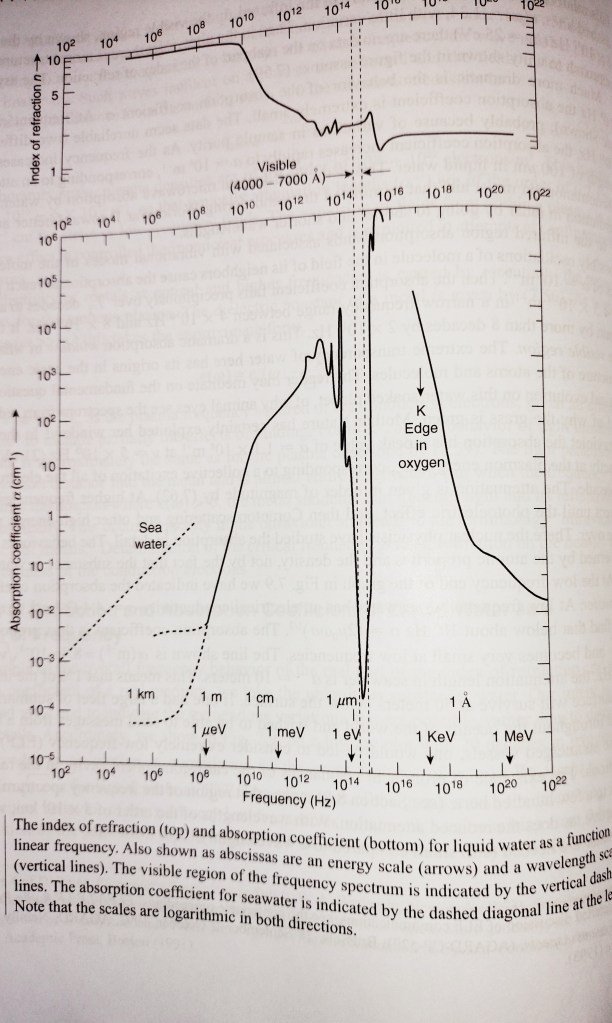
There was much of this brief section (which was about refraction and/or absorption of light** by water) that was slightly over my head.  Nevertheless, it was interesting, and the author introduced a graph (see below) showing at the top the refraction of light by water across wavelengths, and how it tends to vary.  I assume we’re all at least implicitly aware of the fact that different wavelengths are refracted by water differently‒thus the phenomenon of rainbows.

Below this is a table showing the absorption of electromagnetic radiation by water across frequencies.  Here there is a steep upward slope when coming in toward the center from highest and lowest frequencies.  It peaks at around the microwave/infrared wavelengths from the left and around the ultraviolet from the right.

Then a striking thing happens.  There is a sudden, precipitous drop in absorption down to very low levels in a fairly narrow range of frequencies in the “middle” of the graph, meaning that in this range, light passes through water with relatively little absorption.  This is the range we know as visible light.

The author took the time to point out that this fact about the nature of water‒that it is more or less transparent in this very narrow range of frequencies‒is exactly why we Earthlings tend to see only in that range.  It’s not an accident of evolution, some ancient, stochastic occurrence that is thenceforward cemented, unchangeable, into all descendants, like the DNA code and ribosomes and the chirality of biological molecules.  It is instead a fundamental fact of physics that determines where creatures will be able to see if they first developed vision while living in water and then developed eyes that, like the rest of them, were mainly made of water.

There’s no point in making retinal proteins that react to wavelengths of EM radiation that are almost entirely absorbed by water.

That simple fact‒simple in summary, at least‒is enough to explain a huge swath of the nature of our visual perception, and it doesn’t require any further explaining to understand why we see in the range of light we do.

That was just a randomly chosen section of a textbook that reputedly is extremely difficult.  I don’t disagree with that assessment of difficulty; it was a very dense bunch of material even in just 4 or 5 pages.  But to think that one can find such remarkable facts while just trying to read and learn in random order from a textbook!

So, that’s an interesting little tidbit that seems worth sharing, at least to me.  It’s far more interesting than anything going on in the human world right now.  What’s more, this is a fact that has existed as long as water itself has existed‒and implicitly, it existed even before that, lying there waiting in the fundamental laws of nature.  And it will be there long after everything but those fundamental laws is gone.

If you want to embrace eternity, and things like Hilbert’s Hotel and Cantor’s diagonal proof make you worry about your sanity (this happens to many of us, so don’t feel bad) then focus on this fact about visible light.  It’s there, it’s real, it’s quasi-eternal, and it’s concrete.

Though the absorption spectrum for concrete is…quite different.


*This harkens back to the reference from Batman Begins, when Flass says “I swear to God,” and Batman snarls “Swear to me!”  It seems fun to use Batman when one would normally say God.

**By “light” I mean all electromagnetic radiation, from radio waves to gamma rays.

In the voids between galaxies, it’s already next year, but there’s still no life there.

It’s Tuesday, now‒the first Tuesday of the new year.  This is not anything particularly interesting, of course.  It’s really just another day.  But it is also the last day of the first week of the new year, the 7th day of the year, as indicated by the fact that it is January 7th.

“Brilliant, Holmes!” I hear you say.

In this case, though, it truly is elementary.  It’s also pretty boring, so I’m sorry to go on about it.

There have been troubling things in national news, of course:  the terroristic suicide attack-by-vehicle in New Orleans; the guy who blew up his cyber truck; severe cold weather striking large swaths of the eastern US; and, of course, no one has yet yelled “Psych!!” regarding Donald Trump’s election for a second term as president.

I’m not as rabidly anti-Trump as many; he’s just a man, of soft and squishy flesh and blood, like everyone else.  He’s also just one more incompetent government official on a world stage that might as well be a collection of (poor quality) Three Stooges clones.

It would be remarkable and praiseworthy if humans actually elected smart, calm, intellectually honest government officials with personal integrity.  Alas, when holding elections, humans seem unable to be as rigorous in their evaluation of candidates as they would be when screening babysitters or even gardeners.  And, of course, since few people are in the habit of reflecting on themselves in any way to improve on their own flaws in judgment, it seems unlikely that things will change very quickly.

This is all nothing new, of course.  The modern shape of cyberspace and the borderline-antisocial media add little twists and peculiarities, introducing new dynamics to the system.  But the dominating principles of primate social and sexual dominance hierarchies and displays have not changed much, if at all.

The only really interesting thing I’ve found in the news is the statement about a new study‒an elaboration of a first theoretical paper from some years ago‒that proposes a potential alternative explanation for the fact that the expansion of the universe appears to be accelerating that doesn’t require “dark energy”.

The cosmological principle, which underlies the usefulness of standard model, lambda-CDM cosmology, states that, on the largest of scales, the universe is uniform and homogeneous.  However, on anything other than the largest scales, the universe is decidedly clumpy.  This is because of gravity, of course, pulling things together in regions where things are more dense (making them still denser) and making the spaces in between ever more rarefied and so on.

But, of course, gravity is not just a simple attractive force; it works its effects through the warping of spacetime, and in ordinary circumstances (so to speak) its effect on time is far more significant than those on space.  This is a very real effect, one for which we have to adjust when using GPS satellites for instance, so while general understanding of it may be relatively rare, it is not an esoteric bit of physics.  It’s textbook stuff.

The point being made by this new hypothesis is that perhaps there is no real dark energy, but instead, in regions where more mass exists, time slows down.  This is a bit of an oversimplification, but it’s quite true, and indeed, to a large extent, all the apparent physical effects of gravity are produced by the differential flow of time between places where the manifold is more vs. less curved.

So, in the places where matter/energy is relatively scarce, time moves “more quickly”.  So, since the universe is definitely expanding (due to the Big Bang), those regions are going forward through their expansion more quickly than regions with more matter, and so the space between galaxies and clusters appears to expand more quickly, and as the comparative difference, the contrast, in energy concentration increases, the difference in passage of time will tend to increase, too, producing an apparent accelerated expansion.

[Note to self:  how would this model be expected to affect the extreme measured uniformity of the Cosmic Microwave Background?  Is this going to be a point of evidence against it?]

This is not a definitive, tested hypothesis, but it rests on sound principles.  It probably won’t supersede lambda-CDM, but it has the potential to do so.  This is no crank, RFK Jr. style hypothesis by any means.  I haven’t read the papers involved yet; rather I read articles and watched some videos about it; I will try to learn more.

But, since the discovery of the accelerating expansion of the universe in the late ‘90s was the single most exciting (non-personal) event in my life, the idea that there is a new approach that might change that again is also truly exciting.

It makes me wish I had just gone into physics as I had originally intended.  However, post-open heart surgery, transient cognitive impairment, and an exacerbation of depression triggered by the same thing, made it too difficult, in the short term, to keep up with my physics and math classes in the semester after my heart surgery, so to English I went.

But as I picture the large-scale universe differentially flowing through time and thus expanding at relatively different seeming rates, producing this wonderful, higher-dimensional twisty-bulgy-filamentous shape, I can at least feel a little twinge of the joy of contemplating science.  My only real contribution to science was in studying the effects of gliotoxin on naked DNA in vitro, and though that’s quite interesting, it’s not exactly cosmology.

Oh, I also wrote a pretty decent review article about the various effects on cognition and other neurological functions of heart-lung bypass as done during open-heart surgery.  Clearly, that was motivated by personal experience.

Anyway, that’s it for today.  Tomorrow begins the second week of the year, but I don’t expect to write again before Thursday.

There’s the respect that makes calamity of so long blogs

Hello and good morning.  It’s Thursday, and so it’s time for another weekly blog post.  Last Thursday I was out sick, so I only posted a very brief, almost telegraphic announcement of the fact that I wasn’t going to write a “true” post that day, and I said that I might write a true post on Friday if I was feeling better.  Of course, I was not feeling better by Friday, so there was no such post.

I’ve nearly recovered from my acute illness—probably some respiratory virus, but nothing too terribly severe—and now I am more or less back on my normal schedule.

Speaking of being “back”, though, my back has been acting up severely this week, and in an atypical fashion.  I’m not sure what triggered it.  Possibly it’s just due to being sick, with the coughing and the lying around more than usual and so on.  Possibly it’s something else.  Anyway, I’ve had to go to a combination of near-overdoses on my various OTC pain medications, and that’s not wonderful.  It got so severe yesterday that I was actually saying out loud that, if it didn’t improve, I was going to have to find some relatively high parking garage nearby and jump off it.  I was not exaggerating, as I think was obvious to those around me.

It’s easy enough to wonder why I don’t do that anyway, given that there is very little in my life that’s positive, and what positivity exists is episodic, and it can’t make up for the constant negatives of pain and illness and sleeplessness and depression and so on.  The closest I come to any comradely activity is streaming YouTube videos of people reacting to songs or movies that I like.  It’s almost, but not quite, exactly unlike watching a movie with a friend who has never seen it before.

Speaking of paraphrasing or otherwise referring to The Hitchhiker’s Guide to the Galaxy, I’m most of the way through the first run of editing Extra Body.  There’s a long way to go, since I usually do as many as seven such iterations before considering my editing done.  I figure by that time I’ll usually have lost any proprietary affection for a story and it will begin to bore me, so it’ll be easier to cut out extraneous material.

That’s the principle, at least.  I don’t know how well it’s worked hitherto; I’m too deep inside the process to trust my evaluation.  I did at least transcribe the material I had written so far, in passing, on HELIOS, so that if/when I’m ready, I’ll be able to pick up writing that by hand in its first draft.

Extra Body is my first non-horror story in a while (unless you count the beginning I made on writing The Dark Fairy and the Desperado, which is certainly not horror, but is also certainly nowhere near done, if it ever will be).  It’s hard for me to tell if it’s a good choice to have reverted to a sort of lighthearted science fiction story set in the modern world, but at least I was able to squeeze the first draft out.

Of course, I’m paring down the word count as I go.  As I’m sure is obvious to all of you, I get rather wordy when I write, especially when I’m using the computer keyboard, since I type quickly and usually can do so more readily even than I can speak out loud.

I’ve been reading some more books about quantum field theory (and related subjects) lately.  It’s still very intro level stuff, of course, but either because recurrent exposure to increasingly technical material is gradually sinking into my head, or because I’m just getting a tiny bit “smarter” overall over time, I’m actually finding some of it more familiar and understandable than before.

I must say that I was a little bit proud of myself not too long ago when I was thinking about how complex numbers are represented using a two-dimensional plane, with internally consistent mathematics and whatnot, and I wondered if one could have three-part complex numbers.  I soon realized that only even-numbered ones would work, and then I learned that these were indeed a thing (i.e., quaternions) and that indeed only even-numbered versions of such things can work.  Of course, it’s very difficult to visualize something that has four dimensions, so you just have to do the math, and I haven’t started to work on or learn that seriously, but I played with some “higher order” complex-number multiplications a few times, which was how I saw that only even-numbered ones, with separate “imaginary” roots would work.

On a vaguely related note:  I was listening to Sean Carroll’s podcast yesterday evening.  He was speaking to Doris Tsao, a neuroscientist who specializes in facial recognition and processing centers of the brain, and she mentioned that the attributes of a face can be thought of as many-dimensional, in the sense that there are numerous “variables” that can be represented about any given face, and that they effectively comprise a higher-dimensional space.

Then she turned the matter around and noted that there are apparently those who consider using such things as faces as ways of intuiting mathematical or related systems with higher dimensions, thus representing them in ways that the human mind is capable of visualizing.  I though that was a fascinating notion*.

It reminds me little bit of the concept of the “memory palace”, a mnemonic/rhetorical tool that originated in ancient Greece (so I understand) in which one associates the aspects of, say, a speech one is going to give with imagined artifacts or decorations in some imagined hall or room, so that the aspects of that speech can more readily be remembered and brought to mind when needed.

There are several fictional characters, most notably Hannibal Lecter and the BBC’s Sherlock, who use rather exaggerated versions of these memory palaces.  The one described in Hannibal is more coherent than the one in Sherlock, but they both take great liberties with how the concept was originally used.  Nevertheless, for the longest time, thanks to the amusing tableau** Thomas Harris described for how Hannibal Lecter had “stored” Clarice Starling’s (fictional) home address, I could readily reconstruct her address at will.  I think I may still be able to do it.  It should be something like “#33 Tindall Ave, Arlington, Virginia, 22308”.  If anyone wants to check my recollection, that would be welcome.  I’m not certain I got it right.

I’ve usually found such mnemonics more trouble than they’re worth.  It’s easier for me to connect concepts in the real world, building mental models of the way things work rather than trying to memorize.  This means I probably don’t learn as quickly as some do, but I learn deeply when I do, and it’s easier to connect one model to another and to spot analogies and similarities and possible connections between systems that might at first seem unrelated.  That was quite useful in medical practice, as I’m sure you can imagine.

Oh, I almost forgot:  Welcome to the first day of August in 2024!

That’s all I have to say about that.

Apparently the summer Olympics are currently taking place, but I’ve been unable to muster any interest in them, though I used to love them, and I find that the manufactured controversies about some apparent misconstrual of the opening ceremony or some such (and the juvenile ripostes by political antagonists of the original misconstruers responding to the supposed offense) all serves simply to reinforce my feeling that not just the human race, but indeed all life of any kind, is a bad idea.  Thank goodness for the apparent inescapability of the second law of thermodynamics.

Anyway, I feel I’ve been meandering about here, randomly bouncing from topic to topic, without any consistency or coherency, so I’ll bring this to a close soon.  I fear that this once-weekly blog posting suffers from the fact that there are topics I probably would have brought up as solitary daily blog posts when I was doing them, but that I now want to try to squeeze in here.

I just can’t write (or edit) new fiction and write daily blog posts too, not while I’m forced to keep my day job.  If anyone out there wants to pay for my living expenses and support me so I can both write new fiction and write daily blog posts while still studying physics and programming and the like in the meantime, please, let yourself be known!  I’d be pleased to hear from you.

Otherwise, I’m pretty sure none of this is going to last very much longer.  My pain and dysthymia and alienation and insomnia are increasingly unpleasant, and there are fewer and fewer things in my life that compensate.

Here’s to Macbeth’s proverbial last syllable of recorded time.  L’mavet!***

TTFN


*It does come up against difficulties when considering the notion of orthogonal axes of vector spaces being able to be rotated into one-another.  It’s hard to see how one could intuitively consider rotating the variables of, say, eye size and cheek color into one another, or what an inner (or “dot”) product or cross product of two such variables could mean…though with the latter, it makes the use of the “right hand rule” an amusing invocation of a slap in the face…or at least poking someone’s cheek.

**Involving Jesus (age 33) marching along with a .308 Enfield rifle at shoulder arms, followed by J. Edgar Hoover in a tutu, followed by Clarice driving a “Tin Lizzy” model T Ford, going past Arlington National Cemetery.  Something like that, anyway.

***This is an expression I invented this morning, the counter-toast to the famous L’chaim, which in Hebrew means “to life”.  Then, being me, I jotted down some words for the first verse of a parody song of “To Life” from Fiddler on the Roof:


“To death!  To death!  L’mavet!

L’mavet, L’mavet, to death!

Here’s to the father I tried to be

Here’s to that travesty

Drink L’mavet, to death,

To death, L’mavet.

L’mavet, L’mavet, to death.

Death has a way of releasing us

Luring and teasing us

Drink L’mavet, to deeeeeaaaath…”

That’s as far as I got, but I did only work on it for about five minutes, so, it’s not too bad.

If idle blog will once be necessary, I’ll not sleep neither. This mortal house I’ll ruin…

Good-o and hell morning.

It’s Thursday, so I’m writing my formerly standard (and potentially newly standard) weekly blog post today.  Huzzah.  Admittedly, I last wrote a blog post on Monday, so there have only been two blank days since I posted, but it still feels odd.  My daily blog posts are almost never worth reading, anyway, though, so it’s not a huge loss.

It was slightly nice to let myself not feel pressured to write a “report” on my progress these last few days.  I also didn’t push myself to write more than one page a day.  Historically, that has often nevertheless led to me writing quite a bit more per day, but not this time.  Over the last two days, I’ve written a total of 1,361 words on Extra Body, bringing it to its current total of 57,886 words (88 pages).  I just haven’t had much energy for writing, or for anything at all.  That’s even relative to my usual level of energy.

I say that, but I have been trying to study some mathematics and physics.  I’ve been doing the Brilliant course on intro to linear algebra, which is quite interesting, and should help prepare me for more in-depth work in quantum mechanics/quantum field theory and (most important to me) General Relativity.  I need to review and improve my calculus as well.  I also got the e-book (PDF) of Advanced Theoretical Physics by the guy who runs the Science Asylum YouTube channel.  He does a really good job explaining things on his channel‒including things I already understand well, so I know he’s rigorous and thorough.

I’ve also been reading Leonard Susskind’s Theoretical Minimum book on Special Relativity, with plans to move toward the subsequent one on General Relativity (and to circle back to the one on quantum mechanics).  And, of course, I’ve also been reading Sean Carroll’s two Biggest Ideas in the Universe books.  Basically, I want to ground myself in the concepts and renew and improve my mathematics skills before I get into real study of GR, using Sean Carroll’s textbook (I already own it and Gravitation) and possibly some other recommended texts, and also some university level quantum mechanics and quantum field theory.

One reason for this is:  I’ve long wondered just what would happen if one were to accelerate a space ship to close enough to the speed of light that its relativistic length contraction and relativistic mass put it below its Schwarzschild radius (at least relative to outside observers), which should mean it should become a black hole.  But of course, it’s not a simple spherical mass, so the solutions for the equations might be much more complicated and lead to unexpected outcomes as in the Kerr solution for spinning black holes.  This is the most realistic black hole model, since basically all black holes spin, and often do so quite energetically.  Conservation of angular momentum applies to collapsed stars just as it does when a spinning skater spins faster as the skater’s arms are pulled in.

I have a secret fantasy that a spaceship situation such as I described above might allow a ship to turn itself into a wormhole instantaneously if everything is done right, and achieve something that is effectively faster-than-light travel.  But even if that’s not workable, I’d like to know what would happen in such a situation.  I know this is not idle thinking, because there was real curiosity whether, if there really were curled up dimensions that are large enough, particles at the LHC might achieve relativistic mass enough to become tiny black holes*.

This is far from the only question I would like to understand better about GR.  I want to understand, deeply, the mathematics that makes a cosmological constant produce “repulsive gravity” and thus expanding spacetime.  I’m actually starting to get a little inkling of how that works, but only an inkling**.  I need more.

I would like to understand everything, of course, everything that there is to know…but only through the dint of my own work.  I would never want just to be given knowledge.  How lame and boring that would be!

I also have been able to (re)read some fiction amidst all this‒The Belgariad, by David Eddings.  I picked up near the end of Queen of Sorcery and am now in the first half of Enchanter’s Endgame.  It’s nice to be able to read at least these fiction books that I haven’t read in a while 

Basically, I’m frantically grasping at straws‒panicking in my weird, quietish way‒trying to find something, some reason, to keep me going.  I fear it’s not working, though.  The downward pull is too strong; I’m orbiting in the inner accretion disk of my personal black hole, and unless I can be pulled out by someone or something‒for I cannot do it on my own‒I will soon enter the “plunging region” where orbit is no longer possible, and nothing remains but to cross the horizon.  Every single day I yearn for everything to be over.

It doesn’t help that my sleep has been rotten, even by my own standards.  And my chronic pain always interferes with everything.  And my tinnitus is just galling, keening away like a permanent near-the-ear mosquito, but higher in pitch, especially now that I have a bit in my left ear as well as the major tinnitus in my right ear.  It makes the various other noises of the world feel all the more chaotic.  And I’m very much alone in my head, and in my life.  I feel like the only member of my species, like that last passenger pigeon that lived, companionless, in the Cincinnati Zoo for a few years before dying.

Meanwhile, the weather down here in south Florida is thoroughly sloppy, with rain and flooding and everything that goes with them‒such as the Internet being out where I live‒leading to my long commute being more unpleasant than usual.  At least it’s cooler, though (in temperature, not in fashionableness).  There were a few times during the night last night in which, when I started awake‒as I do several times most nights‒I realized that the air conditioner wasn’t even running!  That’s rare in June in this part of the world.

Oh, and I mentioned Substack a few days ago.  Well, it turns out that, technically, I already have a Substack account, since I follow a few other writers and thinkers thereon.  So I guess, if I so chose, I could write stuff there and set it up with a paywall.  Of course, actually, I could do that here on WordPress already, I think, and loyalty would suggest that it would be the better choice.  Of course, I could set up a Patreon account and link it to my work here and to my YouTube channel and so on.

All these thoughts are pipe dreams, though.  I don’t honestly expect any of them to come to fruition‒they’ll just drop to the ground like most of the fifty-six trillion mangos in south Florida, merely to rot there and attract fruit flies.

We’ll see, I guess.

Meanwhile, I’m scheduled to work this weekend, so I’ll have two more days of fiction writing this week and three next week before my next scheduled blog post.  It’ll be almost the equinox next Thursday, and of course, this coming Sunday will be Father’s Day.  I wish that were a holiday I could enjoy; being a father is the most important and greatest thing I have ever done.  But that all went bitterly off-kilter, and I crashed and burned, and right now I’m just surviving in the wasteland near the wreckage, fantasizing about a rescue or an escape, but knowing more and more every day that such a thing is vanishingly unlikely.

Anyway, enough.  This is getting too long.  I hope you all have a good week and a good weekend.  If you’re a father, I hope you have a great day Sunday, and for those of you who have fathers who are still around and who deserve it, I hope you get in touch with them at least and make sure they know that they matter to you.  Men are expected to be stoic about love and other feelings…but men also die by suicide in about three or four times as great numbers as women.  Correlation does not necessarily imply causation, but it sure doesn’t rule it out, either.

TTFN


*This was never a worry, just to be clear, even if it had happened.  A tiny black hole that size would decay almost instantly via Hawking radiation.  But that would (or should) produce an essentially random shower of particles, not the usual decay products of the original particle.  Alas, no such events (or event horizons) occurred, so if there are curled up extra dimensions, the LHC didn’t get energetic enough to probe them.

**That sounds like the word for a baby pen, doesn’t it?

“Sleep”, writing, and studying physics–report for June 5, 2024 AD/CE

Well, I got almost 4 hours of uninterrupted sleep last night, plus 20 minutes or so of on and off dozing.  While that sucks big-time, it’s better than it’s been lately.  At least I’m not seeing bugs on the walls out the corners of my eyes right now–though I still keep briefly thinking there’s a cat waiting by any door that I open, until I look down and see that there isn’t.

What can you do?  Not much right now, it seems.

Anyway, I produced a decent amount of work this morning.  I wrote 1,373 “block” words and 1,388 “net” words, with a difference then of just barely over 1% no matter which number you take as your denominator.  The total word count of this would-be short story is now 54,327 words, and it is 83 pages long in the format I described yesterday (I think).  It’s definitely more of a novella.

I’ve been doing a bit of reading these last few days, skipping between Sean Carroll’s two Biggest Ideas in the Universe books and the first volume of Feynman’s lectures and Jordan Ellenberg’s Shape*.  As you know, I’ve been trying to teach myself more of the physics on which I missed out by switching majors after my heart surgery, especially General Relativity and Quantum Mechanics/Quantum Field Theory.  Sean Carroll’s** “Biggest Ideas” books are focused on explaining those things for interested laypersons without avoiding the mathematics, but not practicing teaching/practicing how to do the math, so it’s a good beginning.  Of course, in a perfect world, I intend to beyond the overviews and actually to get comfortable with using the mathematics, particularly because I want to understand the cosmological constant at the level of the mathematics of General Relativity, because that’s the only part that I don’t quite get intuitively.  But really, I want to understand and be able to use all of it, and to be able to read all the papers on arXiv and understand them at the level of a professional, like I can with medrXiv and bioRxiv.

I doubt that I will live that long.  But, in the meantime, at least I’m learning new things.

Tomorrow is Thursday, so of course, I will be doing my more standard Thursday blog.  It’s silly to call it a “weekly” blog, since I’ve been writing these reports almost every day; once I’ve started a habit it’s hard for me to deviate from it.  But I don’t plan to write any fiction tomorrow, but instead will just focus on the blog post.  I’ll see you then (so to speak).


*I’ve not yet encountered a better teacher of mathematics than Professor Ellenberg.  He captures and conveys the fun and beauty of math as well as anyone I’ve encountered and better than the vast majority.  He narrates his own audio book versions, too.  If you want to review general mathematical ideas and then general geometric ideas (and their surprising applications) in an accessible and enjoyable way, you could not do much better than reading (and/or listening to) his books.

**Professor Carroll is another great teacher, though he deals with slightly more high-falutin’ stuff than Professor Ellenberg in his books, so the subject matter can be denser.

By medicine life may be prolong’d, yet death will blog the doctor too.

Hello and good morning.  It’s Thursday, and so—as I mentioned yesterday that I would—I’m writing a standard blog post.

I’m writing in the back of an Uber right now, but I’m using my laptop, and that combination is a first for me, I think.  I know that taking Ubers is probably an unjustifiable expense, and I mean to cut back on them, but this week I’ve had very little useful energy*, and anyway, I’m only too happy just to burn through the quite small amount of money that I have, since I have no reason to save for the future.

I was briefly puzzled as I did the initial “save” for this document, since I save my blogs by date and day of the week, when I saw that last year the 23rd of May fell on a Tuesday, not a Wednesday.  Each year generally shifts the day (of the week) of any given date one day later than the previous year, since a standard year is one day longer than a multiple of 7: [52 x 7 = 364].  I think that the official mathematical term is “modulo” when you’re just looking at the remainder.  And I vaguely recall noting, earlier this year, that the dates this year were one day later.

But, of course, this is a leap year, in which we “add” a day to the year, specifically on February 29th.  So it makes sense:  early in the year, this year’s dates are one weekday later than they were last year, but after the end of February, they are two days later.  I suppose that means that next January and February will be two days later than they were this year, but after that things will revert to one day later.

Hold on to your hats, folks!  If the whole blog post is this exciting, goodness knows how you’re going to be able to stand it.

It’s a bit tricky writing in the back seat here, because my laptop computer doesn’t have illuminated keys.  When the bouncing around of the car throws me off too much, I have to re-find my typing location by trial and error.  Once I do, I don’t really need to be able to see; I know my way around the keyboard pretty much by proprioception.  After all, I’ve been typing at least since I was eleven.

Not to say that I don’t make plenty of typos.  My coordination isn’t all that great, and I often get ahead of myself.  But at least with modern word processors, it’s so easy to correct for errors that it’s not a big deal.

Actually, I suspect that if I’d been forced to keep using my grandmother’s typewriter, which is what I used to start my typing career, and on which I needed to use correction film to erase mistakes, I would probably be a better, or at least cleaner, typist than I am now.  Once word processing programs came into play, there was no longer as much of a price to pay for minor errors, and so there was less pressure to be more accurate.  As I’ve noted many times, everything responds to local pressures and incentives and disincentives.

I warned you that this might be exciting, didn’t I?

I almost didn’t go in to work today.  That was why I let myself get the Uber:  to help me to clear that activation energy barrier.  I am not particularly physically sick, though I feel a bit of a tickle in the back of my throat.  I just didn’t want to go in.  Yesterday, all day, I was extremely tense and stressed out, and the noise was particularly irksome, and I had payroll to do, and I was always just sliding along what felt like the razor edge of a true breakdown or explosion.  Yet no one seems to have noticed.

I banged my head on the wall quite hard at one point, and did several other things to cause myself pain throughout the day.  I don’t want to go into specifics too much; I don’t want people to think I’m a weirdo or something.

Ha.  Ha.  Ha.  Ha.  Ha.

Anyway, I’ve actually just arrived at the office.  I hope my hands and thumbs won’t feel too sore, today.  Yesterday, my thumb bases were painfully tight, and most of the rest of my finger joints were sore and stiff, albeit to a lesser degree than the thumbs.  It made it quite difficult to try to play guitar, so I didn’t do much of that.

Actually, because of the trouble with my hands, and my shoulders, and of course, the ongoing issues with my back and hips and knees and ankles—especially with my back—I decided to buy a huge bottle of Ibuprofen, and I’ve taken some of them starting yesterday afternoon.

I have been “off” Ibuprofen for quite some time, now, though it was my go-to anti-inflammatory for many years.  I started to avoid it when its use was associated on two or three occasions—possibly just by coincidence—with a relatively high occurrence of what I presume were premature atrial contractions, with associated palpitations.  It was nothing terribly severe, of course, but at the time, I wanted to live, so I switched mainly to naproxen.

I also use some aspirin, as well as acetaminophen for headaches and other things that don’t benefit from any suppression of cyclooxygenase.  But, despite its longer action, naproxen has never worked quite as well as ibuprofen seemed to work, though perhaps that’s been confounded by other variables.  It’s hard to do a double-blind test on oneself.

In any case, at this point, I don’t much care if I get palpitations, although if they happen, maybe I’ll find them unpleasant enough that I’ll change my mind.  Frankly, I don’t mind if I have a full-fledged arrhythmia.  Sudden cardiac death due to ventricular fibrillation, for instance, is probably one of the best ways to die.  You basically just faint, since your brain is no longer getting blood flow, and that’s that.  If no one defibrillates you, and if the arrhythmia doesn’t spontaneously resolve, you’re done.

It’s probably not quite as quick a death as being at ground zero of a thermonuclear explosion, and it’s certainly not as quick as being obliterated when the vacuum energy of the universe quantum tunnels down to a lower level**, since that process would spread throughout the cosmos at the speed of light, and no information within spacetime can exceed the speed of light, so it’s fundamentally impossible to know such an event is happening before it arrives.  It’s also impossible to know about it once it arrives, since everything currently existing in our universe, right down to fundamental particles, would by obliterated by the vacuum state decay—again, at the speed of light, which is far faster than the rate at which the nervous system can experience anything.

Unfortunately, even more than the thermonuclear explosion possibility, vacuum decay would involve taking other, “innocent” people along with me, at least some of whom both wish and deserve to continue living.  That seems a bit unethical—or at least rude, which I sometimes think is worse—and anyway, it’s not as though anyone knows how to make it happen.

It’s better to keep things confined to my person.

I guess even a hemorrhagic stroke wouldn’t be too bad, to be honest, and given my tendency to bang my head against the wall when I get too frazzled and stressed, it seems immensely more likely than vacuum state collapse.  I suppose I could even tolerate death by bleeding ulcer, though I really don’t like nausea***.

Probably, though, in the end, I’m going to have to take a more active and deliberate hand in things.  I suppose we’ll see.  It’s hard to work up the courage to face the discomfort and even frank pain associated with most such interventions, but practice makes better, and I already have a fair amount of experience deliberately causing myself pain, as noted above.

That’s enough blog post for now.  I’ve already droned on and on.  My tentative plan is to do some fiction writing tomorrow morning, and if I do (or even if I don’t) I plan to leave a little report about it here.  I am off work this weekend, so I won’t be writing anything on Saturday (barring, as always, the unforeseen).

I truly, honestly, and fervently hope that each and every one of you feels better than I do right now, and I mean substantially better.  You probably do; it seems likely that, in the phase space of physical and emotional states, there are many more possibilities in that direction than in the other.  But I could be wrong.

TTFN


Addendum:  While editing, I found that MS Word had underlined a sentence in the draft above, in which I wrote, “I think that the official mathematical term is….”  The editor gave the comment that “expressing opinions with certainty adds formality”.  I don’t think I could possibly disagree more than I do with that sentence. 

Bad advice in editor marked up

 PLEASE DON’T DO THAT, PEOPLE!!!!!!!!  Opinions are opinions.  Expressing them with certainty when you are not certain is tantamount to outright lying, and is a huge problem with human discourse!  I’m ashamed of MS Word for making that suggestion.  What a horrible, horrible recommendation!  What a nightmarish thing to say!


*And yet, my level of tension has been exceptionally high.  That’s a frustrating bit of irony, as I probably don’t need to tell you.

**This is purely a hypothetical possibility.  The vacuum energy of the universe may well be at its lowest/ground state, though it is patently not quite zero.  If it were, cosmic expansion would not be accelerating.  Indeed, I often say that cosmic inflation is happening now, based on all the data we have.  That’s what “dark energy” is doing, albeit at a slower rate than what is proposed to have happened 13.7 billion years ago.

***Weird, right?  I don’t like nausea?  How unusual!

Numbers of words and words of thoughts and thoughts of consciousnesses

Since I came up with the idea and mentioned it in my blog on Saturday, I could not fail to put the idea into practice of keeping count of both the number of words in the new “block” of fiction writing I did today and to keep track of the change in the total word count, to compare them.  This was especially true since, on rereading what I had written on Saturday, I realized that I had started a conversation between two characters rather abruptly, and so I added in a more natural beginning to that interaction while I was editing.

This didn’t have as big an impact as it might have, since I also pruned things slightly while rereading.  In any case, I kept track of the net total word change and the word count in the new block of writing, and those numbers are:  1,228 words in the new block written today, but a net increase in word count of 1,264.

I don’t know how representative this is of the typical disparity, but it’s less than a 3% difference whether you use the larger or the smaller number as your denominator, so it’s not huge.  Still, I’ll probably keep this up, at least for a while.

After I had finished writing and gotten up to get ready to get off the train, I had a weird train (ha ha) of thought that led from me thinking about the fact that one can no longer readily stream series A through I of the British show QI in the US, to how I had needed to order the DVDs for those seasons through Amazon UK, which I did quite some time ago.  This led me to think about the shipping process, and how seamless and rapid it had been–it was not as fast as ordering something that’s sourced locally, but nevertheless it was impressively rapid.

And I thought of the various people involved, and how not one of them had been aware of the whole process from beginning to end, and indeed, possibly not one of them had thought about what was being sent and to where.  Each part of the process was more or less automated, or at least occurred “locally”, in a phase-space sense*.  And yet, the whole has become a process that takes place with remarkable efficiency, despite no member of the chain of the process really knowing too much beyond their own part of the job.

And I thought, the whole economy is like this, locally, nationally, and globally.  Indeed, all of civilization is like this; everyone simply acts in response to local forces and events and incentives and disincentives, and the process turns into a self-sustained, much larger entity that has not been created by anyone, and is certainly not run by anyone (any more than a bee hive or an ant hill is “run” by the queen insect).  Nor should it be, since no human mind is capable even of grasping very precisely and in detail anything beyond a tiny part of the thing itself–this is probably part of why “planned economies” always fail, and until there is a super-intelligent AI (and perhaps even then) they always will.  It’s like trying to put one single nerve cell in charge of the entire human brain and body.  It simply doesn’t have the capacity to do such a thing.  When one nerve cell’s activity spreads with relatively little impediment through the brain, you get what we call a seizure.

Anyway, all that led me to thinking about whether it would ever be possible for a civilization, in the aggregate, to become truly sentient and self-aware.  I don’t mean that the members are self-aware; obviously they are already (at least some of them, and to varying degrees).  I mean, could the civilization as a whole develop self-awareness, develop what the philosophers of mind call “qualia“.

Our civilization is probably far too small to instantiate such a thing, currently.  There are after all “only” about 8 billion humans on Earth, compared to, for instance, the roughly hundred billion neurons in each individual human brain (mileage may vary) and tens of trillions of cells in an entire human body.  But perhaps, someday, if a civilization becomes large enough and remains interconnected enough, the lights may come on, so to speak–actually it would probably be a gradual process, rather like those European, “energy-saving” lights; it’s unlikely to be an instantaneous change.  But it could, in principle, happen.

Of course, those who espouse the so-called Hard Problem of Consciousness™, might say that it could never happen, that qualia, that true consciousness requires some other ingredient or process.  I’ve never encountered an argument from any of them that impresses me, though.  Even Roger Penrose’s ideas about quantum mechanical processes being necessary for human consciousness–in denial of the Church-Turing Thesis and related ideas of universal computation–seems to me to be pure motivated reasoning, albeit by one of the great minds of the modern world, so it’s still worth exploring his ideas.  Even when he’s wrong, Penrose’s thought is more fruitful than that of the vast majority of people when they right, yours truly included.

I’ve arrived at no conclusions, of course.  It was just an interesting mental diversion that I thought I would share with you readers, since I have no one else with whom to share such things.  If any of you have any thoughts or ideas about them, please feel free to leave a comment below, here on my blog proper, not on other social media–I would prefer a forum in which other people who read comments on my blog could comment, too, and that’s not likely to happen on Facebook or on “the site formerly known as Twitter”.

Okay, that’s it for today.  I’m not going to edit this much before posting, so apologies if there is any persistently awkward wording or if there are any unnoticed typos.  Have a good “Not Memorial Day” day**.


*Of course, everything in the universe behaves locally–even quantum entanglement is “local” in a very specific sense.  Even gravity is local–the local gravitational “field” responds to the state of the nearby gravitational field, not literally to distant objects, which is part of why gravity can “escape” from black holes.  The larger-scale laws of nature emerge “spontaneously” from all these tiny, local interactions, or so it seems based on the best information I have.

**I mistakenly thought today was going to be Memorial Day because people at work kept talking as if it were.  However, that holiday is next Monday.  Sorry if I confused anyone, and thank you to my cousin for pointing it out to me.

The great blog itself, yea, all which it inherit, shall dissolve

Hello and good morning.  It’s Thursday, and even though I’ve been writing blog posts nearly all this week so far—since I haven’t been writing fiction—this is now my more “traditional” blog post for the week.

I apologize for not writing fiction yesterday and the day before.  I’ve been feeling terrible and horrible and no good and very bad and all that other stuff.  My coworker is still out, though he’ll probably be back sometime today, or possibly tomorrow at the latest, and anyway, that’s not the main problem.  The main problem is that I have been just terribly tense and anxious and have had terrible nights’ sleep even for me, despite trying to sedate myself and optimize my bedtime habits and so on.

Last night I got almost six hours of sleep, which for me is quite good, though it doesn’t feel close to enough.  It would be one thing if I slept six hours and awoke feeling refreshed and healthy; then I would know that I had gotten enough sleep, that six hours was just how much sleep my body needed.

Alas, things are not that simple.  My body’s optimal sleep time is probably pretty typical at around eight hours, but that particular “pressure” in the system is countered by whatever the various sources are of tension and stress and pain and depression.  When the sleep need gets too strong, it overpowers those other vectors, but as soon as it dips below some threshold, those other vectors dominate enough to push me into unpleasant wakefulness again.

I can literally remember the last time I got a good night’s sleep; I’ve probably mentioned it here, before.  I don’t know the specific date, but it was in the mid-1990s*.  (I’m being completely serious about this—as serious as a bloodcurdling scream for help.)

Last night, I walked about three-fifths of the way back from the train station in the evening—about three miles.  It was quite warm out, certainly in the high 80s, so I think I sweated a lot.  At least that meant I didn’t need to wake up to use the bathroom!  Also, I was physically fatigued enough to rest, and I’d been careful to try to balance my walking so that my left knee wasn’t acting up, which seems to have worked reasonably well for the time being.

I know that’s all very boring.  I just don’t have anyone else to whom to talk about these things, so I share them with all of you.  Aren’t you lucky?  I guess you can always just skim over the boring stuff.  I’m not sure how it is that we can tell what’s going to be boring before we literally read it, but people do seem able to do that, and it works.  I’ve done it myself.

I apologize for not writing any fiction since Monday morning.  I don’t know if any of you were angry at me for that, but I feel that I owe an apology.  I guess I really owe an apology for being a big annoyance and a downer, but I don’t know what to do to change those things.

I don’t want to be a blind optimist, of course.  I want to understand the world as clearly as I can, as objectively as I can, and as deeply and broadly as I can.  Maybe there’s no way to do that without being tense and depressive.  The universe is, after all, vast beyond intuitive understanding, and the realms at which fundamental physics applies are tiny and intricate, also beyond ready intuitive understanding, and time is old in the past and so much longer in the future than a person with a finite lifespan can truly take on board.

But I don’t think that must be despair-inducing.  I’m much more stressed out by how little humans seem even to contemplate how small they are, both individually and collectively, than I am by my own smallness.  As I learn more about how the world really works at deep levels, I don’t feel frightened or overwhelmed by it, like some Lovecraft protagonist who goes mad when confronted with the Great Old Ones or whatever.  I feel that I have grown larger—not literally, of course, but the phase space in which my mind exists takes more and more of reality into itself, and it’s really quite cool, if that’s the right word.

I think at least one thing that makes me feel despair is that so few other people seem even to want to understand the greater universe in any depth or breadth.  They would much rather imagine that the universe is very small and brief, as long as they are somewhere near the center of it.

But of course, to paraphrase Gandalf, they can shut themselves into their tiny little world, but they cannot shut the universe out.  And this in turn invokes not merely the old saw that nature, to be commanded, must be obeyed (for indeed, one cannot do anything but obey nature).  But I would say, far more strongly, that nature, to be survived—even to have a chance of being survived—must be understood as well as possible.

If you don’t know the rules of chess, you’re unlikely to be able to win a game.  Likewise with any other game, including even simple video games.  But those games have rules that humans invented.  The rules of nature have to be probed and unlocked and discovered, and they are much more fine-grained and large and complex than any human-made game could be.  They must be so, for the entire human world is but a tiny little part of that game, one of the innumerable things it allows to come into being.

Oh, well.  What are you going to do?

I guess you’re going to write a blog about it, and in the meantime, try to learn as much about the world as you can, because it is interesting at many levels.  And, of course, you can write a bit of fiction, to which I’ll try to return tomorrow morning.

In the meantime, I hope the vast majority of you are getting better rest than I have been getting.  I hope you have a very good day.  And I hope you have friends and family with whom to spend your finite and precious time.

TTFN


*I remember waking up feeling absolutely refreshed, and though I was too young to think about feeling “ten years younger”, I did feel more alive than I had in some time, almost as if I’d gotten superpowers**.  I’ve known people who seem almost addicted to sleep, and if that’s how they tend to feel when they’ve slept, I can hardly blame them.

**Speaking of which, I have a stupid, joke superhero idea that I’ve been too embarrassed to share with anyone in person (I’m sure you’ll understand why):  “Bitten by a radioactive wildebeest, Anthony Edward Lopez finds himself with slightly-greater-than-human powers of strength and speed.  Deciding to use his new powers to fight crime, he becomes:  Gnu-man.”

And simple truth miscall’d simplicity, And captive blog attending captain ill

Hello and good morning.  It’s Thursday again, and so it’s time for a more fully fledged blog post for the week, in the manner in which I used to write them when I was writing fiction the rest of the week (and playing some guitar in the time between writing and starting work most days).

I’ve been rather sick almost every day since last week’s post, except for Friday.  I don’t think it’s a virus of any kind, though that may be incorrect.  It’s mainly upper GI, and it’s taken a lot of the wind out of my sails.

I haven’t played guitar at all since last Friday.  I’ve also only written new fiction on a few of the days—Friday, Monday, and Wednesday, I think—since the last major post.  Still, on the days I wrote, I got a surprisingly good amount of work done, I guess.  It seems as though Extra Body is taking longer than it really ought to take, but once it’s done, I’m going to try to pare it down more than I have previous works, since my stuff tends to grow so rapidly.

I’ve been trying to get into doing more studying and “stuff” to correct the fact that I didn’t realize my plans to go into Physics when I started university.  I had good reasons for this non-realization, of course, the main one being the temporary cognitive impairment brought about by heart-lung bypass when I had open heart surgery when I was eighteen.

I’m pretty sure I’ve written about that before, but I didn’t know about it then, and I didn’t learn about it until I did the review paper I wrote for my fourth-year research project in medical school.  I just felt discouraged and stupid, though I consoled myself by studying some truly wonderful works of literature as an English major, including once taking two Shakespeare courses at the same time.  That was great!

It’s always nice to learn about things, all other things being equal.  I don’t think there are pieces of true information about the world that it is better not to know.  Our response to learning some intimidating truth about the greater cosmos may not be good, but the fault then lies not with the stars but with ourselves.  If you truly can’t handle the truth, then the problem is with you, not with the truth.

Of course, knowing what is true is generally not simple, except about simple things, and often not even about those.  This is the heart of epistemology, the philosophical branch that deals with how we know what we know when we know it, so to speak.  The subject may seem dry at times, especially when it gets weighed down by jargon that serves mainly just to keep lay people from chiming in on things—at least as far as I can see—but it is important and interesting at its root.

Not but what there can’t be good reasons for creating and using specific and precise and unique terms, such as to make sure that one knows exactly what is meant and doesn’t fall into the trap of linguistic fuzziness which often leads to misunderstanding and miscommunication.  That’s part of the reason most serious Physics involves mathematical formalism; one wants to deal with things precisely and algorithmically in ways that one can make testable and rigorous predictions.

Physicists will sometimes say that they can’t really convey some aspect of physics using ordinary language, that you have to use the math(s), but that can’t be true in any simplistic sense, or no one would ever be able to learn it in the first place.  Even the mathematics has to be taught via language, after all.  It’s just more cumbersome to try to work through the plain—or not so plain—language to get the precise and accurate concepts across.

And, of course, sometimes the person tasked with presenting an idea to someone else doesn’t really understand it in a way that would allow them to convey it in ordinary language.  This is not necessarily an insult to that person.  Richard Feynman apparently used to hold the opinion that if you truly understand some subject in Physics, you should be able to produce a freshman-level lecture about it that doesn’t require prior knowledge, but he admitted freely when he couldn’t do so, and was known to say that this indicated that we—or at least he—just didn’t understand the subject well enough yet.

I don’t know how I got to this point in this blog post, or indeed what point I’m trying to make, if there is any point to anything at all (I suppose a lot of that would depend on one’s point of view).  I think I got into it by saying that I was trying to catch up on Physics, so I can deal with it at a full level, because there are things I want to understand and be able to contemplate rigorously.

I particularly want to try to get all the way into General Relativity (also Quantum Field Theory), and the mathematics of that is stuff that I never learned specifically, and it is intricate—matrices and tensors and non-Euclidean geometry and similar stuff.  It’s all tremendously interesting, of course, but it requires effort, which requires time and energy.

And once other people have come into the office and the “music” has started, it’s very hard for me to maintain the required focus and the energy even in my down time, though I have many textbooks and pre-textbook level works available right there at my desk.  I’ve started, and I’m making progress, but it is very slow because of the drains on my energy and attention.

If anyone out there wants to sponsor my search for knowledge, so I wouldn’t have to do anything but study and write, I’d welcome the patronage.

But I’m not good at self-promotion, nor at asking for help in any serious way.  I tend to take the general attitude that I deserve neither health nor comfort in life, and I certainly don’t expect any of it.  I’m not my own biggest fan, probably not by a long shot.  In fact, it’s probably accurate to say that I am my own greatest enemy.

Unfortunately, I’m probably the only person who could reliably thwart me.  I’m sure I’m not unique in this.  Probably very few people have literal enemies out there in the world, but plenty of people—maybe nearly everyone—has an enemy or enemies within.  This is one of the things that happens to beings without one single, solitary terminal goal or drive or utility function, but rather with numerous ones, the strengths of which vary with time and with internal and external events.

I’ve said before that I see the motivations and drives of the mind as a vector sum in very much higher-dimensional phase space, but with input vectors that vary in response to outcomes of the immediately preceding sum perhaps even more than they do with inputs from the environment.  I don’t think there will ever be a strong way fully to describe the system algorithmically, though perhaps it may be modeled adequately and even reproduced.  This is the nature of “Elessar’s First Conjecture”:  No mind can ever be complex enough to understand itself fully and in detail*.

A combination of minds may understand it though—conceivably.  Biologists have mapped the entire nervous system of C elegans, a worm with a precisely defined nervous system with an exact number of neurons, and of course, progress is constantly being made on more advanced things.  But even individual neurons are not perfectly understood, even in worms, and the interactions between those nerves and the other cells of the body is a complex Rube Goldberg machine thrown together from pieces that were just laying around in the shed.

Complexity theory is still a very young science.

And the public at large spends its energy doing things like making and then countering “deep fakes” and arguing partisan politics with all the fervor that no doubt the ancient Egyptians and Greeks and Romans and the ancient Chinese and Japanese and Celts and Huns and Iroquois and Inca and Aztecs and Mayans and everyone else in ancient, vanished, or changed, civilizations did.  They all surely imagined that their daily politics were supremely important, that the world, the very universe, pivoted on the specifics of their little, petty disagreements and plans and paranoias**.

And so often so many of them, especially the young “revolutionaries”, whose frontal lobes were far from fully developed, were willing to spill the blood of others (and were occasionally even willing to sacrifice themselves) in pursuit of their utopian*** imaginings.  This is true from the French Revolution to the Bolsheviks to the Maoists and the Killing Fields, and before them all the way back to the Puritans of Salem, and the Inquisition, and the Athenians who executed Socrates, and the killers of Pythagoras****, and the millions of perpetrators of no-longer-known atrocities in no-longer-known cultures and civilizations.

And then, of course, we have the current gaggle of fashionably ideological, privileged youth, who decry the very things that brought them all that they take for granted, and who will follow in the blood-soaked footsteps of those I mentioned above—l’dor v’dor, ad suf kul hadoroth, a-mayn.

In the meantime, I’ll try to keep writing my stories, and try to keep learning things, and if I’m able to develop an adequate (by my standards) understanding of General Relativity and Quantum Field Theory, it’s just remotely possible that I might even make legitimate contributions to the field(s).  But more likely I’ll self-destruct, literally, well before any of that happens.

I’ve probably gone on too long already, as has this blog post.  I thank you for your patience with my meanderings.  Please try to have a good day, and I hope those of you who celebrate it are having a good Passover.

TTFN


*This implies that Laplace’s Demon could not be within the universe about which it knows the position and momentum of every particle and the strength of every force.  It needs to be instantiated elsewhere.

**Should that be “paranoiae”?  It feels like that ought to be the formal way of putting it, but Word thinks it’s misspelled.

***Not to be confused with “eutopian”.  Utopia means “no place”, whereas Eutopia would mean “good place” or “pleasant place” or “well place”.

****He was caught despite a head start, so I’ve heard, because he refused to cross a bean field, believing that beans were evil.  He was a weird guy.  It’s apparently from his followers that the term “irrational”—which originally just meant a number that cannot be expressed as the ratio of two whole numbers—developed its connotation as “crazy” or “insane”.  They didn’t like the fact that irrational numbers even existed.  Too bad for them; there are vastly more irrational numbers than rational ones…an uncountable infinity versus a “countable” infinity.  It’s not even close.

The moon may be a harsh mistress, but her eyes are nothing like the sun

I was going to write this post on my laptop computer, since I had brought it with me back from the office on Friday, thinking to write fiction this morning.  However, I am waiting for fares to go down to normal levels for Uber or Lyft this morning, so while I wait, I figured I might as well write this post on my smartphone.  It’s inconvenient to write on the laptop computer while waiting at the house, because to do so I need to set up a TV tray table type thing.  That’s not hard, of course, but it’s still more effort than I mean to put forth for something that will hopefully only entail a few minutes’ delay.

I should just have gotten up when I was awake‒well, okay, not when I was first awake.  There would be no point in going to the office in the literal middle of the night.  But if I had gone to the Tri-Rail station early enough, I might have gotten on the 4:20 train.  Still, who knows?  Maybe Uber rates were twice as high as usual even then.  I don’t know why the ride services are so busy at this hour on a Monday morning.

Whatever it is, I don’t see how it could have anything to do with the eclipse that will be coming today.  That phenomenon is cutting a line from the southwest to the northeast across the country, including up by my sister’s house.  I won’t be seeing it, of course, since I’m down here in south Florida, and there won’t be another opportunity to watch one in my lifetime from anywhere readily accessible to me.

I could have gone; I was invited to visit by my sister.  The people at work thought I should go.  But when I started looking into booking either buses or trains or planes‒even though I did renew my state ID to make things easier‒I felt tension bordering on dread at the prospect of traveling in any of those ways.  So I didn’t go.  And here I am.

***

Ride rates have now dropped to normal, and I’m outside waiting for my Uber.  I was hoping to be able to ride my bike to the train station; I changed up my upper body workout a bit last week, and it felt different enough that I thought I might be able to use the bike without issue.  I rode it a decent distance on Saturday, with minimal trouble, though I felt a bit stiff overnight.  Then I rode it some more yesterday, and while riding I felt fine.  I even felt rather good, if slightly breathless.  But then, overnight, the stiffness and splinting and spasms started up again, so I fear that’s just not going to work.  I also have soreness in my right Achilles tendon and significant pain in my left knee, and my left side feels like it’s been infused with hot metal.

***

I’m at the train station now, still in pain (of course) and seated on the ground because I was too late because of the Uber delays to get a good seat where I prefer to sit.  It’s annoying, but I guess I would have been even later if I had ridden my bicycle.  Then again, at least I would have had the good feeling of having gotten some exercise.

Oh, well.  I don’t know whom I think I’m fooling.  I don’t expect to get back in good shape any time before I die.  Every time I try to exercise (so far) it screws me up with worsening of my chronic pain.  I wish I could just shut the pain off, but biology is not readily amenable to compromises in that area.  Pain, like fear, is too essential.  All things that suppress either of them‒even when the pain and/or fear have become thoroughly dysfunctional‒cause terrible side effects.

I can’t go on much longer like this.  It’s almost too bad that the solar eclipse is not some harbinger of disaster, but of course, it is not.  It’s merely a consequence of the geometry of three bodies whose mutual orbits lie nearly in the same plane.  If the moon’s orbital plane were identical to the Earth’s around the sun, there would be a lunar eclipse and a solar eclipse with each orbit of the moon, and predicting such things would have been far less impressive to the native peoples of Hispaniola when Columbus used his knowledge thereof to dupe them into going along with his plans.

Some modern people seem barely less credulous, despite being avid users of the Internet and World Wide Web.  Why, the leading independent candidate for president is full of ideas so absurd that they would have been rejected as plot points in the later seasons of the X-files.  If you caught him at the right time, you could probably convince him that early vaccines had been used to mind-control him and that he had assassinated both his uncle and his father.

Sorry.  I’m grumpy.  My apologies.  I’m in a lot of pain‒more so than usual‒and of course my sleep has been horrible, though at least I napped some over the weekend.  I also replaced the shower-head in the bathroom, but that’s not very impressive, and I had the cable people out to replace the modem for the Wi-Fi, but though that was absurdly nerve-wracking, it’s hardly a big accomplishment.

I feel horrible and rotten and disgusting.  I wouldn’t give myself 5 stars even on an Uber or Lyft scale (in which, if someone doesn’t get 5 stars the app asks you what went wrong, but only gives you pre-programmed, simplistic options for explanation, eliminating the whole point of a 5 star rating system‒3 stars should be the average, but instead it’s something like 4.9).  I wouldn’t give myself an A even on the Yale grading scale (in which, it seems, the vast majority of students get As in the vast majority of their classes‒again, destroying the whole point of the grading system and eliminating any incentives to excel).

Maybe I should write a whole post about that issue, how (among other things) grade inflation makes the prestige of elite educational institutions evaporate, since in the real world, business is competitive, and a 4.0 from a school where everyone gets a 4.0 and there is no merit-based admission will gradually (but not necessarily slowly) come to be not worth the virtual paper on which it is written.

Again, I’m sorry.  I really don’t feel well at all, and I don’t feel good at all, either*.  I hope you all feel significantly better than I do, physically, emotionally, morally and otherwise.  I’m sure you all deserve it more than I do, though “deserves” is for the most part a vacuous term.

I hope you all have a very good day.  If you get a chance, and are in its path, observe the eclipse (but don’t do it directly, not with unprotected eyes).  It’s not an especially impressive cosmic phenomenon, but it’s still pretty cool.  It’s particularly cool that the human race understands the universe well enough that these phenomena, which confused our ancestors so mightily, are almost banal to us, and we can predict and plot them out centuries in advance.

It’s particularly uncool that despite how much is known and understood, there are people who live in the modern world and who constantly use devices that rely on quantum field theory and general relativity yet still think a solar eclipse might be some supernatural sign.

Heavy sigh.  What can you do?  The world is tragically comical and comically tragic.  It’s probably not worth the effort.  And I’m darn near sure that I am not.


*Yes, I mean two different things by those two words.