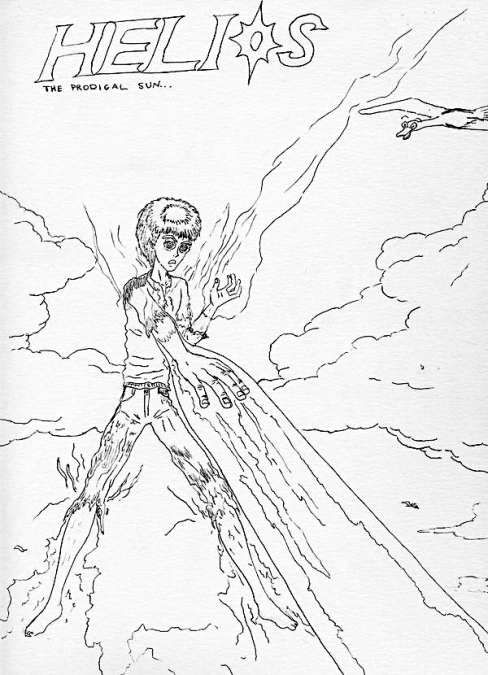
“What hears with their ear? The abyss between the stars.”

It’s Friday, and presumably I’m not working tomorrow.  I don’t think I will work even if it turns out I am working, if you take my meaning.  I’m too tired.  My coworker was out sick yesterday, and so were some other people.  Unfortunately, I’m not sick, apart from the chronic, sick-in-the-head sort of sickness with which you all are no doubt familiar.

I’m writing this on my phone, though I brought my laptop computer with me yesterday.  I had thought to whip out a draft of a blog post on it then write a page of Extra Body before editing the blog post, but now I’m having to wait so long for an Uber that I decided just to take one into the office, anyway.

I hate how Uber always tries to get you to do the “share a ride” thing.  I wish they would stop suggesting it to me, or that there was some setting in the app that would let me tell them never to offer me a shared ride.  In the unlikely event that I want to share a ride, I’ll select that option from the start.  Stop “nudging” me.  It’s unpleasant enough for me to have to deal with the fact of the driver; I don’t want to share the back seat with some other stranger.

Actually, if I’m going to “share a ride” I’ll just take the flipping bus and pay pennies on the dollar, as the saying goes.  I really should just do that, anyway.  Uber and Lyft are bad habits, and not cheap ones.  In fact, I ought just to be walking to and from the train in the mornings, since riding the bike makes my back and hips absolutely scream with pain afterwards (which is very disheartening).

I took half a Benadryl again to try to help me sleep last night.  I don’t think it actually helped me rest, but I do feel groggy and incoherent this morning, so it’s had some effect, subjectively speaking.  I don’t know if you readers can tell, though.  It may well be that, from your point of view, I’m always more or less equally incoherent.

I feel that I’m becoming more and more decoherent with every day.  I wonder if my wave function is collapsing.  Can the Born Rule be applied to a human…or to whatever I am, for that matter?

I’m being silly, I know.

In a sense I suppose the Born Rule could apply to an individual if that individual makes a decision based on a quantum measurement.  There is, apparently, an app that allows you to do just that; it’s connected to a beam splitter in some lab somewhere, through which one photon at a time is being sent, and it tells you which direction a given photon ends up being measured.  Thus, you can make a truly random decision if you so desire‒as far as physics can currently tell, a fundamentally random decision.

A coin flip or a die roll is not fundamentally random, though for practical purposes it may as well be.  We don’t have access to enough information to predict a given outcome on a fair coin or die, but in principle it is possible.  Whereas with a photon going through a beam splitter, we have a completely, in-principle, unpredictable process.  The Nobel Prize was recently awarded to Aspect et al for their experiments that tested and confirmed the Bell inequalities, thus disproving anything but the most esoteric forms of “hidden variables” descriptions of quantum mechanics.

Sorry.  That was one of my weird tangents.  I’m a bit too mentally fatigued to restrain myself very well.

This sort of thing happens in real life, too.  Yesterday, I was talking about something to do with some song that came on the playlist to my boss, and I went off on some esoteric tangents about music and stuff, and I could finally just see his eyes start glazing over, so I pulled up short.  Then I caught myself looking up to see if I could find someone else in the office with whom to share some of my trivia and my thoughts about songs and various other things.

I caught myself in time, though, and retreated to my desk.  Then someone asked to change the music playlist to some pathetic new artist and related crap that wasn’t nearly as interesting.  I briefly put in my earphones and listened to some of the Feynman lectures on physics to block out the noise.  That didn’t work for long, though, because I kept having to do office stuff that required interaction with living humans.  And then, of course, I had to work through lunch, because three people got sales all at once, just as lunch arrived.

I hate my life.  I really do.  It’s not just work that I hate‒at least that involves some purpose, however unfulfilling.  I also hate my time “off”, my lack of friends, my apparent inability to be a friend, and my inability to be able to fucking sleep, along with many other things.

I’m so tired of it all.  I’m tired of writing this blog, but I feel stressed at the prospect of not writing it.  I don’t get tired of writing fiction so much as feel it’s an exercise in futility, and so I generally don’t get started anymore.

Then again, everything in the universe, ever, is just an exercise in futility.  As Charles Halloway said*, “Where do you come from?  The dust.  Where do you go to?  The grave.”  The same could be said of every planet and star and cluster and galaxy and every bit of the observable universe and everything else that may be beyond it‒metaphorically speaking, anyway.  Dust is something within the universe, as are graves, so it seems unlikely that the universe could come from dust.  But I think you get my point.

It’s that there is no point.

There may be no firm fundament but is there a fun firmament?

It’s Tuesday morning, now, and I’m writing this on my laptop computer, mainly to spare my thumbs, but also because I just prefer real typing to the constrictive and error-ridden twiddling of virtual buttons on a very small phone screen.

Speaking of the day, if the Beatles song Lady Madonna is correct, then it’s still Tuesday afternoon, and has been at least since last Tuesday, since “Tuesday afternoon is never-ending”.  Of course, if Tuesday afternoon really is never-ending, then it has been Tuesday afternoon ever since the first Tuesday afternoon.  From a certain point of view, this is trivially the case.  After all, every moment after 12pm on the first Tuesday that ever happened could be considered Tuesday afternoon—or, at least, they could be considered “after Tuesday noon” if you will.

Enough of that particular nonsense.  I only wrote that because there’s nothing sensible about which to write that comes to my mind.  But, of course, in a larger sense, there is nothing “sensible” at all.

There are things that can be sensed, obviously.  I can see, hear, and touch this computer, for instance.  If I wanted, I could probably smell it, though I think its odor is likely quite subdued.  But I mean “sensible” in the more colloquial, bastardized, mutated sense—as in the word “sense” just there—which has to do with something being logical, reasonable, rational, coherent, that sort of thing.  Indeed, it has to do with things having meaning.

Deep down, though, from the telos point of view, there is no true, inherent meaning to much of anything, as far as anyone can see.  Certainly there’s no meaning that anyone has ever demonstrated or asserted convincingly that I have encountered at any point in my life.

Of course, people have beliefs and they have convictions, and humans assign meanings to various things.  All the words I have used in writing this post so far, and all the words I will use henceforth, have “meanings”, but those are invented meanings.  There is nothing in the collection of letters—nor indeed in the shapes of the letters themselves, nor the way we put them down on paper or a screen—that means anything intrinsically.  They were all invented, like justice and morality and the whole lot of such things.

That something is invented doesn’t mean it isn’t real, of course.  Cars are an invention, and only a fool (in the modern world) would deny that cars are real.  But they are not inherent to the universe; they are not in any sense fundamental.

In a related sense, even DNA and the protein structures for which it codes are very much not fundamental; they are quasi-arbitrary.  Of course, one cannot make DNA or RNA or proteins out of substrates for which the chemistry simply will not hold together.  But the genetic code—the set of three-nucleotide-long “letters”, the codons, in the genetic code that each associate with a given amino acid (or a stop signal, or similar) as they are transcribed into proteins—is arbitrary.  There’s nothing inherent in any set of three nucleotides that makes it associate with some particular amino acid.

This sort of thing took me quite a long time to realize as I was growing up and trying to understand biology and chemistry and such.  What, for instance, was the chemical reaction with, say, adrenaline that made things in the body speed up and go into “fight or flight” mode, as it were?  How was it that aspirin chemically interacted with bodies and nervous systems to blunt pain?  How many possible chemical reactions were there, really?  It was mind-boggling that there could be so many reactions, and that they could all produce such disparate effects on various creatures.

When finally I was shown the real nature of such things, it was definitely a scales-dropping-from-eyes moment.  There is nothing inherent in the chemistry of DNA, or of drugs or hormones, that produces their effects.  There is no inherent “soporific” quality to an anesthetic.  You could give a dose of Versed  that would kill a human to some alien with a different biology, and at most its effects would be those of a contaminant.

It’s all just a kind of language—indeed, it’s almost a kind of computer language, and hormones are just messengers*, which are more or less arbitrary, like the ASCII code for representing characters within computer systems.  Likewise, there’s nothing in the word “cat” that has direct connection with the animal to which it refers.  It’s just keyed to that creature in our minds, arbitrarily, as is demonstrated by the fact that, for instance, in Japan the term is “neko” (or, well, it sounds like that—the actual written term is ねこ or 猫).

Of course, there are things in the universe that, as far as we can tell, are fundamental, such as quantum fields and gravity and spacetime itself.  But even these may yet peel away and be revealed to be arbitrary or semi-arbitrary forms of some other, deeper, underlying unity, as is postulated in string theory, for instance.

The specific forms of the fundamental particles and forces in our universe may—if string theory and eternal inflationary cosmology for instance are correct—be just one possible version of a potential 10500 or more** possible sets of particles and forces determined by the particular Calabi-Yau “shape” and configuration of the curled up extra dimensions of space that string theory hypothesizes.  So, the very fundamental forces of nature, or at least the “constants” thereof, may be arbitrary—historical accidents, as much as are the forms and specifics of the life that currently exists on Earth.

And what’s to say that strings and branes and Calabi-Yau manifolds are fundamental, either?  Perhaps reality has no fundament whatsoever.  Perhaps it is a bottomless pit of meaninglessness, in which only truly fundamental mathematics are consistent throughout…if even they are.

I’m not likely to arrive at a conclusion regarding these matters in a blog post written off-the-cuff in the morning while commuting to the office.  But I guess it all supports a would-be Stoic philosophical ideal, which urges us to let go of things that are outside our control and instead try to focus on those things over which we have some power:  our thoughts and our actions.

Of course, even these are, at some deeper level, not truly or at least not fully ours to control—we cannot affect the past that led to our present state, after all, and the future is born of that present which is born of that past over which we have no control.  But, for practical purposes, the levers that we use to control ourselves are the only levers we have to use.

We might as well keep a grip on them as well as we can, and not worry too much about things that are not in our current reach.  Though we can try to stretch out and limber up, maybe practice some mental yoga, to try to extend that reach over time, I suppose.  But that’s a subject for some other blog post, I guess; this one has already gone on long enough.


*For the most part.  Things like cholesterol and fatty acids and sugars—and certainly water and oxygen—and other fundamental building blocks do have inherent chemical properties that make them useful for the purposes to which bodies put them.  Then again, words can have tendencies that make them more useful for some things than others, too.  “No” and “yes” are short and clear and clearly different sounds, for instance; it makes sense that such words evolved to be such important, fundamentally dichotomous signals.

**That means 10 x 10 x 10 x 10… until you’ve done that multiplication 500 times.  You may know that a “googol” is a mere 10100, and that in itself is already roughly 20 orders of magnitude (100,000,000,000,000,000,000 times!) larger than the number of protons and neutrons estimated to exist in the visible universe.  So 10500 is a number far vaster than could ever be written out within the confines of the universe that we can ever see.  There’s not enough space, let alone enough matter, with which to write it.  It’s a googol times a googol times a googol times a googol times a googol!

Audio blog for Friday on anhedonia, fatigue, declining entertainment franchises and Newtonian and Einsteinian physics

This is an oddly meandering audio blog that I made this morning, having little desire to write much, and it goes from my troubles with depression and lessening interest in any former source of joy to the fact that even Star Wars and Marvel franchises are going downhill (with speculation about the causes) on to physics–first Newtonian then Special and General Relativity, and ponderings about the nature of near-light-speed travel and its potential effects when a spaceship passes the Schwarzschild radius in the direction of its motion (and even a tiny dabble into cosmic strings, which are not to be mistaken for the “superstrings” of string theory/M theory).  I find no firm conclusions, but maybe it’s mildly interesting somewhere.  It’s longer than I expected it to be, but hopefully not too long.

Wayward versus prodigal suns, negative integrals, and mildew

Well, it’s Tuesday now, and I’m sitting at the train and writing this blog post on my laptop.  Apparently, the last time I wrote using it was August 21st, but it feels as if it were longer ago than that.  I brought the laptop back to the house with me last night because I knew I wasn’t going to walk back from the train in the evening, having already walked to the train (and then some) in the morning.  And I knew I wasn’t going to walk to the train this morning, because I plan to walk back from the train this evening.  I figured that made it a good evening to carry the computer.

It’s curious how heavy this little thing feels when it’s in the backpack, compared to what I usually keep in there.  When I pick up the laptop in my hands, it feels almost miraculously light, given that I know what it is and what it does, and I know how much computers used to weigh and all that trivia.  But then after I put it in the backpack and later go to pick up and sling the backpack, it’s just so much heavier, subjectively speaking, than it ought to feel.

It’s quite annoying.  I dislike being subject to such subjective impressions from the world.  It’s inescapable, I suppose, since certainly this body was never shaped by nature accurately to assess the weight of a backpack with or without a laptop in it.  I guess the fact that our impressions are so inexact and inconsistent can be useful as a way to keep from feeling overconfident in our assessments of various facts and opinions about the world.

But then again, I tend to hold my judgments and opinions and abilities to be extremely unreliable, anyway.  I think the most common thing I say to myself is, “Robert, you fucking moron!”  That happens at least several times a day, pretty much every day (and I make that estimate without any willful exaggeration).  Just ask some of my coworkers if you don’t believe me*.  I really hold myself in contempt; I hate how weak and pathetic and idiotic I am so much of the time.  Trust me, if you were inside my head, you’d probably feel the same way.

Speaking of me being an idiot, I had slight passing thoughts on and off yesterday of trying to start writing a story I had considered writing before.  It involves a character I invented waaaaay long ago, back when I was maybe about 10 years old.  It was intended then as a comic book.  I even drew the beginnings of one or two comics about the character, one featuring the origin of his arch-enemy and all that.

Then, years later, I started thinking of an idea for a manga featuring the character, but with a much less comic-book style origin and story.  Indeed, it would become a tale about a teenager (not a grown-up, unlike the original notion) who has gone through some form of trauma and has lost his memories and whatnot, but discovers that—apparently as part of the thing that caused him the trauma and memory loss—he has developed incredible powers.

These powers are not psychic abilities or anything, but entail the ability to convert his own matter, and the matter around him directly into energy, which obviously means a lot of energy, given E=mc2  and all that.  It’s a silly-ish story, one for which I’ve drawn a picture or two, and it’s called HELIOS, with a rather silly and whimsical subtitle, “the wayward sun”.  Although maybe it should be “the prodigal sun” or something along those lines.

MS Word has underlined the word “sun” in that last sentence.  Apparently, it’s able to recognize the original phrase well enough to think that the word following “prodigal” should be “son”, not “sun”.  Curiously, it did not underline the word “sun” after “wayward”.  Apparently the song by Kansas isn’t as ubiquitous as the term from that horrible, perverse parable in the gospels.  Who would’ve thought it?  Admittedly, the one from the New Testament has a two millennia head start, so I guess we can cut Kansas a little bit of slack.

Anyway, obviously I know the whole back story regarding HELIOS, and of course there is a reason the title is spelled in capital letters.  I think it could be a decent light-novel type story.  It might even be worth trying to write it on the smartphone, just to see how well I can write stories like that using that tool.

But this is all a pipe dream, of course.  I don’t think anyone would be interested in reading it, even if I were able to force myself to start writing fiction again and do it.  It’s just my little personal fantasy (about writing another science fiction story**).  I doubt that I’d be able to summon the energy to write about that character (which is mildly ironic), but even if I did, there would be no point.

I don’t think I’m going to be able to summon the energy for much of anything, anymore.  I mean, obviously, I’m currently still writing this blog, and I’m sometimes walking to and/or from the train station, and of course I’m working at work.  But there’s no percentage in any of it.  I’m just slowly eroding whatever’s left of me.  I don’t really, honestly expect to make it to the end of this month, not without some major catastrophe or departure or whatever.

Maybe it’s just that I don’t want to make it to the end of this month.  It’s an annoying version of the old notion of “feeling that you can’t go on”.  Unfortunately, I know that I can go on, in the sense that I’m at least physically capable of doing it.  I just don’t want to go on.  I see no good reason to do it.  I want to escape.

Also, even though I didn’t walk to the train today, and the only walking I did so far was up to the end of the station to sit down, I’m already sweaty and my shirt and I smell like mildew!  I doubt anyone else can smell it, but I can, and it’s disgusting.  I just washed this shirt, and did so thoroughly, and dried my clothes thoroughly afterwards.  I don’t know how much Lysol I’m going to have to spray on it and me to kill that horrible smell, but unfortunately, I don’t have a change of shirt with me, and believe me, no one wants to see me topless!

It’s a minor frustration, I know—hardly a tragedy.  But there are so few, if any, compensatory joys in the world anymore.  Even if the function’s y-output isn’t terribly negative, if it just is negative at all, overall, then as time goes on, the integral, the area under the curve (or, well, over the curve) is going to be negative, and that negative integral will only get more and more negative as long as the function continues.  Better just to return the thing to zero and cut one’s losses.

That’s a bit of an obscure metaphor, I suppose, but hopefully it makes sense to people who know a little calculus.

I’m just so tired and worn out.  I feel angry all the time, but the vast majority of that anger is always directed at myself, and rightly so.  I need to escape.  But I probably can’t do it on my own.  At least, I only see one general way to do so on my own.

Oh, well, what are you gonna do?  The universe is a horrible place.  No wonder every little bit of spacetime is trying to push away from every other little bit.  Maybe so-called Dark Energy is just an expression of cosmic self-disgust.

Intergalactic space would certainly not be too distant a place for someone to want me to be from them.  I wish I could be so far away from myself a lot of the time.  But I don’t want to be someone else, either.  That’s another conundrum.

All right, this has gotten too long.  Have a good day, please, and thank you for reading.

helios sharper

[P.S.  Upon looking up this old drawing, it appears that I did think of making the subtitle “the prodigal sun”.  Now I like “wayward” better.  Maybe I’m just being perverse.]


*I don’t know how you might go about that, though, and I don’t really expect you to try.

**It would not be hard sci fi in any way, since of course it leans toward the comic book style of things, but the idea behind some of it is based in a bit of real science, including particle physics, especially relating to the Higgs field (where the H in HELIOS comes from), all that kind of stuff.  But I never thought of it as a serious science fiction thing, like Son of Man.

Bouncing tangents on walking, boots, pain, technology, science, politics, and probably other random stuff

Well, here I am again, writing this blog post at the train station after having walked here this morning.  I had intended to do this wearing a new pair of shoes of the same make and model (so to speak) as the pair I wore yesterday, but that pair, which was supposed to have been delivered yesterday evening, is instead delayed until this morning, after 8 am, which doesn’t do me any good whatsoever.  Anyway, it forced me to do an experiment walking in my boots this morning, which is what I did.

I had switched from my boots because I feared that they might have been responsible for last week’s rather extreme flare-up of my pain.  However, as I changed from them, I also changed chairs in my office.  That’s not a good way to do science, obviously:  varying two parameters at the same time.  It makes it hard to tell which one‒if either‒is having the dominant effect, if indeed there is one.  However, when dealing with severe exacerbations of already-maddening chronic pain, one can easily become impatient.

I’m not excusing it, but I am explaining it.

Anyway, I have come to the suspicion that, just maybe, it wasn’t the footwear at all but mainly the chair that was making things worse.  And now I’ve been forced into doing a better experiment.  If, after today, my pain gets significantly worse, that increases the credence that the boots are the problem.  However, if my pain level is stable‒and certainly yesterday’s walking didn’t seem to exacerbate it‒then maybe the boots aren’t causing any trouble.

I will say one thing about how quickly I’ve gotten into a state of readiness:  though I wore boots, which are heavier than the shoes I wore yesterday, I made slightly better time on my walk today.

Oh, I forgot to note that today is the first day of August‒named for Caesar Augustus (Née Octavian) who followed Julius Caesar (after whom July was named).  Welcome.  Summer is almost half over, at least by dates.  There’s nothing particularly interesting about the start of this month, other than rent and other bills being due, and the prospect of facing another long, dreary month with nothing interesting happening, other than bad things out in the world, which always seem to happen, anyway.

Of course, the US is more and more comically and tragically stupid than it used to be, but that’s been happening for a long time.  I remember when they canceled the Superconducting Supercollider in the late nineties, and I thought to myself, “That’s it, the United States’ days of being an intellectual and scientific and progress-oriented world leader are coming to an end.”

It wasn’t just my physics bias that led me to that conclusion, though that had its impact.  It was mainly the idea that, before, a large part of the ethos of the country seemed focused on constant improvement and leadership, in the sciences, in the arts, in technology, and in prosperity in general, including the traditional “American dream”.  But it turns out‒or so it seems‒that all of that seemingly intrinsic love of education and innovation and hard work was simply born of the post WWII era Cold War competition with the USSR.  We didn’t love these things for their own sake, not in general, not on average.  We just wanted to outcompete the “Godless Communists”.

Indeed, after the Soviet Union fell, the religious right poisoned the Republican Party more and more‒or so it seemed to me‒and turned their hostility inward on their own nation.  And some of the people on the left, without having to worry about being compared to the US’ enemies, became more leftish and pseudo-religious in their own Orwellian ideas.

Of course, most people were, and probably still are, much more centrist/moderate than you would guess, based on people in the news.  But now that we have no opponent against whom to unite, ideologically and physically, we can turn on ourselves more and more, and the most extreme voices aren’t curtailed out of the necessity of unity against a serious enemy.

China doesn’t present the same kind of opposition as the Soviets did, at least in our collective mind, probably because they’re far away and also they are our trading partners, and aren’t of European descent and are culturally different enough to avoid a metaphorical uncanny valley problem.  Also, they’ve not really openly declared any ideologically motivated intention to “take over the world” or to “bury the West”, at least not as far as I’ve heard.

That’s good, as far as it goes, of course.  The Cold War was dreadful;  I honestly grew up thinking that civilization was going to be destroyed by nuclear war at any moment.  When I was a teenager, my friends and I honestly and seriously thought about what we might do to survive after WWIII.  It wasn’t a joke.  And in my late teens, as part of a youth orchestra, I traveled to Lübeck, on the East/West German border, and got to see the fence line, the barbed wire, the mined “no man’s land” area and the machine-gun towers on the Eastern side‒not for keeping people out, but for preventing people from leaving.

That was pretty scary.

I don’t have high hopes for the future of the USA, but I don’t have high hopes for the rest of the world, either.  Our greater technology and abilities haven’t left the average person more respectful of science, because they don’t even understand the basics of the science that dominates almost every aspect of their lives.  Clarke’s Third Law states that any sufficiently advanced technology is indistinguishable from magic, but I wouldn’t have thought it would apply to the technology we have today.  Yet many people seem as incurious about real science‒and mathematics, and philosophy, and other fields of intellect‒as they would be about a world run by wizards.

There are flat-Earthers out there, for crying out loud, even though the refutations of that hypothesis are trivially easy to recognize, and many have been known for thousands of years!  There are people who have been so protected from deadly diseases by successful programs of vaccination (and sanitation and so on) that they actually think vaccines, and those who create them, are the enemy.

It really is depressing.  It’s like the fall of Camelot‒and I don’t refer to the JFK White House culture that people called Camelot, but the mythological Camelot related to the legend of King Arthur.  Though, come to think of it, RFK, Jr is a worthy spiritual heir of Mordred, in being the nephew of the man who declared the intention to have America land on the moon and yet who himself is now working toward the corruption and downfall of all for which his progenitors stood.

Oh, well.  I guess if the people in America and the rest of the world don’t wake up and drink some strong, black coffee and take responsibility for knowledge and growth and improvement, they will get what they deserve.  If they don’t change direction, they will end up where they’re going.  Unfortunately, they will take helpless innocents in vast numbers along with them.

Anyway, that’s my series of tangents for today, like a random plot of the scattering of elementary particles.  I hope it’s been worth your time.  Have a good day.

Wandering through fields of deer

I work in a city in Florida called Deerfield Beach.  People often refer to it simply as “Deerfield”.  Being who I am, I can almost never hear or see that word without thinking something along the lines of “What kind of field is a deer field?”. Then I usually begin some lighthearted speculations on the matter.

I will now share some of these with you, because why should I be the only one to suffer from such stupidity?

I often speculate to myself that perhaps the deer field is a recently discovered quantum field, along the lines of the electron field and the gluon field and all the rest.  If that is the case, what we see as “deer” would be, fundamentally, just local disturbances or vibrations in the “deer field”.

Obviously the deer field interacts with the Higgs field, because although deer can be quite speedy, they never move anything close to the speed of light, and they can even be at rest; they clearly have a rest mass.  As everyone knows, “massless” particles, the ones that don’t interact with the Higgs, always travel at the speed of light*, which is just another term for the speed of causality.

Speaking of which, of course, an individual deer is very massive for a fundamental particle.  The median mass of a deer is around 50 kg.  Putting that in terms more typical of particle physics, it’s roughly 3 x 10^30 eV**.

To give you some perspective, the most massive of the quarks, the top quark, which is (I think) the most massive previously recognized fundamental particle is about 170 GeV (giga-electron-volts).  That’s 170 billion eV, or 170 x 10^9 eV, or 1.7 x 10^11 eV.  That would make a typical deer particle nearly 2 x 10^19 times as massive as a top quark.  Writing that out in terms that might hit home more powerfully, that’s 20,000,000,000,000,000,000 times as massive.

No wonder it’s never been produced in any of our particle accelerators!

Yet the deer field must have very weak coupling with other fields, because individual deer particles are extremely stable.  We can feel reasonably confident that not one single deer particle has decayed spontaneously into other, less massive particles in all of human history, because if it did, the energy released would dwarf the largest nuclear explosion ever set off by humans.

Recall that the explosive force of the original atom bombs at Trinity, Hiroshima, and Nagasaki was produced by the conversion of less than a gram of matter into radiant energy, yielding a blast equivalent to the explosion of about 20 thousand tons (aka 20 kilotons) of TNT.  The energy released by the “decay” of a single deer particle would be about 100,000 times as great, if my figuring is right, or 2 gigatons.  I’m sure you’re all aware that the Tsar Bomba, the largest ever nuclear explosion set off by humans, was “only” about fifty megatons, or about one fortieth as large.

So, don’t stand too close to a decaying deer…and “too close” would probably be “within a few hundred kilometers”.

All this leads me to speculate, given their mass and stability, that perhaps the deer is one of the theorized “supersymmetric” particles, thought to be paired with each of the more “typical” particles of the Standard Model, but which have not yet been detected in any particle accelerators‒again, given the rest mass of a deer, we should not be surprised.

I don’t know whether deer are fermions or bosons; my initial thought is that they would be spin-zero, since I’m not aware of deer showing, for instance, any tendency to align with magnetic fields.  Then again, maybe they’re too massive for spin-related magnetic alignment to be detectable.  They certainly appear to be electrically neutral, though again, if they had a charge comparable to an electron or proton, its effects might hardly be noticeable given their mass.

I would hope that particle physicists would flock‒or perhaps “herd” would be a better term‒to the places where these amazingly stable particles are plentiful, the better to study their characteristics.  Ironically, although I work in Deerfield, I have never seen a single deer particle there, but up north‒particularly in New Jersey‒I’ve seen many.

What is it about New Jersey and similar locales that leads to the local aggregation of so many of these ultra-massive “particles”, which seem likely to be primordial remnants of the big bang***?  Is it perhaps that they interact somewhat strongly with the prominent local corn fields?

Wait a minute!  Corn field?  What’s the nature of that quantum field and particle?!?!?

Anyway, this is the sort of shit that goes through my mind almost every time I see or hear the word “Deerfield”, and it’s only one example of that sort of thing.  There are countless others.

Just in case you ever wonder why I’m always so depressed.

deer-in-field


*The two most well-known such “massless” particles are the photon and the graviton.  Of course, the graviton has not ever been measured as an individual particle, but it has been confirmed‒as expected‒by LIGO, VIRGO, et al, that gravitational waves travel at the speed of light, and so are massless.  I can’t help think that’s a good thing, because if gravitons had/have mass, there would be what I would assume to be some quite complicated self-interactions‒gravitons would themselves interact strongly with the gravitational field‒that would make their theoretical characteristics and so on quite complicated.  The very fact that they carry energy means they must self-interact at some level, since energy interacts with gravity, but they are expected individually to have very low energy, gravity being far weaker than the other “forces” of nature.  Of course, gravity is in some ways not quite like the other forces in character, but don’t get me started on that.

**Short for electron volts, defined as the amount of energy gained by an electron from being accelerated through a potential difference of one volt.  It’s a measure of energy, and it’s used as a measure of mass as well, because in the realm of fundamental particles, E=mc2 really comes into its own.

***It’s hard to imagine any subsequent processes generating such particles, though perhaps supernovae could occasionally create a few.

And “prime” rib doesn’t come from the 13th rib, even though cows have that many*****

Well, it’s Tuesday, the 27th of December (in 2022 AD or CE) and I’m writing this on my phone because I didn’t feel like carrying my laptop yesterday.  I have to say, now that I’m not writing fiction anymore, I find the portable laptop more and more just useless and even irritating.  It was handy on Friday night, when I was at the hotel‒“free” Wifi that comes with the room and all that‒but that sort of thing is unlikely to happen very often.  In any case, I brought it with me on Friday specifically with that thought in mind.  But for other purposes, it’s just mostly an unnecessary and often unpleasant burden, rather like its owner (me).

I think it’s interesting that, come 2023, I will be (indeed, I already am) 53, a prime number, in a year for which the last 2 digits (23) are a prime.  2023 is not a prime, though it looks like it might be at first glance.  But it has prime factors 7 and 17 apparently; a nice pair, but the number they produce (by multiplying 7 x 17 x 17) is by definition not prime.  Still, that’s not many prime factors, and again, they’re particularly pleasing primes, though 7 and 13 would have been more fun.  But 7 x 13 x 13 would be 1183, I think…yes, that’s right.  I just went and checked my mental arithmetic and it was correct.  Phew, that would have been embarrassing to make that sort of mistake in front of all my readers.

So, anyway, 1183 is nice, but it’s 840 years ago next year.  So I’m a little late for that one, I’m afraid.  It’s 839 years ago this year, and 839 is a prime number, but neither 2022 nor 22 are prime, so what’s the point in that?  I wouldn’t even have looked at the number if not for my previous digression.

All that stuff is beside the point I intended to make.  The point is, my age is a prime, and the last 2 digits of the year will be prime, so if I die before my next birthday (but on or after New Year’s Day, of course), I will, in a sense, die “in my prime”.  It’s slightly forced, but as Michael Palin said in the role of a pet shop owner, “It’s as near as dammit”.  He was trying to pass off a terrier as a cat for the customer, who said it wasn’t a “proper cat”.

Anyway, that’s all slightly encouraging about next year’s prospects for me.  It’s about all I have to look forward to (or, rather, “all I have to which to look forward”), so I have to take what I can get, even if it involves squeezing a bit of the potential prime number relationships.

When you think about it, the numbers for the years are more or less entirely arbitrary, and even Darth Ratzinger* has admitted that the historical Jesus (assuming he actually lived) was born in about 6 BC, according to our current date system.  Which is kind of funny, when you think about it‒Jesus was born six years before Christ.  But then, we know he wasn’t born on Christmas, either, as I’ve mentioned before.  Hey, it was 2000 or so years ago, how accurate do you want people to have been**?

The next subsequent chance I would possibly have to die “in my prime” would not be until 2029, when I’m 59!  Although, 2029 is actually a prime number, and so is 29.  So that’s a bit tempting.  But I don’t even really want to imagine waiting six more years!!  And what if I died by accident some year in between?  What a waste that would be.

All of this is silliness, of course.  I like the idea because it’s playing with prime numbers and playing with words at the same time, and they are both things that I like to do.  But I’m not in any way committed to any numerological notions in any magical thinking sense.  If I were, then the 2029, 59 thing would be much more convincing, particularly since 2029 is the year the asteroid Apophis‒named for an ancient Egyptian god of chaos and destruction‒will come within 19,000 kilometers of Earth on April 13th.   That will be a Friday the 13th, by the way!  And if the asteroid passes through a very tiny gravitational “keyhole” (extremely unlikely) it will have its orbit altered such that seven years later it will hit the Earth***.  If I were dogmatic, committed to some quasi-mystical notion of prime numbers and the magical powers of some words, that would all be quite convincing.

But I don’t believe in any mystical or magical things, and I don’t think I’m wrong not to want to believe in them.  I’m well acquainted with metaphorical notions of magic (and fictional ones, of course) and am well acquainted with awe and with the numinous and with the state of being moved profoundly by wondrous things, from the contemplation of the scope of space and time on up to the births of my children.  But these don’t require belief, in the sense of conviction without justifiable evidence and reason.  Faith of that kind is a bug, not a feature, of the minds in which it resides.

So, no, I’m not convinced by the prime number/prime of one’s life coincidence.  I’m just very tired, and have nothing of real, deep value in my life, nor am I myself of any real, deep value.  But I enjoy prime numbers and word games, so it would at least be mildly amusing and satisfying‒or so I imagine‒to die in a year in which my age is prime and so are the last 2 digits of the year.  There’s nothing deeper to it than that.

There probably is nothing deeper than that, come to think of it.


*That’s the Sith name of Pope Emeritus Benedict.  Is he even still alive?  Also, why does “Sith” get the red squiggly underline of an unrecognized word, but “Jedi” doesn’t?  It’s blatant bigotry and hypocrisy by the Jedi, as should come as no surprise to anyone.  Well, I’ve added Sith to my local dictionary, at least.

**Of course, presumably God could have ensured precision and accuracy, but probably an omniscient, omnipotent, infinite being would not think our arbitrary dating systems‒or indeed, we ourselves‒were important in any way whatsoever.

***Of course, there’s plenty of time before then for someone who has, for instance, a private space program to send up a rocket that will gently nudge the asteroid, just a little bit, so that it hits the Earth in 2029…or in 2036, if that’s easier to pull off.  It wouldn’t need to be anything as dramatic as NASA’s recent asteroid deflection test thing, but it would require careful simulation and then application of force on a local scale.  Are you listening, Elon?  It wouldn’t be a mass extinction event, nor even a civilization-ending event, but it would be a global catastrophe such as hasn’t been seen since civilization began.  It might shake humans out of their idiotic Woke vs. MAGA type tribal bickering and make them take seriously the fact that they need to spread out off this planet, to colonize the moon and Mars and so on.  Or…was that actually the purpose of the rocket you sent toward Mars with a Tesla in it?  Is that camouflage for a mission to nudge Apophis to make it hit the Earth?  That’s it, isn’t it?  Oh, I knew you were an evil genius after my own heart!****

****Speaking of evil geniuses, I’ve seen recent videos that show, for instance, what the Death Star’s weapon would look like if it were accurate to real lasers, or showing how impractical it would be to use such a powerful laser, and regarding the apparent rebound energy if one fired a laser powerful enough to destroy a planet.  But the Death Star weapon is no more a laser than are blasters or lightsabers (though lasers may be involved in the workings of the devices).  Blasters and lightsabers are packeted plasma weapons of some kind, with the plasma perhaps constrained in highly shaped electromagnetic fields.  And the Death Star weapon is similar but of a different fundamental type.  I suspect it to be a highly energetic and dense plasma, but composed of anti-matter, and when the plasma strikes the planet at relativistic speeds, the matter/antimatter annihilation is what provides the incredible destructive force.  Or perhaps, alternatively, it is some form of plasma of W and Z particles, which cause massive, rapid nuclear decay in the atoms of the planets they strike, causing hitherto unprecedented fission events on a planetary scale.  It might even be a quark-gluon plasma, but generating that on such a scale seems boggling even to my jaded science fantasy mind.  Anyway, that’s neither here nor there, it’s just a pet peeve.

*****It can come from the 7th rib, though, and I guess you could request that specially.

Much ado about what are effectively mere fluctuations in the vacuum states of quantum fields

Okay, it’s the “middle” of the “work week” and this is my next daily “blog post”, in case any of you reading didn’t know these things.

I made a video yesterday, and I even pretty much edited it, but I haven’t yet posted it to YouTube, and so I cannot share/embed it here.  It was a free-form recording, and ended up being essentially a form of minor self-promotion, in which I encourage people to buy my books (and to a lesser extent to listen to my music) if they want to support me—though that raises the question of whether anyone would ever want to support me in the first place.  In my experience, the answer is “no”.  Heck, I don’t even want to support myself.

But it does show, at least, that I have a certain amount of affection, bordering on pride, for my fiction, and indeed, I am reasonably proud of my books and short stories.  I’m even fairly proud of my songs, though I wish I’d had better equipment to record and produce them.  Still, considering I was literally learning as I went along, I think they came out okay.

I will say this, though—I don’t think I’m going to be making many more videos using my Samsung tablet.  In addition to giving me the black sidebar thingies, which I chose to accept, since lateral videos just need to have background edited out, it also records at way too high a definition, and so videos take up an absurd amount of memory.  I suppose this would be useful and good if I were recording fine visuals, so I have no actual complaints about the tablet’s camera quality, but when the picture is basically just me then frankly, the lower the definition the better.

If I could be rendered in 8-bit graphics, it probably wouldn’t be a horrible thing.

Also, upon sending the video to the desktop, via Google Drive, I couldn’t import it directly into DaVinci* Resolve without the video getting all higgledy-piggledy**, so I had first to import it into the Microsoft video editor (I took advantage and adjusted the audio right then and there at an earlier step than usual), then export it to import into Resolve.  But, of course, even after doing that, and adjusting the output for only medium video quality, the file was still huge.

How much impact on the environment is occurring because of all the memory being generated and all the electricity needed to operate and cool all the huge servers which we use to run and store just the videos we use and the documents in Google Drives and the like?  Might it be more ecologically efficient if we literally just recorded the entire internet on old-fashioned paper?

If we get the wood pulp from tree farms, it would not decrease the forests in the world, and in fact, the paper would be, at least for a time, an effective carbon sink.  Interesting, no?  It just goes to show you, real situations are complicated, and your first, instinctive reactions are often inaccurate.  It’s hard to store an actual video on paper of course, but celluloid is another matter…though that is extremely flammable.

I think for my next video, I’m just going to try to use the camera on the little laptop on which I write this blog post.  It’s comparatively low definition, which is fine with me.  If the microphone were better I might use it for everything, except the Resolve parts.  I’ve tried attaching my USB microphone to a mini laptop once and it didn’t work well—but I think that might have been my previous laptop, not this one.  I think I have tried the native microphone for this laptop, and it was good enough for general recording.

Anyway, that’s yet another blog post about nothing, following on a video about nothing after a previous blog post about nothing.  It’s fine, though, since really everything is about nothing.  I’ve said it before and I’ll say it again, we’re all just (metaphorical) virtual particles***, popping into existence, sometimes (rarely) having externally felt mass effects, and then vanishing back into the nothingness from which we arose before a Planck time (metaphorically, again) has even passed.  Though, en masse, we can have local effects, any individual virtual particle (it would be pairs of particles, really, if the metaphor were strictly applied) effectively does not exist at all, from the point of view of the outside universe.  Think on that, and…

…have a nice day.


*Which seems to imply that the program comes from the city of Vinci, which is in Tuscany, in Italy.  DaVinci wasn’t Leonardo’s “last name” in the modern use of such things, it was just an indicator of where he was from, like Conan of Cimmeria or Simon of Sheboygan.  When people use “DaVinci” to refer to Leonardo as if it were his last name, it leads to some humorous effects at times, if you’re paying attention and applying the literal meaning of the words.

**Please excuse the technical jargon.

***Strictly speaking, virtual particles are sort of metaphorical even in quantum mechanics, at least according to my best understanding.  They really are a shorthand for a more sophisticated process involving quantum fields, but I guess it’s easier to think of things as virtual particles.  That seems to complicate matters unnecessarily, to me, not make them simpler, but I’m weird.

Tangents of tangents of tangents, oh my!

It’s Wednesday, the middle of the week based on our usual reckoning of things.  Welcome.

Of course, the universe at large doesn’t give any preference to days of the week, or months, or whatever.  Days, per se, are more or less natural units of time, as are years.  Both are related to regular, physical phenomena in the solar system*.  Now, one could argue that since the moon’s orbit around the Earth is roughly twenty-eight days, that seven days in a week is a sort of natural division, since 28 divided by 4 is seven.  That’s not an unreasonable thought, but it is derivative, unlike the measure of a year or a day.

Of course, rather irritatingly, the days don’t evenly divide into the years, nor do the months (orbits of the moon, which itself isn’t quite an even number of days), which means we have to do all sorts of mucking about with the number of days in months to get a reasonable number of them per year, and only one of them has 28 days, but even that changes every 4 years, except every hundred years when it’s 28 again, except every thousand years when it’s 29 again, and so on.  And then, of course, we have to add and subtract “leap seconds” on an irregular basis to adjust things to keep them consistent, lest the seasons creep steadily in one direction or the other relative to the calendar as the years pass, even as the times of day and night also shift.

If the period of the moon’s orbit around the Earth divided evenly into the orbit of the Earth around the sun; and the length of days on Earth** also evenly divided into the orbit of the Earth around the sun; and if those divided evenly, say, into the orbits of the sun around the center of the Milky Way; and then if the second, as we decided it, turned out to be some round number of oscillations of a cesium atom being pumped by a particular wavelength of light—say 9 billion exactly, when measuring a previously decided interval of one sixtieth of one sixtieth of one twenty-fourth of a day…that would all be quite a collection of coincidences!  That would make me start wondering if the whole thing was designed by someone.  As it is, though, it looks very much like it just all kind of happened, with no inherent direction or purpose or goal.  Which makes more sense of most of human history and the natural world than the alternative does.

It would also be quite a coincidence if, for instance, pi turned out to be 3.141618110112114…or some other regular pattern alone those lines.  Especially if some similar pattern of interest showed up when it was measured using other number bases, like base 2, base 16, whatever.  That would be something.  Or imagine if pi were an exact integer.  Of course it’s hard even to imagine what it could possibly be that could make the ratio of a circle’s circumference to its diameter into an integer, how that could actually be achieved, since the number pi is something born of what appears to be fundamental geometry, constrained by internal logical and physical consistency.

Anyway, the universe looks very much like, as I said yesterday, a spontaneously self-assembled system.  For all we know, it’s just a collection of quantum building blocks of some kind that fall together in a bunch of spin-networks, if that was the right term, to form spacetime that acts like General Relativity when there are enough of them***.

And, maybe the other quantum fields are just emergent phenomena that develop as part of the properties of these conglomerated spin-networks, and the net result of their gross uniformity leads them to mutual repulsion, and then—rather like quarks being forcefully separated leading to formation of new quarks if you could do it, which you can’t—when spin-networks are stretched apart, they simply generate new, connecting networks in between, out of the energy from the tension of their repulsion.  Thus, spacetime can expand forever, generating new space-time as it does, and perhaps the other quantum fields, again, are mere epiphenomena that arise when enough spacetime exists.  And everything else, as we can already tell, is a bunch of epiphenomena overlying, or produced by, that.

Here’s a question that just occurred to me:  If spacetime can be continuously created by stretching of the preexisting network, in response to “dark energy” or “inflaton field” or whatever one might call it, popping little new nuggets of spin networks or whatever spacetime is made of into existence, can it, on the other end of things, be made to disappear?  Can quantum spacetime be unmade as readily as it is made?  I don’t think it would have to happen, say, in the “singularity” at the center of a black hole.  I can see that as potentially being a thin and narrow “tube” of spacetime stretching off and continuing to grow but only in one direction, like the function 1/|x| as it approaches zero, with a finite “volume” perhaps, but an infinite “surface area” that can keep growing indefinitely if spacetime really can just keep reforming itself.  Though maybe, if the chunks are of finite size, the tube can never narrow past some certain minimal “circumference”.  I wonder what the implications of that could be.

But can spacetime ever un-form?  Quarks that could be formed from, for instance, stretching the gluon field between two of them could, in principle, “un-form” if they encountered an anti-quark of the proper character.  They can even decay, I think.  But they wouldn’t simply disappear, they would convert into, presumably, some pair of high-energy photons, and maybe something else, too.  But spacetime itself doesn’t always obey the straightforward law of conservation of energy/mass, as GR has already shown.  Conservation of energy is a property of things within spacetime, and is born of the mathematical symmetry of time translation, as per Emmy Noether’s**** Theorem.  It doesn’t necessarily apply to spacetime itself.  So under what circumstances, if any, could it simply spontaneously disappear, and what affects would that have?

Well, that’s something I’m not going to figure out right here right now, I’m afraid.  But, boy, have I gone off on some tangents!  It’s rather like a moon or a planet suddenly released from the gravitational embrace of that which it orbits, to go off into eternity like a rock from a King David-style sling.  Or like the derivative of any continuous function, or the derivatives of derivative of derivatives, “most” of which end up settling out at some constant, if memory serves (but not the exponential function, ex!).

All this is, apparently, just what happens when one cannot stay asleep after three in the morning and so gets up very early and waits for the first train on Wednesday morning.  One thing leads to another, but with no inherent direction or purpose or goal.  Things just happen.

That sounds familiar.


*The rotation of the Earth and its orbit around the sun, in case you didn’t already know.

**Of course, there are different ways to define a day.  There’s a solar day, which—if memory serves—describes the time it takes for the Earth to turn until the same longitude line (so to speak) is facing the sun, which, because of the motion of the Earth in its orbit, is going to be slightly longer than a sidereal day, which—again, if memory serves—describes when the same longitude line returns to its place relative to the distant, “fixed” stars.  Of course, the stars themselves are not truly fixed, but their angular location changes so slowly that that’s an adjustment that doesn’t have to be made often.  I think there are other day measures, but they aren’t popping into my head right now.

***I realize that this is very loosely a description of loop quantum gravity, and that one prediction of one form of that model predicts that light speed even through a vacuum varies ever so slightly by frequency—and that our best measurements of light from distant quasars and the like seem to disconfirm that prediction.  But I don’t think the jury is completely in on that question.  And maybe that specific form of LQG is not quite correct, or the difference is smaller than expected.  I don’t know the subject well enough to opine.

****Look her up.  Einstein called her a mathematical genius.  Hilbert invited her to teach in the University of Göttingen (fighting against the powers that be that didn’t want a woman professor).  She should be a household name.  Her face should be on currency.  She should be bigger than every TikTok “influencer” combined.  That she is not should bring every human shame.

It blinded me…with science!

It’s Saturday morning, and I’m at the train station quite a bit too early for the first northbound train of the day.  I woke up much earlier yet, quite a bit earlier than I would need to wake up to get even to the train I usually take in the morning during the week.  Yet the office opens for business an hour later on Saturdays than during the week, so there’s no office-related reason for me to get up or leave so early.  I just can’t seem to sleep all the way through the night.

This morning, I woke up at about 2:30 am, and I couldn’t get back to sleep after that.  This isn’t unusual.  I do go to bed relatively early—starting to wrap things up about 9 pm, most nights—because even if I don’t get to sleep early, I still tend to wake up early, so if I want to get at least some sleep, I need to go to bed early.  Then I can wind down and relax a bit, watch a few videos I’ve seen before*, and hopefully drop off before eleven.

Last night I was able to do that, but I woke up unable to relax again, so I decided to watch a video I had marked for myself to check out.  It’s about the basic math and ideas regarding the strong nuclear force and “color” charge, as it relates to spin, and to regular charge, and to the Pauli exclusion principle.

It sounds dense, I know, but it’s actually quite fun—I’ll embed the video below, because I think anyone interested in such things might enjoy it.  The guy speaking just obviously loves his subject, and even gets transported with delight in explaining the analogy to the way our eyes process “real” color out in the world, and how color television and monitors work.  This analogy is, evidently, why physicists used the term “color” to describe the interactions in the strong nuclear force, which has nothing to do with actual colors as we normally use the term.

There are some vectors and ket notation stuff in the video, but it’s not really necessary to understand it specifically.  The presenter does a good job of conveying the gist, and it’s quite wonderful.  After watching it, I felt that I understood the strong force significantly better than I had before, and that’s one of those rare, reliable good feelings.

I often wish I had stuck with my original intent to go into Physics as a career.  Unfortunately, my path was derailed when I was found to have a congenital heart defect** that had to be surgically corrected.  Heart-lung bypass, such as happens when one has open-heart surgery, has cerebral effects because of the “unnatural” way the brain is perfused with blood during the process, and it often causes transient cognitive deficits.

This is not the only cerebral dysfunction that can manifest.   I realized only in retrospect that I had another one as well—for the first few hours after I awakened from my surgery, I was blind.  At the time I just assumed something was covering my eyes, in addition to the ventilator in my mouth, the three chest tubes, the straps holding both of my wrists, and the more-than-one IV line I had.  I didn’t think much of the blindness because I had other things on my mind.  It was very painful to have open-heart surgery, surprisingly enough.

Anyway, being 18 years old at the time, I recovered from a lot of the other stuff pretty quickly.  But I had a a temporary cognitive deficit.  It was not enough to make me need to take a year off college or anything—it never would have occurred to me even to consider such a show of “weakness”.  I did, however, find the calculus and physics classes in second year as a physics major too difficult to keep up with, and that was frustrating.

It was not helped by the fact that I had been triggered—again, not at all an unusual effect of heart-lung bypass—to have a significant exacerbation of my dysthymia into what was probably my first real, full-blown bout of major depression.

Faced with my difficulties, and at that time thinking I would be in the Navy after college anyway, I had to switch majors to English.  This is not a horrible thing, obviously.  I love English—the language and the literature in general—and I love to read, and obviously I’m a writer.  My overall GPA did, however, go down slightly compared to Physics (not counting the first semester after my surgery), and it turns out this was probably at least partly due to my other ASD.  I had a terrible time in those small-group classes because I did not know when to comment, when to ask questions, or even where people were getting their thoughts and ideas about the various things we were reading.  I liked the stories, and I liked wordplay and intricate language, but the process of discussion and interpretation and interaction about it all was thoroughly puzzling to me.  And needless to say, writing essays that would please the professors was a tall order; I had no idea what they might want.

Obviously I got through the rest of college, though not without lots of heart-rending things happening—personal, familial, career-wise, psychiatric/psychological, physical***—and found myself deciding to go to medical school because I had to do something, I had relevant personal experience, and I love Biology almost as much as Physics.  Medicine was a career in which I could do a lot of good, and it was basically zero risk.

By “zero risk” I mean, I knew that I could get into and pass medical school.  The sorts of things required are right in my wheelhouse:  standardized tests, Chemistry, Biology, dealing with things other people think are “gross”, remembering and understanding complex systems and their interactions—things with actual, concrete answers.  And I’m actually pretty good at caring for other people.  It’s not that it wasn’t hard work, don’t get me wrong.  But it was work I knew that I could do, unlike—for instance—understanding what I should write to get an A on an essay about The Faerie Queene.

Of course, had I not gone into medicine, other things would not have happened that have been thoroughly catastrophic for my life, from which I have not even come close to recovering.  But I cannot and will not ever truly regret anything that happened before the birth of children, so I don’t truly regret not going into Physics as a career.

But it would be nice to have someone around in my actual life with whom I could have conversations about stuff that really interests me, apart from stories, which I seem to have lost my knack for enjoying.  At best, I can sometimes tell the other people around me about some interesting fact or concept, and sometimes they’ll appreciate how cool it is, but then that’s that.  Anyway, I seem to have lost most, if not all, of the social skills I’d had in the past, so it’s hard even to imagine seeking out someplace to interact with such people.

Oh, well.  No one (with authority to do so) ever promised that life would be satisfying, and many smart people have reckoned that life is inherently unsatisfying, so I have no one but myself with whom to lodge any complaints.  The universe is the way it is.  We were not asked for input when it came into existence, and we do not have veto power over any of the facts of nature.

I won’t endorse the old tee-shirt slogan, “There is no gravity—the Earth sucks”.  But I will rather cheerily say, “There is no gravity—the universe is just warped.”  It’s a nerd joke I came up with myself (though others probably have done so also), and so I like it.  It’s also, basically, true.


*I watch previously seen ones so that I don’t get engaged in thinking about new things too late at night, because that can keep me up even more than usual.

**An atrial septal defect, shortened to ASD, but not to be confused with the more commonly seen modern acronym for Autism Spectrum Disorder, which I seem also to have.  So, interestingly, I was born with two ASDs, one discovered at age 18 and surgically corrected, the other discovered or realized (by me, anyway) when I was just over 50, and it cannot be corrected, per se.  I’ve done a literature search and skimmed through some papers, and it seems there is a higher incidence of such cardiac defects in people with Autism Spectrum Disorders, but the reason for the correlation is not at all clear.

***No one goes through open heart surgery without some physical sequelae.