Well, it’s Saturday, and I’m on my way into the office again, since we are open today. And therefore, as I warned you, I am writing a blog post.
I have no idea what I’m hoping to gain by doing this. I have no clear notion even of what in principle could be gained from this. However, I am a creature of habit, as well as of compulsion and desperation, so, well, I’m doing this. I also try very hard to be a man of my word, though I probably fail as much as anyone does at that.
I don’t really have much news to discuss. There’s little percentage in discussing the actual news, i.e., events from around the globe, since in the modern world saying something online that someone disagrees with is tantamount to being a revolutionary religious heretic in their eyes, endangering not only the world but the souls of the unborn.
Of course, one of the expressions that most irks me in this vein is when people say that someone is “destroying their existence” or something along those lines, by what they’ve said. This is obviously nonsense. I try very hard not to say unkind or hurtful things to people‒courtesy is the lubricant of civilization, after all‒but mate, if I wanted to destroy your existence (and acted on that want) you would not be complaining about it; you would not exist.
This is part of the stupid conflation of words with violence, an idea that can only really be held by those who have little experience with real violence*. I’m sure I’ve discussed that here before, and it doesn’t really bear repeating.
Yesterday morning, I had a little bump up in my mood and energy level, which I didn’t understand, but I also didn’t really question at the time. Maybe it was because the holidays are over or something, I don’t know. Maybe it was because a reply I made on threads got hundreds of likes‒which surprised me‒or because a deliberately stupid joke I made in response to another thread got a decent number of likes and no fewer than two people posting gifs of famous scenes of people saying “Boo”. That made me chuckle, because it was more or less exactly the response for which I was hoping.
I don’t like to think I’m that shallow, for such things to significantly give me a boost, but who knows? This stupid human body and limbic system with which they saddled me has all sorts of bugs and hacks and workarounds that just piss me off.
Anyway, such online responses are very temporary and shallow for me, enjoyment wise. And yet, alternatively, when other people actually contact me directly via social media, in most cases, my immediate response is stress, tension, hyperalertness, anxiety, etc. And in me, any form of fear quickly sublimates into hostility and battle-readiness, usually in a very literal sense.
I often have to take hours and hours before I can reply to a simple greeting through one of the various messengers (even ones that aren’t obviously bots trying to sell something or other, which I ignore) and sometimes it takes me days. Even ordinary SMS messages can be stressful. When I hear the text alert on my phone, my usual reaction is either “What do you want!?” or “Oh, shut up, will you?” before I even know who sent the text.
Even positive texts from friends and family, perhaps in response to my own holiday greeting texts sent to them, cause tension, even though I’m glad to receive them.
I suppose one could call it anxiety, but that’s not exactly the way it feels‒though maybe I’m splitting hairs. Anyway, I just feel at a loss whenever anyone tries to communicate with me, especially if I’m mentally engaged in something else. I feel as though I’ve forgotten entirely what one is supposed to do in such situations, but I know that I’m inclined to say or do stupid things.
So, I have to pause and think and give my brain time to digest the fact that someone has messaged me. Somehow, it always feels as though it is a threat‒ironically, it can be more threatening to receive messages from someone I like than from someone I don’t, because those are people whose opinions about me matter to me, at least in principle. And I know I always screw up relationships with people who matter to me.
It’s even stressful to see when I have comments here‒but please don’t let that dissuade you! I want comments, I appreciate them, just don’t take it personally if I take a long time before responding to them. I won’t say preparing to respond is as bad as trying to work up one’s nerve to walk across hot coals, but maybe it’s analogous to preparing to jump into a very cold lake. Even if you know that, once you get used to it, you’re probably going to enjoy it, every time there is a kind of “stage fright”.
It’s analogous with physical contact for me. I have no skill with how and when to initiate physical contact with someone, whether comradely or romantic or whatever. This skill I have never been able even to begin to acquire, let alone to master, though back in the day I got pretty good at faking my way through seeming to feel natural with verbal interactions at least.
This probably has been a large contributing factor in my dolorous and limited romantic history. Even when with someone with whom I wanted to be intimate, and who I knew wanted to be intimate with me, I have near-paralytic difficulty starting anything, even something minor like a touch on a shoulder.
Part of that is an automatic warning in my head that says, “Danger, danger, you are making a mistake. There is no way that anyone, least of all this very special person, could want you to touch them in any way, let alone to do anything further. You are disgusting! Don’t inflict your slimy touch on someone else, especially not someone about whom you really care.” Well, it’s words to that effect‒it’s rarely thought out explicitly, it’s just the uncrystallized, supersaturated feeling those words convey that tends to get in my way.
Oh, and I also tend to get pretty tense when someone touches me‒even if it’s a significant other, sometimes, and even though, in the right situation, even a minor touch can be soothing‒because I feel like I don’t know how to react and I’m sure I’ll screw it up, and anyway, they’ll be in danger of catching cooties** if they touch me. And, of course, a lot of the time I don’t really want to be touched.
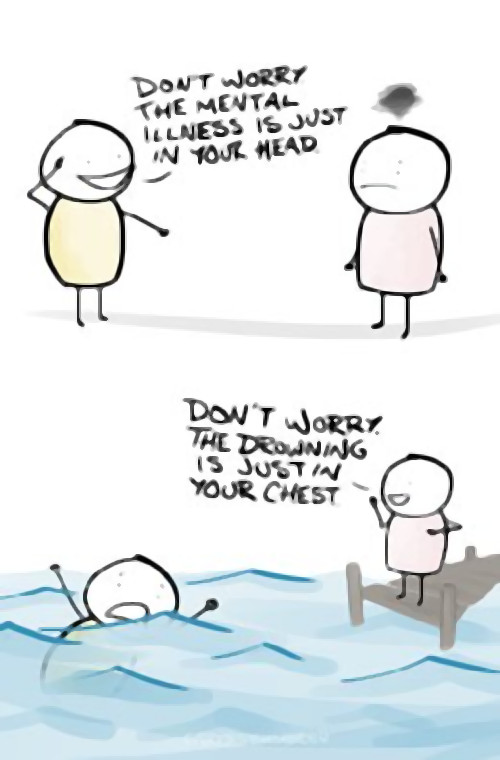
I don’t know how I got onto this topic, but anyway, my temporary boost yesterday lasted only a few hours. I didn’t sink to as low as I had been on Thursday, but after all, if you’re treading water, it may seem for a moment, due to the chaotic action of the waves and maybe a random burst of extreme effort from you, that you have risen higher above the surface of the sea…but you will not stay elevated. You will sink back down to the level of whatever passes for neutral buoyancy, after briefly dipping lower. And, of course, unless you reach shore or a passing boat finds you, sooner or later, you will drown.
That is, unless you’re lucky enough to be eaten by sharks.
*Or perhaps those who have suffered brain damage due to real violence, but those people can be cut a lot of slack.
**Figuratively speaking. I don’t have lice (which is what I am led to understand the term “cooties” originally meant) nor any other literal contagious infestation or infection.






 Robert Elessar