O heavy lightness, serious vanity, misshapen chaos of well-seeming blogs

Hello and good morning.  It’s Thursday, of course‒thus the “traditional” opening salutation‒and here I am again, writing another in a line of hundreds of Thursday blog posts.

Have I said all that I could say, already?  Probably not.  The number of possible 800+ word strings of English writing is surely unfathomably vast.  If I were going to try to give some kind of upper boundary, we would consider that there are a few million words in the English language, and I could just try to solve for a few million to the 800th power.  That’s a huge number (104800). But most of those combinations‒all of them, effectively‒would be nonsense.

By “all of them” I mean that, if one applies the constraints of grammar, or even just of making tolerable sense to a potential reader, the number of strings of 800 coherent words is so much smaller than the number of possible strings of 800 words without care for sensibility that, if one were looking at some shape or field that represented the latter, the former would probably be too small to see, given the constraints on the resolving power of visible light.

It’s a bit like the possibilities implicit in DNA.  The human genome is on the order of a billion or so base pairs* long, if memory serves, and each “site” on the genome has 4 possible “letters”.  So, the potential number of sequences of DNA in that genome is on the order of 4 to the billionth power, which would be 2 to the 2 billionth power, which is about 10 to the 600 millionth power (10600,000,000).

That’s a huge number. Remember, a googol is merely 10100, and it is already a number that far exceeds the number of baryons in the (visible) universe (which is on the order of 1080).  And remember how exponentials work:  every time you add 1 to the exponent you multiply by the base number, in this case 10.  So, 10101 is ten times larger than 10100.

As you can see, the number of possible DNA sequences is beyond astronomical, at least unless we get into, say, the measures of entropy represented by an event horizon, as an indicator of the number of possible quantum states it could have “within”.  But distances and times and numbers of particles in the accessible universe are unnoticeably small compared to the number of possible sequences of DNA**.

However, the vast majority of those base-pair combinations would certainly not code for anything that we would consider human, or indeed any other living creature that’s ever existed on Earth.  Most are the analogue of throwing random words together to make a blog post.  They wouldn’t come close to coding for anything that would be a living creature.

Nevertheless, even ruling out all the nonsense, the number of possible viable human genomes is vast.  It may still be larger than the number of particles in the visible universe, but don’t quote me on that‒I haven’t checked those numbers.  In any case, it’s much larger than the number of humans who have ever lived, and probably larger than the number of humans who will ever live even if the species goes on to become cosmically significant.

What this all comes down to, I guess, is that I haven’t come close to writing all the possible blog posts I could write, even ruling out ones that wouldn’t make any sense and even ruling out ones that differ from others only by a word or two.  I guess this blog itself constitutes a case in point.

But boy, it can be a lot of work trying to write something new every day, and even more work trying to write something interesting.  That’s why I don’t bother with the latter criterion; I just write whatever comes out, which is usually something at least mildly interesting to me, and I figure it’ll reach kindred spirits if they happen upon it‒and if such people even exist.

Speaking of kindred spirits, I hope you all have a lovely day.  At least I hope it will be as good as it can possibly be‒which it will, since once it’s happened, it can’t have been otherwise than it was.

TTFN


*In case you don’t recall, DNA is a long chain molecule of polymerized “nitrogenous bases”, adenine, guanine, thymine, and cytosine.  Because each DNA base can pair up only with its complementary base (A with T, G with C) this allows for high fidelity copying, and thus reproduction.

**Now, if the universe is spatially infinite‒which it looks like it is, but may not be‒then of course the number of particles or quantum states or even planets with life would be infinite, and thus larger than any possible finite number, no matter how big you might choose.  Fun things happen when one deals with infinities.

I’m sorry, I don’t have the energy for a Shakespeare based title

Hello and good morning.  It’s Thursday, and though I don’t particularly feel like it, I’m writing a blog post because it’s Thursday.  This doesn’t necessarily mean I’m going to write one tomorrow or Saturday (assuming we* are open, which we probably will be, since it’s rare to be closed two weekends in a row).  As far as I know, I will not.

I don’t really have any energy or impetus to write much.  I’m trying.  I’ve been rereading my fiction to try to stimulate myself, but so far it’s obviously not doing the trick.  I reread first The Chasm and the Collision, then Son of Man, then The Vagabond, and just yesterday finished rereading Mark RedI’ve also reread a few of my short stories.  But, though I’ve enjoyed rereading my stuff as far as it goes, it’s not really doing anything as far as catalyzing any desire to write, whether fiction or nonfiction.

I think things would be much more positive if I were able to get a good sleep (at least one night) and especially if I weren’t in daily, increasing pain.  I’d be tempted even to try ketamine if I thought it would really help, though there are some cautionary examples in the mainstream media that would give me pause.  Heck, I’d practically be willing to try full-on PCP if I had good reason to think it would provide lasting relief without causing worse problems.

Of course, there’s the rub.  All of these things that can provide even temporary, real relief have a range of side-effects that would make my situation even worse than it is.  Yes, I freely admit that my life could get worse.  It’s almost always true that things could be worse than they actually are.  But that doesn’t mean they’re good.

I’m just so weary, so tired of every day being dominated by both physical and psychological pain.

Actually, I feel that the last adjective there should be “psychical” not “psychological”, since the latter term refers to the study of the psyche, and I don’t have pain or suffering that involves the study of my psyche, just pain in my psyche itself.  Still, the common usage, for what it’s worth, seems to lean toward “psychological”.  Then again, current common parlance refers to psychological problems as “mental health”, as in “Are you suffering from mental health?” which makes little sense.

I wish I could wrap myself in some kind of life-support cocoon and undergo some form of metamorphosis, like Adam Warlock in the comic books.  Hell, just being able to sleep for a while seems like it’s a ridiculous, superstitiously foolish notion, on a par with the expectations of the Heaven’s Gate cultists, who thought a space ship was coming to gather their souls (and was supposedly hiding in, I think, the tail of the Hale-Bopp comet).

I want to rest.  I want to stop being in constant pain.  It’s been going on for more than twenty years, and it’s tainted every aspect my existence.  It has contributed to everything from the breakup of my marriage, to my arrest and incarceration, and to my inability to sustain or create any kind of close relationship of any kind.

The people “closest” to me are hundreds to thousands of miles away, and I have no doubt that if they were physically closer, a kind of Uncertainty Principle-like process would occur, such as what makes the momentum/energy of, say, an electron greater and greater the more tightly you try to pin it down, until more and more of its wave function leaks out and the probability of it being elsewhere‒even on the other side of the universe, so to speak‒dominates over any local presence.

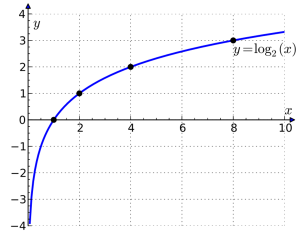
I’m probably not explaining that very well, I’m sorry.  But I don’t even have any will to watch science videos or to read science books or what have you, let alone to go into any rigorous discussions thereof.  I’m just making the point that I’m much better for other people from a distance than from up close, with the function approaching a singularity (of negative infinity) as the distance from me shrinks toward zero, rather like some logarithmic function.  This graph (of log base 2) demonstrates why, from a certain distance, it can start even to be pleasant to interact with me, though with diminishing returns…but woe betide anyone who drops below one unit of distance.

Okay, that’s enough for today.  It’s probably much more than enough.  I’m sorry to be so tedious; believe me, no one gets more tired of me than I do of myself.  At least all of you can just go read something else by someone else, or do something else entirely.  Not I.  I am stuck with being and enduring the miserable git that I am every waking moment.  And waking moments make up far too great a proportion of the times of my life.

Have a good day, if you can.

TT…FN, I guess.


*By we, I mean the office at which I work.  While I have no problem joining with you, my readers, into a collective, first person plural pronoun, I simply have no idea what y’all’s work schedules are.

Maybe it’s signal. Maybe it’s noise. Maybe it’s Maybelline?

Well, it’s Tuesday, and I don’t know that I have anything of use or substance to say, or anything to say that isn’t mostly just noise.  Perhaps I’m just some peculiar source of radio static in the background of the universe.  Or perhaps…perhaps I’m just pretending that what I do is unplanned, when in fact everything is calculated and subversive.

Ha!  I wish.  My brain doesn’t work like that, and I’m not sure anyone else’s does, either.  Even John Von Neumann had to develop complex mathematics and sophisticated models to deal with the limited degree of uncertainty in highly simplified versions of one-on-one poker.  If he was so intrigued by what he‒possessing perhaps the highest general intelligence of which history is firmly aware‒could not fully model, then this is strong evidence that no one, now or ever, has really been in control of anything.

Of course, game theory has advanced since Von Neumann co-invented it, and it is certainly useful, but it is clear that, at best, it deals in probabilities and tendencies.  There is no Asimovian 2nd Foundation Hari Seldon psychohistory that can figure out the specific events of whole galactic civilizations well into the future, and I doubt there ever will be.

Of course, if we want to be trivial, we can predict the far future with some degree of confidence:  Eventually, unless our knowledge of the universe is deeply mistaken*, as entropy increases inexorably, new stars will stop forming, old stars will burn out (even red dwarfs), black holes will evaporate, and the universe will be a thin haze of elementary particles.  Indeed, if everything eventually reduces to massless bosons (e.g., photons) then in a very real sense, time will literally have no meaning, since photons, being massless particles, do not “experience” time.  From their point of view‒to speak very figuratively‒their entire existence is instantaneous.

Of course, going on to the very far future, given the nature of probability, new universes may arise.  Something like Penrose’s conformal cyclic cosmology may be the way things happen, or there may merely be a Poincaré recurrence of the universe.  Or maybe, as I’ve speculated previously, time is not one way, and our future might also be the future of another, far distant “big bang” but for which time/entropy increases in the opposite direction.

Also, of course, if civilization and intelligence persists and grows, which is not a small “if”, then who knows where technology will develop?  Our descendants could conceivably develop the capacity to do cosmic engineering, literally shaping the large-scale development of the universe, or even making new ones.

But I suspect they still will not be able to micromanage perfectly the interactions of innumerable agents in complex systems.  Some limits are fundamental, and I think this may be one.  This comes down to something related to my “Elessar’s First Conjecture/Theorem”, that no complex, intelligence can ever fully understand itself in detail, because to model a given complex system requires a system of greater complexity, which itself will need to be described, leading to an infinite regress.

And, of course, we know that in complex systems, in which interactions are stochastic and multivariate and nonlinear (and thus exhibit chaotic development) the specifics of future happenings will be unpredictable since to know them perfectly, we would need an infinite number of significant digits**, though in some cases‒like entropy‒we can make general predictions with high confidence.  

This is part of why “planned economies” fail, and almost certainly always will, unless they are stupendously lucky.  In any case, such luck will not last, just as neither strength nor good purpose will last in the presence of the One Ring.  This is also why most complex conspiracy theories are simply laughable.

People derive their models of the world to too great a degree from our ubiquitous visual entertainment, which has been around long enough to be deeply self-mimicking and self-derivative.  Gunshots and explosions don’t behave in real life the way they do in action movies, but action movies (and shows and videos) take their models of the world from previous action movies, much as an AI’s model of human speech and interaction, if derived from the internet, is going to be increasingly contaminated by the products of other AIs, and may end up veering far away from anything reminiscent of human interactions, at least if left to its own devices.

Maybe that’s an advantage of written fiction over movies and TV and other videos; it’s not presenting a simulation of some version of reality, it’s telling you a story, describing things, but you have to imagine them.  Meanwhile, if all your fiction is in words, your physical intuition of the real world‒and your psychological and sociological and economic intuition‒would be derived from real events, not the Machiavellian machinations of Manichean movie-based manipulators.

That was an interesting stream of consciousness, if I do say so myself (and I do).  Who could have predicted it?  Not I.  And I’m the one who wrote it.  Which goes to my point.

Please try to have a good day.


*This is always possible in principle, but for many aspects of cosmology, our credences can be justifiably high.

**I sometimes say that while knowledge can vary greatly, ignorance is always infinite.  This can be proven with a single, simple example:  the digits of pi.  There are an infinite number of them, and no matter how many we calculate, there will be an infinite number we don’t know.  Ditto for e and any other transcendental numbers, let alone all the other real numbers that have no specific designation, of which there exist an uncountable infinity.  And this is just one place where infinite information dwells, of which we will always have only finite knowledge.

We skipped the light fandango…

Well, here I am, writing a blog post again on Tuesday, Batman* only knows why.  I don’t really have anything of substance to say.  Not that I had anything of substance to say yesterday.

Actually, come to think of it, I did encounter a neat fact last week.

One morning I decided to get in a bit of reading in one of the textbooks I keep in my office‒Classical Electrodynamics by John David Jackson.  I employed a technique I’ve often used for reviewing:  I flipped a coin to increasingly winnow down the textbook‒heads is first half, tails is second half, etc.‒and pick a random section to start reading.

I knew that much of the mathematical formalism and at least some of the technical matters in the book would be unfamiliar, so I didn’t expect to understand fully what I was reading.  But I also know that the stuff I do and don’t understand will linger in my brain, and as I’m exposed to other things that go with it or explain it or link up with it, the picture will form.  I don’t read or learn especially quickly, but I do learn deeply, and in a way that connects ideas and principles together in the end.

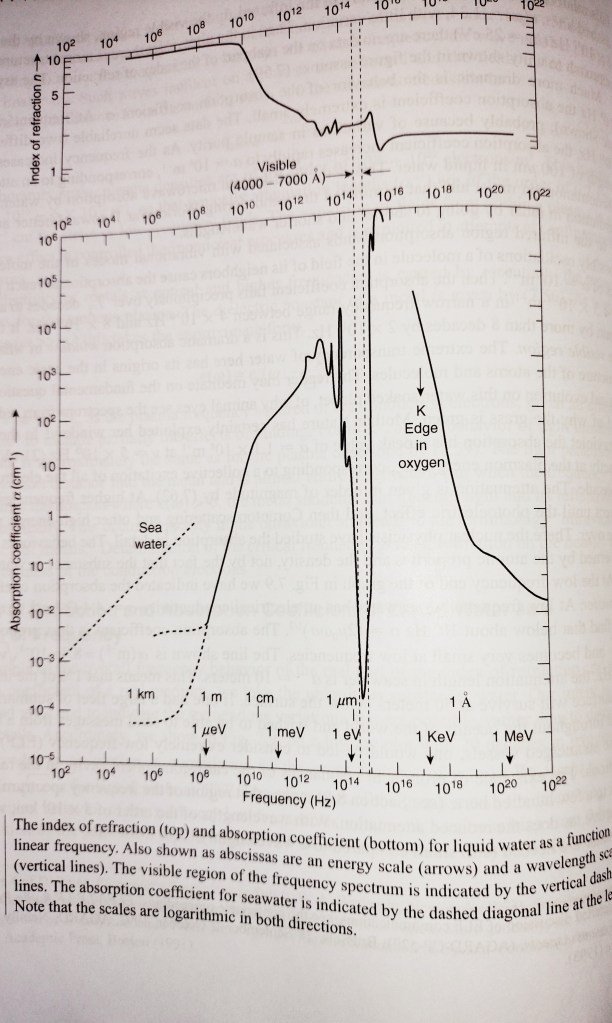
There was much of this brief section (which was about refraction and/or absorption of light** by water) that was slightly over my head.  Nevertheless, it was interesting, and the author introduced a graph (see below) showing at the top the refraction of light by water across wavelengths, and how it tends to vary.  I assume we’re all at least implicitly aware of the fact that different wavelengths are refracted by water differently‒thus the phenomenon of rainbows.

Below this is a table showing the absorption of electromagnetic radiation by water across frequencies.  Here there is a steep upward slope when coming in toward the center from highest and lowest frequencies.  It peaks at around the microwave/infrared wavelengths from the left and around the ultraviolet from the right.

Then a striking thing happens.  There is a sudden, precipitous drop in absorption down to very low levels in a fairly narrow range of frequencies in the “middle” of the graph, meaning that in this range, light passes through water with relatively little absorption.  This is the range we know as visible light.

The author took the time to point out that this fact about the nature of water‒that it is more or less transparent in this very narrow range of frequencies‒is exactly why we Earthlings tend to see only in that range.  It’s not an accident of evolution, some ancient, stochastic occurrence that is thenceforward cemented, unchangeable, into all descendants, like the DNA code and ribosomes and the chirality of biological molecules.  It is instead a fundamental fact of physics that determines where creatures will be able to see if they first developed vision while living in water and then developed eyes that, like the rest of them, were mainly made of water.

There’s no point in making retinal proteins that react to wavelengths of EM radiation that are almost entirely absorbed by water.

That simple fact‒simple in summary, at least‒is enough to explain a huge swath of the nature of our visual perception, and it doesn’t require any further explaining to understand why we see in the range of light we do.

That was just a randomly chosen section of a textbook that reputedly is extremely difficult.  I don’t disagree with that assessment of difficulty; it was a very dense bunch of material even in just 4 or 5 pages.  But to think that one can find such remarkable facts while just trying to read and learn in random order from a textbook!

So, that’s an interesting little tidbit that seems worth sharing, at least to me.  It’s far more interesting than anything going on in the human world right now.  What’s more, this is a fact that has existed as long as water itself has existed‒and implicitly, it existed even before that, lying there waiting in the fundamental laws of nature.  And it will be there long after everything but those fundamental laws is gone.

If you want to embrace eternity, and things like Hilbert’s Hotel and Cantor’s diagonal proof make you worry about your sanity (this happens to many of us, so don’t feel bad) then focus on this fact about visible light.  It’s there, it’s real, it’s quasi-eternal, and it’s concrete.

Though the absorption spectrum for concrete is…quite different.


*This harkens back to the reference from Batman Begins, when Flass says “I swear to God,” and Batman snarls “Swear to me!”  It seems fun to use Batman when one would normally say God.

**By “light” I mean all electromagnetic radiation, from radio waves to gamma rays.

O Caesar! These blogs are beyond all use…

Hello, and yes, good morning.  It’s the 1st Thursday of December in 2024, and so it is time for another edition of my weekly blog post.

I’m writing this on my miniature laptop* on the way in to the office, because I figured it would be a shame to let the device go to waste.  I haven’t used it at all since the last blog post I wrote on it, which would have been…looks like it was November 20, 2024.

Other than the little post I wrote on Monday—which I wrote on my smartphone—I haven’t written anything this week.  I haven’t played any music this week, by which I mean neither have I played it on a device for me to hear, nor have I played the guitar or the keyboard, though I guess I’ve tapped drumbeats on walls and desktops and door jambs and the like from time to time.

I am reading a Japanese light novel series, one that I’ve chosen because the characters are at least reasonably likeable, the story is more or less upbeat and decently written and translated, and there are enough volumes out to keep me busy for a week or two.

I haven’t read any science or math or philosophy in quite a while.  I certainly haven’t written on any books of my own.  I haven’t even watched any science-related videos, to be honest.  The only math I’ve done was when I saw a Facebook post of a sign in Taiwan or China that had an infinite series in sigma form written on it.  I thought I recognized the series, but I wasn’t at all sure, so I worked out the first seven or so terms and summed them up, and it became clear that this was the series that summed to Pi.  It was indicating, apparently, that there were 3.14 kilometers left in what I think was a marathon route.

You wouldn’t see a sign like that in the USA.  Though we have some truly brilliant people in mathematics and science and whatnot, they are a rarefied bunch, and the vast majority of the population is borderline mathematically illiterate, and some of them are stupid enough to be proud of that fact.

I did have one slightly interesting occurrence yesterday—from my point of view.  I was scrolling through “reels” on Facebook and saw one with a woman sitting in a room and giving a sort of strained, tiny smile, and the caption read something like, “I guess the fact that it’s holiday decorations that are hanging now, and not yourself, makes it a successful year.”  That’s not quite right; it was better written, but that was the gist.

I recall thinking, not entirely seriously, “That’s easy for you to say.  I don’t consider it a good result that I’m not the one hanging.  I even have two ropes already prepared for that possibility, but I don’t have any decorations or ornaments, and I have no one with whom to share the holiday season or anything anyway.”

I intended to write that (more or less) as a comment, which required going to the original post on Instagram; I was going to try to be at least a bit jokey about it, so as not to make the poster think was angry at her.  But when I got to the post, I saw that there were people who were complaining about it, saying that jokes about suicide were in bad taste or something, that they had lost relatives or friends or whatever to suicide, and such posts made them feel sad or something.  They had a long string of comments.

A few people wrote in response that such “jokes” or posts, even if seemingly morbid, were often a good way for people to deal with the emotions that overwhelm them, and knowing that other people feel that way and can speak about it was helpful.

But the Puritans were all too stuck in scolding mode.

I wanted to write more, but ended up just saying, “Surely no one has been forced to read this posting.”  The original poster, apparently, replied to my comment, saying that I was wrong, that she was sorry to have been insensitive to people, and wanted to try to be more careful in the future.  I had to bite my figurative tongue to keep from replying, “I was wrong?  You mean people were forced to read the post?”

And then I wanted to add something along the following lines:

“As someone who thinks about suicide daily, ever more so over time, and who feels the urge particularly strongly at this time of year, what with the waning sunlight and the holiday environment, it can be kind of nice to know that other people are thinking similarly, and are even able to be somewhat lighthearted about it–even going so far as to give a slight joke, to try to be positive.  I think all the people who are scolding and berating should be turning their scorn on themselves, if anything.  Maybe if they’d spent less time being so eager to shut other people down when talking about uncomfortable things, they might have encouraged a situation in which their own loved ones might have felt able to talk about their depression and despair.  Maybe these commenters are feeling defensive about the fact that, for all that they’re willing to berate strangers for talking about suicide (in a comparatively light hearted way) what they really need to do is berate themselves for not having done anything of significance to try to help their relatives or friends or acquaintances who were in such pain that they ended their lives.  Maybe if they tried to encourage a climate in which people felt able to talk about the despair that so many people experience—especially people who are “different”, who are, for instance, “neurodivergent” or who just feel weird and alien compared to everyone else on this waste of a planet—then fewer people would feel utterly alone and at a loss and with no apparent answer to their pain and loneliness other than destroying themselves.”

Of course, I didn’t leave that comment.  But it is terribly irritating that people go out of their way to comment negatively about someone who is trying to put out at least a slightly uplifting or relieving thought, but I doubt they went to any trouble at all to support their “loved ones” who were suffering.  Fuck all of them, I say, and in all the most inappropriate and uncomfortable orifices.  They’re making the world worse, not better, with their “Waah, look at how this all affects me, everyone, I don’t like to be reminded about sad things, because I did nothing to prevent or ameliorate the sadness, so now I want to make sure no one else admits that it exists”.

Well, the maker of that reel apologized, but I don’t think she should have, and I am certainly not doing so, though I restrained myself from hurling my ire at those people in the comments section, and only left my original one.  But if I could, I would like to give those people a brief taste of the despair and solitude and emptiness and pain that a person feels when they are severely depressed and suicidal but don’t have anyone they can really talk to about it, no support, since our society still doesn’t deal with mental health issues almost at all.

Even if I could do that, it probably wouldn’t help.  Once that temporary pain went away, those people would almost certainly go back to the way they were before.

That’s enough for now.  I’ve written too much, and the editing process is daunting.  I think I’m only going to give it two go-throughs before posting, instead of three.

I hope most of you—well, all of you—feel better than I do.  If I were convincingly told (by some being who could guarantee it) that by my death I could eliminate depression and despair in the world in everyone else, or even that I could just foster an environment in which people could be open about it and help could be provided at least to the same degree we provide it for heart disease and cancer and infectious disease, then that would be a pretty east decision.

But, of course, reality doesn’t work that way, and there’s no reason to think it ever will.  That still doesn’t mean that there aren’t other, legitimate, valid reasons for a person like me to feel that he and everyone else would be better off—or at least no worse off—if I were dead already.

“Oh well, whatever.  Never mind.”

TTFN


*The miniature laptop is a computer.  The top of my own literal lap, though slightly reduced due to my paunch, in certainly not miniature.

**In English, of course—I’m not partaking of my old ambition to practice reading Japanese until I got truly good at it.  What’s the point?  They would never allow me in the country, anyway, thanks to my “criminal” record***.

***That’s actually kind of funny…what if nations didn’t allow President-elect Trump into their countries because of his felony record?  Of course, that’s not going to happen, it would be a diplomatic disaster.   Once again, the Donald shows that he can successfully be separated from the enforcement of the law, thus sending what ought to be a message to the American people:  Why should you bother obeying any inconvenient laws?  The President doesn’t!  Screw paying taxes or following through on contracts!  It’s every person for itself, in the most short-sighted, opportunistic, petty ways possible.

****Who would ever choose such a thing?  Its very nature is learned helplessness, self-hatred, emotional and physical pain that doesn’t seem to let up, that feels eternal when it’s happening.  It is a metaphorical and sometimes nearly literal version of Hell.

If I could write the beauty of your blogs, and in fresh numbers number all your graces…

Hello.  Good morning.

Aaahhh, doesn’t that feel better?  Now I can use my standard Thursday blog post opening phrases, because today is, in fact, Thursday.  It’s the 21st of November, the third Thursday of the month, so in the USA you only have seven shopping days until Thanksgiving.

Speaking of Thanksgiving, since next Thursday is that holiday, I probably will not be writing a blog post then.  It is one holiday on which our office is always closed.  We will be open on so-called Black Friday, but I can’t guarantee that I’ll write a post on that day.

Of course, in principle, I cannot guarantee that I’ll write anything at all ever again after this post.  I may not even survive to post this entry*‒I am in the back seat of a Lyft, on the highway (I-95) of the East Coast of the US, so goodness knows there’s a non-zero chance of a fatal accident.  I would even wish for one, but I know such a thing would involve harm and possibly death to other, more innocent, people.

Also, of course, wishes don’t actually directly affect reality‒thank goodness.  Imagine if even one percent of wishes came true as wished.  The world would be thoroughgoing chaos…and not in a good way.  I tend to say of wishes that “If wishes were horses, then we’d all be hip deep in horse shit,” but it would be even more terrifying if wishes worked.

The “if‒then” character of the wishes saying (my version or the more SFW one that involves beggars riding) often makes me think of lines of computer code in some generic programming language, like:

If wishes==horses then execute beggars.ride

Or maybe 

If wishes==horses then horseshit_level = “hip deep”

I wonder what that would look like in machine language.  Or, I wonder what it would look like in straight binary.  Really, though, I know part of the answer to the latter piece of wondering:  it would look, to the naked eye, like a random string of ones and zeros, perhaps the tally of some very long record of flipping a coin and marking heads as 1 and tails as 0 (or vice versa).

Actually, of course, given a binary-based computer language, one can literally generate every possible computer program just by flipping an ever-increasing number of coins.  Or, to be honest, one can do it just by counting in binary:  0, 1, 10, 11, 100, 101, 110, 111, 1000…

This is why, if memory serves, computer science people and information theory people say that every program can literally be assigned (and described by) a number.  You could express that number in base ten if you wanted, to make it a bit more compact and familiar to the typical human.  Or, if you want to be more efficient and make conversion easier, you can use hexadecimal.  This is easier because a base-sixteen number system is more directly and easily converted to and from binary, since 16 is a power of 2 (2 to the 4th).

Even the human genome, or any genome in fact, could be fairly readily expressed in binary.  The DNA code is a 4 character language, so it wouldn’t take too much work to make it binary, however you wanted to code it.  Then, each person’s genome would have a single, unique number.  That’s kind of interesting.

It would be a bit unwieldy as an ID number, of course.  The human genome is roughly 3 billion nucleotides long, which means it would be roughly 6 billion binary digits (AKA bits).  And since every ten bits is roughly a thousand in base 10 (2^10 is 1024, which is very close to 10^3, aka 1000) then 6 billion bits should be roughly 2 billion decimal digits long (a bit less), which is much, much larger than the famously large number, a googol**.

It’s a big number.  This should give you at least some idea of just how unique each individual life form is at a fundamental level.  There are so many possible genomes that the expected time until the final heat death of the universe is unlikely to be long enough to have a randomly created duplication within the accessible cosmos.

Of course, within an infinite space‒which is the most probable truth about our universe as far as we can tell‒one will not only have every possible version that can exist, but will have infinite copies of every possible version.  Infinity makes things weird; I love it.

Of course, just as with the making of computer programs by simply counting in binary, the vast majority of genomes would not code for any lifeform in any kind of cellular environment, using any given kind of transcription code you might want (the one on Earth, found in essentially all creatures, uses three base pairs to code for a given amino acid in a protein, but that’s not all that DNA does).  Similarly, most of the counted up programs would not run on any given computer language platform, because they would not code for any coherent and consistent set of instructions.

But even so, you would still, eventually, get every possible working program, or every possible life form in any given biological system if you could just keep counting.

On related matters, there are things like the halting problem and so on, but we won’t get into that today, interesting though it may be (and is).

It’s quite fascinating, when one is dealing with information theory (and computer science) how quickly one encounters numbers so vast that they dwarf everything within the actual universe.

Mind you, the maximum possible information‒related to the entropy‒carried within any bounded 3-D region is constrained by the surface area (in square Planck lengths) of a black hole with that size event horizon.  For our universe, roughly 96 billion light years across, I think that’s something like 10 to the 124th bits, or at least it’s that many Planck areas.  That’s quite a bit*** smaller than the number of possible genomes, though I have a sinking feeling that I’m underestimating the number.

And information, at least when instantiated, has “mass” in a sense, and the upper limit of the amount of information in a region of spacetime is delineated by the Bekenstein entropy description.  So there’s only so many binary strings you can generate before you turn everything into a black hole.

Something like all that, anyway.

I may have been imprecise in some of what I said, but when you’re dealing with very large numbers, precision is only theoretically interesting.  For instance, we**** have found Pi to far more than the number of digits needed to calculate the circumference of the visible universe down to the Planck length.  It would require only about 40 digits of Pi to get to that precision to the size of a hydrogen atom, and those are only about 10^25 Planck lengths across, so we wouldn’t expect to need much more than 65 digits of Pi to get that precise, but let’s be generous and use 100 digits.

How many digits of Pi have actually been “discovered” by mathematicians?  Over 105 trillion digits.  Talk about angels dancing in the heads of pins!  It’s literally physically impossible, according to the laws of quantum mechanics, even to test whether that number precisely defines the ratio of any given circle to its diameter by measuring it.  One cannot, in principle, measure finely enough.

Still it just goes to show that mathematics is vastly larger in scope than any instantiated, superficial reality.  Information is deeper than one might think…so to speak.  But, then, so are minds themselves, vastly deeper.

As Idris/the TARDIS asked in Doctor Who, Series 6, episode 4, “Are all people like this?  So much bigger on the inside?”  Yes, Idris, I suspect they are, even those people we don’t like and feel the urge to denigrate.

That’s enough for today, I think.  I’ve achieved nothing, really, other than write a Thursday blog post, but then again, that’s all I meant to do.  I hope you have among the better half of all the vast number of possible days available to you.

TTFN


*If you’re reading this, though, I clearly did survive.  I have mixed feelings about that.

**How much larger?  Soooo much larger that if you subtracted a googol of something from 10^1,800,000,000 of something, you would not change it to any extent measurable even by the most precise instruments humans have ever created.  And a googol is already something like 10 to the 19th times as large as the total estimated number of protons and neutrons in the accessible universe.

***No pun intended.

****Actually, I had nothing to do with it; it’s just the sort of “royal we”***** kind of thing everyone uses when discussing the accomplishments of humanity as a whole.

*****Not to be confused with royal wee.  That’s the sort of weird, niche thing one might find for sale in mason jars on the dark web.  Be careful if you’re into such things.  I wouldn’t buy it unless you’re sure of the source, so to speak.

You cataracts and hurricanoes, spout till you have drench’d our steeples, drown’d the blogs!

Hello and good morning.

I’m going in to the office today, since down my way, Hurricane Milton has not been very impressive so far.  This is not a surprise.  We were always going to be only on the periphery of the system, and on the leeward side of the state (so to speak).  There wasn’t even any rain of significance down by where I live; just a bit of relatively high wind.

We are going through a bit of rain as I ride in my Lyft to work, but for south Florida, it’s a piddling amount so far.  The wind is mildly interesting, but I’ve ridden a 650 cc scooter (basically a motorcycle with automatic transmission) through wind and rain much worse than this.  I don’t think that was a wise thing to do for anyone who cared about his or her life and health much, but for me, it was just fine.

I’m in a Lyft, by the way, because the train service is suspended today, as it was yesterday.  This was probably not absolutely necessary, but I respect the abundance of caution.

Traffic, at least, seems very light, which is also not surprising.  Most people in the area are not working today, I suspect.  We shall see how many people come to the office today.

I’ve been a bit frustrated lately, as an infection of some kind (possibly a few different ones) has afflicted quite a few people at the office, but I have not gotten sick.  Not only would such an illness give me the opportunity for rest for which I am able to excuse myself (and might even allow me to sleep, given the physiology of the immune response), but it’s also an opportunity potentially to develop some more severe, life-threatening superinfection*.

Apparently, some people used to call pneumonia “the old man’s friend”.  Well, I’m not that old (and I wouldn’t recommend my friendship to anyone, even a pulmonary infection) but apparently the average lifespan for people on the autism spectrum‒assuming that I am, which I give very high likelihood‒is somewhere in the mid-50s.  So, it wouldn’t be unreasonable for something to kill me sometime soon.

Of course, such averages are strongly affected by outliers.  People with the highest support needs are probably more likely to die at significantly younger ages, and that will tend to bring the average down.  It’s a bit like how the very high infant mortality rate strongly skewed the average lifespan in pre-modern times.  People who did reach adulthood probably didn’t live much shorter lives than we do now.

Actually, modern people in the west may be backsliding lifespan-wise, at least in America, as we eat more refined carbs and are less active and so are more prone to hyperinsulinemia, which brings with it not just increased risks of diabetes and elevated lipids, but even increased risks of high blood pressure, heart disease, stroke, and many cancers, as well as infections.

The infant mortality issue illustrates one way in which reported average lifespans and similar statistics can be misleading, at least for people who don’t understand what’s behind the numbers.  It reminds me of something I may have discussed here before:  people (rightly enough) make fun of the fact that (to make up a statistic that’s probably not too far from reality) ninety percent of people think they are above average drivers.

Now, it is almost certainly true that ninety percent of people are not above average drivers; it’s just that so-called neurotypical people tend to have overinflated (and undeserved) senses of self-esteem.  But the notion that seems to be implied in most discussions of such statistics is that it’s impossible for 90% of people to be above the average.  This is not the case, at least not if “average” refers to the arithmetic mean, as it usually does.

If ninety people out of a hundred each scored exactly 51 (out of a 100, say) on some test of driving ability, and the remaining ten only scored 1 point each, then the average score would be ((90 x 51) + (10 x 1))/100, which is 46.  So, ninety percent of people would not only all be above average, but would be five points above average.  It’s not a very impressive score, but it is true.

Now, if it were said that ninety percent of people think they are above the median, then that would be erroneous by definition, because of the meaning of the term “median”.

Most people don’t seem to understand these and other mathematical concepts, and yet those concepts and related ones of many and varied kinds can have significant impacts on the lives of billions.  I once wrote a blog post on Iterations of Zero recommending that probability and statistics be more aggressively emphasized in secondary school education, because I think understanding them would give people far greater insight and even agency in the world.

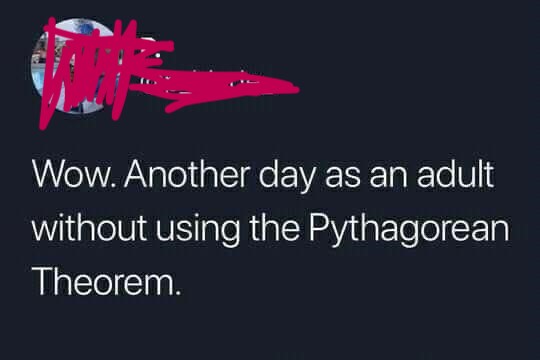
And yet, we see “humorous” memes such as the one below, of which there are numerous iterations and variations:

pythagorean meme

I say the fault for that lack of use lies with the individual, not with their education.  Just because they don’t use the Pythagorean Theorem doesn’t mean it isn’t and couldn’t be useful**, and even if the specific theorem wasn’t useful then the capacity to do it and other, related things, is useful.

I feel I may have mentioned it here recently, but even when one doesn’t use mathematics*** in one’s profession, working with them strengthens the mind and makes it more fit for many other purposes.  Usually, one doesn’t do push-ups to become really good at doing push-ups, and one doesn’t jog in order to become a really good jogger.  One exercises to become stronger and healthier, more capable.  The mind is even more responsive to exercise than is the body, and if there are limits to how strong it can become‒in whatever sense‒I don’t think anyone has come close to reaching them****.

That’s that for today.  I hope you’re all weathering your personal storms reasonably well.  The one down here hasn’t done much to me; I probably could have slept outside in the rear of the house last night without any trouble.  The wind might have been soothing.  It might even have helped me get a better sleep.  It’s not as though it could have been much worse.

TTFN


*By which I mean an infection that opportunistically occurs due to the body’s weakened defenses caused by an initial infection, not an infection with exceptional nature or virulence.

**Understanding geometry is so potentially useful in so many ways that it’s said that the only time in his life that Isaac Newton laughed was when someone asked him what the point was in studying Euclid.  Newton is universally reputed to have been quite arrogant, vindictive, and impatient, to say the least.  One can only imagine the sheer amount of vitriol and scorn that would have been conveyed by that solitary gelastic moment.

***Or philosophy, or physics, or chemistry, or biology, or history, or literature, etc.

****Not even Newton or Von Neumann.

And nature, as it blogs again toward earth, is fashioned for the journey

Hello and good morning.  It’s Thursday, and so:  here’s another blog post—meaning another regular, weekly, Thursday morning blog post.  Of course, people who receive notifications about my blog posts will have seen already that not only did I publish an impromptu entry on Monday, but also that, starting on Tuesday, I’ve been sharing a chapter at a time, three times a day, of Extra Body.

I finished the third editing run-through of that story by Tuesday morning, and I decided, “that’s good enough, I’m done with that, I’m tired of working on it, or on anything else”.  I considered just publishing it through Amazon, but that would have involved designing a cover and getting the formatting right for the paperback and e-book versions, and even then it would have been far from likely that anyone (except my sister) would read any of it, ever.  At least this way, maybe someone who is idly curious but wouldn’t go to the trouble of actually buying the book from Amazon (or other sources) might idly start reading it and even might read the whole thing.

Speaking of the whole thing, it will be completely published by Friday afternoon, which is when Chapter 12 is scheduled to go up.

I don’t know whether the story is any good or not.  I suppose that would depend upon the criteria one uses to judge the “goodness” of a story, and no two people would probably have precisely the same implicit criteria.  I say “implicit” because I doubt most people (or anyone, really) would actually apply any formal judgement criteria to such things.  I think it’s a much more “analog” process, a weighted neural network/high-dimension vector addition (or possibly vector calculus) sort of problem.  As such, it probably changes from day to day and even from moment to moment for every person.

It may be mathematically possible in principle for two people to have exactly the same judgment criteria about fiction*, but I suspect that there aren’t anything like enough people in all the universe—not just spatially but temporally, past and future—to have exactly the same mental state regarding how they judge and react to fiction at any given time, or even in their entire lifetimes (this discounts the potential “quilted multiverse”, if the universe is spatially infinite, in which all states would recur an infinite number of times).

I’m giving this more thought than it probably deserves.  I tend to do that.

On to other matters, or at least, let’s move away from that subject.

This Sunday will be the day of the Autumnal Equinox, the official beginning of Autumn in the northern hemisphere.  It’s also September 22nd (this is often the case with the Autumnal Equinox) and is thus the date of Bilbo and Frodo Baggins’s birthdays (according to Shire reckoning, anyway—I’m not sure precisely how that lines up with the Gregorian calendar, but I suspect Tolkien just kind of took them as roughly aligning, though the hobbits apparently took the 5 (and a quarter-ish) extra days of the year as a non-month in midsummer and had 30-day months for all the rest of the year).  That was also the day on which Frodo left Bag End to begin his long and arduous and torturous path to destroy the One Ring.

So it is an auspicious day in more than one sense, a day on which momentous or portentous things may begin or end or begin to end.

Though Frodo survived, of course, he never was quite the same after his journey, having suffered from the stab of the Morgul blade on Weathertop, and the bite of Shelob, and—most of all—the terrible effects of the Ring itself when it was at its most perilous, its most awake, and its most desperate.

The voice-over near the end of the movie The Return of the King really expresses Frodo’s sense of enduring damage and suffering:  “How do you pick up the threads of an old life?  How do you go on when you begin to understand there is no going back?  There are some things that time cannot mend.  Some hurts that go too deep, that have taken hold.”  How, indeed?

Nietzsche is famously quoted as having said that whatever doesn’t kill us makes us stronger.  In response to that, I would simply say to him, “syphilis”**.

There are many things that do not kill us that nevertheless wear us down, leave scars and damage and dysfunction in their wake.  Of course, one could reply that such things are killing us, they are merely doing it slowly, in a cumulative and collective fashion.  But if one is going to reach for that linguistic/semantic escape clause from the dichotomy of Nietzsche’s statement, then one is merely engaging in tautology.  If one says that anything that doesn’t make us stronger is, by our definition, killing us (even if only slowly), then saying that whatever doesn’t kill us makes us stronger is just saying the same thing.  No insight is gained.

In any case, things wear out and fall apart no matter what.  As far as we can see, that is a fundamental aspect of the nature of reality.  New things do arise, lives are born, stars form, perhaps new “universes” are constantly emerging in an eternal inflationary universe.  But mathematics dictates that all things eventually seek out the most entropic states—not out of any desire, any “telos”, just out of the tendency of the math of complex systems.

Things fall apart.  The center cannot hold.  And Darkness and Decay and the Second Law of Thermodynamics hold illimitable dominion over all***.

TTFN


*Though if the process is truly continuous, in the “real numbers” sense of continuous (quantum mechanics suggests this cannot be so), then there would be literally, uncountably infinite possible arrangements, and so it would be “infinitely improbable” for any two people ever to match exactly.  That seems appropriate, given the story being discussed.

**Perhaps the real “Montezuma’s Revenge”.

***This is a mashup of and paraphrasing of separate literary works, so I’m not surrounding it with quotation marks, but:  credit to Yeats and to Poe****.

****No, NOT the heroic pilot from the newer, Disney-Star-Wars films.  You Philistines*****.

*****This is, ultimately, a reference to the fact that the Philistines, according to legend, stole the Ark of the Covenant from the Temple of Solomon, and thus their name is used as an epithet referring to those who show no respect for sacred or artistic or cultural worth.

There’s the respect that makes calamity of so long blogs

Hello and good morning.  It’s Thursday, and so it’s time for another weekly blog post.  Last Thursday I was out sick, so I only posted a very brief, almost telegraphic announcement of the fact that I wasn’t going to write a “true” post that day, and I said that I might write a true post on Friday if I was feeling better.  Of course, I was not feeling better by Friday, so there was no such post.

I’ve nearly recovered from my acute illness—probably some respiratory virus, but nothing too terribly severe—and now I am more or less back on my normal schedule.

Speaking of being “back”, though, my back has been acting up severely this week, and in an atypical fashion.  I’m not sure what triggered it.  Possibly it’s just due to being sick, with the coughing and the lying around more than usual and so on.  Possibly it’s something else.  Anyway, I’ve had to go to a combination of near-overdoses on my various OTC pain medications, and that’s not wonderful.  It got so severe yesterday that I was actually saying out loud that, if it didn’t improve, I was going to have to find some relatively high parking garage nearby and jump off it.  I was not exaggerating, as I think was obvious to those around me.

It’s easy enough to wonder why I don’t do that anyway, given that there is very little in my life that’s positive, and what positivity exists is episodic, and it can’t make up for the constant negatives of pain and illness and sleeplessness and depression and so on.  The closest I come to any comradely activity is streaming YouTube videos of people reacting to songs or movies that I like.  It’s almost, but not quite, exactly unlike watching a movie with a friend who has never seen it before.

Speaking of paraphrasing or otherwise referring to The Hitchhiker’s Guide to the Galaxy, I’m most of the way through the first run of editing Extra Body.  There’s a long way to go, since I usually do as many as seven such iterations before considering my editing done.  I figure by that time I’ll usually have lost any proprietary affection for a story and it will begin to bore me, so it’ll be easier to cut out extraneous material.

That’s the principle, at least.  I don’t know how well it’s worked hitherto; I’m too deep inside the process to trust my evaluation.  I did at least transcribe the material I had written so far, in passing, on HELIOS, so that if/when I’m ready, I’ll be able to pick up writing that by hand in its first draft.

Extra Body is my first non-horror story in a while (unless you count the beginning I made on writing The Dark Fairy and the Desperado, which is certainly not horror, but is also certainly nowhere near done, if it ever will be).  It’s hard for me to tell if it’s a good choice to have reverted to a sort of lighthearted science fiction story set in the modern world, but at least I was able to squeeze the first draft out.

Of course, I’m paring down the word count as I go.  As I’m sure is obvious to all of you, I get rather wordy when I write, especially when I’m using the computer keyboard, since I type quickly and usually can do so more readily even than I can speak out loud.

I’ve been reading some more books about quantum field theory (and related subjects) lately.  It’s still very intro level stuff, of course, but either because recurrent exposure to increasingly technical material is gradually sinking into my head, or because I’m just getting a tiny bit “smarter” overall over time, I’m actually finding some of it more familiar and understandable than before.

I must say that I was a little bit proud of myself not too long ago when I was thinking about how complex numbers are represented using a two-dimensional plane, with internally consistent mathematics and whatnot, and I wondered if one could have three-part complex numbers.  I soon realized that only even-numbered ones would work, and then I learned that these were indeed a thing (i.e., quaternions) and that indeed only even-numbered versions of such things can work.  Of course, it’s very difficult to visualize something that has four dimensions, so you just have to do the math, and I haven’t started to work on or learn that seriously, but I played with some “higher order” complex-number multiplications a few times, which was how I saw that only even-numbered ones, with separate “imaginary” roots would work.

On a vaguely related note:  I was listening to Sean Carroll’s podcast yesterday evening.  He was speaking to Doris Tsao, a neuroscientist who specializes in facial recognition and processing centers of the brain, and she mentioned that the attributes of a face can be thought of as many-dimensional, in the sense that there are numerous “variables” that can be represented about any given face, and that they effectively comprise a higher-dimensional space.

Then she turned the matter around and noted that there are apparently those who consider using such things as faces as ways of intuiting mathematical or related systems with higher dimensions, thus representing them in ways that the human mind is capable of visualizing.  I though that was a fascinating notion*.

It reminds me little bit of the concept of the “memory palace”, a mnemonic/rhetorical tool that originated in ancient Greece (so I understand) in which one associates the aspects of, say, a speech one is going to give with imagined artifacts or decorations in some imagined hall or room, so that the aspects of that speech can more readily be remembered and brought to mind when needed.

There are several fictional characters, most notably Hannibal Lecter and the BBC’s Sherlock, who use rather exaggerated versions of these memory palaces.  The one described in Hannibal is more coherent than the one in Sherlock, but they both take great liberties with how the concept was originally used.  Nevertheless, for the longest time, thanks to the amusing tableau** Thomas Harris described for how Hannibal Lecter had “stored” Clarice Starling’s (fictional) home address, I could readily reconstruct her address at will.  I think I may still be able to do it.  It should be something like “#33 Tindall Ave, Arlington, Virginia, 22308”.  If anyone wants to check my recollection, that would be welcome.  I’m not certain I got it right.

I’ve usually found such mnemonics more trouble than they’re worth.  It’s easier for me to connect concepts in the real world, building mental models of the way things work rather than trying to memorize.  This means I probably don’t learn as quickly as some do, but I learn deeply when I do, and it’s easier to connect one model to another and to spot analogies and similarities and possible connections between systems that might at first seem unrelated.  That was quite useful in medical practice, as I’m sure you can imagine.

Oh, I almost forgot:  Welcome to the first day of August in 2024!

That’s all I have to say about that.

Apparently the summer Olympics are currently taking place, but I’ve been unable to muster any interest in them, though I used to love them, and I find that the manufactured controversies about some apparent misconstrual of the opening ceremony or some such (and the juvenile ripostes by political antagonists of the original misconstruers responding to the supposed offense) all serves simply to reinforce my feeling that not just the human race, but indeed all life of any kind, is a bad idea.  Thank goodness for the apparent inescapability of the second law of thermodynamics.

Anyway, I feel I’ve been meandering about here, randomly bouncing from topic to topic, without any consistency or coherency, so I’ll bring this to a close soon.  I fear that this once-weekly blog posting suffers from the fact that there are topics I probably would have brought up as solitary daily blog posts when I was doing them, but that I now want to try to squeeze in here.

I just can’t write (or edit) new fiction and write daily blog posts too, not while I’m forced to keep my day job.  If anyone out there wants to pay for my living expenses and support me so I can both write new fiction and write daily blog posts while still studying physics and programming and the like in the meantime, please, let yourself be known!  I’d be pleased to hear from you.

Otherwise, I’m pretty sure none of this is going to last very much longer.  My pain and dysthymia and alienation and insomnia are increasingly unpleasant, and there are fewer and fewer things in my life that compensate.

Here’s to Macbeth’s proverbial last syllable of recorded time.  L’mavet!***

TTFN


*It does come up against difficulties when considering the notion of orthogonal axes of vector spaces being able to be rotated into one-another.  It’s hard to see how one could intuitively consider rotating the variables of, say, eye size and cheek color into one another, or what an inner (or “dot”) product or cross product of two such variables could mean…though with the latter, it makes the use of the “right hand rule” an amusing invocation of a slap in the face…or at least poking someone’s cheek.

**Involving Jesus (age 33) marching along with a .308 Enfield rifle at shoulder arms, followed by J. Edgar Hoover in a tutu, followed by Clarice driving a “Tin Lizzy” model T Ford, going past Arlington National Cemetery.  Something like that, anyway.

***This is an expression I invented this morning, the counter-toast to the famous L’chaim, which in Hebrew means “to life”.  Then, being me, I jotted down some words for the first verse of a parody song of “To Life” from Fiddler on the Roof:


“To death!  To death!  L’mavet!

L’mavet, L’mavet, to death!

Here’s to the father I tried to be

Here’s to that travesty

Drink L’mavet, to death,

To death, L’mavet.

L’mavet, L’mavet, to death.

Death has a way of releasing us

Luring and teasing us

Drink L’mavet, to deeeeeaaaath…”

That’s as far as I got, but I did only work on it for about five minutes, so, it’s not too bad.

If idle blog will once be necessary, I’ll not sleep neither. This mortal house I’ll ruin…

Good-o and hell morning.

It’s Thursday, so I’m writing my formerly standard (and potentially newly standard) weekly blog post today.  Huzzah.  Admittedly, I last wrote a blog post on Monday, so there have only been two blank days since I posted, but it still feels odd.  My daily blog posts are almost never worth reading, anyway, though, so it’s not a huge loss.

It was slightly nice to let myself not feel pressured to write a “report” on my progress these last few days.  I also didn’t push myself to write more than one page a day.  Historically, that has often nevertheless led to me writing quite a bit more per day, but not this time.  Over the last two days, I’ve written a total of 1,361 words on Extra Body, bringing it to its current total of 57,886 words (88 pages).  I just haven’t had much energy for writing, or for anything at all.  That’s even relative to my usual level of energy.

I say that, but I have been trying to study some mathematics and physics.  I’ve been doing the Brilliant course on intro to linear algebra, which is quite interesting, and should help prepare me for more in-depth work in quantum mechanics/quantum field theory and (most important to me) General Relativity.  I need to review and improve my calculus as well.  I also got the e-book (PDF) of Advanced Theoretical Physics by the guy who runs the Science Asylum YouTube channel.  He does a really good job explaining things on his channel‒including things I already understand well, so I know he’s rigorous and thorough.

I’ve also been reading Leonard Susskind’s Theoretical Minimum book on Special Relativity, with plans to move toward the subsequent one on General Relativity (and to circle back to the one on quantum mechanics).  And, of course, I’ve also been reading Sean Carroll’s two Biggest Ideas in the Universe books.  Basically, I want to ground myself in the concepts and renew and improve my mathematics skills before I get into real study of GR, using Sean Carroll’s textbook (I already own it and Gravitation) and possibly some other recommended texts, and also some university level quantum mechanics and quantum field theory.

One reason for this is:  I’ve long wondered just what would happen if one were to accelerate a space ship to close enough to the speed of light that its relativistic length contraction and relativistic mass put it below its Schwarzschild radius (at least relative to outside observers), which should mean it should become a black hole.  But of course, it’s not a simple spherical mass, so the solutions for the equations might be much more complicated and lead to unexpected outcomes as in the Kerr solution for spinning black holes.  This is the most realistic black hole model, since basically all black holes spin, and often do so quite energetically.  Conservation of angular momentum applies to collapsed stars just as it does when a spinning skater spins faster as the skater’s arms are pulled in.

I have a secret fantasy that a spaceship situation such as I described above might allow a ship to turn itself into a wormhole instantaneously if everything is done right, and achieve something that is effectively faster-than-light travel.  But even if that’s not workable, I’d like to know what would happen in such a situation.  I know this is not idle thinking, because there was real curiosity whether, if there really were curled up dimensions that are large enough, particles at the LHC might achieve relativistic mass enough to become tiny black holes*.

This is far from the only question I would like to understand better about GR.  I want to understand, deeply, the mathematics that makes a cosmological constant produce “repulsive gravity” and thus expanding spacetime.  I’m actually starting to get a little inkling of how that works, but only an inkling**.  I need more.

I would like to understand everything, of course, everything that there is to know…but only through the dint of my own work.  I would never want just to be given knowledge.  How lame and boring that would be!

I also have been able to (re)read some fiction amidst all this‒The Belgariad, by David Eddings.  I picked up near the end of Queen of Sorcery and am now in the first half of Enchanter’s Endgame.  It’s nice to be able to read at least these fiction books that I haven’t read in a while 

Basically, I’m frantically grasping at straws‒panicking in my weird, quietish way‒trying to find something, some reason, to keep me going.  I fear it’s not working, though.  The downward pull is too strong; I’m orbiting in the inner accretion disk of my personal black hole, and unless I can be pulled out by someone or something‒for I cannot do it on my own‒I will soon enter the “plunging region” where orbit is no longer possible, and nothing remains but to cross the horizon.  Every single day I yearn for everything to be over.

It doesn’t help that my sleep has been rotten, even by my own standards.  And my chronic pain always interferes with everything.  And my tinnitus is just galling, keening away like a permanent near-the-ear mosquito, but higher in pitch, especially now that I have a bit in my left ear as well as the major tinnitus in my right ear.  It makes the various other noises of the world feel all the more chaotic.  And I’m very much alone in my head, and in my life.  I feel like the only member of my species, like that last passenger pigeon that lived, companionless, in the Cincinnati Zoo for a few years before dying.

Meanwhile, the weather down here in south Florida is thoroughly sloppy, with rain and flooding and everything that goes with them‒such as the Internet being out where I live‒leading to my long commute being more unpleasant than usual.  At least it’s cooler, though (in temperature, not in fashionableness).  There were a few times during the night last night in which, when I started awake‒as I do several times most nights‒I realized that the air conditioner wasn’t even running!  That’s rare in June in this part of the world.

Oh, and I mentioned Substack a few days ago.  Well, it turns out that, technically, I already have a Substack account, since I follow a few other writers and thinkers thereon.  So I guess, if I so chose, I could write stuff there and set it up with a paywall.  Of course, actually, I could do that here on WordPress already, I think, and loyalty would suggest that it would be the better choice.  Of course, I could set up a Patreon account and link it to my work here and to my YouTube channel and so on.

All these thoughts are pipe dreams, though.  I don’t honestly expect any of them to come to fruition‒they’ll just drop to the ground like most of the fifty-six trillion mangos in south Florida, merely to rot there and attract fruit flies.

We’ll see, I guess.

Meanwhile, I’m scheduled to work this weekend, so I’ll have two more days of fiction writing this week and three next week before my next scheduled blog post.  It’ll be almost the equinox next Thursday, and of course, this coming Sunday will be Father’s Day.  I wish that were a holiday I could enjoy; being a father is the most important and greatest thing I have ever done.  But that all went bitterly off-kilter, and I crashed and burned, and right now I’m just surviving in the wasteland near the wreckage, fantasizing about a rescue or an escape, but knowing more and more every day that such a thing is vanishingly unlikely.

Anyway, enough.  This is getting too long.  I hope you all have a good week and a good weekend.  If you’re a father, I hope you have a great day Sunday, and for those of you who have fathers who are still around and who deserve it, I hope you get in touch with them at least and make sure they know that they matter to you.  Men are expected to be stoic about love and other feelings…but men also die by suicide in about three or four times as great numbers as women.  Correlation does not necessarily imply causation, but it sure doesn’t rule it out, either.

TTFN


*This was never a worry, just to be clear, even if it had happened.  A tiny black hole that size would decay almost instantly via Hawking radiation.  But that would (or should) produce an essentially random shower of particles, not the usual decay products of the original particle.  Alas, no such events (or event horizons) occurred, so if there are curled up extra dimensions, the LHC didn’t get energetic enough to probe them.

**That sounds like the word for a baby pen, doesn’t it?