It’s inspiring stuff for an otherwise mundane journey.

I’m starting this blog post a bit later than I usually do—roughly an hour later—because, as I planned yesterday, I have walked from the house to the train station, which is about 4.8 miles, it turns out.  It took me almost exactly an hour and a half, which I guess is a decent pace, though I used to walk more quickly.

I suppose with enough training I shall improve.

Now I’m at the train station (not the one to which I take the bus, but the one from which I always used to set off), waiting for the very train I would have caught had I taken the bus to the train this morning.  So I won’t be arriving at the office any later than usual, but I may be tardy in my posting of this blog entry.

While I walked, I listened to The Fellowship of the Ring on Audible.  It’s a brilliant book to which to listen while walking any distance, because the characters are walking, themselves.  When I started, they were in the Prancing Pony, first meeting Strider (my namesake)*, and by the time I’d gotten to the train station, Frodo had just been stabbed on Weathertop and they were getting ready to repack the pony and head off the following morning.

It’s inspiring stuff for an otherwise mundane journey.

I’m not wearing my Timberland boots today.  I fear that part of the issue with them is that they don’t fit my feet quite snugly enough, and so I slide around a bit in them, and of course, that can lead to blistering.  I’m not sure why the fit is overlarge, though.  I’ve looked at the various reviews and whatnot of those boots, and people generally say that they are true to size, or else a bit small.

Whereas, for instance, the Under Armor shoes I had are actually a bit snug at my usual size, and a pair a half size up seem a more comfortable a fit around my toes.  New Balance walking shoes, such as the ones I’m wearing today, and more or less just right.

I’m leery of trying a pair of Timberlands a half size smaller, not least because they are not cheap.  Though, of course, Amazon does have a try-it-on thing you can do, but if you don’t want to keep a pair you have to send it back, and that’s annoying.  I can’t deal with crap like that anymore; it involves interacting with humans I don’t know and changing my schedule and my routines and all that other stuff, and it’s just not worth the effort.

Maybe I’ll figure something out.  Possibly just the walking itself will strengthen my feet, or alternatively will make them swell enough that they fit the boots snugly.  I will admit, after wearing the boots yesterday, they already feel much more comfortable than they did before, but I did not walk more than about three and a half miles yesterday, total.

I’d like to find something out that is more or less ideal, but there may be no such thing in the real world.  Reality is extremely complex, with all sorts of high order equations interacting with other high order equations all over the place.  It may well be that the possibility of finding something ideally suited in all aspects for any given purpose is functionally impossible.

This is one reason I dislike it when people use the word “perfect”, because in most cases it’s a notion that isn’t even well defined, let alone achievable.  Unless one sets clear and specific and precise criteria, judging anything or anyone to be perfect is just rhetoric, it’s not reason.  Powerful rhetoric can be enjoyable, like watching a boxing match or a martial arts movie, but it absolutely should not be allowed to sway one in important matters that bear on facts of reality or choices of morality.

Should we really let our politics, let alone our judgments of the facts of reality, be shaped by the words of someone who is—effectively—the best name-caller on the playground?  The difference between juvenile remarks—“Neener-neener,” “Your mama,” and “I’m rubber, you’re glue” for instance—and the words in most political discourse and debate is one of degree, not of type.

Imagine if Wiles’s proof of Fermat’s Last Theorem*** had consisted of him saying, “It’s true ‘cause I said it’s true, now what are you gonna do about it?  My grandma knows number theory better than you do.”  Or perhaps he could have invoked the seemingly more mature arguments:  “Of course, my political opponent would be skeptical of my proof, even though it’s obvious to anyone of intelligence that it’s correct.  The members of that party don’t want you to have the freedom brought by knowing that no three positive integers a, b, and c satisfy the equation an + bn = cn for any integer value of n greater than 2.  That’s because it threatens their power structure, and their special interest groups and wealthy lobbyists.  My proof may, like Fermat’s, be too big to fit in the margins of a letter, but believe me, my opponent’s brains, together with his genitals, are more than small enough to fit in such a space.”

Would that be a convincing mathematical argument?  Would it have anything at all to do with the truth of any proposition whatsoever?

Why do people both use and fall for such manipulations?  I know, I know, they’re just a bunch of tailless, nearly-hairless monkeys; why would you expect them to be more reasonable than baboons?  But it’s so frustrating mainly because nearly all of them appear to have the capacity to be rational, contrary to popular belief.

The very use of language itself requires syntax, grammar, logic, all applied at quite a sophisticated and often abstract level.  Almost all humans are capable of language starting at a young age.  They have the wherewithal to be truly reasonable and sharp-minded, almost all of them, with but a bit of effort.  This makes it all the more irritating when they don’t do so.

One doesn’t get angry at a starfish for having no curiosity about astronomy (despite what we call it), or a worm for not grasping quantum mechanics****.  And what does a sea squirt need with philosophy, especially once it’s achieved tenure?  But humans nearly all have the capacity for exceptional achievements.

Though I suppose “exceptional” wouldn’t be the right word if everyone did it.

How did I get on this subject?  I don’t remember.  Anyway, that’s more than enough of a post for today, and as I write this last sentence, having arrived finally at the office (and having now walked just shy of six miles already), I still need to do my editing.  So I’ll call it good.  I don’t think I’m going to be working tomorrow.  It would be good, after my first day of longer walking, to have a day of relative rest.  Then, next week, I shall do my walking, about 12 miles, every day.  That’s not too bad for a start, but not as much as my eventual hope.

We’ll see what happens.


*That’s Aragorn, of course, but for those of you who have only seen the movies, you may not know that his name as king of Gondor, in the fullness of time, was Elessar Telcontar.  Elessar means “elfstone” and refers to the green gem given to Aragorn by Galadriel, whereas Telcontar means, more or less, “strider”**.

**If ever I were to assume a supervillain name of some kind, I might replace my current last name with “Melkor”, because it would lead to possibly the most egotistical concatenation of name meanings ever.  My first name, Robert, apparently means “bright fame” or “bright glory”.  My middle name, Eugene, of course means “true born” or “well born”, as in “eugenics”.  And my counterfactual last name, Melkor, would mean “He who arises in might”.  That’s a heckuva collection of names.  And, of course, I’m a doctor by training and by degree, so that just makes it all even mightier.  “I’m Robert Eugene Melkor, MD.  You can call me Dr. Melkor.  Bwa ha ha ha haaaa!”

***Which, to be fair, should be called Wiles’s Theorem.

****Though they are good at tunneling.  Ha ha.

A turn or two I’ll walk, to still my blogging mind

Hello and good morning to everyone reading this, even if you’re reading it in the afternoon, or the evening, or at night, or if you’re fundamentally not a morning person and so you never see mornings as “good” no matter what anyone says.  Don’t feel bad about that, if it is the case for you.  Even Gandalf expressed his skepticism about the greeting “Good morning,” as we see almost at the very beginning of The Hobbit.

Most greetings are bizarre things, or at least many of them are.  I particularly dislike greetings that involve questions, because I have lost my former hard-earned skill, such as it was, at treating them as the vacuous, ritualistic bird-calls that they are.

If, on a Monday morning, someone asks, “How was your weekend?” I can’t simply reply with a ritual, “It was great,” and then ask about theirs, whether I care about their weekend or not.  I actually have to stop and think about the question*.  Often, I’m sorry to say, I can only shrug and quote Bart Simpson, saying, “Meh.”  This is me trying to avoid being too negative.  But, of course, humans—or at least Americans—don’t want to hear that sort of thing.  I don’t quite know why.

Similarly, some people will ask the rather grammatically suspect question, “How are you doing?” usually with some dropped consonants or strange contractions.  My first instinct, which I almost always resist, is to respond with, “How am I doing what?”  Instead, I tend just to go for the puzzled look followed by a shrug and, again, “Meh.”

The foreshortened version of the earlier question is “How are you?”  It is if anything more bizarre.  It sounds like the beginning of a deep, philosophical discussion, related perhaps to the old “Why is there something rather than nothing?”  How am I?  Does that mean “How is it that I exist?” which seems to be what it means if you take it at face value?

It’s an interesting thing—to me, at least—to think about the same question but changing “How” to various other words such as who, what, where, and when.  The first three make straightforward sense, the last one is an intriguing question calling to my mind the notion that, in GR, there is no time that passes, merely an extra dimension to reality.

They are all better questions and make more sense than the “how” one.  Then, of course, we could take our cue from the improvised, hilarious line given by Drax in Avengers: Infinity War, and ask, “Why are you?”

Okay, let’s move on to other matters besides my steadily atrophying skill at dealing with small talk in anything but a literal (and annoyed) way.

Today is the final valid day for my current bus pass.  These passes are really quite good if you ride the bus more than a few times a week in Broward County.  Unlike the Tri Rail, which charges full price for each calendar month—even if you buy the pass in the last week of that month—the bus passes start ticking (so to speak) only when you first use them, and they expire a minute before midnight thirty-one days later.  That’s it.  Straightforward.  So if you buy a bus pass and “sit on it” for months, you still have 31 days of use once you first use it.

I like it.  It’s a good system.

That being said, I think that after this evening, when I use this pass for the last available time, I’m not going get a new one.  Instead, if I can summon the courage, I’m simply going to walk to and from the train station every day.  That’s slightly under five miles in each direction.  If I can pull that off, counting the walk from and to the station up at work, I’ll be walking eleven or twelve miles a day.

I really ought to be able to do that.  Endurance is not an issue.  I just have problems with still-healing blisters.  But I can’t coddle myself with respect to those.  My blisters are all that’s holding me back, and they are annoying, but I have to push through to the other side of that barrier, because I have a task before me that I want to accomplish.

It won’t be a particularly useful task for anyone but me, and there will no doubt be those who will think it’s not good for me either, but that isn’t really my concern.  I want to try.  As I always say, I don’t want to inconvenience people I care about, so I’m thinking of something that hopefully will minimize “me-related” problems for them, though adjustments will likely need to be made at some level.

At least the number of people close to me personally and physically is small—it’s zero if you’re looking at the combination of the two attributes.  Also, at least my idea shouldn’t be messy or locally problematic.  That’s one advantage, at least.  Or is it two?

I feel that I have to do something though.  I don’t think I can endure much longer with nothing meaningful in my life in any serious way.  My foundations (metaphorically speaking) are crumbling; you can see the cracks widening if you know where to look, and when they give—I keep trying not to let it give as long as I can—the failure will probably be abrupt and messy and will cause trouble for the neighbors, so to speak.  I’d really like to minimize that if I can.  I cause other people enough unpleasantness just by existing; I’d rather not make it worse.

Of course, I’d rather do good for other people, especially the ones I care about.  I’d rather try to relieve suffering and cause joy, or at least to entertain.  I like to make people smile if I can, but I’m not good at it, and I don’t smile very well myself anymore.

I used to practice smiling in the mirror all the time, to try to get it right, but I’ve kind of stopped bothering with that anymore.  My smiles are usually façades and charades, at least in recent years.

Anyway, my bus will be here soon.  I’ll try to keep you all posted, and I’ll probably write something tomorrow again, whether you like it or not.  Have a good day, if you can, but you don’t have to have a good morning if you don’t feel like it, no matter what I said at the beginning of the post.

TTFN

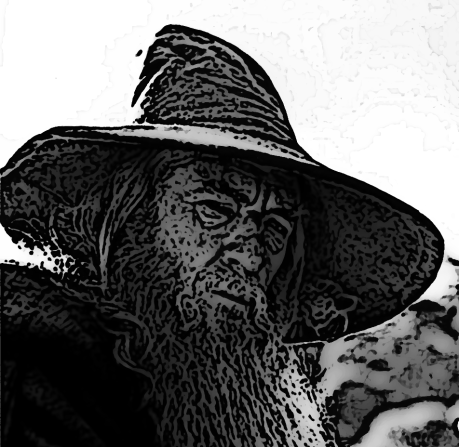
Gandalf_the_Grey


*Lately I’ve considered simply replying, “It was about sixty hours long”, but I always forget to do that when the time comes.

No live creature can continue to exist at all if there is no reality

Well, it’s Friday morning, and for those of you with a typical* American work week, I’ll say a “TGIF” on your behalf, though as I said yesterday, I work tomorrow.

That’s an interesting combination of tenses, isn’t it?  I’ll say, I said, I work, tomorrow…most of the whole latter half of that sentence is a mishmash of inconsistent, time-related words, and yet, as far as I can tell, it makes sense.  Please let me know if I’m wrong about that.

I’m still very tired from the fiascos with the trains Wednesday, and from sleeping on the floor in the office Wednesday night.  Nevertheless, on the way back to the house yesterday, I got an early enough train that I decided to walk back from the train station, despite being tired.  So, between Wednesday morning and Thursday evening I walked a total of about nine miles, and the athletic tape I put on the blister on my right foot seems to have done a good job at protecting it.

I did then pick at the blister a bit as I was lying down last night, and I might have irritated it some, since it’s slightly sore now.  That might just be from the longish walk back from the train last night.  Or, of course, it could be both.  There could even be unrecognized influences causing soreness.  Occam’s Razor pushes against that last bit—I’m unaware of any possible other causes so far, and I have potential known causes that can explain what I find and feel—but it doesn’t give any direction to the choice between the other two things or their combination.

Anyway!

I work tomorrow, as I said before, so I should write a blog post then.  I don’t know what I’m going to write about, but then again, I have no idea what I’m going to write about today, and yet I’ve already written some 360 words.

I think I’ve noted previously how this writing about nothing that nevertheless goes on and on seems almost related to the more ordinary thing called “small talk”, when people get together and discuss things that are of no consequence, really, and which are not planned in advance.  I gather that small talk serves some manner of social cohesion building, an interaction for the sake of interacting, done verbally in humans, since largely hairless house apes no longer need to pick Arthropoda from each other’s fur.

Small talk seems at some level essentially to consist of people saying to each other, “I’m a person you know and are socially bonded with, and you are a person I know and am socially bonded with.  We are part of the same community or tribe, at least at some level.”  I guess that’s useful, and even powerful, in an ultra-social species like humans.

Heck, even scientists and mathematicians get together at conferences**, or hang out together at lunch time.  Apart from this being a social bonding thing, it probably really helps to trigger and stimulate new ideas, as separate minds throw their thoughts into interactions with other minds, coming from varying points of view, triggering new thoughts and new insights that a single brain could not as easily produce.

Of course, reading (and listening to podcasts and audiobooks, and watching videos) can also bring on such new thoughts and ideas, sometimes in slightly deeper ways.  But there is no mutual, “real time” give and take, which can in the right circumstances lead to a seemingly near-miraculous bootstrapping of ideas.  Just imagine what the conversations were like when Gödel and Einstein hung out and went for walks together in Princeton!

Meanwhile, Robert Elessar, not sane, stood by himself against his blogs, holding darkness within.

Ha ha, that’s just me having a bit of fun with a slight paraphrase of part of the first paragraph (also part of the last paragraph) of The Haunting of Hill House.  (That’s also what’s happening in the blog title and in one of the footnotes.)

That has to be one of the best openings to a book this side of “It is a truth universally acknowledged that a single man in possession of a good fortune must be in want of a wife.”***  And, of course, ““No one would have believed in the last years of the nineteenth century that this world was being watched keenly and closely by intelligences greater than man’s and yet as mortal as his own…” from The War of the Worlds.  Or a more recent favorite: “In a hole in the ground there lived a hobbit,” from a book the title of which escapes me****.  Oh, well…call me Ishmael, if you must.

I don’t think I really have much more to write today, though something else may occur to me.  This has very much been a blog about nothing, but then again, that’s probably a decent metaphor for the very universe itself.  A lot seems to go on, at various levels, but there doesn’t seem to be any central theme or topic or subject, unless you count the Second Law of Thermodynamics.

Even if you don’t count that, though, it still applies.  That’s the way of “reality”—it doesn’t depend on your awareness, or on anyone’s awareness.  Indeed, all such awareness is but a tiny little portion of reality itself.  Reality is that which exists whether you believe in it or not.  If you have doubts about that, just consider what happens to people who die sudden, unexpected deaths, as from a surprise bomb attack or similar.  Not knowing that bombs exist or that an attack was coming would not protect against them.

Ask the dinosaurs.  Oh, wait, you can’t.  They’re all gone*******.

See what I mean?  Have a nice day.

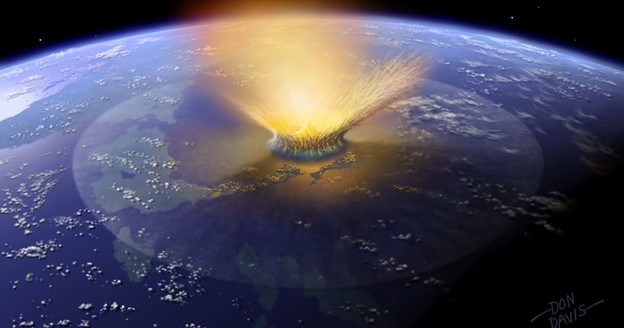
asteroid hit


*Is it really typical anymore?  I wonder what percentage of American workers overall actually work Monday through Friday nowadays.

**And even larks and katydids are supposed, by some, to dream.  See below (in the main body, not in the footnotes) for the source of that line.

***Pride and Prejudice, by Jane Austen.  Surely the very title of that book, as well as its first sentence, would put it on the chopping block in the minds of the puritanical thought police of modern offense mongering.

****It doesn’t really escape me, of course.  It’s The Lion, the Witch, and the Wardrobe, obviously*****.

*****Seriously, I know it’s not.  I doubt there’s any book I’ve read more often than The Hobbit, if only because there have been quite a few times when I’ve started The Lord of the Rings and ended up stopping not long after the battle of Helm’s Deep, which is one of my favorite parts.  The early Frodo/Sam/Gollum stuff  in the latter part of The Two Towers is sometimes a lot to slog through.

*******Except for birds, of course, which really are descended from therapod dinosaurs and are, in a very real sense, extant dinosaurs.  I’m picking nits with my own words—figuratively, at least, since I do not engage in mutual grooming with any other primates if I can help it—but that’s fine with me.

Words, and spice, and a futile device…that’s what this blog post is made of

Well, it’s Friday again, and so tomorrow is Saturday, in the system by which we name our days.

The days themselves don’t know or care about what we call them, anymore than all the various plants and animals and fungi in the world care—as far as anyone can tell—what we call them.  Our names of things are solely for our convenience, to make communication easier and more streamlined—paintbrush handles of thought, as I think Eliezer Yudkowsky described them.

But, of course, having finite minds, as surely do all creatures, we tend to get so used to thinking of things by their names that we think the names and the things are interconnected in and of themselves, and even that the names have inherent power.  This is akin to all the old magical ideas that knowing someone’s or something’s true name gives you power over them in some mystical fashion.  It’s also related to our (depressingly) current notions of names or other words being capable of causing actual, physical harm, and being taboo—even words that are basically innocuous.

I can certainly understand why people might want to avoid using a term that’s been almost exclusively associated with historical injustice, oppression, and literal violence; that’s just a matter of trying to be polite, as far as I can see, and politeness is rarely a bad thing, as long as people don’t get too carried away.  But the tendency of humans to get hung up on some mystical (and fictional) power of names often becomes a problem, and is the error of thought which required the creation of the formerly popular and very important corrective, “Sticks and stones may break my bones, but words will never hurt me.”

That’s very true—unless you’re dealing with Paul Atreides or some other Bene Gesserit person.  Alas, those are fictional beings.  I say “alas” not because I think that it’s too bad that we don’t have the Bene Gesserit and so on, but because it would be great if there really were people/creatures like the Guild Navigators, with the ability to fold space thanks to long exposure to the spice mélange.  That would be tremendously useful for space travel, obviously.  In our world, though, “He who controls the spice controls the universe” just refers to KFC and Colonel Sanders’s secret original recipe for fried chicken, which is tasty, but is not going to get us interstellar travel, at least not anytime soon.

Similarly, as far as we know, in our particular brane-world, there are no orcterlolets, with their ability to manipulate space directly (no spice needed).  And if Simon Belmont is real in our universe, he’s keeping his knowledge and abilities quiet, probably wisely*.

Anyway, coming back to the subject of the day and days, I hope you all are going to have a good weekend, and that you get some time off from work and so on.  I’m going to work tomorrow, unless some highly unusual situation develops, and so I will be writing a blog post tomorrow.

In case you couldn’t tell, I’ve been using my laptop all this week to write, and it’s definitely helping my thumbs, though they are not fully recovered yet.  I will say, even I am struck by how much faster and more eloquently I “speak” when typing than in any other fashion, including actual speech, as far as I can see.  As you may know, I’ve tried to work on doing “audio blogs”, since more people seem to like to listen and to watch things than to read—see yesterday’s post for my lament about that fact—but it’s not nearly as natural to me.  I did find it gratifying to read aloud my last post from Iterations of Zero, which I turned into a “video” on YouTube and embedded here, but that’s as much because I really was trying to get that message out…yet again, perhaps for the last time, after so many, repeated failures.

Apparently, I’m not very good at making myself clear.  Then again, the reason for that, and the emphasis on that reason, was a big part of the point of that last IoZ blog post and the fact that I read it aloud and shared it in different format.  I’m probably wasting my time, though.  Even if someone actually gets the point I’m trying to make, why on Earth would anyone act on it?  Why would anyone even try to save the prisoner in my thought experiment?

Let him die, I say.  He’s a worthless little piece of shit, anyway.  I hate him.

With that, I’ll wrap up this rather bizarre and somewhat short Friday blog post.  I didn’t have any agenda going in, and I think I’ve achieved that agenda nicely, and in fewer words than I usually take to do it.  If you’re spending the weekend with family and/or friends, please do your best to appreciate your time with them.  Make the most of it.  Don’t take them for granted.  Take nothing for granted.  The universe only makes one promise to everyone—and we can’t even be completely, mathematically, epistemically certain of that one.

5755364526_jail_cell_336x264_xlarge


*The immediately preceding few sentences were references to my “fantasy” adventure book, The Chasm and the Collision, in case anyone was confused more by them than by references to Dune.  To learn more about what those references mean, you should buy and read my book!  Heck, buy them all!  They will change your life, I promise you…at the very least in the sense that you will own several more books than you had owned previously.  That’s technically a change, right?

They have blogged at a great feast of languages, and stolen the scraps.

Hello and good morning.

It’s Thursday, so I’m writing my traditional blog post, which I used to write between writing fiction (or editing it) on every other working day of the week.  I suppose it’s possible that now I’m still writing my daily blog between writing fiction, but if so, it’s a very long between, and I see no hint of a far end of that break, at least not one that involves me starting to write fiction again.

Practically no one—perhaps literally no one—has shown any real interest in that possibility, nor is anyone outside my family really reading any of my fiction.  Perhaps few people read fiction at all anymore.  I do have to wonder, how many of the people who buy even the big best-selling fiction works actually read them?

I recall back when Stephen Hawking’s A Brief History of Time was a huge best-seller* that many people just bought it to have it on their coffee table or book shelf, as a social status symbol, just as they might wear Nike shoes or drive a particular make and model of car, or frequent a particular restaurant where they could be seen with other people who were going there to be seen.  They were peacocking, so to speak—it wasn’t just males, of course, because humans have different social structures than birds as a general rule.  But the status, hierarchy, and symbolic drives are all quite reminiscent.  One could say similar things about Jared Diamond’s Guns, Germs, and Steel.

Hell, back in the day, there were probably oodles of people who had sets of high-quality encyclopedias on their bookshelves, that they never used or expected to use.  This is a true shame, because I can tell you that just picking a random volume of an old-school encyclopedia and thumbing one’s way through it, stopping and reading when one encounters something interesting, can be quite a wonderful experience, and lets one learn about things one might never have thought to explore.  Wikipedia does have a sort of “random article” feature, but it’s just not the same.

Anyway, that was a bit of a tangent.  The point I’m making is that I think almost no one reads at all, or at least few people read anything longer than a few hundred words at a time**.  People seem to prefer to watch people speaking in order to get their news, which is far less efficient than reading actual words, which are a comparatively concise and precise means of conveying information.

There are some things for which video is especially well-suited, of course.  Conveying complex scientific ideas can be boosted tremendously with high-quality animation of concepts, especially in physics.  Also, of course, explorations of the natural world as undertaken by the likes of David Attenborough can be used to give people a more direct exposure to things they never would have been able to see for themselves.

But still, words have their power, the written word especially (or so I think).  When you come down to it, every aspect of the internet runs on written words—computer programs and commands—which convey literal, step-by-step instructions from one place to another about what pixel to put where and when, how and when and with what power to vibrate a computer’s speaker, and of course, what ASCII or similar character to call up and put where on what screen.

It happens very fast, of course, but it happens that way.  The very reason video signals can be so high-fidelity but low power—phone signals as well—is that they are transmitted as languages, with redundancy and error-correction implicitly (and deliberately) built in, so that even when part of a signal is lost, the rest can “easily” be reconstructed.

I put “easily” in scare quotes because while it happens readily once everything is set up, it took some of the most brilliant minds ever in the world to figure out how that sort of thing works and what to do to make use of it, and others to figure out how to bring it to the available use of so many of the billions of humans worldwide.

Meanwhile, most of those humans don’t think about the exquisite and astonishing machinery involved in their smartphones, or their “smart” TVs, or their GPS (which requires Special and General Relativity to function!).  Most people use their phones as distractions and—perhaps primarily—as yet another instance of peacocking, of status demonstration.  How else can one explain the push to buy the latest iteration of the latest smartphone, when one hasn’t even taken full advantage of the features of the phone one currently has?

Humans very rarely seem actually to think for themselves.  I’d say almost all of them do it some of the time—occasionally—and some few of them do it much of the time.  But that last population is vanishingly small.  Yet they, I suspect, are the ones who drive most advances in most fields, and produce the improvement of science and technology and art and society.  What a shame that they’re usually just making precious ceramic sculptures to be tossed about by troglodytes.

Oh, well.  Obviously I’m not in an upbeat and optimistic frame of mind today, if ever I am.  And it’s because of facts and thoughts such as these that I think I’m not writing this blog between writing fiction but rather after having written all the fiction I’m going to write in my life.  That’s okay, I suppose.  It doesn’t actually matter much to much of anyone, anyway.

It’s just as well, I guess.  The one person I met at work who actually talked to me about the substance and the ideas in one of my books—Son of Man, in this case—was also a person who died of a drug overdose not long afterward.  It wasn’t the fault of my book; he had a drug problem already.  But he was smart and curious, and he actually read the book and thought about it and asked me questions related to it, and debated points with me.  That was kind of cool.  Small wonder that he died a self-inflicted death; he was too much a kindred spirit to me.  What else could one expect?

So, with that in mind, I—who, regrettably, cannot seem to develop a life-threatening addiction to drugs or alcohol—don’t expect to do much more creative shit in my life.  I could be wrong, of course; I make no claims to absolute epistemic certainty about anything.  I’m not even entirely convinced by cogito ergo sum argument.  I can vaguely conceive of the possibility of myself being a figment of someone else’s dreams, albeit someone with a very vivid (if somewhat dreary) imagination.  Of course, in a sense, an imagined being, if the imagined nature of that being is instantiated in the imagining of independent thought, does exist.  So I guess Descartes’s conclusion, in sum, was still correct as far as it went.

I don’t know.  I’m tired.  If someone is dreaming me, I wish they would have a better dream.  Maybe I wish they would wake up.  Presumably I wouldn’t know that the dream that I was in ended when it ended, anymore than any of us would know if the vacuum state of the universe tunneled to a lower energy level and wiped out everything preceding it, because the wave front of the phase change would progress at the speed of light, which would mean that the first hint of its existence for anyone would be their instantaneous obliteration, faster than they could even potentially know it was happening.

Swift, painless, without the possibility of fear because fear cannot move faster than light—it’s not too bad a way for the universe to go.  To read more about it, please look into The End of the Everything (Astrophysically Speaking), by­­­­­­­ Katie Mack***.  It’s an excellent book, and quite fun.  Buy it even if you’re just going to put it on your coffee table to impress the Joneses.  At least the author would get a bit of money.  And some day, you or someone in your family might accidentally pick it up and learn something.  There are worse accidents than that!

TTFN

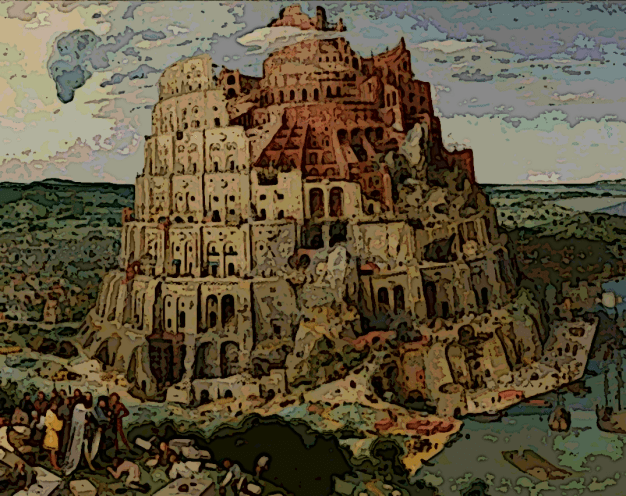
Pieter_Bruegel_the_Elder_-_The_Tower_of_Babel_(Vienna)_-_Google_Art_Project


*Admittedly, that is nonfiction, but it serves my point more generally.

**Though, to my surprise, on the train this morning I saw no fewer than three people actually, actively reading paperback books.  Perhaps I’m too pessimistic.  That would surprise almost no one.

***You need not worry about the possibility of such a phase change much.  It’s far from certain that it even could happen, and even if it can, the best science indicates that it’s vanishingly unlikely over anything like the current lifespan of the universe.  Dr. Mack explains it far better than I could.

Brief thoughts on candy, carbon, communication, and a shared “video”

Well, it’s Wednesday, the day after Valentine’s Day.  I know it’s not technically the Ides of February or anything—at least I think I know that—but there ought to be an official day for the day after Valentine’s Day, some equivalent of Boxing Day after Christmas.  Maybe we could call it Barfing Day; that might be both fun and appropriate.

I was thinking that yesterday would have been an excellent day for me to have a heart attack.  It seems an appropriate potentially fatal healthcare crisis to have on a day when everyone is sharing “heart-shaped”* treats, many if not all of which are not great for the coronary arteries.  However, though I did in fact find myself once sprinting to beat a light and then later sprinting to catch a bus—one can’t get much more cliché than that when it comes to myocardial infarctions—I felt not a hint of chest pain, shortness of breath, palpitations, or what have you.  Disappointing.  And the only nausea I felt was that sort of subjective nausea that isn’t a true physical feeling, but which is a projection of disgust over the very silly and stupid things people say and do.

This queasiness was not in response to Valentine’s Day activities!  Don’t get me wrong.  I thought Barfing Day was a good follow-up day because eating too many sweets in one day can lead to GI upset.  For the most part, I think it’s nice that people express love, romantic and/or otherwise, to those important to them.  It may be frustrating that it’s such a ritualized, scheduled expression of love, but unfortunately, if it were not for such rituals, it’s probable that many people would never make or think of any such expression at all.

Sometimes, it seems, humans need rituals to make them realize their own feelings, and perhaps even to confront their own feelings.  This can apply to bad feelings as well as to good, as when, on the approach to a holiday such as Valentine’s Day, someone realizes that the person with whom they are currently linked is someone with whom they don’t really feel that strong a bond.  Hopefully such a realization occurs before too much has been invested in a relationship.

I suppose the need to act in recognition of such a fact can sometimes lead to a stereotypical Valentine’s Day breakup, which is harsh, but perhaps better than the alternative of a long, unpleasant relationship with increasing acrimony and emotional (if not physical) abuse.  Maybe I’m wrong.  I don’t know; I’m making this up as I go.

In distant parallel to the above, I sometimes think that maybe we should lace all Valentine’s Day candies with hormone blockers or something along those lines to diminish the sex drive of those who eat them.  Surely, anything that can be done to decrease the breeding of new humans is probably going to be a benefit for the rest of the planet, and evolution just isn’t likely to get to that solution on its own.

On second thought, that may actually be a foolish notion.  Honestly, I’d worry more about people if they didn’t have any children, because the nurturing of children is one of the most potent triggers and encouragers of love—not to mention forethought—in humans.  As I think Fagin said in the musical Oliver, I think I’d better think it out again.

Anyway, that’s all for you guys to worry about.  I’m giving up on it, and with any luck, none of what humans do will have any impact on me, other than perhaps to alter slightly the rate of decay of my corpse.  Though it would be useful, I think—and as I’ve written before—to enact a policy, or even a tradition, of storing the bodies of the deceased in deep ocean subduction zones, to get them out of the carbon cycle.

Cremation seems like a terrible idea; it just gives everyone one last lunge to increase their individual carbon footprint!

It probably doesn’t make much difference, though, honestly.  Such minor sequestering and the like on local, individual level is unlikely to accumulate into anything of significance to the global atmosphere.  I think it will only be the development of new science, technologies, and processes that will engineer out the excess carbon from the atmosphere, perhaps using some adjusted and enhanced equivalent of photosynthesis on an industrial scale (among other thing).  After all, photosynthesis takes carbon dioxide and water—potent greenhouse gases—from the atmosphere and ultimately converts them into carbohydrates and fats and such.  These can then be sequestered, if necessary, or converted to bioplastics, and biofuels, to use for things we currently do with fossil fuels.

The local energy for those processes can be derived from the products of the photosynthesis (ultimately from the sun) and so on, so that even when not truly “carbon-negative” it will be at worst “carbon-neutral”.

Of course, it’s stupid to be carbon neutral as a matter of personal, aesthetic judgment.  Carbon is the backbone of life as we know it, and probably will be for most if not all other life in the universe, if there is any.

I know, in these matters, “carbon” is just a shorthand for greenhouse gas reduction and whatnot, but I wonder how many people really think about that when they use the term, especially when one considers that water vapor, which is more potent than CO2  as a greenhouse gas, has no carbon in it at all, and methane, which is also more potent a greenhouse gas than carbon dioxide, has only one carbon atom for every four hydrogen atoms.  And a molecule of methane burns to make one molecule of CO2 and two molecules of water.

If more people were more scientifically literate and careful in their thought, a great many of our problems would probably be diminished, so my biggest local lament here is that many of the more vocal activists on all sides may refer to things like carbon and economics and communication and the like without even really thinking about the words they are saying.  Such words in such cases aren’t tools of communication, but are, as Eliezer Yudkowsky notes, just soldiers going into battle.  What a horrible bastardization of the greatest invention of the human species.

In closing, I just want to let you know that I recorded myself reading aloud the last blog post I made on my alternate blog Iterations of Zero, and I’ve turned it into a video to put on YouTube.  I’ve embed it here, below.  It’s only three minutes long, and some of that is a lead-in moment of silence.

You can read it or listen, whatever you like, but I hope if you “watch” it you’ll give it a “thumbs up” on YouTube.

It’s a brief discussion of a thought experiment or story of a person trapped in a peculiar prison and trying to send messages for help without alerting the jailer, but it’s not as simple as it seems, and it’s not actually fiction.

Enjoy.


*And they are truly sort of heart-shaped, especially if you look at the interior shape of a heart.

Some 義理チョコ from me to you, with 感謝

It’s Tuesday, February 14th, which means that it’s Valentine’s Day, a day that is “celebrated” in the United States and Japan at the very least.  I think it’s observed in many other places, but I’m not at all certain of anything specific.

I guess it’s appropriate, given that it’s a holiday nominally about romantic love, that it falls on a twos-day this year.  Ha.  Ha.  Excuse me, I think I have to throw up.

Anyway, to those of you who are having, or planning to have, a lovely day with your significant other—or others, I suppose that’s possible—I hope you have a nice, even a terrific, day.  Honestly, I do.  I’ve gotten to the point in my depression where I certainly don’t feel envious or spiteful or anything.  I’m just mostly empty.  So do whatever you like with each other, with your civilization, with the world, whatever.  Ruin it, save it, let it slowly grind away, gasping and limping, to its inevitable end.  I don’t really care.  I have no skin in much of any game, anymore, not even my own.

It’s curious, the form in which Valentine’s Day was imported into Japan, at least according to every light novel, manga, and anime I’ve seen that deals with it.  It’s a day on which girls give chocolate to friends and/or to those with whom they are infatuated /romantically interested (usually boys, but not always nor exclusively).  That’s giri-choco (義理チョコ) versus honmei-choco (本命チョコ)* if I recall the terms correctly.  Subsequently, the standard practice is for one who received chocolate (usually a boy) to return some kind of gift on March 14th, which is called “White Day”, and appears to be a holiday that solely exists in Japan.

I doubt anyone much planned for any of these things to happen, of course, despite frequent complaints, there and here, that such holidays were invented by greeting card companies or the like.  As with most human institutions—indeed, as with civilization itself—they are spontaneously self-assembling systems.  They are not even in any kind of stable and/or dynamic equilibrium.  Certainly there are people and organizations that benefit from Valentine’s Day, and they will encourage it to continue and to grow to the degree they can—candy manufacturers, florists, greeting card companies, those sorts of people and things—but that happens very much spontaneously.  As with most actual “conspiracies” it’s not planned, it just occurs.

There is no shame or crime in any of this.  Who among you, given an opportunity to benefit yourself (and by extension, your family and others you love) through the honest production of goods and services that reinforce and spread the memes of a holiday which is at least nominally a positive and cheerful one, would not do so?  Making a living while supporting love seems like a win-win situation.

No one forces you to buy candies, or cards, or decorations.  No one forces you to be in a relationship**, no one forces you to buy holiday-associated clothes or treats or jewelry or whatever.  You may feel strong urges to do such things, but you can’t blame those who recognize those urges and make products that respond to them.  You can’t blame McDonalds for the fact that you feel hungry but don’t want to go to the trouble of eating somewhere else, anymore than McDonalds can blame you if you do choose to eat somewhere else.

I don’t know how I got off on that tangent.  I think I was arguing with myself, past and present, as much as anything else.  It’s all academic and moot to me, now, really.  I have no romantic interest, haven’t had any for quite a long time, and I don’t expect—or really, want—one any time before I die.  I’m a cat whose feet have been burned too painfully to risk walking across that stovetop again.  It was all always confusing and counterintuitive to me from the start, to be honest.

Speaking of walking, my feet still have a little bit of soreness from Saturday, but I got through my four miles total of walking yesterday without much trouble, and my blisters are resolving but not gone.  I think if I undertake such long walking—or longer—in the near future, I should probably do an hour on, an hour off, and so on, at least until I get used to it.  I know I can walk for an hour at a time without any real trouble.

I should also make sure to apply sunscreen.  My nose and forehead are peeling, and that’s not appealing at all.

Sorry.  Stupid pun.  I don’t like it, either, but I have a tendency to punish and hurt myself, and unfortunately, you readers got caught in the process this time.  I apologize; I try not to cause harm to innocent people when I self-harm.  I generally try not even to let people know about it.  But, of course, in the ultimate, it’s a tricky conundrum to go the final distance, so to speak, without at least inconveniencing or worrying some other people, and that’s frustrating.

I don’t know quite how I’m going to get past that.  But I’m going to have to try.  Because my tank has long since been hovering near empty, and the little warning LED has been lit for miles.  There’s no gas station in sight that I can reach, as far as I can tell, and I’m in the middle of the desert, so walking to get a can of gas to bring back is risky.

But it still may not be a bad idea.  Walking to get gas may succeed, it may be useful, with a great deal of luck.  And if it doesn’t, if it isn’t, well…a desert is at least a relatively unbothersome place to die.

I don’t know what I mean by all this.  Have a good day, please.

valentines3


*See the title of this blog post.  Giri choco means, more or less, “obligatory” chocolate, though I don’t think that usually implies insincerity.  It certainly doesn’t with me for this post.  Honmei choco is “true feelings” chocolate, basically saying to someone that you have romantic feelings for them.  It is important to make clear which one you’re giving.

**Not most places, anyway.  If that’s happening, it is indeed a crime and a violation.  But forced marriages or any other variations of such things are generally not what people mind about Valentine’s Day.

Wandering through fields of deer

I work in a city in Florida called Deerfield Beach.  People often refer to it simply as “Deerfield”.  Being who I am, I can almost never hear or see that word without thinking something along the lines of “What kind of field is a deer field?”. Then I usually begin some lighthearted speculations on the matter.

I will now share some of these with you, because why should I be the only one to suffer from such stupidity?

I often speculate to myself that perhaps the deer field is a recently discovered quantum field, along the lines of the electron field and the gluon field and all the rest.  If that is the case, what we see as “deer” would be, fundamentally, just local disturbances or vibrations in the “deer field”.

Obviously the deer field interacts with the Higgs field, because although deer can be quite speedy, they never move anything close to the speed of light, and they can even be at rest; they clearly have a rest mass.  As everyone knows, “massless” particles, the ones that don’t interact with the Higgs, always travel at the speed of light*, which is just another term for the speed of causality.

Speaking of which, of course, an individual deer is very massive for a fundamental particle.  The median mass of a deer is around 50 kg.  Putting that in terms more typical of particle physics, it’s roughly 3 x 10^30 eV**.

To give you some perspective, the most massive of the quarks, the top quark, which is (I think) the most massive previously recognized fundamental particle is about 170 GeV (giga-electron-volts).  That’s 170 billion eV, or 170 x 10^9 eV, or 1.7 x 10^11 eV.  That would make a typical deer particle nearly 2 x 10^19 times as massive as a top quark.  Writing that out in terms that might hit home more powerfully, that’s 20,000,000,000,000,000,000 times as massive.

No wonder it’s never been produced in any of our particle accelerators!

Yet the deer field must have very weak coupling with other fields, because individual deer particles are extremely stable.  We can feel reasonably confident that not one single deer particle has decayed spontaneously into other, less massive particles in all of human history, because if it did, the energy released would dwarf the largest nuclear explosion ever set off by humans.

Recall that the explosive force of the original atom bombs at Trinity, Hiroshima, and Nagasaki was produced by the conversion of less than a gram of matter into radiant energy, yielding a blast equivalent to the explosion of about 20 thousand tons (aka 20 kilotons) of TNT.  The energy released by the “decay” of a single deer particle would be about 100,000 times as great, if my figuring is right, or 2 gigatons.  I’m sure you’re all aware that the Tsar Bomba, the largest ever nuclear explosion set off by humans, was “only” about fifty megatons, or about one fortieth as large.

So, don’t stand too close to a decaying deer…and “too close” would probably be “within a few hundred kilometers”.

All this leads me to speculate, given their mass and stability, that perhaps the deer is one of the theorized “supersymmetric” particles, thought to be paired with each of the more “typical” particles of the Standard Model, but which have not yet been detected in any particle accelerators‒again, given the rest mass of a deer, we should not be surprised.

I don’t know whether deer are fermions or bosons; my initial thought is that they would be spin-zero, since I’m not aware of deer showing, for instance, any tendency to align with magnetic fields.  Then again, maybe they’re too massive for spin-related magnetic alignment to be detectable.  They certainly appear to be electrically neutral, though again, if they had a charge comparable to an electron or proton, its effects might hardly be noticeable given their mass.

I would hope that particle physicists would flock‒or perhaps “herd” would be a better term‒to the places where these amazingly stable particles are plentiful, the better to study their characteristics.  Ironically, although I work in Deerfield, I have never seen a single deer particle there, but up north‒particularly in New Jersey‒I’ve seen many.

What is it about New Jersey and similar locales that leads to the local aggregation of so many of these ultra-massive “particles”, which seem likely to be primordial remnants of the big bang***?  Is it perhaps that they interact somewhat strongly with the prominent local corn fields?

Wait a minute!  Corn field?  What’s the nature of that quantum field and particle?!?!?

Anyway, this is the sort of shit that goes through my mind almost every time I see or hear the word “Deerfield”, and it’s only one example of that sort of thing.  There are countless others.

Just in case you ever wonder why I’m always so depressed.

deer-in-field


*The two most well-known such “massless” particles are the photon and the graviton.  Of course, the graviton has not ever been measured as an individual particle, but it has been confirmed‒as expected‒by LIGO, VIRGO, et al, that gravitational waves travel at the speed of light, and so are massless.  I can’t help think that’s a good thing, because if gravitons had/have mass, there would be what I would assume to be some quite complicated self-interactions‒gravitons would themselves interact strongly with the gravitational field‒that would make their theoretical characteristics and so on quite complicated.  The very fact that they carry energy means they must self-interact at some level, since energy interacts with gravity, but they are expected individually to have very low energy, gravity being far weaker than the other “forces” of nature.  Of course, gravity is in some ways not quite like the other forces in character, but don’t get me started on that.

**Short for electron volts, defined as the amount of energy gained by an electron from being accelerated through a potential difference of one volt.  It’s a measure of energy, and it’s used as a measure of mass as well, because in the realm of fundamental particles, E=mc2 really comes into its own.

***It’s hard to imagine any subsequent processes generating such particles, though perhaps supernovae could occasionally create a few.

There’s a black hat caught in a high tree top

Well, it’s Friday, the 13th of January, and I don’t have any idea what to write or what to write about today, but I’m writing anyway, as you can plainly tell.  That’s a metaphor for life if there ever was one, don’t you think?

Of course, I could write a bit about the fact that it is Friday the 13th, but I’ve mentioned that previously, and it’s not all that interesting.  There’s no such thing as an unlucky day or an unlucky number; that’s all just superstitious, magical “thinking” stupidity.  But there are numbers that are interesting, and the the prime numbers are interesting to me.  I feel a sort of peculiar, protective affection for 13, since so many silly humans think it’s an unlucky number.

For similar reasons, I’m slightly less fond of 7 than I am of most other prime numbers.  It’s sort of the numerical equivalent of Prince Harry or, to pick an older comparison, Paris Hilton*.  It’s already receiving plenty of attention and support, far more than it deserves, so I won’t waste my effort.

There was an update overnight to my phone’s operating system, and now some “buttons” such as the return key, are no longer slightly-rounded rectangles but are more precisely slightly rectangular ovals.  I don’t like it.  The background colors are also slightly altered, and that’s frustrating, too.

In addition, the app buttons are changed, including the text app, and the phone is trying to push all sorts of new apps that it recommends “for me”…but of course, it’s not actually for me (or for you in case you think otherwise) it’s actually for the companies that make the apps, who have paid a premium to have those apps promoted.  

The system forces you to go through their stupid update-based notice thingy to decide on new apps, and many are pre-checked, so you have to opt out of them actively.  Similarly with their “bookshelf” function or whatever it is, and when you close the apps, the screen doesn’t go away, you have to dismiss it separately, which makes no sense and was not that way before.  The people responsible for all this should be burned to death with flame throwers as soon as possible.

I don’t know why companies do that sort of thing.  Gmail has done it with its updates, turning all the nice, well-demarcated shapes with edges and corners into soft, gooey, Play-Doh looking things, as if they really are trying to “child-proof” the world.  I don’t enjoy change without good purpose, and I think there are good reasons not to enjoy it.  If something is functioning reasonably well, most changes will be for the worse, especially if optimality is something not simply and easily achieved.

Just look at genetic mutations to get a clear example.  In an organism that’s functioning well enough to survive and reproduce in its environment, most changes in general are not going to be beneficial.  That’s one reason I hate social movements that say they are pushing for “change”.  Well, what kind of change, in particular?  I mean, the global Covid pandemic was/is a change; the war in Ukraine is a change; the diminishing respect for rule of law and the constraints of the U S Constitution are changes; an asteroid impact that wiped out civilization entirely would be a change.

Well, that last one would be beneficial, so it’s probably a poor example.

Anyway, I wish that people like Android** and Google (are they part of the same company?) and Microsoft and all those would reserve their updates to those changes that are at least attempts to improve functionality, not cosmetic nonsense or transparent and pushy marketing.  It’s very irritating to get used to the color scheme and key layout of a computer system and then wake up to find that it’s different, as are some of the basic functions, and for no good reason.

Even the icons to start writing and to save writing on the Google Docs app are different colors.  Why?  I mean it would be one thing if the previous color were some frequency of X-rays, and using the app was causing cataracts and retinal deterioration and even ocular cancer.  But it was just a sort of neutral blue or gray color, and was reasonably pleasant.  Now it’s sort of a yellowy orangey beige that looks vaguely like something you might heave out after you’ve already vomited all the food contents of your stomach but your body still wants to throw up some more.

It’s unnecessary.  I don’t like surprises, usually even when they’re positive ones.  And this is not a positive one.

Oh, well.  What else is new (ha ha)?  I had a brief glimmer of hope that my enforced change of commute might come to an end today, but it looks like that isn’t happening.  I’m not really surprised, but I am mildly disappointed, and it doesn’t help my energy level.

Oh, I did have a slightly interesting thought about Friday the 13th, thinking of the movies by that name as compared to the Halloween movies.  I had thought for a brief moment that at least the Halloween movies are named after an actual holiday, and it was also one that comes around a bit more often than Friday…the…

…then I caught myself, because I know that any month that begins on a Sunday is going to have a Friday the 13th in it.  And on average, one in seven months will begin on a Sunday, and so there will be, on average, just under 2 Friday the 13ths every year‒the day, not the movies, thankfully.  And in non leap years, if February has a Friday the 13th, so will March!  So there are quite a few more Fridays the 13th than there are Halloweens.

Just imagine if we had 2 Halloweens every year.  Wouldn’t that be great?

Anyway, that’s a lot of writing about nothing. I apologize for the last few days, and for my foolish notions of seeking help, when I don’t think I deserve, or merit, or am worthy of help, or frankly that it would be a good use of anyone’s resources.  Also, I probably would/will not know how to accept help.  Sting had a great line from one of his songs*** that feels pertinent to this: “And I wriggle like a fish caught on dry land, and struggle to avoid any help at hand.”

Of course, if someone could offer me a goodly dose of Valium and Fentanyl that I could use in a pinch to make a basically painless exit, that might at least be worth keeping in my pocket, just in case.  But otherwise, I can’t really imagine doing anything that would involve serious changes.  I don’t like change, and I don’t like surprises, and I particularly don’t like phone calls out of the blue, especially from someone who has in the past made me feel guilty for being depressed.  It all just stresses me out and makes me feel worse about myself.

I mean, if my son or daughter called me, that would be a different matter.  That would be brilliant.  But I would be deeply ashamed if they did so out of a sense of obligation rather than just because they wanted to do it.

I don’t know what the hell I’m getting at.  Nothing much, probably.  Anyway, it’s Friday, and I don’t work this weekend, so you shouldn’t be seeing any new blog posts from me before Monday at the soonest.  If something catastrophic‒depending on one’s point of view‒happens and I don’t write anything even on Monday, well…that’s a change that most people wouldn’t find too unpleasant, unlike the stupid muddy, puss-like color and shape changes on the phone apps and keyboard.


*Interesting…both examples have “initials” P. H.

**And that name doesn’t makes sense.  Android means “man-shaped” and nothing about the operating system or the phones is man-shaped.  Even their little symbol isn’t really man-shaped.  I’m android.  Nothing about the phone system is.

***Be Still My Beating Heart

The satirical rogue says here that old men have grey blogs

Hello and good morning.  It’s Thursday, and so it’s time once again for my traditional Thursday blog post, which always starts with some variation of “Hello and good morning”, as you have just seen.  It’s the second Thursday of 2023, and it is the 12th of January, meaning that tomorrow‒as I’ve noted before‒is Friday the 13th.

I apologize for the tone and content of yesterday’s blog post, which feels to me as though it was unusually dank and dismal.  I’m not apologizing because I didn’t mean what I wrote; I did mean it.  If anything, I tend to understate things.  But I’m sorry to have foisted all that on you lot.

What I wrote yesterday is true, though.  I have a difficult to terrible time seeking out help, so when I get even the slightest urge to do so, I have to try to get it out there.  Because the fact is that I could really use it.  But my mental resources‒and my physical ones, let’s be honest‒for seeking help are stunted or crippled or maimed or whatever you would want to call it.  This blog, at least now that I’ve made it “daily”, is to a large extent my attempt at a proverbial cry for help.  But it’s not doing very well at that.  Not even close.

Maybe I always suspected that would be the case?  Well, no, I think it’s more accurate to say that I feared it might be the case.  If I had truly expected there to be no benefit, I wouldn’t have bothered.  I don’t have quite the kind of mental twistiness that leads one deliberately to do things one doesn’t think have any chance of working.  I really do (and did) wish that somehow this daily blog writing would help me gain some form of mental improvement and possibly even entice someone or something somewhere to help me…somehow.

It’s vague and nebulous, I know, and rather laughably optimistic.  I might as well just play a random Powerball ticket.  Getting millions upon millions of dollars would certainly at least give me greater freedom and resources to seek out help than just about anything else that’s physically possible to have happen to me.

And if wishes were horses, we’d all be hip deep in horse shit.  In which case, climate change would be much worse than it is, because all that horse shit gives off a lot of methane.  And even if you burn the methane, that just gives you a molecule of CO2 and four molecules of water for each molecule of methane burned (in oxygen, anyway), and each of those new molecules is another greenhouse gas*.

Anyway, that’s my mea culpa for yesterday, sort of.  Not that I think I did anything truly wrong, mind you.  I mean, it’s my blog.  It is whatever I want to make of it, and no one is forced to read it**.  If they choose to do so, well then caveat lector, or whatever the appropriate Latin would be.  Let the reader beware.

But the reader doesn’t have to beware all that much, because, in the end, these are words, words, words, as Hamlet said to Polonius when asked what he was reading.  I love words, and written language, obviously, but it is nevertheless true, as we used to say in grade school, that “sticks and stones may break my bones, but words can never hurt me.” And by hurt, I mean literally, physically.

Of course, words do have power.  Language can affect the world, and is the means by which we exchange, record, and pass down knowledge and other information.  Written language is the lifeblood of civilization.  But it is only the blood.  It is not the muscle or sinew or bone.  Words cannot conjure magical beings or events, as they can in stories, other than in the sense that they can be used to make such stories.  Perception is not identical with reality, speech is not violence, and as DMX said, “Talk is cheap, motherfucker.”

I don’t know how I arrived at that point in this blog, but it is a message I try very hard to get across.  We can be glad indeed that words cannot literally hurt people, because if they could, it would make the picture of a world in which wishes were horses, complete with their copious excrement, seem almost paradisiacal by comparison.  I know that my wake would probably be littered with corpses.

Hey, maybe that would be a good idea for a horror story (probably a short one): someone discovers that their words literally have the power to hurt people or make other things happen.  It could be called Sticks and Stones.  Actually, I’ve already written a story that has some of that aspect, in The Death Sentence, and I think H. G. Wells wrote a story about a guy who could make things happen by speaking, quite a long time ago.  Not that the concept is exhausted, of course.  There are many things, potentially, one could do with such a story idea.

I don’t think I’m going to be the one to do it, though.  I don’t think I’m likely to write any fiction again, or even live all that much longer.  Not without some kind of help, which does not seem likely to come.

Oh, well, whataya gonna do?  I hope you all have a good day today, and look forward to tomorrow, which is a Friday the 13th, but has nothing to do with the overworked movie franchise.  That’s got to be worth celebrating, right?

TTFN

words words words


*The “m” is right above the “period” on this phone keyboard, so I briefly made a typo, which the autocorrect showed no sign of changing, that read “another greenhouse gasm”. This sounds like something that might happen to a truly passionate plant lover upon entering a lush, indoor botanical garden when it was deep winter outside.

**Not by me, anyway.  And I don’t think there are any sadists out there cruel enough to make someone read my blog when they have no interest in it.