Blogs without all remedy should be without regard

Hello and good morning to everyone who is reading this.

And to everyone who is not reading this‒well, nothing, really.  It doesn’t matter what I say to the people not reading this, because, until and unless they actually read this, there will be no way for them to know what I am “saying” to them.

I suppose it’s possible that someone might read this blog post out loud to someone else, in which case the listener can know what I’ve written without literally reading it.  But, if you can consider listening to an audiobook to be “reading” the book‒and you can, though you’re not required to do so‒then that would count very much as the same thing.

It’s a bit like, for instance, the wave-front of the wave equation of a photon that was released from the last scattering surface of the early cosmos, just as the universe became cool enough for electrons and nuclei to join together and stop being plasma.

Imagine such a photon’s wave function progressing through the expanding universe, on and on, its wavelength increasing with the expansion of spacetime, red shifting and red shifting and red shifting.  What if it never interacts with anything else in the cosmos?  What if it’s never absorbed or scattered or reflected, “measured” by nothing but spacetime itself, on into the heat death of the universe, until there’s no longer even anything within its cosmic horizon with which it can interact?  Its wavelength stretches and stretches, perhaps eventually becoming light years in size*.  At some point it’s going to be completely swamped and washed out by the random quantum oscillations of the universe, even if that universe is immeasurably close to absolute zero in temperature.

Imagine such a photon given off by that last scattering surface and then traveling for a trillion years, a googol years, then for so long that a googol years seems as vanishing as a microsecond, never interacting, perhaps, until some version of a Poincare recurrence of the universe happens.  In principle, it might not interact even then***.  In what deep sense can that photon be said to be “light”?

It might even count as some manner of “virtual” photon, though certainly not the kind that is usually meant when that term is used.  It might seem lonely and depressing to be that photon, but we can console ourselves with the fact that, as far as any sensible notion of reality appears, photons have no subjective experience*****.  Even the absurd notions of panpsychism don’t literally imagine that photons are individually, actually conscious, in the sense of having internal “qualia“.

So, if I write something that no one reads, then what I have written cannot matter to those who have not read it.  Of course, in principle, all measurable remnants of even Shakespeare’s writing will someday be read and/or uttered for the very last time, but that’s different‒they will already have interacted immeasurably often before then.  The outcome will be nothingness‒or as near to it as possible‒but in the meantime, much will have happened.

Of course, according to quantum mechanics, quantum information is conserved, so everything from Hamlet to my imagined stray, lonely photon would be, in principle, recoverable.  But that’s a very rarefied “in principle”.

So, for those of you reading this, you really don’t have to worry about what people who have never read nor will ever read it will think about it.  They simply won’t have read it.  Likewise, I don’t have to worry about the reaction to my writing from people who don’t read it.

And, of course, if people “react” without ever having read a thing, which certainly does happen, those opinions are not worth considering.  I don’t need to take thought for some criticism of the Mona Lisa by a person who has never seen even any manner of reproduction or image of the painting.

Nor should I worry about being offended by the chattering of a squirrel in a nearby tree, or the noise arising from leaves stirred by the wind.  It’s merely noise, not too different from those quantum jitters that happen even in a region of the universe that’s as close to absolute zero as it can be.  There is always noise‒though it can become vanishingly close to silence (which sounds quite nice, so to speak).

Anyway, that’s enough of that.  I had a long day of walking yesterday‒about 15 miles total distance, and my joints and muscles still feel pretty good, so the shoes are all right******.  I did not walk to the train this morning‒I figure just a bit of recovery time is warranted‒but I may walk this evening.  I hope you have a good day, and that all your metaphorical photons have lots of interesting and enjoyable interactions before they dissipate.

What more could you reasonably ask?

TTFN

Keds cartoon


*That seems an interesting possibility.  What does it mean for a photon to have a wavelength measured in light years**?  If one wavelength takes a year to pass, is it really even a wave anymore?

**Okay, one can literally measure any wavelength in light years if one is so inclined, but for ordinary wavelengths such as those of more usual light, on the scale of nanometers and such, it’s a bit absurd.  One might as well measure the energy output of an LED bulb in megatons of TNT per second.

***Though, if it arrives at another “Big Bang” coming from the other direction in time, as I speculate could be possible, then it’s hard to see it approaching a state of new, lowering entropy from an impending region of inflation and another “last scattering surface” without actually scattering off the dense plasma‒and then our photon would end as it had begun, a quantum event going from the remnant of one Big Bang to another, countless years “later”****

****Though the notion of “later” might be irrelevant, since the directionality of time is determined by the direction of increasing entropy, and that would be inconsistent and reverse itself in my conjectured scenario.  It’s a bit like floating in intergalactic space and saying one is trying to go “higher”.  You can say it if you want, but it’s not really apposite‒it may even be the opposite of apposite.  Higher from one point of view becomes lower from another, even if one is traveling from planet to planet within a solar system.  Likewise for “later” and “earlier” when moving from one inflating region to another…if such a thing can happen, of course.

*****And they also don’t “experience” any passage of time internally…from the point of view of a photon, so to speak, it starts and ends instantaneously.

******That makes me wish I were wearing Keds, so I could honestly say. “The Keds are alright.”

[Put some quote from a Pink Floyd song here]

I’m writing this on my smartphone after having walked to the train station this morning.  It’s cool enough weather that I even wore a hoodie for the walk (though if the sun had been up but the temperature the same I probably would not have done so), and I certainly don’t feel dehydrated.  I didn’t walk back from the train last night, but that was only because we got out of the office late, and then the later train I caught was a further 20 minutes behind schedule.  That was really irritating.

The 610 train is just arriving now, but I will catch the next one (and I only feel a little bit of anxiety over that decision).  I made good time, and I also got up a bit earlier than scheduled, because that seems to be the general trend of my life.  If this continues long enough, I might end up getting up in the morning before I go to bed.  I need to do something about this before I arrive at a contradiction and make the World Program™ crash and shut down.

I wore my boots this morning, and as I had intended yesterday, I did not overtighten the laces.  This has helped a little, at least, but I fear it’s not enough.  My right Achilles tendon is burning, and the arch of my left foot, just a bit behind the 1st metatarsophalangeal joint, is already feeling tight and achy.  That’s not too terrible after five miles of walking at a pretty brisk pace, but it didn’t seem to happen with the New Balance walking shoes at all.

I’m very disappointed, but I may need just to nix the boots.  It’s very sad to me, though I know it’s not truly a big deal.  I think I’ve just gotten to the point of having so little of value or meaning in my life that the loss of even the option to use the shoes that most aesthetically appeal to me feels like the death of an old friend.

It’s all rather pathetic, and not in a good way.  Still, I must do what I must, tautologically speaking.  So, I’ll try to do the walk again tomorrow morning, wearing the walking shoes, and see if it really is easier on the joints of my feet.

By the way:  of course, I have not started writing any kind of short story, or any other story.  What’s more, I haven’t practiced my guitar at all, nor have I listened to any more of the Spanish version of Harry Potter.  I also didn’t translate beyond the first sentence of the Japanese version of Harry Potter.  Nor did I read more than a few paragraphs past the preface or opening note or whatever he called it of Robert Sapolsky’s new book.

I didn’t even finish listening to the podcast with Sean Carroll and David Deutsch.  I tried to listen to a playlist of my favorite songs yesterday while waiting for the train in the evening, but after skipping about a dozen or so of my favorite songs because I just wasn’t interested in listening to them, I concluded (correctly) that I just didn’t want to listen to anything.  Nothing is interesting.

Of course, a famous (and fatuous) saying is that only boring people are bored, but in my case it’s not completely inaccurate.  I am dreadfully boring, even to myself.  Having to listen to me talk, or even just to be around me, for any length of time would probably count as cruel and unusual punishment.  I know it’s punishment to me.

I just got on the train.  It’s mildly interesting to note that there was enough breeze blowing up the tracks as I waited that, given my underlying sweatiness, I actually felt a bit chilly, and had to put my hood up.  That worked well, though.  And once I get to the office, I have other clothes into which to change.

This week has already seemed very long, and it’s just now Wednesday.  It’s kind of a weird inversion or subjective tension when one compares this to the lyrics of the song Time.  Whereas those lyrics note that “every year is getting shorter”, to me it feels‒though the year thing still seems true‒that every day is getting longer.  If the two tendencies continue, I could run into another paradox, in which a day eventually feels longer than a year, and then, again, the world might come to an end because of a logic error.

Actually, I guess it’s not always a contradiction for a day to be longer than a year.  If memory serves, for instance, Mercury is almost tidally locked with the sun, so its days and years are nearly the same length.  And if I recall correctly, I think that a day on Venus‒meaning a complete planetary revolution‒is longer than a year*.

On Earth, though, days are much, much shorter than years.  That’s even truer on Jupiter, where the days are about ten hours long, but the years are nearly a dozen times as long as Earth’s, because of its greater distance from the sun**.

Anyway, all this trivia is beside the point.  I am almost entirely without any sustained joy or happiness, nor do I see any reasonable prospect of that changing.  What would change about it?  I don’t really even care about the upcoming 60th anniversary Doctor Who special!  There are no books or movies or shows or whatever that seem interesting.

And I’m very tired.


*I did recall correctly; that is in fact true.

**This follows from Kepler’s 3rd law of planetary motion, which states, if memory serves, that the period of a planet’s orbit is proportional to the 3/2 power of the length of its orbit’s semimajor axis.  This would mean Jupiter orbits at just under 12^(2/3), or 5.24, times the distance of Earth…and indeed, according to Wikipedia, Jupiter’s semimajor axis is indeed 5.2038 astronomical units.  See, all that math we learned in school is useful for something.

Feel free to imagine your own illustration to accompany this post

As so often seems to happen, I arrived at the station this morning just in time to see the first train of the day arrive and pull out.  That’s fine; I hadn’t been planning to take it, anyway, and there was really no possible way for me to have done so.  If I had gotten up and left five minutes earlier, I very likely would have caught that one, but of course, there’s no true point to getting on that earliest train, since I’ll either be killing time at the office or at the train station or at the house.

I prefer to leave early, since I’m awake anyway, and have been for hours, and traveling early means things are less crowded.  I used to spend time in the morning practicing guitar after writing, but I don’t do that anymore, so there’s no huge benefit to being at the office.

Now, I’m sitting at the station and writing this post on my smartphone.  I’ve been writing all my posts on the phone, lately, since it’s just so convenient.  In fact, I took my little 11-inch laptop back to the house with me last night and I left it there.  I don’t think I’m going to be writing on it again.  I may, possibly, use it for something else, but that’s an iffy possibility.  I guess I’ll have to see.  Anyway, there isn’t much point in keeping it at the office.

I threw out some other things at the office that I don’t need, so it’s getting a little less cluttered.  That’s good, I guess.  It’s probably more pleasant for everyone else.  I still need to clear out some more of the crap there, and even more at the house.  I live in a small room, but there’s still too much useless drek in it, stuff that no one is ever going to want or need.  Better to do my part to contribute to the unsustainability of landfills.

I tried out a corrected-size pair of boots yesterday, since I think part of the issue with the others was that the sizes made by Timberland might be a bit larger than my usual.  Anyway, half a size down seems very good.  I had no adverse effects, and I plan to try a longer walk today, heading back to the house from the train after work.  I wasn’t going to do that yesterday, after a 24 hour food and water fast.  The food wouldn’t be an issue, but I might have become a bit too dehydrated.

The fast yesterday was interesting, as it always is.  I moved rather slowly and was not quite as mentally sharp as I normally am, though that was more due to lower caffeine levels than anything else.  I had one incidence of “head rush” when rising from a seated position, but it was pleasant and a good sign that I’m probably losing weight, which I want to do.

I’ve had head rushes before, and I’ve even had them bad enough to make me lose consciousness completely, including once while in jail.  I didn’t like smacking my head on the concrete (I didn’t feel it at the time; I definitely did afterwards), but passing out suddenly is not a bad feeling.  Indeed, it’s more or less no feeling at all.  That’s what’s great about it.  There’s just that hint of a head-rushy sensation, then everything goes white and then blank.  Even those sensations are probably reconstructed memories after the fact.

I suspect, based on actual expertise, that this is what it “feels” like to die of a sudden ventricular fibrillation arrest.  I don’t mean a heart attack; heart attacks are almost always quite painful and unpleasant, and in and of themselves, they don’t usually cause one to lose consciousness.  Though they can induce dangerous arrhythmias such as ventricular fibrillation, the process leading up to it is decidedly uncomfortable and generally terrifying for the person involved. Trust me; I’ve seen it many times, and I have a very good memory.

But in a V-fib arrest or similar process, the heart basically stops pumping blood all of a sudden, and the brain stops getting perfused‒it’s much like what happens in a sudden fainting spell, but more persistent‒and when the brain suddenly loses all blood flow, it pretty much suddenly blanks out, or at least consciousness does.

There’s no fear, there’s no pain, there’s not any experience of what’s happening.  One isn’t confronted by the threat of permanent cessation*, and there is no potential to “rage, rage, against the dying of the light”, anymore than a computer that is abruptly deprived of all power can struggle to stay “on”.  It simply doesn’t work that way.  The thing that does the raging is what is shut down, and quite abruptly.

Your brain (i.e., you) can no more fight to stay conscious or alive when suddenly deprived of blood flow than your lungs can successfully draw in oxygen if you suddenly find yourself in outer space without a space suit.  Though, even that seems likely to be less unpleasant than movies make it seem, because while you can’t get oxygen, you will still be able to expel carbon dioxide, and it’s the CO2 in your blood that drives your sense of needing to breathe.

So, you won’t feel like you’re suffocating; you’ll just get rapidly light-headed from the lack of oxygen.  Some of the other effects of vacuum might be unpleasant‒your saliva and mucus bubbling into gas phase, perhaps some bubbles forming within your eyes, some other outgassing here and there, but you won’t experience them for long, if at all, because the lack of oxygen will deliver a slightly slower version of the effect of the V-fib arrest.

Oh, by the way, you will not suddenly freeze or even accumulate frost in seconds, like in some movies.  Space is very cold, yes‒the overall temperature of the vacuum is about 2.7 degrees above absolute zero‒but there’s nothing there to conduct your heat away from you, so you only lose it through radiation (mostly infrared and such, but humans do give off a tiny amount of “visible” light), and that is a very slow process.

Think about it.  You can survive indefinitely and even feel pretty comfortable in 70 degree (Fahrenheit)** air, even without much clothing, and that is far from vacuum.  But if you are dropped in water at the same temperature without a wetsuit or similar, you will probably die from hypothermia before long.  And that probably would be quite unpleasant.

Anyway, that’s all quite a digression, but it does reinforce a point I sometimes make:  if you have a choice of how to die, do it by some means that suddenly and completely cuts the blood flow to your brain.

As for other fasting-related matters, well, there was, as always, a slight feeling of detachment from my body by the and of the day, not quite like my numerous experiences of depersonalization***.  It’s a good sort of feeling, a sense of being slightly out of sync with the physical world, but not in a confusing or disturbing way.  Maybe it’s akin to a much slower version of the fainting/V-fib experience.  Anyway, the less I experience being me, usually the better, from my point of view.  Not that I want to be someone else!  That would be even worse.

So, I’ve learned nothing new from fasting, really‒certainly there were no epiphanies‒but I have re-experienced things I’ve experienced before that I found worth repeating.

And now, we’re nearing my train destination, so I’ll let you all go, at least for now.  Have a good day, if you can.


*Or “death” as it is sometimes referred to in the medical literature…but I wanted to avoid too much jargon.

**70 degrees Centigrade/Celsius would be another matter entirely.

**I think that’s the term.

Despite some personal and global grumbles, today is a day worth celebrating

Well, it’s another morning, as usually happens at this time of day, and I’m sitting at the train station.

I did not walk to the station this morning.  I get too washed out if I do that too often in a row while it’s this hot and muggy.  If it were a bit cooler, I could walk back and forth, to and from the train station, and as long as I gave my ankle(s) and Achilles tendon a rest when needed, I think I wouldn’t bat an eye*.  But, as is generally the case at this time of year, the weather in south Florida is disgusting.

Don’t get me wrong; in winter, and especially in late fall and early spring, it’s quite pleasant here.  But at this time of year, it’s sticky and rather gross.

Enough of all that.  I’m here at the train station now, and I’m writing this on my miniature laptop computer.  I needed to give the base of my thumbs a rest—speaking of resting sore parts of one’s body—because they have really been acting up lately.

It also just feels so much more natural to write this on the computer.  This computer—most any such computer, really—feels like an extension of me when I’m using it, much more so than my phone ever feels.  I’m not a huge fan of the smartphones, though I would never deny that they are tremendously useful in many ways, and I do make such use of them.

But I don’t find them handy for talking on the phone; I cannot hear properly using the inbuilt speaker, unless it’s absolutely quiet around me, and even then I have to focus.  So I use earphones, which take care of that, but regular office phones are still easier.  Anyway, the only person I talk to on the phone is my sister, so I guess that’s only an issue in that circumstance.

I do find texting reasonably convenient, but of course, when my thumb bases are suffering from arthralgia**, texting is uncomfortable.  It’s also terribly irritating when one is part of a texting group and there are texts going back and forth and back and forth, so there are text alerts every few seconds, preventing one from doing anything that one is trying to do, because one can’t just ignore the texts—they might be important.

Usually they aren’t.  They’re often just the cyber equivalent of moronic small talk.  It’s maddening.

I do like being able to listen to podcasts and audiobooks on my phone—using the aforementioned headphones—so I can hardly complain about that.  And few people have used a phone for reading Kindle books more than I have.  I also play Sudoku or Euchre when I need to kill a bit of time.

Maybe I’m actually a big fan of the smartphone.  Or perhaps I’ve merely been ensnared, put under a spell, forced to become dependent upon a nefarious technology.  It is a tad annoying that there are more things I can readily do on the phone than on the laptop, when the latter really ought to be more versatile and useful.

The computer certainly has, for me, a much better user interface.  But it doesn’t have the ability to connect to any “phone” networks in and of itself, and using public Wi-Fi makes me slightly nervous, at least in principle.  Of course, I can set up my phone as a mobile hotspot to which the computer can link.  I have done that before, but it uses up a fair amount of phone data and—appropriately—makes the phone get literally quite hot.  After all, processing information generates quite a lot of high-entropy waste heat.

This is, of course, part of the reason why crypto-currency mining is more harmful for the environment than automobile exhaust (if I understand correctly).  “The cloud” is far from carbon-neutral, also.  All those servers running the internet and web, and all those GPUs running all the time to do the “mining” and so on use tremendous amounts of energy, and that has to be generated somehow.

And as far as alternatives to burning stuff:  people are illogically afraid of nuclear power***, and solar is not yet at full efficiency, though there are no big and obvious reasons that it cannot become so in reasonable time.  Mind you, solar power is just a form of fusion power—natural fusion, but fusion nonetheless—when you get right down to it.  But we obviously can only harness the tiniest fragment of the fusion power from the sun.

Still, there’s so much power coming from the sun that even getting a tiny amount is pretty good.

I don’t know why I’m writing about these particular random things at the moment.  I have to write about something though****.  So I just write whatever comes to mind, and since it’s my mind, it’s often rather peculiar.

It is an important, good day globally today, though I won’t get into the specifics.  I’ll just say that one of the two most positive events in the history of the universe happened on this date, twenty-two years ago.  So, if anyone out there has the opportunity to celebrate, you should certainly do so, in whatever way gives you greatest and most durable joy (without causing physical harm to others).  You have ample reason, even if you don’t know what it is.  It’s that good.

You can also celebrate the fact that I am now drawing this blog post to a close, since it’s getting a bit long by now, counting the footnotes.  Please, really, do have a very good day if you can manage it.  Thank you.

celebration scaled


*And I certainly wouldn’t eye a bat.

**Which literally just means “joint pain”.

***Not realizing, perhaps, that probably more people die every year from simple air-pollution-related causes due to traditional power generation than have died from nuclear events since nuclear power has existed.  I’m only guessing, but I do guess, that’s probably even counting the bombings of Hiroshima and Nagasaki.  But the deaths due to air pollution are covert deaths.  They happen in the background, they exist as an uptick in baseline mortality across populations, and each individual untimely death is all but unnoticeable, so it’s hard to recognize that large-scale tragedies are caused—or worsened—by pollution.  People aren’t good at statistics and probability, and they aren’t trained to become better, by and large.

****I really do.  It’s a compulsion.  Not to write on a given morning before work would be extremely stressful for me.  Imagine being forced to watch one of your loved ones (who perhaps has a bit of dyspraxia) trying for the very first time to snow-board, and doing so on a high mountain course with canyons and cliffs and numerous trees and very steep, treacherous paths, after having gotten quite drunk the night before.  It’s that kind of tension.  Or so I imagine.  I’m probably exaggerating.  But it isn’t good, that for certain.  Even thinking about not doing it makes me feel as if I’m in the presence of hostile others.

A mad moon and a mopey Monday morning

Well, here I am at the train station, waiting to get on the train to go to the office to start another week of work.  Yippee.  Yippee, I say.

I’m writing this on my phone, but the base of my thumbs are feeling sore, so I’m going to try to keep it brief*.

There appears to be some issue with the Tri-Rail this morning; the first train of the day is apparently delayed, which is going to mean that the second one is as well.  I may just Uber to the office and blow yet more money.  At least part of that money will go to someone who’s trying to earn a living by driving.  And late trains are always crowded.

I think I’ll do that.  I should’ve walked to the train, anyway, but I didn’t feel like starting the day sweatier than I already am.  Hopefully I’ll have the willpower to walk in the evening.

***

I’m in the Uber now**.  There’s been no sign of any of the trains approaching, and even the Tri-Rail tracker and the main Tri-Rail websites are not responding.  One might be inclined to guess there had been some kind of cyber-sabotage, but the automated (but specific) overhead announcements were working fine.  Probably it’s all something (or things) far more prosaic.  But the 1st train of the day was announced to be arriving 35 to 45 minutes late, which is already later than the second train of the day, so that one’s likely also to be late.

It’s a bit of a challenge to type on the cell phone while in a car going up I-95, and I wonder whether it would be easier or harder on the laptop (computer).  I’m not planning to write the whole remainder of the post here in the car.  I like to keep track of an Uber trip both on the app and outside, sort of watching how fast (or slowly) it updates.  It’s not important, but it’s oddly engaging, and I can’t do that and write at the same time.

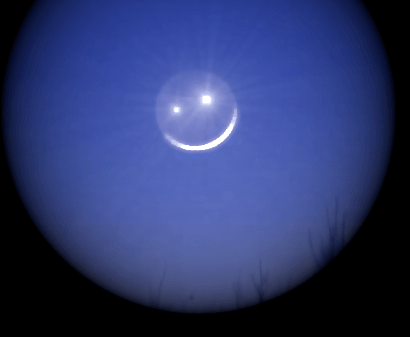
I can see the rising crescent moon outside the right window as I’m heading north (obviously).  I saw it first thing when I stepped out this morning, and thought it looked like some kind of insane (lunatic, if you will) exaggerated grin.

Of course, when the crescent moon is bright and near the horizon, it will always be a grin, not a frown.  The crescent always faces the sun, so if it’s “frowning” it will be following the sun in the morning or leading it down in the evening.  Thus, a frowny moon is going to be a daytime moon, and so less visible than a grinning one.

I think I’m right about this, based on positions and optics and stuff.  I’ve never read about it specifically, but it seems that this is the way it has to be.  Someone please correct me if I’m wrong.

My Uber driver is driving a Tesla, which means I’m sitting in a Tesla.  I must say, the front end of Teslas look disquieting to me, because there is no grill (there doesn’t need to be air intake for an electric motor, other than perhaps for cooling, since it doesn’t use combustion).  Though it makes sense, it always reminds me of the scene in The Matrix, when the Agents made Neo’s mouth disappear, or the fate of the formerly shouty sister of Anthony in the Twilight Zone movie version of It’s a Good Life.  A human face with nose and eyes and no mouth is disquieting to see.  Still, they seem to be good cars, and the lack of a grill probably improves the aerodynamics.

***

Now, here I am at the office.  Though I could finish this on the desktop (the computer, that is‒I am sort of leaning on the desktop at the moment), I’m continuing it on the phone because it feels better to finish where I started.  I’ll do the editing on the desktop (computer), though.

There is a crosswalk on the way to the office****, and the walk signals there have been hosed for months, and nothing seems to have been done about it.  When one is on the west side of Military, waiting to cross Hillsboro, the walk signal never activates.  This is despite the fact that I push walk signals buttons in ascending primes.  In other words, I first push twice, then I pause, push three times, pause, push five times, pause, seven, pause, eleven, pause, thirteen, pause, seventeen, pause…and so on.  It rarely gets that far.  Usually, during the main part of the day, the simple needs of traffic on Military make the thing turn before too long and stay turned for a decent duration, despite the fact that it is, as I say, hosed.

However, this early in the morning, the wait is longish‒there’s much more Hillsboro than Military traffic‒and then when it does change, the change is very brief.  This, at least, demonstrates that it’s not merely a problem of the signal, i.e., it’s not just that the walk sign is not lighting up while the system is otherwise processing things as it is supposed to process them; in other words it’s not just an indicator light problem.  No, the actual walk signals’ input and activation systems (north and south directions) on the west side of that intersection are not functioning.

I had to cross, though, so once the light turned green for traffic in my direction (and once I was reasonably sure the guy in the eastbound truck on Hillsboro, who was going way too fast coming up to a red light, was going to stop before the crosswalk) I scuttled off to cross the street.  But the light turned after the one car each going north and south passed, and it was red before I was much more than halfway across the street (and green for cross-traffic) even though I walk rather quickly.  So, if anyone works for Broward County in the division that manages such things, or knows someone in that division, please let them know this thing needs fixing.

I’m not sure how one would go about alerting them to the problem.  I suppose there might be some phone number or email system online.  I often toy with the thought of deliberately getting hit by an oncoming vehicle while crossing that street and, assuming I survive, explaining that the signal was broken.  It would be making a point and chastising reckless drivers at the same time.  It would also give me a break‒figuratively and perhaps literally.

I doubt I’ll do that.  I tend to be much less careful about entering crosswalks than I used to be, though.  I figure, if I have the right of way and get hit by someone driving inappropriately, well, that might kill two birds with one stone‒or two anthropoid idiots with one vehicle.

I doubt I’ll kill myself using traffic, though I suppose I might act on an impulse if the circumstances were just right.  It’s just generally rude to the innocent drivers out there‒people commuting, all that stuff.  I’d much rather do something quieter and less messy and more polite.  I’m working on it.  I’m reasonably clever and creative, so whatever I choose from among the options I’m considering, it will probably be both effective and not too messy.  Unless I change my mind about avoiding that.  My mind is not my friend, in many ways, so I can’t be sure it will always stick with my preferences.  After all, I’d prefer not to be stressed and angry and depressed and insomniac and in pointless chronic pain, but, oops, it’s all there.  I would rather be reasonably happy and together and have friends and my family and have all of us be reasonably healthy.

I would also prefer you all to have a good day and a good week.  Look after yourselves and those you love; you can’t count on anyone else to do it.

mad morning moon


*I did not succeed.

**I’m not behind a plow***.

***Or “plough” if you prefer the British spelling.

****They do not call it the Rising Sun…or even the Rising Moon

Moods and moons and musings on mythology and morality via Middle-earth

I’m mainly over my weekend gastroenterological difficulty, so physically I’m definitely doing better than I was.  That can’t help but bolster my mood at least a bit, though the elevation bears all the hallmarks of being a supremely temporary state*.  Perhaps you think I’m being pessimistic, but I know myself and my moods reasonably well‒although I will freely admit that it is impossible to be fully objective about such things, given their very nature.

It looks like the moon is very close to its full state this morning, so if it’s not truly “full” now, then it’s one day before or one day after.  If I were a werewolf, I suppose this would be bad news for people around me.  However, I clearly am not a werewolf.  Nor is anyone else**.

I’m also not one who follows all the supposed names of the full moons and all that.  There’s nothing wrong with it, and if paying attention to whether it’s a harvest moon, or a hunter’s moon, or a sun myung moon, or whatever, makes you happy, then do please enjoy yourself.  The whole “super moon” thing is a bit more laughable, though.  The difference in angular size between the moon at perigee and the moon at apogee is too small to be detectable by the naked eye.  Sorry.  Also, by the way, the fact that the moon looks bigger when near the horizon is not even an optical effect***, but is merely an optical illusion.

The weather is slightly more pleasant right now than it has been, because we have a good, strong breeze, thanks to Idalia.  Other parts of Florida are having much worse weather, with the aforementioned hurricane and all, but that’s hitting the northwestern coast of the state, and will cross farther north and east.  We are on the real outer periphery of the storm’s effects down here; we just have more wind than usual, some intermittent rain (not truly unusual) and the very nifty spectacle of the fast-moving clouds all traveling in the same direction, following their course counter-clockwise relative to the center of the storm, hundreds of miles away.

I guess, from a Tolkien-based mythological perspective, a hurricane is sort of a partnership/game between Manwë and Ulmo, though those two don’t ever really come across as overly playful, and I guess they probably wouldn’t willfully do something to cause grief to the Children of Ilúvatar.  That might be more Ossë’s thing; he was apparently associated with storms and whatnot.  Of course, most unfairly, Melkor gets blamed for all the negative stuff‒burning heat and bitter cold immoderate and all that‒but Eru himself plainly and clearly said that everything comes from him.  “Thou shalt prove but mine instrument…” and all that.

Really, Melkor is just a convenient scapegoat so that people don’t get ticked off at Ilúvatar, who gets the credit for the good stuff and gets to foist off blame for the bad stuff, even though he is the one responsible for all of it.  Indeed, he’s the only one**** who could be responsible.

From a certain point of view, Melkor is the being in Ilúvatar’s creation that suffers the most.  He is given the greatest gifts of knowledge and of power of all the created beings in that universe, but he is fated, by his creator, to be disconnected, to be alienated, to feel an emptiness that his brethren don’t seem to share‒he lacks something, he is different, his thoughts are unlike those of his brethren (I can sympathize), and that torments him into becoming the original Dark Lord, the supposed source of all evil in Arda.

But of course, as openly admitted by the being himself, Ilúvatar is the source of all evil in Arda.  It may be worthwhile‒perhaps the gain in beauty and heroism and triumph and courage gained by those who live in his creation more than makes up for the suffering caused by and to the evil creatures.  But those evil creatures are still victims‒perhaps the greatest victims.

Ilúvatar could just have repaired Melkor (and Sauron, etc.).  He could have shown them his wisdom, the error of their ways, could have cured their dysfunction.  But no, that would be boring; that wouldn’t make a good story.  How could he have a heroic and triumphant journey for Frodo and Sam without sacrificing the soul of Sauron to endless emptiness and loneliness and bitterness and fear and hatred, and finally to being blown away into the Void, to suffer there forever (or at least until Ilúvatar decides it’s time to remake the world)?

And let’s not forget Melkor, with his feet chopped off and his head chained between his knees, floating immortally in the Void, with no respite from pain and suffering, no treatment or correction for the flaws and lacks that made him what he was, that Ilúvatar put there to make him an instrument for devising things of greater beauty.  He’s the clay mold around a bronze statue, broken and cast away once the metal cools.

Melkor can’t die, can’t sleep, can’t even change his form anymore.  No wonder he has always hated and envied the favored golden Children.  No wonder he hates Ilúvatar.

Okay, that was a weird digression, and of course, it’s all fiction, though it’s great and wonderful fiction.  But it is a way of highlighting a conclusion that I think is inescapable:  if there is/were a universe created by an infinitely powerful, omniscient, omnipresent being, then that being, and that being alone, would be responsible for all suffering, for all evil.  Everyone else is just a puppet by commission or by omission.

Fortunately(?), there is no reason to suspect such a thing, and I give it quite a low Bayesian credence (though not, perhaps, as low as werewolves).  That doesn’t mean that “free will” and “blame” and “retribution” make any more ethical or moral sense than they would have made otherwise‒they don’t.  But at least we can all cut ourselves and the universe a bit of slack, all the while recognizing that we’re on our own, no one’s going to help us, and it’ll be up to us to sink or to swim…or, maybe, to try to swim but sink anyway.

I don’t know what I’m getting at, but thanks for your patience.  Have a good day, please, if you’re able.


*It was.  Even as I’m editing this, my mood is crashing.  I don’t think it was some manner of self-fulfilling prophecy, but even if it was, I don’t know what I could have done to avoid fulfilling it.  My nature is what it is, while I’m alive‒which doesn’t go a long way to making me attached to that state of existence.

**While, in principle, one cannot really assign absolute certainty to some given proposition, this is a case where my Bayesian prior‒if prior it really is‒is well above 99%.

***Unlike, for instance the fact that, due to atmospheric refraction, we see the sun in the morning before it would technically be directly in view without such refraction, and continue to see it longer than it is truly in line of sight in the evening.  That wouldn’t happen if the Earth had no atmosphere, but then we wouldn’t really care because we probably would all be dead.

****Apart from Tolkien (the author), but I’m approaching this from the point of view of Arda being real, so we’re not going to address that.  Of course, it is a fact that the bad guys in the story are used by the author to create beauty that would not exist if it were not for the hardships and struggles of the heroes.  I know all about this.  I’ve tortured the characters in my stories beyond anything any real people could ever experience.  I guess no creator of any but the simplest of things can ever be truly innocent.

Apologies for a blogless Monday

I was out sick with some form of enteropathy* yesterday, so I didn’t write a blog post.  I frankly haven’t done much of anything that’s in any way productive since Friday, and I’m not sure I did anything productive then.  I hope no one was too bereft by not being able to read my writing for three days (ha ha).

I’m now sitting at the train station, waiting for the train to the office (well, it doesn’t actually go to the office, but I think you know what I mean), not looking forward to the fact that I’ll have to do extra catch-up work from both Saturday and yesterday.  I really don’t want to have to deal with any of it or with anything at all.

I don’t know why I keep doing anything whatsoever.  I can speculate on certain causes, of course‒habit, the evolved drive simply to continue to survive, a dislike for causing inconvenience to other people, all that sort of thing.  Also, I guess there is the idiotic hope that maybe, just maybe, I will find some answers, some meaning, or some solutions to at least some of my problems.

Honestly, when I get sick like over Sunday through yesterday, I get the wild hope that maybe I’ll need to be hospitalized, and while in the hospital, I’ll be able to get some help for my psychological issues as well as my physical ones.  It’s stupid, I know.  I need to stop hoping for anything.  Hope is a waste of my time.

Ironically, it’s hope that keeps me writing about the fact that I’m having problems going on, problems dealing with my issues and my loneliness and my depression and insomnia and pain and all that crap.  I hope that somehow, by talking about it, I’ll either arrive at some insight or ideas or some semblance of understanding that might lead to some modicum of peace.  Or I hope that someone out there in the WordPress world‒perhaps it should be called the WorldPress‒will have some new ideas or insights or some help to offer.  Or maybe some old friend of mine will read what I write and will reach out and offer a hand or something.  I don’t know what they could do, or what I could do.  But anyway, it is hope that keeps me writing, I guess.

But it’s getting old.  I’m getting tired of it.

When I don’t just dwell on morosity (I don’t know if that’s a proper word), I write about weird shit, like I did on Friday.  I could write about current events, I suppose, but most of those are discouraging and boring.  It’s basically about as fun as writing about the interactions of a very large colony of baboons from the baboons’ points of view.  Baboons don’t want to admit to themselves that most of their choices and motivations are almost entirely simple primate dominance, mating, and social jockeying behaviors.

Humans really are just baboons with delusions of grandeur, some of which are excusable, many (perhaps most) of which are not.  They’re weirdly built and strange to look at, with very rare exceptions.  They think their culture and society and civilization were made somehow, deliberately‒by them it sometimes seems they imagine, though that cannot be possible‒when really, it all just sort of happened and continues just to happen, like any weather phenomenon or termite mound.  This is nothing of which to be ashamed‒it’s the nature of everything as far as I can see‒I just find the hubris disgusting and inexcusable.

Even nature itself seems just weird and rather twisted and horrifying when I look at it these days.  Maybe part of it is that I’m down here in Florida, but when you look closely at the very ad hoc, cobbled together, misery-laden natural world, in which even green plants compete ruthlessly against each other, while insects gnaw the tree trunks, and birds eat the insects and cats eat the birds (when they can) and meanwhile ten thousand other such painful and fear-ridden interactions are taking place in every acre, at all levels, from viruses to bacteria, to yeast, to protozoa, to slime molds and lichen and moss and mold and mushrooms up to grasses and bushes and trees and worms and snails and arthropods and fish and amphibians and reptiles and birds and mammals…everything ultimately just churning away at low entropy energy and converting it into high entropy energy…well, it all seems horrifying and discouraging and very, very dark.

Everything in the world seems alien to me…which I guess must mean that I am alien, since everything else is just there, doing what it does, being what it is, and I’m the one that finds it all daunting and repulsive.

I often bring up the concept of Sisyphus, and it now occurs to me that, maybe, Sisyphus is gradually wearing away the mountain on which he rolls his ever-falling boulder, slowly grinding it down until, finally, it’s level, and the boulder will no longer roll but will stay where Sisyphus puts it, and that will be the state of the universe at very high entropy (I want to say at maximum entropy, but I don’t think there is a maximum overall entropy**).

Of course “maximal” entropy is a state that can go on for a very long time.  It’s like the fable (as told by the 12th Doctor) in which the Emperor asks a shepherd boy to tell him the meaning of eternity.  The shepherd boy says there is somewhere a mountain of pure diamond.  It takes an hour to climb and an hour to go around.  Once every hundred years, a tiny bird comes along and sharpens its beak on the diamond mountain.  And when, after so many repetitions of that once-a-century sharpening happens that the diamond mountain is finally worn down to nothing…then the first second of eternity will have passed.

Even once the “heat death” of the universe comes to pass‒assuming that is what will come to pass‒and all is a haze of elementary particles, barely above absolute zero in an endlessly expanding but empty spacetime, which will come potentially after more than 10 to the 100th power years, that will only be an infinitesimal instant at the uttermost beginning of the eternity of nothingness.

In that quantum vacuum, even a direction of time will have less meaning than would any possible sense of up, down, left, right, forward, and backward in the heart of one of the intergalactic supervoids, in which not even a single distant star or galaxy could be seen with anything but the strongest telescope on long exposure.  To the human eye, in a supervoid, all would be blackness and emptiness in all directions, and in the heat death, that would apply to time as well.  With no change, the past and the future are indistinguishable.

Yet, eventually, new universes, or Boltzmann brains, or other esoterica might yet come to be.  Eternity is a long time.  Or maybe they will be found to have been in what seems to be the future but which is, eventually, the past of some universe with an opposite-pointing “arrow of time”.

Anyway, my point is, the universe is weird and harsh and the hubris of self-important creatures would be laughable if it were not so nauseating.

I don’t think I can do all this much longer.  My stop is coming up soon.  Have a good day.


*You can look it up.

**There is a maximum amount of entropy that can be fit into any given region of spacetime, and that is the Bekenstein-Hawking entropy of the area of an event horizon of a black hole that would enclose that region, expressed in square Planck lengths.  Actually, if memory serves, it’s the logarithm of that surface area (probably the natural logarithm).  If you tried to “add more entropy” to such a region, the black hole would grow, and the horizon would just get larger…you wouldn’t get more entropy “within” the given region.

And then the moon, like to a silver bow new bent in heaven, shall behold the blog of our solemnities.

Hello and good morning!

It’s Thursday, July 20, 2023, the day of my traditional weekly blog post.  Far more importantly, it is also the 54th anniversary of the Apollo 11 Moon landing, when the Eagle, carrying Neil Armstrong and Buzz Aldrin, landed in the Mare Tranquillitatis* and those intrepid astronauts took their famous “small” steps.  It’s easy for me to remember how old the Moon landing is, because it’s three months older to the day than I am.

I’ve occasionally, fancifully thought that maybe this explains, or at least illustrates, some of the weird things about me.  Perhaps some alien entity, less a body than an otherworldly mind, hitched a ride with the Apollo 11 mission after having been stranded on the Moon, barely surviving for ages or eons or who can say how long.  Then, after arriving on Earth, it set off on an erratic search for some compatible body and nervous system with which to merge and sustain itself, finally arriving in Pontiac, Michigan and locating a fetus in its 7th month of development‒just the right stage‒and merging with it.

Then, it found that this developing mind was just too weird and twisted, and it fled immediately, screaming inaudible alien screams, hurling itself into one of the Great Lakes and either drowning or merging with a fish somewhere.  Perhaps it had thoughts of leading the fish of the world in a revolution against humans and so on, but it was caught by a recreational angler who had it mounted and put in a wall.  This led to the creation of the prototypical Billy Big Mouth Bass, because the alien kept trying to ask to be released from the wall and the mount, but that first just freaked out the fisherman, then made him laugh because the alien/fish kept quoting the Supremes song You Keep Me Hangin’ On by accident.

The fisherman couldn’t get the rights to that song for his consumer version of the product, so he had to stick with the Bobby McFerrin ditty and related ones.  But the alien remains trapped on the fisherman’s wall to this day, harboring a grudge, and just waiting for AI to become advanced enough to merge with it.

Okay, well, that’s a load of silliness, I know, but it came to me in the moment, so I went with it.  What I really wanted to do was recognize and celebrate one of the most momentous events in human history, the first time people from Earth ever set foot upon another astronomical body.  To quote Tony Shalhoub’s character from Galaxy Quest, “That was a hell of a thing.”

In case you can’t tell, I’m trying to do a more lighthearted post today, just to give everyone who’s still reading my blog a little break.  My entreaties for help aren’t doing any good, anyway, certainly not so far, and though I am stubborn‒and often glad of it‒I’m not quite so monomaniacal as all that.

I still sometimes think about giving up posting on most days of the week and going back to trying to write fiction‒perhaps finishing Outlaw’s Mind or The Dark Fairy and the Desperado or starting Changeling in a Shadow World‒but I don’t know if the beginnings of either of the first two were any good from anyone else’s point of view.  I’m pretty sure my sister has read both of them as far as they have gone, and she’s expressed interest in the third based (I think) solely on the title, which I agree is good.  But I suspect she’s hesitant to give her preference, if there is one, out of concern perhaps about introducing bias.

Maybe what I really should do would be to try to write a new short story.  I have a long list of story ideas that I kept from my old phone, and I’m often thinking of new ones, but I don’t write them down anymore.  For instance, yesterday, on the way “home”, I thought of a story idea based on something I saw, a bit of graffiti, out the window of the train, but I didn’t bother writing it down, and now I don’t remember it.

My own feeling is that my best or at least most enjoyable stories are the ones with groups of “kids” (pre-teens or college students for instance) dealing with huge dangers and overcoming them together, like The Chasm and the Collision or The Vagabond.  If that’s true, it might be worth trying to recreate Ends of the Maelstrom, the first sci-fi/fantasy novel I ever completed but which was lost in the ruins of my former life.  But I don’t know what very many other people think, since I haven’t gotten all that much feedback.  I don’t think more than a handful of people have actually read any of them.

I guess that’s okay.  Apparently nobody ever really read Kafka’s work while he was alive.  As far as I know, though, it does him literally no good whatsoever that now he’s famous and influential and revered, and even has an adjective derived from his name to describe a certain type of story, because he’s dead.

Still, I guess it’s better to have your works become famous and revered after your death than for it never to have happened at all.  We could ask Herman Melville, I suppose.  Oh, wait.  No we can’t.  He’s also dead!

Well…we can ask him, I guess.  It’s easy enough to talk to the dead, or at least to address them.  But as far as anyone can discern, there’s no convincing evidence that any of them actually speak to us, except through the words they wrote and other work they might have done while they were alive.  That’s something, at least, and it’s a lot better than getting vague homilies from deluded and/or deceptive con-artist “psychics”.

Anyway, I guess I’ll keep you all posted (ha ha) about it.  In the meantime, although it’s Thursday, I hope you all have a good second, and far more laudable, Day of the Moon this week.

Shout out to Buzz Aldrin, who is still going strong at 93 years of age!  I met him once, quite by surprise, when my then-wife and I took our (very young) kids to the Kennedy Space Center.  I acted like quite the idiot, because I was so star-struck (or should it be “moon-struck”?), but I’m used to acting like an idiot, so that’s fine.

It’s still a great memory.  How many people can honestly say that they have experienced Buzz Aldrin looking at them like he’s not sure if they’re merely acutely ill or are a complete and utter‒dare I say it‒lunatic?  I’ll bet you haven’t!

While you’re eating your hearts out, I hope you nevertheless have a very good day.

TTFN

buzz about fish


*That’s Latin for “calm female horse”, which would be a better place for an eagle to land than on a not-so-calm female horse.

Nor can I fortune to brief minutes tell, blogging to each his thunder, rain and wind

Hello and good morning.

I decided yesterday afternoon that I would try to write something a bit different for today’s post, rather than just another litany of my depression and despair, since I’m sure any dedicated readers are probably getting almost as tired of reading them as I am of experiencing them.  I cannot directly alter the fact that I experience them—if I could, I would—but I don’t have to make it an uninterrupted trail of goo for you all to slog through on a daily basis.

I came up with two, more or less unrelated, ideas, but I’m only going to focus on the first, which is nearer and dearer to my heart and mind, in any case.  It’s also been something I’ve thought about on and off for some time.  I do wonder what pertinent quote from Shakespeare I’ll find to alter to make the title, but of course, you who are reading will already know the answer.

Don’t spoil it for me, okay?  I want to be surprised.

Anyway, the idea I wanted to bounce around today has to do with the question of the discontinuity of reality at a mathematical level.

I’m sure many of you are aware that, from the perspective of quantum mechanics, there is no sensible differentiation in, for instance, location at any scale smaller than the Planck length, which is about 1.6 x 10⁻³⁵ meters, or in time below the Planck time, which is roughly 10-43 seconds.

There are various reasons for this, and I won’t try to get into them, but this is generally agreed upon by all the scientists who work in the field.  It’s part of why there is an upper limit to the number of possible quantum states within any given region of spacetime, defined, thanks to Bekenstein and Hawking, as the surface area of an event horizon surrounding that region as measured in units of square Planck length.

Thus, based on the best current understanding of the micro-world, the universe is not so much pixelated as blurry at the smallest scales.  Admittedly, these are very small scales—far smaller than we can probe currently, so we may, in principle, be wrong about some of it, and quantum gravity might change our understanding, but there are strong reasons for this assessment.

Now, mathematics—thanks to work threshed out by Newton and Leibniz, building on ground first broken (though no one quite realized it at the time) by Archimedes about two millennia earlier*—can deal with things that are truly continuously divisible.

Those of you who took high school level calculus (or higher) probably recall that a derivative involves finding the instantaneous slope, or rate of change, of a curve describing some function, such as the instantaneous acceleration being the rate of change of the “speed”.  The idea of it had to do with taking the slope of a line connecting any two nearby points on the curve and bringing them closer and closer together, taking the limit as that distance goes toward zero.

Analogously, integrating a function involves finding the area under a curve, and is in a way the opposite of a derivative.  This involves splitting the area under the curve into rectangles of fixed width at any given point along the curve (the height defined by the value of the curve at that point) and adding them together, then taking the width between the points to be smaller and smaller, until one approaches the limit of an infinite sum of “infinitesimally” narrow rectangles.

These processes are tremendously useful, and can describe the orbits of astronomical objects and the trajectories of ballistic materials, just to take two simple examples.  They are good for describing the universe in many ways, and they often produce useful and accurate answers and predictions to the best of anyone’s ability to measure.

But that raises my question.  Do we currently have the capacity to tell the difference between processes in the universe—say, for instance, acceleration due to gravity—being truly continuous or them being in a sense discontinuous?

We know that the Real Numbers are uncountably infinite, as a matter of pure mathematics.  Between any two nonidentical real numbers, however arbitrarily close together, exists an uncountably infinite number of more real numbers, as large—so to speak—as the number of real numbers themselves, a Russian doll in which every new doll revealed by opening the previous one has just as many dolls inside it as there were inside the original Russian doll…but even more unlimited than that.

This is, however, not necessarily relevant to reality**.  Just to demonstrate that fact:  we can calculate Pi (π), the ratio of the circumference of a circle to its diameter, to any number of decimal points we might choose, but it will never come to an end—it’s an infinite, non-repeating decimal number, one of the “transcendental” numbers.  Pi has been calculated to 62.8 trillion digits (as of 2021) but that’s not a number we could ever measure as the ratio of the circumference of any actual circle to its diameter.

I’ve read (from a reliable source) that only 39 digits of Pi are necessary to calculate the circumference of the visible universe*** to the fineness of a single hydrogen atom.  Now, a hydrogen atom is about 1033 Planck lengths across, according to a quick search, so that means, in principle, we’d only need Pi to 72 digits or so to calculate the diameter of the universe to the nearest Planck length.  That’s a fairly large number of digits, but it’s smaller than the order of magnitude of, for instance, the estimated number of baryons in the visible universe, and is smaller than the entropy “contained” in even a solar mass black hole****, unless I’m seriously misremembering.

So, finally, my question is, how well have mathematicians ascertained that aspects of reality can in truth be described by equations that are actually continuously variable, or whether we could ever tell the difference?

A computer, for instance, could simulate some model of a continuously varying system to a high degree of precision by taking each current state and then applying an approximation of the applicable equations to the next state, iterating each step in sequence, as if recapitulating the steps that led to the limit defining the derivative or the integral of a function.  This would be considered an approximation of the true function, of course, but one could, in principle, get arbitrarily close to the true function by taking one’s intervals to be arbitrarily small—solving, for instance, or at least simulating, the three (or more) body gravitational problem, by calculating, at each instant, the net effect of each object on all the others, calculating the acceleration, applying it, moving each thing a tiny step, then recalculating.

But what if it’s not the step-wise approach that’s the approximation?  What if the continuously differentiable functions we use to describe things like gravity and electromagnetism and the various quantum mechanical matters are the approximations?  What if reality is more Δx/Δt than dx/dt?

Obviously this is a simple enough concept to come up with, and I’m far from the first one to think of it.

My more immediate question is, has anyone demonstrated mathematically just how fine our measurements would have to be to tell whether, for instance, the orbit of a planet around a star follow a truly continuously differentiable path, or if it is just a step-wise, iterated process?  If one were able, for instance, to simulate the orbit of a planet, say, by iterating an approximation each Planck time, and reconfiguring the system at each step to the nearest Planck length, how long, in principle, would it take to be able to tell the difference between that simulation and a truly continuously differentiable motion?  Could there, given the constraints upon the nature of reality applied by our best understanding of quantum mechanics and the like, ever be any measurable difference?

I don’t know if this has been addressed by mathematicians.  It may not have any practical implications, since we’re a long way from being able to measure reality precisely enough—or so I suspect—to tell that difference.  But I wonder if it’s been worked out just how finely we would need to be able to measure to tell if reality is truly continuously differentiable.

If anyone reading is a mathematician familiar enough with this sort of question to give me an answer, I would love to hear it.  Or if you know a mathematician with appropriate expertise, or a physicist of similar expertise, I would dearly like to know if anyone has done any explorations from the mathematical (not simply the practical) point of view regarding this.

That’s it, that’s my subject for the day.  I feel that I’ve been very ham handed and brutally quick in the way I’ve gotten into the subject, and for that, I apologize.  I only have the time to write this between my shower and when I leave to go to the train station, so it’s a bit quick and dirty, as they say.

Obviously, I don’t have time or space today to address my other, unrelated question, which is about whether the legality and ubiquity of large-jackpot lotteries of various kinds has changed the general psychology of, for instance, the American people in a way that has decreased “average” ambition and work ethic, providing “bread and circuses” to the masses in a way that has at least contributed to the greater economic disparity between socio-economic levels in the nation (and the world) and the gradual dissolution of the middle class?

I wouldn’t dream of thinking it the only or even the dispositive factor, but I wonder if it might have contributed.

Maybe I’ll write about that tomorrow.  Weirdly enough, we may have a harder time coming up with definitive answers for that question than the one I tried to discuss today.  Mathematics and physics are easy, in a sense.  Biology, psychology, sociology, economics…these things are truly hard to model and describe in useful, predictive ways, because the systems are so complex, with so many variables, both dependent and independent.  Even weather, the quintessentially chaotic system, may be more tractable.

I hope this has been more interesting than my usual reflections and projections of gloom.  I also hope you all have a very good day, and maybe that you think a bit about what I’ve written.

TTFN

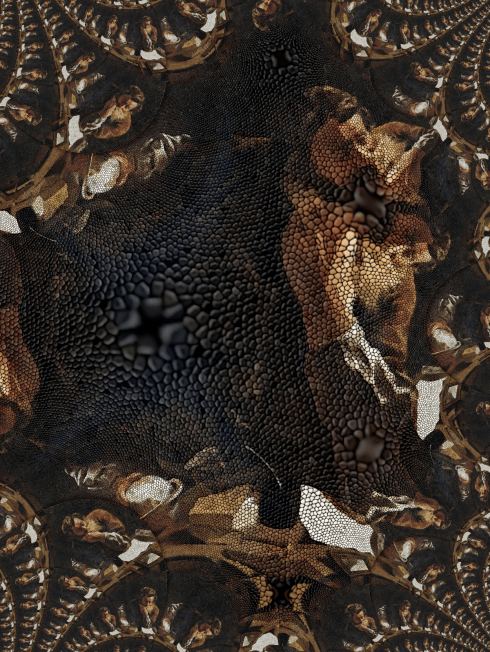
Domenico-Fetti_Archimedes fractal tiles


*What a Mary-Sue that guy was!  I mean, forget the whole acrimonious debate on priority between Newton and Leibniz regarding calculus, these guys were about two thousand years behind the Eureka Man!

**Though it could be, even if distance and time and not limitlessly divisible.  For instance, if the Everettian “Many Worlds” description of quantum mechanics is correct, the overall “space” of “universes” created at points of decoherence/branching could be infinitely and continuously divisible, making it a no-brainer as to how many potentially different worlds there might be in that space—not “real” space, but the orthogonal space that contains all the branches of the many worlds.  However, that might not be infinitely divisible, either.

***That’s everything that can, even in principle, be seen given the finite time light has had to reach us since the Big Bang.

****The Entropy is about 1077, but Entropy is proportional to the natural log (basically, taking a log is the opposite of raising something to a power) of the number of possible microstates in a system, so that number of states is e to the 1077 power, or e multiplied by itself 100000000000000000000000000000000000000000000000000000000000000000000000000000 times.

This is the way the word ends:  Not with a “!” but a “…”

Well, it’s Monday again, the (effective) beginning of yet another week…a week that has no end that I can discern.

I don’t mean to say that I think the week will last forever.  That wouldn’t make any sense (though at times it can feel subjectively endless).  A week, by agreed-upon definition, lasts seven days, and seven is a good prime number (and all primes are finite, though there can be no largest possible prime number).  I mean, rather, that it has no end in the teleological sense.  It has no purpose.  It has no meaning.

I’m not accomplishing anything at all.  I mean, okay, I’m going to work and doing a job.  I’m also writing this blog post, which will be looked at by a few dozen people, perhaps.  That’s bigger than the number of people who have read any of my stories and/or books, and probably larger than the number who have heard any of my songs, but it’s still not much of an accomplishment.

Not that I’m ungrateful!  I deeply appreciate and thank each and every one of you who reads my blog posts, however depressed and depressing the posts tend to be.  But I don’t think I’m doing any good for anyone by writing them.

I am always trying to learn new things, as much as I can.  As I walked the five miles to the train this morning, I listened to some of James Gleick’s The Information, a sort of prehistory and history and exploration of information theory and computer/communication science.  I find that learning the history of discovery and innovation really gives me a deeper handle on the workings of a subject.  On the other hand, though, I also have an audio textbook proper on Information Theory, which is quite interesting in and of itself, but I decided for now to do the Gleick book.

That’s not all to which I’m listening or that I’m reading, of course.  I am interspersing it with two audio books by Sean Carroll (Something Deeply Hidden, which I’ve read before, and The Biggest Ideas in the Universe, part 1, which is new).  I’ve recently started two and finished one Kindle-version book by Hugo Mercier, Not Born Yesterday, and The Enigma of Reason, the latter of which was  co-written with Dan Sperber.  Also, I’m reading The Experience Machine:  How Our Minds Predict and Shape Reality by Andy Clark*.  And I’m reading Secrets of the Autistic Millionaire by David William Plummer, who runs the YouTube channel Dave’s Garage.

I started trying to read the Kindle version of Quantum Field Theory As Simply As Possible, by A. Zee, but since the Kindle version of that is basically a pdf of the print version, it’s hard to read on Kindle, since its text size and formatting can’t be separately adjusted.  Even on a tablet, it’s difficult to read.  I think, if I really want to read it, I might need to get the print version, but if I’m going to go that far, I might as well just get his actual textbook since that’s reputed to be quite good, and I might as well take a deep dive.

Unfortunately, though I enjoy learning all this stuff, it’s also all just pointless, since I have no one with whom to discuss it deeply, and I’m not making any contributions to knowledge or process or to anyone’s quality or quantity of life, including my own**.  I’m not even as useful as someone trying to shout and do semaphore in a sandstorm, because I don’t seem to have any message to convey.

Talk about a tale told by an idiot, full of sound and fury, signifying nothing‒I’m not even telling tales anymore.  I’m certainly not contributing to human knowledge, whether in physics or mathematics or biology or music or literature or even medicine (though I have contributed a tiny amount of the latter in the past).  I’m certainly not contributing to overall happiness or well-being in any sense.

I don’t feel that I’m contributing any lasting good to anyone, not even to my family, though at least I did that in the past, and I also did some good for a fair number of people when I was in medical practice.  Maybe at some point the reflections in this blog might be of interest as a case study of a mind that’s not so much disintegrating as imploding, like a dying star, completely run out of fusible material***.  Otherwise, though, I am alone and pointless.

Anyway, now I’ve ridden the train and have arrived at the office, so I’ll draw this first draft to a close.  I will simply add that, apparently on Saturday, someone (most likely the boss) moved around a bunch of stuff in my area of the office, presumably to free up a plastic tub that now sits empty under a table stacked with papers.  It hasn’t increased the accessibility or usability of the various things.  It’s purely a cosmetic reassortment, which I suppose can be aesthetically beneficial to people who find the seeming mess problematic.

However, I have a hard time sympathizing, when every day I am confronted by the disorder of people ignoring schedules, being inconsiderate of others’ time, cutting corners on procedures and sales and so on, people yelling and shouting and sometimes making fun of other people, people demanding to have loud music playing‒all that crap, all of which is to me not much better than having swarms of flies and mosquitoes constantly buzzing around one’s head.

Probably I’m being unfair.  But it is irritating.

Oh, well.  The world is unsatisfactory, and it probably always will be.  And I need help, but I don’t think I’ll ever get it.  And any given week in my life now has no apparent end, and it often feels that way metaphorically in the other sense.


*Anyone who has been on both Sam Harris’s and Sean Carroll’s podcasts in the space of about three weeks is probably someone with interesting things about which to write, and that is indeed the case.

**In this latter area, the care and maintenance of my well-being, indeed of my own survival, I fear that I need a tremendous amount of help, rather urgently, but I don’t have any right or ability to seek anyone else’s efforts.  My need is my own problem.  Unfortunately, I don’t seem to be up to the task on my own.  In such circumstances, the outcome is reasonably predictable.

***It is theoretically possible, if I understand correctly, for a sufficiently massive star at the end of its “life” to collapse straight into a black hole, with the horizon forming rapidly enough that there is no time for a supernova explosion to happen.  Any astrophysicists who read this (ha ha) please correct me if I’m wrong.