Uttering such dulcet and harmonious blogs, that the rude sea grew civil at her song

Goodo and hell morning.

I’m pretty sure I’ve used that pseudo spoonerism before in a Thursday blog post opening, but I guess that’s okay.  I would be the only one to complain about such copying (and perhaps some imaginary, truly obsessive reader) and I’m okay with it as long as I am also the copier.

I’m writing this on my smartphone, because I had a very bad pain day yesterday*, and even the small extra weight of the mini laptop computer was something I wanted to avoid‒probably purely for psychological reasons, since I doubt it affected the level of my pain directly.

Anyway, I’m not in as much pain today so far, though it’s early doors, of course.  Still, I can’t change my mind and conjure the laptop computer at this point; if I could do that sort of thing, why would I bother going to the office?

Well, today I have one reason other than exerting effort necessary to maintain my job**:  my black Strat is back.  I asked my boss to bring it back, since it was just sitting in his garage, and yesterday he did so.  I even took a bit of time near the end of lunch to change to low E string, though I had brought my electronic tuner back to the house, so I had to tune the guitar afterward by ear***.  I’m pretty good at that, though.  Tuning a cello is much trickier, and I’ve done that a lot in my time.

I diddled around a little bit on it during a brief lull in the afternoon, and it was definitely nice.  I could still play Wish You Were Here and The Man Who Sold the World and Nothing Compares 2U, but I’m embarrassed to say that I had to look up the 5th (or was it 6th?) chord in Fake Plastic Trees****.  Once I got that chord back, though, it was as if I had never forgotten it.

My boss said that he thought my desk area looked better now with the guitar back in place.  Or maybe he asked me if I thought that was so.  Either way, the general message was the same, and I agreed with his assessment (or just answered his question in the affirmative).

I’ll probably do a bit of strumming and plucking this morning before work (and of course I will sing along).  One of these days, maybe I’ll do one of my videos of me playing and singing one of those songs above, or maybe One Headlight, or something like that.  I wonder how the acoustics in the new office would measure up when recording music.

We’ll have to see if I can still sing okay‒though, really, I do sing occasionally at the house when the housemates are out, and as far as I can tell my voice is still tolerable.  I don’t think I sing as well as I used to, but then again back in the day I used to sing more or less constantly during every daily commute, so I got a lot of practice.  I’d play and sing along with the Beatles or Elton John or Billy Joel or the soundtrack from Les Mis or (my favorite) The Phantom of the Opera.  Then later, when I had really long commutes after my divorce, I’d sing along with Tori Amos and Pink Floyd and Radiohead in addition to the previously mentioned artists.

Is it weird that, talking about how (or whether) I can sing, I cannot help but think of the old Simpsons  episode in which Troy McClure stars in the Broadway show Stop the Planet of the Apes, I Want to Get Off?  Specifically, I remember when the famous “Take your stinking paws off me…” line leads into a song in which the surrounding apes repeat, “He can talk, he can talk, he can talk, he can talk, he can talk, he can talk…” and Troy belts out, “I can siiiiiiiiiing!

I haven’t watched much of The Simpsons since Phil Hartman was murdered.  He was never a main character, but he was always awesome.  I once read that he claimed, “I can do a thousand voices…and they all sound like Phil Hartman.”

Well, I suppose that’s enough gobbledegook for today.  For those of you who prefer talk of music to talk of mathematics and physics and their relationships to prosaic, daily matters:  You’re welcome*****.

I hope you have a good day today‒though as you should know by now, it will inevitably be the best possible day you can have, so don’t fret too much.  Reality is what it is.  And as John Mellencamp might have said (though he did not, as far as I know):  “When I fight reality, reality always wins.”

That’s one of the ways we know that it’s reality.

TTFN

I like this picture because David Gilmour’s Strat here looks JUST LIKE mine.

*Unless you prefer to say that, because of how much pain I was in, it was a good day for pain but a bad day for a person who would rather not be in chronic pain.  Raise your hand if that describes you.

**This is a bit peculiar, but without intending to do so, I initially wrote, “…exerting effort to stay alive” (emphasis added).  That hadn’t been the conscious idea or intention in my head as I was writing.  I wonder what a Freudian would say about that off slip of the typing thumbs.

***No, this is not going to be a stupid “by ear” related dad joke.  I just wanted to point out that I did use a video on YouTube where the proper guitar notes were played, just to get the sound for my low E.  After that, the rest of the tuning is pretty easy.

****It was a Dsus2, if memory serves at the moment.  [Checks the chords]  Yes.  Yes, it was a Dsus2.  And it was the 5th chord in the song, if you count the little Asus4 temporary life as a chord that’s separate from the A major chord from which it arises and to which it returns.

*****It’s not “your welcome”, which would seem to refer to a welcome that belongs specifically to you‒it’s “you’re welcome”, with the contracted form of “you are”, meaning, yes, you are welcome to the boon I have provided in the form of not writing about physics and mathematics today******.

******And though I’ve never seen it written so, it’s also not “yore welcome”, which would seem to be some reference to the way people used to be welcomed in the old days.

The stochasticity of quantum interactions and the names of days of the week

It’s Wednesday today.  That’s a weird way to spell a day, and a weird way to spell a version of the name of the god Wotan or Odin, after whom the day is named (unless I am quite, quite mistaken).

Our days are peculiarly and seemingly haphazardly named here in the English-speaking West.  We’re not the only ones with inconsistent weekday names, but ours are certainly a strange hodgepodge.  Sunday and Monday are relatively straightforward:  they’re named for the sun and the moon.  Then, weirdly, we suddenly switch to Norse (!) mythology and name the next four days after four of the old Scandinavian deities.  Then, abruptly, we switch to a Roman god, Saturn, for Saturday.

This “names of the days of the week” thing was clearly not planned out.  It just sort of happened.  But that’s the way so many things occur in the real world—indeed, perhaps everything just sort of happens, and at multiple levels—not randomly but nevertheless stochastically and in a way that is functionally unpredictable, at least in its details.

The various quantum fields just sort of interact in ways that, at their lowest stable energy levels, give us quarks and gluons and electrons and photons and W and Z bosons and various neutrinos and a nonzero Higgs field that interacts with some (but not all) of the other fields.  The quarks and gluons just happen to form up stably into protons (and some neutrons, but neutrons are only stable within an atomic nucleus—they decay with a half-life of about ten minutes when existing freely).  And the protons happen to interact, via the electromagnetic field, with the electron field, and they stably pair up, and neutrons come into play “afterwards”, stabilizing larger atomic nuclei (though that’s not all they do).

Then, on large scales, the graviton field (if there indeed is such a thing, which is suspected but not certain) interacts with all the other fields, and where the density of stuff is slightly higher it pulls that stuff in towards itself, and where it is less, that rarefied stuff gets thinned out further as its components are pulled by neighboring stronger areas of gravity.

This process undergoes positive feedback—as stuff gets denser, its gravity gets more prominent, and that in turn tends to make the stuff get denser still.  And if there is any net angular momentum to larger collections of the stuff—and there almost always is some net angular momentum, since there’s only one way to have zero angular momentum, and there is a functionally limitless number of ways for it to be nonzero*—the stuff starts to rotate around a net common axis.

And then, of course, we get galaxies, and in those galaxies, we get stars, in which the interactions of the various quantum fields and gravity lead the protons and neutrons to get together into bigger clumps, some of which are quite stable (and the ones that aren’t stable simply don’t endure but transform into other states until they find ones that are stable).

Then stars run out of fuel, and the various field interactions and gravity produce various kinds of spectacular deaths, most of which involve scattering at least some heavier elements** out into the reaches of the galaxies.  Then we get next generations of stars, which (by the way) clump and develop angular momentum in a smaller but similar way to the galaxies.  And now, with heavier elements, we get planets, some of which are largely solid.

I think you know the broad strokes of the rest of the story.  If not, let me know.

Of course, this is a very general sketch of how stuff just came together to form the universe in which we exist, and there’s no indication that that is anything more than just small things—or esoteric things, really, such as quantum fields and their local perturbations—interacting with each other and making patterns on larger scales, much as water molecules can clump into fantastic patterns in the frost on windows or in snowflakes when they get cool enough.  Simple (well, relatively simple) rules at small scales can come together to produce surprising things at larger scales when they all interact at secondary, tertiary, quaternary and higher levels.

If you want to see how remarkable that tendency can be even in two dimensions, find a website that lets you play “John Conway’s Game of Life” and see how stable and active and interactive shapes can arise from even truly simple rules.

What was my point?  Sorry, I got distracted there for a minute.  Oh, right, I just meant to say that the things that happen and that all seem very real and important and even inevitable and fundamental are largely the products of stochastic processes interacting in ways that ultimately are far from being representable by any kind of linear equation.

It’s entirely possible and plausible that, if the rules of the quantum fields—or the specific types of quantum fields*** involved—were different, and thus interacted with each other differently, they might still accumulate into structures and functions on higher levels, and though they might produce a universe that would be all but incomprehensible to us, and in which we could not survive for an instant, they might nevertheless form structures and processes that could become what would have to be called “alive” and even “aware” and “intelligent”.

But in how many such universes would there be creatures that name the days of whatever passes for their weeks after various astronomical bodies (or whatever they have that is comparable) and random mythological figures from different places and times?

I leave it to the reader to speculate.


*There’s only so fast anything can be spinning, since no part of the spinning thing can exceed the speed of light.  Even black holes have a maximum angular velocity.  Nevertheless, both the angular velocity and the net axis of rotation can be more or less continuously variable.  If we can apply the real numbers—which ironically may not be possible in the real world—there is an uncountably infinite number of possible ways for angular momentum to be nonzero.  That makes zero really unlikely and unstable.

**Astronomers call any element but Hydrogen and Helium a “metal”, which is a very loose use of the term if you ask me.  I think many astronomers would agree, and sometimes I think I detect more than a tiny amount of embarrassment when they tell people that astronomical definition.

***Or the configurations of strings and branes if superstring/M theory turns out to be correct.

“It’s just the kind of day to leave myself behind”

Well, it’s Tuesday, isn’t it.

Note that I ended that sentence with a period, despite the fact that it seems to be in the form of a question.  That’s because I didn’t really mean it as a question; I had no desire to imply that I wasn’t sure what day of the week it was.  I’m reasonably certain that today is Tuesday.

I’m not absolutely certain, of course, because outside the realms of self-contained systems of mathematical or logical axioms and rigorously defined and applied operations, there can be no true certainty, only higher or lower credence.  Real-world probabilities never reach zero or one.

Mind you, some things are so likely as to be practically certain, and there’s not much point in worrying about whether they are true unless and until some completely new evidence and/or argument makes itself known.  Such is my conviction that today is Tuesday*.

No, I was expressing a sort of resignation about the fact that today is Tuesday.  I would have said it in a sardonic tone had I been speaking aloud.  It’s not that Tuesday is an especially bad day of the week necessarily, notwithstanding the Beatles telling us that Tuesday afternoon is never-ending.  No, it’s just that Tuesday is still practically the beginning of the week, but I am already tired from Monday, and it’s a long way until the weekend, especially if one works on Saturday, which I am going to do, as far as I know.

That last statement has a lower credence than I give to the fact that today is Tuesday, but it’s still well above a 50% chance.

I know, I know, why am I writing this inane nonsense?

It’s just stream of consciousness.  I’m not planning it out, except to the extent that something I’ve written already makes me think of something else I want to write next.  But I have no particular chosen topic today, obviously.  Not that this is atypical.  I almost never have any plan when I start writing blog posts; I just start writing.  Sometimes I’ll just start with an inane phrase, like I did today, and see where that takes me.

Oddly enough, I think when I do have a particular topic in mind—such as in my short-lived series My Heroes Have Always Been Villains—people don’t seem to enjoy my posts as much.  Or, at least, I don’t get as many “likes” or views.  Maybe some people read and “like” them via social media or something, but if so, whatever they’re doing doesn’t reach me as feedback.  I don’t really see comments or responses that aren’t done here on my page.

Of course, as you may already know, the initial purpose for this blog—in this incarnation—was to try to promote my fiction by interacting with potential readers.  Boy was that a dud of an idea!  [No question mark ==> rhetorical, but not really a question].

More people read and have read this blog than ever read any of my books, unfortunately.  It’s rather discouraging, and it’s a large part of why I haven’t been writing fiction for a while, and the last thing I wrote, Extra Body, I just published here.

While I always write the stories I want to write and that I will enjoy (or whatever one might call the process) there really is a rapidly diminishing marginal return as one writes books that almost no one is even aware of, let alone purchases, let alone reads.  And as you know, I have no stomach for self-promotion.  Sometimes I envy narcissists, at least for an instant; then I remember that I tend to find them disgusting (though just a smidge of narcissism can be endearing in the right circumstances).

I also am not very good at interacting with people who might help promote my work, let alone at asking for that help.  I’m pretty good at the creative stuff, or at least I’m tolerably good at it.  I can write, I can draw, I can do music (playing and singing) and other similar stuff.

I’m also pretty good at science and math, and not just in a rote learning sense; I’m pretty creative there, too.  I once invented my own “number” which I call a “gleeb”, the symbol for which was a combined cursive g and b:

The nature of a gleeb is that, if you multiply it by zero, you get one (in other words, a gleeb is the “forbidden” or “undefined” result of 1/0).  That may not seem to make sense, but while I was “up the road” I even worked out some of the algebra and properties of such a number, and it turned out—to my inexpert analysis—to be logically consistent, at least.

I’m not saying it’s useful.  As far as I can tell, it’s not.  But it was a bit of mental fun and exercise, perhaps the intellectual analogue of playing hacky sack.

I’ve also occasionally thought of ideas in physics and in medicine that I thought were interesting, and which later I discovered had actually become areas of research or therapy (the therapy bit is in medicine, not in physics…as far as I know, there are no therapies in physics, despite the fact that there is such a thing as physical therapy**).

But I am not good at putting myself forward or putting myself out there or calling attention to myself.

Okay, well, I guess that’s enough meandering nonsense for the moment, though such nonsense can sometimes be fun.  Hopefully, Tuesday afternoon will not become some bizarre event horizon in which we are stuck forever.

Of course, the person going through the event horizon doesn’t experience the process as eternal; only the distant observers “see****” them slowing and slowing and coming finally, asymptotically, to a complete standstill.  The person who goes through, if they are looking backward, might see the whole history of the universe playing out before them—at least until tidal forces spaghettify them—but they will not experience time stopping.  Think about it:  how could one experience time stopping?  The passage of time is inherent in the process of experience, certainly as we know it.

I hope you have a good day.


*And even if it weren’t, I could just call it Tuesday and say that I have my own way of naming the days of the week, and it would be no more arbitrary than the one in use here in the US and elsewhere.

**This is as opposed to psychotherapy, of course, but it also can lead one to imagine such things as ethereal therapy or conceptual therapy or metaphysical therapy.  What would that last one be***?

***See, I ended that sentence with a question mark; it really was a question, though mainly a rhetorical one.

****I put that in scare quotes because as a person (or whatever) gets closer and closer to an event horizon, any light or other signal leaving them, heading outward, gets red-shifted to longer and longer wavelengths, so it becomes harder and harder actually to see them.  In the end, we cannot truly observe them stuck there forever, because the wavelength of the light leaving them approaches infinity.

Monday morning, wearing down

Well, it’s Monday again.  Time keeps marching on without respite, as it is apparently wont to do, “progressing” in the direction of increasing entropy, whether time is a fundamental aspect of the universe or an emergent phenomenon.  In either case, there doesn’t seem to be any sort of time stream or time vortex like in Doctor Who, but rather a process that simply is a linear dimension with some “entanglement” (not to be confused with quantum entanglement) with the dimensions of space, such that motion and acceleration in space changes one’s “motion” in time, in an updated version of the Pythagorean Theorem.

For those of you who like to share the joke about “Yet another day when I didn’t use a2 + b2 = c2” you’re really depriving yourself of a deep understanding of something that turns up in and governs a ridiculous number of the things and processes in the physical reality in which you live.  Consciousness—despite clever but tortured sophistry (in my opinion) by some prominent philosophers of mind—in no way appears fundamental to the universe*.  On the other hand, the Pythagorean Theorem, which was neither invented nor discovered by Pythagoras, applies in all levels of dimensions, however many you might conjure, and with the modification to make it reflect velocities, it applies to spacetime as well.

There can be no readily conceivable brains** in two spatial dimensions, but Pythagoras nevertheless applies.  In one dimension, it doesn’t really apply, but in one dimension there are no triangles of any kind, so it doesn’t make much difference.  It’s difficult to imagine how consciousness could possibly occur in one dimension (notwithstanding the seemingly one-dimensional paucity of ideas held by so many people, especially in politics).

Anyway, enough of this nonsense.  Well, it’s not nonsense, but it is rather pointless meandering of random thoughts that interest no one but me, and will probably lose me readers.  Weirdly enough, people seem to come and read more often when I write about my depression and self-hatred and anxiety and ASD and how there’s absolutely nothing going on in my life that makes it worth living.

Well, rest assured, all those things are still present and active and driving me toward an early grave, which in some senses will be a release, or at least an escape of sorts.

I keep trying to think of things to engage myself and my interests, but so far to no avail.  I think about asking my boss to give me back my black Strat to play at the office, or I consider bringing in another guitar, or maybe even getting a portable keyboard or something, but when I think of any of them, I cannot even imagine doing anything but sort of staring at them as if I don’t even know what their purpose is.  I don’t play my guitars or my keyboard at the house, either.

It’s likewise with even fiction, other than silly Japanese light novels that take a day or so to read (not continuous time).  I think I like them mainly because of the social interactions of the characters, many of the main ones of whom are somewhat socially awkward.  It can feel, however briefly, that I have a social group of some sort, as I read the stories.  Of course, that means that once I’m done reading there is a comparative let down, which sometimes makes me feel worse than I did before.

I tried to read some of Feynman’s Lectures on Physics, but I lost interest almost immediately, though he was a brilliant and engaging teacher.  I also tried to read some of Anthony Padilla’s Fantastic Numbers and Where to Find Them, which is also very good and fun; if you’re interested in who he is, you can check out the YouTube channel Sixty Symbols, and sometimes Numberphile.  He shows up in both places fairly often.  But in any case, though I like his book (I’ve read it before) it has not been able to grip me.

I’ve also tried to start reading Stephen King’s novella The Life of Chuck, since it’s now a movie and is getting positive reviews.  At least Stephen King is almost always an engaging read.  But I’m not sure I’m getting into the story.  Quite a while ago, I started the first story in If It Bleeds, the collection in which the above novella appears, but I couldn’t get into it at all.  When I can’t even get into reading Stephen King***, things are looking bleak.

I did watch the rest of the latest series of Doctor Who, and it was pretty good, and quite surprising at the end, but Batman only knows when the next series is going to happen, and there will only be a handful of episodes if it keeps up as it has been.  That’s too little too late for me to use as motivation for continued existence.

I don’t know what to do.  I really don’t know.  I feel very lost and, more importantly, very much without any internal impetus.  I can’t even listen to songs I like, let alone try to sing along (or play) without feeling like I’m going to cry, though I don’t understand why.  I’m at the end of my rope (I have two, and both are tied into nooses, just for “fun”).

Anyway, that’s enough.  Sorry to bother you with my crap again, but in my mind, you asked for it by complaining about my tedious math and science stuff.  I hope you have a good day.  Unless you’re lucky (or I am) I’m sure to be back again tomorrow with another blog post.


*The only reason I can discern why some people think consciousness is fundamental to the universe is that consciousness is fundamental to human experience—indeed, one could say that it is human experience—and of course, such people seem tacitly or implicitly to think humans are the measure of all things simply because that is what they are.

**The degree of interconnectivity is just too low.  Connections between 2D neurons would be terribly limited, as would room for such things.  I suppose that, since we can always map anything three-dimensional onto some two-dimensional surface, à la Bekenstein-Hawking black hole entropy and the holographic principle, we could construct a sort of brain in 2D, but that’s a tortuous process, and seems quite unlikely.  Of course, 4D would give us even more available connectivity than 3D—also there are no knots or tangles in 4 spatial dimensions—but there are other issues with 4 (macroscopic) spatial dimensions that would seem to get in the way of life as we know it, such as the nature of gravity (and other forces) and the rate of such forces’ diminishment.  For instance, the force of gravity (and electromagnetism, etc.) in four dimensions would fall off at a rate proportional to r3 rather than r2, and there are apparently no stable orbits in such situations.

***What’s worse, I cannot even get into reading Tolkien.  I’ve tried.  When neither Stephen King nor Tolkien, nor even well-written science books, can engage me, something indeed has happened.

Thoughts on real versus virtual keyboards, books, and quantum teleportation

It’s Friday, and I’m writing this post on my mini laptop computer, because although yesterday I forgot it and had to use the smartphone, it was really quite nice the other day to be able to type for real and not tap around on some simulated keyboard with no aesthetic appeal, on which one cannot feel the keys responding to one’s touch (and which gives this one arthritic pain in the base of his thumbs).

I remember when the notion of such a virtual keyboard first appeared to me—this was in Star Trek: The Next Generation.  I thought the idea seemed terribly unsatisfactory despite being very clever.  I mean, I recognized the efficiency of it, but when the characters would read books and such things on their little portable “tablets”, it seemed almost heartbreaking.

Obviously, in a star ship in deep space, they’re not going to have room for a vast physical library such as the virtual one they clearly have in the ship’s computer.  It’s much like the fact that I have many more books in my Kindle library than I have in my physical living space (though I used to have way more physical books than I have current Kindle books).  But something is lost a bit, nevertheless, at least for me, with such virtual collections.

Actually, it just occurred to me:  in Star Trek, they use replicators to make their food and so on, applying the transporter technology to reproduce scanned items that include food.  Why could they not use that to replicate books as needed, then scan them away when they were done?

Of course, the quantum mechanics of potential real world transporter-type technology is such that you couldn’t mass produce anything from “scanning” any one particular item; as part of the required entanglement process for quantum teleportation, one destroys the quantum states of the particles in the original item (or person, if it’s a person, so Dr. McCoy was right to be leery of the transporter).

Also, the entangled particles used to reconstruct the item by creating a new set of particles in identical quantum states to the original, could not be kept in their transitional states indefinitely; such states are not inherently stable.  Even if they could be maintained thanks to advanced technology, once they were used to recreate the original item or person, those entangled particles would also have their own quantum states irreparably altered, and could not be used to make another copy.

You can never make more than one copy of a thing sent by quantum teleportation, The Enemy Within notwithstanding*.

Still, maybe the people in TNG could “scan” a bunch of real books, as if about to transport them using the ship’s transporters, and just…save them for later.  You couldn’t make multiple copies, again because the originals would not still exist after being scanned—as I noted before, such scanning destroys the initial quantum states of all the constituents of the scanned item (or person).  But they could just be singly stored in the “buffer”, saving the quantum state of the entangled particles used to apply quantum teleportation.

But wait, I hear you say, storing all those books “in transition” would entail a tremendous amount of stored quantum information that would need to be maintained in its entangled state indefinitely, at presumably great cost in data and energy.  Not only that, one would have to have the equivalent of the mass of those items in the ship at all times, no matter** what.

You are very clever, and you are, of course, correct; it wouldn’t be efficient in any sense, and would add to the power requirements of the ship.  Also, in any serious disruption of the ship’s stability and power—such as happens in nearly every episode, so more than twenty times a year on average—much of that quantum information would probably be lost.

Maybe it really doesn’t make practical sense to try to do such a thing.  After all, I’m the person who has bemoaned the incredible data wastage necessary to store audio, let alone video, files rather than the much more efficient written word.  And I have not changed my mind on that set of subjects.  I could record a video, or even an audio, of me reading the words of this blog post, and it would have a file size in the hundreds of K at least; for a video, it would probably be many megabytes in size.

Meanwhile, my average blog posts, as stored in Word, are 16 to 20 K in size.  It’s quite a difference.  Even just using the RAM of this small computer (4 gigabytes) I could load up as many as a quarter of a million blog posts (assuming nothing else were in the random-access memory, which in not the way things work).  That’s about 250 million words.  Even I am unlikely to write that much during my lifetime.

More importantly, with the written word no one has to look at my ugly mug (though I will admit that my voice is absolutely lovely, so it might be worth hearing any audio file I produce…Ha-ha, just kidding).

Anyway, as I noted, it’s Friday, and I’m almost certain we’re not working tomorrow—I’m inclined to say that, even if the office is open, I’m not working tomorrow, but I tend not to follow through on such ultimata, because I’m a pushover—so there won’t be another post until Monday, at the earliest (barring, as always, the unforeseen).

I hope you all have a good weekend, but at least I know, as I pointed out yesterday, that you will have the best weekend you possibly can, since whatever happens becomes inevitable as soon as it happens, and it may have always been so (if quantum superdeterminism is correct).  Of course, that means you will also have the worst weekend possible.  But for most weekends, that’s a comfort.  For most such weekends, you could honestly say, “Well, if that was the worst weekend I could possibly have had, it’s not so bad.”

Usually, you could honestly say and feel that.  And it’s very likely that this weekend will be one such usual weekend.

Have a good one.


*In any case, that episode is really more of a fable than anything truly science fiction.  It assumes a bizarre kind of dualism between body and mind and a further, cleanly divisible dualism even in the mind itself, which in the episode is split into discrete but very broad personality aspects that can be separated out into different bodies.  It’s an interesting exploration of the tension between aspects of a person’s character, and engages speculation about whether a dark/violent side is a necessary aspect for a good leader.

**No pun intended, but I’m leaving it.

O heavy lightness, serious vanity, misshapen chaos of well-seeming blogs

Hello and good morning.  It’s Thursday, of course‒thus the “traditional” opening salutation‒and here I am again, writing another in a line of hundreds of Thursday blog posts.

Have I said all that I could say, already?  Probably not.  The number of possible 800+ word strings of English writing is surely unfathomably vast.  If I were going to try to give some kind of upper boundary, we would consider that there are a few million words in the English language, and I could just try to solve for a few million to the 800th power.  That’s a huge number (104800). But most of those combinations‒all of them, effectively‒would be nonsense.

By “all of them” I mean that, if one applies the constraints of grammar, or even just of making tolerable sense to a potential reader, the number of strings of 800 coherent words is so much smaller than the number of possible strings of 800 words without care for sensibility that, if one were looking at some shape or field that represented the latter, the former would probably be too small to see, given the constraints on the resolving power of visible light.

It’s a bit like the possibilities implicit in DNA.  The human genome is on the order of a billion or so base pairs* long, if memory serves, and each “site” on the genome has 4 possible “letters”.  So, the potential number of sequences of DNA in that genome is on the order of 4 to the billionth power, which would be 2 to the 2 billionth power, which is about 10 to the 600 millionth power (10600,000,000).

That’s a huge number. Remember, a googol is merely 10100, and it is already a number that far exceeds the number of baryons in the (visible) universe (which is on the order of 1080).  And remember how exponentials work:  every time you add 1 to the exponent you multiply by the base number, in this case 10.  So, 10101 is ten times larger than 10100.

As you can see, the number of possible DNA sequences is beyond astronomical, at least unless we get into, say, the measures of entropy represented by an event horizon, as an indicator of the number of possible quantum states it could have “within”.  But distances and times and numbers of particles in the accessible universe are unnoticeably small compared to the number of possible sequences of DNA**.

However, the vast majority of those base-pair combinations would certainly not code for anything that we would consider human, or indeed any other living creature that’s ever existed on Earth.  Most are the analogue of throwing random words together to make a blog post.  They wouldn’t come close to coding for anything that would be a living creature.

Nevertheless, even ruling out all the nonsense, the number of possible viable human genomes is vast.  It may still be larger than the number of particles in the visible universe, but don’t quote me on that‒I haven’t checked those numbers.  In any case, it’s much larger than the number of humans who have ever lived, and probably larger than the number of humans who will ever live even if the species goes on to become cosmically significant.

What this all comes down to, I guess, is that I haven’t come close to writing all the possible blog posts I could write, even ruling out ones that wouldn’t make any sense and even ruling out ones that differ from others only by a word or two.  I guess this blog itself constitutes a case in point.

But boy, it can be a lot of work trying to write something new every day, and even more work trying to write something interesting.  That’s why I don’t bother with the latter criterion; I just write whatever comes out, which is usually something at least mildly interesting to me, and I figure it’ll reach kindred spirits if they happen upon it‒and if such people even exist.

Speaking of kindred spirits, I hope you all have a lovely day.  At least I hope it will be as good as it can possibly be‒which it will, since once it’s happened, it can’t have been otherwise than it was.

TTFN


*In case you don’t recall, DNA is a long chain molecule of polymerized “nitrogenous bases”, adenine, guanine, thymine, and cytosine.  Because each DNA base can pair up only with its complementary base (A with T, G with C) this allows for high fidelity copying, and thus reproduction.

**Now, if the universe is spatially infinite‒which it looks like it is, but may not be‒then of course the number of particles or quantum states or even planets with life would be infinite, and thus larger than any possible finite number, no matter how big you might choose.  Fun things happen when one deals with infinities.

Lost then found thoughts about lost connections

While I was getting ready to go this morning, I thought about writing this blog post.  I thought about my usual starting point of saying something like, “Well, it’s Wednesday morning again,” or some other such inanity.  But then, as I was thinking about that, another, more interesting beginning and an actual, rather interesting, topic occurred to me.

Then, by the time I got ready to start writing—i.e., now—I had completely forgotten what I meant to write.

That’s terribly frustrating, but it is par for the course.

Oh, wait!  Maybe what I was going to write was about my realization regarding the effects of having a very uncomfortable crisis, but one that is inherently finite*.  It’s probably pretty obvious to you that what made me think of this was my recent adventure with a kidney stone.

Of course, while it was happening, it drowned out everything else, especially in the acute stages.  If that had been something without an endpoint, and if there were not sufficient medication to control the pain, then death would have been the only feasible alternative.  Even later, with the stent in place and the literal, constant, burning feeling that I needed to urinate for two weeks, things were pretty harsh.  But though it did not truly drown out my depression, and it was thoroughly exhausting, it did rather overshadow much of my chronic pain.

The day the stent was taken out I felt a fair amount of relief, of course.  But before long my usual existence asserted itself, with all its emptiness, and of course, with all its chronic pain.  And I remembered that, really, I have nothing going on in my life at all, nothing to which I look forward in any kind of long-term sense, and I have no further clue about or hope for my future.

It’s a bit reminiscent, on a shorter time scale, of what happened when I was a “guest” of the Florida Department of Corrections.  Though I was/am innocent of the charges that were created against me, I took a plea bargain for three years (toward which time served applied) because it was tolerably short and I didn’t want to risk the possibility of the much longer sentence with which the prosecution threatened to try to get, risking the outcome on the potential of a jury of my peers to see past my (apparently) not terribly endearing personality and the simple fact that I was a doctor and thus, to those who might be in a typical jury, a generally hated “elite”**.

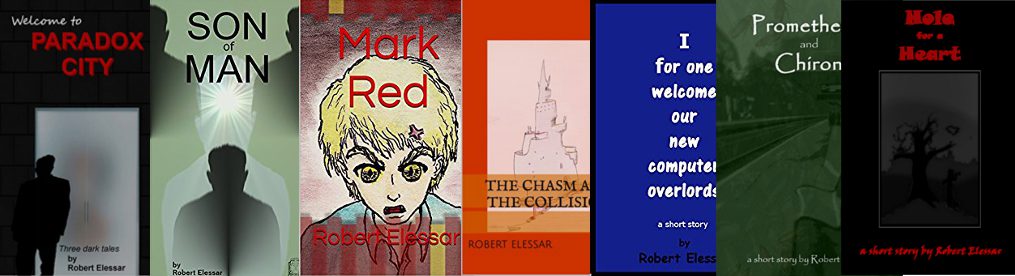
I think it was the best available choice at the time.  And while I was “up the road” I was able to console myself with looking forward to seeing my children again once I got out—and to see them before they were adults, which would not have been the case otherwise—and that gave me the optimism to write first Mark Red and then The Chasm and the Collision and then Paradox City while I was at FSP West.

But then, of course, once I got out, it turned out that my kids didn’t really want the discombobulation of me having visitation or anything of that sort.  While I was heartbroken, I didn’t feel that I had a right forcibly to disrupt their lives when I had already fucked everything up, first with my personal health problems, then with my misguided attempts to help other people with chronic pain that led me to be arrested.

So, I bit the bullet and kept on writing at least, on my own, though I think my stories grew steadily bleaker and darker over time.  And I learned to play guitar and wrote and recorded a few songs, and did some covers and everything.  But I still didn’t see my kids, and haven’t even communicated with my son other than to receive his email stating that he didn’t really want to have a relationship with me (“right now”).

At least I got to see my youngest when I was visited in the hospital with my kidney stone.  That was a gift that was well worth even that much pain.  But now I’m back to my nosferatu existence, and like Vermithrax***, though I don’t feel pain as severe as the kidney stone, I still feel constant pain.

There may be people who can have chronic pain without getting depressed about it, and indeed, without losing their zest for life, but I fear I’m only left with the squeezed dry pulp of mine.  It seems to be just the way I’m built neurologically.

I suspect that most people who keep their spirits up despite chronic pain and disability do so because they are surrounded by a local support system of some sort****, and they probably do better at connecting with and getting along with other people than I do.

I’ve only ever really been close to specific, core groups of people, and with ones nearby, that I saw nearly every day.  I’ve never been good at connecting over long distances, and I have a hard time even picturing people when they’re far away.  I mean, I can “picture” them in the sense that I know what they look like, and I will be able to interact with them if and when I see them, but I cannot in any intuitive sense “model” their existence elsewhere.  I cannot really get a feel for what they might be doing and certainly not for what they might be thinking.

When even the people I love are far away from me, they really exist more as concepts than as people whose reality I can feel.  They are missing in a bleak and rather horrible way.  I feel terrible about that fact, and I hope it doesn’t come across as insulting—though it has probably hurt the feelings of people about whom I care on more than one occasion—but it seems to be just the way my brain works.  It’s also probably related to the fact that I never have for an instant imagined wanting to be someone other than myself, even though I hate myself; I just cannot even conceive of what that would mean, let alone wish for it.

Oh well, whatever, never mind.  I’m back on the train, yeah, and here I go again, on my own…alone again, naturally.

(I do like to quote things, don’t I?)

I hope you have a good day.


*Of course, as far as we can tell, pretty much everything is inherently finite, but some things are much more constrained and contained in time than others.

**This is based on what my attorney, and my attorney’s supervisor, said to me.  I don’t think they were trying to be unkind, and though their judgement was and is fallible, it was likely better than mine would have been.

***I know, I’m mixing fantasy metaphors and similes.  That’s okay; I like them.

****And most of them are probably not “ex-cons”.

Missing AC units and one man’s lack of mental health

Well, it’s Tuesday morning, and that’s better than it still being Monday evening, which wasn’t so fun.  I got the notice that my AC unit had been delivered yesterday afternoon, but when I got back to the house, it was nowhere to be seen, and my housemates had not seen it let alone brought it in out of the rain.

It was raining, in case I hadn’t told you.  It still is.

Anyway, I looked around the nearby houses and then I checked with Amazon, and I called FedEx, who said that their info was that it was delivered.  I went to the website with them and saw the delivery picture‒which was not of the house where I live.

I got pretty frustrated, because it was raining a fair amount, but I looked at the picture and thought it might be the neighbor’s house.  But it had not been there when I’d looked around.

I was already wet, so I went to their house and knocked on the door, so irritated by the whole process that I was willing to interact with other people.  It turned out they had brought it inside because of the rain.  They graciously (and with some difficulty, since it was both heavy and awkward) brought it out for me.

Then I had to lug this 50 pound box, with no real handles, back to the house.  I’m feeling the effects of that in my back quite a bit, and I hold FedEx responsible.

In the end, at least I got it set up and started using it last night.  I won’t say it was miraculous, but I was able to use a blanket part of the night last night for the first time in a long while.

I guess it can’t expect it to make a life-changing difference, but it’s better to be at least a little cooler than I was.  It can’t be a bad thing‒or, well, it’s always possible in principle for it to be a bad thing, but I would give that quite a low likelihood.

As for everything else, well…I’m still at a loss.  I don’t know what to do, and I feel no why to do anything.  I guess it’s appropriate that June is (among other things) Men’s Mental Health Awareness Month, though it might better be called Men’s Mental Lack of Health Awareness Month.

Apparently, according to the statistics I have recently seen (this was on social media, so the precision and accuracy must be considered at least potentially lacking) men die from suicide three times as often as women.  And, of course, people with autism spectrum disorder die from suicide a similar multiple compared with those who do not have it (and the proportion may be as high as 25 times that in non-autistic people, but I’ll stick with 3 times for the moment).

So, if those variables are independent, which they probably are not completely, then I would be nine times as likely to die from suicide as a neurotypical woman.

That sounds alarming, doesn’t it?  Nine times the risk?  Like corduroy pillows, that’s the sort of thing that makes headlines.  But if you think about it, those statistics and probability ratios give you almost no information.  Before you can decide to act on that risk multiplier, you need to understand the baseline risk/rate of occurrence.

If 10% of neurotypical women die from suicide (an absurdly large and entirely imaginary percentage) then with my relative risk of 9 x the baseline, it would seem that I would have a 90% risk of suicide.  If the women’s rate were a bit higher, my risk might even seem to be more than 100%, which is a mathematical absurdity.

On the other hand, if neurotypical women committed suicide at a rate of .000001, or one in a million, then my risk would seem to be .000009, or just shy of one in a hundred thousand*.  That wouldn’t be too terrible.

This is why you should not get alarmed if you hear some statistic such as “people with red hair have a hundred times the chance to spontaneously combust as non redheads”.  You need to know what the baseline chance is to know if there’s anything worth worrying about**.

As for my personal risk of suicide, well, that’s not vanishingly small.  I have numerous risk factors, including the single biggest predictive risk factor.  As a rough estimate, I would say that, despite the fact that I’m a 55 year old white male with some pertinent family history, I think my risk of death by suicide is significantly higher than my risk of death due to heart attack; it’s probably bigger than my chance of having a heart attack, even a relatively minor one.  That’s not a fixed number, of course.  Many things can change all these relative risks.

Unfortunately, I don’t honestly expect my own risk of suicide to go down significantly, or even at all, as time goes on.  My internal life seems to be steadily growing slightly bleaker, and even blanker, every day, and none of the things that used to bring me comfort or at least engage me seem to be of any interest.  If anything, I feel my likelihood is increasing over time, though maybe it’s staying the same but each day is a new roll of the dice, so over time, the likelihood increases.

Oh, well.  What are you going to do?  I don’t have the wherewithal to change the situation myself; if I did, I wouldn’t be in this situation.  I’ve already tried a great many things.

Anyway, I hope the weather is more pleasant wherever you are, and that you have a very good day.


*The actual rates, while apparently difficult to tease out with great precision, are quite a bit more alarming than my second scenario.  In the UK, for instance, it seems that about 1% of people are autistic, but 11% of suicides are by autistic people.  The rate of suicidal ideation among people with ASD is way higher than that in the general population, starting in childhood (which I can confirm in my case), when the rates of ideation and attempt are reported as high as 25 times that of the general population.  Also, overall, the expected lifespan of autistic people has been measured at about 54 years.  Even given typical statistical variance, I’m about due.

**Since there is not a single confirmed case of spontaneous human combustion, despite what you may have heard, even a multiplier of a hundred may leave one so close to a zero probability that being hit by an asteroid might be a more realistic concern.

Year-long quanta and Planck exercises for your core

Well, it’s Monday again.  Huzzah.

I don’t have much new to say.  I still do not have my air conditioner, thanks to the frustratingly poor delivery logistics of FedEx®.  I also have to blame the seller, of course (though I find the concept of blame mostly valueless) since they were the ones who advertised the unit as arriving between the 28th and the 30th of May (this year), and they failed to ensure that it would in fact arrive within their predicted time range.

Hopefully it will arrive today, and hopefully by the time I get back to the house I will have the energy to set it up.  Usually at the end of the day I barely have the energy to change my clothes.

In other news, it was my sister’s birthday recently.  That’s a good thing, and I’m glad she’s doing well.  It would have been nice to spend it with her, but that wasn’t doable given my recent life events.  Of course, I’ve said before that it’s a bit funny that we think of a person as one year older on their birthday, as though time applied to human age in quanta the size of one Earth year.

At the Planck scale time may in fact be quantized, but that’s a very, very tiny scale‒if memory serves, it’s the time it takes light to travel one Planck length*‒and for ordinary experience, the flow of time is continuous, though it is variable thanks to Relativity.

That got me thinking what it might be like if time did apply to humans all at once, one day a year.  I think that would have some curious consequences.  For kids, of course, it might be quite a cool thing, and they might look forward to each birthday enthusiastically‒especially around the time of puberty.

But for adults past their twenties, say, birthdays might become a thing of fear, or at least anxiety, and more so every year.  Imagine that even the long-term consequences of illnesses and injuries only accrued on one’s birthday‒possibly at the exact anniversary of the time one was born.  If you knew you’d been injured that year, you’d surely be dreading the birthday on which the consequences of that injury first fully applied.

Or what if you knew you were predisposed to some chronic complaint, or had a risk for some form of cancer, or of dementia, but you wouldn’t know if anything had happened until the time of your birthday?  I imagine everyone would plan to go to the doctor the day after every birthday, at least once they had passed their twenties.

It’s an interesting idea for a story, perhaps.  You could see people having birthday parties and the like, partly to celebrate and partly to offer support for their friends who were aging.  There could be whole special rituals surrounding the process, especially as people got old enough to perhaps die when the year accrued.

And then there could be a weird, truly bizarre occurrence.  Maybe one person would be found who, after aging “normally” his whole life, suddenly got younger at one year’s birthday, and then again at subsequent birthdays, as if there were some type of glitch.

Heck, even a person who aged continuously would be a freak of nature in such a world.

Anyway, that’s what I found myself thinking about.  It seemed mildly amusing.  I’m not going to write such a story or anything.  At least I don’t expect to write it.

Indeed, I’m basically finished writing this for today.  I hope you have a good day and a good week.


*Which is on the order of ten to the negative 35th meters.  That means that there will be thirty-four zeros after the decimal point before there is any other numeral, so…a very small distance across which causality may act at the “speed of light”.  Since the Planck length is 1.6 x 10⁻³⁵ meters and the speed of light is about 3 x 10⁸ meters per second, the Planck time would be 1.6/3 times (10-35 over 108) or .5 x 10-43 or just 5 x 10-44 seconds**.  That’s way, way too small for us to measure.

**Or .00000000000000000000000000000000000000000005 seconds.

“Ain’t no big surprise”

Well, guess what?  Yep, you got it in one:  I am working today, so I’m writing a blog post.  Not only am I working today, but my coworker, who shares some of my duties, is moving to a new apartment this weekend, so he won’t be in.  We are also supposed to be having people from the “other” office come and work with us, so there will be more to do, but less help, and I’m still just wiped out.

Oh, yeah, and the room air conditioner that I ordered did not arrive on time.  Now, depending on which automatic message one believes, it will arrive sometime today, or it will arrive by June 5th…and if it doesn’t arrive by then, I can then ask for a refund.

As if a refund would be useful!  If I had wanted the money more than I wanted the air conditioner, I wouldn’t have ordered the air conditioner.  I ordered it based on the delivery time range that they posted, which was barely soon enough, and if there had been a similar unit that could be delivered sooner, I would have ordered that.

It’s so frustrating.  This has been a really long couple of weeks, and as with most of what I do, so much of it has gone wrong‒not least of which, of course, was the fact of the kidney stone, which was probably helped along by my attempts to exercise despite the heat and humidity.

I’ve also had a bit of a persistent headache on the left side of my head for the last few days, which doesn’t help improve my mood.  It seems to be sinus related; there’s no clear sign of infection, but my nose is stuffy on that side despite decongestants.  It may also be related to the fact that I tend to clench my teeth fiercely a lot of the time, though I don’t mean to do so.

Because of the short time frame, it’s quite unlikely to be a brain tumor or a growing aneurysm, more’s the pity.

I’ve been following several depression support and suicide awareness accounts on Instagram, in addition to the usual jokey accounts (today is apparently the last day of “Mental Health Awareness Month”).  It’s a bit funny how often they post things that say something like, “Someone is glad that you’re still around.”  I’m never entirely sure that’s true.  I suspect that, if I were not making audible noises (so to speak) most such people would have all but forgotten that I ever existed.

I mean, I’m sure that there are people who are glad that I’m not dead, some in more of an implicit sense, others in a very specific sense.  And that’s very nice, of course, and I would not for a second want to criticize such people.

But what good does that do me*?  They cannot give me a portion of the gladness they have to boost my spirits, and unfortunately, the person who most needs to be glad that I am around is not glad (that’s me by the way).  I am not glad to be alive.  Why would I be?  All I do is spoil the party for others, so to speak, like in the Beatles song.  “There’s nothing for me here, so I will disappear.”

Anyway, sorry, I know this is boring as shit and as pathetic as pathetic can be.  I apologize.  I really wish I had something insightful and/or edifying and/or entertaining and/or at least interesting to say.  But look not for positivity from me.  To paraphrase the ghost of Jacob Marley**, it comes from other regions and is conveyed by other writers to other kinds of readers.

That’s not to imply that, like Scrooge, you who read this are somehow culpable for the fact that I am such a downer and write only gloomy and depressing shit.  That would not merely be unjust, it would be inexcusably rude.  I truly appreciate you, my readers, though I often wonder at your patience and interest.  But to me, like most things I do, my blog feels as though it is a net negative for the world.  Everything about me, except for my children, feels like a net negative for the world.  Just by existing, I make everything around me at least a little bit worse.

Okay, that’s more than enough of that for today.  I’m sorry.  I hope I didn’t make anyone have a bad start to their day or anything.  Please accept my sincere thanks for reading and my strong wishes for you to be healthy and joyful.  And have a good weekend if you can.


*I am deeply sorry if that seems churlish and dismissive or even contemptuous.  It’s not meant to be any of those things.  I respect and appreciate the positive feelings and intentions of those who express such sentiments, and I think those people are truly wonderful.  I merely wish to say that while it’s “nice” to have people out there who are glad you’re alive, that doesn’t actually translate into you, yourself being glad to be alive, that’s all.

**In A Christmas Carol.