Causality, relativity, uncertainty, and attractive versus repulsive gravity–these are worth celebrating

Okay, well, I’m writing this blog post from the office, because this is where I slept last night after the holiday party.  We did not have the party at the office, just to be clear.  We had it at a very decent restaurant called Maggiano’s, which may be part of a chain to some extent, I think.  It was a nice enough restaurant, food-wise, and the building and the outside lights were quite beautiful (see below).  However, inside, it was way too crowded and noisy, and we were seated at a very long, narrow table against a wall.

I felt incredibly stressed when we first arrived; I can hardly hear out of my right ear for one, and I have had tinnitus in it since about 2007 or so, and everything else was a tumult and commotion.  There was too much visual sensory overload also, and way too many people in too close quarters.  I miss the social mores of the pandemic, honestly.  I was barely able to endure long enough for our server to get me a drink so I could calm down a little.  I almost left and just walked back to the office.

My difficulties with such things have gotten worse over time, probably at least partly because I only ever used to go to restaurants and whatnot with people with whom I felt quite comfortable—my family, near and extended, then my wife, her family, our family, and so on—so there was always someone on whom I could focus, and with whom I could speak.

The drinks were rather weak, which may be good, since it was a work night, but I had to drink several to keep from tensing up.  Even so, at the end of the night, when they wanted to take a big group photo, I just walked away.  I had been dodging pictures all night already; there was a terribly annoying number of them, because everyone has their own little cameras in their smartphones, so instead of conversation—which was very difficult with anyone more than one seat away, and pretty hard even with those neighbors—people just took their little, instant, digital snaps, which I suspect will never really be used for recalling memories.

I’ve said it before, it’s not the case that things on the internet (or smartphones or whatever) are forever, as is sometimes claimed.  There is such a cacophony of data and images and whatnot, a good portion of it now not even being “real”, that most things will be swiftly lost like a drop of ink in a roiling, stormy ocean, or the quantum information of something that’s fallen in a black hole.  In principle it’s all there, but in practice it’s as lost as the echoes of Julius Caesar’s death rattle.

I guess it was a pretty nice evening, and the food was pretty good.  The salad was above average, and the broccoli I had on the side with my ziti dish was good.  It was all certainly well above the level of, for instance, the Olive Garden, but it was terribly noisy, literally and figuratively.  By the end, when we were the last party in the restaurant, it was still noisy, because our group was terribly noisy, and it was embarrassing and unpleasant.

I think I mostly at least prevented anyone from capturing my disgusting current face and form on camera in anything other than, perhaps, an oblique angle.  I really don’t like how I look, or how I feel, and certainly don’t want it memorialized, even if it’s evanescent and ephemeral*.

After the party, I was brought back to the office, which is only about four miles from the restaurant.  I could have walked, since the night was reasonably cool, but since I knew I wouldn’t be taking a shower, I decided not to do that.  I have washed up this morning and applied antiperspirant and aftershave (or whatever you call it when you haven’t actually shaved) and I brushed my teeth and everything.  I slept on the floor, with my backpack as my pillow, and it was about as comfortable as sleeping at the house, and I got about 3 hours of sleep.

This is the state in which my life is and has been for years now:  sleeping at the office and spending time here (by myself) is just as pleasant as being at the place where I nominally live.  That’s because I have no life, and I don’t expect one to occur again for me.  I’m really absolutely dismal and morose and unpleasant, even to myself.

I’ve hardly even read anything in over three weeks now, which is very weird and rare for me.  The single thing to which I’m now looking forward is the Doctor Who Christmas special, and that’s not a huge draw, just a pleasant one.  It’s not as though I’m actually watching it with anyone or can talk about it with a friend or anything.

I got out the hardcover books Spacetime and Geometry and Quantum Field Theory, As Simply as Possible at the office.  I have them resting on the desk, hoping to entice myself during any downtime I might have at work.  So far it hasn’t paid off, but I would like to master the mathematics of GR well enough that I can understand intuitively why a uniform energy field permeating space generates “repulsive gravity”.  I understand that it does, but I don’t have a good picture of it in my head, whereas I do have a much clearer intuitive sense of why the curvature of spacetime (especially the time part) leads to the apparent force of attractive gravity.

In a way, that’s my only remaining unaccomplished (and reasonably achievable) goal.  Quantum field theory is interesting and all, but the basic concepts of it seem fairly straightforward to me**.  Contrary to what people often say, quantum mechanics (et al) are only really counter-intuitive if you insist upon trying to apply macroscopic and mesoscopic intuitions to phenomena that happen at much smaller scales.  It’s a bit like expecting one of your bathroom tiles to behave just like the Burj Khalifa, only the scale is much more disparate between the quantum and the macroscopic.

People seem somehow puzzled by the notion of how complementary pairs of one’s measurements of quantum “particles” can never be more accurate than a certain level, as if this is truly different from measurements of macroscopic phenomena.  I’m quite sure that the errors when measuring, say, the mass or velocity of something as large as an elephant, or a car, or what have you, are waaaaaay huger than the absolute uncertainty in measurement of the position and/or momentum of a particle.  They’re just not as noticeable because the thing itself is big, and so the percentage of the error might be smaller and less consequential.

But we know things change with scale, like surface to volume ratios and whatnot.  An uncertainty of a millimeter when measuring a blue whale is hardly relevant, but if you’re measuring an ant, it could easily be crucial, and if you’re measuring a dust mite that error would be larger than the organism.

I also don’t get the objection to the possible “many worlds” description of quantum mechanics that derives from the fact that we only ever see and experience one world.  I don’t know why that puzzles people.  It’s not as if you can see both the outside and the inside of all the solid objects around you.  If you touch the near surface of a basketball with one finger, you can’t feel the opposite side of the ball with the same finger at the same time.

Yet, there’s no real doubt that the inside and the other side of physical objects really exist.  We just can’t sense the whole of any given thing at once.  Any part of space that will never enter our future light cones is something we will never, ever see at all***, but we don’t have any good reason to doubt that far distant regions of spacetime exist.  Internal consistency of reality and logical coherence of the world seem to demand many things existing with which we will not, and sometimes cannot, ever interact.

Okay, that was a weird tangent.  My apologies.  Anyway, I doubt that I’m going to achieve my “dream” of getting an intuitive, mathematical understanding, something I can feel, about why spacetime expands in the presence of a uniform energy.  After all, it’s something about which I honestly care, and my track record with such things is abysmal.  I don’t expect to achieve anything else of value, even to me, in my life.

I’m tired, I’m sad, I’m depressed, I’m alone; the only person in whose presence I always find myself is a person I despise (me).  My catharsis via this blog isn’t working.  I’m getting no help, though I wish for it, but I’m not sure how well I would respond if some were to come.  Maybe, like the wonderful simile Sting used in Be Still My Beating Heart, I would wriggle like a fish caught on dry land, unable to tell the difference between help and danger, between an offer of comfort and a warning of pain.

Whatever.  Sorry, that’s all pathetic, isn’t it?

In closing, I wonder if anyone listened to my little audio snippet yesterday, and if anyone thought it was worth it for me to try to do such a thing more often.  Let me know in the comments (on WordPress) if you have any feedback to offer.  Thanks.

maggianos


*Performing together live, for the first time.

**Straightforward for quantum field theory type things, anyway, to be fair.  I don’t mean that it’s not complex (ha ha! it uses complex numbers all the time, get it?) but I have a sort of picture of how the processes work, and it makes sense.  The rest would just be building details and specifics on top of the basic framework, which is a lot, of course, but there’s no real intellectual hurdle to be cleared.

***Assuming we do not discover any exceptions or workarounds to special relativity and the speed-of-causality limit.  There could in principle be workarounds, but it seems unlikely that there are local exceptions to the cosmic speed limit.  In any case, even such exceptions shouldn’t violate chains of causality.

He was a man. Take him for all in all. I shall not blog upon his like again.


Hamlet:  My father—methinks I see my father.

Horatio:  Where, my lord?

Hamlet:  In my mind’s eye, Horatio.

-Hamlet, Act I, Scene 2


It’s Thursday, October 4th, the day of my father’s birthday.  He would have turned seventy-nine today if he were still alive, but he died just under two years ago.  I don’t remember the exact date of his death, and I see no reason to memorialize it.

My father and I didn’t always get along; in many ways we were too alike to avoid butting heads, especially since one of the ways we were alike is a deep stubbornness.  But my father was an admirable man in many ways; he always took care of his family to the best of his ability, which was usually very good indeed.  He and my mother were married right up until the day he died, which is more than I can say about myself, and I admire them both for it.  That they were best friends and constant companions is an unarguable fact, and they got along as well as any long-married couple I’ve ever known.

It was from my parents—both of them—that I got my love of reading, and more indirectly, my love of writing, of making stories.  It was my father who received as a gift, and who proudly wore, a tee-short quoting Erasmus in saying, “When I get a little money, I buy books.  If any is left, I buy food and clothes.”  This wasn’t quite my parents’ literal attitude, but it was damn close.

I didn’t quite realize how proud and supportive my parents were of my love of reading and writing until in college I came to a point of crisis.

I had always intended—for as long as I thought about it—to become a scientist, though I’ve also always written stories, books, plays, and even screenplays (the latter too laughable to discuss).  By the time I was ready for university, I had decided that I wanted to be a physicist.  I went to Cornell as a Physics Major, and in my first year did quite well in all my physics and mathematics coursework (while also thoroughly enjoying my freshman seminars, first Fantasy and then Writing About Film).  But then, during the summer after freshman year, I underwent open-heart surgery to correct an atrial septal defect (quite a large one) that had only been discovered that year.

In later times, in medical school, I learned more about some of the central nervous system effects of open-heart surgery, and I even wrote a review paper on the nature of the (usually temporary) cognitive decline that heart-lung bypass in heart surgery frequently causes.  Its effects in triggering mood disorders such as depression (something for which I already have a familial and personal predisposition) are probably more widely known than the temporarily diminished mental capacity that comes to most people who have undergone such surgery.  The state of the art may have improved since 1988, but I doubt the problem has been eliminated.

Anyway, I returned to college at the beginning of sophomore year (only two weeks after my surgery!), and over the course of that semester and year, with the combination of a low-grade-sometimes-veering-into-high-grade depression and a dip in my mental acuity, I had a hard time keeping up with the higher level math courses (and the physics was getting into the intro to serious quantum mechanics and other areas, with matters requiring vector calculus, tensors, partial differential equations, and all that fun stuff).  I think if I’d just had the temporary cognitive impairment and not the depression as well, I might have muscled my way through, and brushed up on things once my mental clarity improved.  Alas, not only was I not so lucky, I also had no idea why I was having such difficulty; I felt merely that I was an intellectual and moral failure as a Physics Major.

I didn’t fail any classes or anything like that—I don’t think I got anything below a low B—but I could see myself having more and more trouble as I went forward, if things remained as they were.  At the time, I was already close friends with the woman I would eventually marry, and she had read some of my writing (and really liked it).  She talked to me long and hard about my options, and with her help, I came to the decision to switch majors to English.

I was mortified about this.  I felt that I was failing myself in some important way, and worse, that I was letting my parents down, but I didn’t see any alternative.  So I called them, and I very nervously told them the decision I had made…

They were practically ecstatic.  My father in particular said that he just thought that English suited me better, because I loved reading and writing so much, and was good at it.  They’d always been supportive of my love of science, too, of course, and had been behind me all the way in my goal to become a scientist, but they’d apparently thought that such a career wouldn’t fulfill me…though they were wise enough not to try to change my oh-so-stubborn mind.  I think my parents—and particularly my father—would have been prouder of having a son who was an author than of having a son who won the Nobel Prize in Physics.  I hadn’t ever thought of that before.  But the fact that they were so supportive of, and even excited by, my choice was an incredible, tremendous relief and encouragement.

I’ve occasionally wistfully looked back and wished I’d gone farther in my formal studies of physics and math, but…well, those are things I can study on my own, and I do so when the mood strikes me.  But as an English Major, I realized my deep and abiding love of Shakespeare (at one point I took two Shakespeare courses at the same time; that was fun!), and I learned of the works of Spenser and Mallory and Milton.  I read Paradise Lost (my personal nomination for the greatest English language work of all time), and innumerable other great works beside, ancient and modern.  I’ve never regretted those exposures.  Who would?  I also learned how quickly I can write at need, when I discovered that I’d mis-marked the due date for my honors thesis, and I had to write the whole thing in one weekend.  That was pretty stupid, but maybe I can blame it on the residua of my cognitive impairment, which thankfully seems to have faded completely in the intervening years.

Anyway, it was thanks to my parents’ support, and my father’s words—and the example he set—that I was able to feel good about my choice.  We had some pretty serious interpersonal problems in subsequent years, but eventually we put them behind us, and though I didn’t become an “official” writer directly after college (I went to medical school instead…go figure) I am finally now finally fulfilling my destiny, as the Jedi and the Sith are prone to say.*

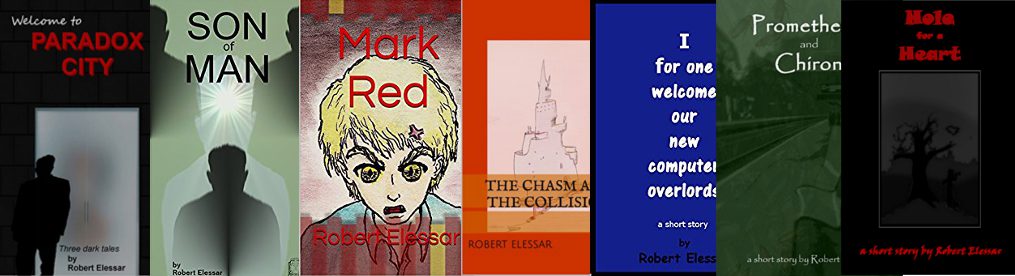
I’m tremendously happy that my father lived long enough to see me publish my first few books, though I wish he’d been alive to read The Chasm and the Collision, since his advice had real, beneficial impact on its style.

And now I have my own version of his tee-shirt that reads, “When I get a little money, I buy books.  If any is left, I buy food and clothes.” It was a gift from my sister, and I come as close to embodying the words as my parents did, if not closer.  I’m more like my father, probably, than I am like any other person I’ve ever known.  I’m a little more playful than he ever was—he was quite a serious man most of the time, and he was exceeded in stubbornness only by his youngest son—but he’s still the only other person I’ve known who had the patience and desire to spend as much time in zoos and museums as I do.  He always loved to learn new things, and I consider that shared love (which also came from my mother) perhaps the greatest gift that I could ever have been given.

I miss him terribly, and my mother as well.  But as Arthur Bach said in the original movie, Arthur, “I was lucky to know him at all.”


*If there is such a thing as destiny, then surely it’s impossible to do anything but fulfill one’s destiny.