How now, you secret, black, and midnight blogs!

Hello.  Good morning.

It’s Thursday.  It is, in fact, the 2nd Thursday in November, which means that, from the point of view of Thursdays in November, we are halfway to Thanksgiving (which in the US is the 4th Thursday in November).

Of course, we are not precisely halfway to Thanksgiving from the point of view of the days of the month of November overall.  Thanksgiving falls on the 27th of November this year‒14 days from today, of course‒so we are not quite halfway there as far as the days of November are concerned, but we are close to it.  If the month had started on a Friday, the halfway point in days versus Thursdays would be the same.

I think that the maximum disjunction would happen if the month began on a Thursday.  The 8th would then be the 2nd Thursday, and Thanksgiving would fall on the 22nd, which is quite a bit larger than 2 x 8.

Mind you, all this depends on starting one’s count in November.  That is not too unreasonable, but one could just as sensibly start counting Thursdays right at or after January 1st (let’s see, this year that’s 46/48 Thursdays, or about 95.833%).  If we did that, we would already be practically at Thanksgiving.  If we counted all days, we might be even closer still, percentage-wise.  Let’s see, 317/331, or about 95.770%.  Whataya know?  I was wrong, the Thursday one is “closer”.  I suspect this varies from year to year, but I’m not interested enough to check.

We could also begin our count at the beginning of autumn, which sort of seems appropriate.  Or, perhaps most sensibly still, we could start right after the previous Thanksgiving, beginning our counting on “Black Friday”.

Jeez Louise, I think I’m losing my mind, here.  Why am I writing about such nonsense?  I mean, yes, it’s interesting to notice how arbitrary and artificial human ways of counting days and things and so on are, so I suppose it’s somewhat edifying, and even could be mildly interesting for a moment.  But I nevertheless feel bad for wasting my readers’ time.

Though, I suppose, in a certain sense, one could say that all time is wasted‒“Plans that either come to naught or half a page of scribbled lines” and all that.

“Where do we come from?  The dust.  Where do we go to?  The grave.”

Of course, that last quote was not meant to be a general description of the human condition, but refers to Ray Bradbury’s “October People” in Something Wicked This Way Comes.  I’ve always thought that I’m an October person, since I was born in October.  Like Macduff, in the play from which Bradbury’s title above is taken, I was a C-section, though it would be a hyperbolic* to say that I was “ripped untimely” from the womb.  (Still, does my manner of birth mean I could defeat Macbeth?)

October is over now, in any case, and who** knows if I shall see another.

I don’t know if anyone has ever written about “November People”, but they don’t sound particularly scary nor particularly inspiring.  This assessment is not meant to refer to people born in November!  Several of my favorite people were born in November.

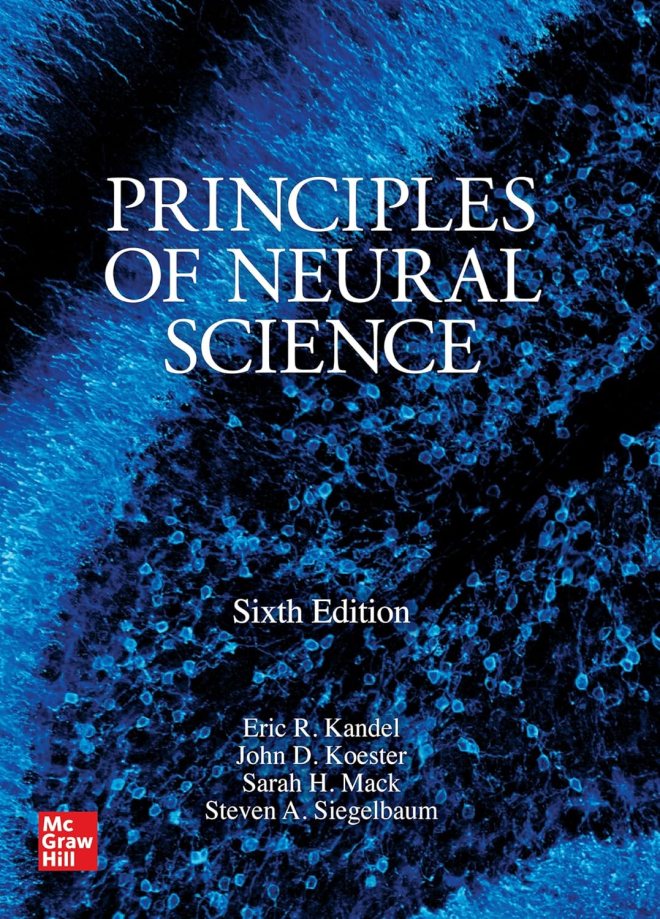
In other news, I did receive my Principles of Neural Science yesterday.  I used my dollar coins to choose a section, and I read it in the afternoon:  it was about neural firing and muscular activation during locomotion, briefly comparing lamprey with vertebrate, especially mammalian, locomotion patterns.

It may seem trivial, and I didn’t learn much that I didn’t at least implicitly know before, but the specifics are new, and all information has the potential to be useful.  We cannot know for certain ahead of time what knowledge might be most beneficial, just as we cannot predict the specifics of progress and invention.

As I said, I chose the textbook page via my coin-flipping process, using my three Sacagawea coins.  I keep a few dollar coins with Susan B. Anthony and/or the aforementioned Sacagawea with me at all times.

I carry such coins not so much for decision-making but because I like to roll them across my fingers when I want to “stop my hands feeling busy”.  I guess it’s a form of “stimming”, and I’ve been doing that particular one since college.  I taught myself to do it after I saw Val Kilmer, as Chris Knight, doing it in the movie Real Genius, which was one of my favorite movies.

Well, this has been a lot of pointless nonsense today, hasn’t it?  I apologize, and I guess I can try to mitigate my offense by at least trying not to produce too much of nothing***.  So I will draw this post to a close now.  I hope you all have a good day.  I will very likely write a post tomorrow, so you can look forward to that, if it’s the sort of thing to which you look forward.

TTFN


*You know, like non-Euclidean geometry.

**The WHO does not know, though with a bit of background information they could probably make reasonable predictions.

***According to the song, that can make a man feel ill at ease.  It can also, according to the same song, make a man abuse a king, which seems like it would be quite a rare situation.

“Though this be madness, yet there is method in’t”

Well, first let me apologize for yesterday’s blog that largely concerned the weather, and in a trivial sense at that.  It was rather lamentable, I know, with emphasis on the first four letters of that adjective.

On the other hand, I don’t apologize for having had my little bit of fun with the date.  That may have been even less interesting to most of you than my jabbering on about the weather, but I like it.  I fully expect that I will do such things again.  For instance, in a similar vein, today is a bit fun because it is 11-12*, so the numbers are in appropriate ordinal sequence with no gaps.

That’s not very fun.  More fun will be had (by me, anyway) on Friday, when it will be 11-14-25.  If you don’t immediately see the fun there, it may help that a similar fun date next month will be available on 12-13-25.  This fun also works with the European date order (but in both you have to leave out the digits that denote the century).  Also, there were no equivalently fun dates in any month before October.

This is the most fun I’ve had on any kind of date in at least 16 years, I would guess.  That’s an easy call, because I haven’t been on any date at all in at least that long.  See what I did there with the multiple meanings of the word “date”?  Of course you did.  What do I think you are, a moron?

No, I do not think that.  You are reading a blog post, so you are a reader, which gives you a serious leg-up, moronia-wise.  You draw from the well of that greatest of all human inventions:  written language.  Your taste in reading material may be somewhat questionable, but I cannot legitimately complain about that.

Wow, I feel like I ought to be almost done with this post, but I’ve barely passed 300 words.

On to other things.  I’m going to try to do a better job about science reading during my downtime in the office.  It’s not that I’m completely slacking; I’m reading Shape by mathematician Jordan Ellenberg, and I just read his earlier book How Not to Be Wrong.  I’ve read both before and/or listened to the audio books, but they are well worth rereading.  He’s a great math professor, and has a gift for explaining potentially abstract concepts.  I think he’s slightly better at this than Steven Strogatz, the author of The Joy of X and Infinite Powers, but they’re all good.

I also just yesterday gave in to an urge I’ve had for some time:  I ordered a textbook I liked in med school but which we didn’t really get into as deeply as I would like:  Principles of Neural Science, by Kandel et al.  The edition I had was by Kandel and Schwartz, if memory serves, but Dr. Schwartz is no longer involved, it seems.

It’s a textbook, so it’s pricey, even in paperback, but I discovered that I could put it on a payment plan through Amazon, so that’s what I did.  It arrives today.

I’ve also resolved, at least tentatively, to try to take the heat off my reading of my science books‒including the above newcomer‒by doing something I did when reviewing/studying in med school:  I would get a text that I was reviewing, and I would pick a section to read/review by flipping a coin.

Actually, it was a series of flips, each one dividing the “remaining” part of the book in half.  In other words, for the first flip, heads would mean I would look in the front half of the book, tails would mean the back half.  Then the next flip would decide to which half of that half I would narrow things down further.

Anyone who has spent any time dealing with computers and/or binary numbers can readily recognize that, with 10 flips of the coin, one could choose a specific page in a 1024 page book.  I guess every flip would count as a kind of “half-life” for the book’s pages.  If one wanted, one could even choose one’s pages not with a coin flip, which is not truly random, but with a quantum event that has a 50-50 chance, like measuring whether a given electron’s spin is up or down.

Of course, I don’t have a Stern-Gerlach gate, so I would have to “farm out” that process.  But I understand that there are apps that you can use that have their sources at labs where each decision is truly made by a quantum measurement.

It’s not terribly practical nor more useful for pickling book pages than is a coin flip, but if you’re a convinced advocate of the Everettian, “many worlds” version of quantum mechanics, it has the added “benefit” that each “flip” will divide the universe into two “worlds”, one where you choose from the earlier half, another where you choose from the latter.

Coin flips do not enact such splitting, not in anything but the trivial sense that every quantum level interaction potentially does so.  The experience will be the same for you, though, except whatever glee you might derive from splitting the universe to choose a section to read.

Anyway, I’ll be trying to read my books, random section by random section.  Believe it or not, this works for me.  I don’t have to learn things in order, usually, and this method avoids me feeling bored while trying to trudge through a text in order.

Perhaps I do have some aspects of ADHD up in there in my brain.

Well, I’ve now passed my target length for this post by some margin, so I’ll call this enough for today.  I expect to be writing another post tomorrow, but like everything else**, it is not absolutely certain.  I hope you have a very good day.


*Only in the American style Month-Day-Year format, though.  It is less fun in the European Day-Month-Year format.

**Yes, even death and taxes, in principle.

It’s a prime day for a (slightly) shorter blog post

Morning has broken!

Does anyone out there know a good, reasonably priced morning repair service or person?  I really don’t have the money or time to go pick out and buy a new morning.

Ha ha.

Sorry.  I know that’s quite a stupid joke.  Still, it should give you some idea just how tired I am.

I should have been able to get a decent sleep last night, but I did not.  That shouldn’t be anything new to me, but some days the effects of the insomnia seem to pile up far more than on some other days.  And today is one of those “pile up” days, it seems.

Thus, I intend to make this a relatively short blog post today if I can.  To that end, I’m setting my “target” number of words to be 701 instead of the usual 800*.  701 has the added advantage of being a prime number, which always makes things at least a little bit better from my point of view.

It’s funny how, as numbers get bigger, there seem to be fewer primes (they fall off as something like the natural log of the number range at which you’re looking, if memory serves).  And yet, there are an infinite number of them‒the same “countable infinity” as the natural numbers, “aleph nought”:

Also, we have the twin primes conjecture‒which apparently most mathematicians think is correct‒that there are an infinite number of primes that are with 2 of each other.

It has apparently been proven that there are an infinite number of primes separated by no more than about 500 or some such (it’s probably a lower separation now, but I haven’t looked into it in a while).  That may not seem like much of an accomplishment, but remember, we’re talking infinity here.  No matter how big the numbers get** you will never stop finding new sets of prime numbers that are no more than about 500 apart.

That’s not particularly useful to anyone but number theorists, I suppose, but it seems very interesting to me.

Incidentally, 701 is not part of a pair of twin primes, since 703 is not prime (it has four factors) and 699 is obviously divisible by 3.  And of course there is only one even prime (the number 2) because all other even numbers are divisible by 2.

Sorry, I know many people find these things boring, but I’m a fan of prime numbers.  In any case I’m trying not to be so negative in my blog posts, since I think it bothers a lot of people and may even be contagious at times.

It certainly doesn’t appear to do me any more good than does being a voice crying out in the wilderness, so to speak.  And despite the excellent biblical reference***, voices crying out in the wilderness usually are not heard or received by anyone or anything that can even understand them, let alone offer them any help.

I guess I can still talk about “imaginary” and complex numbers, because they just involve the square roots of negatives, but are not necessarily negative themselves****.  As long as I avoid multiplying them together, I should be able to steer relatively clear of negativity.

Ha ha, again.

I’m trying to try to avoid making other people miserable by expressing my own dark thoughts, so instead it seems I will make others miserable with my bad jokes.  You’re welcome.

Thinking about complex numbers makes me start feeling like I want to learn more about quaternions and spinors and so on, which seem truly fascinating, but about which I have only highly superficial knowledge.

It would be nice to learn more about them.  I probably will not, knowing me and my fatigued and distractible mind, but at least I can maybe be on the lookout for Numberphile videos about related subjects.  There’s at least one YouTube channel with a series on spinors.  Unfortunately, PBS Infinite Series stopped making new videos some time ago, but at least PBS Spacetime is still going strong, as are all of Brady Haran’s excellent channels.

And now, I’m over 701 (in the first draft), and so I’m done (for today at least).  I hope you all have a good day, and that your subsequent good days scale as the number of days, not as any logarithm thereof.


*I almost always go over my target, but at least it gives me a noteworthy place to decide it’s “time to wrap this up”.

**And there are described numbers so large that if you could memorize every digit of them, the information would be so concentrated as to turn your head into a black hole.

***It’s from the book of Isaiah.  John the Baptist supposedly quoted it and referred to himself as that voice, but then again, a lot of the writers of the “New Testament” shoehorned in references to supposed prophecy in the “Old Testament” to make the whole thing seem more sexy-cool (I guess).

****I just have to try to keep to the right upper quadrant of the complex plane.

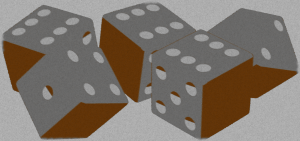
Is an “almost” pair o’ dice just one die?

Oooooh, it’s Friday the 13th!  It’s so spooky!

Not really, of course.  It’s just a day.  I like Friday the 13ths, mostly just because so many people seem to imagine they are unlucky, though I think that superstition may be less prevalent now that it was in the past.  Nowadays, the day is probably mostly associated with the slasher film “series” that uses that title.  Not that even the original movie’s story ever had much to do with the day.  It just was a catchy, well-known “scary” day, following in the footsteps of Halloween (although the latter at least had a theme that suited the day).

Of course, a major reason I like this day is that the number 13 is a prime number, and I like prime numbers.  I like 13 especially, because 13 is possibly the most feared and reviled of the primes, associated with bad luck in much the way that 7 is associated with good luck.

Hmm.  I know at least part of 7’s appeal probably has to do with the dice game “craps”.  7 is the most common total to achieve when rolling two six-sided dice, because there are more ways to get that total than any other number.  Meanwhile, of course, there is no way to get a 13 on two (normally numbered) six-sided dice, but it is only just out of reach.  It’s the first number that’s too high for such a pair o’ dice*.

Of course, you can’t roll a 1 on two six-sided dice either, but that feels more trivial.

I honestly don’t think the reason for 13’s association with bad luck probably has anything to do with dice; it wouldn’t make too much sense.  But someone out there, please correct me if I’m wrong.

It’s interesting to think about probability regarding dice, not least because the very field of probability theory was first created by a guy who wanted to optimize his chances of winning at dice.  According to what I’ve read, he succeeded, at least temporarily.

Nowadays, of course, that field has grown into a special subset of mathematics and physics and information theory and so on, affecting everything from thermodynamics and statistical mechanics to meteorology and quantum mechanics.  In a certain sense‒given that Schrodinger’s equation describes wave functions that have to be squared (in a complex conjugate way) to get literal probabilities that, based on Bell’s Theorem, cannot be further simplified, as far as we know‒probability may be something truly fundamental to the universe, not merely a tool for situations in which we don’t have access to information.  Based on Bell’s Theorem, which has been shown to apply in the Nobel Prize winning experiments of Aspect et al, it seems that, at root, as far as we can tell, the quantum mechanical operations are fundamentally indeterministic.

Of course, just because something is “random” at a lower level doesn’t imply that, at higher levels of organization, it can’t behave in ways that are very much deterministic in character.  Lots of little things behaving in a locally random manner can combine to create inevitable larger-scale behavior.  Perhaps the most straightforward and compelling such thing is the behavior of gases and the Ideal Gas Law***.  The motion of any given molecule of gas is unpredictable‒at the very least it is stochastic and has so many degrees of freedom as to be unpredictable in practice, but since quantum mechanics is involved in intermolecular collisions, it may truly be random in its specifics.

And yet, when oodles and oodles of molecules of a gas come together****, their collective behavior can be so utterly consistent‒with very little depending on even what kinds of molecules comprise the gas‒as to produce a highly accurate “law” with only 4 variables, one constant, and no exponents!

If that doesn’t seem remarkable to you, either you’re jaded because you’ve known it since secondary school or I haven’t explained it very well (or both, of course).

It’s interesting to think about the probabilities of dice games using more than two dice and/or dice with more or fewer than six sides.  Tabletop role-playing gamers will know that in addition to the 5 “perfect” Platonic solids*****, there are quite a few other symmetrical (but with sides not formed from “regular” polygons) solid shapes that can be turned into everything from ten-sided to thirty-sided dice.

But RPGs tend to involve rolling one die at a time, except when rolling up characters, at which time (in D and D and Gamma World, at least) one uses 3 six-sided dice (or 4 when applying a technique to yield better-than-average characters).

I wonder why there are no games of chance using more than 3 six-sided dice or using, say, multiple four-sided dice or eight- or twenty- or twelve-sided dice.  The probabilities would be more trouble to work out, but they would not be harder in principle.  If any of you out there either know of or want to invent a game of chance using more than 2 dice and/or other than six-sided dice, feel free to share below.

In the meantime, I’ll call this enough for today.  I am supposed to work tomorrow as far as I know, though that’s always subject to change.  If there’s no post here tomorrow, then it probably means I didn’t work.  I probably will work, though I couldn’t give you a rigorous working out of the mathematics involved in determining that particular probability.

Have a good day if you’re able.


*You can sometimes see them by the dashboard lights.

**Unless superdeterminism is correct.  However, this is a very hypothetical thing, and I’m not very familiar with what arguments are proposed to support it, so I won’t get into it.

***PV = nRT if memory serves. [Looks it up]  Yep, that’s right.  Four variables and one constant (R).

****Even if it’s not right now, over me.

*****These are, presumably, solids that really care about each other but in a non-romantic way.

“It’s just the kind of day to leave myself behind”

Well, it’s Tuesday, isn’t it.

Note that I ended that sentence with a period, despite the fact that it seems to be in the form of a question.  That’s because I didn’t really mean it as a question; I had no desire to imply that I wasn’t sure what day of the week it was.  I’m reasonably certain that today is Tuesday.

I’m not absolutely certain, of course, because outside the realms of self-contained systems of mathematical or logical axioms and rigorously defined and applied operations, there can be no true certainty, only higher or lower credence.  Real-world probabilities never reach zero or one.

Mind you, some things are so likely as to be practically certain, and there’s not much point in worrying about whether they are true unless and until some completely new evidence and/or argument makes itself known.  Such is my conviction that today is Tuesday*.

No, I was expressing a sort of resignation about the fact that today is Tuesday.  I would have said it in a sardonic tone had I been speaking aloud.  It’s not that Tuesday is an especially bad day of the week necessarily, notwithstanding the Beatles telling us that Tuesday afternoon is never-ending.  No, it’s just that Tuesday is still practically the beginning of the week, but I am already tired from Monday, and it’s a long way until the weekend, especially if one works on Saturday, which I am going to do, as far as I know.

That last statement has a lower credence than I give to the fact that today is Tuesday, but it’s still well above a 50% chance.

I know, I know, why am I writing this inane nonsense?

It’s just stream of consciousness.  I’m not planning it out, except to the extent that something I’ve written already makes me think of something else I want to write next.  But I have no particular chosen topic today, obviously.  Not that this is atypical.  I almost never have any plan when I start writing blog posts; I just start writing.  Sometimes I’ll just start with an inane phrase, like I did today, and see where that takes me.

Oddly enough, I think when I do have a particular topic in mind—such as in my short-lived series My Heroes Have Always Been Villains—people don’t seem to enjoy my posts as much.  Or, at least, I don’t get as many “likes” or views.  Maybe some people read and “like” them via social media or something, but if so, whatever they’re doing doesn’t reach me as feedback.  I don’t really see comments or responses that aren’t done here on my page.

Of course, as you may already know, the initial purpose for this blog—in this incarnation—was to try to promote my fiction by interacting with potential readers.  Boy was that a dud of an idea!  [No question mark ==> rhetorical, but not really a question].

More people read and have read this blog than ever read any of my books, unfortunately.  It’s rather discouraging, and it’s a large part of why I haven’t been writing fiction for a while, and the last thing I wrote, Extra Body, I just published here.

While I always write the stories I want to write and that I will enjoy (or whatever one might call the process) there really is a rapidly diminishing marginal return as one writes books that almost no one is even aware of, let alone purchases, let alone reads.  And as you know, I have no stomach for self-promotion.  Sometimes I envy narcissists, at least for an instant; then I remember that I tend to find them disgusting (though just a smidge of narcissism can be endearing in the right circumstances).

I also am not very good at interacting with people who might help promote my work, let alone at asking for that help.  I’m pretty good at the creative stuff, or at least I’m tolerably good at it.  I can write, I can draw, I can do music (playing and singing) and other similar stuff.

I’m also pretty good at science and math, and not just in a rote learning sense; I’m pretty creative there, too.  I once invented my own “number” which I call a “gleeb”, the symbol for which was a combined cursive g and b:

The nature of a gleeb is that, if you multiply it by zero, you get one (in other words, a gleeb is the “forbidden” or “undefined” result of 1/0).  That may not seem to make sense, but while I was “up the road” I even worked out some of the algebra and properties of such a number, and it turned out—to my inexpert analysis—to be logically consistent, at least.

I’m not saying it’s useful.  As far as I can tell, it’s not.  But it was a bit of mental fun and exercise, perhaps the intellectual analogue of playing hacky sack.

I’ve also occasionally thought of ideas in physics and in medicine that I thought were interesting, and which later I discovered had actually become areas of research or therapy (the therapy bit is in medicine, not in physics…as far as I know, there are no therapies in physics, despite the fact that there is such a thing as physical therapy**).

But I am not good at putting myself forward or putting myself out there or calling attention to myself.

Okay, well, I guess that’s enough meandering nonsense for the moment, though such nonsense can sometimes be fun.  Hopefully, Tuesday afternoon will not become some bizarre event horizon in which we are stuck forever.

Of course, the person going through the event horizon doesn’t experience the process as eternal; only the distant observers “see****” them slowing and slowing and coming finally, asymptotically, to a complete standstill.  The person who goes through, if they are looking backward, might see the whole history of the universe playing out before them—at least until tidal forces spaghettify them—but they will not experience time stopping.  Think about it:  how could one experience time stopping?  The passage of time is inherent in the process of experience, certainly as we know it.

I hope you have a good day.


*And even if it weren’t, I could just call it Tuesday and say that I have my own way of naming the days of the week, and it would be no more arbitrary than the one in use here in the US and elsewhere.

**This is as opposed to psychotherapy, of course, but it also can lead one to imagine such things as ethereal therapy or conceptual therapy or metaphysical therapy.  What would that last one be***?

***See, I ended that sentence with a question mark; it really was a question, though mainly a rhetorical one.

****I put that in scare quotes because as a person (or whatever) gets closer and closer to an event horizon, any light or other signal leaving them, heading outward, gets red-shifted to longer and longer wavelengths, so it becomes harder and harder actually to see them.  In the end, we cannot truly observe them stuck there forever, because the wavelength of the light leaving them approaches infinity.

O heavy lightness, serious vanity, misshapen chaos of well-seeming blogs

Hello and good morning.  It’s Thursday, of course‒thus the “traditional” opening salutation‒and here I am again, writing another in a line of hundreds of Thursday blog posts.

Have I said all that I could say, already?  Probably not.  The number of possible 800+ word strings of English writing is surely unfathomably vast.  If I were going to try to give some kind of upper boundary, we would consider that there are a few million words in the English language, and I could just try to solve for a few million to the 800th power.  That’s a huge number (104800). But most of those combinations‒all of them, effectively‒would be nonsense.

By “all of them” I mean that, if one applies the constraints of grammar, or even just of making tolerable sense to a potential reader, the number of strings of 800 coherent words is so much smaller than the number of possible strings of 800 words without care for sensibility that, if one were looking at some shape or field that represented the latter, the former would probably be too small to see, given the constraints on the resolving power of visible light.

It’s a bit like the possibilities implicit in DNA.  The human genome is on the order of a billion or so base pairs* long, if memory serves, and each “site” on the genome has 4 possible “letters”.  So, the potential number of sequences of DNA in that genome is on the order of 4 to the billionth power, which would be 2 to the 2 billionth power, which is about 10 to the 600 millionth power (10600,000,000).

That’s a huge number. Remember, a googol is merely 10100, and it is already a number that far exceeds the number of baryons in the (visible) universe (which is on the order of 1080).  And remember how exponentials work:  every time you add 1 to the exponent you multiply by the base number, in this case 10.  So, 10101 is ten times larger than 10100.

As you can see, the number of possible DNA sequences is beyond astronomical, at least unless we get into, say, the measures of entropy represented by an event horizon, as an indicator of the number of possible quantum states it could have “within”.  But distances and times and numbers of particles in the accessible universe are unnoticeably small compared to the number of possible sequences of DNA**.

However, the vast majority of those base-pair combinations would certainly not code for anything that we would consider human, or indeed any other living creature that’s ever existed on Earth.  Most are the analogue of throwing random words together to make a blog post.  They wouldn’t come close to coding for anything that would be a living creature.

Nevertheless, even ruling out all the nonsense, the number of possible viable human genomes is vast.  It may still be larger than the number of particles in the visible universe, but don’t quote me on that‒I haven’t checked those numbers.  In any case, it’s much larger than the number of humans who have ever lived, and probably larger than the number of humans who will ever live even if the species goes on to become cosmically significant.

What this all comes down to, I guess, is that I haven’t come close to writing all the possible blog posts I could write, even ruling out ones that wouldn’t make any sense and even ruling out ones that differ from others only by a word or two.  I guess this blog itself constitutes a case in point.

But boy, it can be a lot of work trying to write something new every day, and even more work trying to write something interesting.  That’s why I don’t bother with the latter criterion; I just write whatever comes out, which is usually something at least mildly interesting to me, and I figure it’ll reach kindred spirits if they happen upon it‒and if such people even exist.

Speaking of kindred spirits, I hope you all have a lovely day.  At least I hope it will be as good as it can possibly be‒which it will, since once it’s happened, it can’t have been otherwise than it was.

TTFN


*In case you don’t recall, DNA is a long chain molecule of polymerized “nitrogenous bases”, adenine, guanine, thymine, and cytosine.  Because each DNA base can pair up only with its complementary base (A with T, G with C) this allows for high fidelity copying, and thus reproduction.

**Now, if the universe is spatially infinite‒which it looks like it is, but may not be‒then of course the number of particles or quantum states or even planets with life would be infinite, and thus larger than any possible finite number, no matter how big you might choose.  Fun things happen when one deals with infinities.

“People have this power–the numbers don’t decide”

It’s Saturday again, as I warned everyone would happen if we didn’t do something to stop it.  Unfortunately, no one appears to have listened, so, well…here we are again.

Of course, as I also warned you all, I am working today, and so, here I am writing another blog post, just like all the others.

Except it’s not quite exactly the same as all the others.  And, given the 1000 or so words per blog post, and the number of possible words there are available, even avoiding random jumbles of characters, the number of possible blog posts that I could write is probably far greater than the number of potential days I have left in any plausible human lifetime…or any plausible universal lifetime short of infinity, probably.

Let’s do some quick and dirty math.

I’m going to estimate very roughly, because I only have vague (but educated) intuitions, but let’s assume I start any given blog post with a choice from a list of maybe twenty words.  That seems like a decent ballpark figure.  After that, there are only a limited number of potential next words that would make any sense and that I might be inclined to use.  I’m going to cull that down to 10 options per each next word, and I’m going to ignore individual word probabilities and predominances relative to other words.  I’m also going to ignore the fact that I often write more than 1000 words per post.  We’re just being quick and dirty here.

So, with 20 first words, then ten to choose from for each next word, if we assumed more or less random sorting among those, we’d have a potential number of blog posts of roughly 20 x 10 to the 999th power, or 2 x 101000 possible blog posts.  That’s a staggering number of possible posts, each just a thousand words long.

How staggering is it?  Well, the famous number “googol”, is 10100 (ten to the hundredth power, or 10 times 10 times 10…repeated a hundred times).  It can be written as a 1 followed by 100 zeroes.  That number itself is roughly 10 to the 19th times as large as the number of baryons in the entire visible universe.  In other words, that’s ten billion billion times as many.  That’s more than a billion times the number of people alive on Earth now times the number of baryons in the universe.

But that’s just a googol.  A googol is so small compared to 2 x 101000 that if you subtracted a googol from 2 x 101000 the change would be so unnoticeably small that to notice it, one would require a precision far beyond the most precise measurement humans have ever made.  We’re talking about one part in about 10 to the 900th power.  That’s rounding off!

The best we’ve done as far as comparing experiment and theory goes is the magnetic moment of an electron‒or maybe it’s the fine structure constant, I’ll have to check on that (no, it’s the electron one).  That has been measured to agree with theory out to about the 12th decimal place, if I remember correctly.  As Feynman has said, that’s like measuring the distance between NYC and LA to the precision of the width of a human hair (which is far more precise than would in any case be useful or even applicable for such a distance measurement).

Anyway, the point I’m making is that the number of possible blog posts that can be a thousand words long with a few‒admittedly somewhat overgenerous‒constraints is staggering.  If I could write a blog post every Planck time for the rest of the life of the sun* I wouldn’t even make a dent, not a noticeable scratch or scuff in that number.  And you can’t really do more than one quantum event in any given Planck time, if I understand correctly, anyway.

So, I’m not going to run out of possible blog posts any time soon.  Even though I’ve probably overestimated the number of words I’m likely to use following any given previous word‒and I haven’t weighted the odds as would some GPT-like language model that creates text without thinking, based on huge numbers of things other people have written‒it’s still such a huge number that it’s too large really even to contemplate seriously.

And yet, time after weary time, I write blog posts about very similar things, such as my pain and my depression and the fact that I could really use some help from someone.  It’s very boring, I guess.  I apologize.  If you’re looking to diverge very much, I guess my blog might not be the ideal place for you.  But, of course, the huge majority of all possible blogs that would fit my above-listed criteria would be gibberish**, so we don’t want to get too caught up in those numbers.

It’s a bit like thinking about the human genome.  There are, I think, on the order of a billion base pairs in the human genome, and each “slot” has 4 potential nucleotide “letters” (adenine, guanine, cytosine, and thymine) so the number of possible genomes is about 4 to the billionth power, or 2 to the 2 billionth power…and every 210 is roughly 103 (210 being 1024),and 21000 is about 10300 so 2 to the billionth is about…1027,000,000, if my calculations are correct.  I’m not sure they are, but you get the idea.  It’s a big f*cking number!

Most of these orders of base pairs would not designate a human, nor even anything that could live at all.  So let’s whittle things down in truly draconian fashion and say only 10 to the 90th are potentially viable***.  That’s still far more potential humans than the number of baryons in the visible universe.

I think you can see that we’re never actually going to instantiate that number of humans, since each human is made of a substantial number of baryons…it’s something like 1027, but that’s just a ballpark figure****.  So, unless we find a way to generate a lot of new baryons, and fit them into the visible universe without causing the whole thing to collapse upon itself due to gravitational effects, the whole of actual humanity will always be a sea of unimaginably untapped potential.

I think we all kind of knew that, anyway, didn’t we?

Likewise, the number of actual blog posts I‒or anyone else‒will ever write before the heat death of the universe (assuming that’s the way things end) is embarrassingly negligible.  But we work with what we have.

And speaking of that, I guess I’d better mentally prepare myself for work, since I am already on the train.  I hope you all have a good weekend.  Whatever you do, it will probably be more interesting than anything I’m going to do.  Believe it or not, I find some consolation in that fact.


*It’s about 1060 Planck times:  1043 Planck times per second times 60 seconds per minute times 60 minutes per hour times 24 hours per day times 365.25 days per year times about 5 billion years.

**I mean even more so than my actual blog posts are.

***Don’t make the mistake of thinking that’s a reduction by 26,999,910/27,000,000. It’s way more of a reduction than that.  Don’t be fooled by the comparatively small numbers in exponents.  We’re taking a number that was 27 million digits long and making it only ninety digits long.  If you subtracted the second number from the first, it would be such a small change you’d have to look out well past the 26 millionth digit even to see a difference.

****Again, don’t be confused by the relative closeness of the exponents and worry that we’ll run out of baryons soon.  10 to the 27th is vanishingly small compared to 10 to the 81st.  In fact, curiously, 1027 x 1027 x 1027 = 1081.  Every single gram of hydrogen contains 6 x 10²² atoms, and obviously the number of grams of hydrogen in the universe is waaaaaaaaaaaaaay bigger than that!

Lovers and madmen have such seething blogs…that apprehend more than cool reason ever comprehends.

I'm not in the street you fairy


Okay, so…hello and good morning.  It’s Thursday again, and I’m not flagrantly ill*, so that must mean that it’s time for another blog post.  Huzzah!

It’s hard to think of much that’s new with me since last Thursday.  I did get one very nice comment on this blog about my song, Like and Share, and of course, family and friends on Facebook and elsewhere had some very kind words about it.  Since then, regarding music: I’ve been practicing regularly, and I’m working on two projects, neither of which is as “serious” as Like and Share was.  First, I’m working on recording a “bad cover” of the Beatles song, Something, which I’ve been practicing/learning for the guitar for a while now**.  I’m hoping to make something that’s not too embarrassing to have other people hear.

I’ve also been finally arranging a tune I made up a loooong time ago for the Joker’s song from the graphic novel The Killing Joke, written by the justly legendary Alan Moore and illustrated by the absolutely brilliant Brian Bolland.  The melody just came to me when I read the story from early on, but I never wrote it down or anything; like so many of these things, it’s just been bouncing around in my head ever since.  Well, now I have written it, and I’ve worked out the chord structure and everything—for the piano mainly.  If I get to the point where I can play my own frigging composition at speed without missing notes all over the place, I may record it.

I know they made an animated film version of the story in recent years, and apparently someone must have written their own version of the tune for the Joker’s song, but I’ve neither seen nor listened to it, nor will I before I finish putting my own together.  I don’t want to taint my own thoughts, nor get too depressed about the movie version being either better or worse than my version.

Those are just frivolous little playthings, though… “fairy toys”, as Theseus in A Midsummer Night’s Dream might say.  Not that everything isn’t frivolous from the right perspective, but these are frivolous even from my own point of view***.  My most important work, to me, is my writing, and most particularly my fiction, but for some time now, and still for a bit of time to go, that work has been and will be comprised solely of the editing/tweaking of Unanimity, since it’s such a long story (I still like it a lot, though; don’t get me wrong).

Quite some time ago—but not nearly long ago enough—I decided that I wouldn’t begin any new story until I finished the previous one.  This is because one of the main things that derailed me from finishing many (or any) books earlier in life was my tendency to become distracted and start some new project before ever having finished previous ones.  And so, many things were begun but few were finished…and enterprises of great pith and moment with this disrespect their courses turned awry and lost the name of action.

It’s a common enough lament, I suppose, but it’s terribly annoying for me to look back and realize how many balls I dropped because I kept trying to juggle instead of giving just one of them at a time a good, solid fling into the distance.  Such is the metaphorical nature of regret.

On a lighter note, I just realized that it’s 02/20/2020 today, or in the European form, 20/02/2020.  That’s not as cool as 02/02/2020 was, but it’s still fun for numberphiles like me.  Of course, all dates and dating systems are arbitrary (though the length of a day and of a year do refer to real, physical cycles).  Even most serious Christian scholars (including former pope Benedict, aka Darth Ratzinger) estimate that Jesus was probably born sometime between what we would call 6 B.C. and 4 B.C.  None put his birth at year zero…for there is no year zero in that dating system!  (And almost no one really believes that Jesus was born three or four days after the winter solstice in whatever year.)  The counts of years and of months and of days are just arbitrary.  But the numbers can still be fun.

That’s about that, I guess.  Not much more to talk about.  Or, to put it another way, there’s way too much stuff to talk about (or, rather, “about which to talk”) to get started on it here in my weekly blog post.  Perhaps I’ll try, yet again, to touch upon it in audio posts or to write about it, either on Iterations of Zero, or here.  More likely, I’ll just keep having the conversation with myself in my head—and sometimes out loud—until I can finally shut the stupid soliloquy up for good.

TTFN


*Physically, anyway.  By which I mean outside the brain…though that’s certainly a physical organ.  But I’ll try not to split hairs.

**Not as long as I’ve been working on mastering the lead guitar part from Knives Out, by Radiohead, but that’s difficult mainly because it’s just got a lot going on and has no real slow spots.  It reminds me of some of Bach’s Two-part Inventions, which is part of why I like it.

***Actually, to be fair, pretty much everything is frivolous from my point of view, since I’m fairly unconvinced even of the possibility of any external, intrinsic meaning to anything at all.