Semi-literal “trigger warning” – this post will likely be a downer

Well, it’s Friday again, the second Friday in December I guess, and I’m writing my daily blog post.  I’ll be writing one tomorrow as well, since I’m working tomorrow (barring unforeseen circumstances).  So, if you like to read my blog, keep your eyes open; it should be appearing tomorrow morning, not much later than the usual time.

I’m not sure what to write about this morning.  I suppose I should probably get into more of the informational posting(s) about sugar, but I don’t think I’m in the right frame of mind for that.  I’m grumpy—as usual—this morning, and I was even imagining things about which to be angry everywhere on the way to the train station, which is where I am right now, waiting for the very first train of the day.

I woke up particularly early today—I know, what else is new, right?—and so I’m here well in advance of that first train.  There was a casually discarded Burger King beverage cup lying on the bench on which I usually sit when I got here.  I threw it away.  That was irritating, but it wasn’t the first thing to annoy me today.  Still, it’s difficult to understand why people leave such things lying about, when there are public garbage receptacles every twenty feet or so throughout the train station.

Now they’ve announced that the train I’m taking is boarding on the opposite side than usual, which is also irritating, though at least they’ve announced it well in advance.  I had to get up, after already having started writing, pack the computer away, get in the elevator, go up, cross the bridge, and then—and this is the funny-ish part—summon and wait for the elevator on the parking lot side to the second floor.

The funny part of that is that if I were as selfish or thoughtless or whatever you want to call it as everyone else seems to be, then the elevator would have been at the top already, since I was the last one to use it.  But when I ride the elevator up, I always press the ground floor button as I get off, because people are mainly going to be coming from the parking lot side, so they’ll be needing to get on the elevator at the ground floor, and I might as well save them a bit of the wait, in case they’re running behind schedule or whatever.  It’s convenient for maybe one other passenger a day, at most, but it seems like the right thing to do.

Today, however, it inconvenienced me.  It’s a bit ironic, and it is mildly annoying, in my current frame of mind, but I can’t consider it any kind of injustice.  I’m the one who chooses to do the elevator send-back-down thing, and I don’t regret it, and I’ll continue to do it.

But it is yet another annoying little fact about the world.  I’m sure that everyone has plenty of these petty complaints, of course.  The world doesn’t exist for our convenience, after all.  I could almost say that I should feel lucky enough to be alive, except that most days it doesn’t feel like luck.  At least, at this stage of my life, I don’t feel lucky to be still alive.

I’ve said it before and I’ll repeat it as needed, but I was unreasonably lucky to have the family and the schools that I had and went to, lucky to be able to use my creative and intellectual faculties well and with greater ease than many people, and to able to be good at a lot of things to do with art and science, and thus to be able to decide to become a doctor “at the last minute”, as it were.  I was lucky to meet my ex-wife*, and absurdly lucky to have my children, and to have been part of their lives as long as I was.

I was lucky to have very good friends whose company I enjoyed and with whom I shared many common interests.  So, even though I did have a congenital heart defect and apparently neurological defects, and certainly have had trouble with dysthymia and depression (and insomnia) starting at a pretty young age, I had many things to compensate, and overall, most of the time, I was pretty happy.

But most of that is not the case anymore.  I don’t have friends, my mother and father are dead, my siblings and other family members are far away, I can’t practice medicine, I’m not married anymore, and my kids don’t see me (and one of them doesn’t talk to me).  And I still have whatever neurological and mood disorders I’ve always had, which is not surprising, since there is no known cure for such things, though goodness knows I have tried.  And I have my chronic pain, and tinnitus, and all that jazz.

All this doesn’t really have any point.  I know I just sound like I’m moaning, and I would understand if you just found it irritating, much in the way that I find so many other things irritating.  You certainly have that right.  I’m just saying that, if one had good things in the past that countered the bad things, and then those good things go away, it’s hard to deal with the bad things afterwards, and they seem to have their volume and brightness and contrast all maxed out.

It’s a quibble I’ve always had with the line by Tennyson, that it’s better to have loved and lost than never to have loved at all.  I’ve never thought this was absolutely, cut and dried correct, never considered it a slam dunk argument or postulate or declaration or whatever class of cliché into which it can be slotted.

To have loved—and to have been loved—and to have lost not merely because of the vicissitudes of fate, but because you yourself are just not tolerable to other people after a while, because you’re fucked in the head in ways you can’t really change…that’s a bit of a downer.

It’s always hard to lose people one loves.  It’s more than enough to engender sympathy and compassion.  We will all, ultimately, lose everyone and/or be lost by them, and that’s sad and hard, but it’s not personal (in the sense of being about you as an individual), though that’s small comfort.  But when so many people you love choose to be lost by you, despite what are honestly your best efforts, when you tried with great force and determination and thought to be the best son, the best husband, the best father, the best friend, the best doctor, and so on, that you were able to figure out how to be—well, that’s a special kind of hard.

I’m not feeling sorry for myself—at least, not exactly.  I’m not prone to cut myself much slack.  I disgust myself.  For the most part, I think I deserve every bad thing that could ever happen to me, but then, I’m my own arch enemy.  I’m the Victor von Doom to my own Reed Richards.  I’m almost an anti-narcissist, at least in some of the aspects of my personality.

I’m the person I hate most in the world.

I’ve said it before and would repeat it ad infinitum:  I would never change anything up to and including the moment my children were born, lest it change the fact that they exist.  But there are things that I would change since then.

There was a time, ten or eleven years ago, right at this time of year, when, sitting on the floor with my back against the wall of my poorly kept one-bedroom apartment, I played “Russian Roulette” using the lovely Ruger pigeon-beak grip single action .32 magnum revolver I used to own, just like this one:

Mvc-004f

I wish sometimes that I had put five more bullets in the cylinder before my spin.


*To be clear, she wasn’t my ex-wife when I met her.

And sleep, that sometimes shuts up sorrow’s blog, steal me awhile from mine own company.

Hello and good morning.  It’s Thursday, and so it’s time for my traditional Thursday blog post, which is only different from the rest of my now-daily posts in that I’ve made the title out of an altered quote from Shakespeare, and I’ve used some form of this “Hello and good morning” opening.

I’m not sure what to write about today.  It is the forty-second “anniversary”* of the death of John Lennon, but I dealt with that on Tuesday, and I don’t really want to revisit that horrible event now.  I don’t have much currently to add to yesterday’s blog post about the Alzheimer’s article I read, and in any case, it doesn’t seem to have been particularly well-received.  I had the feeling that I wasn’t writing well yesterday, but it was hard to be sure; nevertheless, I think that must have been the case.

This week has felt terribly long already, and a large part of that must be because I feel that I’ve had even poorer nights’ sleeps than I usually do, which is saying a lot.  I took half a Benadryl again last night, hoping it would help me sleep better, but as is often the case, I get rapidly diminishing returns from such things.  I did end up not getting on the earliest possible train this morning, and am instead waiting for my “usual” one, but that was because during the night I was up so often and finally only got a little bit of sleep at the very end of the night (for me).  I nevertheless still woke up four minutes before my alarm.

I’m sure I’ve said this before, but I really do wish I would come down with some rather severe infection or other illness that takes everything out of my hands and makes it impossible for me even to try to continue.  The people at work have no apparent qualm with just shuffling in late, or leaving early, just doing things at their own pace, with no apparent trouble from their consciences, but I can’t seem to work that way.

I keep plodding along for as long as my body is able to move, and it’s just maddening.  I’ve occasionally wondered, in passing, why Sisyphus would bother to keep pushing his stupid boulder up to the top of his hill, when it would just roll down again every time, but I seem to be no different.  I’m not doing anything more productive than that mythical being, even though I’m actually real—as far as I can tell—and yet I keep on moving, not getting anywhere or accomplishing anything or getting any real joy out of the process.

Of course, it’s possible in my case to take matters into my own hands—there are no Olympians exerting supernatural force upon me to keep me pushing my metaphorical boulder—and that often seems like the preferable option, but people always say, whether to me directly, or with just general advice for everyone, that it’s a bad idea to kill oneself.  And, of course, the biological organism is programmed, in a sense, to avoid death when possible.

I imagine that if I could just get one good, uninterrupted, natural night’s rest, I might feel differently.  I might feel different.  I don’t even remember when the last time was that I had a decent night’s sleep, but the last good night’s sleep (that I can remember clearly) happened in the latter half of the 1990s.  It was amazing.  I recall once musing, in a discussion with my then-therapist, that it was no wonder that vampires live forever—they get a full day’s sleep every day, and have no choice to do otherwise.  It was an amusing thought, but it expressed sentiments that haven’t changed much since then, specifically that I really feel tired all the time and wish I could just get some good rest.

Apparently such sleep problems are quite common in people with ASD of one kind or another (the neurologic kind, not the cardiologic kind, though I did have that one as well).  I guess it’s good to know that it’s not an uncommon thing to have happen, but since I’ve yet to encounter anyone who has any useful recommendations on how to counter the dysfunction, it also perversely points more toward the likelihood that I will get no relief from chronic insomnia while I’m alive.  Of course, I will get no actual relief from it even when I’m dead, but at least I won’t be awake and tired anymore.  My back pain will also not be there, nor will my tinnitus, nor the general feeling of weirdness and alienness that I carry around always.

‘Tis indeed a consummation devoutly to be wished.  And I have no ghost-induced quest to try to bring my father’s killer to justice or vengeance or whatever, since my father died of a form of intestinal cancer, and my mother died from similarly natural causes.  Nor do I have any other worthwhile quest, and I don’t seriously fear any dreams to come in the proverbial undiscovered country.

I wish someone out there could give me some kind of message of comfort or release, or perhaps both.  I don’t mean just the traditional, standard exhortations to keep going, to endure, that there are people who care about you, that there are people who would be sad if you were gone, all that fuckery.  That’s almost like telling Sisyphus, “Keep rolling your boulder, we like watching you do it, it’s inspiring and motivating for us, even though it’s miserable for you.”

Okay, it’s not quite that bad.  I know that people are trying to do what they think is right, trying to show support even when there are no real, deep reasons for them to give.  I merely fear that there aren’t such reasons because I’m well versed in the many versions of the standard arguments, having partaken of them starting at least in my early teenage years, when I can first remember feeling this way.  The discussions don’t seem to change; I haven’t encountered any new arguments or ideas on the subject in years, probably decades.  It’s more or less all clichés, though I’ve no doubt that they are well-intended ones.

But I am so fucking tired.  I’m tired of trying to keep fitting in, in a world in which I don’t feel like I belong, in which the people I love don’t tend to want me around—not too close, anyway—not if they can help it, not for too long.  If they all have such a hard time putting up with me past a certain point, just imagine how I feel about it.  I loathe myself, but I can’t get away from myself, not even through the temporary respite of a good night’s sleep.

Oh, well, I don’t expect any answers from anyone.  I don’t think those answers exist, though I don’t dismiss the possibility in principle.  And I don’t recognize anyone with authority over my existence, or with superior expertise in the matter—I’ll be persuaded by argument and evidence, but not by any argument from so-called authority, even if it’s from someone who is smarter than I.  If they really do know, then they should be able to convey their reasons; information is information.  I’m certainly not going to take anyone’s (or anything’s) word for it.

Still, I’m keeping going anyway for now, because the programming is built that way, damn it.  It’s so frustrating.  “Only meeting strangers, always losing friends; every new beginning always ends…creeping slowly forward, falling back.  Nothing ever stops, but nothing really goes.  Is there any reason?  No one knows.”

Ah, well.  I can’t find wisdom by quoting my own song, which shouldn’t surprise me.  If there were such wisdom for me to  find in my own thoughts, I would already have it.

Whatever.  I hope you all have a good remainder of the week, and of the year, and that you have wonderful holiday times, whatever holidays you may celebrate.  I hope you get to spend time with the people you love and the people who love you.  I hope you have peace and joy.

TTFN

lennon tired


*That seems like an inappropriate term, but I can’t think of a better one right now.  If anyone has any suggestions for something preferable, please leave a comment below.

Some thoughts (on an article) about Alzheimer’s

I woke up very early today‒way too early, really.  At least I was able to go to bed relatively early last night, having taken half a Benadryl to make sure I fell asleep.  But I’m writing this on my phone because I had to leave the office late yesterday, thanks to the hijinks of the usual individual who delays things on numerous occasions after everyone else has gone for the day.  I was too tired and frustrated to deal with carrying my laptop around with me when I left the office, so I didn’t.

I’m not going to get into too much depth on the subject, but I found an interesting article or two yesterday regarding Alzheimer’s disease.  As you may know, one of the big risk factors for Alzheimer’s is the gene for ApoE4, a particular subtype of the apolipoprotein gene (the healthier version is ApoE3).  People with one copy of the ApoE4 gene have a single-digit multiple of the baseline, overall risk rate for the disease, and people with 2 copies have a many-fold (around 80) times increased risk.

It’s important to note that these are multiples of a “baseline risk” that is relatively small.  This is a point often neglected when discussing the relative risks of a disease affected by particular risk factors when such information is conveyed to the general public.  If the baseline risk for a disease were one in a billion (or less), then a four-times risk and an eighty-times risk might be roughly equivalent in the degree of concern they should raise.  Eighty out of a billion is still less than a one in ten million chance for a disease; some other process would be much more likely to cause one’s deterioration and demise rather than the entity in question.

However, if the baseline risk were 1%‒a small but still real concern‒then a fourfold multiplier would increase the risk to one in 25.  This is still fairly improbable, but certainly worth noting.  An eighty-fold increase in risk would make the disease far more likely than not, and might well make it the single most important concern of the individual’s life.

Alzheimer’s risk in the general population lies between these two extremes, of course, and that baseline varies in different populations of people.  Some of that variation itself may well be due to the varying frequency of the ApoE4 gene and related risk factors in the largely untested population, so it’s tricky to define these baselines, and it can even be misleading, giving rise to false security in some cases and inordinate fear in others.  This is one example of how complex such diseases are from an epidemiological point of view, and highlight just how much we have yet to learn about Alzheimer’s specifically and the development and function of the nervous system in general.

Still, the article in question (I don’t have the link, I’m sorry to say) concerned one of the functions of the ApoE gene (or rather, its products) in general, which involve cholesterol transport in and around nerve cells.  Cholesterol is a key component of cell membranes in animals, and this is particularly pertinent in this case because the myelin in nerves is formed from the sort of “wrapped up” membranes of a type of neural support cell*.

cns myelin

This particular study found that the cells of those with ApoE4 produced less or poorer myelin around nerve cells in the brain, presumably because of that faulty cholesterol transport, and that the myelin also deteriorated over time.

Now, the function of myelin is to allow the rapid progression of nerve impulses along relatively long axons, with impulses sort of jumping from one space (a “Node of Ranvier”) between myelin sheath and another rather than having to travel all the way down the nerve, which a much slower process, seen mostly in autonomic nerves in the periphery.  When normally myelinated nerves lose their myelin, transmission of impulses is not merely slowed down, but becomes erratic and often effectively non-existent.

myelin in general

The researchers found that a particular pharmaceutical can correct for at least some of the faulty cholesterol transport and can thereby support better myelin survival.  Though this does not necessarily point toward a cure or even a serious disease-altering treatment over the long term, it’s certainly interesting and encouraging.

But of course, we know Alzheimer’s to be a complex disease, and it may ultimately entail many processes.  For instance, it’s unclear (to me at least) how this finding relates to the deposition of amyloid plaques, which are also related to ApoE, and are extracellular findings in Alzheimer’s.  Are these plaques the degradation products of imperfect myelin, making them more a sign than a cause of dysfunction, or are they part of the process in and of themselves?

Also, it doesn’t address the question of neurofibrillary tangles, which are defects found within the nerve cells, and appear to be formed from aggregates of microtubule-associated proteins (called tau protein) that are atypically folded and in consequence tend to aggregate and not to function and to interfere with other cellular processes, making them somewhat similar to prions**.  It’s not entirely clear (again, at least to me) which is primary, the plaques or the tangles, or if they are both a consequence of other underlying pathology, but they both seem to contribute to the dysfunction that is Alzheimer’s disease.

So, although potential for a treatment that improves cholesterol transport and supports the ongoing health of the myelin in the central nervous systems of those at risk for Alzheimer’s is certainly promising, it does not yet presage a possible cure (or a perfect prevention) for the disease.  More research needs to be done, at all levels.

Of course, that research is being undertaken, in many places around the world.  But there is little doubt that, if more resources were to be put into the study and research of such diseases, understanding and progress would proceed much more quickly.

The AIDS epidemic that started in the 1980s was a demonstration of the fact that, when society is strongly motivated to put resources into a problem, thus bringing many minds and much money to the work, progress can occur at an astonishing rate.  The Apollo moon landings were another example of such rapid progress.  Such cases of relative success can lead one to wonder just how much farther, how much faster, and how much better our understanding of the universe‒that which is outside us and that which is within us‒could advance if we were able to evoke the motivation that people have to put their resources into, for instance, the World Cup or fast food or celebrity gossip.

I suppose it’s a lot to expect from a large aggregate of upright, largely fur-less apes only one step away from hunting and gathering around sub-Saharan Africa that they collectively allocate resources into things that would, in short order, make life better and more satisfying for the vast majority of them.  All creatures‒and indeed, all entities, down to the level of subatomic particles and up to the level of galaxies‒act in response to local forces.  It’s hard to get humans to see beyond the momentary impulses that drive them, and this shouldn’t be surprising.  But it is disheartening.  That, however, is a subject for other blog posts.

I’ll try to have more to say about Alzheimer’s as I encounter more information.  Just as an example, in closing, another article I found on the same day dealt with the inflammatory cells and mediators in the central nervous system, and how they can initially protect against and later worsen the problem.  We should not be too surprised, I suppose, that a disease that leads to the insidious degeneration of the most complex system in the known universe‒the human brain‒should be complicated and multifactorial in its causation and in its expression.  This should not discourage us too much, though.  The most complicated puzzles are, all else being equal, the most satisfying ones to solve.


*The cell type that creates myelin in the peripheral nervous system (called Schwann cells) is different than the type that makes it in the central nervous system (oligodendrocytes), and this may be part of why Alzheimer’s affects the central nervous system mainly, whereas diseases like ALS (aka Lou Gehrig’s Disease), for instance, primarily affect the nervous system outside the brain.

**The overall shape of a protein in the body is a product of the ordering of its amino acids and how their side chains interact with the cellular environment‒how acidic or basic, how aqueous or fatty, how many of what ions, etc.‒and with other parts of the protein itself.  Some proteins can fold in more than one possible way, and indeed this variability is crucial to the function of proteins as catalysts for highly specific chemical reactions in a cell.  However, some proteins can fold into more than one, relatively stable form, one of which is nonfunctional.  In some cases, these non-functional proteins interact with other proteins of their type (or others) to encourage other copies of the protein to likewise fold into the non-functional shape, and can form polymers of the protein, which can aggregate within the cell and resist breakdown, sometimes forming large conglomerations.  These are the types of proteins that cause prion diseases such as “mad cow disease”, and they appear also to be the source of neurofibrillary tangles in people with Alzheimer’s disease.

Four thousand holes in Blackburn, Lancashire

I’m sorry, but I don’t think I’m going to be writing anything of real informative substance today, despite the fact that I brought my laptop with me and am using it to write this.  There will be no sugar discussion and no discussion of the neuropathology and pathophysiology of Alzheimer’s or Parkinson’s today.  For that (and other things) I apologize.

Unfortunately, I had almost no sleep last night—perhaps two or three stretches of nearly a half an hour at a time, not really any more.  In between, I’ve been having trouble with GI issues, presumably from something I ate.  I felt like I was going to throw up a lot of the time, though I never did.

That’s all very pleasant, I know.

I apologize for being such a downer, but it’s apparently just the way I’m built.  I’m not one of those people who was put in this world to bring joy or to be a shining light or to cheer people up.  Not that I think anyone was “put” in this world for any purpose.  People just happen like everything else, and things just happen to them.

I think my first real, visceral encounter with this fact happened forty-two years ago this Thursday, December 8th, when John Lennon was murdered.  I had just turned eleven a month and a half earlier.

I’ve written before about the fact that I literally cannot remember any time in my life when I was not a Beatles fan, being the third born in a family of three children, all of whom were/are Beatles fans, with my birth coming at the very tail end of the sixties.  All my life I’ve known most of the Beatles songs by heart.  I don’t remember learning them, they’ve just always been there, like nursery rhymes but better.

And then, of course, John Lennon, who had just released his first new album in years, was shot dead outside his home by a “fan” who likened himself, apparently, to Holden Caulfield.  This was, perhaps, the beginning of my realization that the human race is not worth preserving, protecting, or saving, which later came to be expanded to pretty much all life on the planet and possibly in the universe.

John Lennon, who brought great beauty into the world, whose work continues to bring joy to millions upon millions of people—and who rightly said that it was more appropriate that the Beatles were honored with MBEs than soldiers, since the soldiers got their honors for killing people and the Beatles for making music—was dead on the pavement in Manhattan.  Meanwhile, the man who killed him, instead of having been dunked up to his neck in Drano for ten minutes a day until it finally killed him, is still alive, with three hots and a cot daily supplied by the people of New York for the past forty two years.  The killer has lived longer since that murder than John Lennon had lived when he was murdered.  And the killer is still eligible for parole, though for his sake, he should hope he is never granted it.

I had originally put that cockroach’s name in the previous paragraph, but I decided not to include it after all.  I have no desire to contribute to any perverse reward of him being famous for having destroyed a brilliant artist.

Meanwhile, the likes of Donald Trump and Herschel Walker and Vladimir Putin are well-known public figures, the former alive and “well” in his late seventies, and are even admired and respected by a fairly substantial group of people.  And, given the number of people who wear tee-shirts commemorating and revering Che Guevara and other historical politically/ideologically motivated murderers, and the failure of so many on the left to recognize how like the Soviets and the Maoists—and other, preceding Inquisitions—their attitudes of ideological conformity and historical revision are, it seems unlikely that history will vindicate and lionize those who actually worked toward enlightenment, toward peaceful, just societies, the rule of law, freedom of expression, and above all the necessity of free exchange of ideas for advancement and improvement; there is very little reason to hope that the human race will improve.

Such improvements as have been made, as have happened, are the products of a vanishingly small proportion of the members of the human infestation.  The vast majority of humans are no more advanced than the average australopithecine as far as their personal contributions to society go (to be fair, they are mostly no worse, also).

And don’t make the silly, naïve mistake of imagining that other animal species are kinder or gentler or more in balance with their world than humans are.  They are simply less competent, less powerful, and so cannot exceed their natural equilibria.  If their predators are removed, prey animals multiply until they drive themselves into starvation, usually taking other species with them.  When predators gain advantages, analogous catastrophes occur.  It has happened numerous times in natural history.

Life, to a very good first approximation, is characterized by selfishness, fear, pain, and loss.  “Nasty, brutish, and short” doesn’t begin to provide an adequate summary, though “quiet desperation” is indeed the state of many humans.

Honestly, I’ve become so disenchanted with this planet, with the universe itself, and with existence, that if I were so inclined, I might dedicate myself to the destruction of all life, simply to prevent the pain and suffering of future generations.

But I’m not certain enough, and I have no respect for certainty that exceeds the degree of its justification in evidence and argument.  And I don’t have much sympathy for those who willfully infringe on the autonomy of other creatures, intelligent, pseudo-intelligent, or otherwise.  So basically what I try to do now is endure, perhaps hoping for something that will change my mind, until I can make my quietus.

But I will say this:  if John Lennon’s killer were brought before me and I had a weapon, I would gladly kill him.  I dislike having to share air with him.  I know that he suffers, and that he had no more choice in doing what he did than anyone else does, but I don’t really care.  There are plenty of far more innocent, far more benevolent, people than he who suffer, and who die, while trying to do their part to make the world ever so slightly better, or at least to do no more harm than they absolutely must.  It’s not a matter of thinking that he “deserves” to die, though by most estimates he probably does.  But “deserves” is a vague term, and is used too often to justify atrocities.  So I would not claim any right of justice or vengeance or anything of the sort.  I would be making an aesthetic choice.  “My” world is uglier with him in it, and it would be that much less ugly with him dead.  I don’t want to see him suffer, nor do I want him to suffer.  I simply would like him gone, just as I would like to paint over a stain on a fresco.

On that pleasant note, I’ll call this blog post to a close.  Apologies for being such a downer, as usual.  I wish I could feel “justified” in trying to be optimistic, or at least to feel supported in that by a preponderance of evidence and rational argument.  Alas, I cannot bring myself to that conclusion.  So, I will instead conclude this writing for today.

Though there’s only one lunar day per month, this is the weekly day of the moon

Okay, it’s Monday morning, and I’m writing this on my smartphone, so I’m not going to try anything too ambitious.  I didn’t bring my laptop back with me to the house because, again, I brought home some music (sheets and a book) under the absurd notion that I might play some guitar or possibly “piano” this weekend.  I don’t know if that was me being in an optimistic frame of mind or me deceiving myself‒or if, indeed, there is any difference at all between the two things.

In any case, as is presumably obvious, I did not play or even listen to any music this weekend.  I barely did anything at all.  I mean, on Sunday I did my laundry, getting terribly stressed before starting it that I would find the machine in use already, even early on Sunday morning, but thankfully that didn’t happen.

I suppose I got a lot of rest, which I needed, because I was still pretty wiped out from the virus or whatever that I’ve been fighting.  I watched some YouTube videos of mainly British comedy panel shows, most of which I’ve seen numerous times already, and on Sunday I watched The Accountant again; that’s becoming one of my favorite movies.  And I watched the Gallifrey Gals’ latest reaction video to Doctor Who.  And I took a few moderate walks, during one of which I spoke to my sister on the phone, which is always nice.  That was pretty much all the socializing I did…for the week, really, not counting interactions at work.

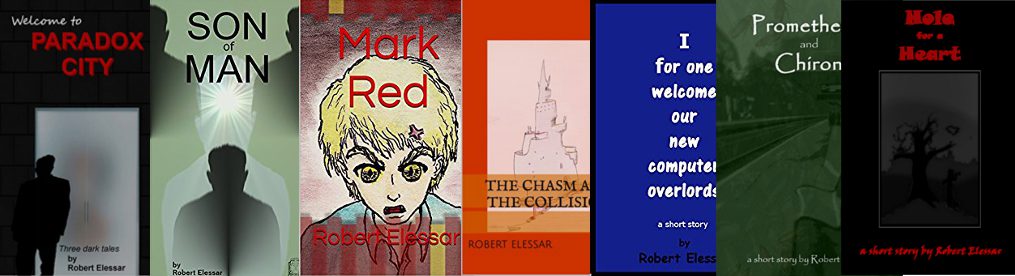
I didn’t read at all this weekend‒not a single page of a book.  Nothing gripped me enough to make me even open the Kindle app on my phone, let alone to grab one of the books I have in my room.  Last week, as you may recall, I reread The Chasm and the Collision.  I also reread one of the stories from Welcome to Paradox City, and I reread “I for one welcome our new computer overlords” in the version that’s in Dr. Elessar’s Cabinet of Curiosities.  They weren’t as fun as CatC, but they were decent stories and I still like them.  But I didn’t feel the urge to read even any of my own stuff this weekend.

I’m on the train on my way to the office now, and wondering what I’m going to do in general.  I keep intending to get back into some kind of better shape, so I don’t die a corpulent grimace of a blob of some kind.  I’m working on it.  I am walking some, trying to work my way up, and I do upper body training to at least some degree every day (except when sick…and after even a few days, it’s remarkable how much more difficult it becomes).  I’m trying to adjust my diet, but that seems to be my most difficult hurdle; eating is one of those rare self-soothing behaviors that’s biologically reliable, and from which it’s difficult to quit cold turkey as it were*.  Still, there are further interventions on which to work.

I’m not giving up on it.  I have something I want to try to do sometime in the relatively near future, and I would need to lose weight before doing it.  I’ve also toyed with the notion, in the past, of perhaps running a marathon some day.  I’ve had difficulties with jogging because of my back, which has at times been sensitive to me running, and some chronic ankle and knee weakness, but since I’ve been walking my two plus miles a day just from and to the train station, I think those areas are getting stronger, and sleeping on the futon on the floor is probably also helping.  Maybe I can gradually work my way up.  I’m not as young as I was in college when I first got into serious running condition, but if anything I am more stubborn.

I need to have something to do with my time, and I certainly don’t “have a life” as the expression goes.  I’ll try to get back to my medical postings soon, anyway, and I apologize for frequently putting them off.  There’s the follow-up to the neurology based post and the discussion of sugar I first sort of introduced last Thursday.

I don’t know what else I might end up doing.  I’m really rather rudderless now, and feel like I’m becoming more so as time goes on.  I have no real sense of a future, just the endless trudge that is the directionless present.  At least the weather is a little cooler down here for walking.  That’s a slight boon.  So much of the year it’s way too hot and humid.

Anyway, that’s it for today.  I hope you all have a good start to your week.


*Ha ha

I don’t feel well this morning.

Okay, well…sorry, I’m not going to be picking up today on the rest of the sugar-based post that I mentioned and half-started yesterday.  I also won’t be doing a follow-up neurology post, either.  I’m actually just going to write a very brief dispatch, if I can do that, mainly to let you know why I won’t be doing those things I just mentioned.

I just really don’t feel well this morning.  I was up during the middle of the night, but that’s not unusual; I even sort of felt somewhat clear-headed for a time.  But then, when I woke up this morning, before my alarm, I felt somewhat confused and disoriented.  This was not in any seriously alarming way.  I knew where I was and who I was and what day it was and so on.  I just felt vague and hazy and out of it, like I hadn’t truly slept at any point at all during the night, or had maybe had apnea episodes or something.  I felt rather uncoordinated as I got ready for my shower and got my clothes and all that stuff out, but not as though I were having an inner ear problem.

Well, perhaps just a little like that.

Anyway, I got showered and dressed, though I felt like it all took me longer than usual.  And now I’m waiting on my morning train.  I’m going to work, even though I feel under the weather, because I already missed one day this week, and because last week the office had a poorish week because of the holiday, and yesterday my coworker with whom I share some responsibilities had to take the day off because he was having particular trouble with his back.  I’m hoping he’ll return today, because I’m really not feeling great, and also because this is supposed to be my weekend off, after having worked the previous two Saturdays.

It seems I’m not the only one who is off kilter.  When I got to the train station, a northbound train was just arriving (I missed it), and I thought I must have lost more track of time than I’d appreciated.  But it turned out that it was the first train, the one I only catch when I really can’t sleep at all, and it was running almost 15 minutes late.  And now, my train is running about 30+ minutes late, and the southbound trains are running late, and the next northbound…well, you get the idea.  I wonder if there’s some computer virus issue going around that affects train systems and weird devices like me.

Probably not.

Anyway, it’s frustrating, because if I’d gotten here as early as I usually do for my usual train, I would have caught the delayed 1st train, and would already be on my way, instead of having to wait here, already feeling crappy, for a more-delayed train that will be more crowded because of the delay, as is always the case.

There are apparently a full three trains now expected to arrive at the Hollywood Tri-rail station, according to the tracker app—all late, but set to arrive within ten minutes or so of each other.  I would frankly wait for the second one if I weren’t sure that it too might not be even more delayed than currently listed*.

Geez, Louise, I don’t need this on a morning when I feel like I do.  I just want to lie down and go to sleep and stay that way.  I hate this stupid world and this stupid life.

So, anyway, my apologies for being so erratic and not doing what I had meant to do yet on the requested topics.  Hopefully I’ll be able to get a good rest this weekend, and by Monday I’ll be prepared to pick up on one of them.  Meanwhile, I hope you all forgive me, and that you have a good weekend.


*I did end up doing that, since the app and a security officer confirmed that the next train was only ten minutes after my delayed one, and that one was packed, and all my usual seats were taken.  Now I’m on a nice and sparsely populated train, at least, though I’m still quite behind my usual schedule, and that’s stressing me out.  But it’s better than being packed into an overcrowded and delayed train.

The sweetest honey is loathsome in its own deliciousness. And in the taste destroys the appetite. Therefore, blog moderately.

Hello and good morning.  It’s Thursday again, so I return to my traditional weekly blog post, after having taken off last Thursday for Thanksgiving.  I’m still mildly under the weather, but I’m steadily improving.  It’s nothing like a major flu or Covid or anything along those lines, just a typical upper respiratory infection, of which there are oodles.  Most are comparatively benign, especially the ones that have been around for a while, because being not-too-severe is an evolutionarily stable strategy for an infectious agent.

An infection that makes its host too ill will keep that host from moving about and make itself less likely to be spread, to say nothing of an infection that tends to kill its host quickly.  Smart parasites (so to speak) keep their hosts alive and sharing for a looong time.  Of course, “smart” here doesn’t say anything about the parasite itself; viruses are only smart in the sense that they achieve their survival and reproduction well, but they didn’t figure out how to be that way—nature just selected for the ones that survived and reproduced most successfully.  It’s almost tautological, but then again, the very universe itself could be tautological from a certain point of view.

It’s an interesting point, to me anyway, to note that today, December 1st, is precisely one week after Thanksgiving.  Of course, New Year’s Day (January 1st, in case you didn’t know) is always exactly 1 week after Christmas.  It’s unusual for Thanksgiving to precede the first of December by a week, because the specific date of Thanksgiving varies from year to year (and, of course, if Thanksgiving were to fall on the 25th of November, December 1st would not be exactly one week later).  It’s an amusing coincidence; there’s no real significance to it, obviously, but I notice such things.

Anyway.

My sister asked me to write something about the vicissitudes of sugar (not her words), and though I don’t mean to finish the topic here today, I guess I’ll get started.  Apologies to those who are waiting for me to finish the neurology post, but that requires a bit more prep and care, and I’m not ready for it quite yet.  Life keeps getting in the way, as life does, which is one of the reasons I think life is overrated.

It’s hard to know where to start with sugar.  Of course, the term itself refers to a somewhat broad class of molecules, all of which contain comparatively short chains of carbon atoms, to which are bonded hydrogen and hydroxyl* moieties.

Most sugars are not so much actual free chains as they are wrapped up in rings.  The main form of sugar used by the human body is glucose, which is a six-membered ring with the rough chemical formula C6H1206.

glucose2

This is the sugar that every cell in the body is keyed to use as one of its easy-access energy sources, the one insulin tells the cells to take up when everything is working properly.  Interestingly enough, of course, though glucose is the “ready-to-use” energy source, it only provides about 4 kilocalories** per gram to the body, as compared to 9 kilocalories per gram for fats.

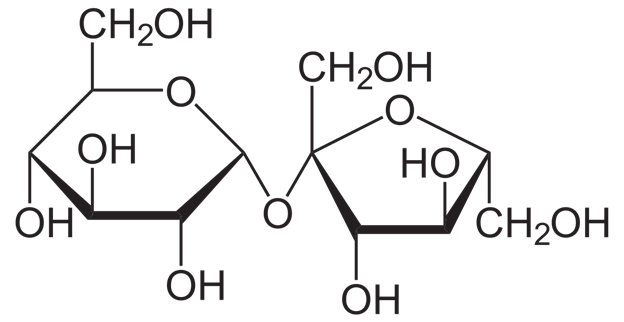
But the sugar we get in our diets is not, generally speaking, simple glucose.  It tends to be in the form of disaccharides, or sugars made of two combined individual sugars.  Sucrose, or table sugar, is a dimer of glucose and fructose, joined by an oxygen atom.

sucrose

Okay, I’m going to have to pick this up tomorrow.  I’ve gotten distracted and diverted by a conversation a few seats ahead of me.

There are two guys talking to each other at the end of this train car, and they are each seated next to a window on the opposite side of the train, so they’re basically yelling across the aisle to each other.  Their conversation is perfectly civil, and though they’re revealing a certain amount of ignorance about some matters, they are mainly displaying a clear interest in and exposure to interesting topics, from history to geography and so on.

At one point, one of the men started speaking of the pyramids and how remarkable their construction was, and I feared the invocation of ancient aliens…but then he followed up to say that, obviously, there were really smart people in ancient Egypt, just like we have smart people today who design and build airplanes and rockets and the like.  Kudos to him!

These men are not morons by any means.  They clearly respect the intellectual achievements of the past and present, and that’s actually quite heartening, because I think it’s obvious that neither one is extensively college-educated, if at all.

But why do they have their conversation from opposite sides of the train, so that everyone nearby has to hear it?  It’s thrown me off my course.

I’ll close just by saying that yesterday I finished rereading The Chasm and the Collision, and I want to note that I really think it’s a good book, and to encourage anyone who might be interested to read it.  The paperback is going for I think less than five dollars on Amazon, and the Kindle edition is cheaper still.  If you like the Harry Potter books, or the Chronicles of Narnia, or maybe the Percy Jackson books, I think you would probably like CatC.

CatC cover paperback

I’d love to think that there might be parents out there who would read the book to their kids.  Not kids who are too young—there are a few scary places in the story, and some fairly big and potentially scary ideas (but what good fairy tale doesn’t meet that description?).  It’s a fantasy adventure starring three middle-school students, though I’ll say again that, technically, it’s science fiction, but that doesn’t really matter for the experience of the story.

Most of my other stuff is not suitable for young children in any way—certainly not those below teenage years—and Unanimity and some of my short stories are appallingly dark (though I think still enjoyable).  If you’re old enough and brave enough, I certainly can recommend them; I don’t think I’m wrong to be reasonably proud of them.  But The Chasm and the Collision can be enjoyed by pretty much the whole family.  You certainly don’t have to be a kid to like it, or so I believe.

With that, I’ll let you go for now.  I’ll try to pick up more thoroughly and sensibly on the sugar thing tomorrow, with apologies for effectively just teasing it today.  I’m still not at my sharpest from my cold, and the world is distracting.  But I will do my best—which is all I can do, since anything I do is the only thing I could do in any circumstance, certainly once it’s done, and thus is the best I could do.

Please, all of you do your best, individually and collectively, to take care of yourselves and those you love and those who love you, and have a good month of December.

TTFN


*Hydroxyl groups are just (-OH) groups, meaning an oxygen atom and a hydrogen atom bonded together, like a  water molecule that lost one of its hydrogens.  This points back toward the fact that plants make sugar molecules from the raw building blocks of carbon dioxide (a source for the carbon atoms and some of the oxygen) and water (hydrogen and oxygen) using sunlight as their source of power and releasing oxygen as a waste product.  This was among the first environmental pollutants on the Earth—free oxygen—and it had catastrophic and transformative effects on not just the biosphere of the Earth but even on the geology.  The fact that the iron in our mines, for instance, is mainly in the form of rust is largely because of this plant-born presence of free oxygen in the atmosphere.

**A kilocalories is defined as the amount of energy needed to heat a kilogram of water by one degree centigrade.  We often shorten this term just to “calorie”, but that is actually only the amount of heat needed to raise a gram of water one degree centigrade (or 9/5 degrees Fahrenheit).  It’s worth being at least aware of the fact that what we tend to call calories are actually kilocalories.

You are not I, but I have a URI

In case anyone was worried, I apologize for not writing my blog post yesterday.  I was “home” sick with an upper respiratory infection, and had neither the energy nor the inclination to try to write a post.  I’m obviously not completely recovered today, but I am going in to the office—it’s payroll day, after all—and I feel a bit better than I did on Monday afternoon and yesterday, at least physically.  My mind feels quite foggy, but that’s not that unusual.

Of course, I’m not going to write either my follow-up neurology post nor the post about sugar and its discontents (so to speak) yet.  My mental acuity is not up to those at the moment, nor am I completely prepared for the former article, so I won’t be getting to them quite yet.  For those who might be waiting, again, I apologize.

There’s not much happening that’s particularly interesting.  I have been rereading the latter part of The Chasm and the Collision over the past few days, and I’m pleased to note that I still enjoy the story.  Parts of it even bring me near tears, which is a curious experience for the author, but then again, I guess it is more personal to me than it might be to others.  I’ve found a few typos—less than a handful, I would say—that were missed before, and if this were a world in which I had time and will and executive function (as they call it), I’d fix them and try to go and adjust the text for future purchasers, but I’m not up to that.

Anyway, it’s nice to know that at least I like the book, still, but I think there would be a lot of people out there who would like it, if it could be brought to their attention.  Unfortunately, I’m not good at self-promotion in any serious way.  This blog is as close to promotion as I get, and you all see how upbeat and enthusiastic I am with it.

Speaking of typos—I was, you can check for yourself—I’ve been making an awful lot of them while typing this.  I guess it’s part of being sick, or sicker than usual, or sick in more ways than usual.  I also, after waking up many times through the night, actually didn’t hear my alarm clock until the second repeat, ten minutes after it first goes off, because apparently I was sleeping on my left side, and I’m very hard of hearing in my right ear.  Probably at least a bit of it is also because I’m sick.  I wish I could say I felt more rested, but who feels better rested when sick?  Maybe afterwards, but not while it’s going on.

I’m wearing a mask on the train today, since I am sick, whereas lately I’ve been occasionally going without it, since often I’d literally be the only masked person in sight.  Perhaps going without a mask is why I’ve gotten sick.  It would make a certain amount of sense.

I think I may try to reread some of my other stories.  Somebody ought to read them, since they’re out there, and it’s not their fault their author isn’t good at promotion.  There are whole communities of people on Twitter and the like who promote independent writers and publishers, and I’ve tried to be an active member of such things in the past, but I’m afraid I have a hard time not getting stressed out by the whole process.  I guess this is why authors get agents and work through publishing houses, but frankly, the notion of dealing even with those situations—getting an agency or a publisher or any of that—is too daunting.  I barely have the will to get up and out of “bed”, frankly, but staying there would be more unpleasant than getting up, so…

Anyway, all that isn’t very interesting.  I guess the only other moderately interesting thing I have to note is that, Monday evening, as I was on my way back to the house, and already feeling the effects of this URI, I was “inspired” to write lyrics to the chorus and after that the first verse, and then a slightly altered second chorus, to a new song.  I even had a little melody in my head to go with it at the time, though I don’t recall that now.  I recorded the initial chorus, sort of, on my voice recorder, though I’m not sure I really caught the tune I had in my head for it, and then I wrote that chorus and the rest in the note-taking app.  I suppose I should email them to myself, lest my phone die and they be lost (though that wouldn’t exactly be a tragedy).  It was a slightly upbeat sounding melody, which was mildly ironic given that the words were rather negative—a cautionary note against complacency and overconfidence.

Is it any surprise that new song lyrics I would write would be so?

Anyway, that’s all that’s going on right now.  For me, I mean.  I don’t know if I’ll go any further with the song idea, but one thing I will do is try to avoid getting too wordy with it, since I tend to do that and end up making songs that are quite long.  I’ll add at most one or two other verses* and maybe a vocal bridge section if the mood for that strikes me.  We’ll see.  Odds are nothing is ever going to come of it, which is fine, because it’s not as though anyone makes a habit of listening to my music, anyway.

Okay, that’s enough of that nonsense.  I hope you all had a decent Tuesday, and have a good last day of November today.  Tomorrow begins what by name should be the tenth month, but which is actually the twelfth month—December, in case you didn’t know.  Yippee.


*To be clear, the verses and chorus such as I have are remarkably unwordy for me, so two to three verses, a chorus (with minor changes in its second repeat) and maybe a little bridge would not be too much.

From Cyber Monday to confidence mistakes

Well, it’s Monday now, and we’re “seeing how it goes”, I guess.

This is the last Monday of November in 2022.  The Monday after Thanksgiving is sometimes called “Cyber Monday”, but that’s really just a marketing gimmick* invented by companies that sell electronics and related things, to encourage people—preferably without making them think too much—to buy computers and phones and items in those categories as part of their Christmas (or other holiday) shopping.

I think the term Black Friday was something that happened more or less organically; it’s hard to imagine retailers and marketers deliberately choosing something that sounds similar to the names given to the dates of various stock market crashes and so on.  No, it was a term born of legitimate lamentation about just how unpleasantly busy malls and other commercial establishments become on the day after Thanksgiving, when a good percentage of people in the USA would have the day off, and would be unable to deny that the Big Holiday was coming, and that they hadn’t gotten much, if any, of their shopping for it done.

But, of course, smart marketers still took advantage of the term and began setting Black Friday sales and the like.  When there’s a source of available resources, of one kind or another, and a busy ecosystem, something will eventually arise to exploit the resource.

Although, to give full disclosure, apparently it took millions upon millions of years for fungi (and possibly other types of microorganisms, I’m not sure) to evolve that could break down the wood of the oodles of plants that had grown and died in the “carboniferous era”, and that’s why those wood carcasses just lay around, and got buried, and for quite a few million years sequestered that carbon, but were converted by pressure and time into coal and so on.  There was a lot of it, obviously, but it is finite, and we’ve gone through much of those millions of years of cellulose creation (from the very air), and returned a good chunk of it to the atmosphere from whence it came, in a precipitous fashion.

It’s going to take more than just tree planting, I suspect, to counter that, because we can’t plant (and grow) many millions of years of trees in the space of a human lifetime.  The solutions are going to have to be at least a bit cleverer than brute natural selection, and probably multifarious, or else brute natural selection will do what it usually does and eliminate a great many forms of life.

It remains to be seen whether the human race will be smart enough to survive for much longer.  The various faces of politics and social media and the like don’t exactly fill me with optimism, but it’s difficult to make reasonable predictions about such things, because we don’t have any good prior data from which to draw our conclusions.  There have been no previous technological civilizations on Earth, and we’ve found no evidence of any out in the rest of the galaxy or beyond, so we just don’t really know one way or the other.  Anyone who confidently make claims about the future (without explicit or at least implicit caveats) is overconfident, more or less by logical definition.

I’m not one of those people who is impressed by confidence, by self-assurance, let alone by dogmatism or arrogance—though back when I was a pre-teen and into my teens I held a spot of envy for such attitudes.  Honestly, though, now I think overconfidence is generally reprehensible.  Holding beliefs that do not scale with the evidence has been a source of some of the greatest atrocities the human race has ever committed, against other humans and the rest of the world.

Beware of people who are certain without adequate reasons for certainty.  And by “adequate”, I mean reasons that would convince a disinterested extraterrestrial of good intelligence and emotional restraint without any preconceived notions one way or the other, not that would convince some naïve group of humans, even a lot of them.

Overconfidence is truly dangerous, and most of the confidence that people tend to try to invoke or evoke or project is overconfidence.  It’s not a coincidence, nor is it wrong, that “con artist” is short for “confidence artist”.  I recommend against trusting anyone who wants you to trust them rather than to be convinced by their evidence and argument.  It may do you good to remember that “trust” is really always just another word for “calculated risk”.  Try to make your own risk calculations as accurate as you can make them.

Anyway, that’s my meandering blog post for today.  I don’t really have energy to write much more.  I had a particularly bad week last week, so I haven’t made progress on reviewing Alzheimer’s or Parkinson’s Disease, and I want to get a better review in before I write any more about them.  I also have a request—from my sister—to write something about the problems and dangers of sugar.  That’s something that doesn’t require nearly as much review, but I’m not up to doing it today.

I don’t feel much better than I did last week, if any at all; I’ll have to see how the day goes.  But it’s not as though the holiday season is over.  Also, the daylight is getting shorter and shorter, and will be doing so for more than three weeks—although, this being near a local minimum of the sine curve, the rate of change is shrinking, and will reach its minimum absolute value right when the daylight reaches its minimum.  Of course, that also means that even once days start getting longer again, the change is going to be very slow at first, and hardly noticeable.

I honestly don’t know how (or if) I’m going to make it through until Spring.  No one has yet given me any good arguments for doing so, certainly none such as might convince a  disinterested extraterrestrial with no preconceived notions on the matter.  And, as I’m the closest thing to an alien that I’ve ever met, I’m better at making that judgment than many others might be.

But I don’t know for sure.  I do know that I’m tired, and I’m sad, and I’m frustrated, and I’m lonely, and I’m confused, and I don’t feel well.  I also can’t seem to sleep very well at all, even for me.  My world is a miserable place, and it doesn’t seem to be getting better over the course of my life.  I don’t know whether the future is therefore likely to be better, or is more likely to be worse still, or what.

I do have my doubts that it’s worth much effort, though.  Again, I guess we’ll see.  Or, perhaps, we won’t see.  Maybe no actual answers will ever be forthcoming.  If so, that’s okay.  I’d rather be uncertain than have firm beliefs that don’t have good, sound, reasonable bases.  I hope you feel much the same.


*Like “non-GMO” and “organic” and “gluten free” are, for the most part, though for those with actual celiac disease, that last one can be a truly serious matter.

Well, here we go again.

It’s Saturday—the one that comes two days after Thanksgiving, though I don’t think it has any special designation—and as I said I would, I brought my laptop with me, so I’m using it to write this post today.

I didn’t play any music or write any fiction yesterday.  Obviously.  I mean, I haven’t written any fiction in months, now.  I’m not sure how many.  And although on three occasions I’ve done a tiny bit of plinking on the guitar and once on the piano, it’s really been nothing like what I did in the past.  I just don’t have the desire to do it, even though I used to enjoy it.

As I’ve said, I used to enjoy fiction, mostly fantasy/sci-fi and horror.  I have a difficult time forcing myself to read any fiction anymore; even the Japanese light novels are getting daunting.  Non-fiction that I would normally have enjoyed, like books about physics, or biology, or psychology, or even politics and sociology, are all just blah.  Most of the videos I want to watch, I’ve already watched, over and over again, and though I am able to enjoy things repetitively, and I always have been, I’ve gotten to the point where I’ve just about squeezed what I can out of the ones that I like.  I haven’t even been able to get more than a few dozen pages into Sean Carroll’s new book.

And now, here I am, sitting at the train station on Saturday morning, ready to go into the office.  The person who last triggered my meltdown on Monday*, was off yesterday and will be off today, enjoying his holiday, and will get paid for his bending of the rules.

All the people I love in the world are elsewhere, with the ones they love, presumably enjoying their holiday weekends—I certainly hope they are—or just enjoying themselves in a faraway land, experiencing other cultures and so on.  And I’m here by myself, near the distal dorsum of America’s flaccid, syphilitic penis.

I think I stay here because, honestly, I don’t feel like I deserve anything better, and anyway, this apparent ASD that I probably have—or whatever psychopathology I have that mimics it—makes it very difficult for me to contemplate changes to any given situation, even though it’s far from ideal.

After I got out of prison, I decided to come back to Florida after a brief visit to my parents, instead of staying with them (I was invited to stay), because I hoped to be able to see my kids sometime relatively soon.  That, of course, did not happen, and I don’t give high odds on my ever seeing them again.

I’m certainly no good at being pushy about trying to get my own way in interpersonal relationships.  I didn’t fight my divorce or any related stuff, never fought about how much child support to give—I was happy to give as much as I was asked.  Frankly, there was nothing better for me to do with my money.  I honestly have little to no inherent sense of having any rights of my own, certainly with respect to other people, though I will tend to demand that people keep their hands off of me, literally and figuratively.

So, I missed the last few years of my parents’ lives that I could have spent with them, in the vain notion that I might get to see my children sooner.  And, of course, that was why I pled guilty in the first place, though I consider myself innocent according to the law as I understand it.  I certainly never willingly broke any laws, but was trying to help people who had chronic pain, such as I have.  I’m not claiming my thought processes were clear or ideal, and I was certainly naïve and foolish, but I never meant anything criminal, and certainly made no profit.

But I figured, three years’ plea bargain (with time served counting toward it) was better than a chance at a longer sentence, especially since I’m not a likeable sort with whom a jury might be expected to sympathize; or so I was told by my court-appointed lawyer.

This is the way the state extorts people into taking “shorter” offered sentences rather than going to court to fight legitimately for their side and their rights.

Anyway, I gave all that up for what turned out to be a pie in the sky notion.  I lost my medical license, my community, my use of skills that I’d put years and years of effort into gaining, and I lost the last years of my parents’ lives, and I lost my children anyway.  I wish I were just some selfish prick who was good at looking out for number one and living for his own enjoyment.

Well, no, no I don’t.  I despise such people.  But sometimes I envy them their ability not to care what anyone thinks of them, or what impact they have on others, no matter what they do.  I mostly don’t worry too much what other people think of me, but I do want people I love not to hate me.  I’m not sure I’ve been very successful at that.  I’d also like to be able to be with my kids and I certainly didn’t want to be divorced, or to disconnect from various other people, but I’m not good at people, it seems, though I was always good at being a caring doctor.

Oh, well.  It doesn’t matter.  It’s all pointless and irrelevant, and I don’t expect I’ll ever see my kids again, any more than I’ll see my mother and father again, though for different reasons.  I guess not seeing my kids is my punishment, or whatever the proper term is, for being utterly incompetent at human relationships.

It sucks, but I can’t get the rules changed as a special dispensation for me.  And I certainly don’t want to inconvenience my kids in any way; I want them to have the dreams they want to achieve, to do what they want with their lives and to enjoy the world as best they can.  Same with my old friends, and my ex-wife, and her family, and everyone else I’ve known.  I’m not interested in being the center of anyone’s attention, unless it’s something they feel good about.  For instance, if they like my writing or my music, I don’t mind if they pay attention to that.  But I’m certainly not worth derailing anyone’s plans out of any sense of obligation or anything along those lines.

I have no idea what I’m trying to say, today.  I’m getting bored with this blog, both today and in general.  I’m calling it good for now.  We’ll see how Monday goes.


*I want to make it clear that he was not the primary cause, he was merely the last straw…but he does often put himself in that position.