Nor can I fortune to brief minutes tell, blogging to each his thunder, rain and wind

Hello and good morning.

I decided yesterday afternoon that I would try to write something a bit different for today’s post, rather than just another litany of my depression and despair, since I’m sure any dedicated readers are probably getting almost as tired of reading them as I am of experiencing them.  I cannot directly alter the fact that I experience them—if I could, I would—but I don’t have to make it an uninterrupted trail of goo for you all to slog through on a daily basis.

I came up with two, more or less unrelated, ideas, but I’m only going to focus on the first, which is nearer and dearer to my heart and mind, in any case.  It’s also been something I’ve thought about on and off for some time.  I do wonder what pertinent quote from Shakespeare I’ll find to alter to make the title, but of course, you who are reading will already know the answer.

Don’t spoil it for me, okay?  I want to be surprised.

Anyway, the idea I wanted to bounce around today has to do with the question of the discontinuity of reality at a mathematical level.

I’m sure many of you are aware that, from the perspective of quantum mechanics, there is no sensible differentiation in, for instance, location at any scale smaller than the Planck length, which is about 1.6 x 10⁻³⁵ meters, or in time below the Planck time, which is roughly 10-43 seconds.

There are various reasons for this, and I won’t try to get into them, but this is generally agreed upon by all the scientists who work in the field.  It’s part of why there is an upper limit to the number of possible quantum states within any given region of spacetime, defined, thanks to Bekenstein and Hawking, as the surface area of an event horizon surrounding that region as measured in units of square Planck length.

Thus, based on the best current understanding of the micro-world, the universe is not so much pixelated as blurry at the smallest scales.  Admittedly, these are very small scales—far smaller than we can probe currently, so we may, in principle, be wrong about some of it, and quantum gravity might change our understanding, but there are strong reasons for this assessment.

Now, mathematics—thanks to work threshed out by Newton and Leibniz, building on ground first broken (though no one quite realized it at the time) by Archimedes about two millennia earlier*—can deal with things that are truly continuously divisible.

Those of you who took high school level calculus (or higher) probably recall that a derivative involves finding the instantaneous slope, or rate of change, of a curve describing some function, such as the instantaneous acceleration being the rate of change of the “speed”.  The idea of it had to do with taking the slope of a line connecting any two nearby points on the curve and bringing them closer and closer together, taking the limit as that distance goes toward zero.

Analogously, integrating a function involves finding the area under a curve, and is in a way the opposite of a derivative.  This involves splitting the area under the curve into rectangles of fixed width at any given point along the curve (the height defined by the value of the curve at that point) and adding them together, then taking the width between the points to be smaller and smaller, until one approaches the limit of an infinite sum of “infinitesimally” narrow rectangles.

These processes are tremendously useful, and can describe the orbits of astronomical objects and the trajectories of ballistic materials, just to take two simple examples.  They are good for describing the universe in many ways, and they often produce useful and accurate answers and predictions to the best of anyone’s ability to measure.

But that raises my question.  Do we currently have the capacity to tell the difference between processes in the universe—say, for instance, acceleration due to gravity—being truly continuous or them being in a sense discontinuous?

We know that the Real Numbers are uncountably infinite, as a matter of pure mathematics.  Between any two nonidentical real numbers, however arbitrarily close together, exists an uncountably infinite number of more real numbers, as large—so to speak—as the number of real numbers themselves, a Russian doll in which every new doll revealed by opening the previous one has just as many dolls inside it as there were inside the original Russian doll…but even more unlimited than that.

This is, however, not necessarily relevant to reality**.  Just to demonstrate that fact:  we can calculate Pi (π), the ratio of the circumference of a circle to its diameter, to any number of decimal points we might choose, but it will never come to an end—it’s an infinite, non-repeating decimal number, one of the “transcendental” numbers.  Pi has been calculated to 62.8 trillion digits (as of 2021) but that’s not a number we could ever measure as the ratio of the circumference of any actual circle to its diameter.

I’ve read (from a reliable source) that only 39 digits of Pi are necessary to calculate the circumference of the visible universe*** to the fineness of a single hydrogen atom.  Now, a hydrogen atom is about 1033 Planck lengths across, according to a quick search, so that means, in principle, we’d only need Pi to 72 digits or so to calculate the diameter of the universe to the nearest Planck length.  That’s a fairly large number of digits, but it’s smaller than the order of magnitude of, for instance, the estimated number of baryons in the visible universe, and is smaller than the entropy “contained” in even a solar mass black hole****, unless I’m seriously misremembering.

So, finally, my question is, how well have mathematicians ascertained that aspects of reality can in truth be described by equations that are actually continuously variable, or whether we could ever tell the difference?

A computer, for instance, could simulate some model of a continuously varying system to a high degree of precision by taking each current state and then applying an approximation of the applicable equations to the next state, iterating each step in sequence, as if recapitulating the steps that led to the limit defining the derivative or the integral of a function.  This would be considered an approximation of the true function, of course, but one could, in principle, get arbitrarily close to the true function by taking one’s intervals to be arbitrarily small—solving, for instance, or at least simulating, the three (or more) body gravitational problem, by calculating, at each instant, the net effect of each object on all the others, calculating the acceleration, applying it, moving each thing a tiny step, then recalculating.

But what if it’s not the step-wise approach that’s the approximation?  What if the continuously differentiable functions we use to describe things like gravity and electromagnetism and the various quantum mechanical matters are the approximations?  What if reality is more Δx/Δt than dx/dt?

Obviously this is a simple enough concept to come up with, and I’m far from the first one to think of it.

My more immediate question is, has anyone demonstrated mathematically just how fine our measurements would have to be to tell whether, for instance, the orbit of a planet around a star follow a truly continuously differentiable path, or if it is just a step-wise, iterated process?  If one were able, for instance, to simulate the orbit of a planet, say, by iterating an approximation each Planck time, and reconfiguring the system at each step to the nearest Planck length, how long, in principle, would it take to be able to tell the difference between that simulation and a truly continuously differentiable motion?  Could there, given the constraints upon the nature of reality applied by our best understanding of quantum mechanics and the like, ever be any measurable difference?

I don’t know if this has been addressed by mathematicians.  It may not have any practical implications, since we’re a long way from being able to measure reality precisely enough—or so I suspect—to tell that difference.  But I wonder if it’s been worked out just how finely we would need to be able to measure to tell if reality is truly continuously differentiable.

If anyone reading is a mathematician familiar enough with this sort of question to give me an answer, I would love to hear it.  Or if you know a mathematician with appropriate expertise, or a physicist of similar expertise, I would dearly like to know if anyone has done any explorations from the mathematical (not simply the practical) point of view regarding this.

That’s it, that’s my subject for the day.  I feel that I’ve been very ham handed and brutally quick in the way I’ve gotten into the subject, and for that, I apologize.  I only have the time to write this between my shower and when I leave to go to the train station, so it’s a bit quick and dirty, as they say.

Obviously, I don’t have time or space today to address my other, unrelated question, which is about whether the legality and ubiquity of large-jackpot lotteries of various kinds has changed the general psychology of, for instance, the American people in a way that has decreased “average” ambition and work ethic, providing “bread and circuses” to the masses in a way that has at least contributed to the greater economic disparity between socio-economic levels in the nation (and the world) and the gradual dissolution of the middle class?

I wouldn’t dream of thinking it the only or even the dispositive factor, but I wonder if it might have contributed.

Maybe I’ll write about that tomorrow.  Weirdly enough, we may have a harder time coming up with definitive answers for that question than the one I tried to discuss today.  Mathematics and physics are easy, in a sense.  Biology, psychology, sociology, economics…these things are truly hard to model and describe in useful, predictive ways, because the systems are so complex, with so many variables, both dependent and independent.  Even weather, the quintessentially chaotic system, may be more tractable.

I hope this has been more interesting than my usual reflections and projections of gloom.  I also hope you all have a very good day, and maybe that you think a bit about what I’ve written.

TTFN

Domenico-Fetti_Archimedes fractal tiles


*What a Mary-Sue that guy was!  I mean, forget the whole acrimonious debate on priority between Newton and Leibniz regarding calculus, these guys were about two thousand years behind the Eureka Man!

**Though it could be, even if distance and time and not limitlessly divisible.  For instance, if the Everettian “Many Worlds” description of quantum mechanics is correct, the overall “space” of “universes” created at points of decoherence/branching could be infinitely and continuously divisible, making it a no-brainer as to how many potentially different worlds there might be in that space—not “real” space, but the orthogonal space that contains all the branches of the many worlds.  However, that might not be infinitely divisible, either.

***That’s everything that can, even in principle, be seen given the finite time light has had to reach us since the Big Bang.

****The Entropy is about 1077, but Entropy is proportional to the natural log (basically, taking a log is the opposite of raising something to a power) of the number of possible microstates in a system, so that number of states is e to the 1077 power, or e multiplied by itself 100000000000000000000000000000000000000000000000000000000000000000000000000000 times.

It’s the end of the week as I know it, and I feel…

It’s Friday.  This week, that means that I have the next two days off work.  I wish I had something fun to do tomorrow or Sunday, but really, my only goal is getting my laundry done on Sunday morning and trying to get a little bit of extra sleep if I can.

I don’t have any friends with whom to do anything fun, and I don’t want to try to achieve anything interesting or useful with anyone.  And if someone were to surprise me with anything other than, for instance, a trip to some kind of inpatient psychiatric facility (pre-paid), I would not be terribly happy about it, though I guess if it were someone I haven’t seen in a long time I might be happy, depending on who the person is.  But that’s not going to happen, anyway.  Actually, neither of those things is going to happen.  As far as I can see, I’m just going to continue as before.

I guess it’s somewhat noteworthy that this is the last day of June in 2023.  Tomorrow begins a new month, the month of Julius Caesar, huzzah (If June had 31 days, then July would begin on Sunday, and we would have a Friday the 13th in July, but alas, this is not to be).  Rent and power and water and other bills are all coming due.  I don’t really care about all that.  It’s not like I have anything else to do with my money, other than get new Kindle books or what have you.

Even that’s getting harder as time passes.  There just aren’t really any new books in which I’m interested.  I still can’t seem to read any new fiction—or old fiction for that matter, not even my old favorites.  There are no shows I want to watch, and no shows that I really want to rewatch, and very few movies.

I suppose I wouldn’t mind seeing The Guardians of the Galaxy 3, but I don’t want to tempt myself with movie theater popcorn and whatnot.  Going to the movies and not getting popcorn and maybe Goobers and such would just feel terribly sad, quite apart from going alone.  Anyway, I’m trying to avoid such foods.  They tend to make my overall energy and health feel worse, and that’s not something I need, obviously.

I rather wish I had been familiar with Uber and Lyft on that first weekend, when I was considering going to the theater to see GotG, and before I had made my current dietary changes.  At that time, I meant to ride my bike there.  However, I had increasing trouble with my back when using my bike, and then the front tire went flat and everything, and now it’s just sitting there upside down under the overhang, a little way outside my door.  It was yet another waste of money and time and effort.  And it’s too far to walk to any theater to see the movie without arriving sweaty and gross—and, again, right now I’m avoiding movie theater type foods.

I was thinking of walking to the train this morning, but I’m really not up to it.  I’m getting a better handle on shoes for walking—or, technically, boots in this case—at least, and I now have three pairs of identical black lightweight hiking boots, which are good for the ankle support and for the general feeling of having my feet in armor.

But walking is a bit unpleasant just because it’s so very hot and humid right now in south Florida.  This probably comes as no surprise to anyone out there.

I regret coming to Florida, to be honest, though I think the state is quite beautiful, physically, in a great many ways.  I like all the plants and the reptiles and birds and amphibians, and even some of the arthropods (I like spiders, and dragonflies are also very nifty).  But most of the worst things that have happened in my entire life have happened since I’ve come here.

Not to say that there aren’t compensations, of course.  My daughter was born in Florida, and I wouldn’t change her existence or nature for anything.  But it would have been nice, once she was born, to have gone back north.  Imagine if my kids had been able to be in White Plains (where I lived before moving to Florida) and so had been able to go to one of the best public school systems around.

Actually, they’ve both done quite well with respect to their education, as they desire it, and maybe the added pressure of being in a more competitive system would have been unpleasant.  I don’t know.

Anyway, the past is done, so it’s pointless to dwell on changes to it.  And I cannot change the present, obviously, since it’s actually already happened/happening in each given moment.  And the best anyone can do is try to steer toward preferred futures, but it may be, as a matter of physical law, that the future is set and inevitable and/or partially random and unpredictable.

As far as the experience of limited minds and beings such as we are, though, the future feels like something over which we have at least some degree of control, or at least through which we have some ability to steer.  It’s limited steering, of course.  It’s not as if we were in a car and driving; it’s not even as though we’re in a sailboat with a rudder.  It’s more as if we’re surfing, and if we do it as skillfully as we can, we might be able to surf in the direction we more or less would prefer to go.

Me, I think those reefs up ahead look inviting.  There are lots of sharks in the surrounding waters, too.  It would at least be a bit exciting, though perhaps painful and frightening at the time, to go there.  Then again, there’s also that whirlpool over yonder; that might be interesting, too, and probably a bit quicker.

I’m not much of a surfer, however, even metaphorically (non-metaphorically, I’m not a surfer at all).  I don’t think I’m surfing on the chaos of reality anymore, anyway, and I don’t think I have been for a long time.  I think I’m just treading water.  And it’s not as though I can just build myself a surf board, or a raft, or a boat or a ship, or anything else, out of the water in which I’m floundering.  And there are no vessels on the (admittedly quite limited*) horizon (though I do keep trying to send up flares).  So, I’m kind of just stuck here, treading away, until I finally tire out and go under.  I don’t know what else to do, but I’m already terribly fatigued.  I guess it’s “good” that the ocean water is salty**, or else it would be harder work to stay afloat.  Or maybe it would be better if it weren’t, so I could tire out more quickly and just have everything done.

Anyway, that’s enough of all that.  I’m sorry, it’s not an interesting blog post.  I think I’ll head out now.  Maybe I’ll get an Uber or Lyft to the train station.  I feel too lazy even for the bus.  We’ll see.

Have a good weekend, please, if you’re able.  If you’re with friends and family, for goodness sake, don’t take them for granted.  Not that you probably do.  Anyway, thanks for reading.


*I say this because, if one were treading water, one’s head would only be a foot or so above sea level, and so the horizon is very short, being a function of the height above the surface and the radius of the Earth.  Thus, as your height above the surface goes to infinity, your horizon asymptotically approaches half of the planet, though of course you would be having trouble with the limits of angular resolution and the amount of light dropping off as the distance squared and so on.  If the Earth were flat—which it is not—the horizon, even from a foot above the ocean, would be indefinitely large, limited only by structures that got in the way, and any haziness that attenuates light.  If the Earth were flat, then from the top of Mount Everest, with a good enough telescope, you could see everywhere on the planet.  You can’t, of course.  The world is round.  This has been understood for thousands of years, contrary to popular conceptions about the ignorance of people in the past.  Eratosthenes knew it 2200 years ago, and even used clever geometry to measure the Earth’s circumference, to within a few percent of the modern best measurement.

**Oh, by the way, did you see the recent reports about the shifting of Earth’s axis (a very small one, but real and measurable) that’s been caused by redistribution both from melting of glaciers and from the extensive pumping of ground water and the redistribution of that and the glacier water into the ocean?  It’s interesting that I was just talking about the changing angular momentum of the Earth by such things shortly before that report came out.  It makes me feel almost clever, though I did have a bit of a self-deprecating (though far from unhappy) head-slap moment when they mentioned the changes due to depletion and redistribution of ground water.  That had not occurred to me.  It’s always nice to have new facts and notions pointed out that make such sense.

“And everything under the sun is in tune, but…”

It’s Wednesday, June 21, 2023 (AD or CE, as you prefer), and I’m writing this on my laptop, but it’s not on my lap.  It’s resting on my desktop at the office, because I stayed here overnight last night.  I had a bad day—personally, not professionally—at the office, yesterday.  I felt just rotten, partly due to how poor a sleep I had, even for me, the night before.

I considered leaving early, but we were rather busy, and I didn’t feel I could justify cutting out on everyone.  Also, I had the nagging concern that, if I left early, I might never come back, because I really felt at my wits end, and though I had no specific plan in mind, I thought I might take some kind of drastic action to make it impossible for me ever to do anything again.  I just wanted to go to sleep and to sleep and to sleep and perhaps never to wake up.

Anyway, it really started to thunderstorm rather badly near the end of the work day, so I decided I would just stay at the office.  I’ve had a hard time getting up to my usual status on the payroll this week so far, and it has to be finished by today, so eliminating the commute time will better allow me to finish that.

But everything is getting too onerous for me.  I’m so tired, and I have no internal drive or purpose of significance, just habit and stubbornness, which can’t really ever make up for the real thing in the long run.  I don’t know what I’m going to do.  I need help, but I doubt I’ll get any, and I don’t think I’m capable of seeking it.

I can’t make myself believe that I deserve or am worthy of any help.

Speaking of long runs (I was, you can go back and check) today is the Solstice—the summer one in the northern hemisphere, and the winter one in the southern hemisphere.  Thus, it is the “longest” or the “shortest” day of the year, depending on one’s location.  I use scare quotes because it’s not the actual length of the day that varies on this date, or from day to day in any kind of steady way, but the duration of daylight, the time in which the sun is overhead, or at least visible in the sky (barring clouds).

But, of course, the length of a day really does change a bit from time to time, though not in anything like as regular, nor as dramatic, a fashion as daylight does regarding solstices and equinoxes and all that.  The earth is a rotating mass, and is subject to the laws of angular momentum.  Thus, when enough mass changes position on the surface of the planet, it can have an effect on the overall rate of rotation of the planet.

The stereotypical “demonstration” of this process is a skater spinning on the ice, who speeds up when bringing his or her arms close to the body and slows down when extending them.  This is because, crudely, the angular momentum is mvr, the mass times the “tangential” velocity (of the mass), i.e. the speed at which it goes around the center of rotation, times the distance from the center of rotation.  Thus, since angular momentum is conserved, if the radius shortens, the velocity around the center of rotation increases proportionately, and vice versa.

The instantiation of this is somewhat complex, as is usually the case, but this really is the gist of it.  The conservation of angular momentum is related to the rotational symmetry of the universe, as per Noether’s Theorem—i.e., the laws of physics aren’t dependent upon which direction you happen to be facing.  This is similar to how conservation of linear momentum is related to symmetry of translation—i.e., the laws of physics don’t depend upon where you happen to be along any linear direction.  And conservation of energy (locally) has to do with the symmetry of time.  This last one can be tricky when taking the universe as a whole, because conservation of energy doesn’t necessarily apply to the whole cosmos, nor is time fully symmetrical on the largest of scales, or so it seems, but locally it is true.

Physicists, please correct me if I made any gross errors there.

Anyway, back to the rotation of the Earth and the length of days.  Movement of significant amounts of mass on the surface of the planet (or within the planet) can change the rate of rotation of the planet.  I’m led to understand by the program QI* that a massive hydroelectric project in China cause the “elevation” of a large enough mass of water to slow the rotation of the Earth by a measurable—if inconsequential and utterly unnoticeable—amount.

I sometimes wonder if the periodic gathering of millions of people near the mouth of the Ganges has any potentially measurable effect on the momentary rate of the Earth’s rotation.  I’m not aware of anyone having made such a measurement.  Even if it’s true that it changes the rotation rate, it may be too small to detect.

I also wonder whether, as glaciers on mountains and across Greenland and similar melt, with the water thus previously elevated seeking a level closer to the center of the Earth, the planet’s rotation might well speed up.  I wouldn’t expect glacier melt in Antarctica to speed up the rotation in quite the same way, because those glaciers are all far closer to the axis of rotation in the first place, and so might have limited effect in shortening the “lever arm” of rotation.  Indeed, if they raise sea levels significantly enough, I could imagine the “center of mass” of the Earth’s rotation moving slightly outward, especially as the seas bulge more at the equator, thus slowing the motion of the planet down.

The odds of this perfectly balancing seem small, but I imagine it would require very complex calculations and—more importantly—quite fine measurement to ascertain the net balance.  And, of course, the balance is likely to shift over time.

In comparison, it’s relatively** easy to calculate the balance between special and general relativity required to keep GPS satellites in synchrony with the ground.  In this case, the speed of the motion of the GPS satellites slows down their local passage of time relative to the surface of the Earth, by a calculable and quite constant amount, but their greater distance from the center of the “gravity well” makes their time go faster relative to the surface of the Earth, again in a quite calculable and rather constant rate.

It’s the latter effect that predominates, and this is routinely accounted for in the GPS process.  If it were not, GPS would have huge and increasing errors as the timing in the satellites and of ground-based clocks diverged steadily, and the errors would very rapidly become far too great to be useful.  So, your use of smartphones to find where you are and how to get where you’re going depend on both of Einstein’s theories of relativity.

I guess you all already knew all that.  Sorry to be boring.

Anyway, that’s my bit*** of trivia for the day.  It will probably be the most interesting thing to happen to me in this particular Earthy rotation, but I hope all of you are having more interesting days than I am.  I’m just very tired, and discouraged, and worn out…and it’s only a little after five in the morning.

I’ve been in pain for twenty years, and I haven’t seen my kids (in person) nor interacted with my son at all (barring one email) in over ten years, and my last remembered restful night’s sleep happened in the mid-1990s.

If I could just find way to get restful nights’ sleeps, that would be a start.  Everything else would be easier, or so I suspect, if I could find a way to make that happen.  Then again, perhaps it wouldn’t help, and I would simply be faced with the tragic irony of having that wish come true only to find that it didn’t make the other things better, and might even make them worse.

Never underestimate the potential for things to get worse.  Reality has no bottom.

There’s that symmetry of translation that implies, by Noether’s Theorem, that momentum will be conserved.  Which brings me full circle, thus recapitulating the conservation of momentum/symmetry of rotation.  It’s neat, isn’t it?  Time, however, is a trickier bit of possible symmetry, as Pink Floyd recognized only too well.  But at least after Time has passed, when on The Dark Side of the Moon, one can look forward to the beauty of The Great Gig in the Sky.

If you haven’t listened to that album in a while, why not listen to it today?  Or if you’ve never listened to it, treat yourself.  It’s well worth it.  What the hell, it’s the longest day (or night) of the year.  Indulge yourself.  And if the cloudbursts thunder in your ear—you shout and no one seems to hear—and if the band you’re in starts playing different tunes, I’ll see you on the dark side of the moon.

Summer-Solstice-Stonehenge-860x540


*Which has, upon occasion, been incorrect, but it does, in the long run, try to correct prior errors, often in hilarious ways, usually at the expense of Alan Davies, as in the running conflict over the number of moons the Earth actually has.

**Ba-dump-bump.

***Well, actually, probably a few thousand bits, albeit redundantly encoded.

Blog Post for June 20, 2023 (AD) – Tuesday

It’s Tuesday morning, and I’m beginning this post at the train station rather than on the train, because this time I timed things so that I arrived a few minutes after the 6:10 train passed.  That way, I didn’t feel the urge to chase after it, like what I described the other day.

This was somewhat deliberate, but it also had a lot to do with just how tired I already am.  I don’t talk about my insomnia all that often, probably for the same reason most of you don’t talk about breathing very often.  It’s just always there.  But last night was worse than many; starting at a bit before two, I “woke up” every five to ten minutes, looking up at the clock, as if I were worried that I might have overslept.  I don’t know what I’m worried about in such situations, honestly‒it’s not as though there would be any objective, dire consequences if I were late.  But, of course, the real problem is that I would be distressed and upset if I were to miss my schedule.  And because of that, I can’t seem to sleep.

So, this morning, I already feel fatigued and mentally worn down, and the day is just getting started.  Of course, yesterday by noon or so I was already mentally crashing at the office, and that was Monday after a full, two-day weekend!  The crash was acutely due to my usual frustration with the nominal rules of the way we do things in the office being ignored when convenient in the short term, but it’s really all a cumulative and complex process.  By the end of each day I’m worn down more than I was at the beginning, and by the next morning I haven’t really gotten quite back up to the level I was at the start of the previous day, perhaps partly due to my insomnia.

It’s not a precise, smooth curve, of course; there are day to day fluctuations, and even I am not always in my worst state of mind.  But overall, the trend is downward, and I think it’s fair to say that I am now palpably lower than I have been in a very long time, if not ever.

It’s a good thing that I can at least talk to my sister on the phone for an hour or so once a week.  But I’m so annoyingly stressed by social interactions that, even with my sister‒whom I’ve literally known all my life, and with whom I get along as well as pretty much anyone‒I have to schedule and plan the phone conversations ahead of time, and generally on weekend days when I’ve at least had a mental break.

It’s ridiculous and pathetic, I know.  I can’t give it any kind of noble or even sympathetic spin.  I’m disgusted by myself…but then, that’s my general attitude toward myself, anyway.  Not to say that there’s nothing about myself that I like, of course.  I like that I’m very curious, and that I can understand science and math and all that stuff rather well, and that I have a good memory, and that I can learn things well and more easily than many other people seem to be able to do.

Even when very depressed and moriphilious* I’ll find myself inescapably driven toward ordering‒or at least to consider ordering‒some book or audio book, perhaps by someone I’ve heard speaking on a science and/or philosophy podcast, or similar.  Also, as I think I mentioned yesterday that I was considering, I did order the hardcover copy of Quantum Field Theory as Simply as Possible.  I almost ordered the author’s textbook (especially when I saw that, among many other places, Cornell uses it), but I decided I would start with the bird’s eye view before going deeper, partly because I’m not sure I have the mathematics expertise really to grasp the deeper stuff in a strict fashion.

I may.  I’m pretty good at stuff like that, and I can build on my prior understanding with more ease than some can, because I don’t tend to learn things by rote.  I learn by a sort of model-building in my head, which means it can take me longer to prepare for a test, for instance, but once I understand something, I don’t tend to lose that understanding very quickly, and can apply it elsewhere and merge it with other matters.  So, if I can get the concepts of some physical theory, and the concepts of the pertinent mathematics, then the nitty-gritty, nuts and bolts of it is much easier then to master.  That’s nice.  I do like that about myself.

But I don’t really have anyone around with whom to talk about the things in which I’m interested at any very deep level.  And it’s hard to contemplate even seeking out such people.  I would be stressed out worrying that dealing with other, new, and potentially frustrating people would be too much effort, but also‒perhaps more so‒that I myself am an irritating person, and I can’t quite bring myself readily to inflict myself on other people.

Also, I would probably have to go through some online community‒perhaps some form of “discord” or whatever that app/system is, or some Facebook or Twitter group or some** such.  I’ve never been interested in trying to get into Reddit communities, and most of the other social media meetup type things are anathema to me.  I don’t even like gaming with strangers online.

Early on, back in the day, I got on a Yahoo! based depression support chat group, but mostly I just lurked, though I did make a very good online friend in one, who (among other things) introduced me to both Sailor Moon and Radiohead, so that was a tremendously lucky and great meeting.  I cannot thank that person enough, and we are still in occasional contact to this day.

But even things like that Yahoo! group have changed and no longer appeal to me.  And I have changed since then, too, of course.  I’ve been to prison, for one thing.  That’ll change you a bit.  Probably even a cushy minimum security Federal Prison changes people, and FSP West is most assuredly not such a place.

Anyway, enough nonsense for today.  Tomorrow is the Summer/Winter Solstice, for what it’s worth, so I’ll probably mention it then, unless I’m lucky enough to have something happen that makes me unable to write my blog post or anything else.  Or unless someone swoops in and rescues me from the verge of the event horizon.

That’s not gonna happen, is it?

Oh, well.  Have a good day.


*I just made that word up, I’m not sure if it really works.

**Here’s a mildly amusing typo:  I originally typed that as “sum such”.

The deep of night is crept upon our blog, and Nature must obey necessity.

Hello and good morning.  It’s Thursday, the 27th of April, the week after my son’s birthday, and I’m already in the office as I write this blog post‒because I never left the office last night.  It got to be late enough that, if I caught the next train, I probably wouldn’t have reached the house before nine, whether I took the bus(es) from the train station or walked.  That is what happened Monday night and Tuesday night.

Of course, If I’d had the bike at the train station I might have reached the house earlier, but I didn’t, and I don’t regret that.  Given that every time I ride that bike, it triggers a flare and a new (but not improved) alteration of my back and leg and foot pain, I think I’m going to keep it for “special occasions” or something like that, even though I’ll be paying for it for three or four more months or something like that.

Pretty pathetic, isn’t it?

Even if I’d caught an earlier train, I don’t think I would have had the energy to get back to the house from the train station, and had I reached the house, I don’t think I would’ve had the energy to come back to the office this morning.  I had sort of planned all along to stay here, because if I went back to the house, I didn’t think I’d be coming in today, and I wasn’t sure if I would be coming in ever again (if you know what I mean).  I guess maybe it was a kind of semi-conscious self-preservation thing, in a way.  But, of course, that can’t work forever.

It’s not a big deal if I stay one night in the office.  It’s not like it will produce a noticeable effect, outwardly.  I always wear one of 2 kinds of black shirts, the same kind of black pants (or trousers if you prefer), the same brand of black socks and one of three brands of black shoes.  Once you find something that’s comfortable for you, I say, you might as well wear that.

I prefer black because you don’t have to worry about matching anything; black goes with everything, particularly other black things.  It’s also a nice, outward representation of my character, my heart, my outlook, what have you.  And if I ever have to pass as a Sith Lord, I can do that.  I only wear black nowadays.  Even my underwear(!).

In any case, though, I don’t mean to stay at the office tonight, though if there were a shower here I might be tempted.  I feel very grimy and sticky, and that’s a particularly unpleasant feeling for me.  But it is dreary to have the daily ritual of going back to a place that feels no more like home than does the office or the train, and not much more like home than the bus, frankly.

Nothing feels like home, anymore.  The planet Earth doesn’t feel like home‒not that it ever really has, to be honest.

I find myself strangely envying my former coworker who just died.  That may seem insensitive, but it’s simply true.  He didn’t die instantly, with the initial heart attack, which sometimes happens.  He had a few weeks or more of being ill and having all other responsibilities taken away, and his family (and friends), aware of his ill health, got to come and be near him for one last time.  That might be nice.  I sometimes think that, if I were known to be dying of cancer (for instance), maybe my children would come and see me.

I don’t know what other sort of thing might engender that outcome, and I certainly don’t want to try to force my way into their lives.  They deserve autonomy and to be free from my odious self, who already screwed up everything in his own life, and caused them pain in the process.  But I would dearly love to spend time with them.

Of course, I do have a potentially terminal condition, and I don’t just mean “life itself” which is uniformly terminal as far as we can see.  I mean depression.  Depression has a direct lifetime mortality rate of about 15%, or at least that was the statistic the last time I checked.  That’s not counting the many things depression makes one more likely to have‒people with depression are more prone to various kinds of physical illnesses and to worse outcomes if they get those illnesses, and they are also more prone than others to drug and alcohol problems.

But I’m talking here about direct self-destruction: suicide, from the Latin “sui” meaning self, and the “cide” part that always means killing, as in fungicide, herbicide, insecticide, anthropocide, etc.  “Suicide” almost feels like it ought to be the opposite of “sui generis” but that’s not correct, and in fact they probably often go together, subjectively speaking.  Maybe it would be the opposite of “sui genesis”.  Could it also be called “sui exodus”?

Anyway, my point is that depression has mortality rates comparable to many cancers, but there are no Ronald McDonald houses for it (as far as I know).  It’s not a sexy/tragic/dramatic disorder worthy of Hallmark movies and that kind of twaddle.  It just sucks all around, because its very nature is to suck and to make everything in the universe feel like it sucks.  Maybe in this it’s like the very curvature of spacetime; tending to bend inward on itself and collapse, unless it is infused with a uniform, positive energy, in which case there will be a tendency to expand.

Believe me, I don’t have a uniform positive energy.  Maybe I used to, but my cosmological constant has long since quantum tunneled into a vacuum state so close to zero that it makes that of the universe, tiny as it is, appear flipping gargantuan.  I don’t know if I have a negative cosmological constant, which would make a kind of human anti de Sitter space.  Then I would collapse rapidly, which might be nice in and of itself.  Also, you could mathematically demonstrate the holographic principle on me using certain areas of string theory.

Maybe the state of suffering from depression is rather like being a human anti de Sitter space.  And the speed of collapse depends on how large the negative lambda is, but collapse is inevitable unless it changes signs.

Incidentally, it appears that people on the autism spectrum‒which I suspect I am, though I don’t have an “official”* diagnosis‒suffer from depression, including chronic depression AKA persistent depressive disorder AKA dysthymia (which I do have), at a significantly higher rate than the general population, are harder to treat, and also, if I recall, are more likely to commit suicide, and certainly to engage in self-harm.

I could have told you that.  Wait, I just did!

Okay, well, that’s more than enough for this Thursday.  I don’t know what I’ll do tomorrow or the next day.  I’m scheduled to work on those days, and I suppose I will, since I don’t like to inconvenience the people around me.  But as I told a coworker yesterday, I’ve been staying alive for quite a long time mainly just not to inconvenience other people, and there’s only so much longer I’m going to be able to do it.  I don’t have any other drive to stay alive; there is nothing to which I look forward.  I’m tired.  Sleeping on the floor in the office is no worse than sleeping at the house, but that’s not saying much at all.

Someday, perhaps soon, my sign off on a Thursday will be “TT” rather than TTFN, because I won’t expect to return.  But for now, the expression remains:

TTFN

ads space ish


*It’s an odd notion, the “official” diagnosis of anything.  I mean, it’s useful for things like insurance and statistics and science, and certainly there is some value in the judgment of experts on such matters, but it is not something handed down from Mount Sinai (the medical school or the Ten Commandments place).  No one can speak ex cathedra on medical diagnoses, or on any fact of nature, frankly.  So don’t put too much stock in them**.

**Unless it’s good chicken stock.  Good chicken stock is tasty.

How would you pronounce an infinite sentence?

Well, it’s Saturday, April 1st, 2023, AD or CE, and I am writing a blog post today because I am working today.  You can’t say I didn’t warn you.

Well, you can say it, but it wouldn’t be true.  You can say almost anything, really.  There is a functionally limitless number of sentences that you can utter, and not all of them will be true.  It’s a vaguely interesting question whether the number of truthful sentences that can be uttered is as limitless as the number of sentences one can utter.  At first glance, it seems, one being a subset of the other, that it should not be the case, but when dealing with infinities, one has to be cautious—initial intuitions can be misleading.

If one restricts oneself to existing words or compound words, and one restricts oneself to sentences that follow standard grammatical rules, one can build a functionally limitless number of sentences simply by including compound sentences or nested phrases, like, “He knew that she knew that he knew that she knew that he was a pedantic idiot.”  That feels a bit like a cheat to me, but logically speaking, it can be done.

Of course, even if, in principle, the number of such possible sentences is infinite, there is a practical limit to the number of them one could possibly construct before the heat death of the universe—or, if the universe “ends” in some other way, before that happens.  This is part of why I wonder whether the number of truthful statements potentially constructible is actually as large—in practice, even if not in principle—as the total number of possible statements.

One could, in principle, construct sentences describing, to the degree possible, the quantum state of every describable aspect of all of accessible reality.  Of course, one could also just make up descriptions of quantum states that have nothing to do with our reality, but if Everett was right, or if the String landscape is right, or what have you, they might all be true somewhere, depending on how you define “some” and “where”.

But, of course, it’s trivially easier to describe quantum states in ways that are physically nonsensical, e.g. “The quantum state of that electron is blue with purple polka dots and smells like ripe bleu cheese”.  Or one can make impossible statements using more formal terminology, such as, “The precise location and momentum of this particular ‘particle’ are, at this precise moment: x and y, with no rounding of digits anywhere.”  As far as we know, that’s physically impossible.

It’s not as exciting as the physically impossible tale, “Bob accelerated his ordinary human body instantly from a standstill to the speed of light, at which speed he stayed long enough to go to the sun and back.  It was an incredible sixteen minutes, and everyone who watched him do it was amazed and thrilled.”

We know that can’t be true because, for one thing, nothing with “rest mass” can reach the speed of light at all—that would require an infinite amount of energy.  Also, if you’re going the speed of light, you can’t experience it, because for you, time ceases to pass.  Also, it’s questionable whether anyone could “see” you moving at that speed, and not just because you would become a black hole before you could ever achieve light speed.

Or would you?  I’ve tried to ask people who should know what would happen if a spaceship (for instance) was accelerated to close enough to the speed of light that, given length contraction and “relativistic mass” it compressed to a front-back length that was shorter than its Schwarzschild radius*, but I haven’t seen or received a reply about it.

This is one of the reasons I bought no fewer than two big textbooks on General Relativity; if I couldn’t get someone to give me the answer, I wanted to try to work it out.  I suspect that the fact that the length contraction is along one axis might make it a complicated situation for any large-scale object; maybe no one has done the mathematics on such questions, but that feels unlikely.

It also feels unlikely that I’ll find the time and discipline to work my way through the appropriate textbooks before I die.  There is background mathematics involved that I would need to master if I were to be able to apply the theory properly.

I don’t doubt that I’m capable of it; it’s not like playing professional basketball, where there are fundamental, physical limits to what someone my height (and age and athletic ability) could accomplish.  But there are so many things that interfere, and my time (and my will) is burned up daily upon matters of even more trivial character than all the pointless things I’ve already done in my life.

At least I’m gaining back some time thanks to my new bicycle.  I am now troubled, though (as I always am when I have some structure outside of myself upon which I have chosen to rely) with worries about maintenance, such as:  What will happen if the tires go flat while I’m en route to the train station?  It’s not that such a thing would be an unsolvable problem; I’ve dealt with such occurrences before.  But I don’t want to deal with them.  Even having to think about them constitutes one more straw piled on the camel’s back, and I’ve been carrying too much straw for too long.  I’m tired.  I want to lie down and just stay that way.

At least I’m getting good exercise.  And now that the seat is fixed, the bicycle seems to be operating well.  I may need to edit (slightly) my scathing review of it on Amazon.  We’ll see.  I’m going to watch and wait a bit longer for any other problems that may arise before I do that.

In closing, I’ll grudgingly acknowledge the fact that it’s “April Fool’s Day” just to remind you that you are all fools…but that I am a fool as well.  So were Einstein and Newton and Socrates and Marcus Aurelius and the Buddha and Lao Tzu and Confucius and, well, everybody else.  As Einstein is credited with saying**, “There are two things that are infinite:  the universe and human stupidity.  And I’m not sure about the universe.”

Depending on what you mean by stupidity, that can be trivially true in the mathematical sense, i.e., the number of unknown things in the universe is infinite.  There are other uses of the word stupidity about which the statement might not be true.  For instance, there are those who define stupidity as doing something in ways that are less efficient than randomness, such as trying to get to the airport by repeatedly driving around the block from your house until your car wears out.  Moving randomly could at least eventually get you to the airport, whereas going in “circles” will never get you there, even with a car that lasts forever.

Enough!  I wrote “in closing” and I haven’t closed yet, so I’ll do that now.  Have a nice remainder of your weekend***.  I’ll be back writing on Monday, barring the unexpected.

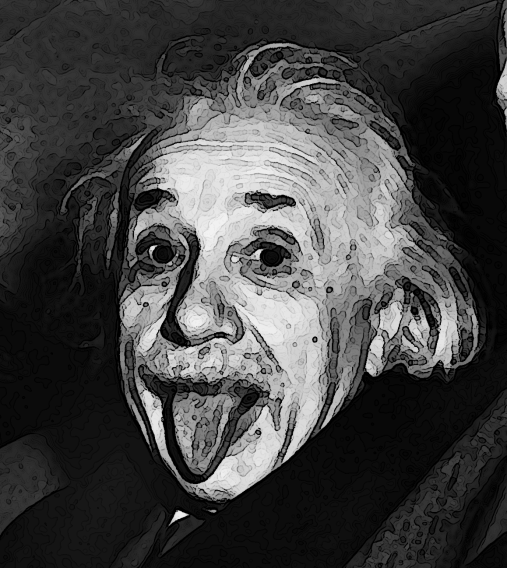
einstein_sticks_his_tongue_1951


*According to outside observers, that is.  For those on the spaceship, it would be the outside world that would constrict into an ever-narrower “tunnel” in the direction of travel.

**I think this attribution is a correct one, which is not reliably so with many quotes attributed to Einstein online.

***What’s the modulus of a weekend?

In nature’s infinite blog of secrecy a little I can read.

Hello and good morning.

It’s Thursday morning once again, and so it’s time for me to attempt to create a simulacrum of what used to be my typical, once-weekly blog post, back when I used to do my fiction writing every non-Thursday morning of the week.  It won’t really live up to expectations, I wouldn’t think, since the situation is now so different.

For one thing, I can’t talk about my fiction writing, since I haven’t done any fiction writing since before I last posted The Dark Fairy and the Desperado, and previously, Outlaw’s Mind, both of which are uncompleted stories and are likely to remain that way until the end of the universe—barring, of course, the possibility that the universe goes on forever and every possible quantum state thereof is eventually realized somewhere, somewhen.

Indeed, if the universe is infinite in spatial extent, as seems to be the case, and if our understanding of quantum mechanics and the maximal entropy state of enclosed regions of spacetime are correct, or even reasonably close to being correct, then somewhere out there in space “at this time” there are an infinite number of versions of me who have completed both stories, and many others besides, and who are world-famous authors.

I used scare quotes around “at this time” because, obviously, given the finite speed of light/causality, and the flexible nature of time depending on relative motion, the concept of simultaneity is fuzzy at best.  Nothing outside one’s local light cones can be considered to be in one’s past or one’s future, but they are also not exactly “now”, either.

Still, we can give an overall statement about the age of the universe for things that have little to no “peculiar motion” relative to the cosmic microwave background and say that such things have gone through about 13.8 billion years since the hot big bang, on average, and it’s not nonsensical to do that.  So, if by “at this time”, I refer to other regions of a spatially infinite universe that have passed through roughly the same amount of local time since the big bang, I’m not incorrect in saying that there are an infinite number of “me” who have completed their stories—and there are an infinite number who have not, and there are an infinite number of every possible variation.

None of that does me (or you) any good, because—being outside my past and future light cones (and yours, which are almost identical to mine)—those distant regions are completely causally disconnected from us, past and future, especially given the accelerated expansion of the universe.  I suppose an Einstein-Rosen Bridge/wormhole could conceivably connect such distant regions, in principle, assuming such wormholes can even happen, which is far from certain.

There are those who hypothesize that quantum entanglement happens through wormholes (small ones), and there are those who have even tried to connect distant multiverses with the many worlds of a branching Everettian quantum mechanics, but I don’t think either of those things is close to having been rigorously described, let alone tested, nor are they generally accepted by the physics community.

Anyway, it still doesn’t help any of us, because clearly, if there are alternate versions of ourselves living better lives than we are*, they have no back-and-forth connection with the lives we currently are living—the wave function has split, the states have decohered, they are not the same beings, even if movies about multiverses win many Oscars and/or make a great deal of money.

What was I talking about again?

I don’t know.  I’m very tired.  I ended up sleeping in the office last night.  I did this deliberately; it had nothing to do with train problems or anything.  I just didn’t feel like going back to the house.  I was tired (still am) and there’s nothing at the house for me that is any more enticing than there is at the office, other than a shower.  And I don’t really care about a shower right now.  For whom would be grooming myself?  Whom am I trying to impress?  All is vanity, as it says in Ecclesiastes.

It’s a funny line for a religious text that some people say contains the infallible word of an all-knowing, all-seeing, all-powerful and omnipresent deity that made everything, deliberately and specifically.  If that were all the case, why would it say all is vanity?  Of course, the argument could be made that these were the words of some ancient human (Solomon or David, one of those kings, is supposed to have been the author of Ecclesiastes, I think), not the direct words of the creator of the universe, but if that’s the case, then clearly the bible is not literally true in all its parts**.  But that’s hardly the only case of seemingly contradictory portions of religious texts, is it?

Anyway, it’s chilly here for south Florida—about sixty degrees, which feels cold when you’re used to 70’s to 80’s, but would no doubt feel beautifully balmy to people back in Michigan or Ohio.  It’s certainly far warmer than intergalactic space, which is only about 2.7 Kelvin (so it’s about 286 Kelvin hotter here).  Then again, it’s much cooler than the heart of the sun, and cooler yet than the heart of blue supergiant stars.  And those are all vastly cooler than just later than one Planck time after whatever initiated the big bang.

Of course, there is, in principle, a maximum heat that any local region can achieve, because if the local energy is high enough, it will form a local black hole, and also the uncertainty principle will kick in to separate things.  Although…if everything is uniformly very hot, such that there is no net curvature of spacetime in one local region relative to another…maybe that’s where inflation comes from?  If there is inflation***.

Anyway, that’s enough nonsense.  I’m just jabbering and chattering, because I don’t really communicate with anyone day-to-day in any way other than this about things that interest me.  I’m very alone and very tired, but I’m also very bad at doing the whole social interaction thing, so I’m kind of stuck.

I’m inclined to say that I deserve it—that’s how I feel—but of course, as Will (played by Clint) points out below, such concepts are really vacuous.  There are a functionally limitless number of possible variations of lives that could be lived by a being that matches my rough description and/or has an identical past that diverged at some point.  I’m just living one of those possibilities, because, well, I had to be living one of them unless I were dead, which I’m not, unfortunately.

I hope most of you are having a better morning than I am.  Heck, I’d be delighted if everyone who reads my stuff always has better days than I do.  That would at least be some good news.  And, of course, somewhere out there in infinite spacetime—if there is such a thing—that situation is instantiated.

Don’t be jealous, though.  There are also places where everyone reading my blog always has worse days than I have.

Poor bastards.

TTFN

deserve


*And if there are, there are also infinite numbers of versions of us living every possible worse life as well.

**If in any of them whatsoever, which is a separate but related question.

***Well, by certain definitions, we could say with great confidence that there is inflation, since the universe is inflating now—that’s the “dark energy” you might have heard about—but it’s doing it quite slowly, doubling in size over the course of every about ten billion years, I think, at the current rate, assuming it’s a constant.  But if you change the time scale, it looks much the same as earlier, more rapid inflation…I think that’s the basis of Roger Penrose’s Conformal Cyclic Cosmology, but I haven’t read his full book on the subject yet, so I may be misunderstanding.

This is yesterday’s blog post

It’s Tuesday morning, and I’m back waiting at the bus stop, which in many ways is preferable to the way things were yesterday, and so many days before, though I won’t get into the specifics.  I had a rather significant exacerbation of my insomnia last night/this morning, by which I mean I woke up extremely early, even for me—and I’m writing this at 5 am, so “extremely” early is early indeed.

I came very close to just getting up when I couldn’t sleep and walking the five miles to the train station (rather than waiting for the bus to go the other one) and getting the first train of the day.  The only thing that really stopped me is that I didn’t want to start the day all sweaty*.  It’s not so bad to end the day that way—there’s no one to whom I’m coming home who has to deal with my sweatiness, and I can just doff my clothes and get a shower and get ready for “bed” when I get back to the house.

Other than that, there’s not much going on in my life.  As you all know, I’m not writing fiction anymore**, and I’m not writing any new music, nor learning any new songs.  I think the last thing I did that was “new” on the guitar was figuring out the tune to Baker Street, especially the sax riff.  That might have been before New Year, though, so it’s been a while.  It didn’t take very long, though it was quite satisfying for a moment.  That sax riff is amazing, and almost everybody recognizes it when they hear it.

Otherwise, everything is mainly empty, and it’s harder and harder for me to distract myself.  I wish I could just go catatonic or something.  But I don’t think my psychopathology is of that type.

Everything is also very noisy, and that’s irritating.  I don’t wish I were deaf—or deafer than I already am—but I do wish everything were quieter.  I particularly wish people did less loud talking, and especially less loud talking about nothing at all.

I started trying to read and work through problem sets—at least all the odd numbered problems, so I could check the answers after doing them—in my old, used copy of Thomas & Finney’s Calculus text, which was the one I used in my undergrad days.  I’ve completed one problem set, very early in the book.

It’s easy stuff, of course, at that point in the text, but I figure reviewing and practicing isn’t going to hurt.  I knew someone in college who literally did every odd-numbered problem in the textbook so he could master the material, and when test times came, he got terrifically high scores on exams that everyone else found difficult.

Obviously he’s inherently very smart—that made him fun, because it’s nice to be around someone smarter than yourself, so you can learn things—but as with many people who are very smart, he also worked quite hard.

I think it would be nice to try to master some more mathematics so that I could actually do some of the calculations related to General Relativity and Quantum Mechanics at more than a rudimentary level.  I’ve also tried to restart reading Sean Carroll’s Spacetime and Geometry, which was really good as far as I had gotten before, but which I stopped partly due to limitations on my mathematical skills.

I think I should probably just try to muscle through things this time, and just file away the bits I don’t understand yet—mostly mathematical formalisms, since the concepts aren’t that difficult—and maybe then get them more and more as I come back to things later.

Of course, all this is really just a fantasy, an idea of me trying to “recapture my lost youth” by attempting to complete some version of a Physics degree on my own.  It’s a pipe dream.  I don’t think I have the will to carry it through, because I really don’t have the will to do much.  The only advantage the idea has is that all the other things I do for fun are steadily losing their charm, so maybe I’ll be able to focus on it by default.  I doubt that will be enough, but who knows?

I suspect it won’t be, though.  I feel like everything is coming to an end for me.  That’s all right, I guess.  It’s not as though I’ve really brought much joy or happiness to anyone in the world, and the people I love don’t tend to find me tolerable over the long term.  I think I’m probably a net loss to the world, and the loss of me would not be a net loss.

I would like to go out in a unique and semi-dramatic fashion, though, as long as it doesn’t cause too much unnecessary inconvenience for other people.  It can be slow and drawn out, and may even, in the process, lead me to some new personal insight or adjustment or revelation.  I don’t know.

That’s all probably a fantasy, too.  I’m not sure exactly what I’m thinking or what I’m getting at.

I’ve just passed 800 words or so, and someone once told me that about 800 words is the best length for a blog post if you want people to want to read it.

I’m sorry, I don’t think this has been very coherent at all.  I’m not feeling well in general, in case it’s not obvious; I’m having some GI** trouble, the cause of which is uncertain.  I’ve taken medicine for it, and that’s obviously done at least some good—after all, I’m waiting for the bus so I can head into the office—but it’s not completely taking care of it, and I feel the temptation to just head back to the house.

The trouble with that is, it’s too easy to fall into the trap of just not going in at all, and not doing anything at all, and just withering away.  Which, I guess is not necessarily that bad.  But, as always, I don’t want to inconvenience people.  Heaven forbid that anyone should be inconvenienced by me.  I already hate myself; I’d like not to add too much fuel to that fire.

However, my belly pain is actually starting to increase somewhat, and I think I’m going to have to go back.  The last thing I want to do is have a “crisis” on the bus or the train and have to make my way back from there.

Further bulletins as events warrant, I guess.


*It turned out that I had some form of enteritis, also, including a low-grade fever, so it was probably just as well that I didn’t even try that walk.  Perhaps the developing issue contributed to my worsening insomnia, now that I look back at it.

**Which I guess is no loss, since no one seems to care about the fact.

***That’s gastrointestinal, nothing to do with the military.

Some musings on brane-worlds, “dark matter”, and even “dark energy”, with apologies

I told you yesterday  that I would be writing another post today, since I’m going into the office, and here I am, writing another post.  You were given fair warning—or at least, you were given adequate disclosure.

Yesterday (and into today) I was listening to an episode of Sean Carroll’s Mindscape in which he spoke with Adam Riess, one of the discoverers in the late 1190s of the increasing rate of cosmic expansion—the single most exciting scientific discovery I recall happening in my lifetime.  In the podcast, the two physicists spoke, of course, of “dark energy” and “dark matter” and the “Hubble tension” between two different ways of predicting and/or calculating the Hubble constant*, and that all reminded me of something that I’d thought of more than twenty years before.

If M-theory (an overall theoretical structure that subsumes “string theory”) were to be right, and we are merely living in a 3-brane embedded in a higher-dimensional “bulk”, then perhaps the explanation for “dark matter” could be simply the gravitational effects of matter in a nearby, parallel 3-brane, or perhaps even more than one (since, if more than one, why not more than two?).  I had first tried to give myself a very simplified model on which to do some calculations about the possibility just for fun, way back in a lunch break during my first year in private medical practice, but I didn’t get very far.  My schedule was rather busy, and I had many good and interesting things going on in my life that drew my attention.  That last part, at least, has changed almost completely.

Despite all the theoretical and proposed notions for what dark matter particles might be (WIMPS, Axions, lots of primordial black holes, etc.) there has not been a single detection of any of them.  There hadn’t been any twenty years ago, and there haven’t been any as of this writing, unless they’re keeping it under their hats, which is unlikely for something of such importance.  Nobel Prizes will be won by those who discover convincing evidence of any dark matter particles!

The evidence for dark matter in general. though, is tremendous and all but unassailable, coming from multiple fronts in astronomy/cosmology/astrophysics, but its specific nature is still not known.

So, yesterday morning, I decided to retry the notion I’d had twenty-odd years ago, just for fun.  I don’t expect to make any particularly interesting breakthrough here, obviously, but it was just my way of seeing if my notion has any modicum of worth at all, or if it’s totally self-contradictory.

As before, I needed to set up a highly simplified situation, just so that it would be within the wheelhouse of my very limited mathematical skills, which are rusty to say the least, and which were never nearly advanced enough for any serious work in GR or M theory (I often consider trying to work my way up to better, more useful such skills, but I don’t know whether that will ever happen).

So, I took my model down to being just a plane rather than a space, which makes the strength of gravity fall off linearly with distance, rather than as distance squared.  Then I just took a line of identical masses, x, (x0, x1, x2 etc.) all separated by an even distance, which I called y, and so the gravitational force on my x0 mass due to any other was just proportional to x over some multiple of y.  I made my gravitational “constant” just 1, so the force would literally be x/y or x/2y, and so on.

Really, in the first universe, though it was in principle two-dimensional, I only had to deal with one dimension of additive forces.  This will make my model not terribly useful with respect to the actual universe, but I wanted just to get a feel for things.  You’ve gotta crawl before you can walk or run or fly.

Then I took my “parallel” brane to be also y distance away—to keep applications of the Pythagorean Theorem and such simple—but obviously in a direction that’s orthogonal to every direction within the original brane.

According to the ideas in M-theory/string theory, most particles—photons, electrons, quarks, gluons, neutrinos, etc.—are described as “open” strings, with free ends, and as such, they cannot leave the brane in which they exist (apparently their ends are “sticky”)***.  But gravitons, as proposed in string theory (they were one of the main things that first led people to take string theory seriously as a potential theory of quantum gravity) are closed strings, and they can go between branes and into the “bulk”, the larger, overarching spacetime in which lower-dimensional branes could be embedded.  Thus, one brane can gravitate with respect to another, and this tendency of gravity not to be confined within a brane could explain the relative weakness of gravity compared to the other forces of nature.

Okay, so I did my best to try to work out the situation relating the additional strength of gravity felt by my initial, single particle due to the added gravity from masses in the parallel brane—and then two parallel branes or so, just to see.  I made some mathematical errors that I caught, and I’m sure I made others than I didn’t catch, so I’ll include my—utterly chaotic and not really annotated—worksheets here below, in case anyone is masochistic enough to want to look through them.

I don’t think I produced any startling insights, of course, but one thing that became more obvious on working it through is that, as parallel masses get farther away as measured in the plane of the original universe, their gravitational effects become more like that of the masses within the original brane.  This makes sense, because the farther away they are, the less the effect of the separation of their branes has relative to that distance; so the angle of that force relative to the plane of the first universe is smaller, and its within-brane component is larger****.  The “nearer” masses would have gravity that was barely felt, or not felt at all, within the original brane (or universe), but the farther out the masses go, the more they would be felt as if they were mere additional mass within the original brane/universe.

Could a situation analogous to this but in higher dimensions explain why dark matter acts as though it is a halo going through and around galaxies, and doesn’t seem to clump together?  And could such a description, in the absence of any detectable particles of dark matter, constitute a test of the notoriously difficult-to-test M-theory in the real world?  At least, the longer we go on being unable to find a direct dark matter candidate particle interaction, the more the Bayesian prior for a string/M-theory explanation might go up.

I don’t know.  I’m way too out of my depth.  But it is an interesting thought, and I invite any readers who have actual expertise in such matters please to give me their reactions.  I don’t think my thoughts are anything that’s useful for anyone, but it is kind of cool.  I think.

For those of you who aren’t interested in such things, I apologize.  It is a Saturday post, so you can consider it a weekend indulgence (though I did the figuring on Friday morning, really).  It’s the sort of thing I think I previously would have confined to Iterations of Zero, and I’ve skirted the topic in the past there and here.

I have to have things like this to do from time to time.  If I weren’t able to think about such things to distract myself from my own awfulness, I would already have killed myself a long time ago.

Maybe that would have been better for everyone.  But the past cannot be changed without making a completely new universe that wouldn’t benefit anyone in this one.  So, it is what it is.

Have a good weekend.

my dark matter m theory scribbles_0001

my dark matter m theory scribbles_0002

my dark matter m theory scribbles_0003


*It’s either roughly 67 or roughly 73 kilometers per second per megaparsec**, which is the overall rate of expansion of the universe.  These values do not have overlapping error-bars, and they both have become tighter over time, so something is being missed.  It’s not a huge difference, but there should be no difference at all if the models are correct in all aspects.

**The parsec is not a measure of time, of course, but of distance, and a mighty big distance at that.  A parsec is a little over three light-years (which is about 30 trillion kilometers), so a megaparsec is roughly 3 million light-years.  Big!  With this measure of the Hubbles constant,  you can see why, at close distances, attractive gravity vastly supersedes expansion; the expansion tendency doesn’t become very large—indeed, expansion doesn’t even happen—until distances become truly cosmic in scale.  The Andromeda galaxy is less than one megaparsec away (not by much), and its net movement toward “us” is about 110 kilometers per second.  I suppose that implies that if it were not for the Hubble expansion, it might be coming toward us at about 180 kilometers per second, and might “collide” with the Milky Way in only two or three billion years instead of four or five.  Oh, well, we’ll just have to wait.

***The thought just occurred to me that branes, like strings, are thought to be composed of some form of “energy”, admittedly a nebulous term and a place-holder—there’s always more to learn.  But uniform energy creates a negative pressure, which in General Relativity produces repulsive gravity…the very cosmological term/constant Einstein proposed and discarded, but which has come back into its own as a descriptor of “dark energy” and even cosmic inflation.  On the scale of individual strings, say, even though the energy density would be high, the Lambda term would be too small to lead something the size of a typical string to expand at all, but in a brane—2 dimensional, 3-dimension, or more—if it’s large enough, the very energy that constitutes the brane might be enough to explain the existence of repulsive gravity, from inflation to the current “dark energy”.  Or am I totally off-base here?

****The vector component of their gravitational force that can be felt within the first brane should be the cosine of the angle between the second-brane mass and its analog in the original times the total gravitational force it would exert on the first.  Any other component would be felt between the branes.  Such possible inter-universe gravitation is in the source of the threatening catastrophe in my book The Chasm and the Collision.  Don’t worry, the book doesn’t dwell much on any technical aspects of this.

I blog not you, you elements, with unkindness

Hello and good morning.  It’s Thursday, February 2nd, and the day of the week on which I’ve long done my semi-traditional blog posting.

I don’t know whether I have the energy to hunt for a Shakespeare quote to alter and/or a picture to put at the bottom, both vaguely related to whatever “subject” I address in the blog.  But, of course, by now, you readers will know what decision I, the writer, will have made, even as you read the words I’m writing while I do not know.

It’s a bit wibbly-wobbly, timey-wimey, isn’t it?

Of course, the biological experience of time is much more malleable and irregular than the actual nature of time, but time is not a simple, straight, linear dimension.  It’s warped by the planet beneath your feet, among many other things.  Your physical body’s tendency to want to follow the most “direct” path through it‒and the fact that the planet is in the way, preventing you from following that path‒creates what we call gravity, locally.

When you’re free-falling, you’re coasting through time (and space, of course), and it’s the ground that actually accelerates you once you reach it.  It’s a hell of an acceleration if you’ve been pursuing your geodesic unimpeded for long by the time the ground throws itself into your path.  Human’s aren’t built to withstand that kind of acceleration.

I’m writing with my smartphone again, today, by the way.  It’s just too annoying to deal with the laptop at the bus stop.  I also wrote more words than I really had meant to write yesterday, probably because I type faster on the laptop, but I don’t think the increased number of words was associated with an increase in actual content.  I think the signal-to-noise ratio, if you will, of my blog post yesterday was lower than it has tended to be with the phone.  That’s not an objective measure, however, and others may disagree.

As for my thumbs, they already feel a bit better than they did, and they’re not giving me too much trouble now.  I have some Voltaren cream (or is it an ointment?) that I can apply to the joints if necessary, though I already take round-the-clock NSAIDs every day for my chronic pain, so it’s not really recommended that I add the Voltaren, a strong NSAID in it’s own right.  It increases the risk for kidney damage and liver damage and stomach issues and so on.  But I’m already at risk for those things (though I take Omeprazole for my stomach protection) and I don’t see easy short-term solutions to the problem.

This is one of the conundrums (conundra?  Probably not) that make opiates and opioids both necessary and yet culturally difficult‒our non-psychoactive pain medications are literally toxic to our bodies above a quite low threshold relative to their analgesic powers.  Yet pain does not easily just go away on its own in many cases‒biology is subject to much stronger pressures for pain to persist than to allow it easily to be relieved, and those incentives will remain so in any evolutionarily stable form of life.

Opiates and the like can work against nearly any degree of pain with limited direct toxicity, but with diminishing success and tolerance, requiring increasing doses over time*.  But they do affect neural circuitry, reward, and motivation, among other things, and so their use is complicated‒and it’s additionally complicated by the fact that the treatment of pain, physical and psychological, is somewhat taboo in our society.

The use of various substances in one’s own body is even criminalized, and so black markets arise to take advantage of the inevitable demand.  And without matters being out in the open and subject to expert scrutiny and monitoring and education, various abuses and issues relating to lack of access to appropriate guidance and treatment and support arise and worsen.

And they will persist.

Do you think continuing to criminalize the use of drugs of various kinds will decrease abuse and death and even violence related to the drugs?  You hypocrites!  I say to you that it is the criminalization of that use that created the black markets and abuse and danger and sordidness‒and, indeed, the majority of the deaths‒in the first place!

You punish people for trying, however imperfectly, to treat chronic pain and those who suffer from it from addressing it, and are surprised that sufferers turn to the market you have created for illicit meds.  You have the temerity to be “shocked” that people die from the unmonitored, unregulated, inexpert use and manufacture of these things which you have removed from the bailiwick of expert awareness and oversight and monitoring.  You took an area that should have been medical and made it criminal and are stupid enough to be surprised that opportunistic criminals (whether they be gangs or governments or otherwise) are not as careful and caring as actual medical professionals.

And sometimes you are so hopelessly moronic as to imagine that further punishments of both producers and suppliers‒and even users‒of drugs will change the problem or decrease it or make it go away.  As if making an already suffering person’s life even more difficult and miserable is going to diminish their urge for relief and escape from at least some forms of pain, and their willingness to risk the permanent end to their pain that is death by overdose.  I’d need to exist macroscopically in all the ten spatial dimensions of M Theory to be able to give that the eye roll that nonsense deserves.

Phew.  That was a heckuva tangent.

I don’t actually use opioids or related medications, though I have been prescribed them in the past.  They interact with my rather peculiar nervous system in ways I find truly unpleasant, though they can help with pain.  So, instead, I suffer constant daily assaults on my kidneys and GI tract and my liver, and I accept that.

It’s not as though I will seek treatment if my organs fail.  I have no insurance, for one thing, but also, I just don’t see any point in trying to preserve my existence.  Heck, I’ve been told I have a possible recurrence or deterioration of my congenital heart problem‒I’m not fully convinced that it’s really any kind of recurrence‒for which I had heart surgery when I was 18, but I have no interest in pursuing possible further exploration or treatment of it, anyway.

Let my kidneys fail, let my liver fail, let my heart fail!  Blow, wind, and crack your cheeks!  Why would I try to preserve or prolong my existence when I don’t even like myself, let alone have anyone else nearby who likes me and spends time with me***?

Anyway, that went off the rails pretty quickly, didn’t it?  It also got longer than I expected.  Sorry.

I still don’t know the answer to my initial wondering about titles and pictures‒but you all do.  And I love you for it.

TTFN

windstormandmanscaled


*Though at least they don’t directly poison livers and kidneys, and the needed doses don’t keep going up without limit, though they are nevertheless often higher than most doctors are willing to prescribe.  This is largely because doctors fear having what happened to me happen to them, and who can blame them?  The only exception to this general hesitancy is with cancer.  People with cancer are allowed to be treated with whatever level of pain medicine it takes to reduce their pain, because in the typical human “mind” having cancer pain is different, and people with cancer are special.  They’re allowed to be dependent on pain medications, because surely they have the only type of pain that can go on and on without resolving and can steal all the joy from their lives, eventually killing them.  Anyone else is just a disgusting drug addict, a scum of the Earth, and deserves merely contempt**.

**The latter portion of the above paragraph is sarcastic.

***I cannot blame them, so don’t be defensive on my behalf.  I find myself infuriating and disgusting.