Mind your vectors and terms of address

I’m writing this on my mini laptop computer again, because even though I find the extra weight of carrying it mildly annoying at the end of the day, at least sometimes the irritation of trying to write using my stupid smartphone is worse.

Although, since those two versions of me exist at different times, it’s hard to weigh their degrees of perceived irritation against each other.  In the morning, if I’m using my thumbs to try to type on a diminutive screen in a fashion that could be easily predicted to lead to some manner of repetitive stress injury, its all too natural for the “me” of that moment to hate the “me” of the previous evening who elected not to bring the laptop computer back with him.

But the “me” of the evening, when faced with the minor extra effort of the mini laptop, can feel very much overwhelmed and exhausted and think that the “me” of the following morning won’t find the process of writing using the smartphone particularly difficult.

The human consciousness clearly doesn’t have one, singular, constant terminal drive or goal as an imagined artificial general intelligence might.  I suppose one might think that the drive “to stay alive” would count as an ironically designated terminal goal, but that’s clearly not an accurate interpretation of the situation.

Not only are some people quite self-destructive and even actively suicidal—which you might credibly dismiss as dysfunction, not the lack of a dedicated system, though I think that would be imprecise—but there’s no good way to think that such a specific drive could evolve.  Evolution is blind to “death” as a concept or force, except as a failure, an accident, a lack, whatever you want to call it.

Before humans, as far as we can tell, no creature on Earth had a concept of “death” as the cessation of the biological processes of an individual organism.  Instead, there are proxies, such as the drive to avoid pain, and the related strong sensation of fear relating to danger and so on.

Similarly, there is no drive “to reproduce” in human (or other animal) minds.  Teens going through puberty don’t start feeling the literal desire to replicate their DNA in other bodies.  Instead, proxies for reproduction evolved, urges and drives that tended to lead to increased chances of reproduction, such as dominance hierarchy drives and displays in social primates such as humans, sexual attraction, and—of course—the pleasure of sex itself, with the reward-based drive to have it as often as feasible (with other inputs adjusting the strength of that drive and causing it to manifest differently in the two biological sexes and at different times and places).

The human brain—like probably all the other adequately complex brains on Earth—is a mélange of modules, with varying drives and processes that have evolved in parallel and sometimes independently, and also developed ways of interacting with each other.  Of course, at the root are the automatic drives that are all but undeniable—the respiratory drive, the thermoregulation drive, and so on.

There are even drives that are neurological in a broad sense, but that are so fundamental that they cannot be interdicted by the rest of the nervous system, only adjusted—I’m thinking here mainly of the heartbeat, the driver of which is in the sino-atrial* node and the Purkinje system of the heart, which is sort of a cross between muscle and nerve tissue.

The upshot is, if you ever feel that you’re “of two minds” on some particular subject, you’re probably not just speaking metaphorically, whether you know it or not.  Your final actions are produced by what I see as the final vector sum (and it can be quite small in the end or it can be huge in magnitude and surprising in direction) of all the drives or “pressures” in the brain that have any effect on decisions about behavior.  Then the action caused by the final behavior feeds back on the system**, changing the lengths and directions of some (perhaps sometimes all) of the contributing vectors, causing changes in the inputs and thus changes in the final vector sum of behavior.  Lather, rinse, repeat as needed, ad nauseam if not actually ad infinitum.

Please don’t imagine this as the sum of physical vectors in real spacetime.  The number of possible dimensions of such mental/neurological vectors is huge.  For all I know, there might even be spinors and tensors and matrices involved, but I don’t think those are necessary for my vague model.  “Simple” higher dimensional vectors probably do the trick.

What a curious set of things about which to write that was!  I had originally intended to start this post with some version of The Simpsons’ “Hi, everybody!”  “Hi, Dr. Nick!” exchanges, perhaps then noting that I could change “Dr. Nick” to “Dr. Robert” and thus reference both The Simpsons and the Beatles at the same time.

But then I might have noted that, although the Beatles song is so titled, “Dr. Robert” is not the way anyone has ever referred to me in actual practice.  It would be, honestly, a little weird for someone to refer to their physician as, for instance, “Dr. Joe” or “Dr. Judy” or whatever, certainly in our culture.

Mind you, there was that tendency for a while (it may still be prevalent) to have kids speak to adults such as teachers and daycare workers and people of that sort using their “title” and then their “given name”, such as “Miss Barbara” or “Mister Jimmy”.  I have always thought that was weird.  I mean, just imagine someone trying to address a certain prominent fictional character as “Dr. Hannibal”.

Alas, that all ended up being a discussion not worth having, except as an afterthought.  Though it’s debatable whether any discussion at all is actually worth having—including the discussion about whether any discussion is worth having.

You all can discuss that if you want; feel free to use the comments below, and to share this post to your social media platforms or what have you.  When you do discuss it, remember to define your terms ahead of time, and stick to them rigorously—i.e., the meaning of “discussion”, and of “worth”, and so on—so that you decrease your chances of getting involved in semantic games and misunderstandings and sophistry.

Whatever you choose to do, please try to have a good day.


*The “sino* in that term relates to its location in what’s called the sinus of the heart, and the “i” in it is a long “i”; it has nothing to do with China, though an identical prefix is sometimes used to mean “related to China”, but in this case with a sort of short “i” sound…or, really, a long “e” sound.

**And there are surely numerous other feedback loops all along the way affecting many, or perhaps all, of the vectors.

Lost then found thoughts about lost connections

While I was getting ready to go this morning, I thought about writing this blog post.  I thought about my usual starting point of saying something like, “Well, it’s Wednesday morning again,” or some other such inanity.  But then, as I was thinking about that, another, more interesting beginning and an actual, rather interesting, topic occurred to me.

Then, by the time I got ready to start writing—i.e., now—I had completely forgotten what I meant to write.

That’s terribly frustrating, but it is par for the course.

Oh, wait!  Maybe what I was going to write was about my realization regarding the effects of having a very uncomfortable crisis, but one that is inherently finite*.  It’s probably pretty obvious to you that what made me think of this was my recent adventure with a kidney stone.

Of course, while it was happening, it drowned out everything else, especially in the acute stages.  If that had been something without an endpoint, and if there were not sufficient medication to control the pain, then death would have been the only feasible alternative.  Even later, with the stent in place and the literal, constant, burning feeling that I needed to urinate for two weeks, things were pretty harsh.  But though it did not truly drown out my depression, and it was thoroughly exhausting, it did rather overshadow much of my chronic pain.

The day the stent was taken out I felt a fair amount of relief, of course.  But before long my usual existence asserted itself, with all its emptiness, and of course, with all its chronic pain.  And I remembered that, really, I have nothing going on in my life at all, nothing to which I look forward in any kind of long-term sense, and I have no further clue about or hope for my future.

It’s a bit reminiscent, on a shorter time scale, of what happened when I was a “guest” of the Florida Department of Corrections.  Though I was/am innocent of the charges that were created against me, I took a plea bargain for three years (toward which time served applied) because it was tolerably short and I didn’t want to risk the possibility of the much longer sentence with which the prosecution threatened to try to get, risking the outcome on the potential of a jury of my peers to see past my (apparently) not terribly endearing personality and the simple fact that I was a doctor and thus, to those who might be in a typical jury, a generally hated “elite”**.

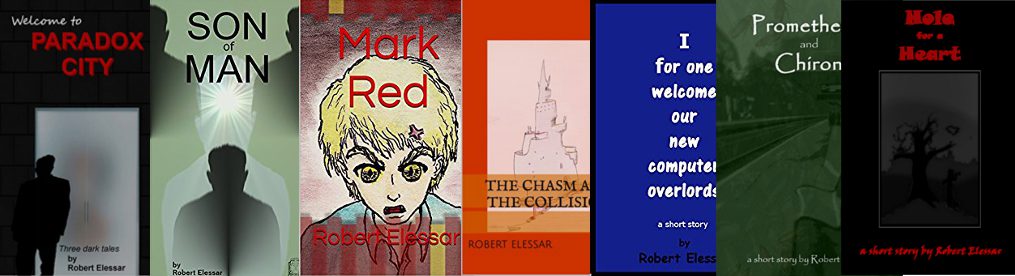
I think it was the best available choice at the time.  And while I was “up the road” I was able to console myself with looking forward to seeing my children again once I got out—and to see them before they were adults, which would not have been the case otherwise—and that gave me the optimism to write first Mark Red and then The Chasm and the Collision and then Paradox City while I was at FSP West.

But then, of course, once I got out, it turned out that my kids didn’t really want the discombobulation of me having visitation or anything of that sort.  While I was heartbroken, I didn’t feel that I had a right forcibly to disrupt their lives when I had already fucked everything up, first with my personal health problems, then with my misguided attempts to help other people with chronic pain that led me to be arrested.

So, I bit the bullet and kept on writing at least, on my own, though I think my stories grew steadily bleaker and darker over time.  And I learned to play guitar and wrote and recorded a few songs, and did some covers and everything.  But I still didn’t see my kids, and haven’t even communicated with my son other than to receive his email stating that he didn’t really want to have a relationship with me (“right now”).

At least I got to see my youngest when I was visited in the hospital with my kidney stone.  That was a gift that was well worth even that much pain.  But now I’m back to my nosferatu existence, and like Vermithrax***, though I don’t feel pain as severe as the kidney stone, I still feel constant pain.

There may be people who can have chronic pain without getting depressed about it, and indeed, without losing their zest for life, but I fear I’m only left with the squeezed dry pulp of mine.  It seems to be just the way I’m built neurologically.

I suspect that most people who keep their spirits up despite chronic pain and disability do so because they are surrounded by a local support system of some sort****, and they probably do better at connecting with and getting along with other people than I do.

I’ve only ever really been close to specific, core groups of people, and with ones nearby, that I saw nearly every day.  I’ve never been good at connecting over long distances, and I have a hard time even picturing people when they’re far away.  I mean, I can “picture” them in the sense that I know what they look like, and I will be able to interact with them if and when I see them, but I cannot in any intuitive sense “model” their existence elsewhere.  I cannot really get a feel for what they might be doing and certainly not for what they might be thinking.

When even the people I love are far away from me, they really exist more as concepts than as people whose reality I can feel.  They are missing in a bleak and rather horrible way.  I feel terrible about that fact, and I hope it doesn’t come across as insulting—though it has probably hurt the feelings of people about whom I care on more than one occasion—but it seems to be just the way my brain works.  It’s also probably related to the fact that I never have for an instant imagined wanting to be someone other than myself, even though I hate myself; I just cannot even conceive of what that would mean, let alone wish for it.

Oh well, whatever, never mind.  I’m back on the train, yeah, and here I go again, on my own…alone again, naturally.

(I do like to quote things, don’t I?)

I hope you have a good day.


*Of course, as far as we can tell, pretty much everything is inherently finite, but some things are much more constrained and contained in time than others.

**This is based on what my attorney, and my attorney’s supervisor, said to me.  I don’t think they were trying to be unkind, and though their judgement was and is fallible, it was likely better than mine would have been.

***I know, I’m mixing fantasy metaphors and similes.  That’s okay; I like them.

****And most of them are probably not “ex-cons”.

I have not become comfortably numb

     Well, I misjudged things a bit, and though when I wrote my post yesterday I didn’t realize it, I had developed blisters on my feet from my long walking‒especially the right one, on which I had been wearing a spandex brace (prophylactically*‒I hadn’t yet been having any ankle problems, but wanted to avoid them if possible).  So, today, I am not walking, at least not to the train/work.

     I have realized that topical lidocaine creams, such as the max strength versions of “Icy Hot”, dull the irritation of blisters.  That’s nice to know, in a pinch, though I don’t know if it would dull the pain of a pinch; it seems only to work with superficial pain, not deeper pain.  Curiously, it also seems to dull some of the local signs and effects of inflammation (though Ibuprofen contributed to that).  Don’t worry, I’m not expecting to cover up my pain and forget about it.  That doesn’t seem doable.  I’ve tried.

     If I could slather lidocaine all over my body and thus numb all my pain, believe me, I would do it.  But I always hit a wall beyond which the numbing doesn’t reach.  Heck, I’ve had multiple steroid/lidocaine epidural injections and they didn’t seem to do anything to my pain, even temporarily.

     I should probably study up on the nature of congenital insensitivity to pain, just to see if the metabolic pathways involved in the condition shed any light on the sorts of things that might make a person have their pain sense shut off.  Mind you, given the nature of that disorder**, I suspect that its effects come about through some aberrant development of the nervous system, not by the presence (or absence) of some neurotransmitter.

     If memory serves, the saliva of the vampire bat has significant pain-reducing as well as anticoagulant properties.  I’ve heard all my life about people thinking it would be good to investigate as a source of potential powerful analgesics, but nothing has come of it, as far as I’m aware.  It wouldn’t be all that hard to separate out the molecules in vampire bat saliva and examine them and try to replicate them.  Heck, if you can figure out the bat’s biochemical process for making the molecules, you could develop transgenic bacteria that could produce the substance en masse, like how replacement thyroid hormone is made.

     No, either there were unforeseen difficulties with using the vampire bat’s saliva analgesic, or no one was interested in doing the research (which seems unlikely but is not impossible), or “big pharma” has blocked the research because it would interfere with the sales of opioids and NSAIDs and so on (see picture below for an example of such interference).  I would like to think that’s unlikely; after all, there would be tremendous potential for legitimate profit in a revolutionary new pain treatment.

     Still, if it turned out that anyone in a big drug company or companies did block research into such a potential pain killer, then all the people involved would need to be strapped to tables and have all their joints and other “tender areas”, like genitals and nipples and lips and eyes, injected with some combination of‒for instance‒capsaicin and gympie-gympie leaf extract and fire ant venom, with some uric acid crystals*** thrown in for good measure.  Oh, and also they should be given constant, powerful stimulants so that they cannot escape their pain by losing consciousness.

     That’s if I don’t think of anything even better to do to them.

     Obviously, I take pain treatment seriously.  That should come as no surprise, given my personal, decades-long chronic pain and my own having gone to prison for trying (naively) to treat other people’s pain, only to be thrown under the bus by people who were taking advantage of my naïveté.  I have very little patience for those who would interfere with other people reducing their pain and suffering, or who would make light of the suffering of innocent people.

     Mind you, though I think vindictive thoughts and entertain vindictive fantasies, I would probably (like a moron and a sucker) feel pity even for people who had done such horrible deeds, and I would probably end their lives with minimal pain.

     I would not feel bad about that though.  People who willfully engender greater suffering in others for their own short-term (or long-term) profit, whatever form that might take (unless it is truly and honestly and reasonably something they perceive to be an emergency or an absolute survival need) are more than worthy of being erased from existence.  And while it might be reasonable for those who knew them to miss them, they would not deserve to be mourned.

     Look at me, getting all murderously vindictive about purely imaginary people, when there are so many real people who are thoroughly deserving of such animus.  But, anyway, that’s enough of this weird-ass blog post for today.  I’ll let you go to enjoy something more wholesome.  Please have a good day if you’re able.


*I am pleased to note that my right ankle is in no danger of an unwanted pregnancy.

**And yes, it is a disorder, not just a “difference”, because it significantly reduces the survival and thrival of people who have it.

***Look them up; they’re related to gout.

It seems appropriate that coughin’ and coffin sound alike.

It’s Monday again, though I know of no one who asked it to be.  I am not going to write much today (I suspect) because I am quite under the weather‒I’ve been dealing with some form of bronchitis that started Friday, and I’m not feeling much better yet, though my oxygen saturation seems good, and I have no fever (but then again, I am always on NSAIDS and acetaminophen, so it’s hard to be sure I haven’t just suppressed a fever).  By rights, I should probably not be going into the office today, but my coworker is out of town until tomorrow, so basically, I’ve got to keep the office running.

I do have masks to wear, and I don’t just mean fun and/or scary ones.  Neither do I refer to “autistic masking” which is what many autistic people do to fit in with other, neurotypical people.  Lord knows I’ve always tried to fit in, and I definitely put on “masks” and tried to shape myself to please those around me.  I feel almost that my autism presented a little more the way it does in girls than in “traditional” autistic boys, at least as discussed by other people with autism.

Anyway, I’m not really doing this blog as a venue via which to discuss ASD.  That must be the case, since I didn’t even consider the possibility before the last few years, and this blog has existed for much longer.  I suppose it might be interesting for someone (but not me!) to look back at my older posts and see if there are any hints about ASD in the way I write or discuss things.  I doubt that I’m interesting enough for anyone ever to do that, though‒I certainly don’t find myself interesting enough.

It may go without saying that I did not play guitar or go for any walks except to the convenience store this weekend.  I was mostly just laying around and trying to rest.  It’s a bit annoying that I still didn’t sleep well, and only stayed asleep for a while under the effects of delta 9 gummies and 2 Benadryl.  I slept a little more than usual, but of course, it’s not really restorative sleep.

I wonder what it is about the autistic brain that leads to the tendency to sleep poorly.  Is it atypia in the hypothalamus, or are the effects on the amygdala leading to hypervigilance which is consistent with my tendency?  I don’t know for sure how well the neuroscience of autism is progressing, but I guess I could get on Google Scholar and/or check the preprint servers.

Anyway, I think I’m pretty much done for right now.  I’m really very tired and worn down.  I guess I’ll be talking to you all tomorrow, though it’s less likely that you’ll be talking to me.  In the meantime, if you’re able, please try to have a good day.

“…the only thing that’s real.”

It’s Wednesday morning, and I’m writing this on my smartphone instead of the laptop computer.  There’s no important rationale for this choice, it’s just the way it turned out.  There are causes for everything that happens, but there aren’t necessarily reasons.

I was terribly stressed out yesterday, though arguably nothing too Earth-shattering happened.  Just quite a few unexpected and frustrating but relatively little things occurred that led me to want to hurt myself, and I wanted just to give away my black Strat at the office as well as a very cool piece of hiking equipment that I have that my boss really admires*.  I just wanted to divest myself of everything and go off and, I don’t know, try to swim to Morocco or something**.

I don’t feel much better this morning, but at least it’s been going reasonably “according to plan”.  I’m still in stupid amounts of pain, since right when I woke up.  Nevertheless, I did my morning exercises and got ready for work, though I feel almost as though my upper body and my lower body are hanging by a thread from each other.  Only nerves seem to connect the two sometimes; otherwise it feels as though my upper half is merely balanced atop my lower half, and as I sit, stand, lie down, walk, and so on, it wants to fall off its perch, and that process hurts.

I haven’t actually played guitar in weeks.  I’ve “wanted” to, intellectually.  I even got the red Strat out at the house, putting away the SG, because the Strat is my second favorite***.  However, that hasn’t led to me playing it, though I came close at least once over the weekend.

I of course also haven’t played piano/keyboards, partly because my keyboard is covered with superfluous clothes and other things that just need a place to be.  It’s shameful, I know, but I have little room for storage.

I also haven’t written any fiction or done any drawing, and I don’t even have any modeling clay, though the discussion of my pain made me think of when I used to play with clay every day (hey hey!).  Occasionally, one would get a single hair mixed in with the clay by accident, and then if you were splitting the clay, the two bits would sometimes be held together only by that hair; that’s how my back feels a lot of the time.

When I shift a little, at the wrong moment, in the wrong way, it feels as though my upper and lower halves want to separate, but they’re held together by the collected nerve fibers that carry all that lovely pain and spasm and electrical sensation back and forth to and from my brain.

I won’t say I wouldn’t wish this pain on anyone‒there are quite a few people in the world who merit such pain and much, much more, and yet they live with impunity.  Many of them have been doing their dirty deeds for quite a long time, and even if they were to die violent deaths tomorrow, they would already have gotten away with nearly a lifetime of successful villainy and will suffer no more than most people are near the end of their lives.  Indeed, these people will probably have better, more attentive health care in their final moments than most people who have done no willing harm to anyone.

Lovely universe you’ve got here.  (It wouldn’t) be a shame if something happened to it.

Also, you can’t threaten such people with stupid points like “history will judge you”, because such people don’t tend to give a shit about that kind of thing.  Many of them probably secretly believe themselves to be immortal; they certainly don’t care about what the milling masses think of them after they’re dead.  And any concept they may have of an afterlife is clearly not worrisome to them, or not enough so to deter their foul deeds.

And here I am, feeling like I am slipping very painfully off my lower half even as I write this, despite aspirin and naproxen and Tylenol and heating pads and Icy Hot and Voltaren cream and CBD and Delta-9 gummies and all that.

It’s too much.  If I cannot get this to improve soon, I may move up the deadline of my plan, because I am tired of being not only depressed and anxious and autistic (with all that that entails) but also just in chronic fucking pain every fucking second of every fucking day for more than 20 fucking years!!!  There is no sign of it abating.

Have a good day if you can, and thank you for reading.


*It’s a machete; I don’t know why I’m being coy.  It’s a beautifully designed and made machete, no cheap throw-away crap.  This is the sort of tool one could see being handed down with pride from generation to generation.  I bought it because of the aesthetics; I rarely need a machete for practical purposes.

**I would not succeed.  I am not that good of a swimmer, but even if I were, I don’t think any human or humanoid swimmer ever could swim across the Atlantic Ocean.

***My favorite is my Les Paul (see above), which was also, like my red Strat, made by my former housemate.  That guitar has such a beautiful sound, but it is very heavy.  It’s what I used for all the guitar parts, including the little arpeggios and whatnot, on Like and Share, and also for my cover of Something, with no pedals and only a little delay.  I used the red Strat almost entirely for Schrodinger’s Head and for much of Catechism, including the solos.  I used the black Strat for the solo in the middle of Breaking Me Down.  I have not recorded anything using the SG.  That’s no criticism of it; the timing was just wrong.

When we fight reality, reality always wins.

It’s Tuesday morning now‒which, fortunately, as far as I know, has never been described as “never-ending”.  Alas, the same cannot be said of Tuesday afternoon.  However, since we are not still stuck in the last Tuesday afternoon‒or indeed in the very first Tuesday afternoon‒then we have to conclude that the line “Tuesday afternoon is never-ending” from the Beatles song Lady Madonna is a poetic figure of speech.

That’s weirdly frustrating for me.  It reminds me a bit of how I remember reading that Tolkien was frustrated with the play Macbeth because Birnam Wood didn’t actually come to Dunsinane, signaling Macbeth’s imminent defeat*.  Tolkien didn’t see why, in a play that clearly involved the supernatural, the wood could not literally come to Dunsinane.

Of course, in the fullness of time, in his own work, the Forest of Fangorn really did come to Isengard, and to Helm’s Deep.  It’s one of the best moments in The Lord of the Rings.

How did I get onto that subject?  Or, as Théoden asked, “How did it come to this?”

Now I’m suddenly thinking about the moment when Théoden, despairing, asks (in the movie) “What can men do against such reckless hate?”  It’s a real moment of doubt and pain, but Aragorn is there to support his spirit.

And that makes me think of doing a “parody” version of Sympathy for the Devil, in which we would have the line, “I was ‘round when Théoden had his moment of doubt and pain / Made damn sure that the uruk hai met our swords and sealed their fate.”  It could be called, perhaps, Sympathy for the Ranger or Sympathy for the Strider or something like that.

We could have lines like “Just as every Noldor is a kinslayer, and all the Nazgul slaves / as East is West just call me…Aragorn, ‘cause Minas Tirith I will save,” or something along those lines.  It’s a bit silly and cheesy, I guess, but that’s okay; it’s a parody.  Anyway, I don’t think I’m actually going to try to produce a whole set of lyrics for it, but who knows?  I’ve done weirder things for more frivolous reasons.

As for what to do about relatively more serious things‒i.e., my diagnosis of ASD level2‒I still don’t know.  I don’t know how I’m going to go about following the recommendations in the report, such as they are.  Knowing at least some of the explanations for many of the difficulties I’ve had in my life, including my relatively intractable troubles with depression and with insomnia and social anxiety, is a good thing in and of itself, but it doesn’t necessarily give me any idea how to approach things from here.

In some sense, it is a little discouraging, especially regarding my depression and insomnia, since there is no cure for neurodevelopmental disorders; they are a product of the fundamental structure and function of the brain.  At best, they can be managed.  This also explains why many traditional or typical treatments for such things do not work well in those with ASD; evidently, for instance, cognitive behavioral therapy doesn’t tend to work as well for people with autism as it does for “neurotypical” people.  And I know that antidepressants have more limited efficacy as well.

This makes sense.  We commonly hear of how many of the treatments and scientific understanding of major illness were for a long time only studied in men, and women were treated the same way as males, until slowly, gradually, the medical community realized that many diseases present differently in women, and respond differently to treatment.

Well, autistic and other “neurodivergent” people are a much smaller portion of the population than women are, and we don’t know as much as we would like about psychiatric and related disorders and their treatment even in the neurotypical.  It makes sense that we should be somewhat behind the curve in even understanding, let alone knowing how to treat, psychological and neurological disorders in those with underlying neurodevelopmental conditions.

The universe is complicated.  Any attempt to make it seem or feel less so, as by following the “ideas” of demagogues and demonizing those who might disagree, is just going to leave one vulnerable to underlying, actual reality‒which is not merely a matter of perception.

The universe at large does not care what you believe.  You can definitely be killed by forces and things that you not only don’t understand, but in which you don’t believe, or about which you have not the slightest inkling.  As a particularly gruesome example, it didn’t matter whether JFK ever knew he was being shot at, let alone that he had been hit.  A person can die before they even know that anything is happening; they can be just snuffed out and gone.  Probably most people, and nearly all other animals, die not understanding at all what is killing them or how or why or what death is.

Such is the evenhanded dealing of the world, to paraphrase Ebenezer Scrooge.  The only thing we can do to armor ourselves is to try to understand as much about the universe as we can.  For one never knows what knowledge will be useful or even essential before one has that knowledge.  Greater knowledge is always worthwhile, all other things being equal.

Of course, all other things never really are equal, but that’s why it pays to learn how to solve partial differential equations.

That’s enough for now.  Have a good day if you can, please.


*Macbeth’s reaction when he receives the news that, apparently, Birnam Wood really has come to Dunsinane Hill, is to hit the messenger and yell “Liar and slave!”  I know I’m not the only one who thinks it’s kind of funny and also is an instance of one of the cardinal failures of literary and dramatic (and real life) villains:  they discourage their own people from giving them information by punishing them for delivering accurate but bad news.

(ASD 2) x 2

It’s Monday morning now, and it’s a new month, and I’m writing a new blog post, one that will‒or should‒not be like the old post.  Though, of course, superficially it will look like most of the others, and for someone perusing a bunch of them who does not happen to read English, there will almost certainly be no distinguishing characteristics.  Certainly there will be no meaningful ones.

Be that as it may, as of Friday evening, I have now received my autism assessment report.  It is official; I have been diagnosed as having autism spectrum disorder, level 2.

The level 2 part of that surprised me a little bit.  In case you don’t know‒and for most of you, there’s no reason why you would‒the levels of autism, not in order, are:

Level 1:  What would be called “high-functioning” autism by the hoi polloi, though that term is frowned upon by the “neurodivergent” community by and large, because it judges the quality of a person with autism by how well they can pretend to be someone without autism.  In any case, those with level 1 are people who have autism but are not significantly disabled by it, and are able to do okay on their own with minimal or at least fairly easy accommodation.

Level 3:  These are people who are more severely impaired by their autism, and are more or less dependent upon support from others; they cannot really function on their own at all.

Level 2 is mid-range (duh!) and is characterized by needing “substantial” or “considerable” support.  Here’s a quote from a web-search:  “Autism Level 2 means a moderate level of autism spectrum disorder (ASD), where an individual requires substantial support to manage social communication and daily activities, exhibiting more noticeable challenges in social interaction and repetitive behaviors compared to Level 1, but not as severe as Level 3.”

I guess my bias was that, if diagnosed, I would be level 1, since I do live on my own and I don’t really have any support.  On the other hand, there’s little argument but that my life is a complete mess, and it’s not improving.  So I guess I really don’t do so well on my own.  But it’s not as though I have any health insurance or any other access to support services to help me improve things.  Still, at least it explains a little bit about my intractable insomnia and depression and anxiety and so on, as well as all my many failed interpersonal relationships.

I don’t yet know whether this knowledge will make any difference for me.  I don’t yet know what I’m going to do with the result.  I am still digesting it.

There is, however, an amusing coincidence, if you enjoy such things*.  I was born with an atrial septal defect (a hole between the upper chambers of the heart) “secundum type”, that was repaired when I was 18.  In other words, that was “ASD” secundum type.  So, one might say, ASD type 2.

And now I have Autism Spectrum Disorder, level 2, so:  ASD level 2.

These are both official acronyms used by the medical community.  It’s nothing but a coincidence, of course, but it is a peculiar and slightly amusing one.  I have been diagnosed with ASD 2 in two different ways.  There’s only one of the two for which there was a surgical intervention that was essentially curative.  The other is something for which one just has to adjust and deal as well as one can.  Fortunately, I’m really good at adjusting to and dealing with just about anything that comes at me.

Ha ha ha ha ha!  That was a lie, obviously.  I don’t think I’ve ever been particularly good at adjusting to things, except perforce, which has certainly happened a fair number of times.

Anyway, again, I don’t know at all what I’m going to do with this information.  I don’t know how I could possibly actually seek, let alone obtain, any manner of support and/or accommodation, other than the basic stuff that happens more or less on its own.  I’m going to tell a few people at work, I think‒certainly the owner, though I feel a bit shy about that, but also my two coworkers with whom I am closest, one of whom has a child with autism.

I don’t know how much will change otherwise.  But I figured I would share this information with those of you who read this blog regularly‒a rarefied few individuals, I must say.  I guess I’ll be writing a post tomorrow, too, barring the unforeseen (a caveat that always applies).  In the meantime, I hope you all have as good a day as you possibly can.


*Well, the councidence’s existence isn’t actually conditional upon you enjoying it, but I think you know what I mean.  Please let me know in the comments below if you do not know what I mean.  I don’t like not being clear.

Udaimonic so-and-so, U.

It’s the last day of February, everyone.  It’s also Friday, the last day of the “typical” work week, and it is also the last day of my work week, since I am not working tomorrow.  It’s not as though I have anything particular to which to look forward this weekend, but I do need the rest.  I’ve been feeling exceptionally exhausted lately.

Alas, as you know, exhaustion does not translate into sleepiness for me, just weariness.  Somewhere in the neurologic centers and relays that connect such things as fatigue and sleep, I have a short circuit, or at least one that doesn’t perform up to spec.

Of course, my pain continues, though as always, I have tried to adapt my activity, my posture, my exercise, my shoes…even my underclothes to try to decrease my pain.  I have put a tremendous amount of mental energy into this over the years.  If I had devoted that time/energy/effort to the study of any abstract problem‒say, the dynamics of an accelerating near-light-speed spacecraft approaching its local Schwarzschild “radius” as length contraction and “relativistic mass” take effect and bring GR into play‒then I would have made significant, possibly really important, advances.

Alas, when one’s problem is chronic pain (coupled, causally or otherwise, with insomnia), it is very difficult to focus enough mental acuity upon other things.  The very nature of pain as a neurological process in animal systems does not allow it to be easily ignored, or indeed to be ignored at all for any length of time.

Those creatures which can readily ignore pain for long, or who don’t experience pain*, don’t tend to leave as many offspring as those for whom pain is both present and urgent.

It’s a similar problem for those rare people who don’t experience fear, though clinically this seems more likely to happen as a result of damage to the brain rather than being congenital, possibly because children without fear really don’t tend to reach adulthood.

It’s interesting to note that, anecdotally at least, people who don’t feel fear tend to be quite frightening to would-be bullies and predators.  They don’t behave like others do in response to potential threats, and predators tend to rely on fear in others.  A person who looks at them with no more fear than they would at a tree or a rock can be quite disconcerting for someone who has become dependent upon the fear of others.

This is one of the reasons it can be good to have dogs present if you’re guarding something.  They don’t fear guns (generally) so one can’t exactly threaten them with firearms.  And if they attack, they don’t hold back.

That was quite a series of little tangents, wasn’t it?  I think they were interesting, but then again, I was the one who brought them up, so that shouldn’t be surprising.  Whether or not anyone else is interested is difficult to guess.  It’s rather akin to the way things are with humor‒it can be very hard to know consistently what other people will find funny, or for them to know what you find funny, so you might as well amuse yourself.  Then, at least, you can watch to see who enjoys your humor, and those people are the ones with whom you can enjoy such things in the future, at least in principle.

I am horribly tired, and I’m in a great deal of pain as I write this, though for the moment at least I don’t notice any fear that might be present.  Time’s been my way when I’ve been so tired and depressed and in pain that I had no reaction to and felt no fear toward things that would normally have made me quite afraid, from minor things like wasps and bees all the way up to oncoming cars and trucks.  I don’t tend to be afraid of people much, never have been‒at least, I’m not afraid of them physically.  Socially, they can make me quite tense.  In that case, though, the tension is not the same as fear, though I guess it qualifies as anxiety.

Speaking of fear, I fear this is it for this week.  I truly hope that you all have a wonderful day and a wonderful weekend and that you are healthy and safe and eudaimonic**.


*There are people who have a genetic disorder called CIPA:  congenital insensitivity to pain with anhidrosis (i.e., they don’t sweat), and they basically don’t experience pain.  They also don’t live very long, and before they die their bodies tend to be quite damaged, often by such simple things as standing in one position for too long, since it doesn’t feel uncomfortable to do so for them.  They also don’t notice infections, and they don’t tend to get fevers.  It occurs to me, however, that though their lives are short, people with CIPA might well have significantly longer pain-free lifespans than, say, I have had.  I had pain issues starting at a pretty young age, after all.  Still, if I could be cured of all pain at this stage of my life, when I am hardly worried about my longevity anyway, I think it would be worth it.

**It’s interesting to consider the prefixes “eu” and “u” in words of Greek origin.  “Utopia”, for instance, literally means “no place”, making it clear that an imagined perfect society does not exist and may be impossible.  Whereas, if one were to write “Eutopia”, one would mean “true place” or “good place”.  Thus, my middle name “Eugene” means “true born” and is etymologically related to the term “eugenics”.  Mind you, only a fool would believe that I was actually the product of some eugenics program, that I am some true-life Khan Noonien Singh***.  “Eugene” was just my paternal grandfather’s name.  On the other hand, while eudaimonia means “good spirit” and refers to a state of general emotional and mental well-being, “udaimonia” would mean “no spirit”.  That sounds more pertinent to me, don’t you think? 

***Though I suppose one could speculate that I was a failure of such a program.

I could a blog unfold whose lightest word would harrow up thy soul

Hello and good morning.  It’s Thursday, of course‒Valentine’s Eve, if you will.  I don’t mean to imply that every Thursday is Valentine’s Eve (which would imply that every Friday is Valentine’s Day).  No, no.  For the sake of any future archaeologists who might be trying to piece together tattered bits of our civilization, among which is this blog post*, I’ll point out that Valentine’s Day falls on February 14th (every year, without even any breaks!), and today is February 13th.  I’ll also point out that I am probably the only one who would think of it as Valentine’s Eve.

As you may be able to tell, I have nothing about which to write, today.  Don’t worry (as if you would), that won’t stop me from writing.  But I am distracted by mental exhaustion and rather severe pain that’s been bothering me and exacerbating my depression all week.  I know that my depression is not dependant on or caused by my chronic pain‒I know this because it predates it by a good twenty years‒but Batman knows it doesn’t help.

I mean, think about it:  you have dysthymia (aka chronic depression, with dips into full-on major depression), probable undiagnosed ASD with all its associated difficulties, you had a congenital heart defect (also called an ASD!) requiring open-heart surgery at 18, and now you have chronic back pain from a disk rupture/tear and “failed back surgery syndrome” for about 20 years (so every day for 20 years has been dominated by pain), and your career is wrecked, you’ve been to prison, you have no social life, no friends (outside of work), no romantic attachments for more than a dozen years (after having been divorced after your marriage of 15 years and then having only one, short and ultimately rather catastrophic, relationship after that) and you strive for self-improvement‒which you stubbornly keep trying to do, because you’re stupid that way‒but each time run into the barriers and obstacles and quicksand of your mood disorder, chronic pain, and probable “neurodivergence”, sending you what feels like three steps backward for every one you took forward.  Why would you not want to give up?

What, other than foolhardy stubbornness (and literally mindless biological forces), could drive someone to keep going and keep trying when there is no point, no goal, no reward, no aspirations, and no significant amount of even transient joy (though there is some)?

Whatever it is, it’s associated with such a high degree of tension that I cannot even sleep at night without waking frequently and early as if I were a soldier in the jungles of wartime Vietnam or something.  It’s really stupid.  I’m very irritated by and with myself.

But I have not yet been able to find effective solutions.  This doesn’t necessarily mean that there aren’t any‒the potential solution space might just be very large, and the subspace of workable solutions much smaller‒but it also doesn’t give any reason to be convinced that there are effective solutions.  There may be no answers, there may be no “right” way to go.

Oh, well.  What was I writing about…or, rather, what was it about which I was writing?  I don’t know.  Valentine’s Day, future archeologists (perhaps virtual beings?) trying to find clues to the attributes of our civilization, the pointlessness of continuing to live without connection or companionship or activities, no full escape from pain (ever), no good nights’ sleeps, all these weird things were matters about which I wrote above.

Enough.  I’m annoyed by myself; I can’t even imagine how annoyed you readers must be.  Really, I can’t.  My apologies.  I don’t know what I’m trying to accomplish.  Nothing, really, and possibly nothingness***.  But I have nothing else to write right now.  I hope you all have a good day.

TTFN


*This, of course, raises the question of how future archaeologists would even be able to see my blog without having already understood much of our civilization.  After all, unlike paper artifacts such as books and magazines, every written thing on the internet and web requires functioning computer systems, including processors, storage, internet protocols, languages from html to Java, C+, Python, Pascal, Fortran, Cobol, I don’t know what, as well as all the necessary hardware.  This is something people who say stupid things like “online is forever” don’t seem to grasp:  if we lose electrical power or some other process interferes with electronics, all the data on the internet is useless.  Hard copy books can decay of course, but that is much slower; they are much more self-contained stores of information, much less contingent.  That’s something about which to think, as the world approaches the brink**.

**Yes, I did that on purpose.

***That was a deliberate sentence fragment, used to convey a sense of drama and intensity.  I don’t know if it worked.

And I looked, and behold a pale cat

Well, I have some relatively good news, which is why I decided to write a post today instead of just leaving it:  Dorian, the light gray cat, has returned.  Well…he was back last night, at least, though this morning he was nowhere to be seen once again, which is itself somewhat unusual.

He was a bit scraggly, with some traces of dried blood around his fur on the side of his head and neck, but it didn’t look like it was his blood.  He actually looked lean and healthy, moving very much like the hard-ass stray cat that he is.

I’m guessing that he got into a pretty big fight at some point‒he seems prone to them‒and then hid away somewhere while he recovered his strength.  Then, that pale grey shadow took a new shape* and grew again.

I think stray cats, like defective and damaged people, don’t like to show any weakness to those around them.  Perhaps it’s more accurate to say that they are unable to show their weakness, even though they may crave acceptance and support.  There are good, sound biological motivations for this in stray cats and other mammals; showing weakness or injury can invite further aggression from other cats and even encourage predators.

Of course, human males (or anthropoid creatures living among humans, such as I) are no exceptions to that tendency.

It’s also been said that, in many ways, people on the autism spectrum are like cats, at least in some ways, and I can see the point, though it is an oversimplification.  Still, it leads me to speculate that, sometime in the relatively deep past, perhaps two separate subspecies of humans (maybe the legendary Neanderthals and Cro-Magnons) existed, one being more naturally ultrasocial, the other more constrained but with other capacities that aided their survival.  We know that Neanderthals, for instance, had bigger brains than so-called modern humans, but the structure appears to have been slightly different.

Perhaps it’s the genes from such a separate subspecies that led to some people having ASD or other versions of “neurodivergence”.  To be clear, I don’t know that there’s any good evidence that this is the case.  I did encounter at least one study that looked for markers known to be associated with the autism spectrum and the DNA residua of Neanderthals present in people of European descent.  There seemed to be some correlation, but I didn’t think it was particularly impressive.  So there’s not a lot of data to support the hypothesis.

It would be nice‒in some ways‒to think of oneself as just a different kind of human, not as something alien.  But I think that’s probably a silly dream for me.  I do not belong here in any serious sense; I am an alien, a mutant, a replicant, a stranger.  And to humans, of course, a stranger is presumptively an enemy unless and until proven otherwise.

Anyway, Dorian was back last night, but gone again this morning.  We’ll see if he returns.  There are other cats who come around.  But, of course, there is no real affection from most of them.  They come to me opportunistically, because I put food out for them.  I am useful to them.  Similarly, I am often useful to humans in the world.  I have many skills and abilities, so I have frequently found that people like to have me around to help them get things done.  But eventually, the negatives of my presence outweigh the positives, and people go away (or send me away).

I don’t blame them.  I want to go away from myself, though I have never had any desire to be anyone else.  I would prefer oblivion.  Or maybe I would just prefer rest.

Speaking thereof, I slept almost four hours last night, and of course, I awakened and couldn’t go back to sleep in the wee hours of the night, and I am now at the office finishing this post.  I don’t look forward to the weekend‒there’s nothing good about it‒but at least I can collapse and try to recuperate.  I don’t know if I’ll write anything next week, or just leave everything be.

I feel perched on the borderland between life and death, and the Undiscovered Country beckons.  It must be really great there, because no one who goes ever comes back.


*To be honest, it’s pretty much exactly the same as the old shape.