And I looked, and behold a pale cat

Well, I have some relatively good news, which is why I decided to write a post today instead of just leaving it:  Dorian, the light gray cat, has returned.  Well…he was back last night, at least, though this morning he was nowhere to be seen once again, which is itself somewhat unusual.

He was a bit scraggly, with some traces of dried blood around his fur on the side of his head and neck, but it didn’t look like it was his blood.  He actually looked lean and healthy, moving very much like the hard-ass stray cat that he is.

I’m guessing that he got into a pretty big fight at some point‒he seems prone to them‒and then hid away somewhere while he recovered his strength.  Then, that pale grey shadow took a new shape* and grew again.

I think stray cats, like defective and damaged people, don’t like to show any weakness to those around them.  Perhaps it’s more accurate to say that they are unable to show their weakness, even though they may crave acceptance and support.  There are good, sound biological motivations for this in stray cats and other mammals; showing weakness or injury can invite further aggression from other cats and even encourage predators.

Of course, human males (or anthropoid creatures living among humans, such as I) are no exceptions to that tendency.

It’s also been said that, in many ways, people on the autism spectrum are like cats, at least in some ways, and I can see the point, though it is an oversimplification.  Still, it leads me to speculate that, sometime in the relatively deep past, perhaps two separate subspecies of humans (maybe the legendary Neanderthals and Cro-Magnons) existed, one being more naturally ultrasocial, the other more constrained but with other capacities that aided their survival.  We know that Neanderthals, for instance, had bigger brains than so-called modern humans, but the structure appears to have been slightly different.

Perhaps it’s the genes from such a separate subspecies that led to some people having ASD or other versions of “neurodivergence”.  To be clear, I don’t know that there’s any good evidence that this is the case.  I did encounter at least one study that looked for markers known to be associated with the autism spectrum and the DNA residua of Neanderthals present in people of European descent.  There seemed to be some correlation, but I didn’t think it was particularly impressive.  So there’s not a lot of data to support the hypothesis.

It would be nice‒in some ways‒to think of oneself as just a different kind of human, not as something alien.  But I think that’s probably a silly dream for me.  I do not belong here in any serious sense; I am an alien, a mutant, a replicant, a stranger.  And to humans, of course, a stranger is presumptively an enemy unless and until proven otherwise.

Anyway, Dorian was back last night, but gone again this morning.  We’ll see if he returns.  There are other cats who come around.  But, of course, there is no real affection from most of them.  They come to me opportunistically, because I put food out for them.  I am useful to them.  Similarly, I am often useful to humans in the world.  I have many skills and abilities, so I have frequently found that people like to have me around to help them get things done.  But eventually, the negatives of my presence outweigh the positives, and people go away (or send me away).

I don’t blame them.  I want to go away from myself, though I have never had any desire to be anyone else.  I would prefer oblivion.  Or maybe I would just prefer rest.

Speaking thereof, I slept almost four hours last night, and of course, I awakened and couldn’t go back to sleep in the wee hours of the night, and I am now at the office finishing this post.  I don’t look forward to the weekend‒there’s nothing good about it‒but at least I can collapse and try to recuperate.  I don’t know if I’ll write anything next week, or just leave everything be.

I feel perched on the borderland between life and death, and the Undiscovered Country beckons.  It must be really great there, because no one who goes ever comes back.


*To be honest, it’s pretty much exactly the same as the old shape.

Maybe it’s signal. Maybe it’s noise. Maybe it’s Maybelline?

Well, it’s Tuesday, and I don’t know that I have anything of use or substance to say, or anything to say that isn’t mostly just noise.  Perhaps I’m just some peculiar source of radio static in the background of the universe.  Or perhaps…perhaps I’m just pretending that what I do is unplanned, when in fact everything is calculated and subversive.

Ha!  I wish.  My brain doesn’t work like that, and I’m not sure anyone else’s does, either.  Even John Von Neumann had to develop complex mathematics and sophisticated models to deal with the limited degree of uncertainty in highly simplified versions of one-on-one poker.  If he was so intrigued by what he‒possessing perhaps the highest general intelligence of which history is firmly aware‒could not fully model, then this is strong evidence that no one, now or ever, has really been in control of anything.

Of course, game theory has advanced since Von Neumann co-invented it, and it is certainly useful, but it is clear that, at best, it deals in probabilities and tendencies.  There is no Asimovian 2nd Foundation Hari Seldon psychohistory that can figure out the specific events of whole galactic civilizations well into the future, and I doubt there ever will be.

Of course, if we want to be trivial, we can predict the far future with some degree of confidence:  Eventually, unless our knowledge of the universe is deeply mistaken*, as entropy increases inexorably, new stars will stop forming, old stars will burn out (even red dwarfs), black holes will evaporate, and the universe will be a thin haze of elementary particles.  Indeed, if everything eventually reduces to massless bosons (e.g., photons) then in a very real sense, time will literally have no meaning, since photons, being massless particles, do not “experience” time.  From their point of view‒to speak very figuratively‒their entire existence is instantaneous.

Of course, going on to the very far future, given the nature of probability, new universes may arise.  Something like Penrose’s conformal cyclic cosmology may be the way things happen, or there may merely be a Poincaré recurrence of the universe.  Or maybe, as I’ve speculated previously, time is not one way, and our future might also be the future of another, far distant “big bang” but for which time/entropy increases in the opposite direction.

Also, of course, if civilization and intelligence persists and grows, which is not a small “if”, then who knows where technology will develop?  Our descendants could conceivably develop the capacity to do cosmic engineering, literally shaping the large-scale development of the universe, or even making new ones.

But I suspect they still will not be able to micromanage perfectly the interactions of innumerable agents in complex systems.  Some limits are fundamental, and I think this may be one.  This comes down to something related to my “Elessar’s First Conjecture/Theorem”, that no complex, intelligence can ever fully understand itself in detail, because to model a given complex system requires a system of greater complexity, which itself will need to be described, leading to an infinite regress.

And, of course, we know that in complex systems, in which interactions are stochastic and multivariate and nonlinear (and thus exhibit chaotic development) the specifics of future happenings will be unpredictable since to know them perfectly, we would need an infinite number of significant digits**, though in some cases‒like entropy‒we can make general predictions with high confidence.  

This is part of why “planned economies” fail, and almost certainly always will, unless they are stupendously lucky.  In any case, such luck will not last, just as neither strength nor good purpose will last in the presence of the One Ring.  This is also why most complex conspiracy theories are simply laughable.

People derive their models of the world to too great a degree from our ubiquitous visual entertainment, which has been around long enough to be deeply self-mimicking and self-derivative.  Gunshots and explosions don’t behave in real life the way they do in action movies, but action movies (and shows and videos) take their models of the world from previous action movies, much as an AI’s model of human speech and interaction, if derived from the internet, is going to be increasingly contaminated by the products of other AIs, and may end up veering far away from anything reminiscent of human interactions, at least if left to its own devices.

Maybe that’s an advantage of written fiction over movies and TV and other videos; it’s not presenting a simulation of some version of reality, it’s telling you a story, describing things, but you have to imagine them.  Meanwhile, if all your fiction is in words, your physical intuition of the real world‒and your psychological and sociological and economic intuition‒would be derived from real events, not the Machiavellian machinations of Manichean movie-based manipulators.

That was an interesting stream of consciousness, if I do say so myself (and I do).  Who could have predicted it?  Not I.  And I’m the one who wrote it.  Which goes to my point.

Please try to have a good day.


*This is always possible in principle, but for many aspects of cosmology, our credences can be justifiably high.

**I sometimes say that while knowledge can vary greatly, ignorance is always infinite.  This can be proven with a single, simple example:  the digits of pi.  There are an infinite number of them, and no matter how many we calculate, there will be an infinite number we don’t know.  Ditto for e and any other transcendental numbers, let alone all the other real numbers that have no specific designation, of which there exist an uncountable infinity.  And this is just one place where infinite information dwells, of which we will always have only finite knowledge.

We skipped the light fandango…

Well, here I am, writing a blog post again on Tuesday, Batman* only knows why.  I don’t really have anything of substance to say.  Not that I had anything of substance to say yesterday.

Actually, come to think of it, I did encounter a neat fact last week.

One morning I decided to get in a bit of reading in one of the textbooks I keep in my office‒Classical Electrodynamics by John David Jackson.  I employed a technique I’ve often used for reviewing:  I flipped a coin to increasingly winnow down the textbook‒heads is first half, tails is second half, etc.‒and pick a random section to start reading.

I knew that much of the mathematical formalism and at least some of the technical matters in the book would be unfamiliar, so I didn’t expect to understand fully what I was reading.  But I also know that the stuff I do and don’t understand will linger in my brain, and as I’m exposed to other things that go with it or explain it or link up with it, the picture will form.  I don’t read or learn especially quickly, but I do learn deeply, and in a way that connects ideas and principles together in the end.

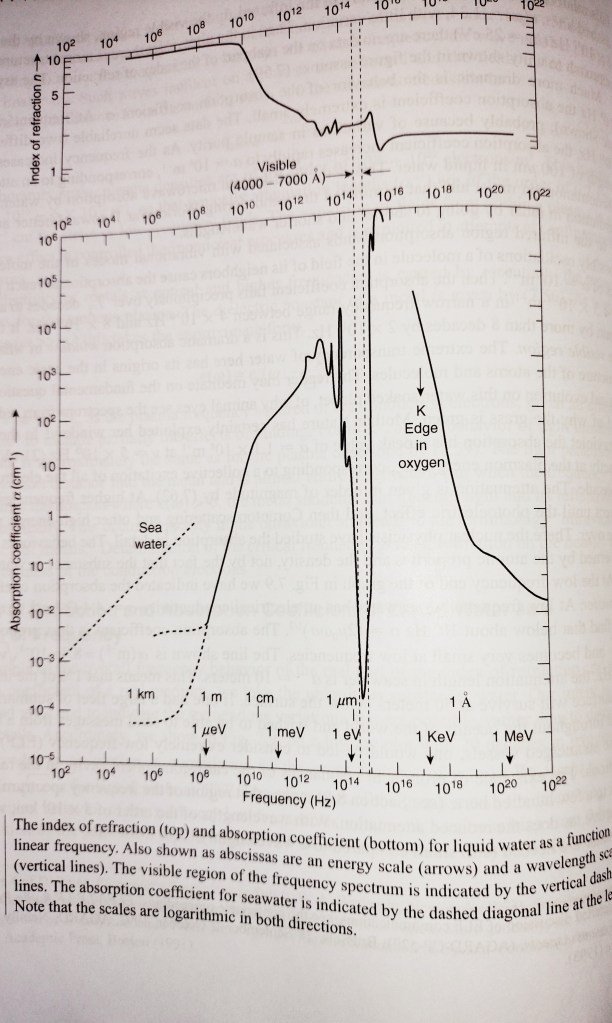
There was much of this brief section (which was about refraction and/or absorption of light** by water) that was slightly over my head.  Nevertheless, it was interesting, and the author introduced a graph (see below) showing at the top the refraction of light by water across wavelengths, and how it tends to vary.  I assume we’re all at least implicitly aware of the fact that different wavelengths are refracted by water differently‒thus the phenomenon of rainbows.

Below this is a table showing the absorption of electromagnetic radiation by water across frequencies.  Here there is a steep upward slope when coming in toward the center from highest and lowest frequencies.  It peaks at around the microwave/infrared wavelengths from the left and around the ultraviolet from the right.

Then a striking thing happens.  There is a sudden, precipitous drop in absorption down to very low levels in a fairly narrow range of frequencies in the “middle” of the graph, meaning that in this range, light passes through water with relatively little absorption.  This is the range we know as visible light.

The author took the time to point out that this fact about the nature of water‒that it is more or less transparent in this very narrow range of frequencies‒is exactly why we Earthlings tend to see only in that range.  It’s not an accident of evolution, some ancient, stochastic occurrence that is thenceforward cemented, unchangeable, into all descendants, like the DNA code and ribosomes and the chirality of biological molecules.  It is instead a fundamental fact of physics that determines where creatures will be able to see if they first developed vision while living in water and then developed eyes that, like the rest of them, were mainly made of water.

There’s no point in making retinal proteins that react to wavelengths of EM radiation that are almost entirely absorbed by water.

That simple fact‒simple in summary, at least‒is enough to explain a huge swath of the nature of our visual perception, and it doesn’t require any further explaining to understand why we see in the range of light we do.

That was just a randomly chosen section of a textbook that reputedly is extremely difficult.  I don’t disagree with that assessment of difficulty; it was a very dense bunch of material even in just 4 or 5 pages.  But to think that one can find such remarkable facts while just trying to read and learn in random order from a textbook!

So, that’s an interesting little tidbit that seems worth sharing, at least to me.  It’s far more interesting than anything going on in the human world right now.  What’s more, this is a fact that has existed as long as water itself has existed‒and implicitly, it existed even before that, lying there waiting in the fundamental laws of nature.  And it will be there long after everything but those fundamental laws is gone.

If you want to embrace eternity, and things like Hilbert’s Hotel and Cantor’s diagonal proof make you worry about your sanity (this happens to many of us, so don’t feel bad) then focus on this fact about visible light.  It’s there, it’s real, it’s quasi-eternal, and it’s concrete.

Though the absorption spectrum for concrete is…quite different.


*This harkens back to the reference from Batman Begins, when Flass says “I swear to God,” and Batman snarls “Swear to me!”  It seems fun to use Batman when one would normally say God.

**By “light” I mean all electromagnetic radiation, from radio waves to gamma rays.

Thoughts meander like a restless spore inside a humid room

In case you’re confused:  Yes, it is Monday, even though I’m writing a blog post.  I just decided that I might as well do something that gives the illusion of productivity, since, y’know, I’m awake and on my way to the office anyway.

As for topics about which to write, well, on that I don’t know.  I don’t think there are any momentous or interesting things worth discussing that are happening in the world right now (ba-dump-bump, chhh!).

Still, it is true that to a very good approximation every event that happens and that seems so earth-shattering and important in the moment is utterly forgotten by everything except quantum mechanics and Laplace’s demon.

Don’t believe me?  Do you remember that scandal in the Roman Senate when Cinna the Younger misdirected Republic funds to buy a “servant” for his household?  No?  Neither does anyone else.  Of course, that was 2000 years ago, so you may think it doesn’t count, but I’m sure almost none of you know about any of the “crucial” events of the day or the escapades of popular stars even 40 years ago.  I certainly don’t remember any, and I was fifteen at the time, and I have an unusually good memory.

Also, time‒with respect to online information, anyway‒is cycling more quickly nowadays.  Sure, information can last a very long time online*, but that doesn’t really matter in a dispositive way, because there is a constant gusher of new and distracting information coming in at all times, with signal and noise intermingling haphazardly.  It’s a bit akin to the fact that although Manhattan is crowded with millions of people in a small area‒so you might think your life would be less private‒in many ways it is more private than other places, because when there, you are one indistinguishable face among those millions.

The internet makes Manhattan look like Mayberry.

Still, it would be nice to be able to get my words and maybe my stories and maybe even my music out to more people who might find them interesting and/or entertaining.  It’s not immortality in anything like a literal sense‒nothing is‒but still, there’s at least some little internal drive to spread the memetic code of me out in the world.  I could think of myself like the fruiting body of a fungus, spewing the spores of my thoughts into the wind, seeing if they’ll be able to infest and infect any other people out there.

It might at least be interesting to give someone the psychological equivalent of a persistent, itchy rash thanks to my words.

Of course, the fungus metaphor is an ironic one for me, since I cannot stand mushrooms for eating, and even the smell of wild mushrooms after damp weather (or mildew for that matter) fills me with literal nausea.  Then again, given my own poor opinion of myself, maybe it’s right for me to think of myself and my ideas (my celium, perhaps…get it?) that way.

Fungi don’t have any qualifications or requirements to meet other than survival and reproduction.  And that’s very much the nature of online information exchange; the stuff that spreads most isn’t the “brilliant” or the “important”, it’s just the catchiest.  The whole process is stochastic.

Of course, there is an entire ecosystem of such meme-plexes, and they vary in their tendencies to spread quickly versus being more long-lasting.  Like the species in a rainforest, some spread quickly and germinate and reproduce quickly, but then quickly die, with short, frequently repeating cycles; others spread and grow more slowly, some perhaps becoming the mighty trees that dominate the structure of the forest, but which perforce have longer, slower growth and death cycles.  And, of course, the various other plants (and animals) in the jungle create and are each others’ environment.  There are even parasitic plants, and opportunistic ones that germinate only after a fire.  It’s very complicated, and no one plant is crucial or eternal**, though they may think they are.

Am I pushing the metaphor too far?  I don’t think so.  I think it’s important for people to recognize that no one controls the internet, just as no one controls the economy, just as no one controls the ecosystem, just as no one controls the evolution of the universe itself.  Everything just happens thanks to the interactions of numerous smaller elements interacting according to local forces and pressures.

That’s enough for a Monday, I think.  I hope you all have a good one.


*But not forever, despite what anyone says.  I fear no contradiction here, because to prove me wrong, you would have to wait until forever had passed.  At which point, if you are right, I will gladly concede the issue.

**Unless you count microbes‒some of those could be considered immortal.  Of course, in a sense, since it all has one common ancestor somewhere, life as a whole could be considered just one gigantic, very long-lived (but probably not immortal) organism.

In the voids between galaxies, it’s already next year, but there’s still no life there.

It’s Tuesday, now‒the first Tuesday of the new year.  This is not anything particularly interesting, of course.  It’s really just another day.  But it is also the last day of the first week of the new year, the 7th day of the year, as indicated by the fact that it is January 7th.

“Brilliant, Holmes!” I hear you say.

In this case, though, it truly is elementary.  It’s also pretty boring, so I’m sorry to go on about it.

There have been troubling things in national news, of course:  the terroristic suicide attack-by-vehicle in New Orleans; the guy who blew up his cyber truck; severe cold weather striking large swaths of the eastern US; and, of course, no one has yet yelled “Psych!!” regarding Donald Trump’s election for a second term as president.

I’m not as rabidly anti-Trump as many; he’s just a man, of soft and squishy flesh and blood, like everyone else.  He’s also just one more incompetent government official on a world stage that might as well be a collection of (poor quality) Three Stooges clones.

It would be remarkable and praiseworthy if humans actually elected smart, calm, intellectually honest government officials with personal integrity.  Alas, when holding elections, humans seem unable to be as rigorous in their evaluation of candidates as they would be when screening babysitters or even gardeners.  And, of course, since few people are in the habit of reflecting on themselves in any way to improve on their own flaws in judgment, it seems unlikely that things will change very quickly.

This is all nothing new, of course.  The modern shape of cyberspace and the borderline-antisocial media add little twists and peculiarities, introducing new dynamics to the system.  But the dominating principles of primate social and sexual dominance hierarchies and displays have not changed much, if at all.

The only really interesting thing I’ve found in the news is the statement about a new study‒an elaboration of a first theoretical paper from some years ago‒that proposes a potential alternative explanation for the fact that the expansion of the universe appears to be accelerating that doesn’t require “dark energy”.

The cosmological principle, which underlies the usefulness of standard model, lambda-CDM cosmology, states that, on the largest of scales, the universe is uniform and homogeneous.  However, on anything other than the largest scales, the universe is decidedly clumpy.  This is because of gravity, of course, pulling things together in regions where things are more dense (making them still denser) and making the spaces in between ever more rarefied and so on.

But, of course, gravity is not just a simple attractive force; it works its effects through the warping of spacetime, and in ordinary circumstances (so to speak) its effect on time is far more significant than those on space.  This is a very real effect, one for which we have to adjust when using GPS satellites for instance, so while general understanding of it may be relatively rare, it is not an esoteric bit of physics.  It’s textbook stuff.

The point being made by this new hypothesis is that perhaps there is no real dark energy, but instead, in regions where more mass exists, time slows down.  This is a bit of an oversimplification, but it’s quite true, and indeed, to a large extent, all the apparent physical effects of gravity are produced by the differential flow of time between places where the manifold is more vs. less curved.

So, in the places where matter/energy is relatively scarce, time moves “more quickly”.  So, since the universe is definitely expanding (due to the Big Bang), those regions are going forward through their expansion more quickly than regions with more matter, and so the space between galaxies and clusters appears to expand more quickly, and as the comparative difference, the contrast, in energy concentration increases, the difference in passage of time will tend to increase, too, producing an apparent accelerated expansion.

[Note to self:  how would this model be expected to affect the extreme measured uniformity of the Cosmic Microwave Background?  Is this going to be a point of evidence against it?]

This is not a definitive, tested hypothesis, but it rests on sound principles.  It probably won’t supersede lambda-CDM, but it has the potential to do so.  This is no crank, RFK Jr. style hypothesis by any means.  I haven’t read the papers involved yet; rather I read articles and watched some videos about it; I will try to learn more.

But, since the discovery of the accelerating expansion of the universe in the late ‘90s was the single most exciting (non-personal) event in my life, the idea that there is a new approach that might change that again is also truly exciting.

It makes me wish I had just gone into physics as I had originally intended.  However, post-open heart surgery, transient cognitive impairment, and an exacerbation of depression triggered by the same thing, made it too difficult, in the short term, to keep up with my physics and math classes in the semester after my heart surgery, so to English I went.

But as I picture the large-scale universe differentially flowing through time and thus expanding at relatively different seeming rates, producing this wonderful, higher-dimensional twisty-bulgy-filamentous shape, I can at least feel a little twinge of the joy of contemplating science.  My only real contribution to science was in studying the effects of gliotoxin on naked DNA in vitro, and though that’s quite interesting, it’s not exactly cosmology.

Oh, I also wrote a pretty decent review article about the various effects on cognition and other neurological functions of heart-lung bypass as done during open-heart surgery.  Clearly, that was motivated by personal experience.

Anyway, that’s it for today.  Tomorrow begins the second week of the year, but I don’t expect to write again before Thursday.

The year is dead; long live the year. Whatever.

It’s Tuesday, December 31st, 2024‒New Year’s Eve.  Of course, as I’ve written before, every day is the first day of a new year, in a trivial but nevertheless true way.  The day to mark the new year is an arbitrary choice.  We could have had the new year begin “officially” on the first of any month.  Indeed, we could have started it in the middle of a month, or perhaps on the winter solstice.  Or we could have 12 months of thirty days, leaving a 5 day extra period which we could use as a long holiday and an official new year celebration, with an extra day every leap year.  We could do this around the winter solstice, or even around the summer one, like hobbits do.

Oh, well.  It’s not as though people are going to collectively change, any more than people are going to go back to really celebrating holidays:  with most workplaces closed except for hospitals and police and fire stations and the like, with people spending the holidays with loved ones.  Once one business stays open on those extra days, competitors (direct and indirect ones) will stay open, too, or suffer a disadvantage that may lead them to be more likely to go out of business.

The world of commerce is red in tooth, claw, and debt, so after a while, only those who push every edge they can without getting more negative marginal returns, will dominate.  And that will become the norm.

No one made it happen, no one planned it.  Everyone’s caught in the currents of chaos, but those able to use the flows to their advantage‒chaos surfing, as I call it‒will thrive, at least temporarily, even if they don’t realize why they are succeeding, which they usually don’t.

It’s similar with the workers:  once some small subgroup is willing to eschew holidays and to work longer hours, they will have advantages over other workers, at least as long as working more proves advantageous to them and their workplaces.  Soon, the marketplace of workers will skew toward people being willing to work longer hours in worse conditions, as long as it provides a relative, local advantage.  Those who cannot match this will fall by the wayside, perhaps becoming homeless, getting addicted to drugs, going to jail or prison‒self-destructing directly or indirectly.

This is not a conspiracy by employers or governments or anyone else.  No one is that clever, and they are all beset by their own local pressures and competitions.  Why else would the very wealthy do anything but sit back and eat ice cream until they die (figuratively speaking)?  They are no more happy or satisfied than most other people.

It’s analogous to the situation with trees and forests.  It takes a lot of effort and resources for trees to grow tall.  Why do they do it?  Because other trees do it, and any tree that doesn’t want the sun blocked out had better do the same*.  If all trees could agree somehow to stay short, they could all thrive and get adequate sunlight and nutrition and water and air at a fraction of their usual height and resource usage.

But once one tree grows taller, the arms race begins.  Such is the way of economies and ecologies.  They cannot be planned, they cannot even really be controlled or constrained (at least not without disastrous results).  At best, they can be “herded”.  That’s a metaphorical herding, by the way‒a careful nudging of things to keep the eddies in the phase space currents from driving the system toward deteriorating returns, along whatever axes one may use to measure such things.

None of this happens due to some malicious plot, and it is not generally evil.  This competitive jockeying and self-abnegation while seeking seemingly locally selfish ends, or at least responding to local pressures (internal and external), has led to all the many scientific and technological advances that we have, from improved farming techniques that allow the world to sustain billions, to better healthcare, better sanitation, better transportation, greater safety from the elements, greater understanding of the universe at large…and the sometimes-cesspool that is the world of electronics, computers, smartphones, tablets, and digital interactions.

No, this shit all just happens “on its own”.  Natural selection works in places other than biology, and it is a ruthless, blind, and amoral driver, here in the region of spacetime where increasing entropy is in the stage where that increase leads to local complexity rather than uniformity.

Whether or not the local manifestation of it will last long remains to be seen.  There are many ways for any particular state of a system to be obliterated, or for that system itself to decay and disintegrate.  It requires constant effort to maintain anything like homeostasis and growth, but not just any effort will do.  One must constantly reassess, course correct, look for mistakes from which to learn, adapt to all the new, varying states of the system, or perish.

I don’t know about you, but I’m very unsure that it’s worth it.  In all honesty, I did not want to see 2025, and really, I still don’t.  I want to find the courage just to check out.  There’s very little for me here, and of all the things in the world that frustrate and irritate and disgust me, I’m the worst.

I guess if I write a blog post on Thursday, you’ll know that I am still around to see 2025.  If so, please don’t congratulate me.  It is not a good thing; it’s yet another failure in my long string of them.

Anyway, I hope you all have a Happy New Year.


*I’m anthropomorphizing here, but don’t get confused.  The individual trees don’t get to choose, evolution just favors the tall in this situation, ceteris paribus.

If I could write the beauty of your blogs, and in fresh numbers number all your graces…

Hello.  Good morning.

Aaahhh, doesn’t that feel better?  Now I can use my standard Thursday blog post opening phrases, because today is, in fact, Thursday.  It’s the 21st of November, the third Thursday of the month, so in the USA you only have seven shopping days until Thanksgiving.

Speaking of Thanksgiving, since next Thursday is that holiday, I probably will not be writing a blog post then.  It is one holiday on which our office is always closed.  We will be open on so-called Black Friday, but I can’t guarantee that I’ll write a post on that day.

Of course, in principle, I cannot guarantee that I’ll write anything at all ever again after this post.  I may not even survive to post this entry*‒I am in the back seat of a Lyft, on the highway (I-95) of the East Coast of the US, so goodness knows there’s a non-zero chance of a fatal accident.  I would even wish for one, but I know such a thing would involve harm and possibly death to other, more innocent, people.

Also, of course, wishes don’t actually directly affect reality‒thank goodness.  Imagine if even one percent of wishes came true as wished.  The world would be thoroughgoing chaos…and not in a good way.  I tend to say of wishes that “If wishes were horses, then we’d all be hip deep in horse shit,” but it would be even more terrifying if wishes worked.

The “if‒then” character of the wishes saying (my version or the more SFW one that involves beggars riding) often makes me think of lines of computer code in some generic programming language, like:

If wishes==horses then execute beggars.ride

Or maybe 

If wishes==horses then horseshit_level = “hip deep”

I wonder what that would look like in machine language.  Or, I wonder what it would look like in straight binary.  Really, though, I know part of the answer to the latter piece of wondering:  it would look, to the naked eye, like a random string of ones and zeros, perhaps the tally of some very long record of flipping a coin and marking heads as 1 and tails as 0 (or vice versa).

Actually, of course, given a binary-based computer language, one can literally generate every possible computer program just by flipping an ever-increasing number of coins.  Or, to be honest, one can do it just by counting in binary:  0, 1, 10, 11, 100, 101, 110, 111, 1000…

This is why, if memory serves, computer science people and information theory people say that every program can literally be assigned (and described by) a number.  You could express that number in base ten if you wanted, to make it a bit more compact and familiar to the typical human.  Or, if you want to be more efficient and make conversion easier, you can use hexadecimal.  This is easier because a base-sixteen number system is more directly and easily converted to and from binary, since 16 is a power of 2 (2 to the 4th).

Even the human genome, or any genome in fact, could be fairly readily expressed in binary.  The DNA code is a 4 character language, so it wouldn’t take too much work to make it binary, however you wanted to code it.  Then, each person’s genome would have a single, unique number.  That’s kind of interesting.

It would be a bit unwieldy as an ID number, of course.  The human genome is roughly 3 billion nucleotides long, which means it would be roughly 6 billion binary digits (AKA bits).  And since every ten bits is roughly a thousand in base 10 (2^10 is 1024, which is very close to 10^3, aka 1000) then 6 billion bits should be roughly 2 billion decimal digits long (a bit less), which is much, much larger than the famously large number, a googol**.

It’s a big number.  This should give you at least some idea of just how unique each individual life form is at a fundamental level.  There are so many possible genomes that the expected time until the final heat death of the universe is unlikely to be long enough to have a randomly created duplication within the accessible cosmos.

Of course, within an infinite space‒which is the most probable truth about our universe as far as we can tell‒one will not only have every possible version that can exist, but will have infinite copies of every possible version.  Infinity makes things weird; I love it.

Of course, just as with the making of computer programs by simply counting in binary, the vast majority of genomes would not code for any lifeform in any kind of cellular environment, using any given kind of transcription code you might want (the one on Earth, found in essentially all creatures, uses three base pairs to code for a given amino acid in a protein, but that’s not all that DNA does).  Similarly, most of the counted up programs would not run on any given computer language platform, because they would not code for any coherent and consistent set of instructions.

But even so, you would still, eventually, get every possible working program, or every possible life form in any given biological system if you could just keep counting.

On related matters, there are things like the halting problem and so on, but we won’t get into that today, interesting though it may be (and is).

It’s quite fascinating, when one is dealing with information theory (and computer science) how quickly one encounters numbers so vast that they dwarf everything within the actual universe.

Mind you, the maximum possible information‒related to the entropy‒carried within any bounded 3-D region is constrained by the surface area (in square Planck lengths) of a black hole with that size event horizon.  For our universe, roughly 96 billion light years across, I think that’s something like 10 to the 124th bits, or at least it’s that many Planck areas.  That’s quite a bit*** smaller than the number of possible genomes, though I have a sinking feeling that I’m underestimating the number.

And information, at least when instantiated, has “mass” in a sense, and the upper limit of the amount of information in a region of spacetime is delineated by the Bekenstein entropy description.  So there’s only so many binary strings you can generate before you turn everything into a black hole.

Something like all that, anyway.

I may have been imprecise in some of what I said, but when you’re dealing with very large numbers, precision is only theoretically interesting.  For instance, we**** have found Pi to far more than the number of digits needed to calculate the circumference of the visible universe down to the Planck length.  It would require only about 40 digits of Pi to get to that precision to the size of a hydrogen atom, and those are only about 10^25 Planck lengths across, so we wouldn’t expect to need much more than 65 digits of Pi to get that precise, but let’s be generous and use 100 digits.

How many digits of Pi have actually been “discovered” by mathematicians?  Over 105 trillion digits.  Talk about angels dancing in the heads of pins!  It’s literally physically impossible, according to the laws of quantum mechanics, even to test whether that number precisely defines the ratio of any given circle to its diameter by measuring it.  One cannot, in principle, measure finely enough.

Still it just goes to show that mathematics is vastly larger in scope than any instantiated, superficial reality.  Information is deeper than one might think…so to speak.  But, then, so are minds themselves, vastly deeper.

As Idris/the TARDIS asked in Doctor Who, Series 6, episode 4, “Are all people like this?  So much bigger on the inside?”  Yes, Idris, I suspect they are, even those people we don’t like and feel the urge to denigrate.

That’s enough for today, I think.  I’ve achieved nothing, really, other than write a Thursday blog post, but then again, that’s all I meant to do.  I hope you have among the better half of all the vast number of possible days available to you.

TTFN


*If you’re reading this, though, I clearly did survive.  I have mixed feelings about that.

**How much larger?  Soooo much larger that if you subtracted a googol of something from 10^1,800,000,000 of something, you would not change it to any extent measurable even by the most precise instruments humans have ever created.  And a googol is already something like 10 to the 19th times as large as the total estimated number of protons and neutrons in the accessible universe.

***No pun intended.

****Actually, I had nothing to do with it; it’s just the sort of “royal we”***** kind of thing everyone uses when discussing the accomplishments of humanity as a whole.

*****Not to be confused with royal wee.  That’s the sort of weird, niche thing one might find for sale in mason jars on the dark web.  Be careful if you’re into such things.  I wouldn’t buy it unless you’re sure of the source, so to speak.

It might be the pate of a politician, which this blog now o’erreaches

Hello and good morning, o dedicated reader(s).

I honestly don’t feel very much like writing today‒I feel extremely low even for me, very gloomy, very pain-riddled and dysthymic, my mood made worse by the diminishing daytime in the northern hemisphere‒but since I did my little throw-away non-blog last Thursday, I figured I might as well do something today.  I don’t know if anyone truly looks forward to my blogs‒it’s hard to imagine someone’s day being worse because they didn’t get any input from my thoughts‒but just in case someone does, I will write.  Or, rather, I am writing.

I don’t want anyone to think that my depression is unusually bad due to political events, and certainly not for anything parochial, provincial, local in time and space.  Cat forbid!

I’m sure that people throughout history have thought that whatever local politics was happening just then, at that moment, was Earth-shattering and of monumental importance.  But, of course, as Ozymandius reminds us, all the great people and events of the past, all the presidents and emperors and warlords and whatnots, are but headless, trunkless, disintegrating statues in a featureless desert.

Actually, most of them are never even that.  During the Cold War, admittedly, especially the latter part during maximum arms race and belligerence between the US and the USSR, it was possible for politics to engender the destruction of much of civilization (and I truly didn’t think the odds were good that we would avoid thermonuclear war for very long*) but even then the moment-to-moment politics was almost incidental.

The Cold War and its existential dangers lasted through numerous presidents and premiers, the former of various political parties‒Truman (D), Eisenhower (R), Kennedy (D), Johnson (D), Nixon (R), Ford (R), Carter (D), Reagan (R), all the way up to George H. W. Bush (R).  And, of course, on the other side, we had Stalin (C), Khrushchev (C), Brezhnev (C), Chernenko et al (C), and Gorbachev (C).  One might imagine that Bush, Sr. and Gorbachev would be truly celebrated historical figures, given their leadership positions at the end of the Cold War, but I don’t see a lot of evidence thereof.

Now, political stupidity** has, of course, caused havoc locally on many an occasion.  More people were killed thanks to the ideological idiocy of Stalin and Mao, for instance, than were killed in wars in the 20th century, despite the immensity of those wars.

But, of course, nearly all the people who died in and around the first world war at least (and most of those alive during the second) would have been dead by now, anyway.  And certainly, everyone who died unnecessarily during the French Revolution and the Napoleonic wars would definitely be dead by now, whatever might have happened.  And all the people slaughtered by the hordes of Genghis Khan would be dead now, no matter what.  And certainly anyone killed due to the mismanagement of even the worst of the Caesars would be dead now‒as dead as Julius Caesar, as they say.  And the people of Greece and Macedon and “Asia Minor” and Egypt and Persia and all those other areas would be dead now whether Alexander the Great had conquered his known world or not.

I recall a column that Michael Shermer wrote in Scientific American (back when it used to be worthy of his writing) called “Remember the 6 billion” (roughly the population of the world at that time).  His point was that, within the following 120 years at most, every single person then alive would die…and for the most part it would go entirely unnoticed, because new people are constantly sporulating to take the place of the ones that fall by the wayside.

The “Great Men” (and women) of history are mostly just names and caricatures; they have no effect on the long term structure of civilization.  We recall that Alexander was a brilliant military leader‒an artist in that realm, perhaps‒but his contributions to that field have no major bearing on modern life.

The ideas of Archimedes, for instance, have had much more durable effects, but that’s because they are discoveries about the nature of the universe, of reality and its underlying rules or tendencies, and so they are, in a sense, universal and universally discoverable by any intelligent civilization anywhere in the cosmos.  Ditto for Galileo and Newton, for Maxwell and Einstein and Schrodinger and Planck and their compatriots.

Not that we should not celebrate those achievements and discoveries, but they are in some senses nonspecific to any individual.  Even the work of Darwin, which may seem both specific (har!) and provincial, since it refers to life on Earth, is probably at least as universal as the work of Newton or Dirac or even Emmy Noether.  Natural selection applies to numerous things even within the higher orders of civilization‒languages, political systems, forms of transportation, the durability and character of bureaucracies, etc.  A form of it may apply to the formation of planetary systems and the potential origin of life therein, and even to the possible bubble universes of the hypothetical inflationary multiverse (or more specifically in Lee Smolin’s speculative notion of universe natural selection through black hole related cosmogenesis).

But politics‒well, it’s provincial in pretty much every way.  Can you imagine any truly alien race caring who got elected president or which party ran the poorer campaign, why one did better or the other worse?  Go canvas the dolphins for their opinions, or the octopuses, or the corvids, or ask a beehive or a termite mound or an ant colony.  Try to get them to give flying fuck at a tiny little that’s ass*** about the minutiae of human politics.

No, my depression, like my pain, is endogenous, or at least it is not trivially reactive.  It is always with me, a truly dark passenger (who often takes the wheel).  It’s probably a product of my atypical, alien neurology, but of course, I’m not anything like as alien as a cephalopod or hymenopteran or a cetacean.  I’m just humanlike enough to exist in the uncanny valley:  weird enough to be unsettling, but not weird enough to be interesting or cute or “beautiful” because of it.

So go ahead, catastrophize or hyper-celebrate about the latest political farce, not recognizing that a lot of what went wrong on all sides was that very tendency to demonize, to catastrophize, to overreact and to be self-righteous.

There is a saying that came into prominence sometime in my teens to twenties (I don’t recall the first time I heard it).  I initially found it irritating just because it was such a “new thing”, but I think its message has endured and even grown in value:  get over yourself.

Everyone needs to take this admonition to heart.  We are all just virtual particles, not-quite-really-real bosons that can carry some degree of information or “force” when there are enough of us around, but which all ultimately pop back out of existence before our presence can even really be noticed by any outside observer.

That’s okay.  It had better be okay, because it’s not optional****.  And if that state of the world, that nature of reality, is unnerving to you, don’t mind it too much.  It won’t trouble you for very long.  No one here gets out alive.

TTFN


*We still haven’t avoided it for very long.  It’s only been a danger for about, what, 70 years?  Really, it’s a little less than that since we’ve had truly civilization-ending amounts of sufficiently powerful nuclear weapons.  So, since I’m just now 55 years old, the threat of global thermonuclear war is only about a decade-ish older than I am.  It could almost be thought of as my eldest sibling.

**Redundant?

***I would not put it past dolphins to try such a thing.

****It’s a bit like free will:  You either have it or you don’t, but you don’t have any choice in the matter.

If idle blog will once be necessary, I’ll not sleep neither. This mortal house I’ll ruin…

Good-o and hell morning.

It’s Thursday, so I’m writing my formerly standard (and potentially newly standard) weekly blog post today.  Huzzah.  Admittedly, I last wrote a blog post on Monday, so there have only been two blank days since I posted, but it still feels odd.  My daily blog posts are almost never worth reading, anyway, though, so it’s not a huge loss.

It was slightly nice to let myself not feel pressured to write a “report” on my progress these last few days.  I also didn’t push myself to write more than one page a day.  Historically, that has often nevertheless led to me writing quite a bit more per day, but not this time.  Over the last two days, I’ve written a total of 1,361 words on Extra Body, bringing it to its current total of 57,886 words (88 pages).  I just haven’t had much energy for writing, or for anything at all.  That’s even relative to my usual level of energy.

I say that, but I have been trying to study some mathematics and physics.  I’ve been doing the Brilliant course on intro to linear algebra, which is quite interesting, and should help prepare me for more in-depth work in quantum mechanics/quantum field theory and (most important to me) General Relativity.  I need to review and improve my calculus as well.  I also got the e-book (PDF) of Advanced Theoretical Physics by the guy who runs the Science Asylum YouTube channel.  He does a really good job explaining things on his channel‒including things I already understand well, so I know he’s rigorous and thorough.

I’ve also been reading Leonard Susskind’s Theoretical Minimum book on Special Relativity, with plans to move toward the subsequent one on General Relativity (and to circle back to the one on quantum mechanics).  And, of course, I’ve also been reading Sean Carroll’s two Biggest Ideas in the Universe books.  Basically, I want to ground myself in the concepts and renew and improve my mathematics skills before I get into real study of GR, using Sean Carroll’s textbook (I already own it and Gravitation) and possibly some other recommended texts, and also some university level quantum mechanics and quantum field theory.

One reason for this is:  I’ve long wondered just what would happen if one were to accelerate a space ship to close enough to the speed of light that its relativistic length contraction and relativistic mass put it below its Schwarzschild radius (at least relative to outside observers), which should mean it should become a black hole.  But of course, it’s not a simple spherical mass, so the solutions for the equations might be much more complicated and lead to unexpected outcomes as in the Kerr solution for spinning black holes.  This is the most realistic black hole model, since basically all black holes spin, and often do so quite energetically.  Conservation of angular momentum applies to collapsed stars just as it does when a spinning skater spins faster as the skater’s arms are pulled in.

I have a secret fantasy that a spaceship situation such as I described above might allow a ship to turn itself into a wormhole instantaneously if everything is done right, and achieve something that is effectively faster-than-light travel.  But even if that’s not workable, I’d like to know what would happen in such a situation.  I know this is not idle thinking, because there was real curiosity whether, if there really were curled up dimensions that are large enough, particles at the LHC might achieve relativistic mass enough to become tiny black holes*.

This is far from the only question I would like to understand better about GR.  I want to understand, deeply, the mathematics that makes a cosmological constant produce “repulsive gravity” and thus expanding spacetime.  I’m actually starting to get a little inkling of how that works, but only an inkling**.  I need more.

I would like to understand everything, of course, everything that there is to know…but only through the dint of my own work.  I would never want just to be given knowledge.  How lame and boring that would be!

I also have been able to (re)read some fiction amidst all this‒The Belgariad, by David Eddings.  I picked up near the end of Queen of Sorcery and am now in the first half of Enchanter’s Endgame.  It’s nice to be able to read at least these fiction books that I haven’t read in a while 

Basically, I’m frantically grasping at straws‒panicking in my weird, quietish way‒trying to find something, some reason, to keep me going.  I fear it’s not working, though.  The downward pull is too strong; I’m orbiting in the inner accretion disk of my personal black hole, and unless I can be pulled out by someone or something‒for I cannot do it on my own‒I will soon enter the “plunging region” where orbit is no longer possible, and nothing remains but to cross the horizon.  Every single day I yearn for everything to be over.

It doesn’t help that my sleep has been rotten, even by my own standards.  And my chronic pain always interferes with everything.  And my tinnitus is just galling, keening away like a permanent near-the-ear mosquito, but higher in pitch, especially now that I have a bit in my left ear as well as the major tinnitus in my right ear.  It makes the various other noises of the world feel all the more chaotic.  And I’m very much alone in my head, and in my life.  I feel like the only member of my species, like that last passenger pigeon that lived, companionless, in the Cincinnati Zoo for a few years before dying.

Meanwhile, the weather down here in south Florida is thoroughly sloppy, with rain and flooding and everything that goes with them‒such as the Internet being out where I live‒leading to my long commute being more unpleasant than usual.  At least it’s cooler, though (in temperature, not in fashionableness).  There were a few times during the night last night in which, when I started awake‒as I do several times most nights‒I realized that the air conditioner wasn’t even running!  That’s rare in June in this part of the world.

Oh, and I mentioned Substack a few days ago.  Well, it turns out that, technically, I already have a Substack account, since I follow a few other writers and thinkers thereon.  So I guess, if I so chose, I could write stuff there and set it up with a paywall.  Of course, actually, I could do that here on WordPress already, I think, and loyalty would suggest that it would be the better choice.  Of course, I could set up a Patreon account and link it to my work here and to my YouTube channel and so on.

All these thoughts are pipe dreams, though.  I don’t honestly expect any of them to come to fruition‒they’ll just drop to the ground like most of the fifty-six trillion mangos in south Florida, merely to rot there and attract fruit flies.

We’ll see, I guess.

Meanwhile, I’m scheduled to work this weekend, so I’ll have two more days of fiction writing this week and three next week before my next scheduled blog post.  It’ll be almost the equinox next Thursday, and of course, this coming Sunday will be Father’s Day.  I wish that were a holiday I could enjoy; being a father is the most important and greatest thing I have ever done.  But that all went bitterly off-kilter, and I crashed and burned, and right now I’m just surviving in the wasteland near the wreckage, fantasizing about a rescue or an escape, but knowing more and more every day that such a thing is vanishingly unlikely.

Anyway, enough.  This is getting too long.  I hope you all have a good week and a good weekend.  If you’re a father, I hope you have a great day Sunday, and for those of you who have fathers who are still around and who deserve it, I hope you get in touch with them at least and make sure they know that they matter to you.  Men are expected to be stoic about love and other feelings…but men also die by suicide in about three or four times as great numbers as women.  Correlation does not necessarily imply causation, but it sure doesn’t rule it out, either.

TTFN


*This was never a worry, just to be clear, even if it had happened.  A tiny black hole that size would decay almost instantly via Hawking radiation.  But that would (or should) produce an essentially random shower of particles, not the usual decay products of the original particle.  Alas, no such events (or event horizons) occurred, so if there are curled up extra dimensions, the LHC didn’t get energetic enough to probe them.

**That sounds like the word for a baby pen, doesn’t it?

And writers say, the most forward bud is eaten by the canker ere it blog

Hello and good morning.

It’s Thursday, so it’s time for my Thursday blog post.  There will be no fiction from me today, other than such ordinary, day-to-day fiction as pretending to be doing better than I really am, as well as using money to buy things*.

I’m writing this on my phone, since I didn’t bring the laptop computer back to the house yesterday.  I was wiped out, and stressed out, and I didn’t feel like carrying any more than necessary.  I did get a bit of walking in, since I had to stop at the store on the way back.  I guess that was good, though something in the way I moved caused a blister on the medial side of my right big toe.  It’s not too bad, but I’ll probably not do any serious walking today.

It’s often questionable why I bother.  Of course, I would like to lose weight and whatnot; I would rather not die the physical travesty that I currently am.  But the best way to do that would be to stop eating completely.  That would be a win-win situation, as the cliché goes.  But that is very difficult to do in ordinary, day-to-day life in the modern United States.

I got a terrible night’s sleep again last night.  It wasn’t as bad as my one-hour night earlier in the week, but it wasn’t a whole lot better.  I’ve been trying to restrict my caffeine intake to the relatively early morning, just to make sure that doesn’t interfere with my sleep, but it doesn’t seem to make much difference.

I haven’t read anything much in quite a while.  I think it’s been over a month since I read any book, fiction or nonfiction.  I have been doing some stuff on Brilliant dot org, as I’ve mentioned here, but yesterday I didn’t even feel like extending my “streak” by doing some simple work in their computer programming course.  For one thing, the constant prods to “extend one’s streak” are thoroughly irritating.

I really despise all the manipulative tactics undertaken by these companies to get people to keep using their sites.  Even Kindle does it.  I had a “streak” of something like 170 or more weeks of reading pretty much every day on my Kindle app, but that’s now been broken, and already Amazon isn’t even recommending any e-books to me.

Still, it’s not as though I ever read to maintain a “streak”.  I read because I want to read.  Except right now I don’t.  I don’t even want to read my own stuff.

I did practice a little on the guitar yesterday.  I guess that’s something.  And, as you all know, I’ve been writing fiction now for a total of over twenty days (counting only writing days).  But it feels almost disloyal to be writing without reading, though it’s only myself that I’m betraying, and I don’t like myself, anyway.  Still, reading has been a fundamental part of my identity for literally as long as I can remember, and not being able to do it makes me feel very much adrift and puzzled.

It’s getting seriously hot and muggy down here in Florida.  I’m sweating significantly and quite visibly just sitting at the train station.  I suppose, if climate change persists, Florida will at least reap what it has politically sown, since both the heat and the sea levels are likely to drive quite a lot of people out of the state, and make much of the coveted ocean-front property into literal and figurative underwater real estate.

I’m not the sort to laugh in malicious glee when people get their comeuppances; I’m much more the type to tighten my lips grimly and nod in affirmative contempt.  But that doesn’t mean it’s not ego-syntonic for me when people get fucked over because of their own arrogant stupidity.

I don’t expect to be around to see any of it happen.  And, honestly, I would not be disappointed if people actually make headway at fixing the problems and correct them in time to save even people who don’t necessarily deserve to be saved, because innocent and beneficent people will be saved along with them.

Human ingenuity is much rarer than people probably think; however, it is so incredibly powerful that it doesn’t take much of it to accomplish wonders.  I guess it’s worth it for there to be so much arrogant stupidity if that’s necessary or unavoidable in order for the occasional sparks of cleverness and even genius to be found.  But it would be nice if stupidity were more sexually unappealing than it is.  Regrettably, though, stupid people seem more likely to breed than smart ones, especially since the smart ones understand about planning and delaying reproduction, or even choosing not to reproduce at all.

Oh, well.  This is the tragic farce of life.  It can be funny if you like lowbrow slapstick in the vein of the Three Stooges.  Unfortunately, I’m not really a big fan of such things, so I don’t think I’m going to keep watching much longer.

All right.  Time to call this to an end.  My back is flaring up quite a lot, probably from yesterday’s walk, and it’s distracting me.  Please try to nurture cleverness and creativity at all levels, and please don’t feed the trolls in any sense.  They’re not worth it.

TTFN


*Yuval Harari famously pointed out that money is a “fiction”, though it is a useful and important one.  So is law and government and the very existence of rights and stuff like that.  Such things exist only in the minds and works of people.  Nature certainly recognizes no rights, unless you want to count the right to be wiped out if you don’t do what you need to survive.  Indeed, the world seems to promise only one thing:  eventually, you (as well as everything you would recognize as the universe) will die.  That’s probably a truly unalienable right.