Doom’d for a certain term to walk the night and, for the day, confin’d to blog in fires

Hello and good morning.  It’s Thursday, and so I am writing my traditional Thursday morning blog post.  This is my first post this week—which feels odd, I have to admit—and should also be my last post for the week, barring (as I always say) the unforeseen.

It’s the Summer Solstice in the northern hemisphere (the Winter Solstice in the southern hemisphere), and so it is the “longest” (“shortest”) day of the year.  It’s also the official beginning of summer in the northern hemisphere (winter in the south), though nature doesn’t give a flying f*ck at a tiny little rat’s ass about how humans label the days.

Speaking of labeling the days, the Tri-rail system is making a repeated, official announcement that on July 4th it will be operating on a weekend/holiday schedule, which is not a surprise.  What is irritating—to me, though probably not to anyone else—is the fact that they have set it up to say that this schedule will occur on “the 4th of July, July 4th”, which they repeat in Spanish and Creole.

It’s irritating because, if they’re going to name the holiday and then give the date, why don’t they refer to it as “Independence Day”, which is after all the original name and point of the holiday?  I mean, it’s worth recalling the ideas included in the Declaration of Independence, aspirational though many have always been and not yet quite fully instantiated.  You know, the whole right to life, “liberty, and the pursuit of happiness”, the fact that all (people)* are created equal, and the fact that governments only legitimately exist in order to secure the rights of the people, “deriving their just power from the consent of the governed”, and that when government fails to perform its fundamental duty, it is the right of the people to change it, with the caveat that one should not change governments lightly or frivolously.

It’s absurd to say that the 4th of July is on July 4th, because it’s redundant, quite apart from failing to acknowledge the point of the holiday.  It’s a bit like making an announcement, “El tren funcionará según el horario de los domingos el Cinco de Mayo, el quinto día de mayo.”  The fact that the announcement is in the form it takes is further evidence that humans don’t think either about the significance of the day nor the logic and concision of the language they use to convey information.

It sometimes gets to the point where one doesn’t bother trying to determine why a particular person is a misanthrope but rather one wonders why anyone is not a misanthrope.  I’m not a bigot, though; I don’t just hate humans.  I don’t think the other animals are any better that humans are (and I’m no great admirer of fungi, plants, protozoa, and prokaryotes).  They’re just less competent (in the broad sense of the word), and so their blind self-interest and response to entirely “local”** influences tends to cause less damage and create fewer absurdities and stupidities.

That’s enough of me griping about train announcements.  In other news, I have been writing this week (though I did not work on Saturday after all, because the office was closed, so I didn’t write any on that day).  Since last post, I’ve written a total of 3,731 words on Extra Body.  It would have been more—it probably should have been more—but I’ve really been writing only a page a day, and I’ve had to force myself to do that.

I’m incredibly exhausted.  My sleep has been consistently poor, even for me, and if anything it seems to be deteriorating steadily.  I can’t even rest when I have down time; I’m extremely tired but I don’t feel sleepy.

To quote John at the bar in the song Piano Man, “I believe this is killing me”.  I’m not speaking metaphorically.  Every day I feel vague and separate, like a very faintly received and poorly rendered analog television signal, dominated by static.  My dysthymia/depression is very bad, my tinnitus is just awful, making my sensory sensitivity to sound (or “SSS” for short) all the worse.  I can’t even tell if I’m writing coherently, or if I’m speaking coherently at any given day or time.  Thankfully—I guess—I speak to nearly no one, other than a few people at work, and that’s pretty limited, because I feel like I have nothing to say that isn’t inane or repetitive.

Of course, it doesn’t help that Sunday was Father’s Day, which is at best a bittersweet holiday for me; I haven’t physically been in the presence of my children since about 2013, and though I’ve exchanged emails, texts, and a few phone calls with my daughter (and she sent me a cool gift for Father’s Day), I’ve had all of one e-mail exchange with my son since 2013 (unless I’m forgetting something).  Clearly, I’m unsatisfactory and/or unpleasant even to the people I love most in the world.  You can just imagine how irritating I am to people who hate me (of which group I am the chief member).

And, of course, two Saturdays from now, June 29th would have been my 33rd wedding anniversary.  Thirty-three is, of course, the age at which hobbits “come of age”, and was Frodo’s age at the beginning of The Lord of the Rings, though it was seventeen years later that he left the Shire to begin his great journey.

Okay, well, I’m rambling now.  I’ve probably been rambling all along, but it’s becoming impossible not to see it at this point, even for me.  I’ll try to get a little more done on Extra Body this week if I can.  It really is almost finished, but that’s a rather nebulous status.  I could conceivably finish the first draft by next Thursday, but I would not recommend placing any bets on it.  I also wouldn’t recommend placing any bets on me living to see it published, let alone to writing and finishing HELIOS, or anything else, for that matter.

I’m just too damn tired and discouraged, and whatever my species actually is, they seem to have forgotten about me, if they ever realized that they left me here***.  I’ve been investigating high, open parking garages in the area—they’re not as common as I would wish in this part of Florida—and experimenting with replacing the psyllium with other substances in these generic Metamucil capsules I have, just to try to figure out promising techniques or ideas.  I don’t know what’s going to happen, of course.  But I’m damn near sure that there will be no epiphany or miraculous rescue.  As far as I can tell, that’s just not how my life works.

Anyway, I hope you all have a good week, and a good beginning of summer, though of course the heat in the American east and northeast is supposedly pretty bad.  It’s rough down here, too, but that’s not anything new.

TTFN

destroyer


*Even Star Trek only fixed their androcentric version of things with the start of The Next Generation in the eighties, so we shouldn’t be too hard on Jefferson et al for unthinking sexism (they had other moral errors that were at least as egregious).  Even in Greece, the birthplace of democracy, women only got the right to vote in 1952, so the US had them beat by over 30 years.  And, of course, there are plenty of countries throughout the world where women still do not have equal rights…or often any rights.

**I’m using “local” in a relatively technical sense, here.  Obviously in these days of global communication networks of various kinds, one can be influenced by ideas and forces not merely from across the planet but also—given the information from history—from the past.  However, all these influences only come to bear upon individuals when they actually receive the information that influences them, when any incoming influence actually impinges on their nervous systems.  And, of course, no organism can help but respond to the forces that operate directly upon and within it, anymore than one can choose to waive one’s compliance with the laws of physics.  So, local, national, and international news are in this sense nevertheless all local forces.  Even gravity is really a local force in this sense—each portion of the gravitational field responds not literally to distant objects, but rather to the state of the field right next to it.  This is especially obvious in the phenomenon of gravitational waves, but is true of all gravitational effects.  And, of course, like all influences in this, our universe, the transmission of those influences cannot go faster than the fundamental speed of causality, which is the speed of light.  There is some possibility that, at least in some sense, quantum mechanics is a non-local process (or set of processes) but I have my doubts about even that.

***This is metaphorical—well, usually—and I am not literally delusional.  It merely captures how I feel about myself in relation to all the other people in the world.

Morose and morbid, but alas, not morphean

This is getting truly intolerable.

I woke up and got up even earlier today than I have most days recently, though I went to sleep no earlier last night.  I finished my fiction writing already by 6:30 am, after having come to the office, though I only wrote a single page:  Block words 784, net words 778, percent difference about 7.7%, total words now 55,105 and total pages 84.  I didn’t have the mental energy to do more.

I don’t know what I’m going to do about this.  I am tired and stressed and borderline angry nearly all the time, and almost everything is unpleasant.  I’m trying to do healthy things, with diet and exercise and even footwear and screen time and all that, but the things I do seem only to make things either stay the same or get worse.  I’m trying very hard to pretend to be as upbeat and positive as I can be–I don’t know, have I been pulling it off here on my blog?–but I spend a substantial part of every day wishing I would die and thinking about optimal ways to make it happen without inconveniencing anyone much, or getting me locked up for trying.

I want to make something clear:  I don’t want to want to die, if you take my meaning.  It’s not a philosophical position, like promortalism or antinatalism*.  At an intellectual level, at a personality level, I would much prefer simply to be reasonably healthy and to like myself and to have a sense of a future and to have joy in the things that have reliably given me joy in the past.  I try.  I really do.  After all, I’m still here.  But to keep trying simply for the sake of “keeping trying”, simply for the sake of “not giving up”, just feels more and more pointless.  To whom am I proving anything?  For whose benefit am I lathering, rinsing, and repeating**?

Oh, well.  What does it matter?  Over 150,000 people in the world die every day.  That’s already more–every single day–than the number of people the Jehovah’s Witnesses believe will be resurrected to reign with Jesus (and yet they keep trying to recruit more people).  At that rate of death, it would take 146 years for all the people presently on Earth to die.  This seems unworkable given that humans rarely live longer than 100 years.  Only a handful reach 120, and as far as we know, no one lives significantly longer than that, as simple fact of biological “design”.  The world is a conveyer belt, transferring countless creatures from birth to the grave, but the people on it think the conveyer belt is eternal–and, in a sense, of course, conveyer belts are.  At least, they are finite but unbounded along the length of their motion, “a circle that ever returneth in to the selfsame spot“.

Oy.  Never mind me.  I don’t think I’m making sense.  I hope you’re all doing well, and that you’ve been getting much more sleep than I’ve been getting.  For goodness’s sake, don’t take it for granted!  Enjoy it.  Luxuriate in it.  Be like Shakespeare, not like Poe, with regard to your attitude toward sleep!

And pay no attention to this man behind the keyboard.  He’s not a bad wizard, he’s just a very bad man.


*Oddly enough, the Wikipedia entries I found for these subjects when looking for a link (so the curious could pursue the subjects further) I found only Swedish language entries that had to be translated.  I’m not going to bother with the links.  The meanings of the terms should be pretty obvious.

*Figuratively speaking.  I only shampoo once on any given day.

Report for June 4th, 2024 AD: this one is so brief you couldn’t wear it at a public beach

I awoke very early again today, after not being able to get to sleep as early as I wanted, yet though I am tired, as always, I am not actually sleepy.

Nevertheless, I already wrote a decent amount on Extra Body by 6:30 this morning.  My “block” word count is 1,380, and my “net” word count is 1,381.  I don’t need to go into specific numbers to note that the difference there is less than one part in a 1,300!  This is despite the fact that I did make changes on the previous few pages’ writing as I reread it.

The first draft is now 52,939 words long, and it’s now 82 pages long (with 1.15 spaces between lines, and in Calibri, 11-point type).  I’m not that such a thing really matters, but it’s quite amusing that I thought this might actually be a “short story”.

That’s all I have for today.  Nothing else in my life is worth mentioning, and even this may not really be worth discussing.  “All is vanity,” as the writer of Ecclesiastes said.  Which is a bit funny, because important things in my story involve materials on the counter-top surface surrounding a bathroom sink–another kind of vanity, but the name for which is surely related to the older usage.

Have a good day.

By medicine life may be prolong’d, yet death will blog the doctor too.

Hello and good morning.  It’s Thursday, and so—as I mentioned yesterday that I would—I’m writing a standard blog post.

I’m writing in the back of an Uber right now, but I’m using my laptop, and that combination is a first for me, I think.  I know that taking Ubers is probably an unjustifiable expense, and I mean to cut back on them, but this week I’ve had very little useful energy*, and anyway, I’m only too happy just to burn through the quite small amount of money that I have, since I have no reason to save for the future.

I was briefly puzzled as I did the initial “save” for this document, since I save my blogs by date and day of the week, when I saw that last year the 23rd of May fell on a Tuesday, not a Wednesday.  Each year generally shifts the day (of the week) of any given date one day later than the previous year, since a standard year is one day longer than a multiple of 7: [52 x 7 = 364].  I think that the official mathematical term is “modulo” when you’re just looking at the remainder.  And I vaguely recall noting, earlier this year, that the dates this year were one day later.

But, of course, this is a leap year, in which we “add” a day to the year, specifically on February 29th.  So it makes sense:  early in the year, this year’s dates are one weekday later than they were last year, but after the end of February, they are two days later.  I suppose that means that next January and February will be two days later than they were this year, but after that things will revert to one day later.

Hold on to your hats, folks!  If the whole blog post is this exciting, goodness knows how you’re going to be able to stand it.

It’s a bit tricky writing in the back seat here, because my laptop computer doesn’t have illuminated keys.  When the bouncing around of the car throws me off too much, I have to re-find my typing location by trial and error.  Once I do, I don’t really need to be able to see; I know my way around the keyboard pretty much by proprioception.  After all, I’ve been typing at least since I was eleven.

Not to say that I don’t make plenty of typos.  My coordination isn’t all that great, and I often get ahead of myself.  But at least with modern word processors, it’s so easy to correct for errors that it’s not a big deal.

Actually, I suspect that if I’d been forced to keep using my grandmother’s typewriter, which is what I used to start my typing career, and on which I needed to use correction film to erase mistakes, I would probably be a better, or at least cleaner, typist than I am now.  Once word processing programs came into play, there was no longer as much of a price to pay for minor errors, and so there was less pressure to be more accurate.  As I’ve noted many times, everything responds to local pressures and incentives and disincentives.

I warned you that this might be exciting, didn’t I?

I almost didn’t go in to work today.  That was why I let myself get the Uber:  to help me to clear that activation energy barrier.  I am not particularly physically sick, though I feel a bit of a tickle in the back of my throat.  I just didn’t want to go in.  Yesterday, all day, I was extremely tense and stressed out, and the noise was particularly irksome, and I had payroll to do, and I was always just sliding along what felt like the razor edge of a true breakdown or explosion.  Yet no one seems to have noticed.

I banged my head on the wall quite hard at one point, and did several other things to cause myself pain throughout the day.  I don’t want to go into specifics too much; I don’t want people to think I’m a weirdo or something.

Ha.  Ha.  Ha.  Ha.  Ha.

Anyway, I’ve actually just arrived at the office.  I hope my hands and thumbs won’t feel too sore, today.  Yesterday, my thumb bases were painfully tight, and most of the rest of my finger joints were sore and stiff, albeit to a lesser degree than the thumbs.  It made it quite difficult to try to play guitar, so I didn’t do much of that.

Actually, because of the trouble with my hands, and my shoulders, and of course, the ongoing issues with my back and hips and knees and ankles—especially with my back—I decided to buy a huge bottle of Ibuprofen, and I’ve taken some of them starting yesterday afternoon.

I have been “off” Ibuprofen for quite some time, now, though it was my go-to anti-inflammatory for many years.  I started to avoid it when its use was associated on two or three occasions—possibly just by coincidence—with a relatively high occurrence of what I presume were premature atrial contractions, with associated palpitations.  It was nothing terribly severe, of course, but at the time, I wanted to live, so I switched mainly to naproxen.

I also use some aspirin, as well as acetaminophen for headaches and other things that don’t benefit from any suppression of cyclooxygenase.  But, despite its longer action, naproxen has never worked quite as well as ibuprofen seemed to work, though perhaps that’s been confounded by other variables.  It’s hard to do a double-blind test on oneself.

In any case, at this point, I don’t much care if I get palpitations, although if they happen, maybe I’ll find them unpleasant enough that I’ll change my mind.  Frankly, I don’t mind if I have a full-fledged arrhythmia.  Sudden cardiac death due to ventricular fibrillation, for instance, is probably one of the best ways to die.  You basically just faint, since your brain is no longer getting blood flow, and that’s that.  If no one defibrillates you, and if the arrhythmia doesn’t spontaneously resolve, you’re done.

It’s probably not quite as quick a death as being at ground zero of a thermonuclear explosion, and it’s certainly not as quick as being obliterated when the vacuum energy of the universe quantum tunnels down to a lower level**, since that process would spread throughout the cosmos at the speed of light, and no information within spacetime can exceed the speed of light, so it’s fundamentally impossible to know such an event is happening before it arrives.  It’s also impossible to know about it once it arrives, since everything currently existing in our universe, right down to fundamental particles, would by obliterated by the vacuum state decay—again, at the speed of light, which is far faster than the rate at which the nervous system can experience anything.

Unfortunately, even more than the thermonuclear explosion possibility, vacuum decay would involve taking other, “innocent” people along with me, at least some of whom both wish and deserve to continue living.  That seems a bit unethical—or at least rude, which I sometimes think is worse—and anyway, it’s not as though anyone knows how to make it happen.

It’s better to keep things confined to my person.

I guess even a hemorrhagic stroke wouldn’t be too bad, to be honest, and given my tendency to bang my head against the wall when I get too frazzled and stressed, it seems immensely more likely than vacuum state collapse.  I suppose I could even tolerate death by bleeding ulcer, though I really don’t like nausea***.

Probably, though, in the end, I’m going to have to take a more active and deliberate hand in things.  I suppose we’ll see.  It’s hard to work up the courage to face the discomfort and even frank pain associated with most such interventions, but practice makes better, and I already have a fair amount of experience deliberately causing myself pain, as noted above.

That’s enough blog post for now.  I’ve already droned on and on.  My tentative plan is to do some fiction writing tomorrow morning, and if I do (or even if I don’t) I plan to leave a little report about it here.  I am off work this weekend, so I won’t be writing anything on Saturday (barring, as always, the unforeseen).

I truly, honestly, and fervently hope that each and every one of you feels better than I do right now, and I mean substantially better.  You probably do; it seems likely that, in the phase space of physical and emotional states, there are many more possibilities in that direction than in the other.  But I could be wrong.

TTFN


Addendum:  While editing, I found that MS Word had underlined a sentence in the draft above, in which I wrote, “I think that the official mathematical term is….”  The editor gave the comment that “expressing opinions with certainty adds formality”.  I don’t think I could possibly disagree more than I do with that sentence. 
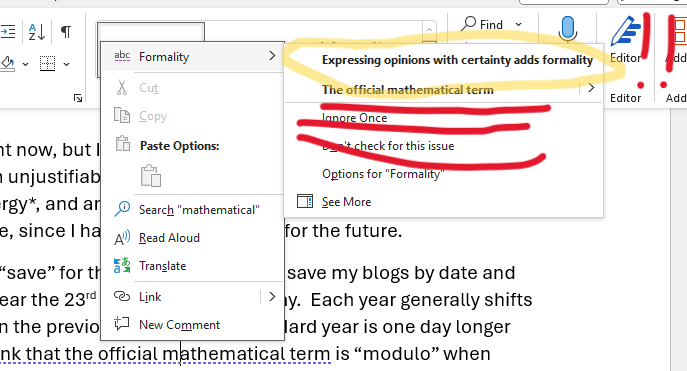
Bad advice in editor marked up

 PLEASE DON’T DO THAT, PEOPLE!!!!!!!!  Opinions are opinions.  Expressing them with certainty when you are not certain is tantamount to outright lying, and is a huge problem with human discourse!  I’m ashamed of MS Word for making that suggestion.  What a horrible, horrible recommendation!  What a nightmarish thing to say!


*And yet, my level of tension has been exceptionally high.  That’s a frustrating bit of irony, as I probably don’t need to tell you.

**This is purely a hypothetical possibility.  The vacuum energy of the universe may well be at its lowest/ground state, though it is patently not quite zero.  If it were, cosmic expansion would not be accelerating.  Indeed, I often say that cosmic inflation is happening now, based on all the data we have.  That’s what “dark energy” is doing, albeit at a slower rate than what is proposed to have happened 13.7 billion years ago.

***Weird, right?  I don’t like nausea?  How unusual!

Mishegas from a misanthropic, moribund, misbegotten former Michigander

It’s very early on Tuesday morning, and I’m already at the office.  I’m not going to be writing any fiction today, unless you count any pretense I make at coherence here in this blog post.

I had a very bad sleep last night, despite taking some diphenhydramine*.  I felt relatively optimistic at the beginning of the week (yesterday), with thoughts of reading some science and/or mathematics and/or other books when there was occasional downtime.  But then, of course, people arrived at the office and started talking and making other noise, and then the “music” was started, and I could not concentrate.

And, back at the house, the air conditioning and fan were, perforce, churning, since it’s quite hot and humid around here.  That’s better than the office noise, because at least it’s steady and sort of “white noise”, but it’s still physically irritating in the small, confined space of my room, especially accompanying, as it does, my now-bilateral tinnitus.

“‘Is this the region, this the soil, the clime,’ spake then the apostate angel, ‘this the site, that we must change for Heav’n, this mournful gloom for that eternal light?'”

Nah, I’ll pass.

I’m trying to be optimistic, or at least to be upbeat.  I’m trying very hard to act as if I’m doing better–playing guitar, writing fiction–in hopes that it will become real.  “Dream that what is dreamed will be.”  I know that I can physically endure, if necessary…but for what purpose, to what end?  It’s just a cycle from dreary to noisy to lonely to turbulent to idiotic to angry to absurd back to dreary and so on, all set against a landscape of chronic pain and self-loathing, accompanied by a constant, high-pitched whine (and no, I don’t mean the fact that I’m whining about it, though I am).

I know, I know:  “Shut up, no one wants to hear about it, everyone has their own issues, just suck it up and walk it off and lather, rinse, repeat.  Everyone suffers, everyone has problems, everybody hurts, yada yada yada.”  This is supposed to, what…make a person want to stick around in the world?  Or is it a somewhat subtle way of encouraging someone just to get gone already, to leave the world to the vapid troglodytes?

I’m so tired.  I don’t have anything to which to look forward.  The only advantage of weekends, even, is that I don’t have to deal with the foolishness and the overhead noise in the office…but then I don’t really do anything on the weekends, either.  I can’t even seem to read, now.  My brain is frazzled and fried and other words beginning with “f”.

Hmm…let’s see…

Fudge’s face froze, feeling forsaken from fair freedom’s fiefdom, foundering forlornly, foully fettered, finding few facts, fearing fundamental farragoes, fleeting facets fabricated from Facebook**.

Oh, for fuck’s fake***!  I need to stop.  Is it any wonder I don’t have people with whom to hang out?  Is it any wonder that eventually even people who love me find it better to do so from a distance?  I, at least, don’t find it surprising.  I don’t even like my own company, honestly, and I’m often driven to punish myself in various ways when I get too wound up…that way, at least, I don’t go off on other people.

I don’t have any idea what I’m trying to accomplish here today, other than perhaps to convey the message, “Look, I wrote a blog post today, even though I didn’t write any fiction!”  Also, I suppose, to try to let people know that I’m slowly, and perhaps subtly, crashing.  It’s a bit (I imagine) like trying to stay above the surface of a vast body of a very viscous liquid that nevertheless has a specific gravity much lower than water.  One cannot float on it, anymore than one could float on the surface of gasoline, but the process of sinking is a slow one (because of the viscosity), so one can “swim” or “tread liquid” to stay on the surface, but it requires constant effort, and the stickiness makes it harder, and there’s no land in sight.

Oh, well.  Life doesn’t promise anyone a rose garden.  Even if one gets a rose garden, there are always thorns (or, technically, according to botanists, “prickles”, but “Every rose has its prickle” doesn’t work as well as a lyric).

A hemlock garden would be better.  If the umbels are tall and fair, one might even encounter Tinúviel dancing among them to a pipe unseen.  And I hear the plant can be used to make an interesting tea, though no man (or plucked chicken) tends to drink it more than once.

All right, all right, that’s enough nonsense.  Sorry.  Have a good day.


*I originally wrote that as “diphenhydrazine”, which is a peculiar typo to make–would that be rocket fuel with a benzyl ring attached at each end of every molecule?

**Sorry.  The ending of the previous comment made me want to see if I could write an entire long sentence in which every word begins with “f” and that nevertheless at least makes some form of sense, grammatically if in no other way.

***Use this last “f” as an archaically written “s”, such as one can sometimes see in old English documents, e.g., “feveral”.

And simple truth miscall’d simplicity, And captive blog attending captain ill

Hello and good morning.  It’s Thursday again, and so it’s time for a more fully fledged blog post for the week, in the manner in which I used to write them when I was writing fiction the rest of the week (and playing some guitar in the time between writing and starting work most days).

I’ve been rather sick almost every day since last week’s post, except for Friday.  I don’t think it’s a virus of any kind, though that may be incorrect.  It’s mainly upper GI, and it’s taken a lot of the wind out of my sails.

I haven’t played guitar at all since last Friday.  I’ve also only written new fiction on a few of the days—Friday, Monday, and Wednesday, I think—since the last major post.  Still, on the days I wrote, I got a surprisingly good amount of work done, I guess.  It seems as though Extra Body is taking longer than it really ought to take, but once it’s done, I’m going to try to pare it down more than I have previous works, since my stuff tends to grow so rapidly.

I’ve been trying to get into doing more studying and “stuff” to correct the fact that I didn’t realize my plans to go into Physics when I started university.  I had good reasons for this non-realization, of course, the main one being the temporary cognitive impairment brought about by heart-lung bypass when I had open heart surgery when I was eighteen.

I’m pretty sure I’ve written about that before, but I didn’t know about it then, and I didn’t learn about it until I did the review paper I wrote for my fourth-year research project in medical school.  I just felt discouraged and stupid, though I consoled myself by studying some truly wonderful works of literature as an English major, including once taking two Shakespeare courses at the same time.  That was great!

It’s always nice to learn about things, all other things being equal.  I don’t think there are pieces of true information about the world that it is better not to know.  Our response to learning some intimidating truth about the greater cosmos may not be good, but the fault then lies not with the stars but with ourselves.  If you truly can’t handle the truth, then the problem is with you, not with the truth.

Of course, knowing what is true is generally not simple, except about simple things, and often not even about those.  This is the heart of epistemology, the philosophical branch that deals with how we know what we know when we know it, so to speak.  The subject may seem dry at times, especially when it gets weighed down by jargon that serves mainly just to keep lay people from chiming in on things—at least as far as I can see—but it is important and interesting at its root.

Not but what there can’t be good reasons for creating and using specific and precise and unique terms, such as to make sure that one knows exactly what is meant and doesn’t fall into the trap of linguistic fuzziness which often leads to misunderstanding and miscommunication.  That’s part of the reason most serious Physics involves mathematical formalism; one wants to deal with things precisely and algorithmically in ways that one can make testable and rigorous predictions.

Physicists will sometimes say that they can’t really convey some aspect of physics using ordinary language, that you have to use the math(s), but that can’t be true in any simplistic sense, or no one would ever be able to learn it in the first place.  Even the mathematics has to be taught via language, after all.  It’s just more cumbersome to try to work through the plain—or not so plain—language to get the precise and accurate concepts across.

And, of course, sometimes the person tasked with presenting an idea to someone else doesn’t really understand it in a way that would allow them to convey it in ordinary language.  This is not necessarily an insult to that person.  Richard Feynman apparently used to hold the opinion that if you truly understand some subject in Physics, you should be able to produce a freshman-level lecture about it that doesn’t require prior knowledge, but he admitted freely when he couldn’t do so, and was known to say that this indicated that we—or at least he—just didn’t understand the subject well enough yet.

I don’t know how I got to this point in this blog post, or indeed what point I’m trying to make, if there is any point to anything at all (I suppose a lot of that would depend on one’s point of view).  I think I got into it by saying that I was trying to catch up on Physics, so I can deal with it at a full level, because there are things I want to understand and be able to contemplate rigorously.

I particularly want to try to get all the way into General Relativity (also Quantum Field Theory), and the mathematics of that is stuff that I never learned specifically, and it is intricate—matrices and tensors and non-Euclidean geometry and similar stuff.  It’s all tremendously interesting, of course, but it requires effort, which requires time and energy.

And once other people have come into the office and the “music” has started, it’s very hard for me to maintain the required focus and the energy even in my down time, though I have many textbooks and pre-textbook level works available right there at my desk.  I’ve started, and I’m making progress, but it is very slow because of the drains on my energy and attention.

If anyone out there wants to sponsor my search for knowledge, so I wouldn’t have to do anything but study and write, I’d welcome the patronage.

But I’m not good at self-promotion, nor at asking for help in any serious way.  I tend to take the general attitude that I deserve neither health nor comfort in life, and I certainly don’t expect any of it.  I’m not my own biggest fan, probably not by a long shot.  In fact, it’s probably accurate to say that I am my own greatest enemy.

Unfortunately, I’m probably the only person who could reliably thwart me.  I’m sure I’m not unique in this.  Probably very few people have literal enemies out there in the world, but plenty of people—maybe nearly everyone—has an enemy or enemies within.  This is one of the things that happens to beings without one single, solitary terminal goal or drive or utility function, but rather with numerous ones, the strengths of which vary with time and with internal and external events.

I’ve said before that I see the motivations and drives of the mind as a vector sum in very much higher-dimensional phase space, but with input vectors that vary in response to outcomes of the immediately preceding sum perhaps even more than they do with inputs from the environment.  I don’t think there will ever be a strong way fully to describe the system algorithmically, though perhaps it may be modeled adequately and even reproduced.  This is the nature of “Elessar’s First Conjecture”:  No mind can ever be complex enough to understand itself fully and in detail*.

A combination of minds may understand it though—conceivably.  Biologists have mapped the entire nervous system of C elegans, a worm with a precisely defined nervous system with an exact number of neurons, and of course, progress is constantly being made on more advanced things.  But even individual neurons are not perfectly understood, even in worms, and the interactions between those nerves and the other cells of the body is a complex Rube Goldberg machine thrown together from pieces that were just laying around in the shed.

Complexity theory is still a very young science.

And the public at large spends its energy doing things like making and then countering “deep fakes” and arguing partisan politics with all the fervor that no doubt the ancient Egyptians and Greeks and Romans and the ancient Chinese and Japanese and Celts and Huns and Iroquois and Inca and Aztecs and Mayans and everyone else in ancient, vanished, or changed, civilizations did.  They all surely imagined that their daily politics were supremely important, that the world, the very universe, pivoted on the specifics of their little, petty disagreements and plans and paranoias**.

And so often so many of them, especially the young “revolutionaries”, whose frontal lobes were far from fully developed, were willing to spill the blood of others (and were occasionally even willing to sacrifice themselves) in pursuit of their utopian*** imaginings.  This is true from the French Revolution to the Bolsheviks to the Maoists and the Killing Fields, and before them all the way back to the Puritans of Salem, and the Inquisition, and the Athenians who executed Socrates, and the killers of Pythagoras****, and the millions of perpetrators of no-longer-known atrocities in no-longer-known cultures and civilizations.

And then, of course, we have the current gaggle of fashionably ideological, privileged youth, who decry the very things that brought them all that they take for granted, and who will follow in the blood-soaked footsteps of those I mentioned above—l’dor v’dor, ad suf kul hadoroth, a-mayn.

In the meantime, I’ll try to keep writing my stories, and try to keep learning things, and if I’m able to develop an adequate (by my standards) understanding of General Relativity and Quantum Field Theory, it’s just remotely possible that I might even make legitimate contributions to the field(s).  But more likely I’ll self-destruct, literally, well before any of that happens.

I’ve probably gone on too long already, as has this blog post.  I thank you for your patience with my meanderings.  Please try to have a good day, and I hope those of you who celebrate it are having a good Passover.

TTFN


*This implies that Laplace’s Demon could not be within the universe about which it knows the position and momentum of every particle and the strength of every force.  It needs to be instantiated elsewhere.

**Should that be “paranoiae”?  It feels like that ought to be the formal way of putting it, but Word thinks it’s misspelled.

***Not to be confused with “eutopian”.  Utopia means “no place”, whereas Eutopia would mean “good place” or “pleasant place” or “well place”.

****He was caught despite a head start, so I’ve heard, because he refused to cross a bean field, believing that beans were evil.  He was a weird guy.  It’s apparently from his followers that the term “irrational”—which originally just meant a number that cannot be expressed as the ratio of two whole numbers—developed its connotation as “crazy” or “insane”.  They didn’t like the fact that irrational numbers even existed.  Too bad for them; there are vastly more irrational numbers than rational ones…an uncountable infinity versus a “countable” infinity.  It’s not even close.

Monday morning report for 4-22-2024

I’m writing a quick blog post this morning before I write any fiction, just to pass the time while I ride into the office.  I had a fairly bad stomach bug this weekend, I don’t really feel up to riding the train, and I didn’t bring my laptop computer back to the house with me on Friday.  I also did not work on Saturday, which is good, since I was busy throwing up.  Now I’m kind sore from all that, but the worst seems over, so I’m going to the office.

I mean to do my fiction writing on the laptop computer at the office this morning, mainly for tradition’s sake.  Though the smartphone writing has been pretty successful so far, I still want to write on the computer mostly.

Of course, the smartphone is a computer as well, but its keyboard isn’t nearly as well-designed for human-type hands to use‒thus all the software add-ons like auto-correct that are necessary to make it tolerable for most people to use.  As for me, I don’t like the auto-fill options, especially in word processing, though suggestions are sometimes useful when one is typing a long word.  Still, the fact that these systems seem to learn from the great masses of illiterati using them doesn’t reassure me.  The fact that the system keeps wanting to add an apostrophe when I’m writing the possessive form of “it” shows that it’s not getting its grammar suggestions from any formal guidelines, and so it’s actually miseducating people who are unaware of the apostrophe convention in this circumstance.

Most people probably don’t pay much attention, of course, so I suppose that’s not a very big worry.

I have a bit of a headache from all my queasiness and such this weekend‒at least, I suspect that’s the source‒so I’m not going to make this much longer.  I will come back before I post it and add a summary of the writing I’ve done today on my fiction.  I hope you all have a good day and a good week, and for those who celebrate it, have a good Passover (it starts tonight).

***

Well, even though I’m not feeling well, and had to lie down for a bit in the middle, I wrote 1952 words on Extra Body this morning.  But now I’m quite discouraged, because my coworker with whom I share responsibilities is not going to be in today, since his back is acting up.  I can’t fail to sympathize‒my back has been acting up for just over 20 years, so I know how bad it can get.  But it’s discouraging, since I really still don’t feel well, and was thinking of ducking out early, today.

I guess there will be no rest for the wicked, of which I am surely one.  At least I got some decent writing done.

There’s a divinity that shapes our blogs, rough-hew them how we will

Hello and good morning.  It’s Thursday, and as I promised‒or threatened, depending on your point of view‒here I am, writing my weekly blog post as before, back when I was regularly writing and publishing my fiction.

I’m not sure what topic(s) I should cover here, today.  I rarely seem able to plan these posts in advance, and when I do plan them, I don’t think they often come out very well.  That’s from my point of view, of course; maybe other people have found my planned posts excellent and wish I would write them more often, but if so, they haven’t given any clear feedback.  So, I don’t really know what will happen from now until the end of this blog post.

Of course, if the universe is deterministic, then whether I or anyone else knows it or not, what I will write is already a certain thing, as is the fact that I don’t know it‒indeed one could legitimately claim that it “already” exists in a sense, particularly if one is invoking the picture of Special and General Relativity and the “block” spacetime concept.

However, the Copenhagen interpretation (if that’s the correct term) of quantum mechanics states that wave-function collapse is truly “random”, and so the future is not determined, at least at the smallest level.  But if the wave function truly collapses, then that would be the only fundamentally irreversible temporal process known in physics so far, and that seems suspicious to me.

I’ve been reading the original EPR paper and thinking about this subject at least a little bit lately.

Of course, in a way, the Everettian “many worlds” interpretation of quantum mechanics would say that the future really is determined, but that at every instance of decoherence, the wavefunction becomes subdivided into waves that no longer interact with each other directly.  People interpret this as if new universes were coming into existence each time, and that’s a decent way to conceptualize it, but to me it seems misleading.

To my mind, it’s just waves that are traveling along in “parallel” and not influencing each other.  But that’s not really any different from the sounds of two separate conversations happening in a crowded room‒maybe one involves a group of people discussing a recent sporting event and another gaggle is talking about some new show on Netflix.  Maybe the conversations are even in different languages.  The sound waves propagate from each conversation independently, and though there may be places where troughs and crests pass and add or subtract for an instant, locally, they are very much different processes.  But there is no mystical invocation of “new universes” such as what troubles some people about Everettian quantum mechanics because of a misunderstanding of Occam’s Razor.  There are just separate, “parallel” things happening within the same overall universe.

That’s not a perfect analogy, of course.  The “waves” of the quantum mechanics are more complex* than sound waves, and are more fundamental, and once they decohere, it seems they are far less likely to interact with their other “branches” than are even sound waves of parallel conversations in different languages.  But even those are more separable than we think.

We have an exquisitely evolved capacity to parse the information out of human conversation, decoding the waves without thought, and so we don’t think very often about how astonishing that process is.  If aliens who communicated only by light flashes were trying to interpret such a set of conversations, they would have a daunting task, indeed.

Just think about how hard it has been even to decode the communications of dolphins and whales‒highly intelligent and social creatures that clearly communicate with each other.  And these are our fellow mammals from the same planet, who also use sound for communication!  We vastly underestimate the complexity of what we’re doing when we understand conversation and other noises, because our auditory processing systems do it without our conscious intervention, and they have been honed over hundreds of millions of years by the brutal and pitiless sieve** of natural selection.

Likewise, we thoroughly underestimate the complexity involved in catching a pop-up fly ball, or a thrown football, or the process of walking, or of throwing a ball, or of finding a specific item on a cluttered desk.  It shouldn’t surprise us that even if the future “division” of the universal wave function seems random, it can be utterly deterministic, and in that sense each branch “already” exists.  But each “branch” that no longer interacts with others after an instance of decoherence will “feel” to given humans*** as if it were the one and only “universe” and that all others have collapsed out of existence somehow, when they’re really just there but not interacting anymore with the person in question.

Maybe I’m wrong, of course.  I mean, I’ve been right before, but not often enough to make it my default presumption.

Anyway, there you have it, the stuff about which I was “destined” to write, though I had no specific plans.  That’s fair enough.  “Life is what happens while you’re making other plans,” as the saying goes.

Speaking of plans, though, I plan to write tomorrow and Saturday**** on my fiction (probably just on Extra Body).  I may take my laptop with me to do it; the experiment with my smartphone seems to be working okay (see my reports from Monday, Tuesday, and Wednesday), but it doesn’t feel quite as “natural” to me, still.  Who knows, though?

Only Laplace’s Demon® (Quantum Version™) knows.  But of course, that entity would feel, if anything, less “free” than those of us who know not yet what is to be and know not fully what has been.  For an entity that can see every detail of the past and the future laid out deterministically and in full detail is utterly incapable of taking any action on such knowledge‒for its own actions are as determined as all others, and it “knows” this.  Indeed, it cannot but know it.

Ignorance is not bliss, but it does at least give you room to improve, and that can be ego syntonic.

Have a good week, if such is your destiny.

TTFN


*Ha ha, that’s a little physics joke there, when you think of how quantum wave functions involve complex numbers.

**Mixed metaphor alert!  How would a sieve hone anything?  Oh, well, I’m not going to change it; it works too well to communicate my meaning.

***And the very process of “feeling like something” is extraordinarily complex, and we only really understand the bare rudiments of how this happens.  This relative ignorance engenders the propagation of nonsensical, conceptually vacuous ideas like panpsychism and the like, and the pseudo-mystery of the “hard problem” of consciousness.  Well, it is a hard problem in a sense, but not the way philosophers of consciousness seem to express it, as far as I can see.

****I think I will be working Saturday, but I’m not certain, because of the highly atypical thing that happened last Saturday, with the office being closed.  This coming Saturday will be my son’s 24th birthday, and I will now literally have missed half of his life more or less completely.  That’s his preference, not mine, though it started as a consequence of my own misadventures‒our personal wavefunction decoherence if you will.  Still, when enough people repeatedly decide they don’t really like having you around or interacting with you too much, you have to think there must be some powerful causes for the consistency, especially when you don’t even really want to be around yourself.  So, I am profoundly sad about the state of things, and I miss my children terribly, but I have to conclude provisionally that they’re making a reasonable decision.  At least I “talk” to my daughter from time to time, and that’s not a small consolation.

With malice toward Aptos, with charity toward Calibri

Well, it’s Saturday, and I’m writing this post on my laptop computer—for the first time in quite a while, I think.  That’s where I’ve been writing Extra Body, and I figure I might as well write both things on the computer and bring it with me to the house and back to the office.

That’s what I did, which I guess is obvious.

I did in fact write some on Extra Body yesterday.  As is often the case, it felt a little clunky as I was getting started, but after a short while it flowed pretty easily, and I ended up writing about a page and a half; so the story is over 3,000 words long already.  I’m trying to keep from going off on tangents and getting into too much detail, and the less-ambitious target of only a page a day may be helping me do that.  We’ll see how well it turns out.

Sorry about that pause there, just now (perhaps you didn’t notice it, since it happened on my end, but didn’t necessarily happen on yours).  I was trying to look to see if I could remember how to change the default font in MS Word back to Calibri.

I don’t know whose nephew designed the “Aptos” font that Microsoft has made their new default font, but I hate it, and I wish ill luck, disease, and financial ruin upon the individual most responsible for its adoption as the new default*.  It has no advantages over Calibri that I can see, but it adds little, irritating curlicues and the like that are just unpleasant to my eye.

There’s also, as far as I can see, no reason to have changed it!  The switch to Calibri from, for instance, Times New Roman was probably justifiable because getting rid of serifs could make a raw document look slightly less cluttered while one is writing.  And, I guess, if one were printing a draft, it might use a little less ink.  Calibri isn’t as aesthetically pleasing as Times New Roman, but it’s clean and easy to read.

I don’t understand the point of this new, not-even-cosmetic change.

By all means, update the program regularly for improved functionality; no program is going to be perfect, and as people use it, they will discover little bugs and quirks, and these can be fixed, and new tools can be added.  But the little twiddles like this font change are much like the cosmetic changes to Google Chrome, which has rounded off all the virtual “buttons” on the screens, and the boxes, and all that related stuff.

Are there really people complaining that the buttons and the boxes and so on that adorn their computer screens are too boxy, that their corners look too sharp and angular?

If there are such people, can we please try to do our best to prevent them from reproducing?  It’s one thing to “baby-proof” a house by putting foam pads on the sharp corners of one’s furniture while a toddler is learning to walk.  But it would be weird to leave them on all through your offspring’s childhood, until they got old enough to head off to college or whatever.

That’s a bit what it feels as though Google is doing with their updates on the shapes of virtual buttons, only in this case it’s even stupider, because no one can bang his or her head on the corner of a button that’s merely a graphic design.

But at least the default font in Google Docs is still the same as it was before:  Arial.  It’s not exactly identical to Calibri, but it may as well be.  It’s a stripped-down, no-serifs, no-frills font where each of the letters is readily distinguishable from the others.

It’s easy enough, I suppose, to alter the font later on, as one is writing, and that can be useful.  If one is making a sign to hang in the office, for instance, it can be useful to vary fonts and font sizes and so on, to try to get the attention of the reader.  Also, when editing my works of fiction, I change the font on each run-through, so the work really, literally, looks different to me than it did while I was typing it.  I don’t know if this actually gives me a fresh outlook on it when I’m editing, but it feels as if it does.

And, of course, when my fiction ready to publish, it’s always going to be in Times New Roman or some other traditional, classic, serif-laden font, because why would you cheapen a work of fiction written for grown-ups with kindergarten-style type?  For working on drafts, the no-frills fonts are good.  But I hate changes that take place for no good reason.

Oh, well.  Whataya gonna do?  I’ve changed the font of this work in progress to Calibri, but that won’t have any Impact (get it?) on you readers, because the WordPress format I have uses one standard font for the main body of the post.

Life really is fundamentally and inherently unsatisfactory, isn’t it?  The Buddhists are right, at least about that.  You can see why the goal of Buddhism, upon recognizing this, would be to escape from the cycle of karma and rebirth.  Of course, reincarnation is a bizarre concept, especially since there’s not supposed to be any actual, subjective connection from one life to the next.  If one’s previous life’s memories and character are all erased and one starts anew, in what sense has that person been reincarnated?  It’s just a new person, almost as if there were no such thing as reincarnation.

Well, I’m not going to digress into that.  I hope you all have a pretty good Saturday and a pretty good remainder of the weekend thereafter.  Heck, I hope you have a great one.  Why not?  My hopes are even more useless to you than they are to me.  It’s like “sending” thoughts and prayers to victims of a tragedy; it does literally no good whatsoever for the people involved.  You’d be better off trying to do a rain dance for people suffering from a drought, because at least you would get some exercise.

That’s enough for this week.  If you’re unlucky enough—and if I’m even more unlucky—I’ll still be around and writing on Monday, and I’ll give you the latest updates on my new story-writing and on the twisted and crampy processes of my thoughts.  In the meantime, please do try to have a nice day, for your own sake, if you can.


*Note that, as I pointed out in my discussion on thoughts and prayers and the like, I’m aware that this will have no actual effect on the person in question.  If my malice had the power to cause harm just by its existence, there would be many, many, specific people who would be suffering this very day, and probably every day.  You may say, “Well, there really are many people suffering every day,” but believe me, you have no idea.  My natural, inherent ill-will is worthy of legend, and it’s just as well for the world and humanity that I direct as much or more of it at myself than at everyone else put together and that I inherently have very strong impulse control for such things.

Top o’ the work week to ye!

I was going to title this post “top o’ the week to ye”, but I realize that many people consider the week proper to begin on Sunday; standard calendars in places such as the US and Canada and the rest of the British Commonwealth and so on look at it that way.  In Japan, on the other hand, I’m led to understand that the week officially starts on Monday, since that’s the day work starts, and Saturday and Sunday (Doyōbi and Nichiyōbi) are the weekend.

Though Japan has individually named weekdays referring to esoteric things much as we do in the West, the Japanese months‒at least their current, standard names‒are basically just numbered (though I understand there are older, more traditional names).  It seems pretty sensible just to number the months‒and the days, for that matter‒rather than give them names.

Then again, while there is a certain logic to the number of months‒related both to the length of the year and to the moon’s orbital period, both of which are objective, external facts‒the number of days in a week is pretty much arbitrary.

It seems the sort of thing that, around the time of the Revolution, the French might have wanted to make decimal, with, say, three ten-day periods (decadi?  decamaines?) per month and 36.5 of those a year.  I mean, multiples of ten were justifiably popular with them.  For instance, they defined the units of distance so that a meter was one ten-millionth the distance from the pole to the equator at the arc passing through Greenwich, England.

Thus, there were 10,000 kilometers on that arc, making the Earth’s circumference a relatively easy to remember 40,000 kilometers (with variations depending on which great circle you’re measuring).  Then they defined their measures of volume accordingly (a liter as one cubic decimeter, for instance), and then their standard of mass based upon those volumes of water, which is surely the most “standard” substance for living creatures on the surface of the Earth.

Of course, now the meter is “officially” defined in terms of the speed of light, which is, as far as we can tell, absolutely constant in all reference frames.  So, a meter is defined as the distance light travels in 1 / 299,792,458 seconds exactly.

The second, by the way, is defined as the time taken by 9,192,631,770 cycles of the unperturbed ground-state hyperfine transition in the electrons of Cesium-133, again exactly.

Of course, given General and Special Relativity, how long that takes can vary depending on one’s reference frame relative to other reference frames‒this is why the GPS system has to compensate both for velocity-based time slowing in the satellites relative to the Earth and gravity-based time slowing on the surface of the Earth relative to the satellites.  Ponder that when you use your GPS; it would not work at all without those constant corrections due to Einstein.

The specific numbers used to define the meter and the second are fairly arbitrary, but they are consistent, and so are useful.  They definitely make more sense than the choice of starting the week on “Sunday” in the part of the world formerly known as “Christendom”.

Think about it*.  Sunday is considered the Sabbath day in most Christian and formerly Christian cultures, certainly those influenced by the former British Empire.  But the Sabbath is supposed to be observed in remembrance of the seventh day of Creation, when God rested.

Leave aside the strange notion of an infinite being either reckoning days based on the cycles of one planet around one of hundreds of billions of stars in each of possibly trillions of galaxies.  We can accept that as a non-literal measure of time, since God is supposed to be outside of space and time, anyway**.  But why would an infinite being of infinite power need to rest?

Anyway, the original Sabbath, as observed in Judaism and a few of the sects**** of Christianity, is Saturday, the official end of the week according to that arbitrary choice.  Even the Spanish word for Saturday, for instance‒sábado‒is related to the word “Sabbath” or “Shabbat”, and Spain is traditionally a very Christian place.  I don’t know what’s behind the disjunction between the Sabbath and the end of the week occurred in the realm of “Christendom” when even some of the most Christian languages maintain the vestiges of a recognition that the sabbath day ought to be at the end of the week, according to their own “holy” book.

Oh, well.  It’s all arbitrary or at least stochastic.

Don’t get me wrong‒I like 7 for the number of days in a week.  It’s a prime number, for one thing.  It’s also the number of “non-fixed” celestial bodies known in antiquity because they were visible to the naked eye (the Sun, the Moon, Mercury, Venus, Mars, Jupiter, and Saturn), which is probably why we have seven days.  Many of the days of the week in western languages retain traces of having been named for those bodies.

Also, 7 times 52 is 364, which means 7 divides into the days of a year with only one and a quarter days’ remainder, so the same date will fall one day “earlier” on each subsequent year (two days earlier after a “leap year” but not after the turn of three out of every four centuries, because of the adjustments made in the Gregorian calendar).  At least they don’t skip quasi-haphazardly through the days of the week every year.  Such would be the case in a decimal “week”*****, unless one made the 5 (or 6) remainder days of the year entirely separate, not ordinary days at all.

This is, apparently, how the Hobbit calendar works in Tolkien’s world, though they put their extra days in “mid-summer”, around the summer solstice rather than around the winter solstice.

Well, this has been much ado about not much of anything but random trivia about time and measure and the days of the week.  I suppose that’s appropriate for what is the beginning of at least the work week for most of us, depending on how you reckon it.

Try to have a good day, everyone, in any case.


*There must be higher love.

**So says Francis Collins, anyway, and he ought to know***.

***Well…no, he oughtn’t know.  No one ought to know, or has any way to know, or any justifiable claim to know such things.  It’s all conjecture and speculation, unsupported by any evidence that would stand up in even a kangaroo court, and what can be asserted without evidence can be dismissed without evidence.  But never mind; it can be fun to think about it.

****Christians often seem much more comfortable dealing with sects than dealing with sex.  Ba-dump-bump.

*****Although…on non-leap years, the dates would cycle between two “opposite” days of the “decamaine”, then would ratchet over to the next pair on leap years, so that might be fun.