Here we go again. Heavy sigh.

It’s Tuesday now, in case you didn’t know, though of course you might not be reading this on a Tuesday.  If by some bizarre set of circumstances my writing is still being read in the far future‒or even more improbably that it goes backward in time somehow or tunnels across to some other part of the universe that nevertheless has people who can read English‒there may not even be Tuesdays where and when you exist.

In case that’s the case, I will just say that in the 20th and 21st centuries‒and actually for quite some time before‒we divided the days into groups of 7, which we called weeks*.  There were roughly 52 of these in a year (52 x 7 = 364, one day and some change less than a full year).

In the English-speaking world we called these days Sunday, Monday, Tuesday, Wednesday, Thursday, Friday, and Saturday.  I could go into the etymology of those names, but that’s a bit of a pain.  Anyway, you’re the ones who are in some future, presumably advanced civilization; why can’t you look that stuff up for yourselves?

Anyway, our “official work week” ran from Monday through Friday, with Saturday and Sunday off.  However, that was far from the only schedule people followed, and in a form of evolution due to mutual competition, people vied with each other to work more days and longer hours for less pay, because other people were willing to do it.  Not to participate would lead one to be less likely to get or keep a job, and that could lead to destitution‒at least somewhat more quickly than does steadily working longer and longer for less and less, which is a kind of creeping but pernicious societal malaise.

Of course, other, parallel forces led to decreasing regulation of companies’ ability to “encourage” their workers to work more for less, and since in the short term** everyone works in response to their local incentives, people tended to allow these things to happen.  And lawmakers and regulators, subject to the inherently woefully dysfunctional political party system, became less and less incentivized to care about the needs and worries of those they nominally represented, and to whom they had sworn their service***.

They were happy to allow the fortunate wealthy and powerful to take advantage of the foolishly earnest and mutually (and self-destructively) competitive citizens, because they were rewarded for allowing it.

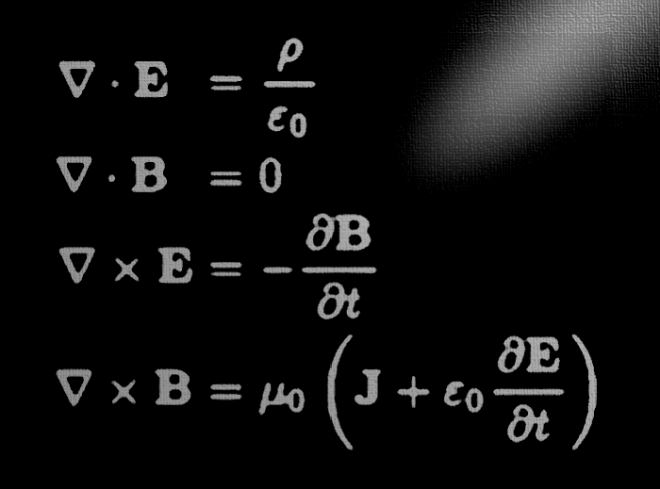
Everyone responds to local forces, of course.  Even spacetime itself responds to the spacetime immediately adjacent to it, as the electromagnetic field responds to the state of the field immediately adjacent to it, as demonstrated by the implications of Maxwell’s famous equations, which I’m sure jump right out at you:

Of course, the meaning of “local” is circular here, almost tautological, since the definition of local is merely “something that can affect another thing directly” more or less.

So it’s only too possible for a system to evolve itself into a state that is overall detrimental to those within the system.  Everyone, even the most seemingly successful, can be in a worse situation than they would be in otherwise, but it’s very difficult to see the way out, to get a “bird’s eye view” of the landscape, if you will.

One can therefore get stuck in situations where, despite the overall equilibrium being detrimental to everyone, any one individual taking action to try to move things in a better direction would make their local situation worse for them.

How is one to respond to such a situation?  Well, one can simply go along with it and try to do what’s best for oneself locally, and that is what most people do most of the time‒understandably enough, even though the overall situation may be evolving toward its own miserable destruction.

Or, of course, one could do what family therapists are often said to do:  effectively setting off a bomb***** in the middle of a difficult situation and seeing what happens when the dust settles, figuring that nothing is likely to be much worse than things are at a given present.  At least this allows for a new system to form, like the biosphere after the various mass extinctions.  Maybe it will become better than the previous one.

Maybe they all will always evolve toward catastrophe, to collapse and then be replaced by a new system.

It would be better if people could learn, and could deliberately change local incentives in careful and measured ways, adjusting settings to correct for and steer things away from poorer outcomes and so on, in ways that are not too disruptive at any given place or time.  That’s nominally what many of our systems are meant to be doing, but they don’t do a very good job at it.

Probably it would be better to do a hard reset.  But I’m not sure.  And it’s probably not worth the effort.  The odds of humanity surviving to become cosmically significant seem very low to me, and I’m not sure it would be good for the universe‒whatever that might mean‒if they do.

It’s probably all pointless, and I’m tired of it, anyway.  I don’t want to be part of this equilibrium or lack thereof anymore.  I want to make my own quietus.  Maybe “civilization” should do the same.


*Not to be confused with “weak”, which sounds the same but means more or less “the opposite of strong” and has little or nothing to do with divisions of time.

**And that’s pretty much the only term that comes naturally and easily to humans, for sound biological but horrible psychological and sociological reasons.

***If they were Klingons, they would surely be slain for their dishonor.  I don’t necessarily disagree with such an outcome morally, but practically, it would probably lead to increasing chaos****, so we understandably avoid it most of the time.

****It’s an open question whether such chaos is inherently bad.

*****Metaphorically, of course. At least, it’s usually metaphorical.

All ideologies are wrong

I don’t know if what follows will be clear or will convey my thoughts very well, but here goes.

I was in the shower this morning, thinking about nothing specific, and somehow I started feeling irritated, as I often do, at people who are dogmatic about ideologies and try to apply them to every possible situation or state of the world.  Then a connection of ideas clicked into position for me in the phase space of the mind, and I thought about the notion of scientific models.

There’s a famous quote about model-building/using in science that says, “All models are wrong, but some are useful.”  (I don’t recall who said it, but I’ll look it up before posting this and I’ll put it in the footnotes*.)  The statement refers to the fact that, to try to understand the world, scientists build models—not usually literal, glue-together type ones, though that occasionally does happen—and see how well those models replicate or elucidate facts of external reality.

They are all simplifications, as they must be, since only the universe itself appears to have enough processing power to simulate the universe fully.  Being simplifications, and reality being complex and prone to chaos (the mathematical form thereof, though the classical kind does occur as well) a simplified model can never be entirely correct.  But some of them are nevertheless quite valuable and useful—take General Relativity and Darwinian natural selection as two good examples—though we know they do not fully encompass every aspect of reality.

Some models are misleading, such as the old notion of the brain as a cooling mechanism for the blood, and some are simply not that useful, such as seeing the brain as a system of hydraulic tubes and valves of some sort.  And when you try to apply a model to a situation in which it doesn’t apply, it will give you wildly wrong (or “not even wrong”**) answers.

It occurred to me there in the shower that human ideologies are quite similar.  They are simplifications, models of the world.  Some are useful in some ways and to some degree, and some are about as applicable as the notion of a spherical cow (which, despite being the punchline of a physics joke, could in principle be useful somewhere sometime).  But it is as absurd to measure every event or occurrence or interaction against some finite ideology as it is to try to apply the germ theory of disease to the question of “dark energy”.

It’s absurd—if you’re being rigorous and serious—to think that the ideas of Karl Marx contain all that is needed to produce a good, fair, productive, and stable society.  But it’s just as absurd to think that laissez-faire, free-market capitalism will for its part provide everything that could possibly be needed for a robust and free and beneficent world, or that the ideas of “post-modernism” contain all that need be said about civilization.

The world is complicated, with many forces interacting at many levels, and no single idea, however personally attractive, can encompass all of it in a useful way.  Capitalism can encourage the production of great innovation and abundance, but it has no inherent justice, despite some popular belief and the works of Ayn Rand.  It can leave people utterly bereft and tortured and miserable through no fault of their own but bad luck.  It can also evolve into inadequate equilibrium states in which isolated, hoarded wealth sits still and does no one any real good while the whole of civilization collapses around it, just as biological systems can evolve into self-destructive states, like cancers, when an individual mutated cell becomes so successful at reproducing itself that it kills off the body in which it resides.

But if people are not rewarded for their work or their creativity or their acumen to some degree that is at least on some level commensurate with the value they produce, then people will stop producing.  Nature does not tend to evolve creatures that act purely to their own detriment without any “personal” gain of some kind  It’s not an evolutionarily stable strategy; such creatures are rapidly selected out.  Humans are no exception.

And history (and mathematics) has shown that economies are too complex to be planned by anyone or any group, and probably by any form of individual intelligence, no matter how advanced.  The information and knowledge required is too staggeringly vast.

It’s not merely political or economic ideologies that are limited and imperfect, either.  All religions fall into this same category.  Some have good and useful ideas, but only the indoctrinated could imagine that highly limited ancient collections of stories or poems or proscriptions and prescriptions can provide even vague guidance about all the things in the modern world, let alone the potential future world.  “Eastern” religions do no better than “Western” ones, though again, some are more useful and some are less so.

Of course, any ideology that is dogmatic is much more likely to be useless or detrimental than one to which inheres the potential for updating and improving itself.  It’s more or less mathematically impossible for a finite set of ideas put down on paper (or wherever) to have successfully discerned all that can be known about how to approach reality.

I think it would be much better if we thought of our various ideologies as models, hypotheses—theories*** at best.  Then we could have many options available to measure and address issues as they arise, and we could honestly assess whether the notions of, say, existentialism or deontology or utilitarianism best apply to a given moment or challenge.

Again, I’m not sure how well I’ve expressed my thoughts here, and I’m sure I could go on and on about this, trying to tease through it as well and thoroughly as possible.  I’ll spare you (and me) that for the moment.  But I think it was a useful realization.  Though I doubt even this has universal applicability in all possible worlds.

Have a good day.


*It was George Box, a statistician, who is credited with this particular phrase, but the idea had been expressed in terms of maps and territories in similar overall fashion previously.

**This expression is attributed to Wolfgang Pauli (of the eponymous exclusion principle fame), one of the early giants of quantum mechanics.

***In the scientific, not the colloquial sense.

Gravid questions of time and gravity (and labor)

It’s Monday, the first of September, which was “originally” the seventh month, but which is now pushed back to the ninth by the two “caesarean” months.  Speaking of such things, it’s also Labor Day in the US (I’m not sure about other countries) a day on which we celebrate labor by giving most people the day off.  This isn’t quite as perverse as it might sound.  After all, what woman would want to work while in labor?

Ha ha.

Anyway, my workplace is open today, though only for half a day.  It has become more and more common for nearly everything to be open even on huge holidays like New Years and so on, let alone “ordinary” federal holidays.  The reasons are fairly straightforward, and they have nothing to do with any kind of formal, deliberate, corporate conspiracy such as is imagined by so many naïve people on social media.

It’s just the same problem‒or situation‒that leads trees to grow tall when it would make much more sense for them all to stay closer to the ground and not waste so many resources on trunks and xylem and phloem, on getting water and nutrients from the ground up to their highest leaves*.  The trouble is, if all the trees were low but then one variant appeared that was slightly higher, it would have a significant advantage over its species-mates (and other species), so it would be more effective at reproduction, ceteris paribus.  Its offspring would come to dominate, unless and until yet other variants occurred that tended to grow even higher.  And thus the “arms race” would begin.

So in the human world:  if everyone else worked four days a week, but one worker was willing/able to work more days or longer days, especially if for the same or only slightly higher pay, then that worker would have a job advantage, (again, ceteris paribus).  And so competition leads at least some workers to strive to outdo each other to the extent they can, and so on, working for local, individual advantage that inexorably leads to less pleasant outcomes for everyone.  It’s just game theory applied to economics.

Anyway, that wasn’t what I wanted to discuss this morning.  I wanted to discuss two physics-related ideas I’ve had in the last few days.  The later one is just a bit of silly fun, but the other is more interesting to me.

The second one happened this morning (at about 2 am, when I was awake, because of course I was).  I put on a YouTube video of Star Talk in which a string theorist was the guest, and Professor Tyson asked her about the possibility of more than one dimension of time, and she said most such theoretical possibilities fall afoul of paradoxes and trouble with causality.

But it occurred to me, if there were a situation with time travel involving, for instance, the “grandfather paradox”, maybe the fact that preventing one’s grandparents from meeting makes one no longer there to prevent the meeting doesn’t necessarily unravel the universe, but maybe the paths and events correct and change each other in a closed, repetitive loop of time, interfering with each other** until only one, complete resonant spacetime line is there.

It’s analogous to a plucked string*** in which all sorts of vibrations and waves go back and forth between the fixed ends, but most waves/vibrations end up canceling each other out except the ones that fit an even number of times within the confines of the fixed string.  So maybe the actual events of reality could thus only be the ones that are resonant within that spacetime…whatever the hell that might mean.

Anyway, that’s the frivolous question; though it’s a bit fun, it probably doesn’t really have anything to do with our actual world (though it could…remember my thought a bit ago about forces traveling backward and forward in time and interfering until only a fixed number of outcomes resonate****?).

More interesting to me, really, was a question that occurred to me while I was reading Lisa Randall’s Warped Passages, a physics book (of course) and a particularly good one.  It was not really discussing the question that popped into my mind, other than that Professor Randall was reviewing the particles in the Standard Model.

We know that fermions cannot pile up one on another (cannot share quantum states), and that bosons can (e.g., in lasers).  We also know that massless force-carrying bosons such as gluons and photons travel at c, the “speed of light”.  The W+ and W- and Z bosons of the weak force do not because they interact with the Higgs field and so have “rest mass”.

Anyway, that’s not really the point.  The point is that gravitons, the hypothetical force-carrying particle of the gravitational field, are also massless bosons, and gravity travels at the speed of light*****.  But something popped into my head that had never occurred to me before and I’m not sure why:  do gravitons come in different frequencies?

We know that light has a limitless number of possible frequencies, across a very wide range, and that higher frequencies/shorter wavelengths are associated with higher energies per photon.  We also know that all matter radiates photons at a spectrum of frequencies that depends on temperature‒the so-called black body radiation.  Well, we also know that all matter “radiates” gravitons, or at the very least it all interacts with the gravitational field.  What if matter gives out gravitons in a spectrum that depends on total mass?

What would it mean for a graviton to have higher frequency or lower frequency?  Would that entail a stronger (and weaker) gravity?  Or would it correspond to something else entirely?

Of course, I know that gravitational waves are of varying frequencies depending upon the source‒that frequency and intensity (amplitude) increase as, for instance, two mutually orbiting black holes get closer and closer, orbiting faster and faster, before they coalesce.  Is that analogous to them producing large numbers of gravitons of those increasing frequencies?  Or are gravitational waves different types of things than “ordinary” gravitons?  Is ordinary gravity propagated by “virtual gravitons” much as the electromagnetic force is carried by “virtual photons”, which are really just mathematical shorthand for perturbations in the quantum field of electromagnetism?

I suspect that, because we don’t really have anything like a good quantum theory of gravity, there would be few clear answers to my questions about gravitons, but there may be constraints based on what we already know that would make my questions answerable or moot.

I mean, I know that “we” know that gravitons would be spin-2 particles, meaning that to rotate them 180 degrees would leave them unchanged******.  I don’t know how this or other aspects of gravitons would affect possible frequencies, though.  Also, can gravitons be polarized in a manner analogous to light?  I’m not sure whether my graviton questions are sensible or pertinent or utterly off the mark.  If anyone out there is a physicist specializing in such things, please, if you can spare a moment, let me know?

This post has gone on for a long time, I know.  I could meander around much longer on these subjects, probably for pages and pages and pages, but that would be a bit much for a daily blog post, if it isn’t already.  Maybe because it’s a holiday, at least some of you will have the time and interest in reading such thoughts, but I don’t want to push my luck.

However, I welcome any comments on the above subjects if you have an interest, and especially if you have relevant expertise (though I welcome all interested thoughts).

In any case, please try to have a good day.


*A fascinating physical process that’s only possible because continuous liquids can actually have negative pressures.

**Not in any inappropriate way, just that they interact and waves can cancel out.

***Not a “superstring” or heterotic string or what have you, just for instance a guitar string or a cello string.

****This is not unlike Feynman’s path integral/sum over histories notion, really.

*****We know this is so because there was a neutron star merger detected by LIGO and VIRGO that was quickly looked at using “light” telescopes as well, and the timing matched up (As a silly aside, since gravitons are bosons and could thus in principle share quantum states, one might, in principle, be able to create a coherent beam of them…a GRASER or GASER if you will).

******Spin-1 particles basically return to their identical state if you rotate them 360 degrees.  And for spin ½ particles, you need to rotate them 720 degrees (!) for them to return to their prior configuration.  Once you’ve rotated them 360 degrees they’re kind of the opposite of their prior configuration.  If that’s hard to think about, just imagine traversing a Mobius strip laid out in a “circle”:  once you’ve gone 360 degrees, you’re on the opposite “side” of the strip than that on which you began, and you have to go another 360 degrees (so to speak) to get back where you started.  Neat, huh?

Viewing his progress through, what perils past, what crosses to ensue, would shut the blog

Hello and good morning.  It’s Thursday, and so it’s time for my “usual” weekly Thursday blog post.  Aren’t you lucky?

I was a bit surprised that yesterday’s post seemed to be rather successful, at least in that people commented on it, here and on social media (where I share it).  I don’t know if anyone else shared it—I encourage anyone who enjoys any of my posts to share it to your own social media, and of course, I encourage you to “like” it if you like it, though I’m falling afoul of my own cautionary song Like and Share by encouraging such activities.

Still, it would be nice if people could share my stuff or comment on it.  I’ll say again:  comments on social media aren’t as useful to me as comments here, on my main page.  Here is where all* the readers come together (over me, so to speak).  So, if one person makes a comment, it might be something that another person finds interesting or insightful, and they might comment back and even get a conversation going.

I don’t know.  I’m probably being unreasonable.  I usually am.  I just have a bit of a hard time sustaining conversation, myself, so I’m always hoping that other people will do so in response to the prompts of my random thoughts, like the ones from yesterday.

Here I’m using a rather constrained version of the term “random”; my thoughts are not random in any true, nondeterministic, quantum mechanical kind of way.  They’re just stochastic, as well as being occasionally sarcastic**, as in my third sentence above.  So, while in practice they are unpredictable, in principle, each follows directly from some individual cause or set of causes.

Of course, nowadays, many people creating “content” on the various social media ask for “likes” or “thumbs up” or whatever the specific equivalent on their site is, as well as sharing and subscribing when that applies.  They also often have things like Patreon accounts, or Ko-fi accounts or whatever (those latter ones allow people to send them small amounts—the price of a cup of coffee, for instance—to help support them), so that some of them can make an actual living by making their “content”.

Of course, it would be nice to make a living by making content, i.e., by these blog posts.  I suppose one can also write posts on Substack nowadays; they are set up to allow people to give paid subscriptions in addition to free subscriptions.

Actually, I think WordPress has instituted something along those lines as well; I’ve gotten notifications of some such things at some point, but I haven’t paid that much attention to them.  All the social media and search engine companies and streaming services are all changing things far too often, so I don’t even try to keep up.

This constant updating gives one (this one, anyway) the impression that the companies really don’t know what they’re doing, and that they haven’t made a good product before they put it out to the public, so they have to keep tweaking it.

I suspect, though, that it’s more that they think they have to keep changing things to keep up with all the competition.  It’s a bit as if seals and sea lions tried to grow tentacles because they saw that squid and octopuses have a fair amount of success using them.

It might be worth it to remind them (the software companies and the pinnipeds) that, while all improvement is change, not all change is improvement.  In fact, most potential change is at best neutral, and more often detrimental, especially in situations in which something is working at least reasonably well.

This is the root of the admission in the Declaration of Independence that prudence dictates that established governments should not be changed due to light or transient causes (something like that, anyway).  It’s also part of why I hate when organizations or people call for “change” without being more specific.  I have more patience with the label “progressive”, because at least it gives tacit recognition to the notion that progress (by whatever definition) is what we want, not mere random change.

It’s true that evolution by natural selection happens with random mutations and non-random survival, and that over time, progress can be made that way, but it is a grim, ungainly, blundering, low, ghastly, ominous, wasteful, and horribly cruel process (here I’m combining words from Edgar Allan Poe and Charles Darwin).  It’s better to use engineering principles rather than random trial and error if one wants to head more swiftly and surely in better directions***.

Anyway, I don’t have any direct way to monetize this blog, though there are probably ways it can be done.  And so, I keep going to work every day, as I am doing now.  If people want to support me, of course, giving “likes” and commenting and (if such a thing ever happens) sharing the link to the posts is also very nice.

Of course, if anyone wants to support me monetarily, they can certainly do so—in principle—by buying my published books and talking about them to other people (and rating and reviewing them on Amazon, for instance).  And, of course, they can play/stream my music on Spotify and YouTube Music and iTunes and so on.  Some of my songs are even available to use as background music for reels on Instagram and TikTok and Facebook.

But I am more or less certain that I’ve made a staggering**** net loss on my music.  That’s okay.  People have listened to my songs, and some people have said that they really like them.  I even had one work friend who was a former professional musician/singer/songwriter say that he thought if my song Breaking Me Down had been released (in a professionally produced version shortened for radio) in the seventies, it would have been a hit.

So, if you so desire, please do listen to my music, share my posts, buy and read my books, all that stuff.  I would be grateful.  And hey, if any of you out there think I ought to try to monetize this blog, please let me know.

It seems unlikely that anyone actually reads far enough even to let me know their response, but if that’s the case, well, I guess I don’t mind being a voice crying out in the wilderness—I’ve always felt that way no matter what.

TTFN


*Though it may be a bit much to use the word “all”, considering that I don’t exactly have that many regular readers—a few dozen at most, most days.

**Oh, noooo, I would never be sarcastic.  Batman forbid!

***Of course, there are many possible ways to think of something as “better”, so making that judgment should also be an important part of the process if one wants actually to make things improve in a way upon which most, if not all, can agree.

****As a matter of percentage in versus percentage out.  The actual amounts are not great in either direction.

Maybe it’s signal. Maybe it’s noise. Maybe it’s Maybelline?

Well, it’s Tuesday, and I don’t know that I have anything of use or substance to say, or anything to say that isn’t mostly just noise.  Perhaps I’m just some peculiar source of radio static in the background of the universe.  Or perhaps…perhaps I’m just pretending that what I do is unplanned, when in fact everything is calculated and subversive.

Ha!  I wish.  My brain doesn’t work like that, and I’m not sure anyone else’s does, either.  Even John Von Neumann had to develop complex mathematics and sophisticated models to deal with the limited degree of uncertainty in highly simplified versions of one-on-one poker.  If he was so intrigued by what he‒possessing perhaps the highest general intelligence of which history is firmly aware‒could not fully model, then this is strong evidence that no one, now or ever, has really been in control of anything.

Of course, game theory has advanced since Von Neumann co-invented it, and it is certainly useful, but it is clear that, at best, it deals in probabilities and tendencies.  There is no Asimovian 2nd Foundation Hari Seldon psychohistory that can figure out the specific events of whole galactic civilizations well into the future, and I doubt there ever will be.

Of course, if we want to be trivial, we can predict the far future with some degree of confidence:  Eventually, unless our knowledge of the universe is deeply mistaken*, as entropy increases inexorably, new stars will stop forming, old stars will burn out (even red dwarfs), black holes will evaporate, and the universe will be a thin haze of elementary particles.  Indeed, if everything eventually reduces to massless bosons (e.g., photons) then in a very real sense, time will literally have no meaning, since photons, being massless particles, do not “experience” time.  From their point of view‒to speak very figuratively‒their entire existence is instantaneous.

Of course, going on to the very far future, given the nature of probability, new universes may arise.  Something like Penrose’s conformal cyclic cosmology may be the way things happen, or there may merely be a Poincaré recurrence of the universe.  Or maybe, as I’ve speculated previously, time is not one way, and our future might also be the future of another, far distant “big bang” but for which time/entropy increases in the opposite direction.

Also, of course, if civilization and intelligence persists and grows, which is not a small “if”, then who knows where technology will develop?  Our descendants could conceivably develop the capacity to do cosmic engineering, literally shaping the large-scale development of the universe, or even making new ones.

But I suspect they still will not be able to micromanage perfectly the interactions of innumerable agents in complex systems.  Some limits are fundamental, and I think this may be one.  This comes down to something related to my “Elessar’s First Conjecture/Theorem”, that no complex, intelligence can ever fully understand itself in detail, because to model a given complex system requires a system of greater complexity, which itself will need to be described, leading to an infinite regress.

And, of course, we know that in complex systems, in which interactions are stochastic and multivariate and nonlinear (and thus exhibit chaotic development) the specifics of future happenings will be unpredictable since to know them perfectly, we would need an infinite number of significant digits**, though in some cases‒like entropy‒we can make general predictions with high confidence.  

This is part of why “planned economies” fail, and almost certainly always will, unless they are stupendously lucky.  In any case, such luck will not last, just as neither strength nor good purpose will last in the presence of the One Ring.  This is also why most complex conspiracy theories are simply laughable.

People derive their models of the world to too great a degree from our ubiquitous visual entertainment, which has been around long enough to be deeply self-mimicking and self-derivative.  Gunshots and explosions don’t behave in real life the way they do in action movies, but action movies (and shows and videos) take their models of the world from previous action movies, much as an AI’s model of human speech and interaction, if derived from the internet, is going to be increasingly contaminated by the products of other AIs, and may end up veering far away from anything reminiscent of human interactions, at least if left to its own devices.

Maybe that’s an advantage of written fiction over movies and TV and other videos; it’s not presenting a simulation of some version of reality, it’s telling you a story, describing things, but you have to imagine them.  Meanwhile, if all your fiction is in words, your physical intuition of the real world‒and your psychological and sociological and economic intuition‒would be derived from real events, not the Machiavellian machinations of Manichean movie-based manipulators.

That was an interesting stream of consciousness, if I do say so myself (and I do).  Who could have predicted it?  Not I.  And I’m the one who wrote it.  Which goes to my point.

Please try to have a good day.


*This is always possible in principle, but for many aspects of cosmology, our credences can be justifiably high.

**I sometimes say that while knowledge can vary greatly, ignorance is always infinite.  This can be proven with a single, simple example:  the digits of pi.  There are an infinite number of them, and no matter how many we calculate, there will be an infinite number we don’t know.  Ditto for e and any other transcendental numbers, let alone all the other real numbers that have no specific designation, of which there exist an uncountable infinity.  And this is just one place where infinite information dwells, of which we will always have only finite knowledge.

Thoughts meander like a restless spore inside a humid room

In case you’re confused:  Yes, it is Monday, even though I’m writing a blog post.  I just decided that I might as well do something that gives the illusion of productivity, since, y’know, I’m awake and on my way to the office anyway.

As for topics about which to write, well, on that I don’t know.  I don’t think there are any momentous or interesting things worth discussing that are happening in the world right now (ba-dump-bump, chhh!).

Still, it is true that to a very good approximation every event that happens and that seems so earth-shattering and important in the moment is utterly forgotten by everything except quantum mechanics and Laplace’s demon.

Don’t believe me?  Do you remember that scandal in the Roman Senate when Cinna the Younger misdirected Republic funds to buy a “servant” for his household?  No?  Neither does anyone else.  Of course, that was 2000 years ago, so you may think it doesn’t count, but I’m sure almost none of you know about any of the “crucial” events of the day or the escapades of popular stars even 40 years ago.  I certainly don’t remember any, and I was fifteen at the time, and I have an unusually good memory.

Also, time‒with respect to online information, anyway‒is cycling more quickly nowadays.  Sure, information can last a very long time online*, but that doesn’t really matter in a dispositive way, because there is a constant gusher of new and distracting information coming in at all times, with signal and noise intermingling haphazardly.  It’s a bit akin to the fact that although Manhattan is crowded with millions of people in a small area‒so you might think your life would be less private‒in many ways it is more private than other places, because when there, you are one indistinguishable face among those millions.

The internet makes Manhattan look like Mayberry.

Still, it would be nice to be able to get my words and maybe my stories and maybe even my music out to more people who might find them interesting and/or entertaining.  It’s not immortality in anything like a literal sense‒nothing is‒but still, there’s at least some little internal drive to spread the memetic code of me out in the world.  I could think of myself like the fruiting body of a fungus, spewing the spores of my thoughts into the wind, seeing if they’ll be able to infest and infect any other people out there.

It might at least be interesting to give someone the psychological equivalent of a persistent, itchy rash thanks to my words.

Of course, the fungus metaphor is an ironic one for me, since I cannot stand mushrooms for eating, and even the smell of wild mushrooms after damp weather (or mildew for that matter) fills me with literal nausea.  Then again, given my own poor opinion of myself, maybe it’s right for me to think of myself and my ideas (my celium, perhaps…get it?) that way.

Fungi don’t have any qualifications or requirements to meet other than survival and reproduction.  And that’s very much the nature of online information exchange; the stuff that spreads most isn’t the “brilliant” or the “important”, it’s just the catchiest.  The whole process is stochastic.

Of course, there is an entire ecosystem of such meme-plexes, and they vary in their tendencies to spread quickly versus being more long-lasting.  Like the species in a rainforest, some spread quickly and germinate and reproduce quickly, but then quickly die, with short, frequently repeating cycles; others spread and grow more slowly, some perhaps becoming the mighty trees that dominate the structure of the forest, but which perforce have longer, slower growth and death cycles.  And, of course, the various other plants (and animals) in the jungle create and are each others’ environment.  There are even parasitic plants, and opportunistic ones that germinate only after a fire.  It’s very complicated, and no one plant is crucial or eternal**, though they may think they are.

Am I pushing the metaphor too far?  I don’t think so.  I think it’s important for people to recognize that no one controls the internet, just as no one controls the economy, just as no one controls the ecosystem, just as no one controls the evolution of the universe itself.  Everything just happens thanks to the interactions of numerous smaller elements interacting according to local forces and pressures.

That’s enough for a Monday, I think.  I hope you all have a good one.


*But not forever, despite what anyone says.  I fear no contradiction here, because to prove me wrong, you would have to wait until forever had passed.  At which point, if you are right, I will gladly concede the issue.

**Unless you count microbes‒some of those could be considered immortal.  Of course, in a sense, since it all has one common ancestor somewhere, life as a whole could be considered just one gigantic, very long-lived (but probably not immortal) organism.

Random thoughts on Saturday morning

I’m on my way to the office this morning, so I figured I would write some reasonable facsimile of a blog post, since I might as well do something that’s vaguely creative and/or productive.

On Thursday, I wrote with my little mini laptop computer, but today I am writing on my smartphone, since I didn’t feel like carrying the laptop.  I think, unless I start writing fiction again*, I’m going to pretty much avoid using the mini computer, and instead use this even-more-mini one.

As for subject matter about which to write, well, there’s really not much that comes to mind.  I do sometimes wonder if I would ever write an entire book on Google Docs on my phone.  It feels almost appropriate, since my “nickname” is Doc.

Even the very young daughter of two coworkers knows me as Doc.

I seem to get along better with small children than I do with so-called adult humans.  Maybe it’s because their thought processes are more like mine, or maybe it’s just that they have potential to be wonderful and brilliant and creative, if only they can avoid being damaged in the wrong ways.

Unfortunately, it seems almost no one avoids that damage.  Weirdly enough, though almost everyone recognizes that children are (literally) the hope for the future of humanity, after paying lip service to that notion, everyone then just lets children grow and develop haphazardly, catch-as-catch-can, putting terribly few resources into education, let alone into research about how best to do education.  There should be as much rigor in the study of education as there is in the study of diseases and medicine in general, or even as much as there is in fundamental physics.

All these hugely successful billionaires ought to put their considerable resources into this area instead of making government “more efficient” or whatever, as if the most “efficient” government were demonstrably the best one.  But they seem to have no thoughts about education, that tremendous public good that can provide potentially unlimited returns for the future.

Imagine these entrepreneurs who consider themselves to be brilliant planners and producers** starting businesses or other projects with no plan, with no research, just old, hackneyed notions mixed with fashionable but untried and highly nebulous ideas, and with limited supervision or moment-to-moment adjustment, feedback, or attempt to improve.  If one in a million such businesses turned out to be successes, one would have achieved more than one deserved.

And yet we approach education with almost no more insight than existed a hundred or even two-hundred years ago.  And our societal attitude toward education (certainly in the US) is frankly unconscionable.  If there were appropriate punishment for people who don’t seem to care about the specific development of the minds of the next generation of humans, it would be hellishly severe and enduring, because such are the consequences of such attitudes toward education.

Oh, well.  Humans are demonstrably stupid, even more so than one might think from following the news, and the government officials and successful business people are by no means any exception to that tendency.  I suspect that large-scale intelligence would have been better coming from descendants of the dinosaurs (i.e., birds), since their brains often seem much more tightly woven.  Probably, though, I would be as disappointed by them as I am by all the fucking humans.

Well, I doubt they’ll change or improve.  And like unsupervised children playing with matches, eventually someone is going to burn the house down, and a lot of them are going to die in the fire.  Maybe all of them will die.  At this point, that wouldn’t break my heart, but then, my heart’s sort of like a scrambled egg already‒if you were going to make it even more shredded than it is, you would first have to unscramble it some.

Anyway, that’s enough of that.  As the YouTubers say so often, if you like my content, please give it a “thumbs up” (i.e., a “like”), subscribe, and share it on your own social media.  Seriously.

And have a good day, if you can. 


*It seems vanishingly unlikely‒more so every day‒which ought to be very sad to me.  Intellectually, it still is, I suppose.  But as for emotions, when I think of ever writing any more fiction, I just feel empty and dead and rotten inside.  Likewise with music.

**I suspect, for the most part, their huge success is largely, if not entirely, stochastic.  In other words, some very lucky things happened early on and they kept benefitting from that afterwards, but not because of any particular brilliance of their own.  It just seems that they must be brilliant because we only hear about those who lucked out and made it to the top, not the countless ones who failed using the same methods.  It’s a bit like imagining you could learn something about what makes someone successful by interviewing people who won the lottery, but paying no attention to the millions who lose.

The year is dead; long live the year. Whatever.

It’s Tuesday, December 31st, 2024‒New Year’s Eve.  Of course, as I’ve written before, every day is the first day of a new year, in a trivial but nevertheless true way.  The day to mark the new year is an arbitrary choice.  We could have had the new year begin “officially” on the first of any month.  Indeed, we could have started it in the middle of a month, or perhaps on the winter solstice.  Or we could have 12 months of thirty days, leaving a 5 day extra period which we could use as a long holiday and an official new year celebration, with an extra day every leap year.  We could do this around the winter solstice, or even around the summer one, like hobbits do.

Oh, well.  It’s not as though people are going to collectively change, any more than people are going to go back to really celebrating holidays:  with most workplaces closed except for hospitals and police and fire stations and the like, with people spending the holidays with loved ones.  Once one business stays open on those extra days, competitors (direct and indirect ones) will stay open, too, or suffer a disadvantage that may lead them to be more likely to go out of business.

The world of commerce is red in tooth, claw, and debt, so after a while, only those who push every edge they can without getting more negative marginal returns, will dominate.  And that will become the norm.

No one made it happen, no one planned it.  Everyone’s caught in the currents of chaos, but those able to use the flows to their advantage‒chaos surfing, as I call it‒will thrive, at least temporarily, even if they don’t realize why they are succeeding, which they usually don’t.

It’s similar with the workers:  once some small subgroup is willing to eschew holidays and to work longer hours, they will have advantages over other workers, at least as long as working more proves advantageous to them and their workplaces.  Soon, the marketplace of workers will skew toward people being willing to work longer hours in worse conditions, as long as it provides a relative, local advantage.  Those who cannot match this will fall by the wayside, perhaps becoming homeless, getting addicted to drugs, going to jail or prison‒self-destructing directly or indirectly.

This is not a conspiracy by employers or governments or anyone else.  No one is that clever, and they are all beset by their own local pressures and competitions.  Why else would the very wealthy do anything but sit back and eat ice cream until they die (figuratively speaking)?  They are no more happy or satisfied than most other people.

It’s analogous to the situation with trees and forests.  It takes a lot of effort and resources for trees to grow tall.  Why do they do it?  Because other trees do it, and any tree that doesn’t want the sun blocked out had better do the same*.  If all trees could agree somehow to stay short, they could all thrive and get adequate sunlight and nutrition and water and air at a fraction of their usual height and resource usage.

But once one tree grows taller, the arms race begins.  Such is the way of economies and ecologies.  They cannot be planned, they cannot even really be controlled or constrained (at least not without disastrous results).  At best, they can be “herded”.  That’s a metaphorical herding, by the way‒a careful nudging of things to keep the eddies in the phase space currents from driving the system toward deteriorating returns, along whatever axes one may use to measure such things.

None of this happens due to some malicious plot, and it is not generally evil.  This competitive jockeying and self-abnegation while seeking seemingly locally selfish ends, or at least responding to local pressures (internal and external), has led to all the many scientific and technological advances that we have, from improved farming techniques that allow the world to sustain billions, to better healthcare, better sanitation, better transportation, greater safety from the elements, greater understanding of the universe at large…and the sometimes-cesspool that is the world of electronics, computers, smartphones, tablets, and digital interactions.

No, this shit all just happens “on its own”.  Natural selection works in places other than biology, and it is a ruthless, blind, and amoral driver, here in the region of spacetime where increasing entropy is in the stage where that increase leads to local complexity rather than uniformity.

Whether or not the local manifestation of it will last long remains to be seen.  There are many ways for any particular state of a system to be obliterated, or for that system itself to decay and disintegrate.  It requires constant effort to maintain anything like homeostasis and growth, but not just any effort will do.  One must constantly reassess, course correct, look for mistakes from which to learn, adapt to all the new, varying states of the system, or perish.

I don’t know about you, but I’m very unsure that it’s worth it.  In all honesty, I did not want to see 2025, and really, I still don’t.  I want to find the courage just to check out.  There’s very little for me here, and of all the things in the world that frustrate and irritate and disgust me, I’m the worst.

I guess if I write a blog post on Thursday, you’ll know that I am still around to see 2025.  If so, please don’t congratulate me.  It is not a good thing; it’s yet another failure in my long string of them.

Anyway, I hope you all have a Happy New Year.


*I’m anthropomorphizing here, but don’t get confused.  The individual trees don’t get to choose, evolution just favors the tall in this situation, ceteris paribus.

Oh what a tangled web weaves itself

Good day, everyone.  It’s now the last Saturday before both Christmas and Hanukkah in 2024.  The office is open today, and I am on my way to work (quite early, because, you know, it’s me, and I don’t sleep very well).

Sometimes I wonder if writing this blog, in which I basically share my random thoughts, is somehow narcissistic.  Maybe it’s just because narcissism is in the news so much lately, especially with regard to politics*, but I do worry about it.  After all, when one is as gifted and skilled and brilliant and creative as I am, there’s always a danger of losing one’s truly exceptional humility.

I’m kidding, sort of to make a point and sort of just because I like to screw around with things that way.  Don’t worry, an overabundance of self-love has rarely been an issue for me.  Sometimes I pretend to be egotistical, mostly for amusement, and in my teenage years, it also helped stave off my already developing self-loathing and depression a bit**.

Still, with all the people on Instagram and TikTok and YouTube, etc., to say nothing of podcasts, and blogs such as this one, and so forth, one might think that the modern world is beset by a pandemic of narcissism.  I think this is not correct, however.  Although there are divas out there, I think there are more innocent reasons for a lot of what we see.

Humans‒bless ‘em‒are extremely social critters.  They are by far the most social of primates, and really, given the power of language and shared “fictions”, they are the most social species the planet has seen.  They are highly interdependent, and they must not merely cultivate but tend to and nurture many relationships.

When a creature’s survival is strongly dependent on certain behaviors, those behaviors tend over time to become pleasurable; they can even become part of play, and creatures will engage in them purely for their own enjoyment.  Many predators, for instance, will hunt and kill even when they don’t need to do it.  (That’s right, plenty of other animals in the world kill for pleasure, sorry to break anyone’s illusion that this is a feature (or a bug) solely of humans.)

Of course, with ultra-social creatures who need constantly to reinforce existing interpersonal threads as well as to cultivate new beneficial ones and to prune detrimental ones, the exchange of goods or even favors cannot possibly be enough to satisfy.  There’s just not enough time and only one body each to go around.

But when one can share information (even seemingly pointless or banal information) with multiple others, one can develop and strengthen numerous threads, cultivating them even from afar, and one can make oneself seem a useful potential connection for others who are themselves useful, and with minimal cost.  After all, information shared is not lost from its source, it is merely reproduced.

Take a moment to ponder that last sentence‒that fact is a big part of what makes life possible at all.

Anyway, now people can share thoughts and jokes and amusing pictures and helpful tips and even serious, high-level expertise, with millions and even billions of other people, and they can get rapid feedback as well.  Of course people are going to do it, especially since it can even be “monetized” in an almost baroque/rococo**** arrangement of fictions and networks, real and virtual, all interacting in astonishingly complex ways, each entity operating entirely under “local” pressures, which change from instant to instant depending on all the other forces at work, spontaneously forming into a structure of tremendous complexity, a thing not merely unplanned but probably unplannable.

So, although narcissists can thrive online, I think they are a minority, and they seem often to self-destruct.  I think most of the various personae telarum are just humans (and other somewhat similar creatures, like me) responding to instinctual drives and enjoying the process.  One should not think of them in the same way one does those dangerously insecure narcissists who seek great political power.


*Though politics has always been a great bastion of narcissistic pathology.  Not everyone who wants to try to contribute to governing their community, state, nation, etc., is a flagrant narcissist; some are surely well-meaning and even humble.  Nevertheless, the field of politics attracts narcissists like the priesthood attracts pedophiles.

**I don’t remember how old I was when I first experienced true depression, but I know that I first started having suicidal thoughts no later than my first trip to music camp (which I loved, by the way, but the separation from all my usual settings didn’t help my depression, which makes sense if I truly do have the second version of ASD***).

***The first ASD, which I definitely had, was an Atrial Septal Defect, a congenital heart defect that required surgical correction when I was 18.  The second, rather amusingly to me, is Autism Spectrum Disorder, the criteria of which I very likely meet, though I have no official diagnosis.  This overlapping of acronyms‒because there are far fewer combinations of, say, 3 letters than of 3 words‒is an example of a problem inherent in all forms of data compression.

****Barococo?

For thy part, I do wish thou wert a blog, that I might love thee something.

Hello.  Good morning.

I’m not actually sure what’s supposed to be good about it, though.  There’s certainly almost nothing of noteworthy “goodness” in my day-to-day life.  Perhaps there are some of you out there who have “good” things happening in your lives.

I have to guess, or to suspect, that there are at least some such people among those who read my blog.  The distribution of such “goodness” is probably statistical, so even if that distribution is heavily skewed toward the “not good” end of the axis, there are likely to be at least some people who fall toward the better end as opposed to the bitter end.

I’ve been having a lot of severe pain recently, more than usual, though I’ve tried to adjust various things and habits and exercises and practices and so on to see if I can make it less severe.  Nothing has made much of a difference so far.

My boss gave me the information for a doctor he went to see when he was having trouble with his own back, and apparently this doctor did him some significant good.  I am considering going, but of course, I don’t actually have medical insurance.  Still, most offices have an uninsured rate of payment, and it’s usually not as crazy an amount as people might think, especially for routine visits and such.

It’s only when things like hospitalizations happen that healthcare becomes ruinously expensive.  That’s really what I suspect should be the only stuff covered by insurance, since that would probably drive down the price of routine care.

The fact that health insurance—for those who have it—aspires to cover every little thing (or at least began that way) encourages increases in the prices of every little thing, not least because the administration of insurance introduces new steps into the whole payment process, and that inevitably carries inefficiencies and other costs.

Anyway, I could go on and on into speculation and discussion of the economics of healthcare, but it’s a subject about which one hears so little of intelligence that even bringing it up engenders frustration.

I don’t think it will probably do me any good to go to my boss’s doctor, though I’m sure he’s good, based on what my boss says.  The problem is, I went through that whole cycle ad nauseam, for more than ten years—trying to treat my pain through interventions, through various different medications, through exercise, and of course, through surgery.

I even had a trial of one of those implanted cortical stimulators, where they thread a wire along your spinal cord that produces an electrical wave that’s supposed to interfere with pain signals.  I felt like I had been turned into some form of Black & Decker™ drill or jackhammer, since it seemed as though half my body was vibrating violently.  But in order to suppress the pain, the power level had to be turned up so high that I could barely walk.

Ultimately, nothing made a huge difference in my pain, including the laminectomy and fusion of my badly damaged (torn all the way to the middle, not just bulging) L5-S1 intervertebral disc.  The surgery did reduce my pain to some degree, and made it somewhat more stable, but it certainly did not come close to making it go away.

I’m not aware of any new breakthroughs in pain management, let along pain cure, and I do keep at least a weather eye out for such things, and I have the expertise and knowledge to recognize them.  There aren’t even really any new pain medications, whether NSAIDs or otherwise.

On the other hand, it seems one can always find the would-be curtailment of people’s access to pain treatment by those who think they have some form of moral obligation to tell other people how to live their lives, despite their own existences being about as enviable as that of a hippo’s rectal leech.  Now there’s a group (the people, not the leeches) I would happily subject to steadily and inescapably increasing daily levels of pain until they finally beg for death.

Actually, they probably aren’t worth all that effort.  They should just be disintegrated so that everyone else can get on with their lives.

Back to the earlier point:  I know enough about the treatment of chronic pain, and about interventions such as epidurals and the like, to know that they are very far from panaceas.  I’ve tried them, more than once, and they have had little to no benefit.  I’ve tried a lot of things.  And yet, my pain not only continues, it spreads.  Most days, most regions of my body are in pain most of the time.  It’s exhausting, and there is almost nothing positive in my life to counterbalance it.

Ironically though, Extra Body is apparently quite a cheerful story.  I’m now well into my second edit-through of the piece, and my sister, who has read the first draft, says she thinks it has the most positive or upbeat (I don’t recall the specific words she used) ending of anything I’ve written since The Chasm and the Collision.

I don’t know where such upbeat writing comes from, other than that it’s simply the nature of this particular story, and it has been since I first thought of the idea.  It’s just not the sort of tale that has a dark or grim ending; I can’t really claim credit for that.  It’s like wondering why a romantic comedy ends with a couple getting together and not with the Great Old Ones rising from the depths to destroy the world*.  That’s just what happens (and what doesn’t happen) in those kinds of stories.

Still, at least maybe it means that someday people will actually read my story, and if they do, they will finish it with a positive feeling, and so perhaps be inclined to read more of my stuff.  (The fools!  Bwa-ha-haaah!)

Oh, well, it’s not important, and this is getting boring, just like everything else.  Almost everything is either boring or is actively unpleasant and painful.

There’s a line from the Pink Floyd song One of My Turns that goes “…and nothing is very much fun anymore”, but I would add that almost nothing is fun at all anymore.  Or, to twist the words of Kurt Vonnegut, “nothing was beautiful and everything hurt”.  Physics is getting boring, as are mathematics, computer science, biology, philosophy, psychology, fantasy and science fiction and horror, books and movies and TV shows and streaming stuff and YouTube videos…all of it is more or less unpleasant.  Human civilization overall is almost entirely moronic.

And there’s certainly nobody who particularly wants to spend time with meYou’ve read my blog posts; at least you’ve read this one.  Can you blame people for not wanting me around?

I didn’t think so.

Anyway, that’s more than enough of my bullshit for now.  I hope you have as good a day as possible with your own bullshit, whatever form it might take.

TTFN


*Though it might be funny to write a romcom with that sort of ending, e.g., When Harry Met Sally in the Cabin in the Woods.