Wednesday woes of a weary worrier who wishes he would write more worlds

It’s Wednesday now, and I’m writing this on my mini lapcom for the first time in 12 days.  Well, actually, I’m writing this for the first time, full stop.  I’ve never written this particular blog post before.  But I haven’t written anything at all using the lapcom—the mini one, anyway—since December 5th, twelve days ago.  I know because that was the last time I wrote a blog post on the lapcom, a fact easy to discern since I save all the files with the date as part of the title and list them in order from most recent to oldest in my blog post saves file.

Am I ruining the magic?  I work with this stuff, you know.

Anyway, I’m not going to get into explorations of the nature of days or human interactions and inadequate equilibria like I did yesterday.  At least, I don’t think I’m going to do that.  I wasn’t planning  to do it yesterday, though—it just sort of spewed out when I opened my figurative mouth, as much to my surprise as to yours—so I cannot rule out the possibility entirely.  Still, it would be a strange thing indeed for me to start writing about the same subject(s).  I don’t even remember very clearly what I wrote yesterday.  That’s one of the side-effects of writing it all down:  I don’t need to use my own disk space to store it in my head.

But I don’t feel like writing anything about external reality on any kind of large scale today.  I don’t really feel like writing anything at all; I’m just doing this out of habit, which has tremendous power over me.  Of course, it’s my habit, initiated by me, so in a way I’m saying that I have tremendous power over me.  Unfortunately, that power is not something readily consciously seized.

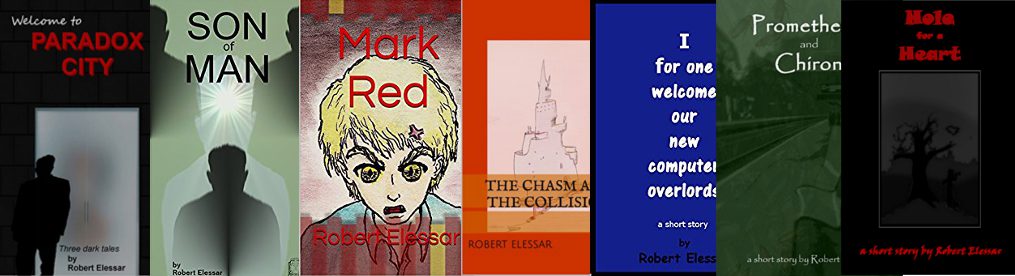
I had a good habit going when I was writing fiction for a long time there.  Starting when I was up at FSP West I wrote three to four pages of fiction every day, and kept that up for nearly ten years, I think, writing or editing on every work morning but Thursdays, and I produced a lot of material given that time frame.  Here, just take a look on Amazon at my list of author’s works*.  There are many titles there.  Mind you, there is some redundancy, in that my short stories that are available individually only for Kindle are also collected into Dr. Elessar’s Cabinet of Curiosities** along with two stories that don’t appear elsewhere.

I was “triggered” to think about such things yesterday afternoon when my coworker was telling me about watching It: Welcome to Derry, and discussing how other things from the Stephen King universe are involved in it, as well as other characters.  It sounded pretty nifty, though I don’t know that I’ll ever watch it.  What it made me think most, though, was how my fictional universe(s) is/are interconnected in many ways, and that they’re all also connected back to the first full-length novel I ever wrote back in high school, called Ends of the Maelstrom.

I lost the original draft of that when I lost nearly everything else I owned—and things far more important even than all that—back in 2012.  But I know the story, of course, and I could probably rewrite it more or less as it was, if I just chose to do it.

But I bemoaned the fact—as I said to my coworker—that I don’t seem able to write fiction anymore, even though thinking about that combined universe writing makes me think about my many unwritten stories.  As I said to my coworker, I really wish I could finish Outlaw’s Mind, though it will end quite sadly, and is already very sad.  I gave him some minor spoilers, which I felt were fine, since he’s unlikely to read any of it, ever.

Of course, not too long ago I wrote my little sci-fi story Extra Body, which is really meant to be kind of funny, in a way, but I couldn’t even get to the point of editing that very much, let alone publishing it.  And I haven’t made any further progress on DFandD.

I wish I had the energy to write new fiction, but all my energy reserves seem to be used up, or at least I am trying to get the dregs out of the container every day.  But every day it gets harder just to make it to the next day.  I’m exhausted, I’m always in pain, I have no real rest and nothing to which I look forward.  If I had a simple “off” switch, I might just flip it.

The trouble with that, of course, is that if it literally just stopped me, it might be possible for someone else to flip it back on and I would have to resume just as I had been when I flipped it off (so to speak).  It might be better to go into a cocoon like Adam Warlock and metamorphose into the next stage of my existence, but I don’t appear to have that option.

I’m very tired.  So very tired.  Indeed, I’m so tired that I’m writing sentence fragments.

Maybe I’ll try to share my various works on social media, to see if anyone picks up on any of them.  I doubt they will, but it’s possible.  After that, I don’t know.  It’s nearly the end of another pointless year, albeit one with one saving grace, perhaps two.  I don’t really look forward to seeing the next year.

But I probably will see myself to writing tomorrow’s blog post.  In the meantime, I hope you’re all doing okay.


*There’s some book in there by someone else that has a sort of similar title to one of my books (Son of Man), but the author’s name is nothing like mine, so I don’t know what the heck is up with Amazon’s software that it put that there.  It’s sort of annoying, but it’s not worth the effort to try to get them to fix it.  They didn’t even carry any Hanukkah-themed gift card boxes or envelopes this year, which really makes me feel a bit disinclined to buy from them as much as I have in the past.

**That one is available in hardcover, and it ought to arrive before Christmas for most people if you wanted to order it as a gift for someone.

For ’tis your thoughts that now must blog our kings

Hello and good morning.  It’s the first Thursday in November today—it has to be so, since it’s the 6th, and there are only 7 days in a week, so there could not have been a prior Thursday in November, there being no “negative numbered days”.  QED*.

I’m writing today’s post on my mini lapcom, as I call it, which I decided to bring with me to the house yesterday, just in case.  Possibly I was persuaded by my discussion in yesterday’s post about the prospect of writing and writing and writing, on some future day, to see how long I could just keep writing off the cuff, impromptu, without a script and without an agenda, with only bathroom (and food) breaks.

I realized that was not something I would ever want to do on my smartphone.  Not that it couldn’t be done, it just wouldn’t be as much fun.  Also, I think the bases of my thumbs would probably swell up to twice their baseline size if I did that, and I might never be able to use them again.

I don’t know what subject or subjects to address on this first Thursday post of November in 2025 (AD or CE, whichever you prefer), but that didn’t stop me from writing nearly two hundred words before even beginning this paragraph.  I guess maybe this is how most casual conversations go, isn’t it?  People just sort of start talking and see what comes out of their own mouths and the mouths of their interlocutor(s).

I suspect that, a decent portion of the time, most people in a conversation are only slightly more “surprised”** by what another person says than they are about what they say themselves.  We don’t tend to think ahead before we speak, at least not in most interactions; we hear our own thoughts even as we’re enunciating them.

So it is with my writing—at least my nonfiction (though my fiction very much also just happens).  I rarely know ahead of time what the next word will be.  I certainly don’t know more than a word or two in advance, unless I’m really focused on making some specific point that’s going to require specific words.

I guess it’s not entirely unlike the way LLMs produce words and so on.  They don’t exactly plan it out ahead of time.  The various weights in the network interact in whatever way they do, which has been influenced by their “training”, and they come out with the next word and the next.  They don’t really have any clearer, linear, step-by-step processes that they would understand (in detail) themselves.

That’s not to say they couldn’t in principle know the weight values of their nodes (I think that’s the term usually used), and could literally copy those weights into other places to run an AI that starts off identical to the original—it’s much easier for software to do this than for wetware like human brains/minds.  But they couldn’t discern and work out the logic, the steps, the process in detail of how and why they work they way they do specifically.

This is the good ol’ Elessar’s Conjecture (which I suspect is a law, or else I wouldn’t conject it):  No mind can ever fully and completely understand itself, because each data processing unit, be it neuron or a transistor or whatever, does not have the information processing power to describe itself, let alone its interaction with the rest of the network of which it is a part.

Intelligence cannot ever be a simple process, I’m very nearly certain of that.  And nonlinear, neural network style “programs” are not simpler just because we can grow them far more easily than we can write out the program for an actual AI.  We don’t know how they work—not in detail, sometimes barely even in vague terms.  They just “grow” if we follow certain steps.

But you can grow a plant in a similar fashion.  Heck, you can grow a new human if you follow a few relatively simple and often not unpleasant*** steps.  But could you “write” a human?  Could you design and them build one, biochemistry to brain and all?

If you can honestly and correctly answer “yes” to that question, what the hell are you doing reading this?  We need you out there solving all the world’s problems!  Maybe you are, though.  I could hardly expect to know better than you what actions you should take if you are such an incredible mind.  Maybe you know exactly what you’re doing.

I doubt it, though.

Nevertheless, perhaps we only truly understand something when we can actually design and build it, piece by piece.  We do not understand our AIs.  What’s more, they do not understand themselves, any more than you and I understand ourselves in detail (though I think we’re currently better at that than AIs, but we’ve had a lot more practice).

Okay, well, I passed 701 words just a moment ago, so I’ll bring this post to a close, having once again meandered into surprising territory, though I hope it’s at least mildly interesting and thought provoking.  I’ll just close with the notion that, perhaps, if one wishes to take drastic, revolutionary action to save the world from great crisis, one should not act against specific human political leaders and the like, but one should rather sabotage server farms and related parts of computer infrastructure.  It is relatively fragile.

I’m not saying I recommend this, I’m just…thinking “out loud” on a keyboard.

TTFN


*That’s the old quod erat demonstrandum, not quantum electrodynamics, though kudos indeed to the Physics community for making one of the best science acronyms ever in QED.

**By which I don’t mean “startled” in any sense, though that can happen.  I just mean that one doesn’t know ahead of time and so one’s own speech is as much a revelation to one’s consciousness as is that of others.

***For good, sound, biological reasons:  Creatures that enjoy sex are far more likely to leave offspring than those that do not, so over time, such creatures will tend to comprise the vast majority of any population that reproduces sexually.

Words about fear and words about words

Well, it’s Saturday again, and for the second week in a row, I am writing a blog post.  I warned you that I probably would:  here, go take a look.  See?  I told you.

Of course, a blog post means I’m going to the office today.  It’s not a full day, but it chews up so much of the middle part that there’s no possibility of getting any extra rest, at least not for me.  For instance, I have awakened well before I would need to go to the office, but my anxiety or tension or whatever it might best be called does not let me sleep‒for fear of oversleeping, I guess.  It’s some manner of fear, anyway.  It’s not a fear of physical attack (I think) but it sort of feels like I have to watch my back, as though someone or something is out to get me.

Fear is not the mind killer, of course, despite the popular mantra from Dune.  Fear (up to a point) can sharpen the mind, if it’s not resisted inappropriately.  I think the 12th Doctor’s take on being scared is far better than that from Dune.  See below:

Obviously, too much fear is bad, but as Stephen Fry, playing the unscrupulous tobacconist points out (starting at roughly the 2:45 point here), that’s what the term too much means.

Too much of anything, more or less by definition, is bad.  This is one of those somewhat rare circumstances in which one can say “by definition” and not be relaying a merely semantic point without substance.

This is in contrast to the silly old conundrum “If a tree falls in a forest and there’s no one to hear it, does it make a sound?”  If you simply define your terms precisely, there is not going to be any ambiguity in the answer‒but you have to choose your “definitions”* of each word clearly, especially ones like “hear” and “sound”.

If you’re ever arguing about something (other than etymology and/or usage and/or diction) and you want to go to the dictionary to settle it, then you’ve probably been arguing about something without substance‒arguing past each other, as they say.  I’ve heard such arguments, even between people with seemingly above-average intelligence.

Of course, if they’re arguing for fun, as a sort of mental sport and exercise, and if they both (or all) are enjoying the process, then I have no trouble with it.  It probably sharpens their thinking skills, as long as they don’t let themselves forget that they’re just arguing over misaligned coding and the logical implications thereof.  Even a skilled martial artist who trains purely for exhibitions may be in real trouble in a street fight against serious opponents.

But even the OED doesn’t decide or define what English words mean; it records what words have been used to mean, their origins, their etymology, all that good, interesting stuff.

How did I get on this subject?  I guess I’ll see as I do the editing.  I certainly do bounce and meander in my head, don’t I?  And that process is often inextricably intertwined with writing.

That can be a good thing, sometimes, I suppose.  I would think it’s at least related to the nature of creativity.  But it’s also important to be able to focus and stay on point, to be disciplined, if one is truly to create anything of depth.  One of my biggest problems in the past was that I would come up with, for instance, good story ideas, but I would soon get distracted by some new story idea and get diverted from the first.

One of the best things about having been to prison‒yeah, there were a few good things, though they were strongly overwhelmed by the bad‒was that I was in a situation in which I could discipline myself to write every morning, when lights came on (about 3 am) for 3 to 4 pages, and not go on to a new story until I finished the first.  I mailed the pages out to my Mom, Dad, and sister as I went along, after rewriting them for a bit of legibility**.

In this fashion, I wrote first Mark Red, then CatC, then Paradox City.  Then, after I got out, I continued writing, finishing one story before starting the next, right up until I began Outlaw’s Mind.  That was the last story I started in that pattern, though I’ve since written a bit on The Dark Fairy and the Desperado and even less on HELIOS.

Currently, I just write this every work day.  I cannot explain why in any quick and simple fashion, but it is what it is, as the tautology goes.

I hope you have a good day.  I should be back on Monday.


*I put that in scare quotes because in nearly all cases, words don’t have real, singular, exclusive definitions, but instead have usages.  Now, as the person who coined various words in, for instance, The Chasm and the Collision, I can actually and literally define those words.  I have actual authority over those words; I created those words and I created those worlds.

**I kept my first draft so I would be able to go back and check things if I needed to do so.

Bing-bing-bing! Ricochet Robert.

I’m in a rather unusually bad amount of pain this morning, even for me, so please excuse me if my thoughts are somewhat incoherent or distracted or grumpy-seeming.  Though I don’t know how you would be able to tell if I’m grumpier than usual.

It’s Monday yet again, and it’s only been two days since my last post, not three, because I worked on Saturday, and on that day, I also wrote a very angry blog post.  I think some people might have found the degree of malice I expressed on Saturday disquieting or at least just not good, which I can understand.  I tend to think of such terrible things a lot more often than most people do (though I share them only infrequently); it’s one of the reasons I find my own company unpleasant.

But, of course, I’ve tried to compensate for my dark tendencies by doing as much good in the world as I’ve been able to do, such as by becoming a doctor.  I’ve never actually acted on any of my darkest impulses and dreams, except when I write horror stories, or when I write non-horror stories with horrible elements in them.

I guess maybe that’s one of the things that’s been therapeutic for me about writing fiction.  Maybe the trouble is right now that I don’t have a good outlet for my terrible thoughts.

Of course, I know that the idea of thoughts and emotions as “substances”, as if some manner of fluids, which can build up and need release is not merely incorrect, but is not even a good analogy for how emotions and other neurological states work.  This is part of why meditation is far more effective against stress and tension than is, for instance, the often counterproductive notion of catharsis.

Of course, sometimes things that work well for neurotypicals don’t work nearly as well for those on the autism spectrum*.  For instance, there is apparently some reasonable evidence that cognitive behavioral therapy, which often works quite well for neurotypicals with depression, is not as effective and can even be counterproductive for autistic people; we already tend to over-self-evaluate our cognitions, and so the tricks and workarounds of CBT often are not merely redundant but miss the issues entirely.

Along a line of possibly similar nature, I’ve written before about how meditation often serves to reduce my anxiety but at the same time worsens my depression.

And yes, in case you’re wondering, I think it’s all a matter of neurological states‒or neurohumoral states if you want to be slightly more precise.  I’ve spent nearly my whole life interested in such things; still, I have found neither evidence nor argument that has so far persuaded me that there’s any significant credence to the notion that humans are anything but temporary patterns of matter/energy, “spontaneously” self-assembled like any termite mound/colony or beehive/swarm**.

Once that pattern breaks because it can no longer sustain itself, due to injury or age or what have you, there is nothing more to it; it’s a hurricane that has passed.  There can be records and traces of its passing, and the damage it has done can linger for a long time, but there is no “afterlife” for weather patterns.

People are more complicated than hurricanes, at least in some senses, I will admit that.  But more intricate complexity doesn’t tend to make things more durable; it makes them more fragile, ceteris paribus.

Of course, all else is almost never equal.  Nevertheless, it’s often useful to consider complex matters as partial differential equations in more than one variable***; one explores the equation by holding all but one variable constant and differentiating or integrating along only one variable at a time.  As long as one thinks carefully about such things and never forgets that one is holding the other variables constant‒and by not forgetting, hopefully avoiding the oversimplification of one’s model of reality‒one can penetrate a great deal by recognizing when powerful tendencies persist even given the fact that other variables can influence matters.

For instance, the metallicity**** of stars influences the size at which they undergo certain levels of fusion, which is why it is thought that the earliest stars had different lifespans and luminosities relative to mass than later stars (like our sun).  But they still, overall, behave like stars, and the bigger ones shine brighter and last a shorter time than the less massive ones.  They are more alike than unalike, the narcissism of small differences notwithstanding.

Well…that tangent, or series of tangents, sure took me down unexpected paths!  But I guess that’s the nature of tangents; in any nonlinear but continuous function (even one as simple as a circle), there are a functionally infinite number of possible tangents.

I think that’s the right mathematical metaphor; isn’t it?  I guess it doesn’t much matter.  I’m just expressing my highly stochastic thoughts (I doubt they’re truly random) as they come.  But they would probably follow different courses if I did not express them in this fashion.

I hope your own thoughts are less troublesome to you than mine are to me and that you are at least at some degree of peace with yourselves and with each other.  You might as well be, though I know that’s not enough to guarantee it.  Still, do what you can, okay?


*Which I am, as you may know; I have written at least in passing about my recent, quite late, diagnosis.

**I don’t mean “like” here as “the same as” but rather “in the same fashion as”.

***My terminology is a bit sloppy here, but I’m not trying to be mathematically rigorous, I’m just trying to get my thoughts across with some clarity and accuracy.

****To astronomers/astrophysicists, a “metal” is any other element but hydrogen and helium (this no doubt irks chemists).  The earliest stars would have been almost entirely hydrogen and helium, certainly to start off.  Mind you, even later generation stars like the sun are still by far mostly hydrogen, but seemingly small “contaminants” can have noticeable effects on big systems, as in the fact that water vapor and carbon dioxide markedly affect Earth’s atmosphere and surface temperature despite being present in tiny amounts compared to nitrogen and oxygen.

Celebrate good times? Come ON.

I had a notion this weekend that I would write this blog post on Sunday afternoon/evening and set it up to publish itself‒so to speak‒this morning.  Then, I would use this morning to perhaps review an/or rebegin HELIOS, or maybe to work on Outlaw’s Mind or DFandD.  I even thought I could write any of those‒especially HELIOS‒on my smartphone, since I have them on Google Docs as well as MS Word.

So I thought, anyway.  When I looked, though, I found that I don’t actually appear to have any version of HELIOS on my Google drive, so it must either be on Word or I never typed in the little bit I had of it.  Of course, I could have just decided to restart and bring one of my spiral bound notebooks and write in that.  The only trouble with doing it that way, if I write during my morning commute, is that I eventually have to retype everything into one of my computers or smartphones.

Now, I have never done the thing* of handwriting a first draft and then copying it into a phone, but I have done that with handwriting and computer word processors.  That method has produced some of my best stuff (by some measures), including Mark Red, The Chasm and the Collision, Paradox City, and even part of The Vagabond, though that last one was written mainly on WriteNow on a Mac SE.  So, maybe the handwritten-to-smartphone idea could actually work pretty well, now that I think about it.

Anyway, all that’s fairly moot, because I did not in fact write this blog post on Sunday afternoon nor yet on Sunday evening.  I am writing it, as I usually do, in the morning, in the midst of my commute to the office, which is so effing early, but which is nevertheless far later than when I woke up.

I’m more than a bit disappointed in myself for failing to carry through with that idea, but it’s easy to think of ideas that seem so doable when you first think of them.  And they are doable, of course.  Not only is it physically possible for me to have written this post yesterday evening and to set a precedent of doing the blog posts in the evening and writing fiction in the morning, it’s banal.  If you told someone that had happened, they would be unlikely to do much more than shrug and say something like a noncommittal “cool”, before going on their way.

But as we all know‒or should know‒it’s much easier to intend to do things in the future than it is to muster the motivation to do them in the moment when one was hoping to do them.  There are many shifting, often conflicting, drives in the human** psyche, and our actions are born of a kind of vector sum of all those “forces” in any given moment.

But not only do those forces shift due to things as seemingly mundane as one’s current state of appetite or fatigue, but they are also affected by what one has done immediately before; for the outcome of that vector sum in one instant feeds back on the system in numerous places, changing the sum (I was going to write “changing the calculus” but I thought that might be mathematically confusing and even misleading, since I am not discussing calculus) with every new iteration.  These iterations and changes aren’t quite happening on the scale of the Planck time***, but they happen quickly‒certainly at least at the “speed of thought”, whatever that might be.

Even the physiological, hormonal, energy state of the body from moment to moment changes those vectors, sometimes a great deal.  If you find yourself needing to use the bathroom while you’re trying to accomplish some task, it can certainly change the state of your concentration.  And if you should suddenly begin to have difficulty breathing, it will distract you from pretty much anything else.

That’s why on airplanes they tell you that, in case of cabin depressurization, if you’re traveling with someone who needs help putting on the oxygen mask, put yours on first, before you help your companion.  If you can’t breathe, your ability to help anyone else is going to tank very rapidly.  We can live weeks to months without food, days without water, but only minutes without air.

On a less extreme angle, if one is hypoglycemic (for whatever reason), it strongly affects all the functions of one’s body, particularly one’s neuroendocrine system.  Less extreme but more persistent issues can sabotage one’s focus upon much else.

I don’t need to tell you, probably, that pain makes it much harder to focus and bring effort to bear on other things.  This is one of the most annoying aspects of chronic pain:  one does not quite ever become accustomed to it, because that would miss the whole biological point of pain.  Making pain something you could ignore would be a bit like making a fire alarm that plays soft, easy-listening elevator music at unobtrusive decibel levels.  It would be less annoying, but being burned to death in a fire is a bigger issue, even if it isn’t very likely.

Of course, if your (typical) fire alarm is stuck on, you may not ever be able completely to ignore it.  You also will not know when there is a real fire. Or at least you will be less likely to know.  And since that can potentially be a matter of life and death, the chronic alarm, like chronic pain, is in its own manifold ways life-threatening.

All that is very tangential to my original point, which was that I am writing this blog today, not writing fiction (at least not this morning on my commute).

Oh, well.  If there’s one day I can let myself get away with slacking a bit, I guess it’s today.  I hope you all have a good one.


*How’s that for clever, descriptive writing?

**Or whatever I am.

***Though the processes that underlie them do.

The return of the Desperado?

Well, it’s Friday, and I’m glad to be able to tell you that I don’t feel as overwhelmed as I did yesterday/Wednesday evening.  I’m not sure what has made the difference‒I have a hard time recognizing my own emotions, let alone decoding them‒but I got some good advice from an old* friend yesterday.  First, there was just the blunt confirmation that, yes, this stuff was in my head (which I knew in principle, but sometimes it pays to get it from outside oneself, particularly from someone who knew me since before I had even met my now-ex wife).

This friend also gave me the good advice that, if I don’t know what to do, I should just do nothing, and not worry about it too much.  Those are my words; he put it better.  He also gave me a meditation reference/link that was helpful.  I like meditation in general, though I have to be careful with it, since sometimes it can soothe anxiety but make my depression worse.  I strongly suspect that, if I could just stick with it, that side-effect would fade, but it’s quite intimidating, since my depression is often literally life-threatening.

I also want to apologize in general, and in spirit, for the implicit (but not intended) disparagement of my youngest child in yesterday’s post.  They definitely don’t deserve anything but praise and affection and love from me, and I mean the word ”deserve” here, despite it being a word I think often has no useful meaning in the contexts in which it is used.  I could not be prouder and more delighted than I am with my child (and my other child as well, except that I would be much more delighted if he would “speak” with me).

Okay, let’s not dwell too much on that stuff.  That’s the kind of rumination that can start a spiral.

In other news, I decided yesterday to start reading what I have written so far of The Dark Fairy and the Desperado, just to see if I liked it and maybe, perchance, if I would want to pick it up and work on it again.  It’s one of three stories on which I have at least a beginning (the other two are Outlaw’s Mind and HELIOS, though the latter is only barely begun).  It’s hard for me to tell if it’s any good, because as far as I can recall, I haven’t received any feedback on DFandD or Outlaw’s Mind, though I have posted them here.

If someone out there did give me feedback and I have forgotten, I do apologize.

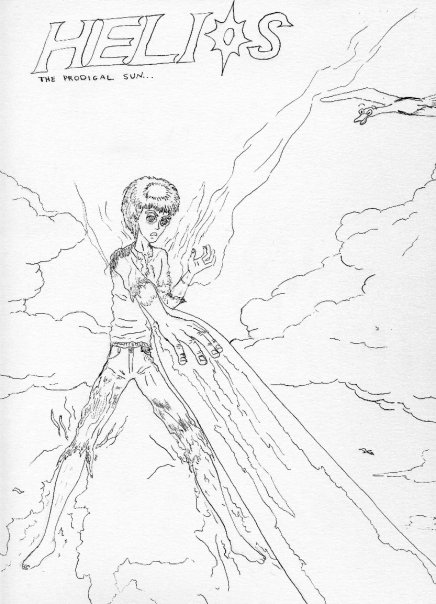
Anyway, so far I quite like The Dark Fairy and the Desperado.  It’s got some subtle, meta-level humor in it, and the two characters therein are figures I’ve probably drawn more pictures of than any other, even Mark Red.  I’ll embed a few of them here, below.

I don’t know if I’ll pick back up on any of these stories, but I welcome any input from readers, though I cannot promise I will follow your recommendations.

Part of me thinks it would be most fun to write HELIOS.  Some of that feeling is because he/it began as my idea for a comic book superhero waaaay back when I was little**.  Also, since I’ve barely made a start on that story, I could in principle try to write it on Google Docs on my smartphone, but overlapping to a larger computer when desired.

Although, that latter plan suffers from the drawback that my mini-lapcom doesn’t really get internet access when I’m commuting, so access to Google Docs is limited.  Also, to be honest, I can write MSWord documents from my smartphone as well; it’s just that the phone app for that word processor is much more cumbersome and less fluid than is Google Docs, though the latter is not as good a word processor overall.

We’ll see what happens, I guess.  I don’t have to do anything, as my friend said, though it’s so hard for me to internalize that, when I’ve spent my whole life doing goal-directed behavior, and thinking that I really had to do things, to be productive, to achieve, in order to justify my continued existence.

But what if my continued existence isn’t justified?  What if no one’s is?  That seems reasonable and consistent with observed facts.   Perhaps it is merely the case that those things that exist do exist and that’s really all there is to it.  If you exist, then you are a fact in the universe.  It cannot have been any other way than to have you in it, once you are there.  If you were not in it, it would not be the same universe.  And it is the same universe.

That all doesn’t quite merit a QED (unless one refers to quantum electrodynamics), but I think it’s pretty definitive, nevertheless.

So, for now, I’ll just exist and not worry too much about doing anything.  This is reminiscent of the wu wei advice of the Tao te Ching, which I like, and other great old eastern philosophical traditions.  Not that I like them because of their age or where they arose; that would be silly.  I like them because they make sense.

Anyway, below are those pictures with which I threatened you.  Some of them are pretty good, I think, for a truly self-taught amateur.  I still would definitely appreciate any feedback about my partly-begun stories and what your thoughts are on which you might be most inclined to want to read.  No matter what I do, if I start writing fiction again, I think I will nevertheless keep writing this daily blog.  I would hate to leave all my countless readers (heh) high and dry.

Please have a good weekend!

*By “old friend” I mean he’s a friend I’ve known for a long time (almost 40 years!) not that he’s old.  He’s more or less the same age I am, give or take a few months.  I guess that’s “old” from a certain point of view, but it’s not old enough to start collecting retirement benefits.

**This may mean that, overall, I’ve drawn the most pictures of that character, but the pictures are of very different quality to one’s I’ve drawn as an adult.

For they blog between term and term, and then they perceive not how time moves

Hello and good morning.  It’s Thursday, so of course I’m writing my “traditional” blog post, with my “traditional” salutation and ending.  I haven’t written the ending yet, but I will, and of course, when you’re reading this, I will have already written those four closing letters—like a vortex manipulator, it’s a kind of cheap and nasty time travel.

I’m writing this post on my mini lapcom, the device formerly known as a laptop computer (to me, at least), because I thought it would be good to write my traditional Thursday post on my traditional type of device.  It’s all very exciting, obviously.

Except of course that it is not exciting.  Nothing is exciting.  There are many worrisome and alarming and infuriating and disgusting things happening in the world and in my pseudo-life, but they are not exciting.

I can’t even feel one of my turns coming on.  Rather, I think I’ve been in “one of my turns” in a low-key way for quite some time now.

I’m very tired.

I wish getting out the lapcom got me fired up to write some new fiction.  I certainly have plenty of story ideas and plots and whatnots in the back of my mind.  But I have no energy to act on them.  By the end of any given workday, I can barely drag myself onto the train to go back to the house, to be honest.

Then, of course, there’s the current washing machine problem.  The machine has finally been delivered, but the old, broken machine is still in place, so the new one hasn’t been installed, and I’m not sure when it will be.  I’m eating into my savings, such as they are, buying new clothes in the meantime.

The need to buy new clothes is particularly irritating, because—quite apart from the expense—I had no desire to buy any, possibly ever again.  New clothes are for people who have a future toward which they look with at least some degree of positive anticipation.  I do not see my own future with any good feelings.

Speaking of the future and not having one and also writing fiction, I thought of an amusing, cautionary tale, a fable of sorts, recently.  Imagine a young man—this sort of story really only works with such a protagonist—who finds a literal genie in a lamp and is given the traditional three wishes.

For his first wish, this young man asks for the ability to stop other people (and things) in time, imagining/planning various nefarious deeds he might undertake while people are “frozen”.  The genie is puzzled and seems troubled, but he grants this first wish.  Soon, the young man finds himself in a situation where he wants to test the power, but when he turns it on a chosen target, as soon as he does, the person just…vanishes.

The young man summons the genie, saying the power didn’t work, panicking a bit about what happened.  The genie explains that the person for whom he stopped time vanished because they simply did not continue past the point in time at which they had been frozen.  So, they did not exist in any future time, and they never would.

The genie had wondered why the young man wanted that power, but he had granted it.  Unfortunately, this deed cannot be readily undone; they cannot bring the person out of the past using the young man’s power as it is.  To change that power and to bring the person back would require the use of the two remaining wishes.

Will the young man choose to do it?  Will he correct his error?  Or will he continue to have the power, now using it as a weapon rather than the for the lascivious means for which he had imagined using it?

I admit, it would be kind of interesting to have such a power.  It’s reminiscent of the ability to send people “away” that the main character had in Stranger in a Strange Land.

What would you do with such an ability?  I would probably use it in morally questionable ways, myself.  But there certainly are people about whom it can safely be said that the world would, overall, be better off if they stopped moving forward through time.

Incidentally, this process would not run afoul of the principle of conservation of energy.  That conservation principle, like all physical conservation principles, is dependent upon the symmetry of the system—this was demonstrated by the genius Emmy Noether in her famous theorem.

The conservation of energy is (or, rather, it would be) a consequence* of the time symmetry of the universe.  But the universe is not symmetric in time, not on large enough scales.  So, on large enough scales, energy (and thus also mass) is not conserved.  Locally it tends to be, because locally, time is symmetrical to a good approximation, rather as the local surface of the Earth is approximately flat on a small enough scale…or rather like the way a small enough portion of any continuous curve can be arbitrarily closely matched by a straight segment on a small enough scale.  This latter fact is the source of the power of calculus.

But just as one can have a local hill or curved shape on the surface of the Earth, one could—in principle—violate local conservation of energy given the right available manipulations.  Now, we in the real world cannot do such a thing, at least not right now, but presumably it would not be beyond the power of a genie.

Okay, well, that’s all pretty stupid, I know, but what do you expect?  It’s me, after all.

I hope you or y’all have as good a day as you possibly can, which you will have, since there is no other possibility.  That doesn’t mean it will be a good day.  It will merely be the best possible day you can have, even if it’s horrible.  Still, I do hope that for you, at least, it will be good.

TTFN


*An interesting term to use, given the current subject.  It has a relation to the order of things in time:  con (with) sequence (ordering of things).

“What hears with their ear? The abyss between the stars.”

Well, I did bring the mini lapcom with me when I left work yesterday.  Nevertheless, I am writing this blog post on my smartphone.  There are specific, calculated reasons for this, but I’m not going to bore you with them, because they are only relevant to me.  But please, do tell me if you notice that this change has affected the quality of my writing, for better or for worse.

Okay, that’s that out of the way.  Now, on to more interesting things.  It’s the first day of October, my favorite month, although the reasons it has always been my favorite month are almost all effaced here in south Florida, in the current state of my “life”.  Still, it is the month of Halloween, and of Cooger and Dark’s Pandemonium Shadow Show, and all of that, so it still holds its position as number one month, as well as being the eighth and the tenth.

A few years ago‒it feels longer‒I set myself the task of writing a “short” story to honor the month of October (though the story didn’t have to be set in the month of October).  That led to Hole for a Heart, which is not my darkest story*, but my sister says it’s my scariest story.  I’m sure that’s pretty subjective, but it warms my own heart-shaped hole at least a bit to have written a quite scary story.

I wish I had the gumption to write something new again for this month.  If I did, the lapcom would be better for writing fiction than the smartphone, though the latter might keep me from going too ham on the whole thing, i.e., writing too much.

But I have a sort of feeling of learned helplessness about writing fiction, as well as about music (writing it and even just playing it) and art and science and everything else I do.  I put a lot of energy into things with almost no return, certainly not one commensurate to the effort involved.  Eventually, I just feel like an exhausted rat lying in the bottom of his cage, knowing that no matter what choice he makes or action he takes, he will be randomly shocked and otherwise tormented.

It’s not that he doesn’t care about the pain or the other stuff, he just knows the pain will come no matter what, and that has taken almost all the possible joy from being creative.  This is especially so when the creativity goes almost entirely unnoticed, like a sculpture made on the ISS and then promptly launched from there into deep space without anyone having seen it but a handful of astronauts.

I don’t know what it might take to rekindle (no pun intended) my writing or other creative sparks.  Maybe if I just had less pain it would do.  Unfortunately, the pain seems just to add new flavors and textures to itself over time; it doesn’t diminish.

I guess maybe that could be considered creative in a sense.

It’s a curious sort of irony, but I know that writing fiction seemed to stave off my depression, at least a little.  One might think it would be exhausting, writing 1400 to 2000 words every workday (except when editing/rewriting, which was its own grind).  Maybe eventually it was, and that was what led me to stop finally, since there was no real reward to it after a while, since almost nobody buys the books and/or reads them.

I don’t regret having written my stories, of course, nor my songs, nor any drawings I’ve made, nor my blog(s).  But over time I’ve had rapidly diminishing relative returns on the fiction writing and on the music and such.  The returns on this blog, relative to the effort, are shrinking more slowly, and occasionally there seems even to be an uptick, but the overall trend of basically everything except my personal knowledge** is downward.

I don’t know when the y-axis overall will cross the origin‒for many particular things, I think it has long since done so‒but I suspect it’s a finite distance, and I’m not decelerating, so I will cross it eventually.

Sometimes‒indeed, pretty much every day and twice on Sundays, ha ha‒I think to myself the metaphorical equivalent of “Where is that fucking x-axis?  It’s time for this to be finished already.”  If I had a goal, or anything significant toward which to look forward, things would probably be different.  But I don’t, and they aren’t.  That’s logic for you.

Well, anyway, this evening begins Yom Kippur and my fast.  Whatever you all are doing, I hope you have a good day.  I expect that I will be writing to you again tomorrow.


*That would be Solitaire.  I’ve told the story of that tale’s origin here before, I think, so I won’t get into it now.  If I am misremembering, let me know, and I’ll try to tell you the curious but not very exciting tale of a very dark tale indeed.  Oh, and if you want to read either of those stories but don’t want to do the Kindle thing, they are both featured in Dr. Elessar’s Cabinet of Curiosities, which is so far my only work you can get in Kindle, paperback, and even hardback!

**I do think that I am always learning new things and improving my understanding of things I knew from before, and I have a good memory, especially for things in which I’m interested.  That’s all well and good, and I’m glad of it, but knowledge in my head is only as good and as durable as my head is.  Eventually, as Roy Baty said, all these moments will be lost in time like tears in the rain.

Discussions of my “first draft” styles and a bit of shameful self-promotion

I wrote yesterday’s post on my miniature laptop computer‒what I call a “lapcom” if you remember, and even if you don’t‒and today I am writing this on my smartphone, because I didn’t feel like lugging the lapcom when I left the office.  It’s not done deliberately (by me), but I am curious about something.

You see, to my surprise, yesterday’s post appears to have been rather popular and successful.  I say “to my surprise” because to me it felt rather disjointed and erratic and like it didn’t go anywhere.  I’m not sure why that is or to what it is in response, or indeed, whether it was merely a fluctuation in a chaotic system and had nothing whatsoever to do with any particular thing I had done.

Still, as you may know, I do feel that I write differently when using different tools for doing it.  On the lapcom, I tend more easily to run off at the page, if you will, because typing on a word processor is just so easy and natural for me.  That doesn’t necessarily make the writing better, though.  I fear that I get too verbose sometimes.

And, of course, writing on the smartphone is less fluid, more cumbersome.  It also tends to exacerbate the arthropathy in my thumbs, for what are probably obvious reasons.

Pen and paper‒for first drafts, anyway‒ is certainly my most long-standing method of writing, and I don’t think I tend to get quite as carried away with that as with typing.  I suspect, but don’t by any means know for certain, that the things I write by pen and paper‒the fiction, at least‒are somewhat better, or at least more fun, than what I write on either a phone or a computer.

Here’s a bit of a rundown.  The following stories I wrote by hand in the first draft, having no other options:  Mark Red, The Chasm and the Collision, and my long short story Paradox City.  I also wrote my stories House Guest and Solitaire with paper and pen, the latter in one sitting, the former way back in high school.

I wrote the first draft of Son of Man at least partly on a very small smartphone that I really liked.

The Vagabond is a bit of a mixed bag.  I started it while at university, and finished the first draft while in med school.  Part of the first draft was written by hand (i.e., with pen on paper) but most of it was written on a Mac SE using the good old word processing program WriteNow.  Does anyone out there remember that one?

The rest of my stories, at least the published ones, were written on mini laptop computers (well, some here and there would have been on full-sized ones) from the beginning.  Most notable of these, perhaps, is Unanimity, which is very long.  But many of my “short stories” were written on regular keyboards, including the other two stories in Welcome to Paradox City, and my “short” stories, Prometheus and Chiron, “I for one welcome our new computer overlords”, Hole for a Heart, Penal Colony, Free Range Meat, and In the Shade, the latter of which‒like House Guest‒appears only in my collection Dr. Elessar’s Cabinet of Curiosities.

Oh, right, and of course Outlaw’s Mind, Extra Body, and The Dark Fairy and the Desperado have all been written (so far) on the lapcom.

If anyone out there has read a sampling of some of these, or all of them, and can give me any considered feedback on any overall difference in quality between the means of writing, pros and cons, I would certainly appreciate it.

And if any of you haven’t read any of the above, well…what are you waiting for?  If you’re a fan of fantasy/sci-fi/horror, you might like some or all of my stuff.  If you’re not sure where to start, by all means, I’ll give you recommendations based on your personal preferences, if I can.

I suspect that The Chasm and the Collision would have the broadest popular appeal, especially for people who like the Harry Potter books and similar stories.  Son of Man is probably my purest science fiction story, but this is not “space opera” type science fiction.  “I for one welcome my new computer overlords” is basically science fiction*, too, in case the title didn’t clue you in.

Everything else is horror of one kind or another.  Most of my horror is supernatural in one sense or another, and I veer into the borders of Lovecraft’s universes in at least two stories**.  Mark Red is supernatural and in some senses horror-adjacent, since it involves vampires and so on, but it’s really more a teen/young-adult supernatural adventure, a story originally intended to be a manga.

My darkest story has no supernatural elements in it at all.  That’s Solitaire; it can be had in stand-alone form for Kindle, and it also appears in the middle of Dr. Elessar’s Cabinet of Curiosities.

Well, that’s been about as much self-promotion as I think I’ve ever done here before.  I didn’t really intend to do it, but once I got going on discussing my various story drafts, it just seemed to go that way.  I hope I haven’t been too insufferable.  I’m really not a raving egomaniac, though I may be some other type of raving maniac.

I hope you all have a good day.


*And I guess Extra Body is sort of light-hearted sci-fi.  It’s even somewhat comical, as my story If the Spirit Moves You is a sort of supernatural comedy (expect no laugh-out-loud moments, though, since they are dry comedy at most).

**The Death Sentence, which appears in Welcome to Paradox City, and In the Shade, mentioned above and in my other collection.

A random, walk-in blog post

It’s Monday again, despite popular demand, and I am here writing another blog post‒not necessarily against or by popular demand.  It’s really more or less orthogonal to such things.

I had a weekend full of little setbacks, and it was quite frustrating.  I had committed to riding my bike four times this weekend, and I started in good form.  I got out relatively early and went riding.  It felt pretty good, pretty comfortable, but I decided not to push too hard, only riding out about 3 miles.  Walking 3 miles is relatively far if it’s hot, but biking 3 miles is not bad at all.

Then, of course, just after I turned around, my rear tire lost pressure.  I don’t know where the puncture was, but I had to walk the bike back to the house.  And 3 miles walking a bike is much more unpleasant than riding or even walking without a bike.

I ordered some Slime brand tire repair stuff for same day delivery, but then it got delayed till Sunday (it actually arrived very late Saturday night).  Then, on Sunday, in between loads of laundry, I tried to repair the tire (so to speak) but at first I had trouble getting it to work, and it wouldn’t stay inflated.  Finally, though, it seemed to stabilize, at least without my fat ass on it.

I was going to go for a short ride to test it, but I couldn’t stand the idea that I might have to walk it back again.  So I went for about a 2 mile walk instead, which is really not very far, but then overnight and into now my back really flared up and is annoying the heck out of me.  Also, my right ankle is sore again.

So I’m frustrated in my attempt to develop better habits and health.  I also had some failures by Uber Eats that were annoying, but that’s a minor issue.  Then yesterday my internet went out and I had to deal with their customer service people to help get it going again, which took way longer than it should have taken.

I suppose all this is really minor stuff, so-called first world problems.  But things accumulate and interact with each other, especially when you don’t really have any outlet for anything and nothing to counteract them.  It might be better if I had someone with whom I could just hang out on a regular basis, but I feel like a different species than the people around me, and no one is offering, in any case.

This is all boring for all of you, I strongly suspect, so I apologize.  It’s bad enough for me to be unpleasant to myself, but I should try not to bring misery upon other people, especially people who are kind enough to read my blog.

Last week was certainly a miss with respect to getting anything done on any music or songs.  I didn’t so much as sing or play keyboard or play guitar at all last week, not once.  I did some reading, including finishing rereading The Chasm and the Collision, which is the book of which I am proudest.  If anyone out there knows people who enjoy fantasy/sci-fi adventures involving middle-schoolers, you should consider suggesting that they check it out.

I don’t know how this week is going to be.  I’m starting it in well-above-average pain, for me, and with worse sleep than usual (though that was the case most of last week as well).  I don’t think this guarantees that it will be a particularly bad week.  The world is complicated, and small things can make relatively large changes, and large things can sometimes be surprisingly ineffectual*.

Maybe I would get started writing fiction again and do it better if I did the first draft of a story by hand (as I did with CatC as well as Mark Red and the title story in Welcome to Paradox City).  As long-time readers will know, I go back and forth about this all the time, and I think I’m probably just chasing my tail.

I have all these dreams and ambitions, and I know I have the ability to carry them out, in some sense, but it’s very hard to keep the will, the motivation.

I’ve said before, I’m sure, that depression itself seems almost to be an illness of the will, a sort of muscular dystrophy or amyotrophic lateral sclerosis of the mind, though I think its causes and complications are much more intricate and multivariate than at least the first of those two comparisons.

I think for a fair amount of those who suffer badly from it, depression makes them want to kill themselves, but depression is also what keeps them from killing themselves; they cannot bring the effort to bear.  This is part of why the beginning of antidepressant therapy in a depressed person with suicidal ideation can be dangerous.  Such a person may begin to feel capable of getting things done, but not optimistic enough to avoid suicidal ideation, so they can sometimes use that new energy to act to kill themselves.

In any case, that’s not really the subject on which I was focused during this post.  I don’t think I’ve really been focused at all in writing this.  I don’t really know what subjects and topics I’ve raised.  I suppose you will know, more or less, having read this far.  And I guess, by the time I edit this, I will know.  But I don’t know right now.

It’s not important.  But one thing that is important is that I hope you all do your best to have a good day.


 *In the movie version of The Lord of the Rings, Galadriel says to Frodo that even the smallest person can change the course of the future, espousing a sort of rudimentary Chaos Theory.  But what does it mean to “change the course of the future”?  If the future has a course, it is defined and determined by the laws of physics, and any seeming “changes” were part of that process, so the course of the future is not “changed”, it is merely instantiated in whatever way it always is.