2 kinds of ASDs and an NTD called SBO all considered by a pitiful SOB

It’s Friday, and this weekend I am not working, which right now seems like a highly positive thing, because starting yesterday in the middle of the day, I suddenly had a huge flare-up of my back/hip/leg pain.  I’m not sure what triggered it.  I’m always trying to see if I can tease out (and test) the causality of such occurrences, but of course, it’s a tricky business, with so many possible variables.  I wondered if it was something I ate‒I had a specific type of food in mind, that I had not eaten for a while‒or was it partly because of my severely poor sleep the night before?  What was it?

It was frustrating in more than the usual sense because, after having walked to the train that morning and not having any problems from it or the previous few days’ longish walks, I was planning to walk in the evening again.  Unfortunately, I did not feel up to such a thing when the time came, so I took an Uber to the house‒after getting some comfort-oriented ice cream at the Cold Stone Creamery*, a place I’ve not visited in over a decade‒and then another one to the train this morning, since I still feel rotten.

It’s noteworthy that, when I am in more severe pain than usual, my willpower to resist indulgences that I want to resist gets quite a lot weaker.  I suppose that trying to compensate for and deal with the pain diverts mental resources that would otherwise be pointed toward self-discipline.  I had a big hot pastrami sandwich for lunch yesterday and then that ice cream, but they were both far less satisfying and pleasant than I would have expected.  I don’t think I’ll ever get either one again.

I’m always trying to think about my back pain and the things that trigger and assuage it and so on, and occasionally‒though for the most part it’s all well-trodden ground‒I come upon some possible connection that I hadn’t seen before.  Yesterday, while thinking about my then-present back pain, I thought back to my childhood leg pains, which I think I’ve mentioned here before.  When I began having my current problems (about 20+ years ago), they first presented as a recurrence of the kinds of pains that I had as a child, quite similar in character.  This led to various investigations to look for neuromuscular or myopathic processes, but I had no myopathy**.

Having more recently researched connections between autism spectrum disorders (which I might have) and congenital heart disease (which I certainly did have‒Atrial Septal Defect, secundum type‒because I had open heart surgery for it when I was 18), it yesterday occurred to me that there might be other associated anomalies.

I think it was while I was browsing biomedical news related to neurodevelopmental stuff on a site that’s linked with phys.org (which is a science news site that I enjoy and recommend) that I saw something about neural tube defects related to autism spectrum disorders.

Neural tube defects (NTDs) occur when the neural tube‒the embryonic infolding that creates the cavity that becomes the sort of scaffold and center of the spinal cord and central nervous system and its supporting structures‒fails to close completely on one or both ends.  It’s mainly to prevent these that potentially pregnant women in the modern world are encouraged to take daily folate supplements.  NTDs can be utterly catastrophic, producing forms of anencephaly and various types of severe and lifelong neurological impairment, or they can be comparatively mild, all the way down to spina bifida occulta.

neural tubeadjusted

That latter term describes the situation when, at the very lower end, the spinal bones and what not are not completely closed at the rear.  The “occulta” part refers to the fact that there are no noticeable external findings that show the presence of the incomplete closure.  The most commonly affected portion of the spine is in the L5 and S1 vertebral bodies (lumbar and sacral, that is) with somewhat incomplete rear closure.  These findings are, according to what I have read, not always noted on MRI unless it is looking for them specifically.

diagrams of sacral spina bifidaadjusted

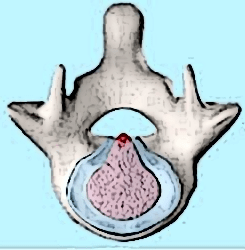
It is noteworthy (to me) that when my back was investigated, including “provocative discography”, I had not just a bulging disc but a full thickness tear in the L5-S1 intervertebral disc, going all the way from the outer edge to the nucleus pulposus.  Imagine one of the pieces of Freshen Up gum, with the goo in the middle of each stick up gum, but torn inward from the edge so that the central liquid leaks out.  That’s the sort of thing I had.
annular-tearadjusted

And it was in the rear of the intervertebral disc, just where any SBO might have left poor structural support.  No one noticed SBO in my back when they were working me up, but they weren’t looking for it, nor even looking at the bones in particular.  No one (including me) suspected any skeletal issue.  And SBO can be very occult, and may present, conceivably, with only very minor, hard to notice changes.

I haven’t yet mentioned that one of the findings that can be associated with SBO is bed-wetting.  I had trouble with that, in addition to my frequent and rather severe childhood leg aches, far later than my siblings…in fact, I never heard of either of them having that trouble at all.

It turns out that the correlation between congenital heart disease and SBO is quite high as such things go, more so than either condition’s correlation with autism spectrum disorders.  Of course, most people with congenital heart problems do not have neural tube defects, and vice versa, but the existence of one involves a prevalence of the other that is quite a lot higher than in the general population.

So, though I cannot arrive at any firm conclusions, I know that I had congenital heart disease, I have lifelong neurological and psychological attributes that seem (to me) to be consistent with what would have been called Asperger’s Syndrome before about 2013, and I had symptoms (and signs) that could very well correlate with the presence of a minor form of Spina Bifida Occulta***.

Also, of course, my physical findings when my back was investigated for a resurgence of leg pain in mid-adulthood are consistent with a structural weakness in the posterior region of L5-S1, such that my disc damage or injury was markedly worse than most I’ve seen in patients with whom I’ve been associated, or in descriptions of disc disease.

Alas, I no longer have, nor have access to, my former radiographs of any kind, nor medical notes or surgical notes.  I could be incorrect in this assessment of possibility, and I certainly don’t put my credence very close to 100%.  But I think I’ve nudged myself at least past the 50% point.

Whatever the case, I have chronic pain now, and I’ve had surgery in my back and implanted matrix with bone growth factor there and a titanium cage, so it’s probably all too messy ever to discern if there used to be a very minor case of SBO in the past.  Until and unless someone develops a means of scanning the past such as the Father invented in my book Son of Man, which uses complex time (and a phenomenon I made up) to be able to scan the past of quantum fields without running afoul of the uncertainty principle, I’m unlikely ever to know with anything close to certainty.

I’m convinced that our firm credences of any of the facts of reality can never actually be 100%‒I personally don’t even consider “I think therefore I am” to be completely valid, since even my consciousness might be part of some much greater mind’s imagination…though I suppose in that case, it would still be valid to say that “I am”, just that what I am would be different than what I seem to myself to be.

But for all practical purposes, it’s reasonable to go with Descartes, though.  Most other aspects of reality are, as he pointed out, less certain than we often suspect them to be‒except when they are more certain than we expect them to be.  

I hope I haven’t bored you too much with these thoughts.  They seem interesting to me, of course, but I recognize that’s no guarantee that anyone else will find them anything but mind-numbing.

It would be nice if I could find a way to get better answers than I have on questions of personal neural tube defects or neurodevelopmental disorders, but even textbook findings of such disorders are somewhat misleading, because we don’t have MRIs (or similar) of everyone in a population and symptoms or signs to correlate with findings.  Indeed, almost by definition, the MRIs and CTs and X-rays of people with such issues are going to be those with the most obvious and glaring findings.

Oh, well.  Reality is often disappointing.  But at least thinking about these things is momentarily engaging.

I won’t be writing a blog post tomorrow, barring the unforeseen, so I hope you all have as good a weekend as you can have‒which you will, since whatever happens will be what has happened, and will not be subject to change once it has (It’s always the best, and the worst, of all possible worlds, in a sense).  So, I guess it might be worth it not to worry about it too much.  But, of course, you also don’t have any choice about whether you worry about it or not, once you’re worrying about it****.

Even if there are “many words” a la Hugh Everett, you still only will experience one version of your life.  The fact that another of you might have it better (or worse) has no bearing on your experience in any given Everettian branch, unless it’s possible for the wave function branches to interfere again after decoherence, which is, in principle, possible, but so vanishingly unlikely that it seems not worth considering.

Enough!  Please have a good weekend.


*It was disappointing.  My tastes seem to have changed over time, perhaps due to Covid or perhaps to other matters, but some things I used to like don’t seem to please me anymore.  In this case, that’s probably just as well.

**Myo- for muscle and -pathy for “something wrong with”.  It’s a fairly basic term that reveals almost nothing beyond its prima facie meaning, but it sounds impressive because of the Latin.

***I should note that leg pain is not part of the traditional symptom list of SBO, but intermittent leg weakness is definitely a part of it‒and my leg aches were associated with some radicular type symptoms, such as apparently being associated with notable temperature change in the affected extremities.  At least, it was notable by our family dog, Ernie, who would often unerringly come and lie on my affected leg when I was in pain, just in the right place, as if to provide warmth and comfort.  He was a good dog!  Anyway, disorders rarely exactly follow the textbook descriptions.  As I’ve often said, diseases don’t read the literature.

****Rush were simply wrong; you cannot choose free will.  It either is or it isn’t, but that’s not up to you.

Write till your ink be dry, and with your tears moist it again, and frame some feeling blog

Hello and good morning.  It’s Thursday, as you may already know, though if you’re reading this later, you may not.  But now you do know, just in case you care.

I’m writing this at the train station, where I just missed a late previous train because the elevator was slow.  I would think they might have been willing to hold the train for the 5 extra seconds it would have taken for me to board‒certainly, the conductor saw me getting off the elevator.  I would respect their desire not to delay if it were not for the fact that they were the ones already running late, according to a schedule that they had promulgated.

They certainly have no leg to stand on with regard to other people taking an extra moment to get on the train, when they are late almost every day.  If they ran consistently and reliably on time, I would respect their demands for punctuality from passengers.  But it is not so.  They are merely hypocrites.

Anyway, I wasn’t planning to get on that train in the first place, because I wasn’t on time for its scheduled departure.  I’m just irritable.

I’m also getting sick‒and not just in my usual, everyday way.  I have a low-grade fever (about 99.7 or so by core temperature) and feel achy and crappy and have a bit of a dry cough.  It could be Covid, I suppose, but I don’t give a f*ck.  Covid was disappointing in that both times I had it‒before and after vaccination‒it didn’t even come close to killing me.

Boo, I say.

Anyway, I probably ought not to go into work today, but I don’t know if my coworker will be there.  Supposedly he is going to be coming in, but then again, supposedly he was going to be there on Saturday, and I ended up getting a last minute Uber to the office (for which the boss has not offered to compensate me, by the way).  So, I’d rather go in and, if my coworker comes, perhaps leave early.

Ideally, I should have taken a 4-day weekend of sorts.  I should just have rested.  Unfortunately, we are not very civilized about such things here in this part of the world.  If I were like so many other people at work‒having a poor time sense and less than ideal work ethic‒I guess I would just indulge myself and give a mental “up yours” to everyone else.

For reasons of which I am far from certain, however, I don’t seem to be built that way.  This has led to me being taken advantage of quite a few times, sometimes continuously, in my life.  That’s probably a large part of what landed me in prison‒being used as a target and a dupe because I wanted to help people with chronic pain, since I suffer from it myself and knew the prejudice such people face.

I guess I was and am stupid, huh?  I don’t see myself changing this characteristic, except to the extent that avoiding it underlies my unwillingness to get very close to anyone.  I sure as Hell* don’t want any romantic entanglements.  They tend to cause me nothing but heartache and heartbreak, though I am at least truly thankful for my children.  I could never regret anything that led to their existence.  After that, though‒especially after 2013, which was when I last actually saw my kids‒all bets are off, and everything is pretty pointless.

Yes, I know, I wrote my books and stories and have done this blog since then.  Again, I say, everything is pretty pointless.  I’m not persuaded that those things‒this thing‒never having happened would be any loss to the world whatsoever.

Whenever I get sick these days, I hope that it will turn into something like pneumonia and perhaps kill me.  I’d prefer not to die of dysentery, but that would be tolerable.  And I’d rather not get meningitis or encephalitis, just because if I survive I might have brain damage that I wouldn’t like.

Reality rarely seeks one’s opinion of course‒a case in point is that I am still alive even after all those opportunities for pneumonia, and my open heart surgery and my back surgery and all the rest.

I just got on the next train, which was 6 minutes late from its scheduled time.  It’s so irritating.  Why is it difficult for trains to keep a schedule?  Buses sometimes have some excuse, but why trains?

It’s also a bit over air conditioned on board, at least relative to the platform, where I was literally sweating like a human despite just sitting still.  I’ve mentioned how the extreme air conditioning is just making the world slightly worse overall, and it seems obvious to me, but what are you going to do with the stupid humans?

Don’t answer that.  I have plenty of ideas of my own.  Only some of them involve the Hobbesian** point that humans can provide some important protein.

Anyway, if I do stay out of the office sick tomorrow, I won’t be writing a post before Monday.  And if this URI converts into an LRI or something equally serious and kills me, or at least puts me in the hospital, I might not be writing a post Monday…or indeed, perhaps I might not write one ever again.

If that’s a prospect that excites you‒and why would it not?‒just imagine how exciting it is for me to consider!  And yet, so far, I keep recovering every time.  Dammit.  F*ck you, Biology!

So, in case I’m not here tomorrow writing a post, I hope you all are happy and well and that you collectively have a very good weekend.  Try to stay safe and healthy; I don’t wish the negative things for others that I wish for myself.

TTFN

best-anime-about-illness


*Surer than Hell, really.  Hell is quite unlikely actually to exist, even if there is a God.  What sort of benevolent deity would punish for eternity the souls of people It created because they were imperfect?  How about doing some teaching and training and corrective maintenance, instead?  How about doing a better job at creating people?  I’ve often said, if even one person‒no matter how horrible‒is consigned to Hell for eternity for the deeds of a human lifetime, then a God that arranged such a thing is unworthy of worship.

**From Calvin and Hobbes, not the author of The Leviathan.

“People have this power–the numbers don’t decide”

It’s Saturday again, as I warned everyone would happen if we didn’t do something to stop it.  Unfortunately, no one appears to have listened, so, well…here we are again.

Of course, as I also warned you all, I am working today, and so, here I am writing another blog post, just like all the others.

Except it’s not quite exactly the same as all the others.  And, given the 1000 or so words per blog post, and the number of possible words there are available, even avoiding random jumbles of characters, the number of possible blog posts that I could write is probably far greater than the number of potential days I have left in any plausible human lifetime…or any plausible universal lifetime short of infinity, probably.

Let’s do some quick and dirty math.

I’m going to estimate very roughly, because I only have vague (but educated) intuitions, but let’s assume I start any given blog post with a choice from a list of maybe twenty words.  That seems like a decent ballpark figure.  After that, there are only a limited number of potential next words that would make any sense and that I might be inclined to use.  I’m going to cull that down to 10 options per each next word, and I’m going to ignore individual word probabilities and predominances relative to other words.  I’m also going to ignore the fact that I often write more than 1000 words per post.  We’re just being quick and dirty here.

So, with 20 first words, then ten to choose from for each next word, if we assumed more or less random sorting among those, we’d have a potential number of blog posts of roughly 20 x 10 to the 999th power, or 2 x 101000 possible blog posts.  That’s a staggering number of possible posts, each just a thousand words long.

How staggering is it?  Well, the famous number “googol”, is 10100 (ten to the hundredth power, or 10 times 10 times 10…repeated a hundred times).  It can be written as a 1 followed by 100 zeroes.  That number itself is roughly 10 to the 19th times as large as the number of baryons in the entire visible universe.  In other words, that’s ten billion billion times as many.  That’s more than a billion times the number of people alive on Earth now times the number of baryons in the universe.

But that’s just a googol.  A googol is so small compared to 2 x 101000 that if you subtracted a googol from 2 x 101000 the change would be so unnoticeably small that to notice it, one would require a precision far beyond the most precise measurement humans have ever made.  We’re talking about one part in about 10 to the 900th power.  That’s rounding off!

The best we’ve done as far as comparing experiment and theory goes is the magnetic moment of an electron‒or maybe it’s the fine structure constant, I’ll have to check on that (no, it’s the electron one).  That has been measured to agree with theory out to about the 12th decimal place, if I remember correctly.  As Feynman has said, that’s like measuring the distance between NYC and LA to the precision of the width of a human hair (which is far more precise than would in any case be useful or even applicable for such a distance measurement).

Anyway, the point I’m making is that the number of possible blog posts that can be a thousand words long with a few‒admittedly somewhat overgenerous‒constraints is staggering.  If I could write a blog post every Planck time for the rest of the life of the sun* I wouldn’t even make a dent, not a noticeable scratch or scuff in that number.  And you can’t really do more than one quantum event in any given Planck time, if I understand correctly, anyway.

So, I’m not going to run out of possible blog posts any time soon.  Even though I’ve probably overestimated the number of words I’m likely to use following any given previous word‒and I haven’t weighted the odds as would some GPT-like language model that creates text without thinking, based on huge numbers of things other people have written‒it’s still such a huge number that it’s too large really even to contemplate seriously.

And yet, time after weary time, I write blog posts about very similar things, such as my pain and my depression and the fact that I could really use some help from someone.  It’s very boring, I guess.  I apologize.  If you’re looking to diverge very much, I guess my blog might not be the ideal place for you.  But, of course, the huge majority of all possible blogs that would fit my above-listed criteria would be gibberish**, so we don’t want to get too caught up in those numbers.

It’s a bit like thinking about the human genome.  There are, I think, on the order of a billion base pairs in the human genome, and each “slot” has 4 potential nucleotide “letters” (adenine, guanine, cytosine, and thymine) so the number of possible genomes is about 4 to the billionth power, or 2 to the 2 billionth power…and every 210 is roughly 103 (210 being 1024),and 21000 is about 10300 so 2 to the billionth is about…1027,000,000, if my calculations are correct.  I’m not sure they are, but you get the idea.  It’s a big f*cking number!

Most of these orders of base pairs would not designate a human, nor even anything that could live at all.  So let’s whittle things down in truly draconian fashion and say only 10 to the 90th are potentially viable***.  That’s still far more potential humans than the number of baryons in the visible universe.

I think you can see that we’re never actually going to instantiate that number of humans, since each human is made of a substantial number of baryons…it’s something like 1027, but that’s just a ballpark figure****.  So, unless we find a way to generate a lot of new baryons, and fit them into the visible universe without causing the whole thing to collapse upon itself due to gravitational effects, the whole of actual humanity will always be a sea of unimaginably untapped potential.

I think we all kind of knew that, anyway, didn’t we?

Likewise, the number of actual blog posts I‒or anyone else‒will ever write before the heat death of the universe (assuming that’s the way things end) is embarrassingly negligible.  But we work with what we have.

And speaking of that, I guess I’d better mentally prepare myself for work, since I am already on the train.  I hope you all have a good weekend.  Whatever you do, it will probably be more interesting than anything I’m going to do.  Believe it or not, I find some consolation in that fact.


*It’s about 1060 Planck times:  1043 Planck times per second times 60 seconds per minute times 60 minutes per hour times 24 hours per day times 365.25 days per year times about 5 billion years.

**I mean even more so than my actual blog posts are.

***Don’t make the mistake of thinking that’s a reduction by 26,999,910/27,000,000. It’s way more of a reduction than that.  Don’t be fooled by the comparatively small numbers in exponents.  We’re taking a number that was 27 million digits long and making it only ninety digits long.  If you subtracted the second number from the first, it would be such a small change you’d have to look out well past the 26 millionth digit even to see a difference.

****Again, don’t be confused by the relative closeness of the exponents and worry that we’ll run out of baryons soon.  10 to the 27th is vanishingly small compared to 10 to the 81st.  In fact, curiously, 1027 x 1027 x 1027 = 1081.  Every single gram of hydrogen contains 6 x 10²² atoms, and obviously the number of grams of hydrogen in the universe is waaaaaaaaaaaaaay bigger than that!

A somewhat more positive blog post. That may not be saying much, but take what you can get.

Well, it probably won’t surprise those of you who read my previous post to learn that I left the office early yesterday‒at lunchtime‒and came back to the house where, after eating a bit, I took a melatonin and half a Benadryl.  I’ll say this for that group of meds:  it was only a few minutes after taking them that I felt a strong pressure to sleep, and so I did.

Some of that may just be fulfillment of expectation, and I was, of course, very tired, but they are supposed to be rapidly dissolving melatonin tablets.  Benadryl never seems to act very quickly on me, so I hesitate to credit the fast onset of sleep to it.

I did wake up quite a lot during the night‒about like usual‒but at least the night was effectively longer, and I don’t mean that in the sense that it felt like it lasted a millennium, as I said yesterday about Monday night.  I mean that I was in bed for a good ten hours roughly, and that at least is something special.  I regret to have to inform you that my pain is only slightly abated, but with a bit of rest, at least it’s slightly easier to tolerate.

I’m writing this on my phone today, by the way, because there was no way in hell I was carrying anything I didn’t really need to carry when I left the office, and that meant no laptop computer.

I think I’m going to try to take just a melatonin in the evening tonight, to see if it works to help me drop off.  The fact that I still reawakened frequently throughout the night at least somewhat assuages my fear that I might oversleep if I take it.  I’m too tense about oversleeping anyway, so short of a general anaesthetic, I’m unlikely to sleep through my alarm.

That raises an interesting point for me.  I clearly have a sense of chronic tension, almost all the time.  I suppose it might be called an anxiety syndrome, but that never feels like quite the right term to me.  I don’t feel “anxious”, like I constantly want to run away, figuratively, but more that I’m constantly ready to fight.  Maybe that’s just an example of different people’s reactions to the same process‒the sympathetic nervous system function of fight or flight, which in me seems to tend powerfully toward “fight”.  Thus, in my song Breaking Me Down, I sing, “I always want to hit someone, but I never get in fights.”

I was strongly trained by my father not to get in fights unless it’s truly, absolutely necessary, and I think that’s good training.  But I always feel ready to fight (not necessarily physically, though that’s always an option).  I even keep weapons (nothing that can accidentally go off!) at my side when I sleep and in the office.

I know, that’s a bit weird.  It’s not that I actually expect to be attacked.  Of all the people I know in the office‒and most other places, really‒I am the one most likely to be inclined to violence, but I have always had exceptionally good impulse control.  I’m not even prone to act on wholesome impulses!  But if I need to get in a fight, I do want every advantage available.

In a sporting situation, fairness is important, but in “real life” I have no interest in fighting fairly.  A fair fight is one where you have a fifty percent chance of losing.  I want to bring that chance as close to zero as I can if things really matter.  I will cheat in any way I can if it’s a fight about something important, and I will feel that I have done right.  The leopard doesn’t offer its prey a head start if it can help it, nor does the prey wait until the leopard has a fair shot at it to run away.

Anyway, enough of that pseudo-macho stuff.  I just mean that, almost all the time, I feel defensive/semi-aggressive, though I strongly dislike getting in arguments (or fights, really), and even feel mortified and ashamed and self-hating if I make a heated comment online.  Sometimes I even feel nervous when I make a positive comment, as though I fear having to deal with anyone responding to me, even if that response is also positive.  It’s weird.  I suppose, to some extent, it’s probably simply the fact that I have always felt weird, like I’m crazy, like I don’t quite function like the people around me, even within my own family.  I think I’ve mentioned that here, before.

All that tension does wear you out, though, and if not tempered, or at least counter-balanced, by positive things, it can make life very unpleasant.  I’m not sure what to do about it, though.  Meditation can soften it, but as I’ve mentioned, meditation often seems to make my depression get worse.  That’s not much of an improvement, if at all.  So, I have my ongoing conundrum.

I don’t know, also, how much‒if at all‒that tension contributes to the worsening of my chronic pain.  It’s possible that it does a fair amount.

In any case, I would say that I probably have some version of chronic anxiety, but that it doesn’t present as what I would call “anxiety”.  I don’t feel worried or afraid, I just feel hostile and often even hateful.  If the Force were real and I had any affinity for it, I don’t see how I could avoid the Dark Side.

Anyway, I’m going in quite early to catch up on things I let go yesterday because I could not focus at all on anything important.  But this pain and this tension and this depression are really grinding me down, and I don’t know how much will and energy I have left.  I’m very, very, very tired.  Maybe if I use the melatonin every day, I’ll gradually feel at least a bit better.  Just because it’s not globally useful doesn’t mean it couldn’t help for certain people in certain circumstances.

If it doesn’t help, I don’t know what I’m going to do.  I keep speaking (or writing) about giving up and dying, but I keep on trying to find solutions or at least palliatives to my physical and psychological difficulties.  And I keep retrying lots of things that have failed before, in a sort of desperation to do something, anything, to see if I can feel less unhealthy.  I’ve not had a lot of luck, but maybe I would have been worse without the various things I’ve tried.  There’s no way to know, since I can’t compare alternate realities.  There’s also no way to know that I might not have been better than I am if I hadn’t tried to combat my dysthymia and pain.

Oh, well.  I’m probably wasting my time and my efforts.  But, if anyone out there knows of any brilliant new ideas, please let me know…but remember, they should probably be truly new, or at least not cliché.  I’m a trained MD, and I’ve read about and tried a lot of things beyond even that extensive training and practice.

The world isn’t made for us, and certainly we were never born to be comfortable.  It’s the feelings of dissatisfaction that prod us to act to stay alive and to thrive and to reproduce.  That’s good engineering, like smoke detectors being hyper-sensitive and fire alarms being extra jarring.  But if the smoke alarm gets stuck in an active position, leaving the alarm always going, eventually you’re going to want to cut power to it, and to hell with the risk of fire.  And if you can’t shut it off no matter what, eventually, you’re either just going to deafen yourself completely or leave the house.

That’s metaphor, of course.

I hope you all have a good day.  If you’re able to get good nights’ sleeps regularly, please make sure not to take it for granted.  And have a nap in my name, if you can!  I know it does me no actual good, but somehow it seems like a nice idea.

3 billion heartbeats, and what do you get?

Well, it’s Wednesday morning now, as one might expect, if one lives life linearly and ordinally, which is how I do it.  I’m writing this on my little laptop computer today, because my thumbs have been getting sore from the use of the smartphone for blogging—more precisely, the base of my thumbs and my first MCP joints on both sides hurt quite a bit.  Also, I just type faster on the laptop, and It’s easier for me to express myself, though why I ever bother doing that is not quite entirely clear to me.

I feel pretty rotten still—physically, I mean.  I still have body aches and soreness and weakness (or at least asthenia) and a general feeling of being slightly breathless.  I still had a very low-grade fever as of last night, but I checked my oxygen, which was 95-96% saturation, occasionally pushing up to 97%, and my pulse rate was in the high-90s to low 100s, a bit variable with respiration.  That’s actually slightly low for me.  All my life I’ve tended to have a rapid pulse, possibly related to the atrial septal defect with which I was born, which can affect the heart’s inherent pacemaker and conduction system because of its location.

Apparently, the average number of heartbeats in a lifetime for a human (or closely related alien) is about 3 billion.  This is more than that of most mammals, which hover a little below two-thirds that many, if memory serves.  That number is roughly consistent from shrews to blue whales.  Geoffrey West discusses some of this in his book Scale, which is really interesting, and I recommend it.  As for me, I haven’t read anything in over a week, really, other than a few blog posts.

I just did a quick calculation regarding my chronic, diagnosed “sinus tachycardia”*.  If my average heart rate were 110—which my pulse can hover near, at least some of the time—I should have lived to about 51.8 years.  I’m already slightly past that, but within the realm of rough experimental error.  If 105 were closer to my average, my expected lifespan would be about 54.3 years, which would mean I have less than a year to go.  I figured the first number by dividing 3 billion by 110, then by 60, then by 24, then by 365.25.  I then did the second one by replacing the 110 with 105 and repeating the whole thing, but it occurs to me that I could just have taken 51.8 x 110/105 and gotten the same answer more easily.

So, basically, if my pulse has been steadily tachycardic—which I can only infer roughly based on the moments in which I’ve actually measured it, since I obviously didn’t measure it in between—then I’ve already lived just about as many heartbeats as I’m expected to live, on average.

Of course, there are some big “ifs” there.  There have certainly been times when I’ve been more fit, and that has tended to slow my resting heart rate somewhat.  Also, let’s not be too quasi-mystical about all this; it’s not as though there is some ethereal hourglass that measures out not seconds but heartbeats in the platonic space of life and death.  It’s just a rough average.

If the world is deterministic, then of course, one does, in a sense, have a pre-programmed number of heartbeats before one dies, but there’s nothing about that number that would determine the length of one’s life; it would, indeed, be a consequence of the various things that determine the length of one’s life, just as would the length of that life in seconds.  It wouldn’t be a dispositive fact, merely an epiphenomenon.  It would be casual rather than causal, one might say.

This is all a bit silly, but in many ways it’s reassuring to me that, just maybe, I really have come to what will be the natural end of my expected life.  I’ve read that people on the autism spectrum have shorter expected lifespans than people not on the spectrum (the range is wide, apparently anywhere from 36 to 61 years, which seems pretty imprecise) supposedly largely due to the various difficulties with self-care and social support and the like.

One reads plenty of reported evidence that a key determinant of a long and “happy” life is the degree of one’s social support network—not necessarily its size, but certainly its quality.  Well, when one of the fundamental aspects of a dysfunction is difficulty with ordinary social communication and connection, one can expect a group to tend to have a poorer social support network and ability to self-advocate.  And, of course, the three major proximate causes of death are apparently—according to a quick Bing search—epilepsy, heart disease, and suicide.

As far as I know, I don’t have any form of epilepsy.  I do have a cavum septum pellucidum cyst in my brain, which was discovered by chance on an MRI done for other reasons.  It’s a benign finding, in and of itself, but it turns out to be slightly more common in people with ASD (the neurologic one, not the cardiac one) as does ASD itself (the cardiac one, this time, which I also had).

So, I do/did have at least one form of heart disease, though I don’t know whether it counts in the measure of what they’re describing as such causes.  I think the third thing in the list is by far the most likely cause of premature death for me, if “premature” is really the right word.  After all, my “social support network” is locally all but nonexistent, and is very limited on a distant scale.

Of course, sleep disorders—also apparently very prevalent in those “on the spectrum”—are significant impediments to a long and happy life for anyone, and my sleep has been disordered for a very long time.  As a case in point, yesterday I was so physically wiped out from work and feeling ill that I just took a ride from the train station to the house and tried just to shut off the light, take half a Benadryl, and go to sleep.  Then—to no one’s surprise, but to my frustration—I could not get to sleep until after midnight, and then I started waking up by no later than two in the morning, awakening on and off every ten to twenty minutes until finally there was no point in delaying anymore.

I don’t know why I’m discussing all this trivia.  Maybe I’m just to try to get the message out that, if I do die “young”** in the near-future, which doesn’t seem terribly unlikely, you shouldn’t think of it as something sad, as some kind of tragedy.  My life is pathetically empty, and rather unpleasant most of the time.

I would never say there aren’t people who have it much worse than I do.  Of course there are.  That will almost certainly always be true, by any set of criteria one might choose.  It’s also irrelevant.  There are people who die young who, based on the quality of their lives, would have been better off having died even younger.  And there are those who live very long lives who still could have lived even longer with great happiness and well-being, and so even after a century, such a death could be considered premature by some criteria.  Futility is in the eye of the beholder.

Anyway, I’m dragging this out, as I tend to do.  I just feel very tired, and very uncomfortable, and I don’t have any particular joy, or prospect of future joy, that makes me want to keep going and live longer.  I’m lonely and sad and uncomfortable and awkward and weird, living in a world in which I feel like an alien or a changeling or a mutant, or whatever.

Well, lets call that good for now, so to speak.  I’m going to get a Lyft to the train again today, because I’ve taken longer than I’d like to catch the bus, and anyway, I’m still just wiped out.  I’m going to try to time the train I take so that I get to my destination after the nearest CVS is open, so I can pick up some cold medicine***.  Maybe a decongestant will help me feel like I can breathe a little better.  Who knows?  But I need to do the payroll today, so at least it might help me stay awake for the time being, even if the decongestant effect doesn’t make much difference.  After that, I don’t think it really matters much.


*Nothing to do with the sinuses in one’s head, but with the sino-atrial node in the heart, the intrinsic pacemaker.  It means that one has a fast heart rate—tachycardia—but that its origin is at the usual source of the heartbeat.  It’s not an aberrant source or a reentrant tachycardia such as might occur when the conduction system of the heart develops a loop that keeps feeding rapidly back into itself and generating a truly and significantly over-fast heartbeat.  That can degenerate into more dangerous arrhythmias, whereas sinus tachycardia does not tend to do so.

**Scare quotes added because I do not feel young in almost any way, other than, perhaps, my ability to remain curious about various things in a way that seems unusual in other people somehow.  Many days I feel as if I’ve lived for centuries, but not in a cool, Anne Rice vampire kind of way.  Rather, I feel more like a mortal who has kept one of the Great Rings.  I’ve discussed that metaphor before and won’t bother going into it now.

***I did time it correctly, and the CVS was open…but the pharmacy was not, and will not be until 9 am.  Unfortunately, one cannot get real Sudafed—the decongestant that actually works without causing dangerous elevations in blood pressure—except at the pharmacy counter, and only in limited amounts, because some people have used it to make amphetamines.

This is a truly absurd and sub-moronic standard.  It’s harder for a law-abiding citizen in Florida to get a product containing pseudoephedrine than it is to get a gun, and all so the state can prevent a small minority of people from willingly taking a substance into their own bodies that no one is forcing them to use, just as some other people use beer or potato chips or Big Macs or ice cream…or tobacco.

And, of course, they aren’t actually preventing anything.  If they wanted to prevent drug use, they’d have to try to find out why life is bleak and empty enough for some people that they seek artificial sources of transient mood elevation (even though those sources are dangerous) and perhaps try to remedy or at least remediate the causes.  But, no, the same sort of people who would decry government overreach if corporate or upper-echelon income taxes were raised slightly, or if the government tried to ensure that people are vaccinated to curtail the spread of actual contagion to millions, and who would take up arms in open rebellion against any attempt to restrict gun ownership at any level, are willing to have the state keep people from using a comparatively safe medication for congestion and force them to use more dangerous ones—like oxymetazoline, which I am going to have to use, today.

The law truly is “a ass” and “a idiot”, and it’s written by people who are—and who are voted into power by—cretins and troglodytes who cannot even comprehend the nature of and the science behind the comforts and technologies which keep them alive and relatively safe.  If any readers here have any influence in this particular issue, please try to do something about it.  If necessary, just burn it all—the whole stupid planet—and let nature start over in some new state.  There are still a billion or so habitable years on Earth in which hopefully to bring an actually intelligent species into existence for the first time.

Tsukiyomi no mori no ban’nin, hikage no shinshi, tsuki no tesaki ni narimashou.

It’s Monday morning again.  I can only think of two songs off the top of my head that provide fun references to the day, and I think I’ve used them both more than once, so I’m not going to do that here.  I suppose I could refer to the Carpenters’ song about Rainy Days and Mondays, but that’s a slightly gloomy and glum song, though pretty (and, to be fair, with some upbeat aspects), and I can do gloomy and glum just fine by myself, thanks*.

Yesterday was pretty uneventful, which is not a bad attribute for a day off.  I did my laundry, which was good, and I also got some rest‒I took several naps throughout the day, which, again, is good.  In all fairness, that’s pretty much what I do throughout most nights:  taking lots of short naps and waking up in between.  I even did that on Saturday night after taking two Benadryl before going to sleep.  In fact, I started having a hard time even dozing back off at about 4 am on Sunday.  But that’s just too early to be getting up and starting laundry, even for me.  So I toughed it out until about 6:30.

You’ve got to be hard on yourself sometimes.

Oh, I’m writing this post on my phone this morning, because I just felt too lazy to bring the laptop with me on Saturday.  There was no particular reason to avoid it.  I just didn’t want to bother.  I’m not sure what I’ll do today; I don’t want to force myself to decide in advance.

I’m somewhat disappointed to report that I don’t seem to have suffered any ill-effects, at least so far, of the little experiments that I began the other day.  It’s not impossible that some could accrue yet, but I think I shouldn’t get my hopes up.  It would be such a weight off if I could just start having a GI bleed or something.  Maybe I’m too half-assed about it.

Rat poison used to be primarily comprised of “super-coumadins” in diatomaceous earth**.  That might have been a useful option.  Nowadays, though, most rat poisons (I have checked) seem to be the new neurologically targeted stuff that’s highly specific toward rat nervous systems, and much less dangerous for humans and dogs and cats if they accidentally ingest it.  I know, that’s a good thing (unless you’re a rat or love rats).  But it’s disappointing if you want to have readily available options for encouraging your own self to bleed without a prescription.

Thank goodness aspirin was discovered millennia before the FDA or DEA and has never been used to “get high” by anyone***.  If it were discovered in the modern world, it would never be available without a prescription‒not in the US, anyway.  You even have to go to the effing pharmacy counter to get pseudoephedrine for your cold and allergy symptoms, because some people turned a certain amount of it into amphetamines of one kind or another.

Makes perfect sense, doesn’t it?  Let’s keep a useful and comparatively harmless medicine**** restricted in availability for people who want to use it for legitimate reasons, in order to prevent rare people from turning it into a product other rare people use because they like it.  Remember, illicit drugs aren’t forced on their users.  People buy them because they want them, just like people do with fast food and candy and beer and tobacco and fast cars and the like, none of which are without drawbacks.

Ah, to hell with it.  It would be nice to improve human civilization using reasoned action with actual measurement of end-points and serious attempts to obtain good data, with a goal of improving things overall, in general, for everyone.  But that’s not how humans are built, is it?

I really want to check out of this madhouse hotel.  It’s noisy and garish and smelly and loud, and it’s almost impossible for me to get a good night’s sleep in it.  And I can’t seem to find anything to do here that’s any fun.

Oh, well.  Maybe things will get better this week.  Try not to laugh; that’s me attempting my closest approach to cautious optimism.  I’m not very good at it.

Princess_Tomoyo


*The “pretty” part might be a personal deficiency in my work, I’ll admit, but sometimes you’ve got to let gloomy and glum just be full-on ugly, and not try to sweeten the hit.  I can do that.

**Coumadin is a brand name of warfarin, an anticoagulant that interferes with vitamin K dependent aspects of the coagulation cascade (is that factors 1, 2, 7, and 9, or am I misremembering?) and of course, diatomaceous earth is basically composed of bajillions of microscopic silica-based skeletons of ancient marine organisms (diatoms), which have tiny little spiky projections everywhere.  I believe that the idea was that the diatoms would make lots of little perforations in rat GI tracts, but I don’t know that it ever did much.  Super-coumadins are more than able to induce various kinds of massive hemorrhaging on their own.

***That factor seems to be the main issue with a great many of the drugs that are illegal, if not all of them.  If people can, at will, do something that will make themselves feel good, even if only temporarily, then what carrots and sticks can keep them being fully productive cogs in the spontaneously self-assembled machine?  Caffeine, on the other hand, is by far the most widely used and abused drug in the world but is quite legal‒and Starbucks is the world’s largest drug pusher, followed closely by Dunkin Donuts and then McDonald’s, or those were the rankings the last time I checked.

****The over-the-counter decongestants available are not as effective, are not as long-acting even in slow-release forms, and are associated with significant and sometimes acutely dangerous elevations of blood pressure, even at their usual dosages.  Blood pressure elevation is, generally, only a theoretic concern with pseudoephedrine; I never saw it actually cause secondary hypertension in anyone.

I was out sick yesterday – again. Or is it “still”?

Okay, I’m writing this post—the first draft, anyway—on my laptop, and actually on my lap, because for right now, I’m sitting on the piano bench* in my room at the house.  I’ve decided not to try to walk to the train this morning, since I’m still feeling under the weather from yesterday.

As you may know, I did not write a post yesterday, and as you may have guessed, this was because I was out sick.  I considered getting onto my WordPress account just long enough to write a pseudo-post titled, “NO POST TODAY”, with a single line in the main body:  “I am out sick.”  However, I didn’t feel up to doing even that, and frankly, I don’t think it really matters to anyone out there, anyway.

Anyway, I was out with a very bad headache and fogginess and some nausea, but it didn’t feel like a typical migraine that I might have.  I suspect it might be a reaction to the fact that, upon arriving at the house, thoroughly exhausted, on Wednesday night, I took a rapid-release pill of melatonin.  I was trying to help myself sleep, if it was possible.

I’ve tried melatonin more than once in the past, and I’ve gotten results that generally made me feel worse rather than better, but I was at the end of my rope, or at least near the end, and I just wanted to be able to sleep.  I knew that if I took Benadryl on a work night, I’d feel groggy and slow for most of the next day, so I didn’t want to do that.

The melatonin may have ended up helping me start sleeping sooner and staying asleep longer—it’s difficult for me to tell—but it did not help me feel in any way better rested.  I awoke—well before my alarm, still—after still not having gone to sleep before eleven or so, despite my horrible exhaustion, feeling absolutely rotten, and having chills, though if I had a fever it was low-grade.  I also felt a bit sick to my stomach, though I did not throw up.

I had reconsidered melatonin after encountering a few stray articles in various sources indicating that melatonin might be useful for sleep disturbances among autistic people—these articles might have been focused more on autistic children, as most of the research is—and since I might have “Asperger’s” to use the relegated term, I thought maybe it would be worth another try.

Of course, Matthew Walker, in his book Why We Sleep, the best popular scientific book I’ve encountered on the subject, said that while melatonin may be good for jet lag and the like, it doesn’t seem to be useful for chronic sleep disorders**.  Still, he was speaking generally, and about the human population, not about changelings and replicants and mutant, weirdo strangers like me, whatever I am, so I thought maybe it would be worth something.

I don’t think I’m likely to try it again, at least not anytime soon.

The most sensible thing for me, probably, would be just to give up.  I’m just not going to be able to get a good night’s sleep ever again, not without the aid of significant pharmaceuticals, and then it won’t really be a good night’s sleep, since pharmaceuticals of all kinds interfere with natural sleep functions.

We don’t know quite what all those are, but sleep appears to be incredibly important for creatures with nervous systems, since every single one of which we are aware spends a significant amount of its time in that semi-inert, quite vulnerable state.  You would think, if it were possible to go without it, evolution would have produced some creature that used that option.  But even marine mammals like whales and dolphins sleep, though I understand that they do so with only half their brains at a time.

There is even a mouse (or vole of some variety) in the far north that is capable of literally going into a kind of suspended animation for months at a time, lowering its heart rate and body temperature nearly to zero (C) and decreasing the freezing tendency of its bodily fluids, and basically shutting down like a sci-fi astronaut.  But it has to rouse itself from this cryo-stasis periodically to sleep!  It needs to wake up from suspended animation so it can sleep or else its brain will suffer!

So, again, sleep is very important, and I’m certainly not getting anything like enough of it, and never in uninterrupted spans of more than maybe an hour at a stretch.  I think I must be missing out on some of the dreaming process, too, since I don’t remember dreams at night, even though I wake up quite frequently, and you would think I would sometimes do so during REM cycles.

Also, almost as soon as I attempt meditation, once I focus on my breath and am still for a moment, I begin experiencing strange courses of thought and images and stories that are quite reminiscent of dreams, as if my brain had been champing at the bit to get running with them at the first opportunity.

As I say, I don’t expect to find the answer or solve the problem.  I would just like to reset or else unplug the game at this point.  It’s long since ceased to be fun, and it’s getting more and more tedious.

I came up with an interesting possible means of shutting down the game the other night—Wednesday night, actually—and I made a test run of the delivery system that was encouraging***.  I may do another test today, and in the meantime I’m going to consider possible payloads, though I have at least one main idea that I mean to try primarily.

It comes down to a thing I recall from reading The Chronicles of Thomas Covenant the Unbeliever.  I don’t remember which of the books it was in, but it was  almost certainly one of the first two, and probably The Illearth War.  Thomas Covenant is telling one of his dreadfully dark true stories of the “real” world, about a man from India who was diagnosed with leprosy, and who killed himself during his flight to go to the Leprosarium in Louisiana, after having lost his whole family because of his diagnosis.

Covenant makes the interesting observation that it seems much easier—at least at first—to commit suicide by means that are typical for another culture but are not typical of your own, because they don’t feel as real to you, and so the barrier to their initiation is lower.  I think there is something to that insight, though it must also be balanced against the observed effect that publicly well-known suicides, especially of celebrities, etc., tend to make certain methods feel more normal, more “acceptable”, and like more “reasonable” approaches for people tending in that direction.

Like most things in the world, the system is complex.

But, anyway, my idea is neither really from another culture, nor typical of modern American culture.  It has some antecedents in some old-fashioned things, and its effects would be potentially delayed, which is part of the whole “lowering the activation energy wall” notion.  But it’s really sort of a “uniquely my own” kind of thing, which seems appropriate.

I don’t seem to be able to connect with any other people around me; they don’t understand me and I certainly don’t understand them.  It seems reasonable, or at least predictable, that I would do something atypical or even unique.  It would at least be nice to end things on some original type of note, ironically.

I’ll keep you posted on my progress—probably, anyway.  We’ll see what happens, I guess.  To paraphrase Yoda, the future is always in motion.  Though that may not actually be true, depending on how much (if at all) reality departs from pure determinism, but from the local, “human” point of view, that’s the way it feels, since we’re always simulating the future in our heads as our means of trying to shape it and to guide our own actions.  It feels as though many different things are possible, even if in actuality they are not.

Neo took the red pill, and for the character it no doubt would have felt as if he made a choice that could have gone the other way, but no matter how many times you rewind and replay that moment, it always turns out the same.  Reality may be just like that, only more so.

Anyway, that’s that.  I’m working tomorrow, so you can reasonably expect a blog post from me tomorrow morning, barring the unforeseen (see above regarding predicting the future and so on).  I hope the rest of you out there have a good day.


*Such is its official name, though no piano has ever sat upon it.

**If memory serves.  It’s been a bit since I read the book, though I used both the print and the audio version, so I got a double whammy.  Anyway, it’s possible I’m misremembering.

***No, this wasn’t what caused any of my symptoms on Thursday morning.  The delivery system is inert, of this I am convinced beyond what I consider a reasonable doubt.  My “Bayesian prior” is certainly over 90%, anyway.

The wine of life is drawn, and the mere lees is left this vault to blog of.

Hello and good morning, all.  Though I suppose I should leave it up to each of your own individual intuitions and criteria about whether it really is a “good” morning, and indeed, what such a term even could mean.  But, really, it’s what they call “a polite nothing” I suppose, because it has no other purpose than being a ritual greeting.

Weird.

It’s June 8th.  In 10 days it will be “Fathers’ Day” (I’m not sure about the “official” placement of the apostrophe).  In 21 days it will be my wedding anniversary, so to speak; anyway, it will have been 32 years since I got married, and I will have been divorced for 2 years longer than I was married, which is a crappy, crappy milestone.  I’ve also already gone roughly 10 years without seeing my kids in person, which is getting close to being as long as I was a part of their lives.

What an utter waste of years and effort it has been for me to be alive since then.

I’m writing this on my phone still/again, at the house, before heading for the bus stop.  There’s not much going on so far today, except to note that I had an unusually bad sleep last night, even for me, so I’m starting the day already feeling exhausted.

As you may recall, yesterday I did not take any “antidepressant”, and I likewise have not taken any today.  I did feel less tense yesterday than I had the days before, and that was certainly a relief, but it’s the sort of thing that happens whenever I change something like that.  I had a brief elevation in my mood when I started the Wort, also.  I suspect it’s just a placebo effect, and/or a reverse version of the same.

Anyway, I can’t blame either starting or stopping the stuff for my sleep problems.  They were there before any meds and they’ll be there after them, probably for the rest of my life.  Hell, I wouldn’t be surprised if I were to keep having sleep problems after I die.

Well…yes, I would.  Both the fact of still having sleep problems and having the ability to be aware of them would be quite surprising to me after I’m dead.  In fact, the ability to be surprised would be quite a surprise after I’m dead.  It would certainly be intriguing, as would the fact of being capable of being intrigued.  In fact, it’s hard to see that, if one is capable of surprise or intrigue or any other emotion, one should actually be considered “dead” in any useful sense.

Of course, I don’t think any of that is possible, really.  I’m quite convinced (provisionally, as always) that death entails merely oblivion, which is one of the things that makes it so appealing.  Indeed, my “Bayesian Prior” on that is so high that I would, so to speak, be willing to bet my life on it.  Admittedly, that’s a cheap bet, from my point of view, but I don’t have any right to bet anyone else’s life, so it’s all I have, worthless and disgusting though it may be.

Almost none of the various antidepressants I’ve taken have ever seemed to help my sleep.  Tricyclics, Effexor, Trazodone, Wellbutrin, Celexa/Lexapro and most other SSRIs…they didn’t make it better and some made it worse.  Only Paxil seemed at least to make me enjoy sleeping, which had never happened to me before, but its other effects were not good.  One downside was that I gained a lot of weight, and that’s not good in someone like me, who is constitutionally prone to overweight and its related effects.  That wasn’t the only problem, either.

Anyway, I don’t know why, but my depression, after initially responding to meds and therapy, has become tougher to treat over the years.  I don’t know if this is partly related to my apparent ASD, or whatever form of atypical, non-human neurology I have, or to something about the nature of depression, or to these and other factors mixed together.

What’s more, I don’t think anyone else in the world could actually know, either.  At most, at best, hypotheses could be made and tested, by me and by other medical/scientific people.  But it’s simply a fact that “we”, meaning all consciousnesses of which any of us are actually aware, don’t know well enough the nature of the normal functioning of the brain, let alone the nature of things like depression, dysthymia, autism spectrum disorders, insomnia (or in fact what sleep really does at all levels) very deeply and/or causally.  It’s extremely complex, and not enough resources have been or are put into the study.

We do spend a lot of money on science, but still more on war, and on politics, and on sporting events and so on.  Actually, I don’t know which if any of those things receives a greater proportion of civilizational resources than science does, but it feels as though it would be nice to divert at least some of the resources away from such things and into science.  The advancement of science is something that can benefit everyone, current and subsequent, especially since, once the information is learned, is discovered, it can (in principle) be shared at vanishingly small cost, to the potential benefit of the whole planet and its future inhabitants.

Of course, the company Elsevier apparently owns many of the premier scientific journals‒it did not originate them, it just bought them and is now rent-seeking through them‒and it not only charges a frankly obscene amount for subscriptions, but it even charges scientists who want to publish in the journals.  That is, in a sense, an actual white-collar crime against humanity, against civilization.

Such people deserve to be strapped down onto tables and have one drop of liquid Drano applied to their skin every hour, or perhaps even just every day, or somewhere in between, until it finally dissolves them away enough for it to kill them.  They could be kept alive in the meantime, and suffering for as long as possible, by IV infusions and naso-gastric feeding.

It’s just a thought.  Probably, even if I were given the power and resources to do so without the risk of consequences for me, I wouldn’t actually torture such people.  They’re just monkeys doing what monkeys do, after all.  But I might take away all their wealth and make them work at subsistence level jobs for the rest of their days.  It’s not the worst punishment, maybe, but getting medical and scientific knowledge out of the control of such people would be the real goal.

Anyway, I’m going to need to head to the bus stop here in a moment.  I feel tired and grumpy, and I’m not looking forward to anything about today at all, not even to its end, since the end of each day is merely a prelude to the dismal cycle of the next day and the next and so on.

I never look forward to going to bed, because going to bed merely ushers in the beginning of the next dreary, worthless day, probably to be faced with too little, too fragmented sleep, and with ongoing pain, and without being around or with any of the people I love.  It’s not the sort of thing to which one would look forward with anything better than weary resignation, and often with frank horror and disgust…and sometimes, honestly, with something akin to terror.

What are you gonna do?  That’s life.  It’s not for the faint-hearted.  And I cannot, in good conscience, recommend it without significant caveats and reservations and misgivings.

TTFN

broken wine glasselectronic

Interior decoration in a derelict ruin

Okay…Wednesday, morning, smartphone, my room, starting before leaving for the bus, all that tedious nonsense.

There, that’s out of the way.

I’m really not doing too well, even for me.  Yesterday was quite stressful, for internal and external reasons, though some of the external reasons mean it was a good day for the office.  Meanwhile, I banged my own head (deliberately) so hard and so often that I got a headache, on top of a worse-than-usual day for back pain and sleep the night before.

Near the end of the day, I took to whacking the back of my hand with a heavyish metal tool.  My boss, who knows that sometimes I will thump my legs and sides and things when they are in pain and spasm, asked me, “Is that where it hurts?”

I replied, after a moment, “It is, now.”. He laughed, but I’m not sure he quite got my point or why I was doing what I was doing.  It was an attempt to distract myself not just from other physical pain, but from stress and anger and the overwhelming sensory chaos of the room by inducing pain.  It works for a moment at a time, and this method doesn’t tend to leave marks, other than some bruises at times.  There are other ways that last longer, but they leave marks, some of which can last a long time…some of which, even, are more or less permanent.

I’m trying.  I’m still taking Saint John’s Wort, and I know at a personal and professional level that it’s too soon to expect any major results, but I fear it’s making me feel worse.  I suppose if it at least triggers something, even something catastrophic, that’s better than my present status as some sort of specter* or ringwraith or phantom‒an undead, but without a purpose.

I’m not a zombie; they tend to be mindless, and in a sense, are far less tortured figures than an undead that is aware of itself, that retains a mind and a personality, but is unable to grow or obtain new life.

I’m trying to treat my allergies and respiratory issues, and studying and working on some breathing techniques that seem to be good, but it feels like rearranging the furniture in a house where the roof has already fallen in, the windows are all broken, there’s no light or water or heat, and winter is coming.  I wish I could just lie on the (figurative) sofa and let the cold take me.

I don’t actually have a sofa, though.  Shame.

If I were my patient‒as I’ve said before, I think‒I would consider referring myself for inpatient psychiatric treatment**, but since this particular patient doesn’t have insurance and lives in a state, in a nation, with shitty, shitty mental healthcare, especially for those who are not wealthy, the options are not great.

Better just to let go.

Hang on, I need to go to the bus stop.

***

Okay, I’m at the bus stop now.

My back is really feeling tight and sore today.  It’s very irritating.  I’m trying to do the things that will help it, such as particular stretches and exercises and whatnot.  I’m not riding the bike, I’m using my shoe inserts and knee and ankle braces, all that.  I have roll-ons and creams and the like that are supposed to help, and I take a rather large (and probably toxic) quantity of OTC analgesics/anti-inflammatories.  I even have a semi-portable massage chair at the office, which I bought, and a foot massager I was given as a gift to go along with it.

Nothing is working very well.

The trouble is, there’s no reason to assume that there actually is an answer or remedy for certain kinds of pain.  We have not been honed by nature with a figurative eye toward having a long, healthy, satisfying life, free of severe physical and psychological pain.  We’ve been honed by nature to be able to survive long enough to reproduce successfully and keep our offspring alive until they can fend for themselves.

The thing about chronic pain, both physical and psychological, is that they are invisible to evolution (more or less) because they tend to develop after the age and time of reproduction has passed.  Pain is useful in the short term, especially when we’re young, because it makes us avoid and fix (when we can) damage that might take us out of the gene pool.  Ditto for fear‒assuming that all these things are present in appropriate or relatively moderate levels, of course.

But the functions that work to improve reproductive success when younger, or at least don’t harm it, can persist and worsen and become pathological as time passes, but that won’t reduce the presence of any genes for these functions.  And, of course, the prevalence and levels of most attributes follow a roughly bell-curve distribution in a population.  Most people cluster near the local mean of any given trait, but there are always outliers, and with enough people, there will be individuals who are outliers in more than one, even independently varying trait.

And then, of course, there can be traits that are good for one thing but bad in another way, and which persist or are selected for because the short-term, reproductive good outweighs the downside from the “viewpoint” of natural selection.  The sickle cell trait confers relative resistance to malaria, but having two copies of it can consign one to a truly hellish existence.

Similarly, it may be that attributes that tend to associate with high intelligence‒systematizing ability, certain kinds of imagination, inventiveness, ability to solve certain kinds of problems, certain kinds of intense focus, and so on that can be extremely useful for any group and for individuals, and lead to reproductive success and more general success, especially in modern society‒may lead, when aggregated together in the right way in some individuals, to autism spectrum disorders, ADHD, and/or a tendency toward depression, anxiety, and self-harm.

Who knows?

The bus is coming soon.  I’ve gotta go.  In more ways than one, I really feel like I really need just to go.


*I’m often torn about the spelling of this word.  I prefer the “old-world” spelling with the “tre” rather than the “ter”, but I worry that it comes across as pretentious.

**Because prescribing a large dose of fentanyl and phenobarbital and digoxin and Valium would be frowned upon by medical and legal “authorities”.  And I don’t have access to such things now.

Like a beard without a grizzle, like a steak without a sizzle; rider in the drizzle

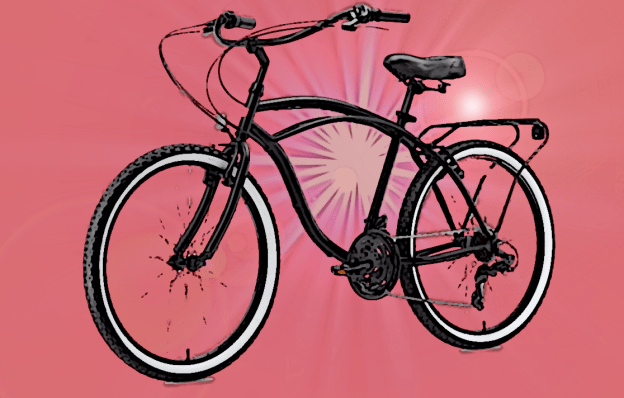
Well, it’s Wednesday morning again, and I’m comparatively upbeat today, as I’m pleased to inform you and I suspect you’ll be glad to learn.  After much effort, some WD-40, and the helpful supplying of a wire coat-hanger by my coworker, I was able to get the seat post out of the frame of my new bike, and with the help of my boss and another coworker—one who does a fair amount of biking—I was able to get my new bicycle together and ready to ride.

I rode it to the train last night, and then from the station to the house, with a mild, modest drizzle pleasantly dampening the way for a bit.  That latter portion is about five miles, as I’ve said before, but on the bike it took me just over half an hour, rather than an hour and a half.  That’s decent speed for my first time riding any bike in many years, and it’s also what it took me this morning in the other direction.  It got me to the train station in time to catch the train that I used to ride back when I took speedier—yet less healthy—means to get there.

Even though I’ve been walking as much as twelve miles a day, and so my endurance is pretty good, biking is a different experience.  I suppose that’s pretty obvious, but still, coming into it is something of a surprise.  It’s clear that, on roads at least, to bike is much more efficient than to walk, and one can cover the same ground with much less expenditure of energy.  But I would definitely estimate that, while it took about a third as long, I doubt that it burned only a third as many calories.

Maybe it’s because my riding is inefficient, but my legs definitely felt the more intense expenditure that riding entails, and my breath definitely came much more rapidly than when I walk, which is a very good biological indicator of the rate of energy expenditure.  The buildup of carbon dioxide is the primary driver of respiration*, so I am producing it much more quickly when biking than when walking.  This is good, I suppose; it will improve my conditioning.

But boy, I feel it in my buttocks; I feel it in my legs**.

Still, there is, as hoped, less joint pain associated so far with biking than there was with walking, and that is huge.  I need to make a few minor bike adjustments, I think, before too long, but it’s not bad overall.  I have some issues with bike seats—when the seats are high enough to, supposedly, make pedaling more efficient, I find myself feeling very awkward, because my feet don’t easily reach the ground.  Maybe that’s just a function of me not feeling all that secure on a bicycle; my coordination is not superb, especially when my legs are fatigued.  Already, I’ve nearly overbalanced at least twice already while getting off the bike, because my legs felt quite heavy and recalcitrant when standing after pedaling.

Presumably, I’ll adapt to this, and may then find it easier to raise the bicycle seat.  We shall see.  I don’t particularly like having to worry about maintenance and adjustment of the bicycle—that’s one of the reasons I haven’t had one, and why I don’t even feel the desire to drive a car or even my scooter.  Such things not only don’t tend to stick in my mind, but they actively stress me out to the point of causing me literally to bang my head against walls.  A bicycle is more straightforward, though, and in south Florida, there are many bike shops about, since people ride all year round***.

Well, we’ll see how things go over the next several days and possibly weeks.  I suspect my legs will strengthen, and my short-term, higher intensity endurance will improve.  In any case, my available time will grow.  Last night, I got back to the house while it was still light out, and not just because the daylight is lengthening.  I arrived almost an hour earlier than usual, and that happened this morning again.

I doubt it will work very long as a boost to my mood, but maybe I’ll be pleasantly surprised.  I don’t think it’s likely to push things in the other direction, do you?

No, I didn’t think so.

bike newer changes


*Not the need for oxygen, as you might suspect.  With normally functioning lungs, in typical Earth atmosphere, oxygen is basically in a constant, fairly good supply for the body.  It’s the carbon dioxide that has to be blown out, both because, as a waste product, it pushes back the equilibrium of metabolism if it remains, and also because, in the blood, it partly links with water and dissociates a hydrogen atom, becoming carbonic acid, decreasing the pH of the blood, which interferes with many functions.  In a person with working lungs (and kidneys) this pH drop never happens to any detectable level; the body is too good at regulating it, and the drive to blow off carbon dioxide is powerful indeed.  However, in people with rather severe chronic obstructive pulmonary disease, their hypercapnic drive can be markedly blunted by chronic inefficiency, with the kidneys taking up some of the slack.  In these patients, the respiratory drive can be shifted toward being oxygen-driven, and that creates a serious catch-22 for them, since they often need more oxygen than they can get readily from the air, but supplemental oxygen blunts their distorted respiratory drive, and they can rapidly go into respiratory acidosis.

**The original, but wisely discarded, opening lyrics to Love is all around.

***Interesting side note—when I first tried to write “round” in that sentence, I initially typed “young”, which is not conceptually much like the word “round” at all, but does have the same three middle letters.  The first and last letters are not even quite next to the correct ones on the keyboard, though they are in similar relation.  I’ve made typos like this before.  It seems that my brain encodes, or indexes, words that I type by the overall shape of the word at some level, with the middle letters dominating.  I wouldn’t have thought that, but then again, I don’t think I would have thought anything else, either.