I was out sick yesterday – again. Or is it “still”?

Okay, I’m writing this post—the first draft, anyway—on my laptop, and actually on my lap, because for right now, I’m sitting on the piano bench* in my room at the house.  I’ve decided not to try to walk to the train this morning, since I’m still feeling under the weather from yesterday.

As you may know, I did not write a post yesterday, and as you may have guessed, this was because I was out sick.  I considered getting onto my WordPress account just long enough to write a pseudo-post titled, “NO POST TODAY”, with a single line in the main body:  “I am out sick.”  However, I didn’t feel up to doing even that, and frankly, I don’t think it really matters to anyone out there, anyway.

Anyway, I was out with a very bad headache and fogginess and some nausea, but it didn’t feel like a typical migraine that I might have.  I suspect it might be a reaction to the fact that, upon arriving at the house, thoroughly exhausted, on Wednesday night, I took a rapid-release pill of melatonin.  I was trying to help myself sleep, if it was possible.

I’ve tried melatonin more than once in the past, and I’ve gotten results that generally made me feel worse rather than better, but I was at the end of my rope, or at least near the end, and I just wanted to be able to sleep.  I knew that if I took Benadryl on a work night, I’d feel groggy and slow for most of the next day, so I didn’t want to do that.

The melatonin may have ended up helping me start sleeping sooner and staying asleep longer—it’s difficult for me to tell—but it did not help me feel in any way better rested.  I awoke—well before my alarm, still—after still not having gone to sleep before eleven or so, despite my horrible exhaustion, feeling absolutely rotten, and having chills, though if I had a fever it was low-grade.  I also felt a bit sick to my stomach, though I did not throw up.

I had reconsidered melatonin after encountering a few stray articles in various sources indicating that melatonin might be useful for sleep disturbances among autistic people—these articles might have been focused more on autistic children, as most of the research is—and since I might have “Asperger’s” to use the relegated term, I thought maybe it would be worth another try.

Of course, Matthew Walker, in his book Why We Sleep, the best popular scientific book I’ve encountered on the subject, said that while melatonin may be good for jet lag and the like, it doesn’t seem to be useful for chronic sleep disorders**.  Still, he was speaking generally, and about the human population, not about changelings and replicants and mutant, weirdo strangers like me, whatever I am, so I thought maybe it would be worth something.

I don’t think I’m likely to try it again, at least not anytime soon.

The most sensible thing for me, probably, would be just to give up.  I’m just not going to be able to get a good night’s sleep ever again, not without the aid of significant pharmaceuticals, and then it won’t really be a good night’s sleep, since pharmaceuticals of all kinds interfere with natural sleep functions.

We don’t know quite what all those are, but sleep appears to be incredibly important for creatures with nervous systems, since every single one of which we are aware spends a significant amount of its time in that semi-inert, quite vulnerable state.  You would think, if it were possible to go without it, evolution would have produced some creature that used that option.  But even marine mammals like whales and dolphins sleep, though I understand that they do so with only half their brains at a time.

There is even a mouse (or vole of some variety) in the far north that is capable of literally going into a kind of suspended animation for months at a time, lowering its heart rate and body temperature nearly to zero (C) and decreasing the freezing tendency of its bodily fluids, and basically shutting down like a sci-fi astronaut.  But it has to rouse itself from this cryo-stasis periodically to sleep!  It needs to wake up from suspended animation so it can sleep or else its brain will suffer!

So, again, sleep is very important, and I’m certainly not getting anything like enough of it, and never in uninterrupted spans of more than maybe an hour at a stretch.  I think I must be missing out on some of the dreaming process, too, since I don’t remember dreams at night, even though I wake up quite frequently, and you would think I would sometimes do so during REM cycles.

Also, almost as soon as I attempt meditation, once I focus on my breath and am still for a moment, I begin experiencing strange courses of thought and images and stories that are quite reminiscent of dreams, as if my brain had been champing at the bit to get running with them at the first opportunity.

As I say, I don’t expect to find the answer or solve the problem.  I would just like to reset or else unplug the game at this point.  It’s long since ceased to be fun, and it’s getting more and more tedious.

I came up with an interesting possible means of shutting down the game the other night—Wednesday night, actually—and I made a test run of the delivery system that was encouraging***.  I may do another test today, and in the meantime I’m going to consider possible payloads, though I have at least one main idea that I mean to try primarily.

It comes down to a thing I recall from reading The Chronicles of Thomas Covenant the Unbeliever.  I don’t remember which of the books it was in, but it was  almost certainly one of the first two, and probably The Illearth War.  Thomas Covenant is telling one of his dreadfully dark true stories of the “real” world, about a man from India who was diagnosed with leprosy, and who killed himself during his flight to go to the Leprosarium in Louisiana, after having lost his whole family because of his diagnosis.

Covenant makes the interesting observation that it seems much easier—at least at first—to commit suicide by means that are typical for another culture but are not typical of your own, because they don’t feel as real to you, and so the barrier to their initiation is lower.  I think there is something to that insight, though it must also be balanced against the observed effect that publicly well-known suicides, especially of celebrities, etc., tend to make certain methods feel more normal, more “acceptable”, and like more “reasonable” approaches for people tending in that direction.

Like most things in the world, the system is complex.

But, anyway, my idea is neither really from another culture, nor typical of modern American culture.  It has some antecedents in some old-fashioned things, and its effects would be potentially delayed, which is part of the whole “lowering the activation energy wall” notion.  But it’s really sort of a “uniquely my own” kind of thing, which seems appropriate.

I don’t seem to be able to connect with any other people around me; they don’t understand me and I certainly don’t understand them.  It seems reasonable, or at least predictable, that I would do something atypical or even unique.  It would at least be nice to end things on some original type of note, ironically.

I’ll keep you posted on my progress—probably, anyway.  We’ll see what happens, I guess.  To paraphrase Yoda, the future is always in motion.  Though that may not actually be true, depending on how much (if at all) reality departs from pure determinism, but from the local, “human” point of view, that’s the way it feels, since we’re always simulating the future in our heads as our means of trying to shape it and to guide our own actions.  It feels as though many different things are possible, even if in actuality they are not.

Neo took the red pill, and for the character it no doubt would have felt as if he made a choice that could have gone the other way, but no matter how many times you rewind and replay that moment, it always turns out the same.  Reality may be just like that, only more so.

Anyway, that’s that.  I’m working tomorrow, so you can reasonably expect a blog post from me tomorrow morning, barring the unforeseen (see above regarding predicting the future and so on).  I hope the rest of you out there have a good day.


*Such is its official name, though no piano has ever sat upon it.

**If memory serves.  It’s been a bit since I read the book, though I used both the print and the audio version, so I got a double whammy.  Anyway, it’s possible I’m misremembering.

***No, this wasn’t what caused any of my symptoms on Thursday morning.  The delivery system is inert, of this I am convinced beyond what I consider a reasonable doubt.  My “Bayesian prior” is certainly over 90%, anyway.

The wine of life is drawn, and the mere lees is left this vault to blog of.

Hello and good morning, all.  Though I suppose I should leave it up to each of your own individual intuitions and criteria about whether it really is a “good” morning, and indeed, what such a term even could mean.  But, really, it’s what they call “a polite nothing” I suppose, because it has no other purpose than being a ritual greeting.

Weird.

It’s June 8th.  In 10 days it will be “Fathers’ Day” (I’m not sure about the “official” placement of the apostrophe).  In 21 days it will be my wedding anniversary, so to speak; anyway, it will have been 32 years since I got married, and I will have been divorced for 2 years longer than I was married, which is a crappy, crappy milestone.  I’ve also already gone roughly 10 years without seeing my kids in person, which is getting close to being as long as I was a part of their lives.

What an utter waste of years and effort it has been for me to be alive since then.

I’m writing this on my phone still/again, at the house, before heading for the bus stop.  There’s not much going on so far today, except to note that I had an unusually bad sleep last night, even for me, so I’m starting the day already feeling exhausted.

As you may recall, yesterday I did not take any “antidepressant”, and I likewise have not taken any today.  I did feel less tense yesterday than I had the days before, and that was certainly a relief, but it’s the sort of thing that happens whenever I change something like that.  I had a brief elevation in my mood when I started the Wort, also.  I suspect it’s just a placebo effect, and/or a reverse version of the same.

Anyway, I can’t blame either starting or stopping the stuff for my sleep problems.  They were there before any meds and they’ll be there after them, probably for the rest of my life.  Hell, I wouldn’t be surprised if I were to keep having sleep problems after I die.

Well…yes, I would.  Both the fact of still having sleep problems and having the ability to be aware of them would be quite surprising to me after I’m dead.  In fact, the ability to be surprised would be quite a surprise after I’m dead.  It would certainly be intriguing, as would the fact of being capable of being intrigued.  In fact, it’s hard to see that, if one is capable of surprise or intrigue or any other emotion, one should actually be considered “dead” in any useful sense.

Of course, I don’t think any of that is possible, really.  I’m quite convinced (provisionally, as always) that death entails merely oblivion, which is one of the things that makes it so appealing.  Indeed, my “Bayesian Prior” on that is so high that I would, so to speak, be willing to bet my life on it.  Admittedly, that’s a cheap bet, from my point of view, but I don’t have any right to bet anyone else’s life, so it’s all I have, worthless and disgusting though it may be.

Almost none of the various antidepressants I’ve taken have ever seemed to help my sleep.  Tricyclics, Effexor, Trazodone, Wellbutrin, Celexa/Lexapro and most other SSRIs…they didn’t make it better and some made it worse.  Only Paxil seemed at least to make me enjoy sleeping, which had never happened to me before, but its other effects were not good.  One downside was that I gained a lot of weight, and that’s not good in someone like me, who is constitutionally prone to overweight and its related effects.  That wasn’t the only problem, either.

Anyway, I don’t know why, but my depression, after initially responding to meds and therapy, has become tougher to treat over the years.  I don’t know if this is partly related to my apparent ASD, or whatever form of atypical, non-human neurology I have, or to something about the nature of depression, or to these and other factors mixed together.

What’s more, I don’t think anyone else in the world could actually know, either.  At most, at best, hypotheses could be made and tested, by me and by other medical/scientific people.  But it’s simply a fact that “we”, meaning all consciousnesses of which any of us are actually aware, don’t know well enough the nature of the normal functioning of the brain, let alone the nature of things like depression, dysthymia, autism spectrum disorders, insomnia (or in fact what sleep really does at all levels) very deeply and/or causally.  It’s extremely complex, and not enough resources have been or are put into the study.

We do spend a lot of money on science, but still more on war, and on politics, and on sporting events and so on.  Actually, I don’t know which if any of those things receives a greater proportion of civilizational resources than science does, but it feels as though it would be nice to divert at least some of the resources away from such things and into science.  The advancement of science is something that can benefit everyone, current and subsequent, especially since, once the information is learned, is discovered, it can (in principle) be shared at vanishingly small cost, to the potential benefit of the whole planet and its future inhabitants.

Of course, the company Elsevier apparently owns many of the premier scientific journals‒it did not originate them, it just bought them and is now rent-seeking through them‒and it not only charges a frankly obscene amount for subscriptions, but it even charges scientists who want to publish in the journals.  That is, in a sense, an actual white-collar crime against humanity, against civilization.

Such people deserve to be strapped down onto tables and have one drop of liquid Drano applied to their skin every hour, or perhaps even just every day, or somewhere in between, until it finally dissolves them away enough for it to kill them.  They could be kept alive in the meantime, and suffering for as long as possible, by IV infusions and naso-gastric feeding.

It’s just a thought.  Probably, even if I were given the power and resources to do so without the risk of consequences for me, I wouldn’t actually torture such people.  They’re just monkeys doing what monkeys do, after all.  But I might take away all their wealth and make them work at subsistence level jobs for the rest of their days.  It’s not the worst punishment, maybe, but getting medical and scientific knowledge out of the control of such people would be the real goal.

Anyway, I’m going to need to head to the bus stop here in a moment.  I feel tired and grumpy, and I’m not looking forward to anything about today at all, not even to its end, since the end of each day is merely a prelude to the dismal cycle of the next day and the next and so on.

I never look forward to going to bed, because going to bed merely ushers in the beginning of the next dreary, worthless day, probably to be faced with too little, too fragmented sleep, and with ongoing pain, and without being around or with any of the people I love.  It’s not the sort of thing to which one would look forward with anything better than weary resignation, and often with frank horror and disgust…and sometimes, honestly, with something akin to terror.

What are you gonna do?  That’s life.  It’s not for the faint-hearted.  And I cannot, in good conscience, recommend it without significant caveats and reservations and misgivings.

TTFN

broken wine glasselectronic

Interior decoration in a derelict ruin

Okay…Wednesday, morning, smartphone, my room, starting before leaving for the bus, all that tedious nonsense.

There, that’s out of the way.

I’m really not doing too well, even for me.  Yesterday was quite stressful, for internal and external reasons, though some of the external reasons mean it was a good day for the office.  Meanwhile, I banged my own head (deliberately) so hard and so often that I got a headache, on top of a worse-than-usual day for back pain and sleep the night before.

Near the end of the day, I took to whacking the back of my hand with a heavyish metal tool.  My boss, who knows that sometimes I will thump my legs and sides and things when they are in pain and spasm, asked me, “Is that where it hurts?”

I replied, after a moment, “It is, now.”. He laughed, but I’m not sure he quite got my point or why I was doing what I was doing.  It was an attempt to distract myself not just from other physical pain, but from stress and anger and the overwhelming sensory chaos of the room by inducing pain.  It works for a moment at a time, and this method doesn’t tend to leave marks, other than some bruises at times.  There are other ways that last longer, but they leave marks, some of which can last a long time…some of which, even, are more or less permanent.

I’m trying.  I’m still taking Saint John’s Wort, and I know at a personal and professional level that it’s too soon to expect any major results, but I fear it’s making me feel worse.  I suppose if it at least triggers something, even something catastrophic, that’s better than my present status as some sort of specter* or ringwraith or phantom‒an undead, but without a purpose.

I’m not a zombie; they tend to be mindless, and in a sense, are far less tortured figures than an undead that is aware of itself, that retains a mind and a personality, but is unable to grow or obtain new life.

I’m trying to treat my allergies and respiratory issues, and studying and working on some breathing techniques that seem to be good, but it feels like rearranging the furniture in a house where the roof has already fallen in, the windows are all broken, there’s no light or water or heat, and winter is coming.  I wish I could just lie on the (figurative) sofa and let the cold take me.

I don’t actually have a sofa, though.  Shame.

If I were my patient‒as I’ve said before, I think‒I would consider referring myself for inpatient psychiatric treatment**, but since this particular patient doesn’t have insurance and lives in a state, in a nation, with shitty, shitty mental healthcare, especially for those who are not wealthy, the options are not great.

Better just to let go.

Hang on, I need to go to the bus stop.

***

Okay, I’m at the bus stop now.

My back is really feeling tight and sore today.  It’s very irritating.  I’m trying to do the things that will help it, such as particular stretches and exercises and whatnot.  I’m not riding the bike, I’m using my shoe inserts and knee and ankle braces, all that.  I have roll-ons and creams and the like that are supposed to help, and I take a rather large (and probably toxic) quantity of OTC analgesics/anti-inflammatories.  I even have a semi-portable massage chair at the office, which I bought, and a foot massager I was given as a gift to go along with it.

Nothing is working very well.

The trouble is, there’s no reason to assume that there actually is an answer or remedy for certain kinds of pain.  We have not been honed by nature with a figurative eye toward having a long, healthy, satisfying life, free of severe physical and psychological pain.  We’ve been honed by nature to be able to survive long enough to reproduce successfully and keep our offspring alive until they can fend for themselves.

The thing about chronic pain, both physical and psychological, is that they are invisible to evolution (more or less) because they tend to develop after the age and time of reproduction has passed.  Pain is useful in the short term, especially when we’re young, because it makes us avoid and fix (when we can) damage that might take us out of the gene pool.  Ditto for fear‒assuming that all these things are present in appropriate or relatively moderate levels, of course.

But the functions that work to improve reproductive success when younger, or at least don’t harm it, can persist and worsen and become pathological as time passes, but that won’t reduce the presence of any genes for these functions.  And, of course, the prevalence and levels of most attributes follow a roughly bell-curve distribution in a population.  Most people cluster near the local mean of any given trait, but there are always outliers, and with enough people, there will be individuals who are outliers in more than one, even independently varying trait.

And then, of course, there can be traits that are good for one thing but bad in another way, and which persist or are selected for because the short-term, reproductive good outweighs the downside from the “viewpoint” of natural selection.  The sickle cell trait confers relative resistance to malaria, but having two copies of it can consign one to a truly hellish existence.

Similarly, it may be that attributes that tend to associate with high intelligence‒systematizing ability, certain kinds of imagination, inventiveness, ability to solve certain kinds of problems, certain kinds of intense focus, and so on that can be extremely useful for any group and for individuals, and lead to reproductive success and more general success, especially in modern society‒may lead, when aggregated together in the right way in some individuals, to autism spectrum disorders, ADHD, and/or a tendency toward depression, anxiety, and self-harm.

Who knows?

The bus is coming soon.  I’ve gotta go.  In more ways than one, I really feel like I really need just to go.


*I’m often torn about the spelling of this word.  I prefer the “old-world” spelling with the “tre” rather than the “ter”, but I worry that it comes across as pretentious.

**Because prescribing a large dose of fentanyl and phenobarbital and digoxin and Valium would be frowned upon by medical and legal “authorities”.  And I don’t have access to such things now.

Like a beard without a grizzle, like a steak without a sizzle; rider in the drizzle

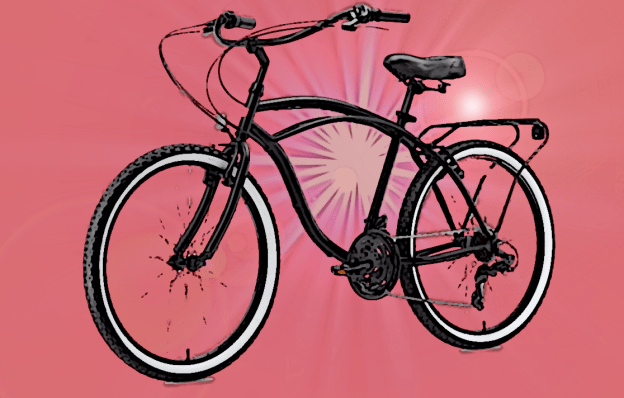
Well, it’s Wednesday morning again, and I’m comparatively upbeat today, as I’m pleased to inform you and I suspect you’ll be glad to learn.  After much effort, some WD-40, and the helpful supplying of a wire coat-hanger by my coworker, I was able to get the seat post out of the frame of my new bike, and with the help of my boss and another coworker—one who does a fair amount of biking—I was able to get my new bicycle together and ready to ride.

I rode it to the train last night, and then from the station to the house, with a mild, modest drizzle pleasantly dampening the way for a bit.  That latter portion is about five miles, as I’ve said before, but on the bike it took me just over half an hour, rather than an hour and a half.  That’s decent speed for my first time riding any bike in many years, and it’s also what it took me this morning in the other direction.  It got me to the train station in time to catch the train that I used to ride back when I took speedier—yet less healthy—means to get there.

Even though I’ve been walking as much as twelve miles a day, and so my endurance is pretty good, biking is a different experience.  I suppose that’s pretty obvious, but still, coming into it is something of a surprise.  It’s clear that, on roads at least, to bike is much more efficient than to walk, and one can cover the same ground with much less expenditure of energy.  But I would definitely estimate that, while it took about a third as long, I doubt that it burned only a third as many calories.

Maybe it’s because my riding is inefficient, but my legs definitely felt the more intense expenditure that riding entails, and my breath definitely came much more rapidly than when I walk, which is a very good biological indicator of the rate of energy expenditure.  The buildup of carbon dioxide is the primary driver of respiration*, so I am producing it much more quickly when biking than when walking.  This is good, I suppose; it will improve my conditioning.

But boy, I feel it in my buttocks; I feel it in my legs**.

Still, there is, as hoped, less joint pain associated so far with biking than there was with walking, and that is huge.  I need to make a few minor bike adjustments, I think, before too long, but it’s not bad overall.  I have some issues with bike seats—when the seats are high enough to, supposedly, make pedaling more efficient, I find myself feeling very awkward, because my feet don’t easily reach the ground.  Maybe that’s just a function of me not feeling all that secure on a bicycle; my coordination is not superb, especially when my legs are fatigued.  Already, I’ve nearly overbalanced at least twice already while getting off the bike, because my legs felt quite heavy and recalcitrant when standing after pedaling.

Presumably, I’ll adapt to this, and may then find it easier to raise the bicycle seat.  We shall see.  I don’t particularly like having to worry about maintenance and adjustment of the bicycle—that’s one of the reasons I haven’t had one, and why I don’t even feel the desire to drive a car or even my scooter.  Such things not only don’t tend to stick in my mind, but they actively stress me out to the point of causing me literally to bang my head against walls.  A bicycle is more straightforward, though, and in south Florida, there are many bike shops about, since people ride all year round***.

Well, we’ll see how things go over the next several days and possibly weeks.  I suspect my legs will strengthen, and my short-term, higher intensity endurance will improve.  In any case, my available time will grow.  Last night, I got back to the house while it was still light out, and not just because the daylight is lengthening.  I arrived almost an hour earlier than usual, and that happened this morning again.

I doubt it will work very long as a boost to my mood, but maybe I’ll be pleasantly surprised.  I don’t think it’s likely to push things in the other direction, do you?

No, I didn’t think so.

bike newer changes


*Not the need for oxygen, as you might suspect.  With normally functioning lungs, in typical Earth atmosphere, oxygen is basically in a constant, fairly good supply for the body.  It’s the carbon dioxide that has to be blown out, both because, as a waste product, it pushes back the equilibrium of metabolism if it remains, and also because, in the blood, it partly links with water and dissociates a hydrogen atom, becoming carbonic acid, decreasing the pH of the blood, which interferes with many functions.  In a person with working lungs (and kidneys) this pH drop never happens to any detectable level; the body is too good at regulating it, and the drive to blow off carbon dioxide is powerful indeed.  However, in people with rather severe chronic obstructive pulmonary disease, their hypercapnic drive can be markedly blunted by chronic inefficiency, with the kidneys taking up some of the slack.  In these patients, the respiratory drive can be shifted toward being oxygen-driven, and that creates a serious catch-22 for them, since they often need more oxygen than they can get readily from the air, but supplemental oxygen blunts their distorted respiratory drive, and they can rapidly go into respiratory acidosis.

**The original, but wisely discarded, opening lyrics to Love is all around.

***Interesting side note—when I first tried to write “round” in that sentence, I initially typed “young”, which is not conceptually much like the word “round” at all, but does have the same three middle letters.  The first and last letters are not even quite next to the correct ones on the keyboard, though they are in similar relation.  I’ve made typos like this before.  It seems that my brain encodes, or indexes, words that I type by the overall shape of the word at some level, with the middle letters dominating.  I wouldn’t have thought that, but then again, I don’t think I would have thought anything else, either.

So we profess ourselves to be the slaves of chance, and flies of every wind that blogs

Hello and good morning.  It’s Thursday again, against almost everyone’s better judgment.  Indeed, it’s the first Thursday (and the second day) of March, which is a new month (though the name is, of course, not new).

It being Thursday, it’s time once again for my traditional weekly blog post, which differs from my now-daily blog post only in that it follows the old pattern of a Shakespearean title and usually a picture…and, of course, this little introduction in which I note all these points, which is frankly rather tedious.  I should probably just quit doing it.

The trains were having severe troubles yesterday morning and yesterday evening.  In the morning, there was temporary suspension of the trains northbound from my usual station, due to what the fellow at the station referred to as a “train versus vehicle* event”.  The RTA was supposedly providing a “bus bridge” from that station to the next one north of the accident, and indeed, at long last, two full buses arrived bringing passengers from the station north of the event so they could continue south.  However, only one of the buses was heading back north, oddly enough, and that bus got full literally just as I was about to get on it.  I was the very one at whom the driver held out his hand, palm forward, and said, “No more passengers.”

So, grumbling, I stepped back, and I and the other remnants waited, asking when the next bus would be.  The fellow at the station did not know, though he guessed about ten minutes (ha ha).  After a while, he received notice that normal service was resuming.  This probably means no one had died in the “train versus vehicle event”, which I suppose is a good thing**.  I ended up being about an hour late to the office, and this was on Wednesday, which means there was payroll to do.  Also, we’re setting up and putting into practice a new program that I am heavily involved in, and we had two new people starting on a trial basis, who needed to be processed…and of course, meanwhile, we had at least three people out sick.  I was pretty stressed out, even relative to a normal day.

Then, last night, as I waited at the train station, the southbound train was announced to be late, and then announced to be later, and then that train was cancelled, and then the next one was announced to be late, and then later…

Eventually, it got to the point that, even if that next train got there at its announced later time, by the time I took it, then the two buses***, then walked from the stop to the house, it would be quite late.  And, honestly, I didn’t have anything (and certainly not anyone) waiting for me at the house, so it didn’t seem worth it to bother going.  I walked back to the office, and I slept here overnight.  And here I am writing this.

Such is my life—if you can call it that.  I hate it.  There’s nothing in it that’s of any real worth.  I’m still in chronic pain, I still have insomnia.  Obviously, I still have my dysthymia/depression, and of course, if I do have any neurodevelopmental difficulties that have hitherto gone undiagnosed, they certainly haven’t gone away.  I remain at least slightly uncertain in that latter category, because though I think the evidence is good, I do not quite trust my own judgment.

Can you blame me?

So, anyway, again, here I am, though metaphorically I am nowhere.  I also have a headache, which is probably at least partly tension related.  And I’m tired.  I’m not sleepy, but I am tired, almost all of the time.  I honestly don’t know what to do.  I mean, I know what I think I ought to do.  But it’s hard to get an “is” from an “ought”—though all “oughts” come from “ises****” contrary to what humeans seem to think—and I don’t have quite the will yet to overcome the activation energy wall created by biological drives/resistances to get to the other side.

I’m working on a way around.  There are things one can do to reduce one’s resistance in the short term, to lower that activation energy barrier.  But I’m not really interested in drugs, nor am I willing to deal with people who deal in illicit ones, and alcohol just tends to make me sleepy (and yet not to stay asleep or feel rested).  I do step swiftly into crosswalks when the lights change, hoping someone will not pay attention to traffic signals and will just hit me; they would deserve to have to deal with it, since pedestrians in the crosswalk have the right of way when obeying signals.  But so far—though many seem tempted—even when I tell them to hit me, none of them have.  I don’t know whether to feel irked about that or to be slightly pleased that so many people are more careful than one might expect.

Oh, well.  It doesn’t matter.  I suspect I’ll find a way to get back where I came from one way or another before too long, blisters and biological drives notwithstanding.  There must be some kind of quantum tunneling that can eventually get me through that mental barrier*****.

There’s no reason to expect things to head in the opposite direction, though, so I don’t really have any sense of optimism or even of possibility.  But in the meantime, I’ll keep writing these daily posts on days when I work, which will include Saturday this week.  You can continue to look forward to them, if you do, but for a limited time only.

TTFN

tri rail

Golden Glades Tri Rail Station – no trains present


*Is a train not a type of vehicle, though?

**Although, honestly, given the trouble the driver of said vehicle had caused—presuming that it was that driver’s fault, which is not certain but seems more likely than not—I can’t help but wish that they at least could have been injured badly, and if you had asked me at the time, I would almost certainly have said they ought to have been killed (but not their passengers, of course, unless the accident was caused by such a passenger).  After all, given the number of people whom they inconvenienced, and the economic, social, and psychological losses they thereby engendered, and the physical stress they created among many people (me included) it seems likely that their escapade led to diminished health and even premature death in one or more than one person.  But they probably didn’t do it on purpose, so perhaps the death penalty would be excessive.  Still, I don’t hear about such accidents happening in countries where commuter trains are much more common than here in the US, whereas something of the sort happens almost monthly just during the times of my commutes.

***I probably wouldn’t have walked.  I’m trying to rest the healing blister on my right foot, at least from more than a mile of walking at a time.  It seems to be doing well.

****That’s a plural that doesn’t want to be spelled.

*****I think this was Dylan’s original first line of All Along the Watchtower, but it just didn’t scan.  It turned out fine when fixed, though, and Jimi’s version was even better, as Dylan himself is said to have admitted.

Some blistering insights into soles like hobbits’ (and holes like ants’)

It’s Monday again.  Yippee ki yawn.  Aren’t you all just so excited?

I don’t have much interesting to report or discuss today, because I haven’t really done anything interesting to report or discuss, nor thought anything interesting to report or discuss since my last blog post.

I have continued trying to sort out different shoes and related footwear.  I walked home from the train station on Friday, but it turned out that the new blister on my right foot had not resolved itself very well during the two weeks since it had happened, which is quite annoying.  The blister on the left foot was fine; I had very carefully, and under effectively sterile conditions, poked a pin-hole in it the day after my very long trek, to drain the fluid, and it basically has now become just a thickened area of foot sole, and it gave me no trouble over the course of my five mile walk on Friday evening.

On the right foot, for reasons I don’t recall clearly, I had elected not to drain the blister—I think it just didn’t seem to have as much fluid in it—and a little more than halfway through my trek on Friday, it started to give me more trouble, as if I had something sharp stuck in my shoe.  I didn’t have any such thing; I checked.

Anyway, I rested on Saturday, during which my right foot was sore still, and I decided to drain that blister as I had the other.  I then walked about six miles (total) yesterday, and though the blister is still irritating, it’s better than it was.

Here’s my off-the-cuff hypothesis for why the course of the left and right blisters was different:

By draining the fluid from the left blister, I allowed the two layers of affected skin to re-adhere to each other, and through that process to become firmer and tougher—at least tougher than they were when the fluid of the blister was present.  On the right foot, however, even as it was recovering, there was still fluid in the blister—it never got completely reabsorbed, and the skin layers thus never re-adhered.  So, once I walked a long enough distance, those two layers of skin were effectively separate and lubricated, and began to rub back and forth against one another.  Just as pertinently, at the edges of the former blister, shearing forces pulled the aforementioned layers of skin further apart, causing new damage.  So, it was actually therapeutic to drain the fluid—as long as I protected rigorously against the risk of infection—than to allow the other to retain its fluid in this case.

As I thought about this, I wondered why such a thing might be the case.  Why would our evolutionary heritage saddle us with a process, on the base of our feet of all things, that would be counterproductive to healing?  Then it hit me*.  Our ancestors throughout almost all of evolutionary time did not wear shoes or boots or any such thing, and they certainly didn’t walk for long distances on paved roads.  They would have formed calluses on the soles of their feet, starting at an early age—presumably as soon as they were able to walk—and repetitive shearing forces, such as are produced by the rubbing of the sole of a shoe, would not apply.  They would have had the soles of hobbits, if you will, and those are pure, tough soles indeed.

So, in some senses, our footwear is detrimental.  Of course, in other ways, it’s extremely useful, and does protect us from sharp and hard objects on the ground against which even thicker skin wouldn’t have defended adequately.  Broken glass is certainly something one wouldn’t want to encounter with bare feet.

Then again, I recall that once, quite a while back, a Kenyan athlete won the Olympic marathon in bare feet, so there aren’t severe disadvantages.  It’s got to be pretty hard to do on pavement, though, and the next time that athlete ran, and won—if memory serves—he did wear shoes.

And you wouldn’t want to go walking through a snowy landscape without something on your feet, at least for warmth.

Still, it makes one wonder how many of the things we wear on our feet are relatively unnecessary and even counter-productive.  If I had gone barefoot a lot over the years, would I not even require footwear much anymore, living as I do in south Florida, where there is almost never anything close to snowy weather?  It’s certainly likely that the risk of fungus would be lower!  It’s interesting to wonder whether even the problems I have with my right ankle, due to an old severe sprain, would be fewer if I had not worn various types of footwear.

It’s also interesting to think about how much of the footwear industry is just a self-sustaining fiction, like so many other industries.  Just to be clear, though, I would not claim that this is any kind of conspiracy or evil plot by malevolent capitalists at Nike and Adidas and Reebok and New Balance.  That’s just a stupid thought, and if you seriously entertain it, you should probably slap yourself.

I’m sure there are worse and better people (by whatever criteria one might specify) at nearly all levels in such companies, as there are in the ranks of social services, as there are working in governments, as there are in charitable organizations, as there are in hospitals.  No, the footwear industry, at all its various levels, is just a big, spontaneously self-organizing system, like everything else about civilization.  There is no master plan, and there is no master**, any more than there is a planner, architect, CEO or Personnel office in an ant hill or a termite mound or a bee hive or a school of fish or a flock of birds.  Things happen, and the things that tend to be self-sustaining tend to sustain themselves***, while the things that don’t tend to do so simply fade away with relatively little fuss.

This is part of, or at least related to, why I hate people calling elected officials our “leaders”.  They’re not leaders, nor should they be, and they certainly don’t “run” the country or state or city or whatever.  They’re employees, managers, servants.  And believe me, they are just as fundamentally clueless as everybody else about what’s happening in the world and what to do about it.  They just sometimes pretend otherwise, even to themselves.  But just because they fool themselves, doesn’t mean you have to let them fool you.

That’s about it for today.  It’s been a weird progression of thoughts, but that seems appropriate, given the eventual topic of discussion.

caveman walk


*It’s just like what happened when I was standing in a park and wondering why a frisbee appears to get larger and larger as it gets closer and closer.

**Except the Time Lord called The Master.

***Duh.

I blog not you, you elements, with unkindness

Hello and good morning.  It’s Thursday, February 2nd, and the day of the week on which I’ve long done my semi-traditional blog posting.

I don’t know whether I have the energy to hunt for a Shakespeare quote to alter and/or a picture to put at the bottom, both vaguely related to whatever “subject” I address in the blog.  But, of course, by now, you readers will know what decision I, the writer, will have made, even as you read the words I’m writing while I do not know.

It’s a bit wibbly-wobbly, timey-wimey, isn’t it?

Of course, the biological experience of time is much more malleable and irregular than the actual nature of time, but time is not a simple, straight, linear dimension.  It’s warped by the planet beneath your feet, among many other things.  Your physical body’s tendency to want to follow the most “direct” path through it‒and the fact that the planet is in the way, preventing you from following that path‒creates what we call gravity, locally.

When you’re free-falling, you’re coasting through time (and space, of course), and it’s the ground that actually accelerates you once you reach it.  It’s a hell of an acceleration if you’ve been pursuing your geodesic unimpeded for long by the time the ground throws itself into your path.  Human’s aren’t built to withstand that kind of acceleration.

I’m writing with my smartphone again, today, by the way.  It’s just too annoying to deal with the laptop at the bus stop.  I also wrote more words than I really had meant to write yesterday, probably because I type faster on the laptop, but I don’t think the increased number of words was associated with an increase in actual content.  I think the signal-to-noise ratio, if you will, of my blog post yesterday was lower than it has tended to be with the phone.  That’s not an objective measure, however, and others may disagree.

As for my thumbs, they already feel a bit better than they did, and they’re not giving me too much trouble now.  I have some Voltaren cream (or is it an ointment?) that I can apply to the joints if necessary, though I already take round-the-clock NSAIDs every day for my chronic pain, so it’s not really recommended that I add the Voltaren, a strong NSAID in it’s own right.  It increases the risk for kidney damage and liver damage and stomach issues and so on.  But I’m already at risk for those things (though I take Omeprazole for my stomach protection) and I don’t see easy short-term solutions to the problem.

This is one of the conundrums (conundra?  Probably not) that make opiates and opioids both necessary and yet culturally difficult‒our non-psychoactive pain medications are literally toxic to our bodies above a quite low threshold relative to their analgesic powers.  Yet pain does not easily just go away on its own in many cases‒biology is subject to much stronger pressures for pain to persist than to allow it easily to be relieved, and those incentives will remain so in any evolutionarily stable form of life.

Opiates and the like can work against nearly any degree of pain with limited direct toxicity, but with diminishing success and tolerance, requiring increasing doses over time*.  But they do affect neural circuitry, reward, and motivation, among other things, and so their use is complicated‒and it’s additionally complicated by the fact that the treatment of pain, physical and psychological, is somewhat taboo in our society.

The use of various substances in one’s own body is even criminalized, and so black markets arise to take advantage of the inevitable demand.  And without matters being out in the open and subject to expert scrutiny and monitoring and education, various abuses and issues relating to lack of access to appropriate guidance and treatment and support arise and worsen.

And they will persist.

Do you think continuing to criminalize the use of drugs of various kinds will decrease abuse and death and even violence related to the drugs?  You hypocrites!  I say to you that it is the criminalization of that use that created the black markets and abuse and danger and sordidness‒and, indeed, the majority of the deaths‒in the first place!

You punish people for trying, however imperfectly, to treat chronic pain and those who suffer from it from addressing it, and are surprised that sufferers turn to the market you have created for illicit meds.  You have the temerity to be “shocked” that people die from the unmonitored, unregulated, inexpert use and manufacture of these things which you have removed from the bailiwick of expert awareness and oversight and monitoring.  You took an area that should have been medical and made it criminal and are stupid enough to be surprised that opportunistic criminals (whether they be gangs or governments or otherwise) are not as careful and caring as actual medical professionals.

And sometimes you are so hopelessly moronic as to imagine that further punishments of both producers and suppliers‒and even users‒of drugs will change the problem or decrease it or make it go away.  As if making an already suffering person’s life even more difficult and miserable is going to diminish their urge for relief and escape from at least some forms of pain, and their willingness to risk the permanent end to their pain that is death by overdose.  I’d need to exist macroscopically in all the ten spatial dimensions of M Theory to be able to give that the eye roll that nonsense deserves.

Phew.  That was a heckuva tangent.

I don’t actually use opioids or related medications, though I have been prescribed them in the past.  They interact with my rather peculiar nervous system in ways I find truly unpleasant, though they can help with pain.  So, instead, I suffer constant daily assaults on my kidneys and GI tract and my liver, and I accept that.

It’s not as though I will seek treatment if my organs fail.  I have no insurance, for one thing, but also, I just don’t see any point in trying to preserve my existence.  Heck, I’ve been told I have a possible recurrence or deterioration of my congenital heart problem‒I’m not fully convinced that it’s really any kind of recurrence‒for which I had heart surgery when I was 18, but I have no interest in pursuing possible further exploration or treatment of it, anyway.

Let my kidneys fail, let my liver fail, let my heart fail!  Blow, wind, and crack your cheeks!  Why would I try to preserve or prolong my existence when I don’t even like myself, let alone have anyone else nearby who likes me and spends time with me***?

Anyway, that went off the rails pretty quickly, didn’t it?  It also got longer than I expected.  Sorry.

I still don’t know the answer to my initial wondering about titles and pictures‒but you all do.  And I love you for it.

TTFN

windstormandmanscaled


*Though at least they don’t directly poison livers and kidneys, and the needed doses don’t keep going up without limit, though they are nevertheless often higher than most doctors are willing to prescribe.  This is largely because doctors fear having what happened to me happen to them, and who can blame them?  The only exception to this general hesitancy is with cancer.  People with cancer are allowed to be treated with whatever level of pain medicine it takes to reduce their pain, because in the typical human “mind” having cancer pain is different, and people with cancer are special.  They’re allowed to be dependent on pain medications, because surely they have the only type of pain that can go on and on without resolving and can steal all the joy from their lives, eventually killing them.  Anyone else is just a disgusting drug addict, a scum of the Earth, and deserves merely contempt**.

**The latter portion of the above paragraph is sarcastic.

***I cannot blame them, so don’t be defensive on my behalf.  I find myself infuriating and disgusting.

Happy Boxing Day, everyone!

For those of you in the United States, just in case you don’t already know, Boxing Day is basically just the day after Christmas.  It’s celebrated in the UK, and apparently in Canada and other parts of the “Commonwealth”, though how exactly it’s celebrated is not clear to me.  It’s also not clear to me—after a few random, admittedly not very careful searches—just what the day actually celebrates, other than the day after Christmas, or to what the Boxing part of Boxing Day refers.

It doesn’t appear to have anything at all to do with the sport of boxing, nor the dog breed, boxers.  I don’t think it has anything to do with the Boxer rebellion in China, either—why would it?  It’s a bit of a mystery.  Maybe it’s related to people putting the gifts they didn’t really want that they received for Christmas back in their boxes to take to the store for refunds, or to put in the attic (or “loft” as they say in the UK).  I doubt that, though.

It’s been a slightly interesting weekend.  On Friday I bit the bullet and went to the evening dinner/party with the office, but I arranged things so that I didn’t need anyone to drive me there or to drive me all the way back to the house.  Instead, I took the train up to Delray Beach as soon as the office closed and walked to a hotel—The Hyatt Place at Delray Beach—where I’d decided to indulge in a rather large expense and reserve a room for the night.

From there, after a rest, I walked two blocks to the restaurant and immediately started ordering drinks to allow me to socialize, then had a pleasant evening with the people I know from the office.  It had begun to get cold—for south Florida, certainly—by that time, and I was pleased to have only a two block walk back to my nicely warm hotel room, where I cuddled up and slept off my drinks, had a continental breakfast in the morning, and then walked back to the train station at about eleven-ish (it was 3 miles…still is, as far as I know) and took the train back to Hollywood and thence to the house.

Since then, I’ve slept a great deal, which is really nice for me.  I tried to keep low on carbs for what I’ve eaten this weekend, because it turns out that I’ve probably become pre-diabetic.

I had been trying to see if I could do a near-vegan* diet, including plenty of legumes and other sources of protein, to see if it could help me be healthier and lose weight.  It rapidly did the opposite (I was gaining weight and I felt worse), and as I walked through a Walgreen’s one evening, thinking about my family history, I checked into the diabetic supplies area, amazed to note that one could buy a glucometer for less than twenty dollars!  I remember when you used to need a prescription to get one because you needed your insurance to pay for it, because they were expensive.

Anyway, not that day, but soon after, I bought one, and tested my fasting blood sugar a few days in a row, and found it to be slightly high, in the pre-diabetic range.  This is not terribly surprising, given my family history, but it was a well-needed confirmation of my suspicion.  I have to admit, on those few occasions when I’ve tried a carbohydrate-restricted diet, I have felt generally healthier.  But it’s been hard for me to maintain, for the temptations of carbs are everywhere, and are all the more difficult to resist when one is stressed out, as appears to be my default state.

But now I have blood glucose confirmation that things are going to go badly if I continue to indulge—and death by type 2 diabetes is too slow a process to make it appealing.  I also know that low carb diets have been objectively beneficial for me in the past—my resting pulse, which normally runs too fast (at over 100 bpm) went down to the mid-sixties, my total cholesterol to about 138, my triglycerides almost ridiculously low, and my HDL at a nicely normal range.  You get the idea.  I felt better, and I looked better (at least at the chemical, microscopic level), and it was only because I had trouble being motivated to control my appetite that I didn’t stick with that mode of eating.

So that’s the plan, or part of it, for the moment.  I’ll keep you posted on an intermittent basis on how things are going.

In the meantime, I’m on my way to the office, though there are far fewer people on the train today than usual—in fact, until five minutes before time for the first train to arrive, I was the only person waiting at the station.  I’m still waking up early, but then again, given how much I slept this weekend, at least I don’t feel worn out.  It’s good not to feel worn out already, first thing on a Monday morning, but I often already do feel that way.  So in that sense, it’s been a good holiday weekend.  Indeed, we did not work on Saturday, but I did have a nice (low carb) breakfast and a good walk to the train.

I hope you all have a nice several days in this last week of 2022.  Remember, since January 1st will fall on a Sunday, there will be a Friday the 13th in January—not one of the movies, but the day.  I always like those days.  They’re almost never bad luck for me (and there’s no reason other than self-fulfilling prophecies for them to be bad luck for anyone else).

Please enjoy your elaborate, traditional Boxing Day celebrations.  But if you do celebrate by boxing, please restrict yourselves to body blows.  Even with gloves and padding, just the inertial transfer of any blows to the head always does some damage to the brain, which tends to be both permanent and cumulative.  Many of us can’t afford to lose more than we already have lost.


*I like to make the joke that it’s ironic that people who only eat vegetables or similar here on earth use the term “vegan”, because the dominant native intelligent life forms in the Vega star system—the Vegans, in other words—are obligate carnivores.  Of course, that’s just a joke; there aren’t really any native species in the Vega star system—it’s too young a star to have evolved complex life.  The inhabitants there are all colonists.  But the dominant ones of those are obligate carnivores**.

**Earth people need not fear some kind of carnivorous alien invasion, though.  Any species that are products of completely separate evolutionary histories cannot readily eat any of the life forms from the other biosphere.  At best they would simply get no nutritional value from their meal—like pandas, as carnivores, trying to get enough food out of bamboo, but thousands of times worse, with only some minerals and electrolytes and perhaps a few simple biochemicals being useful.  But much more likely, the eaten life form’s own endemic microbes would begin to break down their hosts while in the new species’ ineffectual digestive system, and would cause physical and probably chemical damage to the eater.  Many very basic microbes are remarkably good at dining on things that complex life cannot digest…including said complex life.

Some thoughts (on an article) about Alzheimer’s

I woke up very early today‒way too early, really.  At least I was able to go to bed relatively early last night, having taken half a Benadryl to make sure I fell asleep.  But I’m writing this on my phone because I had to leave the office late yesterday, thanks to the hijinks of the usual individual who delays things on numerous occasions after everyone else has gone for the day.  I was too tired and frustrated to deal with carrying my laptop around with me when I left the office, so I didn’t.

I’m not going to get into too much depth on the subject, but I found an interesting article or two yesterday regarding Alzheimer’s disease.  As you may know, one of the big risk factors for Alzheimer’s is the gene for ApoE4, a particular subtype of the apolipoprotein gene (the healthier version is ApoE3).  People with one copy of the ApoE4 gene have a single-digit multiple of the baseline, overall risk rate for the disease, and people with 2 copies have a many-fold (around 80) times increased risk.

It’s important to note that these are multiples of a “baseline risk” that is relatively small.  This is a point often neglected when discussing the relative risks of a disease affected by particular risk factors when such information is conveyed to the general public.  If the baseline risk for a disease were one in a billion (or less), then a four-times risk and an eighty-times risk might be roughly equivalent in the degree of concern they should raise.  Eighty out of a billion is still less than a one in ten million chance for a disease; some other process would be much more likely to cause one’s deterioration and demise rather than the entity in question.

However, if the baseline risk were 1%‒a small but still real concern‒then a fourfold multiplier would increase the risk to one in 25.  This is still fairly improbable, but certainly worth noting.  An eighty-fold increase in risk would make the disease far more likely than not, and might well make it the single most important concern of the individual’s life.

Alzheimer’s risk in the general population lies between these two extremes, of course, and that baseline varies in different populations of people.  Some of that variation itself may well be due to the varying frequency of the ApoE4 gene and related risk factors in the largely untested population, so it’s tricky to define these baselines, and it can even be misleading, giving rise to false security in some cases and inordinate fear in others.  This is one example of how complex such diseases are from an epidemiological point of view, and highlight just how much we have yet to learn about Alzheimer’s specifically and the development and function of the nervous system in general.

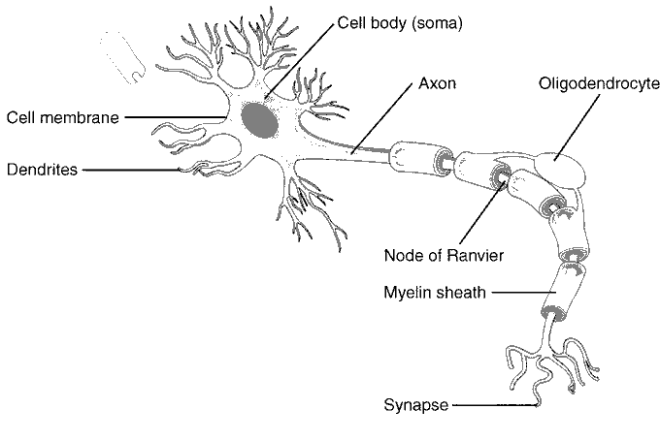
Still, the article in question (I don’t have the link, I’m sorry to say) concerned one of the functions of the ApoE gene (or rather, its products) in general, which involve cholesterol transport in and around nerve cells.  Cholesterol is a key component of cell membranes in animals, and this is particularly pertinent in this case because the myelin in nerves is formed from the sort of “wrapped up” membranes of a type of neural support cell*.

cns myelin

This particular study found that the cells of those with ApoE4 produced less or poorer myelin around nerve cells in the brain, presumably because of that faulty cholesterol transport, and that the myelin also deteriorated over time.

Now, the function of myelin is to allow the rapid progression of nerve impulses along relatively long axons, with impulses sort of jumping from one space (a “Node of Ranvier”) between myelin sheath and another rather than having to travel all the way down the nerve, which a much slower process, seen mostly in autonomic nerves in the periphery.  When normally myelinated nerves lose their myelin, transmission of impulses is not merely slowed down, but becomes erratic and often effectively non-existent.

myelin in general

The researchers found that a particular pharmaceutical can correct for at least some of the faulty cholesterol transport and can thereby support better myelin survival.  Though this does not necessarily point toward a cure or even a serious disease-altering treatment over the long term, it’s certainly interesting and encouraging.

But of course, we know Alzheimer’s to be a complex disease, and it may ultimately entail many processes.  For instance, it’s unclear (to me at least) how this finding relates to the deposition of amyloid plaques, which are also related to ApoE, and are extracellular findings in Alzheimer’s.  Are these plaques the degradation products of imperfect myelin, making them more a sign than a cause of dysfunction, or are they part of the process in and of themselves?

Also, it doesn’t address the question of neurofibrillary tangles, which are defects found within the nerve cells, and appear to be formed from aggregates of microtubule-associated proteins (called tau protein) that are atypically folded and in consequence tend to aggregate and not to function and to interfere with other cellular processes, making them somewhat similar to prions**.  It’s not entirely clear (again, at least to me) which is primary, the plaques or the tangles, or if they are both a consequence of other underlying pathology, but they both seem to contribute to the dysfunction that is Alzheimer’s disease.

So, although potential for a treatment that improves cholesterol transport and supports the ongoing health of the myelin in the central nervous systems of those at risk for Alzheimer’s is certainly promising, it does not yet presage a possible cure (or a perfect prevention) for the disease.  More research needs to be done, at all levels.

Of course, that research is being undertaken, in many places around the world.  But there is little doubt that, if more resources were to be put into the study and research of such diseases, understanding and progress would proceed much more quickly.

The AIDS epidemic that started in the 1980s was a demonstration of the fact that, when society is strongly motivated to put resources into a problem, thus bringing many minds and much money to the work, progress can occur at an astonishing rate.  The Apollo moon landings were another example of such rapid progress.  Such cases of relative success can lead one to wonder just how much farther, how much faster, and how much better our understanding of the universe‒that which is outside us and that which is within us‒could advance if we were able to evoke the motivation that people have to put their resources into, for instance, the World Cup or fast food or celebrity gossip.

I suppose it’s a lot to expect from a large aggregate of upright, largely fur-less apes only one step away from hunting and gathering around sub-Saharan Africa that they collectively allocate resources into things that would, in short order, make life better and more satisfying for the vast majority of them.  All creatures‒and indeed, all entities, down to the level of subatomic particles and up to the level of galaxies‒act in response to local forces.  It’s hard to get humans to see beyond the momentary impulses that drive them, and this shouldn’t be surprising.  But it is disheartening.  That, however, is a subject for other blog posts.

I’ll try to have more to say about Alzheimer’s as I encounter more information.  Just as an example, in closing, another article I found on the same day dealt with the inflammatory cells and mediators in the central nervous system, and how they can initially protect against and later worsen the problem.  We should not be too surprised, I suppose, that a disease that leads to the insidious degeneration of the most complex system in the known universe‒the human brain‒should be complicated and multifactorial in its causation and in its expression.  This should not discourage us too much, though.  The most complicated puzzles are, all else being equal, the most satisfying ones to solve.


*The cell type that creates myelin in the peripheral nervous system (called Schwann cells) is different than the type that makes it in the central nervous system (oligodendrocytes), and this may be part of why Alzheimer’s affects the central nervous system mainly, whereas diseases like ALS (aka Lou Gehrig’s Disease), for instance, primarily affect the nervous system outside the brain.

**The overall shape of a protein in the body is a product of the ordering of its amino acids and how their side chains interact with the cellular environment‒how acidic or basic, how aqueous or fatty, how many of what ions, etc.‒and with other parts of the protein itself.  Some proteins can fold in more than one possible way, and indeed this variability is crucial to the function of proteins as catalysts for highly specific chemical reactions in a cell.  However, some proteins can fold into more than one, relatively stable form, one of which is nonfunctional.  In some cases, these non-functional proteins interact with other proteins of their type (or others) to encourage other copies of the protein to likewise fold into the non-functional shape, and can form polymers of the protein, which can aggregate within the cell and resist breakdown, sometimes forming large conglomerations.  These are the types of proteins that cause prion diseases such as “mad cow disease”, and they appear also to be the source of neurofibrillary tangles in people with Alzheimer’s disease.

The sweetest honey is loathsome in its own deliciousness. And in the taste destroys the appetite. Therefore, blog moderately.

Hello and good morning.  It’s Thursday again, so I return to my traditional weekly blog post, after having taken off last Thursday for Thanksgiving.  I’m still mildly under the weather, but I’m steadily improving.  It’s nothing like a major flu or Covid or anything along those lines, just a typical upper respiratory infection, of which there are oodles.  Most are comparatively benign, especially the ones that have been around for a while, because being not-too-severe is an evolutionarily stable strategy for an infectious agent.

An infection that makes its host too ill will keep that host from moving about and make itself less likely to be spread, to say nothing of an infection that tends to kill its host quickly.  Smart parasites (so to speak) keep their hosts alive and sharing for a looong time.  Of course, “smart” here doesn’t say anything about the parasite itself; viruses are only smart in the sense that they achieve their survival and reproduction well, but they didn’t figure out how to be that way—nature just selected for the ones that survived and reproduced most successfully.  It’s almost tautological, but then again, the very universe itself could be tautological from a certain point of view.

It’s an interesting point, to me anyway, to note that today, December 1st, is precisely one week after Thanksgiving.  Of course, New Year’s Day (January 1st, in case you didn’t know) is always exactly 1 week after Christmas.  It’s unusual for Thanksgiving to precede the first of December by a week, because the specific date of Thanksgiving varies from year to year (and, of course, if Thanksgiving were to fall on the 25th of November, December 1st would not be exactly one week later).  It’s an amusing coincidence; there’s no real significance to it, obviously, but I notice such things.

Anyway.

My sister asked me to write something about the vicissitudes of sugar (not her words), and though I don’t mean to finish the topic here today, I guess I’ll get started.  Apologies to those who are waiting for me to finish the neurology post, but that requires a bit more prep and care, and I’m not ready for it quite yet.  Life keeps getting in the way, as life does, which is one of the reasons I think life is overrated.

It’s hard to know where to start with sugar.  Of course, the term itself refers to a somewhat broad class of molecules, all of which contain comparatively short chains of carbon atoms, to which are bonded hydrogen and hydroxyl* moieties.

Most sugars are not so much actual free chains as they are wrapped up in rings.  The main form of sugar used by the human body is glucose, which is a six-membered ring with the rough chemical formula C6H1206.

glucose2

This is the sugar that every cell in the body is keyed to use as one of its easy-access energy sources, the one insulin tells the cells to take up when everything is working properly.  Interestingly enough, of course, though glucose is the “ready-to-use” energy source, it only provides about 4 kilocalories** per gram to the body, as compared to 9 kilocalories per gram for fats.

But the sugar we get in our diets is not, generally speaking, simple glucose.  It tends to be in the form of disaccharides, or sugars made of two combined individual sugars.  Sucrose, or table sugar, is a dimer of glucose and fructose, joined by an oxygen atom.

sucrose

Okay, I’m going to have to pick this up tomorrow.  I’ve gotten distracted and diverted by a conversation a few seats ahead of me.

There are two guys talking to each other at the end of this train car, and they are each seated next to a window on the opposite side of the train, so they’re basically yelling across the aisle to each other.  Their conversation is perfectly civil, and though they’re revealing a certain amount of ignorance about some matters, they are mainly displaying a clear interest in and exposure to interesting topics, from history to geography and so on.

At one point, one of the men started speaking of the pyramids and how remarkable their construction was, and I feared the invocation of ancient aliens…but then he followed up to say that, obviously, there were really smart people in ancient Egypt, just like we have smart people today who design and build airplanes and rockets and the like.  Kudos to him!

These men are not morons by any means.  They clearly respect the intellectual achievements of the past and present, and that’s actually quite heartening, because I think it’s obvious that neither one is extensively college-educated, if at all.

But why do they have their conversation from opposite sides of the train, so that everyone nearby has to hear it?  It’s thrown me off my course.

I’ll close just by saying that yesterday I finished rereading The Chasm and the Collision, and I want to note that I really think it’s a good book, and to encourage anyone who might be interested to read it.  The paperback is going for I think less than five dollars on Amazon, and the Kindle edition is cheaper still.  If you like the Harry Potter books, or the Chronicles of Narnia, or maybe the Percy Jackson books, I think you would probably like CatC.

CatC cover paperback

I’d love to think that there might be parents out there who would read the book to their kids.  Not kids who are too young—there are a few scary places in the story, and some fairly big and potentially scary ideas (but what good fairy tale doesn’t meet that description?).  It’s a fantasy adventure starring three middle-school students, though I’ll say again that, technically, it’s science fiction, but that doesn’t really matter for the experience of the story.

Most of my other stuff is not suitable for young children in any way—certainly not those below teenage years—and Unanimity and some of my short stories are appallingly dark (though I think still enjoyable).  If you’re old enough and brave enough, I certainly can recommend them; I don’t think I’m wrong to be reasonably proud of them.  But The Chasm and the Collision can be enjoyed by pretty much the whole family.  You certainly don’t have to be a kid to like it, or so I believe.

With that, I’ll let you go for now.  I’ll try to pick up more thoroughly and sensibly on the sugar thing tomorrow, with apologies for effectively just teasing it today.  I’m still not at my sharpest from my cold, and the world is distracting.  But I will do my best—which is all I can do, since anything I do is the only thing I could do in any circumstance, certainly once it’s done, and thus is the best I could do.

Please, all of you do your best, individually and collectively, to take care of yourselves and those you love and those who love you, and have a good month of December.

TTFN


*Hydroxyl groups are just (-OH) groups, meaning an oxygen atom and a hydrogen atom bonded together, like a  water molecule that lost one of its hydrogens.  This points back toward the fact that plants make sugar molecules from the raw building blocks of carbon dioxide (a source for the carbon atoms and some of the oxygen) and water (hydrogen and oxygen) using sunlight as their source of power and releasing oxygen as a waste product.  This was among the first environmental pollutants on the Earth—free oxygen—and it had catastrophic and transformative effects on not just the biosphere of the Earth but even on the geology.  The fact that the iron in our mines, for instance, is mainly in the form of rust is largely because of this plant-born presence of free oxygen in the atmosphere.

**A kilocalories is defined as the amount of energy needed to heat a kilogram of water by one degree centigrade.  We often shorten this term just to “calorie”, but that is actually only the amount of heat needed to raise a gram of water one degree centigrade (or 9/5 degrees Fahrenheit).  It’s worth being at least aware of the fact that what we tend to call calories are actually kilocalories.