What does the moon think it’s smiling at?

It’s Monday morning again.  This keeps on happening, no matter what we try to do about it.  Somehow, we’ve got to get together as a civilization to end this disastrous, senseless litany of workweek beginnings.

Human civilization is about as likely to be able to do that as it is any more important or “realistic” goals it might want to achieve.

That reminds me—I followed the YouTube channel of that guy who did the video on the strong force (see this post), because I thought he seemed like someone worth checking out.  I was right.  He has another video, not as popular, but which I think is even more thought-provoking.

It’s about seeing our governments as a kind of AI (Artificial Intelligence) which have, as a part of their nature, the same issues we have with AI alignment in general:  that unless we are very careful with what terminal goals we give our AIs, they are likely to find the easiest workarounds—cheats, if you will—to satisfy the letter of their terminal values, because they certainly are not capable of grasping the “spirit” of them unless we are smart enough to give them that nature.  The same is true of governments.  The video maker brings this up as a way of possibly explaining the so-called Fermi Paradox*.  His conjecture is that perhaps all governments in the long run tend to evolve into dystopias, and dystopias are not going to colonize the galaxy, and all alien civilizations that might have done so are stuck in dystopias.

I’ll embed the video here for your delectation.  It’s not as polished and fancy as the one about the strong force, and it has no animations, but I think it’s an original, interesting, and troubling idea.  I’d be curious to know what you all think.

Let’s get back to Monday, though, and what we can do about it.  One possible solution to Mondays would be to develop our technology to the point where we don’t need to work at all, where all our actual goods are produced by robots and AIs and the like, so there’s no longer any need to get up and go to “the office” on Mondays.

I don’t think that’s going to work, so to speak.  There’s the alignment problem mentioned above, of course, but there’s also simply the fact that we don’t work merely for sustenance.  If that were the case, many people in the western world, at least, would only have to work 10 to 15 hours a week, maybe, if that.  Unfortunately, humans are competitive—for individual resources, yes, but also for status, prestige, sex, power, all sorts of other things that will always be, in effect, scarce resources, because success in such things is always relative to other people.  We work longer hours now than people did in the 1950’s, despite all the technological advances we’ve made since then.

Maybe we’re already in a dystopia.  Maybe dystopia is the natural state of human civilization, just as it’s (arguably) the state of all those monstrous, gigantic trees, growing ever taller and taller only because they have to compete against other trees for sunlight.  Humans are, after all, really just souped-up chimpanzees with delusions of grandeur.

Maybe the proverbial “quiet desperation” of daily life is the natural state of humans, because, even when basic and not-so-basic needs are met—food, shelter, water, sanitation, protection from most natural disasters, all that stuff—people always want to do more, to compete for higher social status, bigger houses, sexier mates, more “important” jobs, flashier bling, fancier cars, “better” smartphones.  And, of course, like everything else in the universe, people can only respond to local forces, local incentives, so fixing things that are out of whack but in an equilibrium state (of sorts, anyway) is hard even to get started.

Ah, well.  Life is complicated.  We didn’t make the world, nor did we make civilization; it made itself, as I think I’ve mentioned before.  It’s a spontaneously self-organized system.  We’re ants in ant-holes.  And remember, the queen ant, or queen bee, or queen termite, is no more in charge of the ant hill (or beehive or termite mound) than the Queen of England is actually in charge of running the day-to-day business of Great Britain or the British Commonwealth.

Even Putin isn’t really in charge of the moment to moment happenings in Russia.  He has great influence, of course, but it is tenuous, and it is ephemeral.  When he is gone, Russia will still exist, as it existed after Stalin, after the Tsars, after Genghis Khan, and so on.  Essentially no one who was alive during the reign of Queen Victoria is alive today (no human, anyway—there might be a tortoise or two), and that includes Queen Victoria.  And by the year 2150, unless very surprising things happen with respect to trans-humanism, no one will be alive who was alive during the reign of Queen Elizabeth II.  Though she herself is surprisingly durable.

I don’t know what point I’m trying to make.  Maybe I’m trying to make the point that there is no inherent or meta-level point at all, and I’m doing that by not trying to make a coherent point.  That sounds cleverer than I’m likely to be, but maybe my subconscious is smarter and cleverer than I am consciously—well, it almost certainly is those things—and it arranged this on purpose.  I doubt it, but I don’t completely rule it out.

In the meantime, though, remember that Monday is the day of the moon—the moon that was smiling madly but cheerily down at me this morning when I looked up.  It should have looked much the same for anyone else seeing it at that time.  And the moon is pretty cool.  Remember Sting’s description of the moon, by way of Shakespeare, when confronted by a drunk who asked him to describe it:  “My Mistress’s are nothing like the sun.”


*Basically, that our galaxy is at least twice as old as our solar system, and there have been potentially billions of years for other planetary systems somewhere in it to develop first life, then multicellular life, then intelligence, then civilizations, then high technology, and then presumably space-faring civilizations.  Even at a slow rate, any one civilization—and there could have been countless such civilizations, potentially—could have colonized the galaxy by now, or least have produced technology some of the signatures of which we should have been able to detect.  Yet we have found nothing.  So, where is everybody?

It blinded me…with science!

It’s Saturday morning, and I’m at the train station quite a bit too early for the first northbound train of the day.  I woke up much earlier yet, quite a bit earlier than I would need to wake up to get even to the train I usually take in the morning during the week.  Yet the office opens for business an hour later on Saturdays than during the week, so there’s no office-related reason for me to get up or leave so early.  I just can’t seem to sleep all the way through the night.

This morning, I woke up at about 2:30 am, and I couldn’t get back to sleep after that.  This isn’t unusual.  I do go to bed relatively early—starting to wrap things up about 9 pm, most nights—because even if I don’t get to sleep early, I still tend to wake up early, so if I want to get at least some sleep, I need to go to bed early.  Then I can wind down and relax a bit, watch a few videos I’ve seen before*, and hopefully drop off before eleven.

Last night I was able to do that, but I woke up unable to relax again, so I decided to watch a video I had marked for myself to check out.  It’s about the basic math and ideas regarding the strong nuclear force and “color” charge, as it relates to spin, and to regular charge, and to the Pauli exclusion principle.

It sounds dense, I know, but it’s actually quite fun—I’ll embed the video below, because I think anyone interested in such things might enjoy it.  The guy speaking just obviously loves his subject, and even gets transported with delight in explaining the analogy to the way our eyes process “real” color out in the world, and how color television and monitors work.  This analogy is, evidently, why physicists used the term “color” to describe the interactions in the strong nuclear force, which has nothing to do with actual colors as we normally use the term.

There are some vectors and ket notation stuff in the video, but it’s not really necessary to understand it specifically.  The presenter does a good job of conveying the gist, and it’s quite wonderful.  After watching it, I felt that I understood the strong force significantly better than I had before, and that’s one of those rare, reliable good feelings.

I often wish I had stuck with my original intent to go into Physics as a career.  Unfortunately, my path was derailed when I was found to have a congenital heart defect** that had to be surgically corrected.  Heart-lung bypass, such as happens when one has open-heart surgery, has cerebral effects because of the “unnatural” way the brain is perfused with blood during the process, and it often causes transient cognitive deficits.

This is not the only cerebral dysfunction that can manifest.   I realized only in retrospect that I had another one as well—for the first few hours after I awakened from my surgery, I was blind.  At the time I just assumed something was covering my eyes, in addition to the ventilator in my mouth, the three chest tubes, the straps holding both of my wrists, and the more-than-one IV line I had.  I didn’t think much of the blindness because I had other things on my mind.  It was very painful to have open-heart surgery, surprisingly enough.

Anyway, being 18 years old at the time, I recovered from a lot of the other stuff pretty quickly.  But I had a a temporary cognitive deficit.  It was not enough to make me need to take a year off college or anything—it never would have occurred to me even to consider such a show of “weakness”.  I did, however, find the calculus and physics classes in second year as a physics major too difficult to keep up with, and that was frustrating.

It was not helped by the fact that I had been triggered—again, not at all an unusual effect of heart-lung bypass—to have a significant exacerbation of my dysthymia into what was probably my first real, full-blown bout of major depression.

Faced with my difficulties, and at that time thinking I would be in the Navy after college anyway, I had to switch majors to English.  This is not a horrible thing, obviously.  I love English—the language and the literature in general—and I love to read, and obviously I’m a writer.  My overall GPA did, however, go down slightly compared to Physics (not counting the first semester after my surgery), and it turns out this was probably at least partly due to my other ASD.  I had a terrible time in those small-group classes because I did not know when to comment, when to ask questions, or even where people were getting their thoughts and ideas about the various things we were reading.  I liked the stories, and I liked wordplay and intricate language, but the process of discussion and interpretation and interaction about it all was thoroughly puzzling to me.  And needless to say, writing essays that would please the professors was a tall order; I had no idea what they might want.

Obviously I got through the rest of college, though not without lots of heart-rending things happening—personal, familial, career-wise, psychiatric/psychological, physical***—and found myself deciding to go to medical school because I had to do something, I had relevant personal experience, and I love Biology almost as much as Physics.  Medicine was a career in which I could do a lot of good, and it was basically zero risk.

By “zero risk” I mean, I knew that I could get into and pass medical school.  The sorts of things required are right in my wheelhouse:  standardized tests, Chemistry, Biology, dealing with things other people think are “gross”, remembering and understanding complex systems and their interactions—things with actual, concrete answers.  And I’m actually pretty good at caring for other people.  It’s not that it wasn’t hard work, don’t get me wrong.  But it was work I knew that I could do, unlike—for instance—understanding what I should write to get an A on an essay about The Faerie Queene.

Of course, had I not gone into medicine, other things would not have happened that have been thoroughly catastrophic for my life, from which I have not even come close to recovering.  But I cannot and will not ever truly regret anything that happened before the birth of children, so I don’t truly regret not going into Physics as a career.

But it would be nice to have someone around in my actual life with whom I could have conversations about stuff that really interests me, apart from stories, which I seem to have lost my knack for enjoying.  At best, I can sometimes tell the other people around me about some interesting fact or concept, and sometimes they’ll appreciate how cool it is, but then that’s that.  Anyway, I seem to have lost most, if not all, of the social skills I’d had in the past, so it’s hard even to imagine seeking out someplace to interact with such people.

Oh, well.  No one (with authority to do so) ever promised that life would be satisfying, and many smart people have reckoned that life is inherently unsatisfying, so I have no one but myself with whom to lodge any complaints.  The universe is the way it is.  We were not asked for input when it came into existence, and we do not have veto power over any of the facts of nature.

I won’t endorse the old tee-shirt slogan, “There is no gravity—the Earth sucks”.  But I will rather cheerily say, “There is no gravity—the universe is just warped.”  It’s a nerd joke I came up with myself (though others probably have done so also), and so I like it.  It’s also, basically, true.


*I watch previously seen ones so that I don’t get engaged in thinking about new things too late at night, because that can keep me up even more than usual.

**An atrial septal defect, shortened to ASD, but not to be confused with the more commonly seen modern acronym for Autism Spectrum Disorder, which I seem also to have.  So, interestingly, I was born with two ASDs, one discovered at age 18 and surgically corrected, the other discovered or realized (by me, anyway) when I was just over 50, and it cannot be corrected, per se.  I’ve done a literature search and skimmed through some papers, and it seems there is a higher incidence of such cardiac defects in people with Autism Spectrum Disorders, but the reason for the correlation is not at all clear.

***No one goes through open heart surgery without some physical sequelae.

What else should I be?

Thank Cat it’s Friday, or words to that effect.

To be honest, I work tomorrow, so it’s not as though it’s really the end of my work week, but I’ll still try to enter somewhat into the spirit of things.  I might as well do that from time to time, right?

I hope not too many people were put off too much by my blog post yesterday.  I was not feeling well at all—physically, yes, but mainly mentally—and I didn’t feel like pretending that I was.  I’ve decided that I’m not going to try to court popularity, or whatever, with this blog, at least no more than is purely instinctual, but will just try to convey the honest thoughts and feelings that spring into my mind.  Unfortunately—perhaps—for those of you who read this, my mind works somewhat a-neuro-typically, and always has, and I also have my irritating chronic pain and a longstanding mood disorder, so sometimes my thoughts and feelings will be unpleasant.

Actually, it’s entirely possible that, at some point, you may witness a full-scale and complete mental breakdown on this blog.  Heck, you may already have witnessed part of it.  In the spirit of Descartes, I can’t be sure that I haven’t already had a full-scale and complete mental breakdown before I’ve even started writing this.

There certainly seem to be weird numbers of people and vehicles about this morning, doing things they don’t normally do, but no one is doing anything that isn’t allowed by the laws of physics (as I understand them), there just is an unusual number of them.  For instance, there are at least three people sleeping or near-sleeping on benches in the train station, and one person lying in the crosswalk bridge, but they don’t seem to be homeless people.  At least two of them are actively using cell phones.  It makes me wonder if there was an Amtrak train that was cancelled late last night or something, and all these people are waiting for one to come in the morning.

Of course, that doesn’t explain the weird number of cars out and about and seeming activity in a place that’s usually only operative on Friday nights and into the weekend.  I haven’t lost track of the days, have I?  This is Friday, isn’t it?  I was wrong about the date of one of the posts I saved earlier this week, though I did fix it the next day, and the error didn’t show up in the post.  My computer says it’s Friday, but I could, in principle, be imagining my computer.  I don’t think so—none of this feels like a dream—but who knows?

I suppose that’s always the question, and it’s a notion that has been raised all the way from Plato, through Descartes, and up to and including The Matrix.  I doubt that I’ll add any particular insights to the exploration.  I just get stressed out when new things happen that interfere with my routines, but none of what I’ve described above has actually done so; it’s all just curious.  If I were still writing fiction, I might even imagine a supernatural story that might involve these curious things happening, explaining them in a way that at first seems just banal—like the actual reality of the events that I am encountering—but turns out to be the first hint of something “unnatural” and possibly terrifying.

Meanwhile, my own mental deterioration, which is real*, is much more banal, and unfortunately, it doesn’t feel frightening.  Not to me.  I suppose the breakdown of a person with paranoid schizophrenia is probably a truly terrifying thing, from within and even sometimes on the outside.  Mine is subjectively underscored by a diminishment of any feeling of engagement or connection, except sometimes in the form of revulsion and irritation.  The irony is that I probably am in much greater physical danger—from myself—than a schizophrenic might imagine himself or herself to be in, but I don’t feel like screaming or trying to escape.  And I know already that my cries for help are ineffectual.

I’m just skimming along in a passenger jet that’s running out of fuel (and which has no apparent other passengers, which is a good thing) over the contours of a wilderness, losing altitude slowly, unable to shift the controls no matter how I try, with a radio that apparently doesn’t work.  If anyone is hearing my calls, they must be getting a lot of it mired in static, because no one seems actually to grasp what I’m trying to say.

Eventually, some bit of the landscape is going to jut up enough that the plane is going to crash—though I suppose it’s physically possible for there to be a happy accident and the aircraft will skid to a halt on a long flat stretch of prairie or something.  It’s an awful lot to expect.  All I can do, or so it seems, is buckle up and see if I survive when the crash happens.

Honestly, I’m not entirely inclined to buckle up.  I’ve been on this plane for a long time, and it’s not got much to recommend it.  The scenery outside isn’t interesting, possibly because it’s dark out.  I can’t even seem to nudge the yoke downward to speed up the crash, though I have tried, and it seems like there might be just a bit of give in that direction.  But habit, biology, and all the people who always tell you not to give up, make me think I’m supposed to wait and see if, just maybe, something will change, or a voice will come on the radio giving me new, useful instructions about how to get out of this situation and even, just maybe, get back to the place I was before, or someplace like it.

I’m not optimistic, though, either by nature or by anyone’s description.  I figure that sooner or later, as I said, this vessel is going to crash.  I don’t know for sure what shape that crash will take in the outer world.  But if, one day, I suddenly just stop writing these blog posts, that’s probably what happened.  I don’t think it’ll be tomorrow, but I can’t be certain.  Yesterday was a very bad day.

The terrain I’m flying over is not perfectly level; there are hills and trees and even the ruins of old buildings, possibly not built by any human, scattered along it.  There may be mountains jutting up at any point in my path.  It’s hard to tell how high above the ground I am—I guess the altimeter is broken—but I’m not as high as I was a week ago, or a month ago, or a year ago.  I’m losing altitude, and there is going to be a point where the air stops and a hard surface begins.

All right, sorry, I’ve pushed that metaphor more than far enough.  It would be a shame to crash it into the ground, though perhaps I’ve done so already.

I expect I’ll write another blog post tomorrow, and if you’re interested, you can read it.  I’m trying to take my masks off as much as I can, and my true face is not pleasant to look at, so I can’t guarantee it’ll be fun or funny or whatever.

But it will be me.  How could it be anything else?  I’ve never wished to be anyone else, though I’ve often wished I could be a better version of me, to quote Fiona Apple.  I can’t even comprehend what it could possibly mean to want literally to be someone else.  If I were to become someone else, then that wouldn’t be me being someone else, it would just be someone else.  And there are already plenty of other people about who aren’t me.

Anyway, I guess that’s it for now, at least.  I sincerely hope you’re all doing as well as you possibly can, which I should have said yesterday.  Do your best to enjoy the absurdity and to surf on the chaos.  I’m sure it can actually be great fun if you have the skill.


*Though today I am in a better mood than I was yesterday, I do not feel at all that I am in a normal state of mind.  It’s just relatively better.  All things are measurable relative to their local environment.

And careful hours with time’s deformed hand have blogged strange features in my face

“Hello” and also “good morning”.  It’s Thursday again—this time the 18th of August in 2022 A.D.—and so it’s time for another daily post and also for another edition of my longer-standing weekly blog post.  And, of course, this being my Thursday, longer-standing blog post, I almost always start with some variation of “Hello and good morning”, so that’s what I did.  It’s good to try to be consistent, all other things being equal.

I’m very tired, both physically and mentally, so I’m not sure what I’m going to write about.  I certainly don’t have any fiction writing to discuss.  I doubt whether I’ll ever write any fiction again.

Yesterday I very briefly picked up my guitar at work because I wanted to play the opening riff from I Feel Fine, since I’d started using it as one of my alarm sounds on my new phone.  I ended up playing a bit more of the song than that, and then the opening of Wish You Were Here, and then I got tired and didn’t do anymore.  I think that’s all played out for me, if you’ll pardon the pun.

I don’t really feel like I’m ever going to do anything that brings me real joy anymore.  I doubt that I’ll ever see my kids again, though this is thankfully not because they’ve suffered any tragedy*; it’s simply that they have their lives and their pursuits and I’m not part of them and not particularly wanted.  As I think I’ve said before, my son has only interacted with me once—to send an email to thank me for this year’s birthday presents—since about 2012 or 2013**.

I do have a knack for causing the people I really love to hate me or at least to hate having me around.  Does that mean that I must love myself, since I certainly hate having me around?  No.  I’m a special case.  I’ve never been able to get away from myself.  I can’t even get a good night’s sleep to get away from myself for more than an hour or two at a time.

So, as I said, there’s no new fiction, no new (or rehashed) music, no new insights.  I have some new puzzlements and minor irritations.  For instance, in thinking about why people prefer some blog posts to others, I’ve noted—or been told—that having images mixed in with the post helps, and long ago I started putting pictures in my Thursday blog posts.  Now, my popular Monday post this week didn’t have any image, but it did have an embedded video, so I thought maybe that at least helped explain its relative popularity.  So I embedded one video in Tuesday’s post, but it didn’t seem to help that one.

Evidently, the things that make posts relatively popular are more complex or at least more chaotic than my simply hypotheses would support.  This should come as no surprise.  I doubt anyone has undertaken any rigorous, thorough evaluation of the nature of the popularity of blog posts or the like.  There’s lots of data available, but it’s very messy, and the system is nowhere near any kind of equilibrium, so trying to figure out where it goes for what reasons would require real sophistication in statistics and related matters, and I doubt anyone who’s tracking blog posts is really bothering with that.

As I said, I’m tired.  And that being the way things go, since I have no source of relief or rest, I’m getting steadily more and more tired.  I’m tired, and I’m sad, and I’m lonely—but I can’t really stand being around most other people very much either, at least not the ones I see and encounter nowadays.  All my old friends are thousands of miles away, and they have their own lives, and unfortunately, I’ve never been good at maintaining friendships with people at a distance.

It’s not that I don’t want to or don’t think about them.  I just don’t really know what to do, or to say, or how to deal with such things, and I get very stressed out by them.  I also don’t feel I have any right to intrude on other people’s lives and time, or anything to offer anyone.  It’s presumptuous for me to imagine that anyone would want to interact with me at all, and I find most people inexplicable and unpredictable.

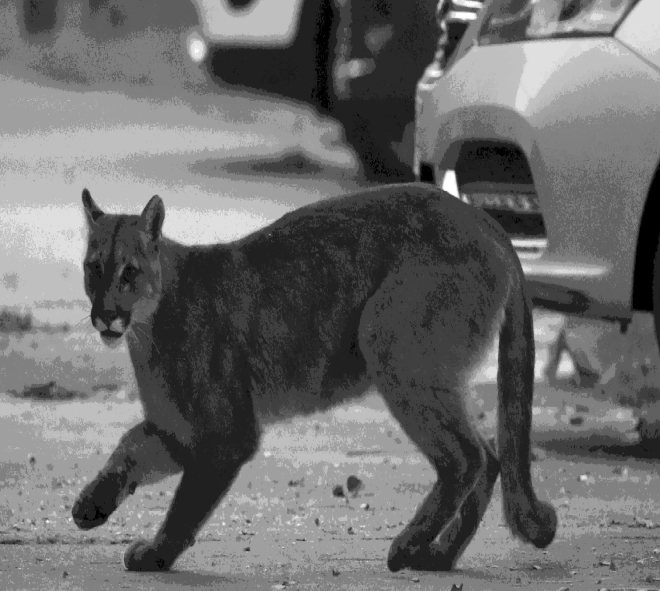
Being in the world these days feels for me like being one of those wild animals you sometimes see in news stories—a bear, a coyote, something more unusual, maybe even a tiger—that’s wandered down from the mountains, or out of a forest, or was released from someone’s private “zoo” and has found itself in an urban or suburban environment which is not where it’s adapted to be.  Everything around it feels potentially hostile—and is potentially hostile—and so it must always be on its guard, always trying to avoid even those who might be benign, because it cannot be sure, and it’s made the mistake of thinking other creatures were benign before, only to have them become hostile (or reveal themselves to be so), and to damage it, leaving permanent pain and deep scarring.

Better to avoid everyone and to be avoided than to face more of that.  There are no other creatures out there that seem safe or beneficial or even familiar enough to be worth the risk.  Better just to lurk in the shadows, scrounging through scraps and garbage to find minimal sustenance, and simply to continue, until starvation or disease or something else gets you; it might even be something of a relief when that happens.

So, no fiction or music, but merely this metaphorical morosity is what I have to offer you.  I’ll understand if this post isn’t popular, but I don’t really give a fuck at this point.  It doesn’t matter.  I’m sick of caring about things.  And I’m tired.

FOFN

cougar in town


*Other than having me for a father, which I suppose is tragedy enough for anyone.

**Prison sure does wonders for making non-violent “offenders” shape their lives up, doesn’t it?  We should send everyone to prison for a while, or maybe just select people randomly for the reward (as often seems to be the way things are done, anyway), and make sure it affects the rest of their lives afterward, curtailing their possibilities, making them unable to practice their professions, severing their ties with their loved ones, restricting their employment and other prospects, and just generally pouring concentrated acid all over their lives.  If it’s good for part of society, it must be even better if it’s done for more people, right?  Yeah, prison for the nonviolent non-criminals (in any legitimate sense) teaches important lessons, the main one being that “civilization***” is a fiction and/or is fucked, and it should probably be wiped from the surface of the universe.  Possibly, even life itself is a bad idea.

***Which, remember, is just a spontaneously self-assembling structure, no more deeply important or planned or meaningful or ideal than a school of fish, or a flock of starlings, or an ant colony, or a “flange” of baboons, or a hurricane, or crystals of saltpeter that form in bat guano.

The Inscrutability of the Relativity of Popularity

I’ve said it before, but I can’t resist noting again that, as I begin writing this, it is Wednesday morning at 5 o’clock.  It’s the beginning line of one of my favorite Beatles songs, She’s Leaving Home, as many of you probably already know.  And as people who know me closely—if there are there any such people anymore—will know, I love to quote lyrics and books and poems and so on.  But I particularly like when things in the real world evoke or even literally iterate the events of a song.

It’s liable to happen again if I keep writing this, since I generally get up at least this early, even if I don’t have anywhere I have to be.  My insomnia is rotten—or, one could say, it’s very good at what it does, though what it does is not very nice.

I’ve noticed a curious thing.  Yesterday, the post that I wrote in which talked a bit about the physics of black holes—asking some questions about it, among other things—got very few “likes”.  In fact, as of the last time I checked, it had gotten one.  It wasn’t especially long, for me anyway, and I thought it was interesting enough, but I guess it wasn’t appealing.

However, the quite long post I wrote on Monday, dissecting the Bob Dylan song Blowin’ In the Wind got oodles of reads and likes, even though it was about 1800 words long.  This makes it one of my longest posts, possibly the longest, not counting my sharing of sections of Outlaw’s Mind.

I’m happy that people still like “longer” blog posts and read them, at least.

I remember being told once that the optimal blog post length was about 800 words, which seemed horribly short to me to try to convey anything interesting.  It’s nice to know that estimate may be wrong.  I’m steadily disheartened by how little most people seem to read anymore, but even more disheartened to think that—possibly—most people have never been very inclined to read.  Perhaps social media isn’t drawing people away from reading but is simply giving them newer things to do instead of other things they used to do instead of reading.

If that’s the case, then at least I’m glad that there are some excellent YouTube channels with educational and interesting materials about science, mathematics, history, literature, and so on.  I have doubts whether anything educational ever happens on TikTok or Instagram or even Facebook or Twitter, though the latter two can at least be used to share links to educational articles or videos.  And I have seen some creative and hilarious TikTok videos.  These were shared with me by coworkers; I do not use TikTok myself, though apparently my music is available on it.

Referring again to songs, and specifically to lyrics, I often recall the words of the Steely Dan song, Reelin’ In the Years, in which the singer says, “Well, you wouldn’t even know a diamond if you held it in your hand; the things you think are precious I can’t understand.”  This is how I tend to feel about a lot of the world in general.  I really don’t get why some things are popular and some things aren’t.

Which is not to say that I understand none of these things.  Some works of art and music and science and whatnot are so broadly universal in their greatness that even an alien like me can recognize why they are loved.  The music of the Beatles, the works of J.R.R. Tolkien and Shakespeare, movies like The Godfather or Alien or the original Star Wars movies, the writing of Poe*, TV shows like Seinfeld or M*A*S*H—these are things that are enduringly popular (some more than others) and of which I understand the appeal quite well.

But I have no idea why anyone cares about the Kardashians**, or why the “music” of Cardi B is popular.  (This assessment is quite apart from the person, Cardi B, herself—from what I’ve seen, she’s charming and funny and seems quite nice, so I don’t begrudge her success.)

Don’t even get me started on wondering why The Donald ever became popular, let alone admired.  The man has bankrupted casinos!  These are places where people come and willingly—one could say willfully—give the house their money!  I, myself, have given my money to a few of his old casinos, and I enjoyed it quite a bit; they were nice, and I used to relish a little blackjack from time to time.  I’ve even been to Mar-a-Lago, quite some time ago, for an AECOM*** Alumni Association event.  It was a bit gaudy, but then, so is Versailles.

But it was horrifying when I was there to see accomplished, well-to-do, middle-aged-and-older adults fawning over the man, even gaggling about him looking for autographs!  I can kind of understand wanting a book signed by its author, especially if it has a “personal” message, or wanting to own an album that was signed by the Beatles, say.  But why fawn over a rather questionable**** businessman who is—admittedly—colorful, in more ways than one, but whose greatest skill seems to be surviving his own mistakes and passing the costs on to others?  And why in the world would anyone think he was qualified to be President of the United States?

Alas, humans are inexplicable to me in many ways—at least when I try to understand them as intelligent individuals.  It gets easier when I recognize them as a large population of unusually brainy primates, who, when you pay attention, are merely doing the stuff that all other lemurs and monkeys and apes do, just on a larger, more complicated level, and who fool themselves into thinking otherwise—it gets easier, but not more reassuring.

So, that’s a rundown of thoughts triggered by the fact that I don’t know specifically why my Monday post was apparently quite popular (relatively speaking), but my Tuesday post, which dealt partly with a bit of General Relativity (in a popular style, I think), was apparently not.  Maybe yesterday’s post is a slow-burner, and people will come back and read it in the future and will consider it some of my finest work.  I doubt it.  Honestly, I don’t truly think it’s some of my finest work, but I don’t think Monday’s post was either.

I don’t understand.  But why would I expect to?  I am a stranger in a strange land.  Your customs and your ways are foreign to me.

Maybe I should just go home.


*Though, man, you should’ve seen them kicking him.  Goo-goo-ga-choob.

**Unless you’re talking about the alien species that first appeared in Star Trek: The Next Generation and was more prominent in Deep Space Nine.  They’re not as interesting as the Klingons or the Romulans, but they’re way more interesting than a family that’s famous for the fact that its former patriarch had been part of O.J. Simpson’s defense team, and then for the rest of the family being rich but dysfunctional.

***That’s the Albert Einstein College of Medicine, not the infrastructure consulting firm, of which I just now became aware.

****Yes, he was questionable even back then.  And, yes, I thought so even back then, and well before.

You pick the space and I’ll choose the time, and I’ll climb the hole in my own way*

It’s Tuesday now, the day that Professor Coyne, aka PCC(E), over at Why Evolution Is True calls “the cruelest day”.  I’m not sure the origin of that expression; as far as I can recall, his website is the first place I encountered it, but I like it.

It’s not the beginning of the week, which has a certain hectic energy at least, with everyone in a kind of recovery from their—hopefully restful—weekend.  It’s not “hump day”, which many people call Wednesday, when things are starting to coast toward the end.  And, of course, it’s not its counterpart:  Thursday, which is a day on which anticipation of the coming weekend can energize one for the day’s work.  And, quite obviously, it’s not Friday, when those who are on a 5-day-a-week schedule are effectively already beginning their weekend**.  Tuesday is the day with the least to make it stand out.  Which, of course, makes it stand out.

Also, as the Beatles pointed out, and as I often note, Tuesday afternoon is never-ending.  And, if time were to be truly continuous and infinitely divisible, then one could effectively make Tuesday afternoon never-ending in a Zeno’s Paradox sort of way, just by subdividing the time in between each moment as each moment passed.

Or, of course, one could fall through the event horizon of a black hole.  To distant observers, that fall would indeed seem to be never-ending (though before too long the image of the faller would redshift into invisibility).  And for the person falling, the end would come rather quickly.  Assuming that person survived the gravitational tides, according to General Relativity, time literally comes to an end in the singularity of a black hole.

Though I always picture the heart of a black hole a bit more like one of those “Gabriel’s Horn” shapes in mathematics, which has an infinite surface area but a finite volume.  Of course, I don’t have the skills and expertise to work the equations of GR, but it feels to me that, if spacetime is endlessly flexible****, then there need never be a true “end” to time; it could just stretch longer and thinner always, infinite in “surface” but finite in “volume”.

I know that’s all a bit esoteric, and I’m sure my understanding is incomplete.  If there are any theoretical physicists specializing in GR reading this who can help me think more clearly about black holes and singularities and why it would be necessary for time to completely end if spacetime were continuous rather than simply to stretch—making a mathematical singularity, but not literally an end—then please do let me now.

I realize that there may be concepts that can only be dealt with rigorously using the mathematics, but on the other hand, clearly the mathematics is translatable into “ordinary language” at some level, or no one would ever be able to teach it or learn it.  And I have at least a bit of mathematical background, though I haven’t formally studied how to do the matrices and whatnot involved in GR.  Still, Einstein himself didn’t know how to do it when he came up with the initial ideas, so he had to learn it and then work with it, but he had the ideas first.

I don’t have his brilliance, obviously—which is certainly not an insult—but if there’s a way to demonstrate why time literally ends at a singularity***** rather than simply stretching out into an endless tube, with shrinking cross-section (in higher-dimensions) but ever-expanding “area” (again, in higher dimensions), I’d like to know.  I mean, according to the whole Dark Energy paradigm, the expansion of spacetime is accelerating now and there’s no theoretical limit to how much it can expand, which seems to mean, at some level, that it has infinite stretchability.

Or perhaps it would be more accurate to say that spacetime can continue to be created between any two points that are stretching apart, somewhat—but not quite—analogous to the way in which if you try to separate two bound quarks, all you do is create two new partner quarks with the energy you’ve put in to try to stretch them so now you’ve got two pairs of inseparable quarks.  Neener neener neener.

Anyway, I know that Penrose and Hawking developed their singularity theorems for black holes and those are accepted by physicists and mathematicians throughout the world.  They are/were brilliant people, there’s no doubt about that.  But does the theorem mean that spacetime literally vanishes at some literally infinitely dense point in the middle of a black hole—which strikes me as implausible given the stretchy-stretchy nature of spacetime—or is it a singularity more in the pure mathematical sense like the function 1/x as x approaches zero?

Enquiring minds want to know.

Wow, that wasn’t at all where I thought I was going when I started this post today, but those random, drunken walks can, at times, at least lead past interesting scenery.  No one would be likely to argue that a black hole doesn’t necessarily belong in a wasteland; in a sense, it is the ultimate wasteland, at least this side of the heat death of the universe.  But it is interesting, topographically (and topologically, to a novice such as I), and though it would be nice to be able to enjoy such scenery with company who would appreciate it in a similar fashion to the way I do, well…one has no “right” to such a thing and no good reason to expect it.  It’s lonely, but at least the wasteland has places of beauty.

And if one gets tired of walking, and/or one is curious enough to see where it leads, one can always just jump into that black hole.


*This is a slightly altered line from the Pink Floyd song Fearless, off their excellent album Meddle.

**Some of us work every other Saturday, of course, and when you have no life, like I have no life, a weekend is not something to which to look forward, except for the chance to rest one’s back.  I don’t really do anything for fun, have no friends with whom I spend time, no places that I go for entertainment or for shopping or whatever.  All such things are too tainted by memories of loss, and anxiety, and the feeling of not belonging on this planet.  My life is more or less a wasteland.  But I can’t see any way out of it (other than the obvious), and I can’t even really tell if I’m just walking in circles within it.  I think I’m walking in random patterns, like a “drunkard’s walk” (though I rarely drink).  And, of course, in a random walk or drunkard’s walk, one will eventually get arbitrarily far away from one’s origin point (though the average location will be the origin, interestingly), but the distance between one and the origin increases—I think, if memory serves—only logarithmically.  And I suspect that the exit from the wasteland is very far away, if it exists at all (other than, as I say, the obvious).  Oh, well.  Life promises one thing and one thing only; anything else is just luck***.

***A footnote within a footnote, just to note the mildly amusing fact that, so far, my footnote is longer than the main text of this post.

****A big “if”, of course.  It doesn’t seem to jibe with quantum mechanics, apparently, but we have no convincing theory of quantum gravity to settle the issue.  I’m so frustrated.

*****Again, according to General Relativity—I know it’s thought not to be the correct picture in such extreme circumstances, because of the uncertainty principle, among other things.

How many rhetorical questions can one man ask?

Well, it’s Monday again, the start of another work week.  I think it’s a bit unfair that we’ve made the day that we named after the moon—arguably our most unique and interesting and certainly among the most important of nearby astronomical bodies—into a day that’s associated with the return to drudgery after a minor respite.

But that’s not what I mean to write about today.  I’ve been thinking recently about a list I saw of “Greatest Songs of All Time”.  I think it was one of those “WatchMojo” or “WhatCulture” lists, but that doesn’t matter much.  What matters to me is, what had this list declared to be the greatest song of all time?  Well, the answer, my friend, was Blowin’ in the Wind.

There’s nothing particularly wrong with the song.  It’s a simple folk tune, pleasant and catchy enough for what it is.  But the greatest?  Musically, it’s not terribly interesting.  It has only three chords, which change in not terribly imaginative or impressive ways, and the tune itself is also not especially beautiful or catchy.  It just repeats its structure 3 times in a row.  That’s all fine, don’t get me wrong, but…surely it can’t be because of the tune and the chords that they think it’s the greatest song of all time.

It must be the words.  After all, the person who wrote this song was recently given a Nobel Prize for his words (all of them, not just this song), so they must be the reason some people consider this the greatest song of all time.  Presumably the Nobel Committee doesn’t give those awards out just for any old lyric writing.  They haven’t given one to Paul McCartney or Bernie Taupin or (God forbid) Tim Rice.

So, Mr. Dylan—if that is your real name*—let’s examine the lyrics of this supposedly greatest not just of your songs, but of all songs.

With the first line, I already have problems:  “How many roads must a man walk down before you can call him a man?”

It’s internally contradictory.  If a man is walking down any road at all, as the lyric says, you’re already calling him a man.  If the starting point is “a man walking down a road” then he doesn’t need to be a man walking down a road at all before you call him a man.  For a man to walk down a road, he has to be already a man.

Then comes the line “How many seas must a white dove sail before she sleeps in the sand?”

This one just doesn’t make sense.  Do white doves sail?  Aren’t doves land birds?  Does any bird, other than a pirate’s parrot or similar, actually “sail” at all?  Do white doves tend to sleep in the sand?  I thought most dove species nested well above the ground.  Or is this “sleep” a reference to dying?  In which case, maybe a white dove will die if it tries to sail—since they aren’t sea birds—and so it will die at once, and the answer is “one or fewer”.

Next comes “How many times must the cannonballs fly before they’re forever banned?”

Well, I don’t think you need to ban cannonballs.  They’re a long-since obsolete form of military projectile.  What good would “banning” them “forever” do?  Cannonballs are easy enough to make, but again, they are obsolete.

Well, this one I’m willing to accept as a catch-all term referring to all military weapons, but surely banning will not be the way war is ended, since “banning” something requires an implicit threat of force in and of itself.  Surely only by advancing as a civilization to the point where war is no longer in any sense desirable by anyone is the way things will go, if it goes that way at all.

Next comes the title verse, “The answer, my friend, is blowin’ in the wind.  The answer is blowin’ in the wind.”

Now this is clearly just an evocative image (so to speak) showing that the answer is not something that can be grasped, calling to mind poetic queries such as “Who has seen the wind?”  But ever since I were a wee lad, I’ve heard this and thought, “So, maybe the answer is ‘a leaf’.”  Which doesn’t quite make sense, but a leaf is the sort of thing that can be found blowing in the wind.  Or we could go “meta” or whatever, and say, “The answer is, ‘dust’.  Dust in the Wind is the answer.”  And for my money, it’s a much deeper, more evocative, more haunting, and far more beautiful song.

But that’s a digression.

Now, the first lyric of the second verse is one I frequently forget, because it’s partly banal and partly misses any point.  The whole “How many years can a mountain exist before it’s washed to the sea?” is a bit of trivia, and it would differ for every mountain.  Also, I would think that not every mountain is, in the end, washed to the sea.  I don’t really think that’s how geology and plate tectonics work.

As for the third line of the verse, “How many times can a man turn his head and pretend he just doesn’t see?” it’s basically an empirical and uninteresting question***; I suppose one could run a test on a statistically significant number of men and have them turn their heads over and over again, pretending not to see, until they get fed up with the process, or fall asleep, or develop some form of repetitive stress injury, then publish the result with error bars and significance estimates, but why would anyone do such a thing?

The middle line sticks in my craw in a worse way, for moral philosophical reasons:  “How many years can some people exist before they’re allowed to be free?”

Well, if freedom is something that people are “allowed” then they aren’t free at all.  They are being given a privilege, not claiming a right.  Freedom is something that is demanded, that is seized, that is declared.  It is not given nor taken away—ethically, anyway—at the whim of other people.

It is certainly questionable, as a matter of physics, whether anything like “freedom” actually exists, but from a civilizational point of view, if you think you have a right to “freedom”, you don’t ask to be allowed to be free, you insist upon it, and—if it’s important enough to you—you put your life on the line to seize it.

Then comes the little chorus again.

Now for the last verse, which starts, “How many times must a man look up before he can see the sky?”

Well, honestly, we don’t have enough information to answer that question.  If the man is in a closed, windowless room, then it doesn’t matter how many times he looks up.  He’s not going to see the sky.  On the other hand, if he’s in the basket of a high-flying balloon, for instance, or in a plane, he may not need to look up at all to see the sky.  But if he is outdoors, and it’s not cloudy (unless clouds count as “the sky”) then he only has to look up once to see the sky.

The next line is “How many ears must one man have before he can hear people cry?”

The most straightforward answer is, “At least one.”  I would be willing to include in this definition of “ear” anything that transduces sound into decipherable neural impulses reaching the appropriate brain centers for interpretation, including those amazing new devices that have allowed previously deaf people to hear for the first time.  When those are turned on, and you see the recipients’ reactions, anyone with half a soul can’t help but cry.  That’s poetry in real life.

But it’s orthogonal to my point.

Next comes perhaps the silliest line, to me:  “How many deaths will it take till he knows that too many people have died?”

There are a lot of assumptions made in asking this question, such as the notion that death is inherently bad in and of itself.  If that’s so, then we’re all hosed, because as far as we know, every human born will die someday, somehow.  As far as we can tell, the universe itself will eventually reach some stage of “heat death” with the development of maximal entropy and no free energy, where there will no longer be any arrow of time.  But in any case, every human will die eventually, that much is effectively certain.

So, how many is too many?  I suppose if the last mating pair of humans alive in the world die, leaving the human race extinct, then “too many” people would have died…from the human point of view, anyway.  Maybe to other creatures on the planet this would entail “just the right number of deaths”.

This line is part of a general attitude toward which I have antipathy.  It is not death per se that is the evil.  It is premature death, and death that causes or entails unnecessary suffering.  Suffering is the real tragedy, not death.  Everyone who is born will die.  If not—far worse—they’re eventually going to find themselves floating in a featureless, timeless haze at just-above-absolute-zero, and they’re going to be alone there until the next Poincaré recurrence, estimated to be on the order of 10120 billion years, if such a thing even happens at all.

That doesn’t sound fun.  Why not just be content to die and then come back whenever the laws of physics accidentally recreate you, somewhere****, which is going to be more likely to happen sooner than the whole universe recurring, not that you’ll experience the intervening time.  That’s all assuming that the laws of physics don’t contain bigger surprises than anyone expects, which they probably do.

This should all be enough to show my irritation with the notion that Blowin’ In the Wind might be the best song ever.  It’s obviously memorable, of course, and it made me think—but only in the sense of thinking of the ways that it’s awkwardly worded or ham-handedly metaphorical.  All Along the Watchtower is a better song, in my opinion.  Even The Times They Are A-Changin’ is a little better.  Or The Man in the Long Black Coat!

Then again, I’ve written a lot of words picking apart this one, simple song, with a simple chord and verse structure, with many lines that could be considered what Dan Dennett calls “deepities”—words that sound profound, but which are fairly banal and even trivial or nonsensical when you look at them closely.

But I did stop and look at them and pick them apart and think about what they could mean if they were slightly better worded, and they made me think about possibly better questions to be asked.

Maybe it’s a pretty great song after all.  Who would’ve thought it?


*That’s a joke.  I know it’s not his real name.  His real name is Vladimir Ilyich Ulyanov**.

**That’s a joke within a joke.  It’s not actually Bob Dylan’s real name.  Anyway, as far as I’m concerned, Dylan is Dylan, just as Muhammed Ali—another famous poet—was Muhammed Ali.

***Though I know it’s really a rhetorical question referring to people’s ability to ignore injustice, and I don’t actually have any issues with it as such.  So I apologize for being picky about this line.

****Possibly as a so-called Boltzmann Brain, which frankly doesn’t sound appealing.

Imagine this post to have a title with a quote from a song about eyes.

I’m not sure how well this is going to go today.  Last night, sometime not too long after midnight, maybe, I must have done something to scratch the conjunctiva of my right eye behind the middle of the upper eyelid, and it wasn’t long before I woke up with real, sharp pain.  I haven’t been able to see anything in there, such as a foreign body, despite mirrors, lights, and bright flashlights, and a complete lack of squeamishness about looking around under my own eyelid.  All I can see is that it’s irritated, though it feels as though there’s a needle in it.  But, of course, I can’t see very well in there even with lights and flashlight and lack of squeamishness, because the eye in question is impaired by the irritation, so there are limits.

I would offer to take and include with this post a picture from my cell phone camera, but I don’t see how that would help.

It’s so bad that I was tempted just to stay home from work, but the problem is, there are too many things in and around the house that are irritating to my eyes in and of themselves—dust from work that’s being done, residual cat dander from the people who used to live in the room in which I’m currently staying (and who had two cats), the general feeling of being annoyed because of where I live…these are all reasons not to want to lie around the house.  Anyway, I would probably just feel guilty, even if I had a good reason—which I I do, in a way.

I suppose I could claim to have—or fear that I have—“pink eye”, but even if I had it, it would be bacterial conjunctivitis, since it’s entirely unilateral; the viral form spreads so easily that it frequently occurs in both eyes.  Also, I just don’t have any other signs or symptoms that go with pink eye.  I am shedding a lot of tears—ironically, not because of my mood—but they are not tainted with pus.  Conjunctivitis tends to produce a greenish discharge.  Mine is as clear as more ordinary tears.

Nevertheless, those tears are annoying, as is the process itself.  And it’s not as though I could just pop into my primary doctor’s office to get it looked at, and maybe get some prescription eyedrops; I don’t have insurance, and I don’t have a primary doctor.  This is what comes from a combination of apparent “neurodivergence”, dysthymia, possible other neuropsychiatric issues, chronic pain, a completely ruined life, a comparative lack of higher-level self-preservation drive*, and a near-total lack of social supports (a complete lack, locally speaking).

So it’s not as though anyone else is going to take care of me when I’m not feeling well.  That’s not surprising, really, and it’s probably no more than I deserve; I’m not the sort of person other people seem to want to take care of, and I usually have been better at (and preferred) taking care of other people than the reverse.  I’m still the one to whom people at the office always come if they need band-aids, or antiseptic, or Tylenol, or to have an MRI report explained to them, all that kind of stuff.  I’m a bad patient, but I’ve almost always been considered a good doctor by those who are qualified to judge.

Anyway, my eye is really annoying me, and I want to give it a rest, so I’ll draw to a close here for today, and also for this week.  If this post is too short, well, at least yesterday I wrote a longish one, with pictures and video and everything.  Feel free to check it and/or any of my other, older posts out.  Have a good weekend.


*Though, as I’ve commented before, here and on Twitter, even if one is intellectually okay with the fact that one is going to die, it’s hard to ignore the fear of death that evolution has baked into us.  “And thus the native hue of resolution is sicklied o’er with the pale cast of”…well, instinct, not thought, in this case.  But terminologies change over time, and I think Hamlet was basically saying what I mean.

His intellect is not replenished; he is only an animal, only sensible in the duller blogs.

Hello and good morning.  It’s Thursday, the “traditional” day for my “traditional” weekly blog post, and so I began with one of the variations of my traditional “Hello and good morning” greetings.  I’m probably the only person even to notice such things, let alone to care, but I can’t seem to help but do both.

I don’t have many interesting things to report about myself lately, as you probably know, since I’m still not writing any fiction, and I haven’t played any music—either in the sense of playing an instrument, such as a guitar or cello or keyboard, or playing music on a device just to listen to it—in recent weeks, either.

Yesterday, though, when I was taking out garbage from the office, I encountered the little owl below, of whom I got a few grainy pictures and even a grainy video (it was still pretty dim out, and I didn’t want to try to get too close and scare the creature).  The video is silent because my phone, due to the humidity, had done as it often does and gone into headphones mode, even though there were no headphones attached to it.

20220810_063950_(1)

The owl and I startled each other nicely, because when I came out, it was barely three feet from me.  We both jumped a little, almost identically and simultaneously.  I’m pretty sure, after doing some Google searching, that it’s an Eastern Screech Owl, perhaps a juvenile one.  It didn’t fly away from me, just sort of hopped and trotted, but its wings appeared functional and symmetrical from what I could see, with no clear sign of injury.  After I made the video, it let me get about 4 feet away, where I knelt down and said hello.  It looked healthy and not terribly alarmed.

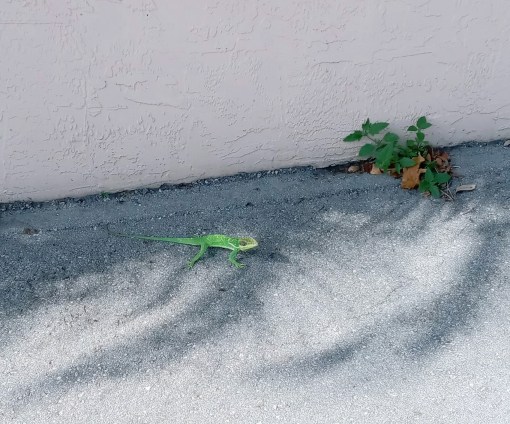
There is quite a lot of wildlife in south Florida, and particularly there are many birds and reptiles.  In fact, I wouldn’t be surprised if the owl and its ilk are gorging themselves on the many lizards, including the unusually large number of young iguanas we’ve had lately.

20220808_133054_(1)

Earlier this week, I saw the subject of this picture outside in the back, and it ran and ran, then I went past a construction dumpster, carrying garbage destined for a more standard dumpster, past where it had been.  I thought it might have already headed toward the little, wooded seating area in the shopping plaza, but then I realized it had tried to climb away only to find itself in the pictured basket, apparently puzzled about what it should do next.

Iguanas don’t seem to tend to be that all that bright.

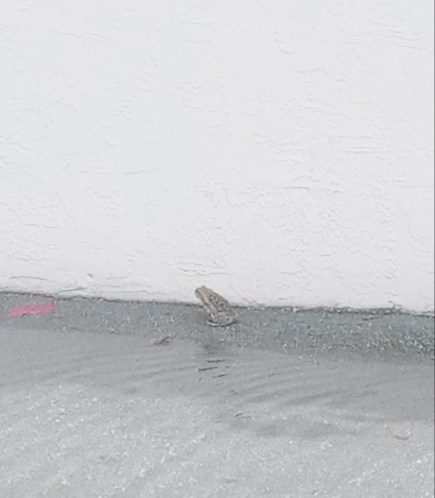
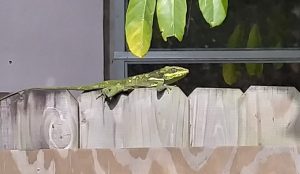
We’ve had some other life in the long alley behind the office, including some good-sized frogs and their tadpoles, and what I think is a Cuban Knight Anole, pictured below, and one of which I saw quite a while back on the fence beside the house in which I live.

20220521_105221_(1)

20220419_163548_(1)

But perhaps the most interesting—in some senses—life form encountered was that seen in this video, in a wooden fence behind the aforementioned slightly wooded, rather pleasant, outdoor seating area in the shopping plaza/strip mall.

There was a time in my life when I would have been terrified even to get this close to such a swarm, but nowadays I just find it fascinating, and I wasn’t the only one.  I’m not sure what I meant when I asked about where the bears are in the video—apparently it was a sensible joke, because my coworker laughed about it.  But all I can think of now is fictional bears trying to get honey from beehives, a la Winnie the Pooh or similar.  And I don’t know why I should have thought of such a thing, even for comical purposes.

Oh, well.  I say and think a lot of things that are bizarre and peculiar, even to myself.

Of course, there is other “wildlife” in south Florida, both native species, like the owl, and invasive species, like the iguanas, the anole, and the humans.  There are other mammals besides humans, as well.  Around the house in which I currently live, there are of course quite a few semi-stray cats, and last night when going out back, I encountered a youngish male raccoon, who was at first nervous of me, though he hadn’t even realized I was there until he practically walked into me, at which time he retreated a bit—apparently I’m pretty quiet.  I spoke calmly to him, and he seemed reassured enough to come back past me to go wherever he was going, through a gap in the fences.  I took no photos, but who hasn’t seen raccoons before?

There’s plenty of food in the neighborhood for an enterprising raccoon or twelve, so I’m not surprised he looked quite healthy.  I know he has older kin, because I’ve seen other, chunkier relatives (presumably) of his in the area in the past, including once what I believe was a mother with her child.  There are also at least two opossums, probably a mother and child based on their relative sizes.

It’s all rather interesting, I suppose.  Unfortunately, nothing about me or my life is nearly as interesting as these animals, except perhaps in the “Chinese curse”* sense.  I still have my usual chronic pain, and this morning my back and side were quite stiff, so before I got dressed I rolled on lots and lots of “Icy Hot”.  I don’t think that was a good idea, because all I have now is that irritating, burning sensation all around my skin in the left half of my midsection, overlaying the stiffness and pain that was already there and persists.

Maybe such products do their work by making you feel relief when they fade away, so you think you feel better when you’ve just reverted to baseline.  It would be a pretty good joke by way of a pain-treating product.

Icy Hot does actually tend to help when I’ve got inflammation and soreness in joints, such as the base of my thumb, so I don’t want to denigrate it too much.  I’m just speaking tongue in cheek—which is a good way to set yourself up to bite your tongue badly if you hit a bump or just forget what you’re doing with your tongue.

That’s about all I have for today.  At least there are some interesting animals, and some exceptionally mediocre pictures and videos of some of them.  If it weren’t for all the people (me included) south Florida would be a really cool—though actually quite muggy and hot—place to be.

Wherever you are, please take care of yourselves and your loved ones.  Relish the time you have with them; it is finite, and you will not necessarily have any warning before it comes to an end.  Revel in your time, as Tyrel said to Roy.

TTFN


*I.e., “May you live in interesting times.”

Methought I heard a voice cry, “Sleep no more!  Microsoft does murder sleep!”

I occasionally have my bones to pick with Microsoft, though on the whole I think they do a good job and make products that I use all the time, and that I have used since I was maybe 12 years old.  But last night, my Windows-based laptop did an automatic update at around midnight or twelve-thirty, and the consequences thereof made me feel less-than-charitable toward the company and its people.

I had gone to sleep watching a YouTube video of a British comedy panel show (one I’d seen many times before, which was why it helped me go to sleep), but once the aforementioned update was over and everything restarted, that show restarted, from its beginning, along with its raucous opening music.  This, weirdly enough, woke me up violently out of what had been, up until then, a reasonably sound sleep.  I had to scramble first to figure out what was happening, then to input my password just so I could get to the screen with the video and stop it playing.

I’m not saying I would have slept through the night like a log otherwise; that almost never happens.  But I was asleep until then, at least.  I had gone for a nice long walk in the evening after work the night before, which helped make me sleepy.  And once I’d been startled awake by the video, it was a long time indeed before I was able to get back to sleep, and my sleep was intermittent after that, as it often is after the first few hours of the night.

What I don’t get is, why does the system trigger a re-starting of such videos after it updates, even if the lock screen is up so that one cannot access it without entering the password?  It doesn’t make sense.  If one’s computer is dormant after restarting, such that to use it one must input one’s password, then videos certainly shouldn’t be relaunching until and unless someone returns to the relevant page.  Surely the code for this can’t be too hard to add to the system; I’m amazed that it wouldn’t simply be the default setting.

Maybe it’s not a problem with Microsoft as much as with Google, who produced the browser I was using and, of course, who owns and operates YouTube.  If they’ve deliberately made it so that videos start playing when a system has restarted after an update, even when the lock screen is on—knowing that most automatic updates are set to happen late at night to minimize user inconvenience—then they need to rethink their software, and indeed their very lives.  Those of us who already suffer from insomnia would be delighted to be tasked with keeping the responsible programmers from ever having more than one hour of daily sleep for the (very brief) remainders of their lives.

Perhaps I should only speak for myself.  It’s not as though anyone else has nominated me to speak for any group, and I certainly haven’t been unanimously elected to represent all the insomniacs of the world or even the USA.  Still, it’s irritating.  This isn’t the first time it’s happened, but it happens intermittently, and rather unpredictably—since updates happen irregularly, and I don’t tend to notice ahead of time that they are coming.

And I enjoy using such YouTube videos to help me go to sleep.  Dropping off at night to a favorite British comedy panel show is at least a pleasant beginning to a night’s slumber, even for those of us with both difficulty falling asleep and difficulty staying asleep.

You would think that such an issue would be a minor problem, and I suppose it would be, if not for my already troubled sleep.  But, as I’ve mentioned before, I can literally remember the last time I had a restful night’s sleep; it happened in the mid-1990’s.  I’ve had general anesthesia since that time, but it’s just not the same.

And though I can induce somewhat longer sleep using medications, they don’t make me feel rested—I don’t know that they make anyone feel rested, since they tend to screw up the normal sleep processes—and I really can’t use them during the work week, because they all make me feel foggy and woozy the next day.

Sorry.  Here I am complaining again.  But I guess I can do that if it’s what I want to do.  As I’ve said, I hoped to use at least these daily (nearly-daily, anyway) blogs as a kind of therapy or catharsis* of some kind, and so, given that, well…it’s my blog and I’ll whine if I want to.

I don’t know that any of it is doing any good one way or another, though I suppose if word of this happens to reach someone at Microsoft or Google (or both) and encourages them to change their software so they don’t further damage people who are suffering from insomnia on top of dysthymia/depression and ASD, decreasing such people’s chances of survival past the end of the present month, which was already not terribly great, then maybe—just maybe—it will have done some good in the world for someone, even if it hasn’t done any good for me.

For me, it’s doing about as much good as the dream-voice that troubled Macbeth did for Duncan after he had already been murdered.  It might almost just as well be a dagger of the mind, proceeding as it does from this heat-oppressed brain.


*Though I’m pretty sure the more or less literal notion of catharsis as a psychological process has been disproven, at least in its semi-literal idea that some form of “pressure” builds up and needs to be released.  But maybe I’m conflating catharsis with something else.