A very low magnitude happiness vector

It’s Friday now, for those of you who have been drinking heavily in the run-up to the big holidays and have lost track of the days.  I’m certainly working today, but I don’t know if the office will be open tomorrow, so I don’t know if I will write a blog post tomorrow.  If you’re interested, feel free to check this site in the morning.  Or, if you like, you can subscribe, and you’ll be sent emails for new posts.  But take that suggestion like a broken barometer:  no pressure.

That’s almost all that I feel I have to say.  Ordinarily, not having anything to say doesn’t mean I won’t write a post.  I’ll just blabber and blather for nearly a thousand words, just to see myself write*.  But there won’t be anything of substance.

Probably a good fraction‒perhaps even a significant majority‒of everything you can find on this blog is pointless nonsense.  Though, of course, I might contend that everything is pointless nonsense.  But here in this blog, you will sometimes find it concentrated, distilled, freeze-dried, and vacuum sealed.

No, I don’t know what some of those things might mean here, metaphorically, any more than you do.  I was just saying words that I thought seemed good.  I have curious tastes, though, so I’ve no idea what others might think of them.

Anyway, that’s me trying to act all silly and funny and whatnot, as if I might be even slightly happy, so that other people don’t have to worry about me.  Well, don’t worry about me.  I’m not happy at all, but it doesn’t matter in the slightest, because neither do I.  Maybe that’s just the way everything is, or maybe it’s just me.  Neither would particularly surprise me.

So, anyway, yeah, I’m not happy, not in any useful sense of the term.  John Galt said that happiness is a state of noncontradictory joy, and that’s always seemed to me like a pretty useful definition of the word, though it’s not the only useful one.  But I like how it separates joy from happiness.  Even people going to the gallows can sometimes joke and laugh, if only as a defense from fear, and in those moments of laughter they may feel joy.  But it is perforce transient, and it’s unlikely that they would be willing to say that they were happy**.

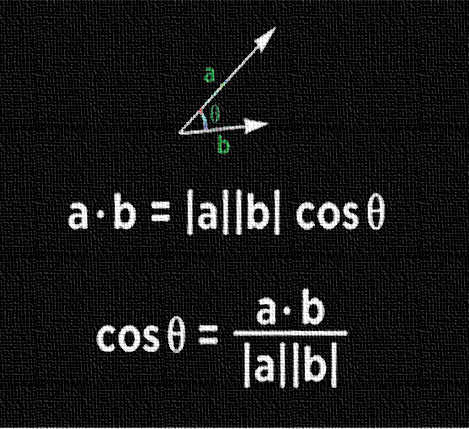
So, in that usage of the word happiness, joy would be necessary but not sufficient for actual happiness.  And both might be relatively orthogonal to a state of wellbeing (which is another word that has more than one interpretation).  Still, though the dot product of happiness and wellbeing may be surprisingly small***, I don’t think it could be zero.

Yes, I use vector multiplication as metaphors for such things, though honestly, it’s not really even so far separated as to be merely a metaphor.  Vectors can be useful for tremendous numbers of things that may seem far afield from each other, from computers and artificial intelligence to physics to biology to economics and ecology.

They can even be of use in psychology, though I don’t know how often they are used therein.  I haven’t dived into a lot of more formal psychology recently, though I like the popular works of Daniel Kahneman and of Jonathan Haidt.  And Paul Bloom is great fun.  But popular works of psychology rarely involve measuring aspects of mental functioning as vectors in a phase space.

Though, as you might have picked up if you’ve read a lot of what I’ve written here, I think it’s useful to think of human behavior and actions as the outcome of a vector sum of all the various “pressures” in the brain/mind, which end up with a resultant that determines what one’s actions will be in that moment.

But, of course, the action itself can feed back on the input vectors, altering them in various ways (maybe their angles, maybe their magnitudes, rarely but possibly their actual sign, which admittedly would just be equivalent to an angle change of 180 degrees, or 𝜋 radians).

Likewise, the state of many of those vectors can change with time.  For instance, one could imagine a vector associated with one’s degree of alertness.  Such a vector would tend to have greater magnitude in the daytime than late at night in most humans, so it waxes and wanes inherently (though even this is likely a result of input vectors delivered by various aspects of the sensory systems).

But the actions taken as a product of previous moments’ vector additions can affect this vector, too.  If a previous resultant led to one having a strong cup of coffee, that might increase the magnitude of the alertness vector, though there would be a delay.  Alternatively, if the previous outcome had led to one drinking a significant amount of Wild Turkey 151 on an empty stomach, the alertness vector might soon start decreasing in magnitude.

Okay, I’ve reached the point in the blog post where I’m using vectors to describe the effects of coffee versus whiskey.  I think it’s reasonable to bring things to a close now.  I hope you all have very good days, by any reasonable measure.  If I work tomorrow, I’ll write a post tomorrow.  I’ll leave figuring out what effect that will have on your own wellbeing for your consideration.


*Analogous to speaking to hear oneself talk.

**Though I can imagine possible situations in which one might be literally happy even on the way to the gallows.  It would be a very brief happiness, nonetheless.

***I doubt that it is, but I also doubt that it is the full, direct product of the magnitudes, as it would be if there were no angular difference at all.  Wellbeing, I think, is more complicated than happiness, which is itself by no means simple.

Noisy events on the horizon of my attention span

It’s Tuesday, isn’t it?  Well, I guess it may not be Tuesday when you’re reading this, but it’s Tuesday as I’m writing it.  It’s the second day in the latest of a seemingly endless stream of utterly pointless “work weeks”.

Welcome to our world.  Welcome to our world.  Welcome to our world of noise.

That’s a paraphrase of the song that was (and may still be) sung by the dancing animatronic puppets in the main front area of the big F.A.O. Schwartz store that sits just by the southeast corner of Central Park in Manhattan.  I’m not sure why I felt like including it there, but it definitely expresses the sentiment I have that nearly everything in the universe is effectively “noise” in the information theoretic sense.  At the very least, the signal-to-noise ratio in the world is vanishingly tiny.

It’s not zero, mind you.  There’s some info hiding in all the nonsense.

Of course, whether something is signal or noise depends very much on what signal you’re seeking.  If you’re trying to detect gravitational waves, then nearly everything else around is “noise” in the sense that it is not evidence of gravitational waves, and is just going to make that evidence harder to find.  But if you’re an ornithologist, then at least some of that seeming noise might be the birdsong “signal” of a rarely seen species there in Louisiana, which I think is where the first LIGO observatory was constructed*.

And, of course, if you’re a seismologist, what you consider a significant signal would very much be noise to the LIGO people.  If there were a gravitational wave strong enough to be seismically significant, it would have to be from a very close and catastrophically violent event.

We don’t expect there to be such a thing any time soon.  And apart from such events, gravitational waves are so relatively weak‒gravity being by far the weakest of the “forces” of nature‒that so far they can only be detected from things like black hole and/or neutron star mergers, which are ridiculously violent events.

Incidentally, apparently recent observations of one such merger has given confirmatory evidence for Stephen Hawking’s black hole horizon theorem**.  That states that when two black holes merge, the (surface) area of the new, combined event horizon must be at least as large as the two prior event horizon areas combined.

In this, as in other things, black holes and their horizons act very much like the 2nd Law of Thermodynamics, and that is consistent with the Bekenstein-Hawking thesis that the entropy of a black hole is proportional to the area of the event horizon, as measured in square Planck lengths.  Indeed, the maximum entropy‒the maximum information‒of any given region of space is that which would be encoded upon an event horizon that would hypothetically enclose such a space.

As for the volume of a black hole within the event horizon…well, that’s harder to quantify.  The apparent radius, as judged from the sphere of the event horizon‒the Schwarzschild radius for a non-rotating black hole‒is almost certainly much smaller than the radius that would be perceived by someone within the horizon, for spacetime is very distorted there.  Indeed, I suspect that, at least by some measures, the volume within a black hole‒or at the very least the radius from the “center” to the horizon‒is infinite, with the “singularity” actually stretching down away forever.

Of course, an asymptotically infinite well of that sort need not always have infinite volume.  There is, for instance, the counter-example of “Gabriel’s Horn”, a shape made by rotating a truncated function (y = 1/x for x ≥ 1) around the x-axis.  This shape has infinite surface area, but it has a finite volume(!).  So you could fill it with paint, but you could never finish painting the inner and outer surface.  Weird, huh?

Of course, the dimensionality of things within a black hole’s event horizon is probably at least one step higher than things in the Gabriel’s Horn comparison, so the finite/infinite comparisons may not translate.

I’d like to be able to do a better job working that out with more than my intuition; that’s one reason why I own no fewer than four fairly serious books on General Relativity.

That’s not the only reason, of course.  I would also like to try to solve what happens to a space ship that accelerates near enough to the speed of light that its relativistic mass and relativistic length contraction puts it below its own Schwarzschild radius (at least in the direction of motion).  Also, how would that figuring be changed if the ship were rotating around the axis of its motion***?

Unfortunately, I rarely have the mental energy to put into pursuing adequate mastery of the mathematics of GR, and so I can (so far) just try to visualize and “simulate” the spacetime effects in my imagination.  That’s fine as a starting place, but even Einstein had to master the mathematics of non-Euclidean geometry and matrices and tensors before he could make General Relativity mathematically rigorous.

It’s almost certainly a pipe dream that I will ever get to that level of expertise.  My chronic pain and chronic depression (dysthymia) combined with the effects of my ASD (level 2****, apparently) and the effort that’s required for me to act “normal” enough to get along just really wear me out mentally.  It’s frustrating.  I have a stack of pertinent texts above my desk at work, where I hope they will entice me.  I even have a copy of my old Thomas and Finney college calculus text there too, so I can do some reviewing in that.

If only I were able to spend some time without pain and to get a good night’s sleep once in a while, I might even make progress.  I suspect that such things are not in the cards, however.

I would love to be dealt The Magician (in Tarot cards) but I fear that I am just The Fool.  Oh, well, that’s all just metaphorical, anyway.  It’s possible to predict the future, of course, but it is difficult, and it’s very unlikely that any set of cards‒however cool they may be‒is the way to do it.


*I remembered correctly.  It is in Louisiana.

**The theorem, being a theorem, is mathematically rigorous, but the question remains whether it describes the way our universe actually works.  That is always a matter of credences rather than “proof” in the mathematical sense.  In the real world, probabilities may come vanishingly close to zero or to one, but they never quite reach them.

***In Special Relativity, when something is traveling around a circle at a significant fraction of the speed of light, length contraction has the effect of “shrinking” the circle from the “point of view” of that which is moving at that speed.

****”Requiring substantial support” according to the official definition.  I do not have such support.

Only the truly continuous is infinitely divisible

Well, it’s Friday, the last day of another work week—the first full week of August (or Sexember, if you prefer) in 2025.  And here I am writing things that, so far, are not only trivial but banal.  Perhaps, as I go along, I will write something more interesting and surprising, but so far, I’m not impressed with myself.  I guess these things happen.

I did not end up riding my new bike back to the house last night, because there were thunderstorms in the area, particularly down by where I live.  I’m not too intimidated by riding a bike in the rain, but it’s a new bike, and its configuration is different than the type to which I am used, and it is slightly wobblier than my normal, so I felt it wasn’t a great idea to ride it five miles in the rain.  It turned out the rain was almost over by the time I got to my train stop, but it was nevertheless still quite wet and puddly, and I probably was wise-ish to avoid riding in it.

Still, it’s slightly frustrating.  Hopefully, today it won’t be an issue, because it would be a shame to miss the whole weekend with it by the house.  There are supposed to be thunderstorms today again, but they are expected earlier in the day than yesterday, and the weather is predicted to clear by early evening.  That should be fine, at least.

Of course, weather prediction is never perfectly precise—Chaos Theory being applicable and all that—but forecasts done for only twelve hours or so in the future are likely to be much more accurate than those for a day or a few days or a week ahead of time.  After about five days, trying to get too specific a forecast is a bit of a waste of effort, and it may always be.  One cannot, with finite computing power, calculate things to infinite precision, and without infinite precision, in the long term, Chaos makes one’s predictions ever more inaccurate.

Of course, that raises (not “begs”!) the question of whether reality is actually defined in any meaningful sense down to the level where limitless precision would apply.  In other words, are Real Numbers actually a thing that exists in reality?  That may seem a strange question, given that they are called “Real Numbers”, but that’s just a name, given by humans as a file heading if you will, a way to index the subject.  It doesn’t actually signify the reality of the real numbers, any more than those who call themselves “Conservative” in the current US are in any legitimate sense conservative by most agreed upon uses of that word.

Of course, all non-complex numbers are Real numbers, and all Real numbers can be considered complex numbers (just with a zero i component if they are only Real).  The counting numbers are still Real numbers, as are all the integers and fractions, and of course, all our best known “irrational”* numbers, like π and e.  But the vast majority of Real numbers cannot be specified by any reductive formula or algorithm, but have do be described digit by digit, forever—maximum information-type entropy.

So, to describe fully a “typical” specific Real number usually requires infinite information, with infinite precision.  But there’s a real (haha) question whether any portion of reality is defined so precisely, or whether that could even have any meaning.  As far as we currently know, the smallest distance that has physical meaning is the Planck Length (about 1.6×10⁻³⁵ m), and the shortest time that makes physical sense is the Planck Time (about 5.4×10−44 s), and so on.  These are very tiny numbers, but they are finite, not infinitesimal, and are certainly not infinitely non-repeating decimals.

But does the Planck Length (and Time) apply to actual, bottom-level reality, or is that merely a limit within the constraints of our current understanding?  We don’t know, for instance, how such things apply to gravity when it becomes strong enough for such scales to apply.

It’s mind-boggling, or at least wildly stimulating of probably inexpressible thought, that reality may be only finitely defined at every given point in space (which “points” themselves would only be finitely packed, so to speak, such that below a certain scale, the distance between two points would have no meaning) or that it may in fact be infinitely defined, down to the fully expressed Real Number level, and that indeed it may be infinitely divisible in the same sense Real Numbers are—and thus there would be, between any two points in spacetime, as many points as there are in ALL of spacetime.

Either possibility is wildly cool and difficult to represent internally—indeed, impossible to represent perfectly internally, but difficult even to contemplate roughly at any very deep level.  Is it any wonder that people like Cantor and Gödel were mentally ill, given the kinds of things they contemplated and explored?  I’m not saying those things were the reason for their illness; that would be a cheesy sort of magical thinking, redolent of an H. P. Lovecraft story.  But the contemplation of infinities and complexity and chaos is both sobering and intoxicating at the same time.

What do you know, I drifted into less banal areas after all.  I guess that’s a decent way to end the work week of blog posts.  I hope you all have an interesting and good weekend, without too many utterly unpredictable events (unless they’re good ones for you).


*Just to remind you, this does not refer to numbers that are in some sense crazy, just that they cannot be expressed as a ratio of two integers, no matter how large the integers.  That’s the original meaning of the word irrational, but the very fact that there existed such numbers seemed so horrifying to the old Pythagoreans—or so I’ve heard—that it almost immediately acquired it’s secondary, now more common, usage.

Monday morning, wearing down

Well, it’s Monday again.  Time keeps marching on without respite, as it is apparently wont to do, “progressing” in the direction of increasing entropy, whether time is a fundamental aspect of the universe or an emergent phenomenon.  In either case, there doesn’t seem to be any sort of time stream or time vortex like in Doctor Who, but rather a process that simply is a linear dimension with some “entanglement” (not to be confused with quantum entanglement) with the dimensions of space, such that motion and acceleration in space changes one’s “motion” in time, in an updated version of the Pythagorean Theorem.

For those of you who like to share the joke about “Yet another day when I didn’t use a2 + b2 = c2” you’re really depriving yourself of a deep understanding of something that turns up in and governs a ridiculous number of the things and processes in the physical reality in which you live.  Consciousness—despite clever but tortured sophistry (in my opinion) by some prominent philosophers of mind—in no way appears fundamental to the universe*.  On the other hand, the Pythagorean Theorem, which was neither invented nor discovered by Pythagoras, applies in all levels of dimensions, however many you might conjure, and with the modification to make it reflect velocities, it applies to spacetime as well.

There can be no readily conceivable brains** in two spatial dimensions, but Pythagoras nevertheless applies.  In one dimension, it doesn’t really apply, but in one dimension there are no triangles of any kind, so it doesn’t make much difference.  It’s difficult to imagine how consciousness could possibly occur in one dimension (notwithstanding the seemingly one-dimensional paucity of ideas held by so many people, especially in politics).

Anyway, enough of this nonsense.  Well, it’s not nonsense, but it is rather pointless meandering of random thoughts that interest no one but me, and will probably lose me readers.  Weirdly enough, people seem to come and read more often when I write about my depression and self-hatred and anxiety and ASD and how there’s absolutely nothing going on in my life that makes it worth living.

Well, rest assured, all those things are still present and active and driving me toward an early grave, which in some senses will be a release, or at least an escape of sorts.

I keep trying to think of things to engage myself and my interests, but so far to no avail.  I think about asking my boss to give me back my black Strat to play at the office, or I consider bringing in another guitar, or maybe even getting a portable keyboard or something, but when I think of any of them, I cannot even imagine doing anything but sort of staring at them as if I don’t even know what their purpose is.  I don’t play my guitars or my keyboard at the house, either.

It’s likewise with even fiction, other than silly Japanese light novels that take a day or so to read (not continuous time).  I think I like them mainly because of the social interactions of the characters, many of the main ones of whom are somewhat socially awkward.  It can feel, however briefly, that I have a social group of some sort, as I read the stories.  Of course, that means that once I’m done reading there is a comparative let down, which sometimes makes me feel worse than I did before.

I tried to read some of Feynman’s Lectures on Physics, but I lost interest almost immediately, though he was a brilliant and engaging teacher.  I also tried to read some of Anthony Padilla’s Fantastic Numbers and Where to Find Them, which is also very good and fun; if you’re interested in who he is, you can check out the YouTube channel Sixty Symbols, and sometimes Numberphile.  He shows up in both places fairly often.  But in any case, though I like his book (I’ve read it before) it has not been able to grip me.

I’ve also tried to start reading Stephen King’s novella The Life of Chuck, since it’s now a movie and is getting positive reviews.  At least Stephen King is almost always an engaging read.  But I’m not sure I’m getting into the story.  Quite a while ago, I started the first story in If It Bleeds, the collection in which the above novella appears, but I couldn’t get into it at all.  When I can’t even get into reading Stephen King***, things are looking bleak.

I did watch the rest of the latest series of Doctor Who, and it was pretty good, and quite surprising at the end, but Batman only knows when the next series is going to happen, and there will only be a handful of episodes if it keeps up as it has been.  That’s too little too late for me to use as motivation for continued existence.

I don’t know what to do.  I really don’t know.  I feel very lost and, more importantly, very much without any internal impetus.  I can’t even listen to songs I like, let alone try to sing along (or play) without feeling like I’m going to cry, though I don’t understand why.  I’m at the end of my rope (I have two, and both are tied into nooses, just for “fun”).

Anyway, that’s enough.  Sorry to bother you with my crap again, but in my mind, you asked for it by complaining about my tedious math and science stuff.  I hope you have a good day.  Unless you’re lucky (or I am) I’m sure to be back again tomorrow with another blog post.


*The only reason I can discern why some people think consciousness is fundamental to the universe is that consciousness is fundamental to human experience—indeed, one could say that it is human experience—and of course, such people seem tacitly or implicitly to think humans are the measure of all things simply because that is what they are.

**The degree of interconnectivity is just too low.  Connections between 2D neurons would be terribly limited, as would room for such things.  I suppose that, since we can always map anything three-dimensional onto some two-dimensional surface, à la Bekenstein-Hawking black hole entropy and the holographic principle, we could construct a sort of brain in 2D, but that’s a tortuous process, and seems quite unlikely.  Of course, 4D would give us even more available connectivity than 3D—also there are no knots or tangles in 4 spatial dimensions—but there are other issues with 4 (macroscopic) spatial dimensions that would seem to get in the way of life as we know it, such as the nature of gravity (and other forces) and the rate of such forces’ diminishment.  For instance, the force of gravity (and electromagnetism, etc.) in four dimensions would fall off at a rate proportional to r3 rather than r2, and there are apparently no stable orbits in such situations.

***What’s worse, I cannot even get into reading Tolkien.  I’ve tried.  When neither Stephen King nor Tolkien, nor even well-written science books, can engage me, something indeed has happened.

The paragraph indentations below are not merely done on a whim

     Wow, okay, yesterday was one heckuva day, and not in a good sense for the most part; it was a real cluster-fudge*, so to speak.  This is not meant to imply that yesterday was all bad or anything; that would be absurd.  I may be a madman (without a box, alas), but I am not so irrational as to think that there were no positive things in any given twenty-four hour period, even if I restrict the universe being evaluated down to only things that happen to me.

     I have never been one of those depressed people who interprets himself or his life as “all bad”.  That would make things easier, probably‒I would either have destroyed myself long ago or I would have embraced my identity as a pure villain**.  But I am capable of nuance, an attribute that seems often to be missing in our political discourse.

     Mind you, that latter happens largely because it’s what people seem to want to consume, or at least what enough people want, and to which enough people respond, that it becomes a stable and often successful strategy for politicians to use.  So, at least some of the “blame” for the vacuity of news and politics is that humans tend to run toward misleading simplicities rather than dealing with a complex world in which even people with whom they disagree can have good points and do good things and have their own pain and loss and fear and love and memory and dreams.  And even people with whom they agree on most things can nevertheless sometimes behave like complete assholes.

     The world is complicated.  How could it not be?  Almost everything of which we are aware and of which our reality consists is constructed from incomprehensibly vast numbers of interactions between quantum fields on tiny, tiny scales, with causality propagating at the speed of light, with behaviors and properties requiring complex numbers*** to describe mathematically.  If you’re an electrical engineer, you might use complex numbers in real life, because they are very useful for modeling cyclical processes like alternating current, but most macroscopic, emergent processes don’t require complex numbers to describe.

     Or maybe they would be best described, mathematically at least, using complex numbers, but most macroscopic, emergent phenomena have too many things going on‒too many moving parts, if you will‒to be efficiently described by any remotely practical mathematical formalism.  Even computer algorithms might be inadequate to describe the functioning of large scale matters in sufficient detail.

     It may be that natural language really is the best tool for describing such aspects of reality, since it allows one to vary one’s level of intricacy and complexity to suit the needs of any given situation.  But of course, to do so requires one to be rigorous to the point of being a martinet about one’s language usage.  If a word or term can have more than one meaning, it is crucial to specify which meaning one intends so as to avoid apparent disagreements that actually just come down to semantic confusion.

     I don’t necessarily mind semantic discussions‒I like words and language and logic and poetry and puns and all that stuff‒but if one is trying to share an explanation for something, and really to share understanding, precise word meaning is going to be necessary.  You can’t use html to write a program that runs in Pascal.  Okay that’s not a great analogy.  Let’s say…you can’t win a game of Texas hold ’em poker by following the strategy you would use for euchre.  It’s not just that you won’t win; your moves won’t even make sense.

     Okay, well, that’s probably enough for today.  I’ve been trying not to be as negative as I was yesterday, and I think I’ve succeeded reasonably well.  I do this sort of back and forth thing so often that some people have said they wonder if I am literally bipolar with a rapid cycling rate.  I can only respond by saying that this possibility has been considered by me and by several different mental health professionals, and it is thought not to be the case.  Of course, I’ve never been tried on a course of, say, lithium****, nor really on any of the other, less tricky mood stabilizers (other than as would-be adjuncts for chronic pain treatment).  But if I were occasionally waxing manic, I would imagine that sometimes I would feel really good about myself, and I rarely do.  Also, antidepressants have never triggered a manic or hypomanic event for me, and I’ve taken many different ones at different times.

     All right, well, there was a whole paragraph after I’d already said I’d written enough.  My apologies.  I do go on, don’t I?  Have a good day, if you can.


*If no one has used that euphemism as the name of a brand of candy, I’ll be even more disappointed in humanity than I was already.

**Knowing me, I would probably accidentally do good for the world every time I tried to do evil.  At least it would be funny.

***Complex numbers are numbers with one “real” part, i.e., some number on the usual, continuous number line, and one “imaginary” part, which is a real number multiplied by i, the square root of -1, which is no more truly imaginary than is any other number.

****I like the song a lot, though.

“Sleep”, writing, and studying physics–report for June 5, 2024 AD/CE

Well, I got almost 4 hours of uninterrupted sleep last night, plus 20 minutes or so of on and off dozing.  While that sucks big-time, it’s better than it’s been lately.  At least I’m not seeing bugs on the walls out the corners of my eyes right now–though I still keep briefly thinking there’s a cat waiting by any door that I open, until I look down and see that there isn’t.

What can you do?  Not much right now, it seems.

Anyway, I produced a decent amount of work this morning.  I wrote 1,373 “block” words and 1,388 “net” words, with a difference then of just barely over 1% no matter which number you take as your denominator.  The total word count of this would-be short story is now 54,327 words, and it is 83 pages long in the format I described yesterday (I think).  It’s definitely more of a novella.

I’ve been doing a bit of reading these last few days, skipping between Sean Carroll’s two Biggest Ideas in the Universe books and the first volume of Feynman’s lectures and Jordan Ellenberg’s Shape*.  As you know, I’ve been trying to teach myself more of the physics on which I missed out by switching majors after my heart surgery, especially General Relativity and Quantum Mechanics/Quantum Field Theory.  Sean Carroll’s** “Biggest Ideas” books are focused on explaining those things for interested laypersons without avoiding the mathematics, but not practicing teaching/practicing how to do the math, so it’s a good beginning.  Of course, in a perfect world, I intend to beyond the overviews and actually to get comfortable with using the mathematics, particularly because I want to understand the cosmological constant at the level of the mathematics of General Relativity, because that’s the only part that I don’t quite get intuitively.  But really, I want to understand and be able to use all of it, and to be able to read all the papers on arXiv and understand them at the level of a professional, like I can with medrXiv and bioRxiv.

I doubt that I will live that long.  But, in the meantime, at least I’m learning new things.

Tomorrow is Thursday, so of course, I will be doing my more standard Thursday blog.  It’s silly to call it a “weekly” blog, since I’ve been writing these reports almost every day; once I’ve started a habit it’s hard for me to deviate from it.  But I don’t plan to write any fiction tomorrow, but instead will just focus on the blog post.  I’ll see you then (so to speak).


*I’ve not yet encountered a better teacher of mathematics than Professor Ellenberg.  He captures and conveys the fun and beauty of math as well as anyone I’ve encountered and better than the vast majority.  He narrates his own audio book versions, too.  If you want to review general mathematical ideas and then general geometric ideas (and their surprising applications) in an accessible and enjoyable way, you could not do much better than reading (and/or listening to) his books.

**Professor Carroll is another great teacher, though he deals with slightly more high-falutin’ stuff than Professor Ellenberg in his books, so the subject matter can be denser.

Squaring away a queasy stomach

It’s Tuesday morning, and I’m not writing any fiction today, because I don’t feel terribly well.  I took a lot of pain medicine yesterday, of more than one kind, and I think it upset my stomach.

Indeed, I woke up very early this morning feeling nauseated.  I wasn’t queasy enough to throw up, which is in some ways disappointing, since that always brings at least a bit of relief, but I was certainly unable to rest.  I decided, finally, just to get up and get an Uber in to the office, since I knew if I waited too long I might choose to stay “home” for the day, and that wouldn’t make me feel any better.

So I showered and then ordered an Uber; today the prices were reasonable, even for a ride all the way in to the office, which helped cement my decision.  It’s frivolous, of course, in that it’s an unnecessary expense, and I really need to avoid doing it too often.  But it ended up being interesting.

I decided, while en route, not to do any writing in the car, either on my phone or on my laptop computer, since I was worried about car-sickness.  Instead, I eventually started playing with the notion of the standard Uber tip buttons.  I thought, to myself, if I were to give a 25% tip (the maximum automatic one), that fact would increase the total amount paid, and so the net tip would be less than 25% of the new total.  So, if I added 25% of the extra, that would increase the total even more, but it would then still be less than 25% of the new total, so I would need to add more, and eventually it would converge on a final number.  As I did a quick bit of figuring, I realized that the final amount I was approaching was 33% more than the original amount.

I realized—this is not a terribly impressive mathematical insight, I know, but I was and am queasy and so it was an interesting distraction—that this process effectively entailed an infinite series, in the form of 1 + 1/n + 1/n2 + 1/n3 +… and so on.  The first little ad hoc trial I had done made me realize that, at least that series had taken n as 4, and iterated it, giving a final number that was 1 and 1/3.  That seemed interesting.

I wondered if this was a general pattern.  So, using a calculator this time, I took one then added a fifth, then added 1 over 5 squared, then one of 5 cubed and so on, and pretty clearly arrived at a final total that was one and a quarter.  A few other numbers made it clear that this was general, and it makes sense if you work it backwards.  25 (one quarter) added to 100 gives you 125, and 25 out of 125 is always going to be on fifth of the new total , or 20%.  33 and a third (or a third) added to 100 gives you 133 and a third, and 33 and a third out of 133 and a third will always be a quarter of the total.

And then, of course, there’s the old mathematics joke about an infinite number of mathematicians going into a bar, with the first one ordering a pint of beer, the second ordering a half pint, the third ordering half as much as the second, the fourth ordering half as much as the third and so on, until finally the bartender holds up a hand and says, “Gentlemen!  Know your limits!” before drawing two pints of beer and putting them out on the table.  This is because 1 + ½ + ¼ + … goes to 2 in the limit as iterations go to infinity.

So, the series 1 + 1/n + 1/n2 + 1/n3 +…converges to 1 + 1/(n-1), which is (n-1)/(n-1) + 1/(n-1), which is n-1+1/(n-1) or just n/(n-1).  I’ve tried to start working the algebra of the infinite series to produce this result (just for fun), but didn’t put much time into it, and it’s not really necessary, since I can see the result clearly by working backwards.

Of course, looking at my result, I know this is really basic stuff, and at some level I already “knew” it, at least formally.  But there’s nothing like working out a thing for yourself to make it sink in and make true sense to you.

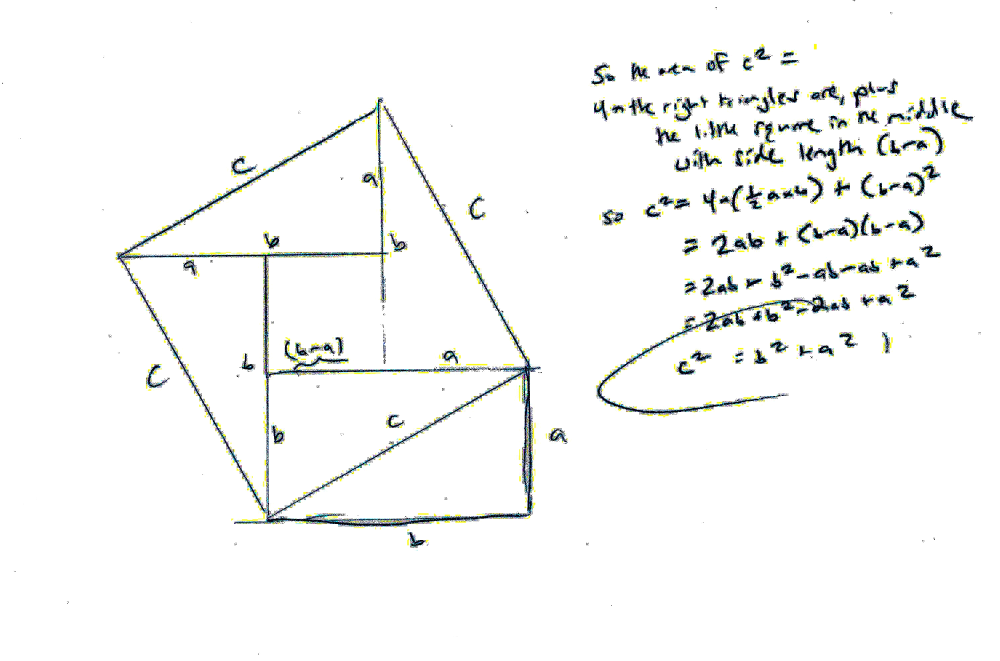
This is a bit like something I did when I was in the Education Department at FSP West during my involuntary vacation with the Florida DOC.  I was helping inmates try to get their GEDs, which was rewarding work given the circumstances.  But at one point it occurred to me that I didn’t think I’d ever seen the Pythagorean Theorem proven*.  So, I set out to prove it for myself, just for a laugh.  It looked something like this:

pytho

I didn’t use any of the standard, purely geometrical proofs that one often sees, but instead applied a combination of geometry and algebra that I kind of fiddled together on the spot.  I don’t know if what I did was perfectly rigorous; probably not.  Nevertheless, after I’d worked things through and simplified my algebra and indeed came out with c2 = b2 + a2, I was more convinced than ever before that the Pythagorean Theorem was not merely a well-supported hypothesis, but was indeed a theorem, and that given Euclidean geometry and so on, it was absolutely true.

All this is frivolous, or trivial, or whatever the term you might want to apply.  It certainly has little bearing on my day to day life.  But it is reassuring to think that, contrary to popular belief, it is possible to have new insights into fundamental ideas and things, however basic they might be, even at an older age (in my forties and fifties in these cases).  The human brain does not stop “growing” or improving after one reaches one’s twenties or thirties or after one has left one’s teens (or at least, whatever kind of brain I have doesn’t stop).  Even old dogs can be taught new tricks; and how much more amenable to teaching are naked house apes!

I’ve often been frustrated when people complain that they learned things like the Pythagorean Theorem in high school (or whenever) and had never had to use them at any point in their lives.  That may well be true in a simple sense, though I think the usefulness of that theorem might surprise people (it appears often in the workings of advanced physics, for instance, including in the Lorentz transformations in Special Relativity, and also in calculating the probabilities of outcomes from the magnitudes of the wave equation when makings measurements of a quantum system).

But ultimately, I feel like asking such complainers, “Do you do push-ups in order to become better at doing push-ups?  Do you do bench presses and squats to become competitive squatters and pressers of benches?  Do you jog to become professional joggers?  Do you do yoga to become a champion yogi?  No, the vast majority of people who do such things do them to make themselves fitter overall, stronger, with better endurance and flexibility, to be better able to do the many things in the world for which it will be an advantage for them to improve their strength and their flexibility and their endurance, and to be healthier overall!”

So it is with exercise of the mind, except the mind is far more plastic, far more able to be improved and trained, than the structures and strengths of the muscles and bones and ligaments and cardiovascular system.  Learning some of the methods of geometry and algebra and calculus, learning basic physics, including Newtonian physics and thermodynamics, learning some Boolean logic, some probability and statistics, some basic biology and chemistry…all these things are both inherently useful, and also give you skills and tools and abilities that are adaptable to hitherto unguessed situations and problems in the world, and give you insight into how much commonality there is to the structure of reality.

Understanding a bit about Chaos and Complexity theory can help you recognize why the specifics of the weather are fundamentally unpredictable but nevertheless the climate can be amendable to explanation and broad prediction.  Understanding a bit about Bayesian reasoning can give you the comfort of knowing that, even if you have a positive mammogram, and that test has an 80% sensitivity, you probably have nothing like an 80% chance of having cancer.  Indeed, you could be an order of magnitude or so less likely than that, depending on base rates and false positive rates and the like.

And in a somewhat orthogonal area of inquiry, if you want to understand something about the human condition, it wouldn’t hurt to expose yourself to the works of Shakespeare, who wrote about that subject as well as or better than practically anyone else ever has, and who did it in remarkable and beautiful language, coining figures of speech we in the “Anglosphere” still use, regularly, in daily life, four hundred years after he created them.

Also, if you live your whole life without ever having read book one of Paradise Lost, I think you will have sadly missed out on a great experience.  It’s not really a very long read.  Milton made his Satan a relatable and charismatic, almost heroic, character, and seeing how he did this can help you understand the power and persuasion demagogues and ideologues can bring to bear in the world, and how dangerous and yet enticing they can be.  Also, Milton’s writing is just beautiful, sometimes better even than Shakespeare.

And in To His Coy Mistress, Andrew Marvell prefigures the works of Billy Joel’s Only the Good Die Young by over 300 years.  And I’m pretty sure Pink Floyd referenced the work in Time.

Anyway, that’s what I did this morning to distract myself from an upset stomach, showing that these pursuits and skills can have wildly unpredictable uses.  So, until and unless you have actual organic illness that prevents your brain from learning, you can still grow, and can take more and more of the universe into your mind.  And, as Milton’s big bad himself said, “What is else not to be overcome?”


*It probably was at some point in my education, but I didn’t recall the proof, so it had clearly never really sunk in for me.  I didn’t doubt the theorem—all the greatest mathematical minds of antiquity and modernity were convinced of it, and it has always worked in practice.  But that’s not quite the same thing.