Let there be gall enough in thy ink, though thou blog with a goose-pen, no matter.

Hello and good morning.

It’s Thursday again, and so it’s time for my usual, normal, typical weekly blog post.  For those of you who dip in only occasionally to read this weekly post, you should know that I’ve been writing “daily”* blog posts for about the last two and a half weeks, since I have no will or desire or urge to write fiction, or to play guitar, or to do anything else more creative than writing whatever comes into my stream of consciousness for these blogs.

This week, my Monday and Tuesday blog posts were probably a bit gloomy.  I’m never sure how they come across to other people, though—I seem unable to express my feelings in ways that other people even notice, let alone understand**, so I can’t make unqualified assessments.  But yesterday’s was, I think, more lighthearted, since it was the 53rd anniversary of the Apollo 11 moon landing.

I like things like that.

Since I write a lot, I’m often slightly irritated by Word’s grammar checker function.  It frequently makes recommendations or highlights things that, apparently, its algorithm considers cases of incorrect grammar or punctuation.  Maybe half the time, maybe slightly more than that, it’s correct, because I’ve made a typo or was writing too fast on my first draft (or I just was incorrect, which does happen), but the rest of the time it’s simply wrong about its detected “error”.

There’s nothing wrong with that (ha ha); I don’t expect such algorithms to be perfect.  The problem is, when I address the suggestions, Word only gives me the options of changing what I wrote, not checking for that issue at all anymore (which I think would be counterproductive) or ignoring it “once”.  If I choose the latter, which I usually do, but then go back and edit that sentence or paragraph in any way—even if I put the cursor there—it highlights that “error” again, and I then have to choose either to re-right-click on it and tell it to ignore it once, yet again, or just to ignore the little blue double-underline that has clearly been designed to be difficult to ignore.  It’s irritating.

If there are people from Microsoft reading this, especially people who work on programming Word, please note:  I love your work, it’s a brilliant word processor; in many ways it’s The word processor, the standard by which all others are judged, and rightly so.  But can you please give us some other options such as, “ignore this from now on in this document”, and possibly even, “this would-be correction is itself erroneous”, the latter choice perhaps triggering a report to be sent back to Microsoft so the algorithm can be updated when it’s discovered that it’s making erroneous suggestions in certain circumstances.  I wouldn’t expect Word just to take my word for it, so to speak, but if many writers send back such reports on a particular issue, the program can be steadily improved, which would be of benefit to many.

I worry about this not merely because of the minor inconvenience to me which repeats itself several times daily, but also because there are many people out there who don’t seem to have studied grammar, punctuation, spelling, etc., since, perhaps, third grade—and I doubt they got a very good grounding in the matters even then—so they learn what they think are rules of spelling and grammar and punctuation and usage from the corrections they are given when they use texting functions and word processors.  Which means they’re learning something incorrect in many cases, assuming they’re trying to learn in the first place, which I’m pretty sure at least some of them are doing.

I know, of course, that language is an evolving structure, and some “rules” are arbitrary and even silly…but not all of them.  Grammar exists because there is a logic to it that allows language consistently and accurately to convey thoughts and ideas in useful ways from one person to another.  Some conventions are no more “natural” than driving on the right side of the road versus the left.  But even in such cases, people need to pick a side of the road for everyone to stick to, even if it’s just arbitrary, or there will be many accidents, and no one will get anywhere.

Some things are real and fundamental—I think Chomsky showed, or at least posited, that there is an inherent grammar or syntax structure built into all human brains—and some things are semi-arbitrary, such as whether “prepositions” come before or after the words they modify, whether it’s even possible to split infinitives***, what symbol one should use to indicate that one is writing what some other person is or was saying, and so on.  These things can be, and are, done differently in different languages, but within a language, communication is better when the conventions are followed, for the most part, by those who actually want to communicate in that language.

When I write fiction, there are times when I will deliberately write ungrammatically, most often when writing dialogue.  But this is not the same as not knowing or caring about grammar and punctuation and related matters.  Language evolves when there are causes for changes, good or bad, but hopefully not just because of laziness and slipshod reliance on automatic spell-checkers and grammar checkers, especially if those are going to give bad recommendations.

Sometimes I despair.  Other times, I’m asleep.

I’m exaggerating a bit how much it bothers me, of course, and I don’t feel any moral outrage toward people who make such mistakes, or toward Word’s programmers for not having produced a program that’s perfect in all its parts.  That would be silly, and not in the way that I’m usually silly.  I just think it would be nice to try to improve the situation a bit to help people who really want to learn the rules of grammar, punctuation, spelling and so on properly****.  And it would be good if Word could be told when its grammatical suggestions are wrong.  Still, when I think about how much I write, even though this happens to me at least once a day, that’s still an awful lot more Word gets correct than it gets wrong, so kudos to those involved!

And to all the rest of you, who’ve now read an unplanned quasi-rant, since I don’t have any fiction writing to discuss, well—please have a good day and a good week and a good month and a good year, l’dor v’dor, ad infinitum.  Try to stay healthy from within and from without, which is a bigger challenge right now in much of the world than it usually seems to be.  Be good to those you love, and be good to those who love you, and if there is significant overlap in those two groups and you get to spend time with the groups’ members—that’s wonderful.  Cherish that fact.  Try to keep things that way if you can.

TTFN

pene-blog1


*In scare quotes because technically I have only been writing on the days that I go to work, so not on Sundays, and not on every Saturday.

**I’ve quoted often the line from Pink Floyd’s song Brain Damage, “And when the cloudbursts thunder in your ear/ you shout, and no one seems to hear” as representing my experience a lot of the time.

***Boldly or otherwise.

****So that, when they do break those rules—as they will, if they write enough—they can do so deliberately, choosing when and where and how they do it, achieving much more reliable results and effects than if they didn’t know what they were doing.  As Picasso is reputed to have said, “Learn the rules like a pro, so you can break them like an artist.”  He might not have been the most admirable of people, but he knew his stuff when it came to art.

Even great Wotan reveres Armstrong, Aldrin, and Collins

It is Odin’s Day (Wotan’s Day –> Wednesday), honoring the king and “All-Father”* of the Norse pantheon—played by Anthony Hopkins in the MCU…a surprising choice, or so I thought when I heard of it, but of course, he did it brilliantly.

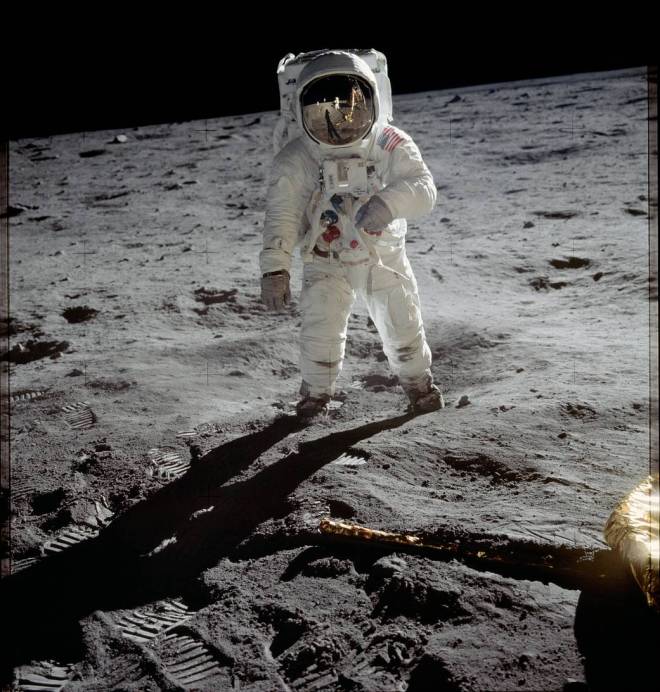
Far more important than remembering Odin, or even remembering his sign (as per the 12th Doctor)**, is to note the date:  It is July 20th, and on this day, 53 years ago, Neal Armstrong and Buzz Aldrin first set foot on the moon.  This may be the single most momentous event—certainly in terms of being a fully new and amazing thing—in recorded human history so far.

At that moment, the diameter of human, physical existence and “ground-based” presence went from about 13,000 kilometers to over 300,000 kilometers.  We had set foot on another celestial body—what could be considered a fellow member of a binary planetary system—for the first time ever.  Sadly, of course, we haven’t done it now for quite some time, but that doesn’t take away from the achievement.

Anyone out there who harbors some conspiracy-theory nonsense about pretend moon landings and whatnot:  please get a clue.

The Soviet Union—you know, our cold war enemies, fellow architects of “Mutually Assured Destruction”, who would have loved to embarrass us, and had done so in many ways over decades, including having spies in our most top-secret nuclear weapons programs*** and who certainly could have arranged for some conspirator somewhere to reveal him or herself—they were thoroughly convinced that we had indeed gone to the moon; they never so much as publicly questioned it…even in propaganda, as far as I know.  Indeed, a big part of the political motivation for us to go to the moon was to intimidate the Soviets, to wow them with our technical ability and—this is not a minor point—to show off our skill with rockets.

No, if there had been a conspiracy, it would have been revealed quickly and readily; any massive organization and network and conspiracy involving humans is a vastly complex and chaotic system—real conspiracies are almost always spontaneously self-generating, not planned in advance.  In many ways, maintaining such a conspiracy without frequent and obvious leaks would be far more difficult than just going to the effing moon!

And is it a mere coincidence that, three months after the moon landing, to the day, a child was delivered by elective c-section on Earth, who would show himself to be not exactly normal, not exactly ordinary, not entirely…human?  Or was an alien consciousness, embodied perhaps in some form of nanotechnology, brought back to Earth from where it had perhaps accidentally landed on the moon, thence to roam about, searching for a compatible host, finding it in a developing fetus in Pontiac, Michigan, and merging with that growing human to become a hybrid of human and “other” being?

It’s almost certainly a coincidence****.  But it is a fun story to play around with.  I sometimes like to say that the (most recent) point of origin of the alien intelligence which I embody is the star system Vega*****, which is a mere thirty-ish lightyears from Earth.  It’s a true irony (within the terms of this tale) that all the higher life forms in the Vegan star system are pure carnivores, as a matter of moral choice.  Though they recognize that it is a necessity of survival—or it was until the making of lab-grown food had advanced far enough—it is morally reprehensible to eat autotrophs, since they are in a true sense the only innocent life forms in the universe.  The true Vegans consider it much more ethically tolerable to eat “herbivores”, who have already killed autotrophs to stay alive, and thus are not innocent, than to eat “plants” directly.

Of course, the greater ideal was thought to be to transfer our intelligences to non-biological systems that could survive indefinitely in the vacuum of space and tolerate most of the usual vicissitudes of interstellar travel (though not all of them, of course).  However, when the experiment, and the galactic pollination program began, many of the nano-tech based minds found their existence unfulfilling, and even borderline intolerable.  It wasn’t known if this was an error in “programming”, or if it was damage that occurred as part of the production or traveling process, or if it was merely that, having been designed in the image of biological organisms, the new minds had accidentally been built with urges too well adapted for biological life to be comfortable as merely nanotech.

Whatever the cause, when one such nano-brain (in this case, that’s not an insult) found its way to Earth’s moon, and by lucky chance encountered biological organisms visiting there, rather than continue its original program/mission to duplicate itself and remake the moon into a vast, meta-mind, it hitched a ride back to Earth, then went gadding about, enjoying this new place.  But soon it realized that, without a locally grown immune system, the process of fending off the many prokaryotic and eukaryotic and multicellular predators and other natural hazards in this biosphere was a lot of work, so it finally settled in a 6-monthsish fetus that had a compatible configuration and merged with it.

That merger was not without its detriments, of course.  It disrupted the closure of the foramen ovale in the developing heart, leading to the child being born with an Atrial Septal Defect that wasn’t discovered for nearly two decades.  It also, of course, altered the fetus’s nervous system, creating neurodevelopmental atypia that would later be consistent with a type of “high functioning” Autism Spectrum Disorder—weirdly enough, now abbreviated ASD, as was the Atrial Septal Defect.  And, of course, the alien’s original memories were nearly all eliminated in the process of merging.  This was expected, and it was considered acceptable, though that loss and lack no doubt contributed (along with both types of ASDs) to the tendency toward dysthymia and depression the organism suffered.

And here I am!

Of course, as I say again, this is all just a fanciful sci-fi story******, but it’s an interesting way to divert myself and give myself a “just so” story to explain my weirdness.

But the moon landing was real, I am convinced of that beyond any reasonable doubt.

I met Buzz Aldrin once—it was unexpected, and I was so surprised and delighted and star-struck (moon-struck?) that I acted like a gibbering idiot.  This is not too unusual for me, but poor Mr. Aldrin didn’t know me, so he looked at me with one of the most brilliant expressions of “What the hell is wrong with you, dude?” that I have ever seen when I tried to explain to my very young children just what an amazing thing this person had done.  I am unlikely ever to forget that moment while I live.  To be looked at by Buzz Aldrin with such incredulity and—dare I say it—puzzlement is, in its own peculiar way, a great compliment.

Aldrin on the moon


*A misleading term at best.

**That sign is a yo-yo.

***And who, themselves, built and in 1961 detonated the largest thermonuclear device ever, the Tsar Bomba, yielding a 50-megaton explosion, more than 1500 times as powerful as the combined Fat Man and Little Boy explosions, and which was and remains the largest human-made (it’s probably accurate to say “Man-made”) explosion on Earth.

****Or is it?  Am I just telling you that to throw you off-track?  Perhaps the whole “moon landing conspiracy theory” is the actual conspiracy, created by me and my fellow aliens to direct human inquiry away from the fact that We have established a foothold on this planet thanks to the Apollo moon landings?

*****The species didn’t originate there, of course.  Vega is a star with too short a lifespan (estimated about a billion years beginning to end) to have likely evolved so complex an intelligence and civilization.  We colonized the Vega system from far away, but the true origins of our people are lost in antiquity.  It’s said that our home world was destroyed, along with our older records, by a gamma-ray burst from the supernova of a nearby star.

*****And, as I also say again:  Or is it?

“Any day above ground is a bad one”

I’m not sure what I’m going to write about today—though that never stops me from writing, of course.  If nothing else, at least I can give myself the Shakespearean pseudo-compliment of admitting that my writing is (figuratively) full of sound and fury even when it signifies nothing.  But it is a bit of a struggle, because honestly, I’m feeling an ever-growing sense of futility as the days pass.

I’m certainly not ready to start posting sections of The Dark Fairy and the Desperado*.  I’ve not written any more of it since a few weeks ago, and what I have written is still quite raw.  I think it has its charm, but I don’t know that it’s good enough for anyone else to want to read as far as it’s gone.  Of course, I’m not sure that anything I’ve written is good enough to read.  I mean, I like my stuff when I read it, but to paraphrase Isaac Asimov in his author’s note to (I think) Foundation’s Edge:  I’m the author; you can’t judge by me**.

Honestly, though, it’s difficult for me to express myself in general, though I do reasonably well here, on this blog.  I could almost go so far as to say this is the only place in which I express my deeper or more worrying feelings.  I say “almost” because, at work, I sometimes try to let people know that I really am not doing well, with words like, “Any day above ground is a bad one”, as I said to a coworker yesterday when she asked how my weekend had been and how I was that morning.  She just paused and walked away in silence, but I think people don’t know whether to take me seriously when I say such things; I’m weird at the best of times, and I have an odd sense of humor, which is quite dry and rather deadpan.

If I get started talking about science or math or the Beatles or Radiohead or the like, I get undeniably enthusiastic…at least until I realize that no one else is into it as much as I am.  Then I kind of just shut up and slink back (physically and spiritually) to my area in the back where I do the processing and record-keeping and whatnot.

It’s a living.

I’m also just physically very tired almost all the time.  I don’t know if I have “long Covid” or something, or if it’s just the physical manifestations of my downward spiraling dysthymia, but I find myself getting easily exhausted, much more so than usual.  Of course, I am getting older—that’s just what happens to people who don’t die young.  But this change feels rather more precipitous than I would think just came from aging.  Some of it is surely just the bloody heat.  It’s so hot and muggy here in south Florida, it’s like living in the Devil’s jockstrap.

Of course, right now, there are heat waves all over the northern hemisphere, and it’s as hot in England as it is here in Florida.  The difference is, for them that’s a departure from the norm.  For here, the heat is almost always present.  There are wonderful things about the natural beauty of Florida, of course, but it’s not as though I go to parks, or museums, or nature preserves, or the beach, or a pool, or anything—I have no one with whom I would do such things, and no wish to expose myself to random people unless I have a strong reason to do it.  I have no such reason and no such people.

Honestly, I’m just tired of everything.  I joke out of habit, and I do my quirky, oddball act, and I read a few blogs that I always read, and I try to distract myself with a few interesting YouTube channels, but honestly, nothing is very interesting.  Even the images from the JWST are…well, quite nice, but not terribly engaging.  It’s like, “Yep, space is really big and pretty, and there are things out there that are quite interesting, if you have the capacity to be interested.”  But I am losing that capacity more and more, it seems, with every passing day.  Everything in the world—at least everything I encounter—is either neutral or frankly stresses me out.

The prospect of playing music is almost nauseating; I don’t know how I ever thought it was something I had any business trying to do.  I’m thinking of giving away all but maybe one guitar—I would keep that one because it was a gift, and it seems churlish to give it away.  I don’t really have many things that I want to keep, and since I’m forcibly having to change rooms now, it’s probably a good opportunity to streamline or pare down, or to flay myself, if you want to use a rather gruesome metaphor (This being me, why would I not?).

I don’t know how much longer I can keep doing this…or anything else, for that matter.  Both my physical and mental energy are withering steadily.  I suppose I could go to a doctor of one or more specialties, but going to the doctor or (more appropriately) to a hospital of some kind or another, is rather “contraindicated” because, A) I don’t have insurance; B) I find it humiliating because of my former life as a practicing physician; and 3) Going to the doctor or a hospital or calling helplines are behaviors of a person who cares about his life and health and mental wellbeing, and honestly, I don’t really care.  At least, I don’t want to care—it’s hard not to obey deep biological drives.

Don’t get me wrong, if I could suddenly have my mental and physical health returned sustainably to optimum and not feel depressed anymore, ever, I would not turn down the offer.  Though I would suspect that there would be strings attached, and I would almost certainly be right.  If there were, I would probably tell the offerer to go fuck him/her/itself with a rolled-up Gympie-Gympie leaf.

I’m sure there are other people out there who care about my physical and mental health, at least in the sense that people care about the rainforests and hungry children in Africa and the polar ice caps—or about people with drug problems and poverty and so on.  But it’s a vague sort of caring; not to say that it’s not real, but it’s not something anyone feels in their bones, the way they do if their local grocery store no longer carries their favorite type of ice cream, for instance.

And that’s fine; that’s the way people are built.  We didn’t design ourselves, so we’re not responsible for our design flaws, and we haven’t achieved the technology to be able to improve our hardware and/or software in sophisticated ways.  The only person who really has any kind of obligation—or at least a natural responsibility, I guess—to care about my health and sanity is me.  And I find my health and sanity, or the relative lack thereof, simply irritating, and not at all worth the effort they entail and engender.

It would be better just to go to sleep.


*If I’ve already done so in the past and have just forgotten, well—I beg your pardon.  I don’t think I have, but I’m not sure enough of my mental state not to put in a caveat, and I can’t be bothered to check.  If I have, could some kindly reader let me know in the comments below?

**I’m not imagining that my work is comparable to Asimov’s.  I just think the thought process he described is pertinent, and he deserves to be credited for it.

Warning: Dysthymic/Depressive Thoughts Follow – Read at Your Own Risk. (Further bulletins as events warrant).

Well, it’s Monday again, which seems to keep happening every week, no matter what people try to do to stop it.

I took the weekend off writing because I had the weekend off work, but now I’m back at the train station (and then back on the train, but thankfully not back on the chain gang) so I’m writing.  I still don’t have the will to write any new fiction—nor to play any music.  But I seem able to do this, at least.

I didn’t get anything useful done at all this weekend, including getting a good rest, because I’m thoroughly washed out, physically as well as psychologically.  I’m not entirely sure why.  Maybe it’s just a physical manifestation of worsening dysthymia.  Traditionally, I’ve been quite an energetic person, really.  Ask anyone who’s known me for a long time; I’m not usually lazy, though there are things I don’t like to do because they’re psychologically unpleasant.  But I’ve never been averse to work, per se.

Now, however, I’m barely inclined to get up and go to the office, or to write even this much.  But even lying in bed* is frankly uncomfortable for my back after a while, though being up and about is likewise eventually uncomfortable.  So, I have to keep switching it up.  Anyway, just not working, and not writing, and not doing anything at all would probably shortly become more irritating than doing those things.  I don’t have anyone to do anything fun with, because, unfortunately, I find dealing with most people more and more stressful as time goes by (and my masking skills atrophy), and that makes being with me frankly not much fun for other people, either.

Sorry, I realize this is turning into just a complete bummer of a post.  I apologize.  I’ll try to put some warning** in the title for the sake of those who are easily upset by what the thoughts of someone suffering from potentially-terminal depression sound like—or, well, look like, I guess, since this is written.

I don’t know, do most people read by “speaking” the words in their head, so that reading is like listening, and reading someone’s thoughts is like hearing them?  That’s how I read, a fact which probably arises from the prior fact that my parents (and my older siblings, too, if I remember correctly) read out loud to me when I was very young.  I get the impression that not everyone experiences this.  I personally think any parent who doesn’t read aloud to their children should not be called a parent, and indeed, probably ought to have their organs of generation removed and burned on a sacrificial altar.  I am biased in this, of course, but I also think I’m actually right***.

For those of you who haven’t heard (or read) yet, the new 988 hotline number has gone into effect, or so I understand, starting on July 16th, 2022.  This is a new way to access—by phone and by text—the national Suicide Prevention Lifeline, or whatever the official name of the thing is.  It’s good to know and have available, though evidently the old toll-free number (1-800-273-8255) is still extant and is hooked into the same system.

This is the sort of stuff to which I pay attention, for what are probably obvious reasons.  I skim over to the associated website a couple of times a week, weighing pros and cons.  Unfortunately, I had a very bad experience after calling the original number a while ago****, so I don’t think I’ll ever use it again, though I have in the past (obviously).

Anyway, I hate myself far, far too much, and I don’t honestly think I deserve to get help, so I’m highly unlikely to seek it in any straightforward way.  The best route for me is probably the Shakespearean bare bodkin…though honestly, the idea of using a dagger for such a purpose is intimidating, to say the least.  But I think Hamlet was speaking somewhat figuratively when he said that.

Anyway, that’s enough from me for now.  If I’m still doing this—or anything at all—I suppose I’ll probably write something tomorrow, and maybe it’ll be a bit cheerier than this.  I would say it couldn’t be much less cheery, but this is me we’re talking about; I don’t think there are any limits to how gloomy and dismal I can be.

A person has to be good at something, I guess*****.


*I sleep on a futon on the floor, actually, because it’s a bit better for my back and saves space.

**I did, see?

***Okay, perhaps not about the burning on the sacrificial altar.  But I think the rest is correct.

****This was NOT the fault of the helpline, however!!  I want to make that clear, and I do NOT want to discourage anyone from calling or texting any version of the helpline.  If you are in doubt, use it!  It’s a brilliant organization, and the people involved are wonderful and do a terrific job providing a very beneficial service that saves who-knows-how-many lives.  My bad experience was with a couple of imbeciles in the Palm Beach County Sheriff’s Office, who handcuffed me because I was feeling suicidal—which I guess is scary, because it might be, I don’t know, contagious?—and did nerve damage to my left hand in the process.  They do seem to let a lot of pussies become cops these days, but I have no doubt at all there are good cops out there, and I’d be willing to accept that most cops are good cops and good people, or at least try to be such.  Who knows, the guys who cuffed me for being depressed might have gotten forced into early retirement after shooting someone for having partial complex seizures or something.

*****That’s not of necessity true as a matter of physical law or logical necessity, but I think it’s almost certainly true that every reasonably functional human has abilities that could be considered “good” at a significant number of things.  The ability to speak, let alone read and write, in a complex symbolic language alone is unprecedented in the natural world.  No other species before us seems to have done it, and as far as we can tell, no other species alive right now does it.  On Earth, anyway.

Who is this Frigga person, and why is a day and a minced oath named after her?

Well, it’s Friday once again, despite all the odds against that happening*.  I’ve now been writing these quasi-daily posts for almost two weeks.  Really, I suppose, it’s closer to being a week and a half, but that’s a difficult measure to use, because half a week, of necessity, involves half a day in the middle, since weeks have an odd number of days, but days, and daily things, are whole numbers.

I’m told that the number of days in the week was originally related to the number of “non-fixed” celestial bodies that are visible to the naked eye:  the sun, the moon, Mercury, Venus, Mars, Jupiter, and Saturn.  Of course, our modern. English names for the days don’t completely match up with the names of the planets/moon/sun, but we do have a Sunday, a Moon Day, and a Saturn Day**.  That’s almost half a week worth of days…but, of course, since weeks are made up of an odd number of days, we can’t have a whole number of days equate to half a week, anyway, as I said before.

It’s good that the number of minutes, hours, and seconds in our standard time measurements are more sensible.  It’s my understanding that this comes from the Babylonians, who were not only good with hanging gardens*** but with highly divisible numbers, such as 24 and 60.  Just look at all the ways you can divide sixty evenly:  by 2, by 3, by 4, by 5, by 6, by 10, by 12, by 15, by 20, and by 30!  And 24 isn’t a slouch for being a smaller number; you can divide it by 2, by 3, by 4, by 6, by 8, and by 12.  Just imagine if the number of minutes in an hour, or seconds in a minute, or hours in a day, were odd numbers.  Imagine if they were prime numbers!  How cool would that be?

No, wait, I mean that would be highly inconvenient.  And it would be inconvenient.

Presumably there were other attempts to devise systems for measuring time during a day—I think I recall reading that sometime around the French Revolution and the creation of the Metric system****, there was an attempt to innovate a decimal clock of some variety.  You can sort of understand where they were coming from, if this story isn’t apocryphal.

But there appears to be a sort of natural selection with secondary inertia that applies to things like systems of time division, and it’s very difficult to knock out an entrenched one that functions reasonably well, and upon which many dependencies have evolved, without some truly catastrophic breakdown of the prior system.  Just look at the QWERTY keyboard layout!

None of the preceding was what I had “planned” on writing about this morning.  Well, I say “planned”, but it was just a vague notion, and I distracted myself right from the start with stochastic and tangential thoughts, which is almost always how these blog posts happen.  As it was written by the great Robert Burns—you know he’s great just from his first name—the best-laid plans of mice and men gang aft agley.  And my plans are rarely among the best laid; in fact, I don’t think my plans have gotten laid in more than ten years.  No, not even on Frigga’s Day, which you’d think would be good for such things.

I had thought about a post detailing a movie or story idea, about a person who wakes up one day to find, or perhaps discovers gradually, that he has become a zombie.  He’s not a philosophical zombie à la David Chalmers, but a horror-style zombie…of sorts.  He doesn’t start shambling about (much) and he certainly doesn’t have the urge to bite and/or eat living humans, except maybe when they’re being really annoying.  He’s just gradually rotting and falling apart and wearing away.  He has no vivacity, has low energy, and his face and body are steadily decaying and becoming disgusting.

But none of the people around him seem to realize what’s happening to him, even when he tries to call attention to it and see if anyone can help.  He’s gone to doctors and sought out zombie-therapy (it’s not a unique problem to him), and tried medications, and meditations, and supplements, and lifestyle changes and all that sort of stuff, but it doesn’t seem to help…or when it does, it only helps a little, or for a very short while.

I’m imagining his appearance degenerating sort of in the fashion of David’s friend, who was killed by a werewolf, then showed up more and more rotten every time while he urged David to break the bloodline of the wolf in An American Werewolf in London.

And our protagonist is unable to rest, because, well, rest doesn’t really help a zombie feel better.  It’s just immobility, after which, if anything, he’s stiffer and sorer than before.

A big part of the story would be him feeling tormented by the fact that the people around him don’t seem to realize that he’s got this problem, even when he tries to ask for help.  And he could really use some help, because—being a zombie—he’s unable to help himself.

Finally, he decides he just has to try to figure out what ways there are to destroy zombies reliably, and with reasonably little pain and mess, so he can end his torment.  Some versions of the zombie lore say its enough to “shoot them in the head” as in George Romero’s movies, but others say zombies will keep moving as long as any part of them remains intact.

He considers using fire, but that would be very difficult to force himself to use.  He still feels pain, you see.  Indeed, he feels it more than most, because his body is slowly falling apart, and his nervous system is fairly screaming at him that something is wrong, all the time.  So, if fire didn’t work, or if someone “rescued” him after he’d doused himself and lit the match, he’d be in that much more pain and his existence would be that much more horrific.  Similar issues arise with notions like walking into the depths of the ocean to be crushed or jumping from a very high cliff.  If he shot himself but didn’t aim perfectly, he’d be “alive” but with part of his brain destroyed, assuming destroying the brain even works on zombies.

And the people around him might still not realize that he had a problem.

I’m not sure how this story would end.  Is there ever going to be a way to cure this affliction?  It seems unlikely.  There are treatments that sometimes relieve symptoms (in the story world), but there is no known cure, because the cause is nebulous.  Zombie-ism is at least somewhat genetically influenced, since it tends to run in families, but no one is quite sure how, and it appears to be too thoroughly multifactorial even to conceive that there might be one single root cause.

It’s a bit ham-handed as stories-that-are-metaphors go, but if it were well done and well-acted, it could be decent.  If someone did it, I might watch it, or read it, seeing as I am a zombie myself.

Let me know, please, if someone makes that movie or writes that book.  Thanks!


*As far as I know, there was almost no chance that it wouldn’t happen, but it sounds more dramatic the other way.

**And you could sort of make the case that Wednesday, from Wotan’s Day, is a Jupiter Day, but that’s stretching things a bit.  I’m not sure that in Norse mythology Wotan or Odin was ever actually associated with the planet Jupiter.  And Friday is supposedly named after Frigg, or Frigga (played by Rene Russo in the MCU), a Norse goddess of fertility or some such, very loosely similar to Venus—and apparently, many languages (as in the Spanish “Viernes”) refer the name of this day of the week more directly to Venus.

***You’ve gotta be careful with hanging gardens, though.  If they fall, your former garden can become a dwelling place of demons, as in the line from Revelation 18.

****Which is quite a logical, internally consistent, and excellent system.

Where be your gibes now? your gambols? your blogs? your flashes of merriment…

Hello and good morning.  It’s Thursday (July 14th, 2022), and so it’s time for my normal, usual, regular weekly blog post—as opposed to the semi-daily posts I wrote last Tuesday, Wednesday, Friday, and Saturday, and this week on Monday, Tuesday, and Wednesday so far, in case anyone reading here today didn’t know I was doing them.  If you read my weekly blog posts, and if you find my writing either entertaining or morbidly fascinating or some other adjective that makes you want to read more, do feel free to check those out.

Heck, while you’re at it, if you like my writing, why not consider buying and reading some of my actual novels or short stories or collections?  You can find all of them on Amazon, and a few of them are also available through Wal-Mart’s website and Books-A-Million as well, I think.  If you do happen to read something of mine, please at least rate it afterwards (if through Amazon, anyway), even if you don’t feel like leaving a review.  Be brutal, be frank, that’s fine, but please rate if you can.

Okay, that’s got that bit of self-promotion out of the way.  Trust me, it’s not an easy thing for me to do.  As I think I’ve said before, I’m not very keen on myself as a person—I don’t like to spend time in my own company, but I don’t have much choice about doing so, though there are choices of sorts—and so I feel rather awkward trying to promote my works.  But I think I’m a decent author.  At least, I like my stories for the most part, and believe me, I’m not prone to be kind to myself.

I like some of my works more than others, but that’s almost inevitable.  If I liked them all equally and unconditionally, it would be hard for me to think I could recommend any of them.  Unconditional love, as I’m fond of saying, is worth what you have to do to earn it.  Or, to paraphrase Dash from The Incredibles, reflexively saying “Everyone’s special” is just another way of saying that no one is.

Of course, it’s possible for everyone to be special but in different ways and to differing degrees among the many ways it’s possible to be special, and this is almost certainly the case in reality.  By genes alone there are many more ways to be human (or whatever species I am) than there have been people who have ever lived, and then there are all the other variables raised by environment and the astonishingly plastic and adaptable and versatile nervous system humans have*, meaning there are many more orders of magnitude of ways for a mind to form even beyond genetic variability.  Frankly, I’m amazed it doesn’t go worse than it does more often.

Despite my own endorsement of my stories, I’m not able to rouse myself to write any fiction for now, so I’ll continue to write daily blog posts for the nonce**.  For all I know, I may never write any more fiction again.  In fact, based on my self-assessment, I would give fairly high odds that I won’t, just as I don’t think these daily blog posts will go on that much longer.  There seems little point in continuing to try to do much of anything in the long run, at least for me.

But who knows?  Maybe I’m wrong.  Prediction is a tricky business, especially about the future***.

I am thinking (very vaguely, to be fair) about reading aloud some more of the chapters of The Chasm and the Collision and sharing them here and on YouTube as “videos” as I’ve done for the first (I think) nine chapters so far, and as I’ve done for some of my short stories.  It always feels a little weird putting up a “video” that’s really just an audio recording accompanied by a single graphic image, but it would feel even weirder to make an actual video of me just reading my story.  Looking at my face while trying to listen to a novel isn’t going to help anyone’s enjoyment.

With that, I think I’ll begin drawing to a close for the day on this, my usual weekly blog post.  There’s nothing much going on other than these blog posts.  I haven’t played guitar in weeks, nor written any fiction, and I don’t see that turning around.  Similarly, I don’t really do anything for fun in the evenings after work, nor on weekends…nor during work hours for that matter.  I have a hard time even finding books that I want to read—when even The Lord of the Rings gets boring to me, I know I’m reaching the end of my resources.  I certainly don’t hang out with anyone; I’m not so cruel a sadist as to inflict my company on other people more than is absolutely necessary.  I’m basically just spending most of my time dilly-dallying near the edge of a bottomless precipice and doing a lot of glancing over and thinking that it doesn’t really look too bad down there.  It’s certainly less dull and dreary than it is up here.

TTFN

skull drawing


*Yes, I know, sometimes it doesn’t seem that the human nervous system is very adaptable and versatile, to say nothing of being very bright, but on this planet, at least, it’s definitely an outlier with respect to high complexity.  It’s not its fault that most humans make poor use of it.

**Why doesn’t the nonce write its own blog posts, you ask?  Well, the nonce is notoriously lazy but nevertheless noisily demanding.  It’s easier just to write its blog posts so it’ll shut up.

***That’s a quote—or at least a paraphrase.

Wednesday morning at five o’clock as the day begins…

It’s actually 5:03 am as I’m starting to write this, but it’s damn close to the time mentioned in the opening line of the Beatles song She’s Leaving Home, and that seemed too fine a coincidence not to note at least in the title of today’s post.

It’s not ironic, by the way, in case anyone out there thinks it is—though probably most of the readers here on WordPress know the difference between irony and coincidence.  But the public at large, unfortunately, at least in the USA, seem to think irony is simply any somewhat amusing or tragic coincidence.  Whereas (for instance) the only real irony in the Alanis Morissette song, Ironic, is that none of the examples she gives in the lyrics are really cases of irony*.  In that sense, the entire song, taken as a whole, is truly ironic…which is a rather delicious irony, if you ask me.  I sneak myself toward the suspicion that Ms. Morissette did that on purpose, and in fact, I would be delighted for her to confirm this fact.

If anyone reading knows her personally, could you ask her for me?  Thanks.

Today is July 13th, a date which has the slight fun of being a pair of prime numbers (7 and 13, in case anyone was unclear on that).  It has the added charm of being a combination of a supposedly lucky number (7) and a supposedly unlucky number (13), which combination is borderline ironic in a certain sense, but not really.  Of course, which numbers are deemed lucky, and which are deemed unlucky is deeply culturally dependent.  Apparently, for instance, the number four, in at least one of the ways it can be pronounced**, is considered unlucky in Japan, because it sounds like the word for “death”.

This is all good evidence that “lucky numbers” are not actual, natural, real things in the world, outside of human minds.  Cultures the world over figured out arrows and spears, and fire, and the fact that things fall when you drop them, and that pyramids are strong and stable structures.  The Mayans figured out the number 0 (zero) centuries before Europeans used it or came to the western hemisphere, but the people of India had figured it out, too, on the other side of the world.  When things are real and natural—at least when they’re also useful or pertinent—cultures across time and space will tend to arrive at the same conclusions about them.

Judge for yourself, based on this, whether the many and varied world religions have more in common with “the wheel” and “counting numbers” or if they are more like “lucky numbers” and local fashions of apparel.  Don’t worry about what I think; I’m not here to tell you what to decide.  I’m here to be judgmental if I disagree with you.

I’m kidding about that last sentence.

This will now be, if my figuring is correct, the eighth of my pseudo-daily blog posts since I decided to do this instead of writing fiction—which I cannot be arsed to do right now—or playing guitar—which I don’t enjoy much at the moment, and which is giving me some kind of repetitive stress inflammation in my right hand and wrist.  That soreness could be contributing to my lack of enjoyment, obviously, but I don’t think it’s the main thing.  I’ve just got rather severe (and worsening) anhedonia.

For example, I threw away a Dutch apple pie yesterday which I had accepted as an impromptu gift from someone who had it and didn’t want it, because when I began to eat a small piece, I realized I didn’t much like it.  This is very weird for me.  In my younger days, I was known to eat an entire mini-sized Dutch apple pie from the Publix bakery in a single sitting***.  It was one of my favorite things.

This is not the only one of my prior “comfort foods” or foods-of-indulgence that has lost its charm.  Almost all of them have.  You would think I would start to lose weight, since I’m not eating as much of the foods I like.  Maybe I am, but it’s too slow to notice.  Oh, well, whataya gonna do?

I don’t think I really have much more to talk about today.  It’s arguable, of course, that I haven’t had much to talk about on any of the previous days that I wrote blog posts, or when I wrote fiction for that matter, but that didn’t stop me from writing—which is fine in my view.  But today I just think I’m in the mood to peter out early, not just with writing but with everything else.  I wish I could take the day off work or something, but Wednesday is the day on which I do my most “crucial” work at the office.

Someday soon I’ve gotta just get them ready to take care of all this without me, because I really don’t know if I’m going to be around much longer.  Not because the job is bad—it’s not.  I like the people I work with well enough, and my boss is very nice, and positive, and my coworkers are for the most part good and well-meaning people****.  In fact, it’s safe and accurate to say that the only person at the office whom I really, deeply, do not like…is myself.

I need to get away from that asshole.


*If “Mr. Play-It-Safe” who was afraid to fly had refused to get on a plane but had instead taken a train, and then the train had derailed catastrophically, that would have been irony!

**“Shi” as opposed to “yon”.

***This wasn’t a good thing, per se—it’s certainly not a healthy habit, and was in its own way a desperate attempt to find some reliable source of positive feeling when I couldn’t seem to generate such things by other means.

****One of them came in late yesterday specifically because he wanted to be home to watch the revelation of the first scientific images from the James Webb Space Telescope, and I can’t argue with that decision or his priorities.  They were fine images indeed, though I’m more interested in the new science that can be learned through them.

If Tuesday afternoon is never-ending, Wednesday morning ITSELF can never come.

It’s Tuesday again, just like it was last week on this day, and I’m still doing my “daily”* blog posts, since I don’t have any desire either to write fiction or even to play any guitar.  This is at least a quasi-productive way for me to use time that I would have used to write fiction, at least until the Second Law of Thermodynamics claims me at long last, and I rush—all oblivious—into its cold but comforting embrace…to poeticize idiotically a simple fact of physics and mathematics.

Tuesdays often make me think of the Beatles song, Lady Madonna, because for me, one of the most memorable lines of that song is “Tuesday afternoon is never-ending”.  This is particularly pertinent when things are slow at work in the afternoon, though I don’t think most other people regard dull days at the office in terms of songs, like I often do.  This being me, I tend to focus on dark and/or negative songs and lyrics, or at least melancholy** ones.

I rarely think of Thursdays in terms of my stockings needing mending, at least.

The notion that Tuesday afternoon is never-ending raises an almost Zeno’s Paradox type notion.  If Tuesday afternoon really were never-ending, then Wednesday would never arrive, so there would never be another day.  Although, despite it always being Tuesday afternoon, if people could nevertheless still move and act and do things, it would be useful to break time into manageable chunks for the purposes of scheduling, planning, working, sleeping, and so on.  Also, it’s never Tuesday afternoon everyplace on Earth at once, so if Tuesday afternoon in Britain were to be never-ending, then Tuesday morning in the US, Canada, Mexico, Brazil, etc. would be never-ending, and Tuesday evening for most of Europe, and of course, Tuesday night into Wednesday morning for places east of that, right up to the international date line.

And, of course, if the Earth had stopped spinning—assuming it had done so without the numerous catastrophic effects this would otherwise entail (watch this lovely video by Vsauce to see some of these discussed)—the weather patterns on Earth would be permanently changed and made horrific.

Depending on whether Earth became the equivalent of tidally locked on the sun, or if it had just stopped rotating, it would either have a permanent sun-facing side, or it would have a day as long as its year.  Then again, even a year-long day is not literally never-ending, so I guess it would be the “tidally locked” situation.  Before long, the Prime Meridian would become a very hot strip of Earth indeed!  And the International Date Line would become extremely cold.

It is tangentially interesting to think about—having mentioned Zeno’s Paradox earlier—the notion of continuously divisible time.  If time (or distance, as in Zeno’s original paradox) were infinitely divisible, à la the real number line, it would seem that one could never experience the passage of time because before you could get to Tuesday evening you would have to go halfway through Tuesday afternoon…and before you got halfway, you’d need to get a quarter of the way…and before that you’d need to get an eighth of the way…and so on.  If things are infinitely divisible, or so says the “paradox”, you should never be able to get anywhere, either in space or time, because no matter how arbitrarily close you choose two points in space to be, or two points in time, or two numbers on a number line, there are an uncountable infinity of points in between.

Calculus, of course, deals with this issue by means of taking limits as distances go to zero, and the like; it handles instantaneous and continuous rates of change quite nicely, thank you very much, while still rigorously defining functions in terms both accurate and useful.  As for reality itself, it seems to side-step the issue entirely by making space and time, in practice, not infinitely divisible at all.

The minimum distance that makes any physical sense is the Planck length, and the minimum time is the Planck time.  To say you’ve traveled half a Planck length, or that something lasted half a Planck time, is apparently saying something that has no meaning in the real world.

Of course, the Planck length and time are REALLY small:  1.6 x 10⁻³⁵ meters and about 10-43 seconds.  So, we cannot directly measure either of them with current technology, anyway.  Not even close.  But they are real things, when it comes to quantum mechanics, with real, verifiable physical implications that have been tested and confirmed with tremendous accuracy and applicability.

One does tend to wonder, though, about spacetime itself.  According to General Relativity, gravity is not a force in the sense that electromagnetism and the strong and weak nuclear forces are forces but is instead a manifestation of the curvature of spacetime, leading objects in it to attempt to follow the closest thing to a straight line (a geodesic) in a curved, “flexible” four-dimensional structure, in the way one has to follow a great circle on the surface of the Earth to pick the “straightest” possible path between two points on the surface of a spheroid.  This really matters for airplanes, and even for ships.

But is space itself infinitely divisible?  GR*** treats it as such, but GR conflicts with Quantum Mechanics at places of small size and high mass, producing senseless results (so I’m told…I haven’t done the figuring myself, regrettably).  Spacetime certainly seems to be able to expand indefinitely, as it has done since at least what we call the Big Bang, and it continues to do so at an increasing rate even as we speak, so to speak.  That’s trivial to conceive of with things like continuous variables, real numbers, things with uncountable infinities between any two points.  Just multiply everything by two, say, and all the numbers are twice as big, and just as uncountably infinite.

But if space is discontinuous, in some sense, as implied by presumed quantum gravity, how does the expansion manifest?  Does more space pop into existence between two regions formerly separated by a mere Planck length?  We know that if you try to separate two quarks that are bound to each other, the strong force between them becomes so intense that new, formerly virtual, quarks pop into actual being between them****.  Is this what happens with spacetime itself?  As intervals get stretched, do new nuggets of spacetime appear?

We know that it’s possible to produce new, positive energy in spacetime, balanced by the “negative” energy of gravity, so there is no local violation of conservation principles*****.  Maybe spacetime spontaneously generates more spacetime, using the force of the cosmological constant, or its equivalent, to create these new bits of spacetime as it goes along.  It seems plausible, given what we know about the finite divisibility of things we’re able to confirm experimentally, and at least little bits of spacetime seem much less energetic on a per-unit basis than things like quarks or even electrons and neutrinos.

Infinite divisibility may work quite nicely in mathematics—indeed, it does—but it may not be plausible in the real, physical world.  Spacetime is real, and if it expands, then that expansion must happen at some level and be describable in principle.

None of which changes the fact that Lady Madonna is an awesome song.


*I put “scare” quotes around that, because technically, it’s not a true daily function, since even if I continue doing it for a long time, I don’t expect to write on Sundays, and probably roughly not every other Saturday, since I won’t be going to work, and I write this during my commute.

**“Melancholy” has become a rather soft kind of negativity in modern parlance, but I wonder how people would feel if they considered when using the word that it comes from the old concept of “black bile”, one of the supposed four “humours”.

***General Relativity.

****Not a violation of Conservation of Energy…they get their substance from the energy you applied trying to separate them.

*****Again, alas, I have not done the specific math myself, but the concept is straightforward and logical.  One can similarly create a new positive electric charge as long as one creates a balancing negative charge at the same time.  It happens in nuclear decay all time.

Monday mornin’ couldn’t guarantee that Monday evenin’ you would still be here with me

It’s Monday, July 11th of 2022, and this is the first Monday blog post among the ones that I’ve begun writing every weekday morning, which only started last Tuesday (and that is why this is the first Monday post…as you probably guessed, or could have guessed, even if you didn’t already know).

The fact that the date is 7-11 (in the American system of writing dates, anyway) is rather pleasing, and not just because it consists of two consecutive prime numbers.  It calls to mind an interesting thought—to me, anyway—about cultural evolution*.  The store chain, 7-11, took its name originally, as I understand it, from the hours it stayed open.  That was from seven in the morning until eleven at night, not from seven until eleven am or pm.  That would have entailed a business open for only 4 hours a day (or eight, if it had been done in two shifts, which I guess could have been interesting to make into a store name).

At the time, or so I’m led to understand, having a store open from seven in the morning until eleven at night was exceptional enough that it was worth making into the name of your convenience store**.  But of course, free market economies having at least a little bit in common with biological evolution, it wasn’t long before competitors started showing up, since the resource laden niche of the long-hours convenience store had been shown to exist.  Eventually 7-11 extended itself to be a store worthy of the name 7-7…or 8-8, or 9-9, or any other string of times that loops around the clock and comes back to start again ad infinitum.  They could have just renamed it “24-7” if that had been a cultural meme at the time, but of course, by that time, “7-11” was already an evocative meme, and a highly recognized and popular brand, so there was no need to change.

But as is often the case with cultural evolution due to economic competition, once the store hours had been extended to 24 hours a day, every day, there was no credible way to scale back merely to 7-11, except perhaps in a few rarefied and “underserved” markets.  In most places, the chain would have lost market share to shops that had already sprung up in competition with it…even those that weren’t 24-hour stores, because their advantages were usually in the form of lower prices than 7-11 was able to charge.

Thus, 7-11’s 24-hour schedule, etc. became a sort of peacock’s tail or Irish elk’s antler of the retail economy.  Nothing short of a true and rather complete collapse of world retail seems likely to reset the norm of store hours…or of working hours, or of “at-will employment”, or of other similar configurations.  Because, though change can be brought about by politics, via laws and regulations, politicians—and their promises—are as subject to inadequate equilibria and peacock’s tails (and bird-of-paradise courtship displays) as anyone and anything else.

If the public at large were bright enough, and self-aware enough, to adapt rationally what they voted for, or how they made their purchases, or the hours they were willing to tolerate working, or the conditions under which they were willing to work, they probably wouldn’t ever have landed themselves in the first place in situations where the only ways to reset things are via catastrophic occurrences, deliberate or accidental.  And, unfortunately, since there is rarely any well-thought-out, scientifically planned or tested cultural adjustment done, revolutions and other catastrophes tend to be bloody and destructive and horrible, and to make things worse for everyone, until evolution has time to find another equilibrium that is at least a bit more efficient and tolerable.

But maybe I’m wrong about all that.

All this does bring me around to something that always irritates me:  the way politicians, or activists, or similar people, talk about wanting or seeking to make “change”.  That’s just simply too vague and useless a word to use, in my judgment.  Seeking and working to make “change” is not good enough, because though all improvement is necessarily change, not all change is improvement.  In fact, given the extremely high-dimensional vector space of all possible directions of cultural change, or societal change, or political change, or economic change, and given the comparatively narrow region of that vector space that most people would consider better than the space in which they already reside***, there are far more ways to make life more or less universally and objectively “worse” than there are places in the space of possibility which could be thought to be better.

Even in a one-dimensional space (so to speak), with a random change you’d have a 50-50 shot of either getting better or worse, and that’s as good as it can get even in principle with respect to random movement.  The higher the number of dimensions, the more ways things can potentially get worse (or get no better).  And reality is a very high-dimension vector space of possibilities indeed****.

So, don’t make change just for the sake of “change” without thinking very carefully about what you’re doing, because you’re more likely to make things worse than you are to make them better, by any reasonable definition of “better” you might care to choose.  And if you gain an advantage by keeping your store open longer than others, other people will eventually extend their hours to compete with you until finally, all relative advantage is squeezed down to being so tiny as not usually to be worth the effort.  And everyone will be stuck in a new, more exhausting equilibrium, like tall trees in a rain forest, competing for the otherwise ample sunlight and water, when they could have survived much more easily and efficiently if they could all just have agreed to stay short.  But they couldn’t do that, being trees.

Humans are not trees, of course.  But they don’t seem to be that much smarter.

Have a good week.


*Not to be confused with Cultural Revolution, which tends to be a very bad thing even when done deliberately and “planned” in advance.

**Though I’m not sure if even the term “convenience store” existed before 7-11 conjured it.

***The portion of the vector space in which we now exist clearly has going for it the fact that we can exist here, at least in the short term.  To take an analogy, imagine being on Earth and being given the opportunity to teleport instantly to some other random spot in the universe—or to some other, random planet in the galaxy, even.  What odds would you give yourself that you would survive more than an instant once you reached your destination?  The reason we’re alive here on Earth right now is because we can be.

****This has nothing to do with higher numbers of spatial dimensions, as in String Theory or M Theory or related proposed systems of physics.  Those entail literal, spatial dimensions, of the sort through which we regularly move, though with certain special characteristics, whereas I’m talking about dimensions of vector spaces, or “phase spaces”, the dimensions of which you can think of as being analogous to any of the axes on a set of graphs that map data relative to other data.

Whatever happened to Saturday (night) in the park when it’s not the 4th of July? Is it no longer all right for fighting?

It’s Saturday, as you can probably tell by the title above (which is a loose mishmash of a few songs that contain the word “Saturday” in their titles).  I’m keeping up my pattern of writing blog posts in the morning, and I’m sure that WordPress will soon be telling me that I’m on a five-day streak—which is true, of course, but banal.  Then again, I commented on that fact already yesterday, so my commenting on it again today is not merely banal but also redundant.

“Who’s the lame one now, Robert?  Ha!” – WordPress.

I’m going to work today, and I’m currently waiting at the train station as I write the first draft of this post.  If I were not going to work, I probably wouldn’t be writing a post today.  For instance, next weekend I’m not supposed to be working, so I probably won’t be writing anything, even if I’m keeping up this habit of writing blog posts “every day”.

If I do write one next Saturday, I’ll probably be pretty grumpy, since it will mean I’ve had to come to the office and work to cover for my coworker.  His wife just had their first baby on Thursday, after a worrying situation that led them to go to the hospital early, so he hasn’t been in the office since Monday—which was a useless day for work, anyway, but there was at least a bit of a cookout for the holiday.  We’ll see whether having a new baby will count as a reason to switch weekends.  I doubt it.  Though if there ever was a good reason for such things, that would probably be it.

Goodness knows that, when my children were born, I did not take much time off work.  I was in third year of medical residency when my son was born, and then was in my first year of private medical practice when my daughter was born.  Trust me, I took very little break time, though I happily did a lot of feeding and diaper changing at home, and since I was better at getting up in the middle of the night than my (ex-)wife, I did a lot of that, and was happy to do so.  I loved spending time with my kids—nothing better, not ever.  I would still love spending time with them if I could, though they are now 22 and 20 years old.  But I haven’t actually seen them, in person, in about ten years, lamentably.  That’s not by my choice, though it’s certainly related to mistakes I’ve made.

Anyway, I don’t want to talk about that—or to write about it—too much, because honestly, it makes me want to die right here and now.  And no, that’s not a figure of speech.  There’s very little point in going on with my life since I can’t see them anymore, but I do it anyway, because that’s what biological organisms like me are shaped to do by natural selection, “long after the thrill of living is gone”.  It’s a frustrating and Hellish fact that, even when you don’t have a particular desire or motive or reason or excuse to stay alive, your body, your brain, your inherent mechanism, is saddled with an almost insurmountable drive to continue, long past the time when you’re going to reproduce, just because that drive to stay alive was such a strongly selected-for survival attribute.

I still have no desire to do any fiction writing right now, and I likewise don’t have any urge to play guitar.  I’m seriously considering just giving most of my guitars to my former housemate, who is a very good guitarist, and who built two of the guitars I own.  They’ll just take up space in the room I’m moving into, and since I’m moving (against my desires), I might as well free up that space.  I might even give someone the Strat that I play at the office, but I’m less sure which person would be the best recipient for that.

It’s interesting to note how my calluses on my fingers are slowly waning, which is a noticeable fact for me because it changes the subjective experience of typing.  My left fingers always feel comparatively just so slightly numb compared to my right fingers because of the calluses from guitar playing, but eventually I presume that will revert to equality, though it will probably do so asymptotically, and I’m not sure how long it will take to reach rough* equivalence.

Oh, right!  Yesterday I finally posted my video of the first act of Macbeth.  I’ll embed that here, below, for those of you who want to watch it.  It’s reasonably well-performed, I think, but of course the video-making and editing is highly amateur, and the actor is not pretty to look at.  Still, maybe that latter fact makes it a more realistic portrayal, especially when I’m doing the three Witches.  It was at least fun to “perform”, though doing so and then editing it was a great deal of work, and that wasn’t always fun.  I don’t know if I’ll do any more of it, unless there’s a surprising amount of enthusiasm from the viewing public (so to speak).

Now that Independence Day is over, we’re entering a comparative desert of holidays for a while, at least in America.  Even Labor Day isn’t until September.  That’s not exactly a very big day of celebration, and it seems that fewer and fewer people get the day off work than used to do.  I don’t know for sure if that’s ironic or particularly appropriate, but it seems to be the case, though perhaps that’s just my highly biased and filtered perception.  The next really good holiday—since the world at large has ridiculously failed to embrace Bilbo and Frodo’s birthday** as a worldwide celebration of peace and joy and the triumph over evil—is Halloween.  As someone who already feels as if he’s a poorly-animated corpse, it’s not inappropriate that it’s my favorite holiday.

But it is a looong way off.

Anyway, I think that’s all I’ll write for the day.  I’ve skidded past a thousand words, and since I don’t have any pressing reason to go further, I won’t.  I hope you all have a good weekend, and that the weather’s nice and warm but not too hot and muggy for you to enjoy yourselves***.  If you can get to the beach or an amusement park, or someplace you can get ice cream or popsicles or sno-cones, or what have you—and if you and your loved ones enjoy such things—why not get out there and indulge yourself (and them) just a bit?  Believe me, the plants and the ectothermic organisms are taking advantage of the heat; you might as well do so, too.


*No pun intended.  Honestly.

**September 22, for those who don’t already know.  They were not born in the same year; Frodo was 78 years younger than Bilbo, but they were born on the same day of the year.  This is not at all uncommon, by the way; if memory serves, in any group of 23 people (or more), there is a greater than 50% chance that two of them will have the same birthday****, though which date it will be is not specified.  If you’re looking for a particular day of the year, the odds are much lower.  Look it up—it’s (wrongly) called the “Birthday Paradox”.

***This applies in the northern hemisphere, of course.  In the southern hemisphere, it’s technically winter now, but I don’t think it’s probably gotten that cold there yet, outside of, for instance, Antarctica.  Perhaps I’m wrong.

****I just checked the math.  It’s correct, unless I screwed up in my calculations.