Blah blah Black Friday blah blah blah

Well, it’s “Black Friday” today, in the US, anyway, though I guess the commercial notion of a Black Friday Sale, at least, has spread to other countries now, as well.  It doesn’t make much sense to have it be a thing in other countries, considering that Thanksgiving‒as the holiday celebrated on the 4th Thursday in November‒is specific to the US, and Black Friday started because it was the biggest shopping day before Christmas, since most people were off work with the Thanksgiving holiday.  But what are you gonna do?

And, since pretty much no one but government workers gets a full four-day weekend anymore, especially given the ubiquity of “Black Friday” promotions, I am of course going in to work today, and I will be working tomorrow as well.

Amusingly, I just heard my first two iterations of the announcement that the Tri-rail will be operating on a Sunday schedule on Christmas Day, which is a month from today.  But, of course, Christmas falls on a Sunday this year, so of course it will be on a Sunday schedule, and if  Christmas is on a Sunday, then so is New Year’s Day.  Ah, well.at least this won’t be as long a time span for the repetition as the one for Thanksgiving was.  I wonder what will happen after New Year’s.

I’m writing this on the smartphone again, because I didn’t take my laptop with me Wednesday when I left the office.  I decided instead to take some music (a book and some tabs and three recently printed piano pieces) with me since I had Thursday off, and thought I might play some.  I was weirdly giddy on Tuesday afternoon and Wednesday afternoon, maybe because I had gotten past the immediate crisis of Monday night.  It was Monday night, wasn’t it, when I had my 988 issues?  Also, I guess the office was kind of in laid-back mode and we had lots of food on Wednesday.  It wasn’t good for business, though.

Anyway, I did fiddle around a bit on the guitar and then on the piano, but it mostly highlighted how rusty and stiff my fingers are.  I also ate some junk food during the day and watched some videos, and then a movie, and that was pretty much it for my Thanksgiving.

As an aside, there must be at least some tendency for people to take today off, since I was, quite literally, the only person boarding the northbound train on my side of the track just now.  There were more people waiting for the southbound train.  Maybe people who go north are more likely to take the day after Thanksgiving off because it’s…colder up north?  That doesn’t make any sense.  I see that there are a few more people at the next station.  I guess there are still tendencies for people to take the day off, or perhaps just to start later, on the day after Thanksgiving.

Sorry, I know I’m just writing nonsense and gibberish and gobbledygook, but frankly, that’s not far from my usual tendencies.  I honestly feel like I’m crashing from my weird little, post-immediate-crisis high on Tuesday afternoon and Wednesday.  None of the treats and snacks and special foods of the holidays really bring any joy to eat, not in and of themselves, anyway.  I even bought a beer to drink yesterday, but I got, I think, five sips of it down before pouring it out.  A can of Coca Cola was good, I guess‒there’s something special about Coke in a can, though more than one would quickly just be the source of a sticky feeling in my mouth.

I’m very tired, though I did basically nothing yesterday.  I slept about four hours last night, which is pretty good for me.  I had a weird dream this morning, about some dark city* or world where a political movement at first made people optimistic and hopeful, but then just turned their society into a dystopia once it got going, which seems to be what dogmatic ideologies tend to do once they achieve real power.  This is surely one of the reasons why free speech and free expression are so crucial, and fuck “safe spaces” and “hate speech”.  Those are the sorts of notions used by totalitarians and the like to suppress dissent, because they don’t even want people to have the mental option available to them to think about alternatives to the Party line.

I used to get slightly irritated by the expression “get over yourself” when it first cropped up, but now I think it needs to be a mantra in response to all the neo-narcissists out there who’ve been raised to think that there ever was or ever will be a place they can feel “safe”, even as they tell other people how they are “supposed” to think.  Sorry, the universe is fundamentally unsafe, and it always will be.  Life is short, everything is trivial, and almost nothing that ever happens is about you, whoever you may be.

Even someone like Genghis Khan is just as dead now as all the enemies he killed, and though we still remember his name‒Temujin‒that means nothing to his anonymous corpse.  Everyone who lived more than 120 years ago is dead.  However many people were alive in the world in 1900, they have all succumbed to the creeping Holocaust of time.  So will we who are alive today.

Anyway, I don’t know what point I’m trying to make.  Maybe I’m making the point that there is no point, and doing it in a meandering and vague way just to make my meaning clear in both words and tone.  But I doubt that I’m that clever.

Cleverness rarely works, anyway.  Cleverness, such as one often sees in TV and movies and such, has too many moving parts, where everything has to go just right, or the cleverness fails.  Things don’t tend to go “just right” in the real world.  Alertness and adaptability, along with straightforwardness‒keeping things as simple as possible‒is probably a better strategy.  I call it “chaos surfing”.  You can’t make the waves, but if you’re alert, you might be able to ride one for a little while.

That’s that.  I hope you all had a good Thanksgiving, those who are in the US.  A particular greeting to my cousin, who reads this blog.  I meant to send you a Happy Thanksgiving text yesterday, but I forgot, and I apologize for that.

Hopefully I’ll feel a little better tomorrow.  I think I’ll bring the laptop this evening, because this phone writing is getting slightly irritating.  Enjoy your Black Friday shopping, if that’s what you’re doing.  I’ll keep trudging along for now, though I don’t really want to do it, because…well, just because I don’t seem to have any better or clearer ideas at the moment.

Belated TTFN for yesterday.


*The atmosphere of the dream clearly owed much to the atmosphere of The Batman, which is the movie I watched yesterday.

どうもありがとう(Doumo arigatou) from Mr. ロバート (Robaato, i.e. Robert)

Good morning and hello.  It’s Wednesday, the 23rd of November in 2022, which is the day before Thanksgiving in the USA.  I suppose one could call it Thanksgiving Eve, though somehow that’s never seemed to catch on.  I’m writing this on my phone, because I didn’t take my laptop when I left the office yesterday; I didn’t forget to bring it; I just didn’t feel like it.  Honestly, I don’t have a lot of enthusiasm for writing a post today, but since I definitely am not going to write one tomorrow, I guess I’d better bite the bullet and write the blogget.

I’m at the train station as I begin this post, and of course, the iterated announcement continues, reminding us that tomorrow, Thanksgiving Day, they will be operating on a Sunday schedule.  This announcement has been repeating since the day after Labor Day.  Presumably, starting Friday, they’ll be reminding us that they will follow a Sunday schedule on Christmas and New Year’s.

It’s very foggy down here by me today, which is unusual.  In fact, when I left the house, my first notion was that something big must be on fire nearby.  But, thankfully, it quickly became obvious (when I took a sniff) that it was merely fog.  It’s surprisingly rare to see fog down here, probably because, even though it’s more than humid enough, the air is almost always too warm to cause the humidity to begin to precipitate out so close to the ground.  Not that it’s cold today; it’s 73 degrees Fahrenheit, according to the weather app when I left the house, and that seems pretty consistent with what the feeling of the temperature is.

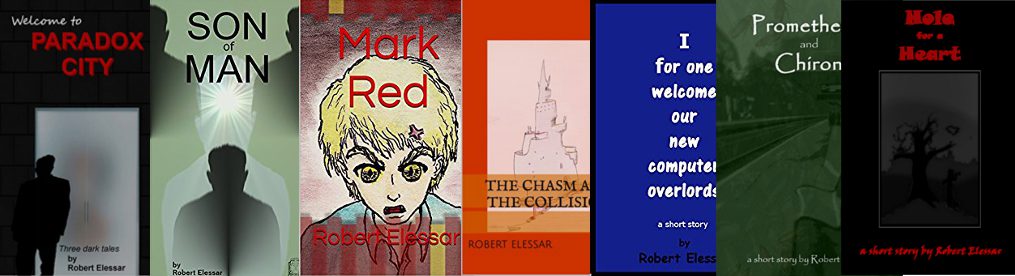
Yes, that’s right‒I’m writing about the weather.  I told you I didn’t really feel up to writing much, didn’t I?  I’m certainly not up to trying to write the follow-up to my neuropathology post from the other day, and I don’t think I would try doing that on my phone if I were, as I think I’ve mentioned previously.  I occasionally toy with the notion, when writing blog posts on the phone, of trying to write a new short story this way.  I wrote a good portion of Son of Man on a previous phone, and I think it came out well.

But honestly, though I think about the idea, I know I won’t do it.  I may not ever write any more fiction for the rest of my life.  I can barely get myself to do non-fiction such as this.

I did listen to some music last night, both on the way to the train and as I lay down trying to get sleepy.  I also ended up watching a fair few “reaction videos” to songs I know.  That’s a rather entertaining genre of YouTube videos in which youngish people, who presumably grew up listening to the latest modern music‒an ever-moving definition in any case‒listen to some classic bands and songs, usually for the first time, and we all get to see their initial reactions.  It’s a fun genre, because these are obviously people who are interested in being exposed to prior hits, and their enthusiasm for the process is often quite moving.

It’s charming (if startling) to see a youngish couple who have never even heard of the Eagles listen to Hotel California…or to see anyone who doesn’t know what’s coming to experience, for the first time, the saxophone solo from Gerry Rafferty’s Baker Street.  It’s also quite a surprise for people to see the young lead singer from the Animals start growling out The House of the Rising Sun.  It still honestly surprises me every time I see it.  It’s as if some teenager has been possessed by the spirit of a cursed man from New Orleans who squandered his life like his father before him, and who must find a body willing to express his torment and his warning before he can ever rest in peace.

It’s also fun to see and hear songs I haven’t thought of in a long time as if for the first time, like The Heart of Rock and Roll, which was huge back in the 80’s.  I saw Huey Lewis and the News in concert, and they put on a terrific show…though he teased the Detroit audience by pretending to forget the last city name in the aforementioned song.  He was a good showman.  He also went to my alma mater, so you know he’s special.

And I’ve yet to see any one of the reactors watch the “best live version” of Radiohead’s Creep and not be in or near tears in response to Thom Yorke’s performance, and commenting about how this is clearly something personal for him, he’s not just singing the song, he’s experiencing it.  Which is surely true, since apparently Thom wrote the song in his late teens, and it was autobiographical.  It certainly conveys sentiments many people have shared at one time or another.

It’s all the next best thing, I guess, to sharing one’s favorite music with a friend, or listening to some new, great song for the first time with one’s peers back in high school or college or what have you.  I guess that’s similar to the reason I watch Doctor Who reaction videos; I have no local person or people with whom to watch it, and it’s definitely the sort of show I would have watched with my wife and/or kids.  I don’t feel too heartbroken to see it now, alone, since I’ve only ever actually watched it by myself, unlike many other shows that I can no longer enjoy.

Not that that makes it unemotional.  I’ve never encountered a show that more frequently evokes teariness than Doctor Who.  It’s really quite remarkable and impressive.  As fans say, it’s a show that’s bigger on the inside.

Anyway, that’s enough writing about nothing.  I hope all of you reading in the US have a truly wonderful Thanksgiving tomorrow, and get to spend time with your loved ones and enjoy some delicious food.  For all those outside the US…well…have a good Thursday‒hopefully not one such as DentArthurDent was prone to have‒and you might as well have some nice food and time with your loved ones, too.  I’ll be back on Friday, barring the unforeseen.

happy-thanksgiving-from-the-farm-maria-keady

Calling 988 is NOT painless with T-Mobile

I’m probably not going to write too much this morning.  I don’t feel much like writing.  In fact, I almost just decided to use my phone for this, even though I brought my laptop with me when I left the office yesterday.  But I thought about the pain in my right thumb and decided, you know what, since I have the laptop with me, I’ll use it.

I left work precipitously yesterday, over the fact that, once again, I was being asked to tacitly approve of a bending of the rules that were set not just by me but also by the boss and the other people who were now wanting to bend them, and all at the behest of the same miserable worm that often pushes us into that situation.  And maybe because of my apparent Asperger’s, or just because of my moral code, or just the truly abysmal mood I was already in (just check yesterday’s blog to find out about that), but I just basically said, “Fuck this,” and got up, packed up my laptop, and left the office.

I texted my main coworker to apologize, and told him that I was going to call 988 once I got back to the house, because I’m at my wit’s end.  I also texted my sister, who was also very supportive, and my coworker told me that the boss apologized to me for putting me in that position.

Anyway, I ended up at the house, which I don’t consider home, and it took me some time and a breather to work my way up to calling the helpline.  This is because, the last time I called the helpline, many years ago, while I was out on bail during my personal downfall/debacle, I got picked up by the PBSO, handcuffed, and taken to a place I think was called the South County Treatment Center.  The deputies didn’t know how to use their handcuffs very professionally—trust me, I’m a connoisseur—and did some nerve damage to my left wrist in the process that lasted almost a year.

So, I finally decided to call 988 yesterday, only to find that T-Mobile prepay would not allow the call to go through, even though I’m paid through December 11th.  I got online to investigate this, and signed into the account, just to confirm that, yes, I was paid up, and I was.  So then I got on their chat function, trying to tell them about the issue and asking, basically, “What the fuck?”

But the person on the chat said that I had to call the toll-free number specifically for T-Mobile’s prepaid system, that they couldn’t do anything or even say anything about it on their end.  And, of course, even though I’d said that I was trying to call the suicide prevention hotline, they used their same cheerful but useless prepackaged, computer-generated phrases to say I had to call their stupid other service first.

Well, it occurred to me that if I could call their stupid toll-free number, I could probably call another, so I told them to fuck off (or words to that effect), and then looked up the 800 number for the old helpline, and I found that it was still active and would redirect automatically to the same place to which 988 goes.  When I started dialing it, I realized that I still had that old number as a contact in my phone, having put it in there just in case, some time ago.

Anyway, I spoke to a pleasant woman who was quite supportive and calming, until I had to use the restroom.  One reassuring thing was, she asked me if I had any immediate plan or method of killing myself, or if I was thinking of killing myself.  I told her, I think about killing myself every day, and have all sorts of possible methods, but I don’t want to be rude or make a mess for other people to clean up or to inconvenience them, so that was why I was calling them.

I guess if they think you are imminently in danger of killing yourself, then they would call the sheriff.  Which leads me to wonder, what if that was your plan?  What if you deliberately wanted to call the sheriff and then when they came, attack them and make them shoot you?

That was not my intention, of course, though such ideas have occurred to me at times.  I finally got off the phone and took care of the restroom business, let my sister and my coworker know that I had called, and that I was going to bed.

I wish I could say it had solved my problems and I felt worlds better, but I don’t think anyone expects that to be the case.  Still, I’m here, for what it’s worth*, and I’m writing this blog, though I’m not working yet on the follow up to my initial neurological post.

But I will close with a public service announcement, or two of them:  First, if you or someone you know has trouble with depression or other mental health issues, or what have you, please keep the following information in mind:  The three digit number for the national suicide helpline in the USA is 988, and the 800 number is 1- 800-273-8255.

The second suggestion is, if you think there’s any chance you or a loved one might need urgent mental health help, don’t do business with T-Mobile.  The fact that I couldn’t get through with the initial 988 number was almost enough to make me decide that it wasn’t worth trying to get help, that this was the world telling me I should just die.  Fortunately my combative stubbornness came to my aid, and I had to try to solve the problem because it did not make sense.

Fuck T-Mobile.  But thank goodness for the people at the suicide help line.


*Nothing, in the greater scheme of things.

There is no room upon the hill

It’s Monday, and I was loosely considering writing the second part of my discussion of Alzheimer’s, Parkinson’s, etc., today, but yesterday (and to a lesser extent Saturday), I got my head thrown for a loop by something that other people would probably consider minor, and because of that, I didn’t do any preparation, such as reviewing some of the latest information on the subjects, so I’m going to put that off a bit.

It’s rather strange how fragile my mental state has become—or perhaps it was always so, but I didn’t know, because my surroundings were such that I was not as vulnerable, or because I avoided the mistake of ever getting used to anything going as I expected or hoped.  In any case, my usual Sunday routine is to get up relatively early and do my laundry in the morning.  It’s two to three loads, and it’s the only day in the week that I can do my laundry, given my schedule, so I’ve kind of carved that out as the way things work.

It was my understanding that the new people living in the outer part of the house knew that; I’d asked the owner to make that clear, and hitherto it’s been good.  It feels like it shouldn’t be much of an imposition on anyone, since the remaining six days of the week are theirs to do what laundry they will as they please.  I do pay for the cable and internet, and for (more than) half of the water and power, despite there being only one of me.

I laid in just a little bit—for me anyway—yesterday morning, which means until about 8:20 am, before going out to do my laundry, only to find that there was a load in the wash and the dryer, just getting started, and the lady was there with some man I haven’t seen before, though he’s not important.  I tried stammeringly to remind her that I need to use the laundry on Sunday morning, that it’s the only day I can do it, and please to leave it free in the future, but I think that I didn’t say half of that, and not just because of my very rusty Spanish.  I was just so stressed out, and felt so angry and anxious and irritated that my words kind of froze up, and I don’t have any idea what my expression looked like.  I also felt almost as though I was going to cry, which is quite embarrassing.  I finally said, “por favor” a few times before retreating into my room.

I know for a fact that my face doesn’t adequately convey my emotions—apparently neither does my voice nor my writing—because I frequently find that I when I am horribly depressed, and having suicidal thoughts, and am trying to send out some kind of request for help, and expect that it’s obvious, and that someone will say something about it, people act just they way they normally act.

I don’t know, maybe they aren’t acting like they normally act, but I’m no good at reading them.  In any case, my experience of their behavior doesn’t seem to change.  Thus, my frequent reference to the line from Brain Damage, the penultimate song from Pink Floyd’s Dark Side of the Moon:  “And when the cloudbursts thunder in your ear / you shout, and no one seems to hear”.  (It’s followed by what is, for me, an even more poignant and heartbreaking line:  “And when the band you’re in starts playing different tunes / I’ll see you on the dark side of the moon.”)

Maybe it’s just that people have seen me get depressed and stressed out so often, and I’ve tried to express how horrible I feel so often, but no one has done anything or recognized it or something, but I haven’t killed myself yet, so it’s probably okay just to leave it, he’ll get over it and keep on going, since that’s what he’s always done so far.  But, of course, past performance is no guarantee of future results, as the dot-com bubble, and the housing bubble, and the 2008 banking crisis reminded us, though it feels as though most people had never realized it before, and probably most people have never internalized the lesson even since those big slams.

Anyway, there’s a reason that the reference to the straw that broke the camel’s back became a cliché.  When a rope is fraying steadily, for a long time it looks like it’s still holding—after all, it doesn’t tend to stretch as it frays, especially not if it’s a modern, polymer rope—but when it fails, it does so abruptly, and often catastrophically.

Too many metaphors.  Too much mixing thereof.  Sorry, but I’m having trouble being very organized.

Anyway, just having my laundry schedule screwed up—I had to wait hours for the person’s laundry first to be done in the wash, then for them to clear it from the dryer while my first load of wash waited, finished washing, in the washer—really fucked me in the head.  It didn’t help that I couldn’t go for a walk as I’d hoped to do, since it’s been pissing down rain for the last thirty-six hours or so, with a fairly steady wind that makes umbrellas pointless, since your lower half is going to get wet no matter what.  Frankly, it’s significantly more inconvenient than the “subtropical storm” was a few weeks ago.

So I couldn’t finish my laundry and then go for a long walk or anything, or really do anything else while waiting for the laundry machines to be available*.  Not that I would have done anything edifying or useful, but I had planned (as I mentioned) at least to review some more recent stuff about the diseases I’d begun addressing.

This is not the only thing that stressed me out.  Saturday, I made the mistake of making a slightly substantive comment on a post in a blog that I follow, and another reader replied to my comment, starting the fucking idiotic response with “You’re missing the point”, and then spewing some irrelevancy about something that didn’t pertain to the point I was making; and by the way I had not missed the supposed point this person thought the original post was making.  It just wasn’t pertinent nor frankly in any way persuasive.

Anyway, I felt very angry—probably inordinately so—and made the mistake of replying (substantively, I think, and not rudely) to the comment, trying to make my own point clearer.  But now I don’t even want to go back to that blog, and I certainly don’t want to get involved in the comments section anymore.  Maybe some people enjoy such argumentative interactions, but they make me want to go full Hannibal Lecter, or maybe just full Thanos, frankly, and that just ends up making me feel more horrible about myself than I already do.

I’ve had lots of other little stressors getting to me far out of proportion to their actual importance—after all, nothing at all is actually truly important—and it’s just highlighting for me again, in case I should ever start to forget, that I don’t belong in this world, I’m not a member of this species, I enjoy very little about the fact of being here, and that little seems to be shrinking asymptotically toward zero.

I can feel each straw gathering on my back in such moments.  I don’t have any idea when it might break.  It doesn’t help that my back always hurts, of course, but it does make the metaphor apt.  I don’t know the extent of my endurance, and I guess I won’t know until it breaks.  But it is being worn down.  I can tell because I’m getting more and more stressed out by milder and more foolish things all the time.

It’s particularly frustrating, though in a different way, when someone, meaning well, asks me how I’m doing or “checks up on me” in passing, because I have to either just dodge the question—since I know people don’t really know what to do if you tell them that you’re doing terribly and wish your life would end—or just say, “Meh,” hoping that is enough to get across the message if they really want to know, but noncommittal enough that they don’t have to feel upset if they’re just trying to be polite.

But I’m not doing well.  I haven’t been doing well.  I’ve been trying to tell everyone that for a long time, and it feels like it’s silly for someone to ask.  If there’s no one who can help me get the load off my back, I’m going to collapse, sooner or later, and I honestly hope that it’s sooner.

Anyway, that’s an unpleasant way to start the week.  I’m sorry.  I’m not much fun.  And I’m sorry about that, too.  I’m sorry that I’m such a waste of a person.  It’s not how I would prefer to be.  It’s not who I’ve tried to pretend to be.  But pretense can only be carried on so far if it requires so much energy to do, and if it just makes you feel like a liar and a fake, when you already feel like a stranger and, above all, a monster.

Oh, well.  The universe wasn’t built for me, that’s for sure.  It’s under no obligation to be the way I wish it were, nor do I have any business complaining about the fact that I’m not who I might wish I were.  I don’t want to be anyone else, of course; I just wish I were a better version of me.

Maybe somewhere out there in the multiverse, if there is such a thing, there is a better version of me, possibly an infinite number of them.  Of course, there would therefore also be an infinite number of even worse versions of me, based on the mathematics of the situation.  I wonder if I’m close to the mean, or the median (these are tricky concepts when dealing with infinities, in any case), or the mode, or if I’m an outlier.  It doesn’t really matter, I suppose.  As far as anyone can tell, this is the only universe with which I have to work, and I am the only me that there is, and I am the only way I can have been.

How disappointing.


*I did at least get to watch Lydia Ko win yet another golf tournament, apparently a big one, and that’s always good.  I would have watched that anyway, but it’s still good.

You’ve got some nerve!

It’s Saturday, the 19th of November in 2022, and I’m going in to the office today, so I’m writing a blog post as well.  I’m using my laptop to do it, and that’s nice—it lets me write a bit faster and with less pain at the base of my right thumb, which has some degenerative joint disease, mainly from years of writing a lot using pen and paper.

The other day I started responding to StephenB’s question about the next big medical cure I might expect, and he offered the three examples of cancer, Alzheimer’s and Parkinson’s Disease.  I addressed cancer—more or less—in that first blog post, which ended up being very long.  So, today I’d like to at least start addressing the latter two diseases.

I’ll group them together because they are both diseases of the central nervous system, but they are certainly quite different in character and nature.  This discussion can also be used to address some of what I think is a dearth of public understanding of the nature of the nervous system and just how difficult it can be to treat, let along cure, the diseases from which it can suffer.

A quick disclaimer at the beginning:  I haven’t been closely reading the literature on either disease for quite some time, though I do notice related stories in reliable science-reporting sites, and I’ll try to do a quick review of any subjects about which I have important uncertainties.  But if I’m out of date on anything specific, feel free to correct me, and try to be patient.

First a quick rundown of the two disorders.

Alzheimer’s is a degenerative disease of the structure and function of mainly the higher central nervous system.  It primarily affects the nerves themselves, in contrast to neurologic diseases that interfere with supporting cells in the brain*.  It is still, I believe, the number one cause of dementia** among older adults, certainly in America.  It’s still unclear what the precise cause of Alzheimer’s is, but it is associated with the development of “cellular atypia made of what are called “neurofibrillary tangles” within the cell bodies of neurons, and these seem to interfere with normal cellular function.  To the best of my knowledge, we do not know for certain whether the plaques are what directly and primarily cause most of the disease’s signs and symptoms, or if they are just one part of the disease.  Alzheimer’s  is associated with gradual and steadily worsening loss of memory and cognitive ability, potentially leading to loss of one’s ability to function and care for oneself, loss of personal identity, and even inability to recognize one’s closest loved ones.  It is degenerative and progressive, and there is no known cure and there are few effective treatments that are not primarily supportive.

Parkinson’s Disease (the “formal” disease as opposed to “Parkinsonism”, which can have many causes, perhaps most notably the long-term treatment of psychiatric disorders with certain anti-psychotic medicines), is a disorder in which there is loss/destruction of cells in the substantia nigra***, a region in the “basal ganglia” in the lower part of the brain, near the takeoff point of the brainstem and spinal cord.  It is dense with the bodies of dopaminergic neurons, which there seem to modulate and refine motor control of the body.  The loss of these nerve cells over time is associated with gradual but progressive movement disorders, including the classic “pill-rolling” tremor, shuffling gait, blank, mask-like facial expression, and incoordination with tendency to lose one’s balance.  There are more subtle and diffuse problems associated with it, including dementia and depression, and like Alzheimer’s it is generally progressive and degenerative, and there is no known “cure”, though there are treatments.

Let me take a bit of a side-track now and address something that has been a pet peeve of mine, and which contributes to a general misunderstanding of how the nervous system and neurotransmitters work, and how complex the nature and treatment of diseases of the central nervous system can be.  This may end up causing this blog post to require at least two parts, but I think it’s worth the diversion.

I mentioned above that the cells of the substantia nigra are mainly dopaminergic cells.  This means that they are nerve cells that transmit their “messages” to other cells mainly (or entirely) using the neurotransmitter dopamine.  The term “dopaminergic” is a combination word, its root obviously enough being “dopamine” and its latter half, “ergic” relating to the Greek word “ergon” which means to do work.  So “dopaminergic” means those cells do their work using dopamine, and—for instance—“serotonergic” refers to cells that do their work using serotonin.  That’s simple enough.

But the general public seems to have been badly educated about what neurotransmitters are and do; what nerve impulses are and do; and what the nature of disorders, like for instance depression, that involve so-called “chemical imbalances” really entails.

I personally hate the term chemical imbalance.  It seems to imply that the brain is some kind of vat of solution, perhaps undergoing some large and complex chemical reaction that acquires some mythical state of equilibrium when it’s working properly, but when, say, some particular reactant or catalyst is present in too great or too small a quantity, doesn’t function correctly.  This is a thoroughly misleading notion.  The brain is an incredibly complex “machine” with hundreds of billions of cells interacting in extremely complicated and sophisticated ways, not a chemical reaction with too many or too few moles on one side or another.

People have generally heard of dopamine, serotonin, epinephrine, norepinephrine, and the like, and I think many people think of them as related to specific brain functions—for instance, serotonin is seen as a sort of “feel good” neurotransmitter, dopamine as a “reward” neurotransmitter, epinephrine and norepinephrine as “fight or flight” neurotransmitters, and so on.

I want to try to make it very clear:  there’s nothing inherently “feel good” about serotonin, there’s nothing inherently “rewarding” about dopamine, and—even though epinephrine is a hormone as well as a neurotransmitter, and so can have more global effects—there’s nothing inherently “fight or flight” about the “catecholamines” epinephrine and norepinephrine.

All neurotransmitters—and hormones, for that matter—are just complex molecules that have particular shapes and configurations and chemical side chains that make them better or worse fits for receptors on or in certain cells of the body.  The receptors are basically proteins, often combined with special types of “sugars” and “fats”.  They have sites in their structures into which certain neurotransmitters will tend to bind—thus triggering the receptor to carry out some function—and to which other neurotransmitters don’t bind, though, as you may be able to guess from looking at their somewhat similar structures, there can be some overlap.

dopamine

Dopamine

serotonin

Serotonin

epinephrine

Epinephrine

Neurotransmitters are effectively rather like keys, and their functions—what they do in the nervous system—are not in any way inherent in the neurotransmitter itself, but in the types of processes that get activated when they bind to receptors.

There is nothing inherently “rewarding” about dopamine, any more than there is anything inherently “front door-ish” to the key you use to unlock the front door of your house, or “car-ish” to the keys that one uses to open and turn on cars.  It’s not the key or the lock that has inherent nature, it’s whatever function is initiated when that key is put into that lock, and that function depends entirely on the nature of the target.  The same key used to open your door or start your car could, in principle, be used to turn on the Christmas lights in Rockefeller Center or to launch a nuclear missile.

Dopamine is associated with areas of the nervous system that function to reward—or more precisely, to motivate—certain behaviors, but it is not special to that function.  As we see in Parkinson’s Disease, it is also used in regions of the nervous system involved in modulating motor control of the body.  The substantia nigra doesn’t originate the impulses for muscles to move, but it acts as a sort of damper or fine tuner on those motor impulses.

Neurotransmitters work within the nervous system by being released into very narrow and tightly closed spaces between two nerve cells (a synapse), in amounts regulated by the rate of impulses arriving at the bulb of the axon.  Contrary to popular descriptions, these impulses are not literally “electrical signals” but are pulses of depolarization and repolarization of the nerve cell membrane, involving “voltage-triggered gates****” and the control of the concentration of potassium and sodium ions inside and outside the cell.

synapse

A highly stylized synapse

The receptors then either increase or decrease the activity of the receiving neuron (or other cell) depending on what their local function is.  It’s possible, in principle, for any given neurotransmitter to have any given action, depending on what functions the receptors trigger in the receiving cell and what those receiving cells then do.  However, there is a fairly well-conserved and demarcated association between particular neurotransmitters and general classes of functions of the nervous system, due largely to accidents of evolutionary history, so it’s understandable that people come to think of particular neurotransmitters as having that nature in and of themselves…but it is not accurate.

Okay, well, I’ve really gone off on my tangents and haven’t gotten much into the pathology, the pathophysiology, or the potential (and already existing) treatments either for Parkinson’s or Alzheimer’s.  I apologize if it was tedious, but I think it’s best to understand things in a non-misleading way if one is to grasp why it can be so difficult to treat and/or cure disorders of the nervous system.  It’s a different kind of problem from the difficulties treating cancer, but it is at least as complex.

This should come as no surprise, given that human nervous systems (well…some of them, anyway) are the most complicated things we know of in the universe.  There are roughly as many nerve cells in a typical human brain as there are stars in the Milky Way galaxy, and each one connects with a thousand to ten thousand others (when everything is functioning optimally, anyway).  So, the number of nerve connections in a human brain can be on the order of a hundred trillion to a quadrillion—and these are not simple switching elements, like the AND, OR, NOT, NAND, and NOR gates for bits in a digital computer, but are in many ways continuously and complexly variable even at the single synapse level.

When you have a hundred trillion to a quadrillion more or less analog switching elements, connecting cells each of which is an extraordinarily complex machine, it shouldn’t be surprising that many things can go wrong, and that figuring out what exactly is going wrong and how to fix it can be extremely difficult.

It may be (and I strongly suspect it is the case) that no functioning brain of any nature can ever be complex enough to understand itself completely, since the complexity required for such understanding increases the amount and difficulty of what needs to be understood*****.  But that’s okay; it’s useful enough to understand the principles as well as we can, and many minds can work together to understand the workings of one single mind completely—though of course the conglomeration of many minds likewise will become something so complex as likely to be beyond full understanding by that conglomeration.  That just means there will always be more to learn and more to know, and more reasons to try to get smarter and smarter.  That’s a positive thing for those who like to learn and to understand.

Anyway, I’m going to have to continue this discussion in my next blog post, since this one is already over 2100 words long.  Sorry for first the delay and then the length of this post, but I hope it will be worth your while.  Have a good weekend.


*For instance, Multiple Sclerosis attacks white matter in the brain, which is mainly long tracts of myelinated axons—myelin being the cellular wraparound material that greatly speeds up transmission of impulses in nerve cells with longish axons.  The destruction of myelin effectively arrests nerve transmission through those previously myelinated tracts.

**“Dementia” is not just some vague term for being “crazy” as one might think from popular use of the word.  It is a technical term referring to the loss (de-) of one’s previously existing mental capacity (-mentia), particularly one’s cognitive faculties, including memory and reasoning.

***Literally, black substance.

****These are proteins similar to the receptors for neurotransmitters in a way, but triggered by local voltage gradients in the cell membrane to open or close, allowing sodium and/or potassium ions to flow into and out of the cell, thereby generating more voltage gradients that trigger more gates to open, in a wave that flows down the length of the axon, initially triggered usually at the body of the nerve cell.  They are not really in any way analogous to an electric current in a wire.

*****You can call that Elessar’s Conjecture if you want (or Elessar’s Theorem if you want to get ahead of yourself), I won’t complain.

Nothing of worth can ever truly be “unconditional”

It’s Friday now, and for many it is the last day of the work week.  If you are one of those people, congratulations.  If you expect to work tomorrow, as I do, then, well, congratulations on having gainful employment.  It’s not a contradiction to consider both cases worthy of celebration.

I’m writing on my phone today because I didn’t want to take my laptop to the house with me‒I took my Radiohead guitar chords book home with the notion that I might actually get the acoustic guitar out and do some strumming, and the book and laptop together seemed likely to make my backpack unpleasantly heavy to carry.  Alas, the strumming part didn’t happen, but I couldn’t retroactively choose to take the laptop with me.

Because of that, I’m not going to write about Alzheimer’s and/or Parkinson’s disease today; I feel that I can deal with them better when I can type more naturally, and so I’ll address those things perhaps tomorrow.  Today, I’ll try to address a random, walk-in set of topics that crowded my head this morning for unclear causes.  The things that popped into my mind as I headed to the train station included the notions of healthcare as a human right, unconditional love, and free education (free anything, really), all loosely linked to something a coworker of mine said yesterday.

I’ll start with the middle one, because it presents itself (rather intrusively) in my mind in the form of the old song, Unconditional Love, performed way back when by Donna Summer and Musical Youth.  The chorus goes, “Give me your unconditional love; the kind of love I deserve; the kind I want to return.”

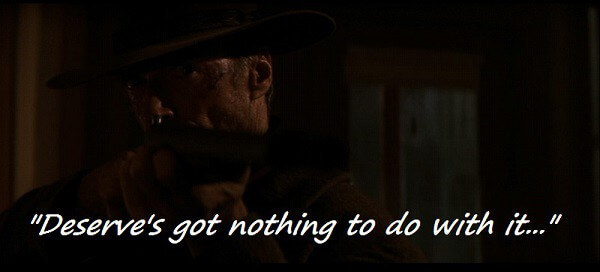
I may have written about this notion before, but do you spot the logical flaws there?  First of all, the notion that one can (apparently) demand another’s love, conditional or otherwise, is rather obscene and also unworkable.  But that’s a separate issue from the notion of “unconditional love”.  One big problem with this is revealed in the second line of the chorus:  that such love is the kind the singer deserves.  But if it’s unconditional, then‒to quote the movie Unforgiven‒”deserve’s got nothing to do with it”.  If love is unconditional, then everyone and anyone (and presumably anything) deserves it.  That’s what unconditional means!

Perhaps they might have meant something along the lines of “non transactional” love, but if so, they reveal hypocrisy in the next line, “the kind I want to return”, because they’re saying, openly, that their own love is not merely conditional but also transactional…I’ll love you if and only if you love me unconditionally.  Maybe that was supposed to be the message of the song, to ridicule such words and thoughts and attitudes toward love by revealing their absurdity, but it certainly didn’t come across that way.

On we go to the notion of healthcare as a human right.  This is something one sees at times brought up and bandied about by activists of various stripes, and I can readily understand and sympathize with the urge, but it is illogical.  One cannot have a right to anyone else’s skill or work or abilities or resources, and the provision of healthcare requires these in spades.

True rights are and can really only be rights to be free from things‒free from coercion, free from threats and violence, free from theft, free from censorship and from unjust imprisonment, that sort of thing.  To claim a right to the work of other people, especially if one claims that right precisely because that work is so important, is the opposite of any kind of right or freedom; it is coercion in and of itself.

Now, it may be that a society could decide that it is best for everyone, as a whole and as individuals, to provide (and therefore to pay for) healthcare for all its citizens without any at-the-time-of-service charge, since illnesses and injuries are often unpredictable, and they do not choose convenient times to strike.  A society may decide that taking away some of that danger, that threat, that uncertainty, will be better for everyone and anyone.  It’s not an unreasonable idea.  But that doesn’t describe any kind of right, even if one is a citizen of a society that has chosen that path.  Give it the credit it deserves and call it a privilege, and one that should be cherished, not a right.

This ties in nicely with the notion of other “free” programs or privileges, the main one that comes to my mind being that of “free college education”.  As with most positive, physical things, the notion of “free” simply doesn’t apply.  Air is free (for now), because it’s pretty much everywhere, and it doesn’t require any work apart from the effort of breathing.  But education requires many resources, including the information gleaned by the innumerable predecessors who worked to develop the knowledge that is being shared, and the time and effort of the scholars and teachers who are sharing it.

Some of this is getting cheaper and easier thanks to advancing computer and communications technology, but those things also required the efforts and resources of numerous people before they became available to so many others, most of whom do not have the knowledge or skill to recreate such resources on their own.

Again, this is not to say that it is not worth considering whether a society might be well-served by making education available without local charge to all citizens who wish to participate.  It may be well worth the expense and effort involved for the society, in the long or even the short term.  I’m a big fan of public primary and secondary schools, and I wish they were better funded and in a more egalitarian way, because there are untold numbers of people with great potential who have not been able to realize it because they had effectively no local resources available to do so.

This is truly a shame and a tragedy.  Who knows what scientists or artists or innovative business people (and so on) we have lost without knowing that we lost them?  But calling for there to be “free” education is silly.  Someone, somewhere, has to “pay” for every good thing that requires effort in transforming the world into a desired form, decreasing local entropy by expending energy and producing compensatory entropy increase through the efforts made.

This all ties in‒in spirit‒with the complaint by a coworker yesterday, who moans frequently about lack of money and a fear of being unable to pay rent, etc., but when the boss asked her to come in this Saturday to work, so she could make more money, said she just can’t work six days a week.  Of course, she doesn’t work six days a week, she hasn’t worked six days a week that I can remember.  I work six days every other week; if I don’t, things don’t happen for the many people who come in on Saturdays voluntarily, to try to make a little extra money for their own expenses.

The problem was not with her choosing not to come in on any Saturday‒that’s her decision, and she is the one who loses the opportunity to make more money‒but with her complaint to me that it’s just “not fair” to have to work six days, which is truly nonsensical given to whom she was speaking, and given the number of people who voluntarily come in and work more Saturdays than not.

My response was pretty unsympathetic.  I told her that “fairness” is a fiction, at least as she’s apparently imagining it.  There’s no injustice in her being encouraged to work an extra day once in a while to make extra money, if she’s truly worried about her expenses.  If anything, it would be unfair for her to expect to make more money without doing extra work.

In a sense, nature is always fair; the laws of physics apply everywhere and for all time, as far as we can tell.  They make no exceptions and provide no “get out of jail free” cards or cheat codes to anyone regarding their application.

Other than this, any notion of fairness is purely a human invention.  It may, in some senses and cases, be very good to seek and to create, for a society and for the individuals within it.  Indeed, I would say that it is worthwhile.  But it too is not free; it requires effort, and it requires ownership of one’s responsibility for one’s share of the effort.  It is not unconditional.  To expect unconditional anything from anyone or anything is not fair, but is in many ways quite the opposite.

Education is very good and beneficial, and probably the more of it we have, the better, all other things being equal.  Reasonable pay for good work is certainly a good thing.  Healthcare is an almost miraculous good that we take for granted at our peril, but which would almost certainly benefit all of society more if it were more efficiently and evenly available.  And love is, quite possibly, the most wonderful and beautiful thing the universe has ever brought into existence.  We should show these things the respect they deserve by not taking them for granted in any way.

deserve

But if you blog it, as many of your players do, I had as lief the town-crier spoke my lines.

Hello and good morning.  It’s Thursday again, and it’s time to resume my traditional, weekly blog posting day after a brief hiatus last week due to a rather lackluster tropical storm.  I expect there will be another hiatus next Thursday, since it will be Thanksgiving here in the USA, and that’s probably a more universally observed holiday here than anything but New Year’s Day (the latter being mainly observed because many people tend to be much the worse for wear after New Year’s Eve).

I’m not going to pick up the discussion of Alzheimer’s and/or Parkinson’s disease today, largely because I’m writing this post on my phone*.  Also, Thursday has traditionally been a day for blog posts about writing, especially fiction.  This makes it a good opportunity to address something raised by the same reader, StephenB, in a comment after yesterday’s blog, in which he asked what my thoughts or approaches were to writing good dialogue.

It’s an interesting topic, not least because I’ve never really thought about trying to write good, let alone great, dialogue.  I have, however, always (as long as I can remember, anyway) enjoyed reading both good/great dialogue and good/great narration.  But the greatness of such writing was always measured by how much I enjoyed it or the story in which it took place, and was from my point of view, never in deference to what anyone else said was good or great.

I’ve always tended to notice passages of writing that I find moving or eloquent, and I read and reread them, and often involuntarily memorize them.  In high school, almost every day, I would write some quote or other on the little-used blackboard of the orchestra room**.  I’ve also always loved characters who used words well‒they’re usually villains for some unclear reason‒in various books and movies and comic books and whatnot.  A big part of the reason Lord Foul is one of my favorite villains is because of his way with words (as well as the fact that, despite being a Sauron-style “big bad”, he actually speaks in the stories)***.

I’ve also always watched people around me and listened to them, mostly to try to discern how ordinary people talk and interact and communicate, which has often been far from intuitive for me.  If someone has peculiar habits of speech or sayings, especially funny ones, I’ll tend to remember them, and sometimes these will appear in my characters’ speech.

But when I’m writing dialogue, whether in a story or a play or whatever (it’s been a long time since I’ve written a play or a screenplay, but I did write them, once upon a time), I’m not really trying to make the dialogue good.  I’m not even really thinking about it as “dialogue”.  To me, the characters in my stories are just people‒real people in a sense.  I don’t do any formal process of, for instance, deciding someone’s background or motivations or nature, partly because, as far as I can see, no real people have such clearly defined backgrounds or motivations‒real people are messy and fuzzy‒and partly because it seems boring.

So, when my characters are speaking, they’re just talking to each other, as people talk to each other, and the subjects and words depend on the situations and the vague tendencies of the person talking.  I will have people try to be funny, when the character wants to try to be funny, but I can’t always tell if they’ve succeeded (and it’s often, ironically, funnier when they haven’t).  Sometimes characters get the right words out and make what they’re trying to say clear on the first attempt, and other times the other characters don’t quite get what they were saying, and they’ll have to clarify their point, sometimes with exasperation.

But real people, as far as I can see, don’t do “dialogue”.  They just talk to each other, and it’s very free-form and impromptu and usually quite messy, but sometimes fun.  And, as I said, the people in my stories aren’t anything but people to me, even the “bad guys”, and so they are prone to say whatever they say in any given situation, and succeed or fail at communicating depending on their luck, skill, or circumstances.

Of course, I do a lot of editing as I finalize stories, but I suspect that I edit dialogue far less than I do narration.  I certainly don’t bother trying to be grammatically correct when people are speaking, unless that character is someone who likes to try to do that, because most people‒even I‒don’t speak in grammatically correct sentences.  Occasionally I’ll tweak something if it’s said in an awkward way that’s not a natural kind of awkwardness, or I’ll add something if it occurs to me that this character really wants to say a bit more about a particular subject than was written originally.

And, of course, in The Chasm and the Collision, the characters sometimes deliberately choose not to swear when they definitely wanted to swear, and would have done so, if not for my decision, on my father’s recommendation, not to have any swearing in the book (since it was “kid” oriented).

So I fear I have little advice to give about writing “good dialogue”, but personally, I wouldn’t worry too much about trying to do that.  I doubt Shakespeare ever tried to write good dialogue specifically; he probably just had his characters say what he thought they would say, both to have fun and to advance the plot (and often tweaked into iambic pentameter).  He ended up making some truly great dialogue, but I think his goal was just to write an enjoyable, moving play that people would be willing to pay to go and see.  The man had to make a living.

I’m no Shakespeare (clearly), but I basically just read what I enjoy and try to write what I enjoy, and my characters aren’t Characters, they’re just people.  They don’t do dialogue, they just talk, like people do, often saying stupid things, and interrupting each other, talking way too much, too loudly, and in singularly unflattering ways.  I don’t know if that counts as any kind of advice or insight; these are just my thoughts on the subject.

That’s my own “dialogue” for the day.  I hope you got some fun out of it, and that you have a good day, and a good week, and have whatever conversations you have with your friends/loved ones that seem to fit.  And, of course, please comment here with suggestions for subjects and topics or inquiries regarding matters about which you’d like me to write.

TTFN

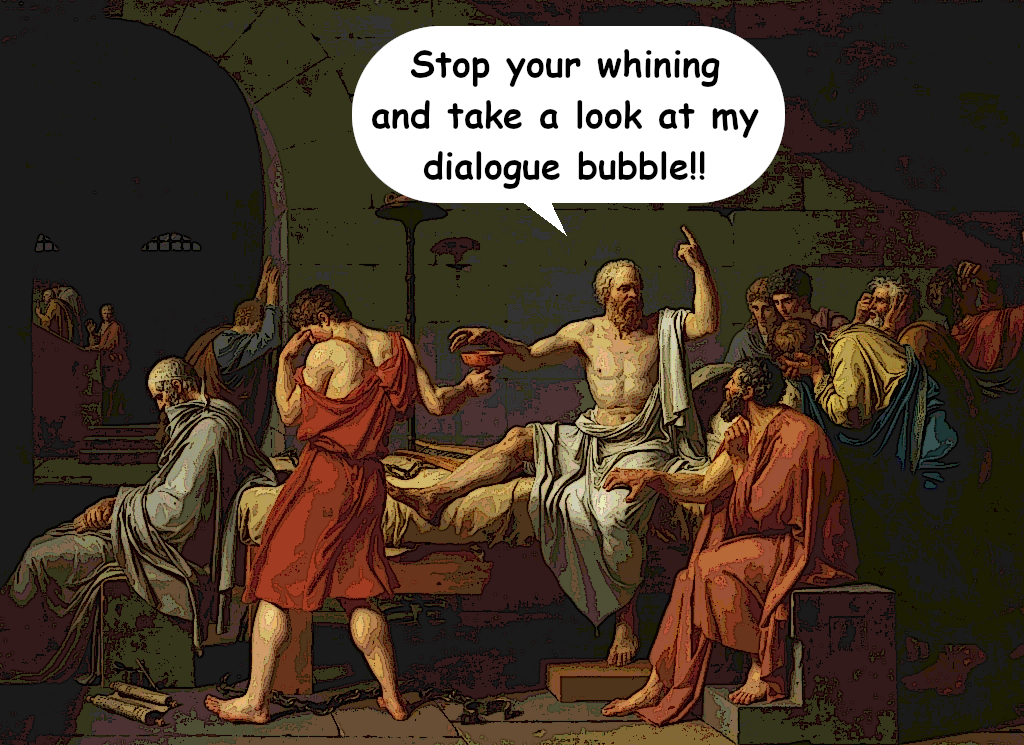
socrates dialogue bubble


*I didn’t bring my laptop when I left work early yesterday, exhausted beyond belief by Monday and Tuesday nights.  I wish I could say I’d gone on some kind of binge on those evenings, but alas, I can’t even usually finish a single glass of wine, and apart from caffeine, allergy medicine, and OTC analgesics, I don’t use any drugs.

**The orchestra teachers were pretty easy-going about this, presumably because I was a good student and the process was nominally educational and occasionally interesting or amusing.  They did give me the “dusty cello award” in my senior year, near graduation, for my idiosyncratic habit, and that very much caught me off guard.  I never really realized it was odd or funny.

***He’s the second person we “meet” from the Land, in the chapter “Invitation to a Betrayal”, and I doubt I will ever forget the final paragraph of his warning to Thomas Covenant:  “One more word.  A final caution.  Do not forget whom to fear at the last.  I have had to be content with killing and torment, but now my plans are laid, and I have begun.  I shall not rest until I have eradicated hope from the Earth.  Think on that, and be dismayed.”

Some discussion of cancer–not the zodiac sign

Yesterday, reader StephenB suggested that I write about what I thought might be the next big medical cure coming our way—he suggested cancer, Alzheimer’s, and Parkinson’s diseases as possible contenders—and what I thought the “shape” of such a cure might be.  I thought this was an interesting point of departure for a discussion blog, and I appreciate the response to my request for topics.

[I’ll give a quick “disclaimer” at the beginning:  I’ve had another poor night.  Either from the stress of Monday night or something I ate yesterday (or both, or something else entirely) I was up a lot of last night with reflux, nausea, and vomiting.  So I hope I’m reasonably coherent as I write, and I apologize if my skills suffer.]

One hears often of the notion of a “cure for cancer”, for understandable reasons; cancer is a terrifying and horrible thing, and most people would like to see it gone.  However, my prediction is that there will never be “a” cure for cancer, except perhaps if we develop nanotechnology of sufficient complexity and reliability that we are able to program nanomachines unerringly to tell the difference between malignant and non-malignant cells, then destroy the malignant ones and remove their remains neatly from the body without causing local complications.  That’s a tall order, but it’s really the only “one” way to target and cure, in principle, all cancers.

Though “cancer” is one word, and there are commonalities in the diseases that word represents, most people know that there are many types of cancers—e.g., skin, colon, lung, breast, brain, liver, pancreatic, and so on—and at least some people know that, even within the broader categories there are numerous subtypes.  But every case of cancer is literally a different disease in a very real sense, and indeed, within one person, a single cancer can become, effectively, more than one disease.

We each* start out as a single fertilized egg cell, but by adulthood, our bodies have tens of trillions of cells, a clear demonstration of the power of exponential expansion.  Even as adults, of course, we do not have a static population of cells; there is ongoing growth, cell division/reproduction, and of course, cell death.  This varies from tissue to tissue, from moment to moment, from cell type to cell type, under the influence of various local and distant messengers, ultimately controlled by the body’s DNA.

Whenever a cell replicates, it makes a copy of its DNA, and one of each copy is sent into each daughter cell.  There are billions of base pairs in the human genome, so there are lots of opportunities for copying errors.  Thankfully, the cell’s proofreading “technology” is amazingly good, and errors are few and far between.  But they are not nonexistent.  Cosmic rays, toxins, other forms of radiation, prolonged inflammation, and simple chance, can all lead to errors in the replication of a precursor cell’s DNA, giving rise to a daughter cell with mutations, and when there are trillions of cells dividing, there are bound to be a number of them.

The consequences of such errors are highly variable.  Many of them do absolutely nothing, since they happen in portions of the genome that are not active in that daughter cell’s tissue type, or are in areas of “junk” DNA in the cell, or in some other way are inconsequential to the subsequent population of cells.  Others, if in just the wrong location, can be rapidly lethal to a daughter cell.  Most, though, are somewhere in between these two extremes.

The rate of cell division/reproduction in the body is intricately controlled, by the proteins and receptors in that cell, and the genes that code for them, and that code for factors that influence other portions of the genome of a given cell, and that make it sensitive or insensitive to hormonal or other factors that promote or inhibit cell division.  If a mutation in one of the regions of the cell that is involved in this regulatory process—either increasing the tendency to grow and divide or diminishing the sensitivity to signals that inhibit division—a cell can become prone to grow and divide more rapidly than would be ideal or normal for that tissue.  Any given error is likely to have a relatively minor effect, but it doesn’t take much of an effect to lead to a significant increase in the number of cells in a given cell type eventually—again, this is the power of exponential processes.

A cell line that is reproducing more rapidly will have more opportunities for errors in the DNA reproduction of its many daughter cells.  These new errors are no more likely to be positive, negative, or neutral generally than any other replication errors anywhere else in the body, but increased rate of growth means more opportunities** for mistakes.

If a second mistake in one of the potentially millions (or more) of daughter cells of the initial cell makes it yet more prone to divide rapidly than even the first population of mutated cells, then that population will grow and outpace the parent cells.  There can be more than one such daughter populations of cells.  And as the rate of replication/growth/division increases in a given population of cells, we have an increased chance of more errors occurring.  Those that become too deleterious will be weeded out.  Those that are neutral will not change anything in the short term (though some can make subsequent mutations more prone to cause increased growth rates).  But the ones that increase the rate of growth and division will rapidly come to dominate.

This is very much a microcosm of evolution by natural selection, and is a demonstration of the fact that such evolution is blind to the future.  In a sense, the mutated, rapidly dividing cells are more successful than their more well-behaved, non-mutated—non-malignant—sister cells.  They outcompete for resources*** against “healthy” cells in many cases, and when they gather into large enough masses, they can cause direct physical impairments to the normal function of an organism.  They can also produce hormones and proteins themselves, and can thus cause dysregulation of the body in which they reside in many ways.

Because they tend to accumulate more and more errors, they tend to become more dysfunctional over time.  And, of course, any new mutations in a subset of tumor cells that makes it more prone to divide unchecked, or that makes it more prone to break loose from its place of origin and spread through the blood and/or lymph of the body will rapidly become overrepresented.

This is the general story of the occurrence of a cancer.  The body is not without its defenses against malignant cells—the immune system will attack and destroy mutated cells if it recognizes them as such—but they are not perfect, nor would it behoove evolution (on the large scale) to select for such a strictly effective immune system, since all resources are always finite, and overactive immunity can cause disease in its own right.

But the specific nature of any given cancer is unique in many ways.  First of all, cancers arise in the body and genes of a human being, each of which is thoroughly unique in its specific genotype from every other human who has ever lived (other than identical twins).  Then, of course, more changes develop as more mutations occur in daughter cells.  Each tumor, each cancer, is truly a singular, unique disease in all the history of life.  Of course, tumors from specific tissues will have characteristics born of those tissues, at least at the start.  Leukemias tend to present quite differently from a glioblastoma or a hepatoma.

Because of these differences, the best treatments for specific cancers, even of classes of cancers, is different.  The fundamental difficulty in treating cancer is that you are trying to stop the growth and division—to kill—cells that are more or less just altered human cells, not all that different from their source cells.  So any chemical or other intervention that is toxic to a cancer cell is likely to be toxic to many other cells in the body.  This is why chemotherapy, and radiation therapy, and other therapies are often so debilitating, and can be life-threatening in their own right.  Of course, if one finds a tumor early enough, when it is quite localized, before any cells have broken loose—“metastasized”—to the rest of the body, then surgical removal can be literally curative.

Other than in such circumstances, the treatment of cancer is perilous, though not treating it is usually more so.  Everything from toxic chemicals to immune boosters, to blockers of hormones to which some cancers are responsive, to local radiation are used, but it is difficult to target mutated cells without harming the native cells to at least some degree.

In certain cases of leukemia, one can literally give a lethal dose of chemo and/or radiation that kills the bone marrow of a person whose system has been overwhelmed by malignant white blood cells, then giving a “bone marrow transplant”, which nowadays can sometimes come from purified bone marrow from the patient—thus avoiding graft-versus-host diseases—and there can be cures.  But it is obviously still a traumatic process, and is not without risk, even with auto-grafts.

So, as I said at the beginning, there is not likely to be any one “cure” for cancer, ever, or at least until we have developed technology that can, more or less inerrantly, recognize and directly remove malignant cells.  This is probably still quite a long way off, though progress can occasionally be surprising.

One useful thing cancer does is give us an object lesson, on a single-body scale, that it is entirely possible for cell lines—and for organisms—to evolve, via apparent extreme success, completely into extinction.  It’s worth pondering, because it happens often, in untreated cancers, and it has happened on the scale of species at various times in natural history.  Evolution doesn’t think ahead, either at the cellular level, the organismal level, or the species/ecosystem level.  Humans, on the other hand, can think ahead, and would be well served to take a cue from the tragedy of cancer that human continuation is not guaranteed merely because the species has been so successful so far.

Anyway, that’s a long enough post for today.  I won’t address matters of Parkinson’s Disease or Alzheimer’s now, though they are interesting, and quite different sorts of diseases than cancers are.  I may discuss them tomorrow, though I might skip to Friday.  But I am again thankful to StephenB for the suggestion/request, and I encourage others to share their recommendations and curiosities.  Topics don’t have to be about medicine or biology, though those are my areas of greatest professional expertise.  I’m pretty well versed in many areas of physics, and some areas of mathematics, and I enjoy some philosophy and psychology, and—of course—the reading and writing of fiction.

Thanks again.


*I’m excluding the vanishingly rare, and possibly apocryphal, cases of fused fraternal twins.

**There are also people who have, at baseline, certain genes that make them more prone to such rapid replication, or to errors in DNA replication, or to increased sensitivity to growth factors of various kinds, and so on.  These are people who have higher risks of various kinds of cancer, but even in them, it is not an absolute matter.

***Most tissues in the body have the inherent capacity and tendency to stimulate the development of blood vessels to provide their nutrients and take away their wastes.  Cancer cells are no exception, or rather, the ones that are do not tend to survive.  Again, it is a case of natural selection for those cell lines that are most prone to multiply and grow and gain local resources.

The Monday misadventures of a moribund moron

I’m writing this blog post under rather unusual—but not entirely unprecedented—circumstances:  I’m already in the office (and using my laptop!) as I write this because I never returned to the house last night.

I had boarded the usual southbound train, but even as I did, I felt a vague sense of foreboding.  Well—it wasn’t all that vague, come to think of it, because there had been an announcement flashed up that one of the northbound trains was delayed thirty to sixty minutes due to an accident involving the train.  This never bodes well.  The Amtrak heading southbound had already dilly-dallied in the station about fifteen minutes longer than it ought to have, delaying the train for which I was waiting.  Still, the southbound train came, only about twenty minutes later than usual, and I got on it, foolish child that I am.

Two stops along, the train came to a station and the conductor and guards came around saying that everyone had to get off the train, that there would be shuttles coming to bring us down south to the next station or something along those lines.  I didn’t have much choice but to join the crowd, heading for the rough bus-boarding area of the station, but the noises from the nearby engine, and the crowd, and the tightly packed, noisy bodies—as well as the unexpected change in routine—were all quite stressful.

I waited for a while, texting my sister and a coworker, mainly to try to relieve my tension, trying to figure out if either the house or the office were in reasonable walking distance.  The office was ten miles north (workable in a pinch) but the house was twenty-one miles south.  By the time I reached it on foot, it would have been almost time to get up and leave for work.

A few city buses came and went—these weren’t the shuttles, but some people got on them, desperate just to get moving, I suppose.  I couldn’t really tell what anyone was saying or doing, because the tinnitus in my right ear had been acting up ferociously all day, and I could (and can) hear even less on that side than usual.  In any case, I wasn’t going to get on the bus, because based on my web search, it would take two and a half hours to get to my destination by bus, if they were even still running down my way by the time I used them.

Soon, though, there was an announcement that a northbound train was coming—going back the way I came—and it was coming on the side of the track that I was on.  The fact that I also had to use the restroom, and there are none of these in the train stations (nor on shuttles, which still hadn’t arrived after nearly an hour) made my decision for me.  I got on the train and rode the two stops back north, got off, and walked to the office, stopping for some unhealthy fast food on the way, because why the hell not?  It’s not as though I particularly want to be healthy (though I do want to be thinner—I’m putting myself on a strict calorie count/restriction now, since it would be nice not to be so fat when I die).

And that’s where I spent the night:  at the office.  My sleep was probably as good as I ever get at the house, though that’s not saying much, and the industrial-carpeted floor is as good for my back as the futon/floor I sleep on at the house.  The only real issue is that I don’t have a shower, and I can’t wear my usual Tuesday clothes today, which is a little distressing.  I also have to wear the same pair of shoes two days in a row, which is quite annoying.  And, of course, I can’t change my socks and underwear.

At least, as I commented to my sister, there’s no one waiting for and/or worrying about me.  There’s never anyone waiting for me to worry about me.  My presence or absence has no impact upon anyone in the world, beyond the immediate and superficial.

So, anyway, here I am at the office already/still, and I don’t have anything else to write about today but the stupid events that happened yesterday evening, which would be far more tolerable if there were any good reason to bother doing any of it.  But there really isn’t.  There’s no point at all to anything I do.

No one has offered me any ideas for topics about which to write; so far there’s apparently nothing about which anyone is interested in my point of view, nothing of worth or of note in my life anymore.  I don’t have any place that I consider—or that feels at all like—home anymore.  I’m lonely and I’m empty, but I find other people stressful and frustrating and their behaviors borderline inexplicable and irrational.  And they’re too loud and chaotic.

On top of that inherent noisiness, of course, there’s that constant, very high D half-sharp* in my right ear, 24 hours a day, that’s been going on for about 15 years or so now, and which has gotten worse recently.  Every now and then, I get a brief run of tinnitus that suddenly pops up in my left ear**, and when it does, I’m horrified that it might be the onset of a permanent noise such as exists in my right ear.

The right ear tinnitus started suddenly, while I was working at the Treasure Coast Forensic Treatment Center, where the heavy metal doors were controlled remotely via a buzzing electromagnetic lock system, and they all had to be slammed shut.  One day while I was there, a shriek suddenly started in my right ear, that piercing, steady, banshee sound vaguely reminiscent of the background noise of an old video monitor that only very young people can hear.  It’s been going on ever since.

Thankfully, it’s only ever lasted less than a minute at a time so far in my left ear.  I don’t know what I would do if it persisted.  I’d be inclined to shove pens and/or pencils into my inner ears bilaterally, but I know that, since tinnitus is related to damage to nerves and closely related structures, such interventions might just do harm without helping stop the noise.

Medical education can be useful sometimes.

Anyway, that’s that.  I’m at the office already, and I’ve told you my dull and dreary, but nevertheless very stressful, tale from last evening to this morning.  If you want me to write about something else, than give me suggestions, as I mentioned yesterday.  Ask me questions.  Ask me anything.  I can’t promise I’ll be able to write about any and/or everything anyone might ask, but I do have a pretty broad knowledge base, and I’m good at learning new things as well.  I would really be interested in your inquiries or suggestions.

Later.


*There seem to be some other notes mixed in, but it’s hard to tease them out, and the D half-sharp is definitely the most prominent one.

**It’s never the same pitch as in my right ear, of course—this is only to be expected, since the nature of tinnitus and the damage that causes it involve processes that are utterly unlikely to coincide, pitch-wise, between the two ears.

A call for topics

It’s Monday morning yet again, despite my best efforts‒the beginning of yet another pointless work week in the dreary tail bit of the year, when the sun sets at 5:31 pm local time, thanks to the outmoded “daylight savings time”, making people like me, who are already dysthymic/depressive and are also subject to some seasonal affective problems that much more unstable.  Spread the word: daylight savings time causes significant morbidity and mortality* and does no one much, if any, good.

I’m writing this on my cell phone again, or “smartphone” if you will (though dumbphone seems like a better term given the way most humans use theirs).  I deliberately didn’t bring my laptop to the house with me over the weekend.  It’s not as though I’m writing stories anymore; I’m just writing this ridiculous blog.  So there’s no particular impetus to make the writing process easier for me, as using the laptop does.  I might as well use the smaller, lighter device when I don’t feel like carrying the heavier one.

I had a reasonably boring weekend, which I guess is a good thing.  I watched a few movies, and I went on some comparatively long walks‒I think I totaled about 12 miles over the course of the two days.  I also spoke with my sister on the phone on Sunday, and that was good.

That’s about it.  That’s the extent of my non-work life.  It’s the best I have to offer, and it’s as like as not just to get worse as time passes.  But I was able to force myself to get almost eight hours of sleep on Friday night and Saturday night, thanks to Benadryl and melatonin.  Oh, and of course, I did my laundry on Sunday, as I always do.

Sorry, I know this is really boring so far.  I don’t know what to tell you.  I didn’t really have any subject in mind for today, other than my brief diatribe about daylight savings time and depression/seasonal affective disorder.  Obviously, it’s a topic that affects me significantly (no pun intended), but there’s otherwise not much for me to say about it.

Eliezer Yudkowsky has an interesting bit of insight into it that he gives as an illustrative case in his excellent book Inadequate Equilibria, dealing with, among other things, the reasons why no one has done research on much stronger light-based treatments for SAD.  But you can’t expect depressed people to take initiative to do remarkable things to help themselves, since a major part of the problem with depressive disorders is comparative inability to take positive action.

If anyone out there has any requests for subjects or topics for me to discuss in a blog post, I’d be more than willing to consider them, though if it’s not a subject about which I have any expertise, I may not be able to do anything worthwhile with it.  Still, I have a fairly broad knowledge base regarding general science, especially biology and physics.  I like mathematics, though I’m not that deeply knowledgeable about esoterica thereof‒a regretted failure of my youthful imagination when I was in college.  Similar things could be said about the deep aspects of computer science; I wish I had known how interesting the subjects were back then and so had pursued them more than I did.

Of course, I have a fair amount of personal knowledge in the reading and writing of fantasy/science fiction/horror, though I haven’t read any new stuff in a while.  I haven’t even read any of my own books in a long time.  I think the most recent horror I’ve read was Revival by Stephen King, which was pretty good.  I haven’t read much if anything in the way of new fantasy since Harry Potter and the Deathly Hallows.  I’m reasonably well versed in slightly older comic book lore, especially Marvel.  And of course, The Silmarillion, The Hobbit, and The Lord of the Rings are among my favorite books.

I enjoy Shakespeare, but I don’t consider myself any kind of scholar of the Bard.  I like his works and his words in a fairly straightforward fashion.  I also like Poe quite a lot, as you might have guessed from my recitation videos of some of his poems.

Anyway, that’s a quick summary of some of the subjects upon which I might at least feel justified in opining.  So, if anyone has any suggestions or requests in these or even other, tangentially related subjects, I would appreciate them.  I like to feel useful or productive in at least some way, so I can justify my existence to myself.  It isn’t easy.  I’m a much harsher judge of my usefulness or worth than Scrooge at his worst, and I expect no ghosts of past, present, and/or future to visit me to give me some epiphany that changes my character.

It would be nice if some rescue mission were to happen to save my soul, but I don’t see it as plausible, and I don’t think anyone thinks it’s in their interest‒or anyone else’s‒to save me, in any case.  So in the meantime I’m just stumbling along like a wind up robot that’s been forgotten by the child that wound it up, legs moving and shifting until the mechanism breaks or the spring finishes untightening.  And damn, that’s an annoyingly efficient spring.


*I don’t have the data for this, but I strongly suspect that, if the sun set at least a little later‒say an hour later, even‒things would be slightly easier for people with SAD.  It might be difficult to tease out the statistics, but SAD doesn’t just kill by increasing rates of suicide, though I’m pretty sure it does that.  People experiencing exacerbations of depression have higher rates of numerous other illnesses and accidents beyond the obvious.