From the wisdom of beer commercials to the gibberings of Azathoth

It’s Friday.  I guess many people express the notion of gratefulness for the end of the work week by saying, “Thank God it’s Friday”, and I suppose that’s a positive and healthy attitude.  It’s good to enjoy your work and to be productive, of course‒though merely human levels of productivity are creeping ever closer to obsolescence‒but it’s also good to enjoy being nonproductive, to being able to divert oneself into other matters.  It’s like the guy sang in the old Michelob Light commercial:  “Who says you can’t love your job and leave it, too?”

Who’d have thought that one could find even small nuggets of real wisdom in beer commercials?  Then again, the making of beer may have been one of the early drivers of the development of agriculture, even more so than bread, so beer has been with us as long as civilization has existed.  It’s also one of the rewards that wheat gave us when it domesticated us.

I’m working tomorrow, so this is not the end of the work week for me.  I don’t know whether I will write a blog post tomorrow or not.  I didn’t plan specifically to write this one (but neither did I plan not to write a blog post).

Yesterday, though, I read a quick snippet from a young autistic woman on “Threads”, which is Zuckerberg’s competitor for the website formerly known as Twitter, and which is run as a sort of strangler fig on the tree trunk of Instagram.  This young woman commented on how she sometimes had the intense desire to write copious journals because that way, if she died alone and utterly separate and friendless‒as she seems to think might happen‒at least it was possible that someday someone might really know her and who she had been.

I’m paraphrasing, of course.  But this was the gist of her comment as I understood it, and it was brief and clear enough that I don’t think I could have misunderstood too badly.  Anyway, it struck a resonance within me, and made me think that such a drive might be at least part of my impetus to write my blog.

Of course, the retrospectoscope always distorts what one sees through it, so even though I trust my memory of my own internal states as much as I trust anything, I know it cannot be perfect.  How could it be?  The state of the mind in any instant encompasses all the memories and thoughts it contains about prior states, however limited or exhaustive that memory might be.  If the brain had then to remember that full state as part of its memory in the next state, then the required storage and processing would double with each passing instant.  And while I think it would be quite a treat to have exponentially growing intelligence, if it was mostly used to remember itself in every successive moment, that would be a bit of a waste.

Still, whether my prior motivations had any trace of the above notion or if it is a newly added interpretation, it doesn’t really matter.  It is here now, and I think it’s operational.  I used to have friends with whom I could talk on a daily basis about matters of mutual interest and so on, and with whom I could experience new things and take in new ideas.  But that was a long time ago.  And even then, I think I was weirder than my friends, and weirder than my wife once I was married.  And then, of course, I was divorced and then more, worse things happened, and well…it’s been roughly 2 decades since I had anyone with whom I could connect on anything like a daily basis.

So, though my blog never did really seem to help much as a form of psychotherapy (then again, my many, many hours of actual psychotherapy didn’t do very much but make me at least feel that I was communicating with someone) maybe it at least gave me some form of record, some sense in which I could know that, at least in principle, my thoughts (some of them, anyway) were out there in the world and discoverable, as are my so-far published books and my so-far released songs.

In the long run, this may well not matter even in a trivial sense.  On the scale of infinity, everything is negligible, and even on the “mere” scale of our cosmic horizon‒a sphere about 96 billion light years across‒everything that has ever happened or probably ever will happen on Earth is entirely unnoticeable.  Hell, even on the scale of the solar system, the Earth is not easily seen as any more striking than any other structures present.  And on the scale of the galaxy, again, we don’t even really exist in any meaningful way.  Not yet, anyway.

But on the scale of the Planck length and the Planck time, we are vast and ancient.  And on that scale, my thoughts may seem as potent (and perhaps as nonsensical) as the gibberings of Azathoth.  Nevertheless, they are here.  They are now.  I’m not sure whether I am glad of that fact, or embarrassed, or bemused, or what.  But these are those thoughts for this morning, for today.

Have a good one if you can.

An impromptu post I wrote but did not edit

It’s Tuesday, and I’m on my way in to the office, and since I’m not writing any fiction right now, I figured I’d see if I can write a brief blog post.  This is my only real interaction with the outside world, and apart from my sister, this is the only form of conversation I actually have with anyone in any depth.

As you know‒well, maybe not‒I’ve tried using my YouTube channel to express thoughts and ideas, but I get no real feedback or engagement there.  I even posted a little video recently on my hitherto fallow Instagram account, but though I got about two “hearts” on that, I don’t expect much more.  It’s a peculiar venue, anyway.  I enjoy the videos of the guy reading silly signs in a silly fashion‒he’s surprisingly funny‒and the people doing skits and especially the woman who does skits acting as everything from planets to fonts to the brothers Romulus and Remus deciding what to name the city they’re founding.  I also enjoy seeing some of the cosplayers, though the music they tend to put in the background is often terribly irritating.  I guess a lot of that is influenced by TikTok.

It’s the first of October, of course.  The month of the Autumn People (of which I suppose I am one, certainly by birth date). “We are the hungry ones. Your torments call us like dogs in the night. And we do feed, and feed well.” “You stuff yourselves on other people’s nightmares.” “And butter our plain bread with delicious pain.”

Of course, none of that sadistic nonsense really appeals to me.  I’m not a tormentor by nature; I’m a destroyer.  If something (or someone) irritates me, I want to obliterate it, not “punish it” or “hurt it”.  I don’t want my enemies to suffer, I just want them to die.  So I am more sympathetic to Melkor than to Sauron*.

And, of course, my greatest, most enduring‒possibly my only‒enemy is myself, and so…

I think what triggered me to want to write a post today was the fact that yesterday, on Why Evolution is True, Professor Coyne wrote a post about his previous night’s insomnia and his unpleasant dream and experience.  He has intermittent insomnia, it seems, and it causes him real discomfort.  I was one of the oodles of people who shared our own experiences in the comments, noting how I almost never remember my dreams, but haven’t slept well in almost 30 years, and that when I sleep I feel like a soldier in a battle zone, never willing to sleep deeply and always alert as if potentially under attack.  I don’t know exactly what’s behind it.  Maybe it’s just that I don’t ever feel safe, anywhere, at any time.  Which is an accurate feeling, of course.  Safety is an illusion and a delusion, and it always has been.  It’s not safe in the world, and no one here gets out alive.

Anyway, I guess I was perhaps hoping that maybe the erudite readers of PCC(E)’s website might have some new ideas about things that might help my problem, but alas.  Nothing so far.  I think I’ll quote the whole thing here, though:

“I almost never have any dreams that I can remember, because I almost never seem to sleep deeply enough (though that’s probably an illusion). In any case, I can remember (roughly) the last time I had a good night’s sleep: It was in the mid-1990’s. My sleep has never been great, even when I was a child, and it has gotten worse over time.
Even taking Benadryl (or similar medications, OTC or prescription) only gets me about four hours, and then I am groggy–but not SLEEPY–for the rest of the day. Alcohol only makes my sleep and chronic pain worse. Mostly what happens when I wake up–several times a night, usually starting about 1 am–is that I long for something like a V-fib arrest in the middle of the night. I feel like a soldier trying to sleep in a battlefield, always watchful lest some emergency happen. That was useful when on call during residency. It’s not so useful now.
I don’t remember the last time I woke up to my alarm. But I do remember that it used to make me rapidly hyper-alert, as if someone had just called General Quarters, and I would tend to sit up instantly and shut it off as quickly as possible. Nowadays I usually just give up on sleep by about 3:30 in the morning.
I SINCERELY hope that PCC(E)’s insomnia resolves or at least improves. This is no way to live.”

I received one comment reply suggesting Remeron, but I’ve tried that, along with various other antidepressants and sleep medications, prescription and otherwise.  I’m not sure what the issue is with me, but I really do wish I could get a good night’s sleep even just, say, once a month or something.  If I could get one regularly, I’m not even sure what would happen, but I feel that I would be so much better in every way.  I suppose I have a sort of gift of extra time because of the fact that I don’t sleep as long as normal people, but the time I have is miserable.  It’s a bit reminiscent of one version of the “Repugnant Conclusion” regarding utilitarianism.  One gains for or more hours per day of extra time awake, but that leads to all time awake being only barely tolerable‒and sometimes not truly tolerable except through the hope that perhaps the next day might be better, and the brutal biological drives to stay alive, even when life is miserable**.

It’s not clear to me that this is the proper or best or even a good choice, but there are so many pressures upon one to stay alive, even without purpose, without meaning, and without any real hope.  Of course, hope is insidious; even those who would seek ruthlessly to expunge illusion and delusion, at least from myself, cannot seem to embrace the freedom of despair (so to speak).  Again, I attribute this to “pre-programmed” biological drives, ruthlessly honed into us by natural selection.

Anyway, that’s enough.  Including my quote, I’ve given you all more than enough dreariness to imbibe on a Tuesday afternoon.  It’s bad enough that Tuesday afternoon is never-ending***.

Try to have a good day.


*When I began writing that, it autocorrected to “Sharon”, which seems a bit unfair to whomever Sharon is.

**And the desire not to cause pain to those one loves.

***If that were literally true, of course, then once the first Tuesday afternoon arrived, there would never be another day, and we would all, always be living in Tuesday afternoon.  That is, unless perhaps each Tuesday afternoon bifurcates in time, with the initial Tuesday afternoon going off on a higher-dimensional tangent and continuing in its course without end, while the other branch continues to cycle through “normal” time, but every week shooting off new, eternal branches of Tuesday afternoons.  That’s a weird thought.  Sorry.

O madam, my old blog is cracked, it’s cracked!

“Hello and good morning,” he said with a sigh.

Here I am, doing this again, or still doing it, or however you want to characterize it.  Words cannot give an absolutely complete picture of things that happen, not without being as dense in information as the literal reality itself, and if one is going to do that, one is going to have to double the information density of every real thing in order fully to describe it, which cannot be done at scale.  As I’ve said before, the only thing with computing power adequate to completely simulate the universe IS the universe, at least as far as I can tell.

I had meant to be done with all of this, or at least on my way to being done with all of this, or on my way toward something better or at least different starting on Sunday, the first day of Autumn, Bilbo and Frodo’s birthday.  Unfortunately, I had rather severe problems with my feet‒my left heel/plantar fascia and my right Achilles tendon‒that made it unworkable to carry things out the way I had intended.

I’ve been doing my best to calm these foot problems down, and they both are improving‒being a trained MD with 15 years of clinical experience is good for something* it seems‒but it may just be necessary to choose some other path to my destination.  There are many from which to choose, and I am prepared for several of them.  This is not a new or frivolous idea of which I speak, and I have put thought and preparation into it for a long time, all while foolishly hoping for some answer, some rescue, some epiphany, but ultimately finding such hopes to be chimeras or will-o-the-wisps**…or maybe even balrogs.

Anyway, as you probably already know, I posted all of Extra Body here last week over the course of four days.  If you read and enjoyed it, please take a look at my books on Amazon and consider buying and reading one or more of them.  Though I should warn you, most of my stories are much darker than Extra Body.

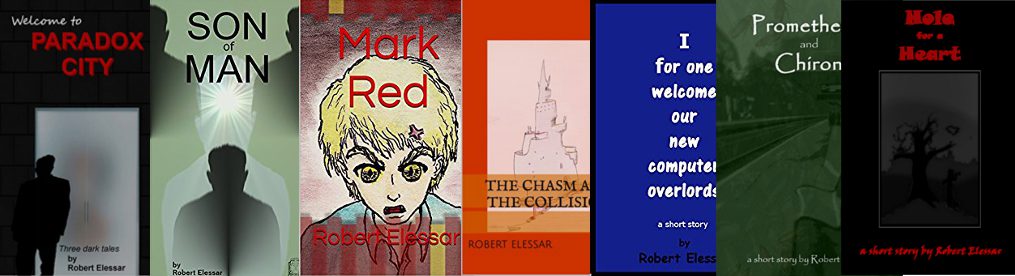
If you’re not good with dark stories, may I suggest The Chasm and the Collision?  My sister has rightly pointed out that it’s my only story with as upbeat an ending as Extra Body.  I would say Son of Man and Mark Red are somewhere in between, and a few of my stories, like If the Spirit Moves You (found in Welcome to Paradox City) and, to a lesser extent, “I for one welcome our new computer overlords” have some lightness to them.  The former could even be called a comedy of sorts.  But both stories center around fairly dark concepts or situations.  Many of my other stories are horror stories…though there’s not a single “supernatural” thing in my darkest ever story, Solitaire, which is available solo and also appears in Dr. Elessar’s Cabinet of Curiosities.

Anyway, I doubt very many people will ever read any of my stories, which I think is too bad, but I certainly have no right to have my stories read.  I think there might be a lot of people who might get at least some joy out of some of them, though.  I think it would also be very satisfying to know that many people read my stories and some fraction of them enjoyed them.  Even if they read them without knowing who the author was, I might not mind.  But maybe I would.  I’m not quite so egoless as all that.

Despite that aside, I have not started writing anything new since publishing Extra Body.  I did open up and look at Outlaw’s Mind and I remade a version of it with the whole first in media res scene taken out, since the story ended up going in directions that I think were better than that original idea.  But I have no will to work more on it.  Likewise, when I even contemplate working on HELIOS, I feel an almost visceral revulsion or intimidation.  And roughly the same thing applies for DFandD, or any of my other potential stories, like Changeling in a Shadow World and Orion Rising and so on.

The various drawing materials I bought upon being briefly inspired by Facebook “reels” of people drawing have laid fallow since I got them.  I can’t imagine drawing something now.  Nor can I really focus enough to read books or watch lectures on serious treatments of General Relativity or Quantum Mechanics, though I dabble here and there throughout most days.

I did read a new book:  Annihilation.  I had seen the movie, starring (a thoroughly misused) Natalie Portman, and wasn’t very impressed.  But then I stumbled across a video page by a young woman who is a Star Wars fan and an author and who said she had loved the book but then had seen and hated the movie, so I got the book (for Kindle).  It was hypnotic and disturbing and bizarre, and definitely far better than the movie.

Unfortunately, it’s told in first person, and when I read first person books I tend to lose a bit of my own sense of self and start thinking with the narrator’s thoughts, even about my real life, at least for a time.  It’s the closest I come, in a way, to having a real “theory of mind” in the ordinary sense.  Otherwise, I don’t tend to have a concept in my mind of what other people might be thinking or doing or feeling when I’m not in their presence.  I think reading fiction from a young age helped save me from being utterly confused by humans in general.

People are observable phenomena, and can be fascinating and fun and engaging, and I like less than half of them half as well as they deserve.  But other than through their own words, or through fiction, I don’t really have an “image”*** of other people’s thoughts or minds.  I’ve never even for a moment wanted to be someone else (though pretending to be‒i.e., acting‒can be enjoyable), because I can’t really imagine what it would be like to be someone else‒not from a subjective point of view, anyway.

I have been playing guitar and singing a bit in the mornings at the office some days, when I know I am by myself and can feel relatively uninhibited.  That’s sometimes enjoyable and sometimes painful (though in a strangely addictive way), and I occasionally think about making a video like some I’ve made previously, of me playing and singing Nothing Compares 2U, or Fake Plastic Trees, or Lucky, or The Man Who Sold the World, or even Karma Police or Ashes to Ashes or Weird Fishes (though I can’t so far do the “arpeggi” part of that latter song), all of which I can play and sing reasonably well.  But the thought of doing the work is too intimidating, and anyway, I can’t really bear the notion of putting my disgusting face out there for people to see.

Okay, well, that was a meandering bit of nonsense.  Unfortunately, here I am, still here, alive and writing this blog‒if nothing else for the moment.  I hope something will change about all that, and soon.  I cannot continue as I am, but I cannot see any better path other then no path at all.  Still, of all things, writing this blog is probably the most ego-syntonic thing I do, and I greatly appreciate everyone who reads and likes and “likes” it, even if I cannot comprehend why you do.  Just, thank you.  I surely cannot thank you as much as you deserve.

TTFN


*Though, like everything else about me, it turned out not to be good for very much for very long.

**Or should that be “wills-o-the-wisp”?

***Not really the right term.  Perhaps “model” might be better?

Extra Body: Chapter 12

As Albert began the luxurious climb back to consciousness, he became aware that, during his sleep—a duration he didn’t yet know—Walter had indeed not finished unlocking the first lock on his door.  In fact, just after Albert had drifted off, Walter had found that his tension, his anger, his jealousy, and his hostility had all started to wane.  His nervous system quickly went from reckless agitation to a state of real calm, of equanimity.

Walter looked down at himself, kneeling before Albert’s door, holding and attempting to use a set of lockpicking tools he had once ordered from Amazon out of curiosity, but which he had never been able to master.  He pulled the torsion bar and the pick out of the lower lock, looked at them, and thought, “What am I even doing?” Continue reading

Extra Body: Chapter 11

Roughly an hour had passed since Albert had last left the bathroom.  He had eaten, and he had drunk his cup of coffee, and he was quietly scrolling through some of the stories on the Google news page, when a feeling of strange disquiet rather suddenly grew upon him.

He lifted his head from his contemplation of his home computer screen and looked around.  His small living space was fairly well circumscribed, and almost all of it was in view from any other point within it.  There really was no place for anyone or anything to hide—at least, nothing much larger than a spider or an occasional roach.

Nevertheless, he felt a sense of unseen threat, or at least some worry, developing.  He looked down at his forearms and was mildly surprised to see them riddled with goosebumps. Continue reading

Extra Body: Chapter 10

Albert awakened quite early the next morning, which wasn’t much of a surprise, considering that—as he now realized—he had gone to bed barely an hour after getting home from work and had fallen asleep not long after that.  At some point it seemed he had laid the book he’d been reading on his bedside table, though he didn’t recall doing so.

He looked at his bedside clock—a relic of sorts that he kept despite the fact that he could use his cell phone or computer for the same purposes it served.  It was just before six in the morning.  It was good that he hadn’t actually needed to get up in the middle of the night to check on the response to the question he was supposedly going to ask, based on what he had told Walter.  He had certainly not set any alarm. Continue reading

Extra Body: Chapter 9

Though he slept well—a fact that he relished, since he’d not always been a good sleeper, especially since his divorce—when Albert awakened, he didn’t have any new ideas about how to approach his situation.  He felt the pressure of being perched in the middle of a three-way conversation that was going at cross-purposes and at different speeds and that wasn’t easy to keep clear in his head.

He got up and took his shower pretty much as usual, deciding to use a bit of the shampoo from the newer, larger cup to wash.  He didn’t want to use too much, since he didn’t want to limit the surface on which the V-42 could write, but he felt it was good to test it, in a sense.  He didn’t really doubt that the reproduced—or new, or whatever you wanted to call it—shampoo was just as effective as the original, and that it would do the same good for him, but having the personal experience, he thought, would help him feel, rather than merely believe, that fact. Continue reading

Extra Body: Chapter 8

Albert was silent for the rest of the drive home, which was not terribly long.  He didn’t think anything clear or precise, just felt a vague sense of contemplation, something that he supposed was almost a Zen-like state.  He was a bit surprised that he was not more nervous than he was, but then again, he felt stronger, more confident, younger—those things had to affect his mental state and acuity, and not just in helping him remember JFK’s youthful medical issues.

Even if the shampoo didn’t directly influence his nervous system—and he didn’t see how it could affect it—just being healthier, feeling healthier, had to have knock-on effects that would improve other aspects of his health.  He thought that he recalled that he had been better at getting “into the zone” when he was younger, such as when he was studying in college. Continue reading

Extra Body: Chapter 7

That evening, as Albert was getting ready to leave for home, his phone chimed.  He looked at it and saw that it was Walter who, not waiting for Albert to call him, had decided to ensure the conversation and so had called Albert.

Slightly irritated, Albert accepted the call, not waiting for Walter to speak, and he said, “Hey, Walter, I’m just getting my things together to head out.  Let me call you from the car.  I can never seem to get the Bluetooth thing to connect right if I try to do it while I’m already talking to someone.”

In his turn, Walter also did not provide any pleasantries.  He simply said, “How long do you think it’ll be?”

This irritated Albert a bit more.  He could call Walter on his own time, when he wanted to call, and it was awfully presumptuous of the man to ask for time parameters.  Still, as he had reminded himself before, Walter had done him some real favors.  After a breath, he said, “Probably about five to ten minutes.” Continue reading

And nature, as it blogs again toward earth, is fashioned for the journey

Hello and good morning.  It’s Thursday, and so:  here’s another blog post—meaning another regular, weekly, Thursday morning blog post.  Of course, people who receive notifications about my blog posts will have seen already that not only did I publish an impromptu entry on Monday, but also that, starting on Tuesday, I’ve been sharing a chapter at a time, three times a day, of Extra Body.

I finished the third editing run-through of that story by Tuesday morning, and I decided, “that’s good enough, I’m done with that, I’m tired of working on it, or on anything else”.  I considered just publishing it through Amazon, but that would have involved designing a cover and getting the formatting right for the paperback and e-book versions, and even then it would have been far from likely that anyone (except my sister) would read any of it, ever.  At least this way, maybe someone who is idly curious but wouldn’t go to the trouble of actually buying the book from Amazon (or other sources) might idly start reading it and even might read the whole thing.

Speaking of the whole thing, it will be completely published by Friday afternoon, which is when Chapter 12 is scheduled to go up.

I don’t know whether the story is any good or not.  I suppose that would depend upon the criteria one uses to judge the “goodness” of a story, and no two people would probably have precisely the same implicit criteria.  I say “implicit” because I doubt most people (or anyone, really) would actually apply any formal judgement criteria to such things.  I think it’s a much more “analog” process, a weighted neural network/high-dimension vector addition (or possibly vector calculus) sort of problem.  As such, it probably changes from day to day and even from moment to moment for every person.

It may be mathematically possible in principle for two people to have exactly the same judgment criteria about fiction*, but I suspect that there aren’t anything like enough people in all the universe—not just spatially but temporally, past and future—to have exactly the same mental state regarding how they judge and react to fiction at any given time, or even in their entire lifetimes (this discounts the potential “quilted multiverse”, if the universe is spatially infinite, in which all states would recur an infinite number of times).

I’m giving this more thought than it probably deserves.  I tend to do that.

On to other matters, or at least, let’s move away from that subject.

This Sunday will be the day of the Autumnal Equinox, the official beginning of Autumn in the northern hemisphere.  It’s also September 22nd (this is often the case with the Autumnal Equinox) and is thus the date of Bilbo and Frodo Baggins’s birthdays (according to Shire reckoning, anyway—I’m not sure precisely how that lines up with the Gregorian calendar, but I suspect Tolkien just kind of took them as roughly aligning, though the hobbits apparently took the 5 (and a quarter-ish) extra days of the year as a non-month in midsummer and had 30-day months for all the rest of the year).  That was also the day on which Frodo left Bag End to begin his long and arduous and torturous path to destroy the One Ring.

So it is an auspicious day in more than one sense, a day on which momentous or portentous things may begin or end or begin to end.

Though Frodo survived, of course, he never was quite the same after his journey, having suffered from the stab of the Morgul blade on Weathertop, and the bite of Shelob, and—most of all—the terrible effects of the Ring itself when it was at its most perilous, its most awake, and its most desperate.

The voice-over near the end of the movie The Return of the King really expresses Frodo’s sense of enduring damage and suffering:  “How do you pick up the threads of an old life?  How do you go on when you begin to understand there is no going back?  There are some things that time cannot mend.  Some hurts that go too deep, that have taken hold.”  How, indeed?

Nietzsche is famously quoted as having said that whatever doesn’t kill us makes us stronger.  In response to that, I would simply say to him, “syphilis”**.

There are many things that do not kill us that nevertheless wear us down, leave scars and damage and dysfunction in their wake.  Of course, one could reply that such things are killing us, they are merely doing it slowly, in a cumulative and collective fashion.  But if one is going to reach for that linguistic/semantic escape clause from the dichotomy of Nietzsche’s statement, then one is merely engaging in tautology.  If one says that anything that doesn’t make us stronger is, by our definition, killing us (even if only slowly), then saying that whatever doesn’t kill us makes us stronger is just saying the same thing.  No insight is gained.

In any case, things wear out and fall apart no matter what.  As far as we can see, that is a fundamental aspect of the nature of reality.  New things do arise, lives are born, stars form, perhaps new “universes” are constantly emerging in an eternal inflationary universe.  But mathematics dictates that all things eventually seek out the most entropic states—not out of any desire, any “telos”, just out of the tendency of the math of complex systems.

Things fall apart.  The center cannot hold.  And Darkness and Decay and the Second Law of Thermodynamics hold illimitable dominion over all***.

TTFN


*Though if the process is truly continuous, in the “real numbers” sense of continuous (quantum mechanics suggests this cannot be so), then there would be literally, uncountably infinite possible arrangements, and so it would be “infinitely improbable” for any two people ever to match exactly.  That seems appropriate, given the story being discussed.

**Perhaps the real “Montezuma’s Revenge”.

***This is a mashup of and paraphrasing of separate literary works, so I’m not surrounding it with quotation marks, but:  credit to Yeats and to Poe****.

****No, NOT the heroic pilot from the newer, Disney-Star-Wars films.  You Philistines*****.

*****This is, ultimately, a reference to the fact that the Philistines, according to legend, stole the Ark of the Covenant from the Temple of Solomon, and thus their name is used as an epithet referring to those who show no respect for sacred or artistic or cultural worth.