O heaven! that one might read the blog of fate, and see the revolution of the times.

Hello and good morning.  It’s Thursday again, and so it’s time for what is, “historically”, my weekly blog post, though in fact it’s merely another iteration of my now-nearly-daily blog post.

It’s getting harder at times to think of what to write about.  I’m more or less committed to doing this whole thing stream-of-consciousness style, since I’m hoping that—just maybe—it might act at least as a form of “talk therapy”, though there are fewer questions and less feedback than one receives from real, usual therapy sessions.  Still, maybe just expressing my thoughts in this fashion will help me to organize them in some way.  I’m certainly not writing fiction or playing music, so I don’t have anything to speak about with respect to those subjects now.

It’s the first Thursday in August 2022, now that I think about it.  That doesn’t seem particularly noteworthy; I can’t think of any major holidays in August, though I suppose I could be forgetting about something.  August is one of those comparatively dull months, though it is a month of “pure” summer, in the sense that, in the northern hemisphere, it’s all in summer, like July, not split up into two seasons like June and September.

It is a bit curious that we don’t start our years at the winter solstice.  People have known about the solstice, about it being the “shortest” day of the year, for who knows how many thousands of years, and many festivals worldwide have been associated with celebrating this renewal of the length of days, dominated in the west of the modern world by Christmas and then New Years.  I think it’s mildly weird that we don’t simply begin the next year on the solstice, or the day after it.  We do start it thereabouts, but why not right on that day?

Maybe the issue is that the solstice changes subtly over time, and occasionally happens closer to one day than another?  I don’t know quite enough about it to say for sure.  If anyone out there does know to what degree the solstices change, feel free to comment about it below—not on Facebook or Twitter, unless you don’t care about the comment being seen for a while, anyway.  I don’t interact much via Facebook anymore; it’s too stressful and depressing, though I miss knowing what many of the people I used to know are doing, seeing pictures of them and their families and whatnot.

Twitter is slightly less stressful, largely because I don’t feel personally involved in any of its stupider aspects and don’t tend to follow people who are.  Twitter, to me, is a good place for sharing links to articles and videos and for one-liners and “What’s your favorite of the ________ movies?” types of questions and answers.  Even with the “enhanced” 240 character limit, it’s simply not a venue for expressing or discussing any deep or complex thoughts.  No wonder “discussions” on the site almost inevitably devolve into monkey-style feces flinging (metaphorically).

Speaking of days and equinoxes*, I read recently that the rate of the Earth’s rotation has speeded up, and indeed, that we recently had the “shortest” day recorded—that’s not shortest in the sense that the winter solstice is the shortest “day” of the year, but that the actual period of the Earth’s rotation has decreased.  It’s not by a lot, of course—I think it was on the order of a microsecond or so, though I may be misremembering that order of magnitude.

It’s certainly not something a person would notice, but the international group that manages the Universal Time standards and sidereal versus solar days and the like needs to pay attention and note such changes.  And if they adjust years—adding leap seconds for instance—that all has to be coordinated with things like GPS satellites and so on, which already have to be managed with respect to General Relativity and Special Relativity; their function depends on highly precise time-keeping, and time is different farther up in “space” and at higher speeds.

As for why the Earth is speeding up, well, I haven’t read any speculation, but at first glance it seems odd.  One might expect that, over time, if anything, the Earth’s rotation might slow down, and I believe that has been the overall trend over billions of years, with tides and the like very, very slowly dissipating angular momentum.  For a rotating body to begin to rotate faster requires—by conservation of angular momentum—that its overall mass distribution gets closer to the center of rotation, like the proverbial spinning ice-skater pulling his or her arms in closer to his or her torso and thereby speeding up.

spinning skater

I wonder if, perhaps, there is some change in the distribution of the Earth’s mass in the form of water from glaciers, such as in Greenland**, and mountain glaciers in other places, decreasing the amount of mass that was higher up and away from the center of the planet and bringing that mass down into the sea, which by default is as close as things like water can get, since liquid water “seeks” the lowest level.  Of course, general erosion of mountains and even adjustments of the planet’s crust due to plate tectonics could have effects on rates of spin, but it seems to me that they would be too slow in their effects to be so noticeable—so to speak.

I’m sure we’ll be hearing more about this phenomenon, particularly if it continues.  It’s unlikely to make a difference in our day to day lives that could possibly be noticeable to people who aren’t measuring with the most precise instruments science and technology can produce, but the information is a curiosity, and it could be at least a marker of the effects of climate change.  Or perhaps not.  There may be another explanation.

Maybe by sheer chance the Earth got hit with meteorites that, for this one small bit of time, happened to, on average, deliver their kinetic energy in the direction of the Earth’s rotation.  It’s not something that’s likely to be a trend, but it could, in principle, happen briefly just by chance.  It seems highly unlikely to happen in such a way as to cause a measurable change in the rotation rate, but what do I know?

Anyway, that’s about enough meandering thoughts for today.  I hope you are all having reasonably good days—even if they are shorter, and you have a microsecond or so less to get your daily chores done.  Please use that diminishing time by spending it with those you love and who love you, if you can.  Take advantage of the moments you have by doing things that are affirming for your relationships and families and so on.  Entropy is always increasing—that’s the 2nd Law of Thermodynamics, and it is as inexorable as any law we can imagine.

We could find someday that there are exceptions to the speed of causality (aka the speed of light), but no one who knows anything about thermodynamics thinks anything is ever going to overthrow the 2nd Law, since it’s based in the fundamental nature of mathematics and probability.  The universe might start again in a Poincaré recurrence, but that’s not going to be for another 10120 billion years or so, so don’t hold your breath.  Or do, if it pleases you; we’re all going to be long gone before any recurrent universe happens, anyway, even if nothing like the “big rip” makes such recurrence impossible.

As I said, don’t waste time.  Love your loved ones and spend time with them if you can—and if they want you around.  Don’t take such things for granted.

TTFN
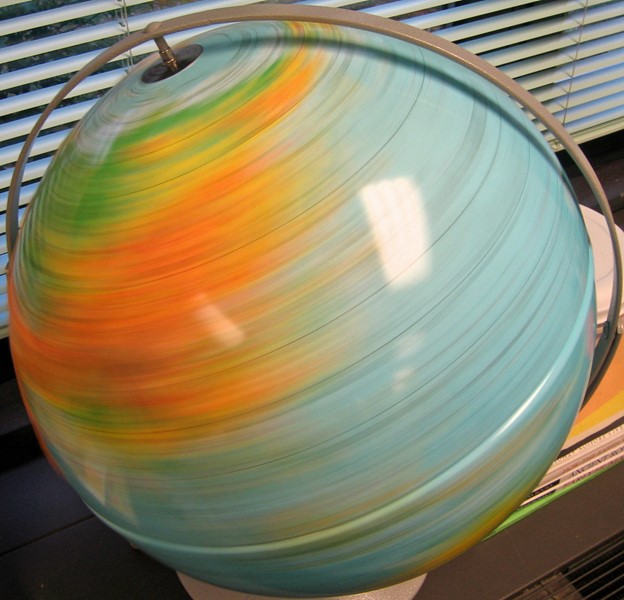
whirling globe


*I was, you can go check for yourself.

**I feel that the ones in Antarctica might be less impressive in effect only because they are so much closer to the axis of rotation already.

Talk about digits, my blog’s got ‘em.

It’s Monday again, and it’s also the first day of August in 2022.  This makes it interesting, in a sense, but I always need to remind myself that, no, Monday being the first of the month does not mean that we’re going to have a Friday the 13th.  It’s when Sunday is the first day of the month that we have a Friday the 13th.

That’s not really important, of course—I have no superstitious beliefs about 13 or Friday the 13th.  In fact, 13 is one of my favorite numbers, so I rather like a Friday the 13th.  This is partly because some people think it’s an unlucky day, and partly because of the bad reputation 13 has with the public among the primes, especially when compared to 7, which is not even as interesting a prime, in my opinion, as 13.  Though, when added together, 13 and 7 do make 20.

This is not a big deal, though.  According to Goldbach’s Conjecture, every even number greater than 2 can be made from the sum of 2 prime numbers.  As far as I know this still hasn’t been proven in a rigorous mathematical sense, but I also don’t think they’ve been able to find any exceptions, and since they have supercomputers and the like with which to work these problems, they’ve gone pretty darn high.

Similarly, they’ve solved π (pi) to about 62 trillion digits or whatnot.  Think about that incredible number of digits.  By comparison, a googol—which is a number larger by far* than the number of elementary particles in the accessible universe—is only 100 digits long.  The Planck length itself is 1.6 x 10⁻³⁵m.  So, it has 35 digits of significance, really, taking the most generous possible meaning of “significance”.  And that’s the fundamental, measurable minimum sensible distance quantum mechanics, in its current best form, says exists for reality**.

In other words, even if we had the greatest possible precision that is physically within the realm of reasonable speculation, we could not measure the radius and circumference of any instantiated circle precisely enough to come close to telling if it matched the current figured length of π.

Of course, no actual, physical circle is going to be a perfect, mathematical circle.  See above regarding the Planck length; that alone will screw up how perfect a circle can be.  Also, spacetime itself is not perfectly flat (although it can locally be extremely close to flat, and on the largest scales it appears to be flat).  Even the presence of the person doing the measuring would probably be enough of a spacetime distortion to make a circle’s ratio of circumference to diameter mismatch against π.

Don’t even start trying to compare the ratio of circumference to radius in a massive body like the Earth or the Sun.  Those ratios are measurably (in principle at least) below π because of spacetime distortion as described by General Relativity.  And, of course, a black hole’s radius, as measured from within, would be functionally infinite.  So, its local equivalent of π would go to zero.

But π is a mathematical constant, describing ratios of mathematical objects that are precisely defined in flat, Euclidian geometry, and as such, π is a real thing…indeed, a transcendental thing, you might say.  It is known to have an infinite number of non-repeating digits.  Which is not to say that there are no repeats at all, just that there is no repetitive pattern.  Obviously, in base ten we have only ten digits with which to work, so there are quite a lot of reuses of each digit—an infinite number of them, in fact.

In fact, I suspect—though I don’t know—that if you πcked any finite number of contiguous digits of π, you would eventually be able to find a recurrence of them somewhere down the line, though it might be far beyond what’s been calculated to date.  The reasoning, at least as I’m thinking about it, is similar to the reasoning that demonstrates that the “Level 1 Multiverse” is a real thing, if spacetime is infinite in spatial extent.  The best data we have now seem to indicate that either space really is infinite or at least it’s waaaaaaaaaaaaaaaaaaaaaaaaaaaay bigger than the 93 billion light-years-across visible universe.  This is part of that spacetime flatness I mentioned before.

To think about it from a more mundane point of view:  the Earth, locally, looks flat (ish), but if you start precisely measuring the angles of bigger and bigger triangles, you’ll find that they’re adding up to more and more above 180 degrees, showing—even if nothing else did show it***—that the Earth is not flat, and in fact has “positive” curvature in Riemannian geometry.  But if you kept on measuring the sums of the angles of bigger and bigger triangles and they all stayed at 180 degrees to the greatest precision you could possibly muster even at immense size, you’d come to the conclusion that, well, either the world on which you stand is flat, or if it’s a spheroid, it’s a really, really BIG spheroid.

The analogous measurements (in three spatial dimensions, obviously) have been done on the scale of the microwave background radiation, which is as far back (and thus as far away) as we can see with light (microwaves, specifically):  about 300,000 years after the Big Bang.  They are consistent with a flat spacetime.  So, as I said, the universe is either spatially infinite, or WAAAAY bigger than what we can see.

This infinity doesn’t really do us any good, of course.  We still couldn’t reach almost any of it, even if we were traveling at the speed of light, since the expansion of the universe appears to be accelerating, and thus distant regions are moving away from us faster than light.  But, since quantum mechanics appears to dictate that, within any closed region of space, there is a maximum number of possible configurations (defined, at its upper limit, by the event horizon of a black hole with that apparent volume, the number of possible states (or its entropy) of which is related to the surface area of the horizon expressed in Planck lengths squared…so, it is big, but it is finite), then if space is infinite, there will be regions of space “out there” that are precisely the same as any finite region you might choose to compare them to, from the size of a human to the size of the accessible universe.  Indeed, in a spatially infinite universe, there are an infinite number of them.

If it helps, you can think of decks of cards being shuffled.  There are 52! (read as “fifty-two factorial”****) ways for a deck of cards to be ordered if they are shuffled randomly…that’s about 8.06 x 1067 ways.  It’s a big number, and though it’s nowhere near the number of elementary particles in the visible universe, it’s so big that we can be mathematically all but certain that no two fairly shuffled decks of cards have ever in human history come out the same.

However, if we have an infinite number of decks being shuffled, not only will any given ordering be repeated, it will be repeated an infinite number of times, though there might be quite a large average distance between repeats.  So it will be with iterations of any person or planet or galaxy or locally causally connected “universe”.

Don’t worry about it too much.  Though in an infinite universe there are an infinite number of any given person (as well as every possible variation thereof), these doppelgängers will have no effect upon you, except perhaps to blow your mind, as your existence will blow theirs.

Well, I don’t want to keep going on forever (har!), so I’ll call it to a close now, by noting in passing that this month (August, see above) is named (as many know) for the first “official” Roman emperor, as July was named (also as many know) for the first “de facto” Roman emperor, and June was named (as very few know) for June Cleaver, the empress of late 1950’s to early 1960’s American television.


*How far?  About 10,000,000,000,000,000,000 or 100,000,000,000,000,000,000 times as big.

**That doesn’t mean there are no finer distances, necessarily—though it might—but unless quantum gravity or whatever changes things significantly, it sure seems to be a limit…a physical one, not a mathematical one.

***Other things do.  The Earth is round, and people have known this for thousands of years, contrary to popular belief.  2200 years ago, Eratosthenes figured out the Earth’s circumference by measuring shadow lengths at different latitudes and doing some basic trigonometry.  He got the right answer, too.

****Which is 52 x 51 x 50 x 49 x … x 3 x 2 x 1.  The 1 is a really superfluous, since anything times one is just the thing itself, but it’s there for completeness.

Even great Wotan reveres Armstrong, Aldrin, and Collins

It is Odin’s Day (Wotan’s Day –> Wednesday), honoring the king and “All-Father”* of the Norse pantheon—played by Anthony Hopkins in the MCU…a surprising choice, or so I thought when I heard of it, but of course, he did it brilliantly.

Far more important than remembering Odin, or even remembering his sign (as per the 12th Doctor)**, is to note the date:  It is July 20th, and on this day, 53 years ago, Neal Armstrong and Buzz Aldrin first set foot on the moon.  This may be the single most momentous event—certainly in terms of being a fully new and amazing thing—in recorded human history so far.

At that moment, the diameter of human, physical existence and “ground-based” presence went from about 13,000 kilometers to over 300,000 kilometers.  We had set foot on another celestial body—what could be considered a fellow member of a binary planetary system—for the first time ever.  Sadly, of course, we haven’t done it now for quite some time, but that doesn’t take away from the achievement.

Anyone out there who harbors some conspiracy-theory nonsense about pretend moon landings and whatnot:  please get a clue.

The Soviet Union—you know, our cold war enemies, fellow architects of “Mutually Assured Destruction”, who would have loved to embarrass us, and had done so in many ways over decades, including having spies in our most top-secret nuclear weapons programs*** and who certainly could have arranged for some conspirator somewhere to reveal him or herself—they were thoroughly convinced that we had indeed gone to the moon; they never so much as publicly questioned it…even in propaganda, as far as I know.  Indeed, a big part of the political motivation for us to go to the moon was to intimidate the Soviets, to wow them with our technical ability and—this is not a minor point—to show off our skill with rockets.

No, if there had been a conspiracy, it would have been revealed quickly and readily; any massive organization and network and conspiracy involving humans is a vastly complex and chaotic system—real conspiracies are almost always spontaneously self-generating, not planned in advance.  In many ways, maintaining such a conspiracy without frequent and obvious leaks would be far more difficult than just going to the effing moon!

And is it a mere coincidence that, three months after the moon landing, to the day, a child was delivered by elective c-section on Earth, who would show himself to be not exactly normal, not exactly ordinary, not entirely…human?  Or was an alien consciousness, embodied perhaps in some form of nanotechnology, brought back to Earth from where it had perhaps accidentally landed on the moon, thence to roam about, searching for a compatible host, finding it in a developing fetus in Pontiac, Michigan, and merging with that growing human to become a hybrid of human and “other” being?

It’s almost certainly a coincidence****.  But it is a fun story to play around with.  I sometimes like to say that the (most recent) point of origin of the alien intelligence which I embody is the star system Vega*****, which is a mere thirty-ish lightyears from Earth.  It’s a true irony (within the terms of this tale) that all the higher life forms in the Vegan star system are pure carnivores, as a matter of moral choice.  Though they recognize that it is a necessity of survival—or it was until the making of lab-grown food had advanced far enough—it is morally reprehensible to eat autotrophs, since they are in a true sense the only innocent life forms in the universe.  The true Vegans consider it much more ethically tolerable to eat “herbivores”, who have already killed autotrophs to stay alive, and thus are not innocent, than to eat “plants” directly.

Of course, the greater ideal was thought to be to transfer our intelligences to non-biological systems that could survive indefinitely in the vacuum of space and tolerate most of the usual vicissitudes of interstellar travel (though not all of them, of course).  However, when the experiment, and the galactic pollination program began, many of the nano-tech based minds found their existence unfulfilling, and even borderline intolerable.  It wasn’t known if this was an error in “programming”, or if it was damage that occurred as part of the production or traveling process, or if it was merely that, having been designed in the image of biological organisms, the new minds had accidentally been built with urges too well adapted for biological life to be comfortable as merely nanotech.

Whatever the cause, when one such nano-brain (in this case, that’s not an insult) found its way to Earth’s moon, and by lucky chance encountered biological organisms visiting there, rather than continue its original program/mission to duplicate itself and remake the moon into a vast, meta-mind, it hitched a ride back to Earth, then went gadding about, enjoying this new place.  But soon it realized that, without a locally grown immune system, the process of fending off the many prokaryotic and eukaryotic and multicellular predators and other natural hazards in this biosphere was a lot of work, so it finally settled in a 6-monthsish fetus that had a compatible configuration and merged with it.

That merger was not without its detriments, of course.  It disrupted the closure of the foramen ovale in the developing heart, leading to the child being born with an Atrial Septal Defect that wasn’t discovered for nearly two decades.  It also, of course, altered the fetus’s nervous system, creating neurodevelopmental atypia that would later be consistent with a type of “high functioning” Autism Spectrum Disorder—weirdly enough, now abbreviated ASD, as was the Atrial Septal Defect.  And, of course, the alien’s original memories were nearly all eliminated in the process of merging.  This was expected, and it was considered acceptable, though that loss and lack no doubt contributed (along with both types of ASDs) to the tendency toward dysthymia and depression the organism suffered.

And here I am!

Of course, as I say again, this is all just a fanciful sci-fi story******, but it’s an interesting way to divert myself and give myself a “just so” story to explain my weirdness.

But the moon landing was real, I am convinced of that beyond any reasonable doubt.

I met Buzz Aldrin once—it was unexpected, and I was so surprised and delighted and star-struck (moon-struck?) that I acted like a gibbering idiot.  This is not too unusual for me, but poor Mr. Aldrin didn’t know me, so he looked at me with one of the most brilliant expressions of “What the hell is wrong with you, dude?” that I have ever seen when I tried to explain to my very young children just what an amazing thing this person had done.  I am unlikely ever to forget that moment while I live.  To be looked at by Buzz Aldrin with such incredulity and—dare I say it—puzzlement is, in its own peculiar way, a great compliment.

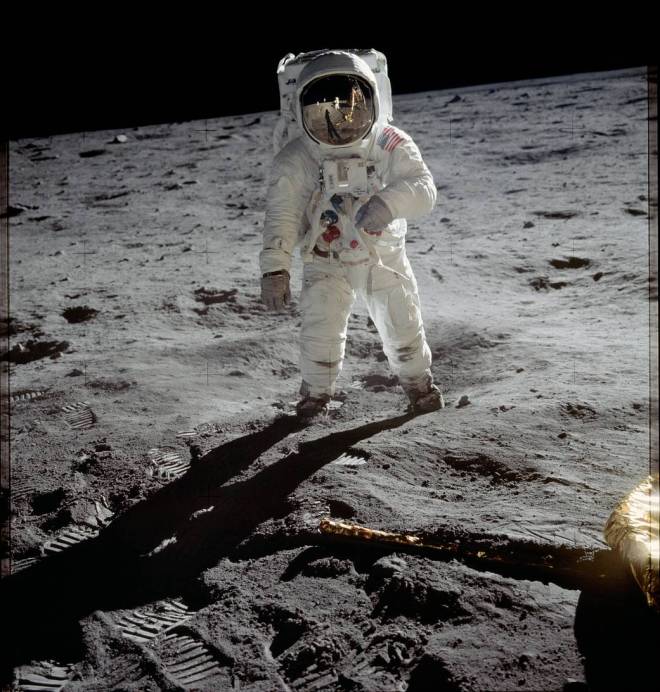
Aldrin on the moon


*A misleading term at best.

**That sign is a yo-yo.

***And who, themselves, built and in 1961 detonated the largest thermonuclear device ever, the Tsar Bomba, yielding a 50-megaton explosion, more than 1500 times as powerful as the combined Fat Man and Little Boy explosions, and which was and remains the largest human-made (it’s probably accurate to say “Man-made”) explosion on Earth.

****Or is it?  Am I just telling you that to throw you off-track?  Perhaps the whole “moon landing conspiracy theory” is the actual conspiracy, created by me and my fellow aliens to direct human inquiry away from the fact that We have established a foothold on this planet thanks to the Apollo moon landings?

*****The species didn’t originate there, of course.  Vega is a star with too short a lifespan (estimated about a billion years beginning to end) to have likely evolved so complex an intelligence and civilization.  We colonized the Vega system from far away, but the true origins of our people are lost in antiquity.  It’s said that our home world was destroyed, along with our older records, by a gamma-ray burst from the supernova of a nearby star.

*****And, as I also say again:  Or is it?

If Tuesday afternoon is never-ending, Wednesday morning ITSELF can never come.

It’s Tuesday again, just like it was last week on this day, and I’m still doing my “daily”* blog posts, since I don’t have any desire either to write fiction or even to play any guitar.  This is at least a quasi-productive way for me to use time that I would have used to write fiction, at least until the Second Law of Thermodynamics claims me at long last, and I rush—all oblivious—into its cold but comforting embrace…to poeticize idiotically a simple fact of physics and mathematics.

Tuesdays often make me think of the Beatles song, Lady Madonna, because for me, one of the most memorable lines of that song is “Tuesday afternoon is never-ending”.  This is particularly pertinent when things are slow at work in the afternoon, though I don’t think most other people regard dull days at the office in terms of songs, like I often do.  This being me, I tend to focus on dark and/or negative songs and lyrics, or at least melancholy** ones.

I rarely think of Thursdays in terms of my stockings needing mending, at least.

The notion that Tuesday afternoon is never-ending raises an almost Zeno’s Paradox type notion.  If Tuesday afternoon really were never-ending, then Wednesday would never arrive, so there would never be another day.  Although, despite it always being Tuesday afternoon, if people could nevertheless still move and act and do things, it would be useful to break time into manageable chunks for the purposes of scheduling, planning, working, sleeping, and so on.  Also, it’s never Tuesday afternoon everyplace on Earth at once, so if Tuesday afternoon in Britain were to be never-ending, then Tuesday morning in the US, Canada, Mexico, Brazil, etc. would be never-ending, and Tuesday evening for most of Europe, and of course, Tuesday night into Wednesday morning for places east of that, right up to the international date line.

And, of course, if the Earth had stopped spinning—assuming it had done so without the numerous catastrophic effects this would otherwise entail (watch this lovely video by Vsauce to see some of these discussed)—the weather patterns on Earth would be permanently changed and made horrific.

Depending on whether Earth became the equivalent of tidally locked on the sun, or if it had just stopped rotating, it would either have a permanent sun-facing side, or it would have a day as long as its year.  Then again, even a year-long day is not literally never-ending, so I guess it would be the “tidally locked” situation.  Before long, the Prime Meridian would become a very hot strip of Earth indeed!  And the International Date Line would become extremely cold.

It is tangentially interesting to think about—having mentioned Zeno’s Paradox earlier—the notion of continuously divisible time.  If time (or distance, as in Zeno’s original paradox) were infinitely divisible, à la the real number line, it would seem that one could never experience the passage of time because before you could get to Tuesday evening you would have to go halfway through Tuesday afternoon…and before you got halfway, you’d need to get a quarter of the way…and before that you’d need to get an eighth of the way…and so on.  If things are infinitely divisible, or so says the “paradox”, you should never be able to get anywhere, either in space or time, because no matter how arbitrarily close you choose two points in space to be, or two points in time, or two numbers on a number line, there are an uncountable infinity of points in between.

Calculus, of course, deals with this issue by means of taking limits as distances go to zero, and the like; it handles instantaneous and continuous rates of change quite nicely, thank you very much, while still rigorously defining functions in terms both accurate and useful.  As for reality itself, it seems to side-step the issue entirely by making space and time, in practice, not infinitely divisible at all.

The minimum distance that makes any physical sense is the Planck length, and the minimum time is the Planck time.  To say you’ve traveled half a Planck length, or that something lasted half a Planck time, is apparently saying something that has no meaning in the real world.

Of course, the Planck length and time are REALLY small:  1.6 x 10⁻³⁵ meters and about 10-43 seconds.  So, we cannot directly measure either of them with current technology, anyway.  Not even close.  But they are real things, when it comes to quantum mechanics, with real, verifiable physical implications that have been tested and confirmed with tremendous accuracy and applicability.

One does tend to wonder, though, about spacetime itself.  According to General Relativity, gravity is not a force in the sense that electromagnetism and the strong and weak nuclear forces are forces but is instead a manifestation of the curvature of spacetime, leading objects in it to attempt to follow the closest thing to a straight line (a geodesic) in a curved, “flexible” four-dimensional structure, in the way one has to follow a great circle on the surface of the Earth to pick the “straightest” possible path between two points on the surface of a spheroid.  This really matters for airplanes, and even for ships.

But is space itself infinitely divisible?  GR*** treats it as such, but GR conflicts with Quantum Mechanics at places of small size and high mass, producing senseless results (so I’m told…I haven’t done the figuring myself, regrettably).  Spacetime certainly seems to be able to expand indefinitely, as it has done since at least what we call the Big Bang, and it continues to do so at an increasing rate even as we speak, so to speak.  That’s trivial to conceive of with things like continuous variables, real numbers, things with uncountable infinities between any two points.  Just multiply everything by two, say, and all the numbers are twice as big, and just as uncountably infinite.

But if space is discontinuous, in some sense, as implied by presumed quantum gravity, how does the expansion manifest?  Does more space pop into existence between two regions formerly separated by a mere Planck length?  We know that if you try to separate two quarks that are bound to each other, the strong force between them becomes so intense that new, formerly virtual, quarks pop into actual being between them****.  Is this what happens with spacetime itself?  As intervals get stretched, do new nuggets of spacetime appear?

We know that it’s possible to produce new, positive energy in spacetime, balanced by the “negative” energy of gravity, so there is no local violation of conservation principles*****.  Maybe spacetime spontaneously generates more spacetime, using the force of the cosmological constant, or its equivalent, to create these new bits of spacetime as it goes along.  It seems plausible, given what we know about the finite divisibility of things we’re able to confirm experimentally, and at least little bits of spacetime seem much less energetic on a per-unit basis than things like quarks or even electrons and neutrinos.

Infinite divisibility may work quite nicely in mathematics—indeed, it does—but it may not be plausible in the real, physical world.  Spacetime is real, and if it expands, then that expansion must happen at some level and be describable in principle.

None of which changes the fact that Lady Madonna is an awesome song.


*I put “scare” quotes around that, because technically, it’s not a true daily function, since even if I continue doing it for a long time, I don’t expect to write on Sundays, and probably roughly not every other Saturday, since I won’t be going to work, and I write this during my commute.

**“Melancholy” has become a rather soft kind of negativity in modern parlance, but I wonder how people would feel if they considered when using the word that it comes from the old concept of “black bile”, one of the supposed four “humours”.

***General Relativity.

****Not a violation of Conservation of Energy…they get their substance from the energy you applied trying to separate them.

*****Again, alas, I have not done the specific math myself, but the concept is straightforward and logical.  One can similarly create a new positive electric charge as long as one creates a balancing negative charge at the same time.  It happens in nuclear decay all time.

CLICK-BAIT HEADLINE!  “LIKE” AND SHARE!  NUMBER 51 WILL AMAZE YOU*!!

It’s Wednesday, and I cannot summon the will to write on The Dark Fairy and the Desperado, so I’ll do a bit of writing here as I discussed yesterday.  I’m not sure what the topic will be.  I did at least come up with a headline that amuses me, though I doubt anyone else will find it funny.  Still, you can’t rely on anyone else to amuse you—they’re much more often infuriating—so you might as well amuse yourself.

There’s no dearth of potential topics out there in the wide world, from the war in Ukraine, to the January 6th hearings, to recent Supreme Court rulings, and of course, “mass” shootings**.  The latter, though certainly serious and important, still constitute a mere rounding error in the overall gun deaths in the United States, the majority of which are still suicides, as I understand it.

All of which nevertheless makes clear that, whatever your take on gun control/gun rights, there’s little doubt that we have a mental health problem in the USA (anyone reading my writing can surely testify to that fact).  In some ways it’s merely part and parcel of our overall healthcare issues, but I suspect that there are aspects that are orthogonal to, and in addition to, all the various other issues we have with our healthcare system.  I’m not part of that system anymore.  I don’t have insurance, nor do I go to any doctor, though I am one myself (no longer in practice).  My own health is one of the things about which I am least enthusiastic—which is really saying something.

Of course, in six days (if all goes as scheduled) the James Webb Space Telescope will release to the public the first of its scientific data so far.  Actually, the telescope itself won’t be releasing the information.  Though it could be considered a robot, it’s not that kind of robot.  NASA and/or the various agencies and institutions involved in the research being done will be the ones releasing the info.

Isn’t that just typical?  The JWST does all the work, but various groups of humans take all the credit.  Humans!  Ptooey***!

As for me and my house…well, I don’t actually own a house, though I live in one, but its state is up in the air right now (figuratively speaking).  I’m being moved into a different room in it so the owner can then rent out the remainder of the house to people as yet unknown.  Meanwhile, my former housemate is doing repairs and upgrades and whatnot, cleaning up after the people who were there before (who were nice, but were messy as well as unreliable, still not having paid for their last 2 months of utilities yet—I covered all that myself).  He’s been using this new sports energy drink powder that’s making him a little too wired, and he was doing odd repairs at about eleven last night, right outside my room.  It woke me up, and I was rather cross; I don’t like surprises much.

Anyway, I’m apathetic and stressed out, all at once.  I’m also still at least a bit ill****.  It’s all terribly interesting and exciting…but only in the sense of the curse, “May you live in interesting and exciting times”.

I’m working on editing a video project or two, which I expect I’ll mention a bit more tomorrow, during my usual weekly blog post.  That editing process reasserts the reality of my appearance upon me, and I really doubt I will do any more such videos in the future.

I honestly still don’t know what, if anything, I will do beyond the immediate future.  I have no plans of significance, and I have no real hopes.  At least, there’s nothing to which I’m looking forward.  No, not even the JWST results, nor even the findings from the latest startup of the Large Hadron Collider, which surely won’t give anything that can be coherently shared with the public for months.  At least we can reassure anyone who still fears the LHC might produce some dangerous phenomenon that will obliterate the planet, by pointing out that cosmic rays of similar character to LHC collisions but vastly greater power—I mean there’s really no comparison—strike the upper atmosphere of the Earth countless times every day and have done so for as long as the Earth has existed.  Fortunately (or unfortunately), none of them has wiped out the planet.  That’s a tremendous number of missed opportunities on the part of nature, if nature actually did want to destroy us*****.  So, there’s no reason to worry about the LHC.  Looking through a magnifying glass at something interesting in the grass is, honestly, more likely to do damage; if it’s a sunny day, you might accidentally focus sunlight and burn an insect or start a fire.

So, please be careful, anyone who still has the childlike sense of curiosity that might make you go out in the field and look at things under a magnifying glass.  First, do no harm.


*Because even though it looks like it ought to be prime, it isn’t; it’s divisible by 17 three times.  53, however, is prime.  57 is not.  59 is.

**Defined in physics as shootings that interact with the Higgs field, and so cannot ever travel at the speed of light.

***I doubt the JWST really cares—it was never designed to have such mental states, even if humans knew how to design and create such states yet, which humans don’t.

****Physically, I mean.  There’s little doubt that I am, have been, and probably will be mentally ill until the day I die.

*****Clearly it doesn’t, because if the universe, or nature, did want to kill us, we would be dead, instantly.  There are innumerable ways the universe could obliterate all traces of life on Earth if there were some actively hostile will behind it.  We living things are, after all, extremely tiny and insignificant on any scale but that of our own minds.

For many miles about there’s scarce a blog.

Hi.  Morning.  Thursday.  Blog post.

You get the general idea.

It’s been a relatively unremarkable week, so far, though I did a few mildly atypical things.  On Monday, I posted a selection of recordings of me “practicing” several songs that I like to do (just rhythm guitar and voice, nothing fancy).  I’d recorded them for my own benefit, but I thought I would share to see if anyone thought any of them were worth working into a video.  If you’re interested in that kind of stuff, by all means, feel free to check it out here.

I uploaded a few videos to YouTube that relate to the “black hole” topic below, but then I decided to keep them private for the moment; I don’t know whether or when I’ll ever make them public.  But I also did post a brief, smartphone video of a colony of tadpoles that had hatched in a slow-flowing storm drain behind where I work.  It’s dried up now, sadly, or at least the stuff above the drain has.  I don’t know the fate of the tadpoles, but it was probably dire, which is sad.  Still, they were cute, and it was funny that, for a time, there was an actual ecosystem in the alley there, just because the drain works so poorly.

On Tuesday, I posted the latest section of Outlaw’s Mind.  In it, Timothy is considering joining the Saturday class at the Vipassana Center; he feels that he’s getting a lot out of his early experience of meditation and would like to go further.  We can try to be optimistic on his behalf, but things will not go as he might wish.  If you’re interested in keeping up with that story so far, please check it out at the above link.  If you want to go back to the first section, the “cold opening”, you can find that here.  And if you just want to go to the collection of all the sections of Outlaw’s Mind so far, you can go here, but I think they will show up in reverse order.

I’ve written steadily on The Dark Fairy and the Desperado, though not quite as fast as last week—only about 4200 words since last Friday.  Still, it’s plugging along, for whatever that’s worth.  Our titular characters are now traveling through the realm of the extra-dimensional being named Lucy.  Though they have no context by which to recognize the significance of words being said and characters and settings they encounter there, the author, and hopefully many of the eventual readers, will find many amusing or charming or bizarre references to a certain legendary band, whose music is so amazing that it’s known throughout the Omniverse.

As for other matters…well, I’m currently stuck in a decaying orbit around a rather good-sized black hole.  It must be good sized, possibly even supermassive, because the tidal forces haven’t spaghettified me yet, though I’m steadily drawing closer, and apparently distant observers—all observers are distant from me—haven’t noted any significant tidal or relativistic effects.  Or maybe they have, but I just can’t tell.  I’m definitely feeling the tidal effects, those painful forces that pull me in opposite directions, and that may one day rip me apart, but so far, I haven’t catastrophically come asunder.  That will probably only happen after I’m below the event horizon, but that will depend on the mass of the black hole.

There doesn’t appear to be a significant accretion disk, which is probably why the black hole is invisible to distant observers, and why my orbit is decaying relatively slowly.  But decaying it is, and I suspect it’s by some process beyond simply the radiation of gravitational waves, since that seems too slow to explain the rate at which I’m approaching the horizon.  Maybe not; I’m not sure.

Anyway, whatever the case, I don’t seem to have the necessary propulsion power to pull myself out of my inward/downward spiral toward the horizon and thence to the singularity on my own, so unless someone out there is paying attention and flings out a big, interstellar length (and quite sturdy) rope of some kind, I don’t see myself doing anything but eventually—probably rather soon—passing the event horizon.  Supposedly, that’s something that’s not actually noticeable to the person so passing, at least according to General Relativity, but it would be noticeable from outside if anyone happened to be looking.  I guess I might have crossed the horizon already, now that I think about it.  Maybe that’s why none of the signals I send seem to reach anyone.

Huh.  That’s an interesting thought.

It’s a good question whether any quantum information regarding my state will survive to reach the outside universe, even in principle.  I know there are speculations about wormholes and the like solving the quantum information paradox, but I’m fairly sure that’s not a resolved issue, and it may not be until a full theory of quantum gravity is developed.  In any case, odds are that, even if in principle some traces of me remain in the outside universe, they will amount—in practice—to nothing more than random Hawking radiation, unnoticed by anyone, ever.

The foregoing is all metaphor, of course, though I’ve tried to keep the physics consistent and accurate.  What’s the point of using a weird, esoteric metaphor that only a science geek would use if you’re going to be reckless with your General Relativity?  Being reckless with metaphors is perfectly acceptable, however, and I’ve certainly done that.  That’s my way, I suppose, of effectively sabotaging myself so that no one can really quite grasp what I’m trying to say—or at least they can’t be sure—and so even if there were someone inclined to act, they’ll have reasons and/or excuses not to do so.  Can you blame them?  I can’t.

Anyway, that’s getting closer and closer to all I’ve got to say.  I hope all of you “distant observers” are doing well, and that only planetary and solar scale gravitational effects are impinging on you.  Please take care of yourselves and each other.

TTFNBlack hole

And these external manners of lament are merely shadows to the unseen grief that blogs with silence in the tortured soul.

Hello, good morning, and again, Happy New Year.  It’s Thursday‒the first one in 2022‒and so it’s time for my first blog post of the year.

There’s really not much to report this week.  The pandemic continues‒and when I say this, I’m referring both to the literal one and to the pandemic of human stupidity.  The latter seems unassailable even in the face of the deaths of millions of people, more or less at random, due to an infectious disease against which science (and those who use it) has been providing astonishing and unprecedented weapons which many more millions (particularly in the US, it seems) eschew because of numerous examples of misguided, often magical-thinking nonsense fueled by that bane of QI contestants: General Ignorance.

The thing about ignorance in the modern age, especially in America, is that it’s frequently willful ignorance.  There’s no shame in being ignorant, per se.  There exist an infinite number of facts about which we all are and always will remain ignorant.  But, to use a perhaps tired metaphor, though the ocean of ignorance is endless, it is possible for us to expand the island of our personal and collective knowledge.

Lately, however, it feels as though most people in America would rather drown.  If this were a literal urge, I could sympathize with them*.  Unfortunately, it’s merely figurative and unrecognized, and it leads to appalling facts such as that the per capita number of deaths from Covid-19 in the US is more than three times the global per capita deaths number**.  This in a country that likes to imagine itself the greatest nation the world has ever known.  Unfortunately, although aspirational greatness‒the desire and the will to be and to achieve great things‒can motivate actual improvement, and sometimes even greatness, unfortunately, once you decide you just are great, without having to do any more personally to earn or maintain the designation, you’re at serious risk of going the way of the Roman Empire and countless other such self-satisfied civilizations.

Oh, well.  These things happen.

I have continued rereading Outlaw’s Mind as it is so far, but I’m not finished and so haven’t yet started writing anything new on it again.  It’s a good story, I think, and I enjoy reading it, but then again, I wrote it.  Who knows if anyone else will ever read it?  Much of the time‒a growing fraction thereof, in fact‒I don’t hope to live to complete it.  To be honest, I often didn’t hope to live to see 2022.  But here it is.

Oh, well.  These things, as I said, do happen.

I’ve been thinking a bit about the Bystander Effect, partly because of a book I recently read‒Rationality, by Steven Pinker‒and partly because of personal reflection.  For those unfamiliar, the Bystander Effect is that circumstance in which a person is ill or injured, or being attacked, or something along those lines, and there are many people around them who could, in principle, help them…and no one intervenes because of the diffusion of responsibility, though if there were merely one or two people nearby, they would likely do something.

The Internet and the Worldwide Web seem to be “places” where a person could surely, if they needed help, reach some person, somewhere, who could and would help them.  But it is, ironically, home to possibly the greatest instantiation of the Bystander Effect ever seen, for each individual knows that there are, potentially, millions of other bystanders, and what’s more, they are all effectively anonymous each to all or nearly all the others.  It’s a place where a person can be truly, abysmally alone despite being in the largest crowd that has ever existed.  It’s the ultimate example of somewhere one can shout, or even scream, at the top of one’s figurative lungs, all while surrounded by countless other people, and yet, no one seems to hear.

What’s the difference between billions of voices all talking without speaking and hearing without listening, and silence?  Silence is at least peaceful.

Where, oh where is Sailor Saturn when you need her?  Oh, yeah, right, she’s in a fictional universe.  What a pity.  Well, they say when you want something done to your satisfaction, you should do it yourself.

Anyway, let’s hope this coming year regresses to the mean a bit, assuming we’re measuring our mean of year quality using the last decade and a half (or better yet the Nineties).  Of course, taking in the whole span of human existence, during most of which life was proverbially nasty, brutish, and short, the overall mean quality of years is probably way below even this pandemic year.  So, maybe what’s happening now is not an outlier in the negative direction which general tendencies will tend to correct back upward, but rather this is the correction, and the progress of civilization has been the extraordinary, truly aberrant, outlier.  Maybe our success is not truly a sign of any real progress within human and civilizational character, and unless improvement is deliberately, persistently, and intelligently and rationally pursued, regression to the mean will happen.

The cosmic mean, by the way, is about six protons per cubic meter***, at a temperature of only roughly 2.7 degrees Kelvin above absolute zero, and it’s getting colder and less dense every instant, approaching absolute zero asymptotically.  It’s cold****, and it’s lonely*****, but at least it’s peaceful…and it’s silent.

TTFN

mouthless emoji


*And the deep ocean is a good place to be buried, all other things being equal, since it makes for an excellent carbon sink, especially if you’re interred near a subduction zone.

**Based on the best numbers available to me.

***Which is about the atomic mass of lithium, interestingly enough.  Unfortunately, even if it were all, actually lithium, which is not the case, there wouldn’t be enough nearby to treat your bipolar disorder before you asphyxiate.

****But it probably wouldn’t feel very cold, because there’s no direct conduction of heat away from a warm surface like a human body.  Space is an excellent insulator; all your heat would only gradually be lost by radiation, contrary to what one sees in some movies when people like the Ebony Maw get sucked into space through holes in spaceship hulls.

*****But at least it’s not ironically lonely, like the “alone in a crowd” situation.

I wrote a post on Iterations of Zero

I haven’t written anything on Outlaw’s Mind this week so far, because what’s the point of that or anything else, after all?  But this morning I got an idea in my head that I decided to write an IoZ post about, and so I did that in the time in which I usually would have written fiction.  Here’s the first few paragraphs of it, followed by a link to the remainder of the post, in case you’re interested:

To really know you’ve created the best possible universe, you’d have to create them all

I was on my way into work this morning and started thinking about a curious question.

You may be aware of the area of theological inquiry called theodicy*. It deals with the “problem of evil”, though I’m sure that’s an oversimplification. In other words, it deals with the issue that, if God exists, and is infinitely powerful, and is omnibenevolent and omnipresent and omni-whatnot, then why is there evil?

We can leave aside arguments based on notions of free will and just desserts; bad things happen to “good” people in the world, whether through the actions of “evil” people or simply through the operations of the forces of nature. Think of childhood cancers and the like, and indeed, most childhood diseases prior to the modern era, as well as the fact that many children, through no fault of their own, are born to parents who are idiots (this probably describes all children, including mine).

One potential solution to the “problem of evil” is the notion that, despite appearances, the universe in which we live is the best possible one there can be. This idea is caricatured by Voltaire in the form of Dr. Pangloss, but it’s a serious point that is seriously made, and there is a certain logic to it. The notion is that, if things were changed, locally, to make some particular situation better, it would overall make more things worse, by whatever criteria you might happen to choose, and so every bad thing that happens, though it may not have any local good to it, is nevertheless necessary to minimize the evil, or maximize the good, of the universe, by whatever measure happens to be used by the one doing the parsing…presumably, God.

But how would such a God know what the best possible universe was? Such a being is assumed to have infinite intelligence**, as well as infinite power and awareness. We could, perhaps, describe it as a sort of “computer” that is infinite in all dimensions (perhaps an infinite number of them) and with limitless processing power, constrained only to the degree that it does not lead to paradoxes and contradictions, since we must assume—or I do, at least—that logic would apply even to an omnipotent being. Even God cannot actually make two plus two equal five without changing definitions, in which case it hasn’t actually been done.

To see the rest, follow this link.

As imagination bodies forth the forms of things unknown, the blogger’s pen turns them to shape

Hello and good morning.  As usual, it’s Thursday—well, that’s only usual on one day of the week, but since this is that day of the week, it’s usual on this day—and so it’s time for my weekly blog post.

I’m feeling pretty exhausted today, partly because of a temporary change in work schedule that’s throwing my mental functions into a minor tailspin, and partly because of frustration associated with trying to get feedback and do useful research about my neurophysiology through the advice or input of people with expertise in the matter.  Some of the fault is mine—I have a hard time forcing myself to initiate or undertake most interactions, including contacting and setting up some form of new relationship with a new therapist…or doing therapy at all.

I also get distracted—and I suspect that some of the people I’ve tried to contact have done so as well—by the ongoing issue of my dysthymia/depression, which is certainly troubling, but which is an old companions of mine and unlikely to improve.  But there’s only so much one can get from YouTube videos and reading, whether it’s technical literature or works aimed at laypeople.  And I have a terribly difficult time even contemplating joining online support or discussion groups (or “in person” ones, which seem even more intimidating and disruptive).  I may be stuck.  I feel stuck.  I could really use some help—of various kinds—but the very prospect of seeking it is too daunting and confusing, and it is further hindered by the fact that I feel, deep down, that I don’t really deserve any help of any kind.

On the other hand, work on In the Shade is proceeding reasonably well, as it has been for some time.  I’m doing a nice job trimming it down, at least as far as raw numbers go.  I hope it improves the story; it would be a shame if it made it worse.  In any case, though, I’m more than halfway through the overall editing process, and that’s a good thing.

A thought popped into my head this morning that has popped in many times before, and I’m tempted to send emails or similar to the likes of Brian Greene just to see if he can clarify anything about it.  But I would feel quite cheeky and rather obnoxious to trouble him, even if I could find a way to send him a query.

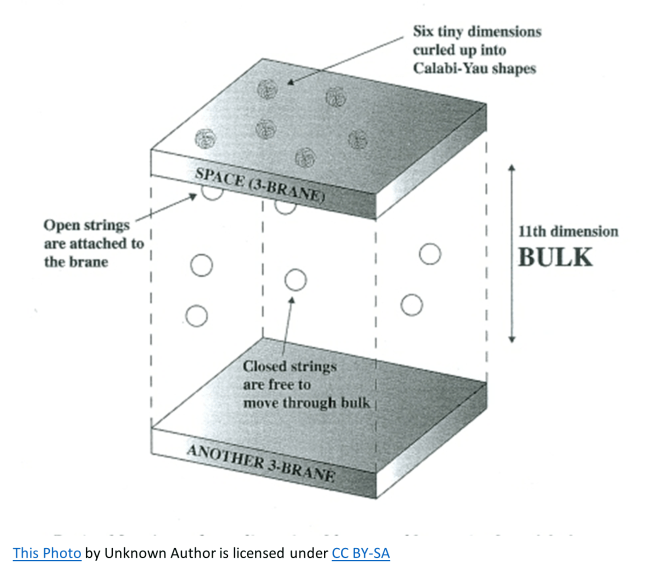
Roughly and briefly, the thought is related to the ideas of “M Theory”*—which encompasses more “traditional” string theory as I understand it—and the notion that our entire three-dimensional universe might be a “brane” embedded in a higher-dimensional “bulk”, and that we can only experience the three dimensional universe in which we live because we—all the force-carrying particles and matter particles of which we are made—are trapped within the brane, possibly because they are composed of open-ended “strings”.  However—again, if I understand correctly based on the reading I’ve done—the graviton, the hypothetical force-carrying boson of the gravitational force, would be a closed string, and could, if there are branes and a bulk and so on, travel between branes.  The hypothesis has been put forward that this might be part of the reason gravity seems so weak; it is not as narrowly confined dimensionally as the other forces, and so spreads out to a greater degree.

I played with some of these ideas very indirectly in The Chasm and the Collision.

Anyway, my thought was that, perhaps, this could provide the explanation for the apparent existence of “dark matter” which is proposed as the presence of a large amount of mass in the universe that doesn’t interact much with “normal” matter, or with light, but which has gravitational effects measurable in the speed of rotation of galaxies and of the interactions of galactic clusters and so on, and which, based on those various measures, would be about five times as abundant as “normal” matter.  But no one has been able, so far, to detect the presence of any such dark matter particles, which would be presumed to interact at least occasionally with normal matter in some way.

It’s proposed as possible in M Theory that there could be other parallel “three-branes” in the bulk, “next to” ours in higher-dimensional space, analogous to planes or pages that float, aligned but not touching, in three-dimensional space.  If most fermions and bosons are stuck in their branes but gravitons can more or less freely pass between them, and if parallel branes came into existence—in their current states, anyway—roughly at the same time, so to speak, then as those universes expanded and evolved, with initial quantum fluctuations leading to increasing clumping of matter, leading to galaxies, stars, etc., they would have influenced each other’s clumping, and so a galaxy in one brane might well tend to be “near” or roughly lined up with, a galaxy in nearby branes, and so on.  If so, and if gravity can, at least to some degree, pass between branes, then the vector components of such gravity that happens to align with the nearby branes’ dimensions might well be felt as an “extra” gravitational force without any source in detectable matter.

If there are multiple branes in parallel to each other—or perhaps even a limitless stack of them, so to speak—depending on their separation and the degree to which gravity can pass between them, the net effect might well be enough to generate the phenomena we measure as evidence of “dark matter”.  If one were only thinking of, say, a four-dimensional space between the three-branes (with other dimensions curled up small), the force of gravity between matter in them would presumably fall off at a rate of one over the distance cubed, but if there were multiple branes in parallel, and again, if the distance were right and the properties correct, then I don’t see why it couldn’t accumulate to give a net effect greater, on large enough scales, than the apparent impact of gravitating mass within a given brane.

Unfortunately, my math skills are not presently up to the task of even doing a “back of the envelope” calculation about how that might work, though I have tried from time to time.  I also don’t know much of the technical details about string theory/M Theory.  And, of course, the whole theoretical framework is troubled by difficulty creating measurable predictions, at least with current technology.  But…if such parallel branes could in fact account for “dark matter”, they would, if correct, predict that there would be no measurable dark matter particles.  Ever.  And so, of course, the longer we go without being able to find one, the more our Bayesian probability might edge toward the correctness of at least some version of M Theory.  Of course, if dark matter particles are found and have characteristics that explain the phenomena we see, then that would at least disprove my notion, if not all of M Theory.

It’s likely that such a notion is already ruled out by some specifics details that I just don’t know—which must of course be almost all the specifics of M Theory.

Maybe some day I’ll work up the courage to forward some version of this to someone like Brian Greene, or maybe Lisa Randall or Leonard Susskind**.  But probably not.  I have a hard enough time mustering the nerve to talk to anyone regarding my own neurological and psychological health.  And, in any case, those people have enough on their minds.  And I have books to write.  And—unfortunately—miles to go before I sleep.

In the meantime, I hope you all stay well and do your best to take care of yourselves and of those who matter to you—and also, while you’re at it, do your best to avoid causing problems for other people.

TTFN

more branes


*Which is, of course, speculative to say the least, but which is certainly intellectually interesting, and which could, in principle, be a description of the deeper physics of our universe.

**These are the three physicists from whose popular works I’ve learned most of what I “know” about such matters.  I first encountered string theory and M Theory in Stephen Hawking’s book, The Universe in a Nutshell, but alas, no one can get any messages to him anymore—or, at least, we can’t get any messages back.

To-day, to-day, unhappy day, too late, o’erthrows thy joys, friends, fortune and thy blog

Hello and good morning.  Welcome to Thursday, and to another edition of my blog post.  It’s the last Thursday in April of 2021.  This day of this month will never come again.

Of course, we could say that about any given date, or hour, or moment—that’s the nature of time.  We may, in some future epoch, decide to restart our dating system, and so we might eventually come to a day the designation of which would match this one, but it would obviously not actually be the same day.

If there is some external meta-time, in which higher-dimensional organisms can replay our time and lives at will—perhaps like Kurt Vonnegut’s Tralfamadorians—they might be able to look at any of our given moments or days over and over again, just as we can re-watch a movie as often as we may like on anything from VHS to DVD to blu-Ray to digital download—or even on old-fashioned film.  For the characters in the story, however—as for us if we were “looked at” earlier in our time—the events are always identical.

Each moment of the story is the same moment, no matter how often you see or read it.  The characters don’t change, their experience, if you will, doesn’t change, and they have no ability to recall previous viewings or readings.  Each time you rewind, you undo whatever developments might be coming.  A character in a film—or in a novel—who comes to a tragic end that “could have been” avoided cannot learn from that tragedy, cannot do things differently the next time you read the story or watch the video.

There is a sense in which, according to most interpretations of General Relativity, every moment in spacetime is “permanent”, but it doesn’t help us as individuals living in time.  If, after the moment of our death, we immediately simply re-begin at the beginning of our life, there will be no memory of having lived “before”.  Indeed, the very concept would make no sense.

And, of course, as even the MCU recognizes, at least at some level, if you could “go back in time” and change things, you wouldn’t literally be changing the past, you would simply be creating a new sequence, which would now be your local future.

It’s an interesting notion to write a sci-fi/fantasy, or perhaps horror, story in which a person reads a book over and over, or perhaps watches a movie over and over, and finds that the characters are learning, in a sense, from the mistakes they made “later” in the story.  Perhaps there could be a character with precognition, or some other form of metacognition, that allows her or him vaguely to recall particularly horrible events from “previous” iterations of the story, and so be inclined to change them on another go-round.

A simpler version of such a notion has been dealt with often in science fiction—in such movies, for instance, as Edge of Tomorrow, based on the story All You Need Is Kill.  But in that story, Tom Cruise’s character (or Keiji Kiriya in the book) gains the ability not merely to return to an earlier time, but to remember clearly, in an “ordinary” sense, what he’s gone through before, every time he dies.  So, it’s not quite the same.  Ironically, the course of the stories, including the time repeats, are the same each time you watch or read it.

Anyway, that’s all a digression.

It’s been a peculiar week—in this, it’s not unusual.  Perhaps one might say that a week in which nothing that feels peculiar happens would be quite unusual, though we might not notice it as such.  As I think I said previously, I got distracted last week by playing with video, and playing on video, a bit, so I didn’t write as quickly or as much as I might have in the morning.  This week, I did better.  In fact, on Tuesday morning—I wish I knew why—I went into afterburner mode, so to speak, and in only an hour wrote 2968 words on my new story!  This is first draft, of course, but still, it was coming out in a gusher.

Then, Tuesday night, I got a flat tire on the way home, and after taking the train the rest of the way that night, I had to come out with my housemate early on Wednesday morning so he could fix it (he has the proper tools), which quite obviously set my schedule back quite a bit.  Nevertheless, I still wrote exactly 1400 words yesterday, still leaving me time to diddle around on the guitar before I needed to start getting the office ready for the day.

If the rule of 10,000 hours’ work needed to become an expert at something holds—and it does seem to be a pretty good rough rule*—it would take me almost 47 years to become an expert guitar player at the rate I “practice”.  I could shorten it, obviously, if I put more time in each day, but that’s difficult.  And I certainly don’t want to live 47 more years.  I don’t even want to have lived as long as I already have!

Oh, well.  I can’t change my past—and I maintain that I would not change anything prior to September 13, 2001, for any reason**—but perhaps I can learn from it.  Indeed, one cannot ever learn from anything but the past, since the present*** is always already happening.  And, unless one falls into the singularity of a black hole, it presumably always will be.

So, the final take-away from this week’s blog post is, “stay away from singularities”.  And in other ways as well, stay safe and healthy if you can, and try to be happy, at least occasionally.

TTFN

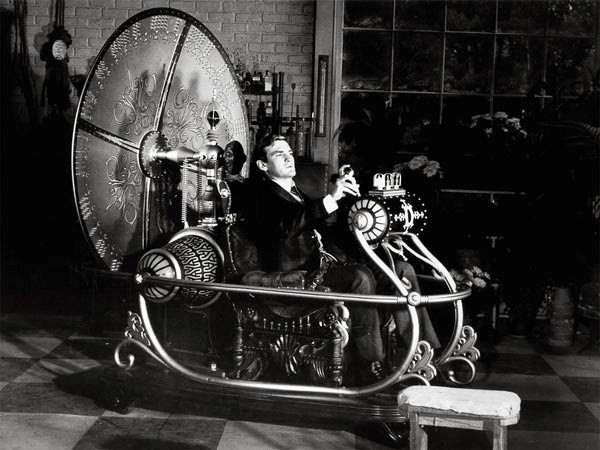
time machine


*I once did the math and realized that, during internship and residency, I had literally worked about 10,000 hours in three years.

**That’s my daughter’s birthdate.  I suppose I might be willing to change things on or just before September 11, 2001—it might be worth it to avoid the 9-11 attack and the subsequent/consequent wars; I cannot easily imagine any realistic way in which those two days would have a detrimental effect on my daughter’s birth.  Of course, if this were a “monkey’s paw” type story, there would be such a way, and being a pessimist, I would still be quite nervous.  But I probably would bite the bullet and do it, given the extremely low probability of a bad perinatal outcome.  Goodness knows I would change many things that I’ve done since then.  But if I were told to choose between 9-11 and something bad happening to my daughter or preventing her birth…I’d probably just have to accept 9-11 happening.  That’s easy enough to say, though, since 9-11 did happen, and I already know and have internalized it, sadly enough.  Hindsight is 20/20, but it’s also biased, since we become inured to what’s already happened…even horrible, horrible things.

***Locally speaking, anyway.  In General Relativity, there is no sensible notion of any universal “now”.  Time is always local.  It makes some sense if you think about it.  I can’t say that this address on West Hillsboro Boulevard in Deerfield Beach is in some sense located everywhere, or even anywhere else, and likewise, I can’t say that the moment I’m presently experiencing is happening anywhere else right now.