I don’t know what my point is (in many ways)

I’m sorry in advance.  I suspect this is going to be yet another boring-ass blog post like the two earlier this week.  Something about walking from the house to the train station seems to set me up not to write very well, or at least not to write in a very interesting fashion.

Maybe it’s just that I’m not writing anything new, but am just rehashing the same old garbage that’s always moving through my mind.  I don’t know what I’m supposed to do about that, though.  I can’t move anything through my mind but my own thoughts, and I can’t simply choose those.  If I could, I would probably choose not to be depressed, as I think anyone with depression would choose.

Of course, it may be the case that I would have a hard time choosing not to be depressed because—presumably as a consequence of my depression—I often feel that I deserve to feel depressed, that I deserve to hate myself, that I am right to hate myself.  But, of course, if I could choose to change my thoughts, then surely I could choose not to think that I deserve to feel depressed, and not to hate myself.  Here we see the beginning of a potential infinite regress, one that’s related to the fundamental ontological* problems with any concept of “contra-causal” free will.

We also run up against issues of fundamental identity, relating to the concept of “terminal goals” as discussed in AI research and the like.  There are instrumental goals—piecemeal goals, objectives, chosen as steps along the way to achieving terminal goals—and then there are the terminal goals, the fundamental goals, the things that are the root drivers of a system.

Could any intelligence with true terminal goals ever opt to change those goals?  How could it choose, as an instrumental goal, the changing of a terminal goal, when such a change would almost certainly lead it to fail in its terminal goal?  I think it was Robert Miles, in one of his Computerphile videos, who proposed a fictional example as a comparable choice to a human:  consider whether (if you are a loving parent) you would be willing, for any reward, to have your personality altered such that you wouldn’t care whether your child or children lived or died, and indeed, that you would be willing to kill them.

If you’re not a parent—not a loving parent, anyway—it might be difficult to see the bone-deep trouble with this, but I suspect that most reasonably normal parents would rather die than be altered so as not to care whether their children live or die, and for good, sound, biological reasons.  I certainly meet that description.

But the point at which I’m getting is to imagine if, somehow, I could once and for all cure my dysthymia/depression, but it would have the effect of changing my character, my nature, my personality—my terminal goals, if your will—would I do it?

It’s somewhat difficult for me to imagine, because I can remember times in my life when I was not depressed, and not all of them were that long ago.  I very much think that I was the same person at those times, fundamentally, as I am now.  There’s a continuity of thought, at least from the point of view of my present memory, which is the only point of view I have.  I don’t feel in any serious way that I was a different person either twenty years ago, or thirty years ago, or forty years ago, or whatever, back to as far as I can remember, to when I started grade school and a bit before.

Of course, I apparently have always had some form of ASD**—Asperger’s or whatever—though I don’t have a formal diagnosis.  Does anyone really have a definitive diagnosis for that, though?  The criteria are semi-arbitrary and are not based on a measurable, physical structure or quantity but a constellation of attributes.  Still, whatever the case, it is something inherent to the given person’s nervous system.  And it does seem to predispose one to depression (and presumably to dysthymia, and certainly to alexithymia), so maybe that tendency has always been there in me.

There are certainly many, relatively early times when I found myself feeling burned out or washed out, or just blank and empty and exhausted, but I didn’t connect it to anything or know why it happened.  By the time I started high school I was already having periods when I would be depressed and have suicidal thoughts.

But I didn’t hate myself back then—not most of the time, anyway.  I even put on something of a show of pretending really to think very highly of myself, to be egotistical and narcissistic in a playful way.  And I did have moments of somewhat megalomaniacal tendencies, but then again, I was good at a lot of things, and I got attention for it.

I definitely always felt different and weird compared to the people around me.  I tried to turn that to my advantage, to make it a defense mechanism—to make myself seem vaguely scary and dangerous because of being sort of crazy, I guess, to make sure no one messed with me.  But it is a fact that I did feel weird; I felt like I was strange, or crazy, and I also felt vaguely hostile and even borderline hateful toward many other people at least some of the time, because what stranger in a strange land of alien beings would not feel that way?

I don’t know where I’m going with this, or what point I’m trying to make.  Again, I’m sorry.  It’s not a very good blog post.  But if it helped you pass a few moments in which you would otherwise have been staring at a wall or—cat forbid—a TikTok video or something, then I guess it’s been worthwhile.

would i lie to you


*I think that’s the term for which I’m looking.

**Apart from the congenital heart defect, I mean.  That was definitely something I had at least until I was eighteen.

It’s inspiring stuff for an otherwise mundane journey.

I’m starting this blog post a bit later than I usually do—roughly an hour later—because, as I planned yesterday, I have walked from the house to the train station, which is about 4.8 miles, it turns out.  It took me almost exactly an hour and a half, which I guess is a decent pace, though I used to walk more quickly.

I suppose with enough training I shall improve.

Now I’m at the train station (not the one to which I take the bus, but the one from which I always used to set off), waiting for the very train I would have caught had I taken the bus to the train this morning.  So I won’t be arriving at the office any later than usual, but I may be tardy in my posting of this blog entry.

While I walked, I listened to The Fellowship of the Ring on Audible.  It’s a brilliant book to which to listen while walking any distance, because the characters are walking, themselves.  When I started, they were in the Prancing Pony, first meeting Strider (my namesake)*, and by the time I’d gotten to the train station, Frodo had just been stabbed on Weathertop and they were getting ready to repack the pony and head off the following morning.

It’s inspiring stuff for an otherwise mundane journey.

I’m not wearing my Timberland boots today.  I fear that part of the issue with them is that they don’t fit my feet quite snugly enough, and so I slide around a bit in them, and of course, that can lead to blistering.  I’m not sure why the fit is overlarge, though.  I’ve looked at the various reviews and whatnot of those boots, and people generally say that they are true to size, or else a bit small.

Whereas, for instance, the Under Armor shoes I had are actually a bit snug at my usual size, and a pair a half size up seem a more comfortable a fit around my toes.  New Balance walking shoes, such as the ones I’m wearing today, and more or less just right.

I’m leery of trying a pair of Timberlands a half size smaller, not least because they are not cheap.  Though, of course, Amazon does have a try-it-on thing you can do, but if you don’t want to keep a pair you have to send it back, and that’s annoying.  I can’t deal with crap like that anymore; it involves interacting with humans I don’t know and changing my schedule and my routines and all that other stuff, and it’s just not worth the effort.

Maybe I’ll figure something out.  Possibly just the walking itself will strengthen my feet, or alternatively will make them swell enough that they fit the boots snugly.  I will admit, after wearing the boots yesterday, they already feel much more comfortable than they did before, but I did not walk more than about three and a half miles yesterday, total.

I’d like to find something out that is more or less ideal, but there may be no such thing in the real world.  Reality is extremely complex, with all sorts of high order equations interacting with other high order equations all over the place.  It may well be that the possibility of finding something ideally suited in all aspects for any given purpose is functionally impossible.

This is one reason I dislike it when people use the word “perfect”, because in most cases it’s a notion that isn’t even well defined, let alone achievable.  Unless one sets clear and specific and precise criteria, judging anything or anyone to be perfect is just rhetoric, it’s not reason.  Powerful rhetoric can be enjoyable, like watching a boxing match or a martial arts movie, but it absolutely should not be allowed to sway one in important matters that bear on facts of reality or choices of morality.

Should we really let our politics, let alone our judgments of the facts of reality, be shaped by the words of someone who is—effectively—the best name-caller on the playground?  The difference between juvenile remarks—“Neener-neener,” “Your mama,” and “I’m rubber, you’re glue” for instance—and the words in most political discourse and debate is one of degree, not of type.

Imagine if Wiles’s proof of Fermat’s Last Theorem*** had consisted of him saying, “It’s true ‘cause I said it’s true, now what are you gonna do about it?  My grandma knows number theory better than you do.”  Or perhaps he could have invoked the seemingly more mature arguments:  “Of course, my political opponent would be skeptical of my proof, even though it’s obvious to anyone of intelligence that it’s correct.  The members of that party don’t want you to have the freedom brought by knowing that no three positive integers a, b, and c satisfy the equation an + bn = cn for any integer value of n greater than 2.  That’s because it threatens their power structure, and their special interest groups and wealthy lobbyists.  My proof may, like Fermat’s, be too big to fit in the margins of a letter, but believe me, my opponent’s brains, together with his genitals, are more than small enough to fit in such a space.”

Would that be a convincing mathematical argument?  Would it have anything at all to do with the truth of any proposition whatsoever?

Why do people both use and fall for such manipulations?  I know, I know, they’re just a bunch of tailless, nearly-hairless monkeys; why would you expect them to be more reasonable than baboons?  But it’s so frustrating mainly because nearly all of them appear to have the capacity to be rational, contrary to popular belief.

The very use of language itself requires syntax, grammar, logic, all applied at quite a sophisticated and often abstract level.  Almost all humans are capable of language starting at a young age.  They have the wherewithal to be truly reasonable and sharp-minded, almost all of them, with but a bit of effort.  This makes it all the more irritating when they don’t do so.

One doesn’t get angry at a starfish for having no curiosity about astronomy (despite what we call it), or a worm for not grasping quantum mechanics****.  And what does a sea squirt need with philosophy, especially once it’s achieved tenure?  But humans nearly all have the capacity for exceptional achievements.

Though I suppose “exceptional” wouldn’t be the right word if everyone did it.

How did I get on this subject?  I don’t remember.  Anyway, that’s more than enough of a post for today, and as I write this last sentence, having arrived finally at the office (and having now walked just shy of six miles already), I still need to do my editing.  So I’ll call it good.  I don’t think I’m going to be working tomorrow.  It would be good, after my first day of longer walking, to have a day of relative rest.  Then, next week, I shall do my walking, about 12 miles, every day.  That’s not too bad for a start, but not as much as my eventual hope.

We’ll see what happens.


*That’s Aragorn, of course, but for those of you who have only seen the movies, you may not know that his name as king of Gondor, in the fullness of time, was Elessar Telcontar.  Elessar means “elfstone” and refers to the green gem given to Aragorn by Galadriel, whereas Telcontar means, more or less, “strider”**.

**If ever I were to assume a supervillain name of some kind, I might replace my current last name with “Melkor”, because it would lead to possibly the most egotistical concatenation of name meanings ever.  My first name, Robert, apparently means “bright fame” or “bright glory”.  My middle name, Eugene, of course means “true born” or “well born”, as in “eugenics”.  And my counterfactual last name, Melkor, would mean “He who arises in might”.  That’s a heckuva collection of names.  And, of course, I’m a doctor by training and by degree, so that just makes it all even mightier.  “I’m Robert Eugene Melkor, MD.  You can call me Dr. Melkor.  Bwa ha ha ha haaaa!”

***Which, to be fair, should be called Wiles’s Theorem.

****Though they are good at tunneling.  Ha ha.

No live creature can continue to exist at all if there is no reality

Well, it’s Friday morning, and for those of you with a typical* American work week, I’ll say a “TGIF” on your behalf, though as I said yesterday, I work tomorrow.

That’s an interesting combination of tenses, isn’t it?  I’ll say, I said, I work, tomorrow…most of the whole latter half of that sentence is a mishmash of inconsistent, time-related words, and yet, as far as I can tell, it makes sense.  Please let me know if I’m wrong about that.

I’m still very tired from the fiascos with the trains Wednesday, and from sleeping on the floor in the office Wednesday night.  Nevertheless, on the way back to the house yesterday, I got an early enough train that I decided to walk back from the train station, despite being tired.  So, between Wednesday morning and Thursday evening I walked a total of about nine miles, and the athletic tape I put on the blister on my right foot seems to have done a good job at protecting it.

I did then pick at the blister a bit as I was lying down last night, and I might have irritated it some, since it’s slightly sore now.  That might just be from the longish walk back from the train last night.  Or, of course, it could be both.  There could even be unrecognized influences causing soreness.  Occam’s Razor pushes against that last bit—I’m unaware of any possible other causes so far, and I have potential known causes that can explain what I find and feel—but it doesn’t give any direction to the choice between the other two things or their combination.

Anyway!

I work tomorrow, as I said before, so I should write a blog post then.  I don’t know what I’m going to write about, but then again, I have no idea what I’m going to write about today, and yet I’ve already written some 360 words.

I think I’ve noted previously how this writing about nothing that nevertheless goes on and on seems almost related to the more ordinary thing called “small talk”, when people get together and discuss things that are of no consequence, really, and which are not planned in advance.  I gather that small talk serves some manner of social cohesion building, an interaction for the sake of interacting, done verbally in humans, since largely hairless house apes no longer need to pick Arthropoda from each other’s fur.

Small talk seems at some level essentially to consist of people saying to each other, “I’m a person you know and are socially bonded with, and you are a person I know and am socially bonded with.  We are part of the same community or tribe, at least at some level.”  I guess that’s useful, and even powerful, in an ultra-social species like humans.

Heck, even scientists and mathematicians get together at conferences**, or hang out together at lunch time.  Apart from this being a social bonding thing, it probably really helps to trigger and stimulate new ideas, as separate minds throw their thoughts into interactions with other minds, coming from varying points of view, triggering new thoughts and new insights that a single brain could not as easily produce.

Of course, reading (and listening to podcasts and audiobooks, and watching videos) can also bring on such new thoughts and ideas, sometimes in slightly deeper ways.  But there is no mutual, “real time” give and take, which can in the right circumstances lead to a seemingly near-miraculous bootstrapping of ideas.  Just imagine what the conversations were like when Gödel and Einstein hung out and went for walks together in Princeton!

Meanwhile, Robert Elessar, not sane, stood by himself against his blogs, holding darkness within.

Ha ha, that’s just me having a bit of fun with a slight paraphrase of part of the first paragraph (also part of the last paragraph) of The Haunting of Hill House.  (That’s also what’s happening in the blog title and in one of the footnotes.)

That has to be one of the best openings to a book this side of “It is a truth universally acknowledged that a single man in possession of a good fortune must be in want of a wife.”***  And, of course, ““No one would have believed in the last years of the nineteenth century that this world was being watched keenly and closely by intelligences greater than man’s and yet as mortal as his own…” from The War of the Worlds.  Or a more recent favorite: “In a hole in the ground there lived a hobbit,” from a book the title of which escapes me****.  Oh, well…call me Ishmael, if you must.

I don’t think I really have much more to write today, though something else may occur to me.  This has very much been a blog about nothing, but then again, that’s probably a decent metaphor for the very universe itself.  A lot seems to go on, at various levels, but there doesn’t seem to be any central theme or topic or subject, unless you count the Second Law of Thermodynamics.

Even if you don’t count that, though, it still applies.  That’s the way of “reality”—it doesn’t depend on your awareness, or on anyone’s awareness.  Indeed, all such awareness is but a tiny little portion of reality itself.  Reality is that which exists whether you believe in it or not.  If you have doubts about that, just consider what happens to people who die sudden, unexpected deaths, as from a surprise bomb attack or similar.  Not knowing that bombs exist or that an attack was coming would not protect against them.

Ask the dinosaurs.  Oh, wait, you can’t.  They’re all gone*******.

See what I mean?  Have a nice day.

asteroid hit


*Is it really typical anymore?  I wonder what percentage of American workers overall actually work Monday through Friday nowadays.

**And even larks and katydids are supposed, by some, to dream.  See below (in the main body, not in the footnotes) for the source of that line.

***Pride and Prejudice, by Jane Austen.  Surely the very title of that book, as well as its first sentence, would put it on the chopping block in the minds of the puritanical thought police of modern offense mongering.

****It doesn’t really escape me, of course.  It’s The Lion, the Witch, and the Wardrobe, obviously*****.

*****Seriously, I know it’s not.  I doubt there’s any book I’ve read more often than The Hobbit, if only because there have been quite a few times when I’ve started The Lord of the Rings and ended up stopping not long after the battle of Helm’s Deep, which is one of my favorite parts.  The early Frodo/Sam/Gollum stuff  in the latter part of The Two Towers is sometimes a lot to slog through.

*******Except for birds, of course, which really are descended from therapod dinosaurs and are, in a very real sense, extant dinosaurs.  I’m picking nits with my own words—figuratively, at least, since I do not engage in mutual grooming with any other primates if I can help it—but that’s fine with me.

What? Were you thinking?

Ugh.  It’s a new day—and a Wednesday, at that, so I have to do the payroll.  It’s a new month, too, so there’s rent and water and electric bills and eventually cable bills and all that coming soon.

I suppose it’s nice that the vernal equinox is this month, and thus the beginning of Spring in the northern hemisphere.  And of course it’s nice that my brother’s birthday is also coming up this month (and one of my best friends from back home has her birthday before that, but we haven’t interacted in a long time).  But other than that, I have no interest in any of it.  Frankly, I don’t have much interest in anything at all.

I spent about ten minutes scrolling through my Audible app this morning, trying to find something I wanted to listen to on my way to the bus stop.  I didn’t find anything, though I have a fair few Audible books—not as many as I have Kindle books, but still, there are quite a few.

I eventually just returned to a podcast that I had started yesterday—an old one with Anil Seth on Sam Harris’s podcast, two interesting people talking about interesting things.  I get a bit frustrated when Sam betrays some of his bias toward the “hard problem of consciousness” being a legitimate, persistent thing, which I think is just a notion he holds onto as a meditator and thinker about consciousness—the notion that there’s something pseudo-mysterious about the fact that neural processes give rise to actual subjective experience.

I don’t understand what he thinks the alternative is.  The so-called philosophical zombie thought experiment is self-contradictory and incoherent when you look at it closely*.  How would a self-monitoring and flexible, self-directing, agentic, information-processing system that’s part of a biological organism with problems to solve and a not-completely-predictable world in which to live be expected to function?  It monitors itself internally and externally, including monitoring at least some of the contents of that processing, because that’s a useful thing for an organism to do to survive and reproduce in a complicated world that includes other beings like itself in addition to predators and prey and whatnot.  Why is it a hard problem that all this produces “subjective” experience?  What do you expect it to do?

It’s not any more sensible than asking why there is something rather than nothing.  What do you expect?  Obviously, there are only people asking that question if there is something.  And why would there be “nothing”, anyway?  Why do people assume that’s the default state?  Of course, I don’t think any actual, conscious being can truly imagine “nothing”, anymore than any conscious being can really imagine or contemplate the experience of ceasing to exist.

If you’ve been under general anesthesia—particularly really deep general anesthesia like you have for open heart surgery and the like—you’ve experienced the temporary cessation of pretty much all of your brain functions.  Try to remember what it was like when you were under complete general anesthesia**.  If there’s something for you to remember, then you were still conscious, and that means you weren’t under complete general anesthesia.

Alternatively, try to remember what it was like (for you) long before you were born, before even your parents were born***.  That’s what it was like not to be conscious.

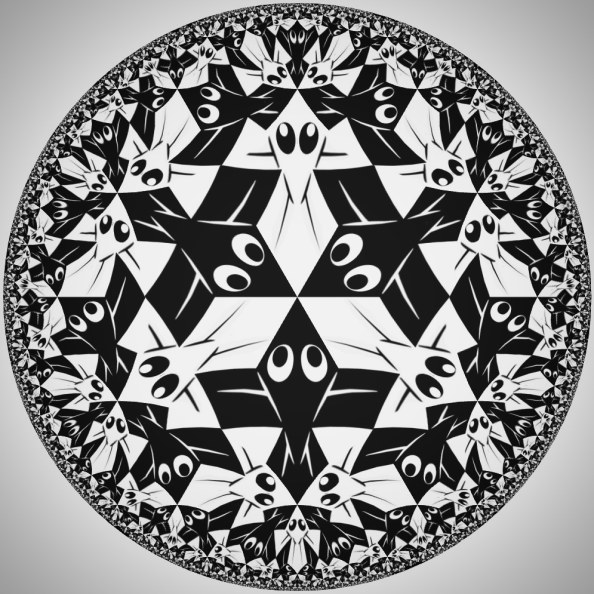
From within its own realm, consciousness is, in a sense, endless, because it doesn’t feel itself begin and it doesn’t feel itself end—it’s almost like one of those Penrose/Escher diagrams of infinite hyperbolic spaces contained within another, finite space.  And this, of course, may very well describe the configuration of our own universe, since GR allows for spaces that look finite from the outside but are infinite from within, and mathematics can deal with them rigorously and consistently and thoroughly.  It’s not readily intuitive without a bit of thought and practice, but why would one expect it to be****?

Anyway, that’s the sort of irritated but at least engaging argument I get into within my skull with people who are not actually present with me, and with whom I’ll never interact.

When I try to talk to people at work about such things, I just get blank looks and confusion.  I tried to bring up my discussion from a week or so ago—regarding the M-theory related notion I had of a potential explanation for “dark matter”—with the smartest person I know in the office.  It was disappointing.  I was actually enthusiastic—I get that way about science and math, still, sometimes—but though he listened intently and politely, he said that it all really just went over his head.

It’s very frustrating, and quite disheartening.  I really do feel like a stranded alien castaway, sometimes, and in many ways, I always have.  This is part of why I always liked the villains in stories, not because they were bad guys—who cares about that?—but because they were always different, but strong and confident nevertheless.  They were people who got things done and changed the world, and who, by the way, also didn’t let other people fuck with them without cost.  They were strange, they were weird, but they were powerful and capable, though often not in productive ways.  And they’re fun, at least, or they used to be.

Nothing is very much fun, anymore, to quote the Pink Floyd song One of My Turns.

The next few songs on that album are Don’t Leave Me Now (too late for that) then Another Brick in the Wall, Part III, which definitely resonates with me, and finally Goodbye, Cruel World, to end the first half of The Wall, one of the greatest concept albums ever made.

The very fact that Pink Floyd’s only number one single was Another Brick in the Wall, Part II, the least good song on that album (though it’s got a great guitar solo…of course), is just another example of how unutterably stupid and worthless the world is.

Goodbye, cruel world, indeed.  And good riddance.

hyperbola hyperbole


*Just because one can utter the words of a “description” of what a philosophical zombie is and make it syntactically correct doesn’t mean the idea makes sense.  I can write 2+3=12, or say it, or whatever, but given what we mean by those symbols or words, it’s not a coherent mathematical statement.

**Not what it was like when you were just going under or gradually coming around.  Don’t be an idiot.

***Not any nonsense about past lives/reincarnation.  Don’t be an idiot.

****I think people tend to exaggerate, quite severely, just how complicated hyperbolic geometry really is.  (Get it?)

Oh, yeah, Happy Presidents Day, by the way

It’s Monday morning, again—a fact for which surely we must all have cause to celebrate.

I’m beginning this blog post sitting at the train station instead of at the bus stop, in the fashion in which I always used to write it, waiting for the second train of the day*.  I feel quite weird and tense, almost anxious, interloping back into my old venue.  I worry that I’m going to be taking someone’s seat at the station by taking the seat I always used to take, or taking someone’s newly usual seat on the train by—hopefully—taking the seat I always prefer to take.

I don’t like things that disrupt my routines, and by extension and logical coherence, I don’t like to disrupt other people’s routines.  I also feel nervous about possible social interactions, e.g., someone saying something equivalent to “long time, no see,” and asking where I’ve been and what happened.  Thankfully, I’ve never been publicly sociable, so there’s no real precedent for anyone to say much, but it’s not impossible.

The base of my right thumb is really acting up today (and it was yesterday) and that’s frustrating because I have been doing my blog posts on my laptop—as I am doing this one—and that definitely gives my thumb comparative rest.  Also, I’ve done something to irritate my right shoulder rather badly, probably the supraspinatus and/or related structures, and raising my arm laterally (aka abducting it), even a little, is quite painful.

It’s frustrating to have all these new pains occurring.  They distract me from my usual, chronic back pain, with which I’m at least familiar.  Unfortunately, they don’t make it go away; they just add to it and sap the energy I usually have to be able to deal with it.

I’m not sure what to write about today, which is somewhat ironic given that I’ve written over three hundred words so far.  Perhaps this is my writing equivalent of small talk?  I’ve never been very good at doing small talk in real time, or at least in being able to understand the point, or endure it when nearly anyone is doing it.  But maybe this is my version of that, and maybe other people find it just as mind-numbing as usual small talk is for me.  In my ethical defense, though, I will say that no one is socially pressured** to read my blogs.  No one corners anyone at a party or in an office or whatever and shoves a computer or phone or tablet under that person’s face and insists that the person read this blog.

Do they?  Has that happened to anyone out there?  If it has, I want to extend my thanks to the person who did that to you—they’re really helping me out!

I’m kidding.  That would be a horrible thing, and I would feel guilty-by-proxy for their deeds.  Or, rather, not “guilty”—since one cannot even in principle actually be guilty or responsible for the deeds of other minds that one has not forced or otherwise caused them to commit—but I would feel chagrined, embarrassed, and just generally bad.

That raises a little tangent point I would like to emphasize:  No person, human or otherwise, can be held morally culpable for the deeds of others, especially for the deeds of the dead, because one cannot be morally culpable for anything over which one did not have even the possibility of control***.  This is why the insanity defense exists in criminal law, for instance, and in this case, the law in neither a ass nor a idiot.  You won’t find me all too often praising the law and its general practices, so enjoy that little aberration.  In most cases, I come not to praise the law but to bury it.

Well, no, burying the law would probably be a mistake.  Even a somewhat dysfunctional legal system is probably better than no laws at all.  Indeed, I suspect that, were the governments of the world to be suddenly abolished and all their power stripped completely away—perhaps as a practical joke or experiment done by immensely powerful extraterrestrials—after a period of horrible violence and instability, with mass starvation, disease, and infrastructure collapse, new systems of laws would come into place.  Even in places where there is gang rule, the gangs (as the previous term suggests) tend to institute “rules” of their own.  It just happens.  It’s an evolutionarily and game theoretically stable strategy, and it works for tyrants as well as for egalitarians.

One big trouble is that the individual people who want to set up and control governments are rarely the ones best suited to do so.  It would probably be better for us, in general, only to elect to our higher offices individuals who saw government—legislative, executive, judicial, what have you—as an unpleasant but necessary chore, like cleaning toilets, mopping floors, or mucking out horse stalls, rather than as a personally desirable thing to do, a means by which to achieve social status and the like.

Becoming president, in particular, should be done almost like jury duty.  No one who wants to do the job, for personal reasons, should probably be allowed to do it.

Perhaps we could arrange it so that no one could be nominated by anyone in their family or whom they knew personally, but could only be nominated by other people, people to whom they were not beholden and who were not beholden to them.  States could each go through a mass nomination process, by which a certain minimum number of people are suggested by those around them, and then strangers look into their character and nature and a public debate among people in general takes place, pro and con, but in which the nominated people cannot take part.

Then, at some point, a state holds a vote among nominated candidates, and the top twenty (or whatever) candidates are then put again before a public debate, in which, again, they cannot participate.  Only others can promote or detract from them, stating their qualifications and shortcomings.  Then, there would be a newer vote, and the recipient of the most votes would be that state’s candidate.

Then their would be a nationwide equivalent to select the office-holder.  No one would be allowed to refuse the job except based on legitimate and confirmed severe health difficulties.  But that would probably all shake out in the initial nomination and election process.  I suppose, to make it worthwhile, it would be best to have slightly longer terms of office, maybe with the new term overlapping the previous, so the new incomer could learn from the predecessor.  And only one term would be allowed****.

Anyway, that’s all silly fantasy stuff, so don’t worry about it.  I’m just tired and mentally unstable.  I really don’t think I can do this very much longer.  By “do this” I mean “exist on this planet”, not “write this blog”, though the former subsumes the latter.  Unfortunately, as far as I know, there’s no one coming to take me back to my home-world, or to the mother ship, or whatever, so I’ll need to figure out some other way.

I’m working on it.

hollywood train


*The irony of the bus-to-train schedule I’ve been doing recently is that it actually all but forces me to get up a little later than I used to, because the buses simply don’t start to arrive as early as trains do.

**Except by me, within my blog, of course.  But that’s a very nebulous kind of social pressure, and comes from someone who, while not anti-social, is surely dis-social.  I’m not sociopathic by any means, but I am “patho-social”, i.e., there seems to be some dysfunction in my ability to socialize, even with people I like.  It’s not pleasant.

***Thus, the notion of “original sin”, for instance, is pure ethical bullshit.

****This makes me imagine another contrafactual scenario, in which candidates for office hold an anti-debate, in which each one is required to denigrate themselves and their own party and give convincing reasons why the other party’s candidate is better, to argue with the other against themselves and their party’s positions.  It would at least be amusing.

Some 義理チョコ from me to you, with 感謝

It’s Tuesday, February 14th, which means that it’s Valentine’s Day, a day that is “celebrated” in the United States and Japan at the very least.  I think it’s observed in many other places, but I’m not at all certain of anything specific.

I guess it’s appropriate, given that it’s a holiday nominally about romantic love, that it falls on a twos-day this year.  Ha.  Ha.  Excuse me, I think I have to throw up.

Anyway, to those of you who are having, or planning to have, a lovely day with your significant other—or others, I suppose that’s possible—I hope you have a nice, even a terrific, day.  Honestly, I do.  I’ve gotten to the point in my depression where I certainly don’t feel envious or spiteful or anything.  I’m just mostly empty.  So do whatever you like with each other, with your civilization, with the world, whatever.  Ruin it, save it, let it slowly grind away, gasping and limping, to its inevitable end.  I don’t really care.  I have no skin in much of any game, anymore, not even my own.

It’s curious, the form in which Valentine’s Day was imported into Japan, at least according to every light novel, manga, and anime I’ve seen that deals with it.  It’s a day on which girls give chocolate to friends and/or to those with whom they are infatuated /romantically interested (usually boys, but not always nor exclusively).  That’s giri-choco (義理チョコ) versus honmei-choco (本命チョコ)* if I recall the terms correctly.  Subsequently, the standard practice is for one who received chocolate (usually a boy) to return some kind of gift on March 14th, which is called “White Day”, and appears to be a holiday that solely exists in Japan.

I doubt anyone much planned for any of these things to happen, of course, despite frequent complaints, there and here, that such holidays were invented by greeting card companies or the like.  As with most human institutions—indeed, as with civilization itself—they are spontaneously self-assembling systems.  They are not even in any kind of stable and/or dynamic equilibrium.  Certainly there are people and organizations that benefit from Valentine’s Day, and they will encourage it to continue and to grow to the degree they can—candy manufacturers, florists, greeting card companies, those sorts of people and things—but that happens very much spontaneously.  As with most actual “conspiracies” it’s not planned, it just occurs.

There is no shame or crime in any of this.  Who among you, given an opportunity to benefit yourself (and by extension, your family and others you love) through the honest production of goods and services that reinforce and spread the memes of a holiday which is at least nominally a positive and cheerful one, would not do so?  Making a living while supporting love seems like a win-win situation.

No one forces you to buy candies, or cards, or decorations.  No one forces you to be in a relationship**, no one forces you to buy holiday-associated clothes or treats or jewelry or whatever.  You may feel strong urges to do such things, but you can’t blame those who recognize those urges and make products that respond to them.  You can’t blame McDonalds for the fact that you feel hungry but don’t want to go to the trouble of eating somewhere else, anymore than McDonalds can blame you if you do choose to eat somewhere else.

I don’t know how I got off on that tangent.  I think I was arguing with myself, past and present, as much as anything else.  It’s all academic and moot to me, now, really.  I have no romantic interest, haven’t had any for quite a long time, and I don’t expect—or really, want—one any time before I die.  I’m a cat whose feet have been burned too painfully to risk walking across that stovetop again.  It was all always confusing and counterintuitive to me from the start, to be honest.

Speaking of walking, my feet still have a little bit of soreness from Saturday, but I got through my four miles total of walking yesterday without much trouble, and my blisters are resolving but not gone.  I think if I undertake such long walking—or longer—in the near future, I should probably do an hour on, an hour off, and so on, at least until I get used to it.  I know I can walk for an hour at a time without any real trouble.

I should also make sure to apply sunscreen.  My nose and forehead are peeling, and that’s not appealing at all.

Sorry.  Stupid pun.  I don’t like it, either, but I have a tendency to punish and hurt myself, and unfortunately, you readers got caught in the process this time.  I apologize; I try not to cause harm to innocent people when I self-harm.  I generally try not even to let people know about it.  But, of course, in the ultimate, it’s a tricky conundrum to go the final distance, so to speak, without at least inconveniencing or worrying some other people, and that’s frustrating.

I don’t know quite how I’m going to get past that.  But I’m going to have to try.  Because my tank has long since been hovering near empty, and the little warning LED has been lit for miles.  There’s no gas station in sight that I can reach, as far as I can tell, and I’m in the middle of the desert, so walking to get a can of gas to bring back is risky.

But it still may not be a bad idea.  Walking to get gas may succeed, it may be useful, with a great deal of luck.  And if it doesn’t, if it isn’t, well…a desert is at least a relatively unbothersome place to die.

I don’t know what I mean by all this.  Have a good day, please.

valentines3


*See the title of this blog post.  Giri choco means, more or less, “obligatory” chocolate, though I don’t think that usually implies insincerity.  It certainly doesn’t with me for this post.  Honmei choco is “true feelings” chocolate, basically saying to someone that you have romantic feelings for them.  It is important to make clear which one you’re giving.

**Not most places, anyway.  If that’s happening, it is indeed a crime and a violation.  But forced marriages or any other variations of such things are generally not what people mind about Valentine’s Day.

Brief thoughts on habits, and locality of points of view, and the causes of headaches

I’m going to try to make this short today.  Of course, it won’t be as short as yesterday, when I didn’t write a blog post at all; my apologies for that if you were disappointed or concerned.

I was “at home” yesterday with a migraine headache, which I suspect was triggered partly by the tension from my sore thumbs, though obviously that’s not the whole story.  Then again, when is anything the whole story?  If the universe is infinite, and especially if there are multiverses‒of various levels‒then even describing everything in our visible universe would not be “the whole story”.  We’re left relying on some analog of perturbation theory to try to make sense of most things in the world.

I’m also going to try to make this short because‒stupidly enough‒I’m writing this on my phone again.  I had intended to bring my laptop with me when I left work on Wednesday, but I was stressed out, and (ironically) distracted by the pain in my hands, and by the usual person who keeps us late, who kept us late.  So, I was a bit rushed when leaving, and I screwed up and left the laptop behind.  Habits are things of powerful inertia, which is a good reason to cultivate useful ones.

Yesterday I spent almost the entire day lying in my room with the lights out, listening to some YouTube videos with the sound low.  My brain still feels rather soggy and squishy, like a wrung-out, beat-up old sponge, but I doubt that comes across as being any different than how I usually come across.

Hopefully no one was too worried about me when I didn’t write my usual blog post yesterday.  Honestly, someone who reads my blog regularly enough to notice that I didn’t write one as usual would probably long since either have seriously started to worry about me in general or would simply have given up on me as a lost cause.  They would not be unjustified in either case.  I don’t know what to say to such a person, since I don’t really know what to say to myself.

I’m not sure what topic readers might be interested in discussing, today.  I’m too frustrated to want to get into politics, because frankly, most politics seems to be a panorama of billions of apes who could easily get together and come up with workable solutions to their problems, or at least with working solutions, things that could be tried and adjusted and tweaked, but they simply are not in the habit of rising above their immediate monkey natures.

It’s not so much a problem that they respond to local pressures and incentives‒that’s the nature of reality itself, and me indeed be a good definition of locality; it can’t be avoided, any more than a closed system can choose to ignore the conservation of momentum or the 2nd law of thermodynamics.  It’s that they don’t even try to lift their heads up and look out beyond their own habitual points of view, their own emotional reactions and pre-digested judgmentalism, to try to get a bigger and deeper awareness of objective versus subjective reality.  Ironically, this would have the effect of potentially making those more distant pieces of information into local pressures and incentives, because they would be in their heads.

I don’t have high hopes for the human race, though there are occasional glimmers of promise here and there.  Unfortunately, it seems that too many people think that anyone who doesn’t agree with them about all matters other than purely aesthetic taste‒and sometimes even that becomes a dividing line‒is not merely wrong but is actually evil.  But no two people will agree on absolutely everything, because the phase space of possible thoughts and values, if not infinite, is vastly larger than the space of all thoughts that have ever been.  So, this attitude effectively balkanizes the whole human race into 8 billion individual instances of solitary versions of “Us” set against a vast sea of Them.

Maybe we should take a hint from George Harrison and have all people who so “proudly” display their pronouns on various social media* simply use “I/Me/Mine”.  Most of their little proclamations appear‒to those of us observing humans from the outside‒simply to be akin to the non-functional constructions of bower birds or the dances of bird of paradise, not the well-considered but provisional positions of creatures with sophisticated minds.  They might as well pin a leek on their lapels or put a sign in their shop windows reading “worker of the world unite”.  Or they could just whistle “Dixie”.

Okay, well, I guess that’s what I was going to write about today.  Who would have guessed?  Who would have bothered to make a guess?  Probably no one.  Why would anyone bother thinking about a creature like me?  I wish I didn’t have to think about me, frankly, so I can’t hold it against you if you don’t want to do it.  I’m tired of the whole mess already.

Oh, and incidentally, my pronouns are “It/it”…other than first person pronouns, obviously.  Those are “I/Me/Mine”.


*Which, I suspect, most of them do as a badge of fashion‒like wearing a ball cap with the emblem of a sports team‒not as any deeply thought out statement about the importance of such tags and identifiers.  Perhaps I’m wrong.

Walking words, a bad “life” habit, and cheapened love

I don’t recall if I already mentioned it, but yesterday I did a little trial recording, using my headphone mic, while I was walking to the bus stop.  I said nothing of significance, of course, but then, the argument could be made that there is nothing that of real significance.  But let’s not venture down that path of inquiry for the moment.

I just wanted to let you know that I had done this recording, and that I am probably going to edit it (for noise reduction, at least) and post it here and probably as a YouTube video, unless it’s really just too embarrassingly dull or stupid.  Maybe there are those who will find interesting the words I self-consciously mumbled to myself on the way to the bus stop.  Maybe they really are interesting.  Perhaps I have world-changing insights when I do my walking, and I just haven’t realized it because no other person has hitherto heard them.

I wouldn’t recommend betting much money on that, but I cannot say that it has a literal zero probability.  I can just say that it’s probably close enough to zero for all practical purposes.

If I were following usual human protocols, I would tell you that I uploaded the recording to my Google Drive and then downloaded it to the desktop‒both of which are true statements‒but that I didn’t have the chance to edit it yet.  This last bit is a cop-out fiction, one of a type to which it seems almost everyone from toddlers to centenarians turn.  If I were to say I hadn’t had the chance to edit it, that would be not merely an error, but technically a lie.

I had chances to edit it; I even had times when I was relatively idle and could readily have edited it, but did not.  I simply had no will to edit it‒it’s that “executive function” thing, or whatever the current jargon is.  For most of the day yesterday, if I’d had to use mental effort to breathe, I would have suffocated.  And I would not have felt disappointed to do so, though I guess it would have been uncomfortable…for a short while, anyway.

My life is really uninteresting to me‒not in its specifics, necessarily, but in its mere fact.  It doesn’t hold any inherent interest.  It’s just a matter of habit, and I don’t know that it’s a very good habit.  It might, in fact, be a bad habit, though I guess you couldn’t call it a self-destructive one, at least not by the usual meaning of that term.

I can’t quite kick that habit yet, but I am working on it, and it is my intention to do so.  It’s just not good for me or for those around me, this life business.  Every illness and pain and sorrow that exists comes as a consequence of being alive.  I can’t recommend it as a habit.  It’s uniformly fatal, for one thing.

At the very least, we should protect the children from exposure to it‒in media, in toys, in advertising and so on.  Although…protecting the children would eventually become a moot point if one does that.

Obviously I haven’t yet thought this through fully, and also, my tongue has been in my cheek for the part where I was making recommendations for others.  I’ve no business doing that about such matters.  On the other hand, the preceding description of my personal attitude and intentions is not at all untrue; for me it’s just a matter of preparation and a bit of working up my courage.

Switching gears to other matters, but returning to notions of usual protocols among humans: is it just me, or is it just in south Florida, or is it something else, or are people saying “I love you” to coworkers and other non-family members a lot more often than people used to say it?

I don’t like it.  I could sometimes say that I hate it.

I think it’s perfectly okay for spouses and siblings and parents and children to say they love each other‒these are people one knows well, deeply, intimately, people who are integral, important parts of one’s life.  Loving them is natural, it’s good; they are in a sense part of one’s identity.

But when I hear people at work telling each other they love them, as while saying goodbye for the day or whatever, it cheapens the concept, it seems disgusting and disingenuous.  Sometimes it even seems manipulative, as though it’s an attempt to invoke a familial level of fealty and benefit by invoking such a powerful term.

To me, love is serious and important, maybe the most important non-survival-related thing in the human world, though it’s certainly not all you need*.  I don’t want co-workers telling me they love me, but sometimes they do say it.  My internal process when this happens‒in addition just to feeling squirmy and tense and uncomfortable and almost grossed-out‒is to think, “You don’t even really know me, you don’t share any common interests and experiences with me other than work, you certainly don’t seem interested in anything in which I am interested, you haven’t read my books or my blog or anything else I’ve written…you simply can’t love me, not in any sense that means anything.  You’re lying to me, to yourself, or to both.”

I suppose these people might think they are fulfilling some kind of Judeo-Christian edict of loving their neighbor as themselves or summat, but I don’t think that’s actually what they’re doing.  I think the words are a mere verbal ritual without meaning, and people throw them around haphazardly, as though giving their pre-school children plastic explosives and arc-welders as toys.

I even had a coworker‒who had requested feedback about something for the eighteen thousandth time and to whom I gave a rather sharp and impatient response‒who laughingly said, “I love you, too.”

I know it was a sarcastic, jokey remark, but I simply had to say, “I don’t love you.  I don’t hate you, either.  You’re fine.  I love my brother and sister, and I love my kids more than I knew I could love anything, and I loved my mother and father and my ex-wife and my extended family.  You are a coworker.”

It’s one thing if you’re honestly committed to the philosophy of lovingkindness, if you practice metta meditation, if you live your life not just saying the words but acting on them.  Then I think I wouldn’t be bothered by someone saying they love me, because it would not be some personal claim, or some attempt to achieve a claim upon me.  But otherwise, it’s almost insulting.  I don’t even love myself; I don’t need some person who barely knows me to claim to love me.  It’s not helpful to someone who hates himself for other people to fakely say that they love him; if anything, it merely highlights the notion that no honest person ever could really love me.

Him, I mean.  Him.


*With apologies to the Beatles.  No disrespect intended.

She told me to walk this way…

It’s Saturday.

I say that just in case you didn’t know.  I hope most of you are relaxing at home with your family and/or loved ones as you read this.  As I write it, I am of course sitting at the bus stop.

You may recall that yesterday my back was acting up especially badly.  It did so all day, pretty much without relent, despite copious use (probably to toxic levels) of OTC meds.

In the evening, after I had ridden the train back down south, I was waiting for the bus and watching the app that tracks arrival times at any given stop, with real time updates on delays or earliness.  The timing of the train’s arrival had been such that there was a bit of a wait (about twenty minutes or so) before the next bus.

But the bus didn’t show at the predicted time, and when I looked back at the app, it had just skipped ahead to the next bus time, half an hour later.  It seemed they had simply canceled that bus without notifying anyone.

I waited about five more minutes before getting fed up.  My patience was far from its peak in the first place, after a day of significantly elevated pain, and the lack of notification‒much more so than the apparent bus cancellation‒irked me mightily.  I figured, “You know what, I don’t feel like waiting for the next bus,”  So, I started walking.

Of course, as I’m sure you could have predicted, within another five minutes, the bus on which I had given up went rolling past me.  I guess it had just been ten minutes late, but its transponder, or telemetry, or whatever they call them, wasn’t connecting with the system that updates the app.  That’s irritating, but I suppose it sometimes happens when you put naked house apes (i.e. humans) in charge of technology.

It wasn’t too bad, though.  I decided I would just continue my walk for the 4.5 to 5 miles back to the house.  I took a route through the neighborhoods, some of which I had never passed before, though I knew the way.  It was just after sunset when I started; there was a fairly stiff breeze, and the temperature was in the sixties, so it was a pleasant walk.  It felt almost reminiscent of being out trick-or-treating back up north in my childhood.

Regrettably, of course, there were no Halloween decorations, and no kids in costumes‒I was mainly by myself on the sidewalks, listening to my shuffled “favorite songs” list on YouTube Music‒but I did see, through the large picture window of a third-ish floor “luxury” apartment building, that someone still had their Christmas tree up, and it was fully lit.

That was actually rather nice, although slightly odd and certainly unexpected.  I can understand why someone would want to keep a festive, brightly lit item around even after its traditional moment had passed, especially during the comparative holiday desert that follows New Year.  Sorry, Valentine’s Day does not count as a festive holiday!  And Saint Patrick’s Day, in America at least, is mainly a drinking holiday‒though corned beef and cabbage can be a quite wonderful dinner if one has it!

Returning to the original topic, though, I found that, as I walked, my back began to relax a bit, and before a few miles had passed, the pain had reduced to a much vaguer sensation, then finally it became insignificant relative to my normal tendency even to notice it.  My right Achilles tendon began complaining slightly* by the end of the walk, but it tends to do that anyway, almost since college, after I badly sprained my right ankle while playing catch.

Sorry, I know, this is all rather boring for a blog post, but I felt like having a mild celebration of the fact that I had soothed my back some by walking.  It hurts more again, now, starting as soon as I woke up, but it’s not as bad as it was yesterday, and hopefully it won’t become so.  If it does, I guess I know what to do about it at least.  Just having that degree of available control makes things a little better, even if one doesn’t use it.

I keep thinking about better types of subjects about which to blog‒as you know‒including medical topics and physics and philosophy and psychology and whatnot.  I still owe you all a blog post or audio blog/podcast about sugar.  I haven’t forgotten.  I just have to decide to buckle down and do it.

But motivation, or executive function, or whatever they call it, is apparently often difficult for people with ASD, as I suspect I am, and also, of course, for people with dysthymia/depression, as I know I am.  That’s not an excuse, so to speak, though both are things I certainly didn’t choose.

Who would willingly choose to be depressed?  It’s truly a thing of horror, but it’s not even exciting or interesting or even disgusting horror.  It’s just a lack of any connection, a sense of learned helplessness that precedes any learning.  And, of course, it includes an inability to be optimistic or to feel certain of anything other than how horrible a person one is.

Maybe everyone, if they could see themselves without filter, without excuse, without delusion, would grow weary of themselves, would be disgusted, would end up hating themselves, and hating the world by reflection or projection.

I’ve read that the modern Catholic conception of Hell is not Fire and Brimstone, but merely a state without any connection to God, a complete removal from God’s presence, cut off from the source of life and light.  It’s rather like the Void in Tolkien’s universe, where Melkor wandered and first began having thoughts unlike those of his brethren, and to which he was consigned after the War of Wrath.  Anyway, that Catholic notion feels like a good metaphor for depression.  It’s not fire and brimstone; that’s all too dramatic, even melodramatic, and interesting in its own way.  Dysthymia and depression are much drearier and more dismal than that.  And yet there is pain.

Oh, well.  Maybe even in the Void, a good long walk can help temporarily ease some kinds of pain.  That would be nice, wouldn’t it?


*You wouldn’t think that something named for the mightiest warrior of the Iliad would be prone to whine, would you.  Then again, he was a bit of a snotty character, and he was invulnerable other than his heel in the original story, so he probably would have moaned a lot when in pain.

This is a virtual, placeholder title that has become “real”. Can an event horizon be far away?

Yesterday, as I noted when I started my post, I wasn’t sure if I was going to bother to find a Shakespearean quote to alter to make my title, nor to find a picture to add to the post, both as I usually do on Thursdays.  Then, near the end of the post, after I had spontaneously quoted King Lear, it just felt appropriate to find something a little later in that same speech to use for my title.  So, I did.

Once I did that, I figured I might as well find some picture of King Lear in the storm to use at the bottom of the post.  But most of the ones I found had the Jester there next to him, and various other sorts of bric-a-brac, so none of them suited.  Therefore, I did what I often do, which was to find bits and pieces of images that I could throw together and manipulate with the GIMP program to turn into what roughly suited my purpose.

My pictorial version of Lear, if you will, got transplanted to what looks like south Florida, based on the palm trees and the apparent hurricane.  This seemed appropriate, since I was channeling King Lear by quoting him.

I don’t know why I’ve decided to go into the mechanics of those processes, but it was a pretty good way to jump start today’s post.

I forgot to mention yesterday that it was Groundhog’s Day.  Or should that be Groundhogs’ Day?  Is it the day of some Platonic ideal of a groundhog?  Or is it a day named for‒and belonging to‒all groundhogs collectively?  Or is there some other apostrophe convention that applies?  Also, how much ground would a groundhog hog if a groundhog could hog ground?*

Who knows?  Who cares?  Why bother?

Anyway, it’s Friday, but I’m working tomorrow, so it’s not as though today is anything to celebrate or feel particularly good about for me.  On the other hand, it’s not as though time off is any more engaging for me than work time‒actually, it’s less so, though the physical rest can be useful.

As long as I can remember, I’ve always only socialized, if that’s the right word, with people in places where I was present for some other, underlying purpose, like school or work.  I liked my school friends a lot‒and then to a lesser extent my work friends‒but I’ve never been able to socialize with people purely for socialization’s sake.

I don’t think I’ve ever made a friend just for the sake of making a friend, though I’ve had friends who were very important to me.  But when I’m not local to them, not seeing them semi-automatically, I don’t know how to keep in contact or maintain friendships; I don’t even know how to try, really.  It feels awkward, and I feel intrusive and idiotic; I can’t seem to figure out what to say or do.  Also, I don’t really have anything to add to anyone else’s life, particularly from a distance, so I feel like I would just be a taker, or at least a beggar, even if I were able to reach out to people.

I’ve also never had a romantic relationship with someone who hadn’t approached me, really, and again, someone from “school” or work.  I have no confidence along those lines, frankly‒and no real impetus, either.  I wouldn’t even want a relationship with someone with whom I didn’t share a lot of interests and attributes in common, and whom I didn’t know well.  What would be the point?

My attitude is, generally, that having sex with someone with whom you’re not truly close, and whom you don’t know and care about a good deal, is just complicated masturbation.  And most of the time, I think people can do that better alone, and without risk of STDs and arguments and heartbreak and infidelity and all the potential nightmares that can come with a relationship.

I don’t know, I guess that’s one of the areas in which I’m particularly weird.  I am lonely, of course, but I’m not really able to do anything about it.  And I don’t think it’s that irrational to be “once bitten, twice shy” about romantic relationships, especially when one is neurologically ill-equipped for making such relationships work, and when the previous instance(s) in which one was “bitten” were severely painful, with deep and chronic ill-effects.

Better to die alone than to try to seek out a life partner when one is constitutionally ill-equipped to bring anyone joy, and when one’s previous attempts have all exploded catastrophically in the long run.  Who needs that extra-spicy, sour and caustic pain, enhanced by the fact that you thought your significant other would be as loyal to you as you were and would be to them?

Speaking of pain, my back is really killing me this morning.  Just in case you were wondering.  I’m not really sure what made it flare up.  I mean, it hurts pretty nearly all the time, but the amount isn’t constant, and I’m always trying to discern patterns in things that make it worsen or improve.  It’s the single most consistent aspect of my life, but I certainly wouldn’t miss it if I could cure it.

Still, I think there’s ultimately going to be only one escape from my pain, and though it couldn’t be called a cure, at least it’s an erasure.  Pain can be endured when one has reasons to endure it, or things that counterbalance it.  I’ve lost most of those, however, if not all of them.  All that’s left are attempts at distraction, and those are rapidly losing efficacy.  All the while I’m stuck between the poles of trying to find the courage to end it all and wondering if it’s even conceivable, let alone possible, for me to find any convincing reason to continue.

Oh, well.  I’ve got nothing on either pole right now, though I think I’m much closer to the former than the latter.  I guess I’ll “talk to you” tomorrow.


*Credit to James Acaster for that joke.  He’s very funny, in a purposely bizarre way.  His version of Pinocchio is priceless.