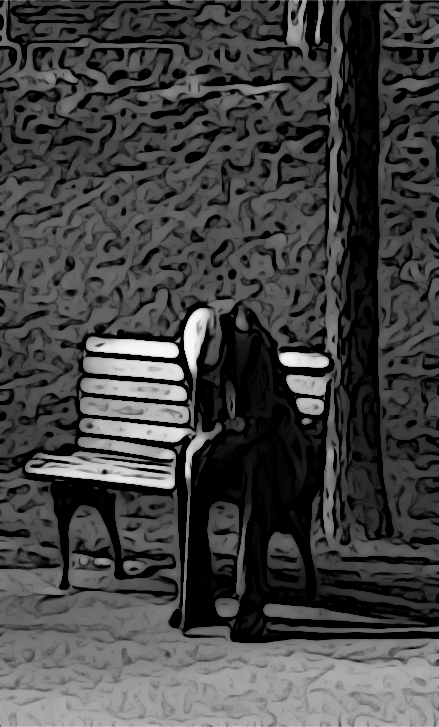
When will the system crash?

Well, it’s another Monday‒the second one in December of 2024*‒and I decided I’d write a little Monday morning blog post.

I’m writing this on my phone today.  I wrote last Thursday’s blog post on my miniature laptop computer, and it got too long and only a few people apparently read it‒or, well, only a few people went to the page.  I can’t tell if they’ve actually read the thing.  The only real way to tell if someone reads something is if they make a comment that clearly responds to the substance of the post.

It’s rather appalling how rarely people read at all anymore.  The odds of someone both liking and actually sharing any of my blog posts are absolutely miniscule.  I suppose I shouldn’t complain too much, since I wrote an actual song called Like and Share” about some evils of the social media landscape.  But the evils I was decrying really focused around the people who curate their online presence to seem as though they and their lives are “perfect” while having who knows how many skeletons in their closets, and the other people who, through comparing themselves to the false images of people online, come to hate themselves and their own lives.

I would love it if people shared my blogs or even my songs or my books (well…the links to my books), but I guess the way one grows one’s audience and gets spread and “retweeted” and so on is by sharing politically charged content with some particular stance.  The more vituperative and divisive and snide, the more likely a thing is to be noticed and shared.  Of course, that’s not going to guarantee spread, but it seems to be an almost necessary thing.

The fact that my primary medium is writing doesn’t help.  With that in mind, I made a little vertical video yesterday, intended primarily for Instagram because “Why not?”, and I shared it there and on YouTube and Facebook and even Threads and X and Bluesky just because, again, why not?

I’m terribly frustrated.  Maybe I should take some controversial stance.  Maybe I should say outrageous and hateful things.  It wouldn’t be that hard.  I hate nearly everything in the whole stupid world.  The problem is that my hatred is equal opportunity.  I find the left and the right to be equally sub moronic, though the malady presents slightly differently in the two political directions.

Maybe I should start promoting an all-out war between neurodivergent people and the NT’s, sort of like Magneto against the humans.  Humans screw everything up.  Many if not most of the positive advances in civilization came from people who were probably “neurodivergent”.  The normies just take advantage of those advances and drive the world into the abyss.

Maybe I should start brainstorming and propounding the benefits of initiating a planet-destroying catastrophe.  I mean, it would be easy enough (in principle) to arrange for various asteroids to end up hitting the Earth; all one really needs is a space agency‒perhaps even a private one, a la SpaceX.  After that, Newtonian mechanics is enough to do the job, plus a little trial and error.

I don’t think it would be enough just to wipe out the human race or current civilization.  I’m thinking of complete sterilization.  None of the other life forms on this planet are any more benevolent or kind or positive than humans are; they’re just less competent.  Weirdly enough, humans appear to be by far the most compassionate, the kindest, the most “life-affirming” species on the planet.  All those that seem kinder or less damaging are simply less powerful.  Even things like lichen and bacteria and archaea have caused massive, even global, catastrophes in the past.

The fact that humans, of all things, are the kindest species on the planet is surely the strongest argument that can be made that life on this planet‒and perhaps all life in the universe‒is simply a huge mistake, and one that ought to be rectified.

I’m pretty sure my own life is a huge mistake, with the exception of my kids.  Certainly everything since about 2012, and possibly somewhat earlier, has been one giant error message written across the monitor of my existence.  I should just power down everything; not restart it, just shut it off and throw it in the trash.

Any thoughts?  “Like” and “share” if you feel the urge.


*Geez, that means the year is almost over again, and I’m still here, like a bad outbreak of herpes.

Raveling down the knitted sleeve of care

Well, it’s Saturday morning, and I’m heading to the office‒way too early, because I still can’t get a good night’s sleep,  Even with recent interventions to try to help my pain and insomnia, it seems the sleep honeymoon phase might already be over.

I felt very much like the lone soldier in the jungle again last night, unable truly to rest and relax, primed at some pervasive level to jump up and react in case some threat developed.  This wouldn’t necessarily be a true external threat.  It might be some break in my routine, sleeping past my alarm*, realizing I had forgotten to set my alarm**, or there might be an intruder, some deliberate, secret assailant, come to attack me in my sleep***, or just a new flare-up of chronic pain developing.

It’s not a great way to start a day or to continue a life.  As I said, I had some temporary improvement not in the quantity of my sleep but in the quality thereof‒I wasn’t sleeping more, but I felt as though I was sleeping better‒for the past week plus a day or so.  This is probably why I’ve had the energy to write some blog posts this week.  But last night felt just like one of my typical, paranoid, restless, angry “sleeps” from before.  I have not stopped my new intervention, but apparently it’s no longer addressing whatever the roots of my sleep issues are.

I suppose I shouldn’t draw too sweeping a conclusion so readily.  One night is not a pattern.  But it’s such a familiar experience, and after such a short semi-respite, that it’s almost worse than never having a respite at all.

For at least 15 years (at least), I’ve spent most of my days and nights alone in the wasteland‒not literally, of course, don’t be stupid.  I just mean that I’ve had the sense of being by myself‒even when in crowded places, such as malls or prison‒and with no real recourse to anyone to help me defend against potential enemies, physical or social or “spiritual”, real or even imagined, external and internal.

To be clear, I don’t feel that the world around me is generally hostile.  In some ways, that would be easier, although considerably less stable.  If I were literally being attacked, I could literally take arms against that sea of troubles and let slip the dogs of war, imitate the action of the tiger, throw my warlike shield before my body and lay on*, fighting against assailants until they were all beaten or until I was dead‒and damned be him that first cried, “Hold, enough!”

Almost certainly, the outcome would be my destruction, but we all have that coming, anyway.  Dying in battle against actual attackers isn’t the worst death I can imagine, if I’m honest (it’s not the best one, either, don’t mistake me…I am not a Klingon or a Sontaran, and I do not embrace the philosophies).

Alas, I will probably be taken down in the end just by the progressive deterioration of my body.  It would be nice to die in a way that is heroic or at least useful, but that’s unlikely to happen.

I’m frustrated and angry about many things this morning, and I’m sick of feeling this way so much of the time.  What is the point of this?  Unlike Camus, I don’t imagine Sisyphus is happy.

It would be one thing if he had people whose company he enjoyed with whom to spend his time while he kept pushing his boulder.  Or, if he really were achieving some result, something beneficial, something that improved the world beyond himself.  But just to keep grinding away at his absurd and pointless task, with no benefit, with no entertainment, with no inherent joy in the process…why bother with that?

At the very least, he could try to plot his escape and enact vengeance against those who sentenced him to this fate!  It might take a long time, but it’s not as though he has anything else to do.  Even though he was made to roll his rock as a punishment, any eternal punishment would always be immoral when brought in response to any finite deed in a finite lifetime.

Of course, no one has put me in my current state.  Well, okay, the government of Florida and of Palm Beach County certainly did their parts in carrying out significant injustice in my case, and those involved are probably worthy of retribution, but it’s all really just so haphazard and so much a part of an unplanned, inefficient, and fundamentally unjust system that it’s not even easy to know where to begin.  Probably, we just need another really big asteroid, or a nearby gamma ray burst, just to wipe the slate entirely clean.

I guess we’ll all see what happens.  In the meantime, I hope you have a good weekend, whether you want to do so or not.  So there.


*Ha ha, I don’t recall whether that has ever happened to me.

 **This has happened, but almost always in the middle of the night, when I awaken, realize with a feeling of severe tension that I forgot to set my alarm, quickly make sure to set it…and then just stay awake until it goes off or until just before it goes off.

***I keep various weapons next to me, within arm’s reach, when I sleep.

****Macduff

If I could write the beauty of your blogs, and in fresh numbers number all your graces…

Hello.  Good morning.

Aaahhh, doesn’t that feel better?  Now I can use my standard Thursday blog post opening phrases, because today is, in fact, Thursday.  It’s the 21st of November, the third Thursday of the month, so in the USA you only have seven shopping days until Thanksgiving.

Speaking of Thanksgiving, since next Thursday is that holiday, I probably will not be writing a blog post then.  It is one holiday on which our office is always closed.  We will be open on so-called Black Friday, but I can’t guarantee that I’ll write a post on that day.

Of course, in principle, I cannot guarantee that I’ll write anything at all ever again after this post.  I may not even survive to post this entry*‒I am in the back seat of a Lyft, on the highway (I-95) of the East Coast of the US, so goodness knows there’s a non-zero chance of a fatal accident.  I would even wish for one, but I know such a thing would involve harm and possibly death to other, more innocent, people.

Also, of course, wishes don’t actually directly affect reality‒thank goodness.  Imagine if even one percent of wishes came true as wished.  The world would be thoroughgoing chaos…and not in a good way.  I tend to say of wishes that “If wishes were horses, then we’d all be hip deep in horse shit,” but it would be even more terrifying if wishes worked.

The “if‒then” character of the wishes saying (my version or the more SFW one that involves beggars riding) often makes me think of lines of computer code in some generic programming language, like:

If wishes==horses then execute beggars.ride

Or maybe 

If wishes==horses then horseshit_level = “hip deep”

I wonder what that would look like in machine language.  Or, I wonder what it would look like in straight binary.  Really, though, I know part of the answer to the latter piece of wondering:  it would look, to the naked eye, like a random string of ones and zeros, perhaps the tally of some very long record of flipping a coin and marking heads as 1 and tails as 0 (or vice versa).

Actually, of course, given a binary-based computer language, one can literally generate every possible computer program just by flipping an ever-increasing number of coins.  Or, to be honest, one can do it just by counting in binary:  0, 1, 10, 11, 100, 101, 110, 111, 1000…

This is why, if memory serves, computer science people and information theory people say that every program can literally be assigned (and described by) a number.  You could express that number in base ten if you wanted, to make it a bit more compact and familiar to the typical human.  Or, if you want to be more efficient and make conversion easier, you can use hexadecimal.  This is easier because a base-sixteen number system is more directly and easily converted to and from binary, since 16 is a power of 2 (2 to the 4th).

Even the human genome, or any genome in fact, could be fairly readily expressed in binary.  The DNA code is a 4 character language, so it wouldn’t take too much work to make it binary, however you wanted to code it.  Then, each person’s genome would have a single, unique number.  That’s kind of interesting.

It would be a bit unwieldy as an ID number, of course.  The human genome is roughly 3 billion nucleotides long, which means it would be roughly 6 billion binary digits (AKA bits).  And since every ten bits is roughly a thousand in base 10 (2^10 is 1024, which is very close to 10^3, aka 1000) then 6 billion bits should be roughly 2 billion decimal digits long (a bit less), which is much, much larger than the famously large number, a googol**.

It’s a big number.  This should give you at least some idea of just how unique each individual life form is at a fundamental level.  There are so many possible genomes that the expected time until the final heat death of the universe is unlikely to be long enough to have a randomly created duplication within the accessible cosmos.

Of course, within an infinite space‒which is the most probable truth about our universe as far as we can tell‒one will not only have every possible version that can exist, but will have infinite copies of every possible version.  Infinity makes things weird; I love it.

Of course, just as with the making of computer programs by simply counting in binary, the vast majority of genomes would not code for any lifeform in any kind of cellular environment, using any given kind of transcription code you might want (the one on Earth, found in essentially all creatures, uses three base pairs to code for a given amino acid in a protein, but that’s not all that DNA does).  Similarly, most of the counted up programs would not run on any given computer language platform, because they would not code for any coherent and consistent set of instructions.

But even so, you would still, eventually, get every possible working program, or every possible life form in any given biological system if you could just keep counting.

On related matters, there are things like the halting problem and so on, but we won’t get into that today, interesting though it may be (and is).

It’s quite fascinating, when one is dealing with information theory (and computer science) how quickly one encounters numbers so vast that they dwarf everything within the actual universe.

Mind you, the maximum possible information‒related to the entropy‒carried within any bounded 3-D region is constrained by the surface area (in square Planck lengths) of a black hole with that size event horizon.  For our universe, roughly 96 billion light years across, I think that’s something like 10 to the 124th bits, or at least it’s that many Planck areas.  That’s quite a bit*** smaller than the number of possible genomes, though I have a sinking feeling that I’m underestimating the number.

And information, at least when instantiated, has “mass” in a sense, and the upper limit of the amount of information in a region of spacetime is delineated by the Bekenstein entropy description.  So there’s only so many binary strings you can generate before you turn everything into a black hole.

Something like all that, anyway.

I may have been imprecise in some of what I said, but when you’re dealing with very large numbers, precision is only theoretically interesting.  For instance, we**** have found Pi to far more than the number of digits needed to calculate the circumference of the visible universe down to the Planck length.  It would require only about 40 digits of Pi to get to that precision to the size of a hydrogen atom, and those are only about 10^25 Planck lengths across, so we wouldn’t expect to need much more than 65 digits of Pi to get that precise, but let’s be generous and use 100 digits.

How many digits of Pi have actually been “discovered” by mathematicians?  Over 105 trillion digits.  Talk about angels dancing in the heads of pins!  It’s literally physically impossible, according to the laws of quantum mechanics, even to test whether that number precisely defines the ratio of any given circle to its diameter by measuring it.  One cannot, in principle, measure finely enough.

Still it just goes to show that mathematics is vastly larger in scope than any instantiated, superficial reality.  Information is deeper than one might think…so to speak.  But, then, so are minds themselves, vastly deeper.

As Idris/the TARDIS asked in Doctor Who, Series 6, episode 4, “Are all people like this?  So much bigger on the inside?”  Yes, Idris, I suspect they are, even those people we don’t like and feel the urge to denigrate.

That’s enough for today, I think.  I’ve achieved nothing, really, other than write a Thursday blog post, but then again, that’s all I meant to do.  I hope you have among the better half of all the vast number of possible days available to you.

TTFN


*If you’re reading this, though, I clearly did survive.  I have mixed feelings about that.

**How much larger?  Soooo much larger that if you subtracted a googol of something from 10^1,800,000,000 of something, you would not change it to any extent measurable even by the most precise instruments humans have ever created.  And a googol is already something like 10 to the 19th times as large as the total estimated number of protons and neutrons in the accessible universe.

***No pun intended.

****Actually, I had nothing to do with it; it’s just the sort of “royal we”***** kind of thing everyone uses when discussing the accomplishments of humanity as a whole.

*****Not to be confused with royal wee.  That’s the sort of weird, niche thing one might find for sale in mason jars on the dark web.  Be careful if you’re into such things.  I wouldn’t buy it unless you’re sure of the source, so to speak.

“When you come to a fork in the road, take it.”

And here…we…go, as the Joker said.

I’m writing something now on Wednesday on the way to work, in the back seat of a Lyft.  This time, I’m writing it on my little laptop computer, which has the disadvantage that its keys are not illuminated, and the back seat is dark, so I have to type by memory, to do my own bespoke version of touch-typing.  This isn’t too great of a burden, since I’ve been typing for more than 40 years*, but it does take away some degree of the advantage in speed that typing on a real keyboard otherwise gives me over the phone.

If I ever get another small laptop like this one, I mean to make sure that the keyboard lights up.  It’s just too useful.

Anyway, upon opening this laptop for the first time in a few weeks, I found that it was still at the point in Outlaw’s Mind where I had stopped when rereading through and further editing it.  It’s right after Timothy’s encounter with the policeman.  He’s about to be brought to the Vipassana Center, where things will begin to become stranger for him.

I really am more pleased with the nature of the story as it is than with the more straightforward idea that had sparked it initially and had been prefigured by the original opening, which I am removing.  Really, I have removed it, but it’s still there in my postings here on my blog, of course.  If I were ever to finish it and publish, I suppose I would take it down from here on my site, as would also be the case with Extra Body.

I doubt that any of that will ever happen, though.  I don’t have the impetus to do either thing, nor to start HELIOS, nor any of the oodles of other stories waiting in the back of my mind, some of which are already well-developed and involve an overall universe, linking to others in my stories’ omniverse.

I guess it would be nice to continue with them.  It would be nice not to have to worry about so many little things day by day that drain my hit points and my spirit points.  If I were to win a large lottery payoff**, I guess I would use it to move back up north and just write full time.  I could even spend my spare time studying mathematics and physics and other sciences, if I had the energy.  Why not?

It’s darned unlikely that anything like that is going to happen, unfortunately.  I have no rich relatives or friends, and even if I did, it’s hard to see one of them wanting to support me while I’m writing.

I have so many story ideas in the back of my mind, written down in quick notes in my phone and other systems, or just swimming through my brain.  And I still think of new little ideas for self-contained stories (I hesitate to call them “short” given past experience) as I go along, but unlike before, I don’t jot them down anywhere.  That’s a huge surrender on my part, but I have to be realistic.

If the Everettian quantum multiverse exists, then it’s likely that in some proportion of the wave function I succeed at doing all these things.  Likewise, if the universe is infinite in spatial extent, there are certainly a fraction of the infinite copies of me out there who will have some inordinate luck and go on writing.  However, these possibilities are no consolation, as I have no experience of what they experience anymore than of some small, furry thing from Alpha Centauri.

I guess that’s also a good thing, though, since there are certainly versions of my life that are much, much worse than this one.  I wouldn’t want to experience them.  But, of course, experiencing is one of the functions of the individual, separate identities, not of the conglomerate of those that share some common characteristics or past.  No one should expect to be able to experience both worlds that split after some quantum “measurement”.  It’s not logical.

Once their cells have split, identical twins are separate beings, individuals each in his or her own right, and there is no mingling or superposition of their experiences.  Thank goodness.  Because we are all descendants of an unbroken line of cellular ancestors, and have common past with every living thing on the planet (and a few orbiting in space).  Imagine if we somehow were able to experience every other living thing at some level.  It would be a bit like that weird Gaia planet in the later Foundation novels.

Anyway, while I can dream of having some benefactor or patron who takes care of my living logistics while I write, and maybe even who helps me market and promote my books and related items, I can also, any time I like, dream about having superpowers, or being universally loved, or some other such nonsense.

Such dreams are nice (as the Radiohead song admits), but reality is not obligated to make any of our dreams come true, good or bad.  It doesn’t even make some aggregated average of people’s dreams come true.  It just does what it does, and it is what it is, and we are merely one little, evanescent—although relatively interesting—corner of a universe that may be infinite in space and in time, and perhaps in other ways beyond those.


*Man, are my fingers tired.

**Difficult, since I don’t play.

It might be the pate of a politician, which this blog now o’erreaches

Hello and good morning, o dedicated reader(s).

I honestly don’t feel very much like writing today‒I feel extremely low even for me, very gloomy, very pain-riddled and dysthymic, my mood made worse by the diminishing daytime in the northern hemisphere‒but since I did my little throw-away non-blog last Thursday, I figured I might as well do something today.  I don’t know if anyone truly looks forward to my blogs‒it’s hard to imagine someone’s day being worse because they didn’t get any input from my thoughts‒but just in case someone does, I will write.  Or, rather, I am writing.

I don’t want anyone to think that my depression is unusually bad due to political events, and certainly not for anything parochial, provincial, local in time and space.  Cat forbid!

I’m sure that people throughout history have thought that whatever local politics was happening just then, at that moment, was Earth-shattering and of monumental importance.  But, of course, as Ozymandius reminds us, all the great people and events of the past, all the presidents and emperors and warlords and whatnots, are but headless, trunkless, disintegrating statues in a featureless desert.

Actually, most of them are never even that.  During the Cold War, admittedly, especially the latter part during maximum arms race and belligerence between the US and the USSR, it was possible for politics to engender the destruction of much of civilization (and I truly didn’t think the odds were good that we would avoid thermonuclear war for very long*) but even then the moment-to-moment politics was almost incidental.

The Cold War and its existential dangers lasted through numerous presidents and premiers, the former of various political parties‒Truman (D), Eisenhower (R), Kennedy (D), Johnson (D), Nixon (R), Ford (R), Carter (D), Reagan (R), all the way up to George H. W. Bush (R).  And, of course, on the other side, we had Stalin (C), Khrushchev (C), Brezhnev (C), Chernenko et al (C), and Gorbachev (C).  One might imagine that Bush, Sr. and Gorbachev would be truly celebrated historical figures, given their leadership positions at the end of the Cold War, but I don’t see a lot of evidence thereof.

Now, political stupidity** has, of course, caused havoc locally on many an occasion.  More people were killed thanks to the ideological idiocy of Stalin and Mao, for instance, than were killed in wars in the 20th century, despite the immensity of those wars.

But, of course, nearly all the people who died in and around the first world war at least (and most of those alive during the second) would have been dead by now, anyway.  And certainly, everyone who died unnecessarily during the French Revolution and the Napoleonic wars would definitely be dead by now, whatever might have happened.  And all the people slaughtered by the hordes of Genghis Khan would be dead now, no matter what.  And certainly anyone killed due to the mismanagement of even the worst of the Caesars would be dead now‒as dead as Julius Caesar, as they say.  And the people of Greece and Macedon and “Asia Minor” and Egypt and Persia and all those other areas would be dead now whether Alexander the Great had conquered his known world or not.

I recall a column that Michael Shermer wrote in Scientific American (back when it used to be worthy of his writing) called “Remember the 6 billion” (roughly the population of the world at that time).  His point was that, within the following 120 years at most, every single person then alive would die…and for the most part it would go entirely unnoticed, because new people are constantly sporulating to take the place of the ones that fall by the wayside.

The “Great Men” (and women) of history are mostly just names and caricatures; they have no effect on the long term structure of civilization.  We recall that Alexander was a brilliant military leader‒an artist in that realm, perhaps‒but his contributions to that field have no major bearing on modern life.

The ideas of Archimedes, for instance, have had much more durable effects, but that’s because they are discoveries about the nature of the universe, of reality and its underlying rules or tendencies, and so they are, in a sense, universal and universally discoverable by any intelligent civilization anywhere in the cosmos.  Ditto for Galileo and Newton, for Maxwell and Einstein and Schrodinger and Planck and their compatriots.

Not that we should not celebrate those achievements and discoveries, but they are in some senses nonspecific to any individual.  Even the work of Darwin, which may seem both specific (har!) and provincial, since it refers to life on Earth, is probably at least as universal as the work of Newton or Dirac or even Emmy Noether.  Natural selection applies to numerous things even within the higher orders of civilization‒languages, political systems, forms of transportation, the durability and character of bureaucracies, etc.  A form of it may apply to the formation of planetary systems and the potential origin of life therein, and even to the possible bubble universes of the hypothetical inflationary multiverse (or more specifically in Lee Smolin’s speculative notion of universe natural selection through black hole related cosmogenesis).

But politics‒well, it’s provincial in pretty much every way.  Can you imagine any truly alien race caring who got elected president or which party ran the poorer campaign, why one did better or the other worse?  Go canvas the dolphins for their opinions, or the octopuses, or the corvids, or ask a beehive or a termite mound or an ant colony.  Try to get them to give flying fuck at a tiny little that’s ass*** about the minutiae of human politics.

No, my depression, like my pain, is endogenous, or at least it is not trivially reactive.  It is always with me, a truly dark passenger (who often takes the wheel).  It’s probably a product of my atypical, alien neurology, but of course, I’m not anything like as alien as a cephalopod or hymenopteran or a cetacean.  I’m just humanlike enough to exist in the uncanny valley:  weird enough to be unsettling, but not weird enough to be interesting or cute or “beautiful” because of it.

So go ahead, catastrophize or hyper-celebrate about the latest political farce, not recognizing that a lot of what went wrong on all sides was that very tendency to demonize, to catastrophize, to overreact and to be self-righteous.

There is a saying that came into prominence sometime in my teens to twenties (I don’t recall the first time I heard it).  I initially found it irritating just because it was such a “new thing”, but I think its message has endured and even grown in value:  get over yourself.

Everyone needs to take this admonition to heart.  We are all just virtual particles, not-quite-really-real bosons that can carry some degree of information or “force” when there are enough of us around, but which all ultimately pop back out of existence before our presence can even really be noticed by any outside observer.

That’s okay.  It had better be okay, because it’s not optional****.  And if that state of the world, that nature of reality, is unnerving to you, don’t mind it too much.  It won’t trouble you for very long.  No one here gets out alive.

TTFN


*We still haven’t avoided it for very long.  It’s only been a danger for about, what, 70 years?  Really, it’s a little less than that since we’ve had truly civilization-ending amounts of sufficiently powerful nuclear weapons.  So, since I’m just now 55 years old, the threat of global thermonuclear war is only about a decade-ish older than I am.  It could almost be thought of as my eldest sibling.

**Redundant?

***I would not put it past dolphins to try such a thing.

****It’s a bit like free will:  You either have it or you don’t, but you don’t have any choice in the matter.

Performance is a kind of will or testament which argues a great sickness in his judgment that blogs it.

Hello and good morning.  It’s Thursday (of course) and so it’s time for my weekly blog post.

There have been no interim posts this week because I have been quite under the weather since Saturday night.  This doesn’t necessarily imply that if I had not been sick, I would definitely have written any extra posts, but the illness made that possibility all but zero.  And, of course, now that the potential extra-post days have passed, we can say that, at least in this part of the Everettian multiverse, it did not happen.

I was off work on Monday and Wednesday.  I sort of had to go in on Tuesday, because I needed to prepare the payroll, and most of that data comes back on Tuesday.  It was no mean task, because we have more people working than in the past, and we have two offices now, so I was somewhat stressed out, in addition to being sick.  I was able to finish the job from the house yesterday morning, because I had prepared everything adequately.

Anyway, I’m heading back in today‒though in a truly civilized society which the US is not, I would probably stay in the house until I was more recovered than I am.  Still, I really don’t like lying around there.  It’s crowded (with my own clutter of stuff) and it’s dim, and it’s not as though there’s anyone around to take care of me, so I have to do everything for myself anyway.  That limits my rest a bit.  In any case, it’s not a restful environment.  Though I don’t quite know what would constitute a restful environment for me, honestly.

Of course, yesterday, when I was at the house, they had a tremendously successful day at the office, perhaps the most successful day that we’ve ever had, doing as much business in one day as we used to do in a whole week.  This is yet more evidence supporting a hypothesis that I have long suspected to be true:  everything tends to go better when I am not around.

Probably, even those of you who read this blog regularly would have slightly better lives if you did not read it.

It’s pretty clear that things got easier for my parents after we had a falling out (for a while) and I took over my room and board and everything else for myself during the latter half of college*; they were finally able to get on with their freer lifestyle now that the last of their kids was truly out of the house (I do not mean to imply that this was in any way their aim or desire; that would be so far beneath them as to be indiscernible).  The next time my parents and I saw each other was when I graduated from medical school.

Also, of course, my ex-wife divorced me specifically because she wasn’t happy, and I think she has been much happier since she did so.  My kids certainly seem to have done well, especially since the time I was more or less completely excised from their lives by the State of Florida (it nothing to do with any kind of DCF parental problem finding, it was just me being sent away to be a guest at the FSP, securing the final nail in the coffin of my prior life).  Not having me around is certainly not acting to their detriment, at least, which is usually what having me around does to people.

In fact, non-family members** who feel the most affinity with me, or with whom I feel the most affinity, tend not to turn out well.  No fewer than two of the friends of my ex-wife’s parents who heard me sing*** for the first time and were enthusiastically and convincingly complimentary‒one of them even asked for a tape‒died within a year.  And two of the people at the office with whom I got along well and felt affinity, and one of whom could have become a close friend (he was the one who read Son of Man and liked it and was a techy sort of person) died of drug overdoses.

I’m not positing any kind of supernatural process, here; I don’t think there is such a thing as a real curse or anything along those lines.  But I think that there are aspects of my personality and nature and character which, when they resonate with people strongly in the wrong way, tend to reinforce bad outlooks and bad health, and can even lead to untimely death.

This is just a hypothesis, of course.  But it does seem potentially true that even the world itself would be slightly, but noticeably, happier, healthier, more prosperous, and in general better off, if I were not around.

It’s the ironic turnaround of the song Creep, in which Thom Yorke sings, “I want you to notice / when I’m not around.”  Well, people do tend to notice when I’m not around, and what they notice is that everything is at least a little bit better.

Like the fella once said, “Ain’t that a kick in the head?” to quote another, older song, also ironically****.

Unfortunately, it doesn’t look like my present illness is going to be lethal, though I suppose it could surprise me.  It is possible to seem to be improving and then to worsen or to experience complications or to have a superinfection that becomes life-threatening.  But the world is not usually so fair or just.  Jim Henson died in his prime of what would ordinarily have been a treatable infection, while slow-growing, purulent tumors such as I persist long past even their potential usefulness or value.

Ain’t that a hole in the boat?

TTFN


*I had a full scholarship, thankfully, otherwise I never could have gone there in the first place.

**Relatives appear to have some manner of immunity.

***I used to be better than I am currently, because I practiced more, and sang more “formal” stuff.

****I will not quote Alanis Morisette.

From the wisdom of beer commercials to the gibberings of Azathoth

It’s Friday.  I guess many people express the notion of gratefulness for the end of the work week by saying, “Thank God it’s Friday”, and I suppose that’s a positive and healthy attitude.  It’s good to enjoy your work and to be productive, of course‒though merely human levels of productivity are creeping ever closer to obsolescence‒but it’s also good to enjoy being nonproductive, to being able to divert oneself into other matters.  It’s like the guy sang in the old Michelob Light commercial:  “Who says you can’t love your job and leave it, too?”

Who’d have thought that one could find even small nuggets of real wisdom in beer commercials?  Then again, the making of beer may have been one of the early drivers of the development of agriculture, even more so than bread, so beer has been with us as long as civilization has existed.  It’s also one of the rewards that wheat gave us when it domesticated us.

I’m working tomorrow, so this is not the end of the work week for me.  I don’t know whether I will write a blog post tomorrow or not.  I didn’t plan specifically to write this one (but neither did I plan not to write a blog post).

Yesterday, though, I read a quick snippet from a young autistic woman on “Threads”, which is Zuckerberg’s competitor for the website formerly known as Twitter, and which is run as a sort of strangler fig on the tree trunk of Instagram.  This young woman commented on how she sometimes had the intense desire to write copious journals because that way, if she died alone and utterly separate and friendless‒as she seems to think might happen‒at least it was possible that someday someone might really know her and who she had been.

I’m paraphrasing, of course.  But this was the gist of her comment as I understood it, and it was brief and clear enough that I don’t think I could have misunderstood too badly.  Anyway, it struck a resonance within me, and made me think that such a drive might be at least part of my impetus to write my blog.

Of course, the retrospectoscope always distorts what one sees through it, so even though I trust my memory of my own internal states as much as I trust anything, I know it cannot be perfect.  How could it be?  The state of the mind in any instant encompasses all the memories and thoughts it contains about prior states, however limited or exhaustive that memory might be.  If the brain had then to remember that full state as part of its memory in the next state, then the required storage and processing would double with each passing instant.  And while I think it would be quite a treat to have exponentially growing intelligence, if it was mostly used to remember itself in every successive moment, that would be a bit of a waste.

Still, whether my prior motivations had any trace of the above notion or if it is a newly added interpretation, it doesn’t really matter.  It is here now, and I think it’s operational.  I used to have friends with whom I could talk on a daily basis about matters of mutual interest and so on, and with whom I could experience new things and take in new ideas.  But that was a long time ago.  And even then, I think I was weirder than my friends, and weirder than my wife once I was married.  And then, of course, I was divorced and then more, worse things happened, and well…it’s been roughly 2 decades since I had anyone with whom I could connect on anything like a daily basis.

So, though my blog never did really seem to help much as a form of psychotherapy (then again, my many, many hours of actual psychotherapy didn’t do very much but make me at least feel that I was communicating with someone) maybe it at least gave me some form of record, some sense in which I could know that, at least in principle, my thoughts (some of them, anyway) were out there in the world and discoverable, as are my so-far published books and my so-far released songs.

In the long run, this may well not matter even in a trivial sense.  On the scale of infinity, everything is negligible, and even on the “mere” scale of our cosmic horizon‒a sphere about 96 billion light years across‒everything that has ever happened or probably ever will happen on Earth is entirely unnoticeable.  Hell, even on the scale of the solar system, the Earth is not easily seen as any more striking than any other structures present.  And on the scale of the galaxy, again, we don’t even really exist in any meaningful way.  Not yet, anyway.

But on the scale of the Planck length and the Planck time, we are vast and ancient.  And on that scale, my thoughts may seem as potent (and perhaps as nonsensical) as the gibberings of Azathoth.  Nevertheless, they are here.  They are now.  I’m not sure whether I am glad of that fact, or embarrassed, or bemused, or what.  But these are those thoughts for this morning, for today.

Have a good one if you can.

You cataracts and hurricanoes, spout till you have drench’d our steeples, drown’d the blogs!

Hello and good morning.

I’m going in to the office today, since down my way, Hurricane Milton has not been very impressive so far.  This is not a surprise.  We were always going to be only on the periphery of the system, and on the leeward side of the state (so to speak).  There wasn’t even any rain of significance down by where I live; just a bit of relatively high wind.

We are going through a bit of rain as I ride in my Lyft to work, but for south Florida, it’s a piddling amount so far.  The wind is mildly interesting, but I’ve ridden a 650 cc scooter (basically a motorcycle with automatic transmission) through wind and rain much worse than this.  I don’t think that was a wise thing to do for anyone who cared about his or her life and health much, but for me, it was just fine.

I’m in a Lyft, by the way, because the train service is suspended today, as it was yesterday.  This was probably not absolutely necessary, but I respect the abundance of caution.

Traffic, at least, seems very light, which is also not surprising.  Most people in the area are not working today, I suspect.  We shall see how many people come to the office today.

I’ve been a bit frustrated lately, as an infection of some kind (possibly a few different ones) has afflicted quite a few people at the office, but I have not gotten sick.  Not only would such an illness give me the opportunity for rest for which I am able to excuse myself (and might even allow me to sleep, given the physiology of the immune response), but it’s also an opportunity potentially to develop some more severe, life-threatening superinfection*.

Apparently, some people used to call pneumonia “the old man’s friend”.  Well, I’m not that old (and I wouldn’t recommend my friendship to anyone, even a pulmonary infection) but apparently the average lifespan for people on the autism spectrum‒assuming that I am, which I give very high likelihood‒is somewhere in the mid-50s.  So, it wouldn’t be unreasonable for something to kill me sometime soon.

Of course, such averages are strongly affected by outliers.  People with the highest support needs are probably more likely to die at significantly younger ages, and that will tend to bring the average down.  It’s a bit like how the very high infant mortality rate strongly skewed the average lifespan in pre-modern times.  People who did reach adulthood probably didn’t live much shorter lives than we do now.

Actually, modern people in the west may be backsliding lifespan-wise, at least in America, as we eat more refined carbs and are less active and so are more prone to hyperinsulinemia, which brings with it not just increased risks of diabetes and elevated lipids, but even increased risks of high blood pressure, heart disease, stroke, and many cancers, as well as infections.

The infant mortality issue illustrates one way in which reported average lifespans and similar statistics can be misleading, at least for people who don’t understand what’s behind the numbers.  It reminds me of something I may have discussed here before:  people (rightly enough) make fun of the fact that (to make up a statistic that’s probably not too far from reality) ninety percent of people think they are above average drivers.

Now, it is almost certainly true that ninety percent of people are not above average drivers; it’s just that so-called neurotypical people tend to have overinflated (and undeserved) senses of self-esteem.  But the notion that seems to be implied in most discussions of such statistics is that it’s impossible for 90% of people to be above the average.  This is not the case, at least not if “average” refers to the arithmetic mean, as it usually does.

If ninety people out of a hundred each scored exactly 51 (out of a 100, say) on some test of driving ability, and the remaining ten only scored 1 point each, then the average score would be ((90 x 51) + (10 x 1))/100, which is 46.  So, ninety percent of people would not only all be above average, but would be five points above average.  It’s not a very impressive score, but it is true.

Now, if it were said that ninety percent of people think they are above the median, then that would be erroneous by definition, because of the meaning of the term “median”.

Most people don’t seem to understand these and other mathematical concepts, and yet those concepts and related ones of many and varied kinds can have significant impacts on the lives of billions.  I once wrote a blog post on Iterations of Zero recommending that probability and statistics be more aggressively emphasized in secondary school education, because I think understanding them would give people far greater insight and even agency in the world.

And yet, we see “humorous” memes such as the one below, of which there are numerous iterations and variations:

pythagorean meme

I say the fault for that lack of use lies with the individual, not with their education.  Just because they don’t use the Pythagorean Theorem doesn’t mean it isn’t and couldn’t be useful**, and even if the specific theorem wasn’t useful then the capacity to do it and other, related things, is useful.

I feel I may have mentioned it here recently, but even when one doesn’t use mathematics*** in one’s profession, working with them strengthens the mind and makes it more fit for many other purposes.  Usually, one doesn’t do push-ups to become really good at doing push-ups, and one doesn’t jog in order to become a really good jogger.  One exercises to become stronger and healthier, more capable.  The mind is even more responsive to exercise than is the body, and if there are limits to how strong it can become‒in whatever sense‒I don’t think anyone has come close to reaching them****.

That’s that for today.  I hope you’re all weathering your personal storms reasonably well.  The one down here hasn’t done much to me; I probably could have slept outside in the rear of the house last night without any trouble.  The wind might have been soothing.  It might even have helped me get a better sleep.  It’s not as though it could have been much worse.

TTFN


*By which I mean an infection that opportunistically occurs due to the body’s weakened defenses caused by an initial infection, not an infection with exceptional nature or virulence.

**Understanding geometry is so potentially useful in so many ways that it’s said that the only time in his life that Isaac Newton laughed was when someone asked him what the point was in studying Euclid.  Newton is universally reputed to have been quite arrogant, vindictive, and impatient, to say the least.  One can only imagine the sheer amount of vitriol and scorn that would have been conveyed by that solitary gelastic moment.

***Or philosophy, or physics, or chemistry, or biology, or history, or literature, etc.

****Not even Newton or Von Neumann.

Doubt is called the beacon of the wise, the blog that searches to th’ bottom of the worst.

Hello and good morning.

It’s Thursday, and so it’s time for my “regular” weekly blog post.  It’s the first Thursday in October of 2024.  It’s also Rosh Hashanah, so for those of you who celebrate it, L’shana Tovah.

I haven’t been working on any fiction at all since my last report‒unless you count my façade of being a normal person or living a normal life, of course.  That’s doing what it does, and I continue to do it for whatever reason(s)‒perhaps habit, perhaps duty (to whom or what, though?), perhaps out of self-punishment or self-harm, I don’t know.

I wish I had something interesting to discuss.  I’m nearly done with Authority, the second book in the Southern Reach novels.  They are (so far) much better than the movie Annihilation was.  But they are disorienting, as I’ve mentioned before, and given my own chronic and worsening insomnia and pain, they make me feel as though I might not be experiencing my own life as what it really is.  Not that I actually think I’m being fooled or am hallucinating in any serious ways.  But I do feel disconnected, separate, as though I’m not fully within or fully a denizen of this universe, but of some nearby, partly overlapping one.

I’ve long suspected that it would be difficult to “gaslight” me, because I have always found my own memory and understanding (certainly of my experiences) to be better than that of anyone around me.  Yet I don’t “trust” myself, either, which means I tend to keep checking and confirming aspects of reality to test the consistency of my impressions.  It may smack of OCD a bit, but it means that, at least intellectually, I find my own take on reality to be more coherent and consistent than that of most people with whom I interact.  Though there are always things one can learn from others, too.  One just has to be rigorous and strict in assigning credences.

As Descartes pointed out, we can never truly be certain that some powerful enough entity has not pulled the world over our eyes*.  He famously came down to the conclusion, or rather the starting point, of cogito ergo sum‒“I think, therefore I am”, the point being that he knows, to his own satisfaction at least, that he is there and is thinking, because he experiences it even if all else is an illusion.

Of course, even subjectivity could be an “illusion” in some sense, in principle.  The characters in all my stories have thoughts and subjective experiences‒they “think” they exist‒but that subjectivity only exists when they are being read, or when I wrote them.

And of course, we could be within an immensely complex “simulation”, and “merely” be aspects thereof.  Such a simulation could be paused, say, and this could happen frequently or for tremendous periods of time up in the level of reality in which the simulation is being run, and as long as the simulation picks up right where it left off, no one here would ever have any way to notice or to know.

There could be a googol “higher-level” years between every Planck time in our universe** and as long as the simulation wasn’t changed, or was changed in ways that were logically consistent, there would be no way to see it from inside.  This is one of the implications of the “simulation hypothesis” or whatever the “official” term is, put forward by such notables as Nick Bostrum, who apparently has a new book out called Deep Utopia.  I have not read it; I never finished his book Superintelligence, because it dragged on a bit and I didn’t find it as challenging or revelatory as I hoped it would be.  Maybe if I started again, the experience would be different.

I am reading at least two other books, though.  I’m reading Yuval Noah Harari’s new book, Nexus, which is quite good so far, though nothing is likely to surpass his first book, Sapiens, which is one of the best books I’ve read.

I’m also working through Now: The Physics of Time, by Richard A. Muller.  He’s trying to describe his notion of the true source and nature not only of time’s arrow, but of time itself.  It’s reasonably good so far, but his arguments have not been as interesting or as impressive as I’d hoped they might be.  Still, I look forward to getting to the point in which he elaborates on his idea that not merely space is expanding, but time is also doing so, and this is the source of time’s arrow and the nature of “now” and so on.  It’s intriguing, and it’s far from nonsensical, considering that Einstein/Minkowsky showed that space and time are one entity.

I’m sort of on hiatus from Nate Silver’s On the Edge, which is a good book, but is quite long and in-depth, and some things he discusses are more interesting than others, to me.

Other than that, I continue to feel discordant, or hazy or separate, like everything, including me, is “a copy of a copy of a copy of itself”.  Last night, the feeling of being disconnected, rootless, and that I am in the process of disintegrating felt highly distressing***.  I wished I could find a way to feel connected with the daily, normal processes of my life, instead of feeling as though I am, for instance, one of the people exploring Area X and trying to understand it without much chance or hope of success.  Or perhaps it felt more that I am the analogy of Area X, I am the alien thing/environment in the more “ordinary” world, dropped here perhaps by accident, with no idea where I really belong or whence I really came.

Now, this morning, those notions are not gone, but the alarm associated with them is not as intense, replaced more and more by fatigue, a kind of learned helplessness.  As time goes by, I tend more and more toward apathy‒not acceptance but merely giving up, just not having the energy to continue to care.  I would like to connect in some way, to feel as though I belonged somewhere, but I am a Nexus 13 in a world of humans‒a world where, inexplicably, nobody seems ever to have manufactured such replicants, and yet here I am, making everything ever more drearily baffling.

Oh, well.  Maybe as the disjunction progresses, I will reach some turning point, and I will melt, thaw, and resolve myself into a dew.  Or maybe I’ll have to try Hamlet’s next mentioned option and make my own quietus as I intended to do on the 22nd‒I don’t believe in any “Everlasting” being, fixed canons or otherwise, that could prohibit “self-slaughter”.

Or maybe I will find some answers; or if answers don’t already exist, maybe I’ll create some answers.  It seems unlikely, given my personal experience and understanding, but the odds are not zero.  Though they may well be close enough for all practical purposes.

TTFN

rosh-hashanah-merged


*To borrow a lovely expression from The Matrix.

**Ignore Relativity’s problems with simultaneity for…well, for now.

***So many “dis” words.

And nature, as it blogs again toward earth, is fashioned for the journey

Hello and good morning.  It’s Thursday, and so:  here’s another blog post—meaning another regular, weekly, Thursday morning blog post.  Of course, people who receive notifications about my blog posts will have seen already that not only did I publish an impromptu entry on Monday, but also that, starting on Tuesday, I’ve been sharing a chapter at a time, three times a day, of Extra Body.

I finished the third editing run-through of that story by Tuesday morning, and I decided, “that’s good enough, I’m done with that, I’m tired of working on it, or on anything else”.  I considered just publishing it through Amazon, but that would have involved designing a cover and getting the formatting right for the paperback and e-book versions, and even then it would have been far from likely that anyone (except my sister) would read any of it, ever.  At least this way, maybe someone who is idly curious but wouldn’t go to the trouble of actually buying the book from Amazon (or other sources) might idly start reading it and even might read the whole thing.

Speaking of the whole thing, it will be completely published by Friday afternoon, which is when Chapter 12 is scheduled to go up.

I don’t know whether the story is any good or not.  I suppose that would depend upon the criteria one uses to judge the “goodness” of a story, and no two people would probably have precisely the same implicit criteria.  I say “implicit” because I doubt most people (or anyone, really) would actually apply any formal judgement criteria to such things.  I think it’s a much more “analog” process, a weighted neural network/high-dimension vector addition (or possibly vector calculus) sort of problem.  As such, it probably changes from day to day and even from moment to moment for every person.

It may be mathematically possible in principle for two people to have exactly the same judgment criteria about fiction*, but I suspect that there aren’t anything like enough people in all the universe—not just spatially but temporally, past and future—to have exactly the same mental state regarding how they judge and react to fiction at any given time, or even in their entire lifetimes (this discounts the potential “quilted multiverse”, if the universe is spatially infinite, in which all states would recur an infinite number of times).

I’m giving this more thought than it probably deserves.  I tend to do that.

On to other matters, or at least, let’s move away from that subject.

This Sunday will be the day of the Autumnal Equinox, the official beginning of Autumn in the northern hemisphere.  It’s also September 22nd (this is often the case with the Autumnal Equinox) and is thus the date of Bilbo and Frodo Baggins’s birthdays (according to Shire reckoning, anyway—I’m not sure precisely how that lines up with the Gregorian calendar, but I suspect Tolkien just kind of took them as roughly aligning, though the hobbits apparently took the 5 (and a quarter-ish) extra days of the year as a non-month in midsummer and had 30-day months for all the rest of the year).  That was also the day on which Frodo left Bag End to begin his long and arduous and torturous path to destroy the One Ring.

So it is an auspicious day in more than one sense, a day on which momentous or portentous things may begin or end or begin to end.

Though Frodo survived, of course, he never was quite the same after his journey, having suffered from the stab of the Morgul blade on Weathertop, and the bite of Shelob, and—most of all—the terrible effects of the Ring itself when it was at its most perilous, its most awake, and its most desperate.

The voice-over near the end of the movie The Return of the King really expresses Frodo’s sense of enduring damage and suffering:  “How do you pick up the threads of an old life?  How do you go on when you begin to understand there is no going back?  There are some things that time cannot mend.  Some hurts that go too deep, that have taken hold.”  How, indeed?

Nietzsche is famously quoted as having said that whatever doesn’t kill us makes us stronger.  In response to that, I would simply say to him, “syphilis”**.

There are many things that do not kill us that nevertheless wear us down, leave scars and damage and dysfunction in their wake.  Of course, one could reply that such things are killing us, they are merely doing it slowly, in a cumulative and collective fashion.  But if one is going to reach for that linguistic/semantic escape clause from the dichotomy of Nietzsche’s statement, then one is merely engaging in tautology.  If one says that anything that doesn’t make us stronger is, by our definition, killing us (even if only slowly), then saying that whatever doesn’t kill us makes us stronger is just saying the same thing.  No insight is gained.

In any case, things wear out and fall apart no matter what.  As far as we can see, that is a fundamental aspect of the nature of reality.  New things do arise, lives are born, stars form, perhaps new “universes” are constantly emerging in an eternal inflationary universe.  But mathematics dictates that all things eventually seek out the most entropic states—not out of any desire, any “telos”, just out of the tendency of the math of complex systems.

Things fall apart.  The center cannot hold.  And Darkness and Decay and the Second Law of Thermodynamics hold illimitable dominion over all***.

TTFN


*Though if the process is truly continuous, in the “real numbers” sense of continuous (quantum mechanics suggests this cannot be so), then there would be literally, uncountably infinite possible arrangements, and so it would be “infinitely improbable” for any two people ever to match exactly.  That seems appropriate, given the story being discussed.

**Perhaps the real “Montezuma’s Revenge”.

***This is a mashup of and paraphrasing of separate literary works, so I’m not surrounding it with quotation marks, but:  credit to Yeats and to Poe****.

****No, NOT the heroic pilot from the newer, Disney-Star-Wars films.  You Philistines*****.

*****This is, ultimately, a reference to the fact that the Philistines, according to legend, stole the Ark of the Covenant from the Temple of Solomon, and thus their name is used as an epithet referring to those who show no respect for sacred or artistic or cultural worth.