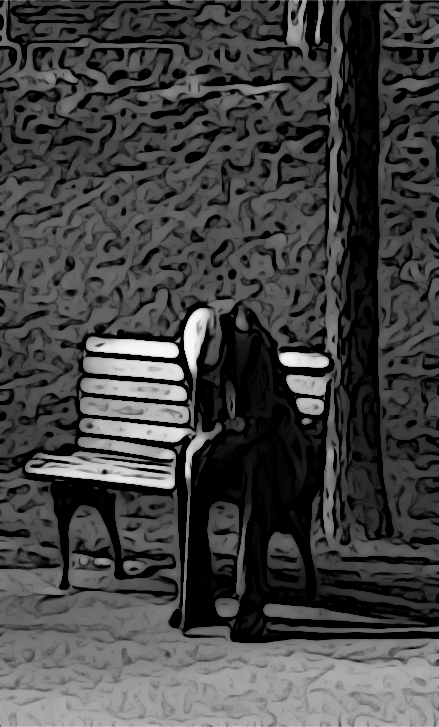
And I looked, and behold a pale cat

Well, I have some relatively good news, which is why I decided to write a post today instead of just leaving it:  Dorian, the light gray cat, has returned.  Well…he was back last night, at least, though this morning he was nowhere to be seen once again, which is itself somewhat unusual.

He was a bit scraggly, with some traces of dried blood around his fur on the side of his head and neck, but it didn’t look like it was his blood.  He actually looked lean and healthy, moving very much like the hard-ass stray cat that he is.

I’m guessing that he got into a pretty big fight at some point‒he seems prone to them‒and then hid away somewhere while he recovered his strength.  Then, that pale grey shadow took a new shape* and grew again.

I think stray cats, like defective and damaged people, don’t like to show any weakness to those around them.  Perhaps it’s more accurate to say that they are unable to show their weakness, even though they may crave acceptance and support.  There are good, sound biological motivations for this in stray cats and other mammals; showing weakness or injury can invite further aggression from other cats and even encourage predators.

Of course, human males (or anthropoid creatures living among humans, such as I) are no exceptions to that tendency.

It’s also been said that, in many ways, people on the autism spectrum are like cats, at least in some ways, and I can see the point, though it is an oversimplification.  Still, it leads me to speculate that, sometime in the relatively deep past, perhaps two separate subspecies of humans (maybe the legendary Neanderthals and Cro-Magnons) existed, one being more naturally ultrasocial, the other more constrained but with other capacities that aided their survival.  We know that Neanderthals, for instance, had bigger brains than so-called modern humans, but the structure appears to have been slightly different.

Perhaps it’s the genes from such a separate subspecies that led to some people having ASD or other versions of “neurodivergence”.  To be clear, I don’t know that there’s any good evidence that this is the case.  I did encounter at least one study that looked for markers known to be associated with the autism spectrum and the DNA residua of Neanderthals present in people of European descent.  There seemed to be some correlation, but I didn’t think it was particularly impressive.  So there’s not a lot of data to support the hypothesis.

It would be nice‒in some ways‒to think of oneself as just a different kind of human, not as something alien.  But I think that’s probably a silly dream for me.  I do not belong here in any serious sense; I am an alien, a mutant, a replicant, a stranger.  And to humans, of course, a stranger is presumptively an enemy unless and until proven otherwise.

Anyway, Dorian was back last night, but gone again this morning.  We’ll see if he returns.  There are other cats who come around.  But, of course, there is no real affection from most of them.  They come to me opportunistically, because I put food out for them.  I am useful to them.  Similarly, I am often useful to humans in the world.  I have many skills and abilities, so I have frequently found that people like to have me around to help them get things done.  But eventually, the negatives of my presence outweigh the positives, and people go away (or send me away).

I don’t blame them.  I want to go away from myself, though I have never had any desire to be anyone else.  I would prefer oblivion.  Or maybe I would just prefer rest.

Speaking thereof, I slept almost four hours last night, and of course, I awakened and couldn’t go back to sleep in the wee hours of the night, and I am now at the office finishing this post.  I don’t look forward to the weekend‒there’s nothing good about it‒but at least I can collapse and try to recuperate.  I don’t know if I’ll write anything next week, or just leave everything be.

I feel perched on the borderland between life and death, and the Undiscovered Country beckons.  It must be really great there, because no one who goes ever comes back.


*To be honest, it’s pretty much exactly the same as the old shape.

Maybe it’s signal. Maybe it’s noise. Maybe it’s Maybelline?

Well, it’s Tuesday, and I don’t know that I have anything of use or substance to say, or anything to say that isn’t mostly just noise.  Perhaps I’m just some peculiar source of radio static in the background of the universe.  Or perhaps…perhaps I’m just pretending that what I do is unplanned, when in fact everything is calculated and subversive.

Ha!  I wish.  My brain doesn’t work like that, and I’m not sure anyone else’s does, either.  Even John Von Neumann had to develop complex mathematics and sophisticated models to deal with the limited degree of uncertainty in highly simplified versions of one-on-one poker.  If he was so intrigued by what he‒possessing perhaps the highest general intelligence of which history is firmly aware‒could not fully model, then this is strong evidence that no one, now or ever, has really been in control of anything.

Of course, game theory has advanced since Von Neumann co-invented it, and it is certainly useful, but it is clear that, at best, it deals in probabilities and tendencies.  There is no Asimovian 2nd Foundation Hari Seldon psychohistory that can figure out the specific events of whole galactic civilizations well into the future, and I doubt there ever will be.

Of course, if we want to be trivial, we can predict the far future with some degree of confidence:  Eventually, unless our knowledge of the universe is deeply mistaken*, as entropy increases inexorably, new stars will stop forming, old stars will burn out (even red dwarfs), black holes will evaporate, and the universe will be a thin haze of elementary particles.  Indeed, if everything eventually reduces to massless bosons (e.g., photons) then in a very real sense, time will literally have no meaning, since photons, being massless particles, do not “experience” time.  From their point of view‒to speak very figuratively‒their entire existence is instantaneous.

Of course, going on to the very far future, given the nature of probability, new universes may arise.  Something like Penrose’s conformal cyclic cosmology may be the way things happen, or there may merely be a Poincaré recurrence of the universe.  Or maybe, as I’ve speculated previously, time is not one way, and our future might also be the future of another, far distant “big bang” but for which time/entropy increases in the opposite direction.

Also, of course, if civilization and intelligence persists and grows, which is not a small “if”, then who knows where technology will develop?  Our descendants could conceivably develop the capacity to do cosmic engineering, literally shaping the large-scale development of the universe, or even making new ones.

But I suspect they still will not be able to micromanage perfectly the interactions of innumerable agents in complex systems.  Some limits are fundamental, and I think this may be one.  This comes down to something related to my “Elessar’s First Conjecture/Theorem”, that no complex, intelligence can ever fully understand itself in detail, because to model a given complex system requires a system of greater complexity, which itself will need to be described, leading to an infinite regress.

And, of course, we know that in complex systems, in which interactions are stochastic and multivariate and nonlinear (and thus exhibit chaotic development) the specifics of future happenings will be unpredictable since to know them perfectly, we would need an infinite number of significant digits**, though in some cases‒like entropy‒we can make general predictions with high confidence.  

This is part of why “planned economies” fail, and almost certainly always will, unless they are stupendously lucky.  In any case, such luck will not last, just as neither strength nor good purpose will last in the presence of the One Ring.  This is also why most complex conspiracy theories are simply laughable.

People derive their models of the world to too great a degree from our ubiquitous visual entertainment, which has been around long enough to be deeply self-mimicking and self-derivative.  Gunshots and explosions don’t behave in real life the way they do in action movies, but action movies (and shows and videos) take their models of the world from previous action movies, much as an AI’s model of human speech and interaction, if derived from the internet, is going to be increasingly contaminated by the products of other AIs, and may end up veering far away from anything reminiscent of human interactions, at least if left to its own devices.

Maybe that’s an advantage of written fiction over movies and TV and other videos; it’s not presenting a simulation of some version of reality, it’s telling you a story, describing things, but you have to imagine them.  Meanwhile, if all your fiction is in words, your physical intuition of the real world‒and your psychological and sociological and economic intuition‒would be derived from real events, not the Machiavellian machinations of Manichean movie-based manipulators.

That was an interesting stream of consciousness, if I do say so myself (and I do).  Who could have predicted it?  Not I.  And I’m the one who wrote it.  Which goes to my point.

Please try to have a good day.


*This is always possible in principle, but for many aspects of cosmology, our credences can be justifiably high.

**I sometimes say that while knowledge can vary greatly, ignorance is always infinite.  This can be proven with a single, simple example:  the digits of pi.  There are an infinite number of them, and no matter how many we calculate, there will be an infinite number we don’t know.  Ditto for e and any other transcendental numbers, let alone all the other real numbers that have no specific designation, of which there exist an uncountable infinity.  And this is just one place where infinite information dwells, of which we will always have only finite knowledge.

Ticking away…

Well, it’s Friday here, now*, and I’m going to the office, so I figured I might as well write a blog post, since I do nothing else to express myself in any real way anymore.

I’m not sure how well this expresses myself, though‒I feel that either my main point in so many of these posts goes completely missed or misunderstood, or that people get it but don’t really take it seriously, or they are helpless, or both.  Either way I don’t have any right to feel slighted or disappointed, because I don’t have any right to think I deserve any help or response.  I’m just another ant in the afterbirth, and I’m one who‒if he even has some true colony or hill to which he belongs‒is separated from his own kind and puttering around alone.  Solitary ants don’t do very well.

I’m feeling physically slightly better than I did yesterday, so I don’t think I have anything like the flu.  It could be that this illness will be one of those mythical “you get better at first, then you get worse and die” illnesses, if there really is something like that in the world**, but I’m not going to hold my breath.

It would probably be reasonable for me to take the day off today as well, but if I did that, there would be so much work with which to catch up on Monday that it would be just…well, more stressful than I want things to be.

Also, of course, being by myself at the house isn’t really conducive to my mental well-being.  Not that anything apparently is conducive to that.  But at least when I go to the office, I can feel a bit useful and productive.  Otherwise, I just feel like some kind of tick or tapeworm or something, or maybe a fungal rash, stuck somewhere on the inner or outer epithelium of society, absorbing…something, I don’t know.

I don’t think, overall, that I do very much harm to the world.  Not that I don’t want to do harm‒Batman knows I have the urge to do all sorts of terrifically destructive things.  Like Hamlet, “now could I drink hot blood, and do such bitter business as the day would quake to look on.”

That inclination to be a destroyer has been at least a part of me for as long as I can remember, and I’ve always tried hard to keep it under wraps, or to give it safe outlets like RPGs and books and movies (and sometimes video games) and by writing horror stories.  My frontal lobes must bulge like Conan’s biceps, they’ve been working so hard for so long keeping my amygdalae under control or at least suppressed.

Anyway, it doesn’t look like my current illness is the pneumonia for which I was hoping, the one that would finally take all this bullshit off my hands, so to speak.  Who knows, maybe I’ll get a superinfection***.

Finally, some sad news:  the pale, cloudy gray stray cat I’ve been feeding for years now‒ever since my former housemate moved out‒has almost certainly died.  He was an old cat already‒especially for a stray‒and he had a tendency to get in fights from time to time, based on scars and a disfigured ear that he had as long as I knew him.

Anyway, he’s stopped coming around at all.  He used to spend most of his time just hanging around in the patio/“yard” area just outside my door.  I put out some old clothes for him to make a bed of, but he didn’t tend to use it.  Anyway, he’s been gone now for over a week, and I don’t think he’s coming back.

I called him Dorian (because he was gray) but he did show signs of his own rowdy-living past, so I guess any painting of him would still look lovely.

There are other cats who also come around for the food, of course, and even one who is fairly friendly.  But I am not going to put as much effort into feeding the other cats.  I can’t take any in because I’m allergic, so all I can do is put out food and such.  It gets mildly annoying sometimes, and it also attracts raccoons and opossums.  That’s not a terrible thing, but I don’t feel any particular urge to go out of my way to feed “wild” animals.

Anyway, that’s enough of that for now.  I’m off work tomorrow, so no post then.  I hope you have a good weekend.


*Which implicitly  includes the 4 axes of spacetime as its coordinate system.

**I suppose, in a certain sense, HIV was/is that, but only on a very long time scale.

***This does not refer to some amazingly powerful infection but to a secondary infection that occurs in the presence of an already existing infection, like bacterial pneumonia developing in someone with flu or RSV.

Thoughts meander like a restless spore inside a humid room

In case you’re confused:  Yes, it is Monday, even though I’m writing a blog post.  I just decided that I might as well do something that gives the illusion of productivity, since, y’know, I’m awake and on my way to the office anyway.

As for topics about which to write, well, on that I don’t know.  I don’t think there are any momentous or interesting things worth discussing that are happening in the world right now (ba-dump-bump, chhh!).

Still, it is true that to a very good approximation every event that happens and that seems so earth-shattering and important in the moment is utterly forgotten by everything except quantum mechanics and Laplace’s demon.

Don’t believe me?  Do you remember that scandal in the Roman Senate when Cinna the Younger misdirected Republic funds to buy a “servant” for his household?  No?  Neither does anyone else.  Of course, that was 2000 years ago, so you may think it doesn’t count, but I’m sure almost none of you know about any of the “crucial” events of the day or the escapades of popular stars even 40 years ago.  I certainly don’t remember any, and I was fifteen at the time, and I have an unusually good memory.

Also, time‒with respect to online information, anyway‒is cycling more quickly nowadays.  Sure, information can last a very long time online*, but that doesn’t really matter in a dispositive way, because there is a constant gusher of new and distracting information coming in at all times, with signal and noise intermingling haphazardly.  It’s a bit akin to the fact that although Manhattan is crowded with millions of people in a small area‒so you might think your life would be less private‒in many ways it is more private than other places, because when there, you are one indistinguishable face among those millions.

The internet makes Manhattan look like Mayberry.

Still, it would be nice to be able to get my words and maybe my stories and maybe even my music out to more people who might find them interesting and/or entertaining.  It’s not immortality in anything like a literal sense‒nothing is‒but still, there’s at least some little internal drive to spread the memetic code of me out in the world.  I could think of myself like the fruiting body of a fungus, spewing the spores of my thoughts into the wind, seeing if they’ll be able to infest and infect any other people out there.

It might at least be interesting to give someone the psychological equivalent of a persistent, itchy rash thanks to my words.

Of course, the fungus metaphor is an ironic one for me, since I cannot stand mushrooms for eating, and even the smell of wild mushrooms after damp weather (or mildew for that matter) fills me with literal nausea.  Then again, given my own poor opinion of myself, maybe it’s right for me to think of myself and my ideas (my celium, perhaps…get it?) that way.

Fungi don’t have any qualifications or requirements to meet other than survival and reproduction.  And that’s very much the nature of online information exchange; the stuff that spreads most isn’t the “brilliant” or the “important”, it’s just the catchiest.  The whole process is stochastic.

Of course, there is an entire ecosystem of such meme-plexes, and they vary in their tendencies to spread quickly versus being more long-lasting.  Like the species in a rainforest, some spread quickly and germinate and reproduce quickly, but then quickly die, with short, frequently repeating cycles; others spread and grow more slowly, some perhaps becoming the mighty trees that dominate the structure of the forest, but which perforce have longer, slower growth and death cycles.  And, of course, the various other plants (and animals) in the jungle create and are each others’ environment.  There are even parasitic plants, and opportunistic ones that germinate only after a fire.  It’s very complicated, and no one plant is crucial or eternal**, though they may think they are.

Am I pushing the metaphor too far?  I don’t think so.  I think it’s important for people to recognize that no one controls the internet, just as no one controls the economy, just as no one controls the ecosystem, just as no one controls the evolution of the universe itself.  Everything just happens thanks to the interactions of numerous smaller elements interacting according to local forces and pressures.

That’s enough for a Monday, I think.  I hope you all have a good one.


*But not forever, despite what anyone says.  I fear no contradiction here, because to prove me wrong, you would have to wait until forever had passed.  At which point, if you are right, I will gladly concede the issue.

**Unless you count microbes‒some of those could be considered immortal.  Of course, in a sense, since it all has one common ancestor somewhere, life as a whole could be considered just one gigantic, very long-lived (but probably not immortal) organism.

Random thoughts on Saturday morning

I’m on my way to the office this morning, so I figured I would write some reasonable facsimile of a blog post, since I might as well do something that’s vaguely creative and/or productive.

On Thursday, I wrote with my little mini laptop computer, but today I am writing on my smartphone, since I didn’t feel like carrying the laptop.  I think, unless I start writing fiction again*, I’m going to pretty much avoid using the mini computer, and instead use this even-more-mini one.

As for subject matter about which to write, well, there’s really not much that comes to mind.  I do sometimes wonder if I would ever write an entire book on Google Docs on my phone.  It feels almost appropriate, since my “nickname” is Doc.

Even the very young daughter of two coworkers knows me as Doc.

I seem to get along better with small children than I do with so-called adult humans.  Maybe it’s because their thought processes are more like mine, or maybe it’s just that they have potential to be wonderful and brilliant and creative, if only they can avoid being damaged in the wrong ways.

Unfortunately, it seems almost no one avoids that damage.  Weirdly enough, though almost everyone recognizes that children are (literally) the hope for the future of humanity, after paying lip service to that notion, everyone then just lets children grow and develop haphazardly, catch-as-catch-can, putting terribly few resources into education, let alone into research about how best to do education.  There should be as much rigor in the study of education as there is in the study of diseases and medicine in general, or even as much as there is in fundamental physics.

All these hugely successful billionaires ought to put their considerable resources into this area instead of making government “more efficient” or whatever, as if the most “efficient” government were demonstrably the best one.  But they seem to have no thoughts about education, that tremendous public good that can provide potentially unlimited returns for the future.

Imagine these entrepreneurs who consider themselves to be brilliant planners and producers** starting businesses or other projects with no plan, with no research, just old, hackneyed notions mixed with fashionable but untried and highly nebulous ideas, and with limited supervision or moment-to-moment adjustment, feedback, or attempt to improve.  If one in a million such businesses turned out to be successes, one would have achieved more than one deserved.

And yet we approach education with almost no more insight than existed a hundred or even two-hundred years ago.  And our societal attitude toward education (certainly in the US) is frankly unconscionable.  If there were appropriate punishment for people who don’t seem to care about the specific development of the minds of the next generation of humans, it would be hellishly severe and enduring, because such are the consequences of such attitudes toward education.

Oh, well.  Humans are demonstrably stupid, even more so than one might think from following the news, and the government officials and successful business people are by no means any exception to that tendency.  I suspect that large-scale intelligence would have been better coming from descendants of the dinosaurs (i.e., birds), since their brains often seem much more tightly woven.  Probably, though, I would be as disappointed by them as I am by all the fucking humans.

Well, I doubt they’ll change or improve.  And like unsupervised children playing with matches, eventually someone is going to burn the house down, and a lot of them are going to die in the fire.  Maybe all of them will die.  At this point, that wouldn’t break my heart, but then, my heart’s sort of like a scrambled egg already‒if you were going to make it even more shredded than it is, you would first have to unscramble it some.

Anyway, that’s enough of that.  As the YouTubers say so often, if you like my content, please give it a “thumbs up” (i.e., a “like”), subscribe, and share it on your own social media.  Seriously.

And have a good day, if you can. 


*It seems vanishingly unlikely‒more so every day‒which ought to be very sad to me.  Intellectually, it still is, I suppose.  But as for emotions, when I think of ever writing any more fiction, I just feel empty and dead and rotten inside.  Likewise with music.

**I suspect, for the most part, their huge success is largely, if not entirely, stochastic.  In other words, some very lucky things happened early on and they kept benefitting from that afterwards, but not because of any particular brilliance of their own.  It just seems that they must be brilliant because we only hear about those who lucked out and made it to the top, not the countless ones who failed using the same methods.  It’s a bit like imagining you could learn something about what makes someone successful by interviewing people who won the lottery, but paying no attention to the millions who lose.

The year is dead; long live the year. Whatever.

It’s Tuesday, December 31st, 2024‒New Year’s Eve.  Of course, as I’ve written before, every day is the first day of a new year, in a trivial but nevertheless true way.  The day to mark the new year is an arbitrary choice.  We could have had the new year begin “officially” on the first of any month.  Indeed, we could have started it in the middle of a month, or perhaps on the winter solstice.  Or we could have 12 months of thirty days, leaving a 5 day extra period which we could use as a long holiday and an official new year celebration, with an extra day every leap year.  We could do this around the winter solstice, or even around the summer one, like hobbits do.

Oh, well.  It’s not as though people are going to collectively change, any more than people are going to go back to really celebrating holidays:  with most workplaces closed except for hospitals and police and fire stations and the like, with people spending the holidays with loved ones.  Once one business stays open on those extra days, competitors (direct and indirect ones) will stay open, too, or suffer a disadvantage that may lead them to be more likely to go out of business.

The world of commerce is red in tooth, claw, and debt, so after a while, only those who push every edge they can without getting more negative marginal returns, will dominate.  And that will become the norm.

No one made it happen, no one planned it.  Everyone’s caught in the currents of chaos, but those able to use the flows to their advantage‒chaos surfing, as I call it‒will thrive, at least temporarily, even if they don’t realize why they are succeeding, which they usually don’t.

It’s similar with the workers:  once some small subgroup is willing to eschew holidays and to work longer hours, they will have advantages over other workers, at least as long as working more proves advantageous to them and their workplaces.  Soon, the marketplace of workers will skew toward people being willing to work longer hours in worse conditions, as long as it provides a relative, local advantage.  Those who cannot match this will fall by the wayside, perhaps becoming homeless, getting addicted to drugs, going to jail or prison‒self-destructing directly or indirectly.

This is not a conspiracy by employers or governments or anyone else.  No one is that clever, and they are all beset by their own local pressures and competitions.  Why else would the very wealthy do anything but sit back and eat ice cream until they die (figuratively speaking)?  They are no more happy or satisfied than most other people.

It’s analogous to the situation with trees and forests.  It takes a lot of effort and resources for trees to grow tall.  Why do they do it?  Because other trees do it, and any tree that doesn’t want the sun blocked out had better do the same*.  If all trees could agree somehow to stay short, they could all thrive and get adequate sunlight and nutrition and water and air at a fraction of their usual height and resource usage.

But once one tree grows taller, the arms race begins.  Such is the way of economies and ecologies.  They cannot be planned, they cannot even really be controlled or constrained (at least not without disastrous results).  At best, they can be “herded”.  That’s a metaphorical herding, by the way‒a careful nudging of things to keep the eddies in the phase space currents from driving the system toward deteriorating returns, along whatever axes one may use to measure such things.

None of this happens due to some malicious plot, and it is not generally evil.  This competitive jockeying and self-abnegation while seeking seemingly locally selfish ends, or at least responding to local pressures (internal and external), has led to all the many scientific and technological advances that we have, from improved farming techniques that allow the world to sustain billions, to better healthcare, better sanitation, better transportation, greater safety from the elements, greater understanding of the universe at large…and the sometimes-cesspool that is the world of electronics, computers, smartphones, tablets, and digital interactions.

No, this shit all just happens “on its own”.  Natural selection works in places other than biology, and it is a ruthless, blind, and amoral driver, here in the region of spacetime where increasing entropy is in the stage where that increase leads to local complexity rather than uniformity.

Whether or not the local manifestation of it will last long remains to be seen.  There are many ways for any particular state of a system to be obliterated, or for that system itself to decay and disintegrate.  It requires constant effort to maintain anything like homeostasis and growth, but not just any effort will do.  One must constantly reassess, course correct, look for mistakes from which to learn, adapt to all the new, varying states of the system, or perish.

I don’t know about you, but I’m very unsure that it’s worth it.  In all honesty, I did not want to see 2025, and really, I still don’t.  I want to find the courage just to check out.  There’s very little for me here, and of all the things in the world that frustrate and irritate and disgust me, I’m the worst.

I guess if I write a blog post on Thursday, you’ll know that I am still around to see 2025.  If so, please don’t congratulate me.  It is not a good thing; it’s yet another failure in my long string of them.

Anyway, I hope you all have a Happy New Year.


*I’m anthropomorphizing here, but don’t get confused.  The individual trees don’t get to choose, evolution just favors the tall in this situation, ceteris paribus.

Making blog post headlines out of Shakespearean quotes is boring

Hello and good morning yet again.

It’s now the first full day of Hanukkah, and‒it being the day after Christmas‒it is Boxing Day, at least in the UK and the Commonwealth, and there are possibly other former colonies that recognize the day.

I’ve not found a very good explanation for the name Boxing Day, but I haven’t tried very hard.  It’s not like it matters.  It’s also not very interesting.  For me, at least, it just serves as the basis for a few stupid, tired jokes around the holidays, based on the more common modern meaning of the word “boxing”.

As for other things…

Huh.  I don’t really have any other things going on.  I didn’t do anything yesterday except take a walk to 7-11 and back, which totals a little over three miles.  That’s it.  I got out of work quite a bit later than everybody else on Tuesday, because the final report we needed to do the payroll didn’t arrive until quite a bit later than hoped, and its contents required a lot of work and adjustments.  At least it was quieter once the others in the office left at lunch to do whatever they were going to do with friends and family and/or loved ones.

Sorry.  That’s all very boring, I know, and not really worth writing about.  Trust me, I find it boring as well.  Pretty much everything about me and my life is boring.  And, not to be insulting, but pretty much everything about everyone else’s life is boring to me.  Even seemingly momentous events in the world are boring, and all the celebrities and politicians and billionaires and artists and other prominent people are supremely boring.  Even war and disaster and all those kinds of things are boring, and they also often have the added detriment of being profoundly stupid.

Even science and scientists and science communicators are boring.  The usual science and math YouTube channels I tend to watch would need to throw in some manner of long distance back massage for me to want to watch them most of the time nowadays.  Ditto for podcasts.  Even my favorite science books have been drained to the dregs.

Music, whether listening to it or playing it, is boring.

And, of course, this blog is a waste of time.  Not just this post, but all of it, from the beginning.  It didn’t end up promoting my books, which was my original reason for doing it.  Most of the copies of my books that have been purchased were purchased by me, given to people I know, or people with whom I work and so on, so what money I made from them was money I had spent.

It also clearly hasn’t helped my mental health, or if it has, it didn’t do it very much.  If anything, such help as it has provided has simply prolonged my dreariness.

It’s also not as though it’s worked as a way to reconnect with any old friends, nor really to make new ones‒a few people comment regularly, and that’s nice, but that’s it.  It certainly has failed‒in a very big way‒as a “cry for help”, which is really disappointing, since that was sort of my Princess Leia’s message*.

It’s not surprising, though.  For people to want to help someone, the object of that help has to be worth helping, not to be someone whom helping would actually harm the world.  Who would save Hitler or Stalin or Pol Pot if they were drowning and all onlookers knew who the drowners were and what they had done?

Chronic pain is boring‒and not just in the “boring into you like a drill” sense, though both can coincide.  Insomnia is boring.  And unfortunately, work‒I’m working today and tomorrow, but not on Saturday‒is boring and yet often irritating.  I guess it gives me someplace to go and to be, and to have a few interactions with humans, some of whom I actually like.  But I quickly become boring to them if I talk about things in which I’m interested.

Reading pretty much anything is boring, which is tantamount (for me) to saying that breathing is boring.

But breathing is boring.  It’s tedious and irritating and frustrating to have to keep breathing, and to have to keep eating and drinking and excreting.  Life is something the only value of which is self-justifying, circular, and tautological.  It doesn’t have any extrinsic value‒how could it?  Only living things can value things, so of course they’re prone to imagine that life is important, in the same sense that the laws of nature are important, but it’s not.

From the outside, death is boring, too.  From the outside, however, only the living are assessing it.  From the inside, actual death is neither boring nor exciting.  It is nothing and it is nothingness.  It’s not even like a never-ending dial tone or the endless static of an empty TV channel.  It is, rather, whatever is north of the north pole.

In other words, to imagine experiencing the state of being dead is nonsensical.  When a snowflake melts, the water molecules remain, but there is nothing left of the snowflake, no residual touch in those water molecules of anything that retains the specific former pattern.  The molecules may each go on to be part of many future snowflakes or frost patterns or blocks of ice, but there is no more, no deeper connection to the original flake than there is in a stone from Mount Everest that’s now being used as a doorstop in Siberia.

And this post has long since become boring.  My apologies.

TTFN


*As in “Help me, Obi Wan Kenobi.  You’re my only hope.”

Oh what a tangled web weaves itself

Good day, everyone.  It’s now the last Saturday before both Christmas and Hanukkah in 2024.  The office is open today, and I am on my way to work (quite early, because, you know, it’s me, and I don’t sleep very well).

Sometimes I wonder if writing this blog, in which I basically share my random thoughts, is somehow narcissistic.  Maybe it’s just because narcissism is in the news so much lately, especially with regard to politics*, but I do worry about it.  After all, when one is as gifted and skilled and brilliant and creative as I am, there’s always a danger of losing one’s truly exceptional humility.

I’m kidding, sort of to make a point and sort of just because I like to screw around with things that way.  Don’t worry, an overabundance of self-love has rarely been an issue for me.  Sometimes I pretend to be egotistical, mostly for amusement, and in my teenage years, it also helped stave off my already developing self-loathing and depression a bit**.

Still, with all the people on Instagram and TikTok and YouTube, etc., to say nothing of podcasts, and blogs such as this one, and so forth, one might think that the modern world is beset by a pandemic of narcissism.  I think this is not correct, however.  Although there are divas out there, I think there are more innocent reasons for a lot of what we see.

Humans‒bless ‘em‒are extremely social critters.  They are by far the most social of primates, and really, given the power of language and shared “fictions”, they are the most social species the planet has seen.  They are highly interdependent, and they must not merely cultivate but tend to and nurture many relationships.

When a creature’s survival is strongly dependent on certain behaviors, those behaviors tend over time to become pleasurable; they can even become part of play, and creatures will engage in them purely for their own enjoyment.  Many predators, for instance, will hunt and kill even when they don’t need to do it.  (That’s right, plenty of other animals in the world kill for pleasure, sorry to break anyone’s illusion that this is a feature (or a bug) solely of humans.)

Of course, with ultra-social creatures who need constantly to reinforce existing interpersonal threads as well as to cultivate new beneficial ones and to prune detrimental ones, the exchange of goods or even favors cannot possibly be enough to satisfy.  There’s just not enough time and only one body each to go around.

But when one can share information (even seemingly pointless or banal information) with multiple others, one can develop and strengthen numerous threads, cultivating them even from afar, and one can make oneself seem a useful potential connection for others who are themselves useful, and with minimal cost.  After all, information shared is not lost from its source, it is merely reproduced.

Take a moment to ponder that last sentence‒that fact is a big part of what makes life possible at all.

Anyway, now people can share thoughts and jokes and amusing pictures and helpful tips and even serious, high-level expertise, with millions and even billions of other people, and they can get rapid feedback as well.  Of course people are going to do it, especially since it can even be “monetized” in an almost baroque/rococo**** arrangement of fictions and networks, real and virtual, all interacting in astonishingly complex ways, each entity operating entirely under “local” pressures, which change from instant to instant depending on all the other forces at work, spontaneously forming into a structure of tremendous complexity, a thing not merely unplanned but probably unplannable.

So, although narcissists can thrive online, I think they are a minority, and they seem often to self-destruct.  I think most of the various personae telarum are just humans (and other somewhat similar creatures, like me) responding to instinctual drives and enjoying the process.  One should not think of them in the same way one does those dangerously insecure narcissists who seek great political power.


*Though politics has always been a great bastion of narcissistic pathology.  Not everyone who wants to try to contribute to governing their community, state, nation, etc., is a flagrant narcissist; some are surely well-meaning and even humble.  Nevertheless, the field of politics attracts narcissists like the priesthood attracts pedophiles.

**I don’t remember how old I was when I first experienced true depression, but I know that I first started having suicidal thoughts no later than my first trip to music camp (which I loved, by the way, but the separation from all my usual settings didn’t help my depression, which makes sense if I truly do have the second version of ASD***).

***The first ASD, which I definitely had, was an Atrial Septal Defect, a congenital heart defect that required surgical correction when I was 18.  The second, rather amusingly to me, is Autism Spectrum Disorder, the criteria of which I very likely meet, though I have no official diagnosis.  This overlapping of acronyms‒because there are far fewer combinations of, say, 3 letters than of 3 words‒is an example of a problem inherent in all forms of data compression.

****Barococo?

But darkness and the gloomy blog of death environ you…

Hello and good morning.

If you’re a regular reader, you know what day it must be if I’m using that opening phrase.  It’s Thursday, the third one in December of 2024 AD (or CE if you prefer).  There’s only one more week until Boxing Day, so keep your training up!

You should probably take a rest on the day before Boxing Day‒“Boxing Eve”, if you will, though there are other names for the day, I’m led to understand.  In many places, people take Boxing Eve off from work, so it might be a good time to kick back and relax your body, to let it recover from your training.  Get a decent meal with plenty of protein, but abstain from alcoholic beverages* entirely.  And keep the refined carbs to a minimum.

Also, of course, you should not listen to songs like Baker Street, or Careless Whisper, or Turn the Page.  While it’s slightly controversial, many experts agree that one should avoid sax before a fight.  You might even want to avoid Feels So Good, by Chuck Mangione, for though he plays the flugelhorn, not the saxophone, the sound is similar, and science is not entirely certain which aspect of the sax’s sound interferes with boxing ability.

It may simply be that it leaves a person too relaxed and at ease to be at their fiercest.  So, perhaps one should just avoid soothing music altogether, and stick with environments that keep one hostile and alert.  Remember what Palatine said about anger:  “It gives you focus…makes you stronger.”

Fortunately, many people find the traditional Boxing Eve celebrations with family quite stressful and irritating.  You gotta hold on to that fury.

All right, enough of that silliness.

Next week is also the beginning of Hanukkah, the first night of which begins on Boxing Eve (also known as “Christmas”, which is a curious amalgam of Saturnalia and the Nordic Yule grafted onto the celebration of the birth of the founder of an obscure Jewish sect).  None of this stuff is really of any consequence to me, though; I’m not celebrating anything.  What cause would I have to celebrate, and with whom would I do so?  Nothing and no one.

I’m frankly discouraged that it looks like I’m going to be around to see a new year.  Of course, every day is, in principle, the beginning of a new year, just as every second begins a new hour, and every day is the last day of your life so far, for whatever that’s worth.  I wouldn’t think it would be worth very much, but who knows?  Worth is a very subjective thing.  It can be intersubjective, but unless you’re talking about things like food, water, air, and shelter, most values are related to the valuer and the culture such a valuer shares with other valuers.

Stepping farther back, even the seemingly inherent value in things like food, water, air, and shelter is predicated entirely on the needs of living creatures‒subjects, if you will.  Life itself is an entirely subjective value, at least in that sense.

Please note that I’m not saying that reality is subjective!  One’s personal experience of reality is, to some degree, subjective, but reality itself is what it is, not what individual persons believe it to be…unless those persons happen to believe it to be as it is, whether through luck or discerning thought and perception.

Anyway, this is all pointless.  I tend to try to cloak my inner darkness in humor and whimsy for other people’s sake.  This might fool you into thinking you’re seeing someone who’s not really unwell, not really so down, not really doing all that badly.  Similarly, an active accretion disk might make you think a particular astronomical object is inherently bright, staggeringly so even.  But that radiance is merely the conflagration of all the matter spinning and colliding and accelerating and trying to squeeze into limited, rotating spacetime before passing the event horizon.

With the exception of Hawking radiation‒which is smaller and fainter the larger the black hole‒the event horizon is a surface of absolute darkness, at least from the outside.

You might ask why there could not be something even darker than a lack of light, perhaps some form of antilight.  But, no.  Photons are bosons, and bosons are, in a sense, their own antiparticles, so the opposite of light is just light.  Under normal circumstances, bosons don’t self-annihilate, though they can destructively interfere, in a fairly straightforward, wave dynamics kind of way.

This blog post, and the blog itself, is in a sense my accretion disk.  It may be hot and sometimes bright, in an ordinary incandescent way, but so many things burn and flare, hot and bright and fierce and beautiful, even as they fall to ashes, never then to shine again, reduced to a state of maximum local entropy.

And, at the heart of the black hole‒at least in GR, avoiding quantum mechanical concerns**‒lies the singularity.  It’s appropriate.  The center is a singular entity‒like a singular person‒which does not entail anything but an end to time itself, the complete obliteration of anything and everything and everyone that it encounters.

No wonder people stay away from such individuals.

TTFN


*In some cultures, people tend to drink alcoholic beverages on Boxing Eve.

**Which you can’t really do, to be honest; see my point about reality not being subjective.

No one is to blame

Well, as often happens on the day immediately following a Monday, it is now Tuesday.  Congratulations.

I don’t know why I wrote “congratulations” there.  I felt as if I were saying that the fact that Tuesday has arrived was some manner of accomplishment and not merely the universe continuing to do what it does and work through its laws as always.

Maybe the thought was to congratulate those of you who consider it a positive thing to live another day for succeeding at doing so.  Maybe it’s a supportive statement to those who really don’t want to go on, but who continue to endure because they don’t want to bring pain to their loved ones.  Making it through another day for a person in that situation is no joke, and those people should be recognized.

It would be nice if they could be recognized in a non-judgmental way by those loved ones for whom the people in question endure.  Not that I expect that the loved ones of the suffering have any better calibration than the people who love them.  Nothing finite is without imperfections (and I’m agnostic about the situation with infinite things, but I have my doubts).

So, it is hard for a person with depression to endure, even when they’re doing it for their family and friends and are suffering because of it, and those depressed people are worthy of sympathy and non-judgmental support from their loved ones and the world in general.  But the people around them are worthy of sympathy, too, and should not be regarded judgmentally for not being able to recognize or even help their loved ones’ suffering.

Here’s where we come to the concept of blame, and how utterly unjustified it is, in every single case.  And to be clear, I don’t mean to say we shouldn’t hold people responsible for their actions in the sense that they are the proximate causes of those actions, and their behavior can be adjusted and improved.  But they are not the ultimate cause‒not of what they are, not of their strengths and weaknesses, not of their limits and their experiences and their sensory acuities and their social skills 

If you have car trouble and your cousin, with whom you are hanging out, doesn’t know the first thing about cars‒doesn’t own one, doesn’t drive, never has‒you may well be disappointed that this cousin can’t help you and doesn’t even recognize that there is a problem until and unless your car completely breaks down.  But you don’t get self-righteously angry at your cousin for that lack of knowledge and skill‒not if you’re even remotely reasonable.  You don’t fully understand what’s wrong with your car, yourself, and you certainly don’t know how to fix it.  And it’s your car.  How can you expect others to be both able and willing to fix your car for you?  They have their own vehicular maintenance issues.

I’m pushing the metaphor, I know.  But I think it’s a good one.  We can all, of course, try to be there for those we love, and to be worthy of having others be there for us, and sometimes that’ll work out and sometimes it won’t.  It can be quite natural to feel resentful and wounded by the people who fail to see your suffering, even though they care about you and are important to you.  But, as Radiohead sang, “Just ‘cause you feel it doesn’t mean it’s there.”  So cut other people slack; and cut yourself some if you can, too.

You didn’t build the universe, or the world, or your nation, or your community.  Neither did anyone else, living or dead.  These things just happened, rarely with any kind of coherent, before-the-fact plan of any kind.  And on the rare occasion when people did try to plan things, those plans essentially always went aglee‒the stricter and more regimented and more dogmatic the plan, the greater the apparent tendency to veer wildly astray, as though there were some manner of Heisenberg’s Uncertainty Principle that applies at the scale of societies.

Civilization is a spontaneously self-assembled and self-assembling system, and like frost on a window, different parts of it carry different orientations and patterns that are not the product of any of the individual constituent water molecules.  The molecules can only line up in the crystal where there is a spot and only in particular orientations, based entirely upon where it is in the system and what the surrounding dynamics are‒and what came before.

This may be the case for the entire universe, as well.  The underlying quantum fields may just all “crystallize” out in particular ways that are highly stochastic and ultimately local, with different kinds of complexity in different places.

Anyway, I’m veering off topic.  The point is, there’s no call for and no use in blaming people for not knowing about your suffering and how they might have done differently and it might have helped you.  And don’t blame yourself, either‒unless you invented the universe.  If you did, well, you’ got some ‘splaining to do.